
Kalodata vs TikTok Creative Center: Choose by Research Task
Choose between creative inspiration and product commerce research using eight skincare examples, a dated US sample, and a practical workflow that separates observations, estimates, and testable ideas.
Kalodata vs TikTok Creative Center: Choose by Research Task
Choose TikTok Creative Center first when you need an advertising hook, reference creative, or storyboard. Choose Kalodata first when you need a TikTok Shop product, shop, or creator shortlist informed by estimated commercial signals. This is our task-based recommendation from the official documentation reviewed on September 16, 2026, not a measured ranking of tool performance. A convincing skincare demonstration can inform a production brief without establishing that the featured product sells well, that its seller is profitable, or that paid advertising caused any sales.
For ecommerce operators, creative strategists, and agencies, this distinction matters before the next research session becomes a purchasing decision. This guide uses a dated AdMapix skincare sample and eight supplied visual examples to show where creative research ends and product validation begins. It provides a practical selection framework, not a hands-on benchmark of either external tool.
Last updated: September 16, 2026. The creative sample remains frozen at September 14, 2026.
AdMapix Research — prepared with Codex and checked against the dated source sample. Editorial ownership: Brad at AdMapix. Brad is AdMapix’s editorial owner, focused on advertising-intelligence research and product publishing. This ownership statement does not imply personal human review. AdMapix is our product.
Quick Answer
Start with Creative Center for a hook, reference ad, or storyboard; start with Kalodata for a TikTok Shop product, shop, or creator shortlist using estimated commercial signals. Use both sequentially when a product hypothesis needs to become a creative brief, keeping each source’s dates, units, and limitations attached.
- Creative Center is our first recommendation for the creative deliverable, based on TikTok’s July 2026 overview, reviewed September 16, 2026.
- Kalodata is our first recommendation for the commerce shortlist, based on its official product description and FAQ, accessed September 16, 2026.
- This is a choice of starting point, not feature exclusivity: Creative Center can provide product inspiration, and Kalodata includes video and ad research.
- Neither replaces the merchant’s first-party orders, margins, refunds, commissions, or ad account for financial decisions. AdMapix supplies a separate creative-evidence workflow in the case study below.
Start with the decision your team needs to make
The most useful comparison begins with the deliverable: a creative brief, a product shortlist, or a commercial decision. These outputs can share references while requiring different standards of proof. A creative team can learn from a clearly visible application sequence. A sourcing team needs an identified product and seller. A budget owner needs actual economics and measured outcomes before approving expansion. Choosing a research tool becomes easier once the required output is explicit.
Consider a skincare team preparing its next production batch. The product, stock position, and sales destination are already decided. Its unresolved questions concern presentation: should the opening emphasize a personal routine, product packaging, an application action, or a shopping location? A product ranking does not directly answer those questions. The team needs inspectable examples and a disciplined way to turn them into original concepts.
Now consider an operator who has not chosen what to sell. That operator needs to understand the specific item, available variations, seller context, and the meaning of any commerce estimates. A collection of attractive videos might suggest product categories, but it cannot establish supplier quality, achievable margin, return exposure, or dependable demand.
An agency may need both outputs. Its research document should then contain separate creative and commerce findings, joined by verified product identity. This prevents a familiar reporting error: placing an appealing screenshot beside a sales estimate and allowing the layout to imply a relationship that the sources never established.
The broader TikTok Shop ad research guide provides the topic context. Here, the narrower decision is which research job should come first, what evidence each job needs, and how to avoid carrying assumptions from one into the other.
Compare the tools by the evidence you need
The dated official pages support a functional recommendation: Creative Center first for creative development, Kalodata first for a TikTok Shop commerce shortlist. The comparison below maps those documented roles to deliverables. It does not rank accuracy, speed, price, or coverage: we performed no logged-in benchmark or purchase. The frozen AdMapix examples are a separate visual case study, not records we found inside either compared tool.
TikTok’s About Top Ads, updated May 2025 and reviewed September 16, 2026, describes selected high-performing, advertiser-authorized creatives and temporal performance insights. This is a selected collection, not an entire advertiser account or an audited commerce dataset. The document is older than twelve months; its update date and our review date are deliberately separate.
| Research question | Sensible starting point | Evidence to capture | Decision still requiring other evidence |
|---|---|---|---|
| How could we open a skincare ad? | TikTok Creative Center or inspectable creative examples | Opening frame, visible language, product reveal, source context | Whether that opening improves our results |
| Which product, shop, or creator deserves further investigation? | Kalodata | Exact entity, geography, dated commercial estimate and its definition | Whether we can source, partner, and sell profitably |
| What does a product demonstration explain? | Creative inspection | Visible handling, application, packaging, instructions | Whether the claimed benefit is substantiated |
| Does the example lead to our intended sales channel? | Product and destination verification | Actual destination and matching item details | Whether the destination converts |
| What should our production team make? | A source-linked creative brief | Observations, original hypothesis, execution requirements | Which concept deserves additional budget |
| Did our advertising create valuable sales? | Our own advertising and transaction records | Attributed outcomes, costs, returns, measurement definitions | Incremental impact where attribution remains uncertain |
An ad library is a searchable collection of advertising examples and associated records. Commerce intelligence concerns products, sellers, and commercial activity. AdMapix is an advertising intelligence product used here as the source of indexed creative records. These definitions describe different evidence categories, even when a service presents more than one category in its interface.
A useful buying question is therefore concrete: can this service provide the evidence required for our next decision, in our market, with enough context to interpret it? A large database claim or a polished dashboard cannot answer that question on its own.
Methodology: the dated US skincare sample
This article analyzes a bounded AdMapix search sample for the United States, using the query “skincare” and the exact measurement window 2026-08-16 to 2026-09-14. The sample was fetched on September 14, 2026, at approximately 16:05 UTC. The request used the TikTok media filter, descending estimated-impression order, and up to three pages of ten rows each. The supplied consolidated sample contains 29 distinct advertising records.
The public frozen source package includes the source batches, request parameters, and checksums. Those materials make the recorded extraction and its counts publicly reproducible. A future live search can differ because the index and estimates can change; the frozen package preserves the basis of this article.
The query selected a category word rather than a single verified brand or product. Consequently, these results are not one advertiser’s campaign portfolio. They include an app-linked record, product imagery, retailer references, and creator-style demonstrations. The assortment is useful for examining research decisions, but it is not a complete skincare advertising census.
The request’s TikTok media filter establishes the search scope. It does not independently establish the paid delivery network of every returned record. Individual source/network fields are missing for many examples, and media labels are not equivalent to verified advertising networks. Accordingly, the article describes these as TikTok-filtered search results and indexed creative examples, rather than declaring every image an independently verified TikTok paid placement.
Visual analysis is limited to the supplied static images and timestamped contact sheets. A contact sheet is a set of selected video frames arranged together for inspection. For Sample 1, the supplied timestamps are 0, 2, and 5 seconds. For Samples 4–8, they are 0, 2, 5, and 10 seconds. Samples 2 and 3 are static source images, with no temporal sequence established.
The tool comparison is a documentation review using official pages accessed September 16, 2026; no logged-in hands-on benchmark, price comparison, accuracy test, or purchase was performed. The visual case study uses only the supplied AdMapix images: no complete videos were watched and no products were tested. Its records contain no verified conversions, campaign spend, profitability, or experimental results. Advertising copy and packaging statements are analyzed as messages, not independent findings about product efficacy.
Read the sample counts before reading the patterns
The sample contains 29 advertising records, 11 distinct video fingerprints, and 64 distinct image fingerprints; these are separate counting units. Thirteen records contain video, while no records contain playable files. Flattening the supplied fingerprint arrays before deduplication is essential because a single record can reference several assets, and several records can reference the same asset. None of these counts establishes the total creative production of a brand or category.
| Measure | Frozen result | Correct interpretation |
|---|---|---|
| Distinct advertising records | 29 | Records in this bounded search sample |
| Records containing video | 13 | Record count, including reuse of underlying video files |
| Distinct video fingerprints | 11 | Distinct indexed video fingerprints in the sample |
| Distinct image fingerprints | 64 | Distinct indexed image fingerprints, including multiple images attached to records |
| Distinct playable fingerprints | 0 | No playable files identified in this sample |
| Records containing playable files | 0 | No playable-bearing records in this sample |
The difference between video-bearing records and video fingerprints is visible in a specific example. The Sprouts/Acure video shown in Sample 4 appears under three records with the same video fingerprint. The associated wording varies, including a clean skincare routine description and a brightening skincare invitation. That supports a finding of file reuse across records. It does not establish three independent video productions or reveal the advertiser’s testing design.
Likewise, the Amazon-oriented records contain arrays of product images. A record with several images should not automatically be described as several campaigns or a verified carousel. The data establishes attachment relationships, while the actual placement layout remains unobserved.
We do not use the estimated-impression ordering to declare a creative winner. For example, the Thea-linked record reports 8,530 estimated impressions, while many other records report 1. These are third-party model estimates for the specified window, not observed delivery. The sample does not explain the repeated low values well enough to rank commercial strength from them.
What TikTok Creative Center should help you investigate
Start with TikTok Creative Center when your deliverable is a hook, reference creative, or storyboard. TikTok’s July 2026 Creative Center overview, reviewed September 16, 2026, describes inspiration, Top Ads, trends, and creative tools. General access does not require login, while login enables more features and data. That supports choosing it as a creative starting point, not calling its library exhaustive.
The Top Ads dashboard guide, updated May 2025 and reviewed September 16, 2026, documents keyword and product search, region/industry/objective/time filters, reach and CTR sorting, and relative second-by-second graphs. It says logged-out visitors see only five ads. This older documentation supplies a functional baseline; it does not establish universal availability in every session. Relative within-video graphs are not absolute sales, causal uplift, or ROI comparable with another tool.
For a skincare brief, begin with the communication problem. A product might be easy to recognize but difficult to explain. Another might have a simple use case but packaging that is hard to distinguish at small size. A third might require a personal routine context to make its relevance understandable. These problems call for different reference searches.
When inspecting an example, preserve the surface where it appeared and the filters you actually used. If the interface provides a metric, save its label and scope exactly as displayed. Do not silently translate a platform label into revenue, profitability, or a transferable prediction for your own account. If a field is absent, record that absence instead of filling the gap with an assumption.
The skincare sample demonstrates why this approach is useful even without a tool leaderboard. Thea’s visible expression centers on a personal outcome. The bunny-shaped mist bottle communicates through packaging. The capsule examples emphasize handling and application. A useful creative session would classify those mechanisms and decide which one matches the team’s actual communication problem.
For navigation and broader background, use the published TikTok Creative Center tutorial. This article does not repeat its module inventory or assume that an older interface description remains current. Before committing to a workflow, confirm the relevant market, filters, and access conditions in the interface available to your team.
The practical stopping point is a brief that a producer can execute. If the research only produces a folder of appealing clips, the tool has supplied references but the team has not yet completed the creative decision.
What Kalodata should help you investigate
Start with Kalodata when your deliverable is a TikTok Shop product, shop, or creator shortlist informed by estimated commerce activity. Its official home page and FAQ, accessed September 16, 2026, describe product, shop, creator, video/ad, and livestream research. The FAQ says it models publicly collected e-commerce information; transaction and ad-spend figures may differ from actual values and should not support high-precision uses such as commission settlement. It also states that Kalodata is independent of TikTok/ByteDance. These documented roles support our recommendation, not claims of audited revenue or guaranteed profitable products.
A product research question should be narrower than “what is winning in skincare?” Start with the candidate item and the decision it could change. Are you considering a particular product type, evaluating a seller relationship, or investigating whether an apparent sales pattern deserves further checking? Each question determines which fields would be useful and which missing fields would prevent action.
If a commerce interface displays a sales or gross merchandise value estimate, preserve the definition alongside the value. Gross merchandise value, commonly shortened to GMV, describes merchandise transaction value under the source’s accounting definition. It is not automatically net revenue, contribution margin, or profit. Its treatment of discounts, cancellations, returns, and attribution must be understood before comparing it with internal business numbers.
Product identity also needs more precision than a brand name. A brand can sell several formulations, sizes, bundles, and variations. A creator may show an item whose sales destination differs from the one in a product database. A retailer-oriented image may not correspond to a TikTok Shop listing at all. An unresolved match should remain unresolved.
The separate Kalodata vs FastMoss comparison addresses selection within the commerce research category. Here, the important boundary is earlier: whether commerce research is the task you actually need. A team with a fixed product and an empty script queue should not expect a product estimate to substitute for creative analysis.
A useful commerce deliverable is an identified candidate with dated evidence, unresolved questions, and a next verification step. It becomes a purchasing or inventory decision only after the team checks its own costs, operational constraints, and acceptable risk.
The eight examples show different research objects
The supplied images demonstrate why a broad skincare search cannot be treated as a uniform list of TikTok Shop products. The examples include a beauty app association, packaging-led product images, a retailer visit, a routine accessory, capsule demonstrations, and scalp care. Each can inform creative work, but each presents a different identity and commerce verification problem. The table gives a compact map before the individual analyses.
| Sample | Visible or reported subject | Creative observation available | Commerce question left open |
|---|---|---|---|
| 1 | Thea-linked beauty app record | Personal outcome language in a mirror setting | What destination and commercial action the record actually supported |
| 2 | TONYMOLY Pocket Bunny moist mist | Distinctive packaging on a white background | Which seller or product listing, if any, matches the image |
| 3 | Revolution Superdewy Skin Tint | Product label and shade information emphasized | Exact variation, destination, and seller identity |
| 4 | Sprouts storefront and Acure product | Retail location followed by shelf and package views | Whether any online commerce listing matches the featured item |
| 5 | Q-tips disposable face towels | Routine replacement language and package reveal | Pack details, seller, and sales channel |
| 6 | Elizabeth Arden retinol capsules | Styled product presentation and capsule handling | Exact capsule product and corresponding listing |
| 7 | Elizabeth Arden gold ceramide capsules | Close-up application action | Exact product variation and commerce relationship |
| 8 | Scalp-care content mentioning VT Cosmetics US | Hairline and applicator demonstration | Verified product identity and category placement |
The next sections preserve those distinctions. None of the screenshots is a Creative Center or Kalodata interface capture, and none proves campaign performance.
Sample 1: a personal outcome does not identify a commerce product
The Thea-linked example shows a personal outcome message, while its associated app ID makes it a poor candidate for an automatic skincare-product sales comparison. The source record links to Thea - #1 Beauty App, with app ID 6523434295. That association is more informative than the presence of a skincare hashtag. It still does not identify the ad buyer, establish the destination shown to viewers, or prove that the visible claim describes a measured result.
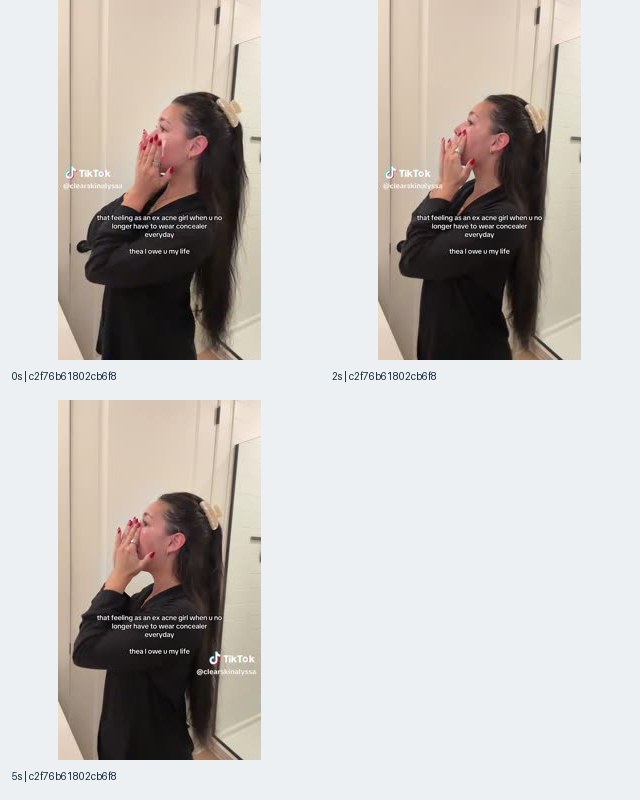
Sample 1 — Source record c2f76b61802cb6f827f5953622254126, associated with Thea app ID 6523434295. Only the supplied 0, 2, and 5 second frames are observed. The image records an advertising claim, not evidence of a skincare outcome.
Across the selected frames, a person faces a mirror with hands near the face. The visible overlay describes the feeling of no longer needing to wear concealer every day and expresses gratitude to Thea. The communication centers on an emotionally meaningful change in routine rather than a package, ingredient, or shopping offer.
A creative strategist can extract a useful structural observation: the example makes the desired everyday experience prominent. The product association is supplied through wording and record metadata rather than a visible physical item. That could inform an original concept for a service whose value is difficult to show in a conventional product shot.
The hypothesis would be that describing a specific daily frustration makes the service’s relevance easier to understand. Testing that hypothesis would require a truthful message about the team’s own product, an appropriate destination, and measured outcomes. It would not justify copying the creator’s personal statement or promising the same skin result.
For commerce research, the first action is to classify the object correctly. An app association should not be joined to a physical skincare SKU merely because both records contain the word skincare. A Kalodata-oriented product search might be irrelevant to the immediate decision, while creative reference research remains useful.
The handoff should therefore say: personal outcome framing observed; app association documented; buyer and conversion path unresolved. That preserves the creative lesson without manufacturing a product-sales narrative.
Sample 2: distinctive packaging creates a visual research lead
The TONYMOLY image provides a clear packaging reference but no evidence of sales, product use, or a video hook. The static image shows a pink Pocket Bunny moist mist bottle with its bunny-shaped cap beside it. It belongs to an indexed record carrying the text “Shop Amazon For Your Skincare Needs!” The package name is visible, while the seller, destination, and paid placement are not established by the image.
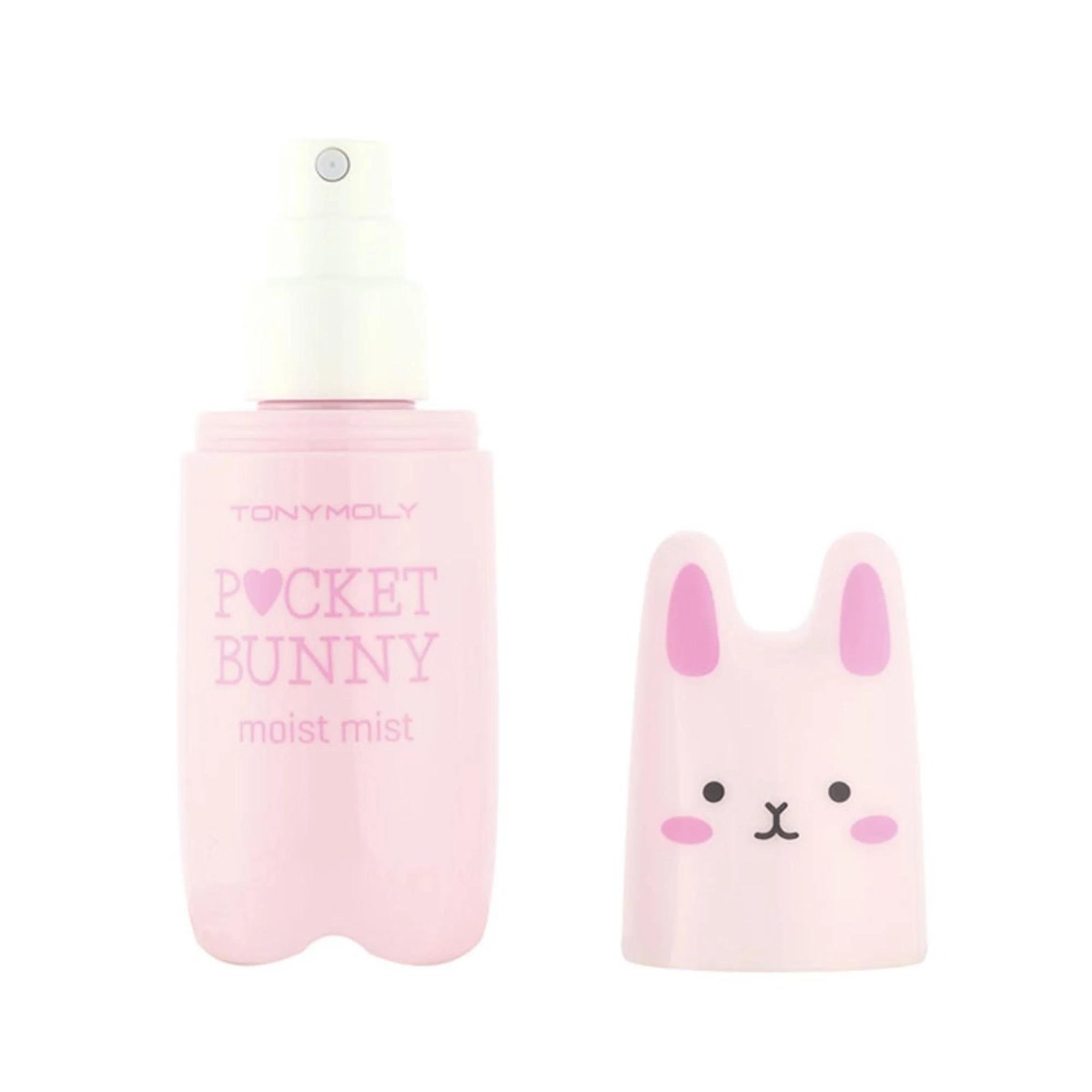
Sample 2 — Static source image from record 8ba7c1dcf4225c7e3190b3671bb7b3e6, whose reported copy references Amazon skincare shopping. The visible TONYMOLY packaging does not verify an Amazon seller or TikTok Shop listing.
The composition makes the package itself the subject. The removed cap shows the spray pump while preserving the recognizable bunny silhouette next to the bottle. A viewer can inspect the object and infer its spray format from visible hardware without a creator demonstration. That is an observation about product communication, not a finding about attention or conversion.
For a creative team, this reference raises a practical production question: can our packaging communicate both identity and function in a single frame? If the answer is uncertain, a simple original product photograph may be a useful test candidate. The team could compare a closed package view with an open view that reveals how the product is dispensed.
That comparison should preserve the same product, claim, destination, and offer. Otherwise, any observed difference could come from a changed message rather than the packaging view. The expected benefit—clearer recognition or understanding—remains a hypothesis until assessed with appropriate research or campaign data.
For a product researcher, the image is only a discovery lead. The next step is to find an exact matching listing, including package details and seller identity. The source copy’s Amazon reference should remain attached to the record; it should not disappear when the image moves into a TikTok Shop research deck.
This is where the tool distinction becomes operational. Creative research can use the image immediately as a visual reference. Commerce research needs another verified connection before attaching a product estimate to it. Neither task requires calling the product a bestseller.
Sample 3: product-label detail is not verified product performance
The Revolution image emphasizes product identity and label information, giving researchers a different reference from the packaging personality in Sample 2. The visible tube reads Superdewy Skin Tint, includes SPF 30 and mineral wording, and identifies the shade as Light Neutral. These are observable package statements. The supplied evidence does not independently validate sun protection, formulation, shade suitability, sales, or any other product performance claim.
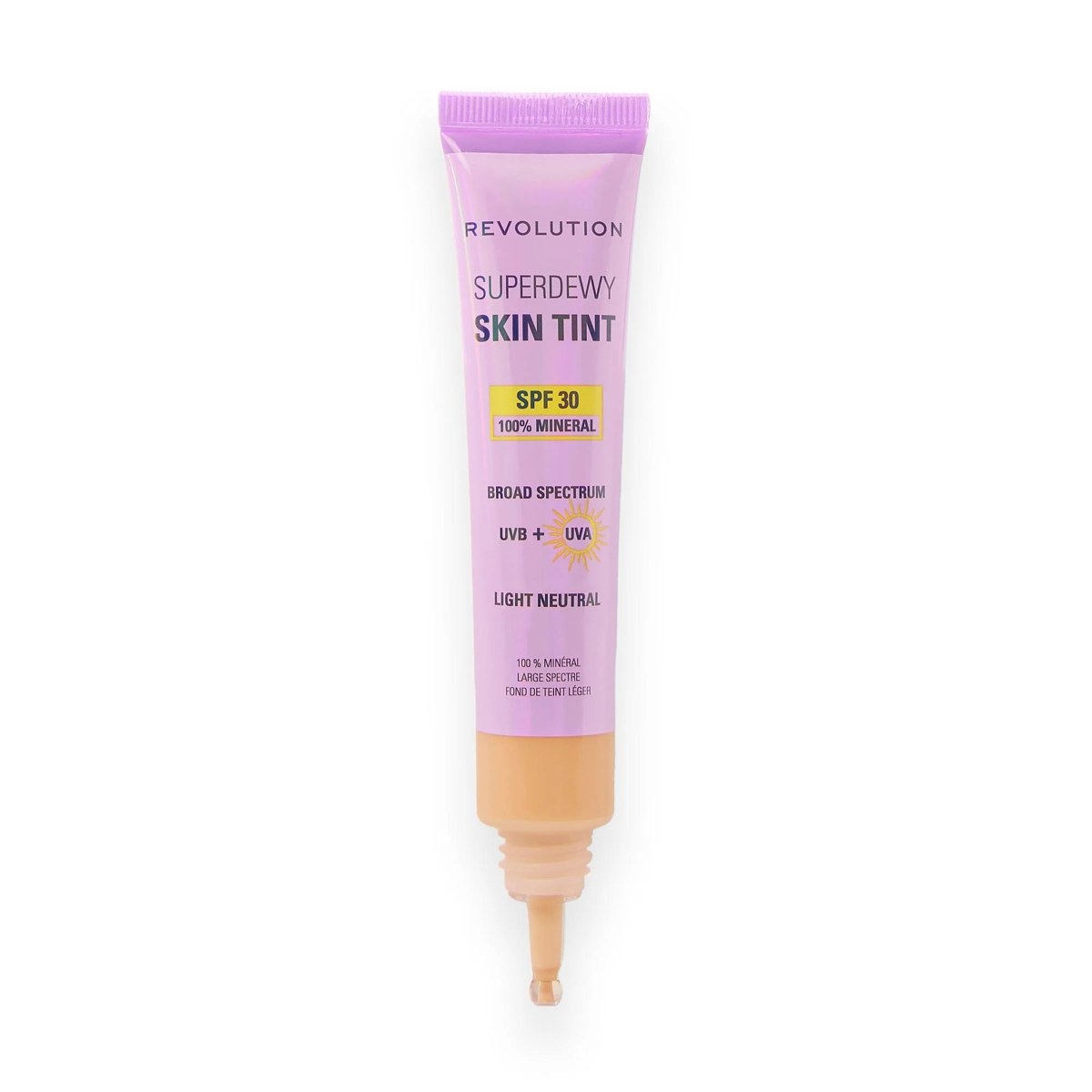
Sample 3 — Static source image from record 2f9d15f2c4f1f78192337658d02a0b05, also carrying Amazon-oriented skincare copy. The image supports label transcription and composition analysis, not verification of the label’s claims.
The product occupies a narrow central column, with the cap removed and the applicator visible. The hierarchy is largely typographic: brand, product name, protection-related label, and shade. Compared with the bunny mist image, this reference asks the viewer to read more product information to understand what is being offered.
That creates a useful creative question about the team’s own product: which piece of information must remain legible at the size where the ad will actually appear? A package photograph that looks informative at full resolution may leave the intended message unclear when reduced. A producer can inspect that issue directly without pretending to know how this source image performed.
An original test could compare an unannotated package view with a composition that makes one substantiated product attribute easier to read. The team should choose the attribute because it addresses a real buyer question, rather than because it appeared in a competitor image. Any added statement must be supported for the team’s own product.
For commerce analysis, the visible shade is a warning against a loose name match. A sales estimate for a broader product family may include variations that differ from this photographed tube. A same-brand result is insufficient if the research decision concerns the exact featured item.
A good evidence note would preserve the brand, product line, visible shade, source copy, and unresolved destination. That note makes a later product lookup more accurate while keeping the creative analysis useful on its own.
Sample 4: retail context changes the research question
The Sprouts/Acure contact sheet shows a retail discovery sequence in the selected frames, so its shopping context must remain part of the analysis. At 0 and 2 seconds, the supplied frames show a person outside a Sprouts Farmers Market storefront. At 5 seconds, the view is of Acure products on a shelf. At 10 seconds, a hand holds an Acure Brightening Facial Scrub tube. The frames support that sequence, but not an account of unseen transitions or the full video.
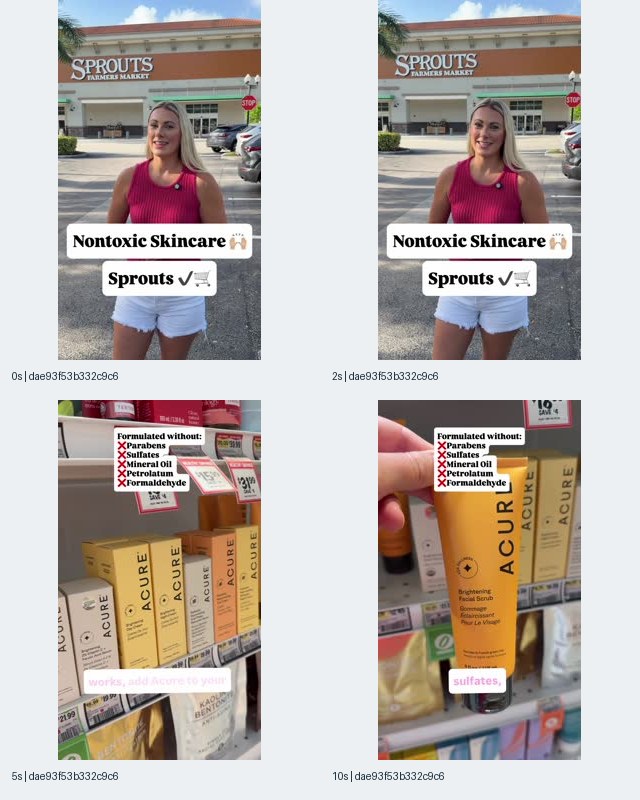
Sample 4 — Source record dae93f53b332c9c6d710784e8f3a8d78. Selected frames show Sprouts retail context and Acure packaging. On-screen “nontoxic” and ingredient-exclusion wording are advertising statements, not independently verified conclusions.
The storefront establishes a place to shop before the selected frames show a particular package. This differs from starting with an isolated product or an abstract skincare concern. The creative research lesson concerns context: a physical location can help frame the discovery process and explain why the featured object appears in the story.
The ingredient-exclusion list adds another layer. A researcher can record that the message uses exclusions as reassurance, while declining to endorse the implication that the omitted ingredients make the product safer. Copying the structure into a brief requires the team to check both the factual claim and what the wording implies about alternatives.
This example also supplies a concrete deduplication lesson. Its video fingerprint appears in records dae93f53b332c9c6d710784e8f3a8d78, dd86faf8bc08f8c4f9d09fc0de35dde7, and 18edb2988132a5c6ff3869c586c544df. The records show reuse of one indexed video file. They do not reveal the reason for reuse or prove that the file succeeded.
For a commerce team, the retailer setting makes an immediate TikTok Shop attribution especially questionable. The product may be sold through several channels, but this sample does not establish which channel received a sale. A later product estimate must be matched to its actual listing and market rather than attached through the brand alone.
The production hypothesis is that showing the relevant shopping or usage context before the package could improve understanding. It remains an experiment to design, not a performance lesson already demonstrated by these records.
Inspect indexed examples before building a shortlist
A useful research session should preserve context before it compresses examples into a shortlist. Product name, visible format, source wording, asset reuse, and destination certainty all affect what an example can teach. Removing those details can make unrelated records appear comparable. The skincare examples are particularly instructive because a shared keyword brings together different commercial objects and different kinds of creative evidence.
You can inspect indexed skincare creatives in AdMapix and use the same distinctions while browsing. Treat that link as a starting query, not a reconstruction of the frozen sample. Set the relevant country, dates, and available media filters in the live interface, then record the settings actually used.
Do not begin by labelling everything “winning skincare ads.” Begin with narrower folders or tags: personal outcome, package presentation, product explanation, retail context, routine replacement, and application demonstration. These labels describe visible communication rather than commercial success.
A shortlist becomes actionable when each saved example answers a specific question. For instance, the bunny bottle can answer a packaging composition question, while the Acure sequence can answer a context-setting question. Neither needs to be promoted into a sales recommendation to justify its place in the research.
Sample 5: routine replacement is a specific creative proposition
The Q-tips example frames disposable face towels as a replacement within an existing skincare routine. The source copy explicitly says “Ditch the bath towel,” while the selected frames show a presenter in a robe and a product package. This gives a creative team a concrete behavior to analyze: the message asks the viewer to change one step. It does not independently establish that the replacement improves skin or is appropriate for every user.
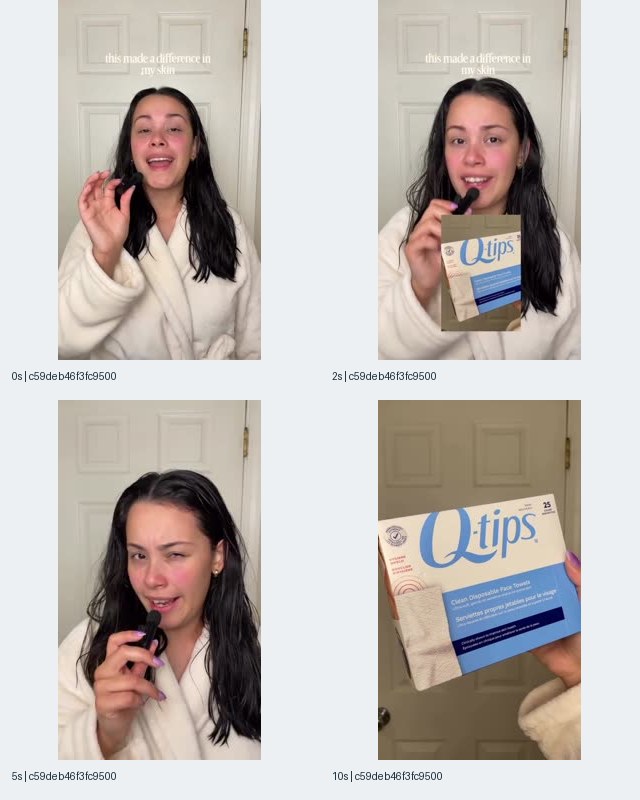
Sample 5 — Source record c59deb46f3fc9500e889ffe6d2543c04. The supplied frames show a presenter and Q-tips face towel packaging. The routine-change and skin-related language belongs to the advertisement.
The package appears in the 2-second frame as an overlay and in the 10-second frame as a close-up. That supports an observation that the selected sequence connects personal presentation with product identification. It does not reveal the full spoken explanation, the exact timing of every reveal, or the eventual call to action.
A routine-replacement angle is useful when a product’s purpose is defined by what it changes in an existing habit. The creative brief can name the current step, show the alternative, and explain a substantiated difference. This is more specific than a general instruction to make the product feel relatable.
For an original concept, a team might film the actual point in its own product’s routine where the item is used, then make the product name and function clear. The hypothesis is that a concrete usage moment reduces ambiguity about why someone would consider the item. It does not require imitating the presenter or reproducing the source’s skin claim.
Commerce research asks different questions. Which pack is shown? Which seller offers it? Does the comparison concern the same pack size or a different bundle? Are apparent sales estimates attached to the exact item or an aggregated listing? Those details are not established by the contact sheet.
A product can be easy to explain creatively while having unattractive economics for a particular seller. The visual strength of a routine-replacement proposition should therefore inform production consideration without bypassing sourcing, costs, and transaction validation.
Sample 6: styled presentation and handling answer different questions
The Elizabeth Arden retinol capsule example combines a styled product arrangement with close-up handling in the supplied frames. The opening selections show pink capsules and a bottle against an ornate mirror. Later selections show the bottle held toward the camera and hands manipulating a capsule. This supports analysis of how the object is presented and made tangible. It does not establish texture, complete usage instructions, efficacy, or the viewer response to the sequence.
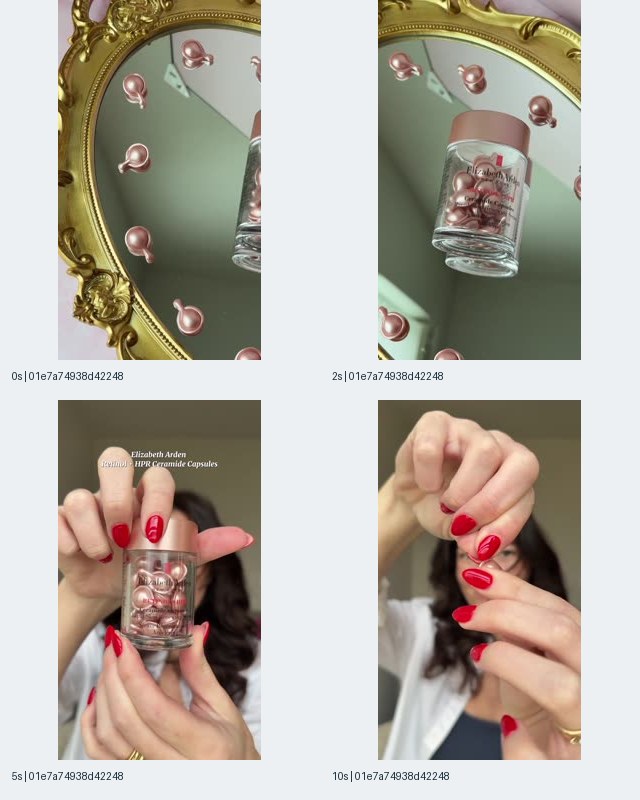
Sample 6 — Source record 01e7a74938d42248623730132e549943. The record’s copy names Elizabeth Arden retinol and includes a partner hashtag. That disclosure language does not identify the paid-media buyer or verify campaign results.
The ornate mirror gives the product a deliberate visual setting. The later hand-held view changes the information available: the viewer can inspect the bottle’s scale relative to a hand and see a capsule treated as a usable object. These are different production functions. One establishes presentation; the other helps explain physical form.
A creative team should identify which function its own ad needs. If the product format is unfamiliar, an elaborate still life might leave the basic usage question unanswered. If the format is already familiar, a distinctive presentation might be worth testing. The source does not establish which condition applied to its viewers.
An original brief could therefore specify two independently useful assets: a clear product arrangement and an accurate handling demonstration. The team can decide whether to compare them as openings or combine them in a longer sequence. Either choice should follow the communication question and available production resources, rather than an assumed lesson about luxury styling.
The commerce verification problem is also specific. Retinol capsules and ceramide capsules are not interchangeable just because both carry the Elizabeth Arden name. The next sample features different product wording and a different video fingerprint. A sales estimate for one should not be used to explain the other without an exact product relationship.
The source record’s earlier discovery date does not establish continuous paid activity or success. The dated sample permits a statement that this record was returned for the measurement window. It does not justify dividing a window estimate by the age of the record to create a performance proxy.
Sample 7: an application close-up creates procedural clarity
The gold ceramide capsule example makes a small application action visible, providing a procedural reference rather than proof of a skin benefit. The selected frames show a capsule held near the camera, product on a cheek, the word “SQUEEZE,” and a finger touching the cheek. The source copy names Elizabeth Arden Advanced Gold Ceramide Capsules. Its claims about potency and skin longevity remain advertiser statements within this analysis.
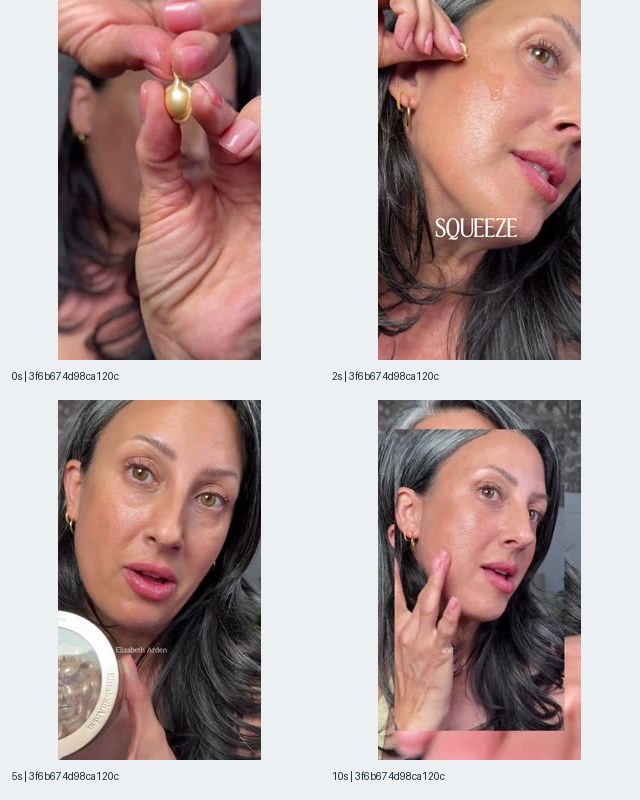
Sample 7 — Source record 3f6b674d98ca120c5ddbb6268630fa34. The supplied frames support an application-sequence observation. They do not establish a before-and-after comparison, clinical result, or complete instruction set.
The visible instruction is concrete: an action word accompanies a close view of the product being used. That makes this reference useful for products whose physical format raises a practical question. A viewer might need to understand how an item opens, dispenses, attaches, or is held before considering its promised benefits.
The production hypothesis is that showing the relevant action clearly could reduce uncertainty about use. To test it, a team would identify a real point of confusion about its own product and film an accurate demonstration. The demonstration should follow the product’s instructions, and any outcome statement should have separate support.
This example also helps distinguish visual proof from commercial proof. The contact sheet provides evidence that an action appears in the selected frames. It does not prove that viewers found the action clear, that they purchased, or that the advertised product produced the visible appearance of the skin. Lighting, framing, and the absence of a controlled comparison all limit that interpretation.
For product research, preserve the exact named capsule line and any variation details that can later be verified. Do not merge the example with the retinol capsule record simply to create a larger pool of apparent evidence. Shared brand identity is useful for navigation, but it is not a substitute for item matching.
A responsible handoff would state: close-up application reference available; product line named in source copy; exact commerce listing and outcomes unverified. That gives both creative and merchandising teams something useful without pretending they are looking at the same measurement.
Sample 8: category adjacency can improve ideas and distort counts
The scalp-care example shows that a skincare keyword can retrieve adjacent hair-care content, which is useful for inspiration but risky for category-level conclusions. The selected frames show a person wearing a face mask, a close view of the hairline, and a turquoise comb-like applicator positioned against the hair. The source copy mentions a PDRN Reedle Shot hair ampoule and VT Cosmetics US. Those references do not independently verify the item or its benefits.
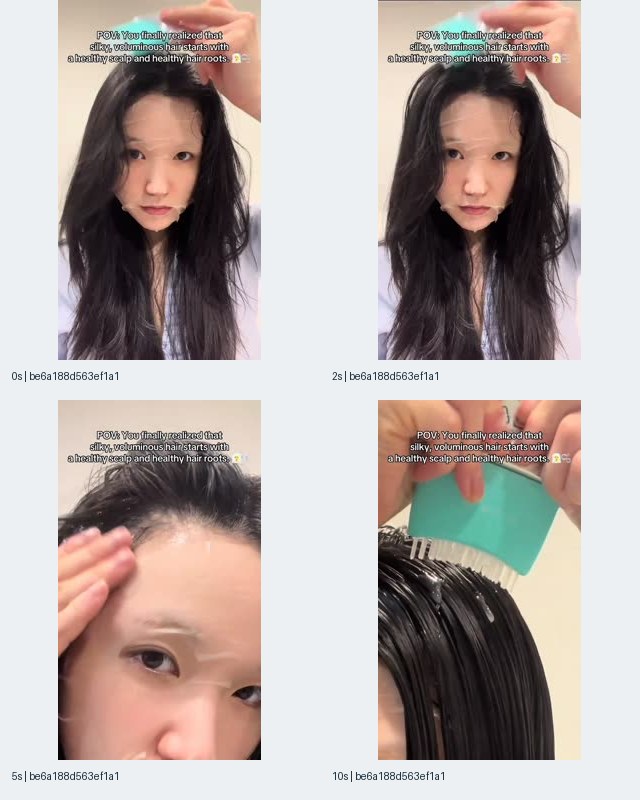
Sample 8 — Source record be6a188d563ef1a1ad61dd068e8881f3. The copy mentions scalp care and VT Cosmetics US. The supplied frames show application-related imagery, not evidence of hair growth, stronger roots, or anti-aging effects.
The face mask creates a visible connection to a broader beauty routine, while the applicator shifts attention toward scalp and hair care. A creative researcher can use that relationship to ask whether an adjacent routine helps introduce an unfamiliar product. That is an interpretive hypothesis about the role of the sequence, not a measured explanation of its effect.
For production, the transferable idea is the visible use of a specialized applicator. If a team’s product has an unfamiliar delivery mechanism, showing it in contact with the intended surface may be more informative than a package-only shot. The team still needs to film accurate usage and avoid importing unsupported biological claims from the source copy.
For commerce analysis, the same adjacency can be a source of error. A facial skincare shortlist should not silently count scalp-care items as direct substitutes. A broader beauty shortlist can include both, but the category definition must be explicit. Otherwise, the researcher may mistake a query’s vocabulary for the boundaries of a market.
The source text also contains cultural and age-related statements. They are not audience research. This article does not use them to establish what a demographic prefers, who saw the content, or which audience settings an advertiser selected.
The practical lesson is to keep two labels: the term that retrieved the record and the product category verified afterward. Those labels often differ. Preserving both makes creative discovery more flexible and product analysis more precise.
Keep creative evidence and commerce evidence in separate columns
Creative observations and commerce estimates should remain separate until a verified relationship connects them. A screenshot can show a package, a person, a claim, or an action. A commerce record may describe an identified listing over a defined period. Combining them requires evidence that the same item and relevant market are involved. Even a correct match does not establish that the pictured creative caused the estimated transactions.
A simple research ledger prevents the visual layout from overstating the evidence:
| Field | What belongs there | What should stay out |
|---|---|---|
| Observed creative | Exact visible action, package, wording, or composition | Claims about viewer response without measurement |
| Source context | Record, capture date, query, filters, reported copy | Assumed paid network or buyer |
| Product identity | Verified app, item, variation, seller, or destination | A name-only match presented as certainty |
| Commerce evidence | Dated estimate with its original definition | Profit or causal attribution inferred from GMV |
| Hypothesis | A proposed explanation that can be tested | A confident conclusion disguised as a creative insight |
| Next decision | The action the evidence currently supports | Inventory or budget expansion unsupported by economics |
The distinction is especially important when an image contains a recognizable brand. Familiarity can make a match feel settled before the researcher has checked it. Samples 6 and 7 demonstrate the problem within one brand: different capsule lines require separate product treatment.
Missing data should also remain visible. If a destination is absent, write “destination unverified.” If a commerce estimate is unavailable, leave it unavailable. Replacing a blank with a plausible guess makes the report look complete while weakening every later decision that relies on it.
This ledger can support a combined workflow without forcing every example into a combined conclusion. Some references will remain creative-only. Others may become product candidates after verification. That is a useful outcome because it reflects the actual strength of the evidence.
A practical workflow from search to a production decision
An effective workflow moves from a defined question to a documented example, an identity check, and an original test brief. It should produce a decision your team can act on while making unresolved information easy to see. The steps below use the frozen skincare sample as a worked example, but the same structure applies to another category. They describe a proposed operating process, not a tool test already completed.
First, name the decision and its owner. A creative lead might need an opening concept for an existing product. A merchandising lead might need a verified product candidate. A buyer might need a reason to allocate test budget. Write that decision at the top of the research document so that later evidence is judged against the same question.
Second, define the search scope. Record the country, exact dates, query, and filters actually used. For this article, that scope is US, skincare, and 2026-08-16 to 2026-09-14, with the TikTok media filter and a bounded descending-estimate sample. In a new session, use the scope relevant to the decision and preserve it rather than assuming a query link carries all settings.
Third, separate records from assets. Keep the original records, but group repeated media when analyzing production patterns. The Sprouts/Acure example should occupy one video-reference group with its associated records preserved beneath it. This prevents a repeated file from dominating a creative shortlist simply because it appears several times in the search results.
Fourth, classify the research object. Distinguish apps, physical products, retailers, accessories, and adjacent categories. Sample 1 belongs in an app-associated group. Samples 2 and 3 are product-image references. Sample 8 needs a scalp-care label even though skincare retrieved it. These classifications should follow the evidence, not the team’s preferred narrative.
Fifth, write literal observations before interpretations. “A hand holds a capsule near the camera” is an observation. “The close-up reduces uncertainty about use” is a hypothesis. Writing both makes the analysis more useful: the producer knows what the reference actually shows, and the strategist knows which assumption needs testing.
Sixth, branch into commerce research only when it serves the decision. For a fixed-product creative brief, the main task may be finished without an external sales estimate. For product selection, verify the exact item and seller, then inspect whatever dated commerce fields are currently available. Retain the source’s definitions and avoid joining unmatched products through a shared name.
Seventh, draft an original execution. Choose a communication mechanism that fits the team’s own product. A package-led example might inspire a clearer dispensing view. An application example might inspire a close-up of an unfamiliar action. A routine-replacement example might inspire a truthful explanation of when the product enters a daily habit. The source supplies a question and a reference, not reusable claims or footage.
Finally, decide whether the brief is ready, needs verification, or should be dropped. A brief is ready when the team can identify the product, substantiate its message, film the execution, and measure the intended result. It needs verification when a critical identity or claim remains unresolved. Dropping an attractive example is appropriate when it does not support the actual business decision.
Turn the capsule examples into a copyable brief
A useful brief states what was observed, what the team proposes to change, and how the resulting idea will be judged. The capsule examples provide a worked structure because they separate product presentation from application. The brief below is an original planning example for a team with its own accurately demonstrable product. It is not a recommendation to copy Elizabeth Arden’s packaging, creator, claims, or visual identity.
| Brief field | Example entry |
|---|---|
| Business question | Do prospective customers understand how our product is used? |
| Source observation | Samples 6 and 7 show product handling and close-up application in selected frames |
| Product requirement | Our own product has a real usage action that can be shown accurately |
| Hypothesis | A clear action-first opening may improve understanding compared with a package-only opening |
| Original execution | Film our product being opened or dispensed, followed by a legible product view |
| Message requirement | Use only statements substantiated for our product |
| Controlled elements | Keep the destination, offer, core explanation, and intended audience comparable |
| Measurement | Select an owned-account outcome appropriate to the objective before launch |
| Decision rule | Continue, revise, or stop according to the predefined result and uncertainty |
The producer should receive enough detail to make the concept concrete. Specify what must be visible, which action needs a close view, and what information should remain readable. Avoid instructions such as “make it premium” unless they are translated into actual choices about lighting, background, framing, and handling.
The strategist should also document what would count against the hypothesis. If viewers still misunderstand the product, the close-up may have shown motion without explaining function. If clicks increase but the intended downstream result does not, the opening may attract curiosity without improving the overall proposition. These are possible interpretations to investigate, not predetermined outcomes.
A commerce researcher can contribute verified product and offer details to this brief, but a third-party sales estimate does not choose the winning edit. For a broader method of isolating variables and recording outcomes, see the creative testing framework.
Evaluate creative ideas with your own measurements
Competitor evidence can justify a test candidate, while your own measurements must decide whether that candidate earns further investment. The frozen sample supplies examples of communication and media reuse. It supplies no experiment comparing packaging, routines, retail context, or application openings. A team that treats those examples as proven performance lessons skips the most important stage: checking whether the idea works for its product, offer, audience, and destination.
Begin by choosing the outcome that matches the campaign objective. A product-understanding exercise may use direct comprehension research. An advertising test may use a relevant account metric and downstream business outcome. The choice should be made before results arrive, so that an attractive intermediate number does not become the success criterion after the fact.
Keep the test interpretable. If the question is whether a clear dispensing action helps, avoid simultaneously changing the price, landing page, creator, and core promise. Perfect isolation is not always operationally possible, but every material difference should be documented. Otherwise, the team may attribute a result to the opening when the actual change was elsewhere in the offer.
Plan for ambiguity. Low-volume outcomes, uneven delivery, changing promotions, and tracking problems can leave a result inconclusive. The proper response is to record that uncertainty and decide whether another observation period or revised test is justified. It is not to borrow confidence from the source ad’s age, estimated impressions, or brand recognition.
Commercial evaluation needs its own accounting. For a product-selling business, revenue alone does not capture fulfilment costs, product cost, discounts, fees, returns, or other relevant expenses. A promising creative result can coexist with weak economics. Conversely, an operationally attractive product may need better explanation before an ad becomes effective.
For a mixed assignment, our recommendation is sequential: use Kalodata to form the commerce shortlist, verify the item and seller, then use Creative Center to develop the hook and storyboard. Keep the commercial estimate’s window separate from the creative observation date and any platform-relative metric. For a fixed-product assignment, start directly with Creative Center. In either path, owned measurements determine whether the resulting execution deserves further investment.
How to evaluate access before paying for another tool
Evaluate a tool with a task your team already needs to complete, using acceptance criteria written before purchase. This is more informative than comparing marketing claims or counting dashboard modules. Because the supplied package contains no live external-tool test, the following is a buyer’s procedure rather than a report of observed usability. Current access, pricing, market coverage, and available fields must be checked in the service offered to your team.
For a creative task, use a real briefing question and ask whether the available examples are inspectable enough to answer it. Can you preserve source context? Can you distinguish repeated media? Can the producer understand the reference without another researcher narrating it? These questions assess the quality of the handoff rather than the visual appeal of the interface.
For a commerce task, bring a product whose identity you already understand. Check whether the service’s result matches the actual item and market. Examine the displayed time period and metric definitions. If the interface aggregates variations or sellers, determine whether that aggregation fits your decision. A result can be useful for broad discovery while unsuitable for exact item validation.
For both tasks, record missing evidence and manual work. If the team must repeatedly rebuild context after saving an example, that effort belongs in the evaluation. If a key product match remains ambiguous, do not compensate by giving the tool a generous subjective score for “insights.” The relevant question is whether the required decision became better supported.
Compare the service against the workflow you already have. A new subscription should remove a real bottleneck or supply evidence that was previously unavailable. If your current process can answer the question adequately, it may be sensible to improve tagging, identity checks, or briefing discipline before buying another interface.
Common mistakes that make this comparison misleading
The central mistake is treating visible creative, estimated commerce activity, and measured business performance as interchangeable evidence. The errors below arise when one category quietly stands in for another. They are avoidable if the research document preserves source, scope, identity, and uncertainty. The skincare sample provides concrete examples of why those fields belong in everyday work rather than in a methodological footnote nobody reads.
Calling every result a TikTok Shop ad. The search used a TikTok media filter, but many records lack individual network metadata. Some copy references Amazon, and one example shows a physical retailer. Preserve those facts instead of assigning a commerce channel from the query context.
Counting records as independent concepts. The Sprouts/Acure video appears in three records. That is evidence of file reuse, not three independently created videos. Similarly, an image array does not establish a campaign count or a verified carousel layout.
Attaching sales estimates through a brand name. The Elizabeth Arden examples feature different named capsule lines. A same-brand commerce result is not enough to connect an estimate to either source image. Product and variation matching must come first.
Turning an advertising statement into product advice. Concealer-related outcomes, “nontoxic” wording, SPF labels, and scalp-care benefits appear in the supplied material. Their presence supports an analysis of the message. It does not independently substantiate the underlying claim.
Using age as proof of effectiveness. Discovery and observation dates do not establish continuous paid delivery, profitability, or the advertiser’s reason for reuse. Dividing a window estimate by the age of a record creates a metric whose denominator answers a different question.
Treating a static image as a video sequence. Samples 2 and 3 support composition and label observations. They do not show an opening duration, transition, reveal, soundtrack, or retention pattern. Those elements require evidence that the supplied images do not contain.
Buying a tool before naming the deliverable. A product research subscription cannot automatically solve an unclear creative brief, and a collection of references cannot settle inventory economics. Identify the next decision, then choose the evidence source that can support it.
When AdMapix fits the handoff
AdMapix fits when your next task is to inspect indexed creative evidence and turn it into a source-linked research document or brief. This article demonstrates that handoff with a bounded query, separate record and asset counts, timestamp-limited visual observations, and explicit hypotheses. It does not position AdMapix as a substitute for verified product transactions, current Kalodata commerce data, or your own advertising-account measurements.
The appropriate next action is practical: take a product or communication question, inspect relevant indexed examples, preserve their context, and select an original concept to test. If the unresolved question is instead which exact product to source, continue commerce and operational verification before using a creative reference to justify buying stock.
For a subscription decision, consult AdMapix’s live pricing page. Commercial terms can change, so this evergreen guide does not reproduce plan prices or credit allowances. No paid-plan trial is currently offered under the supplied product facts.
The same product facts do not establish an hourly refresh service-level commitment. Plan a research workflow around the observation dates actually available rather than a presumed update schedule. The value of the handoff is a clearer, inspectable decision—not a promise that public creative evidence reveals private campaign economics.
FAQ
These answers apply our task-based recommendation to common buying decisions. The functional comparison uses official documentation reviewed September 16, 2026; the separate creative case study retains its September 14 sampling date. Neither constitutes a logged-in benchmark or accuracy test.
Is Kalodata a replacement for TikTok Creative Center?
They overlap, but our recommended starting points differ. Choose Creative Center for a hook, reference ad, or storyboard; choose Kalodata for a TikTok Shop product, shop, or creator shortlist. The September 16, 2026 documentation review supports that functional distinction. Kalodata also includes creative research, and Creative Center can inspire product ideas. Neither is a universal replacement for the other.
Can TikTok Creative Center prove that a product sells well?
A creative example alone cannot prove product sales or profitability. Even when an interface displays performance-related information, its definition and scope must be preserved. The skincare examples in this article come from a frozen AdMapix sample, not a Creative Center session. They support observations about presentation, packaging, and application, while sales validation requires identified commerce evidence and appropriate business data.
Does a Kalodata sales estimate prove that an ad worked?
No. A product sales estimate does not by itself establish which ad caused those transactions, or whether paid advertising caused them at all. You first need an exact product relationship and compatible dates and market. Even after matching those fields, causal attribution remains a separate question. Preserve the estimate as a source-defined commerce signal rather than converting it into an ad-performance claim.
Are all eight examples verified TikTok Shop advertisements?
No. They are supplied images from a TikTok-filtered AdMapix skincare search. Individual network metadata is missing for many records, and the examples include Amazon-oriented copy, a retailer setting, and an app association. The article keeps captions tied to their source records. Neither a TikTok watermark nor a product name independently establishes a TikTok Shop destination, seller, or paid-media buyer.
Why are there 29 records but only 11 video fingerprints?
Records and video files are different units. The sample contains 13 video-bearing records, which resolve to 11 distinct video fingerprints because an underlying file can appear in several records. Other records reference images. The 64 distinct image fingerprints are a separate count. Adding these figures together without defining the unit would create a misleading total rather than a clear description of the sample.
Which should a small skincare team use first?
Choose Creative Center first if your product and offer are fixed and you need a production concept. Choose Kalodata first if you need a TikTok Shop product, shop, or creator shortlist, then verify operational fit and your own economics. Use both sequentially when both deliverables are required. This recommendation concerns task fit, not which subscription is cheaper or which tool produces better measured results.
What should we measure after adapting an idea?
Measure an outcome aligned with your objective using your own research, advertising, or transaction data. Define success and relevant business constraints before launch, and keep material differences between variants documented. A clearer opening may improve one part of the journey without improving the final business result. Treat an inconclusive test as inconclusive rather than using competitor visibility to supply missing confidence.
Key Takeaways
Choose the research starting point by the decision, and preserve the evidence boundary throughout the handoff. The skincare sample is useful because its differences are visible: an app association, product imagery, retailer context, routine accessories, and application demonstrations do not all belong in the same commercial comparison.
- Start with Creative Center for hooks and storyboards; start with Kalodata for a TikTok Shop commerce shortlist. Use both sequentially when the assignment spans both tasks.
- Use creative examples to develop original presentation hypotheses, not to declare profitable products.
- Match the exact product, variation, market, and destination before joining creative and commerce records.
- Report the sample accurately: 29 records, 11 video fingerprints, and 64 image fingerprints are separate measures.
- Keep static-image observations and selected-frame observations within their actual visual limits.
- Let owned measurements and business economics determine what to continue, revise, or stop.
Sources
The tool recommendation uses official documentation accessed September 16, 2026; the visual findings use the separate September 14, 2026 frozen AdMapix sample. This distinction preserves both the basis of the functional comparison and the original measurement dates.
-
TikTok: About Creative Center — updated July 2026; accessed September 16, 2026. Basis for the documented creative-research role and general access distinction.
-
TikTok: About Top Ads — updated May 2025; accessed September 16, 2026. Older than twelve months; basis for the selected, advertiser-authorized sample boundary.
-
TikTok: How to use Top Ads — updated May 2025; accessed September 16, 2026. Older than twelve months; basis for the documented dashboard workflow, logged-out limit, and relative graphs.
-
Kalodata official home page and FAQ — accessed September 16, 2026; no page update date established. Basis for its research scope, modeled-data limitations, and independence statement.
-
Frozen US skincare source package — observed September 14, 2026; measurement window 2026-08-16 to 2026-09-14; US; skincare query; TikTok media filter; bounded sample of 29 distinct records. Includes public batches, request parameters, checksums, and the source relationships for the illustrated examples.
-
AdMapix skincare search workflow — relevant product workflow for inspecting indexed creative examples. The article’s observations are dated September 14, 2026; live results can differ and require their own country, date, and filter settings.
-
AdMapix methodology — public reference for interpreting indexed advertising evidence. Applied here to the September 14, 2026 observation: distinguish records from media, preserve measurement windows, and treat impressions as third-party model estimates rather than observed delivery or business outcomes.
Product boundaries follow the supplied AdMapix product facts reviewed August 13, 2026. The eight images are source screenshots or contact sheets, not evidence of conversion, spend, profit, continuous campaign activity, or a complete advertiser portfolio.
Turn these observations into your next creative study
Open the creative library and select samples for your market, network and research question.
Related Articles
Facebook Ad Copy Examples: Match Copy, Visuals, Proof and Offers
Compare complete Facebook ad headlines and bodies with eight source images, archived offers and bounded video observations, then turn the findings into an original creative brief.
Block Blast Ad Strategy: Video Hooks and Creative Reuse in a Verified iOS Sample
A verified US iOS sample links 30 advertising records to 12 video fingerprints and 15 playable fingerprints, with eight visual analyses and practical plans for original creative tests.
Subway Surfers Ads: What a Name Search Actually Shows
A dated US audit of 30 Subway Surfers name-search results finds no verified iOS reference matches, with eight source-linked screenshots showing how to separate listing identity, visual observations, and test hypotheses.