
Block Blast Ad Strategy: Video Hooks and Creative Reuse in a Verified iOS Sample
A verified US iOS sample links 30 advertising records to 12 video fingerprints and 15 playable fingerprints, with eight visual analyses and practical plans for original creative tests.
Block Blast Ad Strategy: Video Hooks and Creative Reuse in a Verified iOS Sample
Last updated: 2026-09-13. Editorial ownership: Brad — AdMapix. AdMapix Research — prepared with Codex and checked against the dated source sample. Editorial ownership does not imply personal human review.
Block Blast creative research reveals both video reuse and a range of opening ideas in this verified US iOS sample: crowded puzzle boards, benefit labels on bottles, update messages, physical block lamps, paint mixing, and a color-customization tutorial. Across the dated sample, 30 advertising records contain 12 distinct video fingerprints and 15 distinct playable fingerprints. For UA managers, creative strategists, and production leads, the useful decision is which original concepts and asset combinations to test next. The September 2026 snapshot provides concrete references for that planning. It does not reveal the advertiser’s internal strategy, identify the ad buyer, or establish which execution produced installs. This analysis connects the supplied frames to production decisions while keeping those limits visible.
Quick Answer
- The verified US iOS sample contains 30 ad records, 12 distinct video fingerprints, and 15 distinct playable fingerprints for 2026-08-14 to 2026-09-12.
- Reuse is directly observable: the crowded-board video represented by Sample 1 appears in eight sampled records with eight different playable fingerprints.
- The eight contact sheets show different creative approaches, including gameplay, benefit framing, update prompts, physical objects, paint mixing, and a tutorial-style sequence.
- These findings support original test hypotheses. They do not establish conversion, profitability, network coverage, buyer identity, or the full advertising activity of Block Blast.
What a UA Team Can Decide From This Sample
This sample can help a team choose what to brief, how to organize its reference library, and which assumptions require separate testing. It provides enough evidence to distinguish a new video file from another record using the same file. It also lets a creative team compare specific opening structures without pretending that a ranking by estimated impressions identifies the most persuasive concept.
That distinction changes the meeting. A folder containing repeated screenshots may lead a producer to conclude that an advertiser is making many similar videos. A fingerprint grouping can reveal a different situation: the same video is associated with several interactive files. The appropriate production response may be to investigate modular combinations, rather than commissioning more copies of the same opening.
The images also raise different questions for different roles. A strategist can ask whether an opening presents the game immediately or borrows attention from a physical activity. An editor can examine when the subject changes between sampled frames. A product marketer can identify statements that need substantiation. A playable developer can note which video records have an associated interactive file, then request the actual build before evaluating continuity.
An ad record is an indexed entry with its own identifier and associated media. A video fingerprint is an identifier used to group the indexed video file. A playable fingerprint identifies an associated interactive file; its presence does not demonstrate that the interaction was opened or tested. Those definitions keep the analysis usable across production and buying teams.
For broader format context, the AdMapix mobile game ads guide is the topic parent. This article adds a specific dated example: how to read visible creative choices and reuse relationships within a deliberately bounded product sample.
Methodology: Exact Dates, Country, Query, and Sample Limits
The research covers a product-filtered US sample for 2026-08-14 to 2026-09-12, fetched on 2026-09-13, with “Block Blast” as the research query and 1617391485 as the verified iOS product ID. The collection was capped at three pages of ten records, ordered by descending third-party impression estimate. It is a bounded selection of indexed records, not a census of the game’s advertising.
The supplied collection used product-content search for the creative batches and separate record-to-app lookups to inspect listing associations. The verified store reference is Block Blast!, Apple track ID 1617391485, bundle ID com.blockpuzzle.us.ios, and seller ARETIS LIMITED. The index’s unified company label is Hungry Studio. The store identifier anchors the entity; the company label and displayed app name do not replace that anchor.
All 30 supplied records include the verified iOS listing among their reported app associations. Some records also list other app IDs. Those additional associations remain part of the source evidence, but this article does not expand the target entity to include them. Their presence also means that a record associated with the verified listing should not automatically be described as exclusive to that listing.
The asset counts come from flattening the supplied fingerprint arrays and deduplicating their individual values. The package reports 12 distinct video fingerprints, 15 distinct playable fingerprints, 22 records with video, and 27 records with playable content. Video and playable categories overlap at the record level. Their counts should not be added and presented as a single number of independent creative concepts.
Visual analysis is limited to the eight supplied contact sheets. Each contains frames labeled 0, 2, 5, and 10 seconds. The article can describe those frames and differences between them. It cannot establish everything that happened between the timestamps, inspect audio, describe unseen endings, or claim that the entire videos were watched. A contact sheet is a compact arrangement of selected video frames, not a complete playback record.
The source entries share the numeric source code 9, but the supplied evidence does not map that code to a verified advertising network. AdMapix is the research index used here, not the delivery network. Neither the vertical layout nor creator-style captions establish that a creative appeared on a particular social platform. The iOS product filter likewise does not identify the device on which every observed ad was served.
Any impression value in the source is a third-party model estimate for the specified window, not observed delivery, spend, installs, revenue, profit, or lifetime exposure. Product-search aggregates with an unspecified time scope are excluded. This article does not calculate daily impression rates, divide window estimates by record age, or use repeated appearances as evidence of effectiveness.
The public frozen source package preserves the batches, request parameters, record associations, and checksums. Those materials make the sample and its counting method publicly reproducible. A later live search may return different records or estimates; it should be treated as a new observation rather than a correction to the frozen window by default.
Evidence Table: Records, Files, and Observable Content
The central finding is a difference between record volume and media-file variety within the same dated sample. The table separates those units and states what each can support. This prevents an ordinary production observation, such as a shared video file, from becoming an unsupported claim about market share, creative output, or campaign results.
| Evidence item | Verified value or scope | Supported interpretation | Boundary |
|---|---|---|---|
| Measurement window | 2026-08-14 to 2026-09-12 | Common window for the sampled creative query | Not a lifetime period |
| Country filter | US | US-scoped query | Not worldwide coverage |
| Sample size | 30 ad records | Number of retained indexed entries | Not total advertising fleet size |
| Records containing video | 22 | Video is associated with these records | Not 22 distinct videos |
| Distinct video fingerprints | 12 | Indexed video-file variety after deduplication | Not necessarily 12 original concepts |
| Records containing playable content | 27 | An interactive-file association is present | Not evidence of user interaction |
| Distinct playable fingerprints | 15 | Indexed interactive-file variety | Not tested gameplay experiences |
| Playable-only records | 8, derived from the listed records | Playable fingerprint present with no video fingerprint | Not a global format share |
| Static image fingerprints | 0 distinct values | No image fingerprints recorded in this sample | Not proof that the product uses no image advertising |
| Visual examples | 8 contact sheets | Selected frames from eight distinct sampled videos | Not complete-video reviews |
| Product identity | iOS ID 1617391485 | Verified listing association | Does not identify the ad buyer |
| Delivery network | Unverified in supplied evidence | No named-network conclusion | Visual style cannot supply the missing attribution |
The eight playable-only records are identifiable by the record prefixes 83e86207, c96cb48e, 3b956a16, 99bb7a57, 33757a18, 40ea1ce8, 01ace5cc, and 3ff6c9ae. The prefixes identify the corresponding full entries in the public package. Reporting that derived count separately is useful because an interactive file can appear without a video as well as alongside one.
The absence of static image fingerprints does not conflict with the screenshots in this article. These editorial images are contact sheets extracted from video references. They are not evidence that the source records contained standalone image-ad files. The same separation should carry into a team’s asset library: a screenshot used for annotation should not silently become another counted advertising asset.
Verify the Listing Before Interpreting the Strategy
The verified iOS store ID establishes the product association, while the name alone does not establish ownership or advertising responsibility. This sample was collected in verified-product mode, so it can support analysis of records associated with the reference listing. It should still be described as a sample of indexed associations, rather than a confirmed inventory of ads personally purchased by a named company.
Several source records contain more than one linked store entry. Sample 1, for example, is associated with the verified listing and another iOS ID, 6757412443. That relationship should remain visible when the example is reused in a report. It does not establish common ownership, separate ownership, a competitive relationship, copying, infringement, or fraud. None of those conclusions follows from the two identifiers appearing together.
The frozen product search also supplied a wider collection of upstream IDs. The research narrowed that collection to the independently verified iOS reference. It did not accept every similarly named package as the same product. That is the useful operational lesson: use broad discovery to find candidates, then restrict the analytical entity using evidence you can actually verify.
This matters especially when an asset includes another game’s name. Sample 6 visibly mentions Fortnite, yet its source record reports the Block Blast iOS listing. A name visible inside a creative is evidence about the creative’s message. It is not sufficient to reassign the record to the product named in that message.
For a reader building a reference library, preserve two separate fields: the listing associated with the record and the brands or games mentioned in the creative. A third field can hold the buyer when independently documented. Keeping those fields separate prevents a later search, presentation, or automated summary from merging fundamentally different relationships.
Sample 1: A Crowded Board Makes the Placement Problem Visible
Sample 1 opens with a dense block-puzzle board and a narrow central space, giving the viewer a visible arrangement to inspect immediately. The sampled frames show changing block positions and an intense red particle effect at 10 seconds. They support analysis of board complexity, placement visibility, and visual interruption. They do not show a confirmed transition from video into an interactive ad.
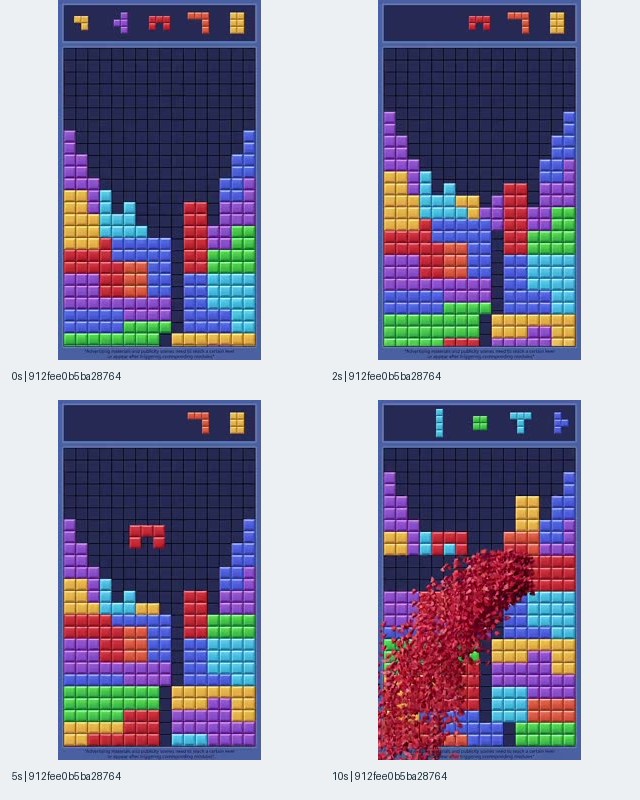
Image 1. Record 912fee0b5ba28764416d77a7536d9304, associated with verified iOS listing 1617391485 and another reported iOS listing. Frames: 0, 2, 5, and 10 seconds. The particle effect is visible video content; no playable handoff or campaign result is established.
At the opening timestamp, the board fills most of the vertical frame. Colored stacks rise along both sides, and upcoming pieces sit above the grid. The empty space is therefore part of the visual message: the viewer can inspect where a piece might fit without waiting for explanatory copy. Calling that a placement problem is an observation about composition. Calling it an effective hook would require audience evidence.
The 5-second frame includes a red piece suspended above the occupied area. That image provides a useful reference for the relationship between the available piece and the receiving space. A production team can ask whether the target remains clear when the piece moves, whether its outline remains distinguishable from surrounding blocks, and whether a viewer unfamiliar with the game can identify the intended action.
The red particle burst at 10 seconds introduces a different visual task. It covers part of the board, so the image becomes an effect sequence as well as a puzzle demonstration. A plausible hypothesis is that this interruption creates a stronger visual punctuation point. Another is that it obscures the move the viewer was following. The contact sheet cannot choose between those explanations.
An original brief could hold the board arrangement constant and compare an unobstructed resolution with a resolution followed by a particle effect. The effect should be the tested variable. Changing the starting puzzle, animation speed, caption, and ending at the same time would make the result difficult to interpret.
For storyboard review, ask someone who has not seen the brief to describe the available move from the opening frame. Record the answer rather than asking whether the image feels exciting. That proposed comprehension check would generate evidence about your own execution. It would not retroactively demonstrate that the sampled creative was understood by its audience.
Sample 2: Bottles Turn Benefits Into Physical Labels
Sample 2 uses labeled bottles before moving to a filmed tablet scene, making benefit copy and curiosity the visible opening devices. At 0 seconds, the bottles read “Free to play,” “No Boredom,” and “No Wifi.” By 5 seconds, the contact sheet shows a person using a tablet beneath “KEEP WATCHING FOR SECRET NEW FEATURE.” These are advertising statements to analyze, not verified product facts.
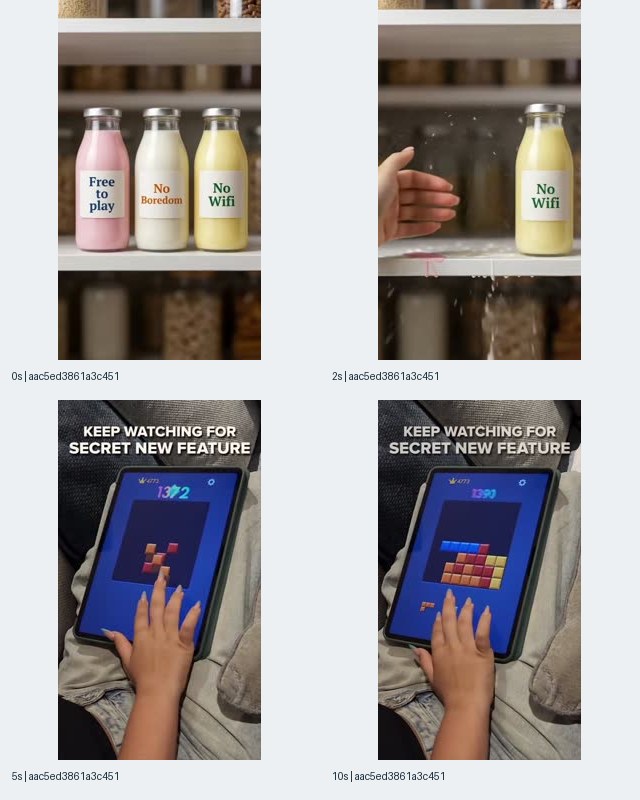
Image 2. Record aac5ed3861a3c451face7f1e2878efd6, reported against iOS listing 1617391485. Frames: 0, 2, 5, and 10 seconds. The benefit labels and secret-feature message are visible ad copy; the source does not verify those promises or the unseen feature reveal.
The bottle arrangement gives each benefit its own physical object. The pink, pale, and yellow liquids create separation between the labels, while the shelf supplies a familiar setting. At 2 seconds, the yellow “No Wifi” bottle remains prominently visible beside a hand and splashes or droplets. The sampled images show a change in arrangement, but they do not provide every action that produced it.
This is materially different from the board-first opening in Sample 1. The viewer initially encounters a claim about the experience of playing, rather than a puzzle to solve. The later tablet shot connects that claim-oriented introduction to a game demonstration. That bridge is a specific editorial feature worth studying: how does a physical setup hand attention to the product without making the second scene feel unrelated?
The “secret new feature” caption adds an unresolved promise. The 5- and 10-second frames show the tablet and block arrangements, but the supplied frames do not confirm what the promised feature is or whether it appears later. A brief should therefore describe this as a curiosity-based message, not a demonstrated feature launch.
For an original execution, choose a benefit that your own product can substantiate and decide how the next scene will demonstrate it. If offline use is the benefit, a separate product check must establish the supported conditions. If customization is the benefit, the creative should show the relevant interaction in the actual version being promoted. A bottle label alone supplies neither proof.
A useful test hypothesis is that a physical representation of a verified benefit may help viewers remember that benefit compared with a text overlay on gameplay. The proposed test needs a comprehension or recall measure as well as campaign outcomes. Otherwise, a change in clicking could be mistaken for understanding, even when viewers remember the object but miss the product connection.
Sample 3: A Persistent Version Message Carries the Opening
Sample 3 presents a “New Version” dialog across all four supplied timestamps, with the message that the new version has no ads and is completely free. The repeated dialog is the most prominent observable element. There is no clear sequence of rapid puzzle progress in these frames, so this example should be analyzed as version and benefit messaging rather than a short gameplay challenge.
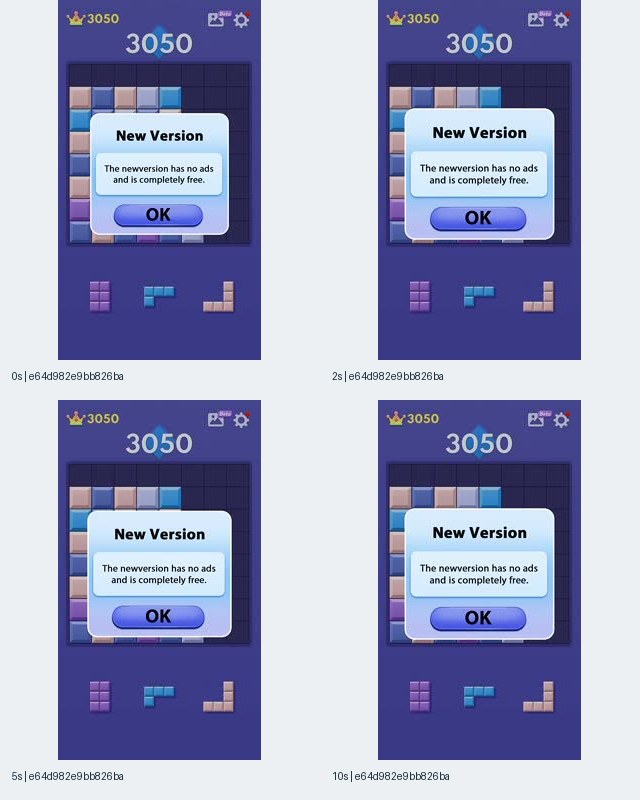
Image 3. Record e64d982e9bb826ba24e2ba04a2845a85, reported against iOS listing 1617391485. Frames: 0, 2, 5, and 10 seconds. The dialog contains an advertising claim about a new version; this research did not verify the game’s current advertising or pricing behavior.
The composition puts the dialog at the center of the board. A large “OK” control sits below the text, while the score and available pieces remain visible around it. This creates a layered image: the board establishes the game context, but the message interrupts access to that context. The relevant creative question is what the interruption asks the viewer to believe and do.
The sampled states look substantially similar. That supports the narrow statement that the same message is visible at each observed timestamp. It does not prove that the entire interval is motionless, that the original file contains no animation, or that a user can tap the depicted control. A rendered button inside a video is still a visual element until runtime evidence establishes otherwise.
The “no ads” wording also needs careful handling in a research article. It is tempting to turn an ad’s promise into a convenient answer about the app. That would substitute promotional text for product verification. The verified store identity establishes which listing the record is associated with; it does not validate every statement embedded in the creative.
An original version-announcement concept should start with a documented release or feature change. The production team then needs to specify the exact claim, eligible version, and destination where the viewer can obtain it. If the message applies only under certain conditions, those conditions need to survive the edit rather than disappearing for the sake of a cleaner screen.
The testable creative variable could be an explicit feature demonstration versus a message-led announcement. Both variants should make the same supported promise. Comparing a truthful demonstration with an unsupported offer would mix creative structure with a different product claim, making any apparent result unsuitable as guidance for repeatable production.
Sample 4: An Update Prompt Uses a Different Message Structure
Sample 4 shows a compact “New version” prompt asking the viewer to update the app, with “Combo 66” and the puzzle board visible behind it. The prompt appears at every supplied timestamp. This is a second version-message execution, but its copy differs from Sample 3: it requests an update without the same explicit no-ads and free promise.
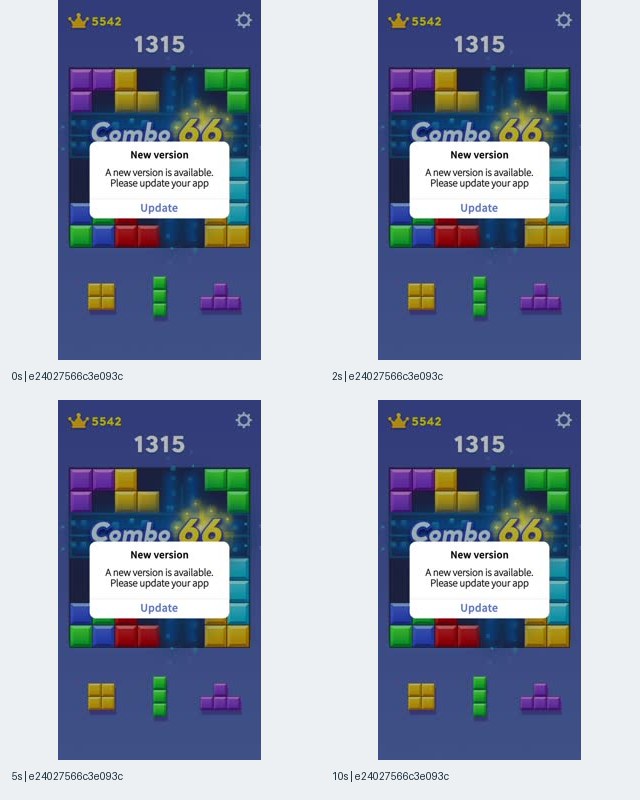
Image 4. Record e24027566c3e093c68f3ff1e904e18e7, reported against iOS listing 1617391485. Frames: 0, 2, 5, and 10 seconds. The update prompt is part of the sampled creative image, not a verified operating-system notification or a demonstrated before-and-after gameplay result.
The white prompt is smaller and visually simpler than the blue-toned dialog in Sample 3. Its “Update” control uses restrained text, while the game background provides color and activity cues. A creative analyst can compare the hierarchy: how much screen space goes to the instruction, how much context remains visible, and whether the viewer can identify the product underneath the message.
Those are presentation questions. The contact sheet does not reveal whether the intended audience already had the app installed, whether the record belonged to a re-engagement campaign, or whether the message was personalized. An update-themed image does not establish a retargeting audience. That would require campaign or targeting evidence absent from this sample.
There is also no demonstrated problem-and-payoff sequence here. The sampled images preserve the same overall dialog and board arrangement. Describing the example as a transformation would invent a narrative that the available frames do not supply. Its value lies in the visible instruction and context, rather than in an assumed solve between the timestamps.
A team considering an original update creative should first define the user task. Is the viewer learning about a new mode, returning to an existing account, or installing the product for the first time? That decision affects the destination and copy. The current sample cannot answer it for Block Blast, but it makes the question concrete for your own campaign.
A useful proposed comparison would keep the verified release message constant while changing the presentation from a dialog over gameplay to a clearly branded announcement with a feature preview. Measure whether viewers understand what has changed and what happens after the call to action. Do not interpret a higher tap rate on a button-like image as proof of a better user experience without checking the subsequent path.
Sample 5: Pastel Gameplay Shows Changing Board States
Sample 5 shows a pale pink and blue block puzzle against a gray background, with the board becoming more occupied before a later, less-filled state appears. The score reads 3315 in the early sampled frames and 3615 at 10 seconds. These observations support analysis of gameplay presentation and visual change. They do not establish a video-to-playable transition or the exact sequence of moves between frames.
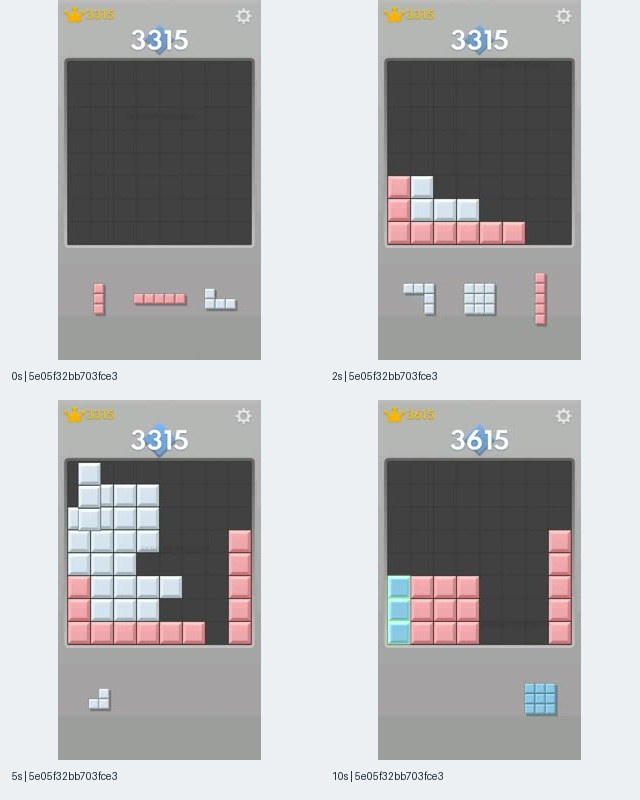
Image 5. Record 5e05f32bb703fce37a3aa5886586e2ba, reported against iOS listing 1617391485. Frames: 0, 2, 5, and 10 seconds. Changing occupancy and score are visible in the video frames; interaction, line-clear timing, and an eventual playable handoff were not tested.
The initial board is empty, with available pieces below it. By 2 seconds, blocks occupy the lower-left area. The 5-second frame shows a larger arrangement, and the 10-second frame presents a different distribution with open space in the upper board. The contact sheet therefore offers distinct states from which an editor can study orientation and visual continuity.
The palette creates a different presentation from Sample 1’s saturated stacks. That is a visible distinction, but descriptions such as calming, relaxing, or better for a particular audience remain hypotheses. The absence of bright colors does not measure emotional response. The gray background and pale pieces also need to be evaluated together, because changing color can alter legibility as well as style.
This sample is useful for a restrained original test. Keep the demonstrated puzzle, framing, piece scale, and animation timing the same, then compare two palettes that remain consistent with the product. If the pale treatment improves a campaign metric, a follow-up should investigate whether the mechanism is readability, preference, novelty, or something else. The reference itself supplies no answer.
A producer should also separate score change from causal explanation. The displayed values are part of the image. They do not show that a particular visible move earned a specific amount, because the intermediate actions are not all present. For a new gameplay demonstration, use a traceable sequence from your own build so score, movement, and outcomes can be checked together.
The record contains a playable fingerprint, but that association sits in a different evidence layer. It can justify requesting the interactive file for inspection. It cannot turn the 10-second frame into an interactive screen by assumption. Preserving that distinction allows video editors and playable developers to collaborate without treating a screenshot as a runtime test.
Sample 6: A Physical Block Lamp Connects the Game to a Desk Scene
Sample 6 places the block motif in a physical desk setup, with a hand stacking illuminated pieces and captions mentioning both Fortnite and Block Blast. The visible action is lamp assembly, not an observed interactive ending. This makes the example useful for studying a physical analogy: recognizable block shapes connect an everyday object to a game-related message.
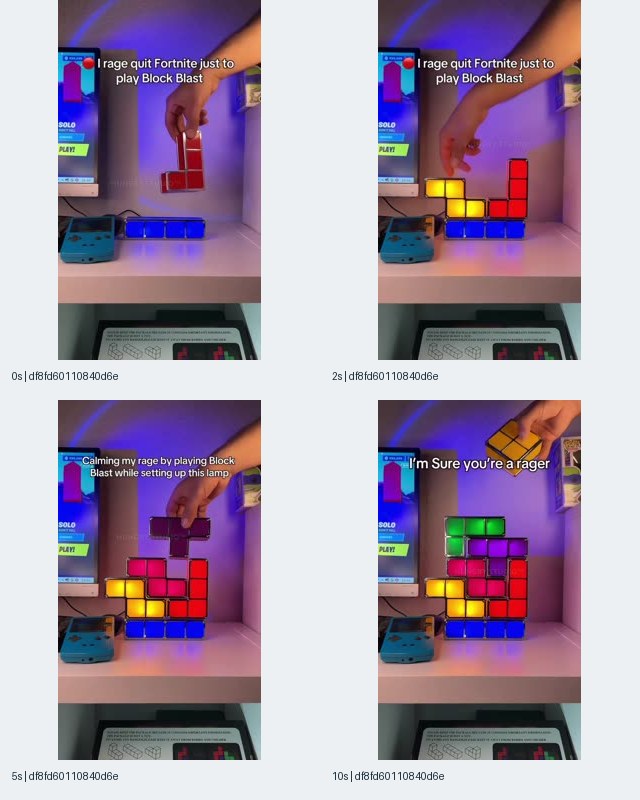
Image 6. Record df8fd60110840d6e2329f76d65aaa96d, reported against iOS listing 1617391485. Frames: 0, 2, 5, and 10 seconds. Fortnite is mentioned within the creative; that mention does not reassign the record’s product association or identify an audience or delivery network.
The opening caption reads “I rage quit Fortnite just to play Block Blast.” The desk includes a gaming screen, a handheld controller, and a blue-lit base of block shapes. Later sampled frames show the stack growing as different colored pieces are positioned. At 5 seconds, the caption connects playing Block Blast with setting up the lamp; at 10 seconds, it addresses the viewer as a “rager.”
The emotional language belongs to the ad’s narrative. The frames do not establish that the person had actually experienced the stated frustration, that playing the game reduced it, or that viewers responded in the same way. The research can identify a frustration-to-alternative message without converting that message into a psychological or performance finding.
The physical action is nevertheless a concrete creative reference. The shapes and colors provide continuity across the desk scene, while the growing stack creates a visible change between frames. A producer can adapt that structural idea using an original object and truthful product connection. The important briefing question is how the object helps explain the game rather than merely decorating the shot.
For example, a studio might build a tabletop arrangement that mirrors a supported puzzle mechanic, then transition to its own gameplay at the matching state. That is a proposed execution, not something demonstrated in the supplied contact sheet. The team should decide in advance whether the physical sequence is intended to establish the mechanic, introduce a mood, or create curiosity.
Testing the physical analogy requires a relevant comparison. A desk scene and a direct gameplay opening could use the same later demonstration and call to action. Audience comprehension and downstream quality should accompany any attention measure. A visually appealing lamp might attract interest in the object, so the product connection needs its own check rather than being assumed from the presence of block shapes.
Sample 7: Paint Mixing Makes Color Choice the Subject
Sample 7 shows paint being mixed in a palette under the caption “Picking three random colors to be my Block Blast colors for today.” The supplied timestamps emphasize the mixing process and changing color selections. They do not show a dark puzzle board, confirm a completed in-game customization, or establish that the flag graphics correspond to geographic targeting.
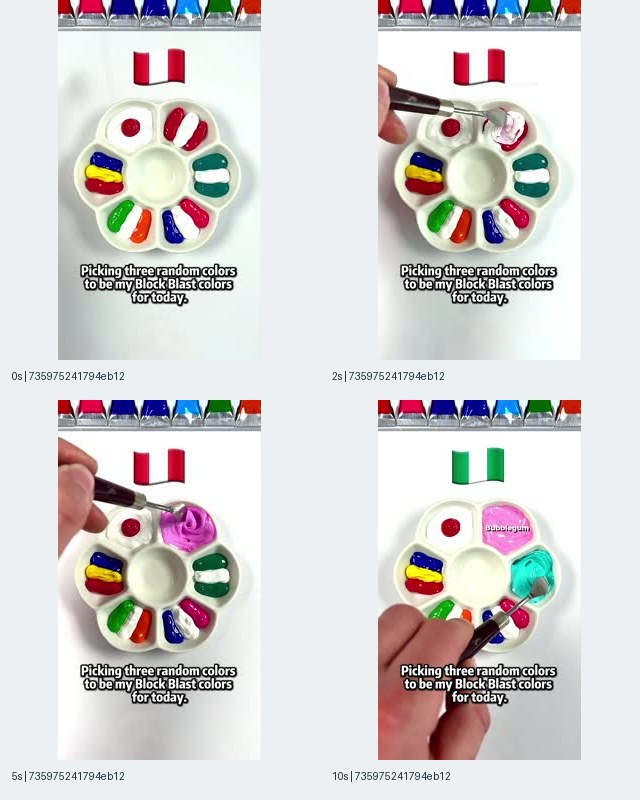
Image 7. Record 735975241794eb125f17fd1e1436772a, reported against iOS listing 1617391485. Frames: 0, 2, 5, and 10 seconds. Paint mixing and flag graphics are visible creative elements; the frames do not prove localization, targeting, or a tested game feature.
The white background and flower-shaped palette make the physical activity the dominant image. At the opening timestamp, different colors occupy separate wells. A hand and mixing tool appear in later frames, with a pink mixture prominent at 5 seconds and a turquoise mixture visible at 10 seconds. “Bubblegum” is visible as a label on the pink mixture in the later image.
This structure offers a process to follow before the game itself is shown in the supplied selection. The caption supplies the connection: these colors are being chosen for Block Blast. The connection is therefore verbal in the observed frames. The contact sheet does not establish how or whether the chosen paints are translated into the app later in the video.
The useful hypothesis is that a tangible selection process may make personalization feel concrete. That is more specific than saying the ad uses bright colors. The viewer is shown an act of choosing and transforming a palette, which a team could translate into an original customization narrative if its own product supports that choice.
A production brief should specify the proof scene before filming the satisfying process. If the first scene promises personal colors, what exact app interaction will substantiate that promise? What options are actually available? Can the same colors be selected in the version and market being promoted? Answering those questions avoids an attractive introduction that cannot be connected to a truthful product demonstration.
The flag graphics need a separate annotation. Record them as visible symbols, without labeling the ad as aimed at the countries they resemble. A US-filtered source can contain many cultural references. Market targeting, language localization, and creative imagery are different fields. Keeping them separate prevents a color-selection motif from becoming an invented international media plan.
Sample 8: A Tutorial Caption Gives a Specific Navigation Step
Sample 8 presents a tutorial-style sequence about changing block colors, moving from pink blocks on a board to a color-selection interface by the 10-second frame. At 5 seconds, “Click this shirt icon” appears with an arrow toward the top-right icon. The sequence is evidence of a depicted navigation explanation. It is not an independent test that the current app offers the same controls.
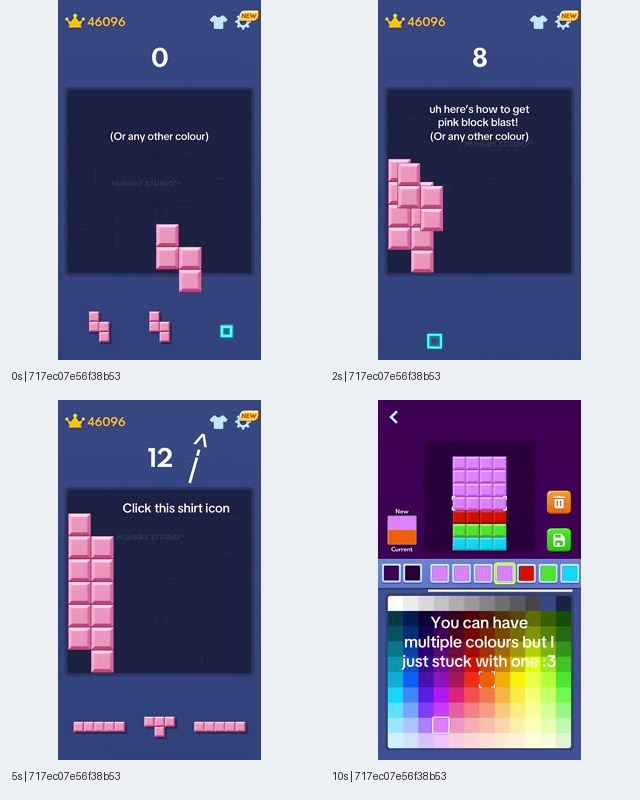
Image 8. Record 717ec07e56f38b53b55f124304591a58, reported against iOS listing 1617391485. Frames: 0, 2, 5, and 10 seconds. The record lists a 28-second video, but the supplied visual evidence ends at 10 seconds. Current feature availability and the unseen ending were not tested.
The early sampled frames establish the desired appearance: pink blocks, accompanied by wording about getting pink Block Blast or another color. The 5-second instruction then names a visible control. At 10 seconds, the screen has changed to a palette-like interface with selectable colors and a larger color grid. That creates a more explicit product bridge than the paint-mixing sequence in Sample 7.
The distinction is useful for a creative team. One approach makes customization tangible through a physical process; the other depicts a navigation step within an interface. Neither is automatically stronger. They answer different questions for the viewer: what might this look like, and where would I change it? A test should decide which of those questions matters for the intended audience.
An original tutorial brief can begin with the outcome, identify the relevant control, and show the resulting state. Every depicted step should come from the team’s own verified build. If controls vary by version, account, or device, the brief should specify the environment used for recording. That preparation keeps the tutorial from becoming outdated or impossible to reproduce at launch.
The arrow is also a specific design variable. It directs attention toward a small icon that could otherwise be missed. A proposed comparison could hold the footage and caption constant while changing the guidance treatment. A separate comprehension exercise can ask viewers where they would act, while live testing can evaluate the relevant campaign and product outcomes.
The listed 28-second duration is metadata, not evidence that a longer cut performed well. Only the selected early timestamps were reviewed here. A producer should avoid deriving an ideal ad length from that duration. The more useful question is whether the necessary explanation remains clear when edited, and whether the eventual call to action follows the promise made in the opening.
Compare the Eight Examples by the Viewer Task
The eight examples become easier to use when they are grouped by what the viewer is being asked to notice or understand. That approach preserves their visible differences. It also avoids forcing every creative into a generic gameplay-hook category, which would conceal the bottle labels, version dialogs, physical lamp, and paint-mixing process that actually distinguish this selection.
| Sample | Visible opening or early device | Viewer task suggested by the image | Original test direction |
|---|---|---|---|
| 1 | Crowded block board | Inspect a placement problem | Board clarity and payoff visibility |
| 2 | Benefit labels on bottles | Read benefits, then connect them to the tablet scene | Physical benefit framing versus an in-game demonstration |
| 3 | New-version dialog with a free and no-ads claim | Read a version-related promise | Verified feature proof versus message-led announcement |
| 4 | Update prompt over gameplay | Understand an instruction to update | Announcement presentation and destination clarity |
| 5 | Pastel gameplay on gray | Follow changing board states | Palette treatment with mechanics held constant |
| 6 | Illuminated block-lamp assembly | Connect a physical activity to the game message | Physical analogy versus direct gameplay |
| 7 | Paint mixing and color-choice caption | Follow a personalization process | Tangible color selection with a verified product reveal |
| 8 | Pink blocks and shirt-icon instruction | Understand a depicted customization step | Guidance clarity in a truthful tutorial |
These labels are editorial descriptions of the supplied images. They are not measured audience segments, automatic platform categories, or a frequency distribution of the full sample. Only eight of the distinct videos are illustrated here, and the examples were supplied as a selected media set. The table should therefore be used to organize ideas, not to calculate how often the advertiser relies on each approach.
A practical comparison begins with the product promise. Samples 2, 3, 7, and 8 all contain messages that imply something about the experience or available features. Samples 1 and 5 place more of the visible burden on the board itself. Sample 6 connects the product to an emotional narrative and a physical object. Sample 4 foregrounds an update instruction. These distinctions help a team choose what additional proof it needs before producing its own variant.
To inspect relevant indexed references, search Block Blast creatives in AdMapix. Begin with the reported listing associations and record the date and country scope before saving an example. A name search is a discovery step; reproducing this article’s scope requires retaining the verified iOS ID and the explicit measurement window.
Creative Reuse: One Board Video Appears With Eight Playable Files
The crowded-board video represented by Sample 1 appears in eight sampled records, each with a different playable fingerprint. This is a concrete file-association finding from the frozen package. It supports the conclusion that the indexed sample contains repeated use of the same video alongside different interactive files. It does not establish that those combinations were a controlled test or that one ending caused better results.
The shared video fingerprint is 3730aa68f0dc03c3e26f7e9006f7f993. The following table uses short record identifiers and playable fingerprint prefixes to make the association readable; complete identifiers are preserved in the public source package.
| Sampled record prefix | Shared video | Associated playable fingerprint prefix |
|---|---|---|
| 912fee0b | Sample 1 video | 56820b9f |
| 07c493af | Sample 1 video | 19ee5199 |
| a00da9c4 | Sample 1 video | a33a9e45 |
| 6d5ca7f8 | Sample 1 video | abe9990a |
| 069fd91c | Sample 1 video | 84e24316 |
| 1a404fbb | Sample 1 video | d47a5d87 |
| e65eb4c1 | Sample 1 video | cbdcc52f |
| 85f04a50 | Sample 1 video | 374bb902 |
A second reuse group is visible around the version-dialog video in Sample 3. Its fingerprint appears in records beginning e64d982e, 534baae7, 44128954, and 48914702, with different playable fingerprints. This gives the article another specific example of the same relationship without relying on visual similarity between screenshots.
The distinction between a file and a concept remains important. An identical fingerprint is strong evidence of the same indexed video file within this system. Different fingerprints do not automatically establish unrelated creative ideas: files could differ in edits, captions, encoding, or other details. Conversely, several distinct-looking storyboard concepts might share a common production approach. File counts and concept counts answer different questions.
For a production lead, the defensible lesson is to track the reusable components of an ad separately. The video, interactive file, copy, and destination can each have a stable identifier. That makes it possible to ask whether a new record actually required a new shoot, a new animation, a new interactive build, or simply another association of existing elements.
For a UA lead, the same graph is a preparation tool rather than a performance verdict. It identifies combinations worth inspecting, but it does not supply audience allocation, auction conditions, spend, or conversion. Record ranking cannot fill those gaps. A shared video plus different interactive files is compatible with several operational explanations, including modular experimentation and ordinary asset reuse; those explanations remain hypotheses about the advertiser’s process.
Playable Presence Is Separate From Playable Experience
A playable fingerprint establishes that an interactive file is indexed with a record; it does not establish the user experience of that file. This sample contains 15 distinct playable fingerprints and 27 records with playable content, but no supplied runtime session, interaction log, loading test, or completion measurement. The article therefore does not grade those playables for usability, persuasion, or conversion.
That boundary is especially relevant when a video frame contains a button. The “OK” control in Sample 3 and the “Update” control in Sample 4 are visible inside the sampled video images. Their appearance does not show that the viewer can interact with those exact controls in the advertising experience. Likewise, a record containing both a video and a playable does not reveal the precise moment at which one hands off to the other.
A future QA session should begin with the actual interactive build and a documented test environment. The tester would record the initial state, guidance, allowed actions, response to those actions, progression, and final destination. Loading behavior and orientation also belong in that session. Those checks would generate new evidence, so they should carry their own observation date rather than being attributed to these contact sheets.
The production question of continuity can still be raised now. If a video establishes a particular puzzle objective, a connected playable may need to preserve that objective or explain the change. If an opening promises customization, an interactive ending focused on an unrelated task could require a clearer bridge. These are design hypotheses derived from the visible message, not findings about the unseen files.
The playable ad analysis method provides related workflow context. In this case, the handoff is straightforward: use the fingerprint associations to identify files for inspection, then keep the resulting runtime observations separate from the current video-frame analysis. That separation makes both kinds of evidence more useful.
Separate Creative Promises From Verified Product Facts
The sample contains several statements that require independent product evidence before they can become claims in a new campaign. “No Wifi,” “no ads,” “completely free,” “new version,” and color-customization instructions are all visible forms of advertising communication. Their presence proves that the source creative contains the message. It does not verify the current app’s behavior or establish the conditions under which the message applies.
This distinction is useful during briefing because a creative team often inherits a reference before it inherits the product details. A producer sees a bottle labeled with a benefit and starts planning a similar scene. A copywriter then shortens the wording, and an editor may remove a qualifier. Without a claim record, the final asset can drift away from what the product team actually supports.
A practical claim record should include the exact proposed wording, the product behavior that supports it, the version or environment checked, and the person or team responsible for maintaining that information. This is a suggested process for your own work, not a description of how the sampled advertiser operates. Its purpose is to connect each creative promise to a checkable product fact.
The same discipline applies to emotional language. Sample 6 presents a frustration-related narrative. An original ad can tell a truthful story or depict a clearly framed scenario, but the research does not demonstrate a therapeutic effect or a general audience response. The creative hypothesis concerns how the message is understood; evidence of broader benefits would require a different kind of study.
For tutorials, verification includes the path as well as the outcome. A color setting might exist, yet the control could differ from the depicted shirt icon. A version announcement might be accurate, yet the destination could lead to a page that does not explain the change. Reviewing copy, interface steps, and landing context together makes the test more interpretable because the intended promise survives the whole journey.
Build a Creative Brief Around One Observable Difference
A useful test brief begins with a specific observation and changes one defined creative variable. This sample supplies several candidate observations, but it does not supply ready-made winners. The goal is to make the proposed experiment falsifiable: a team should be able to describe what changed, why it might matter, what evidence would count against the hypothesis, and what decision follows each outcome.
Consider Sample 1. The observation is that a dense board and receiving space appear immediately. A proposed hypothesis is that a clearly identifiable receiving space helps prospective players understand the mechanic compared with a less structured arrangement. The variable is the board composition. The footage duration, text, destination, and tested audience should remain comparable enough that the result can speak to that variable.
Sample 2 motivates a different question. Its physical benefit labels may be memorable, but the link to the game arrives in a later scene. An original test can compare that structure with the same verified benefit demonstrated directly in the product. The result needs to distinguish attention from understanding. A bottle scene that improves early viewing but weakens product comprehension would call for a different edit than one that improves both.
Samples 7 and 8 create a useful paired hypothesis about personalization. The paint sequence makes selection tangible; the tutorial depicts where selection happens. A studio could test a process-led introduction against an interface-led introduction while preserving the same verified customization promise. That is a proposed comparison for the studio’s own product, not evidence that these source records were tested against each other.
Use the following brief as a copyable structure:
| Brief field | What to write |
|---|---|
| Source observation | A factual description tied to an image number and timestamp |
| Product requirement | The actual mechanic or feature your execution will demonstrate |
| Hypothesis | Why a specific presentation change might affect a defined response |
| Changed variable | The board state, guidance, reveal timing, palette, or other isolated element |
| Stable elements | The parts that should remain comparable across variants |
| Primary measure | The outcome used to judge the intended effect |
| Guardrail | A downstream measure that would challenge a superficially positive result |
| Evidence against | The outcome that would make the team reject or revise the hypothesis |
| Next decision | Keep, revise, stop, or investigate, with conditions stated before launch |
The brief should also say what it is not trying to learn. A palette test does not establish the value of a new mechanic. A different opening does not identify the best interactive ending if both change together. Narrowing the question makes a modest experiment useful, because the result can be carried into the next production decision without a large explanatory leap.
Four Original Test Plans Motivated by the Sample
The sample supports a backlog of original experiments with different learning goals, provided the source observations remain separate from the proposed outcomes. The plans below are examples for a team’s own product. None was conducted for this article, and none implies that the corresponding Block Blast record succeeded or was part of a formal experiment.
Board comprehension test. Use Sample 1 as a reference for a visible receiving space, then build original boards in your own game. Compare an arrangement with an obvious target against a similarly complex arrangement where the target is less visually isolated. Begin with a comprehension exercise to check that the intended difference exists. If live campaign testing follows, evaluate the chosen acquisition outcome alongside product engagement so that easy-to-understand footage is not confused with qualified demand.
Benefit-to-proof test. Use Sample 2 to motivate a comparison between a physical label and a direct product demonstration. Select one benefit that the team has verified. Keep the benefit wording and subsequent product scene consistent, while changing the opening representation. Ask viewers what benefit was offered and which product offered it. If the physical opening attracts attention but weakens those answers, revise the bridge before treating additional views as progress.
Customization explanation test. Use Samples 7 and 8 to compare a tangible selection process with a navigation-led tutorial. Both executions should end in the same supported customization state. The variable is the explanation structure. A suitable comprehension question asks how the viewer would obtain the depicted appearance. The campaign guardrail should reflect whether people who respond continue into the relevant experience, rather than assuming that color interest automatically translates into game interest.
Video-and-interactive combination test. Use the shared fingerprint group as motivation to evaluate modular production in your own account. Keep an original video fixed while comparing interactive endings that differ in a single defined way, such as the initial objective or guidance treatment. Verify each build first. Record the video and playable identifiers together so the measurement remains attached to the combination that actually ran. Any conclusion about the ending requires comparable exposure and appropriate campaign data.
These plans also have different stopping conditions. A comprehension test can reveal that the manipulation was not understood, in which case a media test would not answer the intended question. A build check can reveal inconsistent mechanics, in which case the interactive variants need repair. A campaign result can remain inconclusive, in which case the learning log should preserve uncertainty instead of selecting a winner for the sake of completing the report.
The creative testing framework is a relevant next step for planning the experiment. The contribution of this article is the evidence-backed starting point: specific frames and file relationships that explain why a variable deserves investigation. The causal answer must come from the team’s own appropriately designed test.
A Practical Workflow From Search to Production Handoff
A repeatable workflow should preserve identity and evidence before it turns references into recommendations. The proposed process below can be run in a spreadsheet, a shared database, or a team’s existing research system. Its value comes from the fields and decisions it preserves, rather than from a particular tool or a promised turnaround time.
First, define the question and entity. Write the product ID, store, country, and time window at the top of the research note. Decide whether the work concerns creative openings, file reuse, claim verification, or interactive design. A broad instruction to find successful ads is too ambiguous when the available source does not include campaign outcomes. For this case, the bounded questions concern visible approaches and indexed file associations.
Second, retain the original records. Save stable record identifiers and the reported listing associations alongside each reference. Preserve the collection order and its meaning. A sample ordered by modeled impressions should not later be described as the newest creatives. If a second collection uses discovery order, keep it as a separate selection with its own scope rather than merging the two into an unexplained list.
Third, deduplicate at the right level. Group video fingerprints separately from playable fingerprints, flattening any arrays before comparison. Maintain the record-to-file relationships after grouping. The point is not merely to reduce a count; it is to retain the combinations that explain reuse. A deduplicated folder with all record links removed can lose the evidence needed for the most useful production observation.
Fourth, annotate the visible material. Use fixed timestamps when contact sheets are the available evidence. Record what is shown, the text that is legible, and the uncertainties introduced by the missing intervals. In Sample 4, the annotation should identify the persistent update prompt. In Sample 7, it should identify paint mixing and the color-choice caption. Generic labels such as gameplay or satisfying creative are insufficient when they erase the actual scene.
Fifth, separate facts from interpretations. Put the observation in one field and the hypothesis in another. “A shirt icon is indicated by an arrow at 5 seconds” is an observation. “The arrow may improve navigation comprehension” is a hypothesis. “The arrow increased conversion” is an outcome claim that this source cannot support. Keeping those statements apart makes the brief easier to review and the eventual test easier to evaluate.
Sixth, check product compatibility. Before assigning production, confirm that your own game can support the proposed mechanic, benefit, and destination. A physical metaphor can be original while still making an inaccurate promise. A tutorial can be visually clear while demonstrating a control that is unavailable in the promoted build. Those mismatches need resolution before they become expensive footage or ambiguous test results.
Seventh, hand off a decision-ready brief. Include the source reference, the original concept, the changed variable, the stable elements, the measurement plan, and the reason to stop or revise. The producer should know which visual relationship matters, not merely receive an image to imitate. The UA lead should know what the result can answer, not merely receive an asset labeled new variant.
Finally, attach the outcome to the original question. When your own test concludes, record the result against the hypothesis and the exact asset combination. Preserve inconclusive outcomes and failed manipulations. This creates a learning record that can improve later briefs, while the competitor reference remains what it originally was: evidence that motivated the question, not proof of the answer.
Organize the Library as a Map of Related Components
A creative library becomes more useful when it preserves relationships among records, video files, interactive files, and concepts. The Block Blast sample demonstrates why: the same board video appears under several record IDs, while the same broad version-message approach can be represented by different video files. A single folder hierarchy cannot reliably express all of those relationships without losing context.
A practical library can keep the record as the evidence entry and link it to reusable components. The video component stores its fingerprint, visible approach, and reviewed timestamps. The interactive component stores its fingerprint and a clear status indicating whether it has been tested. The concept label describes the editorial idea, such as physical benefit framing or navigation tutorial, without pretending that the label is an upstream fact.
| Library field | Example of a useful entry | Decision it supports |
|---|---|---|
| Verified product | iOS ID 1617391485 | Keeps the research entity stable |
| Record association | Full record ID and all reported listing IDs | Preserves attribution context |
| Video component | Fingerprint plus Sample 1 reference | Identifies repeated video use |
| Interactive component | Separate fingerprint and untested status | Prevents runtime assumptions |
| Visible message | Exact legible wording with timestamp | Supports claim and copy analysis |
| Editorial concept | Crowded-board placement problem | Helps retrieve related ideas |
| Hypothesis | Original proposed test, explicitly labeled | Connects research to production |
| Owned test result | Evidence from the team’s own campaign | Supports subsequent decisions |
The concept label should be revisable. A researcher may initially tag Sample 2 as a benefit opening and later add a curiosity tag because of the secret-feature caption. That does not require changing the underlying record identity. Separating labels from evidence makes the library flexible without making its source history unstable.
This structure also improves handoffs between people. An editor can work from the selected frames, a developer can find the associated interactive file, and an analyst can see that runtime evidence is still missing. No one has to infer which part of a previous note was observed and which part was suggested. The reusable asset is therefore not just the screenshot; it is the relationship between a source, an interpretation, and a proposed decision.
Read Dates and Ranking Without Inventing a Lifecycle
First-seen dates and impression ordering describe aspects of the index, but they do not reveal a complete creative lifecycle. A record can have an early discovery date and still appear in a later window without proving continuous delivery, sustained profitability, or uninterrupted use of the same campaign settings. The bounded sample also cannot show every asset that entered or left the advertiser’s activity.
Reuse makes date interpretation more complicated. Several records can reference the same video while carrying different first-seen dates. A later record is not necessarily a newly produced video. It might represent another association of an existing file. The Sample 1 group is therefore useful for teaching the distinction between record discovery and media creation, even though the package does not establish the production history of the underlying footage.
File URLs are another weak basis for lifecycle claims. A date-like string in a media path can reflect storage or processing conventions. It should not be promoted into a verified shoot date, launch date, or release event without supporting evidence. The source package provides explicit record timestamps; even those timestamps need to be interpreted according to their stated role rather than expanded into a complete narrative.
The same restraint applies to ranking. Descending impression estimates determine which records were selected, but they do not randomize creative treatments or control for exposure. A record can rank above another for reasons that the supplied data cannot separate. No conversion, cost, or retention evidence is available to resolve that comparison.
For your own reporting, keep discovery history and business performance in different sections. Use the dated index to identify changes worth investigating. Use first-party campaign and product data to assess fatigue, efficiency, and outcomes. That approach allows longevity to remain useful context without turning it into a substitute for evidence of performance.
What the Sample Cannot Tell a Media Buyer
The sample cannot identify a winning network, calculate a budget allocation, or explain the audience behind a creative’s appearance. It supplies product associations, record metadata, file relationships, and selected visual content. A media buyer can use those inputs to prepare creative questions, but the missing campaign variables prevent a defensible recommendation to move spend toward a specific source or format.
Creator-style footage illustrates the problem. Samples 2 and 6 show hands, devices, or a desk scene, and several examples use captions that resemble social content. Those are creative conventions. The same visual approach can appear in different advertising environments, so style alone cannot establish where the ad was delivered. The numeric source code in this package is not accompanied by a verified network mapping.
The iOS filter supplies a different kind of scope. It restricts the target product reference to a verified Apple listing. It does not establish the advertiser’s complete iOS activity, the delivery device of every observation, or the relationship between that activity and Android. The wider app associations in some records make it especially important to preserve the exact claim: these are records linked to the selected listing.
Likewise, an update prompt does not prove a re-engagement campaign, and a Fortnite reference does not prove targeting toward Fortnite players. Those are plausible questions for further investigation. They remain hypotheses until campaign settings, independently documented targeting, or suitable first-party evidence is available.
The useful media handoff is therefore a test request with defined creative variables and appropriate measurement. A buyer can decide whether the team has enough verified material to run that test. The buyer cannot recover missing spend, installs, or profit by multiplying model estimates, counting repeated records, or treating the age of a file as a performance score.
Common Mistakes That Would Change the Conclusion
The most consequential mistakes in this case would change the unit, the entity, or the visible scene being described. Those errors can survive even when every copied number is accurate. A reliable report therefore checks its captions and interpretation as carefully as its arithmetic, especially when a repeated template encourages different screenshots to be described in the same language.
Counting records as unique assets. The 30 records contain 12 distinct video fingerprints. Calling them 30 videos would overstate indexed video variety. Calling the video and playable counts a single total of concepts would introduce another undefined unit. Keep records, video files, playable files, and editorial concepts separate.
Inventing transitions from file associations. A record containing both video and playable content does not prove that a particular sampled frame marks the handoff. Sample 5 shows changing gameplay states. Its associated playable fingerprint is separate evidence. A precise caption should not merge those two observations into a transition that was never viewed.
Describing the wrong image. Sample 7 shows paint mixing, not saturated blocks on a dark grid. Sample 6 shows a physical lamp, not a reused gameplay video with an interactive ending. Samples 3 and 4 show persistent dialogs, not demonstrated before-and-after solves. Mislabeling those scenes removes the article’s most useful creative differences.
Treating ad copy as product verification. “No Wifi,” “no ads,” and “completely free” are visible source messages. They need independent product evidence before being repeated as facts about the current game. The same rule applies to a tutorial path shown in a video: depiction and verified availability are different claims.
Expanding identity through a name. The verified iOS ID anchors this sample. Other linked IDs and names do not establish corporate relationships, rival ownership, or wrongdoing. A product mention inside the ad belongs in the message analysis, while the record’s app associations belong in the attribution analysis.
Treating modeled ranking as a winner list. The sample was selected by descending estimated impressions, but no supplied conversion or cost evidence grades the creative approaches. Repetition and rank can help prioritize inspection. They cannot explain why a file appeared or establish what a new campaign should spend.
Calling the sample a complete fleet. Three pages are a collection limit, not proof that nothing exists beyond them. The absence of a format, network, or new concept from this set cannot establish its absence from the product’s advertising. Conclusions should retain the sample window and the verified listing scope.
When AdMapix Fits This Research Task
AdMapix fits the discovery stage when a team needs indexed creative references and a path from product search to evidence-based briefing. AdMapix is our advertising-intelligence product, and this article uses a frozen sample from its index. The value demonstrated here is concrete: source records make file reuse visible, while timestamped images make the creative observations inspectable.
The article’s contact-sheet analysis is an editorial use of the supplied media. It should not be read as a claim that every step described in the workflow is an automatic hosted product feature. Likewise, preserving identifiers in a spreadsheet or creating an internal asset graph is a suggested team process. Those recommendations should remain distinct from current commercial capabilities.
AdMapix does not supply the missing first-party outcomes for this sample. A team still needs its own campaign reporting, attribution context, product analytics, and interactive QA to evaluate the original tests described above. Research can improve the question and the brief; it cannot turn public creative evidence into a rival’s private conversion report.
For a small studio, the sensible starting point is a narrow research question and a manageable set of references. Verify the listing, group repeated files, select a concept that fits the product, and produce an original test. An extensive reference collection is unnecessary if the immediate decision concerns a single unclear opening or an unverified feature promise.
To move from research to a purchasing decision, use the search example above with your own target listings and compare the available evidence with the fields your team actually needs. Then check the current AdMapix plans and pricing. Commercial terms can change, so this evergreen article does not enumerate plan prices or credit quotas and does not promise a paid-plan trial.
FAQ
What does this Block Blast analysis actually cover?
It covers 30 indexed advertising records associated with verified iOS listing 1617391485 under a US filter for 2026-08-14 to 2026-09-12. The research examines file fingerprints and eight supplied contact sheets at 0, 2, 5, and 10 seconds. It does not measure spend, installs, conversion, retention, profitability, or the full advertising fleet.
Are the 30 records 30 different videos?
No. The sample contains 22 records with video and 12 distinct video fingerprints. It also contains 27 records with playable content and 15 distinct playable fingerprints. Those categories overlap because a record can contain both media types. Report the units separately rather than treating every row as another original video or adding all files into an undefined concept count.
What is the clearest evidence of creative reuse?
The video represented by Sample 1 appears in eight sampled records, each associated with a different playable fingerprint. The version-dialog video in Sample 3 also appears in several records with different interactive-file associations. These are observable relationships in the index. They do not identify the advertiser’s experiment design, establish simultaneous delivery, or show which combination performed better.
Do the version dialogs prove that Block Blast has no ads?
No. Sample 3 contains a visible claim that a new version has no ads and is completely free. Sample 4 contains an update request. Those are advertising messages, not independently verified statements about the current app. This research did not play the game or test its monetization behavior, and the screenshots should not be used to answer that product question.
Which network delivered the sampled creatives?
The supplied evidence does not verify a named delivery network. The records share a numeric source code without a provided mapping, and AdMapix is the research index rather than the delivery network. Vertical footage, creator-style captions, or a physical gaming setup cannot establish Meta, TikTok, AppLovin, Unity, or any other network attribution by themselves.
Can these findings be applied to Android advertising?
They should not be extrapolated to Android. The analytical entity is the verified iOS listing, even though some records report additional app associations. An Android analysis requires independently verifying the relevant package IDs and collecting a separately scoped sample. The present data also cannot establish that an unexamined platform uses no ads or no particular creative approach.
Were the videos watched in full or the playables tested?
No. Visual observations are limited to the supplied timestamped contact sheets, and the playable findings come from file associations. The article does not evaluate audio, unseen endings, loading behavior, tap targets, completion, or store routing. A separate playback or runtime session would create additional evidence and should document its own environment, observation date, and scope.
How should a small studio use these examples?
Choose an observed structure that fits a feature your own product can substantiate, then write an original brief around one changed variable. Preserve the source record and label the proposed outcome as a hypothesis. Use your own comprehension checks, campaign data, and product metrics to evaluate the result. The reference explains why the test is worth considering; it does not preselect a winner.
Key Takeaways
The practical value of this sample is a clearer production question, supported by inspectable frames and file relationships. Its strongest findings concern what is visibly depicted and how indexed components are reused. Keeping that scope intact lets a team act on the research without importing unsupported assumptions about the buyer, network, audience, or business outcome.
- Keep the unit explicit: 30 sampled records contain 12 distinct video fingerprints and 15 distinct playable fingerprints for 2026-08-14 to 2026-09-12.
- Read the actual scene: the examples include bottles, dialogs, a lamp, paint mixing, gameplay, and a tutorial; they are not interchangeable gameplay screenshots.
- Preserve the reuse graph: Sample 1’s video appears in eight records with different playable fingerprints, but the runtime experience remains untested.
- Verify every product promise: visible copy about offline use, free access, ads, updates, or customization is source messaging until independently substantiated.
- Test original executions: use the observed differences to define a variable, then evaluate it with evidence from your own product and campaigns.
Sources
The dated source package supports the record counts, listing associations, fingerprint relationships, and contact-sheet references in this article. The product and workflow pages below provide research context and current commercial information; they do not supply missing campaign performance. Visual observations were prepared on 2026-09-13 from the supplied images, and no full-video, playable-runtime, or external-tool test is claimed.
- Frozen Block Blast source package — fetched 2026-09-13; US product-filtered sample for 2026-08-14 to 2026-09-12, restricted to verified iOS ID 1617391485. Public batches, request parameters, and checksums support reproduction of the sample and its counts.
- Block Blast US App Store reference — verified listing information supplied with the 2026-09-13 package: track ID 1617391485, bundle ID com.blockpuzzle.us.ios, seller ARETIS LIMITED. This reference establishes listing identity, not ad-buyer identity or every creative claim.
- AdMapix methodology — public methodology reference supplied for the 2026-09-13 analysis. Scope here: indexed records, explicit measurement windows, model-estimate boundaries, and the distinction between product association and unverified delivery details.
- AdMapix Block Blast search workflow — research entry point associated with this 2026-09-13 analysis. Live results may change and require listing verification; the frozen package remains the source for the article’s specific sample.
- AdMapix product facts supplied for this article were reviewed on 2026-08-13. The live pricing destination linked above maintains commercial terms; no current refresh SLA, paid-plan trial, or private campaign measurement is inferred from this sample.
AdMapix Research — prepared with Codex and checked against the dated source sample. Editorial ownership: Brad — AdMapix; no personal human review is implied.
Continue researching Block Blast
Find matching apps, verify the developer and store, then inspect recent creatives.
Related Articles
Subway Surfers Ads: What a Name Search Actually Shows
A dated US audit of 30 Subway Surfers name-search results finds no verified iOS reference matches, with eight source-linked screenshots showing how to separate listing identity, visual observations, and test hypotheses.

Fortnite Ads: Verify the Product Before Reading the Strategy
A US sample for August 12–September 10, 2026 links 30 Fortnite advertising records to eight video files, revealing creative approaches and reuse while separating verified product identity from unknown payer, network, and performance details.

FC Mobile Ad Strategy: Hooks, Events, and Creative Reuse
A US sample for August 12–September 10, 2026 reveals FC Mobile event messaging, national-team imagery, and video reuse, with eight visual breakdowns and practical creative test briefs.