
Subway Surfers Ads: What a Name Search Actually Shows
A dated US audit of 30 Subway Surfers name-search results finds no verified iOS reference matches, with eight source-linked screenshots showing how to separate listing identity, visual observations, and test hypotheses.
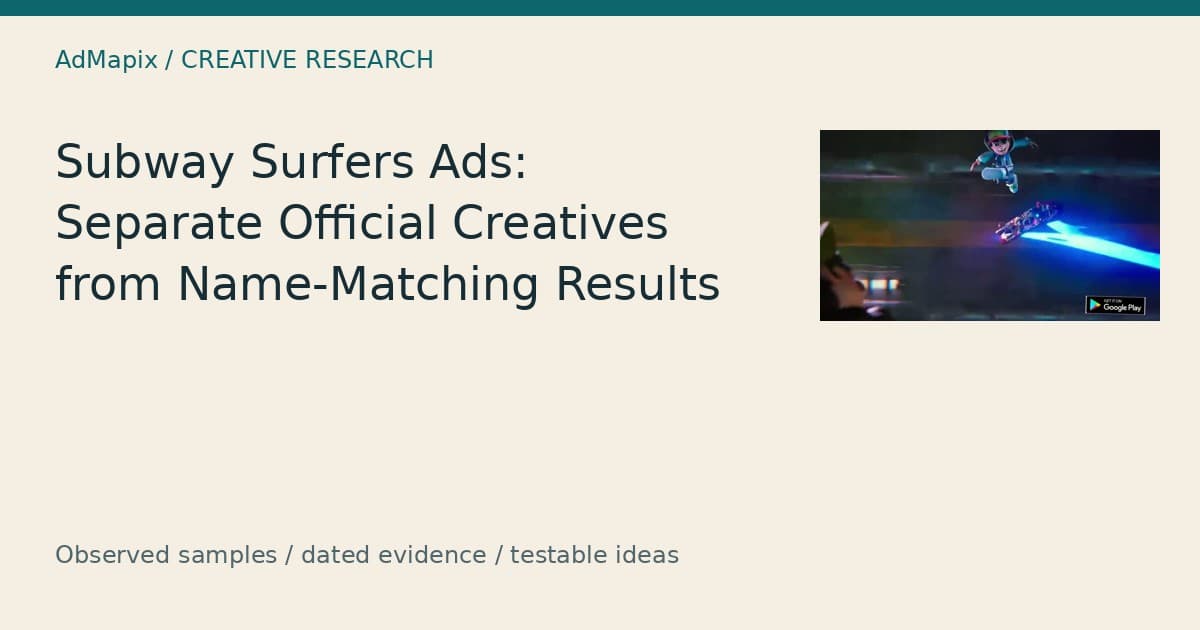
Subway Surfers Ads: What a Name Search Actually Shows
Subway Surfers ad research needs an identity check before a creative teardown. In the dated AdMapix sample examined here, a US name search returned 30 advertising records, and none matched the verified iOS reference for Subway Surfers. Every record linked to another reported store listing. That finding helps user acquisition managers, creative strategists, and agencies decide which examples belong in a product report and which belong in a broader research folder. It does not establish who bought the ads, whether the listings share ownership, or whether the official game advertises elsewhere. As teams prepare new creative briefs, the immediate opportunity is to preserve useful visual observations without assigning them to the wrong product. The eight screenshots below show how to do that.
Last updated: September 12, 2026.
AdMapix Research — prepared with Codex and checked against the dated source sample.
About the author: AdMapix Research is the byline for this Codex-generated article. Its scope here is auditing reported store identities, organizing static-image observations, and developing test hypotheses from the frozen evidence. The byline identifies AI-assisted research, not a human author or reviewer.
Editorial ownership: Brad at AdMapix. This identifies the site's editorial owner and does not imply personal human review of this automated draft. AdMapix is our product.
Quick Answer
- The US search for “Subway Surfers,” covering August 13–September 11, 2026, returned a bounded sample of 30 advertising records: zero verified iOS reference matches, 30 other linked listings, and zero unresolved records.
- The reference is the Subway Surfers iOS listing with app ID
512939461, whose verified seller is Sybo Games ApS. This reference does not independently verify Android identity or identify an ad buyer. - The sample contains 13 distinct video fingerprints across 29 records with video. Advertising records, media files, and creative concepts require separate counts.
- Use the screenshots as examples of search-result attribution and visible creative composition. They do not establish official campaign strategy, delivery, conversions, ownership, or profitability.
What This Search Can Help a Game Team Decide
This search can help a game team organize evidence correctly before choosing visual ideas to investigate. It cannot support a report on Subway Surfers' official advertising strategy because the sampled records do not match the verified iOS reference. That distinction changes the deliverable: the useful output is an attribution audit with creative observations, followed by a list of questions that need additional evidence.
A user acquisition manager might arrive with a straightforward request: find recent Subway Surfers ads and identify approaches worth testing. The first part sounds like a discovery task, but it contains an unspoken assumption that every returned item belongs to the requested game. Here, accepting that assumption would attach another reported listing's screenshots and estimated impressions to the reference product.
A creative strategist has a different immediate need. They may care about train corridors, character poses, obstacle visibility, or the balance between animation and gameplay-like imagery. Those observations remain useful even when product attribution differs from the query. The strategist should retain the original listing association and describe each idea as a visual reference, without converting resemblance into official authorship.
An agency preparing a client presentation needs both layers. The evidence appendix should preserve the reported listing IDs, while the recommendation slide should state which observations are suitable for a new, original test. If the client specifically requested official advertising, the presentation should explain that this sample did not supply the required matches and that further identity-led discovery remains necessary.
This article sits within the broader mobile game ads guide. Its narrower task is to show what happens before format analysis: establishing what a search result is actually linked to, what the image visibly contains, and which conclusions remain unsupported.
Methodology: Exact Query, Dates, Country, and Sample Limits
The measurement window is 2026-08-13 to 2026-09-11, with the country filter set to US.
The analysis uses a frozen AdMapix name-search sample collected on September 12, 2026, at 08:04:49 UTC, with an explicitly requested US measurement window of August 13–September 11, 2026. The query was “Subway Surfers.” Collection was limited to three pages of ten results, ordered by descending third-party model-estimated impressions. It was an audit of search-result identity against a verified iOS reference, rather than a sample selected from an authenticated advertiser account.
The scope matters at several levels. The country filter describes the requested search scope. The start and end dates define the window associated with the record-level impression estimates. The collection timestamp identifies when the source package was assembled. These dates serve different purposes and should remain separate in any reproduction of the analysis.
The verified reference was the iOS store listing for Subway Surfers, app ID 512939461, bundle identifier com.kiloo.subwaysurfers, and seller Sybo Games ApS. The reference set used for the audit contains that verified app ID. Additional identifiers appearing in a broader upstream product association were not automatically accepted as verified aliases. In particular, this iOS verification cannot settle the identity of an Android package.
Each sampled record already carries an identity classification. This article preserves those classifications: a reference match means a reported store ID matches the verified reference; another linked listing means the record reports a different listing ID; unresolved means usable linked identity is missing. The classifications describe the relationship between a record and the reference, not ownership, authorization, or the identity of the party paying for an ad.
Visual analysis is limited to the eight attached static source images or thumbnails. They are not timestamped playback sequences. No full video was watched, no audio was evaluated, no app was played, and no external advertising tool was tested for this article. A video duration reported in a record is metadata, not evidence that the article inspected the content throughout that duration.
The source package includes the collected batches, request parameters, and checksums, making the dated audit publicly reproducible. Reproducing the historical analysis means using that frozen package. Running the same search later creates a new observation that may return different records or estimates. Neither the page limit nor the ordering establishes full coverage of all relevant advertising.
Evidence Table: What the Frozen Sample Contains
The central measured finding is a complete absence of verified iOS reference matches within this particular 30-record sample. All 30 records are classified as other linked listings. The media counts describe the files represented in those results, while the identity counts describe their reported listing associations. Keeping these measures separate prevents a search-result count from becoming an unsupported claim about official creative production.
| Measure | Dated sample result | Correct interpretation |
|---|---|---|
| Advertising records | 30 | Sampled ad instances returned by the name query |
| Verified iOS reference matches | 0 | No sampled record reports the verified reference ID |
| Other linked listings | 30 records | Each record reports a different listing ID from the reference |
| Unresolved records | 0 | The supplied audit found usable linked identity for every sampled record |
| Records with video | 29 | Records containing a video association |
| Distinct video fingerprints | 13 | Distinct video files under the supplied fingerprint method |
| Distinct image fingerprints | 6 | Distinct indexed image files, counted separately from videos |
| Distinct playable fingerprints | 0 | No playable files represented in this sample |
| Records with playable content | 0 | No sampled record carries a playable association |
The image count is not the number of screenshots reproduced in this article. A screenshot can be derived from a video thumbnail, while an indexed image fingerprint identifies an image associated with a record. The article's eight illustrations are selected source images with separate published URLs. They are not a substitute for the underlying media accounting.
The selected illustrated records are identified below. Every row reports the listing Subway Runner Surfers Platform, package com.dash.runner.adventure.simulator, and every row retains the classification “other linked listing.” The estimates are included to make the selection traceable, not to rank creative effectiveness.
| Image | Source record ID | Third-party model-estimated impressions, August 13–September 11, 2026, US |
|---|---|---|
| 1 | dddb239cd7ce5c23934af34af43b67bd | 151,445 |
| 2 | 79c8bf67971bbc20a2727b42e049ca09 | 77,286 |
| 3 | b5f1f5562ec20c82c70b3ee4cc841eaa | 24,863 |
| 4 | f419b001d2c1297a0b77eb949749d97a | 14,336 |
| 5 | 97d3215c664736a31fd51cfa752faa01 | 9,766 |
| 6 | 95bf130636e331e426d1ef226523c35d | 8,652 |
| 7 | 2344f7ac8b7963da33df0f792d0553e3 | 8,222 |
| 8 | 0baffc3ba1e724bb4ea738a018b75140 | 5,859 |
These are selected illustration records, not the first eight search rows. Duplicate video associations and a separate text-led attribution example also appear in the broader sample. The values are window estimates, not observed delivery, spend, installs, profit, or lifetime totals.
Establish the Reference Before Reading the Creative
A verified store ID establishes the reference entity more reliably than a title, character, or familiar setting. In this audit, the reference is the iOS listing identified by 512939461. A result containing the words “Subway” and “Surfers” can still report another listing. The correct comparison therefore takes place between identifiers before anyone interprets the imagery as evidence of the reference game's campaign choices.
The sampled runner listing illustrates the problem directly. Its reported name is Subway Runner Surfers Platform, and its reported package is com.dash.runner.adventure.simulator. Its title contains words that overlap with the query, but its reported ID differs from the verified iOS reference. That difference supports the audit category “other linked listing.” It does not, by itself, establish a different corporate owner or a competitive relationship.
The reported developer label can provide context, but it should not override the identifier comparison. Developer and company labels are not interchangeable with a verified product relationship, and the source package does not provide an authenticated record of who purchased the advertising. An analyst who recognizes a seller name still needs to preserve the distinction between store metadata and advertising-account evidence.
Even a future reference match would have a limited meaning. It would show that the record reports the verified store ID. It would not automatically demonstrate that Sybo bought the ad, approved the specific creative, or supplied every visual component. Those are separate questions requiring evidence suited to the claim.
A useful research note makes all of this explicit: “Queried Subway Surfers; record reports Subway Runner Surfers Platform; different reported store ID; buyer and ownership relationship not established.” That sentence is longer than a brand label, but it prevents the screenshot from acquiring a false identity when it moves into a presentation.
The same discipline applies across games. The published Fortnite product-attribution analysis addresses the related need to establish product association before reading strategy. Its findings are not imported into this sample; the transferable element is the order of analysis.
Image 1: A Dramatic Character Frame Does Not Establish Attribution
Image 1 shows a character suspended above a board with a bright cyan trail against a dark background. That is a defensible description of visible composition. The associated record reports Subway Runner Surfers Platform and is classified as another linked listing. Recognizable runner imagery and a Google Play badge do not turn this frame into a verified Subway Surfers advertisement.

Image 1. Static thumbnail associated with record dddb239cd7ce5c23934af34af43b67bd, reporting Subway Runner Surfers Platform (com.dash.runner.adventure.simulator). Classification: other linked listing. Included in the September 12, 2026 source sample; no playback sequence or campaign performance is established.
The brightest visual element extends diagonally through the lower-right area, while the character occupies the upper portion of the frame. The background provides relatively little readable environmental detail. A strategist can tag this combination as character emphasis, dark setting, bright motion-like effect, and visible store call to action. These tags describe composition without making claims about what happened before or after the captured moment.
It would be premature to label the scene an opening hook. The source image does not identify its position within the video. It would also be premature to describe a chase sequence, a successful escape, or a particular narrative payoff. A still can show a pose associated with movement without demonstrating a complete action.
A testable hypothesis for an original runner creative is that emphasizing the character and a bright directional effect could make the focal action easier to notice against a simplified background. That hypothesis needs a controlled comparison using the team's own footage or assets. It remains possible that the same treatment obscures the playable objective or attracts attention to an effect rather than the game.
The research handoff should therefore include both the observed composition and the unresolved question: does this treatment improve recognition of the intended action in our creative? The sample supplies the visual reference. It does not supply the answer.
Image 2: Similar Thumbnails Need Separate File Checks
Image 2 resembles Image 1 closely, but the source records associate them with different video fingerprints. That supports retaining them as separate video-file entries in the audit. It does not establish that they are different creative concepts, different campaigns, or different experiments. A matching visual moment and a differing file identifier answer different research questions.

Image 2. Static thumbnail associated with record 79c8bf67971bbc20a2727b42e049ca09, reporting Subway Runner Surfers Platform (com.dash.runner.adventure.simulator). Classification: other linked listing. Its associated video fingerprint differs from Image 1's; the full videos were not compared.
Both images contain an airborne figure, a board-like object, a cyan trail, a dark environment, and a Google Play badge near the lower-right corner. Image 2 appears more visibly compressed. That difference can be recorded as an image-quality observation, but it does not explain why the underlying video identifiers differ. Encoding, editing, sound, duration, or other differences would require direct file inspection to establish.
The associated records both report a video duration of 31 seconds. Equal reported duration does not prove equal content. Different fingerprints do not prove a meaningful creative change. A production analyst should avoid selecting whichever signal happens to support a preferred story about systematic iteration.
A practical tagging approach keeps a file-level entry for each fingerprint and gives both screenshots a provisional visual-family label. The family label is an analyst judgment based on the visible images, so it should remain separate from the exact-file grouping. This allows a team to retrieve similar examples without losing the source distinction.
For a creative brief, the useful observation is the repeated visual arrangement across the supplied thumbnails. The useful follow-up is to inspect the full files if understanding the variation matters to a production decision. Neither image provides evidence that the apparent quality difference affected clicks, installs, or audience response.
Count Records, Files, and Concepts Separately
The sample contains 30 advertising records and 13 distinct video fingerprints, so a record count would overstate the number of represented video files. The source also reports six distinct image fingerprints and no playable fingerprints. These measures belong in separate columns because they describe different objects. None of them directly measures how many creative concepts a production team developed.
An advertising record is an indexed instance with its own identity, dates, associations, and estimates. A video fingerprint identifies a file under the source's deduplication method. A concept is an interpretation of what the creative is trying to communicate. An analyst can count the first two from supplied identifiers; the third requires a declared tagging method and sufficient access to the content.
There is a concrete repeated-file example in the source. Records 79c8bf67971bbc20a2727b42e049ca09 and 2d7742d8445e9daa854d35df0883d2d1 share the same video fingerprint. Treating them as independent videos would count the same file again. Their existence as separate records should still be preserved when examining record-level metadata.
Fingerprint values must be treated as collections. A record may contain multiple associated values, so deduplication should consider every value rather than compare an entire collection as though it were one identifier. That method should be applied separately to video, image, and playable associations. Combining the resulting totals into an unexplained “asset count” would hide the possibility that media types appear together within the same record.
For concept analysis, use a distinct editorial layer. Images 1 and 2 can be grouped provisionally as a character-and-board composition. Images 3, 5, and 8 can be grouped provisionally as an orange train-corridor composition. These are screenshot-based visual families, not verified counts of full-video narratives.
The distinction helps production planning. File counts inform how much material there is to inspect. Visual families help organize references. Record counts describe the returned sample. A manager who needs an estimate of production effort would still need to understand what changes between the full files and which components were created or reused.
Image 3: The Train Corridor Makes the Apparent Task Visible
Image 3 presents a gameplay-like view of a character on a train roof, with trains, overhead wires, buildings, and an orange surface between the tracks. The apparent navigation space is more visible than in Images 1 and 2. This supports a discussion of task legibility within the screenshot, while leaving the actual gameplay, sequence, and product authenticity unverified.

Image 3. Static source image associated with record b5f1f5562ec20c82c70b3ee4cc841eaa, reporting Subway Runner Surfers Platform (com.dash.runner.adventure.simulator). Classification: other linked listing. The image shows gameplay-like composition; it does not verify the linked app's playable experience.
The train roofs create an apparent route through the frame. The character is relatively small compared with the environment, and a train facing the viewer occupies an adjacent track. The orange surface provides strong contrast against the roofs and buildings. A score display and other interface elements are visible near the upper-right area, with a Google Play badge near the bottom right.
These elements can be tagged without reading the screenshot as a completed action. The image does not establish whether the character is about to jump, has just landed, or will collide. It also does not establish whether the orange surface causes a failure state. Describing it as an apparent hazard is an interpretation; describing it as orange terrain is a direct observation.
For an original creative, the relevant hypothesis is that showing the available route and nearby obstacles together could make the intended task easier to understand. A competing hypothesis is that the broad environment and small character make the focal decision harder to notice. Both can be investigated with the team's own material.
A useful brief would specify the action the viewer should understand, the visual element that communicates it, and a comprehension question for the test. It would avoid instructions to reproduce the sample's characters or artwork. The transferable feature is the relationship between route, obstacle, and player position.
Image 4: Illustration Supports a Different Kind of Question
Image 4 shows an illustrated scene with a figure holding a ledge on the left and another character looking down from the upper right. It provides a different visual treatment from the gameplay-like train corridor, but the still does not establish a narrative sequence or explain the characters' relationship. The record remains associated with another reported listing.

Image 4. Static thumbnail associated with record f419b001d2c1297a0b77eb949749d97a, reporting Subway Runner Surfers Platform (com.dash.runner.adventure.simulator). Classification: other linked listing. Character positions are visible; dialogue, narrative order, and the outcome are not supplied.
The scene uses a predominantly blue background, broad shadows, and a large separation between the figures. Black side borders frame the illustration within the landscape image. A Google Play badge is visible in the lower-right portion of the illustrated area. These observations support tags for illustration, spatial separation, character interaction, and a visible store call to action.
An analyst might hypothesize that the composition invites curiosity about what happens to the figure on the ledge. That is an interpretation of the image, not a measured audience response. The article cannot say the ad begins with suspense, resolves into comedy, or transitions into gameplay because no sequence was inspected.
The production decision differs from the decision prompted by Image 3. A team considering illustration should ask whether the scene communicates a relevant situation that its own product can resolve. If the visual invites a narrative question but the app's actual appeal is a precise mechanical challenge, the team should test whether viewers understand that connection.
The reference can therefore inform a storyboard discussion without becoming evidence that illustrated storytelling outperforms gameplay. To investigate that question, the team would need original executions, a declared comparison, and its own outcome measurements.
Want to inspect the listing associations alongside the visuals? Explore indexed creatives for “Subway Surfers” and check each result's reported product identity before saving it. A live search may differ from this dated sample.
Image 5: Repeated Scenery Is a Visual Family, Not a Proven Test
Image 5 shows another orange train-corridor scene resembling Image 3, with a character on a train roof and an adjacent train facing the viewer. Its source record associates it with a different video fingerprint. This supports keeping both file entries while grouping their screenshots as visually related. It does not demonstrate an advertiser's testing plan.

Image 5. Static source image associated with record 97d3215c664736a31fd51cfa752faa01, reporting Subway Runner Surfers Platform (com.dash.runner.adventure.simulator). Classification: other linked listing. Its visual resemblance to Image 3 is an observation, not proof of a controlled creative experiment.
The character's position within the displayed train-roof area differs from the position in Image 3. The surrounding architecture, overhead wires, orange corridor, and broad route arrangement appear similar. That is enough to justify a related-scene tag. It is not enough to say that one video uses an earlier moment, that one is a shortened version, or that the files differ only in their opening.
This is where a research folder can become more useful than a sequence of screenshots. Place the images together under a provisional family label, retain their separate record identities, and add a comparison question: what changes in the full files? Possible dimensions to investigate include the visible task, framing, pacing, text, sound, and ending, but none should be filled in from assumption.
For production, the image raises a specific question about player position. A character close to an apparent edge may make a next move feel more immediate, but that is a hypothesis. The same framing could reduce clarity by hiding the landing area or making the available route ambiguous.
A team can test that idea with its own scene by changing the selected moment while preserving the same underlying action and presentation. The research observation explains why the test is worth considering. It does not forecast the result or identify the sampled record as a winner.
Image 6: An Unreadable Image Is an Evidence Limit
Image 6 is predominantly black and does not provide a reliably readable creative scene. Its associated record still has a reported listing and a video fingerprint, so the identity audit can include it. The visual analysis should stop at the image's limited readability. It should not invent a minimalist design intention or treat the dark image as a known failure in the served advertisement.

Image 6. Static source image associated with record 95bf130636e331e426d1ef226523c35d, reporting Subway Runner Surfers Platform (com.dash.runner.adventure.simulator). Classification: other linked listing. The supplied image is insufficient for a substantive scene analysis; the associated video was not played.
Several explanations are conceivable, including a dark source frame or an issue in the available preview. The evidence does not identify the explanation, so none belongs in the finding column. The practical annotation is simply that visual content could not be reliably assessed from this image.
This example shows why identity confidence and visual interpretability need separate fields. A record can contain a usable listing association while its preview contributes little to creative analysis. Conversely, an image can be visually clear while its linked product remains unresolved. Combining both into a single confidence score makes it harder to understand what additional evidence is needed.
For a creative inventory, retain the record and its file association, but leave scene, hook, offer, and narrative fields unassigned. Do not fill those fields from neighboring records that share the same reported product. Even a shared video fingerprint would justify checking the associated file, not inventing content that is absent from the supplied preview.
The next action depends on the decision. If the task is only to audit listing identity, this record can remain in the result. If the task is to brief a visual concept, the current image is insufficient. That is a concrete research outcome: additional media inspection is necessary before this example can support a production recommendation.
Image 7: Portrait Geometry Does Not Identify a Network
Image 7 is a portrait image showing a character on a board above red rail cars, with white trains and colorful buildings ahead. Its shape provides a useful composition example, but it does not identify the advertising network or placement. The source associates the image with a record reporting Subway Runner Surfers Platform, not the verified iOS reference.

Image 7. Static image associated with record 2344f7ac8b7963da33df0f792d0553e3, reporting Subway Runner Surfers Platform (com.dash.runner.adventure.simulator). Classification: other linked listing. Portrait orientation is observable; the network, placement, and full-video composition are not verified.
The character occupies a larger share of the image than the character in the landscape train-corridor screenshots. The red rail car provides a strong foreground surface, while trains, signals, wires, and buildings extend into the distance. Water is visible along the left side. These are useful spatial observations even though the image's advertising context remains limited.
The image came from a record that also contains a video association. That does not make this static image proof of the video's orientation throughout its duration. It may be an associated image rather than a representative frame of every part of the video. The source relationship should therefore remain attached to the image rather than be expanded into a full-video claim.
For an original portrait execution, a testable hypothesis is that enlarging the character while preserving the route ahead could make both the action and destination easier to read on a small screen. A countervailing possibility is that the larger foreground subject blocks important route information. A composition review should examine both.
Nothing in the frame warrants a TikTok, Reels, Shorts, or specific in-app placement label. Those assignments need source evidence. A team can still use the image to discuss portrait composition, provided the brief describes the intended placement as the team's planned test environment rather than the sample's verified origin.
Image 8: Another Similar Frame Should Refine the Questions
Image 8 adds another orange train-corridor screenshot associated with a separate video fingerprint. Its value is to sharpen questions about visual reuse and variation, not to multiply claims about successful creative concepts. The visible setting resembles Images 3 and 5, while the underlying full-video relationship remains unexamined.

Image 8. Static thumbnail associated with record 0baffc3ba1e724bb4ea738a018b75140, reporting Subway Runner Surfers Platform (com.dash.runner.adventure.simulator). Classification: other linked listing. Similar scenery supports a provisional visual-family tag, without establishing a shared campaign or measured performance.
The screenshot contains the same broad ingredients: train roofs, a small player figure, orange terrain, closely spaced buildings, overhead wires, and a store badge. Compression and small positional differences limit what can be inferred from a side-by-side view. A researcher should not describe those differences as deliberate optimizations without knowing how the source files were produced.
A useful next step is to create a comparison worksheet that separates what is visible from what requires playback. Visible fields include dominant colors, character scale, apparent route, interface presence, and badge placement. Playback-dependent fields include scene order, audio, duration of each shot, the timing of any call to action, and the final state.
That worksheet makes media review purposeful. Instead of watching related files and writing an impressionistic summary, the researcher can answer a defined set of questions. If the files turn out to differ only in encoding, the family remains one apparent concept with multiple files. If their narrative or mechanic emphasis differs, the concept taxonomy can be refined with direct evidence.
Until then, the appropriate conclusion is limited but useful: this screenshot belongs in the same provisional visual family as the other orange train-corridor images. It remains linked to its reported listing, and its separate record estimate supplies no reason to treat it as a superior or inferior execution.
The Buff Play Record Shows a Different Path Into the Query
The Buff Play record demonstrates that a game-name search can return advertising copy that mentions the game while linking to another product. Record 8194173758162ad1bae090fee5ea7966 reports Buff Play - Play to Earn, package com.buff.play, and is classified as another linked listing. Its description names Subway Surfers alongside Roblox and Candy Crush within an earning-related promotional claim.
That text provides a concrete attribution example distinct from the similar runner title. The query phrase appears in the description, while the linked listing is Buff Play. The article does not need to infer an ownership relationship or a competitive strategy to explain the mismatch. The observed facts are the named games in the copy and the different reported store identifier.
The promotional statement should remain a source claim. This article did not install Buff Play, check eligibility, verify rewards, test payouts, or investigate the relationship between the named games and the promoted app. Repeating the wording as an endorsed benefit would turn advertising copy into unsupported product advice.
The record has an image association and no video association. It is part of the 30-record audit, but it is not one of the eight illustrated examples. That selection should remain visible when interpreting the article: all eight displayed images report the runner listing, while the broader search sample also includes this different listing and different type of text association.
For a reader building a research database, this calls for a “brand mention” field separate from “linked product.” A game name can be the subject of the search, a term in promotional copy, an element in an image, or the identity of the reported destination. Those roles should not be collapsed into a single advertiser label.
The practical decision is to retain the Buff Play result in a name-mention audit and exclude it from a verified-reference creative set. That is a classification decision supported by the record. It makes no assertion about the validity of the promotion, the ownership of the listing, or who funded its distribution.
Read Impression Estimates Only Within Their Stated Window
The impression figures in this sample are third-party model estimates for August 13–September 11, 2026, under the US query scope. They are not observed delivery, spending, installations, revenue, or lifetime exposure. Their role here is to document the ordering and identify the sampled records. They cannot grade the creative ideas visible in the screenshots.
Image 1's associated record reports 151,445 estimated impressions in that window, while Image 2's record reports 77,286. Those values do not show that one composition persuaded more people. The screenshots resemble each other, and the source provides no conversion data, controlled exposure conditions, audience assignments, or authenticated campaign budget. A performance comparison would therefore exceed the evidence.
The source also includes first-observed and later-observed timestamps. Those fields should not be treated as a complete advertising schedule. A null end field does not establish continuous delivery, and an observation after the measurement window does not extend the window estimate. The record's observed history and the estimate's requested dates describe different aspects of the data.
This article does not divide impressions by ad age. Doing so would combine a bounded estimate with a different time span and produce a misleading rate. It also avoids daily intensity comparisons because they are unnecessary to the attribution question and would require careful evidence about coverage within the window.
Product-search impression and spending aggregates are excluded. Their time scope is not established for comparison with these creative-record estimates. Restoring them would create a product-level narrative that the verified audit does not support, especially when none of the sampled records matches the reference.
If a team needs performance evidence, it should specify the decision and obtain the appropriate measurements from its own campaign or experiment. Click response, installation quality, retention, and return on advertising spend each answer different questions. A public creative reference can motivate those tests, but it cannot stand in for their results.
Separate Store Badges, Media Shapes, and Source Networks
The supplied records do not provide a verified human-readable network mapping, so this article does not assign the sample to Google Ads, Meta, TikTok, AppLovin, or another network. A Google Play badge is visible in several screenshots, and a portrait format appears in Image 7. These observations describe the creative, not its confirmed delivery source.
All sampled records carry the same numeric source code, but the frozen evidence does not explain that code with a verified network label. Translating it from memory would introduce an unsupported platform claim. The defensible source description is that these are records returned by the AdMapix index under the specified query and dates, with network identity unverified in this package.
The distinction has practical consequences. A designer may want to adapt a composition for a planned social placement. That is a valid future production task. It does not mean the source image was observed on that social platform. The brief should state the planned destination independently of the source record's unknown placement.
Likewise, the US filter should not become a detailed targeting claim. It does not reveal age ranges, interests, bidding objectives, retargeting audiences, devices, or audience exclusions. An analyst can discuss how an image might communicate to a proposed audience, but that discussion must be labeled as a hypothesis rather than the sampled advertiser's demonstrated targeting.
To make a source-specific claim later, preserve the evidence that supports it: the named network, the observation context, and the relationship between that context and the creative record. If those details are absent, leave the network unassigned. This keeps the library useful for cross-source research without disguising unknowns as coverage.
A Practical Workflow for Auditing a Game-Name Search
A reliable workflow starts with a verified reference, classifies every returned record, and only then organizes the creative observations. The purpose is to ensure that a screenshot can travel from discovery to a brief without losing its listing identity or evidence limits. The following process can be applied to a new search while keeping this frozen audit as a worked example.
Define the decision before choosing the query. Write whether the task is to find official product-linked advertising, map mentions of a game name, or collect visual references for a genre. The same result can be relevant to one task and unsuitable for another. Here, the query supplied useful name-match examples but did not supply verified iOS reference matches.
Create the reference card. Record the verified store, exact app ID, product name, seller, verification date, and any independently confirmed aliases. For this audit, the accepted reference is the iOS app ID 512939461. Leave Android unverified until a suitable source supports its relationship. Do not import every identifier from a broad product association simply because it appears beside the familiar name.
Record the search conditions. Preserve the query text, country, start date, end date, sort order, collection time, and page limit. Use the same explicit measurement window when comparing records. If the search is rerun with a different ordering or wider scope, label it as another collection rather than silently mixing the results.
Classify every result. Compare reported store IDs with the verified reference set. Keep reference matches, other linked listings, and unresolved results distinguishable. A missing title is not automatically an unresolved identity if the linked store ID remains available. A visible game character is not enough to resolve a missing store association.
Deduplicate media without deleting record history. Group identical video fingerprints, image fingerprints, and playable fingerprints separately. Preserve the original records within those groups. This allows the analyst to describe file reuse while retaining record-level dates and estimates. It also avoids confusing a recurring file with a series of newly produced videos.
Describe only the available media. For a static image, record the visible subject, setting, text, composition, and readable call to action. Mark temporal questions as unassessed. For an unreadable image such as Image 6, leave creative tags unassigned rather than copying a description from another example.
Write observations and hypotheses in separate fields. “Character is small relative to the corridor” is an observation. “A larger character might improve action recognition” is a hypothesis. “The advertiser increased character size to improve conversions” would require evidence that this package does not contain.
Choose a next action suited to the gap. An identity gap calls for store or product verification. A narrative gap calls for media inspection. A performance question calls for an experiment or authenticated campaign data. These actions are not interchangeable, and gathering more screenshots does not automatically resolve any of them.
Publish the smallest defensible conclusion. For this sample, that conclusion is the absence of verified iOS reference matches within the bounded name search, accompanied by source-linked visual examples. The report can still recommend original tests, but those recommendations should remain separate from claims about the reference game's advertising.
Turn the Visual Observations Into an Original Test Brief
An actionable brief uses the sample to define a question about the team's own creative, then specifies how that question will be answered. It should not ask production to recreate an unverified ad or assume that a repeated visual treatment is effective. The creative observation supplies a starting point; the team's own product, assets, and measurements supply the test.
Consider a runner team deciding how clearly its ad should show the next move. Images 3, 5, and 8 offer a reference for a broad corridor view with a relatively small character. Image 7 offers a portrait composition with a larger foreground subject. These examples suggest a question about action legibility, but their different scenes and source relationships do not form a controlled comparison.
A suitable brief would use the team's own scene and change framing while holding the depicted action and message consistent. The hypothesis could be: “Making the player character larger while retaining the destination will help viewers identify the intended move.” That statement is falsifiable and does not claim anything about the sampled advertiser's results.
| Brief field | Example entry |
|---|---|
| Research observation | Supplied images vary in character scale and visible route information |
| Source identity | Other linked listing; official-reference attribution not established |
| Product basis | Our own verified gameplay scene and original production assets |
| Hypothesis | Larger character framing improves recognition of the intended action without hiding the route |
| Variable | Character and route framing within the same scene |
| Elements to hold consistent | Action, message, audio treatment, offer, and intended test environment |
| Initial evaluation | Ask viewers to identify the intended move and what happens if it is missed |
| Campaign evaluation | Use the team's declared outcome metric and quality guardrails |
| Evidence that would reject the idea | No clearer understanding, or improved attention accompanied by worse product comprehension |
| Decision | Keep, revise, or reject the framing based on the team's measured result |
The first evaluation can be a comprehension exercise before paid distribution. Ask viewers what the player is trying to do, which visual element communicates the next step, and what they expect the app experience to contain. This produces direct information about whether the composition communicates the intended task. It does not replace a campaign test, but it can identify a confusing execution before the team spends on distribution.
If the team proceeds to a campaign experiment, it should define the outcome metric and stopping rules before inspecting results. The appropriate metric depends on the actual objective. A click-oriented result should not automatically be treated as evidence of better installation quality, and a successful comprehension exercise should not be described as improved return on advertising spend.
Images 1 and 2 support another possible brief about focal contrast. Image 4 supports a question about whether an illustrated situation communicates a product-relevant problem. These should be separate hypotheses rather than simultaneous changes within the same execution. Otherwise, the team may see a difference without knowing which change produced it.
For the broader experimental process, use the creative testing framework. The role of this attribution audit is to make the input trustworthy: the source remains attached, the visual claim stays observable, and the proposed improvement remains a hypothesis until tested.
Build a Research Report That Preserves the Attribution
A useful report places the reference identity and the sample scope beside the finding, so readers do not mistake a familiar screenshot for official advertising. The report should also separate identity evidence, visual observations, and performance questions. This lets a client or colleague reuse the material without inheriting an unsupported conclusion from a slide title or folder name.
Start the executive summary with the actual result: “The bounded US name-search sample contained no matches to the verified Subway Surfers iOS reference.” Follow with the counts and dates. Avoid opening with a visual gallery under a heading such as “Subway Surfers' Winning Ads,” because that framing assigns identity and success before the reader reaches any caveat.
The evidence table should include the query, reported listing, exact store ID, identity classification, source record, media grouping, and observation date. If impression estimates are relevant, give the explicit window and label them as third-party model estimates. They should not be combined with unrelated product totals or converted into a budget estimate without an appropriate method and evidence.
For each image, preserve a short caption even when the image appears in an internal deck. Captions are part of the evidence, not decorative text. A screenshot detached from its listing association can easily be reintroduced into a later report under the query name. The caption should survive cropping, export, and handoff wherever practicable.
The recommendation section should describe what the team will investigate next. An identity audit may lead to another verified-ID search, a review of a reported destination, a full-file comparison, or an original creative experiment. The report should identify the evidence that would change the current conclusion rather than treating an unanswered question as a flaw to conceal.
Finally, give the dated source package a stable place in the report. That makes corrections manageable. If a listing association is later updated, a researcher can distinguish what the original collection reported from what the new evidence establishes. The historical audit remains reproducible, and the current decision can change without rewriting the past.
Common Mistakes That Would Change the Meaning of This Sample
The most consequential mistakes in this audit are attribution errors and scope errors, not arithmetic errors. A correct number can still describe the wrong product, the wrong unit, or the wrong period. The following mistakes show how a plausible-looking report could become inaccurate even while quoting values directly from the source.
Calling all returned records official Subway Surfers ads. The query name describes the search, while the record-level IDs describe the reported listings. None of the 30 sampled records matches the verified iOS reference. The correction is to keep the name-search scope and identity classification visible throughout the report.
Turning another linked listing into a confirmed competitor or infringer. Different store IDs establish different reported listings in this comparison. They do not establish different ownership, unauthorized use, fraud, or a competitive relationship. Those claims require additional evidence and should not be inferred from the audit category.
Extending an iOS finding to Android. The verified reference is an iOS listing. The absence of that ID in these results cannot answer whether a separately verified Android listing appears elsewhere. The correction is to investigate Android identity independently before making a platform-wide product claim.
Treating zero matches as zero advertising. The sample is limited by query, dates, country, ordering, and page count. It does not cover every discovery route or all advertising activity. The correct statement is zero reference matches in this bounded sample, with the necessary qualifiers attached.
Calling 30 records 30 unique creatives. The sample reports 13 distinct video fingerprints across 29 records with video. Record count, file count, and concept count answer different questions. Report the known units separately and avoid a combined asset total that obscures how the media are associated.
Inferring performance from repetition or estimated impressions. Repeated files show repeated file associations. Higher window estimates show higher modeled values within that scope. Neither establishes conversion quality or the reason an advertiser used a creative. Keep those observations out of a winners-and-losers ranking.
Describing a thumbnail as a complete video. A still cannot establish the opening, pacing, audio, transition, or final call to action. Use scene-level wording and identify temporal questions that need direct inspection. Image 6 is especially useful here because it shows that a source record can be usable for identity while its preview is unusable for creative interpretation.
Converting a store badge into a network label. Google Play branding is visible in several images, but the source package does not provide a verified network mapping. Similarly, portrait orientation does not establish a social placement. Keep visible creative elements separate from delivery-source claims.
Copying the promise made in advertising text. The Buff Play description contains an earning-related promotion that names several games. The record verifies that the copy was supplied, not that its promise was tested. Attribute such wording to the source and avoid turning it into an endorsed recommendation.
When AdMapix Fits This Workflow
AdMapix fits teams that need searchable creative evidence and a repeatable way to connect returned records with their reported product identities. The value demonstrated here is the ability to organize a name search into a defensible audit and turn visible examples into research questions. It is not a guarantee that every query will produce verified official advertising or complete coverage.
For a user acquisition team, start with a question that the index can help investigate: which reported listings appear for this game name, which files recur, and which visible compositions deserve closer examination? Preserve the query conditions and check the product association before exporting screenshots into a brief. This keeps discovery useful even when the result differs from the expected product.
For a creative team, the handoff is a source-linked reference set with observations and hypotheses. AdMapix does not make the sample a substitute for playing the relevant app, inspecting a complete video, or running an experiment. If the decision depends on private campaign economics or the identity of an ad buyer, those questions need evidence beyond the static creative sample.
The supplied product facts, reviewed August 13, 2026, do not establish an hourly refresh guarantee. They also distinguish structured research data from hosted research workflows. This article makes no claim to have tested those tools and does not promise a paid-plan trial.
Before buying, choose the research task that needs support and compare the current terms on AdMapix's live pricing page. Plan prices and credit allowances can change, so they are intentionally not fixed in this evergreen article. The decision should follow a concrete assessment of whether the available listing associations and media are useful for the team's workflow.
FAQ
The questions below address the decisions that this dated sample can support and the conclusions that require more evidence.
Are these official Subway Surfers ads?
The supplied audit does not establish them as official Subway Surfers ads. All 30 sampled records report other linked listings, and none matches the verified iOS reference ID 512939461. The eight illustrated records report Subway Runner Surfers Platform. Their familiar imagery does not override their reported listing associations or identify who bought the ads.
Does zero reference matches mean Subway Surfers has no advertising?
No. It means this bounded US name search returned no matches to the verified iOS reference for the specified window and collection conditions. The search covered three pages ordered by estimated impressions. Other queries, dates, sources, or verified store references could produce different results. Android identity is not independently established by this iOS reference.
Do different store IDs prove that the listings have different owners?
No. Different IDs establish different reported store listings in this comparison. They do not settle corporate ownership, authorization, competition, or infringement. The audit deliberately uses the narrow classification “other linked listing.” Any stronger claim would need supporting evidence about the particular relationship being asserted, rather than a name or identifier mismatch alone.
Why are 30 records represented by only 13 video fingerprints?
Multiple advertising records can associate with the same video file. The sample contains 29 records with video and 13 distinct video fingerprints after deduplication. Record metadata should be preserved even when files repeat. Image files and playable files are counted separately, while creative concepts require an additional, clearly defined analysis of the available media.
Can a static screenshot reveal an ad's hook or performance?
A screenshot can reveal visible subjects, composition, text, and a call to action if one is readable. It cannot establish that the displayed moment is the opening hook unless its position is documented. It also cannot show conversion performance. The observations in this article are limited to static images, with any suggested audience effect labeled as a hypothesis.
Are the impression estimates useful for choosing a winning creative?
They can help describe the dated search ordering, but they do not identify a winning creative. The values are third-party model estimates for August 13–September 11, 2026, under the US scope. They are not observed delivery or conversion data. Choosing a winner requires measurements aligned with the team's objective and an appropriate comparison using its own evidence.
What should I do after finding a similar-looking result in AdMapix?
Check the reported store ID against a verified reference, preserve the classification, and inspect the media only to the extent available. Save the source association with the image. If the visual suggests a useful idea, write an original test hypothesis for your own product. If identity or narrative remains unclear, request the evidence needed to resolve that specific gap.
Key Takeaways
The defensible outcome is an attribution audit that preserves useful creative observations without turning them into unsupported product or performance claims.
- The August 13–September 11, 2026 US sample contains 30 records and zero matches to the verified Subway Surfers iOS reference.
- Another linked listing is a precise classification; it does not establish ownership, competition, authorization, or the ad buyer.
- Count records, video files, image files, and playable files separately. Treat visual families as an additional editorial interpretation.
- Keep every screenshot attached to its reported listing and describe only what the available image shows.
- Use the observations to design original tests. Obtain separate evidence for full-video structure, Android identity, network attribution, and campaign outcomes.
Sources
The factual audit is based on the September 12, 2026 frozen source package, with an explicitly requested US window of August 13–September 11, 2026. The methodological and product links below explain the research workflow and its boundaries; they do not constitute additional campaign measurements.
- Frozen Subway Surfers name-search source package — collected September 12, 2026, at 08:04:49 UTC. Includes the sampled batches, request parameters, record identities, media associations, and checksums for public reproduction of this bounded audit.
- Subway Surfers US iOS reference listing — identity captured in the dated source package: app ID
512939461, bundle identifiercom.kiloo.subwaysurfers, and seller Sybo Games ApS. Used to establish the iOS reference, not Android identity or the ad buyer. - AdMapix methodology — methodological reference supplied with product facts reviewed August 13, 2026, and applied to the September 12 observation. Relevant to interpreting indexed records, media units, estimated metrics, and source limits.
- AdMapix creative search workflow — the live discovery route corresponding to the query used in this audit. The article's historical findings come from the frozen collection; current search results may differ.
- Building a searchable ad creative database — published workflow reference for preserving source information, organizing observations, and making saved examples retrievable. It is included as practical guidance, not as a source of additional statistics for this sample.
The eight illustrations are supplied static source images or thumbnails associated with identified records. They are evidence of the available visual material, not proof of campaign performance. No full-video playback, app test, conversion measurement, or external-tool test is claimed.
Continue researching Subway Surfers
Find matching apps, verify the developer and store, then inspect recent creatives.
Related Articles

Fortnite Ads: Verify the Product Before Reading the Strategy
A US sample for August 12–September 10, 2026 links 30 Fortnite advertising records to eight video files, revealing creative approaches and reuse while separating verified product identity from unknown payer, network, and performance details.

FC Mobile Ad Strategy: Hooks, Events, and Creative Reuse
A US sample for August 12–September 10, 2026 reveals FC Mobile event messaging, national-team imagery, and video reuse, with eight visual breakdowns and practical creative test briefs.

Last War Ad Strategy 2026: One Blockbuster Video and Ten Distinct Bets
Last War's US Top 10 contains ten distinct videos, but one 56-second creative contributes 67% of the visible estimated impressions. This teardown explains the concentrated-winner portfolio, its 36–57-second duration band, and the fresh short-form tests observed in August.