
Mobile Game Ads Guide: Formats, Real Examples, and Competitor Research
A practical 2026 guide to mobile game ads formats, creative examples measured from live US fleets, channel fit, research tools, competitor research, testing plans, and KPI guardrails.
A practical mobile game ads system connects creative research, channel fit, testing, and post-install quality.
By the AdMapix Research Desk - Updated September 7, 2026
Mobile game ads work when they do one job clearly: turn a player fantasy into an install that survives the first session. That sounds simple, but most budget gets wasted before the campaign even starts. Teams pick a channel, produce a few videos, watch CPI, and then wonder why cheap installs do not retain.
Examples beat theory: 12 AppLovin game ad videos from the US and Japan show current hooks, lengths and formats.
This guide is for UA managers, founders, creative strategists, and growth teams who need a practical way to plan mobile game ads in 2026. We will cover ad formats, examples measured from live US fleets, channel fit, the tools each job needs, competitor research, creative scoring, and KPI guardrails. If you need the broader launch system, read our companion guide to mobile game marketing strategy. This article focuses on ads: what to make, where to run it, how to research competitors, and when to scale.
Search language in this topic is messy. People may type "mobile game ads," "game ads," "ads gaming," "video game advertising," or "game advertising" while looking for the same operating question: which ad formats and creative angles should a game team test first? We use "mobile game ads" as the main phrase because it is the clearest fit for app-install and mobile UA intent.
AdMapix is an ad intelligence product, so we are biased toward creative research. The framework below is still tool-neutral. You can run it with public ad libraries, spreadsheets, or an internal swipe file. The important part is the operating loop.
<!-- admapix-data:v1 -->Are Mobile Game Ads Mostly Video or Playable Right Now? (AdMapix Data)
The format matrix tells you what to choose. This is the market baseline to compare against. Over the last 30 days the AdMapix index tracked 4.3M active image/video creatives and 248.4K active playable ads in the games vertical (AdMapix vertical code 602); playables are roughly 6% of the two combined. Across all verticals the same window held 307.1K active playables, 176.8K of them running in the US.
These are indexed creative counts, not impression share, and they are not deduplicated by media file; the "thirty entries, twelve files" pattern from the teardowns in this guide applies here too. They answer "what formats is the market testing", not "which format is more profitable".
Source: the AdMapix creative index, 2026-08-09 to 2026-09-08. All figures are counts of creatives active within that window, not lifetime totals. Create a free AdMapix account to inspect currently indexed records →
<!-- /admapix-data -->What Mobile Game Ads Need To Do In 2026
A mobile game ad is not just an install ad. It is a short promise about a game experience. The user decides in seconds whether the promise feels interesting, believable, and worth trying.
Strong game ads usually answer four questions fast:
| Question | Why it matters |
|---|---|
| What is the player fantasy? | The ad needs a reason to care before the viewer understands mechanics. |
| What is the visible action? | Games are interactive, so a passive brand story usually underperforms. |
| What happens after the click? | Store pages and first sessions must match the ad. |
| What quality signal proves scale is safe? | CPI alone can hide weak retention and misleading creatives. |
This is why game ads should be planned as a system, not a pile of assets. A playable, UGC video, rewarded video, Apple Search Ads campaign, and competitor teardown are different tools. They should not be judged by the same KPI in the same way.
Official ad platforms push in the same direction. Google App campaigns can combine text, image, video, HTML5, playable, and store assets across multiple surfaces. Meta's Advantage+ app campaigns automate delivery, but they still need enough distinct creative and event signal. Apple Ads can connect search intent with custom product pages. The marketer's job is not only buying media. It is feeding each system with better creative evidence.
Sources: Google Ads app campaigns, Google Ads Help - App campaign asset types, Meta Advantage+ app campaigns, Apple custom product pages.
Mobile Game Ad Format Matrix
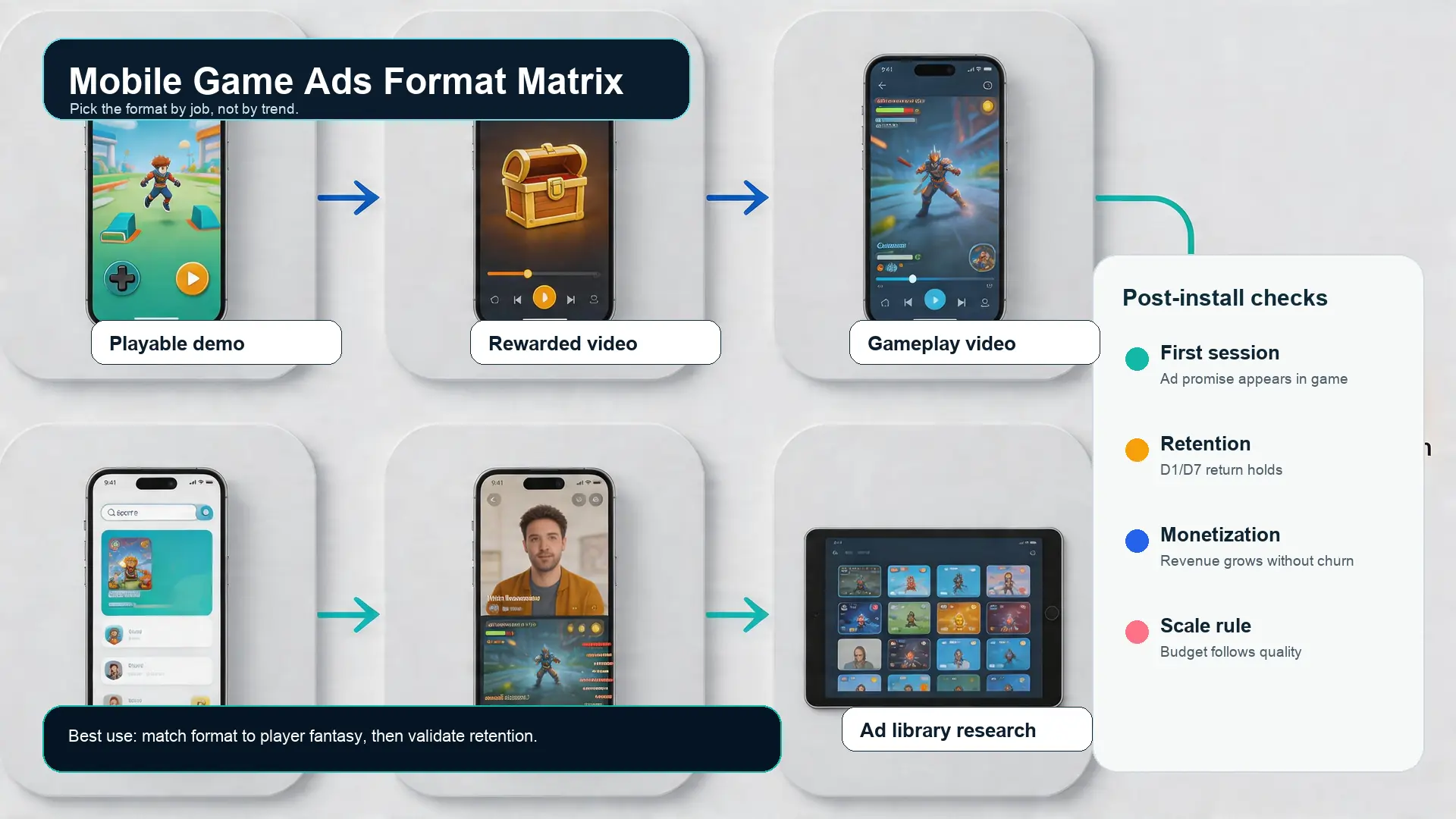
Use the format matrix to choose the right creative format before spending on production.
Use this matrix before briefing creatives:
| Format | Best for | What it must prove | First KPI to watch |
|---|---|---|---|
| Short gameplay video | Most genres | The core loop is understandable and satisfying. | CTR and store conversion |
| Playable ad | Puzzle, merge, hypercasual, strategy-choice mechanics | One action creates an immediate result. | Interaction rate and install quality |
| Rewarded video | In-app inventory and monetization networks | The reward moment is clear without misleading the user. | Completion rate and post-install quality |
| UGC or creator reaction | Puzzle, RPG, strategy, casual, social games | A human reaction makes the mechanic emotionally legible. | Hook hold rate and comments |
| App store search ad | High-intent capture | The keyword, ad, and store page match the same promise. | Tap-through and store CVR |
| Influencer gameplay clip | Community-driven, RPG, strategy, simulation, shooter | The creator can show authentic play, not a generic read. | View quality and assisted installs |
| Competitor research board | All paid UA programs | You understand what category winners repeat. | Better briefs before spend |
The most expensive mistake is choosing a format because a competitor used it. Choose the format because it fits the player fantasy and the first-session proof.
For example:
| Player fantasy | Better format | Weak format |
|---|---|---|
| "I can solve this challenge" | Playable or short fail-and-fix video | Cinematic trailer with no interaction |
| "I can collect rare heroes" | Reward reveal, pull animation, creator reaction | Static screenshot carousel |
| "I can dominate other players" | Strategy choice, battle replay, clan moment | Generic install banner |
| "I can relax and transform a space" | Before/after merge or makeover video | Combat-focused montage |
| "I can win rewards fast" | Rewarded video or event offer with real mechanics | Fake multiplier with no in-game match |
Mobile Game Ad Examples From Measured US Fleets (2026)
Format theory is cheap. What follows is what top-charting games actually ran in the United States, measured creative by creative in the AdMapix index over the 30 days to 2026-08-19 and written up in our ad strategy teardown series. Impressions are model estimates; "fleet" means the advertiser's top measured creatives in that window.
| Format decision | What a real fleet did | Why it matters for your brief |
|---|---|---|
| Playable-only launch | Smash Fest! debuted in the top 10 with a top-15 fleet containing zero videos and zero static images: every creative was a playable, seven of them launched inside 48 minutes. | A single-format launch is viable when the mechanic is one-tap and the first session matches the playable. |
| One playable at extreme scale | Pixel Flow! ran one playable to 2.3 billion US impressions in a single 30-day window, 78% of its top-fifteen fleet. | Concentration is normal at the top. Budget for one winner and many test creatives, not fifteen equal bets. |
| Video master reused across many entries | Gossip Harbor: fifteen ad entries resolve to fourteen video files, and one 25-second file carries 70.5% of all delivery. Block Out! ran a 12.2-billion-impression fleet on just four distinct videos. | Count distinct assets, not ad rows, when you audit a competitor. One video with many end cards is one idea. |
| Video plus playable end-card recombination | Jewel Coloring: seven video masters and five playable masters recombined; one 54-second video runs under four end cards. Block Craft 3D pairs one video with 67 different playable end cards. | The end card is a test variable in its own right. Brief it separately from the video hook. |
| Long-running evergreen creative | Royal Match kept a 119-second video live for 305 days; Vita Mahjong has a creative live for 467 days. | "Refresh every N weeks" is not a law. Retire on evidence, using the creative refresh playbook. |
| Synchronised reset | MONOPOLY GO! retired six ads in 31 minutes; Pixel Flow! retired ten and launched three on the same date. | Big fleets rotate in batches. If you monitor competitors weekly, you will see these as step changes, not drift. |
| Steady drip, no batches | Meowdoku reached 637 million impressions with a one-or-two-a-week drip of 27–60-second cat-sudoku videos across two store SKUs. | A calm cadence can hold a top-10 chart position. Volume of ideas beats volume of edits. |
| Long-form drama hook | DramaBox: one 111-second serial video fingerprint contributes 75.5% of top-10 scale; PineDrama multiplexed one 273-second video under seven copy lines. | Short-drama apps prove that "keep it under 15 seconds" is a genre rule, not a platform rule. |
| Playable vs video verdict that flips by title | Century Games runs three titles with opposite playable-versus-video outcomes; Mahjong Blast is 92.7% playable. | Decide format per title and per fantasy. A publisher-level doctrine does not exist even inside one company. |
Two patterns repeat across almost every teardown. First, a handful of assets carry most of the delivery, so the interesting question is always "which one, and why", not "how many". Second, the number of ad rows overstates the number of ideas: fleets of thirty entries routinely resolve to ten or twelve distinct files. Both patterns shape the research workflow later in this guide.
Mobile Game Ad Examples By Creative Angle
You do not need to copy competitor ads. You need to understand the angle that makes them work. The six angles below apply across every channel. For Meta-specific angles such as fail-and-fix, live-ops events, and comeback retargeting, see Meta ads creative for mobile games.
1. The Challenge Hook
This is the classic puzzle, trivia, word, merge, and hypercasual angle: "Can you solve this?" The ad shows a visible problem, a near-fail state, or a wrong choice. The viewer keeps watching because the solution feels close.
Use it when:
- The mechanic can be understood in under three seconds.
- One move changes the visible state.
- The viewer can mentally play along.
Brief template:
| Element | Example direction |
|---|---|
| Opening | Show a nearly failed level, not a menu screen. |
| Tension | Add a timer, locked path, bad move, or opponent. |
| Payoff | Solve the level or show the mistake. |
| Store match | The first screenshot should show the same mechanic. |
Avoid the trap: if the advertised challenge is not in the real game, the ad may win clicks and lose retention. Our analysis of fake mobile game ads covers what that trade-off looks like at scale.
2. The Progression Hook
Progression ads work for RPG, simulation, merge, decoration, strategy, idle, and tycoon games. The ad shows a player moving from weak to strong, messy to clean, empty to upgraded, or base to empire.
The best version is visual. Viewers should understand the before/after without reading.
Good progression signals:
- Level 1 to level 50.
- Small base to defended city.
- Broken room to renovated room.
- Weak hero to evolved hero.
- Empty inventory to rare collection.
This angle needs retention discipline. If the ad promises satisfying progress but the game gates that payoff too late, installs may churn before the fantasy arrives.
3. The Reward Hook
Reward hooks are common in mobile gaming advertising because rewards compress value into one moment. They can work for daily bonuses, event pulls, starter packs, battle passes, rewarded video, or limited-time return campaigns.
The stronger version explains why the reward matters:
| Weak reward ad | Strong reward ad |
|---|---|
| "Claim 1,000 coins" | "Claim 1,000 coins to unlock the first rare upgrade." |
| "Free hero" | "Free healer fixes the stage most new players fail." |
| "Watch ad for reward" | "Watch once, revive, and finish the boss." |
Reward ads should be precise. Vague abundance creates low-quality installs.
4. The Social Proof Hook
Social proof works when the audience needs confidence that the game is alive, competitive, or culturally relevant. This can include creator reactions, guild moments, leaderboard tension, comments, ratings, event participation, or friend challenges.
Use it for:
- Strategy and clan games.
- RPG and gacha games.
- Party and social games.
- Competitive puzzle or word games.
- Live-ops events.
Do not fake community if the product cannot support it. The landing page and first session should reinforce the same social proof.
5. The Creator Reaction Hook
Creator ads translate mechanics into emotion. A viewer may not understand your UI, but they understand surprise, frustration, relief, and pride.
Good creator directions:
- "I thought this puzzle was easy."
- "This boss fight changed when I upgraded one skill."
- "I made the wrong merge and lost the event reward."
- "My guild carried this battle in the last 10 seconds."
Bad creator reads sound like generic sponsorship copy. The creator should play, react, and teach the hook.
6. The Playable Demo Hook
Playable ads are strongest when they teach the core loop quickly. They are weakest when they are a fake mini-game unrelated to the actual product.
Use playables when:
- The mechanic is one-tap or drag-and-drop.
- The feedback is immediate.
- The user can win or fail quickly.
- The playable sample matches the first-session game.
Avoid playables when:
- The game depends on long progression.
- The core loop needs too much explanation.
- The playable is slower than a short video.
- The sample misrepresents the game.
TikTok and other ad platforms still support interactive/playable formats, but the creative principle matters more than the label: the interaction must make the player want the real next turn. For a method to dissect competitor playables step by step, see playable ad analysis for mobile games.
Source: TikTok Ads Help - Playable Ads.
Channel Fit: Where Each Mobile Game Ad Format Belongs
The same mobile game ads should not be copied across every channel. Each surface rewards different behavior.
| Channel | Best role | Creative bias | Risk |
|---|---|---|---|
| Meta | Broad discovery, event optimization, retargeting | UGC, gameplay loops, creator reactions, event offers | Too few creative angles starve the algorithm. |
| TikTok | Fast concept discovery and cultural hooks | Short creator-led, fail states, humor, challenge formats | Overproduced ads can feel native to nobody. |
| Google App campaigns | Broad app promotion across Google surfaces | Strong asset variety across text, image, video, HTML5/playables | Weak store assets reduce campaign learning. |
| Apple Ads | High-intent App Store capture | Keyword-store match, custom product pages, clean screenshots | Poor keyword grouping blurs intent. |
| In-app networks | Gaming audiences and rewarded inventory | Playable, rewarded video, fast gameplay proof | Misleading mini-games can damage quality. |
| Influencers | Trust, community, launch momentum | Authentic gameplay, events, long-form explanation | Generic reads do not create a player reason. |
For Apple Ads, the ad is close to the store decision. That means keyword intent, screenshots, and custom product pages matter. For Meta and TikTok, the first three seconds matter more. For in-app networks, playable friction and reward clarity matter. For Google App campaigns, asset variety and conversion events matter because the system learns across surfaces.
Sources: Google Ads app campaigns, Apple Ads, Apple custom product pages.
Mobile Game Video Ad Tools: What Each Job Needs
"Mobile game video ad tool" covers three different jobs. Buying one product for all three is the usual mistake.
| Job | What the tool must do | Where to look |
|---|---|---|
| Research: see what competitors run | Show creatives at advertiser and asset level, distinguish video from playable, record first-seen and last-seen dates, deduplicate reused files | Official ad libraries (Meta, TikTok, Google) for one advertiser at a time; an ad intelligence index such as AdMapix for cross-advertiser and US coverage |
| Production: make the videos and playables | Templates for vertical gameplay capture, captions, end cards, and HTML5 playable export that passes each network's size limit | Your creative team's editor and a playable builder; check each ad network's playable specification before committing |
| Measurement: know which creative earned quality installs | Creative-level attribution, retention and payer cohorts, fatigue curves | Your MMP and ad platform reports; competitor libraries cannot tell you this |
Research tools describe what was observed in the market. They do not report a competitor's spend, ROAS or retention, and observed scale is not proof that a creative was profitable. Use them to find hypotheses worth a brief, then let your own measurement decide.
Competitor Research Workflow Before Launching Ads
The goal of competitor research is not to copy. The goal is to reduce blind creative spending.
Run this workflow before every major campaign:
- Pick 10 to 20 direct and adjacent competitors.
- Collect ads that appear to be active, repeated, or long-running.
- Deduplicate by asset, not by ad row. The teardowns above show thirty entries collapsing to twelve files; count ideas, not rows.
- Tag the first three seconds: hook, visual, emotion, gameplay moment.
- Tag the promise: challenge, progression, reward, community, power, relaxation.
- Tag the format: UGC, gameplay, playable, cinematic, store-search, influencer.
- Compare store pages: do screenshots, video, subtitle, and ratings match the ad?
- Identify gaps: what player fantasy is overused, underused, or poorly executed?
- Turn findings into original briefs, not duplicates.
Use public sources first:
| Source | What to inspect |
|---|---|
| Meta Ads Library | Active social creatives, page-level patterns, hooks. |
| TikTok Creative Center or the TikTok Commercial Content Library | Native video pacing, creator formats, trend language. |
| Google Ads Transparency Center | Search, YouTube, display-style competitor signals. |
| Apple App Store and Google Play | Screenshot order, video, ratings, title/subtitle match. |
| AdMapix teardowns and reports | Cross-market pattern discovery and asset-level fleet measurement. |
If you use AdMapix reports, build a weekly swipe file around repeated patterns. If you do not, a spreadsheet still works. The workflow matters more than the software.
Creative Teardown Scorecard
Score each competitor ad before deciding whether it deserves a test brief.
| Dimension | 1 point | 3 points | 5 points |
|---|---|---|---|
| Hook clarity | Slow or confusing | Clear after several seconds | Clear in the first 2 seconds |
| Gameplay truth | No real mechanic | Partially representative | First-session match is obvious |
| Player fantasy | Generic app pitch | Specific genre benefit | Strong emotional job |
| Format fit | Format fights the message | Format is acceptable | Format makes the hook stronger |
| Store match | Store page contradicts ad | Some asset overlap | Screenshots and video reinforce the ad |
| Differentiation | Common clone | Familiar but improved | Distinct angle worth briefing |
| KPI risk | Likely cheap but low quality | Unclear | Can be measured cleanly |
Any ad scoring high on hook clarity but low on gameplay truth should be treated carefully. It may explain why a competitor gets attention, but it should not be copied without product support.
Turn the scorecard into a brief:
| Brief field | What to write |
|---|---|
| Player fantasy | The emotional job, not the genre label. |
| Opening visual | What the viewer sees first. |
| Core action | What happens in the game. |
| Format | UGC, playable, gameplay loop, influencer, search ad. |
| Store match | Screenshot or custom product page to pair with it. |
| Primary KPI | CTR, CVR, retention, payer event, ROAS, or event completion. |
| Kill rule | What result stops the test. |
Testing Plan And KPI Guardrails
Mobile game ads need enough creative volume to learn, but not so much volume that teams lose control of the hypothesis.
A useful starting plan:
| Stage | Creative volume | Goal | Stop condition |
|---|---|---|---|
| Concept test | 6 to 10 angles | Find hooks with attention | No hook beats baseline hold rate or CTR. |
| Format test | 2 to 4 formats per winning angle | Learn whether playable, UGC, or gameplay wins | Same promise loses quality across formats. |
| Store match test | 2 to 3 screenshot/video variants | Improve conversion after click | CVR gain does not hold after retention check. |
| Scale test | 3 to 5 strongest creative sets | Validate spend durability | CPI improves but retention or payer quality drops. |
Track these KPIs by creative angle, not only by channel:
| KPI | Why it matters |
|---|---|
| Thumb-stop or hook hold | Shows whether the first seconds work. |
| CTR | Shows interest, but not install quality. |
| Store conversion rate | Shows whether the click promise matches the store. |
| CPI | Useful only with retention and monetization context. |
| Tutorial completion | Shows first-session fit. |
| D1/D3/D7 retention | Reveals whether the ad attracts the right cohort. |
| Rewarded-ad engagement | Matters for hybrid monetization. |
| First purchase or payer event | Early LTV direction. |
| Creative fatigue speed | Shows how fast the concept decays. Compare against measured creative lifespan benchmarks before assuming a fixed refresh cadence. |
One rule protects budget: never scale a mobile game ad on CPI alone. A misleading ad can make CPI look good while hurting retention, reviews, and store conversion.
Common Mobile Game Ads Mistakes
Mistake 1: Starting from the channel instead of the player fantasy. "We need TikTok ads" is not a brief. "We need a creator-led fail state for level-based puzzle players" is closer.
Mistake 2: Copying fake mobile game ads without the product to support them. The ad may win attention, but the first session pays the debt.
Mistake 3: Treating playables as magic. A bad playable is just a slow ad. Use playables when interaction teaches the core loop faster than video.
Mistake 4: Separating paid UA from ASO. Ads, screenshots, videos, ratings, and custom product pages should reinforce the same promise.
Mistake 5: Testing edits instead of ideas. Changing a background color is not a new angle if the hook, fantasy, and format are unchanged.
Mistake 6: Ignoring post-install quality. The ad is not successful until the cohort behaves like the audience you want.
Mistake 7: Counting competitor ad rows as competitor ideas. Thirty entries that resolve to ten files is ten ideas. Audit at asset level or you will overestimate how much a rival is really testing.
FAQ
What are mobile game ads?
Mobile game ads are paid or sponsored creatives used to attract players to a mobile game. They can include gameplay videos, UGC clips, playable ads, rewarded video ads, app store search ads, influencer content, display ads, and retargeting ads. The best mobile game ads communicate a player fantasy and match the first-session experience.
Which ad format works best for mobile games?
There is no universal best format. Playable ads work well when the mechanic is simple and interactive. UGC works when a human reaction explains the emotion. Gameplay videos work when the loop is visually clear. Store search ads work for high-intent users. The right format depends on genre, player fantasy, channel, and KPI. The measured fleets above show the verdict flipping even between titles from the same publisher.
Are playable ads still effective?
Playable ads are still effective when they teach the core loop quickly and honestly. They are weaker when the playable mini-game does not match the actual game, takes too long to load, or requires too much explanation. In 2026 several top-charting US puzzle titles ran fleets that were mostly or entirely playable.
How do you research competitor mobile game ads?
Use public ad libraries, ad transparency centers, app stores, and ad intelligence tools. Deduplicate by asset, then tag competitor ads by hook, format, player fantasy, offer, store-page match, and likely KPI. Turn repeated patterns into original briefs rather than copying the creative.
What KPIs should mobile game advertisers track?
Track hook hold, CTR, store conversion rate, CPI, tutorial completion, D1/D3/D7 retention, rewarded-ad engagement, first purchase events, payer quality, and creative fatigue. CPI is useful only when paired with quality metrics.
How many creatives should a game launch with?
Early tests often need 6 to 10 distinct angles, with 2 to 4 formats or variants for the strongest angles. The exact number depends on budget and genre. The key is to test different ideas, not dozens of tiny visual edits.
How are mobile game ads different from general app ads?
Mobile game ads sell an interactive fantasy, not just a utility. They need to show action, emotion, progression, reward, or social competition quickly. They also require tighter alignment with first-session gameplay because misleading installs can damage retention.
Conclusion
Good mobile game ads are not random creative swings. They are a system: research competitor patterns at asset level, choose the format that fits the player fantasy, pair the ad with the right channel and store assets, then scale only when post-install quality agrees with acquisition metrics.
If you want to shorten the research step, sign in to AdMapix and search the titles from the teardowns above to see their current fleets, or start from the ad strategy teardown series and build your next mobile game ad brief from live category patterns. If not, keep the process anyway: format, fantasy, channel, and KPI discipline will protect your budget.
Turn these observations into your next creative study
Open the creative library and select samples for your market, network and research question.
Related Articles
TikTok Ad Library (Commercial Content Library): How to Search It in 2026
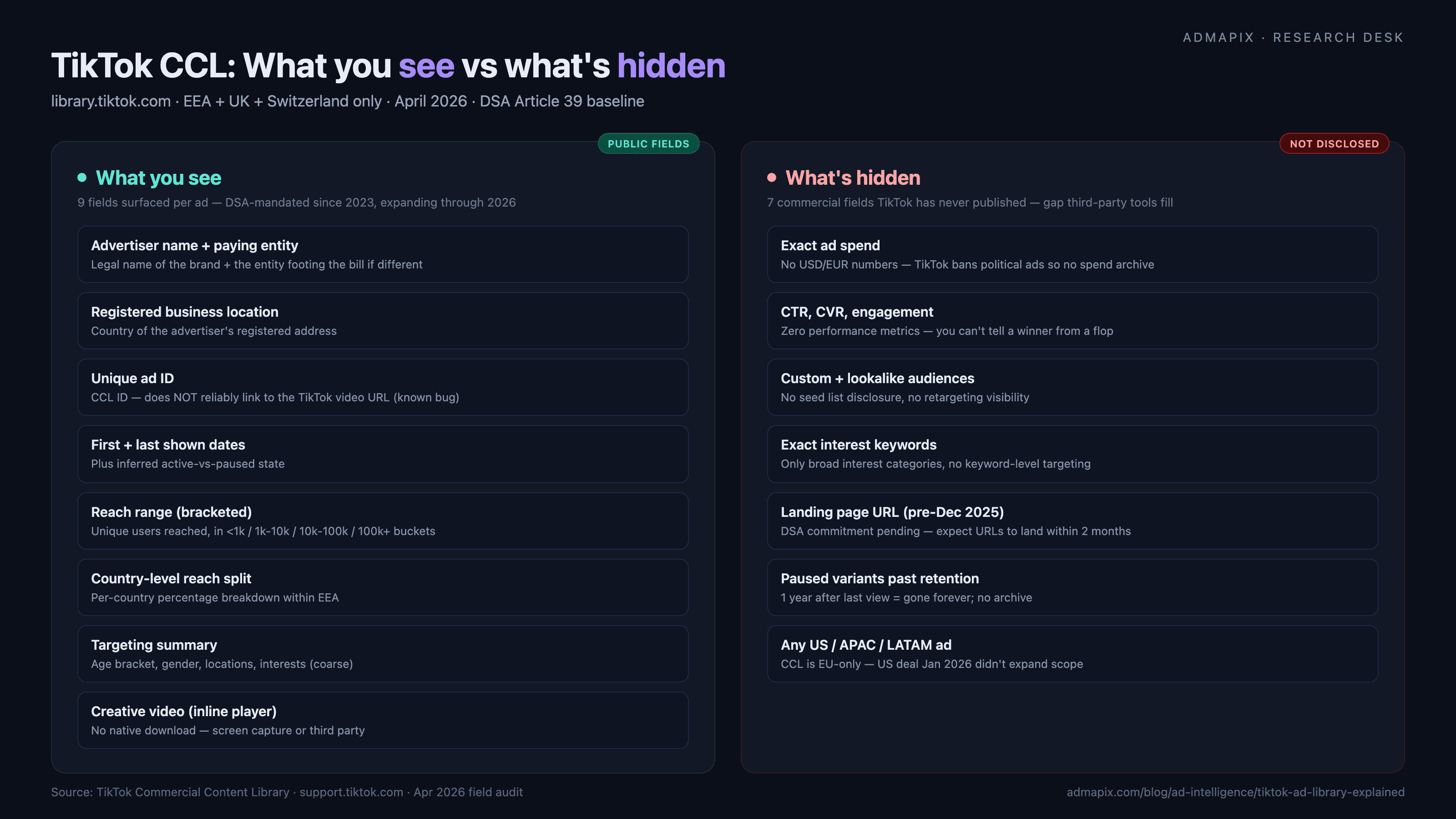
The TikTok Ad Library is the Commercial Content Library at library.tiktok.com. It covers paid ads served in the EEA, UK and Switzerland only. This guide gives the direct URLs, a step-by-step search workflow, every visible and hidden field, retention rules, the December 2025 DSA commitments and what they change during 2026, and when a third-party tool is the right surface instead.
TikTok Ads Research in 2026: 7-Step Workflow + 10 Hook Patterns
A methodology-first TikTok ads research playbook: the free stack, a 30-min weekly SOP, 10 hook patterns advertisers we track actually win with, and a bulletproof brief template.
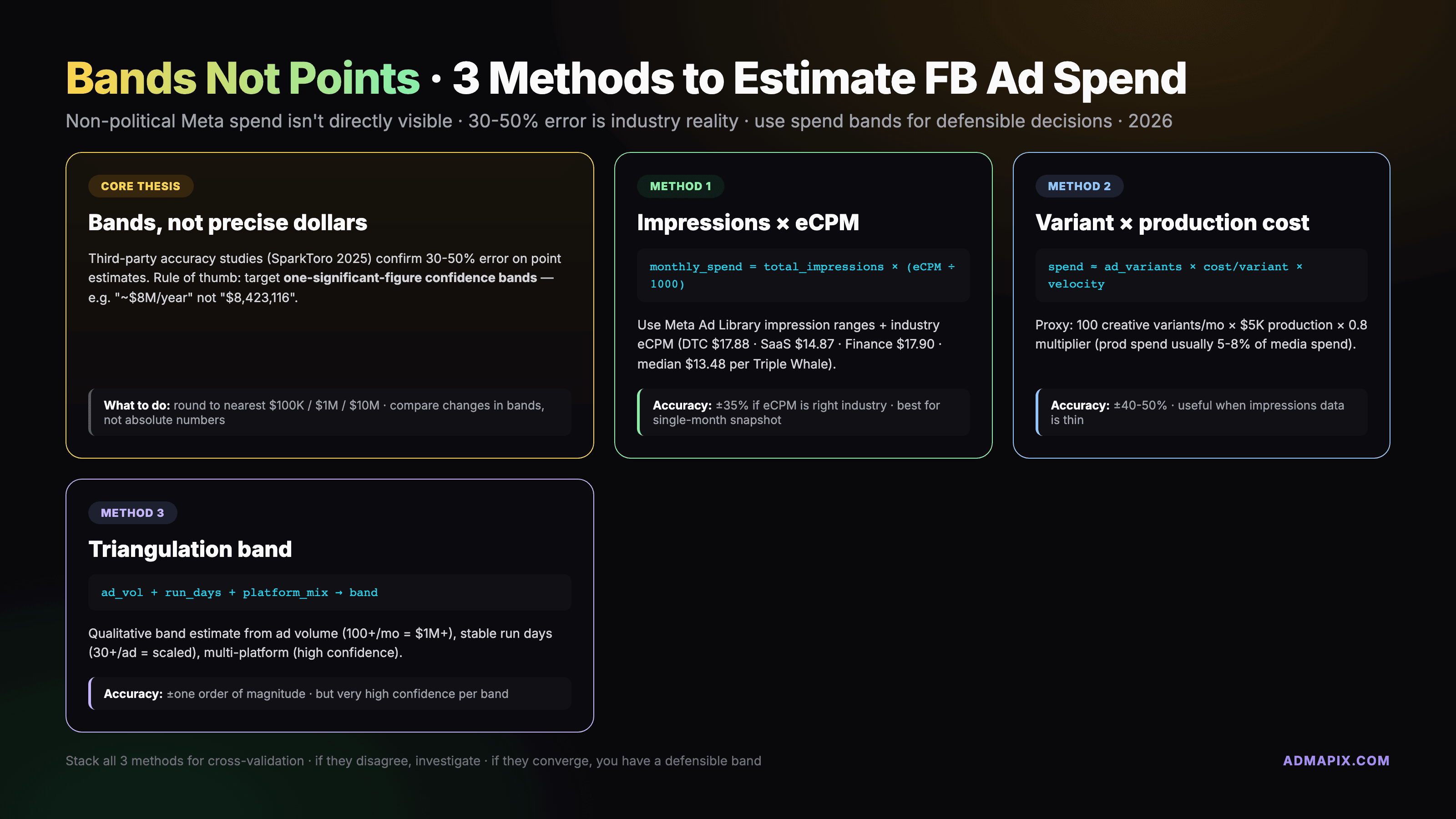
How to Monitor Competitors' Facebook Ad Spend in 2026 (3 Methods + Worked Example)
Non-political Meta ad spend is not publicly visible. Here are three defensible inference methods, a worked $10M DTC example, and the 2026 EU cumulative-spend rollout explained.