
Retargeting Ads Strategy 2026: Segmentation, Frequency, Sequencing & Competitor Intel
A complete 2026 retargeting ads strategy — intent-depth segmentation, frequency and fatigue control, cross-platform sequencing across Meta, Google, and TikTok, creative ladders, post-signal-loss measurement, and how to reverse-engineer competitor retargeting angles from public ad intelligence.
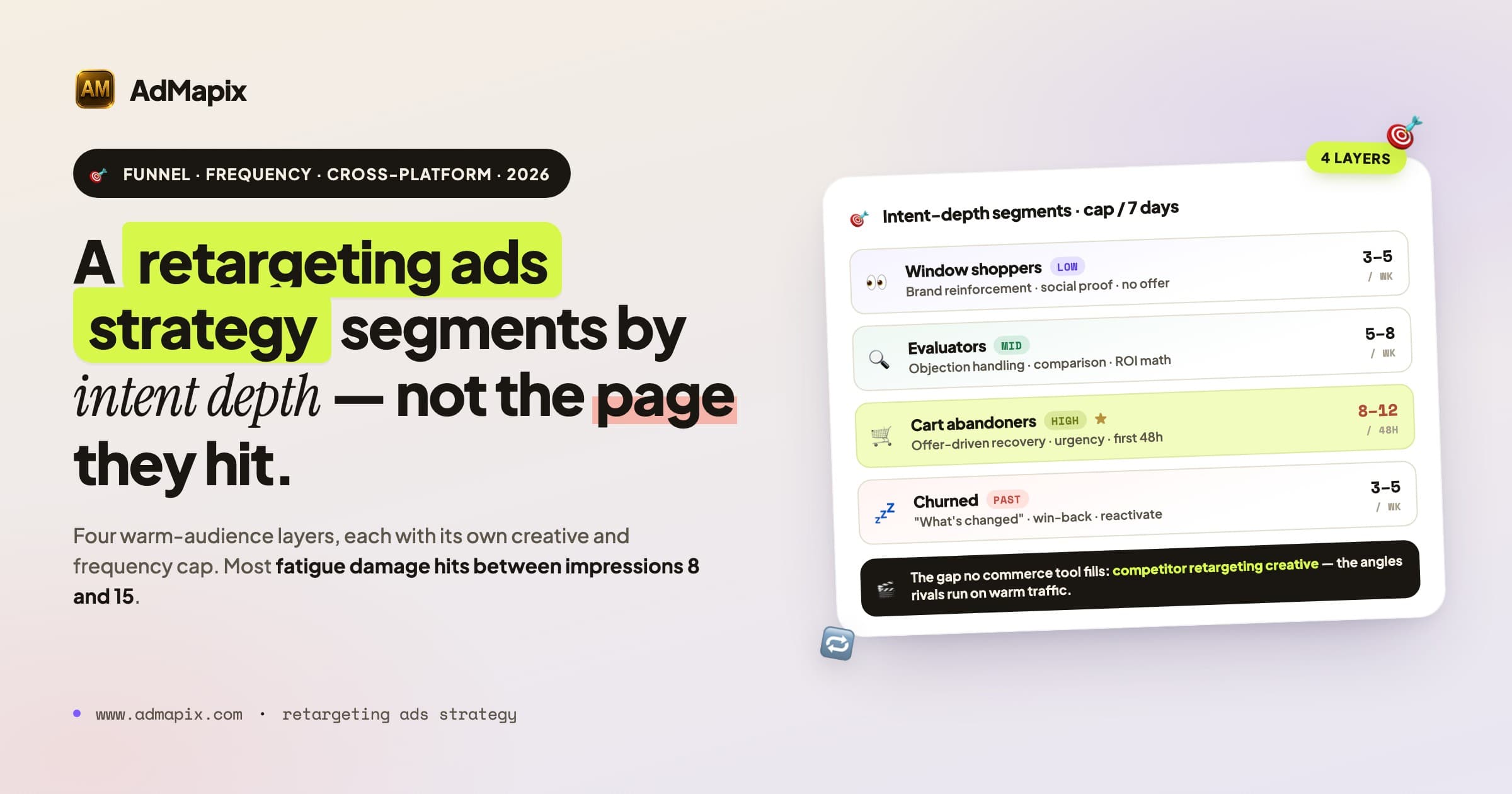
Retargeting Ads Strategy 2026: Segmentation, Frequency, Sequencing & Competitor Intel
By the AdMapix Research Team — Updated June 21, 2026
Most teams set up retargeting the same way they did in 2018: install a pixel, build a "visited the website in the last 30 days" audience, drop the same three creatives on it, and add a discount code for anyone who hit the pricing page. That worked when third-party cookies were reliable, attribution windows were generous, and CPMs on lower-funnel audiences were a fraction of prospecting. None of those conditions hold in 2026. Signal loss from iOS App Tracking Transparency, the long death of the third-party cookie in Chrome, shrinking attribution windows, and platform-side modeled conversions have quietly broken the old retargeting playbook — yet most accounts are still running it on autopilot, mistaking a healthy-looking ROAS dashboard for a healthy business.
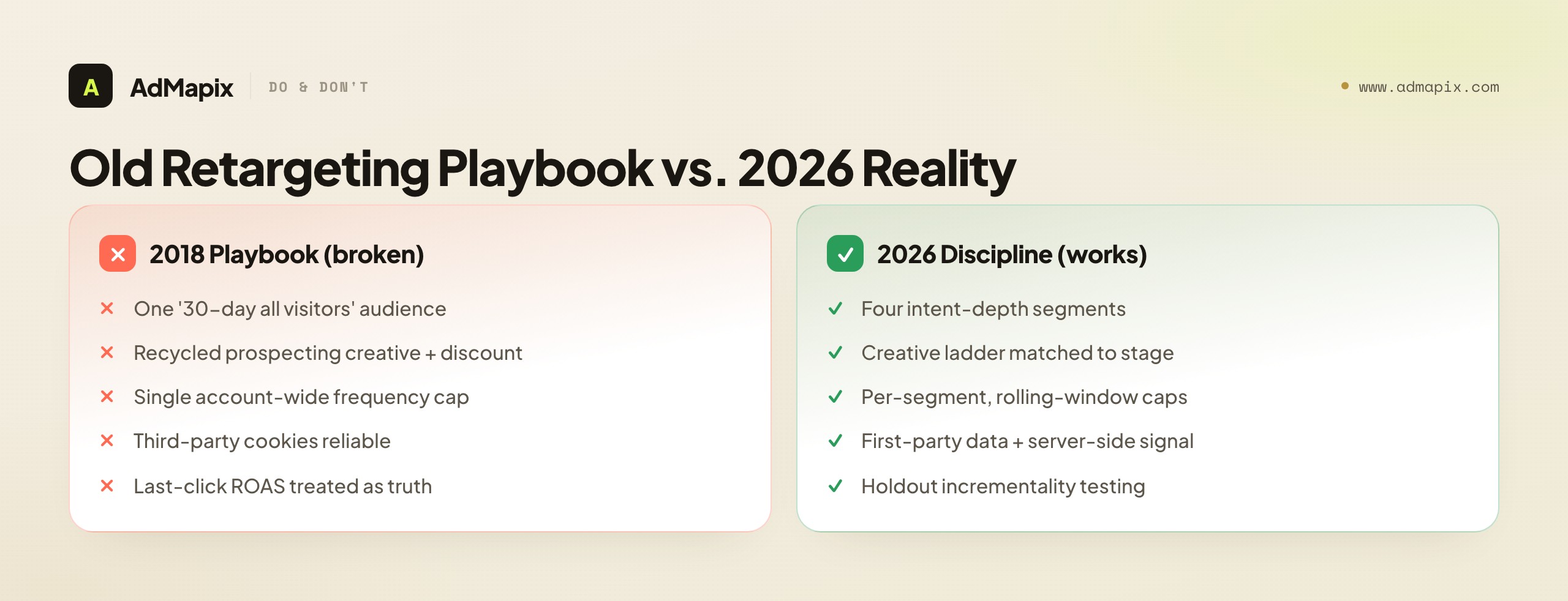
A modern retargeting ads strategy is not a setting in your ads manager. It is a distinct discipline with four moving parts that have to be designed together: how you segment warm audiences by intent depth rather than by page label, how you control frequency so you re-engage without burning goodwill, how you sequence creative across Meta, Google, and TikTok instead of blasting one ad everywhere, and how you measure whether any of it is actually incremental in a world where deterministic tracking is mostly gone. This guide walks through all four, plus the part almost no one does systematically: using public competitor ad intelligence to reverse-engineer what angles your rivals are testing on their warm audiences, so you can find the retargeting gaps they have left open. We have analyzed how thousands of brands structure their lower-funnel creative, and the pattern is consistent — the teams that win at retargeting in 2026 treat it as competitive signal intelligence, not as a remarketing afterthought bolted onto acquisition.
<!-- admapix-data:v1 -->The Landing Page Is the Least Observable Layer in Retargeting (AdMapix Data)
Retargeting debates centre on creative and frequency because those are the two layers you can see. The conversion layer is the opposite: over the last 30 days the AdMapix index tracked 101.7K active landing pages, 73.3K of them newly discovered inside that window — 72% new.
Two things you can actually use here:
- Landing pages and image/video creatives are different record types (24.2M image/video creatives in the same window). Page reuse, extra crawling and parsing, and collection coverage can all affect their counts. The totals cannot separate those factors.
- The 72% new-discovery share describes this index. First discovery is not first launch. Changes in collection coverage and crawl frequency also affect the ratio, so it does not measure how quickly advertisers replace landing pages.
The method implication: competitor landing-page changes will not surface on their own — you have to snapshot and revisit them on a schedule. On your own side, if retargeting splits into three audience tiers but lands them all on one page, the segmentation is half-built. That is one of the few checks that needs no competitor data at all.
Source: the AdMapix creative index, 2026-08-09 to 2026-09-08. All figures are counts of creatives active within that window, not lifetime totals. Create a free AdMapix account to inspect currently indexed records →
<!-- /admapix-data -->TL;DR — Retargeting Ads Strategy in One Screen
- Retargeting in 2026 is a separate strategy, not a safety net. It needs its own segmentation, frequency rules, cross-platform creative sequence, and incrementality measurement — designed together, not bolted onto acquisition.
- Segment by intent depth, not by page visited. Window shoppers, evaluators, cart/checkout abandoners, and churned customers behave differently and need different creative, offers, and frequency caps. Behavior depth beats URL labels every time.
- Frequency is a budget allocator, not a vanity metric. Most fatigue damage happens between impressions 8 and 15 on a warm audience; cap by segment and by 7-day window, and rotate creative before the curve flattens.
- Sequence creative across platforms instead of cloning it. Meta carries the heavy retargeting load, Google captures branded and comparison demand at the moment of search, and TikTok re-engages with native-feeling reminder content. Each platform plays a role in the sequence.
- Signal loss changed the audience-building layer, not the strategy. Lean on first-party data, CAPI/server-side events, modeled conversions, and platform-native tools (Advantage+, Performance Max) — but verify them with holdout incrementality tests, because modeled retargeting credit is the easiest number to inflate.
- Reverse-engineer competitor retargeting from public ad libraries. Retargeting ads leak identifiable signals — objection handling, urgency, comparison language, platform-only placement — and the gaps competitors leave are your highest-leverage angle tests. AdMapix sits in the competitor retargeting creative research layer.
Why Most Retargeting Ads Strategy Is Still Backward
Walk into almost any mid-sized ads account and the retargeting setup looks identical. There is one "all site visitors, 30 days" audience. There are two or three creatives that were duplicated from the prospecting campaign with a discount slapped on. There is a single frequency cap, if any, applied account-wide. And there is a ROAS column in the reporting view that looks fantastic — because of course it does. You are advertising to people who already raised their hand. The dashboard is measuring the wrong thing, and the strategy is optimizing toward the wrong outcome.
The core error is treating retargeting as a recovery mechanism for acquisition rather than as a strategy in its own right. Under the recovery-mechanism mental model, the only question is "how do we catch the people who didn't convert the first time?" That framing leads directly to the lazy setup: one broad audience, recycled creative, a blanket discount. It ignores the two levers that actually move retargeting performance — segmenting warm traffic by how much intent the behavior reveals, and designing creative and offers that match each intent level instead of treating a 30-second blog reader the same as someone who started checkout.
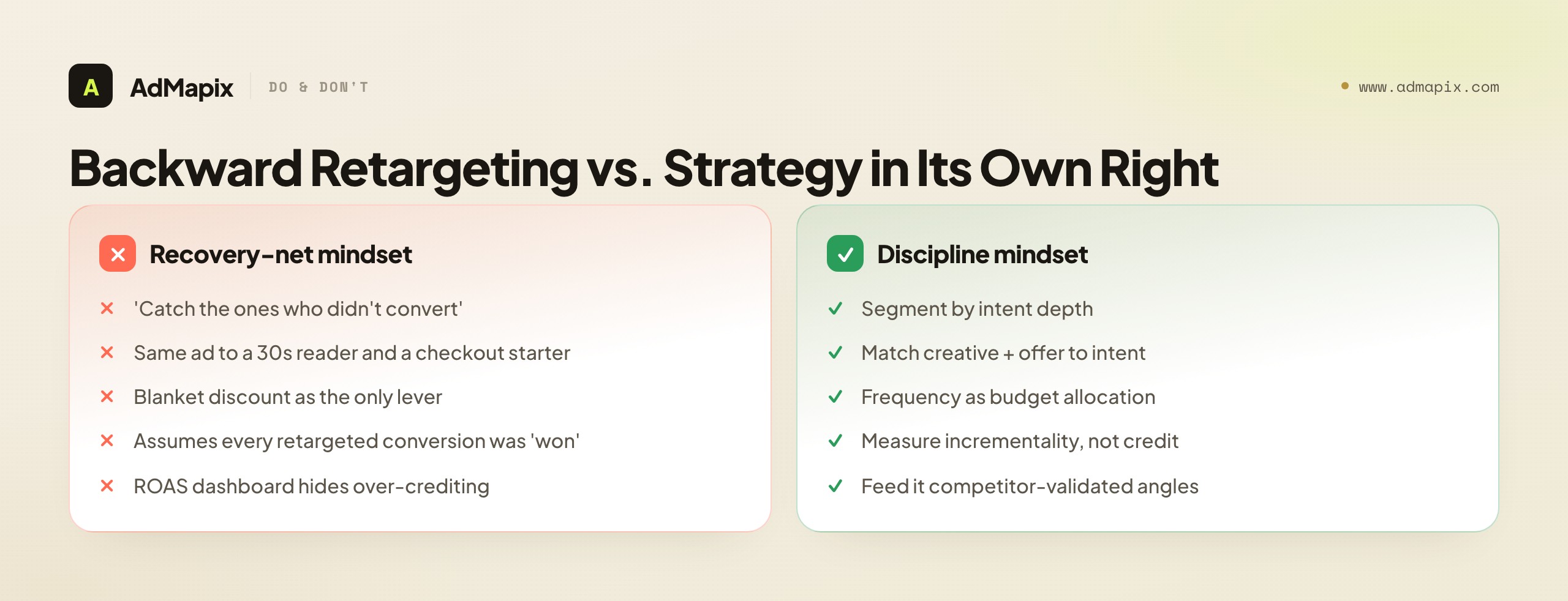
There is a second, subtler error baked into the backward approach: it assumes retargeting is additive by default. The implicit belief is that any conversion that comes through a retargeting ad is a conversion you "won" with retargeting. But a meaningful share of those conversions would have happened anyway — the person already decided to buy, then saw your ad, then bought, and the platform happily claimed credit. This is the incrementality problem, and it is the difference between retargeting that grows your business and retargeting that merely narrates growth you already had. We will spend a full section on how to separate the two, because in 2026 — with modeled conversions filling the gaps left by signal loss — the temptation to over-credit retargeting has never been stronger.
The fix is structural, not tactical. You do not fix backward retargeting by writing better ad copy or finding a cheaper audience. You fix it by rebuilding the strategy around four pillars: intent-depth segmentation, frequency and fatigue control, cross-platform creative sequencing, and incremental measurement under signal loss — informed by competitor retargeting intelligence so you are testing angles the market has validated rather than guessing in isolation. The rest of this guide is those pillars, in order.
It is worth naming why the backward setup persists despite being so obviously broken, because the reasons tell you what to defend against. The first reason is inertia disguised as performance: the broad-audience setup posts a high ROAS, so nobody questions it — the number that should trigger scrutiny is instead the number that protects the status quo. The second reason is organizational placement: retargeting usually lives with the same person who runs acquisition, gets the leftover budget and the leftover attention, and inherits the prospecting creative because making net-new lower-funnel creative feels like extra work for a "recovery" channel. The third reason is the absence of a counterfactual: without a holdout, there is no version of the world where you didn't retarget, so there is no way to feel the cost of over-crediting — the missing measurement makes the waste invisible. Each of the four pillars below is, in part, an answer to one of these failure modes: segmentation breaks the "one audience" inertia, frequency control fights the leftover-attention problem, cross-platform sequencing forces net-new creative, and incrementality measurement supplies the counterfactual that makes the whole thing honest.
The Retargeting Funnel: Four Intent-Depth Segments
The single highest-leverage change most accounts can make is to stop segmenting retargeting by which page someone visited and start segmenting by how much intent their behavior reveals. A URL is a weak proxy for intent. Someone who landed on your pricing page from a misleading ad and bounced in eight seconds has lower intent than someone who read three blog posts over twelve minutes and never touched pricing. Behavior depth — time on site, pages per session, scroll depth, repeat visits, micro-conversions — is a far stronger signal than any single page label.
Once you accept that, the retargeting funnel naturally splits into four intent-depth segments, each with its own creative strategy, offer posture, and frequency cap. These are not rigid rules; they are a starting rubric you tune to your sales cycle. A 90-day B2B SaaS cycle stretches the windows; an impulse DTC purchase compresses them. But the shape holds across verticals.
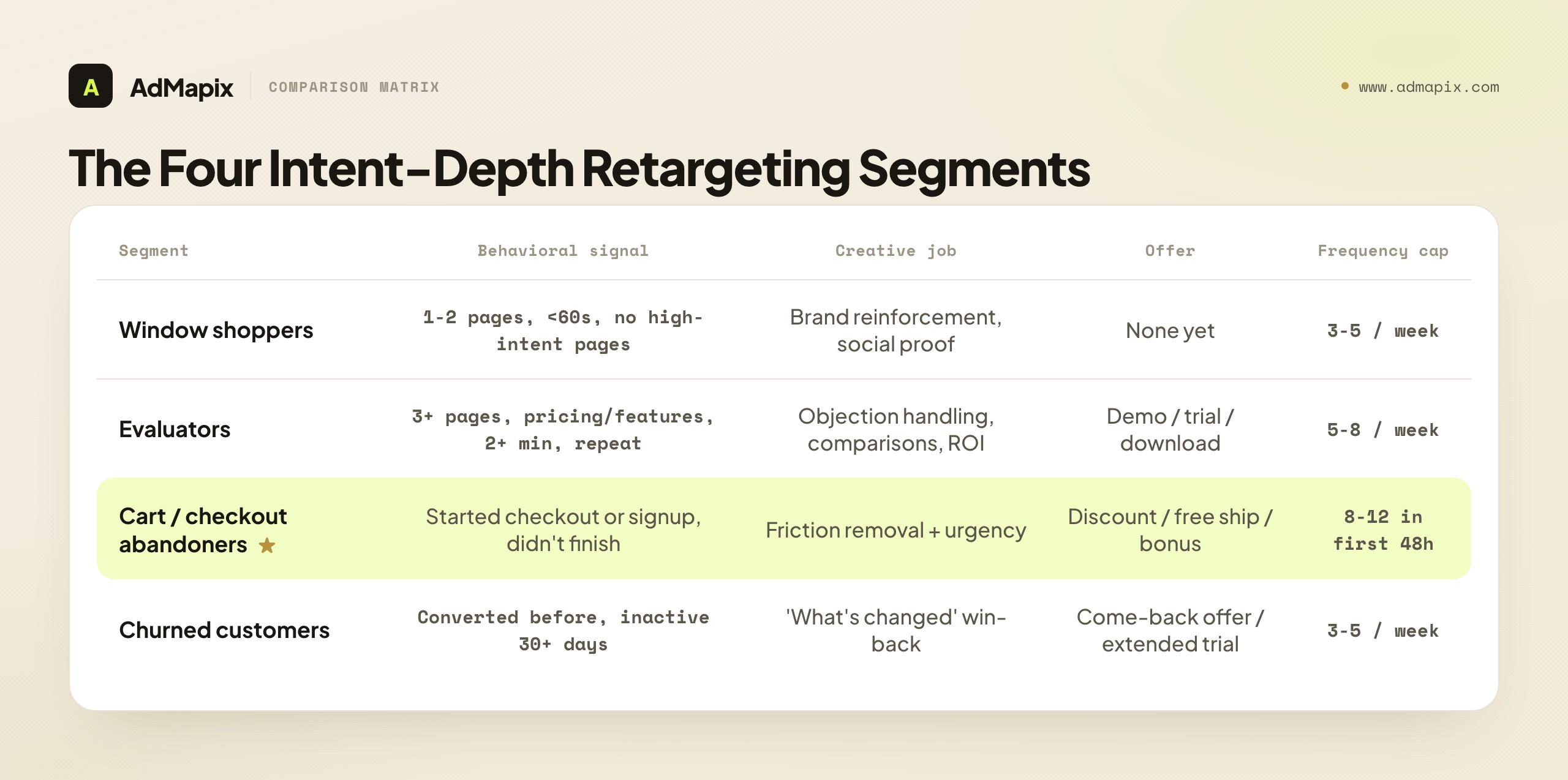
Window shoppers are low-intent browsers — one or two pages, under sixty seconds, no high-intent pages touched. They do not know enough to convert, so pushing an offer is wasted spend. Their job is to come back for a second session, and your creative job is brand reinforcement: social proof, "why us" stories, the product in action. Offer: none yet. Frequency: keep it light, 3–5 impressions per week, because over-serving someone who barely engaged is the fastest way to train them to scroll past you.
Evaluators are mid-intent researchers — three or more pages, time on pricing or feature pages, multiple sessions, two-plus minutes. They are weighing you against alternatives. Their creative needs to do the comparison and objection-handling work: case studies, "vs competitor" framing, ROI math, the answers to the questions that made them hesitate. The offer is a low-friction next step — a demo, a trial, a content download — not a discount. Frequency can climb to 5–8 per week because their engagement justifies more presence.
Cart and checkout abandoners are the highest-intent segment — they started a checkout or a signup and didn't finish. This is the only segment where aggressive frequency and offer-driven creative are clearly justified, and where the first 48 hours matter enormously. Friction removal ("no credit card required," "free returns"), gentle urgency, and a recovery offer (discount, free shipping, bonus feature) belong here. Frequency can spike to 8–12 impressions in the first two days, then taper hard. Beyond about 72 hours, an abandoner who hasn't converted is usually telling you something a discount won't fix.
Churned customers are past converters who have gone quiet — typically inactive for 30-plus days. They already trust you, so the message is not "why us" but "what's changed": product updates, new features, win-back offers, "we miss you" reactivation. Frequency stays modest, 3–5 per week, because hammering a lapsed customer reads as desperation. The win-back segment is also where your CRM and first-party data earn their keep, since you can often match these users deterministically by email rather than relying on cookies.
The discipline here is to build these as four distinct audiences with four distinct campaigns, not one audience with one creative set. The moment you collapse them, you are back to backward retargeting — and you have thrown away the entire reason intent-depth segmentation works.
Frequency, Fatigue, and the Cost of Over-Serving
Frequency is the most misunderstood lever in retargeting. Teams treat it as a number to glance at in reporting when they should treat it as an active budget-allocation decision. Every impression you serve to a warm user is an impression you chose not to serve to someone else — and on retargeting, where the audience is finite by definition, that trade-off is sharp. The audience does not refill quickly; you are recycling the same people, so frequency compounds fast.
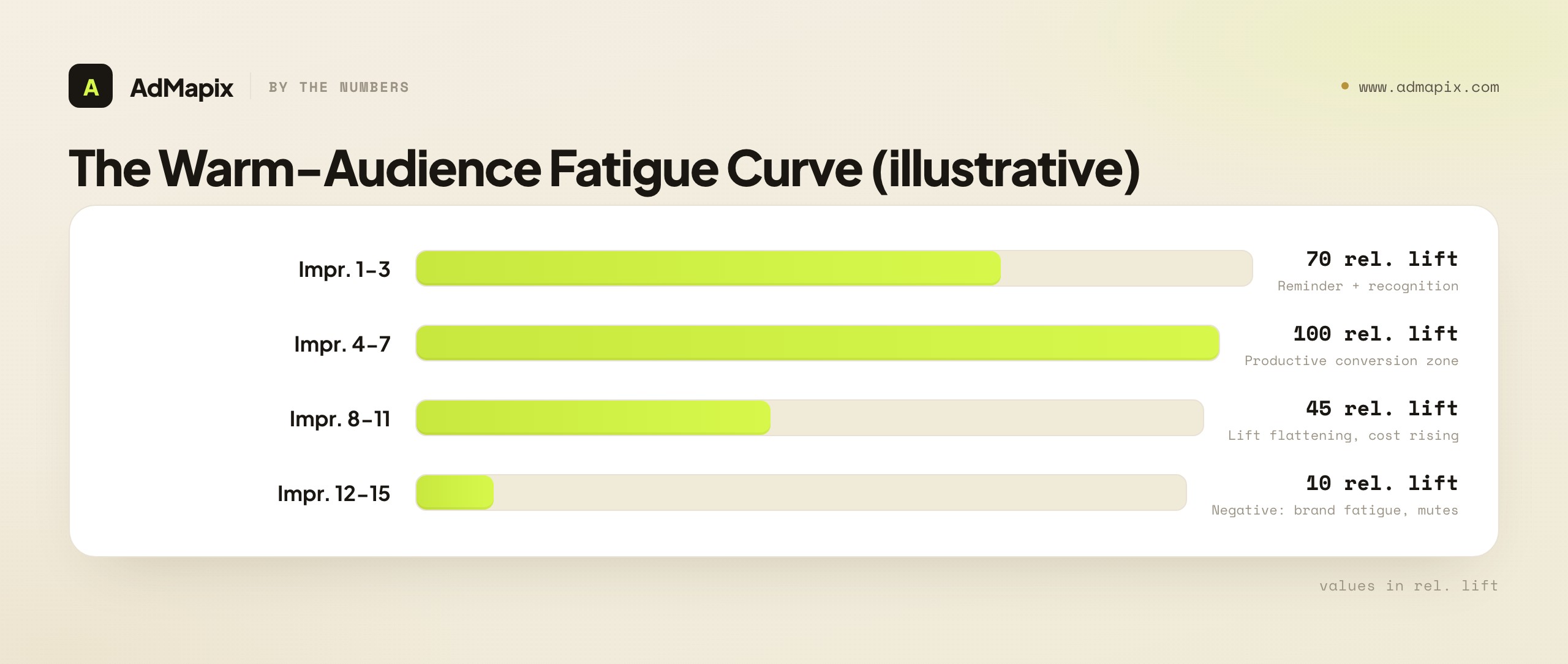
The fatigue curve on a warm audience is steeper than on prospecting because these users already recognize your brand. The first few impressions do useful work — reminder, recognition, a nudge. Then there is a productive middle zone where conversions actually accrue. Then, somewhere around impressions 8 to 15 depending on segment and creative, the curve flattens and turns negative: incremental conversions stop, but cost keeps climbing, and worse, you start generating negative brand sentiment. The user who has seen your cart-abandonment ad eleven times in two days is not closer to buying; they are closer to muting you, hiding the ad, or developing a quiet aversion to the brand. That brand cost never shows up in your ROAS column, which is exactly why over-serving is so common.
Practical frequency control has three parts. First, cap by segment, not account-wide. A cart abandoner can absorb far more frequency in a short window than a window shopper, so a single global cap either starves your hottest segment or floods your coldest one. Second, cap by rolling window, not lifetime. "8 impressions per 7 days" behaves very differently from "8 impressions ever," and the rolling window is what controls the burn rate that actually drives fatigue. Third, rotate creative before the curve flattens. Fresh creative resets the fatigue curve partially — a warm user reacts to a genuinely new angle almost like a new impression — so a library of 4–6 creatives per segment, rotated on a schedule, buys you materially more productive frequency than running two ads into the ground.
There is also a duration dimension that frequency caps alone miss: how long someone stays in a retargeting audience. The default 30-day window is arbitrary. For high-intent segments, the productive retargeting window is often much shorter — a cart abandoner who hasn't converted in 7 days rarely converts because of impression 40 on day 25. Shortening membership windows for hot segments concentrates spend where it works and stops you from paying to chase people who have moved on. Pair short windows on hot segments with longer, lighter-frequency windows on warm and churned segments, and your retargeting budget starts to mirror the actual shape of buyer intent.
Two operational details quietly determine whether your frequency caps work at all. The first is converter suppression. The moment someone converts, they must be removed from every retargeting audience — otherwise you keep paying to advertise a product to people who already bought it, which is both wasted spend and a genuinely bad customer experience (nothing says "we don't know you" like serving a cart-recovery ad to someone who completed the purchase three days ago). Converter suppression sounds obvious, yet it is one of the most common gaps in real accounts, especially across platforms, because a conversion tracked on Meta doesn't automatically suppress the user on Google or TikTok. Build a unified suppression list from your first-party purchase data and push it to every platform, not just the one where the conversion fired.
The second detail is cross-platform frequency blindness. Each platform caps and counts impressions inside its own silo, so a user capped at 8 on Meta, 6 on Google display, and 5 on TikTok is actually seeing roughly 19 of your ads a week while every platform reports a "reasonable" cap. The user's experience of fatigue is the sum, not the per-platform number. You cannot get a perfect cross-platform frequency count without a clean-room or MMM layer most teams don't have, but you can approximate it: assume heavy audience overlap on your warm segments, set per-platform caps lower than you would if each platform were the only one running, and treat any segment running on all three platforms as effectively triple-served. The discipline is to manage the total warm-audience impression load, not three independent numbers that each look fine in isolation.
A final note on creative rotation, because it interacts with everything above. Rotating creative is not just an anti-fatigue tactic — it is also how you keep your test backlog moving. Each new variant in the rotation is both a fresh impression and a data point about which angle works on warm traffic. The teams that rotate creative on a schedule (rather than waiting for a campaign to visibly fatigue) get two compounding benefits: their frequency stays productive longer, and they accumulate a library of validated lower-funnel angles far faster than teams that run two ads until they die. Pair scheduled rotation with the competitor swipe file described later, and your creative supply problem — the usual bottleneck in any serious retargeting program — largely solves itself.
Cross-Platform Retargeting: Meta, Google, and TikTok Each Play a Role
The biggest waste in multi-platform retargeting is treating each platform as a separate place to run the same ad. Meta gets the cart-abandonment creative, Google gets the cart-abandonment creative, TikTok gets the cart-abandonment creative — three clones, three audiences that heavily overlap, and a frequency picture you cannot see because each platform counts impressions in its own silo. The user experiences all of it as one barrage. You experience it as three "well-performing" campaigns that are actually triple-serving the same people.
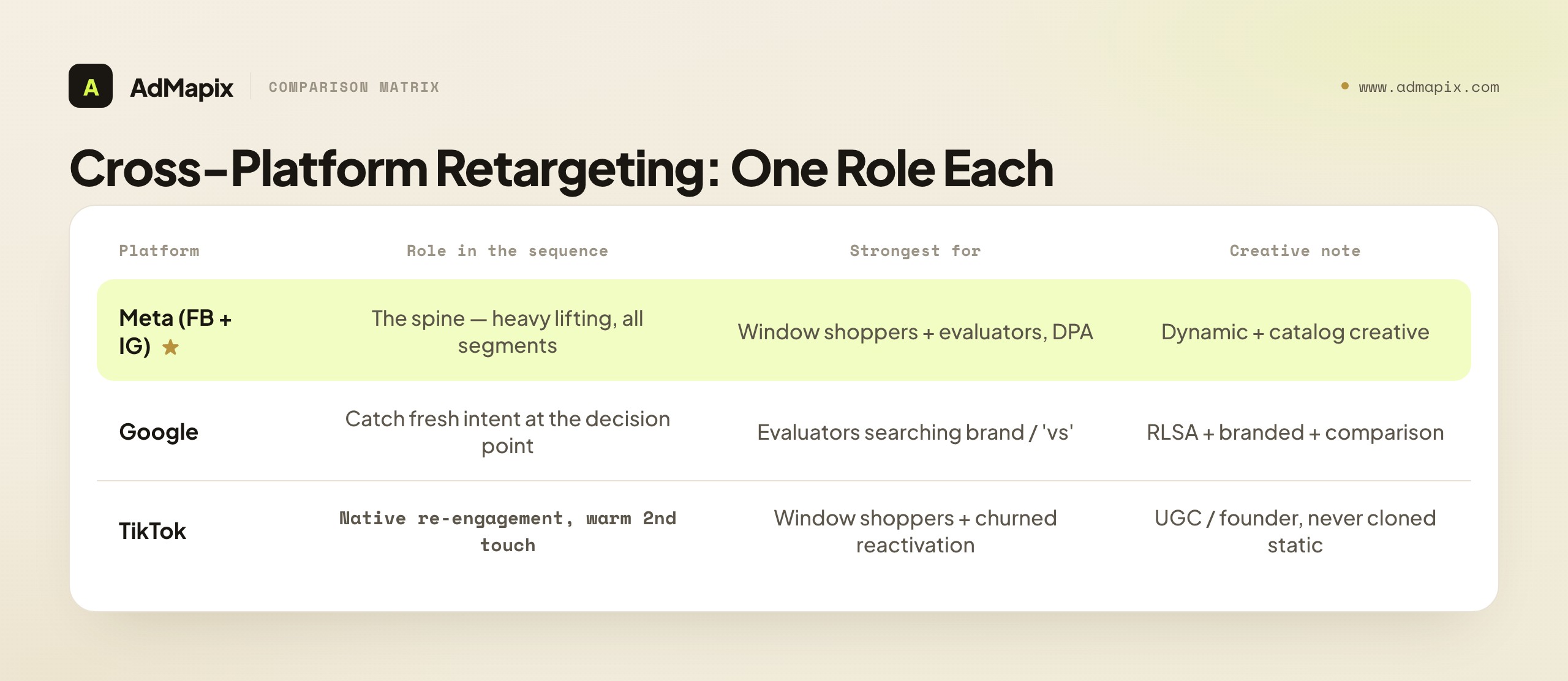
A real cross-platform retargeting strategy assigns each platform a role in a sequence rather than a copy of the message. The three major retargeting surfaces have genuinely different strengths, and the strategy works when you play to them.
Meta (Facebook + Instagram) is the workhorse of retargeting. Its audience-building, dynamic product ads, and placement breadth make it the natural home for the heavy lifting across all four segments — especially window shoppers and evaluators, where you need reach and creative variety. Meta is where your intent-depth segmentation lives most fully, and where dynamic creative and catalog-based dynamic retargeting earn their keep for e-commerce. Treat Meta as the spine of the sequence.
Google retargets at the moment of intent rather than the moment of scrolling. Its unique value is search: a warm user who later Googles your brand name, "[brand] pricing," "[brand] vs [competitor]," or "[brand] alternative" is showing fresh, active intent that no social impression can match. Branded search retargeting, RLSA (remarketing lists for search ads), and Performance Max with retargeting audiences capture demand at the decision point. Google's display and YouTube remarketing add reach, but the search layer is the differentiated piece — it catches the evaluator who has gone off to compare and is now actively looking for a reason to choose you.
TikTok re-engages with content that feels native to the feed rather than like a retargeting ad. The platform punishes obviously-recycled creative, so cloning your Meta cart-abandonment static onto TikTok performs poorly. What works is native-style reminder content — UGC, founder talking-head updates, "here's what you missed," short demos — that re-introduces the product in TikTok's own grammar. TikTok is strongest for window shoppers and churned-user reactivation, where the goal is a warm second impression rather than a hard conversion push.
The sequencing logic ties them together. A prospect engages on TikTok or Meta, gets segmented by intent depth, receives the appropriate Meta creative ladder, and — when they show fresh search intent — gets caught by Google branded and comparison retargeting at the decision moment. To make this work without triple-serving, you need a frequency view that spans platforms (even if approximate), suppression of converters across all three, and creative that is adapted per platform rather than copied. Cross-platform retargeting done well feels to the user like a coherent follow-up; done badly it feels like being followed.
Creative Ladders: Matching Message to Retargeting Stage
If intent-depth segmentation tells you who to talk to, the creative ladder tells you what to say at each rung. The most common creative mistake in retargeting is running one message — usually a discount — across every segment. A discount to a window shopper who doesn't yet understand the product is wasted margin; a "why us" brand story to a cart abandoner who already decided and just needs a nudge is a missed conversion. Each rung needs its own creative job.
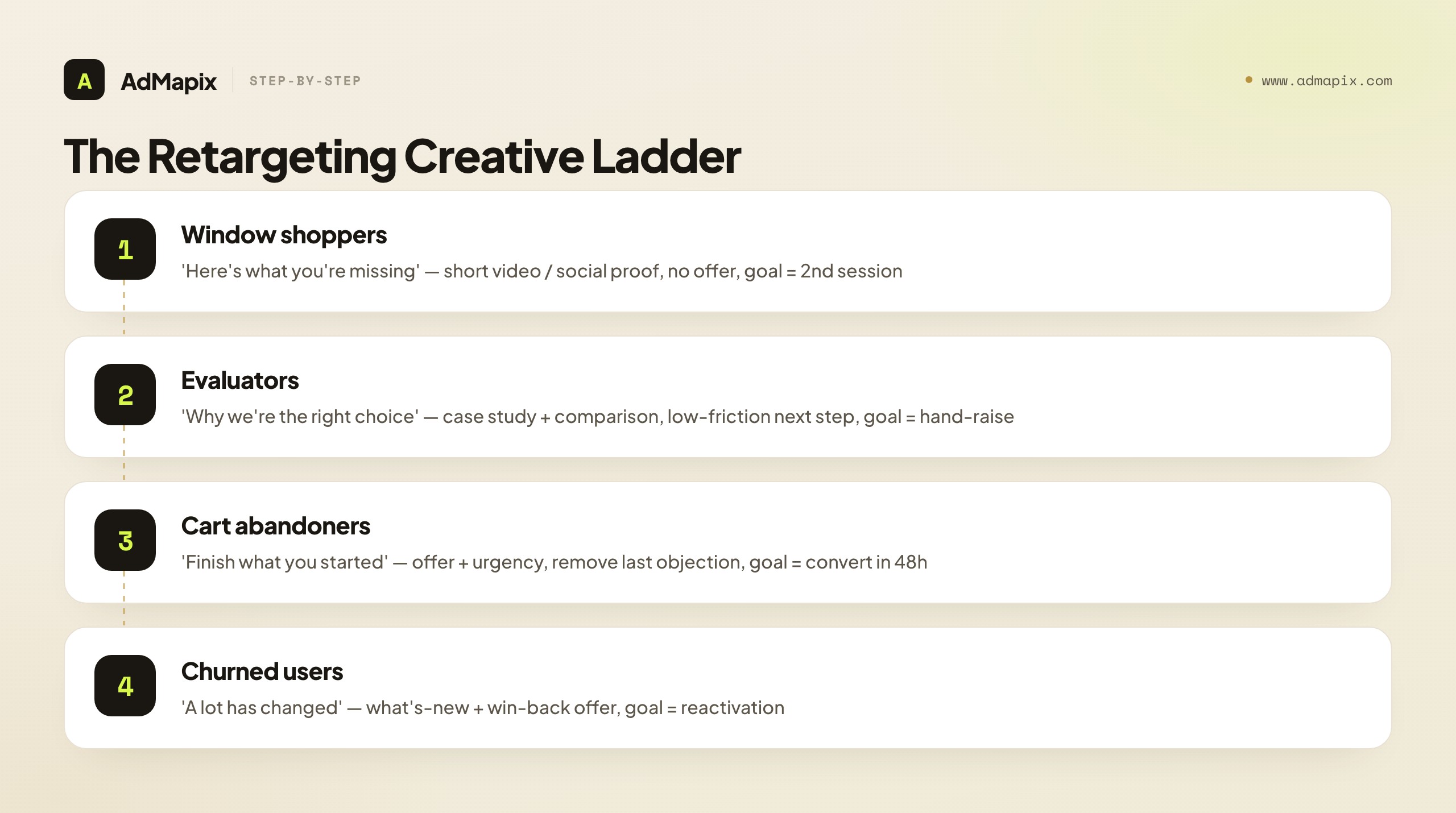
Window shoppers (awareness → consideration): short video (15–30 seconds) or a strong social-proof static. The message is "here's what you're missing" — product in action, a customer result, the core value proposition restated. No offer. The goal is a second session, not a conversion. A good test here is "product demo" creative versus "customer story" creative, because the winner tells you whether your cold audience needs to understand the product or trust it.
Evaluators (consideration → intent): case-study video, comparison content, longer-form proof. The message is "here's why we're the right choice" — objection handling, comparisons, ROI math. The offer is a low-friction next step: demo, trial, content download. The goal is a hand-raise. A productive test is "social-proof angle" versus "numbers/ROI angle," which reveals whether your buyers are convinced by belonging or by math.
Cart and checkout abandoners (intent → conversion): offer-driven static or carousel, plus a short reminder video. The message is "finish what you started" — remove the last objection, add gentle urgency, surface the recovery offer. The goal is conversion inside 48 hours. The highest-value test is "discount" versus "bonus feature/free shipping" as the recovery mechanism, because the answer changes your margin structure: if a non-discount offer recovers nearly as many carts, you keep the margin.
Churned customers (reactivation): "what's new" video, product-update carousel, founder or story content. The message is "a lot has changed since you left." The offer is a come-back deal or extended trial. The goal is reactivation — a login, a second purchase. Test "product update" creative against "we miss you" creative to learn whether lapsed users return for new value or for relationship.
The ladder also has a fatigue dimension baked in. Because warm audiences burn through creative faster, each rung needs not one ad but a small rotating set — typically 3–6 variants that attack the same job from different angles. This is where competitor intelligence becomes a creative-supply engine rather than a strategy input: the fastest way to fill a retargeting creative ladder with validated angles is to study what messages your competitors are running on their warm audiences and which ones they keep alive.
Retargeting After Signal Loss: iOS, Cookies, and the New Audience Layer
Everything above assumes you can actually build these audiences. In 2026, that assumption is where most retargeting strategies quietly break. Apple's App Tracking Transparency cut the deterministic signal from a large share of iOS users; Chrome's long, messy deprecation of third-party cookies has eroded the web-side identity layer; shrinking attribution windows and platform privacy changes have made the old "drop a pixel, build a 30-day audience" approach progressively leakier. The audiences you build today are smaller, fuzzier, and more modeled than the ones you built five years ago — and pretending otherwise is how you end up optimizing against a number the platform invented.
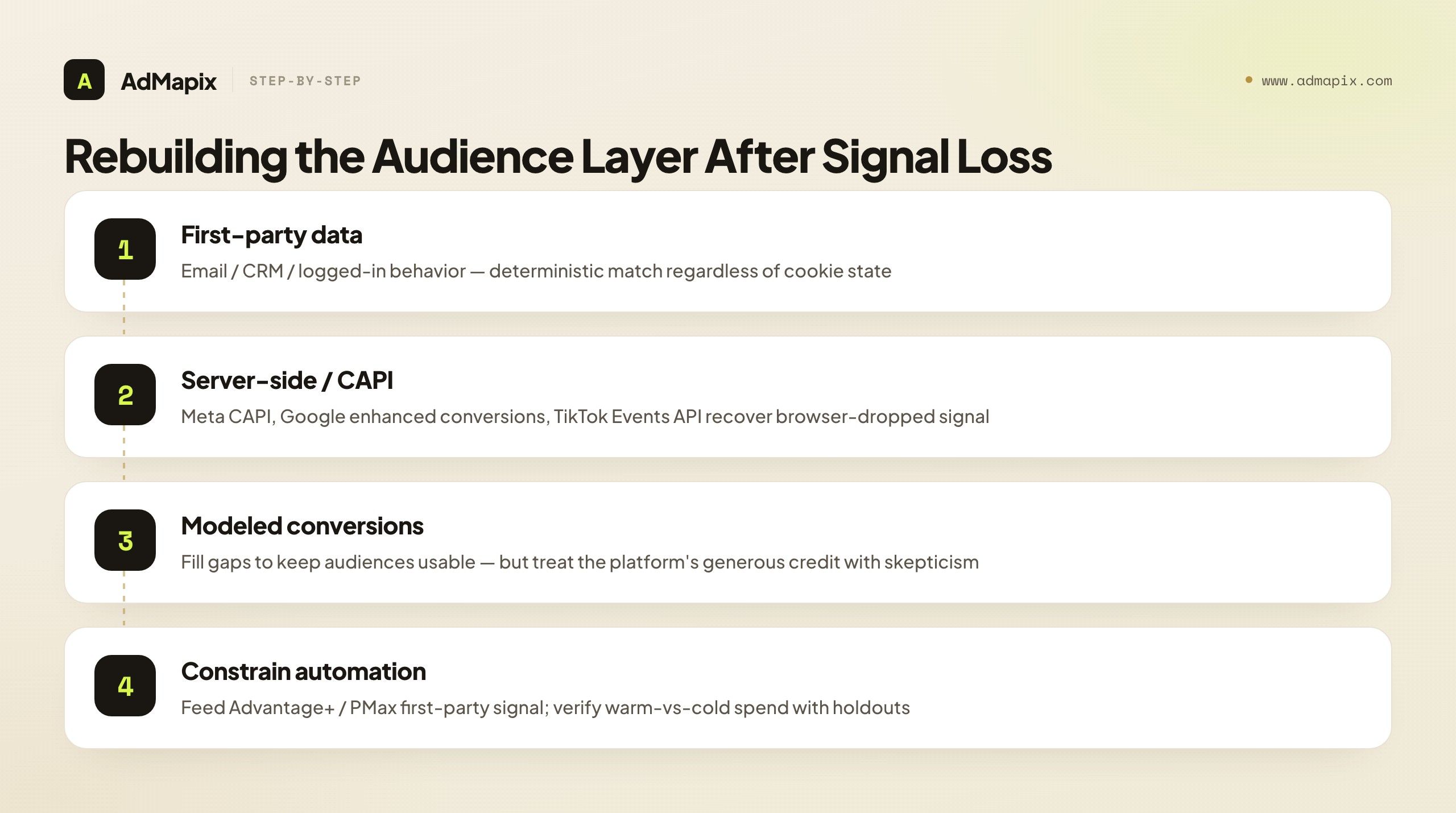
Signal loss changed the audience-building and measurement layers, not the strategy. Intent-depth segmentation, frequency control, cross-platform sequencing, and creative ladders all still apply — you just have to rebuild the plumbing underneath them. The new audience layer rests on four pillars.
First-party data is the new foundation. The most durable retargeting audience in 2026 is built from data you own: email lists, logged-in user behavior, purchase history, CRM segments. These match deterministically (via hashed email) regardless of cookie state, and they are the backbone of churned-customer and high-value-evaluator retargeting. Investing in first-party data capture — newsletter signups, account creation, loyalty programs — is now a retargeting strategy decision, not just a CRM one.
Server-side and CAPI events restore signal the browser dropped. Meta's Conversions API, Google's enhanced conversions, and TikTok's Events API send conversion and behavioral signals from your server rather than from the user's browser, recovering a meaningful share of the events that pixel-only setups lose to ad blockers, ITP, and ATT. A correctly implemented CAPI/server-side layer is now table stakes for retargeting audiences to be large and accurate enough to work.
Modeled conversions fill the gaps — and require skepticism. Platforms increasingly model the conversions they can't observe directly, which keeps retargeting audiences and reporting functional but introduces a confound: the platform has a structural incentive to attribute generously. Modeled retargeting credit is the single easiest number to inflate, which is precisely why the measurement section below insists on holdout testing. Use modeled conversions to operate; use incrementality tests to judge.
Platform-native automation absorbs some of the complexity. Meta Advantage+ and Google Performance Max blend prospecting and retargeting inside automated systems, which can be efficient but also opaque — they will happily spend your budget re-serving warm users and call it new growth. The strategic move is not to refuse automation but to constrain and verify it: feed it first-party audience signals, watch the warm-vs-cold spend split where the platform exposes it, and pressure-test its retargeting claims with the same holdouts you apply to manual campaigns.
Beyond those four pillars, three adjacent capabilities increasingly separate the brands that retarget well after signal loss from the ones limping along. Consent and consent mode is the first: in privacy-regulated markets, whether a user has consented to tracking now directly determines whether they can enter a retargeting audience at all, and platforms' consent-mode implementations model the behavior of non-consenting users rather than tracking them. Getting consent capture right — clear value exchange, well-designed consent flows, server-side consent signaling — is now upstream of retargeting performance, not a legal afterthought. A brand with a 70% consent rate has a structurally larger and cleaner retargeting pool than an otherwise identical brand at 40%.
Data clean rooms are the second. As deterministic cross-party matching disappears, clean rooms (platform-native ones like Meta's and Google's, plus neutral third parties) let you match your first-party data against a platform's in a privacy-safe environment to build audiences and measure overlap without exchanging raw identifiers. For larger advertisers this is becoming the backbone of both audience-building and cross-platform measurement — the only practical way to answer "how much do my Meta and Google warm audiences overlap?" in a post-cookie world. Smaller teams won't run clean rooms yet, but they should understand the direction, because it is where durable retargeting measurement is heading.
Durable identity is the third. Hashed-email-based identity (the same primitive behind CAPI matching and custom-audience uploads) is emerging as the most reliable cross-session, cross-device, cross-platform identifier left standing. The strategic implication is blunt: every email you capture is a retargeting asset that survives cookie deprecation and works across platforms, while every anonymous cookie-only visitor is an asset that degrades by the month. This reframes a lot of seemingly unrelated decisions — gated content, account creation, loyalty programs, even checkout flow — as retargeting-audience investments. The brands quietly winning at retargeting in 2026 are often the ones that spent 2024–2025 maximizing logged-in, identified traffic.
The throughline: signal loss made retargeting audiences smaller and measurement murkier, so the premium on first-party data, server-side signal, and honest incrementality testing has gone up, not down. The brands that treated 2024–2026 privacy changes as a reason to invest in owned data and measurement discipline now have a structural retargeting advantage over the ones still hoping the cookie comes back.
Measuring Incrementality, Not Last-Click Credit
The biggest measurement mistake in retargeting is crediting it for conversions that would have happened anyway. If you retarget someone who already decided to buy, and they buy, the platform reports a conversion and a glorious ROAS — but retargeting added zero value. It captured organic intent and took credit for it. Multiply that across a whole retargeting program and you get the classic trap: a dashboard that looks like a money printer sitting on top of a business that isn't actually growing faster because of it.
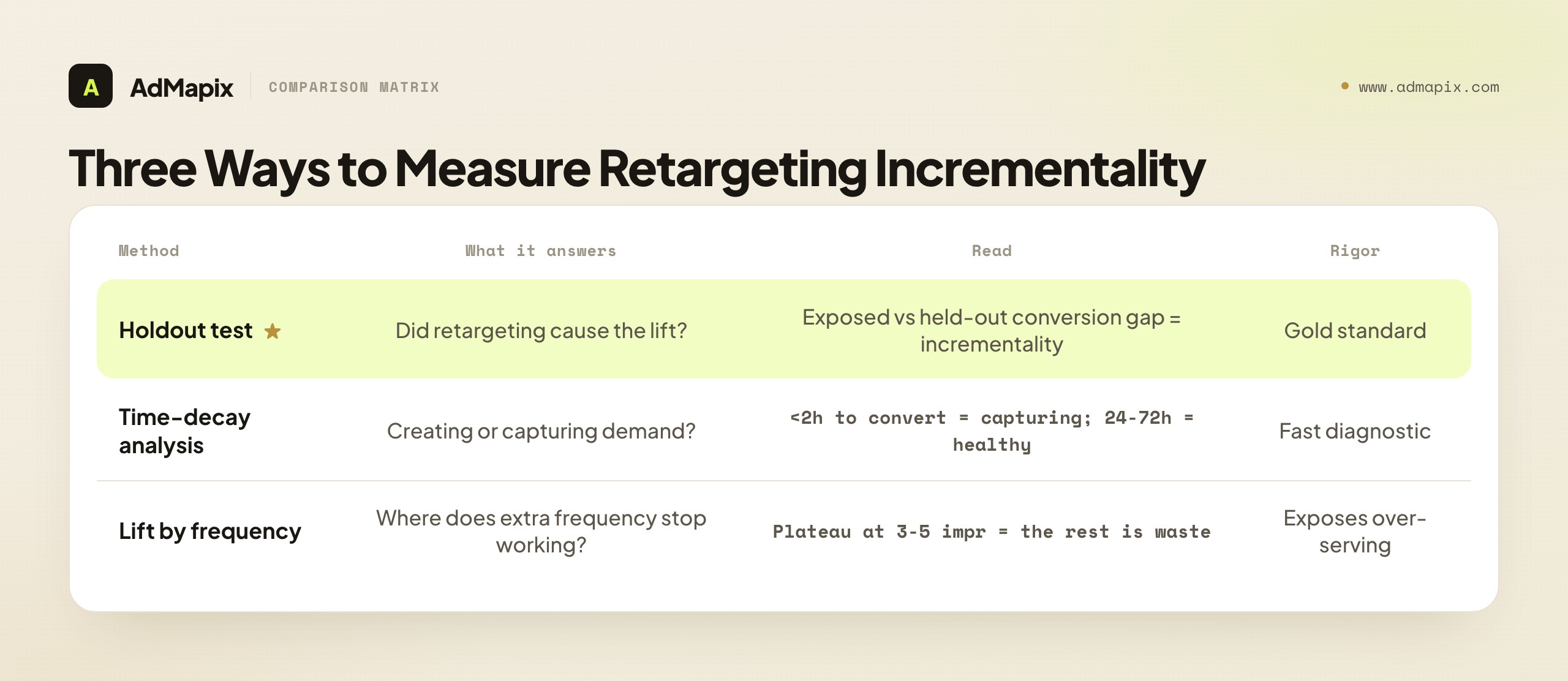
Incrementality is the question of whether a conversion happened because of your retargeting or merely alongside it. There are three practical ways to measure it, in rough order of rigor.
Holdout testing is the gold standard. Randomly exclude 10–15% of each retargeting audience from seeing ads, then compare the conversion rate of the exposed group against the held-out group. The difference is your incrementality — the lift retargeting genuinely caused. A holdout that converts almost as well as the exposed group is a brutal but honest signal: your retargeting is mostly capturing demand that would have closed regardless. Most platforms now offer conversion-lift or holdout tools natively; if yours doesn't, you can construct a holdout with audience exclusions. This is the one test worth the operational hassle.
Time-decay analysis is a fast diagnostic. Measure the time between a user's first retargeting impression and their conversion. If high-intent segments are converting within an hour or two of their first retargeting touch, retargeting is very likely capturing organic demand rather than creating it — the person was already going to buy. Healthy retargeting-driven conversions for considered purchases typically land 24–72 hours after first touch, reflecting genuine persuasion over time. A suspiciously short decay window is a red flag that you are paying to claim conversions you already had.
Conversion lift by frequency reveals waste. Plot conversion rate against retargeting impression frequency. If conversion rate keeps climbing as frequency rises, additional impressions are doing incremental work. If it plateaus at 3–5 impressions and you're serving 12, the extra frequency is pure waste — cost with no lift, plus the brand-fatigue cost discussed earlier. This single chart often pays for itself by exposing the over-serving that backward retargeting hides.
Two more advanced methods belong in the toolkit once the basics are running. Geo holdout (matched-market) testing turns off retargeting in a set of regions statistically matched to a comparison set where it stays on, then compares total conversions between them. Because it measures at the market level rather than the user level, geo testing sidesteps the user-level tracking that signal loss has degraded — which makes it one of the most resilient incrementality methods available in 2026. It is blunt and needs enough volume to be statistically meaningful, but it answers the question that user-level attribution increasingly can't: did retargeting move the total number, not just the attributed number. Ghost-ad / PSA holdout testing is the more granular cousin of the audience holdout: instead of simply excluding the holdout group, you serve them a neutral placebo ad (a public-service announcement or a charity spot) so both groups have the same ad exposure behavior, isolating your creative's specific lift. It removes a subtle bias in plain exclusion holdouts — that the excluded group might differ because they saw some ad versus no ad — and is supported natively by some platforms' lift tools.
The practical hierarchy is simple: run a holdout (audience or ghost-ad) as your standing measurement, use time-decay and frequency-lift as cheap continuous diagnostics, and pull out geo testing for the periodic "is this whole channel worth it?" question. What you should never do is let last-click ROAS or modeled platform credit be the only number you steer by, because both are structurally biased toward over-rewarding demand capture.
Without incrementality discipline, you will reliably optimize retargeting toward capturing existing demand instead of creating new demand, because last-click and modeled credit both reward demand capture. Your ROAS will look excellent while your total new-customer growth stalls — the most expensive kind of vanity metric, because it actively misallocates budget away from the prospecting that drives real growth. The deeper lesson is that retargeting's job in a healthy media mix is narrow and earned: it should convert the genuinely-on-the-fence and reactivate the genuinely-lapsed, and an incrementality program is simply how you keep it honest about staying inside that job rather than ballooning into a credit-claiming machine.
How to Spot Competitor Retargeting Ads
Here is the part almost no one does systematically, and the part where competitive ad intelligence becomes a genuine retargeting advantage: reverse-engineering what your competitors run on their warm audiences. Prospecting ads are easy to find — they are everywhere, served broadly. Retargeting ads are harder to see, because by definition they are served to a narrow warm audience you may not be in. But they leak identifiable signals, and once you know the patterns, competitor retargeting strategy becomes visible in public ad libraries.
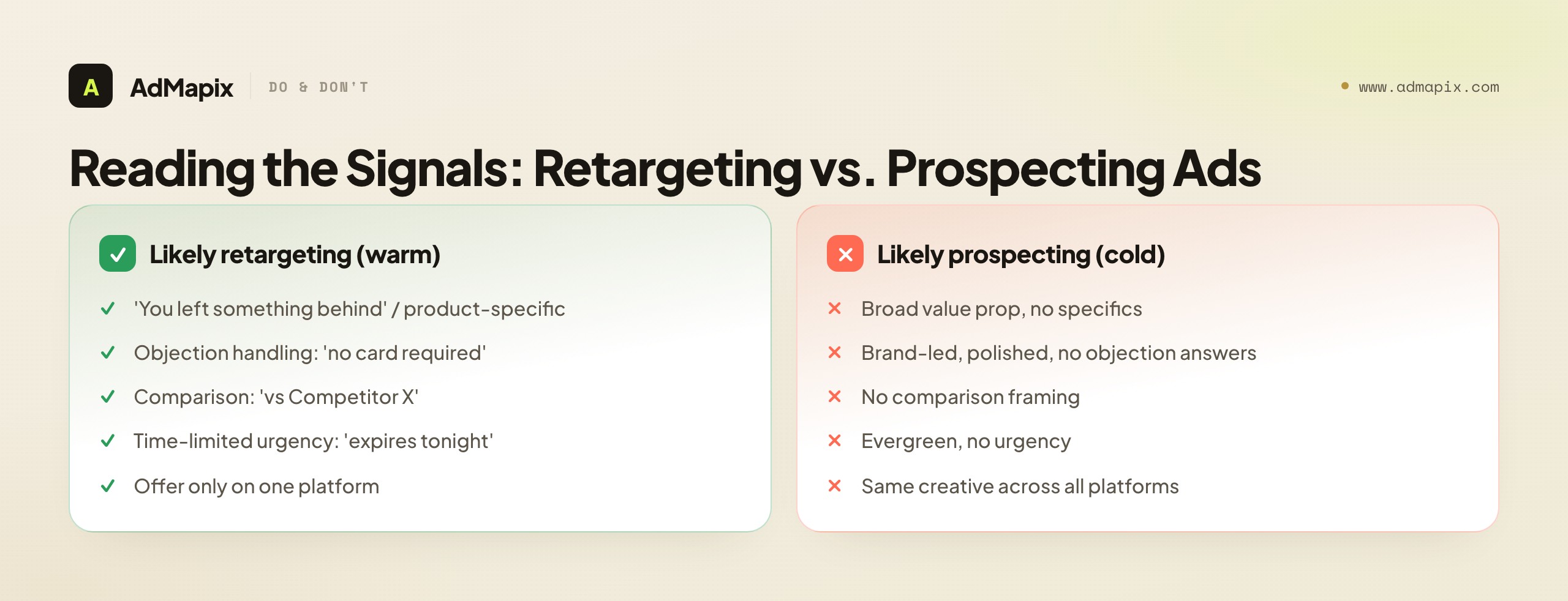
Signals that an ad is retargeting rather than prospecting:
- Offer specificity. "You left something behind," specific product references, "come back and get X% off" — language that only makes sense to someone who already engaged.
- Objection handling. Ads that directly answer common objections ("no credit card required," "cancel anytime," "free returns") are usually retargeting; they are responding to hesitations a prospect formed before bouncing.
- Comparison language. "vs Competitor X," "the [Competitor] alternative" — these typically retarget users who visited comparison or review content and are now in active evaluation.
- Social-proof depth. Detailed case studies, specific customer outcomes, and named results signal mid- and bottom-funnel retargeting rather than top-funnel awareness.
- Temporal urgency. "24-hour flash sale," "expires tonight," "last chance" — urgency that only lands if the viewer already knows the product and has a decision pending.
- Platform-only placement. If a brand runs prospecting on Meta and TikTok but a particular offer-heavy ad appears only on Meta, that ad is often retargeting a Meta-built warm audience.
Where to look: the Meta Ad Library shows whether competitors run distinctly different offers and styles from their prospecting ads; the Google Ads Transparency Center reveals search retargeting patterns, especially branded-plus-generic bidding ("brand + pricing," "brand + vs," "brand + alternative"); and landing-page analysis exposes dedicated retargeting pages with different offers than the prospecting pages. The method is to monitor each competitor over 3–4 weeks and separate their apparent retargeting ads from their prospecting ads using the signals above, documenting the differences in offer, creative style, and urgency level. A single screenshot tells you almost nothing; the gradient between a competitor's cold and warm creative tells you their whole lower-funnel strategy.
There is one inference technique worth calling out because it dramatically sharpens the read: longevity as an intent proxy. Ad libraries show how long an ad has been running. Prospecting creative and retargeting creative fatigue on different curves — prospecting ads churn fast as the brand chases cold-audience efficiency, while a high-performing retargeting offer can run a long time because its warm audience constantly refills with new abandoners. So an ad that is offer-heavy, objection-handling, and has been running continuously for months is almost certainly a load-bearing retargeting asset the competitor has validated and protected. Those are the ads to study hardest: a competitor does not keep an underperforming offer alive for ninety days. Conversely, a flurry of near-identical offer ads launched and killed within two weeks is usually a prospecting test, not a settled retargeting play. Reading the time dimension alongside the content signals turns a static screenshot into a read on what the competitor has actually proven works on their warm traffic.
It also pays to triangulate across the brand's owned surfaces. If a competitor's site shows an exit-intent popup with a 10%-off code, and the Ad Library shows a Meta ad with the same 10%-off offer, you have just confirmed both the offer and the retargeting mechanic — the popup captures the email, the ad re-engages the abandoner, and the discount is the recovery lever. Cross-referencing on-site behavior (popups, cart messaging, email capture) with ad-library creative is how you move from "this looks like retargeting" to "here is their exact cart-recovery sequence." That triangulated read is far more actionable than either source alone.
Building a Competitor Retargeting Swipe File
The output of competitor retargeting analysis is a swipe file — but a structured one, not a folder of screenshots. For each competitor you track, the goal is to capture not just what their warm-audience creative looks like but the gradient from first touch to retargeting, because that gradient is the strategy.
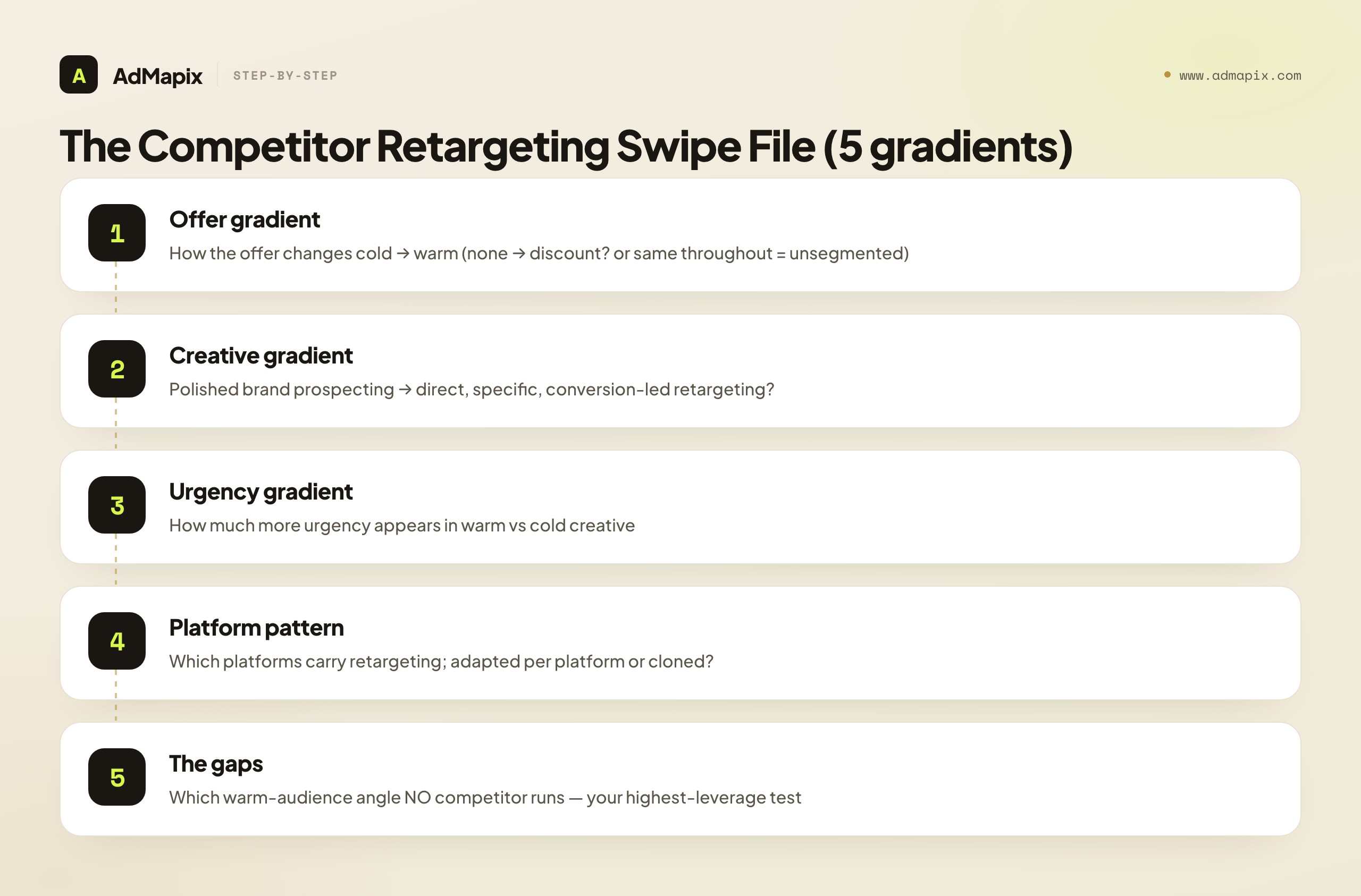
A useful competitor retargeting swipe file documents five things per competitor. The offer gradient: how does their offer change from prospecting to retargeting? Many brands run no offer cold and a discount warm; some run the same offer throughout (a signal they have not segmented). The creative gradient: does the visual style shift? A common pattern is polished, brand-led prospecting creative giving way to more direct, specific, conversion-focused retargeting creative. The urgency gradient: how much more urgency appears in warm creative versus cold? The platform pattern: which platforms carry their retargeting load, and does the message adapt per platform or get cloned? The gaps: which retargeting angle is no competitor in your set running? That last one is the highest-leverage entry in the whole file — an unworked angle the market has left open for you.
The competitor retargeting swipe file is usually thinner than the prospecting swipe file, precisely because retargeting ads are harder to identify. That scarcity is what makes it valuable: fewer teams build one, so the team that does has a lower-funnel creative edge that compounds. This is the layer where AdMapix fits in a retargeting strategy — not as the campaign tool, but as the competitor retargeting creative research engine. When you can see a competitor's complete creative output across networks over time, their retargeting strategy separates visibly from their prospecting, the offer and urgency gradients become legible, and the gaps reveal themselves. The strategy work above tells you what to look for; competitive ad intelligence is how you supply it with validated, market-tested angles instead of guesses.
Seven Retargeting Anti-Patterns That Quietly Bleed Budget
Most retargeting waste comes not from doing nothing but from doing the wrong thing confidently. These seven anti-patterns show up across accounts of every size, and each one hides behind a metric that looks fine.
One audience for everyone. The "all 30-day visitors, one creative" setup pools a 30-second blog reader with a checkout abandoner. It looks efficient (one campaign to manage) and reports a strong ROAS (it's full of high-intent abandoners), but it under-serves your hottest segment and over-serves your coldest. The fix is the four-segment structure from earlier — the single highest-return change in this entire guide.
Recycling prospecting creative. Dropping your cold-audience brand ad onto warm traffic with a discount stapled on ignores that a warm user has different questions than a cold one. They already know what you do; they need objection handling, proof, or a reason to finish — not the value prop they already absorbed. Net-new lower-funnel creative is the cost of doing retargeting properly.
Discounting by default. Reaching for a discount as the universal retargeting lever trains your audience to abandon carts on purpose (they learn the discount is coming) and erodes margin on conversions that didn't need it. Test non-discount recovery offers — bonus features, free shipping, extended trials — and reserve discounts for segments where they demonstrably move incrementality, not just last-click credit.
No converter suppression. Continuing to serve cart-recovery ads to people who already bought is pure waste plus a brand-damaging experience, and it is shockingly common across platforms because a conversion on one platform doesn't suppress on the others. Unified, cross-platform suppression from first-party purchase data is non-negotiable.
Frequency without a window. A "lifetime" or account-wide cap doesn't control the burn rate that actually drives fatigue. Rolling 7-day, per-segment caps do. Without them, your hottest segment either starves or floods, and you discover the damage only when a warm user hides your ad.
Endless membership windows. Keeping users in a retargeting audience for 30+ days regardless of segment means paying to chase abandoners who decided "no" three weeks ago. Short windows on hot segments concentrate spend where intent is fresh.
Trusting platform credit as truth. Steering by last-click ROAS or modeled platform conversions optimizes you straight into demand capture, because both metrics over-reward it. Without a holdout, you literally cannot tell whether retargeting created the conversion or just stood next to it. This is the anti-pattern that makes all the others invisible, which is why incrementality measurement is the discipline that holds the whole strategy together.
The common thread: every anti-pattern is comfortable because it reports a good number. Fixing retargeting means being willing to make a metric look worse in exchange for the business actually growing faster — which is exactly why the incrementality discipline above is the hardest and most valuable part.
A 30-Day Retargeting Strategy Rebuild Plan
Strategy is only useful if it becomes a sequence of actions. Here is a 30-day plan to rebuild a backward retargeting setup into the four-pillar version above, in the order that compounds.
Week 1 — Audit and segment. Audit your current retargeting: how many audiences, what creative, what frequency caps, what the holdout-free ROAS is actually claiming. Then rebuild the audience structure into the four intent-depth segments — window shoppers, evaluators, cart/checkout abandoners, churned customers — using behavioral signals (time on site, pages, micro-conversions), not URL rules. Set per-segment frequency caps on rolling 7-day windows and shorten membership windows on the two hot segments.
Week 2 — Fix the audience plumbing. This is the signal-loss work: confirm CAPI/server-side events are firing, integrate first-party data (email/CRM) as deterministic match sources for evaluators and churned users, and verify converter suppression across every platform. Without this, the segments you built in week 1 will be too small and leaky to perform.
Week 3 — Build the creative ladder and the cross-platform sequence. Produce 3–6 creatives per segment matched to each rung's job (brand for window shoppers, objection-handling for evaluators, offer for abandoners, "what's new" for churned). Assign platform roles: Meta as the spine, Google for branded/comparison search retargeting, TikTok for native re-engagement. Adapt creative per platform; do not clone.
Week 4 — Add competitor intelligence and measurement. Build the competitor retargeting swipe file for your top 3–5 rivals, document the offer/creative/urgency gradients, and identify at least one unworked angle to test. Simultaneously, stand up a holdout test (exclude 10–15% of each segment) so that by the end of the month you are measuring incrementality, not last-click credit. From here, the program runs on a cadence: weekly creative rotation, monthly incrementality review, quarterly competitor swipe-file refresh.
Thirty days in, you will have replaced one broad audience and three recycled ads with four intent-matched segments, a per-platform creative sequence, a signal-loss-resilient audience layer, an honest incrementality read, and a competitor intelligence loop feeding validated angles into your creative pipeline. That is the difference between retargeting as an afterthought and retargeting as a discipline.
FAQ
What is a retargeting ads strategy?
A retargeting ads strategy is a systematic approach to advertising to users who have already interacted with your brand — website visitors, app users, past customers — with the goal of moving them toward conversion or reactivation. In 2026 it is a distinct discipline, not a safety net for acquisition: it uses intent-depth segmentation, per-segment frequency control, cross-platform creative sequencing, a privacy-resilient audience layer, and incrementality measurement, ideally informed by competitor retargeting intelligence.
How is retargeting different from remarketing?
The terms are used almost interchangeably. Historically "remarketing" leaned toward Google's branded term and email-based re-engagement, while "retargeting" leaned toward display and social ad re-engagement, but in 2026 both describe the same core practice: serving ads to a warm audience that has already engaged with your brand. What matters far more than the label is whether you segment that warm audience by intent depth and measure incrementality — the strategy, not the terminology.
How do I segment retargeting audiences?
Segment by intent depth, not by which page someone visited. Use four levels: window shoppers (low intent — one or two pages, brief sessions), evaluators (medium intent — multiple pages, pricing/feature visits, repeat sessions), cart and checkout abandoners (high intent — started checkout or signup), and churned customers (past converters now inactive). Define them with behavioral signals like time on site, pages per session, repeat visits, and micro-conversions rather than URL-level rules, because behavior depth is a far stronger intent signal than any single page label.
What is a good retargeting frequency cap?
Cap by segment and by rolling 7-day window rather than account-wide or lifetime. As a starting point: 3–5 impressions per week for window shoppers and churned users, 5–8 for evaluators, and a short, aggressive 8–12 in the first 48 hours for cart abandoners before tapering. The exact numbers matter less than the principles: most fatigue damage on warm audiences happens between impressions 8 and 15, so rotate creative before the curve flattens and shorten membership windows on hot segments so you stop paying to chase people who have moved on.
How do I run retargeting across Meta, Google, and TikTok together?
Assign each platform a role in a sequence rather than cloning one ad across all three. Meta is the spine — heavy lifting across all segments with dynamic and catalog creative. Google captures fresh intent at the decision moment through branded and comparison search retargeting (RLSA, Performance Max). TikTok re-engages with native-style content (UGC, founder updates, "what you missed") rather than recycled static ads. Adapt creative per platform, suppress converters across all three, and watch a cross-platform frequency view so you are not triple-serving the same warm users.
Does retargeting still work after iOS and cookie changes?
Yes, but the audience-building and measurement layers had to change. Signal loss from iOS App Tracking Transparency and third-party cookie deprecation made retargeting audiences smaller and fuzzier, so the strategy now leans on first-party data (email/CRM) as a deterministic foundation, server-side/CAPI events to recover signal the browser drops, modeled conversions to fill gaps, and platform-native automation (Advantage+, Performance Max) — all verified with holdout incrementality tests. The strategy itself (segmentation, frequency, sequencing, creative ladders) is unchanged; only the plumbing underneath it is different.
How do I measure if my retargeting is actually incremental?
Use holdout testing as the gold standard: randomly exclude 10–15% of each retargeting audience, then compare the exposed group's conversion rate against the held-out group's — the difference is true incrementality. Supplement with time-decay analysis (healthy retargeting conversions for considered purchases land 24–72 hours after first touch, not within an hour, which would signal you are capturing organic demand) and conversion-lift-by-frequency (if conversion rate plateaus at 3–5 impressions while you serve 12, the extra frequency is waste). Last-click and modeled credit both over-reward demand capture, so they cannot answer the incrementality question on their own.
How do I find my competitors' retargeting ads?
Look for the signals that distinguish retargeting from prospecting: specific product references and "you left something behind" language, objection handling ("no credit card required"), comparison framing ("vs Competitor X"), time-limited urgency, detailed social proof, and platform-only placement. Monitor each competitor across the Meta Ad Library, Google Ads Transparency Center, and their landing pages over 3–4 weeks to separate their warm-audience creative from their cold-audience creative, and document the gradient between the two — that gradient is their lower-funnel strategy.
What is a retargeting creative ladder?
A creative ladder matches the message to each rung of the retargeting funnel instead of running one ad (usually a discount) across all of them. Window shoppers get brand reinforcement and social proof with no offer; evaluators get objection-handling, comparisons, and a low-friction next step; cart abandoners get offer-driven, urgency-led recovery creative; churned customers get "what's new" reactivation content. Because warm audiences fatigue fast, each rung needs a small rotating set of 3–6 variants rather than a single ad.
How does AdMapix help with retargeting strategy?
AdMapix sits in the competitor retargeting creative research layer. It tracks competitor ads across networks over time, which lets you separate a rival's prospecting patterns from their retargeting patterns, read their offer/creative/urgency gradients, and spot the warm-audience angles no competitor is running yet. That turns your competitor retargeting swipe file from a folder of screenshots into a validated source of creative angles to test on your own warm audiences. See AdMapix reports or review pricing for recurring competitor retargeting research.
Bottom Line
Retargeting in 2026 is not a checkbox in your ads manager and not a recovery net for acquisition. It is a distinct discipline with four pillars that have to be designed together: intent-depth segmentation that replaces lazy "all visitors" audiences, frequency and fatigue control that treats impressions as a budget you allocate rather than a number you watch, cross-platform sequencing that gives Meta, Google, and TikTok each a role instead of a clone, and incrementality measurement that tells you whether retargeting is creating demand or just claiming it. Underneath all of it sits a privacy-resilient audience layer built on first-party data and server-side signal, because signal loss raised the premium on owned data and honest measurement rather than lowering it.
The teams that win at retargeting are not the ones spending the most. They are the ones that segment warm audiences by intent, match creative to stage, control frequency by segment, sequence across platforms, measure incrementality honestly, and reverse-engineer competitor retargeting to test market-validated angles instead of guessing. Treat retargeting as competitive signal intelligence applied to your warmest audiences — and it stops being an afterthought and starts being one of the highest-leverage disciplines in your entire paid-media program.
Related Reading
- Competitor ad analysis framework — the broader 5-dimension framework that competitor retargeting analysis sits inside
- Competitive analysis in paid advertising — the multi-channel competitive workflow that feeds your retargeting swipe file
- Competitor ads guide — how to find and read competitor creative across platforms
- AI ad creative strategy — filling retargeting creative ladders faster with AI-assisted production
- Competitor ad spend — inferring how much rivals invest in lower-funnel media
- Google Ads Transparency Center guide — reading competitor search retargeting patterns
- TikTok ads research guide — the TikTok evidence layer for native re-engagement creative
- Ad spend tracking — connecting retargeting frequency and budget to measurable outcomes
Authoritative Sources
- Meta Ad Library — the public evidence layer for spotting competitor retargeting offers and creative
- Google Ads Transparency Center — competitor search and display retargeting patterns
- Google Ads remarketing lists for search ads (RLSA) — official documentation on search retargeting audiences
- Meta Conversions API (CAPI) — server-side event documentation for rebuilding the post-signal-loss audience layer
- Apple App Tracking Transparency — the iOS framework behind retargeting signal loss
- Google Privacy Sandbox — the third-party-cookie replacement reshaping web-side retargeting
- TikTok Creative Center — native creative trends for TikTok re-engagement
Turn these observations into your next creative study
Open the creative library and select samples for your market, network and research question.
Related Articles
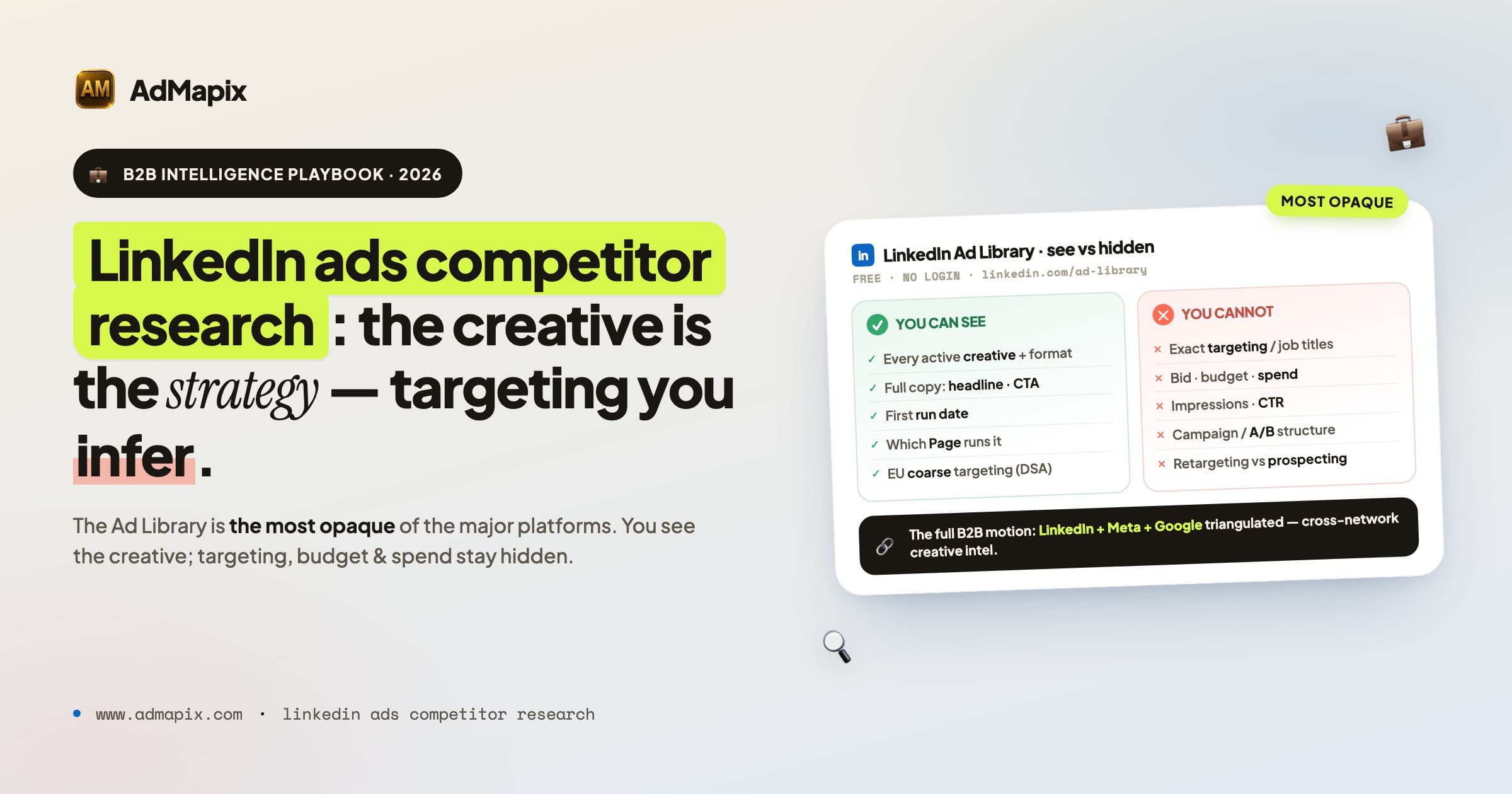
LinkedIn Ads Competitor Research in 2026: The Complete B2B Intelligence Playbook
A complete 2026 system for LinkedIn Ads competitor research — how to use the LinkedIn Ad Library, what you can and can't see, how to infer B2B targeting from public signals, how to teardown rival creative and messaging, an ABM-driven monitoring workflow, and a cross-network method that pairs LinkedIn with Meta and Google so your B2B competitive intelligence is full-funnel, not single-channel.
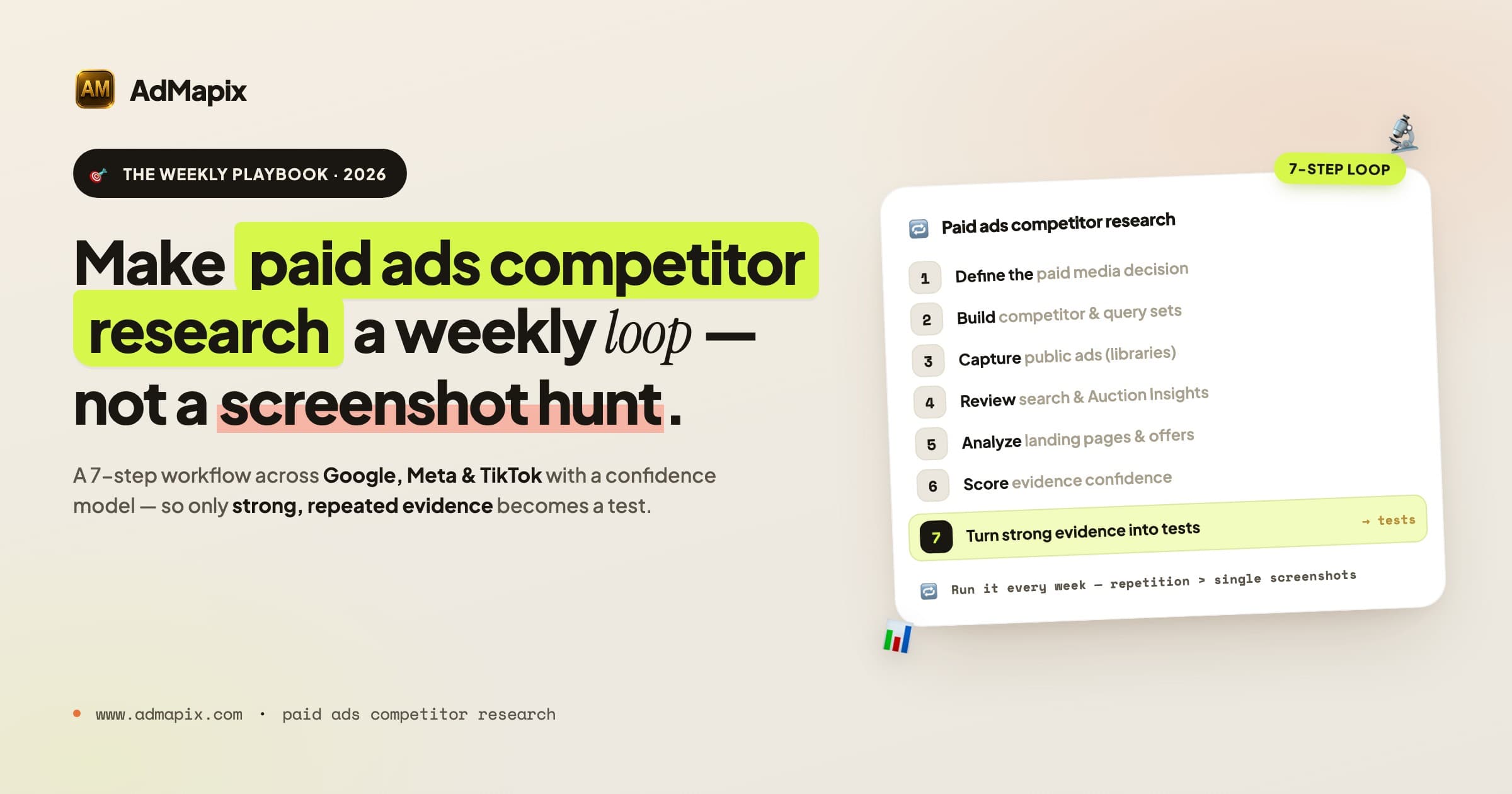
Paid Ads Competitor Research in 2026: The Complete Competitive Analysis Playbook
A 7,000-word 2026 playbook for paid ads competitor research and competitive analysis: ad libraries, SERP and Auction Insights, landing pages, confidence scoring, channel-by-channel SOPs, metrics, and a weekly operating system.
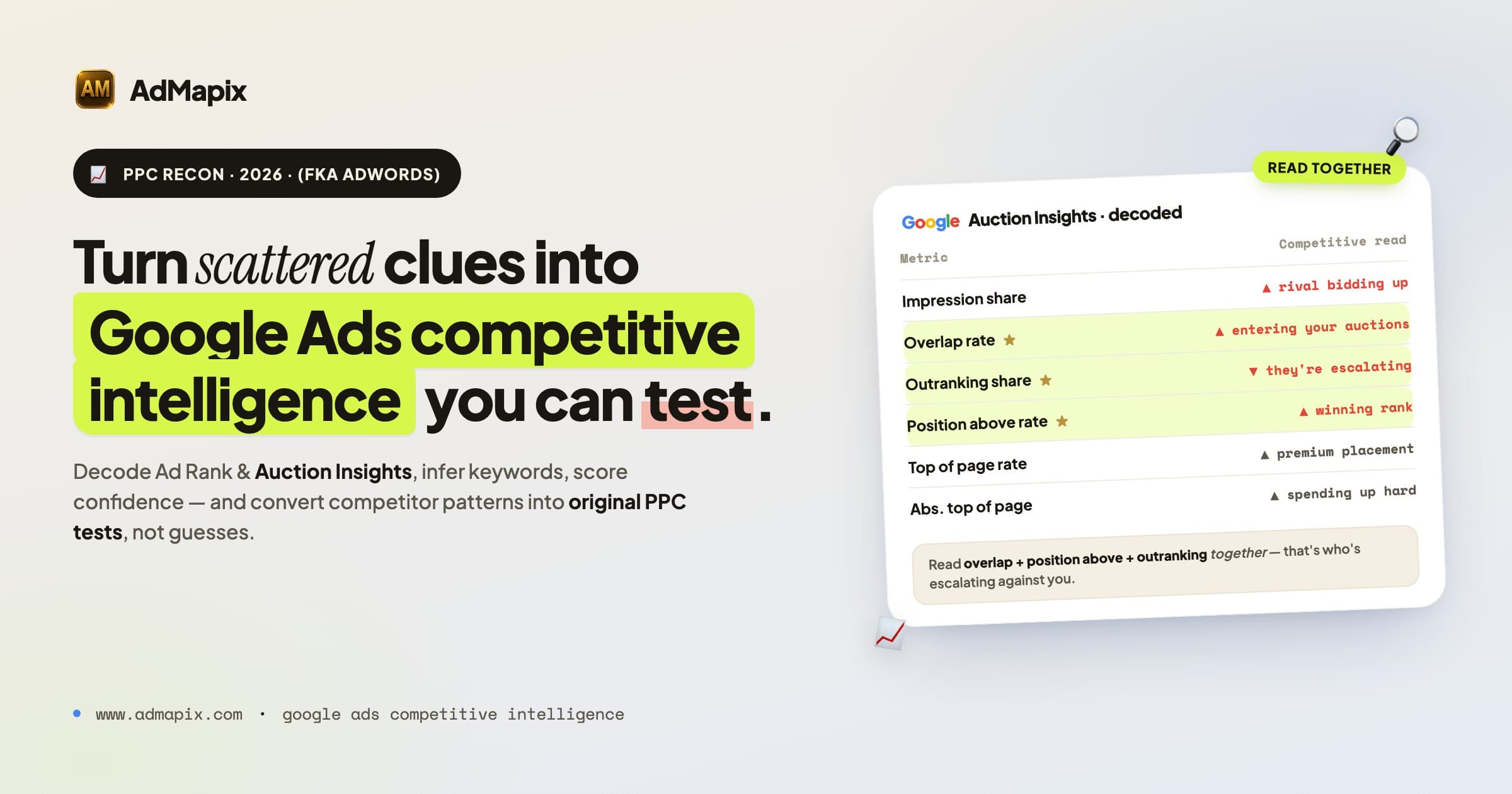
AdWords Intelligence in 2026: A Google Ads Competitive Intelligence Playbook
A complete 2026 Google Ads competitive intelligence workflow: research competitors with public ads, decode Ad Rank and Auction Insights, infer keywords, dissect landing pages, score confidence, and turn findings into original PPC tests.