
Mobile Game Marketing Strategy: A 12-Step UA & Creative Playbook (2026)
A practical mobile game marketing strategy guide for 2026 covering creative intelligence, paid UA, soft launch KPIs, ASO, retention loops, and competitor ad research.
Reviewed and updated by the AdMapix editorial team on September 5, 2026.
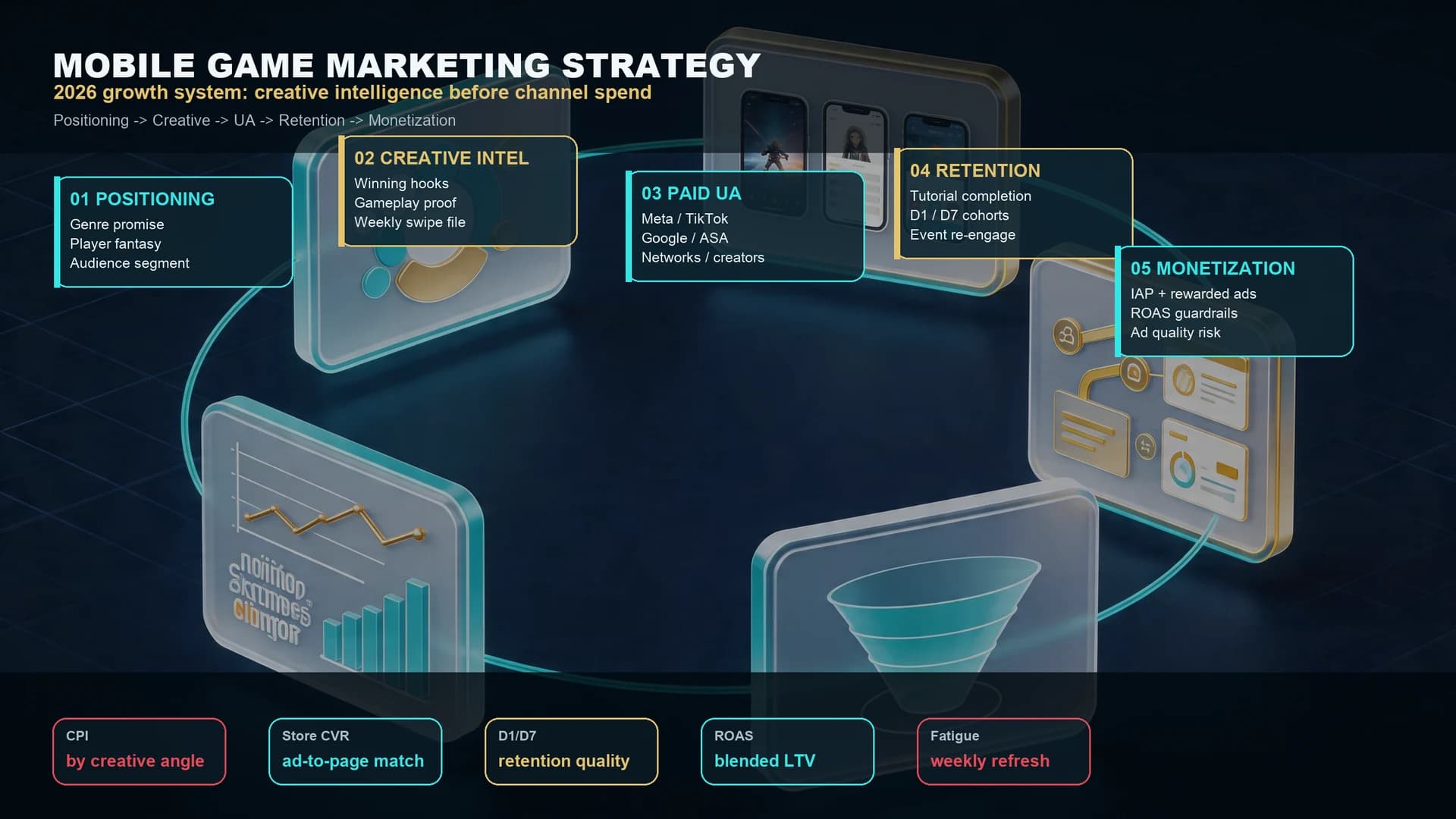
A mobile game marketing strategy in 2026 has to do more than buy installs. The teams that scale profitably treat marketing as a loop: position the game clearly, study competitor ads before spending, test creatives weekly, connect paid user acquisition with app store conversion, and feed retention data back into the next campaign. If you only plan channels - Meta, TikTok, Google, Apple Search Ads, AppLovin, Unity - you will miss the real bottleneck: creative learning speed.
This guide is written for founders, UA managers, growth leads, and creative strategists who need a practical operating system for mobile game marketing. AdMapix is our own product, so we are biased toward creative intelligence, but the framework below is channel-neutral. Use it before soft launch, during global launch, or when a live game needs a new growth loop.
Turn the strategy into a stage-by-stage plan
Use the same creative-learning loop at each stage, but change the decision you are trying to make. The thresholds belong to your genre, market and economics; the table is an operating template, not a promise of a universal CPI or ROAS.
| Stage | Decision | Produce | Measure before moving on |
|---|---|---|---|
| Before soft launch | Which product promise is both attractive and playable? | Positioning matrix, real-gameplay concepts, instrumentation plan | Whether the first session delivers the advertised mechanic |
| Soft launch | Which player cohort fits the game? | Controlled creative/channel tests and matching store assets | Cohort retention, conversion and monetization under an agreed measurement window |
| Launch | Which concepts can be repeated without losing quality? | A production backlog, localized variants and consistent asset IDs | Results by distinct creative and comparable market/cohort |
| Growth | What should we iterate or retire? | A weekly review of creative, store page and product experience | Our own outcome trends, creative fatigue and production cost |
An example from our Bus Traffic Fever research
In our US snapshot dated August 19, 2026, 22 ad instances resolved to nine distinct videos and eight playable end cards. Twelve 58-second rows represented four video files. Those counts show why a launch plan should track unique creative assets and their delivery variants separately.
For your own test backlog, create one row per distinct concept and attach its edits, end cards, markets and source records. The observation can inform production organization; it does not prove that a 58-second video or a competitor's long-running creative will work for your game.
The 2026 Mobile Game Marketing Model
The old model was simple: build the game, buy installs, check CPI, increase budget if ROAS looks good. That model breaks when privacy restrictions, fragmented ad networks, higher creative fatigue, and hybrid monetization all hit at once.
The stronger model has five loops:
| Loop | The question it answers | Output |
|---|---|---|
| Positioning | Why should this player care in three seconds? | Genre promise, player fantasy, audience segment |
| Creative | Which hook can stop the scroll? | Video concepts, playables, UGC scripts, store assets |
| Acquisition | Which channels can find the right cohort? | Meta, TikTok, Google App campaigns, Apple Search Ads, networks |
| Retention | Do users reach the core loop fast enough? | D1/D7 retention, tutorial completion, session depth |
| Monetization | Does growth create durable LTV? | IAP, rewarded ads, battle pass, subscription, blended ROAS |
Searchers for "mobile game marketing" usually want the whole system. That is why this article does not stop at "run ads and use influencers." A good strategy shows what to test, how to read signals, and when to stop spending.
There is also evidence that paid app advertising can lift organic installs instead of merely replacing them. An arXiv preprint first submitted in 2025 and revised in July 2026 reports positive paid-to-organic spillovers in data from one US-based mobile game developer. That setting does not establish a universal lift for every game. Treat that as a planning clue: paid UA, ASO, PR, store featuring, and social proof should be measured together, not in separate dashboards.
Source: Advertising Spillovers in Mobile Apps: Evidence from Ad Shutoffs and Store Rankings.
The Operating Rule: Creative Intelligence Before Channel Spend
Before you spend on a new mobile game, build a creative map.
That map should answer six questions:
| Question | What to collect |
|---|---|
| Which competitor ads have run the longest? | Meta Ads Library, TikTok Creative Center, Google Ads Transparency Center, AdMapix reports |
| Which hooks repeat across observed creatives? | First three seconds, first line, opening visual, challenge statement |
| Which gameplay moments are shown? | Core loop, power fantasy, failure state, upgrade moment, social proof |
| Which player emotions are used? | Mastery, competition, collection, relaxation, humor, fear of missing out |
| Which offers are visible? | Pre-register, free rewards, starter pack, battle pass, limited event |
| Which landing/store assets match the ad? | App Store screenshots, Google Play video, custom product page, rating copy |
Google's own App campaign asset documentation shows why portfolio thinking matters: app campaigns can combine headlines, descriptions, YouTube videos, images, HTML5/playable assets, and store assets. That matters more in games because a single winning format can fatigue quickly. Creative volume without creative learning becomes noise, but creative intelligence turns ad research into briefs your team can actually produce.
Source: Google Ads Help - Asset types for App campaigns.
12 Mobile Game Marketing Playbooks That Still Work
1. Start With A Genre-Positioning Matrix
Do not start with "we are a puzzle game." Start with the player job.
A merge game can be sold as relaxation, collection, makeover fantasy, decorating, mystery-solving, or time-killing. A strategy game can be sold as base building, clan loyalty, world domination, historical immersion, or tactical mastery. Same mechanics, different promise.
Create a simple matrix:
| Genre | Player fantasy | Proof in ad | First KPI |
|---|---|---|---|
| Puzzle | "I solved this faster than others" | Before/after, challenge, timer | Click-through rate |
| Merge | "I can restore this world" | Messy-to-beautiful transformation | Store conversion |
| RPG | "I can build a rare hero team" | Pull animation, combat burst | Tutorial completion |
| Strategy | "My plan beats real players" | Attack, defense, alliance, map control | D1 retention |
| Casino/social casino | "Fast reward and suspense" | Bonus spin, win moment, social proof | payer event |
This is the first mobile game marketing decision because it controls every ad format later.
2. Run Soft Launch As A Signal Test, Not A Vanity Launch
Soft launch is not a small launch. It is a controlled signal-gathering phase. The goal is not to prove that your team can buy installs cheaply in one geography. The goal is to learn whether the game can retain and monetize the audience you plan to scale.
Minimum soft launch checklist:
| Signal | Why it matters |
|---|---|
| CPI by channel and creative angle | Shows which promise attracts users |
| Store conversion rate | Reveals whether screenshots and video match the ad |
| Tutorial completion | Shows whether the first session delivers the promised fantasy |
| D1/D3/D7 retention | Validates the core loop |
| Ad engagement or rewarded-ad opt-in | Matters for hybrid monetization |
| First purchase event | Gives early LTV direction |
| Creative fatigue rate | Shows how fast the first batch decays |
If a creative gets cheap installs but poor tutorial completion, the ad may be misleading. If D1 is strong but D7 collapses, the launch problem is not only marketing. It is product pacing, economy, or content depth.
3. Build A Creative Testing Machine Before Scaling UA
Most teams under-build the creative operation. They think of ads as assets. Better teams think of ads as experiments.
Each mobile game ad should be tagged by:
| Dimension | Examples |
|---|---|
| Hook type | Challenge, mistake, reward, comparison, story, reaction |
| Visual source | Real gameplay, fake gameplay, creator footage, cinematic, UGC, playable |
| Promise | Relax, win, collect, upgrade, compete, solve, earn |
| Proof | Rating, gameplay, creator face, event reward, social proof |
| CTA | Install now, pre-register, claim reward, try the challenge |
Then test in batches. A useful weekly rhythm is 8 to 12 concepts, 3 to 5 variants per concept, and clear kill rules after a minimum spend or impression threshold. The exact volume depends on budget, but the principle is stable: test ideas, not random edits.
4. Use Real Gameplay Earlier Than Competitors Expect
Fake mobile game ads exist because exaggerated mechanics can grab attention. But they also create trust debt. Players who install for a fantasy that the game never delivers churn quickly, complain publicly, and weaken store conversion for future campaigns.
That does not mean every ad must be a literal screen recording. It means the first 5 to 10 seconds should teach the core loop honestly. Stylized overlays, speed ramps, creator reactions, and challenge framing are fine. Misrepresenting the entire mechanic is risky.
Use this rule:
| If the ad shows... | The game must deliver... |
|---|---|
| A puzzle fail moment | A similar challenge within the first session |
| A merge makeover | Visible transformation loop in early levels |
| A combat power spike | Clear hero upgrade or skill payoff |
| A reward multiplier | A real reward system or event |
| A social battle | Real PvP, clan, or leaderboard mechanic |
This protects retention and review quality while still giving creative teams room to dramatize.
5. Test UGC, Creator Reactions, And Streamer-Style Formats
UGC is not only for beauty and e-commerce. Mobile games can use UGC because players understand reactions faster than interface explanations.
High-performing patterns:
| Format | Best for | Execution note |
|---|---|---|
| "I thought this was easy..." | Puzzle, trivia, hypercasual | Show failure in the first seconds |
| Streamer reaction | RPG, strategy, shooter | Pair facecam with payoff moment |
| Friend challenge | Word, puzzle, social games | Create a reason to share |
| Before/after narration | Merge, makeover, decoration | Let transformation carry the ad |
| "Do not make this mistake" | Strategy, survival, simulation | Make the lesson visible |
UGC works when it translates mechanics into emotion. Avoid generic creator reads that could sell any app.
6. Pair Each Paid Channel With Native Creative
A mobile game ads plan should not reuse one video everywhere. Channels reward different signals.
| Channel | Best role | Creative bias |
|---|---|---|
| Meta | Broad audience discovery and retargeting | UGC, short gameplay loops, event offers |
| TikTok | Fast concept discovery and cultural hooks | Creator-led, challenge, humor, remixable formats |
| Google App campaigns | Intent plus broad inventory across Search, YouTube, Play, and Display | Diverse asset portfolio and store-quality creative |
| Apple Search Ads | High-intent App Store capture | Keyword, custom product page, screenshot alignment |
| AppLovin / Unity / ironSource | In-app gaming inventory | Playables, rewarded video, genre-specific audiences |
| Influencers / creators | Trust and community entry | Authentic gameplay, community challenge, launch event |
Meta's app promotion products and Google's App campaigns are built around algorithmic delivery, so the marketer's job is not only bid management. It is feeding enough differentiated creative and event signals into the system.
Sources: Meta Advantage+ app campaigns, Google Ads app campaigns.
7. Use Playable Ads Only When They Teach The Core Loop Fast
Playable ads are powerful when the game mechanic is intuitive. They are weak when the interactive sample is slower than the ad environment allows.
Use playables for:
- Puzzle mechanics that can be understood in one tap.
- Merge mechanics with a clear transformation payoff.
- Strategy choices where one action creates a visible outcome.
- Hypercasual loops with instant feedback.
Avoid playables when:
- The game fantasy depends on long progression.
- The first meaningful choice needs too much explanation.
- The mini-game is not representative of the real product.
- Load time or interaction friction is high.
The best playable is not a small demo of the whole game. It is a fast lesson that makes the viewer want the next turn.
8. Connect Paid UA And ASO Through Store Page Variants
If your ad promises "beat level 37," the store page should not open with generic landscape art. Store assets are part of the campaign.
Apple Search Ads and Google Play experiments can help teams align paid traffic with store messaging. The workflow is simple:
- Pick one player fantasy per campaign.
- Build matching screenshots or video.
- Route traffic to the closest store page or custom product page when available.
- Measure conversion rate separately from CPI.
- Keep variants that improve store conversion without hurting retention.
This is where app SEO and paid UA meet. The keyword, the ad hook, and the store page should all describe the same promise.
Source: Apple Developer - custom product pages.
9. Localize Hooks Before Localizing Everything
Full localization is expensive. Hook localization is faster and often more revealing.
Before translating every campaign asset, test:
| Asset | What to localize first |
|---|---|
| Opening line | Local slang, challenge wording, genre term |
| Store subtitle | Player fantasy, not literal title translation |
| Creator format | Local creator archetype and pacing |
| Offer | Local holiday, event, reward framing |
| Screenshot captions | Short local benefits |
For global mobile game marketing, do not assume the same hook travels. A collection fantasy may work in one market, while competition or humor works in another. Localize the promise before you localize the production pipeline.
10. Re-Engage Payer And Non-Payer Cohorts Differently
Retargeting is not one audience. A payer who stopped after a battle pass behaves differently from a non-payer who finished the tutorial and left.
Segment at least four cohorts:
| Cohort | Message |
|---|---|
| Installed, did not finish tutorial | "Try the moment you missed" |
| Finished tutorial, no session in 3 days | "New event, new reward, continue progress" |
| Engaged non-payer | "Starter bundle, limited reward, ad-free benefit" |
| Former payer | "New season, exclusive item, returning bonus" |
This protects spend efficiency and improves player experience. A generic "come back" ad ignores why the player left.
11. Treat Monetization Ads As Player Experience Risk
Rewarded video and in-game ads can fund growth, but bad ad quality can damage retention. Unity's recent ad quality work is a useful reminder: ad experiences inside games are part of the product experience, not separate inventory.
Marketing, product, and monetization teams should review:
- Frequency caps by session depth.
- Rewarded ad placement in the core loop.
- Ad content quality and brand safety.
- Whether ads interrupt tutorial, first win, or payer conversion.
- Whether ad revenue improves blended LTV without increasing churn.
Source: Unity - ad quality and player experience.
12. Review Competitor Ad Libraries Every Week
Weekly competitive review is the cheapest habit in mobile game marketing.
Use official libraries and third-party tools:
| Tool/source | Use it for |
|---|---|
| Meta Ads Library | Active Facebook and Instagram creatives |
| TikTok Creative Center | TikTok ad patterns and trending concepts |
| Google Ads Transparency Center | Google and YouTube advertiser visibility |
| AdMapix reports | Cross-channel creative search, hooks, landing pages, and category signals |
| Sensor Tower / data.ai / AppsFlyer / Adjust reports | Market sizing, benchmark context, spend trends |
For a broader legal workflow across Meta, Google, TikTok, and YouTube, use our guide to spying on competitors' ads. If you need tool selection rather than process, compare the best ad spy tools.
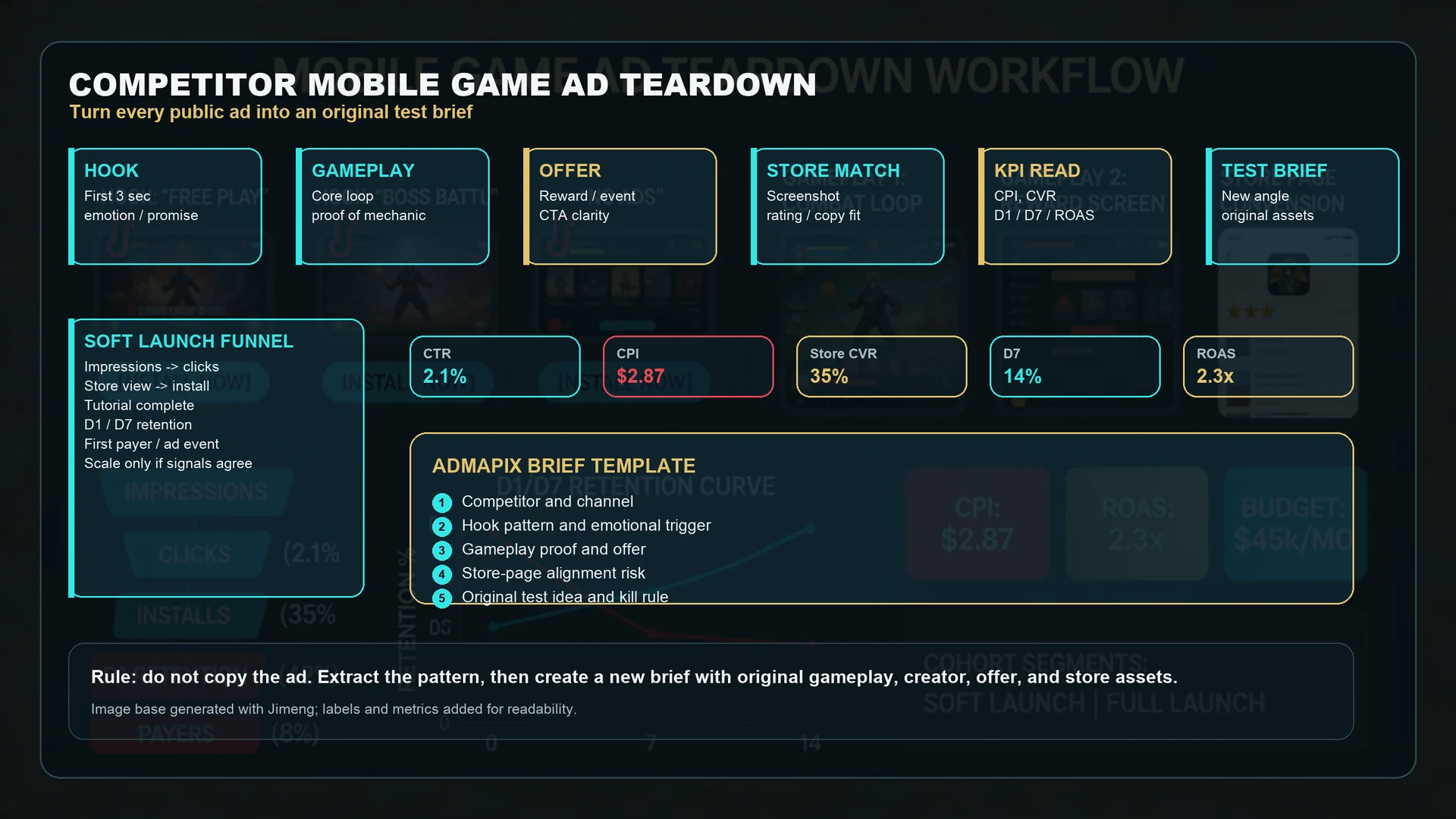
Turn every competitor ad into a brief, not a screenshot folder.
Brief template:
| Field | Example |
|---|---|
| Competitor | Game name and publisher |
| Hook | "Only 1% can solve this" |
| Mechanic shown | Drag puzzle, merge, battle, build, decorate |
| Player promise | Mastery, reward, relaxation, competition |
| Proof | Rating, creator reaction, event reward |
| Landing/store match | Good, weak, missing |
| Test idea | "Challenge hook with real level fail in first 3 seconds" |
If your team uses AdMapix, save these into a recurring swipe file. If you do not, a spreadsheet is enough as long as the review is weekly and decision-oriented.
Channel Map: Where Each Playbook Fits
| Goal | Strong channels | What to measure first |
|---|---|---|
| Pre-launch demand | TikTok, creators, Discord, Apple Search Ads pre-order, Google Play pre-registration | Wishlist/pre-register rate, email/SMS opt-in, creator engagement |
| Soft launch learning | Meta, Google App campaigns, in-app networks | CPI, tutorial completion, D1/D7 retention |
| Global launch | Meta, TikTok, Google, AppLovin, Unity, Apple Search Ads | Store CVR, ROAS, creative fatigue, retention |
| Re-engagement | Meta, Google, push/email, in-app events | Return rate, event participation, payer recovery |
| Monetization growth | In-game ad networks, rewarded video, offerwall tests | ARPDAU, ad engagement, churn impact |
The best channel mix depends on genre and monetization. Puzzle and casual games often need high creative volume. Strategy and RPG games need stronger community, longer retention, and deeper event marketing. Casino and social casino need compliance discipline and very clear LTV controls.
Budget And KPI Guardrails
For early-stage teams, use budgets as learning caps instead of ego targets.
| Stage | Budget purpose | Guardrail |
|---|---|---|
| Concept validation | Learn which promise gets attention | Do not scale on CTR alone |
| Soft launch | Validate retention and early LTV | Pause misleading ads even if CPI is low |
| Global launch | Find repeatable creative/channel pairs | Scale only when store CVR and retention hold |
| Live ops | Refresh audiences and re-engage cohorts | Protect churn and player sentiment |
Core KPIs:
- CPI by creative angle.
- Click-through rate by hook.
- Store conversion rate by ad/store match.
- Tutorial completion rate.
- D1, D3, D7 retention.
- First payer conversion.
- ARPDAU and blended ROAS.
- Creative fatigue speed.
- Review sentiment after paid bursts.
One practical rule: if a creative lowers CPI but worsens retention, it is not a growth win. It is delayed churn.
Common Mobile Game Marketing Mistakes
Mistake 1: Copying a competitor's fake ad without understanding the product gap. The ad may win clicks because the real game does not have that mechanic. If you cannot deliver the promise, you inherit the churn.
Mistake 2: Treating ASO as a separate SEO task. App store screenshots, keywords, ratings, and paid campaigns interact. Paid traffic can expose weak store positioning quickly.
Mistake 3: Testing too many edits and too few ideas. Changing subtitle color is not a strategy if the hook, mechanic, and promise are unchanged.
Mistake 4: Scaling before soft launch signals are stable. CPI is easy to buy. Retention and payer behavior are harder to fake.
Mistake 5: Ignoring in-game ad quality. If monetization harms first-session experience, user acquisition gets more expensive over time.
FAQ
What is mobile game marketing?
Mobile game marketing is the strategy used to attract, convert, retain, and monetize players for a mobile game. It usually includes positioning, creative testing, paid user acquisition, ASO, influencer marketing, community, retention campaigns, and monetization optimization.
How do you market a mobile game before launch?
Before launch, define the player fantasy, research competitor ads, test short-form creative concepts, build App Store and Google Play assets, collect pre-registrations or waitlist demand, and run small soft launch campaigns to validate CPI, store conversion, tutorial completion, and retention.
Which ad channels work best for mobile games in 2026?
Meta, TikTok, Google App campaigns, Apple Search Ads, AppLovin, Unity, and influencer channels can all work. The best channel depends on genre, creative volume, market, monetization model, and retention quality. The stronger approach is to match each channel with native creative rather than reuse one ad everywhere.
How much should a mobile game spend on user acquisition?
There is no universal number. Early teams should spend enough to reach a statistically useful read on creative, store conversion, and retention without forcing scale. A small soft launch budget should answer whether the game keeps the users it attracts. Larger budgets should only follow once CPI, retention, and LTV signals agree.
Are playable ads still effective for mobile games?
Playable ads are still effective when they teach the core loop quickly and honestly. They work best for puzzle, merge, strategy-choice, and hypercasual mechanics with instant feedback. They are weaker when the mini-game misrepresents the real product or takes too long to understand.
How do mobile game marketers spy on competitor ads legally?
Use public ad libraries, platform transparency tools, and third-party competitive intelligence tools. Focus on patterns: hooks, gameplay moments, offers, store-page alignment, and creative longevity. Do not copy protected creative. Turn findings into new briefs that your team can execute with original assets.
What metrics matter most during soft launch?
The most important soft launch metrics are CPI by creative angle, store conversion, tutorial completion, D1/D3/D7 retention, first purchase or ad engagement events, early ARPDAU, and creative fatigue. CPI alone is not enough because cheap installs can hide poor retention.
Conclusion
The best mobile game marketing strategy in 2026 is not a channel checklist. It is a learning system. Study the category before spending, translate competitor ads into original test briefs, connect paid UA with ASO and retention, and scale only when creative, store conversion, and product signals agree.
If you want to build that weekly creative intelligence loop faster, browse live category signals in AdMapix reports or start from AdMapix pricing. Use the tool if it saves your team time. If not, keep the workflow anyway: the habit is more important than the software.
Turn these observations into your next creative study
Open the creative library and select samples for your market, network and research question.
Related Articles
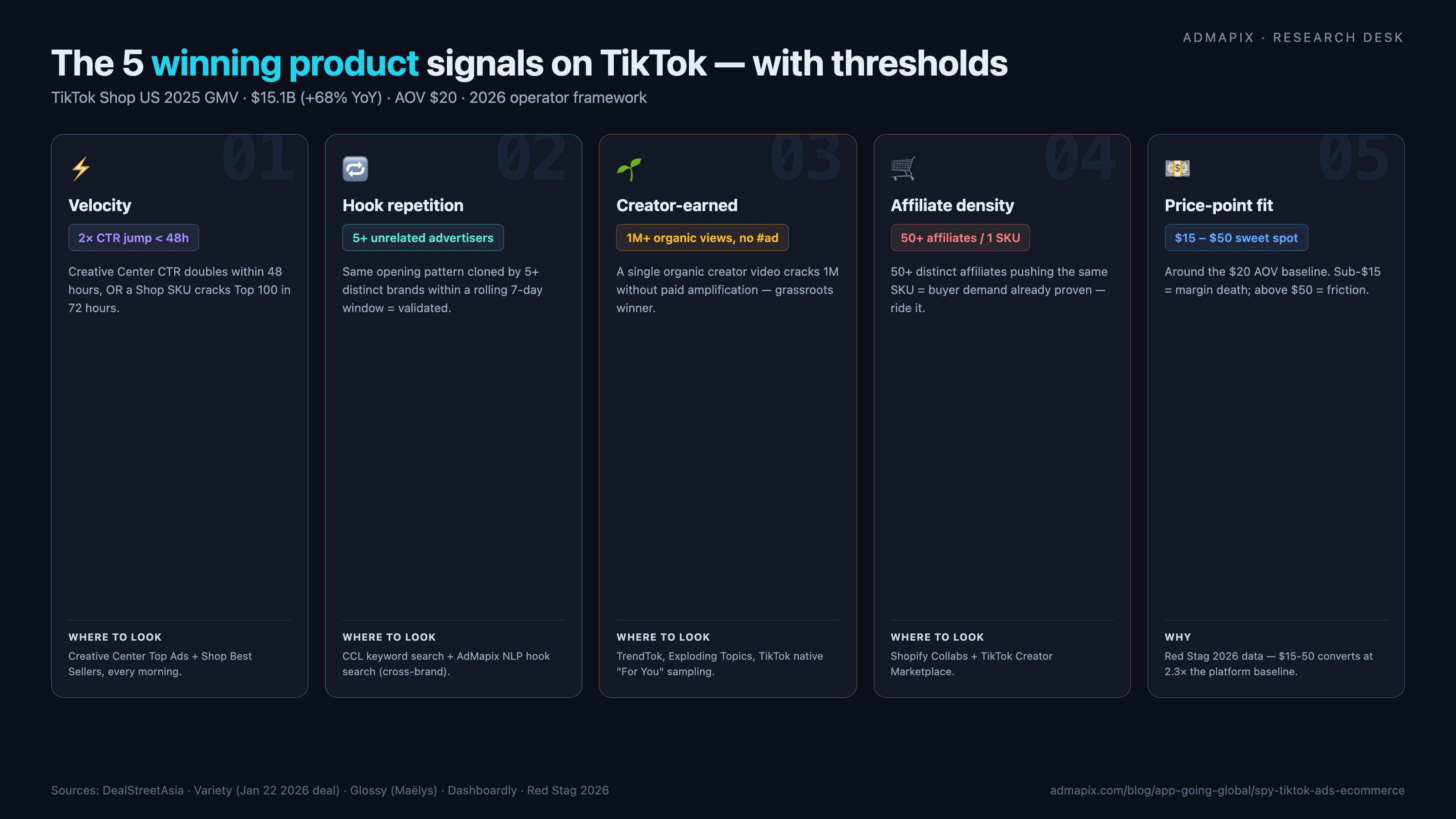
TikTok Ad Spy for E-commerce: The Operator Manual (Post Jan-2026 Deal Update)
TikTok Shop closed 2025 at $15.1B US GMV (+68% YoY) and the Oracle-led US joint venture closed January 22, 2026. This operator manual covers five winning-product signals we test against every Monday, a seven-step creative extraction workflow, a tool stack with 2026 prices, a security callout, and the Maëlys $108.5M case study — for operators who want a repeatable loop, not a listicle.
How to Find Winning Products on Facebook Ads Library (2026)
A practical product-research workflow: record observable ad evidence, verify the offer and supplier, calculate your costs, and test candidates without assuming profitability.

Mobile App Internationalization: Winning Global Markets in 2026
A practical, data-informed guide to app internationalization, covering market entry, localization, regional ad platforms, and user acquisition across SEA, LATAM, and MENA.