
App SEO: How to Rank App Pages and Support ASO in 2026
App SEO guide for ranking app landing pages, supporting ASO, mapping app store keywords, and connecting SEO with paid user acquisition.
App SEO works best when web landing pages, app store assets, keyword research, and paid acquisition share the same intent map.
App SEO: How to Rank App Pages and Support ASO in 2026
App SEO is the work of making app-related pages discoverable in search engines while supporting the same intent map inside the App Store and Google Play. It is not only ASO. It is also not only writing blog posts.
A strong app SEO strategy connects four surfaces:
| Surface | What it should do |
|---|---|
| Web landing pages | Rank in Google for app, category, use-case, comparison, and problem-aware searches |
| App store pages | Convert high-intent users inside App Store and Google Play |
| Content cluster | Educate searchers before they are ready to install |
| Paid acquisition pages | Match ad promises and feed SEO/ASO learning back into campaigns |
That connection matters because app discovery is fragmented. A user might search Google for "best sleep tracker app," search the App Store for "sleep tracker," click a paid social ad, compare a competitor page, and then install from a custom product page. Treating SEO, ASO, and paid UA as separate teams creates gaps in that path.
This guide explains app SEO, SEO for apps, app store keywords, app store keyword research, and how app store optimization tools fit into a broader growth workflow. For paid channel planning, read the paid user acquisition guide. For broader app growth and creative strategy, use the mobile game marketing strategy and best ad intelligence tools guides.
What App SEO Means
App SEO means ranking the web assets that help people discover, evaluate, and trust an app.
Those assets can include:
| Asset | Example search intent |
|---|---|
| App homepage | Brand, category, or core app promise |
| Use-case page | "expense tracker for freelancers" |
| Comparison page | "app name alternative" or "best app for..." |
| Blog guide | "how to plan meals with an app" |
| Country or localization page | "best budgeting app in Canada" |
| Feature page | "receipt scanning app" |
| Report or research page | Category trend, competitor examples, market proof |
The goal is not to rank every page for "app." The goal is to capture the real questions users ask before installing or subscribing.
Google's SEO starter guide still applies: make pages useful, crawlable, descriptive, internally linked, and aligned with search intent. App SEO adds another constraint: the web page must connect to an install or signup path without feeling like a thin doorway page.
App SEO vs ASO
App SEO and ASO overlap, but they are not the same.
| Area | App SEO | ASO |
|---|---|---|
| Main surface | Google and other web search engines | App Store and Google Play |
| Main assets | Web pages, blog posts, landing pages, comparison pages, reports | App title, subtitle, short description, long description, screenshots, preview/video, ratings |
| Keyword source | Google Search Console, SEO tools, SERP analysis, competitor web pages | App store keywords, store search, app intelligence, ASO tools, console data |
| Conversion path | Web CTA, store badge, signup, deep link, email capture | Store page install |
| Ranking signals | Content relevance, links, technical SEO, UX, authority, page quality | Store relevance, conversion, ratings, retention signals, keyword fields, category context |
| Best output | Search-qualified visitors and assisted installs | Store-qualified installs |
The two should reinforce each other. If your Google page ranks for "AI note taking app," the App Store page should not lead with a generic productivity screenshot. If the App Store page ranks for a specific feature term, your web content should explain that feature for users who research outside the store.
The mistake is treating ASO as "app SEO." ASO is one part of the app discovery system. App SEO is the broader web and search strategy around the app.
Keyword Research for App SEO
App SEO keyword research should start with intent, not only volume.
Use five keyword groups:
| Keyword group | Examples | Page type |
|---|---|---|
| Category | "habit tracker app," "budgeting app," "AI photo editor app" | Main app landing page or category page |
| Use case | "track expenses for freelancers," "learn Spanish vocabulary app" | Use-case page or guide |
| Comparison | "app name alternative," "best app like..." | Comparison page |
| Problem-aware | "how to stop forgetting subscriptions" | Blog guide |
| Store-aware | "app store keywords," "app store optimization tools" | ASO guide or app store keyword research article |
This is where app store keyword research and web SEO diverge. A term can be valuable in the App Store but weak on Google, or strong on Google but not a direct store query.
Build a map like this:
| Query | Google intent | Store intent | Recommended owner |
|---|---|---|---|
| "app seo" | Learn strategy | Low direct store intent | Pillar guide |
| "seo for apps" | Learn how web SEO applies to apps | Low direct store intent | Pillar guide |
| "app store keywords" | Learn ASO keyword mechanics | High ASO intent | ASO support page |
| "expense tracker app" | Compare options | High store intent | Landing page plus store metadata |
| "best expense tracker app for couples" | Evaluate use case | Medium store intent | Use-case page |
| "competitor app alternative" | Switch or compare | Medium store intent | Comparison page |
The goal is to prevent every page from competing for the same query. One page should own the core term. Supporting pages should own specific intent.
App Landing Page Structure
An app landing page should rank, explain, and convert. It should not be a thin app store badge with a few screenshots.
Use this structure:
| Section | Purpose |
|---|---|
| H1 with clear app category or use case | Tell search engines and users what the page is about |
| Short value proposition | Explain the app's promise in plain language |
| Primary CTA | App Store, Google Play, web signup, or waitlist |
| Visual proof | Screenshots, workflow, demo, or product video |
| Use cases | Match the queries users search |
| Feature proof | Explain the features that support the promise |
| Trust signals | Ratings, reviews, privacy, press, customer logos, compliance |
| Comparison or alternatives | Help users evaluate choices |
| FAQ | Answer search objections |
| Internal links | Connect to guides, reports, comparisons, and pricing |
For app SEO, screenshots matter because users want to see the product before installing. But screenshots alone are not content. Add explanatory copy that says who the app is for, what problem it solves, when to use it, and why it is different.
Avoid this pattern:
| Weak page | Better page |
|---|---|
| "Download our app. Available on iOS and Android." | "A receipt scanning app for freelancers who need tax-ready expense records." |
| Generic screenshots only | Screenshots grouped by use case |
| No FAQ | Questions about pricing, privacy, platforms, exports, and limitations |
| One CTA repeated everywhere | CTA plus demo, comparison, and trust proof |
App Store Keyword Research and Store Assets
App store keywords are not only words. They should shape store assets.
If a keyword represents a use case, the screenshot sequence should show that use case. If a keyword represents a competitor comparison, the page should show why the app is different. If a keyword represents a feature, the preview or first screenshot should make the feature obvious.
Apple's custom product pages allow additional App Store product page versions with different screenshots, previews, and promotional text. Google Play's store listing experiments support testing store listing variations. These are not only paid UA features. They are useful because they create a feedback loop between keyword intent, store conversion, and acquisition quality.
Use this workflow:
| Step | Output |
|---|---|
| Collect app store keywords | Keyword list by category, feature, problem, and competitor intent |
| Group by intent | Category, feature, use case, comparison, brand, country |
| Match store asset | Screenshot, preview, subtitle, short description, long description |
| Test page variants | Custom product page or store listing experiment |
| Read quality metrics | Store conversion, activation, retention, rating sentiment |
| Feed back to SEO | Build or revise web pages around the proven intent |
App store optimization tools can help with keyword discovery, ranking tracking, competitor app metadata, screenshot research, localization checks, and review analysis. Do not choose tools only by database size. Choose them by workflow fit.
| Tool workflow | What it should help with |
|---|---|
| Keyword discovery | Find app store keywords and search volume estimates |
| Ranking tracking | Monitor keyword movement by country and device |
| Competitor metadata | Compare titles, subtitles, descriptions, screenshots, ratings |
| Review mining | Identify user language for SEO and ASO copy |
| Localization | Adapt keywords and screenshots by market |
| Store testing | Connect variants to conversion and quality signals |
Content Cluster Model for App SEO
App SEO works better as a cluster than as isolated posts.

A good app SEO keyword map separates Google search pages, app store keyword targets, comparison pages, and paid UA support pages.
Use this model:
| Page type | Keyword role | Example |
|---|---|---|
| Pillar page | Broad strategy keyword | "app seo" |
| App landing page | Category or product keyword | "AI meeting notes app" |
| Use-case page | Specific user job | "meeting notes app for sales calls" |
| Comparison page | Alternative intent | "Otter alternative" |
| Blog guide | Problem-aware education | "how to summarize meetings automatically" |
| Country page | Localization intent | "meeting notes app in Japan" |
| Report page | Data and proof | Competitor ad trends, category report |
| Paid UA support page | Message match | Landing page for one campaign promise |
Do not make every article target the same phrase. If you publish "app SEO," "seo for apps," and "app store keyword research," define which page owns which query.
For this cluster:
| Query | Recommended owner |
|---|---|
| app seo | This pillar page |
| seo for apps | This pillar page or a section within it |
| app store keyword research | Dedicated ASO keyword workflow page after publication |
| app store keywords | Dedicated ASO support page or keyword research page |
| paid user acquisition | The paid UA guide |
This prevents keyword cannibalization. It also helps internal links send clearer signals.
Internal Linking and Cannibalization Control
Internal linking is not only navigation. It tells search engines which page is the hub.
Use these rules:
| Rule | Example |
|---|---|
| Link from spoke pages to the pillar | ASO keyword posts link back to app SEO |
| Link from pillar to published spokes | App SEO links to paid UA and later ASO keyword research |
| Use descriptive anchors | "paid user acquisition" instead of "click here" |
| Avoid linking every page with the same anchor | Vary by intent and context |
| Do not create duplicate pages for the same query | Merge or differentiate |
If two pages target the same query, decide:
| Situation | Fix |
|---|---|
| Both pages explain the same topic | Merge into one stronger page |
| One is broad and one is narrow | Make broad page the pillar, narrow page the spoke |
| One is web SEO and one is ASO | Clarify title, H1, and internal anchors |
| One is outdated | Update or redirect |
This is especially important for apps because the same words can mean different surfaces. "Keyword research" might mean Google SEO, App Store keywords, or paid search terms. Clarify the surface in the title and structure.
How Paid UA Supports App SEO and ASO
Paid UA can support app SEO if the team treats it as research.
The paid user acquisition guide explains channel planning and creative testing. For app SEO, the most useful paid UA signals are:
| Paid UA signal | SEO/ASO use |
|---|---|
| Winning hook | Use in title tests, meta copy, hero section, screenshot captions |
| High-converting audience segment | Build use-case pages |
| Store conversion by message | Update screenshots and app store copy |
| Landing-page conversion by promise | Build SEO pages around proven intent |
| Competitor ad patterns | Identify gaps in content and store assets |
| Retention by campaign | Avoid ranking for promises that attract bad-fit users |
This is why competitor ad intelligence matters. If competitors repeatedly advertise a promise that you do not explain on your site or store page, either you have a content gap or the promise is not relevant to your product. Use AdMapix reports to monitor those gaps if manual tracking is too slow.
Measurement Framework
App SEO measurement should connect traffic to installs and user quality.
| Metric | What it tells you |
|---|---|
| Google impressions and clicks | Whether searchers can find the page |
| Query mix | Which intent the page is actually winning |
| Landing-page conversion | Whether web visitors continue to store or signup |
| Store conversion | Whether the store page confirms the intent |
| Activation | Whether acquired users reach first value |
| Retention | Whether the promise attracted good-fit users |
| Branded search lift | Whether awareness is increasing |
| Assisted conversions | Whether content helps paid or direct installs |
Do not stop at rankings. A page that ranks for a broad keyword but sends low-quality users can hurt the business. A page with lower volume but high activation can be more valuable.
Use separate reporting for:
| Report | Why |
|---|---|
| SEO page performance | Google traffic and query intent |
| Store page performance | Conversion and asset tests |
| Paid UA performance | Cost and user quality |
| Retention cohorts | Whether acquisition promises match product value |
| Competitor movement | New messages, ad hooks, and category shifts |
Common Mistakes
Mistake 1: Treating ASO as the whole app SEO strategy. ASO matters, but Google search pages can capture users before they open the app store.
Mistake 2: Creating thin app landing pages. A few screenshots and badges are not enough to rank or convert.
Mistake 3: Targeting only high-volume category keywords. Use-case and comparison queries often convert better.
Mistake 4: Ignoring store-page alignment. If the web page promises one use case and the app store page shows another, installs suffer.
Mistake 5: Publishing overlapping posts. Decide which page owns "app seo," "seo for apps," and "app store keyword research."
Mistake 6: Measuring only traffic. App SEO should be judged by qualified installs, activation, retention, and assisted paid performance.
FAQ
What is app SEO?
App SEO is the strategy of making app-related web pages discoverable in search engines while aligning those pages with App Store and Google Play conversion paths. It includes landing pages, use-case pages, comparison pages, content clusters, technical SEO, internal links, and ASO support.
What is the difference between app SEO and ASO?
App SEO focuses on web search visibility for app-related pages. ASO focuses on App Store and Google Play visibility and conversion. The two should share keyword research and messaging, but they optimize different surfaces.
How do I do SEO for apps?
Start by mapping search intent, building a strong app landing page, creating use-case and comparison pages, connecting the content cluster with internal links, aligning store assets with the same promises, and measuring installs, activation, and retention.
Do app store keywords affect Google rankings?
App store keyword fields do not directly replace web SEO. But app store keywords reveal user language, and that language can inform web page titles, headings, FAQs, screenshots, and app landing-page copy.
What app store optimization tools should I use?
Use app store optimization tools that support keyword discovery, ranking tracking, competitor metadata, review mining, localization, and store experiment workflows. The best tool depends on whether your bottleneck is research, tracking, content, creative assets, or reporting.
How does paid user acquisition support app SEO?
Paid UA reveals which messages, audiences, and store-page promises convert. Those learnings can inform app SEO pages, ASO copy, screenshots, custom product pages, and content cluster priorities.
Conclusion
App SEO is not a separate checklist from ASO and paid user acquisition. It is the search layer of app growth. The web page, the app store page, the paid ad, and the product experience should describe the same promise.
Start with an intent map. Decide which page owns each query. Build web pages that are useful enough to rank and specific enough to convert. Use app store keyword research to improve store assets. Use paid UA and competitor research to learn which promises actually attract qualified users.
If you want to connect competitor ad signals with app SEO and ASO planning, browse AdMapix reports or review AdMapix pricing for a recurring workflow.
Turn these observations into your next creative study
Open the creative library and select samples for your market, network and research question.
Related Articles
Paid User Acquisition: Strategy, Channels, and Creative Testing
A practical paid user acquisition guide for app teams: channel strategy, creative testing, budget guardrails, measurement, and competitor research workflows.
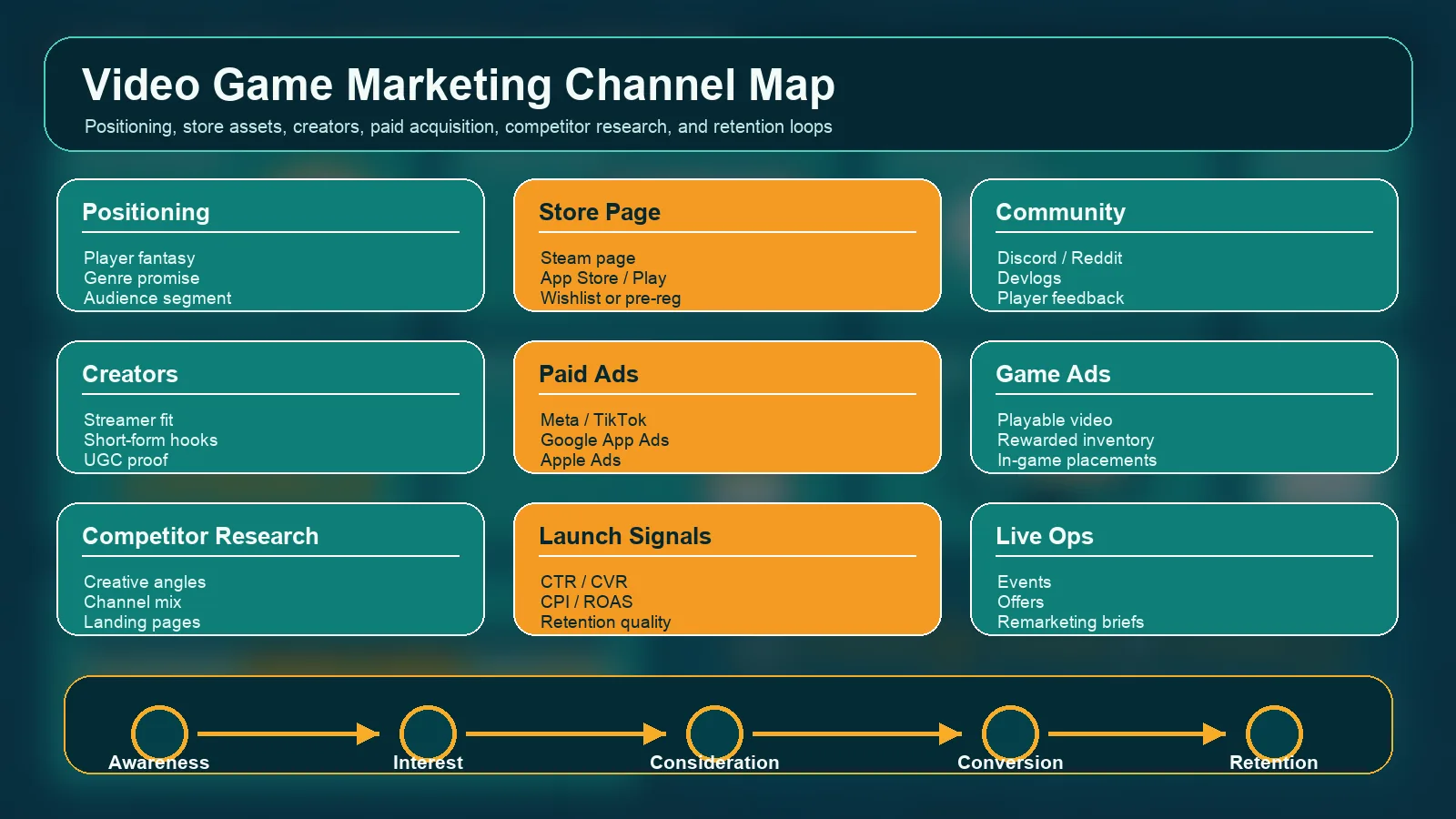
Mobile Game User Acquisition in 2026: The Complete UA, Creative & Marketing Playbook
A 7,000-word 2026 mobile game user acquisition playbook: UA channels, creative testing, CPI/ROAS math, competitor ad research, soft launch, and a 30/60/90-day scaling system for indie and mobile teams.
Mobile Game Monetization: Ads, IAP, and Hybrid Revenue Models
A practical 2026 guide to mobile game monetization, covering ad revenue, IAP, hybrid models, rewarded ads, interstitials, player experience, and competitor research.