
Paid User Acquisition: Strategy, Channels, and Creative Testing
A practical paid user acquisition guide for app teams: channel strategy, creative testing, budget guardrails, measurement, and competitor research workflows.
Paid UA works best when channels, creative testing, store-page alignment, and measurement operate as one system.
Paid User Acquisition: Strategy, Channels, and Creative Testing
Paid user acquisition is the process of buying qualified app users through paid channels, then improving campaigns until the cost of acquiring those users is justified by retention, monetization, or another business outcome.
That definition sounds simple. The operating reality is not. App user acquisition is not just "run ads." A paid UA system includes channel selection, audience quality, creative testing, store-page alignment, measurement, budget guardrails, competitor research, and a feedback loop from product data back into marketing.
The best teams treat paid user acquisition as a learning system. Every campaign should answer one question: which audience, promise, creative, channel, and store experience can attract users who are likely to stay?
This guide is for app teams building a paid user acquisition strategy in 2026. It is especially relevant for mobile apps, mobile games, AI apps, consumer subscriptions, and growth teams that need repeatable creative learning. If your app is a game, pair this with the mobile game marketing strategy guide. If you are choosing research tools, use the best ad intelligence tools comparison.
The examples focus on mobile app user acquisition, but the operating model also applies to web-to-app funnels and subscription apps that use paid media to create qualified demand.
What Paid User Acquisition Includes
Paid user acquisition is more than media buying. A complete system has six parts:
| Layer | What it answers |
|---|---|
| Positioning | Why should this user care now? |
| Channel strategy | Where can we find the right audience at the right cost? |
| Creative testing | Which message, format, and proof can stop the scroll or win the click? |
| Store or landing-page alignment | Does the destination match the ad promise? |
| Measurement | Are acquired users valuable after install or signup? |
| Iteration | What should we pause, scale, or test next? |
Many teams skip straight to channel setup. That is risky because paid UA amplifies whatever positioning and store experience already exist. If the ad promise is unclear, paid spend only buys faster confusion. If the store page is weak, better targeting will not fix conversion. If retention is poor, cheap installs become a vanity metric.
Paid user acquisition should be planned around the full path:
| Stage | Paid UA question |
|---|---|
| Impression | Did the creative earn attention? |
| Click or tap | Did the promise create intent? |
| Store or landing page | Did the destination confirm the promise? |
| Install or signup | Did friction block the user? |
| Activation | Did the first session deliver the promised value? |
| Retention and monetization | Did the acquired user justify the acquisition cost? |
If your team cannot measure beyond install, treat early results as directional. If your team can measure activation, retention, purchase, trial, subscription, or ad revenue, paid UA becomes more reliable.
Paid UA Is a Learning System
The expensive version of paid user acquisition is buying traffic before knowing what you are learning. The useful version is running controlled experiments.
Every paid UA test should have:
| Item | Example |
|---|---|
| Hypothesis | "New parents care more about sleep tracking than habit streaks." |
| Audience or channel | Meta broad app campaign, Apple Search Ads keyword group, Google App campaign, TikTok creator-style video |
| Creative angle | Problem, outcome, social proof, comparison, offer, demo, urgency |
| Destination | App Store product page, custom product page, Google Play listing, web landing page |
| Success metric | Store conversion, cost per install, activation cost, trial start, D7 retention, payback signal |
| Kill rule | Pause if cost per activated user is 2x target after minimum spend |
| Next action | Scale, revise hook, change store screenshots, or stop the angle |
This is the difference between paid UA and random spend. A channel manager buys media. A growth team builds a system that improves its next test.
Channel Map for App User Acquisition
There is no universal best paid UA channel. There are channel roles.
| Channel | Best role | First thing to test |
|---|---|---|
| Google App campaigns | Broad scale across Google properties and partner inventory | Asset variety, conversion event, target bid, store alignment |
| Meta app campaigns | Broad discovery, social proof, UGC-style creative, retargeting | Hook and first visual |
| Apple Ads / Apple Search Ads | High-intent App Store demand capture | Keyword intent and custom product page match |
| TikTok | Fast concept discovery and creator-style hooks | Opening moment and native pacing |
| In-app ad networks | Gaming, utility, and high-volume app inventory | Playable/video fit and post-install quality |
| Influencer or creator paid media | Trust, story, audience education | Creator-market fit and offer clarity |
| Retargeting | Return users, trial nudges, payer recovery | Segment-specific message |
Google App Campaigns
Google's official App campaigns page describes promotion across Google Search, YouTube, Google Play, and more from a single campaign. That scale is useful, but it also means the marketer's job is not only keyword picking. The job is feeding strong assets, conversion events, budget, and product signals into a machine-learning delivery system.
Use Google App campaigns when:
| Good fit | Watch out |
|---|---|
| You have enough conversion volume for optimization | Weak event setup can send the system the wrong signal |
| Your app has broad demand or a clear category | Narrow positioning may need stronger asset discipline |
| You can provide many text, image, and video assets | One weak asset set limits learning |
| You can measure valuable in-app actions | Install-only optimization can overvalue low-quality users |
For Google App campaigns, creative diversity matters. Do not upload five versions of the same message and call it a test. Separate by user promise, visual proof, product moment, and audience pain.
Meta Advantage+ App Campaigns
Meta's official Advantage+ app campaigns page describes AI-optimized bidding, audiences, and placements for app promotion. For app marketers, this means creative signal quality is critical. The system can find pockets of demand, but it still needs strong inputs.
Meta often works well for:
| Use case | Creative bias |
|---|---|
| Consumer subscriptions | Problem-solution, creator explanation, social proof |
| Games | Fast gameplay, challenge, fail/win moment, reward |
| AI apps | Demo, before/after, workflow shortcut, transformation |
| Commerce apps | Product discovery, offer, comparison, social proof |
| Local or lifestyle apps | Persona and situational use case |
The mistake is trying to solve a weak creative strategy with more targeting controls. In modern app campaigns, creative is targeting. The hook selects the audience before the algorithm finishes the job.
Apple Ads and Custom Product Pages
Apple Ads and App Store traffic are powerful because intent is high. Users are already in the store or searching for apps. That does not make the channel automatic. It makes message match more important.
Apple's custom product pages documentation says teams can publish additional versions of an App Store product page with different screenshots, previews, promotional text, and URLs. Apple also notes that custom product pages can be used in Apple Ads campaigns.
Use custom product pages when the paid UA promise differs by audience:
| Campaign promise | Custom page emphasis |
|---|---|
| "Track workouts faster" | Fitness screenshots and quick-start flow |
| "Calm bedtime for parents" | Sleep, family, routine, trust proof |
| "Win puzzle challenges" | Gameplay challenge, level progression, social proof |
| "Save money on subscriptions" | Savings proof, before/after, security |
This matters because app user acquisition does not end at the ad. A high-intent Apple Ads click can still fail if the screenshots, subtitle, and preview do not confirm the searcher's intent.
TikTok, Creators, Ad Networks, and Retargeting
TikTok and creator-style paid media are often best for concept discovery. The platform rewards native pacing, clear emotion, and a fast first moment. The lesson for app marketers is simple: do not make the ad look like a product tour unless the product tour is genuinely surprising.
In-app ad networks are strong for games and some high-volume consumer apps, especially when the product can be explained through video, playable ads, or rewarded inventory. The challenge is quality. A channel can produce cheap installs while hurting retention if the creative overpromises or the placement creates accidental clicks.
Retargeting should be segmented. A user who installed but did not activate needs a different message than a former payer. Do not run one generic "come back" campaign for everyone.
Creative Testing System
The creative system is where paid user acquisition either compounds or stalls.
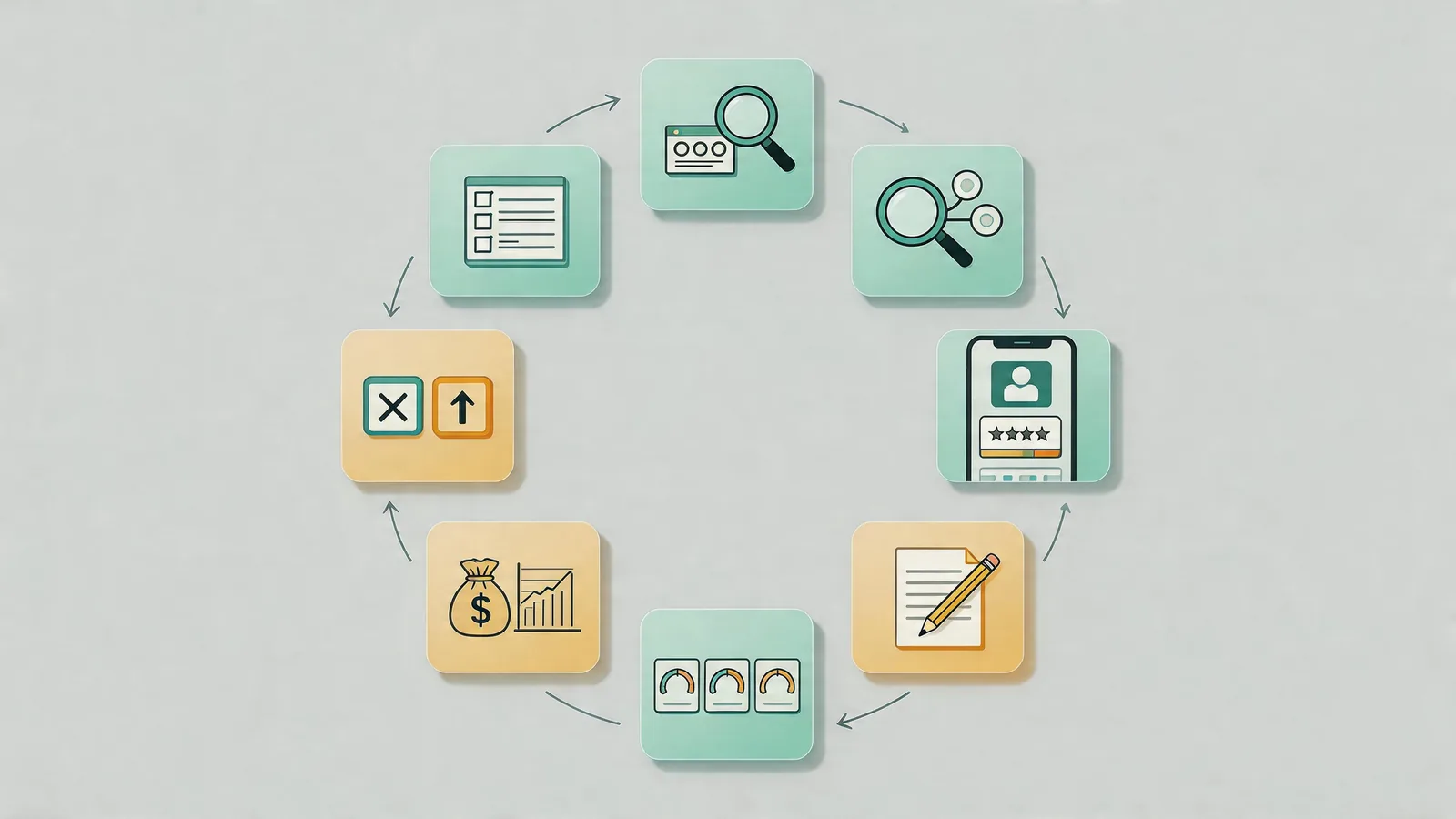
The useful paid UA loop turns competitor signals into original creative briefs, tests, measurement, and next actions.
A good app UA creative test is tagged by idea, not just by file name.
| Tag | Examples |
|---|---|
| Hook type | Problem, outcome, mistake, challenge, speed, comparison, proof |
| Visual format | Product demo, UGC, gameplay, creator reaction, screenshot, animation, testimonial |
| User promise | Save time, earn more, relax, win, learn, organize, discover, avoid risk |
| Proof | Rating, demo, data point, testimonial, before/after, recognizable workflow |
| CTA | Install, try, start free, compare, claim, join, play |
| Destination | Default store page, custom product page, landing page, deep link |
Test ideas in batches. A useful weekly rhythm for a small team is:
| Step | Minimum operating version |
|---|---|
| Research | Review 5 to 10 competitor ads and 2 benchmark brands |
| Brief | Write 3 to 5 distinct creative ideas |
| Variants | Produce 2 to 4 variants per idea |
| Launch | Keep budget small enough to learn without forcing scale |
| Read | Evaluate CTR, store conversion, activation, and early retention |
| Decide | Kill, revise, expand, or scale |
Do not confuse edits with ideas. Changing a button color is not the same as testing a new promise. If three variants share the same hook, they are one idea with three executions.
Store Page and Landing-Page Alignment
Paid UA fails when the ad and destination tell different stories.
Google Play's store listing experiments documentation emphasizes testing graphics and localized text to improve installs and retention signals. That is a useful reminder: acquisition and product-page optimization are connected.
Use this alignment checklist:
| Ad promise | Destination must show |
|---|---|
| Fast setup | First screenshot or hero section shows setup speed |
| Better sleep | Store assets show the bedtime use case, not generic dashboard UI |
| AI writing assistant | Demo, before/after, workflow, trust and privacy proof |
| Game challenge | Real gameplay or challenge proof, not unrelated character art |
| Money savings | Concrete savings claim, eligibility, proof, and caveats |
If the ad earns attention but the store page loses people, do not only blame the channel. Fix the page.
For web landing pages, check:
| Landing-page question | Why it matters |
|---|---|
| Does the hero repeat the ad promise? | Message match protects conversion |
| Is the CTA obvious on mobile? | Paid traffic is impatient |
| Is there proof before the second scroll? | Users need confidence fast |
| Does the page load quickly? | Slow pages tax every paid click |
| Does the page route to the correct app store? | Friction kills intent |
Budget Model and Kill Rules
Paid user acquisition should use learning budgets before scaling budgets.
| Stage | Budget purpose | Guardrail | | --- | --- | | Signal test | Learn which promise earns qualified attention | Do not optimize on CTR alone | | Store conversion test | Learn whether the destination supports the promise | Pause if click quality is good but store CVR stays weak | | Activation test | Learn whether users reach the first value moment | Watch cost per activated user | | Retention test | Learn whether paid users remain valuable | Do not scale on CPI alone | | Scale test | Increase spend while preserving economics | Watch fatigue, LTV, and payback |
The exact budget depends on category, geography, and monetization. The principle is stable: do not ask a tiny budget to prove LTV, and do not let a large budget run without a kill rule.
Example kill rules:
| Test | Possible kill rule |
|---|---|
| New hook | Pause if CTR and store CVR both underperform after minimum impressions |
| New custom product page | Pause if conversion falls and retention does not improve |
| New channel | Cap spend until activation cost is within target range |
| Retargeting offer | Pause if incremental conversions are not visible |
| Creative scale | Rotate if frequency rises and conversion falls |
Do not make kill rules too early. A test needs enough data to be fair. But do not make them so late that the budget becomes an excuse to keep a weak idea alive.
Measurement Framework
Paid UA measurement should connect acquisition cost to user quality.
| Metric | What it tells you |
|---|---|
| CTR or tap-through rate | Creative attention and relevance |
| Store conversion rate | Destination fit |
| CPI | Install cost, but not user quality |
| Cost per activated user | Whether the ad attracted people who reached value |
| D1/D7 retention | Whether the product delivered the promise |
| Trial start or purchase rate | Commercial quality |
| ROAS or payback | Whether spend can scale |
| Creative fatigue | How fast an idea decays |
Install volume alone is a weak success metric. It can be useful early, but it should not be the final decision metric unless the business model truly monetizes every install similarly.
For subscription apps, track trial starts, trial-to-paid conversion, refund rate, and cancellation cohorts. For games, track tutorial completion, D1/D7 retention, payer conversion, ad engagement, and ARPDAU. For AI or productivity apps, track activation event, weekly usage, and conversion to paid plans.
Competitor Research Loop
Competitor research helps paid user acquisition when it becomes original testing, not copying.
Use a simple workflow:
| Step | Output |
|---|---|
| Pick competitors | Direct apps, fast movers, aspirational brands, and category benchmarks |
| Collect ads | Save channel, hook, visual, offer, CTA, and run pattern |
| Review destination | Check store page, custom page, landing page, and proof |
| Tag patterns | Group by user promise, format, and proof type |
| Write briefs | Turn patterns into original creative ideas |
| Test | Launch small batches and compare quality metrics |
| Report | Share what changed, what worked, and what to test next |
AdMapix is built for this kind of recurring competitor ad research. Browse AdMapix reports if your team needs faster signal capture, or review pricing if you want a lightweight workflow before buying a larger intelligence stack.
Common Mistakes
Mistake 1: Scaling before activation is proven. Cheap installs are not growth if users do not reach the first value moment.
Mistake 2: Testing channels before testing promises. If the user promise is weak, every channel looks expensive.
Mistake 3: Treating app store assets as separate from paid UA. The store page is part of the campaign.
Mistake 4: Using one creative for every channel. A TikTok-style hook, Apple Search Ads custom product page, and Google App campaign asset set should not be identical.
Mistake 5: Copying competitors instead of learning from them. Use competitor ads to identify patterns, then build original creative.
Mistake 6: Optimizing for CPI while ignoring retention. Low CPI can hide bad audience quality.
FAQ
What is paid user acquisition?
Paid user acquisition is the process of acquiring users through paid marketing channels such as Google App campaigns, Meta app ads, Apple Ads, TikTok, ad networks, creator paid media, and retargeting. For apps, it should be measured beyond installs, using activation, retention, monetization, and payback signals.
What is the difference between user acquisition and paid user acquisition?
User acquisition includes all ways a product gets users, including organic search, ASO, referrals, partnerships, PR, content, community, and paid channels. Paid user acquisition is the paid media subset of that system.
Which paid UA channels work best for apps?
Google App campaigns, Meta app campaigns, Apple Ads, TikTok, in-app ad networks, creators, and retargeting can all work. The best channel depends on app category, creative strength, measurement setup, geography, store-page conversion, and retention quality.
For mobile app user acquisition, the best starting mix is usually one broad automated channel, one high-intent store channel, and one creative discovery channel.
How much should an app spend on paid user acquisition?
Early teams should spend enough to get a fair read on creative, store conversion, and activation, not enough to force scale. Larger budgets should come after CPI, activation cost, retention, and monetization signals agree.
What metrics matter most for app user acquisition?
CTR, store conversion, CPI, cost per activated user, D1/D7 retention, trial or purchase rate, ROAS, payback, and creative fatigue all matter. CPI alone is not enough.
How should teams use competitor ads in a user acquisition strategy?
Use competitor ads to understand hooks, formats, proof, offers, landing pages, and category movement. Do not copy protected creative. Convert patterns into original briefs and test them with your own product proof.
Conclusion
Paid user acquisition works when it is built as a loop: position the app, choose channels, test creative, align the store page, measure quality, and feed learning back into the next campaign.
The teams that win do not simply spend more. They learn faster. They know which competitors to watch, which hooks to test, which store assets to change, which metrics matter, and when to stop a weak idea.
If your team needs that weekly research loop, start with AdMapix reports. If you need to map recurring competitor research into your budget, review AdMapix pricing.
Turn these observations into your next creative study
Open the creative library and select samples for your market, network and research question.
Related Articles
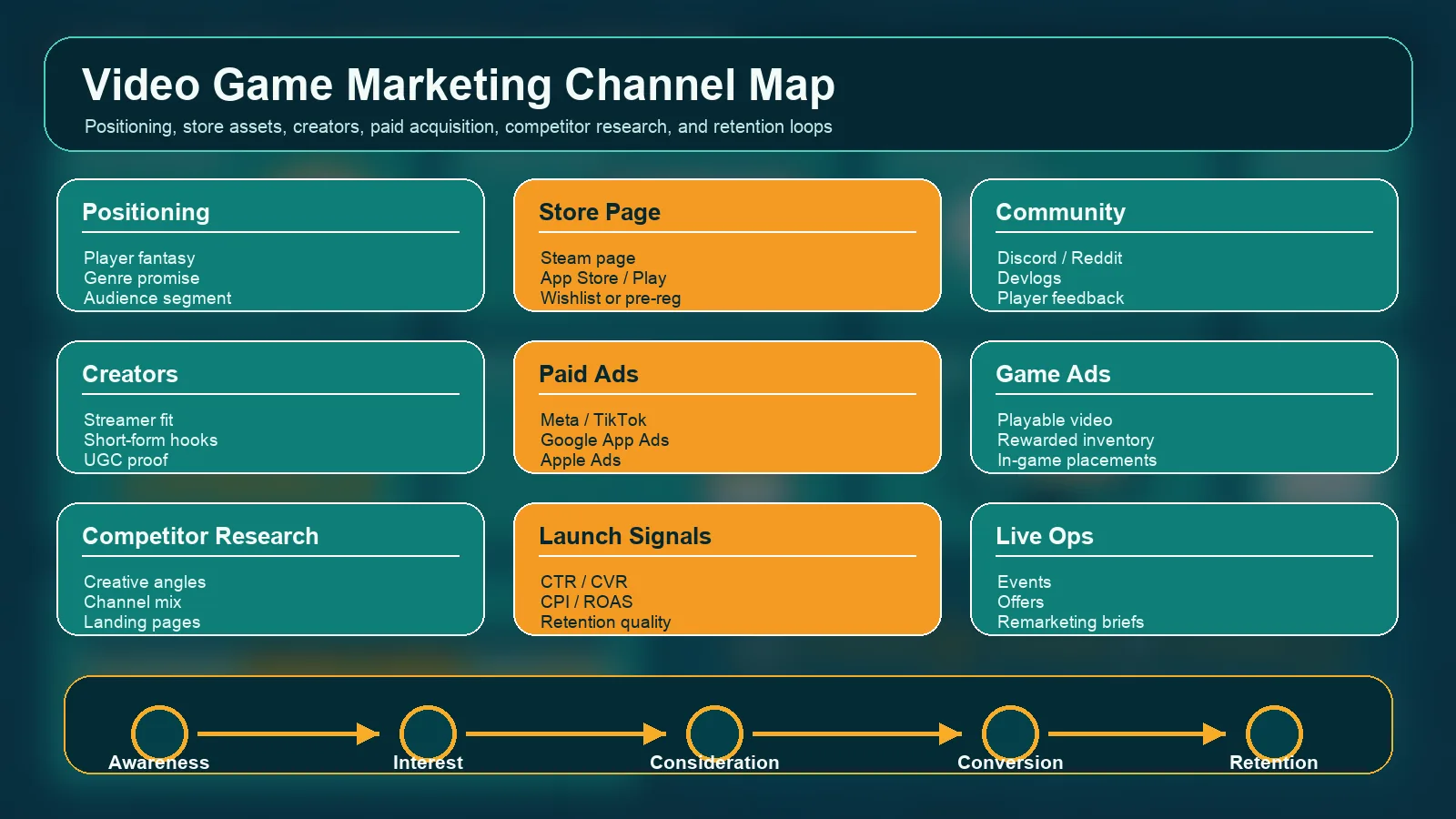
Mobile Game User Acquisition in 2026: The Complete UA, Creative & Marketing Playbook
A 7,000-word 2026 mobile game user acquisition playbook: UA channels, creative testing, CPI/ROAS math, competitor ad research, soft launch, and a 30/60/90-day scaling system for indie and mobile teams.
Mobile Game Monetization: Ads, IAP, and Hybrid Revenue Models
A practical 2026 guide to mobile game monetization, covering ad revenue, IAP, hybrid models, rewarded ads, interstitials, player experience, and competitor research.
Mobile Game Marketing Strategy: A 12-Step UA & Creative Playbook (2026)
A practical mobile game marketing strategy guide for 2026 covering creative intelligence, paid UA, soft launch KPIs, ASO, retention loops, and competitor ad research.