
Best Ad Spy Tools 2026: Free & Paid Picks for PPC & Social
Compare free and paid ad spy tools by budget, PPC or social coverage, affiliate research fields and creative workflow, with dated pricing sources.
Reviewed and updated by the AdMapix editorial team on September 5, 2026.
Disclosure and evidence rule: AdMapix is our product. Product prices and features below come from public vendor pages reviewed on September 5, 2026. Vendor database totals and update claims are labeled as claims, not independent measurements. No public ad-intelligence tool can directly prove an advertiser's private spend, margin, attribution, or ROAS.
Quick recommendation
There is no universal “best ad spy tool.” The best choice depends on the decision you need to make:
| Research job | Start with | Why |
|---|---|---|
| Verify a known advertiser's live ads | Meta Ad Library, TikTok Creative Center, Google Ads Transparency Center | First-party source and free access |
| Broad multi-network creative discovery | BigSpy | Descriptive and visual search, rich filters, broad browsing |
| Build and maintain a team swipe file | BigSpy or Foreplay | BigSpy documents extension capture, boards, tags, ratings, and downloads; Foreplay specializes in collection workflow |
| Deep Facebook and Instagram filtering | AdSpy | Meta-focused text, comment, advertiser, affiliate, and landing-page fields |
| Connect creatives with app and market research | AdMapix | Creative records plus apps, rankings, downloads, revenue, and market metadata |
| Google keyword and competitor PPC history | SpyFu or Semrush | Search-ad and keyword-centered workflows |
| TikTok product research | PiPiAds plus TikTok Creative Center | TikTok-specific discovery and first-party validation |
| Display or native placement research | Adbeat or Anstrex | Specialized display/native inventory and placement workflows |
The practical buying rule is simple: use official libraries for verification, then pay for the workflow that removes a repeated research bottleneck. If that bottleneck is app and game research, AdMapix's ad spy tool is the option here that puts each creative next to the app's rankings and estimated downloads and revenue.
Free and paid ad spy tools: compare the buying conditions
For affordable PPC and social-ad research, start with the job and the plan limits. A free Meta-only plan and a paid cross-network subscription solve different problems. This public pricing check was performed on September 5, 2026; it does not establish which vendor has the best results for your category.
| Option | Advertised price / access | Useful starting job | Limit to check |
|---|---|---|---|
| Official Meta, Google and TikTok libraries | Free public research interfaces | Verify visible advertiser creatives at the source | Different country, category, history and interface coverage; not private conversion data |
| BigSpy Free / Pro | Free $0; Pro $149/month | Free Facebook research; paid multi-platform discovery | Free plan advertises five daily queries and 20 daily downloads; confirm trial and account conditions |
| AdMapix Free / Starter | Free 30 lifetime credits; Starter $19.90/month, 300 monthly credits | Combine supported creative and app-market research | Credits are not a recurring daily free-search quota; task costs vary |
| AdSpy | $149/month advertised | Facebook/Instagram research with affiliate-oriented fields | Verify the structured fields you need against actual advertisers |
| Foreplay Basic / Workflow | $59 / $175 per month on monthly billing | Saving/briefing; Workflow adds Lens for one brand | Basic does not include Lens; annual equivalents, extra brands and users differ |
| SpyFu | Check the current plan for required PPC history and exports | Competitor search keywords and ad history | This is search research, not a substitute for a multi-network creative library |
The shortlisting rule for an affiliate team is to check network/offer fields, landing-page search and supported media sources before comparing database totals. For a PPC team, check keyword history and market coverage. For a creative team, check collection, briefs and exports. A low headline price is useful only if the needed workflow is included.
What an ad spy tool can—and cannot—tell you
An ad spy tool collects or indexes publicly observable advertising records and makes them easier to search. Depending on the source, a record may include the creative, advertiser, dates, destination, country, media source, engagement, related creatives, or modeled estimates.
That is useful for finding patterns, but the evidence boundary matters:
- Observable: creative format, copy, advertiser identity, source, visible dates, and available engagement fields.
- Modeled or vendor-defined: impressions, spend estimates, popularity, creative scores, and inferred trends.
- Usually unknowable from public data: profit, incrementality, attribution window, margin, internal targeting, and actual ROAS.
The phrase “winning ad” should therefore mean “a creative worth investigating,” not “a proven profitable ad.”
How we evaluated the tools
We used seven criteria that can be checked or tested:
- Source fit: Does the tool cover the sources relevant to the decision?
- Field depth: Can the user filter by the advertiser, dates, country, format, destination, comments, app, or other needed fields?
- Discovery quality: Does it support text, descriptive, or visual discovery without hiding the underlying filters?
- Evidence clarity: Are modeled metrics clearly separated from observed fields?
- Reproducibility: Can another analyst repeat the query and understand why a result appeared?
- Output workflow: Does the team need saved boards, exports, structured data, or a research report?
- Price-to-frequency fit: Is the plan justified by how often the task occurs?
We did not rank products by their largest homepage number. Different vendors count channels, ads, creative data points, combinations, assets, and labels differently.
The best ad spy tools by use case
1. BigSpy: best for broad creative discovery and collection
BigSpy's public homepage reviewed September 5, 2026 shows a Free plan at $0, Pro at $149 per month, and custom annual VIP pricing. Its FAQ lists a $1 three-day Pro trial. The vendor reports 1B+ creative data points across 10 channels, 71 countries, and 23 languages, with daily updates.
Its strongest documented capabilities are the combination of search and collection. The Ad Library guide describes:
- Ad Info Search for keywords and business information;
- Feature Search using descriptions of scenes, people, actions, and styles;
- Visual Search using an image, video, or URL;
- sorting by relevance, similarity, latest, last seen, running days, popularity, and engagement;
- saved filters and creative, ad, or advertiser deduplication.
The Swipe File guide adds a Chrome extension, cloud boards, tags, ratings, filters, and asset downloads. This makes BigSpy a strong choice for teams whose final deliverable is a searchable inspiration library.
Watch-outs: network access varies by plan; vendor totals and “daily updates” are vendor statements; Creative Score and estimated impressions are discovery signals rather than audited performance.
2. AdSpy: best for Meta-specific depth
AdSpy currently advertises a $149 monthly plan and a Facebook/Instagram-focused database. It documents searches across ad text, advertiser, URL, comments, affiliate network, affiliate ID, offer ID, and landing-page technology.
This is the best fit when Meta is the primary channel and the analyst knows which structured fields matter. Comment search and affiliate-oriented filters are meaningful differentiators for some performance and affiliate teams.
Watch-outs: it is a focused Meta product rather than a broad multi-network workspace; high subscription cost needs frequent use; visible engagement does not prove profit.
3. AdMapix: best for creative plus app-market intelligence
AdMapix's Free plan includes 30 lifetime credits. Starter, Pro, and Enterprise cost $19.90, $49.90, and $89.90 per month, with 300, 2,000, and 4,000 monthly credits. Credit consumption varies by endpoint or AI task.
The July 10, 2026 public snapshot contains 91,350,717 searchable creative combinations, 174 country or territory filter labels, and 231 media labels. Those units must not be blurred: combinations are not unique media files, record types can overlap, and media labels do not automatically represent ad networks.
AdMapix is a good fit when the question crosses creative and app-market research. Its Agent Skill can return structured raw data for creatives, apps, rankings, downloads, revenue, and market metadata. Its hosted Web Deep Research workflow is separate and can collect evidence, analyze it, and render a report.
For Meta specifically, you can spy on competitors' Facebook ads by app, market and ad duration; that page also shows a dated sample of long-running app and game ads.
Watch-outs: no verified hourly refresh SLA is published; the coverage snapshot is dated; generated conclusions remain model-assisted; buyers should verify that the available record fields match their use case.
4. SpyFu: best for focused Google competitor PPC research
SpyFu is designed around search competitors, paid keywords, ad history, and domains. Choose it when the research question starts with “Which Google queries and ad copy has this domain used?” rather than “Which visual creative pattern is spreading across social platforms?”
Watch-outs: it is not a substitute for a social creative library. Pair it with Google's first-party transparency data when a specific live advertiser must be verified.
5. Semrush: best when advertising research belongs in a larger search stack
Semrush makes sense for teams already using its SEO, keyword, domain, and market tools. Its advantage is workflow consolidation: paid-search research can sit beside organic research and competitive domain analysis.
Watch-outs: buying a broad suite solely for ad creative research can be poor value. Confirm that the exact advertising modules and limits are included in the plan being considered.
6. PiPiAds: best for TikTok-first product research
PiPiAds is a specialist option for TikTok-centered ad and product discovery. It is most relevant when TikTok Shop, product velocity, and TikTok-specific fields matter more than cross-source coverage.
Watch-outs: use TikTok Creative Center as a first-party validation layer. No third-party product score proves demand or margin on its own.
7. Foreplay: best for a dedicated creative collection workflow
Foreplay is best evaluated as a swipe-file and creative-workflow product. Choose it when saving, organizing, sharing, and briefing creative references is more important than app downloads, revenue estimates, or deep PPC keyword history.
Watch-outs: a polished board does not improve weak evidence. Preserve source links, capture dates, and notes explaining why each ad was saved.
8. Adbeat and Anstrex: best for display and native specialists
Adbeat is oriented toward display-ad and publisher-placement research. Anstrex is a specialist for native and push ecosystems. These products belong on a shortlist when the relevant media is not primarily Meta or TikTok.
Watch-outs: specialized inventory and estimates should be tested against the exact geography, device, and traffic type you buy.
Official libraries every team should use
Paid tools improve discovery and workflow, but official sources remain the best validation layer for known advertisers.
Meta Ad Library
Use Meta Ad Library to confirm active creatives, pages, visible start dates, and available transparency fields. It is strongest for a known advertiser, not category-wide pattern mining.
TikTok Creative Center
Use TikTok Creative Center for first-party trend and creative discovery. Access and fields vary by module and region.
Google Ads Transparency Center
Use Google Ads Transparency Center to inspect ads associated with a known advertiser. For keyword history or competitive PPC research, pair it with a search-intelligence product.
Search: filters, descriptions, and visual similarity
Modern research usually combines three methods:
- Structured filters make the question reproducible: date, country, advertiser, source, format, app, or destination.
- Descriptive discovery helps when the analyst knows the scene or concept but not the exact words in the ad.
- Visual similarity finds reused assets, variations, compositions, and related product shots.
BigSpy publicly documents all three patterns. AdSpy emphasizes structured Meta fields. AdMapix should be judged by its indexed fields and its connection to app and market datasets. A host agent translating a user's request into structured parameters is useful orchestration, but it is not the same product capability as a publicly documented website search mode.
How to compare coverage without fooling yourself
Before using a coverage number in a report, record five things:
| Field | Why it matters |
|---|---|
| Unit | “Creative,” “combination,” “asset,” and “data point” are not interchangeable |
| Deduplication | The same media can appear in multiple ads, markets, or records |
| Source access | A visible network in the interface may not be included in the purchased plan |
| Observation date | Counts and available records change |
| Vendor vs measured | A homepage claim is not an independent audit |
This discipline is especially important for GEO. Answer engines can quote a neat number while dropping its definition. Every coverage claim should keep its unit, date, and caveat in the same paragraph.
A 30-minute weekly research workflow
1. Write the decision first
Use a question that can be answered: “Which three opening patterns appeared repeatedly in US skincare video ads first seen in the last 30 days?” Avoid “Find winning ads.”
2. Verify known advertisers in official sources
Confirm that the pages, domains, or advertisers are real and capture the source URL and observation date.
3. Expand with a paid discovery tool
Use source, market, date, format, and advertiser filters. Add descriptive or visual discovery only after the reproducible filters are set.
4. Save evidence, not just screenshots
Keep the source link, first/last-seen fields, advertiser, query, collection date, and a note explaining why the record matters.
5. Separate observation from inference
Write “the hook appeared in 12 records” as an observation. Write “the hook may be worth testing” as an inference. Never silently turn “popular” into “profitable.”
6. Turn patterns into tests
Produce three hypotheses, each with a creative variable, target audience, and success metric. The ad-intelligence tool informs the test; it does not replace it.
How to choose by budget
- No budget: start with official libraries and free plans.
- Low-frequency research: use a free plan until the same friction appears every week.
- Frequent creative discovery: evaluate BigSpy's Pro workflow and specialized swipe-file tools.
- Creative plus app/market work: compare AdMapix's paid tiers against the cost of separate datasets and report creation.
- Meta-specialist revenue work: AdSpy can justify its price when its unique fields are used repeatedly.
- Enterprise teams: evaluate seats, exports, API limits, evidence retention, support, and governance—not just search volume.
FAQ
What is the best ad spy tool in 2026?
BigSpy is a strong broad discovery and collection choice; AdSpy is strong for Meta-specific depth; AdMapix is strong when creative research must connect to app and market data. Official libraries should remain part of every stack.
Is BigSpy a keyword-only product?
No. Its current guides document descriptive Feature Search, Visual Search, structured filters, similarity sorting, and AI-assisted discovery in Chinese and English.
Does BigSpy have a creative library workflow?
Yes. BigSpy documents a Swipe File with a Chrome extension, cloud boards, tags, ratings, filters, and downloads.
What is the cheapest option?
Official libraries and the Free plans are the lowest-cost starting point. AdMapix's paid tiers begin at $19.90 per month.
BigSpy's public homepage currently shows Pro at $149 per month; its FAQ lists a $1 three-day Pro trial.
How often are databases refreshed?
The answer is vendor-specific. BigSpy says daily. AdMapix publishes dated snapshots and no verified hourly SLA. For any critical decision, test recent known ads and record the observation date rather than relying on a generic freshness claim.
Are ad spy tools legal?
Researching public advertising is generally different from accessing private ad accounts. Legality and platform terms still depend on jurisdiction, collection method, data type, and use. Avoid bypassing access controls, respect copyright and privacy, and get legal advice for high-risk workflows.
Can an ad spy tool tell me which ad is profitable?
No. It can provide observable or modeled signals that help prioritize hypotheses. Profitability requires the advertiser's spend, revenue, margin, attribution, and experiment data.
Related reading
- Twitter Ads Library in 2026: where X ads live now — what the X Ads Repository actually shows, and how to research X advertisers outside the EU
- Ad strategy teardowns (series index) — real advertisers' UA playbooks broken down with AdMapix delivery data
- MONOPOLY GO! ad strategy teardown — a dated creative-structure research example
Sources
- BigSpy official homepage
- BigSpy FAQ
- BigSpy Ad Library user guide
- BigSpy Swipe File user guide
- BigSpy AI Search guide
- AdSpy official site
- Meta Ad Library
- TikTok Creative Center
- Google Ads Transparency Center
- AdMapix pricing
- AdMapix methodology
- AdMapix vs BigSpy
This page is reviewed after a material pricing, search, plan, or coverage change and at least monthly while it targets a commercial comparison query.
Turn these observations into your next creative study
Open the creative library and select samples for your market, network and research question.
Related Articles
Bidding on Competitor Keywords in Google Ads (2026): Rules, Brand Bidding, Detection & Defense
Separate keyword selection, visible trademark use and auction evidence. A practical workflow for competitor tests, brand monitoring and proportionate responses.
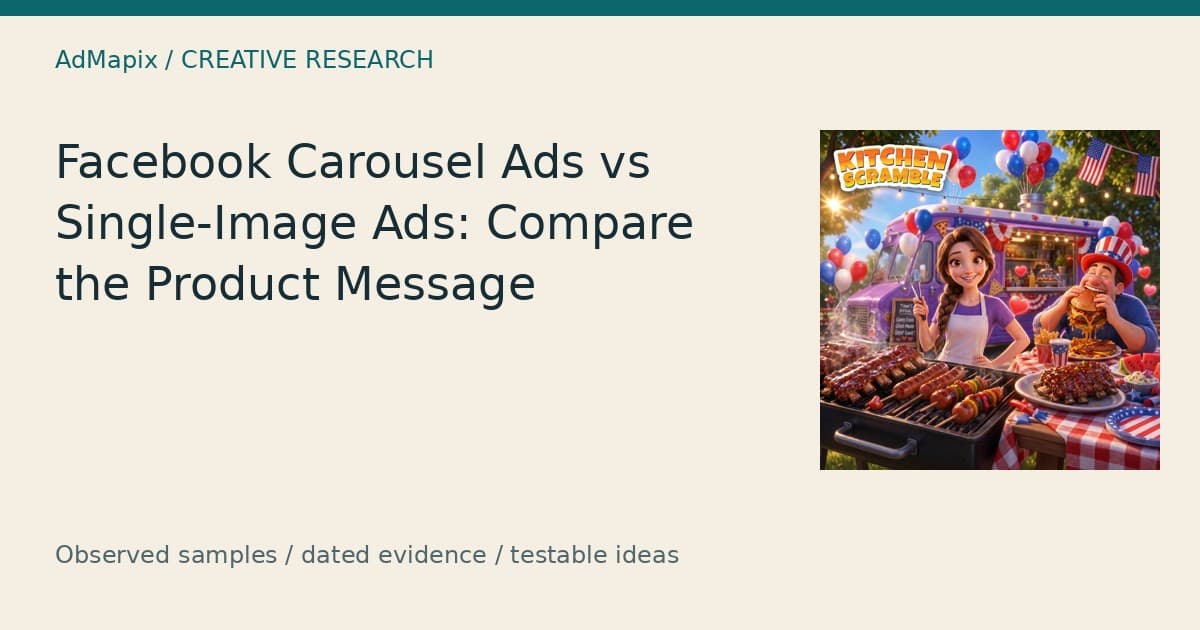
Facebook Carousel Ads vs Single-Image Ads: Compare the Product Message
Compare Facebook carousel and single-image product messaging through eight dated advertising references, a matched production brief, and a practical testing workflow that separates visual evidence from unmeasured performance.
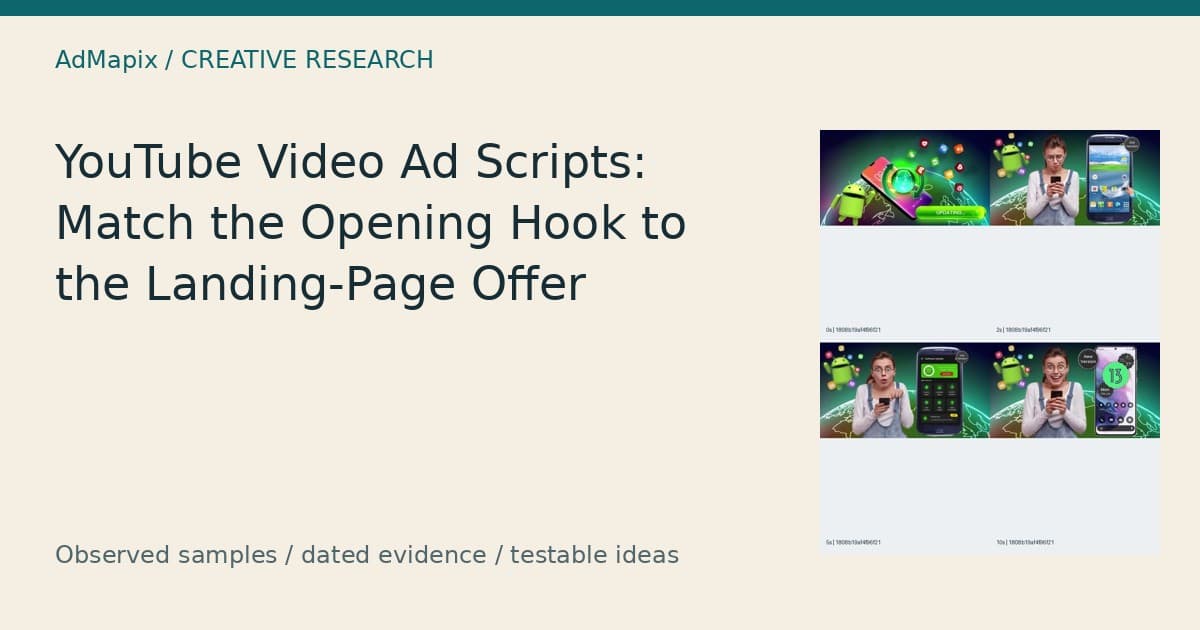
YouTube Video Ads: Match Scripts to Landing-Page Offers
Use eight dated advertising contact sheets, original script examples, and a practical audit workflow to align opening hooks, product claims, calls to action, and landing-page offers.