
Hook atlas
Compare openings by promise, tension and demonstration instead of saving random videos.
Study opening hooks, demonstrations, proof and calls to action across indexed TikTok-labelled creatives—then compare those patterns with app and market signals.
Start with 30 lifetime Free credits; usage varies by task.
Creative combinations are not unique ads. Content types may overlap and must not be summed.
The query, observation date and limitations travel together, so crawlers, researchers and customers see the same evidence.
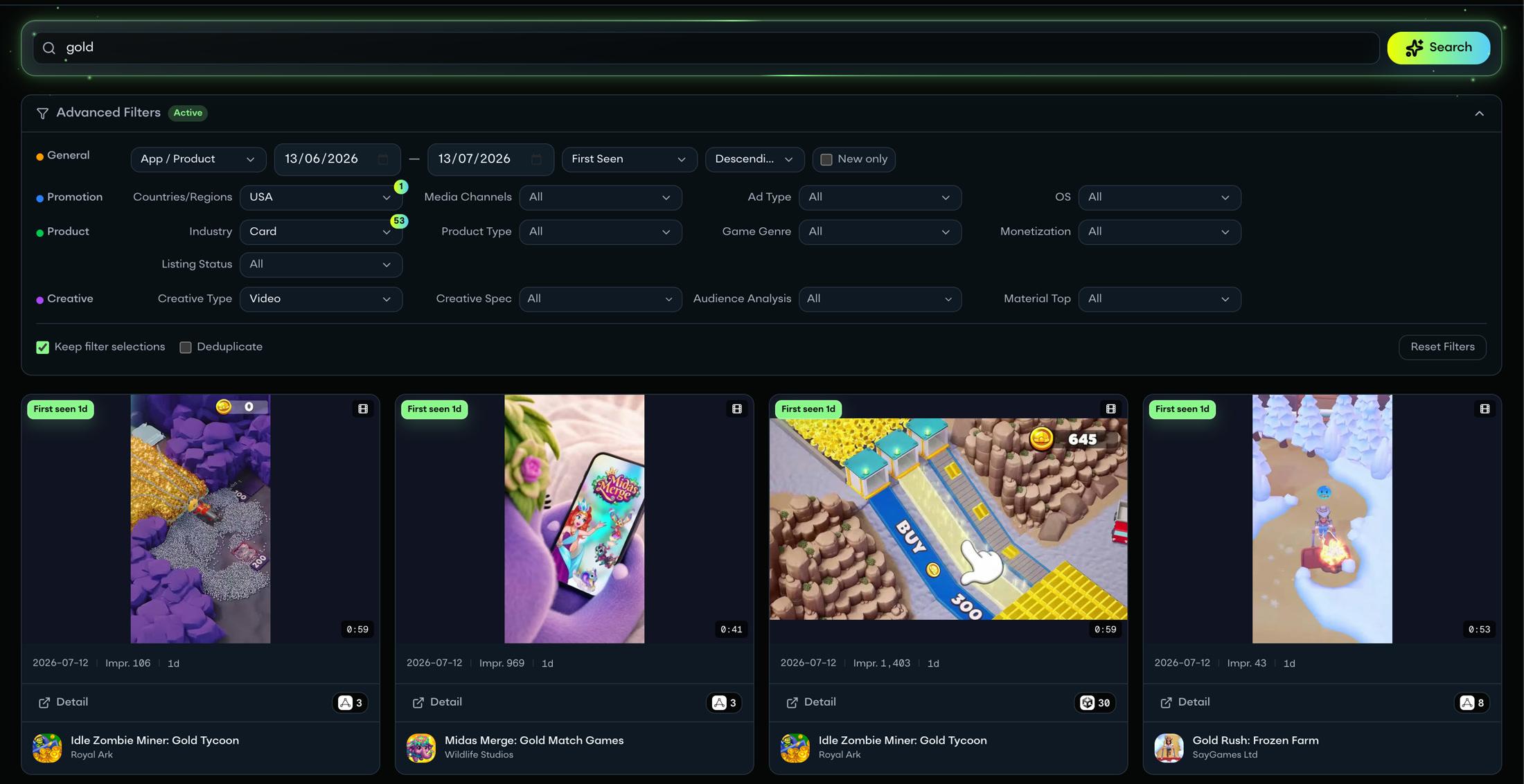
Read a short-form video as a sequence. Mark the opening promise, the demonstration, the proof and the closing action before comparing patterns across competitors.
Compare openings by promise, tension and demonstration instead of saving random videos.
Map Hook → Demo → Proof → CTA on the same visual timeline.
Turn recurring, source-linked observations into testable creative directions.
Repeated hooks, longevity and modeled impressions are useful leads. None of them alone proves profitability. Add app ranking and estimated market context before writing a brief.
“Which opening hooks recur among recently indexed casual-game TikTok videos, and how do their app signals compare?”
TikTok Creative Center is the official platform resource. AdMapix adds cross-channel search and app context, while indexed availability and modeled metrics remain research signals with stated limitations.
TikTok Creative Center is TikTok's official resource. AdMapix is designed for cross-channel indexed research and for connecting creative observations with app signals.
No. Private advertiser spend and ROAS are not available. Modeled metrics are explicitly labeled and should be treated as directional evidence.
No single public signal can prove profit. Recurrence, longevity and modeled reach can prioritize what to inspect, but economics and attribution still require first-party data.
No. The visible example collection is a versioned static snapshot. It does not make an AdMapix data request when you visit the page.