
Facebook Carousel Ads vs Single-Image Ads: Compare the Product Message
Compare Facebook carousel and single-image product messaging through eight dated advertising references, a matched production brief, and a practical testing workflow that separates visual evidence from unmeasured performance.
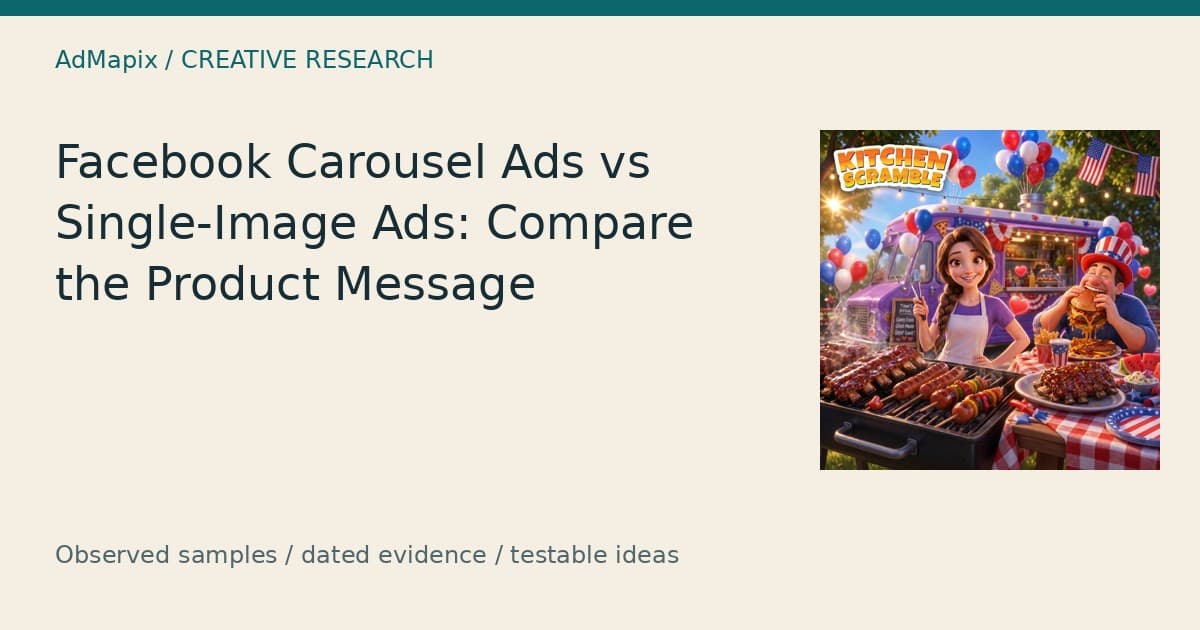
Facebook Carousel Ads vs Single-Image Ads: Compare the Product Message
Facebook carousel ads and single-image ads are worth comparing when they communicate the same product promise under comparable conditions. The useful question is whether separating the message across cards helps people understand the product and take the intended next step. The frozen advertising sample behind this article supports a detailed analysis of message structure; it does not establish a performance winner or contain a completed, controlled format experiment.
For paid social managers, ecommerce teams, and creative strategists preparing their next production brief, that distinction matters. A product photograph, a video contact sheet, and a record containing several images provide different kinds of evidence. Treating them as interchangeable carousel examples can produce a misleading brief before any budget is spent. Below, eight dated references become practical decisions about what belongs in one image, what deserves a separate card, and how to test the resulting original work.
Last updated: September 30, 2026.
AdMapix Research — prepared with Codex and checked against the dated source sample. Editorial ownership: Brad at AdMapix; this does not imply personal human review. AdMapix is our product.
Quick Answer
Facebook carousel ads are a reasonable format hypothesis when a product message contains distinct, useful parts that deserve separate visual treatment. Single-image ads are a reasonable hypothesis when the product, promise, and next action can remain clear together.
- Compare the same product, offer, audience conditions, and destination before attributing a result to format.
- A collage is one image; a video contact sheet is a research aid; several attached images do not independently verify a served carousel.
- This US, Facebook-filtered sample contains 29 advertising records, 11 unique video fingerprints, and 23 unique image fingerprints for September 1–30, 2026.
- The examples support creative hypotheses, not claims about conversions, profitability, or which format Facebook favors.
Start With the Decision the Ad Must Support
The right starting point is the buyer’s unresolved question, because format should follow the information needed to answer it. A dishwasher discount, an unfamiliar kitchen utensil, and a cooking game create different communication tasks. They may all appear in a search for “kitchen,” but they do not belong in one performance comparison. Their value here is showing how different messages use visual space.
Write the intended decision as a sentence before drawing a layout. For a familiar appliance, it might be: “Decide whether this model and its current offer deserve a closer look.” For a specialist utensil: “Understand what the tool does and whether it belongs in my cooking routine.” For a curated collection: “Find an item that fits my preferred style.” These sentences imply different evidence requirements.
The appliance may need a clear product view and accurately qualified offer. The utensil may need a visible hand movement, scale reference, and explanation of use. The collection may benefit from browsing distinct objects. None of those observations proves that the corresponding format will perform better; each gives a reason to build a particular test.
Also distinguish a communication objective from a business objective. “Make the preparation step understandable” describes a creative task. “Generate qualified purchases at an acceptable acquisition cost” describes a business result. A useful experiment connects them without assuming that improving the first automatically improves the second.
For the broader discovery process, use the Facebook Ads Library research guide. This article concentrates on the narrower production decision: how to compare one product message expressed together and expressed across cards.
Methodology: What the Dated Sample Contains
This analysis uses a bounded US search sample for the exact measurement window 2026-09-01 to 2026-09-30, retrieved on 2026-09-30 at 18:39:33 UTC, with the query kitchen and the supplied Facebook source filter. The collection requested up to three pages with ten records per page, using impression-descending ordering. It returned 29 records. This is a sample of indexed search results, not a complete advertiser fleet or a representative census of Facebook advertising.
The public frozen source package contains the dated batches, request parameters, and checksums needed to reproduce the collection and inspect its contents. Checksums establish which stored material the analysis refers to; they do not establish advertising quality, campaign success, or product truth.
The source filter supports describing these as Facebook-filtered indexed records. It does not establish a particular Facebook placement, device experience, buyer identity, or distribution across other Meta services. The attached images do not include a complete live ad interface showing card navigation. Consequently, this article distinguishes observed media from proposed carousel structures throughout.
Counting uses separate units. There are 29 advertising records, 11 records containing video, 11 unique video fingerprints, 23 unique image fingerprints, and no playable fingerprints in this sample. Fingerprint arrays are treated as collections of file identifiers. Those figures are not combined into a single “unique creative” total because a record and its attached media represent different things.
The supplied impression fields are zero throughout the returned records. They provide no useful performance ranking here, despite the requested ordering. Zero fields are not evidence that no advertising was delivered. More generally, impressions in this source are third-party model estimates for the specified window, not observed delivery, spend, installs, profit, or lifetime totals. Product-search impression and spending aggregates are excluded.
Visual analysis covers the eight supplied images. For the two video contact sheets, observations are limited to the labeled timestamps at 0, 2, 5, and 10 seconds. No complete playback, audio review, app interaction, external tool test, or conversion measurement was supplied or performed for this article.
Evidence Table: Eight References and Their Limits
The eight references show different ways to present products, but they do not form matched experimental pairs. The table identifies each source record by a unique abbreviated record identifier, which can be located in the public source package. Listing associations come from the attached product records rather than a visual name match. Those associations do not independently identify the advertising buyer.
| Image | Reported listing and record reference | Material inspected | Supported observation | Important limit |
|---|---|---|---|---|
| 1 | Kitchen Scramble: Cooking Game; f2158083 | Static image | Cooking character, barbecue food, diner, branded truck, and patriotic decoration share one scene | No gameplay or conversion evidence |
| 2 | ZLINE Kitchen and Bath; 838e422c | Video contact sheet | Sampled frames show handling around a range, protective-film removal, and an open oven | No complete demonstration or audio observation |
| 3 | ZLINE Kitchen and Bath; e80f5227 | Static image | Dishwasher photograph carries “UP TO 35% OFF” | Historical ad wording, not a verified current offer |
| 4 | The Honest Kitchen; 3982ac55 | Video contact sheet | Dog and packaged products appear before sampled kitchen presentation frames | No complete preparation sequence observed |
| 5 | The Honest Kitchen; fb54ed3e | Static image | Prepared food, package, ingredient styling, and a simplicity headline appear together | Product requirements need separate verification |
| 6 | Bento&co; f7975bc0 | One supplied image from a record with six image fingerprints | Miso muddler is shown in use with explanatory copy | Multiple attachments do not confirm served carousel behavior |
| 7 | Kitchen Scramble: Cooking Game; 98e75c69 | Static image | Character presents a tray of food and drink in front of a branded truck | Separate record, not a verified second carousel card |
| 8 | Button Marketplace; 9cfcbf19 | Static image | “Kitchen Counter Goals” collage presents a coordinated assortment | Visible brand references do not replace the reported listing association |
Kitchen Scramble references 1 and 7 share the Android listing identifier air.com.kitchenscramble.goo. That supports a common linked product, not a claim that the images were served together or bought by an identified party. The other references similarly retain their reported listing associations.
Distinguish the Format From the Research Preview
A carousel is a presentation with multiple browsable cards, whereas a single-image ad presents one image asset as its main visual. That conceptual distinction is useful, but a research export may not preserve enough interface information to verify the original presentation. The safe practice is to record what is visible first and assign a format only when the evidence supports it.
A collage can contain numerous products while remaining one image. Image 8 demonstrates this directly: bowls, dispensers, kitchen tools, and decorative objects occupy a shared canvas. Calling it a carousel because it contains multiple objects would confuse content with delivery format.
A contact sheet also contains multiple panels, but those panels represent selected moments from a video. Images 2 and 4 are contact sheets. Their arrangement was supplied for analysis; it is not evidence that an advertiser delivered those panels as cards. The timestamp labels help locate observations, not reconstruct everything between them.
A record containing several image files creates a different ambiguity. Bento&co’s record has six image fingerprints and six corresponding image attachments. That makes it relevant to researching a possible multi-image presentation. However, only one of those images is supplied as a visual reference here. The record does not provide enough observed interface evidence to assert card order, per-card destinations, or how the user encountered the images.
Finally, a static image asset is not always sufficient to prove that the live ad used a single-image format. It could be one component of another presentation. In this article, “single-image reference” describes the inspected visual. Where a proposed test uses a single-image ad, that is a future production choice rather than a reconstructed delivery fact.
This vocabulary prevents a practical mistake: designing an experiment around a format that the reference never actually established.
Image 1: A Complete Scene Can Carry Several Message Roles
The first Kitchen Scramble reference places product identity, cooking activity, food variety, and customer enjoyment inside one illustrated scene. Its usefulness for this comparison is that a single canvas can carry multiple message roles without dividing them into cards. Whether viewers actually process those roles as intended remains a hypothesis to test.

Image 1. Static source image linked to Kitchen Scramble: Cooking Game, record f2158083, in the September 30, 2026 sample. The illustration supports analysis of visual messaging, not gameplay fidelity or campaign performance.
The logo occupies the upper-left area, the cook stands near the center, and the foreground grill provides a large food display. The diner’s expression and floating hearts add an explicit enjoyment cue. Red, white, and blue decorations create a recognizable celebratory setting, although the artwork alone does not establish the campaign’s intended holiday, launch schedule, or targeting.
The accompanying record describes a fast-paced cooking game and recipes from around the world in Italian. Those are advertising claims and language observations. They do not turn the illustration into a recorded game session. The US search condition also does not prove that the advertiser targeted Italian speakers in the United States.
A production team could extract a structural idea: use one scene to connect preparation with an appealing customer outcome. An original execution would need its own characters, assets, and substantiated product representation. If actual gameplay is the intended purchase reason, obtain genuine gameplay evidence before writing instructions around that promise.
A carousel hypothesis would separate cooking action, food variety, and customer response into distinct cards. The cost of that separation is losing the immediate relationship among them. A single-image hypothesis would retain the relationship while simplifying background detail. Neither version should receive an extra offer or stronger gameplay claim merely because its layout has more space.
The decision question is concrete: does separating those roles improve understanding enough to justify another interaction? The source image provides the question, not the answer.
Image 2: Product Handling Offers Detail Candidates, Not a Verified Card Sequence
The ZLINE range contact sheet supplies visible product details that could inform an original brief, but it does not establish a carousel or a complete product demonstration. The sampled frames emphasize the appliance’s surfaces, controls, and interior access. They support a discussion of what a static image can show and what may require an additional view.
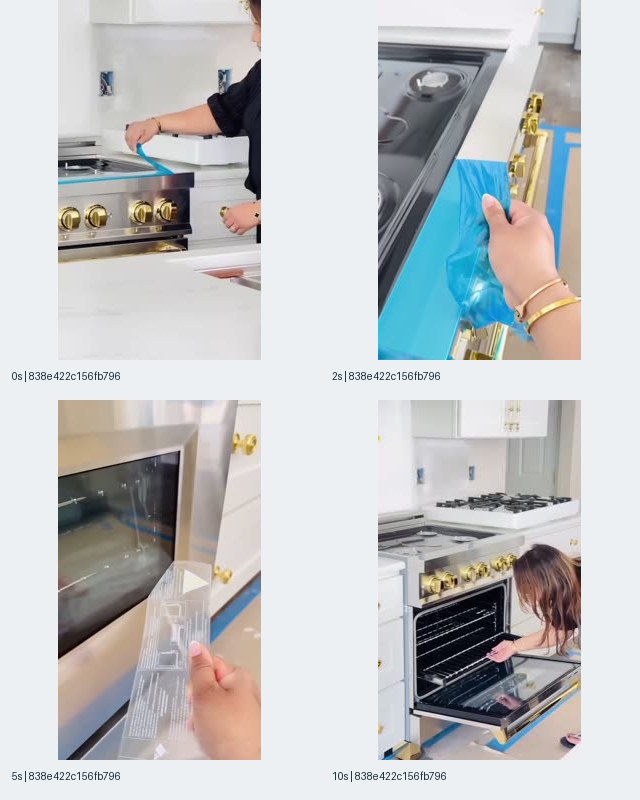
Image 2. Contact sheet for ZLINE Kitchen and Bath, record 838e422c. Only the displayed frames at 0, 2, 5, and 10 seconds were inspected; the source record lists an 11-second video.
The opening sampled view places the range within a light kitchen. Another view concentrates on a hand removing blue protective material near the controls. The later samples show the oven-door area and the open interior. These are useful observations about presentation and handling. They do not demonstrate cooking precision, heating consistency, durability, or ease of cleaning.
The accompanying copy names the ZLINE Autograph Edition Professional Range and uses “beauty meets precision” as a positioning statement. Appearance has visible support in the frames; precision would require evidence appropriate to that claim. A creative team should not treat an attractive control close-up as a performance measurement.
For an original single-image version, choose the view that best identifies the specific appliance and its main approved message. If the message concerns appearance, a clear installed view might be enough. If the message concerns interior configuration, the interior needs meaningful space rather than a decorative inset too small to inspect.
For a proposed carousel, separate views can answer different buyer questions: what it looks like installed, what the relevant detail looks like, and what is inside. Those are editorial suggestions, not the observed order of a source carousel. The actual product documentation must determine which details and accompanying statements are valid.
The reference also exposes a common comparison error. Giving the carousel several attractive photographs while using an indistinct frame grab for the single image would compare production quality as well as format. Build each version from appropriately prepared original photography, then document the remaining differences.
Image 3: A Clear Offer Can Fit Into One Product View
The ZLINE dishwasher reference combines a recognizable product photograph with a prominent discount statement, making it a useful example of message concentration. It shows how a single image can communicate category, setting, and offer without presenting a sequence. It does not establish whether the offer was available to every customer or remains valid today.
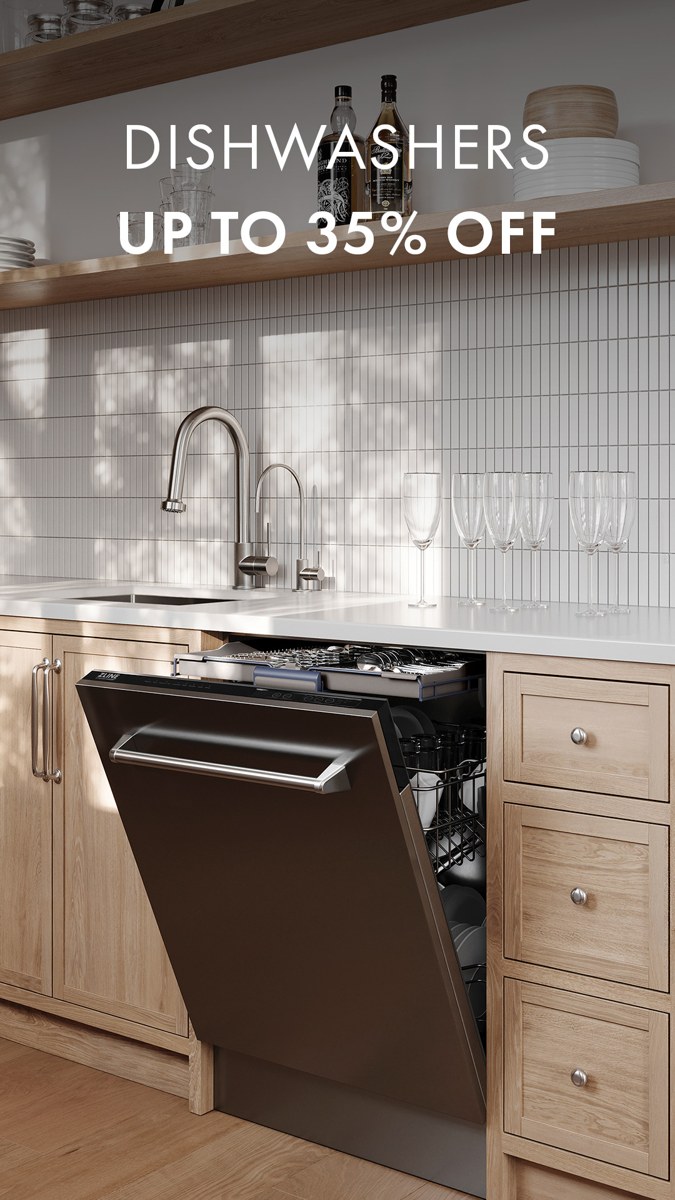
Image 3. Static ZLINE Kitchen and Bath reference, record e80f5227. “UP TO 35% OFF” is wording visible in the archived advertisement, not a current offer verified by AdMapix.
The product occupies the lower portion of the frame, with cabinetry and countertop context around it. The upper text uses a simple hierarchy: category first, offer second. The open door reveals some interior structure while keeping the appliance recognizable as part of an installed kitchen.
The record’s body copy additionally claims cleaning performance, quiet operation, and design appeal. Only the design presentation is directly inspectable from this image. Neither cleaning performance nor quietness can be verified from a still photograph. Those claims should remain attributed to the source advertisement unless separate documentation supports them.
A proposed single-image test could use one verified product and one current, approved offer. A carousel version could allocate extra space to relevant product details or eligibility information. However, it should preserve the same offer scope. Removing “up to,” substituting a different model, or highlighting an excluded product would change the promise rather than simply reorganize it.
The range in Image 2 and the dishwasher in Image 3 share the reported ZLINE listing, but they are different products with different messages. Comparing their account results, even if those results were available, would not isolate a carousel-versus-single-image effect. Brand consistency is not sufficient experimental control.
Before commissioning additional cards, ask what unresolved question they would answer. If the additional content only repeats the same product beauty shot, a carousel has more surfaces without necessarily adding useful information. If it clarifies a genuine buying uncertainty, it creates a specific hypothesis worth evaluating.
Image 4: A Creator Presentation Changes the Evidence Burden
The Honest Kitchen contact sheet connects packaged products with a dog and a person presenting them in a kitchen, but it does not reveal the full story of the video. The visible material supports a product-context observation. It cannot establish a complete testimonial, preparation method, or measured pet response.
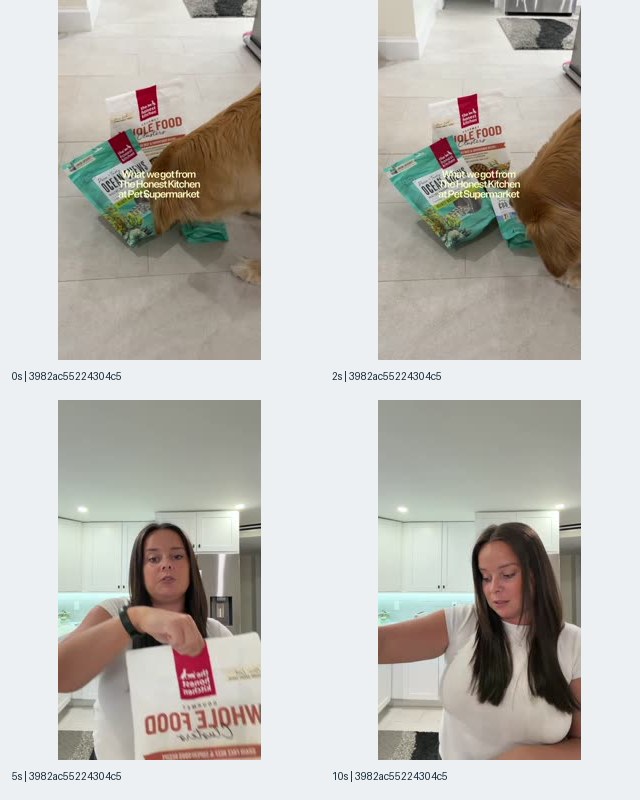
Image 4. Contact sheet linked to The Honest Kitchen, record 3982ac55. The inspected timestamps are 0, 2, 5, and 10 seconds; the source record lists a 54-second video.
The first samples show a dog near bags and boxes. On-screen text refers to products obtained from The Honest Kitchen at Pet Supermarket. At 5 seconds, a woman is visible with a product box in a kitchen. At 10 seconds, she looks downward with her arm extended; no box is visible, and any off-frame action remains unknown. The record’s title and body also communicate availability at Pet Supermarket and describe meals, toppers, and treats.
That creates an identifiable message task: connect a product assortment with a retail destination. It is different from proving how a particular recipe is prepared. The presence of a kitchen and a person handling a package does not fill in unobserved preparation steps or justify summarizing the whole video as a completed demonstration.
An original single-image version might show the relevant package and an approved availability message. A proposed carousel might organize the message around product category, intended use, and where to learn more. Any retail availability statement would need a fresh check before publication; the archived message is historical evidence.
A creator-based execution also introduces variables beyond format. A face, home setting, personal narration, and visible product handling may influence interpretation. If the single-image version contains only a pack shot while the carousel contains a person and a personal story, the comparison includes those differences too.
For a cleaner format question, keep the central claim and source material aligned. For a broader production question, deliberately compare the complete concepts and label the conclusion accordingly. “This creator-led package performed differently from this product-led package” would be a narrower, more accurate result than a universal format verdict.
Image 5: The Package Must Resolve What the Hero Image Leaves Unclear
The Honest Kitchen static reference uses a large prepared-food bowl and ingredient styling to express simplicity, while the package identifies what is being offered. That division of labor matters because an attractive food image can communicate a desired result without explaining the product’s preparation requirements. Additional cards are useful only if they resolve a real ambiguity.
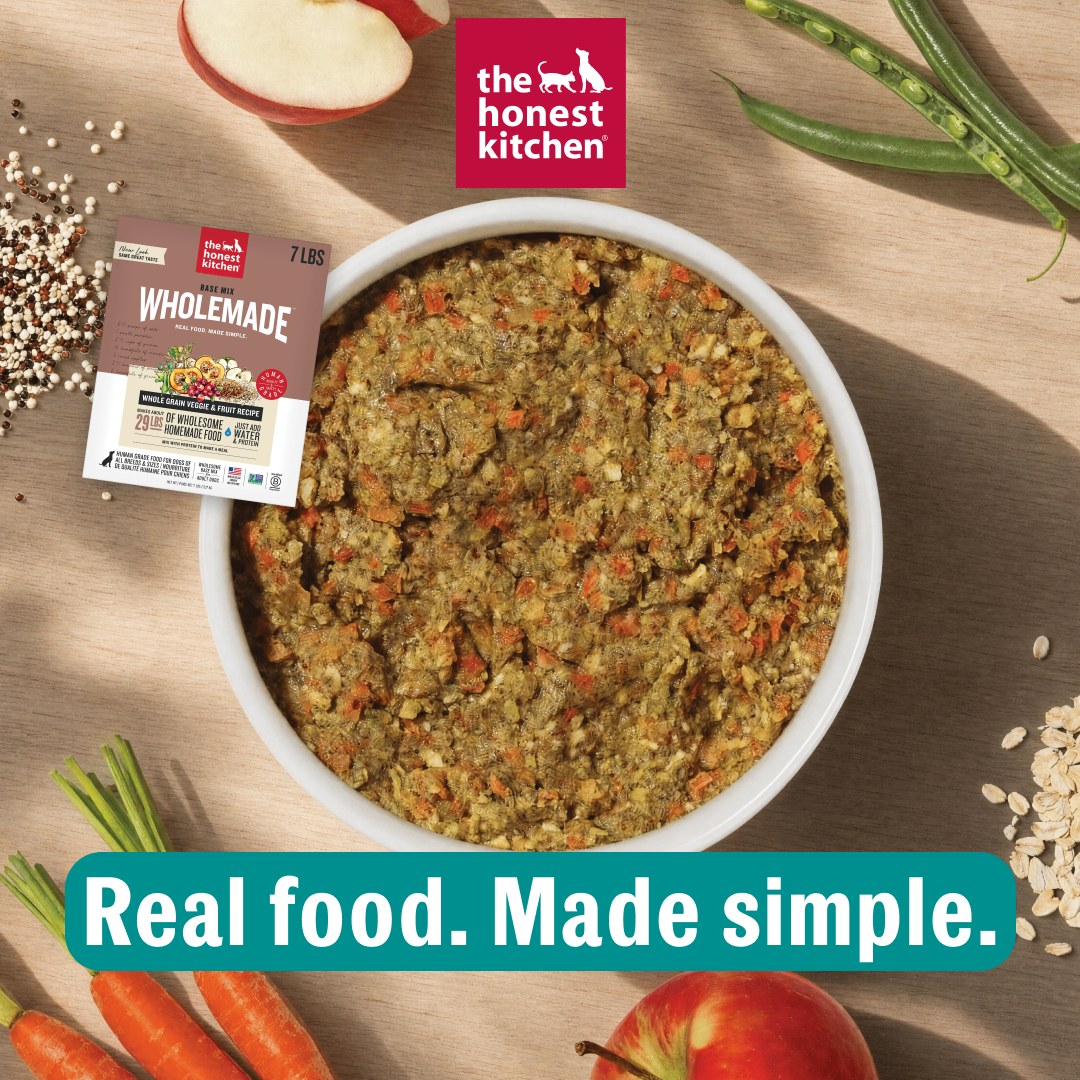
Image 5. Static reference linked to The Honest Kitchen, record fb54ed3e, titled “Mix. Add Protein. Done.” The visual is advertising evidence, not independently verified feeding or preparation guidance.
The brand block sits above the bowl, the package appears to the left, and the teal headline spans the lower portion. Apples, vegetables, and grains establish an ingredient-oriented setting. The package visibly identifies a base mix, while the record title explicitly refers to adding protein. These details matter more to a faithful brief than a generic description such as “healthy pet-food image.”
A proposed adaptation should preserve the distinction between the packaged product and the prepared result. If the food shown requires additional ingredients, the execution should not imply that everything in the bowl comes directly from the package. The correct preparation and feeding information must come from current documentation for the exact product.
For a single-image version, the team could test whether a clearer package view and a concise approved explanation make the offer understandable without sacrificing the food photograph. For a carousel version, separate the packaged item, the verified preparation requirement, and the prepared result. That structure is a hypothesis for the team’s own product, not an observed carousel from this source.
Images 4 and 5 share a reported brand listing, but their exact product selections and communication objectives are not established as identical. They therefore provide complementary references rather than an experimental pair. One emphasizes a retail discovery context; the other emphasizes a product-and-result composition.
This distinction should survive the handoff to design. “Use the same brand” is too loose a constraint. Record the exact product, variant, preparation requirement, and intended action before distributing the message across either format.
Image 6: A Tool-in-Use Image Can Explain More Than a Pack Shot
The Bento&co reference shows the miso muddler performing a recognizable action, making it a strong structural reference for explaining an unfamiliar utensil. The visible action, product name, and explanatory text all support the same communication task. That does not prove effectiveness, but it gives a production team a specific alternative to isolated product photography.
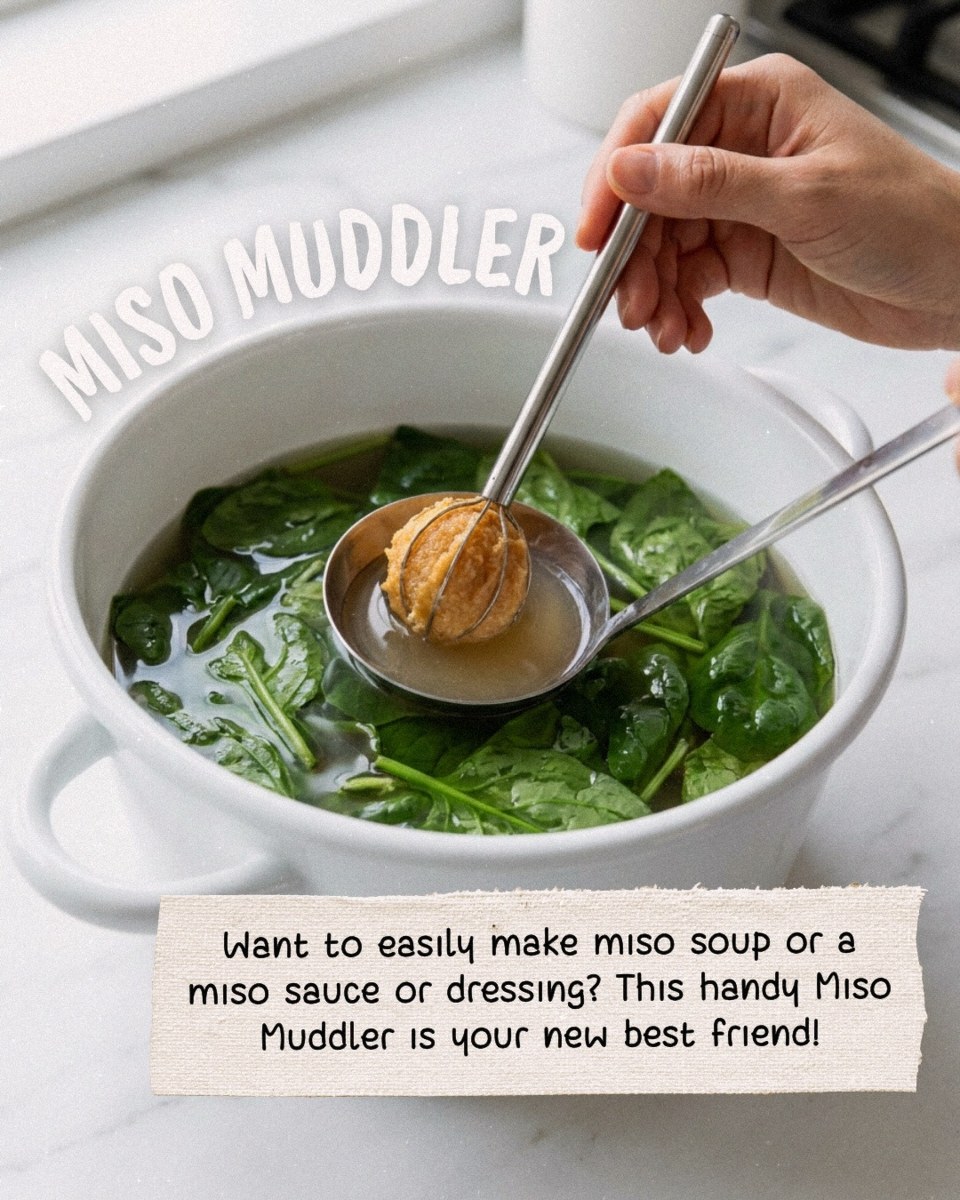
Image 6. Supplied image from Bento&co’s “Kitchen Tools” record f7975bc0. The record contains six image fingerprints, but this article visually inspects only the displayed muddler image and does not verify a served six-card carousel.
The composition gives the hand, tool, miso paste, ladle, and soup enough context to form an intelligible relationship. “MISO MUDDLER” names the unfamiliar object. The lower text mentions making miso soup, sauce, or dressing. Those are source advertising statements; this analysis does not certify product specifications or test the utensil.
The important creative observation is that use context can reduce the amount of explanation an isolated object requires. A pack shot of a wire-ended utensil might leave a viewer unsure of its purpose. Showing the object in relation to food provides a visual answer. Whether viewers interpret that answer correctly would require a comprehension check.
A proposed single-image version for a comparable, documented product could preserve the whole action and use concise approved copy. A proposed carousel could separate recognition, use detail, and the relevant next step. The extra cards should add information the first image cannot comfortably communicate, such as a closer view of the action or a verified product option.
Do not invent the contents of the other attachments. Their existence supports a file-count statement, not a reconstructed narrative. It would be inaccurate to describe unseen cards as showing cleaning instructions, alternative recipes, or additional products.
This is also a useful point to inspect the research directly. Explore indexed kitchen creatives in AdMapix, then check the current source, dates, listing association, and attached media before saving a reference. A live query may return different results from the frozen September sample, and the keyword link alone should not be assumed to preserve every collection filter.
Image 7: A Second Image of the Same Product Is a Useful Control Candidate
The second Kitchen Scramble reference supports a same-product visual comparison because it shares the linked Android identifier with Image 1. It changes the scene and composition while retaining recognizable branding and character presentation. That makes it useful for separating a message-angle decision from a format decision, although no controlled results are available.

Image 7. Static Kitchen Scramble: Cooking Game reference, record 98e75c69, linked to the same Android product identifier as Image 1. It is a separate image record, not a verified continuation card.
The character faces the viewer and holds a tray across the center. Cake, a lemon dessert, a drink, and salad create a compact product-world display. The branded truck remains in the background, while blossoms and warm light establish a different visual setting from the barbecue scene.
The source record’s Vietnamese copy describes cooking and serving customers. The visible artwork remains an illustration rather than gameplay evidence. Neither the language nor the scene establishes the audience configuration used to deliver the advertisement.
A team could build an original comparison around scene complexity while keeping format constant: a wider activity scene against a more concentrated character-and-tray scene. That would be a visual-composition experiment. Separately, it could compare one of those message structures in a single image against a proposed carousel using the same approved promise.
Combining both changes at once would make interpretation harder. If the carousel uses the tray concept and the single image uses the barbecue concept, any difference could relate to food selection, seasonal cues, character scale, background complexity, or format. Sometimes a team intentionally wants that broader concept comparison. It should simply document what it is testing.
The shared product identifier helps establish a valid starting point, but it does not solve every control problem. Offer, copy language, destination, audience conditions, and production choices still require alignment before the result can support a narrow claim about format.
Image 8: A Curated Collage Is an Assortment Message on One Canvas
The “Kitchen Counter Goals” reference communicates a coordinated assortment through one collage, showing that product variety does not automatically require a carousel. The visual invites inspection across many objects within a shared style. A proposed carousel would change how that assortment is encountered, not merely increase the number of products available to show.

Image 8. Static reference from the record linked to Button Marketplace, 9cfcbf19. The artwork includes “AMAZON EDIT” and “MAKING PRETTY SPACES”; those visible labels do not change the reported listing association or identify the ad buyer.
The objects share a palette of wood, cream, stone, amber, and metallic accents. Large and small items occupy different parts of the canvas around the central headline. The record describes functional, attractive finds curated on Amazon. The source does not supply verified destinations for each object or establish current availability.
A single-image assortment concept can preserve the overall aesthetic immediately. A carousel hypothesis can give individual objects more room and make category distinctions easier to inspect. Each option creates a different risk: the collage may reduce item detail, while the carousel may require additional interaction before the viewer understands the collection’s breadth.
For a fair test, decide whether the intended action is browsing a collection or buying a specific product. A collection page and an individual product page answer different promises. Allowing every proposed card to send users to a different destination would create a navigation experiment as well as a visual-format experiment.
A useful original brief might compare a coordinated collection overview with separate views of the same included items, using the same collection destination. Another might compare a collage against a single hero product, but that would test assortment breadth too. Keep those questions separate in the results log.
The central lesson is practical: count decision tasks, not objects. Multiple products can support one style proposition, while one unfamiliar product can require several distinct explanations.
Build a Message Inventory Before Choosing Card Count
A message inventory makes the format decision reviewable by separating the product promise from the pieces of evidence used to communicate it. Without that inventory, teams often fill available space with additional claims. A carousel then becomes more persuasive on paper because it was given more information, while the single image is judged against a deliberately incomplete brief.
Use the following worksheet for the exact product being advertised. The entries below are production questions, not findings about the sample brands.
| Message component | Question to resolve | Single-image treatment | Proposed carousel treatment |
|---|---|---|---|
| Product identity | Can the viewer identify the item or service? | Clear hero view and readable name | Clear opening card; context repeated where needed |
| Main promise | What is the reason to consider it? | One dominant approved statement | Same dominant statement, with supporting cards |
| Use evidence | What visible action supports understanding? | Action photograph or explanatory detail | Separate action view if it adds useful information |
| Qualification | What condition changes the meaning? | Readable and close to the relevant claim | Kept with every claim that requires it |
| Offer | What is available on what terms? | Accurate, current offer hierarchy | Same offer scope throughout the set |
| Next action | What should happen after the ad? | Clear destination expectation | Consistent destination expectation across cards |
Mark each item as required, helpful, or unnecessary for the chosen decision. A required item cannot disappear because the layout becomes crowded. If the single image cannot accommodate essential information, revise the message or consider a different presentation. If several cards only repeat helpful decoration, remove them from the proposed sequence.
Keep a separate claim source for each factual statement. Appearance may be supported by photography; dimensions require product documentation; a discount requires current commercial terms. One type of evidence cannot silently substitute for another.
For the copy-to-visual check, the Facebook ad copy examples guide provides a related workflow. Here, the inventory becomes the shared contract that both formats must satisfy.
Write a Matched Brief for One Original Product Concept
A matched brief compares different arrangements of the same approved information, while openly recording any differences that remain. The example below is a proposed production exercise for a team advertising its own documented miso-mixing utensil. It is inspired by the communication task visible in Image 6; it is not a claim that Bento&co ran these versions or that either version has been tested.
Begin with a product packet. Confirm the exact item, approved product name, intended use, current instructions, included components, destination page, and available original photography. If the packet does not support a use claim, remove that claim from both versions. Do not infer materials, cleaning requirements, portion accuracy, or compatibility from the reference image.
The shared communication objective is: “Help a viewer understand what the utensil is used for and decide whether to inspect its product details.” The shared business objective must be chosen by the advertiser. It could concern purchases or another qualified action, but the source sample supplies no appropriate target or baseline.
The single-image concept uses one original action photograph. The hand and utensil remain visible, the relevant ingredient provides context, and a short approved product label identifies the object. The primary text explains the same use supported by the product packet. The destination opens the exact product information represented in the ad.
The proposed carousel uses the same visual identity and approved information, divided into a recognition view, a closer use view, and a product-detail or next-step view. This proposed three-card structure is a design choice for the example, not a recommended platform limit or an observed source sequence. The opening card must still identify the product without requiring the remaining cards.
| Brief field | Shared requirement | Single-image execution | Proposed carousel execution |
|---|---|---|---|
| Product | Same exact documented item | One identifiable view | Same item throughout |
| Promise | Same approved use statement | Presented with the action image | Presented initially and supported by detail |
| Source assets | Original photography with suitable rights | One composed image | Separate views from the same production session |
| Offer | Same current terms, if any | Same scope and qualifications | Same scope and qualifications on relevant cards |
| Destination | Same product information | One agreed destination | Same destination for this format comparison |
| Evaluation | Same primary business outcome | Recorded under its own variant | Recorded under its own variant |
The hypothesis is that separating the recognition and use detail may improve product understanding. A competing hypothesis is that the complete action image already communicates enough, and additional cards add friction without useful clarification. Both are plausible before testing.
Write the disconfirming result before production. If viewers still cannot identify the item after seeing the carousel, the extra cards have not solved the comprehension problem. If qualified business outcomes remain uncertain, clearer comprehension alone does not establish a commercial winner. The brief should make those outcomes possible to report without embarrassment or retrospective rewriting.
Keep the Opening View Complete and Later Views Useful
The opening view should communicate a coherent proposition on its own, while later carousel cards should add specific information. This is a production principle for the proposed test, not a claim about a particular platform’s delivery behavior. It protects the message when a viewer gives the ad only a brief look or does not continue through the sequence.
For the utensil example, the opening view needs product identity and use context. A mystery object followed by a delayed explanation may create curiosity, but it changes the communication strategy. If curiosity is the intended variable, record it as a separate hypothesis rather than treating it as an inherent advantage of carousel format.
Later cards should have distinct jobs. A closer action view can clarify how the object relates to the ingredient. A product-detail view can help identify the exact item. A final next-step view can explain what the destination provides. Repeating the same photograph with slightly different adjectives adds production work without a clear informational purpose.
Review each card separately as well as in the intended sequence. Ask whether pronouns, cropped product names, or detached qualifications make a card confusing outside its neighbors. If a discount applies only to selected items, the relevant limitation belongs with the discount claim, not solely on a distant closing card.
At the same time, do not cripple the single-image version to make the carousel look useful. A single image can use composition, a small detail view, or concise primary text where appropriate. The objective is to build credible versions of both formats, then compare the resulting packages under documented conditions.
Current placement dimensions, card behavior, and account options should be checked in the actual publishing interface before launch. No unseen platform documentation or unperformed setup test is being used here to prescribe those specifications.
Run a Comprehension Review Before Paying for Distribution
A comprehension review can identify unclear product messaging before a paid experiment, although it cannot substitute for campaign outcomes. Its purpose is to discover what people think the ad is offering and which details they miss. This review is proposed as a reader workflow; no participant study was supplied with the frozen sample.
Show the proposed versions under comparable viewing conditions. Avoid explaining the intended message first, because that teaches the answer. Ask open questions such as: “What is being offered?”, “What would you expect after selecting this ad?”, and “What would you still need to know?” Record the response in the participant’s own words before adding interpretation.
For a carousel, distinguish responses to the opening view from responses after browsing. That helps identify whether the initial proposition is complete and whether later cards resolve a meaningful question. Do not present all cards as a large contact sheet and assume the response represents the live browsing experience.
For the single image, inspect readability at the actual intended display size. A design that is understandable when enlarged in a review meeting may conceal the product name or qualification on a smaller screen. The same concern applies to each carousel card.
Use the findings to revise both versions against the shared brief. If people misidentify the utensil, improve the product view or label. If they misunderstand what is included, clarify the package contents using verified information. If they expect a discount that does not exist, remove the implication rather than adding an explanation far from the main claim.
Save the review conditions and limitations. Feedback from colleagues, existing customers, or a small recruited group may help locate confusion, but it does not represent a measured population response. Treat the review as production quality assurance and hypothesis refinement, with the business question still awaiting appropriate evidence.
Design a Paid Comparison That Matches the Claim You Want to Make
A credible paid comparison must control the conditions relevant to its conclusion and identify the conditions it cannot control. Comparing two unrelated campaign reports will not isolate format. The practical goal is to create a test whose eventual result can be described precisely: which product, which versions, which audience conditions, which period, and which outcome.
Choose between a narrow format question and a broader execution question. The narrow question asks whether reorganizing approved information across cards changes the result. The broader question asks which complete creative package should receive further investment. Both can be useful, but the latter permits more variation and supports a less specific explanation.
For the narrow comparison, align the product, offer, destination, primary copy meaning, campaign objective, audience eligibility, measurement definitions, and test period. Record placement eligibility and any automated transformations that could alter the delivered creative. If the two formats cannot use equivalent placements or settings, document that limitation instead of claiming perfect isolation.
Where the account offers a suitable randomized experiment, use it according to its current documented behavior and record the assignment method. This article does not claim to have inspected the account or verified which experiment controls are available. If the team instead compares ordinary delivery groups, audience and auction differences may remain alternative explanations.
Do not change the destination halfway through the test unless the change is necessary; if it occurs, log the time and assess whether the comparison remains interpretable. The same applies to stock changes, offer expiration, tracking interruptions, and creative revisions. A clean naming convention is useful, but it cannot repair a changing experiment.
Set the primary outcome and decision rule before viewing results. The appropriate sample requirement depends on the baseline event rate, the difference that would matter commercially, variability, and the analysis method. The frozen sample supplies none of those inputs, so it cannot justify a universal budget, duration, or minimum conversion count.
Record what will count as an inconclusive result. Insufficient observations, delivery imbalance, or a wide uncertainty range should remain visible in the report. Declaring a winner merely because one estimate is numerically higher turns uncertainty into a false lesson.
For a broader discussion of isolating variables and recording decisions, use the published creative testing framework. The important handoff from this article is a matched brief, a specific hypothesis, and a list of remaining confounders—not a forecast that the carousel will win.
Measure the Intended Result and Define Every Denominator
The primary metric should represent the business decision, while supporting metrics explain where the versions may differ. Clicks, browsing interactions, purchases, and qualified leads answer different questions. Treating a higher interaction count as proof of better business performance can reward an ad that creates activity without delivering the intended result.
For an ecommerce test, the advertiser might choose an acquisition-cost or purchase outcome. For a considered appliance purchase, a qualified inquiry or another validated step may be more appropriate. Those are examples of possible measurement choices, not recommendations derived from the source brands’ private results.
| Measurement layer | Useful question | Evidence needed | Interpretation limit |
|---|---|---|---|
| Comprehension | Do viewers understand the product and offer? | Recorded responses under stated conditions | Does not prove purchase behavior |
| Ad interaction | Do people take the defined outbound action? | Owned-account reporting with a stable definition | Interaction may include low-intent activity |
| Destination behavior | Does the page receive and support the intended visit? | Consistent analytics and event definitions | Tracking gaps can distort comparisons |
| Qualified result | Does the visit produce the chosen outcome? | Validated conversion or lead records | Attribution method affects reported credit |
| Economics | Is the result worthwhile after relevant costs? | Spend, production costs, and business data | Cannot be inferred from public screenshots |
Write the denominator beside every rate. A result per impression differs from a result per click or per landing-page visit. If a reporting system exposes card-level interactions, check exactly what each field counts before comparing it with ad-level data. Avoid adding card-level values into an ad total without knowing whether that duplicates events.
Keep measurement windows and attribution settings aligned. If purchase decisions take time, determine in advance how outcomes will be allowed to mature. Comparing a newly launched version with a version whose conversion window has largely elapsed can create an artificial difference.
The public sample does not supply these owned-account measurements. Its value is upstream: identifying message structures and building better questions. The answer to the commercial question must come from data appropriate to the advertiser’s actual test.
Interpret Outcomes Without Turning One Test Into a Format Rule
A test result applies first to the tested executions and conditions, even when the experiment is well designed. A carousel that performs better for an unfamiliar utensil does not establish that carousels outperform single images for appliances, curated collections, or games. The evidence should become a reusable local lesson, with its scope preserved.
If the carousel improves the primary outcome and the uncertainty is acceptable under the preselected rule, retain the execution and investigate what information may have helped. The additional use view is a candidate explanation, not a proven mechanism merely because it appears in the winning version. A follow-up test can examine that component more narrowly.
If the single image performs better, inspect whether the opening carousel card communicated enough and whether later cards added useful information. Avoid inventing an explanation such as “people dislike swiping.” The result may reflect this particular opening image, information distribution, production quality, or delivery environment.
If the carousel attracts more outbound activity but does not improve qualified outcomes, inspect destination expectations and traffic quality. More interactions can coexist with unchanged business value. Conversely, fewer interactions with stronger qualified results may reflect more selective messaging, but that explanation also needs supporting evidence.
If the result is inconclusive, preserve the uncertainty. The team may revise an unclear message, collect additional evidence within the planned method, or decide that the possible difference is not worth further production effort. “No decision yet” is more useful than adding a weak universal rule to the creative playbook.
A good result note names the product, the message difference, the test conditions, the measured outcome, and the next action. It also records anomalies. That makes the finding usable when the offer changes or a new product enters the same category.
Include Production and Maintenance in the Format Decision
Production effort belongs in the decision because additional cards create additional assets, copy surfaces, and update requirements. The relevant cost is the team’s actual work and expenditure, not an assumed industry price for a carousel or single image. The frozen source sample contains no production-cost or turnaround data.
Track the work required to create usable versions: photography, selection, design, copy, product verification, localization, review, and publishing preparation. A single-image concept with complex retouching may require more work than a straightforward carousel assembled from suitable original photographs. Format alone does not determine cost.
Maintenance matters when the message includes changing information. An offer update may require revising every card that mentions the promotion. A discontinued product can affect a collection overview and several detail views. Save a simple map showing which source fact appears in which deliverable so the next update is complete.
For a smaller team, production capacity can determine the sensible next experiment. If existing photography supports a strong single-image version but the carousel requires an additional shoot, evaluate whether the unresolved question warrants that effort. Do not assign a speculative performance uplift to justify the production request.
After testing, combine measured business outcomes with actual production and maintenance costs. A format with a modest apparent advantage may be less attractive if the evidence remains uncertain and the operating burden is substantial. Conversely, a reusable set of clear product views may have value beyond one campaign, provided that value is recorded separately rather than attributed to advertising performance.
Common Mistakes That Make the Comparison Unusable
The most damaging mistakes change the message, mislabel the source, or overstate the result while leaving the comparison labeled “carousel versus single image.” The following corrections keep research and testing connected to the question the team actually needs to answer.
Calling a collage a carousel. Image 8 contains many objects within one image. Record it as a collage reference. If the team later separates those objects into cards, label that as a proposed adaptation.
Treating a contact sheet as a delivered ad layout. Images 2 and 4 show selected video frames. They cannot establish card order or what happened between timestamps. Preserve the timestamps whenever the observations enter a brief.
Equating several attachments with confirmed carousel delivery. The Bento&co record contains six image fingerprints, but only one attached image is visually inspected here. The correct next research step is to verify the presentation, not fill the gaps with an imagined sequence.
Comparing different products under one brand. The ZLINE range and dishwasher have different product tasks. The Honest Kitchen references also do not establish the same exact item and offer. Brand association is useful for organization, but it is not a substitute for product-level control.
Moving essential qualifications away from the claim. Extra cards do not justify separating “up to” or an eligibility condition from the offer it changes. A layout should preserve meaning wherever the claim appears.
Using source copy as verified product documentation. An ad can claim precision, quietness, simplicity, or ingredient quality. The creative shows how the advertiser communicates those claims; independent substantiation requires suitable evidence.
Reading zero impression fields as no delivery. The returned zeros do not support a performance ranking or a conclusion that the ads were never shown. They are a reason to omit the ranking, not invent another proxy.
Using longevity as a success score. A first-observed date or repeated appearance does not reveal conversion, profit, or continuous delivery. Do not divide a window estimate by ad age or use age to choose a supposed winner.
Changing the landing experience without acknowledging it. A carousel with product-specific destinations and a single image with a collection destination compare different navigation systems. That can be a valid experiment, but its conclusion must reflect the broader change.
A Practical Workflow From Search Result to Test Record
A useful workflow produces a small set of verified observations, an original matched brief, and a test record with explicit unknowns. It does not require collecting every kitchen-related result or declaring the most visually attractive reference a winner. The sequence below can be used by an in-house team or an agency preparing a client handoff.
- Write the product decision. Name the exact product and the question the ad should answer. Exclude references that only share a keyword but have no useful communication relationship to that task.
- Capture the research scope. Save the query, country, source filter, collection date, measurement window, and sample limit. A screenshot without context becomes difficult to interpret later.
- Verify the listing association. Retain the linked product identifier and record reference. Keep visible brand wording separate from what the source actually associates with the record.
- Label the inspected media. Distinguish a static image, a timestamped video contact sheet, and a record with multiple attachments. Mark unverified delivery format as unknown.
- Extract one usable observation. For example: “The utensil is shown in use beside explanatory copy.” Keep proposed effects in a separate sentence beginning with “Hypothesis.”
- Collect product substantiation. Obtain the team’s own current product details, commercial terms, and suitable original assets. A competitor reference does not authorize claims about your product.
- Build the message inventory and both versions. Give each format the same approved product promise. Record any differences in information, imagery, or destination that cannot be removed.
- Review and launch through the chosen test method. Check comprehension, readability, destination match, tracking, and actual account settings. Save the conditions before results arrive.
- Record the outcome at the right scope. Report the measured result, uncertainty, anomalies, production effort, and next action. Keep inconclusive findings in the same learning log as clear decisions.
The final handoff should let someone who did not conduct the research trace every reference and understand why the test exists. That is the practical standard for a useful creative research package.
When AdMapix Helps With This Decision
AdMapix helps when the team needs indexed advertising references to investigate message structures and build a traceable production brief. In this article, its contribution is the dated search sample, linked listing information, media references, and reproducible source package. Those inputs support discovery and analysis; they do not expose an advertiser’s private conversion results or establish a format winner.
Use the kitchen query to find potentially relevant records, then narrow the research to the exact communication task. Keep the source context alongside the observation. If the task is choosing the commercial winner between finished versions, move to the advertiser’s own experiment and measurement systems.
A practical decision CTA is: Build my next matched-format brief from indexed creative evidence. Start with a product question, select references that genuinely help answer it, and carry the source limitations into production. Check the live AdMapix pricing page for current access and commercial terms before choosing a plan.
This article does not enumerate prices or credit quotas because those terms can change while an evergreen guide remains useful. It also makes no paid-trial promise, refresh-time guarantee, or claim that a broad database total represents unique media files.
FAQ
Are Facebook carousel ads better than single-image ads?
The supplied evidence does not establish a better-performing format. Carousel ads are a reasonable hypothesis when separate views answer meaningful product questions, while a single image may communicate a complete proposition clearly. Compare the same product, offer, destination, and relevant delivery conditions, then evaluate an agreed business outcome. A result should remain scoped to the tested executions and audience conditions.
Does a record with several images prove that the ad was a carousel?
No. Several attached images establish that the record contains multiple image assets, but they do not independently verify how the advertisement was served. The Bento&co reference contains six image fingerprints, while only one image is visually inspected in this article. Confirm the live presentation or suitable archived interface evidence before describing card order, navigation, or per-card destinations as observed facts.
Can video contact sheets be used to plan carousel cards?
Yes, as references for proposed information structure, provided the adaptation is labeled clearly. A sampled frame may suggest a product detail or action worth photographing for an original card. The contact sheet itself remains selected video evidence. It does not prove a complete demonstration, reveal the audio, or show that the advertiser delivered the frames as a carousel.
How many cards should the proposed carousel contain?
Use enough cards to answer the selected product questions without adding repetition, then check the current publishing requirements for the intended placement. This article does not supply verified platform limits or an optimal card count. Start with the message inventory: each proposed card should identify the product, clarify useful evidence, resolve a relevant uncertainty, or support the intended next action.
Should the single image and carousel use the same landing page?
For a narrow comparison of message presentation, a common destination helps reduce another source of difference. If carousel cards lead to different products while the single image leads to a collection, the experiment also changes navigation and product selection. That broader comparison can be useful, but the result should be described as an execution-and-destination comparison rather than a pure format effect.
What can the zero impression values tell us?
They tell us that the returned impression fields provide no useful basis for ranking these records. They do not prove that delivery was absent or that the ads failed. More generally, the source’s impression values are third-party model estimates for the stated window, not observed account delivery. This article therefore uses the sample for visual analysis and makes no impression-based performance comparison.
Can a small team apply this workflow without producing many variants?
Yes. A small team can start with one documented product promise, one credible single-image execution, and one proposed carousel execution. The important work is aligning claims, assets, destinations, and measurement before launch. Use existing suitable original photography where possible, record actual production effort, and keep an inconclusive result visible rather than creating extra variants solely to manufacture a winner.
Key Takeaways
The format decision becomes useful when it is attached to a specific product question and an honest test plan.
- Separate observed source media from proposed carousel layouts; a collage or contact sheet is not proof of carousel delivery.
- Use product identifiers and exact items to establish comparison scope, then align offer, message, destination, and relevant test conditions.
- Give every additional card a distinct informational job, while making the opening view coherent on its own.
- Treat the 29-record September sample as creative evidence, with separate media counts and no usable performance ranking.
- Choose the next production action from measured outcomes, uncertainty, and actual operating effort rather than assumed format superiority.
Sources
The sources below support the dated observations, research workflow, and stated product boundaries; none supplies a completed carousel-versus-single-image performance experiment.
- Public frozen advertising source package — retrieved September 30, 2026, at 18:39:33 UTC. Scope: US, query “kitchen,” supplied Facebook filter, exact window 2026-09-01 to 2026-09-30, up to three pages, 29 returned advertising records. Includes public batches, request parameters, checksums, and the source relationships used in the eight image analyses.
- AdMapix kitchen creative search — relevant product workflow for inspecting indexed creatives. The article’s observations are frozen as of September 30, 2026; live results and filters may differ and should be recorded when repeating the research.
- AdMapix methodology — public methodology reference for interpreting indexed advertising evidence. Product boundaries supplied for this article were reviewed August 13, 2026; the advertising sample was observed September 30, 2026. Record counts, media fingerprints, source labels, and modeled window metrics remain distinct.
- AdMapix commercial terms — use the live pricing page linked above for current access terms. No prices, credit quotas, or paid-trial claims are preserved in this evergreen comparison.
The eight illustrations are source advertising screenshots or timestamped contact sheets. They are not generated test outputs, complete playback observations, or proof of campaign performance.
Turn these observations into your next creative study
Open the creative library and select samples for your market, network and research question.
Related Articles
YouTube Video Ads: Match Scripts to Landing-Page Offers
Use eight dated advertising contact sheets, original script examples, and a practical audit workflow to align opening hooks, product claims, calls to action, and landing-page offers.
UGC Creator Brief for Product Demo Ads: Shots, Claims, and Proof to Request
Build a practical UGC creator brief with eight source-linked visual references, product and claim worksheets, shot requirements, delivery specifications, and acceptance criteria.
TikTok Carousel Ads vs Video Ads: How to Compare Creative Structure
Compare carousel and video creative structure through eight source-linked images from a reproducible US kitchen-keyword sample, matched production briefs, and a practical testing workflow.