
UGC Creator Brief for Product Demo Ads: Shots, Claims, and Proof to Request
Build a practical UGC creator brief with eight source-linked visual references, product and claim worksheets, shot requirements, delivery specifications, and acceptance criteria.
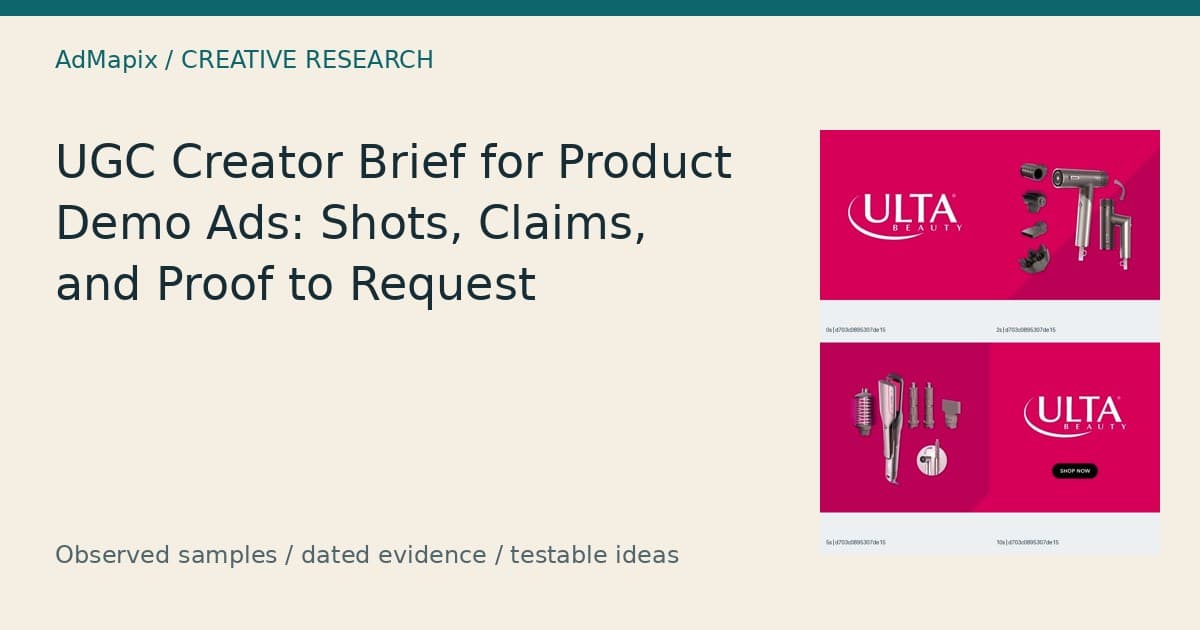
UGC Creator Brief for Product Demo Ads: Shots, Claims, and Proof to Request
A useful UGC creator brief tells a creator what to show, which product statements they can support, and what files the team will accept. It connects every requested demonstration to a real product, a specific viewer question, and an appropriate source of evidence.
For ecommerce marketers, creative strategists, and agencies commissioning product demos, that connection matters before filming starts. A polished delivery can still be unusable when the label is hidden, the demonstration skips a necessary step, the testimonial overstates the creator’s experience, or the offer expires before launch. This guide provides a production packet, shot requirements, claim worksheet, and acceptance process. Eight dated advertising contact sheets supply concrete visual references. They illustrate questions to resolve in your own brief; they do not establish that these ads converted or that their products delivered the advertised benefits.
Prepared September 22, 2026. AdMapix Research — prepared with Codex and checked against the dated source sample. Editorial ownership: Brad at AdMapix. This attribution does not imply personal human review. AdMapix is our product.
Quick Answer
A UGC creator brief for a product demo should include the exact product and variant, the audience’s practical question, required shots, approved statements with supporting evidence, delivery specifications, usage permissions, and acceptance criteria.
Request continuous footage of important actions, readable product identification, truthful personal observations, and clean files that editors can reuse within the agreed scope. Separate a visible demonstration from a claim about lasting results. Use advertising references to explain a production task, then validate the finished ad through your own product checks and campaign measurement.
What a Creator Brief Must Help the Team Decide
A creator brief should make it possible to commission, film, edit, and accept the same product demonstration without each person inventing missing requirements. Its purpose is practical coordination: the creator knows what experience to capture, the editor knows what evidence must remain visible, and the brand knows what it is approving.
A UGC creator is a person commissioned to make content in a personal, user-oriented style. That description does not establish that they are an existing customer, an independent reviewer, or an influencer distributing the video to their own audience. Specify the actual relationship. A creator can demonstrate a product honestly without pretending to have discovered it independently or used it for longer than they have.
Start with the buyer’s unresolved question. For a cream, the question might concern dispensing, texture, or how it looks immediately after application. For a styling device, it might concern attaching a component or handling the controls. For a fragrance, it might concern bottle size and how the sprayer operates. Those questions lead to different footage and different evidence requirements.
The brief should also identify the intended next action. A viewer comparing variants needs clear product identification. A viewer deciding whether a device is manageable needs an understandable operation sequence. A viewer responding to an offer needs accurate eligibility and timing. Asking one short video to answer every question can make the production request internally inconsistent.
For the broader research process, the ecommerce product-ad research guide provides the topic framework. Here, the deliverable is narrower: a packet that a real creator can shoot and an editor can check.
Use a simple commissioning question throughout: What must be visible or documented for us to accept this particular statement? If the answer is unclear, change the statement, request additional evidence, or remove it before filming.
Methodology: What the Dated Sample Contains
This guide uses a bounded US keyword sample collected on 2026-09-22, with the exact measurement window 2026-08-24 to 2026-09-22. The query was skincare. Collection requested three pages of ten advertising records each, using descending estimated-impression sorting. The resulting thirty records are a research sample, not a complete advertiser portfolio or a representative survey of UGC production.
The dated sample contains 30 advertising records, 27 distinct video fingerprints, and 9 distinct playable fingerprints. There are 27 records containing video and 12 records containing a playable association. These categories overlap: a record may reference both a video and a playable. They must not be added together as though they were mutually exclusive creative types. No distinct image fingerprints were reported; the contact sheets reproduced here are derived video references, not evidence of standalone image ads.
A playable is an advertising asset designed to support interaction. Its presence in a record does not mean that we interacted with it. No app was played and no playable behavior was tested for this article.
The eight attached contact sheets show selected frames labelled 0, 2, 5, and 10 seconds. Analysis is limited to those frames. We did not watch complete videos, listen to audio, inspect every transition, or verify the final destination after a click. The sheets arrange separate moments into a grid; neighboring panels should not be mistaken for a single simultaneous layout. Surrounding pale areas belong to the presentation of the sheet and should not be interpreted as pauses in the original video.
Listing associations come from the supplied store identifiers. Samples 1, 2, 3, 5, 6, 7, and 8 are associated with Ulta Beauty: Makeup & Skincare, iOS listing 561930308. Sample 4 is associated with ASMR Makeover: Skincare Games, iOS listing 6754906411. These associations identify reported destinations; they do not independently identify the ad buyer, production company, creator, or owner of every depicted product.
The source records do not provide a verified readable network mapping. Accordingly, this article does not label the examples as TikTok, Instagram, Meta, or another network’s advertising. A vertical composition alone cannot establish a platform.
Any impression values in the underlying package are third-party model estimates for the specified window. They are not observed delivery, spend, installs, conversions, profit, or lifetime totals. We do not use those estimates to rank creators, infer production quality, or claim that an older ad performed well. Product-search aggregates are excluded.
The public frozen source package preserves the source batches, request parameters, and checksums for reproducibility. It supports reconstruction of this sample, not a promise that a later live search will return identical results.
Evidence Table: What Each Reference Can Contribute
The references support different production questions, so they should enter a creator brief with an explicit purpose. Most show product presentation rather than a person demonstrating use. That difference is useful: it exposes which missing actions a creator would need to film before a team could call its own footage a product demo.
The record prefixes below identify the corresponding entries in the public source package.
| Image | Record prefix | Reported listing | Visible reference | Briefing use and limit |
|---|---|---|---|---|
| 1 | d703c0895307de15 | Ulta Beauty, 561930308 | Hair tools and separate attachments on magenta backgrounds | Specify product and accessory identification; operation is not established |
| 2 | c8ac90ca47bba721 | Ulta Beauty, 561930308 | Polite Society packaging against orange and peach graphics | Request packaging and texture coverage; application is not shown in these frames |
| 3 | bc211f25a538f888 | Ulta Beauty, 561930308 | Peach & Lily bottle and cream jar | Distinguish product recognition from evidence of skin outcomes |
| 4 | 44c827c938b70941 | ASMR Makeover: Skincare Games, 6754906411 | A simulated bowl, ingredient icons, pestle, and foam | Exclude game imagery from physical skincare proof |
| 5 | 3c4dcdf6d93d8906 | Ulta Beauty, 561930308 | Device grouping, bottles, and a styling brush | Request component roles and model-specific operation |
| 6 | f1f17ef921248cce | Ulta Beauty, 561930308 | Redken spray bottle and treatment tube | Trace label language to the exact product and approved claims |
| 7 | 0ab1717660cdce9d | Ulta Beauty, 561930308 | Store imagery, people holding products, and a discount badge | Brief shopping context, personal experience, permissions, and offer verification |
| 8 | ee8df9e715d84fb2 | Ulta Beauty, 561930308 | Fragrance bottles and retailer branding | Separate visible handling from subjective scent descriptions |
These are eight separately supplied visual references, not eight proven UGC campaigns. Their practical contribution is a set of observable choices and missing evidence that can be translated into original production requirements.
Assemble the Product Packet Before Writing Shot Directions
The creator needs an authoritative product packet before they can demonstrate the correct item. Packaging photographs alone leave too many questions open: products may share a visual identity while differing in formulation, size, shade, included accessories, or directions.
Provide the exact product name, internal SKU or equivalent identifier, variant, market, and current packaging reference. Include a photograph of the unit being shipped. If the sample differs from what customers will receive, explain that difference and decide whether it prevents filming. A creator should not discover during editing that the approved label has changed.
Supply the current directions relevant to the demonstration. For skincare, that could include the intended application area, product amount, sequence, and any instructions that affect what can be filmed. For equipment, provide the model-specific setup and operating instructions. These are brand inputs to verify, not details the creator should infer from a competitor’s ad.
Separate the packet into usable parts:
- Product identity: the exact item and variant, with current packaging.
- Demonstration instructions: the operation or application the creator may perform.
- Approved statements: precise language, supporting source, and relevant qualifications.
- Open questions: anything awaiting confirmation, with an owner.
- Commercial details: destination, offer conditions, and the date on which they must be checked again.
Keep the approved statements short enough to use on set. A long presentation with scattered claims encourages accidental paraphrasing. If a phrase depends on a footnote, place the qualification beside the phrase and tell the editor whether it must remain in the finished ad.
Also document what has actually reached the creator. Shipment confirmation is different from confirmation that the correct product arrived undamaged. Ask for an arrival photo and a simple acknowledgement of the instructions. This gives the production team a chance to fix a mismatch before a location, lighting setup, or collaborator has been booked.
Image 1: Make Product Identity and Attachments Understandable
A device brief should show how the exact product and its components relate, because an attractive collection of accessories does not explain their use. Sample 1 supplies a clear reference for product separation and identification, while leaving the operation sequence unresolved in the observed frames.
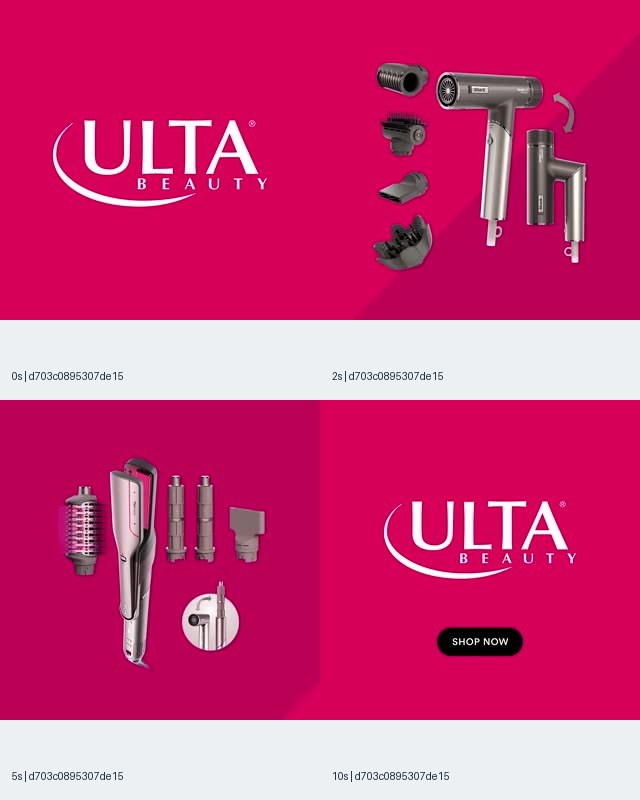
Image 1. Record d703c0895307de153bf446608b5355cc, associated with Ulta Beauty. The 0-, 2-, 5-, and 10-second frames include retailer branding, hair tools, attachment groupings, and a Shop Now end frame. Source sample observed September 22, 2026; these frames do not establish operating performance.
The visible attachments make an immediate commissioning question concrete: which component should a viewer recognize, and what should they understand about it? A brief that merely asks for “accessory B-roll” could return decorative close-ups without any useful relationship between the accessory and the main device.
For an original demonstration, request a product-identification shot, a component-identification shot, and an uninterrupted connection sequence where the manufacturer’s instructions permit it. Ask the creator to keep the connection point visible. A hand covering the latch may make the action look natural while removing the information the viewer needs.
State whether the accessory is included with the advertised purchase. If that status is unknown, do not let a group shot imply that every visible piece comes in the box. The editor should have a current included-items list tied to the destination offer.
A suitable acceptance criterion is: the viewer can distinguish the main device from the attachment and see the correct connection without an unexplained substitution. That criterion checks communication and continuity. It does not certify durability, styling quality, or suitability for every user.
Production hypothesis: showing the connection clearly may reduce uncertainty about setup. Test that hypothesis in your own context; the contact sheet does not establish that setup clarity caused an advertising result.
Image 2: Request Texture Footage That Answers a Real Question
A texture request should specify what the viewer needs to observe, because a close-up of packaging cannot demonstrate dispensing, spread, or finish. Sample 2 shows branded beauty products against orange and peach graphics, providing a useful packaging reference without supplying application evidence.
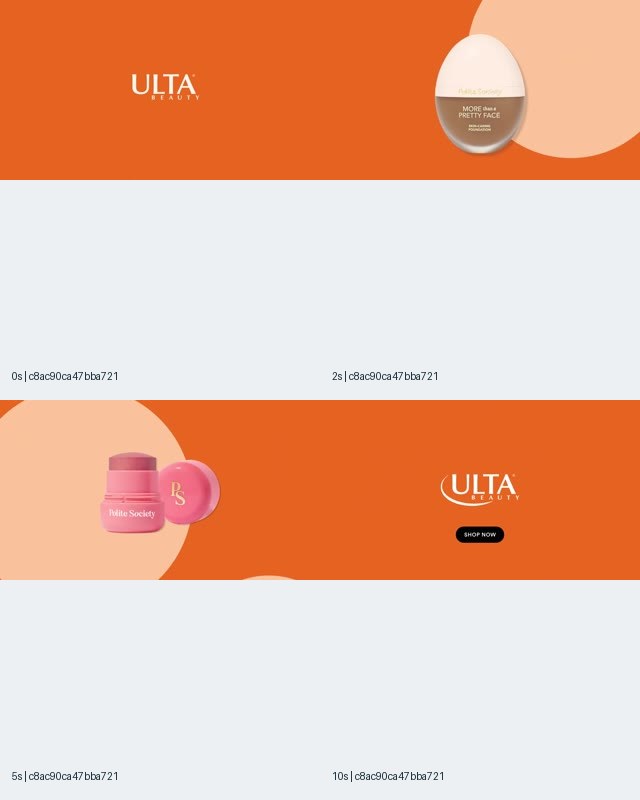
Image 2. Record c8ac90ca47bba7217b78b9c2f41f7f7d, associated with Ulta Beauty. Sampled frames show Polite Society packaging, a pink cosmetic product, retailer branding, and Shop Now. The sheet does not establish texture, shade suitability, or wear.
Turn a vague instruction such as “show how luxurious it feels” into observable actions. Depending on the actual product, those actions might include opening the package, dispensing the instructed amount, showing it on an appropriate surface, and recording the immediate appearance after application. The creator can separately describe their personal experience if that description is truthful and approved for use.
A macro shot needs context. An isolated smear may be visually interesting but leave the viewer uncertain about quantity and scale. Pair it with a wider view that establishes where the product came from and what surface receives it. Ask for enough continuous footage to connect those moments without inventing a transition.
Lighting is part of this request. Tell the creator to avoid changes that would make the product look materially different across the sequence. If the team needs accurate color, agree on a reference capture and review process before filming. Do not promise perfect shade matching from an uncalibrated phone preview.
The acceptance check should identify the intended observation: readable dispensing, visible spread, or immediate finish under the recorded conditions. A texture shot should not silently become evidence of hydration duration, ingredient penetration, or long-term benefit.
Production hypothesis: an identifiable product followed by a clear application close-up may help viewers understand how it fits into a routine. That is an idea for an original shoot, not a finding about the sampled ad’s effectiveness.
Image 3: Separate Product Recognition From Skin-Result Proof
Skincare briefs should distinguish identifying the product, showing its use, and substantiating a result. Sample 3 provides product recognition through a Peach & Lily bottle and jar; the observed frames do not document a person’s skin before or after use.
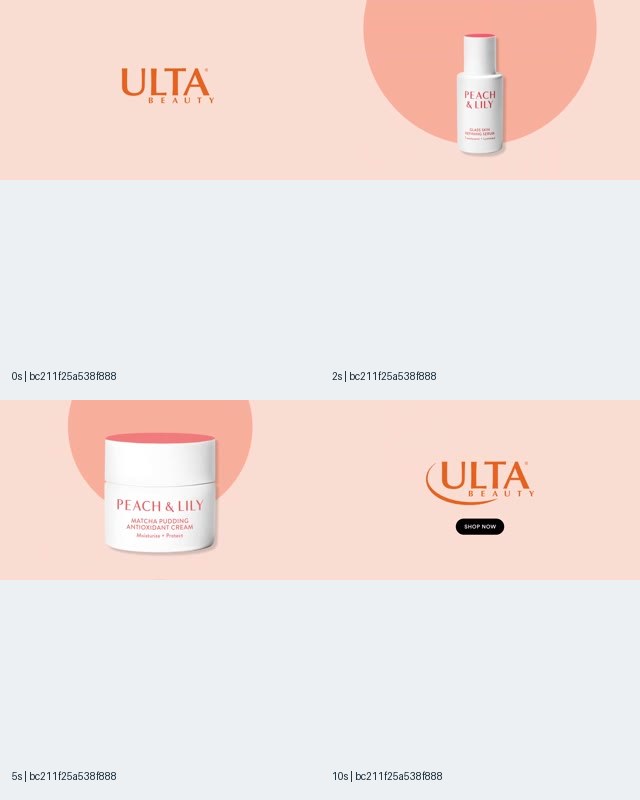
Image 3. Record bc211f25a538f88815d520e185570a73, associated with Ulta Beauty. The selected frames show Peach & Lily packaging, retailer branding, and a Shop Now end frame. They provide no before-and-after evidence.
A brand may want to communicate both a serum and a cream. The creator still needs to know whether the assignment concerns a single product, a routine, or a comparison. Those are different commissions. A routine requires accurate sequence instructions; a comparison needs a defined basis; a single-product demo should not imply that another item caused the observed finish.
For immediate application footage, specify the starting condition. Record relevant context such as whether other products were already present and whether the skin was wet or dry, when that matters to interpretation. The purpose is to preserve what happened, not to manufacture laboratory conditions around a casual creator video.
If the brand wants a result over time, stop treating the request as ordinary B-roll. Define the claimed outcome, duration, evidence source, capture conditions, and intended wording before commissioning it. A creator’s visible experience may be useful, but it does not automatically support a general promise for buyers.
Editors need this distinction too. A cut from a bare face to a brighter frame can communicate improvement even without explicit words. Check whether lighting, makeup, framing, or another product changed. Preserve the original footage and notes so that the team can assess the implication of the edit.
A practical acceptance line is: “The footage may show application and the immediate visible finish under documented conditions; it may not be labelled as proof of a lasting skin change without separately approved support.” That gives the creator a clear assignment and the editor a concrete boundary.
Build a Claim Ledger With an Evidence Owner
Every material product statement should have a source, an owner, and a defined scope before it enters a creator’s lines or on-screen text. A claim ledger is a compact worksheet connecting what the ad will communicate with the evidence the team actually has.
The ledger should include implied claims. A timed demonstration, a comparison layout, or a before-and-after cut can communicate something stronger than the spoken words. Review the combination of voice, footage, captions, product name, and destination.
| Statement type | What to request | What the evidence can support | Acceptance question |
|---|---|---|---|
| Product identity | Current packaging and exact SKU | Which item is being shown | Does footage match the advertised variant? |
| Directions | Current instructions for that product | How the product is intended to be used | Does the action follow those instructions? |
| Personal experience | Creator’s actual account and relevant context | What that person experienced | Is the line faithful to their experience? |
| Immediate visible behavior | Continuous footage and capture notes | What happened in that recorded demonstration | Can the viewer see the event without a misleading cut? |
| Measured benefit | Appropriate supporting documentation | The result within the documented conditions | Does the wording preserve those conditions? |
| Comparative claim | Defined comparator and supporting method | The specific supported comparison | Is the comparison narrower than the evidence? |
| Offer | Current commercial terms and eligibility | The offer available under those terms | Will it still be accurate when the ad runs? |
Give each proposed statement a status: approved, revise, or unresolved. Use those statuses operationally. An unresolved line should not appear in a shoot document as though approval were inevitable. If it is necessary to the concept, resolve it before filming; otherwise provide an alternative that does not depend on it.
Personal experience needs particular care. “I found the cap easy to open” concerns the speaker’s experience. “Anyone can open this effortlessly” broadens that experience into a universal statement. Similarly, “This is the amount I used in this demonstration” is narrower than a promise about how long a package will last.
Request evidence appropriate to the claim rather than collecting documents for appearance. A package photo can confirm visible wording, but it does not independently validate a scientific assertion printed on the package. A screenshot of another advertiser’s claim is evidence that the claim appeared, not evidence that it is true for your product.
Record the approval date and the person or function responsible for approval within your own organization. This is a recommended production responsibility, not a claim that the sampled ads underwent any particular review process.
Image 4: Keep Simulated Actions Out of Physical Product Proof
A keyword match should not turn a game advertisement into a skincare demonstration reference. Sample 4 belongs to a reported game listing and shows a simulated activity, making it useful for research filtering rather than evidence about a physical cosmetic product.
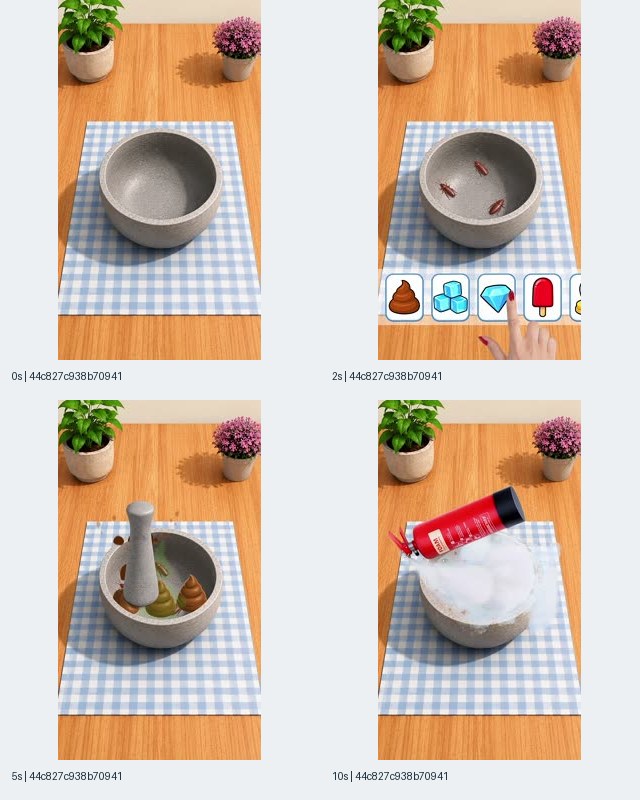
Image 4. Record 44c827c938b70941416f09c217e482bc, associated with ASMR Makeover: Skincare Games, iOS listing 6754906411. Sampled frames show a bowl, selectable icons, a pestle, and foam. We did not play the app or test the associated playable.
The bowl and hand-like pointer create a sequence of apparent actions. That structure could inspire a question about whether a viewer can follow a step-by-step process. It cannot establish how an actual skincare product mixes, reacts, dispenses, or behaves on skin.
Label such a reference precisely if it remains in an internal inspiration board: “game advertisement; visual sequencing reference only.” Better still, exclude it from the creator’s product-proof packet and keep it in the researcher’s notes. A creator working quickly should not have to infer which examples are approved demonstrations and which are unrelated visual ideas.
Do not recreate a simulated chemical reaction with a real product simply because the image is attention-grabbing. If your concept depends on a physical effect, establish that the product actually produces it under an appropriate procedure and that the resulting message is supportable. Otherwise, choose a demonstrable action such as opening, dispensing, or applying according to instructions.
This is also a reminder to retain listing identifiers during research. Similar words in titles do not establish the same product, owner, or business category. Here, the game association changes the appropriate use of the reference before any creative analysis begins.
To inspect the range yourself, explore indexed creatives for skincare. Start by separating product retail, creator-style footage, and game listings; then select references that answer the actual question in your brief. Live results may differ from the dated sample.
Image 5: Ask for Operation Coverage Specific to the Device
Device footage should explain a defined operation on a defined model, rather than relying on a group of attractive objects to communicate functionality. Sample 5 shows a device grouping and a separate styling brush, which raises questions about component roles that the selected frames cannot answer.
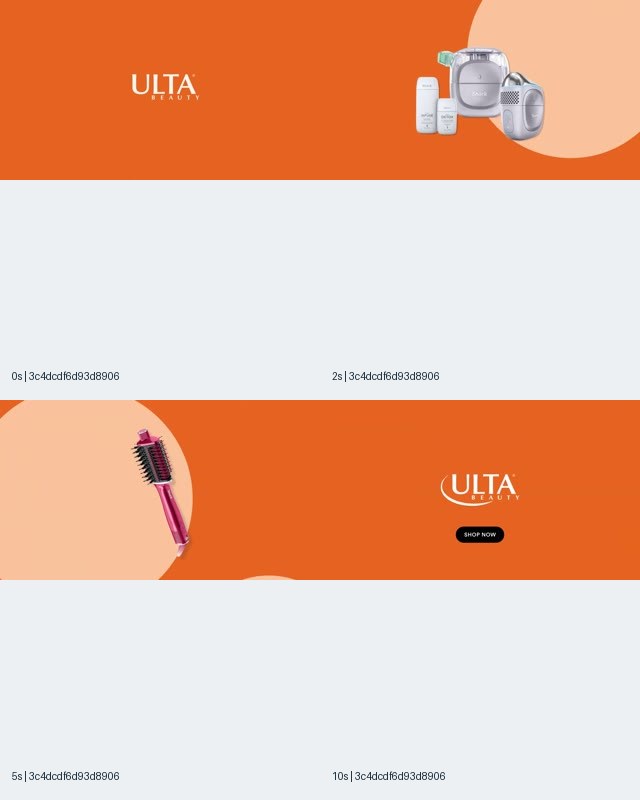
Image 5. Record 3c4dcdf6d93d8906f7ac1ba71071fe6b, associated with Ulta Beauty. The observed frames show retailer branding, devices with bottles, a pink styling brush, and Shop Now. They do not establish device settings, treatment effects, or operating speed.
For your own device, identify the specific action the commission covers: assembly, control selection, positioning, cleaning, or another approved operation. Include the corresponding instructions and decide which labels or indicators must remain visible. A close-up of a button is only useful if the viewer can understand its role.
Ask the creator to record the setup as well as the polished action. That can include a wider shot establishing the device and a closer view of the relevant control. Where power, heat, moving parts, or treatment settings matter, the instructions should come from the product owner’s current documentation. The creator should not improvise an operating procedure for visual effect.
Separate an operation demonstration from a timed-performance claim. A shortened edit can show the order of actions without establishing how long the complete task takes. If elapsed time is central to the claim, request a documented timing procedure and preserve the continuous recording used to support it.
Acceptance should focus on the commissioned operation: the correct model appears, the intended setting is identifiable, the action follows approved instructions, and the edit preserves any relevant setup. If an editor needs to add an arrow or caption to clarify a control, confirm that the annotation points to the right feature.
Production hypothesis: showing the control in context may make a device easier to understand than showing a detached close-up. This is a proposed communication test, not a verified advantage of the sampled execution.
Image 6: Treat Packaging Language as Something to Verify
Visible label language should trigger a product-specific claim check before it becomes a creator’s spoken endorsement. Sample 6 shows a Redken spray bottle and treatment tube, but the presence of branded packaging does not independently substantiate every benefit a team might associate with those products.
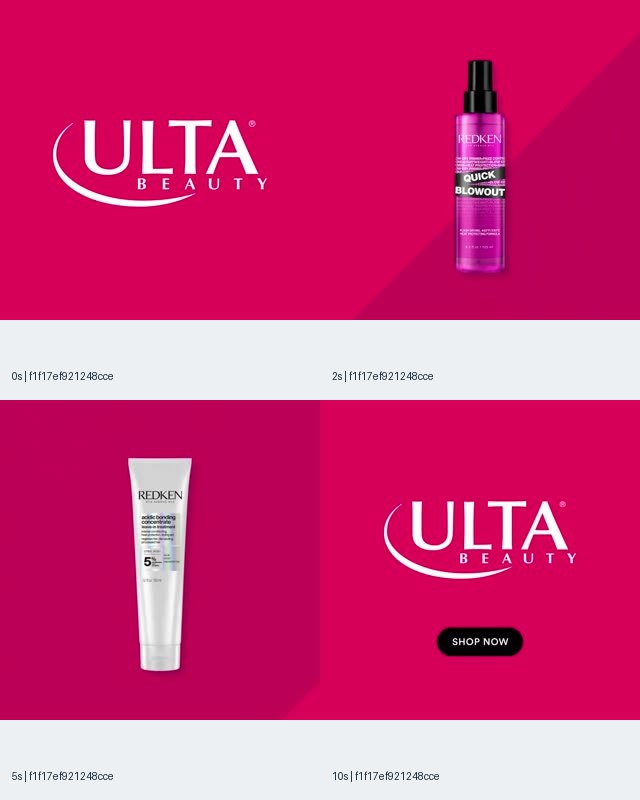
Image 6. Record f1f17ef921248cce5608fa69c0c08d8e, associated with Ulta Beauty. Selected frames show Redken packaging and retailer branding. The sheet does not demonstrate treatment results or validate label claims.
A common commissioning error is to transfer a phrase from one product in a range to another. Prevent that by attaching approved wording to the exact SKU. When the footage includes multiple products, each statement needs an unambiguous visual referent. A line about the spray should not continue over a tube in a way that creates a different claim.
Request pronunciation guidance if the creator will speak the product name. This is a simple production detail with downstream value: an otherwise usable take may need to be repeated if the central name is wrong. Supply a readable label reference so the editor can also check captions.
For haircare, define the task without silently adding an outcome. Showing the instructed application is different from establishing reduced damage, longer-lasting styling, or another result. If the proposed concept concerns a visible styling finish, record relevant starting conditions and any other products or tools used. The editor needs that context to avoid attributing the entire result to one item without support.
Keep creator reactions truthful. Do not require a predetermined statement such as “I immediately noticed a difference” if that is not what the person experienced. Give the creator room to report a narrower observation or ask for a different line.
A useful approval note is: “Product names and descriptive wording must match the supplied SKU sheet; any benefit beyond visible handling requires the corresponding approved claim.” That rule is specific enough to check without turning every close-up into a claim about efficacy.
Image 7: Brief Human Context, Experience, and Offers Separately
Creator-style footage needs separate instructions for the setting, the person’s experience, and any commercial offer. Sample 7 combines store context, people holding products, and a discount badge, but those elements do not establish the speakers’ identities, customer histories, or the current availability of the offer.
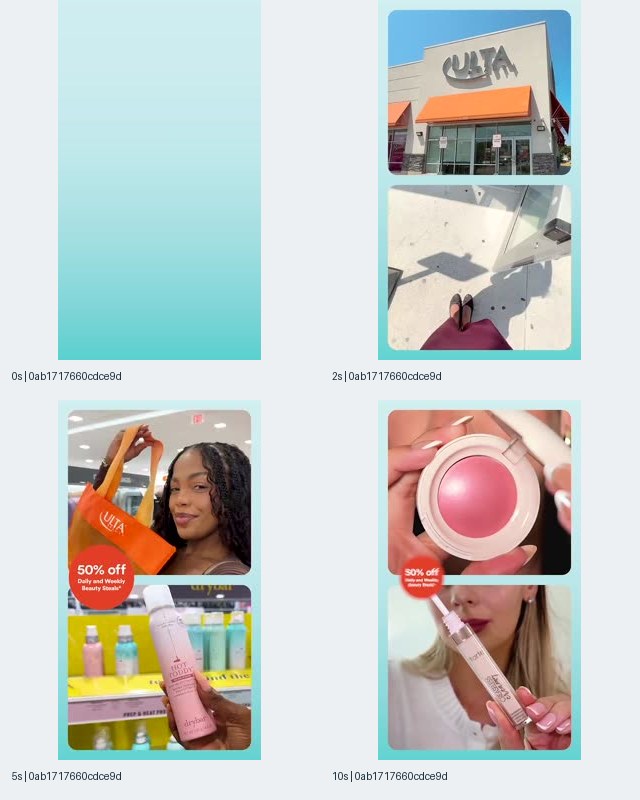
Image 7. Record 0ab1717660cdce9d3d3ce0a341bbd3d3, associated with Ulta Beauty. The selected frames include a storefront, shopping context, people holding beauty products, and a visible 50% off badge. The badge is historical advertising content, not a verified current offer.
This reference is closer to the human context a team may want from a creator. At the observed timestamps, the imagery moves from retail surroundings to people and product close-ups. The sheet does not establish a full narrative, spoken testimonial, or independent customer recommendation.
For an original commission, define whether the creator is filming at home, in a store, or in another setting. Confirm that the intended filming and use of the resulting footage are permitted. Give alternatives if a location becomes unavailable. An at-home unboxing and a store visit may answer similar product-discovery questions, but they require different logistics and cannot be substituted silently.
Ask the creator what they can truthfully say about the product before finalizing testimonial language. Did they just receive it? Have they used this exact variant? Are they describing a first impression or a longer experience? Capture those answers in the production notes, then write within that scope.
Treat offers as a separate editable module. Supply the current terms, eligible items, dates, and destination. If those details are not final, request a clean product close and an offer-neutral spoken ending. The editor can add a verified offer later without asking the creator to repeat the entire demonstration.
For acceptance, inspect the context and commercial message independently. A genuine demonstration does not rescue an expired discount. Accurate terms do not rescue a fabricated customer story. Both need their own check.
Production hypothesis: relevant human context may help viewers understand when they would use or shop for a product. The sample provides a visual example of that context, not evidence of its conversion effect.
Image 8: Keep Sensory Descriptions Within the Creator’s Experience
A fragrance brief can demonstrate the object and its use while treating scent descriptions as personal observations. Sample 8 shows fragrance bottles and retailer branding; it cannot convey smell or establish longevity through the image alone.
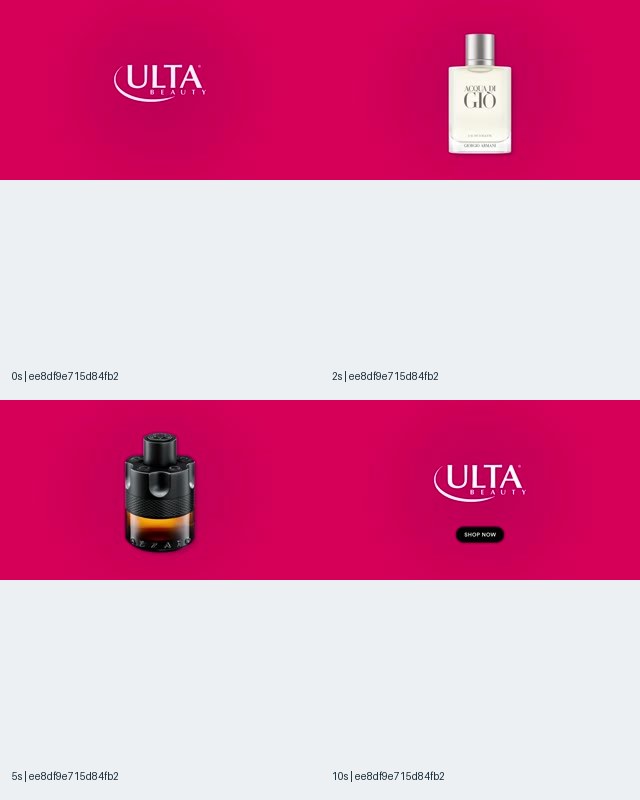
Image 8. Record ee8df9e715d84fb2e7d06d717c32c01c, associated with Ulta Beauty. Sampled frames show fragrance packaging, retailer branding, and Shop Now. Scent, wear duration, and personal preference cannot be verified from these frames.
For a fragrance demonstration, specify the correct bottle, size, and variant, then request clear handling footage. Relevant actions could include removing the cap, showing the sprayer, and using the product according to its directions. The camera can document those actions; it cannot directly transmit the sensory experience.
If the creator describes the scent, ask for their actual impression and separate it from the brand’s documented product description. “It reminds me of…” signals an individual association. A statement that every wearer will experience the same impression would require a different basis and is usually unnecessary to the demonstration.
Longevity creates another boundary. A first-impression shoot cannot truthfully become an all-day wear account through editing. If the assignment includes a personal wear diary, define when observations will be recorded and preserve their context. Do not present one person’s experience as a universal duration guarantee.
The same logic applies beyond fragrance. Taste, comfort, perceived weight, texture, and ease of handling can involve personal experience that deserves accurate attribution. Let the creator’s language remain specific enough to be true.
A useful acceptance criterion is: visible actions match the exact product, personal descriptions reflect the creator’s recorded experience, and any broader statement has separate support. This gives the team expressive material without asking the footage to prove something the medium cannot show.
Turn the References Into a Shot Acceptance Matrix
A shot matrix makes the brief reviewable by connecting each requested asset to a viewer question and a pass condition. It should cover the material needed for the commissioned concept, rather than accumulating attractive shots that have no defined use.
The following is a suggested production structure, not a count observed in the advertising sample.
| Asset | Viewer question | Creator request | Accept when |
|---|---|---|---|
| Product identification | What is this exact item? | Hold or place the correct variant with the main label visible | Product and variant can be checked against the packet |
| Context | Where does this fit into use? | Show the relevant setting without unrelated claims | Context is clear and permissions are resolved |
| Setup | What happens before use? | Capture required preparation or assembly | Necessary steps remain visible |
| Core action | How is it used? | Record the key operation continuously | Action follows approved directions and is understandable |
| Detail | What should I inspect? | Capture the relevant texture, control, or connection | Detail answers the stated question |
| Immediate observation | What happened in this demonstration? | Show the result under documented conditions | Caption and voice do not exceed what is supported |
| Personal account | What did the creator experience? | Record truthful observations in their own voice | Experience and wording agree |
| Closing asset | What should the viewer do next? | Capture a clean ending and approved action line | Destination and offer match the current brief |
Add priority to each row. Required assets are necessary to make the concept accurate and editable. Optional assets add flexibility. This helps a creator make sensible decisions when weather, location access, product quantity, or another constraint changes.
Include a reference frame only where it clarifies the row. Explain the transferable principle in words: label visibility, hand position, component separation, or human context. Do not ask a creator to reproduce another person’s exact performance, branded layout, or wording.
Finally, assign an evidence dependency. A product close-up may be ready to shoot immediately; a measured-benefit segment may remain blocked until documentation arrives. Mark that difference visibly. A brief should expose dependencies before they become expensive missing footage.
Direct the Creator Without Scripting a False Persona
Creator direction should preserve the person’s truthful experience while making the requested information easy to capture. The team can specify the product question, required facts, and filming constraints without dictating an invented identity or rehearsed enthusiasm.
Describe the intended viewer in terms of their decision. “Someone unsure how this attachment connects” is more actionable than an unsupported demographic stereotype. It tells the creator where to slow down, what to keep visible, and which explanation matters.
Provide mandatory facts separately from optional phrasing. The product name, variant, instructions, and approved qualifications may need precise treatment. Transitions and personal descriptions can often remain flexible. This division lets the creator speak naturally while protecting the meaning of the demonstration.
Ask for alternatives that differ in a useful way. For example, a creator might record a direct explanation and a quieter observation-led version of the same action. Label these as proposed production alternatives. Do not call one “the high-converting version” before it has been tested.
Give physical direction where it affects comprehension. Tell the creator when to keep their hand below a label, when to pause after an action, or when to keep the product in the same orientation. Explain the reason so they can solve problems on set. “Keep the connection visible so viewers can follow the setup” is clearer than “make it more premium.”
Leave space for accurate negative or neutral feedback during production. If the product does not behave as the brief expected, the creator should report that mismatch rather than repeat takes until the footage implies something false. The team can revise the concept around a supportable observation.
This article focuses on commissioning and acceptance. For arranging spoken beats into a narrative, use the separate UGC video ad script template. The script should be built from the approved production packet, so that persuasive language remains connected to footage the creator can actually deliver.
Specify Files Around the Editor’s Real Needs
Delivery requirements should describe the assets the editor will use and the conditions under which they remain usable. “Send everything in high quality” is too vague to settle whether the team receives clean footage, isolated audio, alternate takes, captions, or only a finished export.
Agree on the intended placements and editing workflow before selecting recording specifications. Resolution, orientation, frame rate, audio format, and delivery method are project requirements, not universal properties of UGC. Confirm current destination requirements with the person responsible for trafficking the finished ad. This source sample does not verify platform specifications.
Request original camera files where that is part of the agreement. Messaging-app previews may be useful for quick feedback, but they should not silently replace the agreed masters. If the creator applies stabilization, color changes, filters, or other processing, document what was applied and whether an unprocessed version is needed.
Distinguish clean footage from edited outputs. A clean clip has no baked-in music, captions, promotional badge, or other addition that prevents a later revision. The editor may still need a finished reference cut to understand the creator’s intended rhythm. Both can be useful, but they are separate deliverables.
Audio deserves its own requirements. Ask for intelligible speech, a quiet recording environment suited to the concept, and a short playback check before the full session. If product sounds matter, request them separately where practical. A cap click recorded underneath loud music may be difficult to recover later.
Specify how much usable space is needed around actions and lines. Rather than imposing a supposed industry benchmark, explain the editing task: leave a natural pause before speaking, keep the product still after the demonstration, and avoid stopping the recording at the exact moment an action ends.
Use filenames that identify the product, shot, take, and version. Ask for a delivery index mapping each required asset to its file. That index can be a simple table; the important part is that a reviewer can find the requested connection shot or approved closing line without opening every clip.
Acceptance should include successful file opening, audible speech, usable framing, and correspondence with the agreed specification. Technical acceptance does not automatically approve claims or usage rights; those remain separate checks.
Agree on Usage, Editing, and Commercial Scope Before Filming
A production brief should state how the footage may be used, because receiving a video does not resolve every permission needed for advertising. Put the agreed commercial scope in the appropriate contract or written agreement, then summarize the relevant instructions in the creator packet.
Clarify whether the assignment covers content production, publication on the creator’s account, paid use from a brand account, or another arrangement. These uses involve different deliverables and responsibilities. A creator hired to supply footage should not discover after delivery that they were also expected to post or grant account-based advertising access.
Record the intended duration, territories, channels, editing rights, and any limits on reuse. If the team wants to make shorter cuts, alternate captions, translated versions, or compilations, discuss those uses explicitly. Do not assume that permission for one finished video settles every derivative use.
Address the creator’s image and voice, other people appearing in the footage, location permissions, and third-party material such as music. Specify who is responsible for supplying and checking each item. Avoid collecting unnecessary personal information while preserving the documentation needed for the agreed use.
AI-related reuse deserves an explicit conversation when it is proposed. Permission to edit a video should not be treated as automatic permission to synthesize a person’s voice, alter their statements, or generate new performances. State the intended use and obtain the appropriate agreement before adding it to production.
Keep offer dates separate from the duration of footage rights. The team might be allowed to use a clip after a promotion has expired, while still needing to remove the old promotional overlay. Clean masters make that correction possible, but they do not substitute for checking the terms.
These are commissioning recommendations, not a finding about the contracts behind the sample ads. For a specific commercial arrangement, have the responsible business and legal stakeholders resolve the terms appropriate to that project. The creator-facing brief should then communicate the settled scope clearly.
Use a Pre-Shoot Check That Resolves Expensive Unknowns
A pre-shoot check should establish that the creator has the right product, understands the requested action, and can capture usable footage in the intended setting. Its value comes from resolving dependencies before the full shoot, not from adding another ceremonial approval meeting.
Start with product arrival. Confirm the exact variant, visible condition, and accessories needed for the demonstration. If the shipment is incomplete, decide which shots can proceed and which must wait. Avoid asking the creator to substitute a similar item without updating the concept and claim ledger.
Then request a short technical sample suited to the assignment. It might show the product label in the planned lighting and the creator speaking a neutral sentence. Check focus, reflection, framing, and speech clarity. This is a proposed production check; no such creator test was conducted for the advertising references in this article.
Review the core action next. Ask the creator to describe the intended sequence or send a simple rehearsal when appropriate. This can reveal a hidden problem: the relevant control faces away from the camera, the packaging obscures the action, or a necessary step is missing from the brief.
Resolve wording questions before the creator records every line. Product pronunciation, qualified statements, and personal experience boundaries should be clear enough that the creator can identify an accidental departure during filming.
Finally, confirm the delivery and escalation process. Name the contact for product questions, explain how to report an unexpected result, and distinguish an urgent blocker from an optional creative suggestion. Give the creator a way to pause a dependent shot while continuing other approved work.
The output is a short readiness note: correct product confirmed, essential instructions resolved, technical sample acceptable, unresolved items identified, and shoot scope current. It should be easy for the editor to understand later, especially if the team changes personnel between filming and launch.
A Copyable Product Demo Brief
A usable brief combines a clear objective with specific asset and evidence requirements, while leaving unknown product facts visibly unresolved. The following template is intended for adaptation to your own product. Its fields are production instructions, not facts about the brands shown in the sample.
Project and decision
Product: [exact name, SKU, variant, market]. Audience question: [the practical uncertainty this demonstration will answer]. Intended action after viewing: [the approved next step]. Concept owner: [responsible team member]. Current brief version and date: [version].
Product packet
Ship the approved product and required accessories. Attach current packaging references, directions relevant to the filmed action, and the approved statement ledger. Identify any difference between the supplied unit and the item available at the destination. Do not film a dependent claim while its supporting information remains unresolved.
Creator relationship and experience
Describe the assignment accurately: commissioned demonstration, first impression, existing-user account, or another agreed role. Record the creator’s actual experience with this exact product. Personal observations should remain truthful and may be revised if the product behaves differently from expectations.
Required footage
Capture a readable product-identification shot; the relevant setup; the core action with sufficient continuity to understand it; a closer detail that answers the audience question; and a clean ending. Add human context only where it supports the concept. Keep labels and necessary controls visible. Record alternate takes without changing the underlying product claim.
Statements and evidence
Approved wording: [statement]. Supporting source: [document or observed event]. Scope: [conditions and qualifications]. Evidence owner: [responsible function]. Creator wording flexibility: [what may be paraphrased]. Unresolved statements: [excluded until resolved].
Capture conditions
Use the agreed location, lighting, framing, and audio setup. Document relevant starting conditions and other products or devices used in the demonstration. Avoid processing that materially changes the appearance relevant to the claim. Preserve original footage needed to assess continuity and context.
Offer and destination
Destination: [approved page]. Offer wording and eligibility: [verified details]. Validity period: [confirmed dates]. Recheck owner: [responsible team member]. If the offer is not final, deliver an offer-neutral ending and clean footage suitable for a later verified overlay.
Delivery
Provide [agreed original clips], [agreed edited outputs], [audio or caption files if commissioned], and an index mapping files to required shots. Use the agreed format and transfer method. Identify any omitted shot, technical issue, or departure from the approved concept.
Acceptance
The team will check product accuracy, visibility of the requested action, truthful experience, claim support, technical usability, and agreed permissions. Aesthetic preference changes will be distinguished from missing or incorrect contracted deliverables. Revision scope and timing follow the agreed commercial terms.
Testing handoff
Hypothesis: [what communication change might help the intended audience]. Variant difference: [the single planned difference where possible]. Measurement owner: [team]. Outcomes and decision rules: [defined before launch]. No performance promise is implied by accepting the production.
This template works because its unknowns remain visible. A blank evidence field is a task to resolve, not an invitation for the creator or editor to invent a benefit.
Worked Example: Commissioning an Original Moisturizer Demonstration
A moisturizer commission can focus on showing packaging, dispensing, and application without promising a skin outcome the team has not substantiated. The example below is a hypothetical production brief inspired by the questions raised by Samples 2 and 3. It is not a campaign we ran, a product we tested, or a reconstruction of those advertisers’ production process.
Assume a brand wants to help prospective buyers understand how its own moisturizer is used. The brand has current directions and packaging information but has not supplied evidence for a lasting-result claim. The commission therefore centers on use and immediate observation.
The decision question: can the viewer identify the exact moisturizer and understand the instructed application from the delivered footage?
The product owner’s task: supply the precise SKU, current label images, application directions, and any relevant conditions. Confirm the destination page and whether the product is being sold individually or as part of a set. No statement about duration of hydration or another lasting benefit enters the brief without appropriate support.
The creator’s task: confirm receipt of the correct item, then film a clear package view, opening or dispensing, and application according to the supplied directions. Preserve enough continuity to connect the product with the action. Record a truthful personal observation only if the creator has one they are comfortable making.
The editor’s task: keep the product identity understandable and avoid implying a transformation through unrelated footage. An immediate finish may be shown under the recorded conditions, but it should not be labelled as a lasting result. If the creator’s observation includes a qualification, preserve its meaning when shortening the line.
The required asset matrix might specify a package close-up with readable identity, a wider view establishing the application context, a continuous core action, and a clean end frame. A texture close-up is optional if it answers the buyer’s question and can be captured accurately. A dramatic before-and-after is outside this hypothetical scope.
The proposed acceptance review finds three possible outcomes. If product identity and action are clear, the footage can proceed to the remaining checks. If the label is obscured but the application is usable, request a targeted identification pickup. If the action departs from the approved directions, the team must resolve the product issue before treating the footage as an acceptable demo.
For testing, the team could formulate this hypothesis: showing the dispensing action before the personal introduction may improve viewers’ understanding of how the product is used. Produce both openings from the same approved material, keep the remaining message and destination consistent, and define the measurement plan before launch.
The research has now produced a concrete commission and a testable question. It has not produced a predicted conversion rate. That distinction keeps the creator responsible for a clear, accurate delivery while leaving commercial outcomes to the team’s actual measurement.
Accept the Footage With Observable Pass Conditions
Acceptance should determine whether the delivery satisfies the brief, using checks that another reviewer could repeat. A vague verdict such as “doesn’t feel authentic” is difficult to act on; a note that the creator states an experience they did not report is specific and consequential.
Review product identity first. Check the name, variant, packaging, accessories, and destination relationship. A technically excellent clip of the wrong item is a product mismatch. Do not hide the mismatch with a tighter crop and assume that it has disappeared.
Review the action next. Can a viewer follow the requested operation? Are important steps missing? Does an edit conceal a substitution or change the apparent result? Use the original footage where necessary to understand what happened. A shortened final cut may be acceptable while still requiring a continuous source recording for review.
Then compare the complete message with the claim ledger. Check speech, captions, overlays, visual comparisons, and the implications of the sequence. A statement can become broader when a qualification is removed or when it is placed over footage of a different product.
Technical review comes after those substantive checks, although obvious problems may be found earlier. Confirm focus, readable labels, stable enough framing, intelligible speech, appropriate color handling, and usable files. Inspect the final crop intended for delivery rather than assuming that a clear master remains clear in every adaptation.
Use a review table with a decision and a reason:
| Review area | Pass | Targeted revision | Hold |
|---|---|---|---|
| Product identity | Correct item and variant are clear | Add a missing readable close-up | Wrong product or unresolved destination match |
| Demonstration | Approved action is understandable | Replace an obscured detail | Procedure or implied result is unsupported |
| Personal account | Wording reflects actual experience | Restore a necessary qualification | Experience was invented or remains unresolved |
| Offer | Terms match the intended launch | Update an editable overlay | Eligibility or timing is unknown |
| Technical delivery | Files meet the agreed needs | Replace a damaged or unclear clip | Essential footage is unusable |
Keep the feedback consolidated. Contradictory notes from multiple stakeholders can cause the creator to fix one issue by introducing another. Assign someone to reconcile comments into a single actionable revision request, with each request tied to the agreed brief.
Request Pickups Without Turning Every Revision Into a Reshoot
A revision request should identify the missing information and the smallest useful replacement asset. This helps the team preserve usable footage while making the final demonstration accurate and understandable.
Suppose the application sequence is clear, but the opening label faces away from the camera. Request a matching product-identification pickup. State the framing, product orientation, lighting context, and intended placement in the edit. Do not simply ask the creator to “make the product more visible” across the whole video.
If an important control is obscured, request the relevant detail and enough surrounding action to connect it to the existing sequence. Check whether continuity matters. A pickup using a different variant, accessory, amount, or setting may create a new problem even if the close-up looks better.
For spoken lines, explain the factual correction. If a claim exceeds the evidence, provide the approved narrower meaning and let the creator phrase it naturally within the agreed flexibility. Repeating the same unsupported line with a softer tone does not resolve its scope.
Distinguish corrections from new creative requests. Missing a contracted setup shot differs from asking for a new location, a new product angle, or another concept after delivery. The commercial agreement should govern additional work; the review process should make that distinction visible.
Before closing the revision, inspect the updated edit as a whole. A replacement line can shift timing, a new close-up can suggest a different order, and a corrected offer can leave an old claim in the captions. Acceptance belongs to the final combination of assets, not only to the last file received.
Design the Test After Defining What the Creator Can Deliver
A creative test should connect a specific communication hypothesis to measurable outcomes in your own campaign. The sampled advertisements provide production references, but their appearance, repetition, or observation dates do not identify a winning opening, creator, or demonstration format.
Choose a question the production can actually isolate. For example, compare a product-identification opening with an operation opening while keeping the creator, core demonstration, claim, offer, and destination as consistent as practical. If all of those elements change at once, the result concerns the combined concept rather than a single shot choice.
Write down the primary outcome and its denominator before launch. If the team studies viewing behavior, specify what counts as a view and which population enters the rate. If it studies purchasing behavior, specify the conversion event, attribution approach, and available account data. Avoid borrowing a metric label without checking its definition.
Include a practical comprehension check where useful. Ask intended viewers what product they saw, what action was demonstrated, and what result they believe was promised. Treat that exercise according to its actual sample and method. It can reveal confusing communication without proving a commercial lift.
Set decision rules appropriate to the team’s traffic and uncertainty. A small or noisy result may justify another test rather than a winner announcement. Record other changes that could affect interpretation, including offer updates, audience changes, or destination revisions.
The creative testing framework provides a fuller structure for this measurement stage. Keep the production acceptance decision separate: a creator can deliver exactly what was commissioned even when a hypothesis later fails. That separation supports fair commissioning and more useful learning.
Common Mistakes That Make a Brief Hard to Use
The most damaging briefing mistakes leave the creator guessing about the product, the evidence, or the definition of an acceptable delivery. Fix them by replacing ambiguous direction with an observable task and a responsible owner.
Sending references without annotations. A folder of ads does not tell the creator whether to borrow product scale, hand position, pacing, or a testimonial style. Write the specific principle beside each reference and identify anything that must not transfer to your product.
Calling every human appearance a testimonial. A person holding a bottle is an observable visual fact. Their history with the product, relationship to the advertiser, and spoken opinion require additional evidence. Define the role you are commissioning accurately.
Requesting proof after filming. A result claim may need conditions or documentation that cannot be reconstructed from a polished export. Identify those requirements before the creator starts.
Treating a package claim as universal permission. Check the exact SKU, current wording, conditions, and intended use of the statement. Do not transfer benefits between products because their packaging looks similar.
Baking a temporary offer into every asset. Keep clean footage and an offer-neutral ending when useful, so that a commercial update does not require replacing the entire demonstration.
Using estimated impressions to select a supposedly proven creator style. The sample contains no conversion evidence. It also mixes retail product presentation and game-related material, making broad UGC conclusions inappropriate.
Accepting only the finished export. If the agreement requires reusable material, check that the promised source clips and delivery index are present. A finished cut may conceal missing assets until the next edit is requested.
Giving aesthetic feedback as a factual rejection. Explain whether the problem is accuracy, usability, or preference. Each calls for a different correction and may have different commercial implications.
When AdMapix Fits the Creator-Brief Workflow
AdMapix fits the research stage when a team needs to find indexed advertising references and turn visible examples into specific production questions. It is an advertising-intelligence product, and this guide uses a dated search sample to demonstrate that role.
The useful handoff is a small evidence packet: a relevant reference, its reported listing, the observation date, the visible feature being discussed, the limitation, and the original shot request that follows. This preserves the reason a reference was selected instead of passing an unexplained screenshot to a creator.
For example, Sample 1 can lead to an attachment-identification request. Sample 7 can lead to separate instructions for human context and offer handling. Sample 4 can be excluded from physical product proof. Each decision is more actionable than labelling the whole search result page “winning skincare UGC.”
AdMapix does not replace the product owner’s documentation, the creator’s truthful account, agreed usage permissions, or your own campaign measurement. This article also provides no verified refresh guarantee or promise of complete coverage for a particular network.
Start my next creator brief: take the search workflow above, select references that match the product question, and complete the shot and claim worksheets before commissioning. If ongoing research belongs in your workflow, check current AdMapix plans and pricing. Commercial terms can change; use the live page for the current options.
The decision to use a research tool should rest on whether it helps your team produce a clearer, traceable commission. It should not depend on treating public ad examples as private performance evidence.
FAQ
These answers address the practical questions that arise when commissioning a real product demonstration. They use the same distinction throughout: reference imagery informs production choices, while product claims and commercial outcomes require their own evidence.
What should a UGC creator brief include?
Include the exact product and variant, the audience’s question, required footage, approved statements with supporting sources, delivery specifications, usage scope, and acceptance criteria. Add an owner for unresolved questions. The creator should be able to tell which shots are essential, what they may say truthfully, and what files the editor expects without reconstructing the assignment from a reference folder.
How is a creator brief different from a video script?
A script organizes spoken lines and narrative beats. A creator brief defines the production assignment: product facts, required assets, evidence boundaries, permissions, and acceptance. A script can sit inside the brief, but it cannot replace those requirements. This guide focuses on what must be filmed and checked; the finished narrative should use only material the creator can accurately deliver.
Do product-only ads count as UGC references?
They can inform parts of a UGC production, such as label visibility, product scale, or accessory separation. They do not establish creator authenticity or a personal-use demonstration. Most contact sheets in this article show retail product presentation. Use their visible choices to define an original shot request, while requesting the additional human context and actions your own concept needs.
What proof should I request for a skincare demonstration?
Request current product identity and directions first. For application footage, preserve relevant starting conditions and continuous source material. For personal experience, record what the creator actually experienced. A lasting or measured benefit requires appropriate separate support and qualified wording. A close-up, a package label, or an edited before-and-after sequence does not automatically substantiate a broader result claim.
Should the creator deliver raw footage or a finished ad?
Specify whichever outputs the project needs, and agree on them before filming. Original clips support revisions, continuity checks, and later edits within the permitted scope. A finished cut communicates the intended sequence. If both are needed, commission both explicitly and request an index linking files to required shots. Receiving one output should not be treated as an automatic entitlement to every other asset.
Can these examples identify the best-performing creator format?
No. The evidence is a bounded US skincare keyword sample for August 24 through September 22, 2026, with observations limited to selected frames. It contains no creator-level conversion measurement or controlled format experiment. Estimated impressions and observation dates cannot establish which format caused a result. Use the examples to formulate production hypotheses, then evaluate those hypotheses with your own defined measurement.
How should a small team evaluate the cost of this workflow?
Separate research, creator production, editing, revisions, and usage rights in the budget. Then ask which missing information is likely to cause avoidable rework. A concise product packet and acceptance matrix can be useful without a large operation. For AdMapix, consult the live pricing page rather than an evergreen article’s stored prices; this guide does not promise a paid-plan trial.
Key Takeaways
A dependable creator brief connects the product, the requested action, the supporting evidence, and the acceptance decision.
- Identify the exact product and variant before commissioning footage.
- Give each required shot a viewer question and an observable pass condition.
- Separate visible demonstrations, personal experiences, and broader product claims.
- Keep clean assets and current offer terms available for accurate revisions.
- Use advertising references to build hypotheses; use your own evidence to evaluate results.
Sources
The sources below establish the dated advertising sample and the relevant research workflow. They do not provide product efficacy testing, creator contracts, conversion measurement, or complete video playback evidence.
- Frozen advertising source package — observed 2026-09-22: Public sample, request batches, parameters, and checksums. Scope: US, skincare query, measurement window 2026-08-24 to 2026-09-22, thirty bounded search records and the eight source-linked contact sheets analyzed above.
- AdMapix search workflow — article observation date 2026-09-22: Indexed skincare creative search. Relevant workflow for inspecting current indexed references; live results are not an exact replay of the frozen sample.
- AdMapix methodology — product-facts reference reviewed 2026-08-13; applied to this article on 2026-09-22: Public methodology and data boundaries. Relevant to interpreting indexed advertising records and separating estimated measures from private campaign outcomes.
AdMapix Research prepared this automated draft with Codex and checked it against the dated source sample. Editorial ownership remains with Brad at AdMapix; no personal human review is asserted.
Turn these observations into your next creative study
Open the creative library and select samples for your market, network and research question.
Related Articles
TikTok Carousel Ads vs Video Ads: How to Compare Creative Structure
Compare carousel and video creative structure through eight source-linked images from a reproducible US kitchen-keyword sample, matched production briefs, and a practical testing workflow.
UGC Video Ads: Script Template for Hook, Demo, Proof and CTA
A complete UGC video ad script template for skincare teams, covering hook, demonstration, proof, CTA, creator direction, testing, and evidence limits.
Ad Optimization Best Practices: The 2026 Performance Playbook
The definitive 2026 guide to ad optimization best practices — a high-output creative production system, statistically honest A/B testing, budget governance and pacing rules, the metrics that matter, structured account hygiene, an optimization cadence, and an FAQ that settles the hard questions performance teams keep arguing about.