
UGC Video Ads: Script Template for Hook, Demo, Proof and CTA
A complete UGC video ad script template for skincare teams, covering hook, demonstration, proof, CTA, creator direction, testing, and evidence limits.
UGC Video Ads: Script Template for Hook, Demo, Proof and CTA
Editorial ownership: Brad at AdMapix. Disclosure: AdMapix Research — prepared with Codex and checked against the dated source sample.
UGC video ads work when the viewer understands the problem, sees a believable demonstration, receives a reason to trust the claim, and knows what to do next. This template gives UA managers, creative strategists, creators, and skincare teams a shootable system for those four jobs. It is designed to produce a brief another person can film, edit, approve, and learn from.
The examples use a bounded US search sample for “skincare” captured from 2026-08-16 to 2026-09-14. The supplied contact sheets show only timestamped frames. They do not prove that an ad won, that a named platform delivered it, that the advertiser selected a particular audience, or that any product claim is true.
Quick Answer
- A practical UGC video ad script follows four beats: hook, demonstration, proof, and CTA.
- Put a concrete audience problem in the first two seconds, show the product in use before making a strong claim, and make proof specific enough to verify.
- Write three hook variants and one controlled demonstration so the first test isolates the opening idea.
- In the dated AdMapix sample, 30 records resolved to 25 unique video fingerprints and 9 unique playable fingerprints; the records are a bounded search sample, not a complete skincare advertising fleet.
- Use AdMapix to find and tag source examples, then validate every claim with your own product, legal, platform, and conversion data.
Who This Template Is For
This template is for teams that need a repeatable UGC production brief rather than a swipe-file caption. A UA manager can use it to create a test matrix. A creative lead can hand it to a creator with shot directions and on-screen text. A founder can use it to keep a small production sprint focused on one customer problem and one measurable action. An agency can duplicate the fields across clients without turning every brief into the same voice.
UGC means user-generated-style creative: a person speaks or acts in a way that feels native to a feed, often from a phone camera, while the advertiser controls the brief, product, claims, and edit. The style can be performed by a creator, customer, employee, or actor. “UGC” describes the presentation; it does not prove that the speaker is an unpaid customer, that a testimonial is typical, or that the person has professional expertise.
The decision this guide supports is simple: should your next test lead with a problem, a product demonstration, a proof point, or an offer? The answer should come from the job of the campaign and the evidence you can substantiate, rather than from a generic list of viral hooks.
What a Complete UGC Script Must Contain
A complete script specifies the visual, spoken line, on-screen text, product action, proof boundary, disclosure, edit note, and CTA for every beat. “Creator talks about dry skin” is not a production brief because it leaves the editor to invent the evidence and the ending.
| Beat | Viewer question | Script requirement | Safe output |
|---|---|---|---|
| Hook | Why should I stop? | A concrete tension, contrast, or question in 0–2 seconds | “My makeup kept separating here.” |
| Demonstration | What does it do? | A visible product action linked to the problem | Apply, compare, layer, or show texture |
| Proof | Why believe it? | A verifiable observation, usage detail, or clearly labeled testimonial | Ingredient, routine detail, permitted review excerpt |
| CTA | What next? | One action and one reason to take it now | “See the shade match” or “Shop the routine” |
Keep the promise narrow. “Helps my skin feel less tight after cleansing” is a personal observation. “Erases wrinkles in seven days” is a performance claim that needs substantiation and may trigger platform or regulatory review. The script should identify whether each sentence is a product fact, a creator opinion, a demonstration, or an offer. That classification makes approval faster because reviewers can focus on the statements that require evidence.
A useful brief also records the intended audience problem, product SKU, market, destination, required disclosure, music status, aspect ratio, duration, and success metric. These fields prevent a creator from filming an attractive scene that cannot be connected to a measurable campaign question.
How We Evaluated the Source Sample
The source package records a US search for “skincare” through AdMapix’s creative search endpoint. The explicit measurement window is 2026-08-16 to 2026-09-14, and the country filter is US. The pull covered up to three pages, ten rows per page, sorted by estimated impressions descending. It produced 30 ad records, 25 unique video fingerprints, zero unique image fingerprints, and 9 unique playable fingerprints. Twenty-five records included video; eleven included a playable field.
These impression values are third-party model estimates for the stated window. They are not observed delivery, spend, installs, profit, or lifetime totals. A record is an ad instance, not automatically a unique asset. Fingerprint arrays were flattened before counting. Product-search aggregates were excluded because their time scope is unknown. The record count therefore describes the query output, while the fingerprint counts describe deduplicated media files. They should never be added together and called a total number of ads.
The sample is useful for observing production patterns such as vertical composition, product reveal, end-card structure, and reuse. It cannot establish conversion rate, audience targeting, platform ownership, media cost, or causal performance. The supplied images are timestamped contact sheets; I did not watch the entire videos or test the advertised apps and products. The source network shown in the records is the indexed source field; the visual treatment alone does not identify Meta, TikTok, YouTube, a DSP, or any other buyer or placement.
The Four-Beat Script Architecture
The four-beat architecture gives each shot one job. The hook earns attention, the demonstration makes the product concrete, proof reduces doubt, and the CTA turns interest into an action. A 15-second edit may spend 2 seconds on the hook, 7 seconds on demonstration, 4 seconds on proof, and 2 seconds on the CTA. A 30-second edit can expand the demonstration and add a second proof beat without changing the order.
The order is a starting structure, not a law. A high-consideration product may need a proof cue before the demonstration. A limited offer may introduce a price in the hook, then prove value through a routine. What matters is that every beat answers a distinct viewer question and that the transition between beats is understandable without narration.
Beat 1: Hook
Write the hook as a sentence the viewer can understand with sound off. Use a visible problem, a surprising comparison, a direct question, or a specific routine moment. Avoid a vague promise such as “You need this.”
Script fields
- Visual: close-up of the problem area or product texture.
- Spoken line: one sentence, 12 words or fewer.
- On-screen text: the same idea in six to nine words.
- Timing: 0.0–2.0 seconds.
- Test variable: hook angle only.
- Approval check: the visual must support the words without exaggeration.
Example: “If your concealer cracks around noon, try this prep step.”
The line is a hypothesis, not a guarantee. If your product is not a prep product, change the action so the demonstration remains honest. A hook can be emotionally direct without using shame. “My skin looked tired after travel” is a context statement; “Your skin is damaged because you skip this” creates a stronger claim that needs support.
When filming several hooks, preserve the first frame, camera distance, creator, lighting, and audio level where possible. Otherwise the test measures production changes as well as the words. Create a silent review export and ask someone unfamiliar with the brief what problem they think the opening communicates.
Beat 2: Demonstration
Show the product doing the job described in the hook. Demonstration is stronger when the camera captures the hand, texture, application area, and immediate context. If the result takes time, show the routine and label the time frame instead of implying an instant transformation.
Script fields
- Visual: product enters frame, then one clear use action.
- Spoken line: explain what you are doing and why.
- On-screen text: product name or routine step.
- Timing: 2.0–8.0 seconds.
- Test variable: demonstration format, held constant across hook variants.
- Approval check: product amount and use order are accurate.
Example: “I use one pump, warm it between my fingers, then press it here before concealer.”
The demonstration should be repeatable. Film a clean take with no jump cuts, then a faster edit for paid testing. Keep lighting, product amount, camera angle, and application side consistent when comparing hooks. If the product has special storage, preparation, or patch-test instructions, either include them or avoid implying that the shown use is a complete routine.
Beat 3: Proof
Proof answers the viewer’s objection without inflating the claim. Use an ingredient label, a verified review, a routine detail, a side-by-side texture shot, or a clearly identified creator experience. A proof line should say what was observed, by whom, and under what conditions when that context changes interpretation.
Script fields
- Visual: label, texture, routine calendar, or permitted testimonial.
- Spoken line: one evidence-bound reason to believe.
- On-screen text: source or condition where relevant.
- Timing: 8.0–13.0 seconds.
- Test variable: proof type, tested separately from the hook when possible.
- Approval check: the evidence matches the exact product and market.
Example: “After two weeks in my morning routine, my skin feels less tight after washing.”
Do not turn a personal testimonial into a universal medical or cosmetic result. If the product has a substantiated claim, use the approved wording and keep required disclosures visible. A review excerpt should retain enough context to avoid changing the reviewer’s meaning. If evidence is preliminary, say so in the brief and keep the language proportionate.
Beat 4: CTA
The CTA should complete the thought established by the hook. Ask for one action: view the routine, check the shade, read the ingredients, or shop the product. “Learn more” is acceptable when the landing page genuinely provides more information, but a specific action usually gives the editor a clearer ending.
Script fields
- Visual: product pack shot, creator gesture, or storefront screen.
- Spoken line: one action and one reason.
- On-screen text: action verb plus destination.
- Timing: final 2–3 seconds.
- Test variable: CTA wording or offer, tested after the hook is stable.
- Approval check: destination, price, availability, and offer match the edit.
Example: “Tap to see the full routine and choose your formula.”
A CTA is a promise about the next screen. “Shop the bundle” should open a bundle page, not a generic homepage. “Check your shade” should lead to a shade selector that works on mobile. If the offer is time-sensitive, keep the date in the production record and reapprove the end card before reuse.
Eight Source Examples and What They Show
The following images are source-specific observations from the dated skincare query. They are references for structure and shot planning, not proof of campaign results.
1. Brand-first product reveal
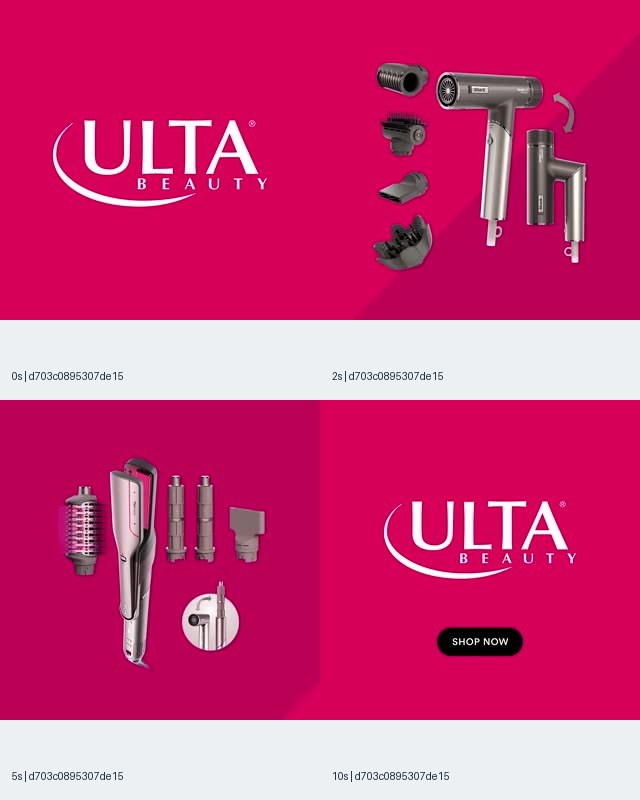
Sample 1 — record d703c0895307de153bf446608b5355cc; observed frames at 0, 2, 5, and 10 seconds. The contact sheet shows Ulta Beauty branding and beauty-tool product imagery. Use it to study a fast brand-to-product transition; it does not establish delivery or platform.
The opening frame makes the brand legible before the product appears. For a UGC version, keep the logo secondary: begin with the creator’s problem, then let the pack shot identify the solution. A useful test is brand-first versus problem-first, with the same demonstration and CTA. Record whether the first frame remains readable on a small phone and whether the logo crowds the creator’s face.
2. Orange background and compact product proof
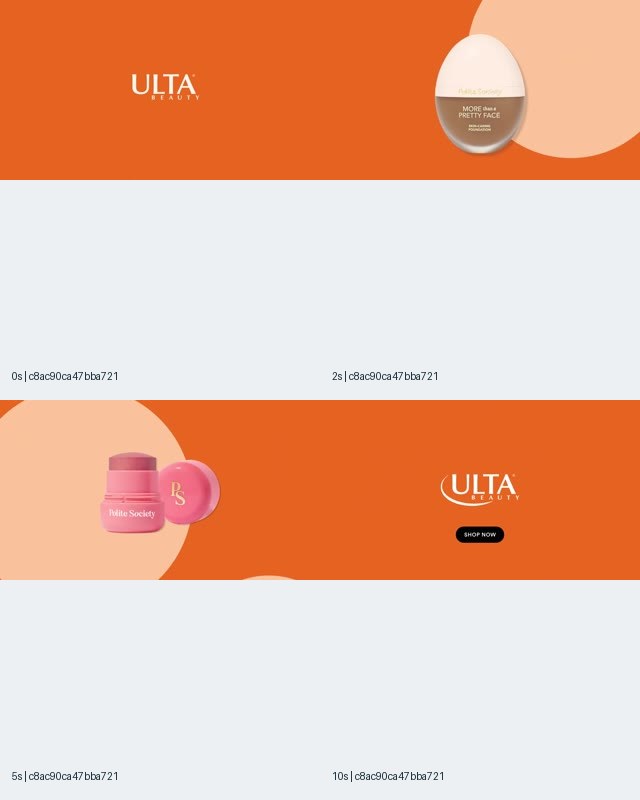
Sample 2 — record c8ac90ca47bba7217b78b9c2f41f7f7d; observed frames at 0, 2, 5, and 10 seconds. The record is indexed under Ulta Beauty: Makeup & Skincare, listing 561930308. The frames show Ulta Beauty branding, an orange background, and pink product packaging. The indexed listing does not identify each pictured product’s brand or establish the ad buyer’s identity.
The visual system uses a strong color field and a small product object. Translate that into UGC by placing the product close to the lens for one beat, then returning to the creator’s face. The close-up must show the actual package and avoid adding text that is absent from the approved label. Check glare, focus, and whether the product remains recognizable after platform compression.
3. Soft palette for a gentle routine
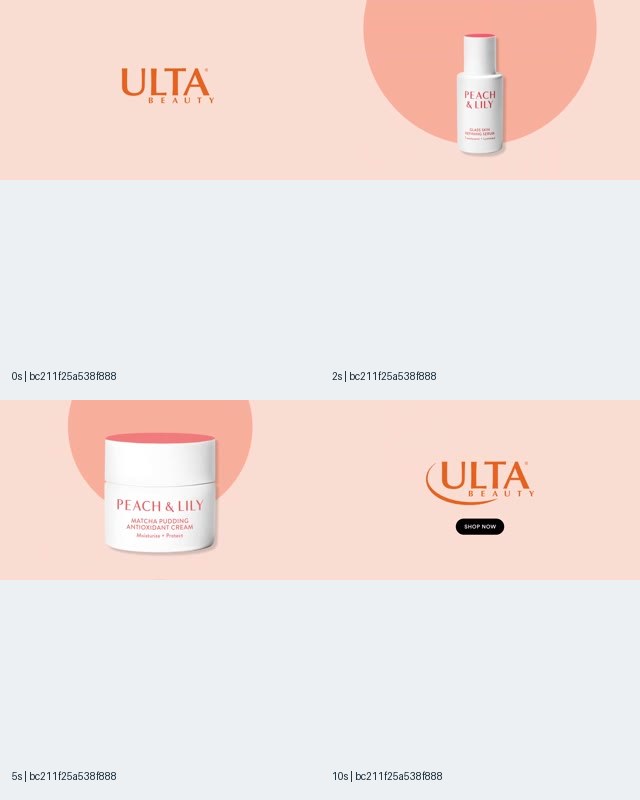
Sample 3 — record bc211f25a538f88815d520e185570a73; observed frames at 0, 2, 5, and 10 seconds. The peach palette and product reveal suggest a calm routine tone. They do not prove that the product improves skin or that the ad was bought by the brand shown.
A calm palette can support a sensitive-skin or evening-routine angle, but tone is not evidence. Pair the visual with a precise routine statement: when the product is used, how much, and what the creator noticed. Keep the hook specific enough to stop a scroll without using fear. Ask the art director to define the palette in color terms so a creator can reproduce it with ordinary household light.
4. Demonstration through a playful interface
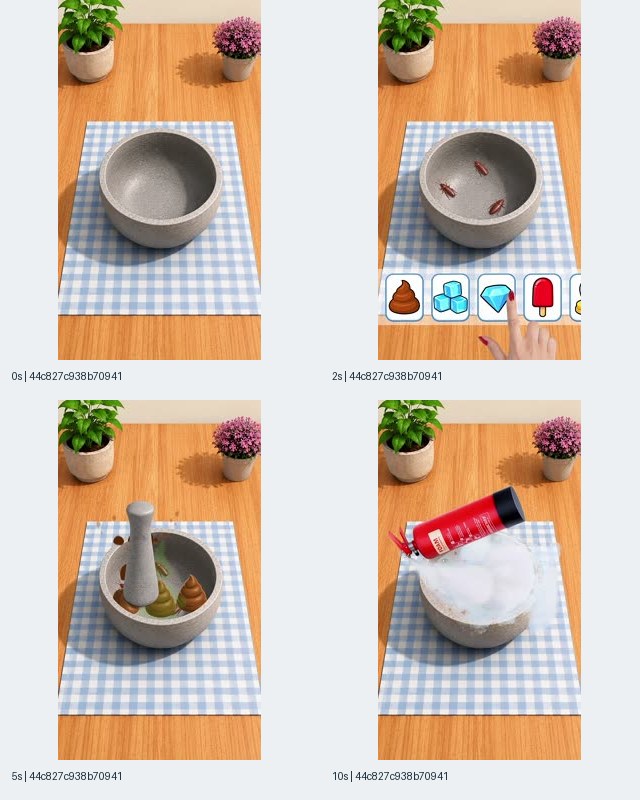
Sample 4 — record 44c827c938b70941416f09c217e482bc; observed frames at 0, 2, 5, and 10 seconds. The listing is ASMR Makeover: Skincare Games, and the frames show interactive, game-like actions. This is an indexed creative example, not evidence of a skincare product result.
The sequence demonstrates a mechanic rather than a cosmetic outcome. For a real product, borrow the principle: let the hand perform a satisfying action, such as dispensing, mixing, or applying, and add a tactile sound. Do not imply that a visual game action is equivalent to a clinical demonstration. In the brief, separate “satisfying to watch” from “proves efficacy”; they are different creative jobs.
5. Tool-focused product framing
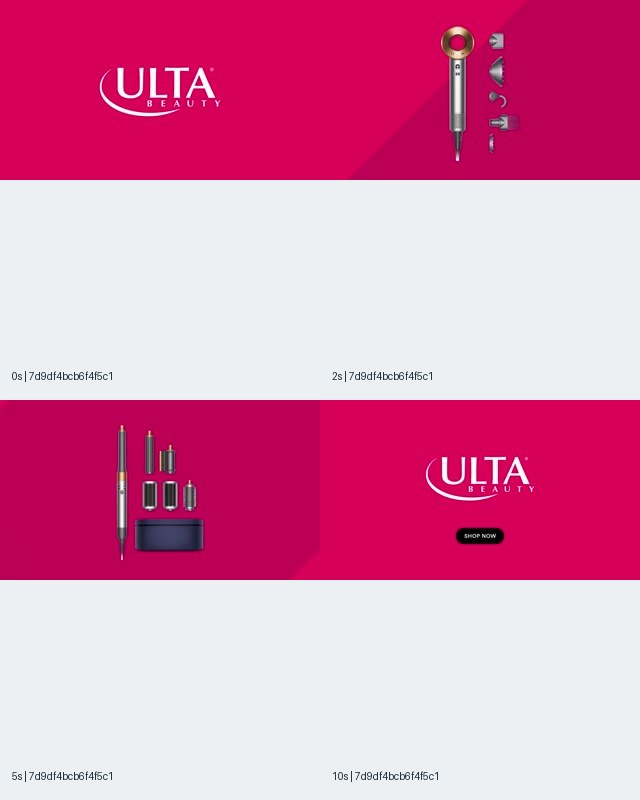
Sample 5 — record 7d9df4bcb6f4f5c1099cbb4da4373d48; observed frames at 0, 2, 5, and 10 seconds. The visual emphasizes a tool and attachments under Ulta Beauty branding. It is useful for studying an accessory reveal, not for claiming hair or beauty performance.
A tool demonstration benefits from a clear before state, one motion, and a realistic after state. Film the hand placement and the attachment change. If the outcome depends on heat, time, or technique, put those conditions in the script and landing-page copy. Include a safety line when heat, electrical current, or contact with eyes is relevant.
6. Single-product hero shot
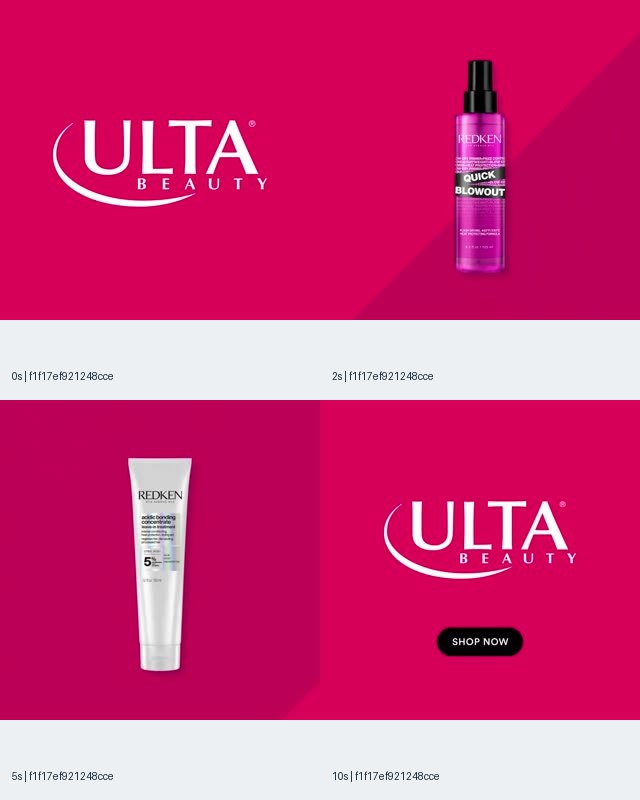
Sample 6 — record f1f17ef921248cce5608fa69c0c08d8e; observed frames at 0, 2, 5, and 10 seconds. The frames show Redken products and an Ulta Beauty shop-now ending. The contact sheet does not reveal spend, conversion, or the buyer’s targeting.
A single-product hero shot works when the viewer already understands the problem. In a UGC script, introduce the problem in the spoken line, then hold the bottle steady long enough to read the name. Keep the CTA destination consistent with the product shown. If several SKUs appear, specify which one receives the click and why the others are present.
7. Offer badge and product comparison
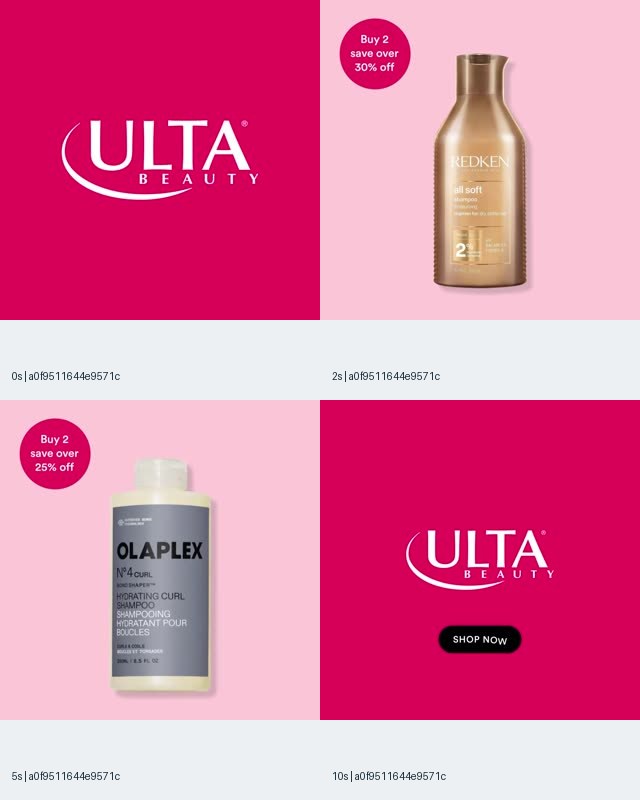
Sample 7 — record a0f9511644e9571c4c0411567b8756bf; observed frames at 0, 2, 5, and 10 seconds. The contact sheet includes buy-two savings language and named products. Offers are time-sensitive; verify current eligibility, dates, exclusions, and destination before publication.
Offer-led UGC should show the product value before the discount. State the offer exactly as approved, include a date or “while available” only when supported, and avoid implying that a discount proves product quality. Test offer-first against benefit-first while holding the creator and demonstration constant. The offer review should check stock, regional eligibility, coupon mechanics, and whether the landing page repeats the same terms.
8. Orange visual system and tool close-up
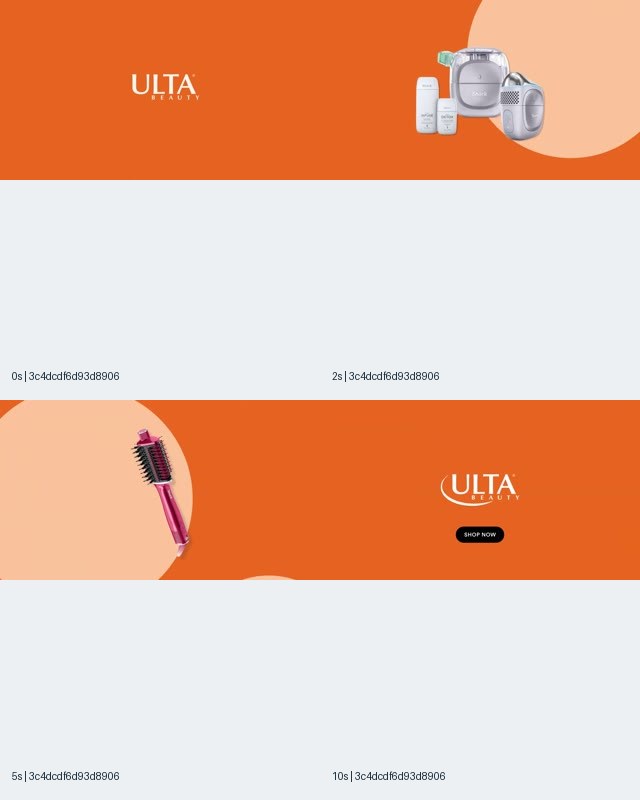
Sample 8 — record 3c4dcdf6d93d8906f7ac1ba71071fe6b; observed frames at 0, 2, 5, and 10 seconds. The indexed frames pair an orange brand field with beauty devices and a shop-now card. They are timestamped observations, not proof of channel placement or effectiveness.
The sequence alternates category imagery and a final action card. For a UGC edit, use a face-to-product cut rather than multiple unrelated products unless the landing page contains a genuine routine bundle. Every extra object adds cognitive load and makes the CTA less specific. A storyboard review should ask whether a viewer can name the product and next action after one silent viewing.
A Shootable 15-Second Skincare Script
Use this as a starting brief. Replace bracketed text with approved product facts.
0.0–2.0 seconds — Hook
- Visual: creator holds a mirror toward the camera and points to the area where makeup separates.
- Spoken: “My concealer kept cracking here by lunch.”
- On-screen: “Makeup separating by noon?”
- Direction: natural window light; no beauty filter; keep the product out of frame for the first half-second.
2.0–8.0 seconds — Demonstration
- Visual: creator dispenses the approved amount, warms it between fingers, and presses it onto one side of the face.
- Spoken: “I started using [product] as the prep step, then I press concealer over it.”
- On-screen: “Prep → press → apply.”
- Direction: show the amount and order clearly; do not fake a split-screen result.
8.0–13.0 seconds — Proof
- Visual: package label, ingredient panel, or permitted creator diary card.
- Spoken: “After [approved time frame] in my morning routine, this side feels less tight after cleansing.”
- On-screen: “My routine observation — not a guarantee.”
- Direction: use the legal-approved claim or personal-experience disclosure.
13.0–15.0 seconds — CTA
- Visual: creator holds the product beside the approved destination card.
- Spoken: “Tap to see the full routine and choose your formula.”
- On-screen: “See the routine.”
- Direction: one CTA; make the destination match the product and offer.
A Shootable 30-Second Script
A longer cut should add evidence or remove an objection, not repeat the same sentence. This structure gives the editor a clear reason for every additional second.
0.0–3.0 seconds — Context hook
- Visual: creator returns from travel, removes makeup, or shows a dry patch in ordinary light.
- Spoken: “Travel changed one step in my evening routine.”
- Text: “My post-travel skin reset.”
3.0–9.0 seconds — Problem detail
- Visual: close-up, product-free, showing the routine moment.
- Spoken: “Cleansing left my skin feeling tight, especially around my cheeks.”
- Text: “Tight after cleansing?”
9.0–17.0 seconds — Demonstration
- Visual: show the product, amount, texture, and application order.
- Spoken: “I use [amount] after cleansing and press it in before the rest of my routine.”
- Text: “Step 1: apply [product].”
17.0–24.0 seconds — Proof and conditions
- Visual: label, ingredient, diary entry, or approved review.
- Spoken: “This is my observation after [time frame], using it [frequency] in [routine context].”
- Text: “Personal experience; results vary.”
24.0–30.0 seconds — CTA
- Visual: product and destination page.
- Spoken: “Tap to read the ingredients and build the routine for your skin type.”
- Text: “Read ingredients. Build routine.”
The 30-second version should be cut into a 15-second excerpt only after the full version has been approved. Do not assume that removing the proof section leaves the same claim context. If the short cut makes a stronger promise than the long cut, it needs its own review.
Hook Variants to Test
Create variants that change one idea at a time. Keep the demonstration, creator, edit length, music, CTA, and landing page stable for the first round.
| Variant | Hook line | Best use | Risk to check |
|---|---|---|---|
| Problem | “Why does my makeup separate here first?” | A visible routine pain | Avoid implying universal experience |
| Curiosity | “I changed one prep step before concealer.” | A low-claim discovery angle | The demonstration must reveal the step |
| Demonstration | “Watch what one pump looks like.” | Texture and dosage education | Do not imply one pump suits everyone |
| Objection | “If rich creams feel heavy, try this order.” | Sensory concern | Keep the product texture description accurate |
| Proof | “Here is the label detail I checked first.” | Ingredient-conscious audience | Show the real label, not a recreated claim |
| Offer | “This routine is included in the current bundle.” | Verified promotion | Recheck dates, exclusions, and stock |
| Comparison | “I tested the same prep on both sides.” | Controlled visual comparison | State what is and is not measured |
| Routine | “My two-minute morning prep starts here.” | Habit formation | Avoid unsupported time or efficacy promises |
Do not call every variant a winner because it earns a higher hold rate. A strong opener can attract low-intent viewers. Read hook metrics together with click quality, downstream conversion, refund or return signals where relevant, and customer feedback from your own account. A hook that increases cheap traffic while lowering qualified actions may be useful for awareness but unsuitable for a direct-response objective.
Demonstration Direction for Creators
Give creators an action map rather than a paragraph of brand language. Ask them to film a clean master and three short pickups: product entry, texture close-up, and CTA card. Record room tone and a second take without music so the editor can adapt the cut.
A useful direction sheet includes:
- Camera: vertical 9:16, eye-level, stable phone framing.
- Light: show true product color and skin texture.
- Hands: keep product and amount visible for at least one second.
- Speech: conversational pace; leave a half-second pause before the proof line.
- Captions: high contrast, safe margins, accurate transcription.
- Disclosure: identify sponsorship or gifted product according to applicable rules.
- Claims: use only approved product and substantiation language.
- Delivery: provide raw footage, clean audio, captions file, and final CTA variations.
- Safety: include warnings or usage limits when the product requires them.
- File naming: product_market_hook_proof_length_date.
The goal is not to make every creator sound identical. Keep the evidence and action consistent while allowing natural phrasing, facial expression, setting, and accent. Ask for enough headroom and clean frames that the editor can crop for different placements without cutting off captions or disclosures.
Before the shoot, send a one-page “do and do not” sheet. The “do” column can include approved product names, amounts, routine order, and permitted personal language. The “do not” column can include medical claims, guarantees, competitor comparisons, unapproved before-and-after effects, and statements about typicality. This reduces revision cycles without forcing the creator into a robotic script.
Creator Casting and Briefing
Casting should follow the audience problem and required demonstration. A creator who can show a detailed application may be better for texture education; a creator with a strong conversational style may be better for an objection hook. Follower count alone does not determine whether the footage will communicate the product clearly.
Ask each candidate for examples of natural speaking, close-up product handling, and disclosure placement. Confirm usage rights, paid-media duration, territories, whitelisting or account access requirements, exclusivity, and permitted edits in writing. Keep these commercial terms in the production record so a successful creative can be reused lawfully.
The brief should state whether the creator must use the product for a specific period before filming. If a personal observation is requested, record the routine conditions and avoid asking for a predetermined result. A creator should be free to report that a product did not suit them; forcing a positive statement weakens trust and may create a substantiation problem.
Editing and Versioning Rules
Versioning should isolate a single creative question. Start with three hooks and one proof structure. After selecting a promising opening, test proof type, then CTA. Label files with product, hook angle, proof type, length, market, and date so results remain interpretable.
A practical matrix might contain three hooks × two demonstrations × two CTAs, but do not launch every combination automatically. Choose the six combinations that answer the next decision. If the team changes creator, offer, hook, and landing page at once, a performance difference cannot be attributed to one idea.
Use captions because many feeds begin muted. Keep text short enough to read at mobile speed. Make the first frame understandable without audio, and avoid placing important copy under interface controls. Render a clean version, a captioned version, and a platform-safe version after checking the actual destination.
Maintain a version log with these fields:
| Field | Example | Why it matters |
|---|---|---|
| Creative ID | SK-UGC-014 | Connects media, results, and approvals |
| Hook | Problem | Defines the tested variable |
| Demonstration | One pump, press-in | Keeps the product action stable |
| Proof | Personal observation | Sets the claim boundary |
| CTA | See the routine | Identifies the destination |
| Creator | Internal code | Supports rights and privacy control |
| Market | US | Prevents accidental reuse |
| Launch date | YYYY-MM-DD | Anchors analysis |
| Status | Draft, approved, live, retired | Prevents outdated reuse |
Do not overwrite the original master when making a new cut. Preserve the raw footage, caption file, approved copy, and export checksum or storage reference. This matters when a platform requests clarification or when a later result prompts a re-edit.
Sound, Captions, and Accessibility
Sound design can make a product action feel concrete, but it should not carry the only explanation. Record clean dialogue at a level that remains intelligible over light music. Avoid sounds that imply a result the image does not show, such as an exaggerated “before-and-after” impact.
Captions should match the spoken line exactly unless the approved on-screen wording intentionally summarizes it. Keep line lengths short and place text in safe margins. Review the edit at normal phone distance, with brightness reduced and sound muted. If the product is visually subtle, use a restrained pointer, crop, or label rather than a dramatic animation that changes the meaning.
Accessibility also includes readable contrast, clear pronunciation, and descriptions that do not depend on color alone. If a demonstration shows a difference between two sides of the face, label the sides and explain the condition. Do not assume that every viewer can distinguish a pale texture against a white background.
Claim, Compliance, and Approval Workflow
A claim review should happen before filming whenever a sentence could be interpreted as a promise. Create a claim register with four categories: factual product information, personal experience, comparative claim, and offer. Each category receives a different approval path.
Factual product information includes size, shade, ingredient presence, instructions, and packaging. Verify it against the current product source. Personal experience should identify the speaker and conditions. Comparative claims need a defined comparison and evidence. Offers need current dates, eligibility, exclusions, inventory, and landing-page parity.
A practical approval sequence is:
- Marketing writes the audience problem and desired action.
- Creative writes the hook, demonstration, proof, and CTA.
- Product or science owner verifies product facts.
- Legal or compliance owner reviews claims, disclosures, and comparisons.
- Creator records a raw take before final polish.
- Editor adds captions, music, transitions, and end card.
- QA checks the final URL, mobile rendering, spelling, audio, and disclosure.
- Media owner records the exact creative ID and launch conditions.
- Analyst defines the decision rule before results accumulate.
Do not use a disclaimer to rescue an unsupported headline. A tiny footnote cannot reliably reverse a large visual promise. Rewrite the main statement so the first impression is accurate, then use the disclosure to add context.
Measurement Plan for UGC Tests
A UGC test needs a decision metric, a guardrail, and a stopping rule. The primary metric should reflect the campaign goal. For a direct-response skincare campaign, that may be qualified purchase rate or contribution margin. For a consideration campaign, it may be landing-page engagement or product-page progression. Thumb-stop rate and three-second hold can diagnose the hook, but they do not by themselves establish business value.
Write the measurement plan before launch:
| Layer | Example metric | Question answered |
|---|---|---|
| Attention | Three-second hold | Did the opening earn a pause? |
| Understanding | Product-page view rate | Did viewers follow the intended path? |
| Intent | Add-to-cart rate | Did the message create meaningful interest? |
| Outcome | Purchase or qualified lead rate | Did the traffic complete the goal? |
| Quality | Refund, repeat purchase, or margin | Was the outcome commercially useful? |
Keep attribution windows and event definitions consistent between variants. Record spend, delivery conditions, audience exclusions, placement, and landing-page version. If the platform optimizes toward a shallow event, a hook may appear strong because it generates that event while weakening later quality. Read the complete funnel before changing the brief.
Do not use third-party impression estimates from an external creative index as a substitute for your own test results. Those estimates can help prioritize what to inspect, but they cannot grade your UGC script or tell you that a competitor’s visual caused a conversion.
How to Diagnose a Weak Result
A weak result does not automatically mean the concept is bad. First identify where the drop occurs. If viewers leave before the demonstration, revise the hook or first frame. If they watch but do not click, inspect the proof and CTA. If they click but do not buy, inspect landing-page continuity, price, stock, trust signals, and product fit.
Use a simple diagnostic tree:
- Low hold: the first frame may be unclear, slow, or mismatched to the audience problem.
- Good hold, low completion: the demonstration may be repetitive, confusing, or too long.
- Good completion, low click: the proof may not resolve the objection, or the CTA may be vague.
- Good click, low conversion: the landing page, offer, product expectation, or tracking may be misaligned.
- Good conversion, poor quality: the hook may attract the wrong audience or overpromise.
Change one element at a time when the diagnosis is uncertain. Keep a “learning” field in the experiment log that states what the result supports, rejects, or leaves unresolved. A flat result is still useful if it rules out a costly production direction.
Landing-Page Continuity
The UGC ad and landing page should share the same product, language, visual cue, and next action. If the video says “choose your formula,” the page should make formula selection obvious. If the proof is an ingredient detail, the page should surface that detail without forcing the visitor to search.
Capture a screenshot of the destination at launch and store the offer terms beside the creative ID. Pages change after an ad is approved, and a later analyst may otherwise attribute a performance change to the video when the real change was the page. Check mobile load time, product availability, price, shipping information, returns, and consent language.
Avoid sending a problem-specific hook to a generic category page unless the category page clearly continues the story. A broad destination can be appropriate for discovery, but the CTA should say what the viewer will find there. The more specific the promise, the more specific the landing path should be.
How to Turn Competitor Observations Into Hypotheses
Observed creative structure becomes useful when you translate it into a falsifiable hypothesis. “Competitors use pink backgrounds” is an observation. “A warm, product-led opening may help skincare viewers recognize the category before the CTA” is a hypothesis. It needs a test, a success metric, and a stop rule.
Use this worksheet:
| Observation | Hypothesis | Test | Metric | Limit |
|---|---|---|---|---|
| Product appears within two seconds | Earlier product recognition may improve qualified clicks | Product-first vs problem-first | Qualified CTR and conversion | Sample may be biased |
| One creator action repeats | A tactile demonstration may improve hold | Texture close-up vs talking head | Three-second hold, completion | Repetition does not prove success |
| End cards use a short CTA | A single action may reduce choice friction | One CTA vs two links | Click-to-landing rate | Offer and page must match |
| Color fields dominate early frames | A consistent color cue may improve recognition | Branded color vs neutral background | Brand recall or qualified click | Aesthetic is not causal evidence |
| Playable interaction appears in a record | Visible interaction may clarify the product promise | Tap-through demo vs static explanation | Completion and downstream action | The listing may be a different product |
Search the AdMapix creative index for skincare examples to collect current references, then record the source, date, identity, and exact observation. Do not relabel an indexed listing as an official ad for another product, platform, or buyer. A hypothesis should retain the uncertainty that made it a hypothesis in the first place.
Example Workflow for a Small Creative Team
Scenario: A three-person skincare team needs six new vertical ads before a seasonal promotion.
Question: Should the first batch lead with a makeup problem or a product texture?
Research: Capture eight relevant examples from the dated index, tag each by hook, demonstration, proof, CTA, and offer. Keep the eight source images next to notes about what is visibly present.
Brief: Produce three problem-first hooks using one approved product demonstration. Produce three texture-first hooks using the same creator, lighting, offer, and destination.
QA: Confirm package accuracy, claim language, captions, disclosure, landing-page match, and offer dates. Remove any unsupported “instant,” “clinically proven,” or universal-result wording.
Launch: Run the six variants under the same test conditions where possible. Define a primary metric before launch and a minimum spend or event threshold. Record downstream quality, not only thumb-stop performance.
Decision: Keep the winning hypothesis only if the result is consistent with the account’s conversion and customer-quality signals. If the evidence is mixed, keep both angles and change the next variable deliberately.
A weekly review can fit on one page: new references, hypotheses opened, tests launched, tests closed, evidence that changed the brief, and claims requiring reapproval. This turns UGC from a one-off production request into a learning system.
Example Workflow for an Agency
An agency should separate client facts from general creative patterns. Create one evidence card per reference with the source URL, observation date, listing identity, visible message, format, and confidence. Then create a client brief that contains only original execution ideas and approved product facts.
For each client, maintain a reusable taxonomy: problem, audience context, proof type, product action, tone, offer, creator role, duration, and destination. A shared taxonomy makes cross-client reporting possible without copying a client’s protected claims or footage. Use a red-yellow-green confidence field to show whether a note is directly visible, inferred, or awaiting client confirmation.
When presenting recommendations, show the reference beside the proposed variation and explain the changed variable. “Use the same ad” is a weak recommendation. “Use the visible texture close-up as the demonstration, but replace the competitor’s claim with our approved routine observation” is actionable and safer.
Practical Production Checklist
Before filming, confirm:
- The audience problem is written in one sentence.
- The product SKU and market are fixed.
- The hook can be understood without audio.
- The demonstration shows a real product action.
- The proof type and conditions are named.
- The CTA has one destination.
- Rights, disclosure, and creator usage are documented.
- Product claims have an owner and evidence source.
- The landing page is available and matches the script.
- The test metric and stop rule are written.
Before launch, confirm:
- Captions match the approved words.
- The product name and package are correct.
- No frame implies an unsupported result.
- The offer, price, stock, and dates are current.
- Disclosures are visible at normal playback size.
- The destination opens on a mobile device.
- Tracking events fire as intended.
- The creative ID is tied to the final file.
After launch, confirm:
- Delivery conditions are recorded.
- Early attention metrics are separated from outcome metrics.
- Any edit or landing-page change is timestamped.
- The result is interpreted against the prewritten rule.
- The learning is added to the next brief.
What Public Creative Evidence Cannot Prove
A public creative record can show that an indexed ad instance contained a video, a playable, a product frame, or a visible message during the measurement window. It cannot show exact spend, audience settings, bid strategy, conversion rate, revenue, retention, or profit. Third-party impression estimates are not observed delivery.
The sample also does not establish platform coverage unless the source network is verified. Similar visual treatment across records does not prove common ownership, infringement, or fraud. Different store identifiers do not automatically mean different competitors. Identity should come from verified product IDs and listing evidence, not a name match alone.
These limits change the workflow. Use public evidence to generate creative questions and production references. Use your own experiment data to decide whether a claim, format, or offer deserves budget. Keep observations and hypotheses in separate columns so a later reader can see where interpretation begins.
Common Mistakes
Writing a hook without a visual
A spoken line alone is hard to stop on mute. Pair it with a face, product, texture, or action that makes the problem visible.
Showing a result that the script cannot support
A fast before-and-after can imply an instant effect. If the real product experience takes days or weeks, show the routine and label the time frame.
Testing too many variables at once
Changing creator, hook, music, offer, and landing page produces an interesting asset but a weak experiment. Start with one controlled question.
Treating longevity as performance
An indexed creative’s age or continued presence does not prove that it is profitable. It may reflect reuse, limited replacement, or a different buying objective.
Counting records as unique assets
Thirty records in a search sample can contain fewer unique videos because the same fingerprint may appear in multiple instances. Report records and deduplicated files separately.
Copying a competitor’s claim
Borrow the structural insight, such as a texture close-up or a direct objection, and write an original claim supported by your product evidence.
Hiding disclosures
A creator-style ad still needs appropriate sponsorship, gifted-product, affiliate, or other disclosures. Put them where viewers can notice them.
Ending with multiple competing CTAs
If the viewer can shop, subscribe, download, and read a guide at once, the test no longer has one clear action. Choose the destination that matches the hook.
Letting the creator improvise regulated language
Natural delivery is valuable, but improvisation can introduce treatment, prevention, or guaranteed-result claims. Mark forbidden phrases in the brief and review the raw take before editing.
Reusing an expired offer
An old end card can continue circulating in a folder after the promotion ends. Put an expiry or review date in the filename and archive the export when the terms change.
Making the product invisible
A creator may deliver an engaging story while the package remains out of focus. Reserve a readable product frame and test the edit at ordinary phone distance.
Confusing attention with intent
A surprising hook can create high retention while attracting people who will never buy. Treat attention as a diagnostic signal and judge the concept with downstream evidence.
When AdMapix Fits the Workflow
AdMapix fits teams that need searchable creative evidence, deduplicated media references, timestamped contact sheets, and a repeatable way to move from competitor observation to a brief. It is useful at the discovery and hypothesis stages, especially when a team is comparing hooks, product demonstrations, proof styles, and CTAs across a bounded market query.
It does not replace your ad platform reporting, product substantiation, legal review, creator contracting, or conversion analytics. If you only need to test your own ads, your platform dashboard and a disciplined creative log may be enough. If you need to search, compare, and organize external examples before production, explore the AdMapix search workflow and then review the live pricing page for current commercial terms.
Want to turn one observed pattern into a production-ready brief? Search the index, save the evidence, write the hypothesis, and hand the final script to your creator and compliance owner before launch.
FAQ
What is a UGC video ad script?
A UGC video ad script is a production brief for creator-style advertising. It defines the opening hook, product action, proof, spoken lines, on-screen text, disclosures, timing, and CTA. The creator can sound natural while the team keeps the product claims, visual evidence, and destination consistent.
How long should a UGC skincare ad be?
Start with a 15-second cut when the product action is simple, then make a 30-second version if proof needs context. Length should follow the claim and demonstration. A longer edit is useful only when every extra second adds understandable evidence or removes an objection.
Should the hook show the product immediately?
Test product-first against problem-first. Product-first can help category recognition, while problem-first can create tension before the brand appears. Keep the demonstration, creator, offer, and CTA stable so the test answers the hook question instead of mixing several changes.
What proof can a creator safely use?
Use approved product facts, permitted testimonials, ingredient or label details, and clearly framed personal observations. Avoid turning a personal result into a universal promise. Claims about treatment, prevention, clinical outcomes, or guaranteed timing require appropriate substantiation and review for the markets and platforms involved.
Can I copy a competitor’s UGC ad structure?
You can study a visible structure such as hook type, shot order, or demonstration method and create an original execution. Do not copy protected footage, scripts, trademarks, testimonials, or unsupported claims. Record the source and write a new hypothesis tied to your own product evidence.
Does a long-running indexed ad prove that it is a winner?
No. A record’s age or continued presence is an observation, not a profitability result. Public samples can be incomplete, and impression values may be model estimates for a specified window. Use longevity as a question for your own data, then check qualified conversions, retention, and margin.
Can AdMapix show exact competitor spend or conversion rate?
No. The supplied creative sample provides estimated impressions for its explicit window and creative metadata. It does not provide a rival’s private spend, conversion rate, targeting, profit, or lifetime delivery. Use AdMapix for discovery and evidence organization, then use your own account data for performance decisions.
How should a small team start testing?
Write three hooks for one demonstration and one CTA. Film one clean master plus pickups, verify claims and disclosures, then launch the smallest set that answers a clear question. Log the source observation, hypothesis, primary metric, threshold, and decision before spending so the result can inform the next brief.
Key Takeaways
- Build every UGC ad around hook, demonstration, proof, and one CTA.
- Make the first two seconds understandable with sound off and show the product doing the job described.
- Separate personal experience from substantiated product claims.
- Test one creative variable at a time and evaluate downstream quality, not only attention metrics.
- Treat indexed records and model-estimated impressions as bounded evidence for hypotheses, never as proof of spend or profitability.
- Deduplicate media fingerprints before describing asset counts.
- Keep landing-page language, offer terms, disclosure, and product identity aligned with the video.
- Use AdMapix to find and organize references, then validate the final script with product, legal, platform, and conversion owners.
Sources
- AdMapix public methodology and product workflow, accessed for this article on 2026-09-14: AdMapix Methodology.
- Frozen public source package for the US “skincare” search, measured 2026-08-16 to 2026-09-14, up to three pages and ten records per page, impression-descending: public source snapshot. The package is dated, checksummed, and reproducible from its published request parameters.
- Relevant internal workflow: Ad creative intelligence workflow for mobile UA teams.
- Relevant internal creative analysis guide: Ad Creative Analysis.
- Current commercial terms: AdMapix pricing. Terms can change; this article does not enumerate plans or credit quotas.
Last updated: 2026-09-14.
Turn these observations into your next creative study
Open the creative library and select samples for your market, network and research question.
Related Articles
Ad Optimization Best Practices: The 2026 Performance Playbook
The definitive 2026 guide to ad optimization best practices — a high-output creative production system, statistically honest A/B testing, budget governance and pacing rules, the metrics that matter, structured account hygiene, an optimization cadence, and an FAQ that settles the hard questions performance teams keep arguing about.
Similarweb Alternative for Ad Intelligence in 2026: Market Data or Creative Evidence?
A 2026 decision framework for choosing a Similarweb alternative for ad intelligence — when traffic and market data wins, when creative-evidence tools like AdMapix win, how to run a fair head-to-head trial, and how to build a two-layer competitive stack.
Moat Alternative in 2026: Ad Verification vs. Creative Intelligence
A complete 2026 buyer's guide to choosing a Moat alternative — why teams look past Oracle Moat, what Moat actually does (viewability, invalid traffic, brand safety), the critical split between the ad-verification layer and the creative-intelligence layer, a layered comparison across coverage and fit, who should choose which, a practical migration plan, the honest limits of public creative data, and where a creative-research tool like AdMapix fits.