
Similarweb Alternative for Ad Intelligence in 2026: Market Data or Creative Evidence?
A 2026 decision framework for choosing a Similarweb alternative for ad intelligence — when traffic and market data wins, when creative-evidence tools like AdMapix win, how to run a fair head-to-head trial, and how to build a two-layer competitive stack.
Similarweb Alternative for Ad Intelligence in 2026: Market Data or Creative Evidence?
By the AdMapix Research Desk — Updated June 21, 2026
Similarweb is built to answer market and traffic questions: how big a competitor's audience is, where their visits come from, which channels they invest in, and how the whole category is moving. It is a genuinely strong tool for that job. What it is not built to do is show you the actual ad creative your competitors are running — the specific hook in the first three seconds, the video structure that makes one execution outperform another, the offer that repeats across a campaign. So when marketers search for a "Similarweb alternative for ad intelligence," they are usually hitting one of two very different walls: either Similarweb's price and scope are more than they need, or — far more often — they bought a market-intelligence platform expecting creative evidence and discovered the two are different categories entirely.
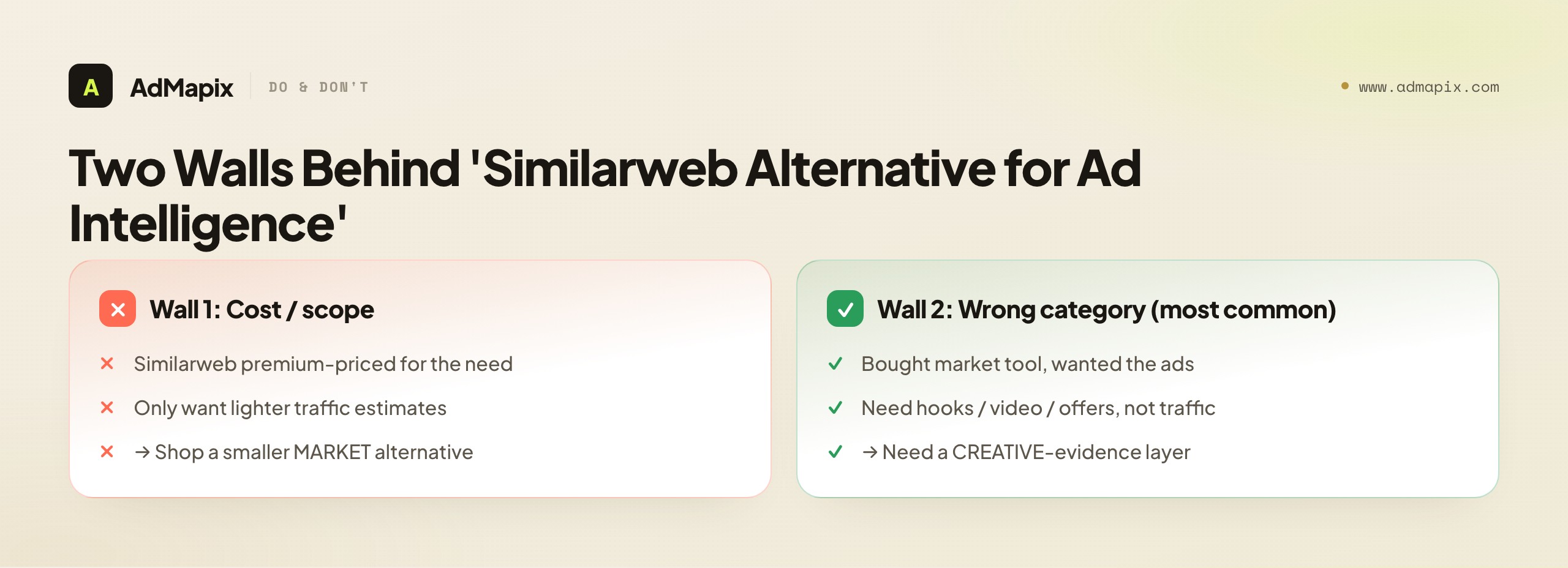
This guide untangles that confusion, because the wrong diagnosis here is expensive. It is for growth leads, performance marketers, agencies, and competitive-intelligence teams trying to decide whether Similarweb covers their ad-intelligence need, whether a cheaper market tool would do, or whether the real gap is a creative-evidence layer that no traffic-estimation platform was ever designed to fill. We will define what Similarweb actually measures, name the two distinct jobs hiding inside "ad intelligence," lay out exactly when each kind of tool wins, give you a fair-trial method so you decide from your own evidence rather than a marketing demo, and show how the strongest teams run a two-layer stack instead of forcing one tool to do both jobs. Throughout, we are honest about where AdMapix fits — the creative-evidence layer — and where it does not — market sizing and traffic estimation — because recommending the wrong category is the single most common and costly mistake in this space.
TL;DR — Choosing a Similarweb Alternative for Ad Intelligence
- "Ad intelligence" is two jobs, not one. Market intelligence (traffic share, channel mix, audience size, market sizing) and creative intelligence (the actual ads — hooks, video, offers). Similarweb is strong on the first and out of scope on the second.
- Choose Similarweb (or a market alternative) when your decision depends on context: how big a competitor is, where their visits originate, which channels they lean on, and how to allocate budget across a market.
- Choose a creative-intelligence alternative like AdMapix when your next deliverable is built from the ads themselves: which creatives are live, what the video does, which offer repeats, and a brief a strategist can test.
- They are complements, not substitutes. A market tool estimates the strategy; a creative tool shows the executions. The best teams run both as a two-layer stack.
- All third-party traffic and ad data is observed or modeled, never the advertiser's own numbers. Treat traffic estimates as directional and creative evidence as "observed in market," never as proof of spend or performance.
- Decide from a trial, not a feature list. Run one competitor set, one market, one weekly decision through each candidate and score time-to-deliverable, not chart count.
What "Ad Intelligence" Actually Means — and Why It Splits in Two
The phrase "ad intelligence" is doing too much work, and that ambiguity is the root of almost every mismatched purchase. When a performance marketer says they need ad intelligence, they could mean either of two fundamentally different things, served by two different categories of tool that happen to share a marketing vocabulary.
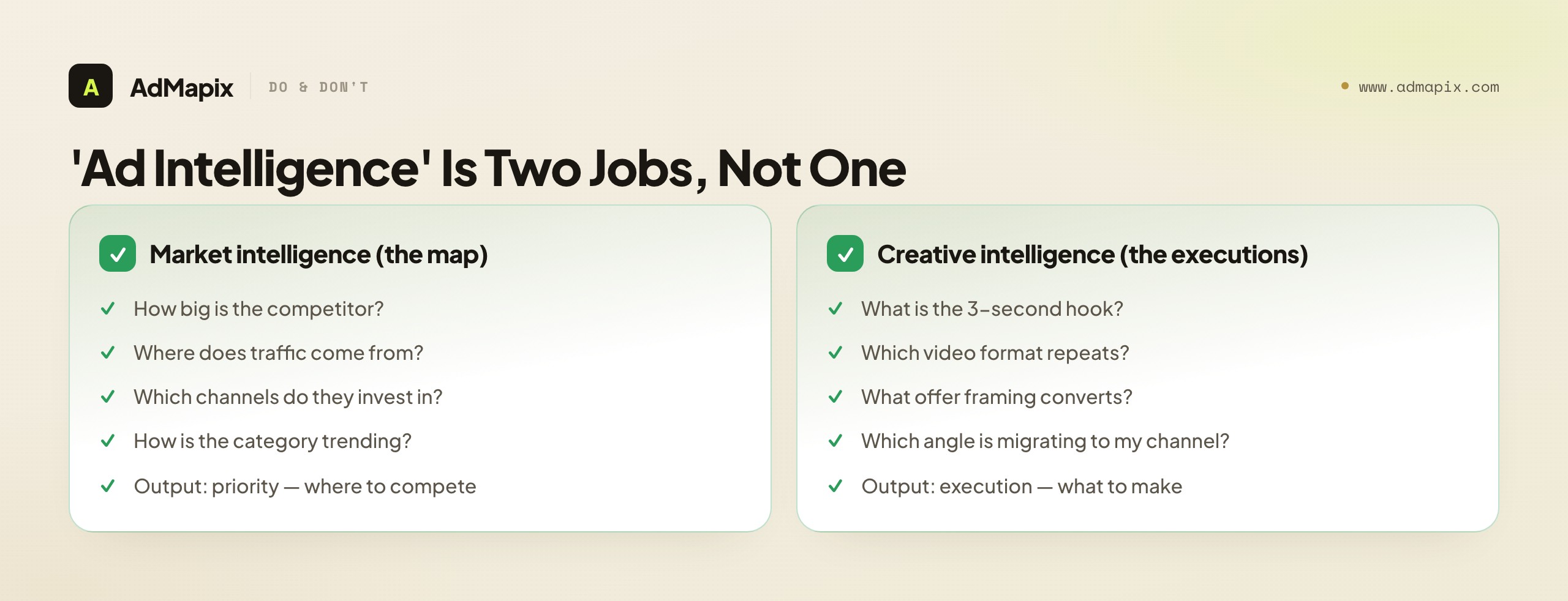
The first job is market intelligence: understanding the competitive landscape from above. How much traffic does a rival get? Where does it come from — search, social, display, direct, referral? Which geographies? How does their channel mix compare to ours, and how is the whole category trending? This is the territory Similarweb owns. It is the layer you use to size an opportunity, benchmark a market, decide which channels deserve budget, and brief leadership on competitive scale. The output is a map: a sense of where everyone sits and which direction the traffic is flowing.
The second job is creative intelligence: understanding what competitors are actually saying and showing in their ads. What is the hook in the first three seconds of their top video? What offer framing — discount, bundle, urgency, social proof — drives their conversions? Which creative format repeats across a campaign, and which one did they kill after a week? What angle is working on Meta this month that will land on TikTok next month? This is a completely different layer. Its output is not a map of the territory but the actual executions running on it — the ads themselves, saved, broken down, and turned into testable briefs.
Here is the trap: both layers get marketed as "ad intelligence," "competitive intelligence," or "competitor research," so teams assume one premium tool covers both. It does not. A market-intelligence platform can tell you a competitor invests heavily in paid social; it cannot show you the specific video that is winning for them. A creative-intelligence tool can show you that video frame by frame; it cannot tell you the competitor's total audience size or traffic share. Naming which job is your bottleneck — before you look at any tool — is what turns this whole decision from confusing to obvious.
What Similarweb Actually Measures
To choose a Similarweb alternative intelligently, you first have to be precise about what Similarweb is and isn't. Per its own positioning, Similarweb is a digital data-intelligence platform that estimates traffic, engagement, channel mix, audience interests, and market share from a modeled panel combined with other signals. Its ad-intelligence features give visibility across display, search, and social channels and connect campaign activity to traffic trends. That is a powerful market-context capability, and for the market-intelligence job it is a category leader.
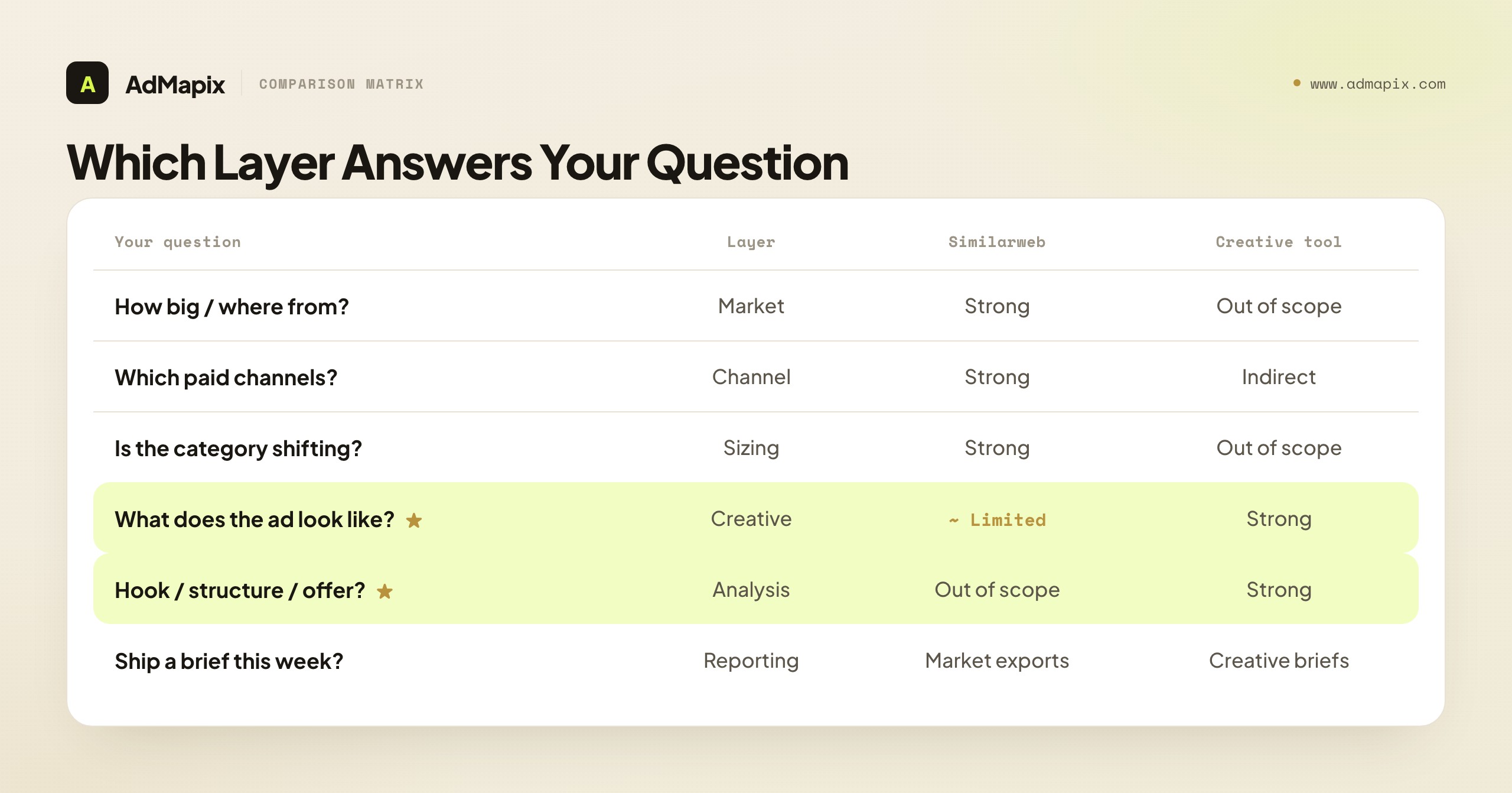
| Question you have | Layer you need | Where Similarweb helps | Where a creative tool helps |
|---|---|---|---|
| How big is this competitor and where do their visits come from? | Market intelligence | Strong: traffic estimates, channel mix, geography | Out of scope |
| Which paid channels does a brand lean on? | Channel strategy | Strong: display / search / social visibility signals | Indirect |
| Is the whole category growing or shifting? | Market sizing | Strong: market and industry trend views | Out of scope |
| What does the competitor's actual ad creative look like? | Creative evidence | Limited: not the core job | Strong: live ad search, saved media |
| What is the video hook, structure, and offer? | Creative analysis | Out of scope | Strong: video analysis, tagging |
| Can I hand this to a client or strategist this week? | Reporting | Market dashboards and exports | Creative-focused briefs and reports |
The practical lesson reads straight off the table: Similarweb is excellent for the "how big and where" questions in the top half and weak-to-out-of-scope for the "show me the ad" questions in the bottom half. A creative tool is the mirror image — thin on market sizing, strong on the executions. Buying on brand recognition alone is how teams end up with a market platform and still no competitor creatives to study on Monday morning.
One more thing to internalize before you compare anything: every traffic, engagement, and channel figure from Similarweb (or any third-party panel) is an estimate, not the advertiser's own analytics. These numbers are directionally useful for sizing and trend-spotting, and they are genuinely good at that — but they will not reproduce a competitor's internal dashboard, and they cannot tell you the exact creative running in a given campaign. Treat them as a map of the territory, not the ads on it. We will return to this "observed vs. true" distinction repeatedly, because mishandling it is how good research turns into a misleading deck.
When Similarweb (or a Market Alternative) Is the Right Call
Reach for Similarweb — or a market-data alternative — when the decision is about market context rather than creative execution. There is a clear set of jobs where a traffic-and-market platform is exactly the right tool, and reaching for a creative library instead would leave you guessing.
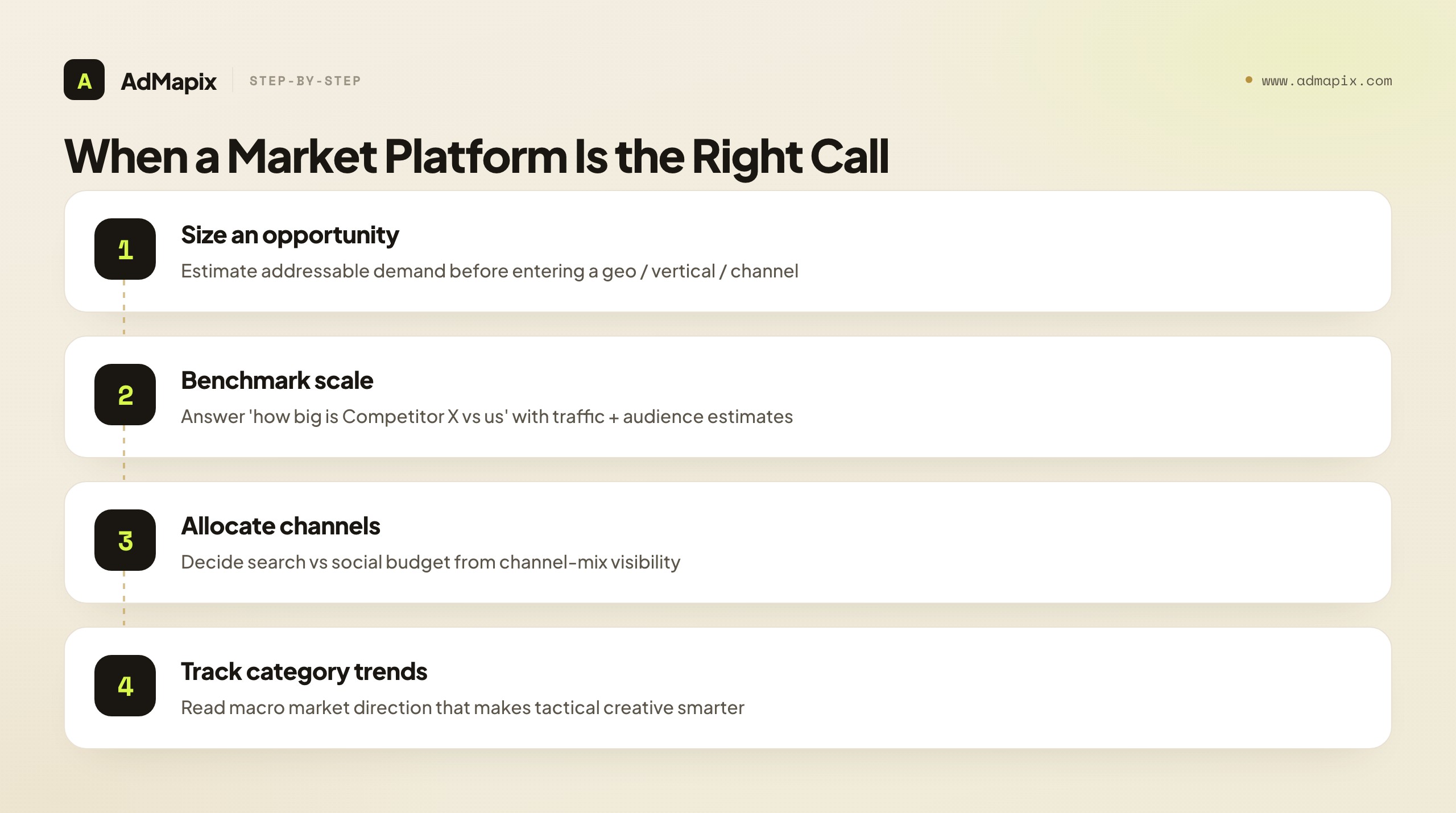
Sizing an opportunity or a market. Before you commit budget to a new geography, vertical, or channel, you want to know how big the addressable demand is and who already owns it. Traffic estimates and market trend views answer that directly; a creative library does not.
Benchmarking competitive scale. When leadership asks "how big is Competitor X compared to us," the honest answer comes from audience and traffic estimates, not from a folder of their ads. Market tools are built to produce exactly that benchmark.
Allocating budget across channels. If your question is "should we shift spend from search to paid social, and where are competitors investing," channel-mix visibility is the relevant signal. A market platform shows you which channels a brand leans on at the strategy level.
Understanding where traffic originates. Source breakdowns — search vs. social vs. direct vs. referral, by geography — are a market-intelligence specialty. This shapes which channels you even enter, a decision that precedes any creative work.
Tracking category-level trends over time. Is the whole market growing, consolidating, or shifting toward a new channel? That macro read is a market-data job, and it is the context that makes your tactical creative decisions smarter.
What to keep in mind throughout: these are estimates from a panel, directionally useful for sizing and trend-spotting but not a substitute for the advertiser's real numbers, and never a window into the specific ads they are running. If your decision lives in the list above, a market platform is your starting point — and if Similarweb itself is too expensive or broad for your needs, a lighter market-data alternative may serve, but you are still shopping in the market-intelligence category, not solving a creative-evidence gap.
When a Creative-Intelligence Alternative Wins
Now the other half. Reach for a creative-intelligence tool when the next deliverable is built from the ads themselves rather than from traffic estimates. This is the job that sends most people searching for a "Similarweb alternative" in the first place — they have the market context and still cannot answer the question their creative team is actually asking.
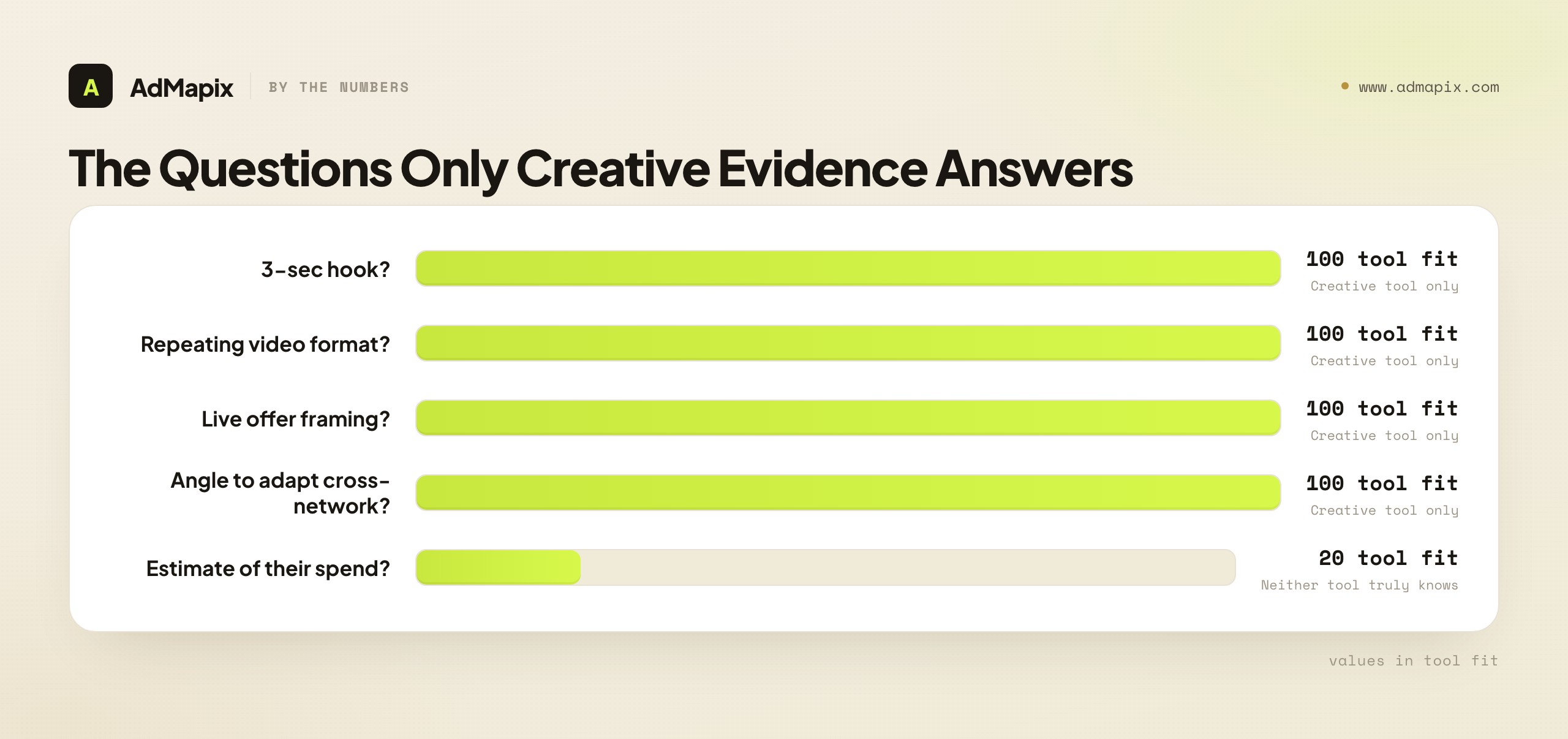
The tell is in the language of the request. When a strategist or media buyer asks any of these, no market dashboard can help:
- "What hook are competitors using in the first three seconds?"
- "Which video format repeats across their winning campaigns?"
- "What offer is in market right now — and how is it framed?"
- "Show me the actual ad, not an estimate of their spend."
- "What angle is working on Meta that we should adapt for TikTok?"
- "Can I turn this into a creative brief a designer can execute by Friday?"
These are all evidence questions. They require seeing and saving the real creative, then breaking down what makes it work — which is precisely what a market-data platform is not designed to produce. This is the gap a creative-intelligence tool like AdMapix is built for: search competitor ad creatives across networks, save the strongest examples as media, run video analysis on the ones worth studying, tag recurring patterns, and compile the findings into a brief or report. The output is creative evidence a team can act on this week, not a traffic chart that informs next quarter's channel plan.
The deeper reason creative intelligence is hard to substitute: creative is where paid-social performance is actually won or lost. Two brands can have near-identical traffic profiles and channel mixes — information a market tool surfaces perfectly — yet one dramatically outperforms the other because its hooks, pacing, and offers are sharper. That performance gap is invisible to traffic estimation and fully visible to creative analysis. If your competitive disadvantage is creative, no amount of market data will fix it, because market data was never measuring the variable that's hurting you.
Why Cross-Network Visibility Matters Even for Single-Channel Teams
A subtle but important point separates the best creative-intelligence alternatives from the rest: cross-network coverage. It is tempting to assume that if you only advertise on, say, TikTok, you only need to study TikTok ads. That intuition is wrong, and acting on it leaves proven angles on the table.
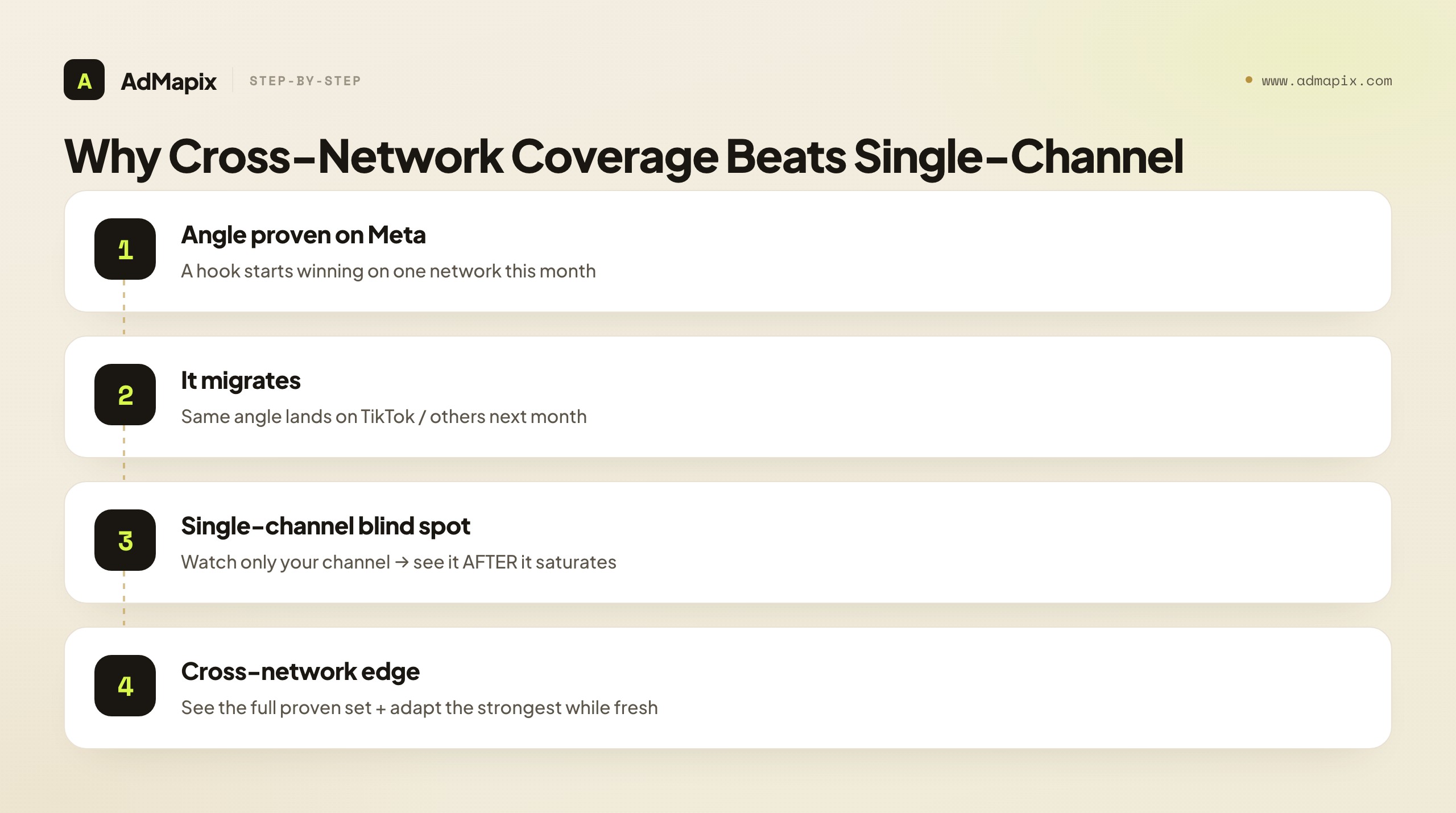
Winning ad angles migrate across platforms. A hook that is crushing it on Meta this month frequently lands on TikTok the next, and the same product is routinely advertised with different framings on different networks depending on each platform's native grammar and audience. If you only watch your own channel, you see a fraction of the proven creative playbook for your category — and you see each angle only after it has already saturated your platform and lost its edge. Cross-network visibility lets you assemble the full set of proven angles, spot the ones migrating toward your channel before they arrive, and adapt the strongest one while it is still fresh.
This is also where market tools and single-network ad libraries both fall short. A market platform tells you a competitor is active across channels but not what the creative says on each. A single-network library shows you the creative but only on one platform, missing the migration pattern entirely. The combination you actually want for the creative job is cross-network creative search with history — every network's executions in one searchable workspace, preserved over time so you can see how an angle traveled. For the broader multi-channel workflow this feeds, see spy on ads across all platforms.
What Public and Modeled Ad Data Can — and Cannot — Prove
Both categories rely on public or modeled signals, so intellectual honesty about the limits is not optional — it is what keeps your reports credible. Overclaim once in a stakeholder deck and you lose the room. The discipline is to be precise about which claims your evidence actually supports.
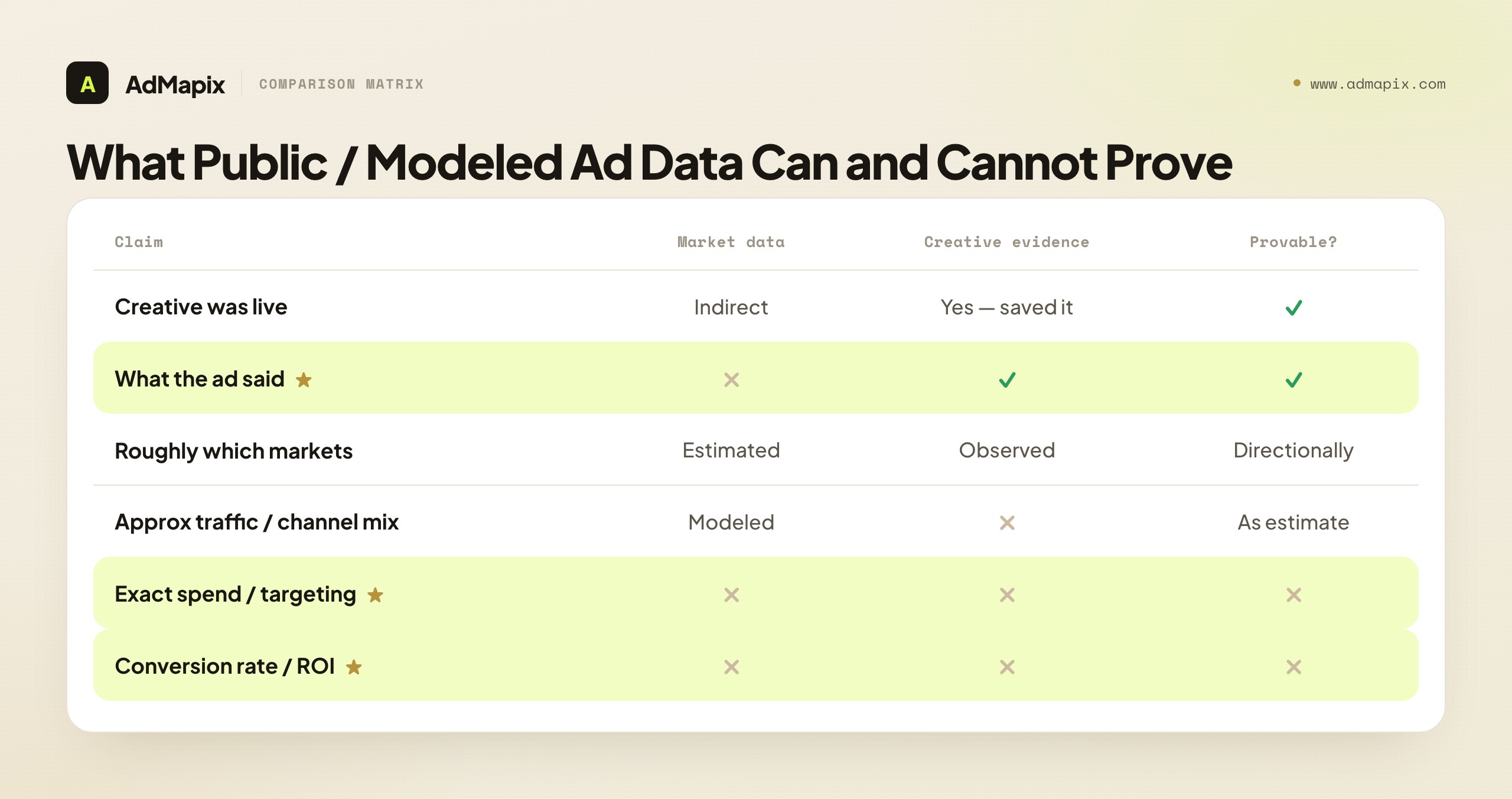
| Claim type | Market data (Similarweb) | Creative evidence (AdMapix) | Can you prove it? |
|---|---|---|---|
| "This creative was live and observable" | Indirect | Yes — you saw and saved it | Yes |
| "Here is what the ad looked like / said" | No | Yes | Yes |
| "Roughly which markets it ran in" | Yes (estimated) | Yes (observed) | Directionally |
| "Competitor's approximate traffic / channel mix" | Yes (modeled) | No | Directionally, as estimate |
| "The exact spend behind this creative" | No | No | No |
| "The exact targeting parameters" | No | No | No |
| "The conversion rate / ROI this ad earned" | No | No | No |
Read this as the boundary of every report you produce. Public and third-party data can prove a creative was live, what it looked like, which format and messaging it used, and roughly which markets it ran in. Modeled panel data can give you a directional read on traffic and channel mix. Neither can prove the spend behind a single creative, the exact targeting, or the conversion performance — those live inside the advertiser's private account and no external tool sees them.
The correct framing in a stakeholder report is therefore "here is what is observably in market and why it likely works," not "here is what this campaign earned." Creative evidence answers the first cleanly; no public tool reliably answers the second. Keep two columns mentally separate at all times: observed (you saw it run) versus performed (it converted). Conflating them is the fastest way to turn solid competitive intelligence into a claim you cannot defend when someone pushes back.
The Two-Layer Stack: How Strong Teams Actually Set This Up
The teams that get the most out of competitive research stop trying to make one tool do both jobs and instead run a deliberate two-layer stack: a market-intelligence layer for context and a creative-intelligence layer for executions. Each answers the questions the other can't, and together they cover the full decision.
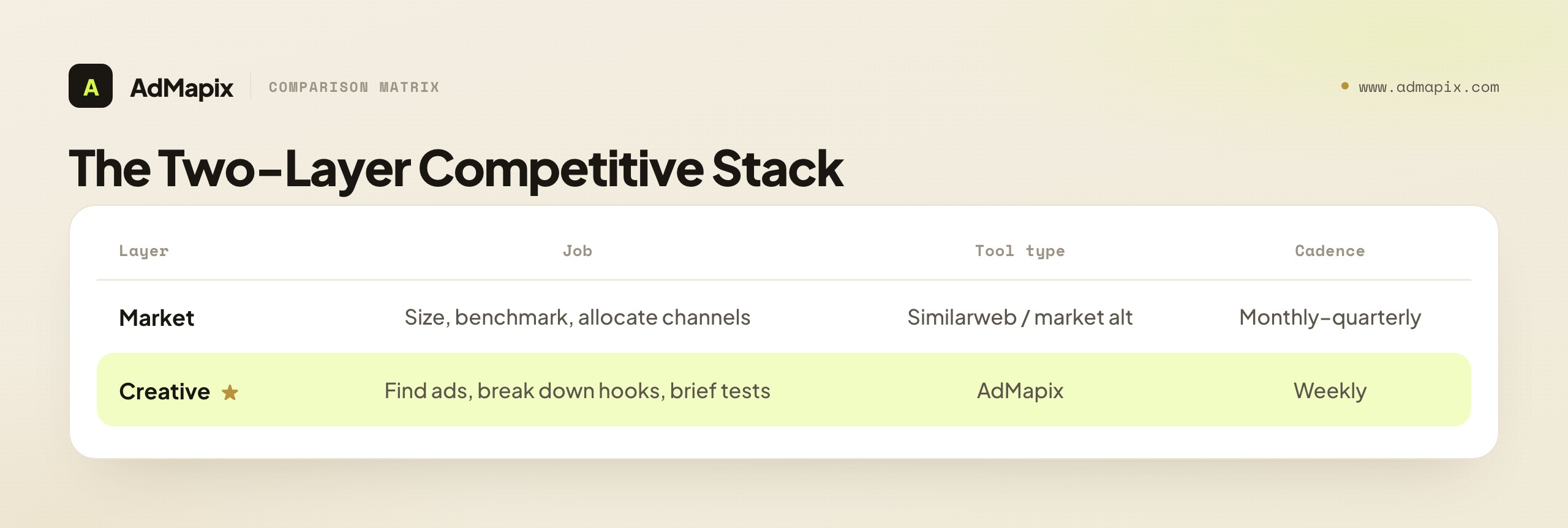
| Layer | Job | Tool type | Output | Cadence |
|---|---|---|---|---|
| Market | Size the opportunity, benchmark scale, allocate channels | Market-data platform (Similarweb or alternative) | Traffic share, channel mix, market trends | Monthly / quarterly |
| Creative | Find live ads, break down hooks and offers, brief tests | Creative-intelligence tool (AdMapix) | Saved creatives, video breakdowns, briefs | Weekly |
The two layers operate on different clocks, which is part of why one tool can't serve both well. Market intelligence is a slower loop — you re-size a market or rebalance channels monthly or quarterly, because those realities move slowly and an estimate-based panel is well suited to spotting gradual trends. Creative intelligence is a fast loop — winning ads fatigue in days, new angles appear weekly, and your testing cadence demands fresh creative evidence on a much tighter schedule. A tool optimized for the quarterly market read is not built for the weekly creative grind, and vice versa.
The handoff between layers is where the value compounds. The market layer tells you where to look: this competitor is scaling in this channel, this geography is heating up, this category is shifting. The creative layer tells you what to test: here are the actual ads winning in that channel and geography, here is the hook driving them, here is the brief. Market context without creative evidence is direction with no execution; creative evidence without market context is execution with no priority. Run both and you get prioritized, executable competitive intelligence — which is the only kind that moves your numbers. For the broader version of this stacked workflow, see competitive analysis in paid advertising and the structured competitor ad analysis framework.
How to Run a Fair Head-to-Head Trial
Do not decide from feature pages or sales demos — decide from a parallel trial on your evidence. Feature lists reward the tool with the longest spec sheet; a real trial rewards the tool that produces your next deliverable fastest. Here is a method that produces a defensible decision in about a week.
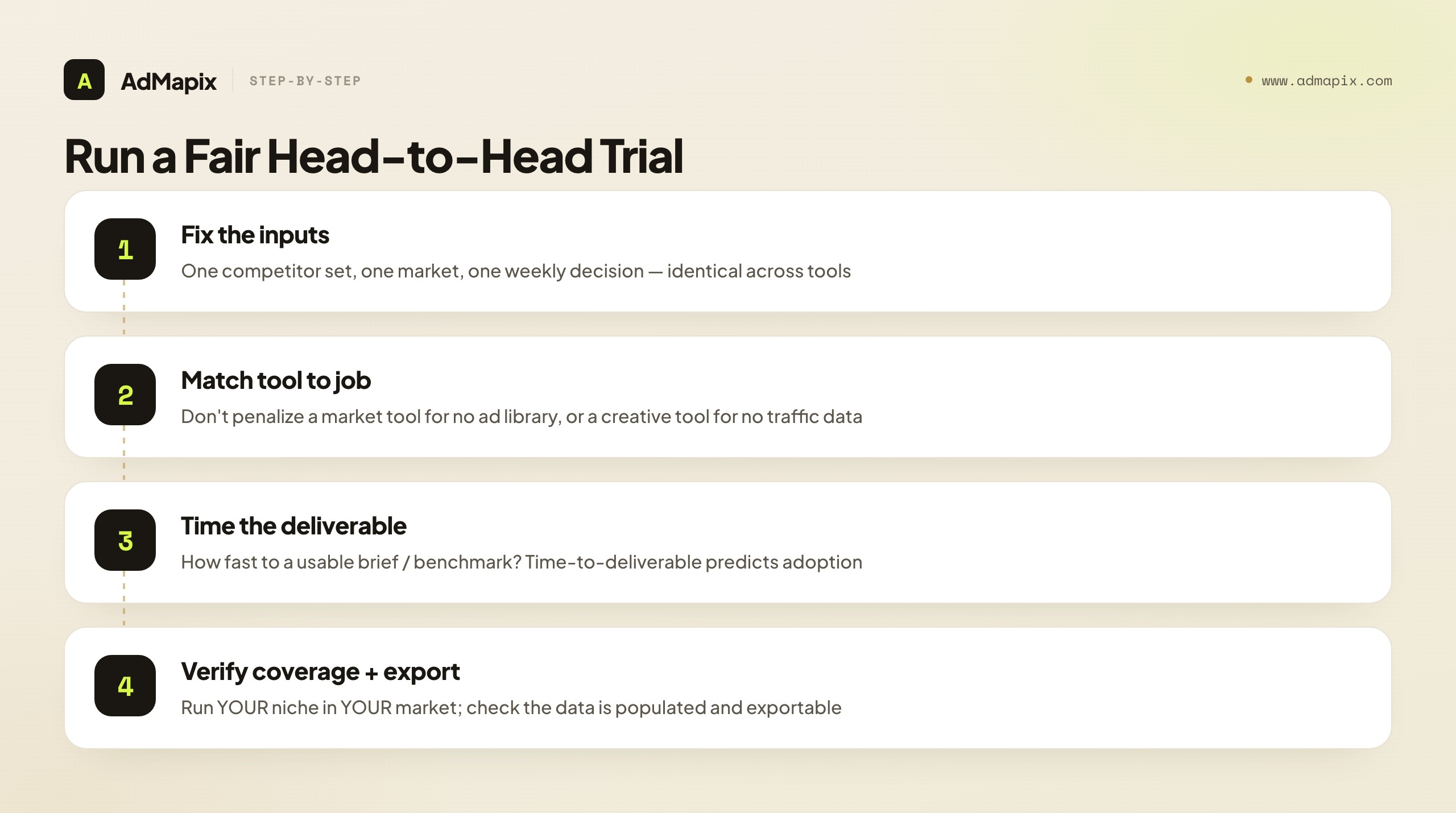
1. Fix the inputs. Pick one competitor set (three to five rivals), one target market, and one concrete weekly decision you actually need to make — for example, "what hook should we test next" or "is this competitor scaling a new channel." Load the identical inputs into each candidate tool so the comparison is apples to apples.
2. Name the job, then judge the right tool on it. This is the step most trials botch. If your decision is creative ("what ad to make"), do not penalize a market tool for lacking ad libraries, and do not credit a creative tool for lacking traffic estimates — you are testing which tool serves your job, not which has more features overall. Be ruthless about matching the tool category to the bottleneck you named in step 1.
3. Time the deliverable. For each tool, measure how long it takes to produce a usable output for your weekly decision — a creative brief, a channel recommendation, a competitor benchmark. Time-to-deliverable is the single most predictive metric of whether a tool will actually get used, because tools that are slow to a deliverable quietly get abandoned no matter how rich their data.
4. Check evidence quality and export. Can you trust the output, and can you get it out? For a market tool, do the estimates match your real-world sense of the market? For a creative tool, is the creative evidence current, and can you export saved media and briefs into the format your team or client uses? Trapped data is unused data.
5. Confirm coverage in your market. Demos mislead because they're run on the tool's strongest data. Run your exact category in your exact target country and check whether the data is genuinely populated or sparse. A tool that looks comprehensive in a US demo can be thin in your real niche — for both market data and creative coverage.
6. Decide on the deliverable, not the dashboard. The winning tool is the one that makes your next action clearer, faster. Judge evidence quality, export, and time-to-deliverable — not which dashboard has more charts. If two tools win on different jobs, that is your signal that you need both, in a two-layer stack, rather than one compromise tool.
Common Mistakes When Choosing a Similarweb Alternative
The failure modes here are predictable, which makes them preventable. Almost every wrong purchase in this space traces back to one of these.
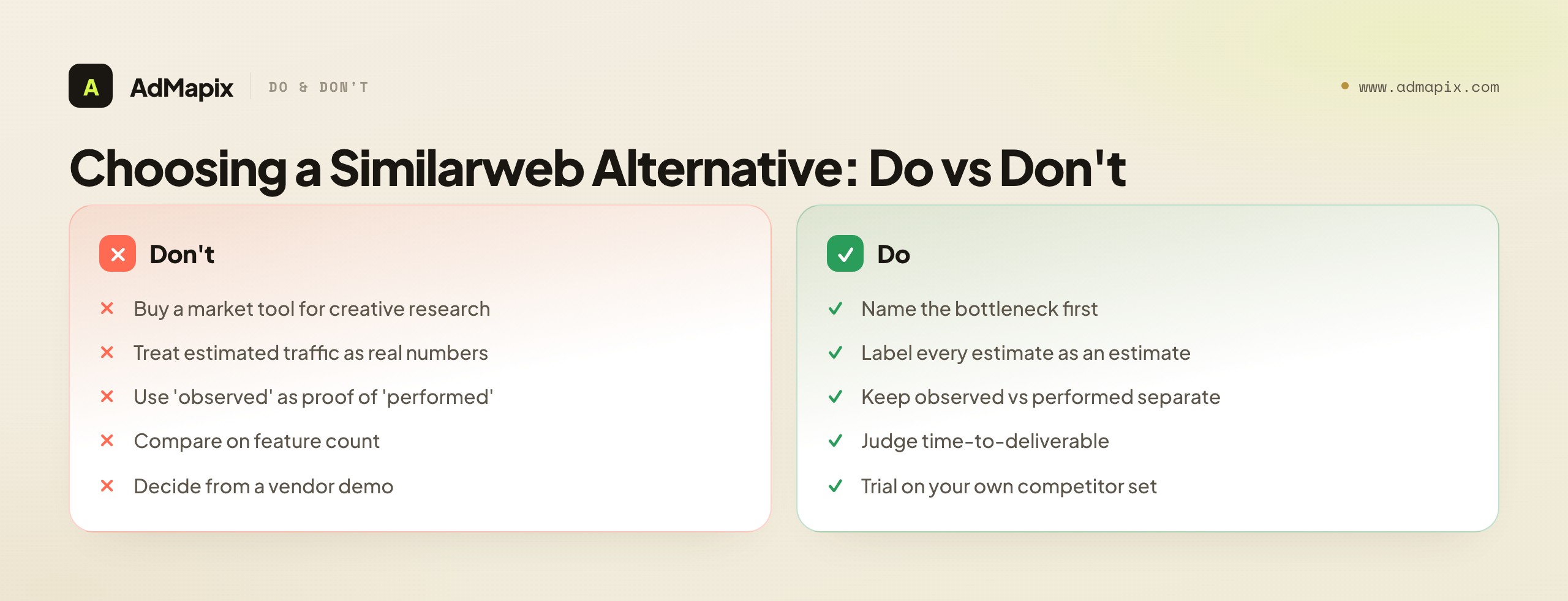
- Buying a market platform to do creative research. Traffic and channel estimates guide priorities but never explain the hook, the video structure, or the offer. If your bottleneck is creative, a cheaper or pricier market tool is still the wrong category — you'll have spent budget and still have no ads to study.
- Treating estimated traffic as the advertiser's real numbers. Panel-based figures are directional. Present them as ground truth and a competitor with access to their own analytics will dismantle your deck in one sentence. Label estimates as estimates, every time.
- Using creative evidence to claim performance. Seeing an ad proves it ran, not that it converted. Keep "observed" and "performed" in separate columns; a long-running ad is suggestive of performance, but it is not proof, and stating it as proof invites a correction you can't defend.
- Comparing tools on feature count. The longest spec sheet rarely wins the real job. What matters is which tool produces your next deliverable fastest — a focused tool that nails one job often beats a sprawling suite that half-does five.
- Assuming one tool covers both layers. Market sizing and creative testing are different jobs on different clocks. Pretending one tool does both leaves a gap somewhere — usually the creative gap, because that's the one buyers underestimate.
- Deciding from a demo instead of a trial. Vendor demos run on the vendor's best data. Your decision should run on your competitor set, in your market, against your weekly decision. Anything else is buying on marketing, not evidence.
- Skipping coverage verification in your region. A tool strong in the US can be sparse in Southeast Asia, the UK, or Latin America — for both traffic data and creative coverage. Verify on your real markets before committing.
Cost: Compare Price Per Decision, Not Sticker Price
Pricing is where the market-vs-creative decision quietly goes wrong, because the two categories are priced for different buyers and comparing their headline numbers tells you almost nothing useful. A full market-intelligence platform like Similarweb is an enterprise-grade product priced for organizations that need market sizing, channel benchmarking, and trend data across many competitors and geographies — its value is in breadth and the confidence to make budget-level decisions. A focused creative-intelligence tool is priced for teams whose recurring job is finding and testing ad creative. Putting the two sticker prices side by side is a category error; you are comparing the cost of a market map to the cost of a creative workshop.
The framing that actually helps is cost per decision made. A tool is cheap or expensive only relative to how many real decisions it lets you make and how fast. A market platform that costs more but lets you confidently size three new-market opportunities a quarter is cheap for that job. A creative tool that costs less but produces a tested brief every week is cheap for that job. The expensive purchase, in both directions, is the mismatched one: a market platform bought to answer creative questions sits half-used because it never produces the brief the team needed, and a creative tool bought to answer sizing questions can't benchmark a market no matter how many seats you buy. The waste isn't the price tag — it's paying anything at all for a tool that doesn't move your actual bottleneck.
Two practical implications follow. First, don't downgrade across categories to save money — a cheaper market tool does not solve a creative gap, it just makes the gap cheaper to keep. If your bottleneck is creative, the cost question is "which creative tool earns its keep," not "which market tool is cheapest." Second, a two-layer stack is usually cheaper than it looks, because each tool is doing the job it's priced for, and neither is over-bought to cover a job it can't. Paying for one right-sized market tool plus one right-sized creative tool frequently beats paying enterprise rates for a single platform you're stretching to cover both layers it was never built to serve. Run the cost question through your actual weekly deliverable, and the right-sized purchase usually becomes obvious.
Match the Tool to Your Role
The right Similarweb alternative also depends on who you are and what your week actually looks like, because the same "ad intelligence" need shows up differently for different roles. Mapping yourself to a role makes the market-vs-creative call concrete.
In-house growth or performance marketer. Your week is dominated by the creative testing loop — new variants, fresh hooks, killing fatigued ads. Your bottleneck is almost always creative evidence: you already have a rough sense of the market, and what you lack is the next angle to test. Lead with a creative-intelligence tool and treat market data as occasional context, not a weekly tool. The exception is when you're proposing a new channel to leadership — then you briefly need market sizing to justify the bet, which is a one-off market-tool moment inside an otherwise creative-led role.
Agency strategist or media buyer. You serve multiple clients across categories, so you need both layers, but the deliverable is the deciding factor. Client briefs and pitch decks usually live or die on creative direction — "here's what's winning in your category and what we'll test" — which is a creative-evidence job. Market data strengthens the pitch (here's the scale of the opportunity) but rarely closes it. Most agencies lead with the creative layer for the recurring client work and pull in market data for new-business sizing and quarterly category reviews.
Competitive-intelligence or strategy analyst. Your job leans more toward the map than the executions: leadership wants to know how big competitors are, where the market is heading, and which channels are shifting. Market intelligence is your primary tool, and creative evidence is the texture you add to make the strategic story concrete ("and here's the actual creative behind that channel shift"). You're the one role that genuinely leads with the market layer.
Solo operator or small brand. Budget is tight and the bottleneck is usually singular. Diagnose ruthlessly: if you can't find products or sense the market, a market tool; if you can find what to sell but your ads underperform, a creative tool. Buy one tool for your one bottleneck, and resist the instinct to buy the broader-sounding platform — breadth you won't use is just expensive shelfware.
The thread: the same phrase means different purchases for different roles, and the deliverable you're judged on — a tested brief, a client deck, a leadership benchmark — is the most reliable guide to which layer leads.
When You Might Not Need a Creative Tool At All
Honest tool selection includes naming the cases where the answer is "buy neither category" or "you already have what you need," because the most expensive purchase is the one that solves a problem you don't actually have. A guide that only ever concludes "you need the second tool" isn't a decision framework; it's a sales funnel. So here are the situations where a creative-intelligence layer is genuinely not your next move.
When your bottleneck is upstream of advertising entirely. If your real constraint is product-market fit, pricing, or a landing page that converts poorly regardless of which ad sends traffic to it, no amount of competitor creative evidence fixes it. Studying rival hooks while your checkout flow leaks customers is optimizing the wrong stage. Diagnose where the funnel actually breaks first; if it breaks after the click, creative intelligence is premature, and you'd get more from session recordings and conversion-rate work than from any ad library.
When you have very few competitors running ads. In a thin or nascent category where two or three rivals advertise sporadically, the creative-evidence pool is too shallow to support a weekly research cadence. You can monitor those few competitors manually in the free public ad libraries without paying for a dedicated tool, because there simply isn't enough volume to justify the workflow. The tool earns its keep when you have enough competitors and enough creative throughput that manual monitoring becomes the bottleneck — below that threshold, the free libraries plus a spreadsheet are sufficient.
When your team won't actually run the weekly loop. A creative-intelligence tool only pays back if someone uses it on a cadence — searching, saving, breaking down, briefing. If your team is stretched thin and realistically won't touch it more than once a quarter, you're buying a capability you won't operationalize, and the honest move is to fix the capacity problem before adding the tool. A tool used quarterly is usually worse value than a disciplined manual check, because the subscription runs whether you log in or not.
When the free public libraries already answer your question. For occasional, low-stakes competitor checks — "what is this one rival running right now" — the Meta Ad Library and Google Ads Transparency Center are free and often enough. The case for a paid creative tool is built on history (public ads vanish when campaigns stop), cross-network consolidation (one searchable workspace instead of tab-hopping), and volume (more competitors than you can track by hand). If none of those three apply to you yet, the free layer is the right starting point, and you can upgrade when one of them becomes a real constraint.
The thread: a creative-intelligence tool is the right answer when your bottleneck is genuinely competitor creative evidence at a cadence and volume that manual work can't sustain. When the bottleneck is elsewhere — a leaky funnel, a thin category, an under-capacity team, or a need the free libraries already meet — naming that honestly saves you a subscription you'd regret. The same discipline applies to the market layer: don't buy Similarweb to answer a question your existing analytics or a free traffic estimate already cover. Buy for the bottleneck that's actually blocking your next decision, and be willing to conclude that the answer is "neither, yet."
Turning Creative Evidence Into a Testable Brief
Finding competitor ads is only half the creative job; the value is in the conversion from evidence to testable brief, and this is where teams most often stall. A folder of saved competitor ads that never becomes a test is research theater — it feels productive and changes nothing. Here is the discipline that turns observed creative into something your team can actually run.
Start from the mechanism, not the surface. When you save a strong competitor ad, the temptation is to note what it looks like ("UGC video, fast cuts"). The useful move is to extract the mechanism — what buyer anxiety or desire the ad is addressing. If a rival's hook is "still tracking expenses by hand?", the mechanism is the pain of manual, error-prone work, and the offer answers it with automation. The mechanism is portable; the exact execution is not. You test the mechanism in your voice with your proof, not a clone of their footage — copying the surface imports a claim your funnel may not be able to back, and cedes the creative initiative.
Look for repetition, because repetition is the signal. A single competitor ad is an experiment that may have failed. The same hook or offer running across multiple ads, or persisting for weeks, is far stronger evidence that the mechanism is working for them — running ads costs money, so persistence is a vote. Tag recurring patterns across your saved set; the patterns that repeat across several competitors are the highest-confidence angles to test first, because the market has validated them more than once.
Write the brief as a hypothesis, not a description. A testable brief names the mechanism, the angle, the format, and what you expect to learn — "test a 'reclaim your evening' time-savings hook in 15-second UGC, because three competitors are running time-savings angles and our current creative leads on features instead." That framing forces the research to produce a decision (run this test) rather than a summary (here are some ads). End every creative-research session on a brief, or the session didn't earn its place in the week.
Close the loop on your own data. Competitor evidence generates hypotheses; only your own results confirm them. After a test runs, compare the outcome against the competitor pattern that inspired it — did the validated-elsewhere angle work for you? Over a quarter this builds a private library of what trended, what you tested, and what actually converted in your account, which is the asset that makes next quarter's briefs faster and sharper. This loop is also why a creative tool with history matters: you want to see how an angle traveled and persisted over time, not just a snapshot of today's ads. For the structured version of turning competitor signal into hypotheses, see the competitor ad analysis framework.
A short worked example. Two teams research the same five competitors in the same category and arrive at different right tools, which is exactly the point. Team A is a CI analyst preparing a board update on whether the category is consolidating and which channels are gaining share — that is a market question, so a market platform's traffic and channel-mix estimates produce the deliverable, and a creative library would leave them with ads but no benchmark. Team B is a performance marketer whose paid social has stalled and who needs the next hook to test this week — that is a creative question, so a creative-intelligence tool surfaces the live competitor ads, the analyst extracts the repeating time-savings mechanism, and the brief writes itself, while a traffic dashboard would have told them the rival is "active in social" and nothing testable. Same competitor set, opposite correct tools — because the deliverable, not the rival list, decides the category. The mistake would have been either team buying the other's tool because it was the more familiar brand, then discovering after purchase that it answers a question they didn't have.
When to Use AdMapix (Honest Positioning)
Use AdMapix when your bottleneck is competitor creative evidence, not market sizing — that is, when you already understand the market context and now need to see, save, and break down the ads behind it. We'll state plainly what it is and isn't, because recommending it for the wrong job would waste your money.
AdMapix is a cross-network ad creative tool for performance marketers, creative strategists, and agencies who need to find live competitor ads, study the video, tag recurring patterns, and turn them into testable briefs and client reports on a weekly cadence. It is the layer that complements a market platform rather than replacing it.
AdMapix is not a traffic-estimation or market-sizing tool. It does not estimate audience size, traffic share, or market-wide channel spend. If your only question is "how big is this competitor and where does their traffic come from," a market-intelligence platform like Similarweb is the better starting point, and you can layer AdMapix on top once the question shifts from how big to what creative.
A realistic workflow: run your competitor set in Search AdMapix to surface what is currently live, keep the strongest examples in Media, use Video Analysis to break down the hooks and structure worth testing, and compile the findings in Reports. When the weekly cadence proves it saves real briefing time, create an account from Login or compare seats on Pricing. For the wider landscape of creative-intelligence tools to evaluate alongside it, see best ad spy tools 2026 and marketing intelligence tools.
FAQ
Is AdMapix a direct Similarweb alternative?
Not a one-to-one replacement. Similarweb answers market and traffic questions — audience size, channel mix, traffic share, market trends — while AdMapix answers creative-evidence questions: which ads are live, what the video hook does, which offer repeats. AdMapix replaces the creative-research layer some teams hoped Similarweb would cover, but it does not estimate traffic share or market-wide channel spend. Many teams keep a market platform for sizing and add AdMapix for the ads themselves, running both as a two-layer stack.
Does Similarweb show competitor ad creatives?
Similarweb's ad-intelligence strength is visibility across display, search, and social channels and how campaign activity relates to traffic trends, per its own positioning. That is channel-level context, not a searchable library of the actual creative a competitor is running. To study the specific hook, video structure, and offer in market right now, you need a creative-intelligence tool — that is a different category from a traffic-and-market platform.
Why would I need a Similarweb alternative at all?
Two common reasons. First, scope mismatch: you searched for "ad intelligence" expecting to see competitor ads and found a market-data platform, so the real gap is a creative-evidence tool, not a cheaper Similarweb. Second, cost or breadth: Similarweb is a premium market platform, and a team that only needs lighter traffic estimates may want a smaller market alternative. Diagnose which one you are — a creative gap or a market-tool-cost gap — before shopping, because they lead to completely different purchases.
When should I use both a market tool and a creative tool?
Use the market layer first when you need to size an opportunity, benchmark competitive scale, or decide channel budget — those are slower, context-setting decisions. Then use the creative layer (AdMapix) to collect the live ads, analyze the videos, and turn the patterns into a brief or report on a weekly cadence. The market tool tells you where to look; the creative tool tells you what to test. Run both and you get prioritized, executable intelligence instead of either direction-without-execution or execution-without-priority.
How do I test these alternatives fairly?
Pick one competitor set, one market, and one concrete weekly decision. Run it through each tool and compare on a single criterion: which one produces a usable deliverable faster. Match the tool category to your named bottleneck — don't penalize a market tool for lacking ad libraries or a creative tool for lacking traffic estimates. Judge evidence quality, export, coverage in your real market, and whether the next action is clearer — not which dashboard has more charts.
Can public ad data tell me what a competitor spent?
No. Public and third-party ad data can prove a creative was live and what it looked like, and modeled panel data can give a directional read on traffic and channel mix — but none of it reveals the exact spend, targeting, or conversion performance behind a specific campaign. Those live inside the advertiser's private account. Frame findings as "observably in market" rather than "this is what it earned," and keep every estimated metric clearly labeled as an estimate.
Does cross-network coverage matter if I only run ads on one platform?
Yes, more than most single-channel teams expect. Winning ad angles migrate across platforms — a hook crushing it on Meta this month often lands on TikTok next month, and the same product is advertised with different framings on different networks. If you only watch your own channel, you see a fraction of the proven playbook and only after each angle has already saturated. Cross-network creative visibility lets you assemble the full set of proven angles and adapt the strongest before it arrives on your platform.
Is estimated traffic data reliable enough to act on?
It is reliable for direction and relative comparison, not for exact figures. Panel-based estimates are good at telling you Competitor A is larger than Competitor B, or that a category is trending up — and that is genuinely useful for sizing and prioritization. They are far less reliable as exact numbers, and they never reproduce the advertiser's internal analytics. Use them to prioritize and trend-spot, and never present an estimate as the competitor's real reported number.
What's the difference between market intelligence and creative intelligence?
Market intelligence is the view from above: how big a competitor is, where their traffic comes from, which channels they invest in, how the category is moving. Creative intelligence is the view from the ad itself: the hook, the video structure, the offer, the angle. Market intelligence sets priority (where to compete); creative intelligence sets execution (what to make). They are different tool categories on different cadences, which is why one premium platform rarely serves both jobs well.
What's the single biggest mistake in choosing a Similarweb alternative?
Buying a market platform to solve a creative problem (or the reverse). Most teams searching for a "Similarweb alternative for ad intelligence" actually have a creative-evidence gap — they need to see competitor ads, not better traffic estimates — yet they shop in the market-tool category and stay stuck. Name your bottleneck first: if your next deliverable is built from the ads themselves, you need a creative-intelligence tool; if it's built from traffic and market context, you need a market platform. Match the category to the job and the choice becomes obvious.
Key Takeaways
- "Ad intelligence" splits into two jobs — market intelligence and creative intelligence — served by two different tool categories that share a vocabulary. Name your bottleneck before you buy.
- Use Similarweb (or a market alternative) for traffic share, channel mix, and market sizing; treat its figures as directional estimates, never the advertiser's real numbers.
- Use a creative-intelligence alternative like AdMapix when the deliverable is built from the ads themselves: search, save, analyze video, tag, and report on a weekly cadence.
- Cross-network coverage matters even for single-channel teams, because winning angles migrate across platforms before they reach yours.
- Never present creative evidence as proof of performance, or estimated traffic as the advertiser's reported numbers — keep "observed" and "performed" separate.
- The strongest setup is a two-layer stack: a market tool for slow, context-setting decisions and a creative tool for the fast, weekly creative loop. Test candidates on one competitor set and one weekly decision, judging time-to-deliverable, not feature count.
Related Reading
- Best ad spy tools 2026 — the full landscape of creative-intelligence tools to evaluate alongside AdMapix
- Marketing intelligence tools — the wider competitive-intelligence stack across market and creative layers
- Competitive analysis in paid advertising — the multi-channel workflow that a two-layer stack feeds
- Competitor ad analysis framework — the 5-dimension system for turning competitor evidence into testable hypotheses
- Spy on ads across all platforms — why cross-network creative visibility beats single-channel libraries
Sources
Official source pages were checked as of June 21, 2026. Product naming, packaging, and coverage can change, so re-verify before relying on specifics.
- Similarweb — positions itself as digital data intelligence and states marketers can track competitors across display, search, and social.
- Similarweb Web Intelligence 4.0 announcement — describes ad-intelligence visibility across display, search, and social ads and how campaigns connect to traffic trends.
- Meta Ad Library — public evidence layer for observing live competitor creative across Meta platforms.
- Google Ads Transparency Center — public record of advertisers' live ads across Google's networks.
AdMapix is our product. Its data scope is cross-network ad creative search, saved media, video analysis, tagging, and reports; it does not estimate market-wide traffic or spend.
Turn these observations into your next creative study
Open the creative library and select samples for your market, network and research question.
Related Articles
Moat Alternative in 2026: Ad Verification vs. Creative Intelligence
A complete 2026 buyer's guide to choosing a Moat alternative — why teams look past Oracle Moat, what Moat actually does (viewability, invalid traffic, brand safety), the critical split between the ad-verification layer and the creative-intelligence layer, a layered comparison across coverage and fit, who should choose which, a practical migration plan, the honest limits of public creative data, and where a creative-research tool like AdMapix fits.
WhatRunsWhere Alternative in 2026: Legacy Media-Buying Intelligence or Modern Creative Research?
A complete 2026 buyer's guide to choosing a WhatRunsWhere alternative — why teams look past this legacy media-buying tool, what it actually does (display, native, and mobile placements and publisher paths), the three layers of competitive intelligence, the legacy-access risk to check first, how to evaluate alternatives, who should choose which, a migration plan, the honest limits of public ad data, and where a modern cross-network creative tool like AdMapix fits.
Pathmatics Alternative in 2026: Ad Spend Intelligence vs. Creative Workflow
A complete 2026 buyer's guide to choosing a Pathmatics alternative — why teams look past Pathmatics (now Sensor Tower), what it actually measures, a layered comparison of spend-intelligence suites versus creative-workflow tools across coverage, data type, price, and fit, who should choose which, a practical migration plan, the honest limits of estimated spend, and where a lighter cross-network creative tool like AdMapix fits.