
Moat Alternative in 2026: Ad Verification vs. Creative Intelligence
A complete 2026 buyer's guide to choosing a Moat alternative — why teams look past Oracle Moat, what Moat actually does (viewability, invalid traffic, brand safety), the critical split between the ad-verification layer and the creative-intelligence layer, a layered comparison across coverage and fit, who should choose which, a practical migration plan, the honest limits of public creative data, and where a creative-research tool like AdMapix fits.
Moat Alternative in 2026: Ad Verification vs. Creative Intelligence
By the AdMapix Research Team — Updated June 21, 2026
Moat, now Oracle Moat, is an ad verification and measurement product — so the right alternative depends entirely on what you are actually trying to fix. If your decision is viewability, invalid traffic, or brand safety on your own campaigns, you want another verification vendor. If your decision is what competitors are running, which video hooks repeat, and which creative to test next, you want a creative-intelligence tool instead. These are two unrelated jobs, and the single biggest mistake in any "Moat alternative" search is treating them as one. The ranking lists that mix verification vendors with competitor swipe-file tools are doing exactly that — and following them is how a brand-safety lead ends up with a creative tool that cannot verify a single impression, or a creative strategist ends up with a measurement product that cannot tell them which hook to test.
This guide is for media buyers, agencies, brand-safety leads, creative strategists, and founders who keep seeing "Moat alternative" lists that collapse two unrelated jobs into one ranking. We will define exactly what Moat does, why teams look for alternatives, why the verification layer and the creative-intelligence layer are genuinely different problems, how to choose within each, who should pick what, how to run a fair migration test, and the honest limits of public creative data. The goal is to make sure you replace the layer you actually need — because replacing the wrong one leaves a real, sometimes compliance-relevant, gap.
TL;DR — Choosing a Moat Alternative in One Screen
- Moat (Oracle) is a verification-and-measurement layer: viewability, invalid traffic (IVT), and brand safety on your own media. It is not a competitor swipe-file or creative-research tool.
- Pick your alternative by the layer you need: verification and viewability on your campaigns, or competitor creative evidence to decide what to test.
- For verification, IVT, and brand safety, replace Moat with another measurement vendor. A creative tool cannot do this job, and AdMapix does not pretend to.
- For competitor ad search, video hook breakdowns, and report-ready creative evidence, you need a different layer — one Moat never covered.
- The two layers both touch "ads," which is why they get confused. Verification asks "was my ad seen, safely, by a real human"; creative intelligence asks "what creative wins, and how do we copy the pattern."
- Public creative data is observational. It shows what is running and how often a pattern repeats, never spend, ROAS, or whether a rival's ad converted.
- AdMapix fits the creative-intelligence layer: cross-network ad search, saved media, video analysis, tagging, and reports. It does not measure your media, so it complements a verification vendor rather than replacing it.
Why Teams Look for a Moat Alternative
Moat is an established, capable verification product, so the search for an alternative is rarely about it being "bad." It is usually about a mismatch — either between what Moat does and what the buyer's real decision needs, or about change in the product itself. The reasons cluster into a recognizable list.

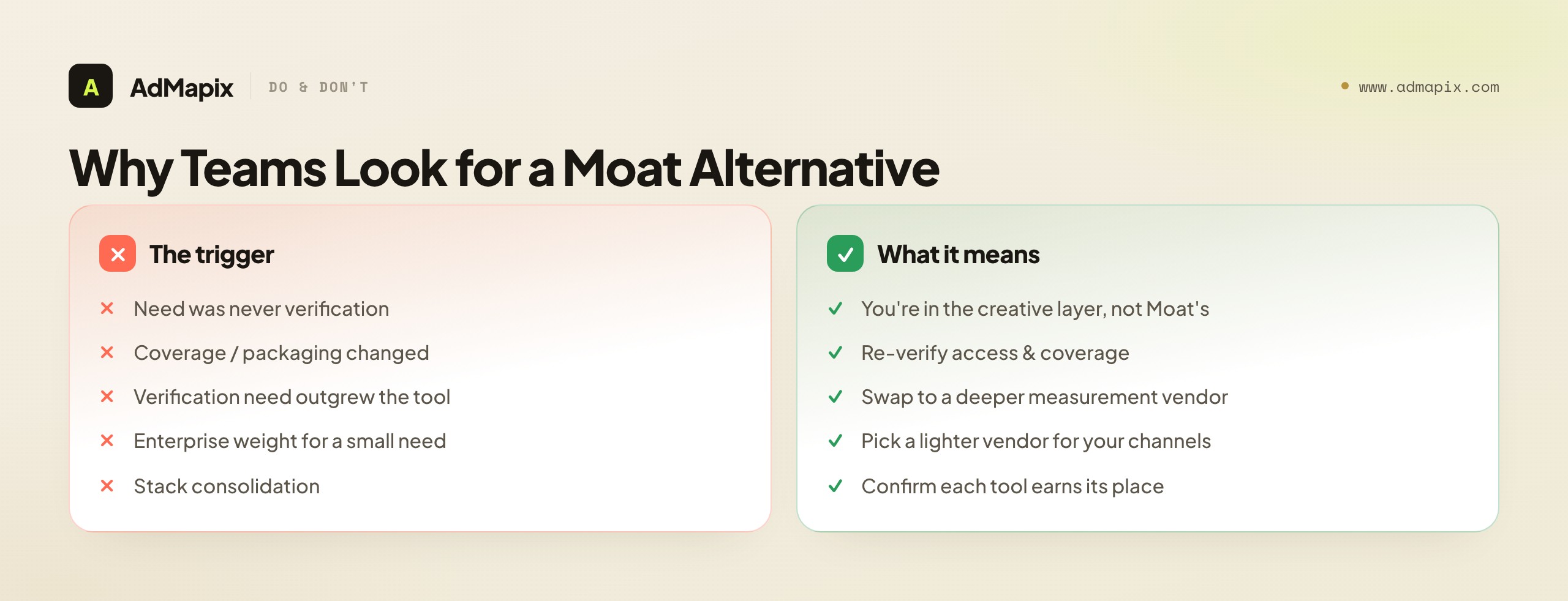
The need was never verification in the first place. A large share of "Moat alternative" searchers are creative strategists or growth teams who landed on Moat because it is a famous ad tool, then realized it measures their own media quality rather than revealing competitors' creative. The mismatch is not Moat's fault — they are simply shopping the wrong layer, and an alternative measurement vendor will not help them.
Coverage or packaging changed. Moat is now part of Oracle's advertising and measurement portfolio, and enterprise measurement products get repackaged, rebundled, and occasionally deprecated over time. Teams reasonably re-evaluate when access, channel coverage, or pricing shifts, to confirm they still get the verification they bought. (Industry-wide, ad-verification offerings have seen real consolidation and change, which is exactly why a freshness check belongs in any evaluation.)
The verification need outgrew the tool. A team whose IVT, viewability, or brand-safety requirements have grown — new channels, new compliance demands, new standards — may need a verification vendor with different or deeper coverage. That is a within-layer move: replacing one measurement tool with another that fits the current need.
Enterprise weight for a smaller need. A smaller advertiser may find an enterprise measurement suite heavier and pricier than their actual verification need warrants, and look for a lighter vendor that still covers the channels they buy.
Stack consolidation. Teams rationalizing their martech stack re-examine every enterprise contract, verification included, to confirm each tool still earns its place.
Only the first reason points away from the measurement layer entirely — and it points to a lot of people. Recognizing which reason is yours is the whole game: most of them keep you in the verification layer (swap vendors), but the first one means you were never in the verification layer at all.
The reason the first reason is so common deserves a moment, because it explains the strange shape of the "Moat alternative" search. Moat is one of the most recognizable names in ad measurement, which means it surfaces for a huge range of people typing "ad tool," "competitor ad tool," or "ad analytics" into a search bar — many of whom have no verification need whatsoever. A creative strategist who has never thought about viewability hears "Moat" as "the famous ad-intelligence thing" and assumes it must show competitor ads. They arrive, discover it measures their own media, and start searching for a "Moat alternative" that does what they actually wanted all along — competitor creative research — without realizing they have crossed a layer boundary in the process. The brand recognition that makes Moat famous is precisely what funnels the wrong audience to it. If that describes you, the good news is simple: your search is not for a better measurement vendor, it is for a creative-intelligence tool, and the rest of this guide is written for you.
What Moat Actually Does (and Why Substitutes Differ)
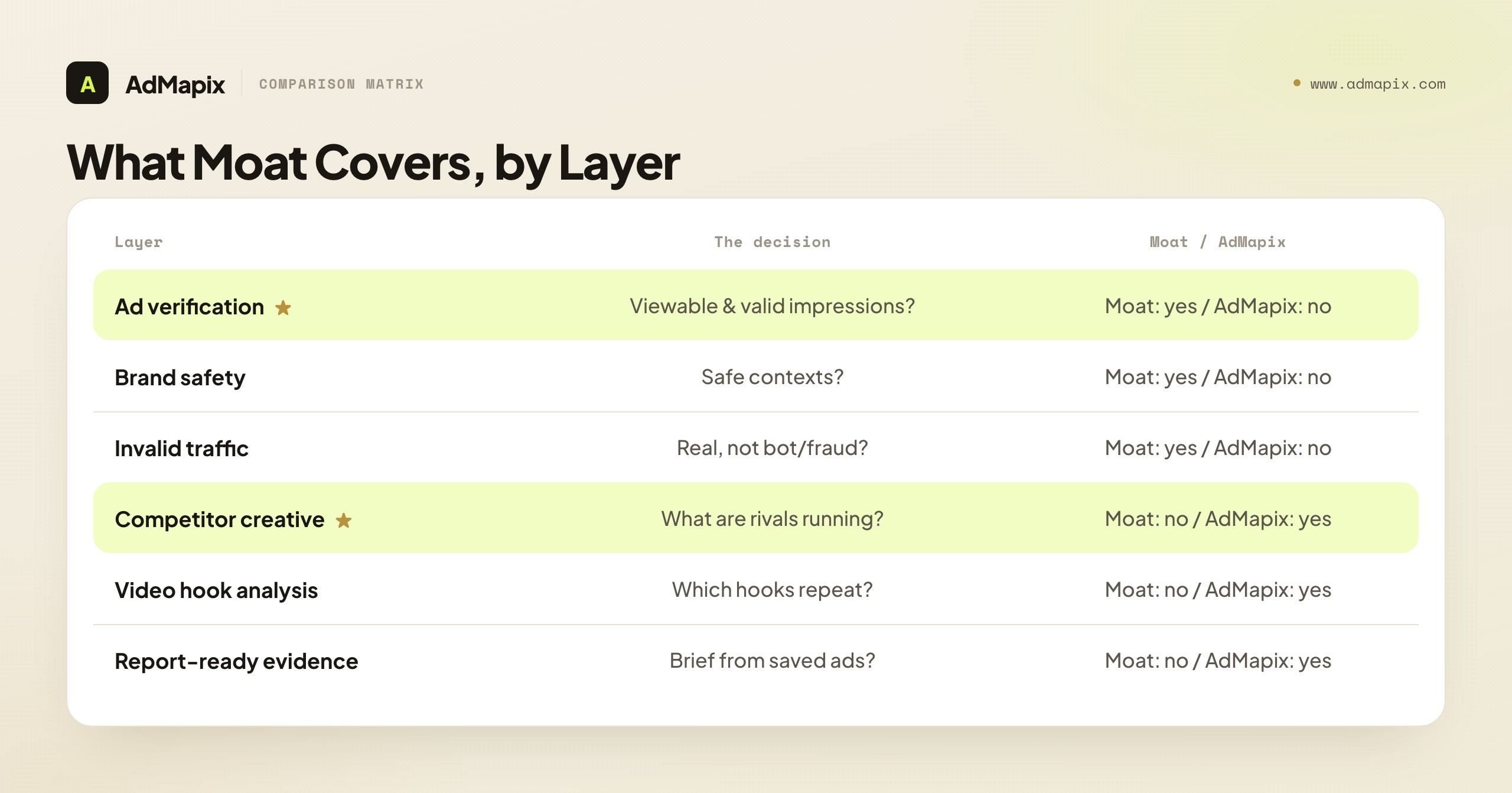
Moat is digital ad measurement and verification: it answers whether your impressions were viewable, whether traffic was valid (not bot or fraud), and whether your ads ran in brand-safe contexts across video, mobile, display, and branded content. That matters because two products people call "Moat alternatives" solve completely different problems, and swapping one for the other leaves a real gap.

Oracle's own materials frame Moat this way: the Moat Analytics demo page describes advertising-performance insight across video, mobile, display, and branded content with viewability, invalid traffic, and brand-safety measurement, and Oracle's 2017 release positioned the acquisition as a digital-measurement and marketing-data-cloud addition. So the honest first question is not "which tool is more famous" but "is my next decision about verifying my own media, or about studying someone else's creative?"
| Layer | The decision it answers | Moat covers it? | Where AdMapix fits |
|---|---|---|---|
| Ad verification | Were my impressions viewable and valid? | Yes (core) | No |
| Brand safety | Did my ads run in safe contexts? | Yes (core) | No |
| Invalid traffic (IVT) | Was my traffic real, not bot/fraud? | Yes (core) | No |
| Spend / media intelligence | How is budget allocated across channels? | Partial | No |
| Competitor creative research | What ads are rivals running, and why? | No | Yes (core) |
| Video hook / format analysis | Which hooks and formats repeat? | No | Yes (core) |
| Report-ready creative evidence | Can I brief or report from saved examples? | No | Yes (core) |
The top three rows are Moat's home turf and the bottom three are a different layer entirely. The single row in the middle — spend intelligence — is yet another layer (the Pathmatics-style one), which Moat only partially touches. Reading this table top to bottom is the fastest way to locate your real decision and stop comparing tools that were never solving your problem.
This three-way split is worth holding in your head, because the broader "ad intelligence" market is genuinely three layers stacked into one confusing category, and most buyer confusion comes from not seeing the seams. The verification layer (Moat, and its measurement peers) answers "is my own media being delivered cleanly and safely." The spend-intelligence layer (Pathmatics-style suites) answers "how much are competitors spending and where." The creative-intelligence layer (tools like AdMapix) answers "what creative are competitors running, and what should I make next." All three get marketed as "ad intelligence," all three touch "competitor" or "ad" language somewhere on their sites, and all three show up in the same search results — which is exactly why a buyer can spend weeks comparing tools that were never solving the same problem. The cure is to locate your decision in one of the three rows before you compare a single feature. Moat is firmly in the first layer; a "Moat alternative" only makes sense once you have confirmed the first layer is actually where your decision lives.
The Two Layers That Get Confused
The entire "Moat alternative" confusion reduces to one conflation: both verification and creative intelligence touch "ads," so they get filed together — but they ask opposite questions, for opposite purposes, owned by opposite teams.

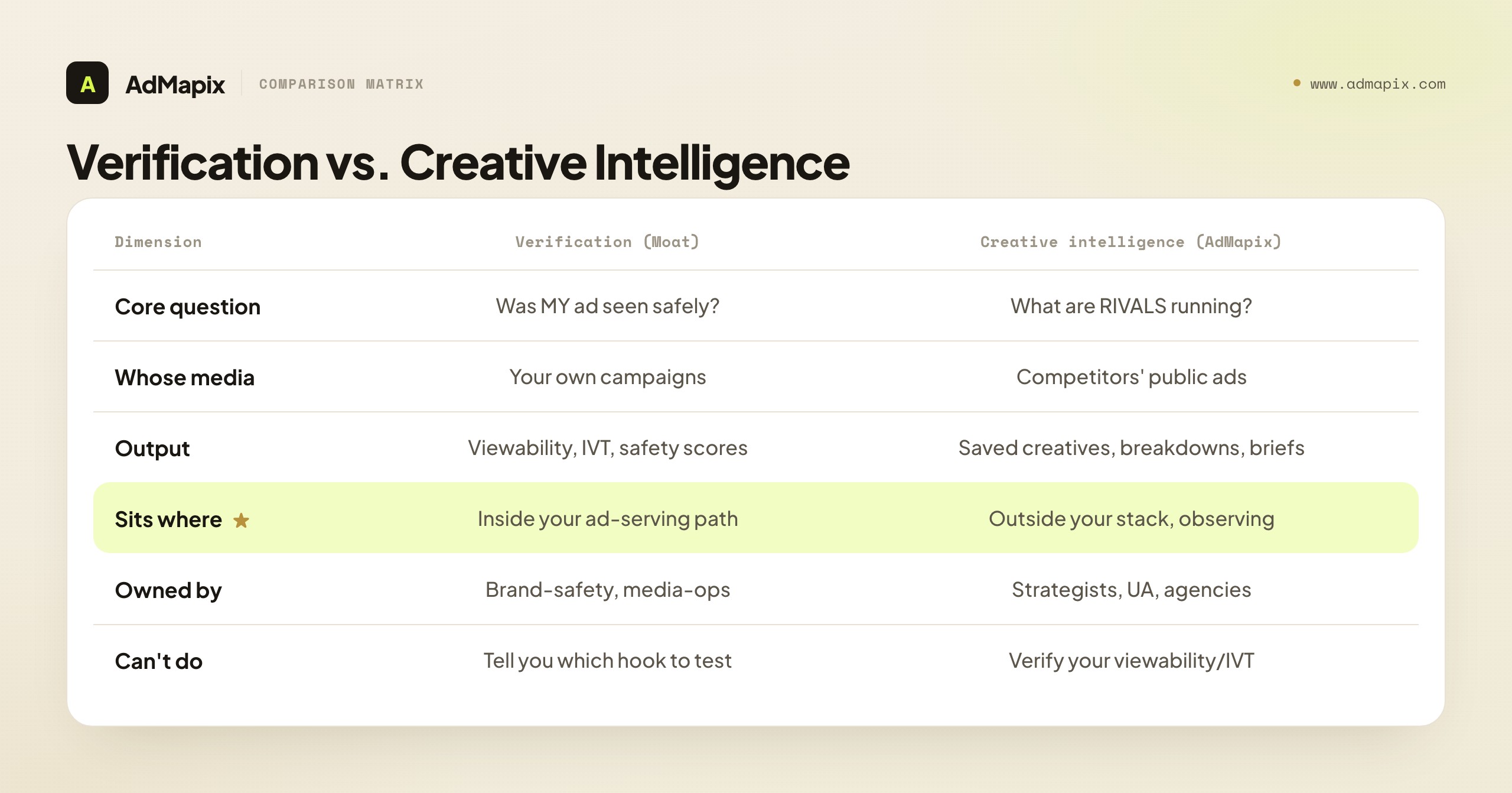
| Dimension | Ad verification (Moat) | Creative intelligence (AdMapix) |
|---|---|---|
| Core question | Was my ad seen, safely, by a real human? | What creative are rivals running, and why? |
| Whose media | Your own campaigns | Competitors' public ads |
| Primary output | Viewability, IVT, brand-safety scores | Saved creatives, video breakdowns, briefs |
| Who owns it | Brand-safety, verification, media-ops | Creative strategists, UA, agencies |
| Sits where | In your ad-serving / tracking path | Outside your stack, observing public ads |
| Decision it drives | Protect spend, ensure compliance | What to test next, what to brief |
| What it cannot do | Tell you which hook to test | Verify your viewability or IVT |
Read across any row and the opposition is total. Verification sits inside your ad-serving path, measuring media you paid for, to protect that spend and meet compliance. Creative intelligence sits outside your stack, observing competitors' public ads, to decide what you should make next. One is a defensive, measurement function; the other is an offensive, ideation function. A tool built for one is structurally unable to do the other — not as a feature gap, but as a category difference. This is why "replace Moat with AdMapix" is the wrong frame: AdMapix is not a cheaper Moat, it is a different layer that Moat never occupied.
Moat in the Oracle Ecosystem
A second reason teams re-evaluate is the acquisition and platform context, and understanding it helps you judge both Moat and its alternatives sensibly. Oracle acquired Moat in 2017 and folded it into its broader advertising and marketing-data portfolio, placing the verification capability inside a large enterprise data ecosystem rather than leaving it as a standalone measurement product.
For an enterprise that wants measurement inside a wider Oracle data relationship, that consolidation can be a plus — one vendor, cross-referenced data, unified procurement. For a team that only ever needed the verification piece, the same consolidation can feel like buying into a larger platform than the job requires. And the broader ad-verification and measurement market has seen real movement over the years — consolidation, repositioning, and shifting product boundaries across the major vendors — which is precisely why a freshness check is non-negotiable before you commit. The packaging, channel coverage, and access you remember may not match what is currently on offer.
The practical implication is the same discipline that runs through this whole guide: verify the current state directly rather than trusting a year-old comparison, and be honest about whether you want the standalone verification capability or a seat in a larger ecosystem. If your need is narrow — viewability and IVT on a handful of channels — a focused measurement vendor may serve it more directly than an enterprise platform. If your need is broad and you already live in a given data ecosystem, staying inside it may be the lower-friction path. Either way, that is a within-verification-layer decision. It only becomes a cross-layer decision if you discover, as many "Moat alternative" searchers do, that you never needed verification at all — in which case the entire Oracle-versus-peer question is moot, and your real destination is the creative layer.
If You Need Verification, Stay in the Measurement Layer
If your problem is viewability, invalid traffic, or brand safety on campaigns you are paying for, a creative-research tool is the wrong replacement — full stop. Verification needs measurement vendors that sit in your ad-serving and tracking path, sample real impressions, and report against industry viewability and IVT standards (the kind accredited by media-measurement bodies). That is a technical integration into your media buying, not a research subscription you browse.

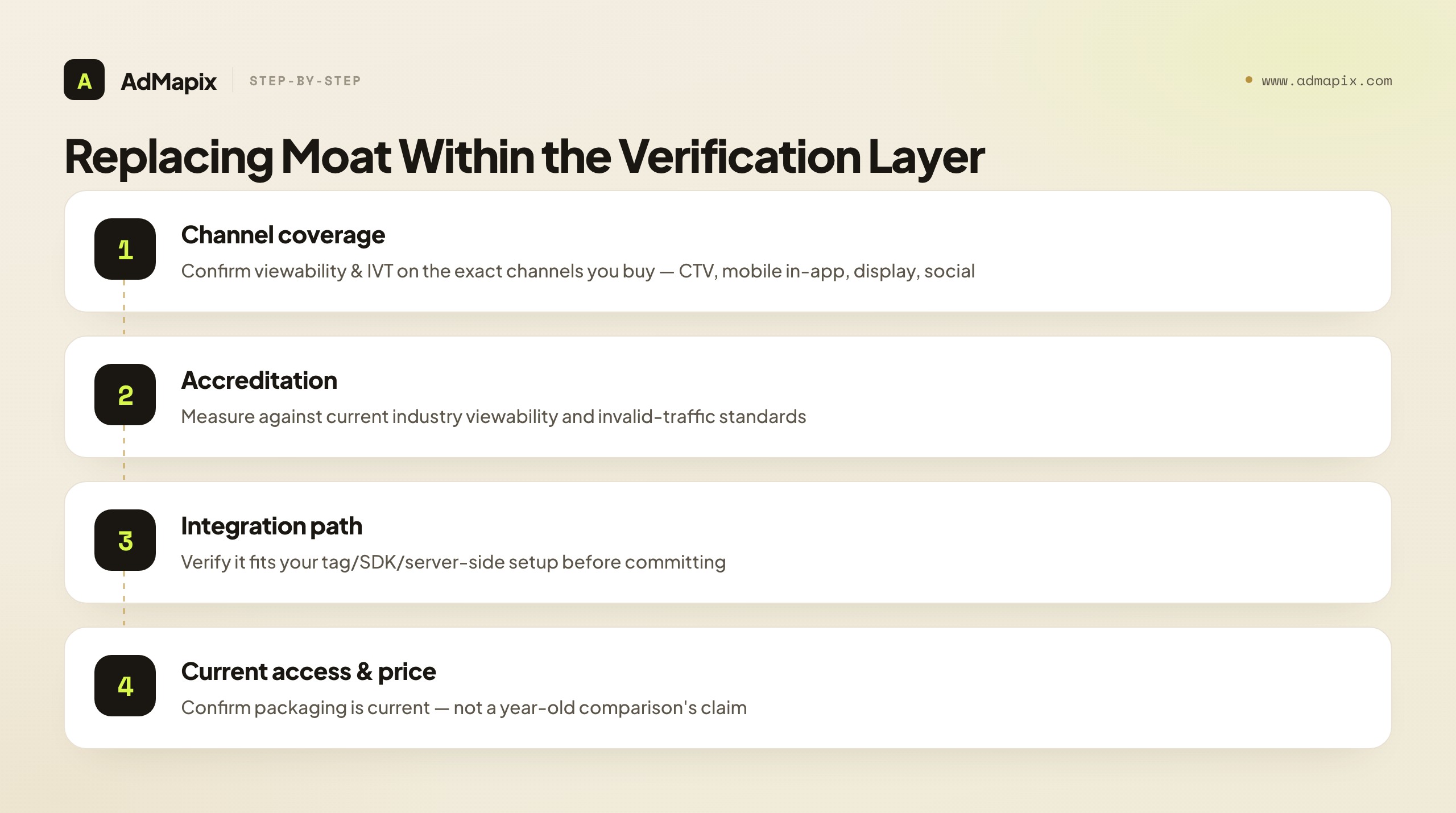
When you evaluate measurement alternatives, a few checks matter more than the marketing page:
- Channel coverage for what you actually buy. Confirm the vendor measures viewability and IVT on the specific channels and formats in your media plan — video, CTV, mobile in-app, display, social. Coverage gaps here are silent failures.
- Accreditation and standards. Verify the vendor measures against current industry viewability and invalid-traffic standards, so your numbers are comparable and defensible to clients and auditors.
- Integration path. Verification has to live in your tag/SDK/server-side setup. Confirm the integration fits your stack and your channels before you commit.
- Current access and pricing. Legacy and enterprise verification products change packaging often, so confirm the access and price are current — not what a year-old comparison post claimed.
AdMapix does not do any of this. It does not measure your impressions, validate your traffic, or score brand safety, and no amount of competitor creative data substitutes for a verification vendor. If verification is your real need, this guide's one job is to send you to the right measurement tool and stop you from buying a creative product that cannot do the work. Everything below is for the other kind of "Moat alternative" searcher.
One more verification-layer reality worth naming: the stakes are often compliance and contractual, not just optimization. Many advertisers commit to viewability and IVT thresholds in their media contracts, and agencies report verified delivery to clients as a condition of the engagement. In that world, a verification gap is not a missed optimization — it is a broken commitment, a make-good, or a damaged client relationship. That is why "just skip verification and rely on the platform's own numbers" is a poor substitute for an independent, accredited vendor: the whole point of third-party measurement is that it is independent of the platform selling you the media. So when you replace Moat in the verification layer, weight independence and accreditation heavily, not just price and coverage. The cheapest measurement tool that produces numbers your clients or auditors will not accept is no bargain at all. This is a different buying calculus from the creative layer, where the worst case of a weak tool is a slower decision, not a contractual breach — another reason the two layers should never be evaluated on the same scorecard.
If You Need Competitor Creative, You Need a Different Tool
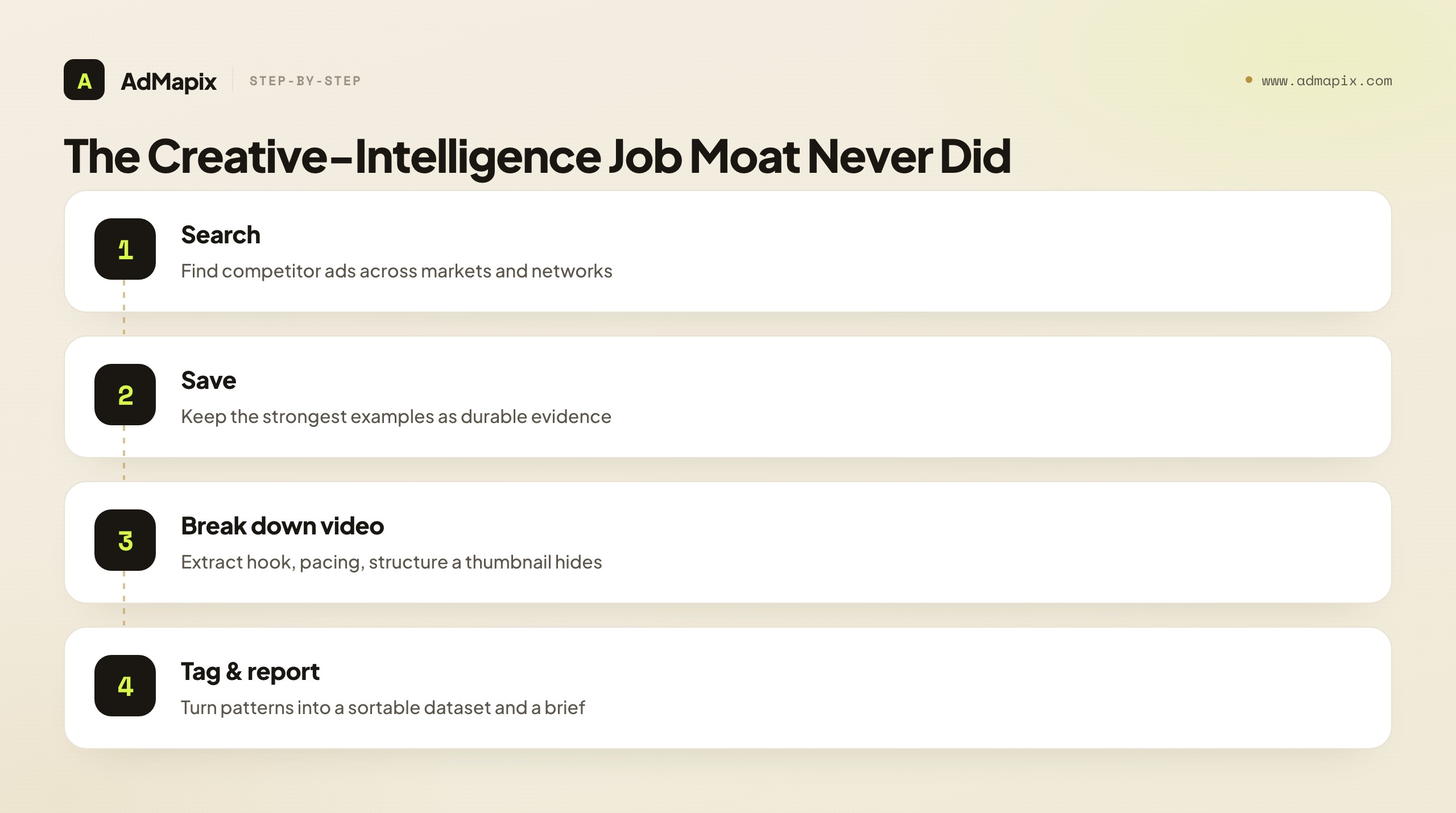
If your problem is "what are competitors running and what should we test," Moat was never built for that, and neither is a verification swap. This is the creative-intelligence layer: searching live ad creatives across networks, breaking down video hooks and structure, saving the strongest examples, tagging them, and turning patterns into a brief or report.

The reason teams conflate the two is that both touch "ads," but the questions are opposite. Verification asks "was my ad seen safely by a real human." Creative intelligence asks "what creative wins, and how do we adapt the pattern." A brand-safety lead and a creative strategist sit in the same marketing org and both say "I need an ad tool," and the famous name they both reach for is Moat — but only one of them is in the right building.
Concretely, the creative-intelligence job looks like this: you search competitor ads across markets and networks, you save the strongest examples as durable evidence, you run video analysis on the ones worth dissecting to extract the hook, pacing, and structure a static thumbnail hides, you tag recurring patterns so a folder becomes a sortable dataset, and you compile the patterns into a brief or a client-ready report. None of that is measurement; all of it is ideation. It is the work of deciding what to make next, fueled by what the market is already responding to — and it is a job Moat, by design, simply does not do.
It is worth being precise about why a verification vendor cannot be bent into this role, because the temptation is real once you are already paying for one. Verification data is about the delivery quality of impressions — was this ad seen, by a human, in a safe place. It has no notion of creative reasoning: it does not know or care whether a hook is a problem-callout or a testimonial, whether a video front-loads the product or the pain, whether an offer is a discount or a bundle. Those are the only questions a creative strategist is actually asking, and they live in a dimension verification never measures. So even a verification tool that happens to show you some creatives — as evidence of what was delivered — cannot give you the searchable, taggable, video-broken-down, report-ready workspace that turns competitor ads into a weekly test plan. The creatives in a verification report are exhibits in a measurement case; the creatives in a creative-intelligence tool are raw material for the next campaign. Same objects, completely different purpose, and only one of them advances a strategist's decision.
There is also a cadence mismatch that reinforces the layer split. Verification is a continuous, background, set-it-and-monitor function — you configure it once and watch the numbers, intervening only when delivery quality dips. Creative intelligence is an active, weekly, hands-on loop — you go looking for what changed, what a rival just launched, what new hook is spreading in your category, and you turn that into a test. A tool built for the first rhythm is wrong for the second, and vice versa. The brand-safety lead wants a quiet dashboard that alerts on anomalies; the creative strategist wants a fast research surface they reopen every week. Trying to serve both rhythms from one product is how teams end up with a tool that is either too heavy for the weekly creative loop or too shallow for the continuous verification one.
Who Should Choose What
The right pick maps to who is making the next decision, not to feature counts. Below is a practical mapping from role to layer.

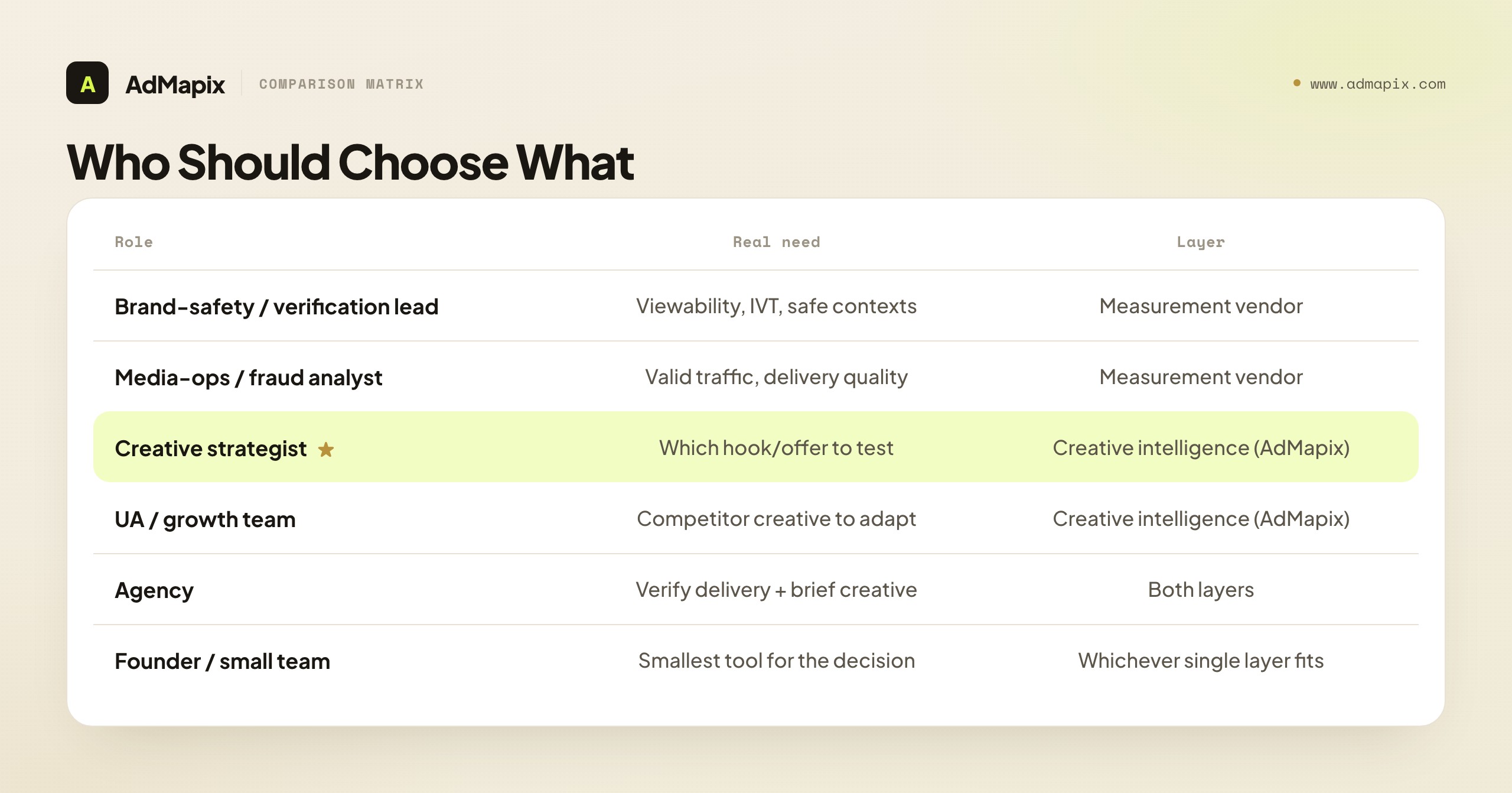
| Team or role | Real need | Better-fit layer |
|---|---|---|
| Brand-safety / verification lead | Viewability, IVT, safe contexts | A measurement vendor (not AdMapix) |
| Media-ops / ad-fraud analyst | Valid traffic, delivery quality | A measurement vendor |
| Enterprise media / planning team | Budget allocation, benchmarking | Spend / media-intelligence suite |
| Creative strategist | Which hook, video, or offer to test | Creative intelligence (AdMapix) |
| UA / growth team | What competitor creative to adapt | Creative intelligence (AdMapix) |
| Agency | Verify delivery and brief creative | Both layers, each for its own job |
| Founder / small team | The smallest tool for the next decision | Whichever single layer fits, not the broadest dashboard |
The split is unusually clean here because the layers barely overlap. If your title or your task is about protecting and measuring your own media, you are a verification buyer and AdMapix is not your tool. If it is about studying competitors and deciding what to create, you are a creative-intelligence buyer and a verification vendor will not help. The agency is the one role that genuinely needs both — and the mature agency carries both deliberately, never expecting one to do the other's job.
A quick self-test if you are unsure which row is yours: ask whose ads you are looking at. If the answer is "my own campaigns — am I getting what I paid for," you are in the verification layer, full stop. If the answer is "my competitors' ads — what are they doing and what should I copy," you are in the creative layer. That one question — whose ads — cleaves the entire market in two and resolves the vast majority of "Moat alternative" confusion in a single sentence. It is more reliable than any feature comparison, because it goes straight to the structural difference the whole category is built on: verification looks inward at your own media, creative intelligence looks outward at everyone else's.
A Practical Migration Plan
Whether you are swapping verification vendors or adding the creative layer, a disciplined test beats a feature-list bake-off. Here is a migration plan that surfaces real fit fast — and note that the test differs sharply depending on which layer you are in.

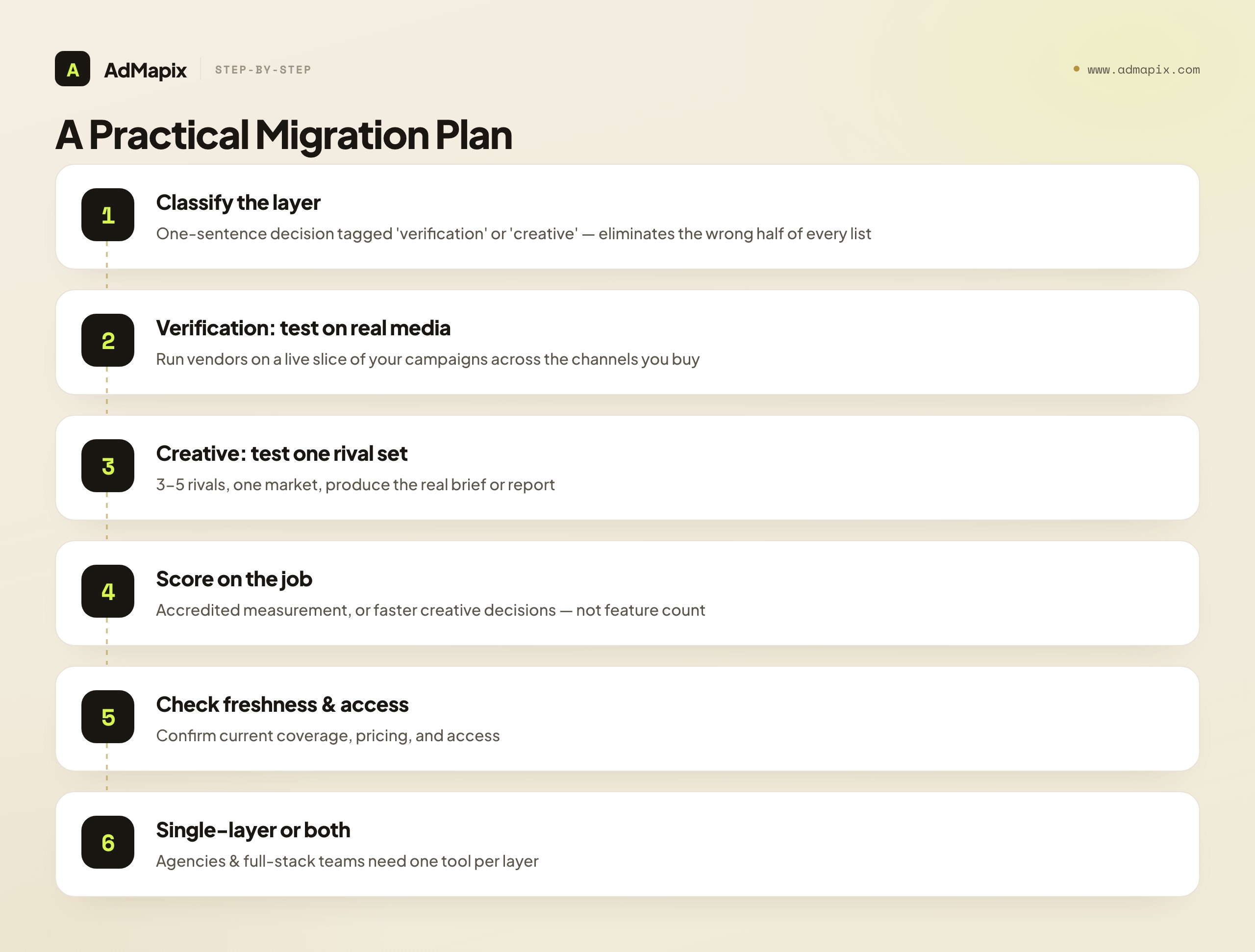
- First, classify your layer. Write your decision in one sentence and tag it "verification" or "creative." "Ensure our CTV impressions are viewable and fraud-free" is verification; "decide which two competitor hooks to test weekly" is creative. This single classification eliminates the wrong half of every "Moat alternative" list immediately.
- For verification: test against your real media. Run candidate measurement vendors on a live slice of your actual campaigns, across the channels you buy, and compare coverage, accreditation, integration effort, and reporting against your current setup. Verification can only be judged on your own traffic.
- For creative: test against one competitor set. Pick three to five rivals in one market and run them through each creative tool, producing the real output you need — a brief or a report. Judge on evidence quality and time-to-decision.
- Score on the job, not the feature list. For verification, the job is trustworthy, accredited, well-integrated measurement on your channels. For creative, it is faster, clearer decisions about what to test. Feature count is noise in both cases.
- Check freshness and access. Confirm current coverage, pricing, and access — especially important for legacy enterprise measurement products that change packaging without much announcement.
- Decide single-layer or both. If you are an agency or a team that genuinely needs to verify delivery and research competitor creative, the honest answer is two focused tools, one per layer — not one tool stretched across both.
The discipline that makes this work is step one. A migration that starts by classifying the layer evaluates each candidate on the only thing that matters — whether it does that layer's job well — instead of comparing a measurement vendor and a creative tool on a single ranking where neither can win the other's criteria.
A Worked Example: Two Teams, Two Right Answers
Abstract frameworks land harder with a concrete case, so here are two teams who both searched "Moat alternative" and arrived — correctly — at opposite destinations.
Team A: a brand-safety and media-ops team at a large advertiser. Their named decision is "ensure our CTV and mobile in-app impressions are viewable, fraud-free, and brand-safe, with numbers we can defend to clients and auditors." They classify the layer immediately: this is verification. They eliminate every creative tool on the "Moat alternative" lists in one stroke — none can measure an impression — and run two candidate measurement vendors against a live slice of their actual campaigns. The scoring is about channel coverage (do they measure CTV and in-app properly), accreditation (are the viewability and IVT numbers to standard), and integration effort (does it fit the existing tag and SDK setup). The winner is whichever measures their specific channels to standard with the least integration pain. Their right answer is a measurement vendor; the creative tools were never in the running, and correctly so.
Team B: a growth team at a DTC brand. Their named decision is "decide which two competitor ad hooks to test each week across three rivals." They classify the layer too: this is creative. They realize Moat was never going to help — it measures their own media, not competitors' creative — so the real question is which creative-intelligence tool gets them to a weekly test decision fastest. They run three rivals in one market through a couple of creative tools, producing the actual brief they need, and pick the one with the strongest evidence and the fastest path to a decision. The enterprise measurement seat they almost bought because "everyone uses Moat" would have been pure waste — it cannot tell them a single thing about a competitor's hook. Their right answer is a creative tool; verification never entered the decision.
The lesson is the entire guide in miniature: the same search term, two completely different correct outcomes, because the decisions lived in different layers. Team A's mistake would have been buying a creative tool to verify media — losing compliance-grade measurement. Team B's would have been buying a verification suite to research competitors — gaining numbers about their own media they did not need and learning nothing about rivals. Classifying the layer first is what saved each of them from the other's error. Write your decision sentence down before you open any tool, and let it eliminate the wrong layer without mercy. The hour you spend writing that one sentence will save you weeks of comparing tools that were never going to solve your problem — and, often, a five-figure annual contract for a capability you did not need.
Building a Two-Layer Marketing Stack
For agencies and full-stack marketing teams, the honest answer is often not "replace Moat" or "skip it" but "run a deliberate two-layer stack" — a verification layer to protect and measure your own media, and a creative-intelligence layer to study competitors and decide what to make. Done well, this is cheaper and far more effective than forcing one tool to span both jobs, which no tool does well because the jobs are structurally opposite.
Start by mapping your recurring decisions to layers explicitly. List what your team actually decides on a cadence — "is our delivery viewable and fraud-free," "are we brand-safe in this new channel," "which competitor hook do we test," "what offer do we counter" — and tag each "verification" or "creative." The tally tells you how much of each layer you genuinely need, and it almost always reveals that the two are non-substitutable: no amount of verification answers a creative question, and no amount of competitor creative answers a verification one. That non-overlap is exactly why a two-layer stack is the mature default, not a redundancy.
Then size each layer to its real usage and connect them at the workflow level, not the data level. The verification layer lives inside your ad-serving path and is owned by media-ops and brand-safety; provision it for the channels you buy and the compliance you owe. The creative layer lives outside your stack and is owned by strategists and UA; provision it for the whole team that researches competitors weekly. You do not need the two tools to integrate technically — you need a habit that hands off between them: verification confirms your media is being delivered cleanly (protecting the spend), and creative intelligence decides what that spend should be put behind next (directing the spend). One keeps the engine clean; the other chooses the destination. A team that runs both deliberately gets the full value of each at a fraction of the cost and confusion of trying to make one famous tool do a job it was never built for.
The budgeting logic follows the cadence. Verification is a smaller-seat, continuous, infrastructure-like cost — a few people configure and monitor it, and its price is justified by the spend and compliance it protects. Creative intelligence is a larger-seat, weekly, distributed cost — every strategist and UA person benefits from access, so it should be priced for the team rather than rationed to one shared login. Getting this allocation right is the difference between a stack that hums and one that fights itself: under-provision the creative layer and your whole team bottlenecks on a single seat; over-provision the verification layer with seats nobody uses and you have simply burned budget. Map the seats to who actually does each job, weekly, and the two-layer stack pays for itself by putting the right capability in the right hands at the right frequency.
What Public Creative Data Can and Cannot Prove
Creative intelligence is observational, so be honest about its limits — and this honesty is doubly important here, because verification buyers are used to accredited, measured numbers and may wrongly expect the same precision from competitor creative data.

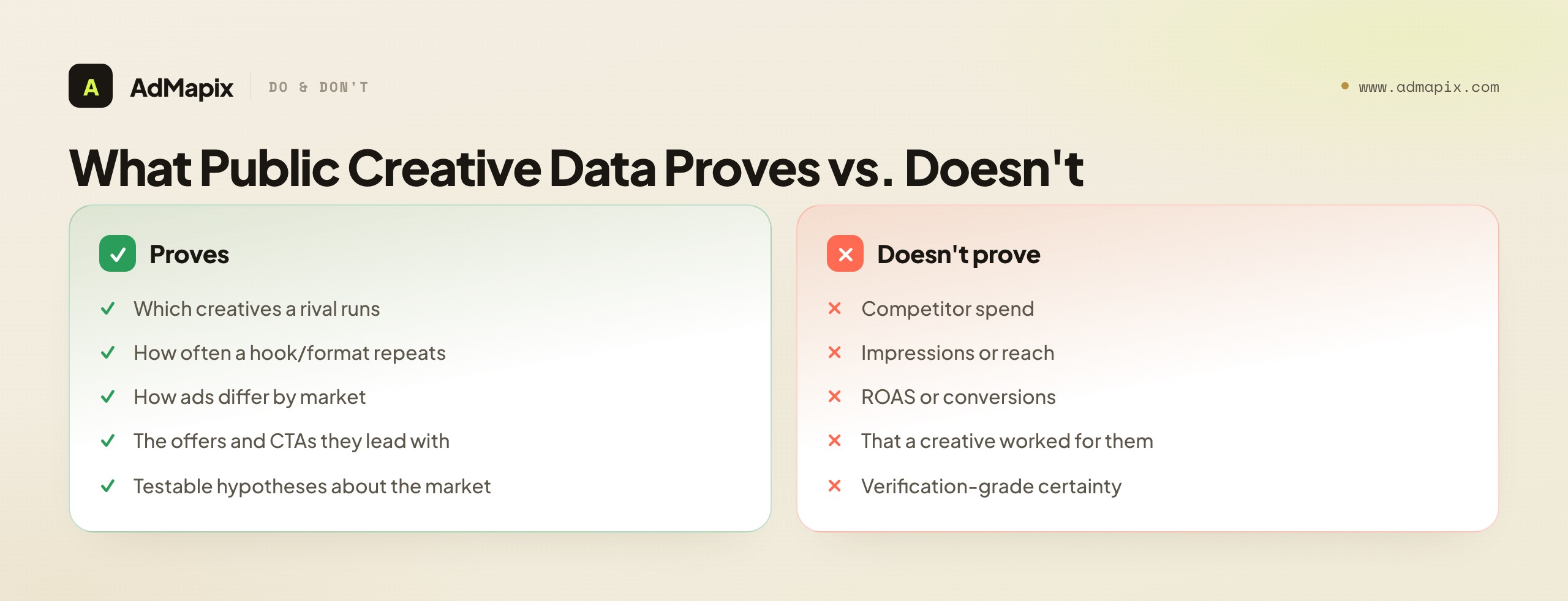
What it proves. A cross-network ad search can show you which creatives a competitor is running, how often a hook or format repeats, how their ads differ by market, and what offers and CTAs they lead with. That is concrete, observed evidence of what ran — enough to build testable hypotheses about what the market is responding to.
What it cannot prove. It cannot show spend, impressions, ROAS, or which creative actually converted for that advertiser, because that data is private and lives in accounts no external tool can reach. A creative that repeats across many variants is a signal — brands rarely keep funding losers — but repetition is a hypothesis to test, not proof of performance.
The honest read. Treat repeated patterns as signals to test on your own account, never as proof of a rival's results, and verify any official product detail directly, since enterprise pages and packaging change without notice. This is a different epistemics from verification: verification produces measured numbers about your own media; creative intelligence produces observed evidence about competitors that you turn into hypotheses. Both are valuable; confusing the certainty of one for the other is how reports lose credibility. Label creative findings as the testable signals they are, and your competitive intelligence stays trustworthy.
This distinction matters most precisely for buyers crossing over from the verification world, so it is worth making explicit. In verification, a number is a measurement: "72% viewable" is an accredited fact about media you ran, defensible to an auditor. In creative intelligence, a finding is an observation plus an inference: "this rival has run the same problem-callout hook across nine variants for two months" is a fact about what is visible, and "therefore it is probably working for them" is an inference layered on top. A verification buyer trained to treat tool output as measured truth can over-trust creative findings, presenting "competitor is winning with this hook" as if it were an accredited number — and then scaling a copied angle that never actually worked. The fix is a habit of evidence-grading: state the observed fact (what is visibly running and how persistently), state the inference plainly as an inference (likely working, worth testing), and let your own test data supply the only measurement that matters for your account. Carry the measurement mindset's rigor into the creative layer, but not its false certainty, and you get the best of both: disciplined claims without fabricated precision.
Common Mistakes When Choosing a Moat Alternative
The failure modes here are unusually clean, because the two layers are so distinct. Naming them is the cheapest insurance against a costly mismatch.

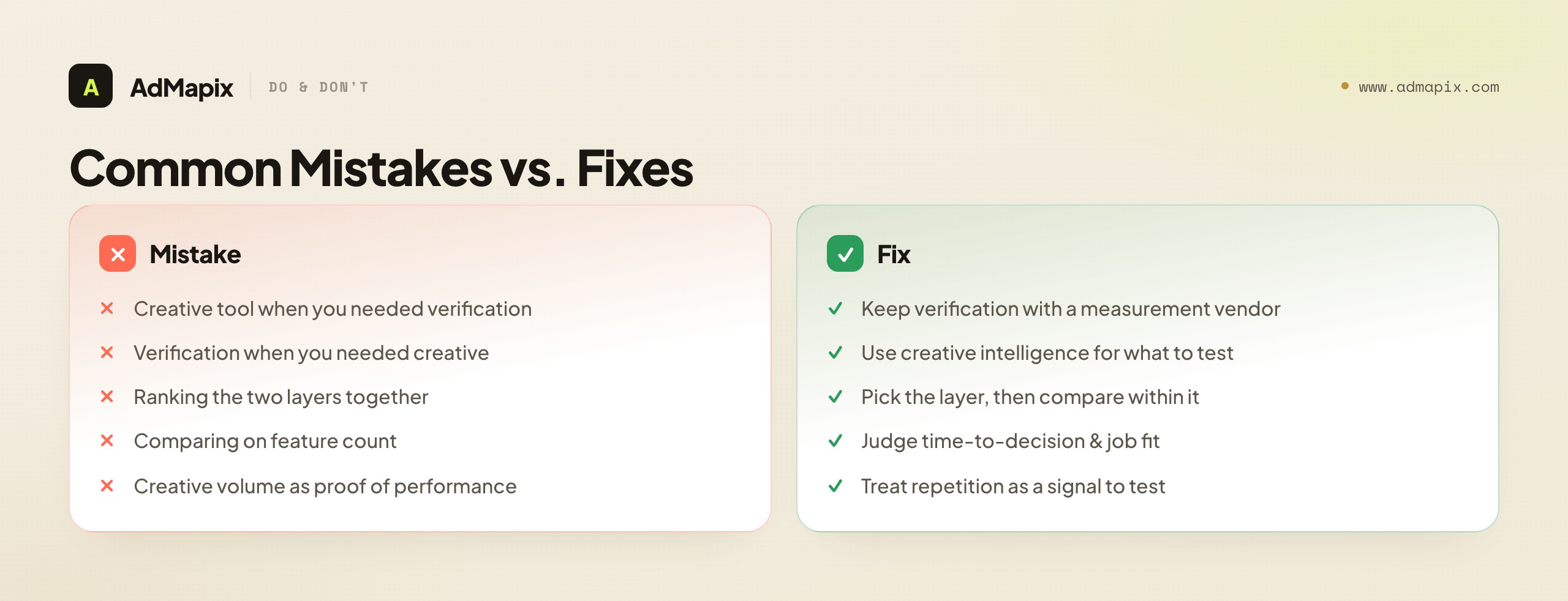
- Replacing Moat with a creative tool when the real need was verification. You lose viewability, IVT, and brand-safety coverage — sometimes with compliance consequences — and gain data you cannot act on for that problem.
- Replacing a creative tool with verification when you actually needed competitor research. Verification tells you nothing about which hook, format, or offer to test next.
- Comparing across layers on a single ranking. A list that ranks measurement vendors and creative tools together is comparing things that solve different problems; pick the layer first, then compare within it.
- Comparing on feature count. Workflow fit and time-to-decision beat long feature lists that span unrelated layers.
- Ignoring legacy access risk. Older measurement brands may still have a live website but unstable, rebundled, or deprecated product access — verify before committing.
- Treating competitor creative volume as proof of performance. Frequent does not mean profitable; it means worth testing.
- Expecting verification-grade certainty from creative data. Observed competitor creative is a hypothesis source, not an accredited measurement.
When to Use AdMapix
Use AdMapix when the missing layer is competitor creative evidence, not ad verification. It is built for creative strategists, agencies, UA teams, and founders who need to search live ad creatives across networks, save the strongest examples as media, break down video hooks and structure, tag what matters, and turn it into a report a client or team can act on.

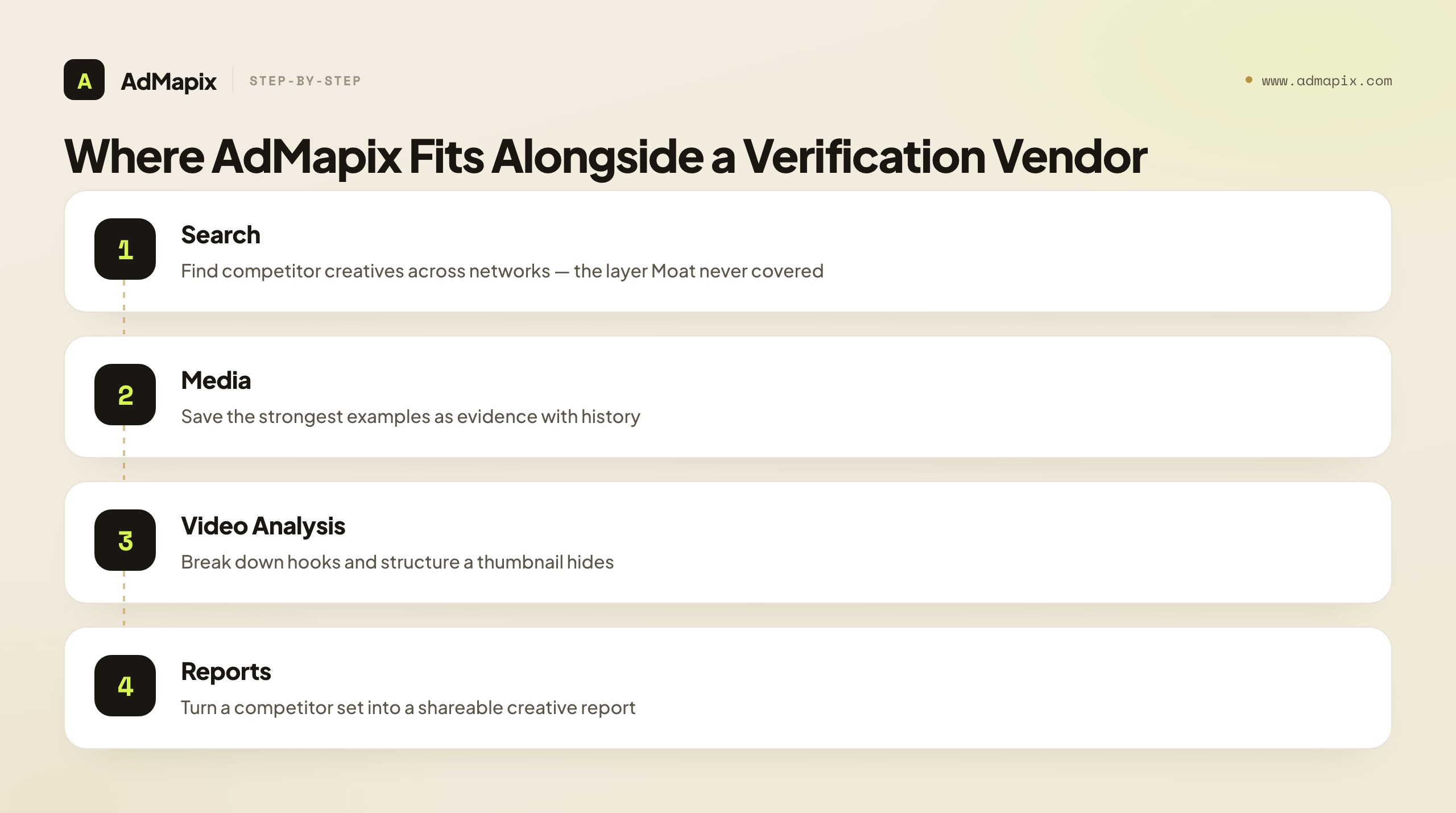
Start broad in Search AdMapix to find competitor creatives across markets, keep the strongest in Media, break down winning ads in Video Analysis, and package findings in Reports. If one competitor set deserves a weekly look, run it once in Search and save the best examples in Media. When it starts saving briefing time, create an account from Login or compare seats on Pricing.
It is explicitly not for you if your problem is viewability, invalid traffic, or brand safety on your own campaigns — that stays with a measurement vendor, and AdMapix does not measure your media, validate your traffic, or score brand safety. The honest positioning is that AdMapix occupies the creative-intelligence layer that Moat never covered, not a cheaper version of the verification layer Moat owns. Many marketing orgs run both: a measurement vendor to verify and protect their own media, and AdMapix to study competitors and decide what to create. The two never overlap, which is exactly why naming your layer first resolves the entire "Moat alternative" question.
Putting It Together: Split the Job, Then Buy
The whole decision reduces to one move made before you look at any tool: split the job. A "Moat alternative" is meaningless until you have decided whether your real need is verifying your own media or researching competitors' creative — because those are two different layers, owned by two different teams, solving two opposite problems. Once you have split the job, the rest is straightforward: if you need verification, replace Moat with another measurement vendor judged on channel coverage, accreditation, and integration; if you need competitor creative, you need a different layer entirely, judged on evidence quality and time-to-decision.
The lists that rank verification vendors and creative tools together are the trap, because they imply a choice between things that do not compete. Refuse that framing. Classify your layer, run the layer-appropriate test, treat any competitor creative data as testable signal rather than measured fact, and accept that an agency or a full-stack team legitimately needs both — one tool per layer, neither stretched to do the other's job. Do that, and you stop buying a famous name and start buying the specific capability your next decision actually requires.
FAQ
What is the best Moat alternative?
There is no single best one, because Moat does verification and measurement. If you need viewability, invalid traffic, and brand safety, pick another measurement vendor and judge it on channel coverage, accreditation, and integration. If you actually need competitor creative research, video-hook analysis, and report-ready evidence, that is a different layer where a tool like AdMapix fits. Classify your decision first; the shortlist follows.
Can AdMapix replace Moat?
Not for verification, and it does not claim to. AdMapix does not measure viewability, validate traffic, or score brand safety. It occupies the layer Moat never had: cross-network ad creative search, saved media, video analysis, tagging, and reports for competitor research. If verification is your need, replace Moat with a measurement vendor; AdMapix complements that vendor on the creative side.
What does Moat actually do?
Moat (Oracle Moat) is digital ad verification and measurement. It reports whether your impressions were viewable, whether traffic was valid (not bot or fraud), and whether your ads ran in brand-safe contexts across video, mobile, display, and branded content. It measures your own media quality; it is not a competitor research or creative swipe-file tool.
Why do teams look for a Moat alternative?
Several reasons: the need was never verification (a creative strategist landed on a famous ad tool by mistake), coverage or packaging changed under Oracle, the verification need outgrew the tool, an enterprise suite is heavier than a small advertiser needs, or a stack consolidation prompts re-evaluation. Only the first reason points away from the measurement layer entirely — and toward the creative-intelligence layer instead.
When should I use both a measurement tool and AdMapix?
Use a measurement vendor to verify your own media — viewability, IVT, brand safety — and a creative-intelligence tool for competitor research. An agency might verify campaign delivery with one and brief creative tests from competitor examples with the other; the two never overlap. That two-layer split is the normal mature stack, not a redundancy.
Does AdMapix data prove a competitor's ads are working?
No. Public creative data shows what is running and how often a pattern repeats, but not spend, impressions, or conversions for that advertiser. Treat repeated hooks and formats as testable signals — brands rarely keep funding losers, so persistence is a useful hint — but validate every pattern against your own account before scaling. It is a hypothesis source, not an accredited measurement.
How is ad verification different from creative intelligence?
They ask opposite questions. Verification asks "was my own ad seen, safely, by a real human," sits inside your ad-serving path, and produces measured viewability and IVT scores for media-ops and brand-safety teams. Creative intelligence asks "what are competitors running and why," sits outside your stack observing public ads, and produces saved creatives and briefs for strategists. One protects spend; the other decides what to make.
How do I test alternatives before committing?
Pick one recurring decision and classify its layer. For verification, run candidate vendors against a live slice of your real campaigns across the channels you buy, and compare coverage, accreditation, and integration. For creative, run one competitor set in one market through each tool and compare evidence quality and time-to-decision. Judge by whether the next action is clearer, not by feature lists.
Is an enterprise measurement suite worth it for a small advertiser?
It depends on your verification need, not your size alone. If you buy channels where viewability and fraud are real risks and clients or compliance demand accredited numbers, verification is non-negotiable — choose a vendor that fits your channels at a sensible price. If your verification need is modest, a lighter vendor may suffice. Either way, that is a separate decision from competitor creative research, which most small advertisers get more day-to-day value from.
Does AdMapix measure brand safety or invalid traffic?
No. AdMapix is a creative-intelligence tool — it searches, saves, analyzes, and reports on observed competitor creatives across networks. It does not sit in your ad-serving path, measure viewability, validate traffic, or score brand safety. Those are verification jobs that require a measurement vendor integrated into your media buying. AdMapix complements such a vendor; it does not replace it.
Key Takeaways
- Split the job first: ad verification (viewability, IVT, brand safety) and competitor creative research are two different layers for two different teams.
- Replace Moat with a measurement vendor when the decision is viewability, invalid traffic, or brand safety — judged on channel coverage, accreditation, and integration.
- Use a creative-intelligence tool like AdMapix when the decision is competitor ad search, video hooks, and report-ready creative evidence.
- Run a layer-appropriate test: verification against your own live media, creative against one competitor set in one market.
- Treat public creative patterns as hypotheses to test, never as proof of a rival's results — and never expect verification-grade certainty from observed competitor data.
Related Reading
- Best Ad Spy Tools 2026 — a broader roundup of creative-intelligence and ad-spy tools across categories.
- Best Ad Intelligence Tools — how the measurement, spend, and creative layers map across the market.
- Pathmatics Alternative in 2026: Ad Spend Intelligence vs. Creative Workflow — the parallel buyer's framework for the spend-intelligence layer.
- Ad Spy Tools by Channel: Meta, TikTok, Google, YouTube, Native — how coverage differs across networks when comparing creative tools.
- Advertising Intelligence Guide — how the layers of ad intelligence fit together end to end.
Sources
Official pages were checked as of June 21, 2026. Product naming, access, pricing, and coverage for enterprise measurement tools can change without notice — verify current details before committing a stack.
- Oracle Moat Analytics demo — describes advertising-performance insight across video, mobile, display, and branded content, with viewability, invalid traffic, and brand-safety measurement.
- Oracle Moat acquisition release — Oracle's announcement framing Moat as a digital-measurement and marketing-data-cloud addition.
- Oracle Advertising overview — the broader Oracle advertising-and-measurement context Moat sits within.
Turn these observations into your next creative study
Open the creative library and select samples for your market, network and research question.
Related Articles
WhatRunsWhere Alternative in 2026: Legacy Media-Buying Intelligence or Modern Creative Research?
A complete 2026 buyer's guide to choosing a WhatRunsWhere alternative — why teams look past this legacy media-buying tool, what it actually does (display, native, and mobile placements and publisher paths), the three layers of competitive intelligence, the legacy-access risk to check first, how to evaluate alternatives, who should choose which, a migration plan, the honest limits of public ad data, and where a modern cross-network creative tool like AdMapix fits.
Pathmatics Alternative in 2026: Ad Spend Intelligence vs. Creative Workflow
A complete 2026 buyer's guide to choosing a Pathmatics alternative — why teams look past Pathmatics (now Sensor Tower), what it actually measures, a layered comparison of spend-intelligence suites versus creative-workflow tools across coverage, data type, price, and fit, who should choose which, a practical migration plan, the honest limits of estimated spend, and where a lighter cross-network creative tool like AdMapix fits.
Semrush Ad Intelligence Alternative in 2026: PPC Research or Creative Evidence?
A 2026 decision framework for choosing a Semrush ad intelligence alternative — when PPC keyword and spend research wins, when competitor creative and video evidence wins, how AdClarity fits, a fair-trial method, and how to build a two-layer stack.