
Competitor Ad Analysis in 2026: The 5-Dimension Framework, Templates & SOP
A complete competitor ad analysis playbook for 2026 — a 5-dimension scoring framework, a 10-question creative teardown checklist, ready-to-use Notion and Airtable templates, a weekly-to-quarterly SOP, and the Meta Ad Library impressions shortcuts that make competitive ad research up to 60% faster.
By the AdMapix Research Team — Updated April 16, 2026
Competitor ad analysis is the structured study of the creative, messaging, channel, budget, and funnel signals your rivals leak through their paid media — and in 2026 it is no longer optional. Creative fatigue has compressed the average Meta ad lifespan to 7–9 days, so the brand that decodes what is working in the market this week ships winners while everyone else recycles last quarter's hooks. This guide gives you a complete, repeatable system: a 5-dimension scoring framework, a 10-question creative teardown checklist, ready-to-use Notion and Airtable templates, a daily-to-quarterly SOP, a tools stack mapped to budget, and the 2026 Meta Ad Library impressions shortcuts that cut research time by up to 60%.
<!-- FIG out=fig1.jpg -->We've analyzed tens of thousands of competitor ad sets across DTC, SaaS, and subscription verticals, and the same pattern keeps emerging: teams that "spy on competitors" without a framework drown in screenshots and never ship. Teams that treat competitor advertising as signal intelligence — structured, dimensional, repeatable — ship three to five winning variants every quarter. The difference isn't access to data. Everyone can open the Meta Ad Library. The difference is methodology. This is the methodology, written so you can copy it into your own stack today.
TL;DR — Competitor Ad Analysis in One Screen
- Competitor ad analysis is the structured extraction of creative, messaging, channel, budget, and funnel signals from rivals' paid media, turned into testable hypotheses for your own campaigns. It is not copying hooks or hoarding screenshots.
- Use the 5-dimension framework — Creative, Messaging, Channel, Budget, Funnel — as a scoring rubric, not a vibe check. Score each competitor 1–5 per dimension so comparisons are numeric and week-over-week.
- Run the 10-question creative teardown on any new competitor in under 30 minutes to extract signal fast.
- Operate on a cadence: daily 15-min surveillance, weekly 2-hr deep dive, monthly half-day rollup, quarterly hypothesis-hit-rate review.
- The free stack (Meta Ad Library + Google Ads Transparency Center + TikTok Creative Center) covers ~80% of needs; the 2026 impressions filter is the single biggest time-saver.
- Every row in your analysis sheet must produce at least one row in your test backlog — analysis that doesn't ship is cosplay.
What Competitor Ad Analysis Actually Is (and Isn't)
Competitor ad analysis is the structured process of extracting creative, messaging, channel, budget, and funnel signals from your competitors' paid media activity, then turning those signals into testable hypotheses for your own campaigns. It is not copying their hooks, stealing their visuals, or a once-a-quarter audit. Done well, it's a recurring rhythm that informs your weekly sprint, not a dusty PDF that nobody reopens.
What it isn't: a dump of screenshots, a "top 10 best ads" listicle, or a one-time swipe file. Those have value as reference, but they're artifacts, not analysis. Analysis requires a frame — asking specific questions against specific dimensions and recording the answers in a structure you can compare week-over-week.
What it is: a disciplined practice of observation plus inference. You observe what competitors show publicly. You infer what those observations mean about their budget, audience hypothesis, funnel, and strategy. You record both layers and revisit them as fresh data rolls in. The inferred layer — what we call "Our Read" in the templates below — is where most teams leave value on the table, because they stop at "here's their ad" instead of asking "and therefore they believe X about their buyer."
<!-- FIG out=fig2.jpg -->The patterns we see across high-performing accounts: they treat every competitor ad as a data point in a time series. A single creative screenshot tells you almost nothing. The same creative still running on day 45 while two sibling variants got killed tells you a lot. The analysis lives in the shape of the series, not the individual ad. This is also why "ad creative analysis" done as a one-off — pull a screenshot, admire it, move on — fails: you've sampled one frame of a movie and tried to review the plot.
There's a vocabulary distinction worth nailing down, because people use these terms interchangeably and then talk past each other:
- Competitor ad analysis is the umbrella: all five dimensions across all platforms over time.
- Ad creative analysis (or ad creative teardown) is the deep-dive on Dimension 1 — hooks, visuals, formats, pacing of one ad or one competitor's whole creative library.
- Competitive ad research is the discovery phase: finding which competitors and which ads even deserve a teardown.
- Ad messaging framework is the structured way you tag and cluster Dimension 2 — pain points, value props, proof, CTA — so messaging patterns become visible across a category.
This guide covers all four, but the through-line is the same: structure beats access. Let's build the structure.
The 5-Dimension Framework (and How to Score It)
Most competitor research collapses into "here's a screenshot of their Facebook ad." That's one dimension out of five. Our framework forces you to look at the full picture — Creative, Messaging, Channel, Budget, Funnel — and it's the backbone of every template, checklist, and SOP in this guide.
The upgrade in this version: don't just describe each dimension — score it. For every competitor, rate each of the five dimensions on a 1–5 scale (1 = weak/sloppy, 5 = best-in-class). The total (out of 25) gives you a single number to rank threats, and the per-dimension breakdown tells you exactly where a competitor is strong and where they're exposed. A competitor scoring 5/5 on Creative but 2/5 on Funnel is leaking conversions you can win on landing-page craft. The scoring rubric is what turns "they have nice ads" into "they out-execute us on hooks but their LP is beatable."
<!-- FIG out=fig4.jpg -->Dimension 1: Creative — Hook, Visual, Length, Tone
What you're looking for: the first three seconds (the hook), the format (static, carousel, reels-style video, UGC talking-head, mixed-media), duration (6-second punch vs. 30-second story vs. 90-second education), and emotional tone (urgency, empathy, humor, authority, curiosity).
Where to find it: Meta Ad Library's video preview, TikTok Creative Center's trending ads, Google Transparency Center's video tab, and paid spy tools like Foreplay or SwipeKit that let you filter by hook type. The Meta Ad Library's 2025.12 update added an impressions-sorted view, which surfaces the heaviest-rotated creatives first — start there, not with "newest."
What it tells you: which hook archetype is winning your category this quarter, how your competitor is pacing creative tests (one new variant per week or ten), and whether they've locked on a winner (same creative with multiple aspect-ratio cuts, or same script with three different presenters).
Scoring rubric (1–5): 1 = one stale static running 60+ days, no hook discipline. 3 = consistent format, occasional hook tests, mixed production quality. 5 = clear hook archetypes, weekly variant cadence, multiple presenters/formats per winning angle, obvious systematic testing.
Red flags: a competitor running the same creative for 60+ days with no variants is either testing staying power or, more often, ran out of assets and never refreshed. Don't assume longevity equals performance. Cross-reference with the impressions tier before you crown a "winner."
Dimension 2: Messaging — Pain Point, Value Prop, CTA, Proof
What you're looking for: the pain point positioned (explicit or implied), the value proposition (feature-led, outcome-led, identity-led), the call to action (free trial, shop now, learn more, book demo, quiz), and the proof elements (user counts, testimonials, press logos, before/after, founder story, scientific claims).
Where to find it: read the ad copy line-by-line — primary text, headline, description. Then the landing page. Messaging that shifts between ad and LP is either intentional (broad ad → targeted LP) or sloppy (mismatch tanks conversion). Both are signal.
What it tells you: this is where you decode their audience hypothesis. "Tired of…" opens pain-aware buyers. "Imagine if…" speaks to upstream dreamers. Three testimonials at three different price points signals an ambiguous ICP. Patterns we see: challenger brands lean outcome-led, category leaders lean identity-led, agency tools lean feature-led. Building an ad messaging framework — a fixed taxonomy of pain / promise / proof — is what lets you spot when an entire category is shifting its positioning at once.
Scoring rubric (1–5): 1 = generic "best [product] ever," no clear pain or proof. 3 = one consistent value prop, some proof, CTA matches funnel stage. 5 = sharp pain-aware hooks, layered proof (data + social + authority), CTA segmented by awareness stage, messaging that maps cleanly to a defined ICP.
Red flags: over-indexing on promo codes (constant 40% off) signals margin panic, not clever positioning. A CTA that never changes across 50 creatives suggests a narrow funnel — either great focus or an inability to monetize anything else.
Dimension 3: Channel — Platform Mix, Spend Cadence, Seasonal
What you're looking for: which platforms they're live on (Meta, Google Search, Google Display/Demand Gen, YouTube, TikTok, LinkedIn, Pinterest, Reddit), the ratio of spend across those platforms (inferred from variant density and impressions tier), spend cadence (always-on vs. campaign bursts), and seasonal patterns (do they 4× their Meta footprint every Black Friday, then go dark in January).
Where to find it: Meta Ad Library covers Facebook, Instagram, Messenger, WhatsApp (new 2026 filter). Google Ads Transparency Center covers Search, Shopping, Display, YouTube. TikTok Creative Center shows TikTok. LinkedIn has an "Ads" tab on every Company Page. For Pinterest and Reddit, paid spy tools are most reliable. Cross-reference Similarweb's paid-keyword data for Search-heavy competitors.
What it tells you: channel mix reveals strategy. A pure-Meta competitor is either early-stage DTC or skipping intent channels. A pure-Google-Search competitor rides category demand and is probably weak on creative. A balanced 40/40/20 Meta/Google/TikTok mix is a mature brand with figured-out cross-channel attribution. Cadence tells you budget rhythm — always-on means predictable finance, burst means agency retainers or lumpy board-level budgeting.
Scoring rubric (1–5): 1 = single platform, reactive bursts. 3 = two platforms, mostly always-on, some seasonal logic. 5 = deliberate multi-platform mix with channel-specific creative, always-on base plus disciplined seasonal scaling, clear evidence of cross-channel attribution.
Red flags: PMax and Search Partner noise — don't treat every "Google ad" as core Search. Tools that don't separate PMax Search Partner placements inflate Google spend by 20–40%. Seasonal blitzes (random 3-week TikTok splurges) are often agency pitches that didn't renew, not strategic shifts.
Dimension 4: Budget Signals — Run Days, Variant Count, Impressions
What you're looking for: how long each ad has been running (start date on Meta Ad Library), total variant count (unique creatives running in parallel), impressions tier (<1K, 1K–10K, 10K–100K, 100K–1M, 1M+), Google Transparency Center payer-name disclosure (often reveals the parent entity funding the spend, especially useful for agency-managed accounts), and spend trajectory (are they adding creatives or shedding them).
Where to find it: Meta Ad Library shows launch date and impressions tier directly. The 2026 impressions filter lets you sort by tier — use it. Google Ads Transparency Center now defaults to showing payer-name, so a small brand with a big holding-company payer tells you they've been acquired or are VC-backed. For variant count, tally every active ad in the library.
What it tells you: this is the most abused dimension in competitor research — and the most valuable. A brand running 40 parallel variants is in aggressive testing mode, meaning they haven't found their winner (or just found one and are cloning it). A brand running two variants for 90 days has a killer and is milking it. Impressions tier plus run days gives you a spend proxy: a 1M+ tier × 30 days ≈ six figures on that single creative.
Scoring rubric (1–5): 1 = a handful of low-impression ads, no read on intent. 3 = visible testing, mixed impression tiers, some long-runners. 5 = clear winner-and-test structure (2–3 long-running 100K+ tier ads plus a rotating test cohort), payer-name reveals serious backing, obvious budget discipline.
Red flags: Meta's <100 impressions badge (new 2026) surfaces dev/test ads that never got real budget — not strategic signal. Bot traffic inflated February 2026 impressions on some smaller advertisers by 15–25% per PPC Land's investigation — cross-reference sibling creatives before calling a winner. And "paused-ad ghosts" show as active when paused at the ad-set level — verify with variant-density patterns.
<!-- FIG out=fig6.jpg -->Dimension 5: Funnel — Landing Page, Offer, Proof, Friction
What you're looking for: the landing page the ad points to (dedicated LP, PDP, homepage, blog-style advertorial), the offer match between ad and LP, social-proof placement (above fold, below fold, floating), form friction (email-only, email + phone, multi-step, quiz-gated), and post-click remarketing signals (do they retarget you within 24 hours, what's the retargeting creative angle).
Where to find it: click every competitor ad from a clean browser or lightweight VM (to avoid polluting your ad profile). Record the destination URL, screenshot the LP, note the above-fold offer, count form fields. For retargeting, let a cookie ride 48 hours on a dummy profile and track what creatives follow you. Visualping or weekly manual review works for LP-change tracking.
What it tells you: the ad is a promise. The LP is the proof. Mismatch is where budgets leak. Advertisers report that competitors maintaining tight ad-to-LP coherence (same hero, headline, offer wording) convert at 1.5–2× the rate of those who don't. Offer type reveals funnel focus: quizzes signal high-AOV considered purchases, direct PDP links signal impulse SKUs, email-gated magnets signal top-of-funnel list-building.
Scoring rubric (1–5): 1 = ads dump to homepage, no message match, generic form. 3 = dedicated LPs, partial message match, reasonable friction. 5 = pixel-tight ad-to-LP coherence, social proof above fold, friction calibrated to offer value, evidence of a structured retargeting sequence.
Red flags: an LP static for six months while ads rotate weekly means uncoordinated paid and LP ownership — often agency-paid, in-house LP, poor handoff. That's an opportunity, not a playbook to copy. Watch for LPs with three different offer stacks in one scroll: they don't know what's converting and they're throwing spaghetti.
Putting the Scores Together
Once you've scored all five dimensions for each competitor, you have a 5-number fingerprint per brand and a total out of 25. Three ways to use it:
- Rank threats by total. The 22/25 competitor deserves your weekly deep dive; the 11/25 competitor gets a monthly glance.
- Find your wedge by the lowest dimension. A category leader scoring 5/5/5/5 on Creative-Messaging-Channel-Budget but 2/5 on Funnel is telling you exactly where you can win: build a tighter ad-to-LP experience and steal their leaking conversions.
- Track the trajectory. Re-score monthly. A competitor whose Creative score jumps from 2 to 4 in 60 days just hired or signed an agency — and is about to get harder to beat. Move before the gap widens.
A useful way to visualize the scored set is a 2×2 of execution quality (their total score) against threat to your position (overlap with your ICP and channels). It tells you not just who's good, but who's good and aimed at you — the brands that belong in your weekly rotation versus the ones you can safely monitor monthly.
<!-- FIG out=fig3.jpg -->The 10-Question Creative Teardown Checklist
This checklist is the fastest way to extract signal from a competitor you've never analyzed before. It's also the operational core of an ad creative teardown — run through all ten in under 30 minutes per brand and you'll have a defensible read on their strategy.
<!-- FIG out=fig5.jpg -->- How long has their top-performing ad been running? Anything >30 days at a 100K+ impressions tier is a validated winner. Reverse-engineer why.
- How many creative variants are running in parallel right now? <5 means focus or starvation. 5–15 is healthy testing. 40+ is either a massive budget or a team that hasn't found its winner.
- Which platform gets the highest variant density? That's where their best creative team lives. That's also the platform they believe in most.
- Has their hook archetype shifted in the last 30 days? A visible shift (problem → testimonial, or static → UGC) is a tell: either the previous hook fatigued, or a new growth hire rewrote the playbook.
- Are they entering any new channel? First-time TikTok Creative Center appearances for a Meta-first brand usually signal either a new hire or a new agency engagement. Either way, budget is flowing there now.
- Has their offer changed? Price drops, bundle changes, free-shipping thresholds — these appear in ad copy before the website banner updates. Spot them first.
- Have they added or changed landing pages? Use Visualping or manual checks. An LP change plus a variant spike in the same week is a full-funnel launch, not a test.
- How is their proof escalating? Brands under pressure escalate proof (more testimonials, bigger user-count claims, stronger press logos). De-escalation signals confidence or complacency.
- Are they expanding geographically? Meta Ad Library country filters and localized creative variants tell you when a brand is testing a new market. If you operate there, they're about to be your problem.
- How dependent are they on UGC / creators? Count the creator ads as a share of total. Heavy UGC dependency is a strength and a fragility — when the creator pipeline breaks, creative velocity collapses.
The checklist's power isn't in any single question. It's in running all ten across three competitors and spotting where everyone is converging. That convergence is where your next test lives. For the "find winners" side of this workflow, our find winning products via Facebook Ads Library guide covers product-discovery specifically.
A Worked Teardown (Annotated)
To show the checklist in motion, here's a condensed teardown of a hypothetical mid-market sleep-aid DTC brand, "RestCo" (composite, anonymized from real Q1 2026 accounts):
| # | Question | Observation | Inference |
|---|---|---|---|
| 1 | Top ad run days | One UGC video, 47 days, 1M+ tier | Validated winner — dissect the hook |
| 2 | Parallel variants | 38 active | Aggressive testing; not yet consolidated |
| 3 | Highest variant density | TikTok (22 of 38) | Best creative team is on TikTok |
| 4 | Hook shift in 30 days | Product-feature → "new-parent survival" | Category repositioning underway |
| 5 | New channel | First YouTube Shorts ads this month | Budget expanding; new hire or agency |
| 6 | Offer change | Added "first month free" | Moving to subscription LTV play |
| 7 | LP change | New quiz-gated LP, same week as variant spike | Full-funnel launch, not a test |
| 8 | Proof escalation | Added "47,000 parents" counter | Under growth pressure, leaning on scale proof |
| 9 | Geo expansion | New UK + AU localized variants | Testing English-language expansion |
| 10 | UGC dependency | 71% of creatives are creator UGC | Strength now, fragility if pipeline breaks |
Read across the rows and a strategy snaps into focus: RestCo is repositioning from "better sleep" to "survive newborn life," scaling spend into TikTok and YouTube Shorts, moving to a subscription model, and leaning hard on UGC. The single most actionable cell is row 4 — the category is shifting its messaging frame, and there's a first-mover window for anyone who moves within 30 days. That's not a screenshot. That's intelligence.
Analysis Templates (Notion / Airtable / Feishu Schemas)
Three tables run the whole system. Copy these schemas into Notion, Airtable, or Feishu Base — whichever your team uses. The non-negotiable column in all of them is Our Read / Our Hypothesis: the inference layer. Without it you've built a screenshot graveyard.
Table 1: Creative Matrix
One row per unique creative. This is your ledger.
| Field | Type | Purpose |
|---|---|---|
| Competitor | Link (brand table) | Pivot dimension |
| Ad ID | Text | Meta library ID or equivalent |
| Launch Date | Date | Signals testing cadence |
| Run Days (live) | Formula | TODAY() − Launch Date |
| Format | Select (static / carousel / short video / long video / UGC / founder) | Creative-type analysis |
| Hook Archetype | Select (problem / question / stat / testimonial / demo / offer) | Hook pattern tracking |
| Duration (sec) | Number | Only for video |
| Tone | Multi-select (urgency / empathy / humor / authority / curiosity) | Emotional positioning |
| Impressions Tier | Select (<1K / 1–10K / 10–100K / 100K–1M / 1M+) | Spend proxy |
| Variant Group | Text | Group sibling creatives for aspect-ratio/localization cuts |
| Screenshot | Attachment | Evidence |
| Our Read | Long text | Inference layer — what this tells you |
Table 2: Messaging Theme Cluster
One row per theme (pain → promise → proof triad). Creatives get tagged into themes. This table is your living ad messaging framework.
| Field | Type | Purpose |
|---|---|---|
| Theme Name | Text | e.g., "Sleep debt for new parents" |
| Pain Point | Long text | Explicit or implied |
| Value Prop | Long text | Feature / outcome / identity framing |
| CTA | Select | Shop / learn / book / try / quiz |
| Proof Elements | Multi-select | Testimonial / press / data / founder / UGC |
| Competitors Using | Link (multi) | Everyone running this theme |
| First Observed | Date | Theme-emergence timestamp |
| Our Hypothesis | Long text | Test idea this theme suggests |
Table 3: Channel Map
One row per competitor per platform per month — a heatmap over time.
| Field | Type | Purpose |
|---|---|---|
| Competitor | Link | Pivot |
| Platform | Select | Meta / Google Search / Google DG / YouTube / TikTok / LinkedIn / Pinterest |
| Month | Date | Monthly bucket |
| Active Variants | Number | Count in that month |
| Spend Tier (est.) | Select (low / med / high / very high) | Inferred from impressions + variant count |
| Cadence | Select (always-on / burst / seasonal) | Rhythm |
| Geo Focus | Multi-select | Key markets |
| Notable Shift | Long text | Anything new vs. prior month |
Table 4: Dimension Scorecard
The fourth table is the one that turns the framework into a ranking system. One row per competitor, re-scored monthly.
| Field | Type | Purpose |
|---|---|---|
| Competitor | Link | Pivot |
| Creative (1–5) | Number | Dimension 1 score |
| Messaging (1–5) | Number | Dimension 2 score |
| Channel (1–5) | Number | Dimension 3 score |
| Budget (1–5) | Number | Dimension 4 score |
| Funnel (1–5) | Number | Dimension 5 score |
| Total (/25) | Formula | Sum — threat ranking |
| Weakest Dimension | Formula | MIN() — your wedge |
| Score Date | Date | Trajectory tracking |
| Trajectory Note | Long text | What moved since last score |
All four tables link to each other via the Competitor record. When a stakeholder asks "what's Brand X doing on TikTok this month," you filter Channel Map. When they ask "who else is running the founder-story pain hook," you filter the Messaging Theme Cluster. When they ask "who's our biggest threat right now," you sort the Scorecard by Total. The structure is the leverage.
Step-by-Step: Running a Full Analysis (Daily → Quarterly Cadence)
A framework without a rhythm is a poster on a wall. Here's the cadence that works in operational accounts — and why each tier exists.
<!-- FIG out=fig7.jpg -->Daily (15 min) — Surveillance. Open Meta Ad Library and Google Ads Transparency Center. Filter to your top 3–5 competitors. Sort by "newest." Scan for new launches only — ignore creative you've already logged. Flag significant shifts (new product, new offer, new platform). This is pattern surveillance, not analysis. The goal is to never be surprised, not to be thorough.
Weekly (2 hr) — Deep dive. Deep-dive into one competitor per week on rotation. Pull everything they've launched in the last 7 days across all five dimensions. Fill out the Creative Matrix, Messaging Theme table, and Channel Map. Re-score them on the Dimension Scorecard. Add three testable hypotheses to your backlog. One competitor per week means a 4–5 brand set gets a full teardown roughly monthly without burning a day.
Monthly (half-day) — Rollup. Roll up into a one-page strategy doc — three threats, three opportunities, next two weeks of tests. Pull the Scorecard totals and trajectories. Share with creative, media buying, and leadership. The monthly rollup is the artifact that turns analysis into action. Without it, your weekly notes become a graveyard nobody reads.
Quarterly (full day) — Hit-rate review. Review the hypothesis → test → outcome loop. Of the hypotheses you pulled this quarter, how many did you actually test? How many won? Accounts that track this number explicitly converge on 25–40% hit rates within two quarters — 3–5× higher than teams testing without structured competitor input. This is the tier that proves the whole system pays for itself.
The Surveillance-vs-Analysis Distinction
The most common failure mode is collapsing all four tiers into "I check the Ad Library sometimes." Surveillance (daily) and analysis (weekly+) are different jobs. Surveillance is cheap, shallow, and constant — its only output is a flag. Analysis is expensive, deep, and scheduled — its output is a scored teardown and hypotheses. Mixing them means you either over-analyze noise (every new ad gets a full teardown, you burn out in two weeks) or under-analyze signal (you "keep an eye on" competitors and never produce a hypothesis). Keep them separate and the system runs for years.
Data Collection: Where the Signals Live
The free stack covers 80% of needs. The paid stack accelerates the other 20%.
Meta Ad Library (facebook.com/ads/library) is ground truth for Meta-family placements. In 2026, the two key updates are the impressions-sorted filter (Dec 2025) and the WhatsApp platform filter (Jan 2026). Use impressions sort to surface heavily-rotated creative instead of wading through noise. New to the library? Our complete guide to the Facebook Ads Library covers every filter, every 2026 update, and the Page-ID search trick that pins a competitor exactly.
Google Ads Transparency Center (adstransparency.google.com) now defaults to showing payer-name, letting you trace ad spend back to parent entities and holding companies. Useful for agency-run DTC brands and conglomerate pressure.
TikTok Creative Center (ads.tiktok.com/business/creativecenter) gives trending ads by region and category. Trend velocity has compressed to ~7 days in 2026 (from 30 pre-2024), so refresh frequently.
LinkedIn Ads tab sits on every Company Page (Posts → Ads). It's the most under-used free source for B2B competitor research — most teams forget it exists.
Paid tools fill what public libraries can't — historical archives, cross-platform unification, team collaboration. For paid options with pricing, see our best ad spy tools 2026 breakdown. For end-to-end spy workflows, our how to spy on competitors' ads in 2026 walks through the full stack. Need coverage beyond Meta (TikTok, YouTube, LinkedIn, Reddit, Pinterest)? Our spy on ads across all platforms guide maps the tool-to-platform matrix.
Decoding the Creative Dimension: A Hook-Archetype Library
Because Dimension 1 (Creative) is where most "ad creative analysis" actually happens, it deserves its own decoder. Across tens of thousands of teardowns, winning hooks cluster into a small number of archetypes. Tag every competitor creative with one of these and patterns become legible fast.
| Hook archetype | Opening pattern | Best for | Tell when it's winning |
|---|---|---|---|
| Problem-callout | "Tired of [pain]?" | Pain-aware buyers, DTC | Runs 30+ days, multiple presenters |
| Question | "What if you could…?" | Upstream / curiosity | High variant count, broad audience |
| Stat / shock | "92% of people don't know…" | Cold authority plays | Same stat reused across cuts |
| Testimonial | "I didn't believe it until…" | Considered purchase, high AOV | Multiple creators, same script |
| Demo / how-it-works | Product in first 2 sec | Feature-led, SaaS, gadgets | Long run days, low refresh need |
| Offer-first | "50% off ends tonight" | Impulse SKUs, promo cycles | Spikes seasonally, fades fast |
| Founder / origin | "I built this because…" | Trust-building, challenger brands | Long-runner, hard to fatigue |
| Pattern-interrupt | Unexpected visual/audio | TikTok-native, Gen Z | Short lifespan, high velocity |
The strategic move is not to copy the winning archetype — it's to find the underserved one. If five competitors all run problem-callout hooks and nobody's running founder/origin, that's a positioning gap. Creative-angle clustering (mapping a category to its active archetypes) tells you what's saturated and what's open. The open lane is where new creative should target. This mirrors the angle-clustering play we detail in the Facebook Ads Library complete guide — in most verticals there are only 8–12 distinct active angles at any time, and mapping them is a half-day exercise with outsized payoff.
Tools Stack by Budget
Match the stack to the spend, not the pitch deck.
<!-- FIG out=fig8.jpg -->Free ($0/mo): Meta Ad Library, Google Ads Transparency Center, TikTok Creative Center, LinkedIn Ads tab, Pinterest public ad filters, plus Notion/Airtable/Feishu for templates. This stack gets a solo operator or small brand 80% of the insight of paid tools if you're disciplined about weekly cadence.
Under $50/mo: Add a lightweight swipe-file tool like SwipeKit or a Foreplay-lite plan — lets you save, tag, and search ads across Meta, critical once your library exceeds 100 creatives.
Under $200/mo: Foreplay Pro, Atria, Minea, or similar mid-tier tools covering Meta + TikTok + sometimes YouTube with historical archives and team sharing. At this tier you also want an NLP-enhanced cross-platform tool — AdMapix fits here, with semantic search across Meta, TikTok, Google, and YouTube ad archives and creative-theme clustering that speeds up pattern recognition when your competitor set grows past 10 brands.
Enterprise ($500+/mo): SEMrush Advertising Research plus Similarweb plus Pathmatics — paired, these give Search-spend estimates, cross-channel share-of-voice, and historical programmatic data the free stack can't touch. Worth it only if you're spending $500K+/month and need board-ready dashboards.
The right tier is a function of two variables: how many competitors you track, and how much history you need. Under 5 competitors and a Meta-only focus? Stay free. Past 10 competitors across three-plus platforms with a team that needs shared, searchable history? The mid-tier consolidation layer pays for itself in hours saved within a month.
Red Flags + False Positives
Every competitor analysis system gets fooled by the same patterns. Name them, so you stop counting them as signal.
<!-- FIG out=fig9.jpg -->One-time blitzes. A Black Friday spike, Shark Tank appearance, press cycle, funding announcement. These inflate variant count and impressions for 1–3 weeks then collapse. If the spike doesn't persist past 21 days, it's an event, not strategy.
PMax and Search Partner noise. Google Ads Transparency Center mixes PMax Search Partner placements into overall spend. Some paid tools aggregate these into "Google Search spend" and inflate by 20–40%. For accurate Search analysis, filter to keyword-targeted Search when the tool allows.
Bot traffic spikes (February 2026 anomaly). PPC Land and Coinis reported sustained bot-driven impressions inflation on smaller advertisers in early 2026, skewing Meta Ad Library impressions-tier readings by 15–25%. If impressions are high but variant count is low and run days are under 14, suspect noise.
Paused-ad ghosts. Meta Ad Library shows ads as "active" when paused at the ad-set level but not archived. They look like running creatives but aren't driving spend. The tell: impressions tier stops growing while run days continue. 7+ days of that pattern = paused, skip it.
Vanity-variant inflation. A competitor running 40 "variants" that are really one creative in 40 aspect-ratio/localization cuts is not in aggressive testing — they have one asset and a localization pipeline. Always collapse sibling variants into their Variant Group before counting "tests." This single discipline prevents the most common misread in the Budget dimension.
Turning Analysis Into Brief Into Test Pipeline
Analysis that doesn't ship is cosplay. The pipeline below is what we watch high-performing growth teams actually do.
<!-- FIG out=fig10.jpg -->Here's a real example from a sleep-aid DTC brand we advised in Q1 2026 (anonymized).
Observation (D1 + D2): Three competitors shifted from product-feature hooks to "new-parent sleep debt" pain hooks within 14 days of each other. All three doubled variant count.
Inference: The category was repositioning from functional (sleep-quality) to identity (new-parent survival). First-mover advantage still open if the brand moved within 30 days.
Hypothesis: Conversion rate would increase if the hook shifted from "deeper sleep" to "survive the newborn months."
Brief (one-page): Insight — category shift to parent-identity framing. Audience — parents of kids <18 months. Angle — "You don't need more sleep. You need to survive the next 90 days." Format — 15-second UGC from founder or mom creator. Success metric — CAC reduction 15% vs. current best over 14 days. Owner — paid creative lead. Deadline — 7 days to first test.
Test: Three variants launched. Two flopped. One hit 0.9× current best CAC and revealed a sub-angle ("you don't need to sleep-train, you need to survive") that became the next test — which won at 0.75× CAC.
Outcome: One winning creative, one clear next-test direction, one learning logged. 18 days from observation to shipped winner.
The pipeline format matters less than the discipline. Insight → hypothesis → test → outcome. Every row in your competitor matrix should produce at least one row in your test backlog, or you're collecting screenshots instead of doing analysis.
The One-Page Brief Template
Steal this structure — it's the connective tissue between analysis and shipped creative:
- Insight: the competitor signal, in one sentence ("category shifting from feature to identity framing").
- Audience: who this is for, specifically.
- Angle: the hook/message hypothesis, in the customer's words.
- Format: the production spec (length, type, presenter).
- Success metric + threshold: one number, one bar to clear.
- Owner + deadline: a name and a date. No owner, no test.
If a brief can't fit on one page, the analysis behind it wasn't sharp enough yet. Go back to the Scorecard and find the cleaner signal.
2026-Specific Callouts
The tools and tactics that worked in 2023 are partially broken in 2026. Four shifts matter.
Creative fatigue acceleration. Average Meta ad lifespan compressed from ~14 days in 2022 to 7–9 days in 2026, per Motion's creative-fatigue benchmark and Meta's own advertiser studies. A competitor's "stable" creative is now one running 14+ days, not 30+. Recalibrate your "winner" threshold.
Meta Ad Library impressions filter. Released Dec 2025. Instead of scrolling chronologically, sort by impressions tier and surface the heaviest-rotated creative first. This single feature cuts competitor analysis time ~60% in our workflows. The highest-leverage single adjustment of the year.
Google Transparency Center payer-name default. Payer-name now shows by default, letting you attribute spend to holding companies and agencies — exposing PE-owned brand networks and agency-retainer patterns that were previously invisible. Transformational for competitive intel in mature categories.
AI Overview SERP compression. Google's AI Overview now occupies the top of SERP for a growing share of informational queries. Branded and defensive queries are increasingly the only high-certainty paid-search surfaces. Competitor Search-ad analysis needs to weight branded-keyword defense more heavily than it did in 2023.
Common Mistakes (and How to Avoid Them)
After auditing dozens of in-house competitor-research processes, the failure modes rhyme. Avoid these and you're ahead of most teams:
- Collecting without inferring. Screenshots with no "Our Read" column. Fix: make the inference field mandatory; a row isn't done until it's filled.
- No cadence. Sporadic Ad Library checks that depend on someone "remembering." Fix: calendar the daily/weekly/monthly/quarterly tiers as recurring events with owners.
- One-dimensional analysis. Only looking at creative, ignoring funnel and budget signals. Fix: the 5-dimension scorecard forces full coverage.
- Counting noise as signal. Treating blitzes, bot spikes, and paused ghosts as strategy. Fix: the red-flags checklist, run before every "winner" call.
- Analysis with no test backlog. Beautiful sheets, zero shipped creative. Fix: enforce the rule that every analysis row produces a backlog row.
- Copying instead of decoding. Lifting hooks directly. Fix: use competitor signal to find the underserved angle, not to clone the saturated one.
How AdMapix Fits This Workflow
This framework runs on free tools — that's by design. But once your competitor set passes ~10 brands across multiple platforms, the manual stack hits two walls: history (the Meta Ad Library erases non-political ads the moment they stop) and consolidation (you're tab-hopping across five free tools with no shared, searchable archive).
AdMapix sits in the mid-tier consolidation layer: one search bar across seven ad networks, with Meta Ad Library data normalized alongside TikTok Creative Center, YouTube, and Google Display. The two features that map directly to this framework are semantic search (find every "new-parent survival" themed ad across platforms in one query, instead of eyeballing thousands) and creative-theme clustering (the Messaging Theme Cluster table, automated). For teams running the weekly-deep-dive cadence across a large competitor set, that's the difference between a half-day teardown and a one-hour one. If your research is Meta-only and brand-specific, stay free — the framework works without us. If you're multi-platform with a large set and need history, that's exactly the gap we close. See the AdMapix reports for examples of what cross-platform competitive output looks like.
FAQ
What is competitor ad analysis? Competitor ad analysis is the structured process of extracting creative, messaging, channel, budget, and funnel signals from your competitors' publicly visible paid media — primarily through transparency tools like the Meta Ad Library and Google Ads Transparency Center — and converting those signals into testable hypotheses for your own campaigns. It's a recurring practice, not a one-time audit, and it's distinct from copying ads (which is legally risky and strategically weak).
How do I analyze a competitor's ads step by step? Run the 10-question creative teardown: check top-ad run days, parallel variant count, highest-variant-density platform, hook-archetype shifts, new channels, offer changes, landing-page changes, proof escalation, geo expansion, and UGC dependency. Then score the competitor 1–5 on each of the five dimensions (Creative, Messaging, Channel, Budget, Funnel), log everything in your Creative Matrix and Scorecard, and convert at least one observation into a test-backlog hypothesis. The whole teardown takes about 30 minutes per brand.
What's the difference between competitor ad analysis and general competitor analysis? Competitor analysis looks at the whole business — pricing, product, team, funding, positioning. Competitor ad analysis is a subset focused specifically on paid media signals: creative, messaging, channel mix, budget proxies, and funnel behavior. The analysis techniques overlap, but the data sources and cadence are completely different.
What's the difference between ad creative analysis and competitor ad analysis? Ad creative analysis (or creative teardown) is the deep dive on the Creative dimension alone — hooks, visuals, formats, pacing — for a single ad or a competitor's whole creative library. Competitor ad analysis is the umbrella that also covers messaging, channel, budget, and funnel. Creative analysis answers "is this a good ad?"; competitor ad analysis answers "what is this brand's whole paid strategy?"
How often should I run competitor ad analysis? Daily 15-minute scans to spot new launches, weekly 2-hour deep-dives on one competitor per week, monthly half-day rollups, and quarterly full-day reviews of your hypothesis-to-test hit rate. This cadence is the rhythm that high-performing growth teams actually sustain — anything less frequent becomes a dusty quarterly PDF.
What is an ad messaging framework? An ad messaging framework is a fixed taxonomy for tagging the messaging dimension — pain point, value proposition (feature/outcome/identity), proof elements, and CTA — so that messaging patterns become comparable across competitors and over time. Operationalized as the Messaging Theme Cluster table, it lets you spot when an entire category is shifting its positioning at once, which is one of the highest-value signals in competitive ad research.
My team has no budget. Can I still do this well? Yes. The free stack (Meta Ad Library + Google Ads Transparency Center + TikTok Creative Center + LinkedIn + free Notion/Airtable) plus the 5-dimension framework and 10-question checklist covers about 80% of what paid tools deliver. What you trade off is speed and historical depth, not analytical rigor.
Will AI Overview make search ad analysis obsolete? No, but it changes the weighting. AI Overview compresses informational-query SERP, which reduces the importance of informational-keyword paid search. Branded, defensive, and high-commercial-intent queries become more valuable, not less. Refocus your Search competitor analysis on those surfaces.
Can I trust Meta Ad Library's impressions filter numbers? They're tiered, not exact, and occasionally inflated by bot traffic (see the February 2026 anomaly). Treat them as directional: a 1M+ tier is meaningfully different from a 10K tier. Within the same tier, cross-reference run days and variant count before drawing conclusions.
Is it legal or ethical to copy a competitor's creative? Analyzing publicly available ads is legal and standard practice. Directly copying creative, copying trademarked phrases, or lifting visual assets is both legally risky and strategically weak — you'll always be behind. Use competitor analysis to inform your own positioning and angles, not to produce derivative creative.
What tools do I need for competitor ad analysis? At minimum, the free stack: Meta Ad Library, Google Ads Transparency Center, TikTok Creative Center, LinkedIn Ads tab, and a database (Notion/Airtable/Feishu) for the templates. Add a swipe-file tool (SwipeKit, Foreplay-lite) once your archive exceeds 100 creatives, and a cross-platform consolidation tool like AdMapix once you track more than ~10 competitors across multiple platforms. The tool tier should follow competitor-set size and history needs, not the pitch deck.
Related reading
- Facebook Ads Library 2026: complete guide — every filter, 2026 updates, Page-ID search
- How to spy on competitors' ads in 2026 — the end-to-end spy workflow
- Best ad spy tools 2026 — paid tool comparison with pricing
- Find winning products via Facebook Ads Library — product-discovery side of the workflow
- Spy on ads across all platforms — the tool-to-platform matrix
Authoritative sources
- Meta Ad Library — https://www.facebook.com/ads/library/
- Google Ads Transparency Center — https://adstransparency.google.com/
- TikTok Creative Center — https://ads.tiktok.com/business/creativecenter/
- SEMrush Advertising Research — https://www.semrush.com/features/advertising-research/
- PPC Land (Meta Ad Library 2026 reporting) — https://ppc.land/
Turn these observations into your next creative study
Open the creative library and select samples for your market, network and research question.
Related Articles
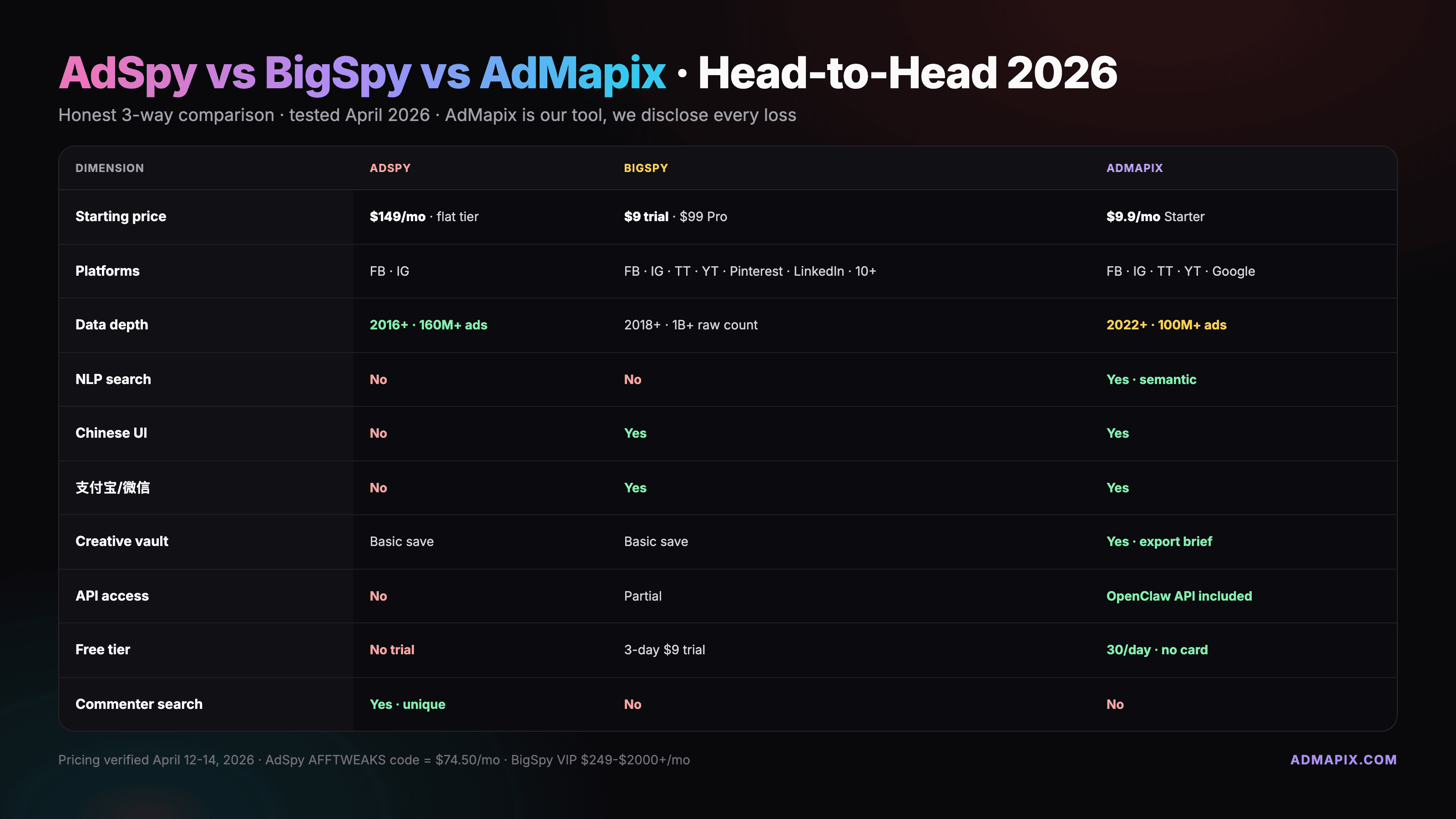
AdSpy vs BigSpy vs AdMapix 2026: An Evidence-Based Comparison
Compare AdSpy, BigSpy, and AdMapix by current public pricing, documented search workflows, source coverage, saved-creative workflow, research outputs, and evidence limits. Reviewed August 13, 2026.
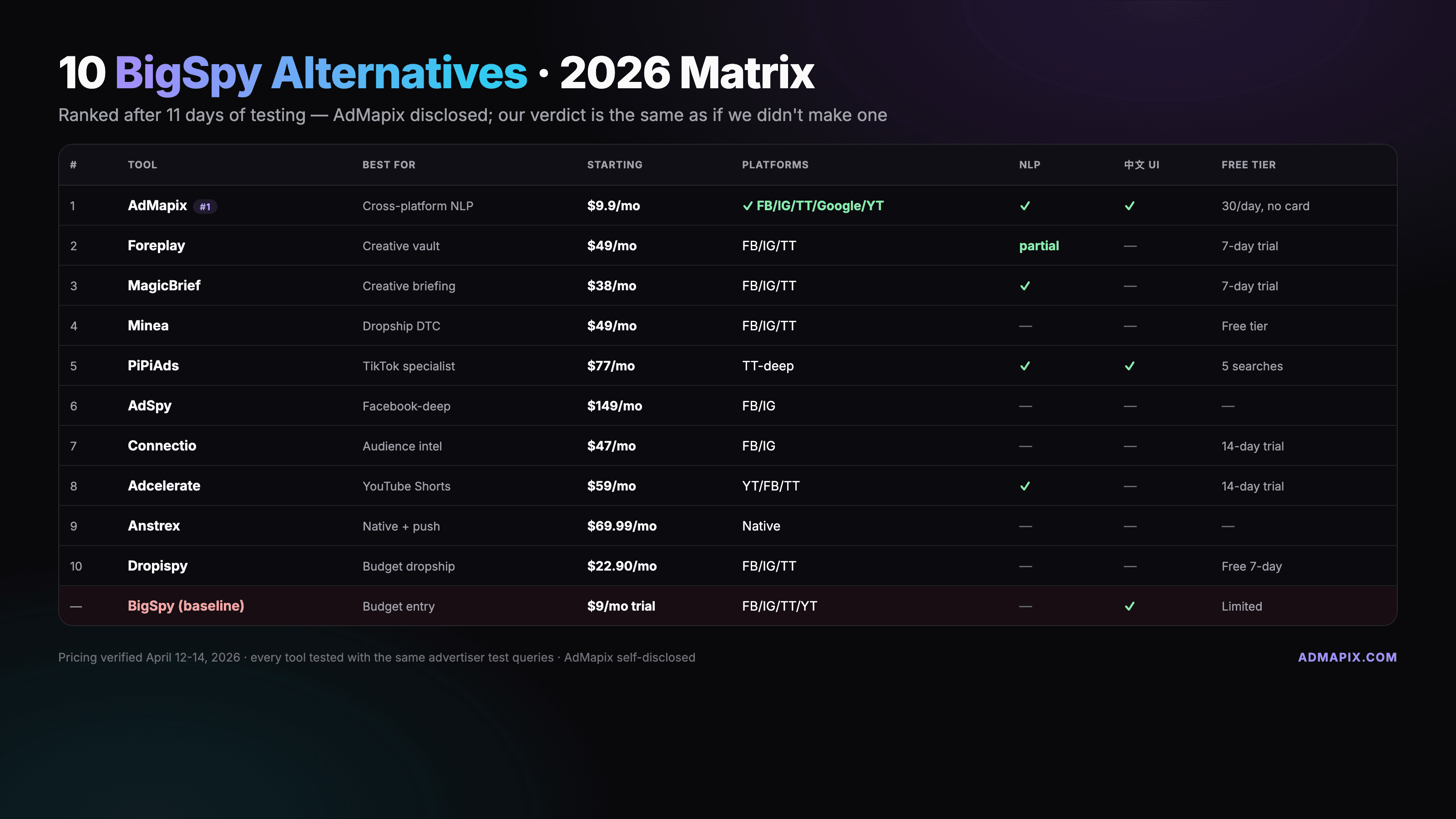
Best BigSpy Alternatives in 2026: Choose by Workflow
An evidence-based guide to BigSpy alternatives for Meta depth, app-market data, TikTok product research, PPC, display, native, and creative collection—with a migration checklist. Reviewed August 13, 2026.
Advertising Optimization Best Practices for Global Growth
A practical playbook on creative workflows, A/B testing, benchmarking, and budget allocation to improve ad performance across regions and platforms.