
AI Ad Creative Tools in 2026: The 5 Categories, Best Tools & a Workflow That Actually Converts
A practical 2026 guide to AI ad creative tools — the 5 categories (text, image, video, analytics, A/B testing), best tools per category, prompt templates, a competitive-intelligence-fed workflow, AI UGC ads, platform disclosure rules, and how to ship variants that win instead of generic AI noise.
By the AdMapix Research Team — Updated June 21, 2026
AI Ad Creative Tools in 2026: The 5 Categories, Best Tools & a Workflow That Actually Converts
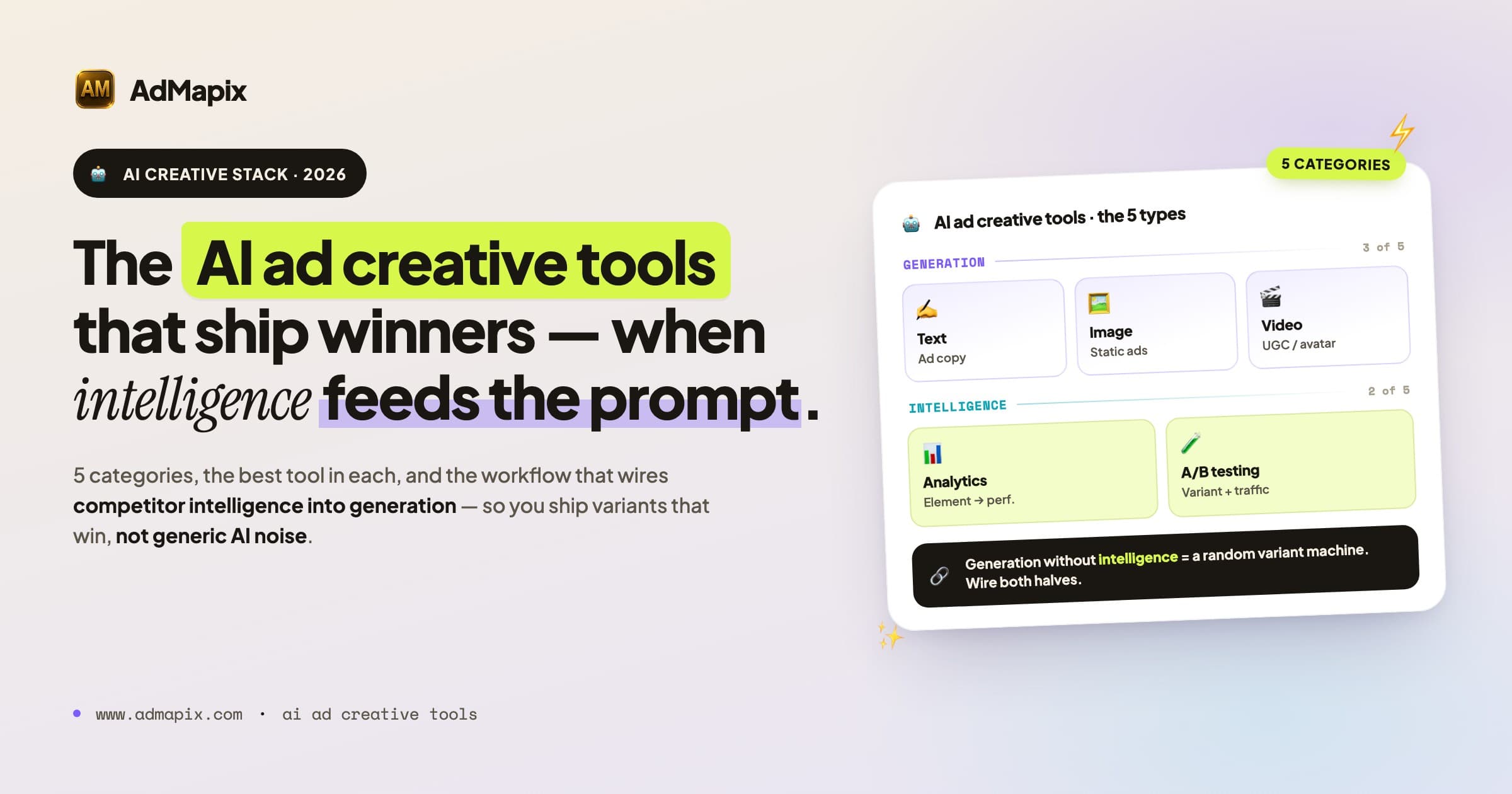
AI ad creative tools are the generative-AI software that produces ad copy, images, video, and creative variants — and in 2026 they fall into five distinct categories that most "AI ad generator" roundups blur together: text generation, image generation, video generation, creative analytics, and automated A/B testing. The single biggest mistake paid-media teams make is treating these tools as a strategy replacement. They are accelerators: they turn a sharp creative brief into 50 variants in minutes. Without the brief — which comes from competitive intelligence and performance data — they produce generic output that looks like everything else in the auction. This guide breaks down what each category actually does, names the best tools, gives you copy-paste prompt structures, and walks the exact workflow that wires competitive intelligence into AI generation so you ship variants that win instead of noise.
The framing that matters most: AI ad creative tools work best when competitive intelligence feeds the prompt, not when AI generates in a vacuum. Everyone has access to the same models. The differentiation is no longer "do you use AI" — it's "what do you feed it, and how do you test and analyze what comes out." That loop is the whole game in 2026, and it's what this guide is built around.
TL;DR — AI Ad Creative Tools in One Screen
- AI ad creative tools span 5 categories: text (copy), image (static), video (UGC/avatar/generative), creative analytics (element → performance), and A/B testing engines (variant generation + traffic allocation).
- They are accelerators, not strategists. AI fed a generic prompt produces generic output. AI fed a competitive brief produces differentiated variants.
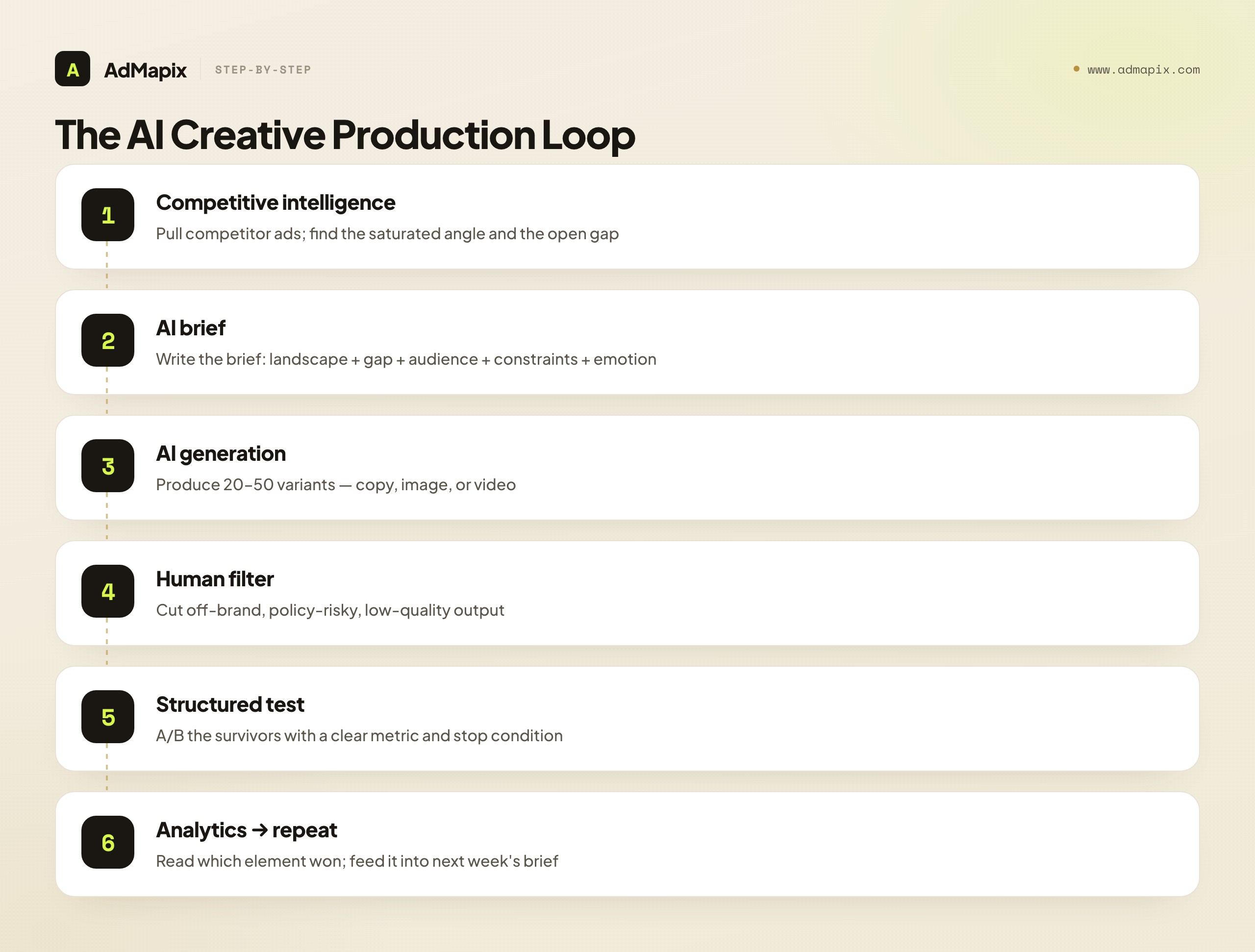
- The winning workflow: competitive intelligence → AI brief → AI generation → human filter → structured test → analytics → repeat.
- Hybrid beats pure AI. For images, generate the scene with AI and composite the real product. For video, validate hooks with AI, then scale winners with real footage.
- AI UGC ads are now viable for testing hooks cheaply, but still trail real creators on authenticity — use them to validate angles, not as your final scaled creative.
- Mind platform disclosure rules. Meta and Google increasingly require AI-content disclosure; check current policy before publishing.
- Pick tools by your bottleneck (copy, image, video, analytics, or testing), not by buying a suite. Solve the most painful one first.
What AI Ad Creative Tools Actually Do in 2026
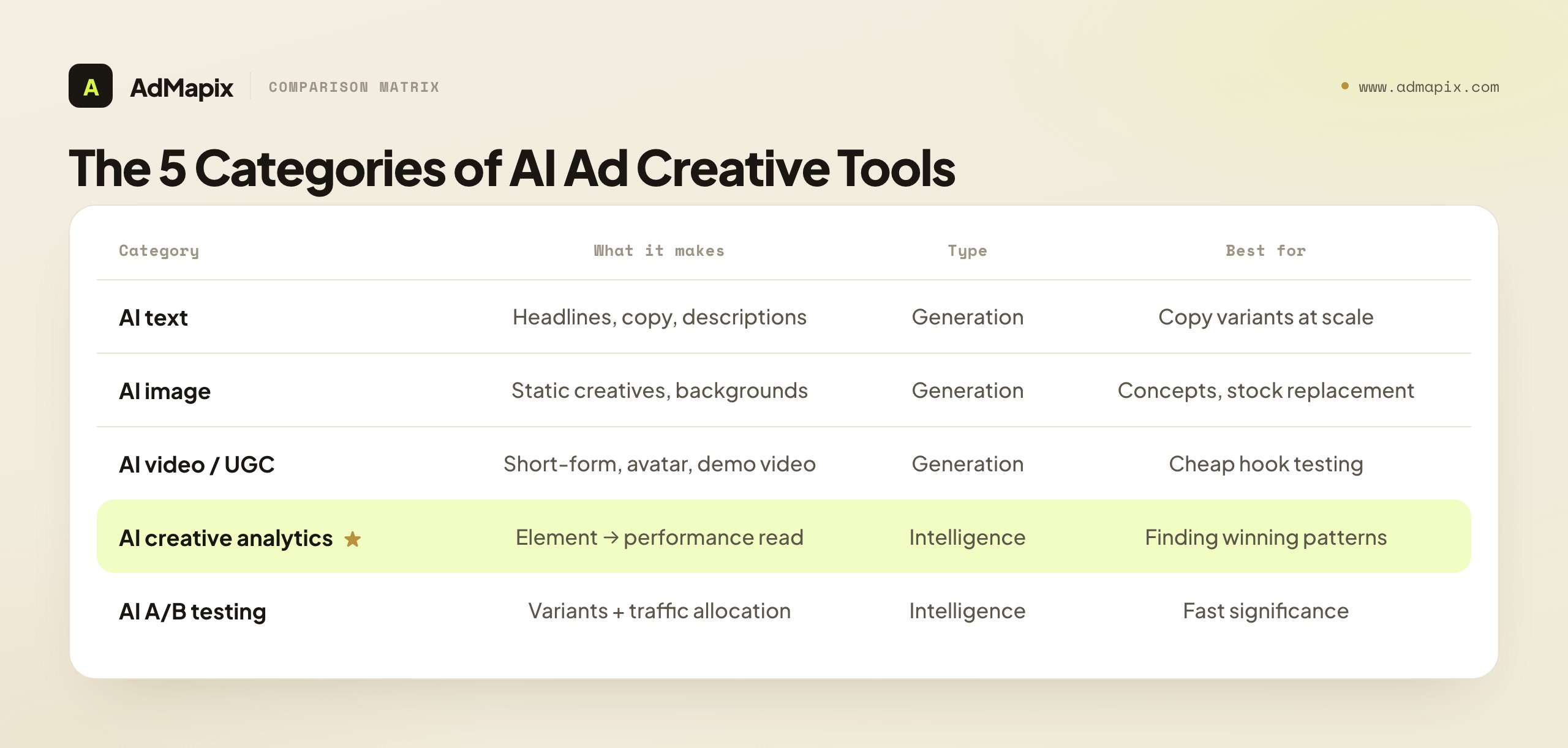
"AI ad creative tools" is a noisy category. Every tool with a text-to-image feature now calls itself an AI ad platform. But for paid-media teams running real campaigns, the landscape breaks into five distinct categories:
- AI text generators — headlines, descriptions, ad copy variants at scale
- AI image generators — static ad creatives, background variations, product shots
- AI video generators — short-form video ads, UGC-style clips, avatar-based spots
- AI creative analytics — which visual elements correlate with performance
- AI A/B testing engines — automated variant generation and multivariate testing
The mistake most teams make: treating AI tools as a replacement for creative strategy. They're accelerators — they turn a clear creative brief into 50 variants in minutes. But without the brief (which comes from competitive intelligence and performance data), they produce generic output that looks like everything else in the auction.
This article separates what each category actually does, shows you how to wire competitive intelligence into your AI creative workflow, and gives you a repeatable process for producing AI-assisted ad variants that are grounded in competitor data — not just prompt guesses.
The Generation-vs-Intelligence Distinction
Before the categories, internalize the split that organizes everything below. There are two fundamentally different jobs an "AI ad tool" can do:
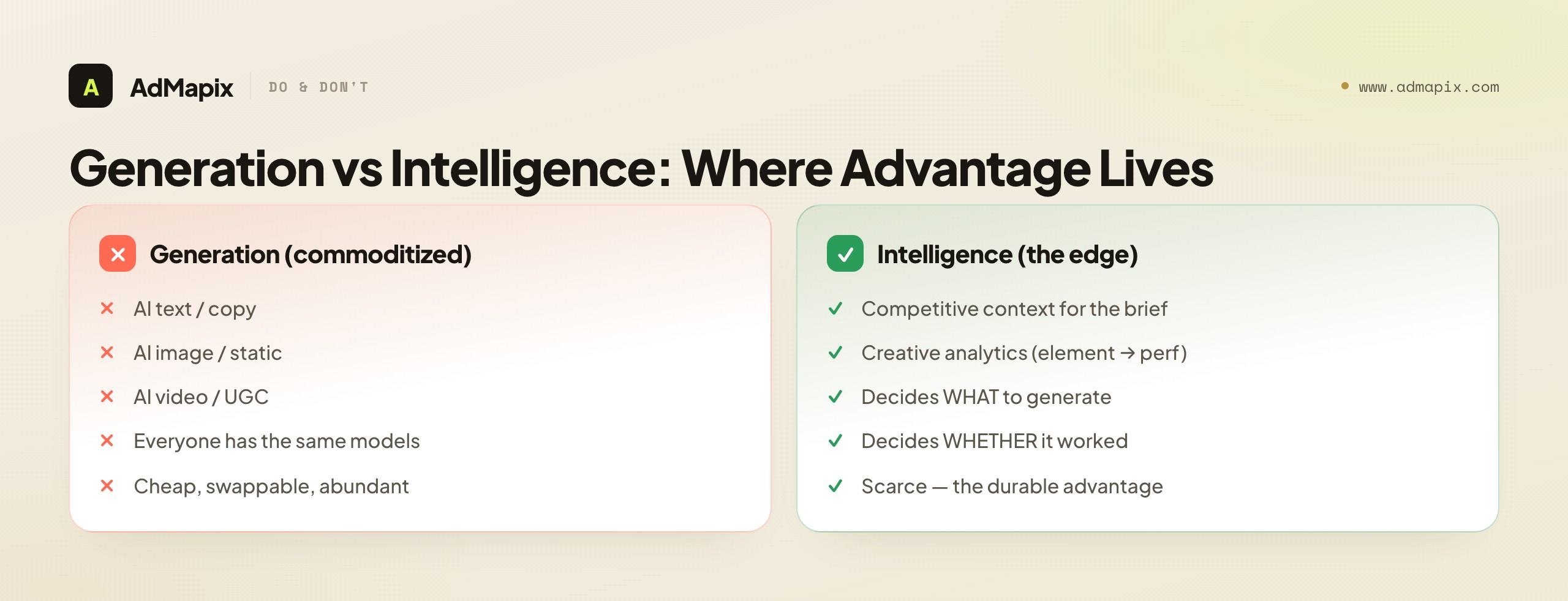
- Generation: produce new creative (copy, image, video). This is the flashy part — diffusion models, LLMs, avatar video. Abundant and increasingly commoditized.
- Intelligence: decide what to generate and whether it worked (competitive context, creative analytics, testing). Scarcer, and the actual source of durable advantage.
Most "AI ad generator" marketing is about generation. But generation without intelligence is a random variant machine. The teams winning in 2026 over-invest in the intelligence side — the brief and the analytics loop — and treat generation as a cheap, swappable commodity. Keep this split in mind as you read the five categories: three are generation, two are intelligence, and you need both halves wired together.
The 5 Categories of AI Ad Creative Tools
1. AI Text Generators (AI Ad Copy)
These tools generate ad headlines, descriptions, and body copy from a brief or product URL. They're the most mature category because text generation has the longest training history — an "AI ad copy generator" is the most reliable AI creative tool you'll use.
What they do well:
- Generate 50+ headline variants from a single value proposition
- Adapt copy to platform-specific character limits (Google Ads vs Meta vs TikTok)
- Produce localization variants across languages
- Maintain brand voice when given clear guidelines
What they don't do:
- Know which angle will outperform without performance data
- Understand nuanced market positioning
- Replace a copywriter who knows what's already running in the auction
Tools to evaluate: Jasper, Copy.ai, AdCreative.ai (copy module), and frontier LLMs (ChatGPT, Claude) with custom prompts. For most teams, a frontier LLM with a well-built brief now matches or beats the dedicated copy tools, because the bottleneck was never raw generation quality — it was the context you feed in.
The key insight: AI copy generators are only as good as the competitive context you feed them. Give them "write 10 headlines for a project management tool" and you get noise. Give them "competitor X uses price-led headlines, competitor Y uses social-proof-led — generate 10 headlines that differentiate on ease of use" and you get useful variants. The prompt template later in this guide makes that concrete.
2. AI Image Generators (Static Ad Creatives)
Text-to-image models have improved dramatically. Midjourney v7, DALL-E 4, and Stable Diffusion 3.5 can now produce ad-ready static creatives with minimal post-processing. An "AI image generator for ads" is now a genuine stock-photography replacement for a large share of static creative needs.
What they do well:
- Generate background scenes and lifestyle imagery
- Create product mockups in different environments
- Produce multiple color/layout variations from one concept
- Replace stock photography at near-zero marginal cost
What they don't do:
- Consistently render text on images (improving, but still unreliable for precise copy)
- Produce screenshots of real software interfaces
- Understand brand-safety boundaries without explicit guardrails
Tools to evaluate: Midjourney (best quality), DALL-E 4 (best prompt adherence), Stable Diffusion (best for custom fine-tuning and on-brand LoRAs), AdCreative.ai (purpose-built for ad layouts).
Production tip: use AI for background generation and concept exploration, then composite with real product screenshots and UI elements in Canva or Figma. Pure AI output rarely converts as well as hybrid approaches where the product is real and the scene is generated. The text-rendering weakness is the single biggest reason to keep a human in the loop on static ads — let AI own the scene, let a designer own the headline overlay.
A practical image-prompt habit: prompt for the scene and emotion, not the product. Instead of "a project management dashboard ad," prompt "a calm, sunlit home office with an empty, organized desk, soft morning light, shot on 35mm, lifestyle aesthetic" — then composite your real UI screenshot into a device on that desk. The AI delivers the aspirational context (which it's great at) and your real product carries the credibility (which AI fakes badly). For on-brand consistency at volume, a fine-tuned Stable Diffusion LoRA trained on your existing brand imagery will hold color and style across dozens of variants far better than one-off Midjourney prompts.
3. AI Video Generators (and AI UGC Ads)
This is the fastest-moving category in 2026. Tools now produce short-form video ads from text prompts, product URLs, or uploaded assets — including the "AI UGC ad," an avatar or AI-presenter video built to mimic an authentic creator post.
What they do well:
- Generate UGC-style talking-head videos with AI avatars
- Turn product screenshots into short demo videos
- Create multiple format variants (9:16, 16:9, 1:1, 4:5) from one source
- Add captions and motion graphics automatically
What they don't do:
- Replace high-production-value brand spots
- Guarantee platform compliance (especially Meta's policies on AI-generated content)
- Match the authenticity of real UGC creators — the "uncanny" gap is narrowing but real
Tools to evaluate: HeyGen/Synthesia (AI avatars), Runway/Pika (generative video), Arcads/Co:Create (ad-specific AI UGC), Creatify/Cluesive (product URL → video ad).
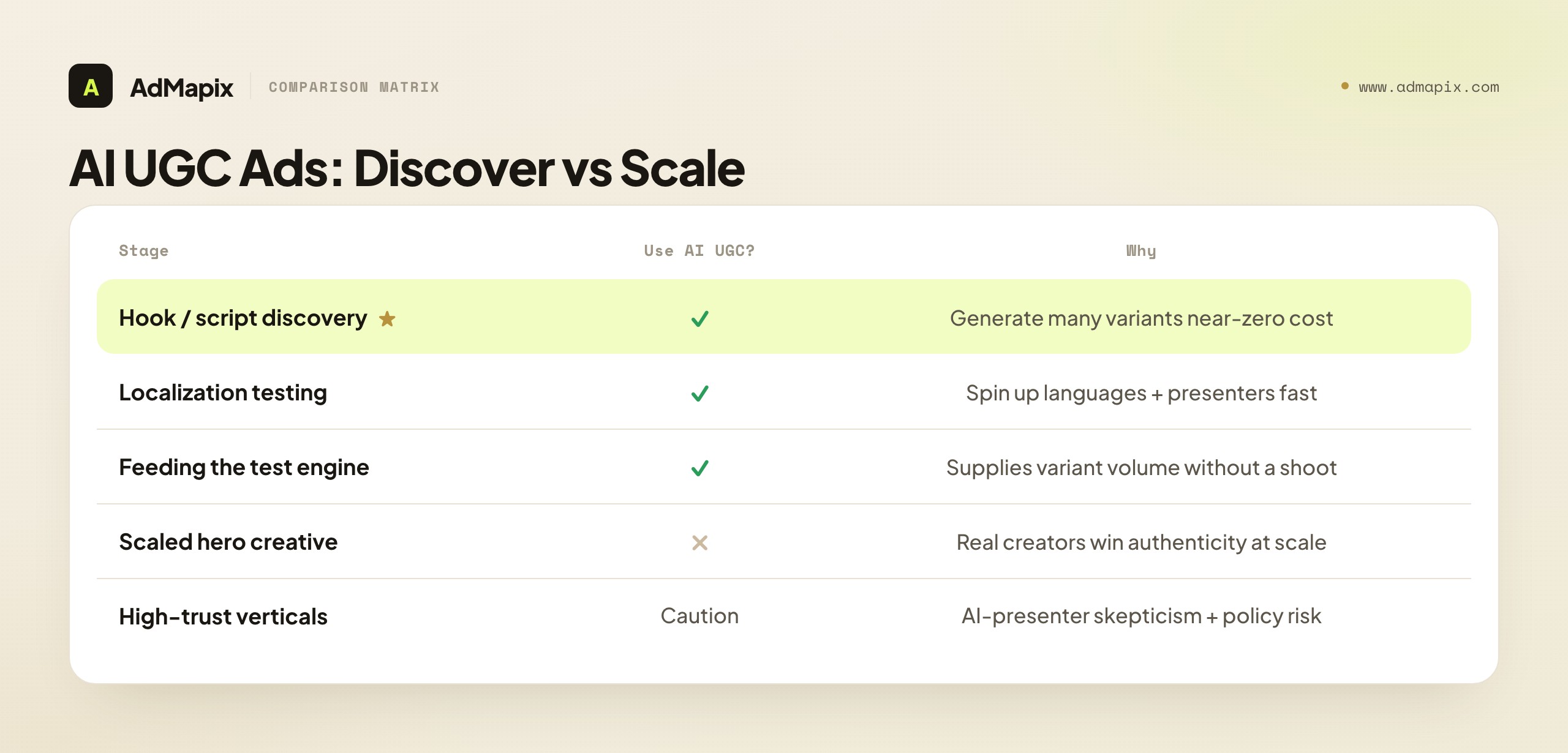
The 2026 reality on AI UGC ads specifically: they are now viable for testing hooks and angles before investing in real production, but they are rarely your best scaled creative. The pattern that works: generate 10–20 AI UGC variants to find which hook and script wins cheaply, then re-shoot the winning angle with a real creator for the version you scale. AI UGC compresses the discovery cost; real UGC wins the authenticity battle at scale. Treat AI video as a hypothesis machine, not a replacement for your creator roster.
A workflow note that saves money: the expensive part of video isn't the avatar — it's the script. Use a frontier LLM to generate 15–20 script variants (different hooks, same offer) first, then render only the 3–4 strongest as AI UGC videos. Rendering every script wastes credits on hooks you'd have cut on the page. And keep the videos short for testing — a 9:16, 8–15 second clip is enough to read whether a hook stops the scroll, which is the only question the AI version needs to answer before you commit real-creator budget.
4. AI Creative Analytics (Intelligence)
These tools analyze your existing ad creatives (and competitor creatives) to identify which visual and copy elements correlate with performance. This is one of the two intelligence categories — and it's where the loop closes.
What they do well:
- Tag creative elements (colors, objects, text position, face presence, pacing)
- Correlate elements with CTR, CVR, and ROAS
- Surface winning patterns across large creative libraries
- Benchmark your creative performance against category averages
What they don't do:
- Replace a creative strategist's judgment
- Account for audience-targeting differences (a "winning element" may just be a better audience)
- Work without sufficient data volume (need ~50+ ad variants minimum to find real signal)
Tools to evaluate: Motion (creative analytics), Marpipe (creative testing), VidMob (creative scoring), and AdMapix for the competitive creative-intelligence slice.
This is where competitive intelligence and AI intersect most powerfully. When you can see not just what competitors are running, but which creative elements appear in their longest-running ads, AI analytics turns observation into actionable patterns. Your own analytics tells you what's working in your account; competitive analytics tells you what's working in the market — and the gap between them is your test backlog.
5. AI A/B Testing Engines (Intelligence)
Automated testing platforms that generate variants and allocate traffic using multi-armed bandit algorithms.
What they do well:
- Generate hundreds of creative permutations (headline × image × CTA)
- Allocate budget to winning variants automatically
- Reduce the time to statistical significance
- Learn across campaigns and ad accounts
What they don't do:
- Design the initial creative strategy
- Understand brand-positioning nuances
- Work across walled gardens (Meta, Google, TikTok don't share data)
Tools to evaluate: Adalysis (Google Ads), Revealbot (Meta + Google), Smartly.io (enterprise multi-platform), Motion (creative analytics + testing).
The caution here: a testing engine multiplies whatever you feed it. Feed it variants from a sharp competitive brief and it finds your winner fast. Feed it 200 undifferentiated AI permutations and it efficiently allocates budget to the least-bad version of generic — which still loses to a competitor running a genuinely distinctive angle. The engine optimizes execution; it cannot fix strategy.
Best AI Ad Creative Tools by Category (Quick Reference)
No single tool wins every category — the right answer is a small stack matched to your bottlenecks. Here's the at-a-glance map of who's strongest where, with honest weak spots. Treat it as orientation, not endorsement; verify current features and pricing on each vendor's page.
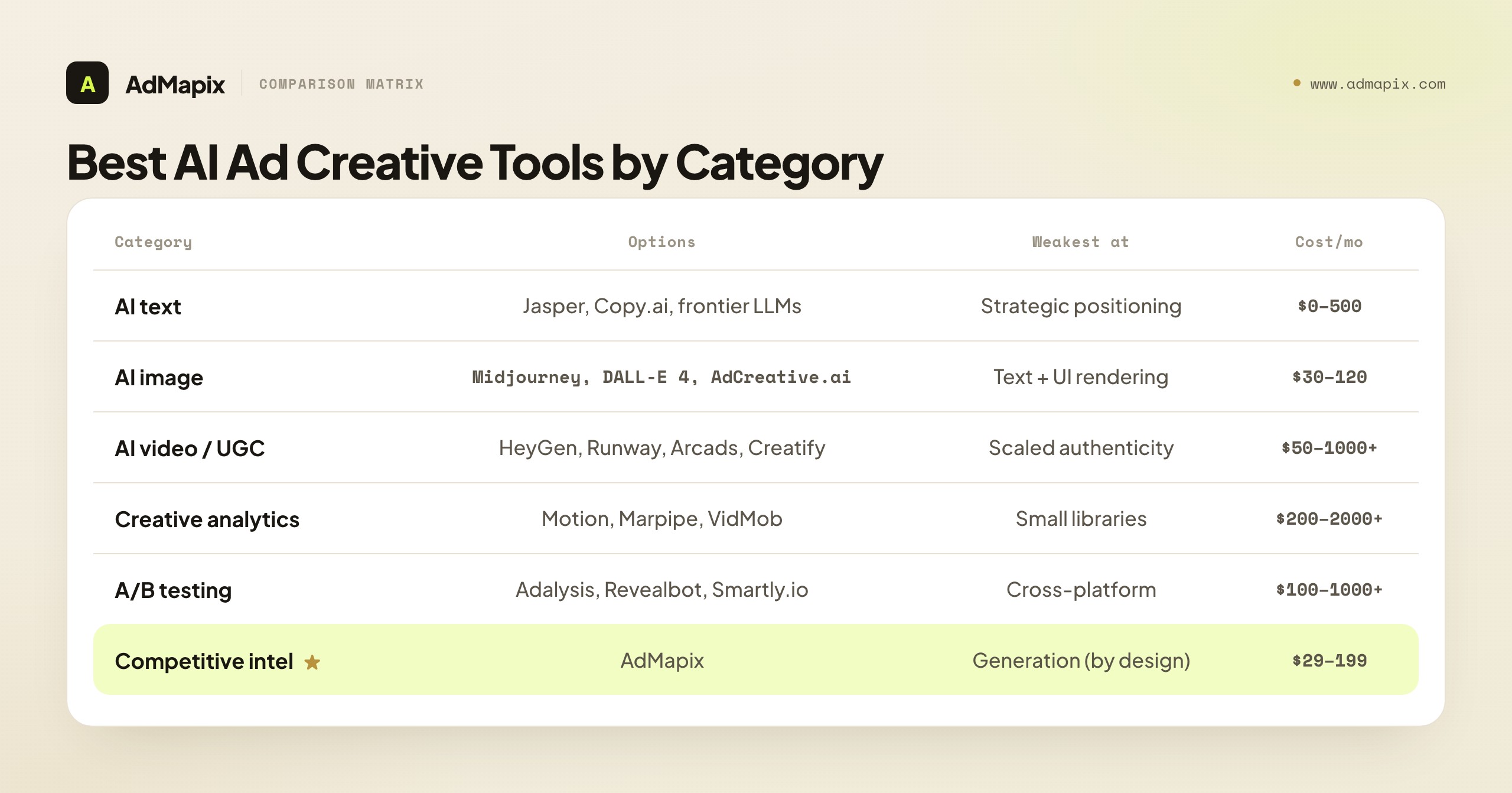
| Category | Best-in-class options | Strongest for | Weakest at | Cost range/mo |
|---|---|---|---|---|
| AI text (ad copy) | Jasper, Copy.ai, frontier LLMs | Headline/description variants at scale | Strategic positioning | $0–500 |
| AI image (static) | Midjourney, DALL-E 4, Stable Diffusion, AdCreative.ai | Backgrounds, concept art, mockups | Text rendering, UI screenshots | $30–120 |
| AI video / UGC | HeyGen, Synthesia, Runway, Arcads, Creatify | Testing hooks, AI UGC validation | High-end brand spots, scaled authenticity | $50–1000+ |
| AI creative analytics | Motion, Marpipe, VidMob | Element → performance mapping | Small creative libraries | $200–2000+ |
| AI A/B testing | Adalysis, Revealbot, Smartly.io | Traffic allocation, variant gen | Cross-platform testing | $100–1000+ |
| Competitive intel | AdMapix | Competitor creative evidence for briefs | AI generation (by design) | $29–199 |
Wire Competitive Intelligence Into Your AI Creative Workflow
Here's the workflow that separates teams using AI effectively from teams burning budget on generic AI output. It is deliberately short on each step so it survives a busy week — the discipline is in running it every time, not in any single step being elaborate.
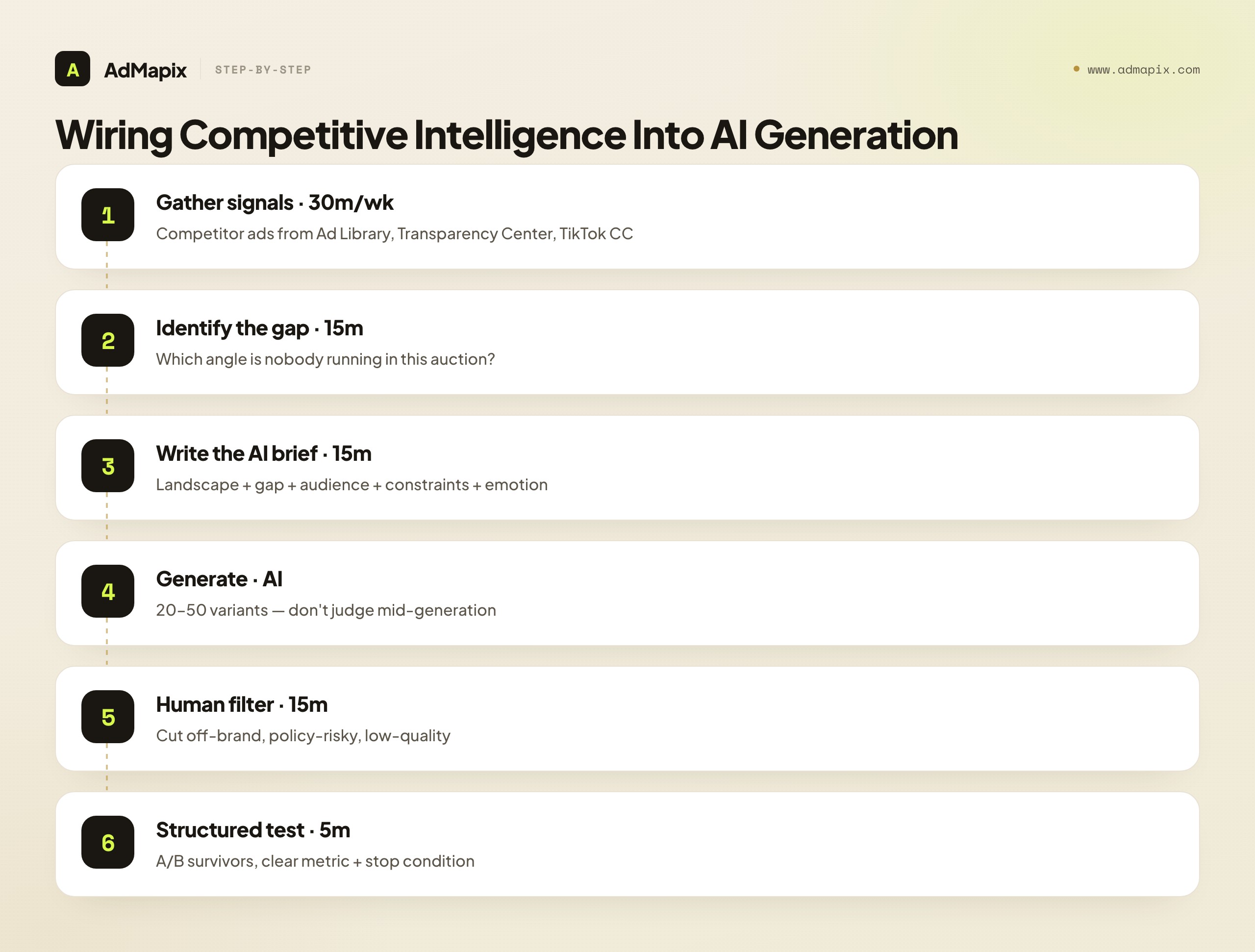
Step 1: Gather competitive signals (30 min/week). Pull competitor ads from Google Ads Transparency Center, Meta Ad Library, and TikTok Creative Center. Document: headline patterns, offer types, visual styles, format mix, and which creatives have been running longest (a proxy for what's working). Our competitor ad analysis framework gives the 5-dimension scoring system for this step.
Step 2: Identify the gap (15 min). Ask: what creative angle is no one using in this auction? Maybe every competitor runs price-led headlines — test a benefit-led angle. Maybe every competitor uses polished studio footage — test UGC-style. The gap is your hypothesis.
Step 3: Write the AI brief (15 min). Feed the competitive context into your AI tool's prompt. A good AI creative brief includes: competitive landscape summary, the gap you're exploiting, target audience, platform constraints, brand guidelines, and the specific emotion you want to evoke. (Full template below.)
Step 4: Generate variants (AI handles this). Let the tool produce 20–50 variants. Don't judge them yet — judging mid-generation collapses the diversity you're paying the model for.
Step 5: Human filter (15 min). A human removes variants that are off-brand, policy-risky, or low-quality. This step is non-negotiable — AI will produce some nonsense, and publishing it damages your quality scores and risks account flags.
Step 6: Launch as a structured test (5 min setup). Run the surviving variants as an A/B test with clear success metrics and a stop condition. Then feed results back into Step 1 — the winning element becomes next week's competitive baseline.
This workflow keeps AI in its proper role: a variant-generation engine fed by competitive intelligence, not a strategy replacer. The loop is the product; the tools are interchangeable.
The AI Creative Brief Template (Copy-Paste)
The brief is where 80% of AI output quality is decided. A weak brief can't be rescued by a better model. Use this structure every time — it's what turns "write me some ad headlines" into differentiated work:
ROLE: You are a direct-response copywriter for [brand], a [category] product.

COMPETITIVE LANDSCAPE:
- Competitor A leads with [angle, e.g. price]
- Competitor B leads with [angle, e.g. social proof]
- Competitor C leads with [angle, e.g. features]
- The auction is saturated with [the dominant angle]

THE GAP WE'RE EXPLOITING:
No one is running [underserved angle, e.g. ease-of-use / time-saved / identity].

AUDIENCE: [who, their pain, their awareness stage]
PLATFORM: [Meta / Google / TikTok] — [character limits, format]
BRAND VOICE: [3 adjectives + 1 thing to never say]
EMOTION TO EVOKE: [relief / aspiration / urgency / belonging]

TASK: Generate [N] [headlines / scripts / concepts] that exploit the gap,
fit the platform constraints, and stay in brand voice. Vary the mechanism,
not just the wording.
The two lines that matter most are the competitive landscape and the gap — they're also the two lines AI can't fill in for you, because they come from competitive intelligence, not from the model's training data. That's the whole reason the intelligence layer is non-negotiable: it's the input only you can provide.
The Hybrid Production Method (Why Pure AI Underperforms)
Across thousands of creative tests, one pattern is consistent: hybrid creative beats pure-AI creative. The reason is simple — AI is excellent at the parts that are interchangeable (scenes, backgrounds, variant volume, first-draft scripts) and weak at the parts that build trust (real product, real faces, precise on-image copy, genuine authenticity).
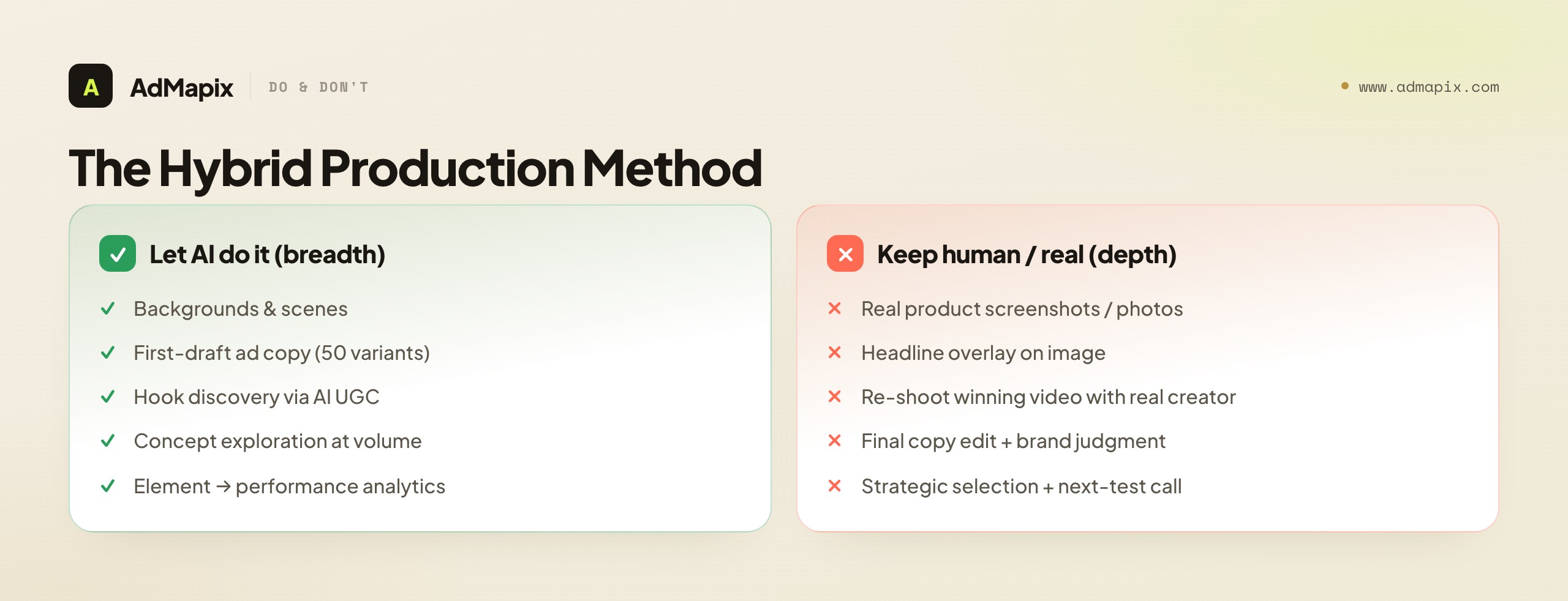
| Creative element | Let AI do it | Keep human / real |
|---|---|---|
| Background / scene | Yes — fast, cheap, infinite variants | — |
| Product depiction | — | Real screenshots / photos (AI fakes UI) |
| Headline overlay on image | — | Designer (AI text rendering unreliable) |
| First-draft ad copy | Yes — 50 variants from a brief | Final edit + brand judgment |
| Hook discovery (video) | Yes — AI UGC to test angles cheaply | Re-shoot winner with a real creator |
| Concept exploration | Yes — divergent ideas at volume | Strategic selection |
| Element → performance read | Yes — creative analytics | Interpretation + next-test call |
Read the table as a division of labor, not a competition. The highest-converting 2026 workflow uses AI for breadth (explore many angles cheaply) and humans for depth (pick, polish, and ground in reality). Teams that try to remove the human entirely ship faster and convert worse; teams that refuse AI ship slower and test less. Hybrid wins both axes.
AI Ad Creative Tool Selection Scorecard
Before buying any AI ad creative tool, score it against criteria that predict whether it'll change your output — not whether the demo looked impressive.
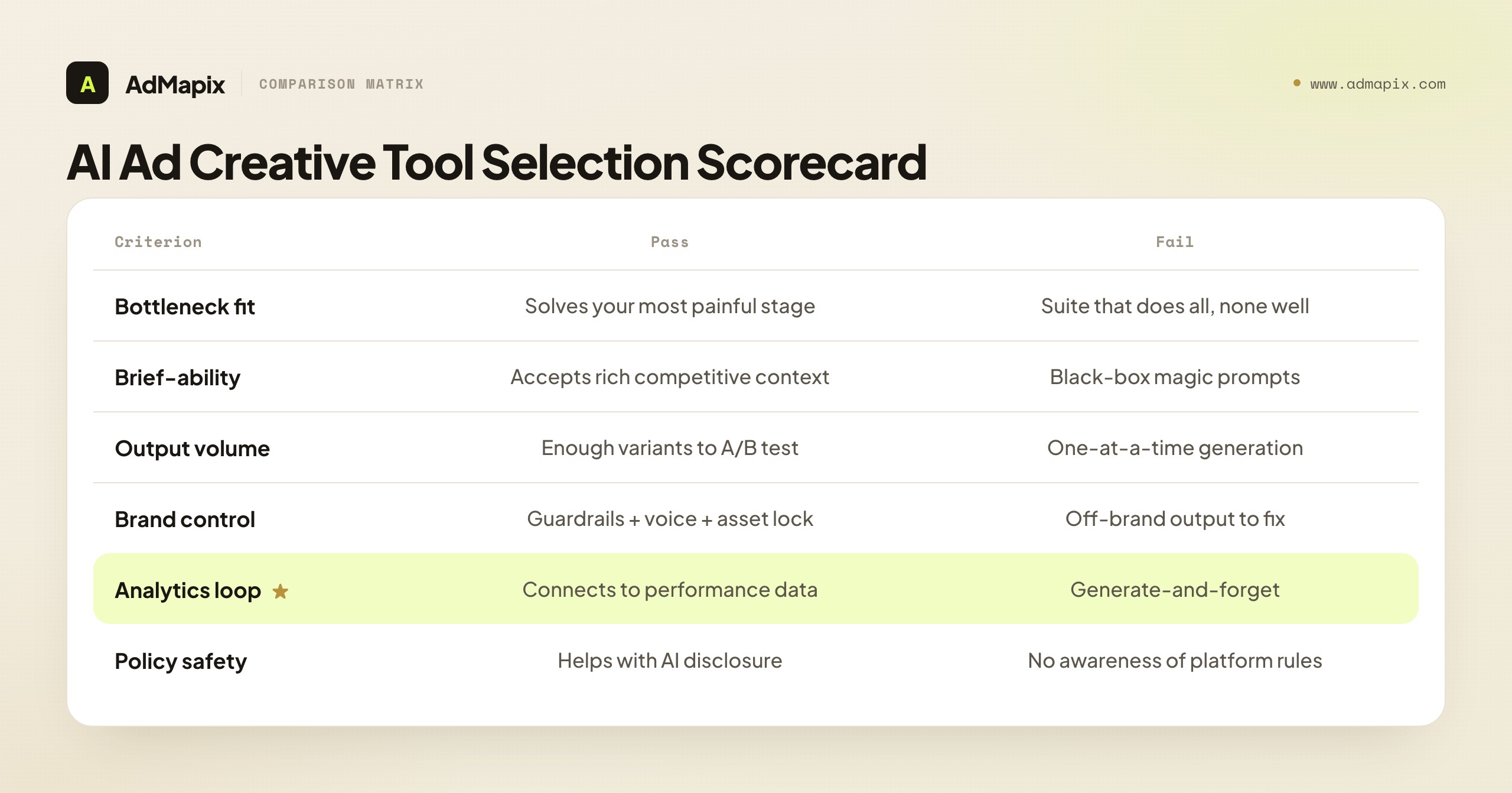
| Criterion | Good sign (pass) | Bad sign (fail) |
|---|---|---|
| Bottleneck fit | Solves your single most painful production stage | A suite that does everything adequately, nothing well |
| Brief-ability | Accepts rich competitive/brand context as input | Black-box "magic" prompts you can't steer |
| Output volume | Produces enough variants to A/B test meaningfully | One-at-a-time generation |
| Brand control | Guardrails, voice, and asset locking | Off-brand output you must heavily fix |
| Analytics loop | Connects (or exports) to performance data | Generate-and-forget, no feedback |
| Policy safety | Helps with AI-disclosure / compliance | No awareness of platform AI rules |
Scoring rule: 5–6 passes means buy or expand; 3–4 means pair it with a complementary tool; 0–2 means it's a demo toy, not a production tool. The criterion teams most often skip is analytics loop — they buy a generator, never close the feedback loop, and AI quietly becomes a random variant machine.
How to Build Your AI Creative Stack by Bottleneck
Don't buy a suite. Diagnose your single most painful production stage and solve that first, then expand. The bottleneck tells you where to start.
| Your bottleneck | Symptom | Start here |
|---|---|---|
| Copy production is slow | Can't produce enough headline/angle variants to test | AI text generator + a sharp brief |
| Not enough image variants | Static-creative testing is starved | AI image generator + hybrid compositing |
| Video production is expensive | Can't afford to test many hooks | AI UGC/video for hook validation |
| Don't know what's working | 100 variants live, no read on why | AI creative analytics |
| Testing is too slow | Manual variant rotation, slow significance | AI A/B testing engine |
| Briefs are generic | AI output looks like everyone else's | Competitive intelligence layer (the real root cause) |
Notice the last row. Most teams diagnose a generation bottleneck when the real problem is an intelligence bottleneck — their briefs are generic, so every generator downstream produces generic output. If your AI ads look like everyone else's, more generation tools won't fix it; sharper competitive input will. Start at the root.
Build a Reusable AI Creative Prompt Library
The brief template earlier in this guide produces one good brief. A prompt library turns that one-off into a compounding team asset — and it's the difference between a team that gets lucky with AI occasionally and one that produces differentiated creative on demand. Most teams skip this step and re-derive the same prompts from scratch every sprint, throwing away the hardest-won learning.
The structure that works is modular, not monolithic. Instead of one giant prompt per ad, break prompts into reusable components you assemble:
- Role blocks — the persona the model adopts ("direct-response copywriter for a B2B SaaS," "DTC performance creative strategist"). Write three or four for your common contexts and reuse them.
- Competitive-context blocks — the saturated-angle / open-gap summary for each competitor set, refreshed from your intelligence pass. This is the block that changes most often and matters most.
- Constraint blocks — platform character limits, brand-voice rules, the one thing to never say. These are stable; write once, reuse forever.
- Task blocks — the specific ask ("generate 10 headlines," "write 5 UGC scripts," "produce 3 image scene prompts"). Swappable per output type.
Assemble role + context + constraint + task per generation and you get consistency and differentiation: the stable blocks keep output on-brand, the context block keeps it pointed at the current market gap. Store the library where the team works — a Notion database, an Airtable, even a shared doc — with each block tagged by platform, funnel stage, and the angle it targets.
Two practices make a library actually compound. First, version your winning prompts: when a generated variant wins an A/B test, save the exact prompt that produced it, tagged with the result. Over a few months you accumulate a library of proven prompt-to-outcome pairs, which is genuinely defensible institutional knowledge no competitor can copy. Second, review and prune quarterly — models change, platforms change, and a prompt that produced winners six months ago may now produce dated output. The library is a living asset, not an archive. Teams that maintain one cut their time-from-brief-to-variants dramatically, because 80% of any new prompt is assembled from blocks that already exist; only the competitive-context block needs fresh thinking each time.
AI Creative Tools vs Traditional Production
A fair question before you reorganize your workflow: when does AI actually beat the traditional agency-or-designer route, and when does it not? The honest answer is that it's not all-or-nothing — it's a division of labor that shifts by what you're optimizing for.
| Dimension | AI creative tools | Traditional production |
|---|---|---|
| Speed to first variant | Minutes | Days to weeks |
| Variants for testing | Effectively unlimited | Limited by budget/hours |
| Cost per variant | Near zero (after subscription) | High (designer/creator time) |
| Authenticity ceiling | Lower (improving) | High (real people, real product) |
| Strategic direction | None — needs a brief | Strategist included |
| Brand polish | Variable, needs human pass | High, by default |
| Best role | Breadth: explore + test many angles | Depth: scale the proven winner |
The mistake at both extremes is real. Teams that go pure-AI to cut costs ship a flood of generic variants and watch CTR sag. Teams that refuse AI keep producing five hand-crafted ads a month and lose the testing-velocity race to competitors running fifty. The 2026 equilibrium is clear: AI owns the top of the funnel (cheap breadth, rapid hypothesis testing), traditional production owns the bottom (the polished, authentic version of the proven winner). Use AI to find what works; use real production to scale it.
Measuring the ROI of AI Creative Tools
AI creative tools are easy to justify on intuition and harder on a spreadsheet, because the value shows up as testing velocity and avoided production cost, not as direct attributable conversions. Three ROI mechanisms are real and worth tracking:
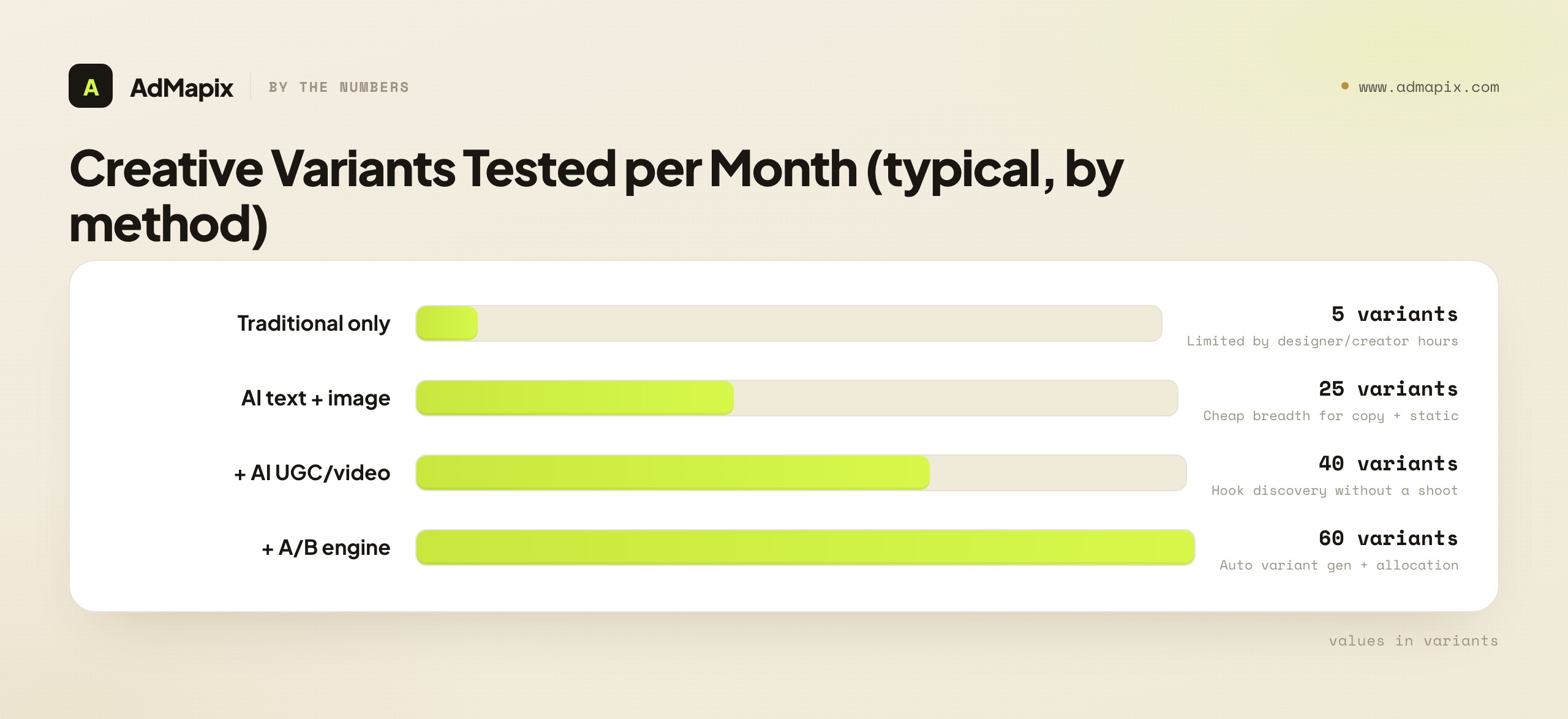
- Testing velocity. If AI lets you test 40 creative angles a month instead of 5, you find your winner faster. On a meaningful media budget, shaving weeks off "time to a winning creative" recovers far more than any tool subscription costs. The KPI to watch is creatives tested per month and days to a new winning angle.
- Avoided production cost. Every static you generate-and-composite instead of commissioning, and every hook you validate with AI UGC instead of a paid shoot, is direct cost avoided. A single avoided video shoot often covers a year of tool subscriptions.
- Better hit rate via the loop. The intelligence-fed loop raises the share of tests that win, because each brief is grounded in a real market gap rather than a guess. A higher hit rate compounds: fewer wasted test slots, more budget on proven creative.
The trap is measuring AI creative like a performance channel and expecting clean attributable ROAS. It's not one — it's a productivity-and-optionality investment. The clean signal that it's paying off: your team consistently ships more tested variants per week, finds winners faster, and spends less on production for the same or better creative output. If those three are true, the stack is earning its keep, regardless of which specific tool produced any given winner.
AI Creative Tools by Team Size: Solo to Enterprise
The bottleneck framing tells you which tool to buy; team size tells you how to operate the whole loop, because a solo founder and a 30-person agency face completely different constraints. The same five-category landscape applies, but the practical stack and the failure modes shift dramatically by scale.
Solo founder / one-person marketing. Your constraint is time, not budget. The winning setup is a single frontier LLM for copy and brief work, one image generator (Midjourney or DALL-E) for static, and a free ad library for the competitive-intelligence input — skip the dedicated analytics and A/B-engine tools, because you don't have the variant volume to feed them. Your highest-leverage move is the brief, not the tooling: thirty minutes of competitor research feeding a sharp prompt beats any amount of generation horsepower. The failure mode at this scale is tool sprawl — buying five AI subscriptions you never integrate. Pick three tools, run the loop manually, and ship.
Small growth team (2–8 people). Now you have enough volume to justify a creative-analytics tool and you start needing consistency across people. This is where the prompt library above becomes essential — without it, every team member produces in their own style and you lose the compounding benefit. Add a swipe-file/intelligence layer so competitor research is shared rather than re-done by each person, and introduce a lightweight A/B discipline even if it's manual. The failure mode here is no shared system: three people each running their own AI workflow, none of it documented, all of it lost when someone leaves.
Agency / enterprise (10+ people, multiple brands or accounts). Scale flips the priorities. Generation is fully commoditized at this level — your edge is the intelligence and reporting layer, because you're managing many competitor sets and need client-ready output. You want cross-network competitive intelligence (so the same research workflow covers every account), a real creative-analytics platform (enough volume to find statistically valid element-level winners), and an A/B engine with cross-campaign learning. Governance matters too: AI-disclosure compliance, brand-safety guardrails, and a documented prompt library become operational requirements, not nice-to-haves. The failure mode at this scale is generation obsession — chasing the newest generator while under-investing in the intelligence and analytics that actually differentiate enterprise output.
The throughline across all three: as you scale, value shifts from generation toward intelligence and systematization. The solo founder wins on a sharp brief; the enterprise wins on a documented loop that any team member can run on any account. Buy generation for the bottleneck, but invest your scarce systematizing effort in the intelligence layer and the reusable prompt library — those are what compound as the team grows.
AI UGC Ads: A Closer Look
Because "AI UGC ad" is one of the fastest-growing searches in this space, it deserves its own treatment — and a clear-eyed one, because it's also the most over-hyped slice of the category.
What AI UGC is good for in 2026:
- Hook and script discovery at near-zero cost. Generate 15 avatar-presenter variants of different opening lines and angles, run them as cheap tests, and find which message resonates before paying a real creator.
- Volume for the testing engine. A/B systems need variant volume; AI UGC supplies it without a shoot.
- Localization. Spin up the same script across languages and presenter looks for multi-market testing.
Where AI UGC still falls short:
- Authenticity at scale. Audiences increasingly recognize AI presenters, and trust dips when they do. For the version you put real budget behind, a genuine creator usually wins.
- Platform policy. Some platforms restrict or require disclosure of synthetic-media ads; rules are tightening, not loosening.
- Category fit. High-trust categories (health, finance, anything testimonial-driven) are the most sensitive to AI-presenter skepticism.
The mature play: AI UGC to discover the winning angle, real UGC to scale it. This mirrors the hybrid principle — use AI for cheap breadth, real humans for the depth that converts at scale. For finding which real creators and formats are already winning in your niche, pair this with creative-evidence research like our creative ads library walkthrough.
Common Mistakes When Using AI for Ad Creatives
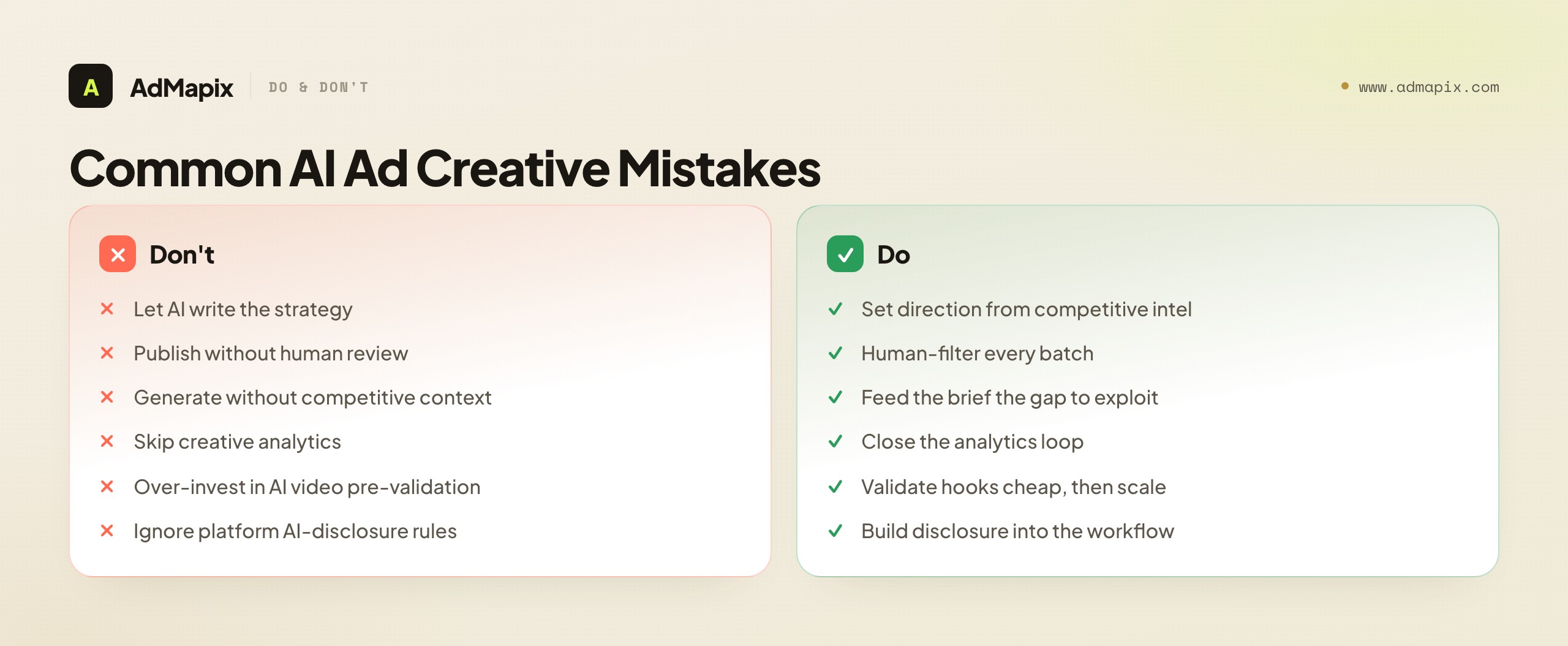
- Letting AI write the strategy. AI doesn't know your competitors just shifted offers or that a new entrant is flooding the auction. Competitive intelligence sets the direction; AI fills in the execution.
- Publishing AI output without human review. Every AI tool produces occasional nonsense. One off-brand or policy-violating ad can get your account flagged.
- Generating without competitive context. AI produces generic output by default. "Write 10 headlines" is useless. "Competitors X, Y, and Z all use price-led headlines — generate benefit-led alternatives" produces differentiated work.
- Skipping creative analytics. Teams generate 100 AI variants, launch them, and never analyze which elements actually drove performance. Without closing the analytics loop, AI becomes a random variant generator.
- Over-investing in AI video before validation. AI video costs add up fast. Test hooks and angles with static images and cheap AI UGC first, then invest video budget in the winning directions.
- Ignoring platform AI-disclosure policies. Meta and Google increasingly require AI-generated-content disclosure. Check current platform policies before publishing AI-generated creatives.
- Confusing generation volume with strategy. Shipping 500 variants feels productive, but 500 variants of a generic angle still lose to one genuinely differentiated competitor ad. Volume amplifies your angle; it doesn't create one.
Platform AI-Disclosure Rules: Don't Skip This
A section that grows more important every quarter. As AI-generated creative floods the auction, platforms have tightened disclosure and authenticity requirements. The specifics change, so treat this as a checklist to verify against current policy, not a static rule set:
- Meta has rolled out labeling for AI-generated and AI-altered content and updates its advertising standards on synthetic media regularly — confirm whether your AI creative requires a disclosure flag before launch.
- Google applies AI-content and synthetic-media policies across Ads and increasingly requires disclosures for certain ad types (notably anything resembling people or sensitive verticals).
- TikTok requires creators and advertisers to label realistic AI-generated content, and enforcement has tightened.
The practical rule: assume disclosure may be required, build it into your asset workflow, and check each platform's current policy before every launch. A flagged account is far more expensive than a disclosure label. This is the one area where moving fast with AI can cost you the whole account, so it's worth a standing checklist item in Step 6 of the workflow above.
A Worked Example: From Competitor Gap to Winning Variant
To ground the whole loop, here's a composite example (anonymized from 2026 paid-media accounts) of using AI ad creative tools the right way.
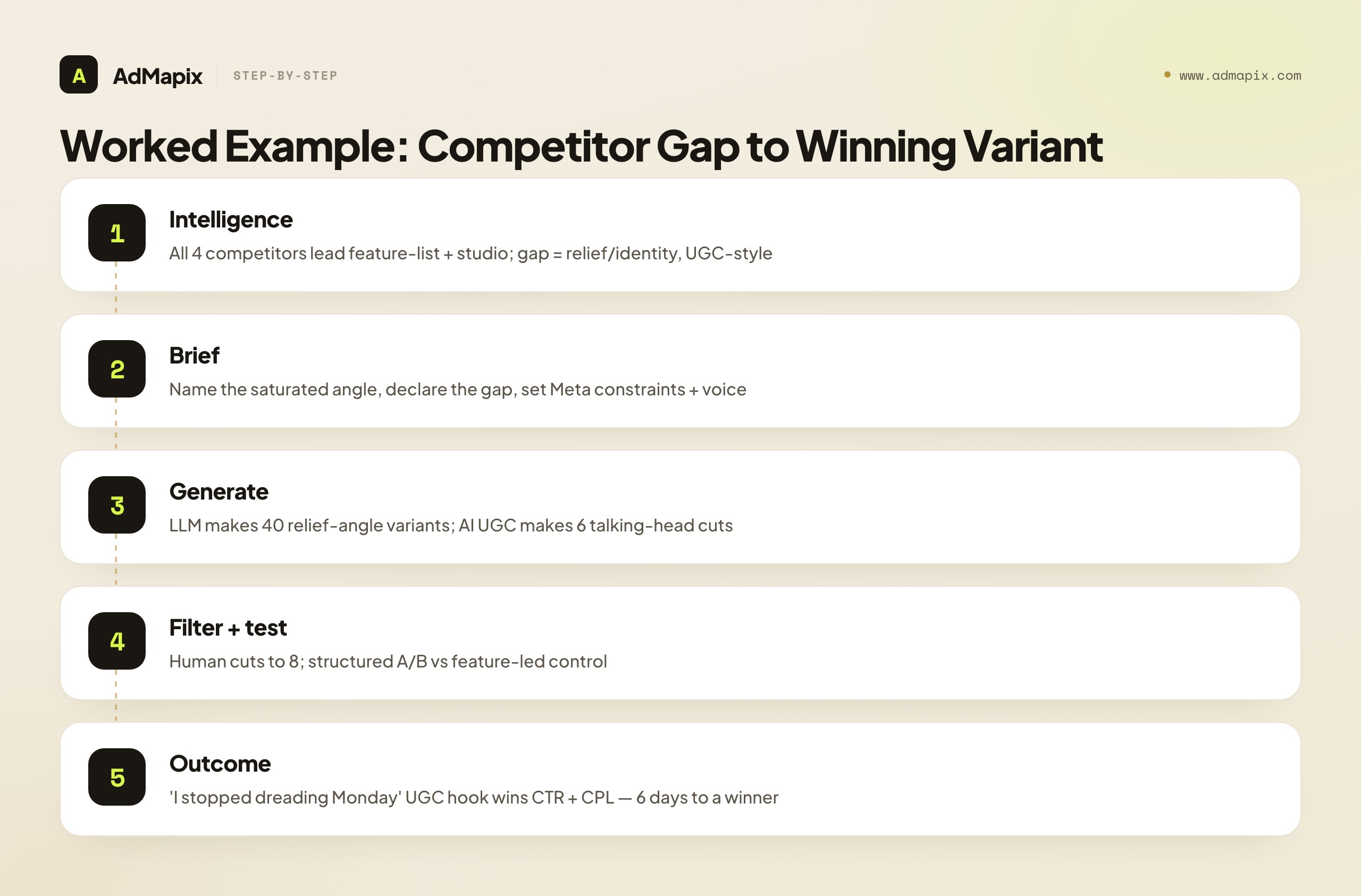
Decision: A B2B scheduling SaaS needs new Meta creative; current ads are fatiguing.
Step 1–2 (intelligence): Pulling competitor ads from the Meta Ad Library revealed that all four main competitors led with feature-list headlines ("10 integrations, unlimited bookings") and polished studio imagery. The gap: nobody ran an identity/relief angle aimed at the overwhelmed operations manager, and nobody ran UGC-style.
Step 3 (brief): The AI brief named all four competitors' feature-led angle, declared the gap ("speak to the relief of a calendar that runs itself, in the operator's own voice"), and specified Meta constraints and brand voice.
Step 4–5 (generate + filter): A frontier LLM produced 40 headline/script variants on the relief angle; a human cut to the 8 strongest and removed three that overpromised. An AI UGC tool produced 6 talking-head variants of the top two scripts.
Step 6 (test) + analytics: The variants launched as a structured test. The winning creative — a UGC-style "I stopped dreading Monday scheduling" hook — beat the feature-led control on CTR and cost per lead. Creative analytics flagged that the relief hook plus a real-face thumbnail drove the lift; that finding seeded the next three briefs, and the winning angle got re-shot with a real creator to scale.
Elapsed: ~6 working days from competitor research to a shipped winner. The point isn't the specific result — it's that the intelligence-fed loop, not the AI tool itself, produced a differentiated, testable angle. Swap the tools and the loop still works; remove the intelligence and the best tools still produce noise.
How AdMapix Fits the AI Creative Workflow
AdMapix handles the competitive-intelligence layer — Step 1 of the workflow above, the input that makes every downstream AI tool produce differentiated work instead of generic noise. It tracks what competitors are running across networks, surfaces creative patterns and longest-running ads, and gives you the evidence to write sharp AI briefs. Crucially, it doesn't generate ads — by design. It tells you what's already saturating the market so your AI-generated ads can target the gap.
In practice: run your competitor set through Search AdMapix to see what's live, save the evidence with context in Media, break down the winning hooks with Video Analysis, and package the read into a brief-ready report. That report becomes the "competitive landscape" and "the gap" lines in your AI brief template — the two lines AI can't fill in for you. For the analysis discipline behind it, the competitor ad analysis framework and our best ad intelligence tools comparison go deeper. Compare seats on pricing when the loop starts saving real briefing time.
FAQ
What are AI ad creative tools?
AI ad creative tools use generative AI — large language models, diffusion models, and video-generation models — to produce ad copy, images, videos, and creative variations. In 2026 they span five categories: text generation, image generation, video generation, creative analytics, and automated A/B testing. The first three generate creative; the last two are intelligence tools that decide what to make and whether it worked. The best results come from wiring all five together with competitive intelligence feeding the brief.
What is the best AI ad generator?
There's no single best AI ad generator — it depends on which stage is your bottleneck. For ad copy, frontier LLMs (with a strong brief) or Jasper/Copy.ai; for static images, Midjourney, DALL-E 4, or AdCreative.ai; for video and AI UGC, HeyGen, Runway, or Arcads. The more important question isn't which generator but what you feed it: a generic prompt produces generic output regardless of the tool, while a competitive-intelligence-fed brief produces differentiated variants from almost any of them.
Can AI replace ad creative teams?
No. AI accelerates execution — turning a clear brief into 50 headline variants or 20 image concepts in minutes. But it can't replace the strategic work: understanding competitive dynamics, identifying market gaps, setting creative direction, and applying brand judgment. The teams winning with AI use it as a force multiplier for human strategists, not a replacement. Generation is commoditized; strategy and the analytics loop are where advantage lives.
Do AI-generated ads convert as well as human-made ads?
It depends on the category and how AI is used. AI-generated text and static images, when guided by a strong competitive brief, can match or exceed human-only output in A/B tests. AI-generated video and AI UGC are improving fast but still trail real creators on authenticity, especially for testimonial-style content. The highest-converting 2026 approach is hybrid: AI for variant generation and concept exploration, human for final polish, real product, and strategic direction.
What is an AI UGC ad and does it work?
An AI UGC ad is an avatar- or AI-presenter video built to mimic an authentic user-generated creator post. In 2026 they work well for discovering winning hooks and scripts cheaply — generate many variants, test them, find the message that resonates. They work less well as your scaled creative, because audiences increasingly recognize AI presenters and trust dips when they do. The mature play is AI UGC to find the winning angle, then re-shoot it with a real creator for the version you put real budget behind.
How do I write a good AI ad creative brief?
Include six things: a competitive landscape summary (what angle each competitor leads with), the specific gap you're exploiting, the target audience and their awareness stage, platform constraints (character limits, format), brand voice, and the emotion to evoke. The two highest-leverage lines — the competitive landscape and the gap — are exactly the ones AI can't generate for you, because they come from competitive intelligence rather than the model's training data. A weak brief can't be rescued by a better model.
How does competitive intelligence make AI creative tools more effective?
AI produces generic output by default because it's trained on the entire internet. Competitive intelligence constrains that output toward what's differentiated in your specific auction. When you tell an AI tool "competitors A, B, and C all use X angle — generate Y alternatives," the output is inherently more distinctive than prompting in isolation. Teams combining competitive intelligence with AI generation consistently outperform teams using either approach alone, because intelligence supplies the one input the model can't: what's already saturating your market.
How do I pick the right AI ad creative tool?
Start with your bottleneck. If copy production is slow, start with AI text generation. If you can't produce enough image variants for testing, start with AI image generation. If video production costs limit testing velocity, try AI video for hook validation. If you don't know what's working, start with creative analytics. Don't buy a suite — solve the single most painful bottleneck first, then expand. And check whether your real bottleneck is actually generic briefs (an intelligence problem) before buying more generation tools.
Do I need to disclose AI-generated ads?
Increasingly, yes. Meta, Google, and TikTok have all tightened policies on AI-generated and synthetic-media content, with labeling or disclosure required for certain ad types and verticals. The rules change frequently, so verify each platform's current policy before every launch and build disclosure into your asset workflow. A flagged account costs far more than a disclosure label — treat it as a standing checklist item, not an afterthought.
Where does AdMapix fit in the AI creative workflow?
AdMapix handles the competitive-intelligence layer: tracking what competitors are running across channels, surfacing creative patterns, and providing the evidence you need to write sharp AI briefs. It doesn't generate ads — it tells you what's already in the market so your AI-generated ads stand out by targeting the gap. It's the input to Step 1 of the workflow, the part that determines whether everything downstream produces winning variants or generic noise.
How do I build an AI ad creative prompt library?
Break prompts into modular, reusable blocks — role, competitive context, constraints, and task — and assemble them per generation rather than writing each prompt from scratch. Store them in a shared database (Notion, Airtable) tagged by platform, funnel stage, and angle. The two practices that make a library compound are versioning your winning prompts (save the exact prompt that produced any A/B-test winner, tagged with the result) and pruning quarterly as models and platforms change. Over a few months you accumulate proven prompt-to-outcome pairs that are genuine institutional knowledge competitors can't copy.
What AI ad creative tools do small teams versus enterprises need?
A solo founder needs the minimum that runs the loop: one frontier LLM, one image generator, and a free ad library for competitive input — the brief matters far more than the tooling at that scale. A small growth team (2–8) adds a creative-analytics tool and a shared prompt library for consistency. An agency or enterprise (10+) shifts investment toward the intelligence and reporting layer plus governance (AI-disclosure compliance, brand-safety guardrails), because generation is fully commoditized at scale and the edge is a documented loop any team member can run on any account. The constant: as you scale, value shifts from generation toward intelligence and systematization.
The AI Creative Production Line
AI ad creative tools are not magic. They're production-line machines: competitive intelligence feeds the brief, the brief feeds the AI, the AI produces variants, human judgment filters the output, A/B testing tells you what works, and analytics feeds the next brief.
The teams winning in 2026 aren't the ones with the most AI tools. They're the ones with the tightest loop: competitive intelligence → AI brief → AI generation → human filter → structured test → analytics → repeat. The tools inside that loop are increasingly commoditized and swappable; the loop itself — and the competitive intelligence feeding it — is the durable advantage.
If you're evaluating AI creative tools for a paid-media team, start with the competitive-intelligence layer. Knowing what's already in the market is the difference between AI producing noise and AI producing ads that win.
One last reframe to carry with you: as generation gets cheaper and more universal, generic creative gets cheaper too — which means the auction is flooding with competent, forgettable AI ads. That flood is an opportunity, not a threat. When everyone can generate clean variants, the scarce thing becomes a distinctive angle, and the only reliable source of distinctive angles is knowing precisely what your competitors are already saturating so you can deliberately go elsewhere. The teams that treat AI as a strategy will drown in the flood. The teams that treat AI as an accelerator on top of sharp competitive intelligence will use that same flood as cover, shipping the one differentiated angle while everyone else ships variations of the same generic one. Build the loop, feed it real intelligence, and let the tools be the cheap, swappable part — because in 2026, they are.
Authoritative Sources
- Meta Ad Library — competitive creative evidence to feed AI briefs
- Google Ads Transparency Center — cross-format competitor ad research
- TikTok Creative Center — trending short-form and UGC creative
- Meta Transparency Center — Meta's advertising and synthetic-media policy hub
- Google Ads policies — current ad content and AI-disclosure rules
Turn these observations into your next creative study
Open the creative library and select samples for your market, network and research question.
Related Articles
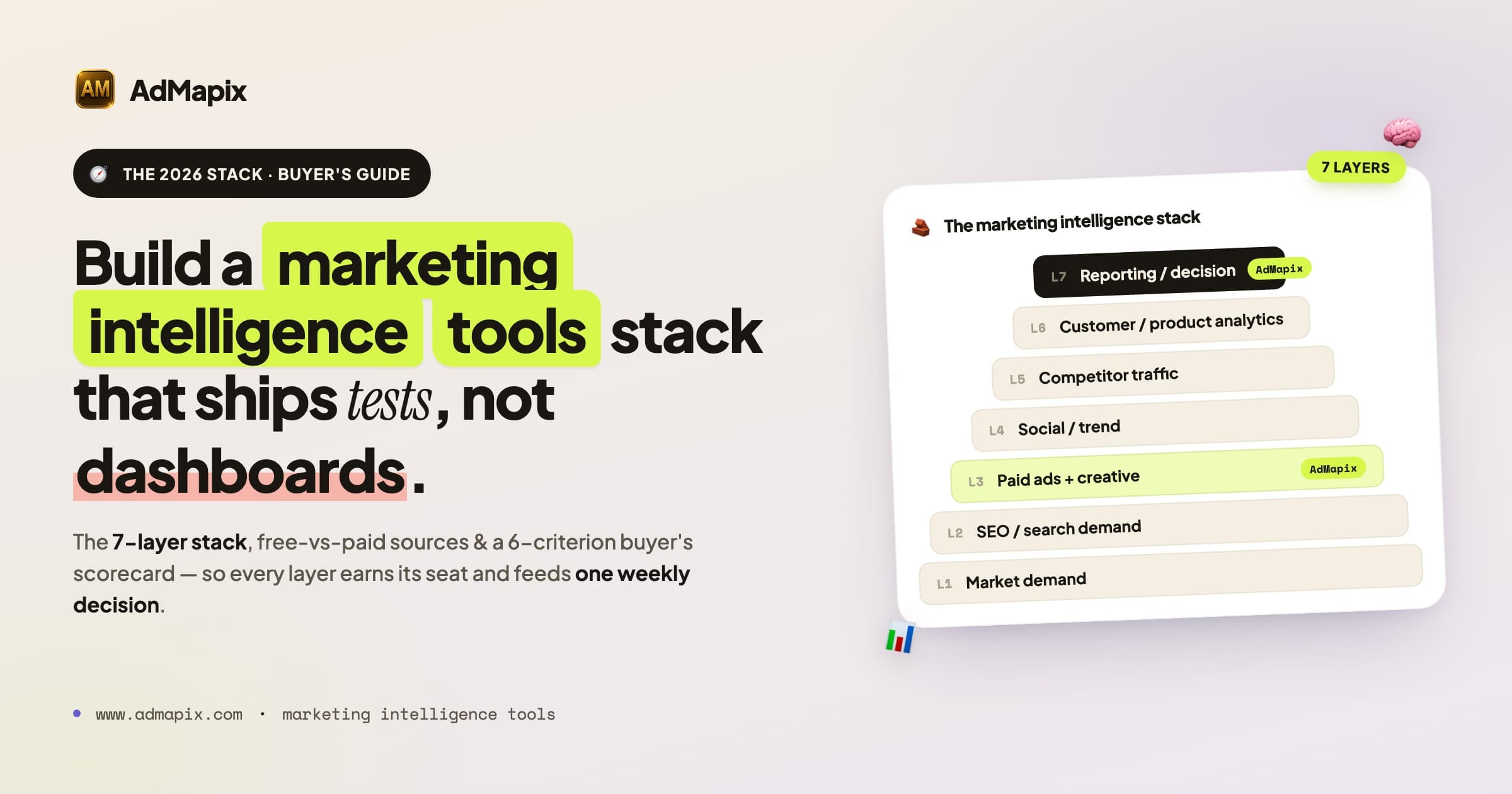
Marketing Intelligence Tools in 2026: The 7-Layer Stack, Software Compared & Buyer's Scorecard
A practical 2026 guide to marketing intelligence tools and software — the 7-layer stack, free vs paid sources, a 6-criterion buyer's scorecard, stacks by team stage and industry, build-vs-buy math, ROI, and a weekly decision workflow that turns signals into tests.
30 Days of AdMapix: What We Learned About Ad Intelligence in 2026
A 30-day recap of ad intelligence workflows, ad spy tools, transparency libraries, app ads, game ads, and competitor research lessons for 2026.
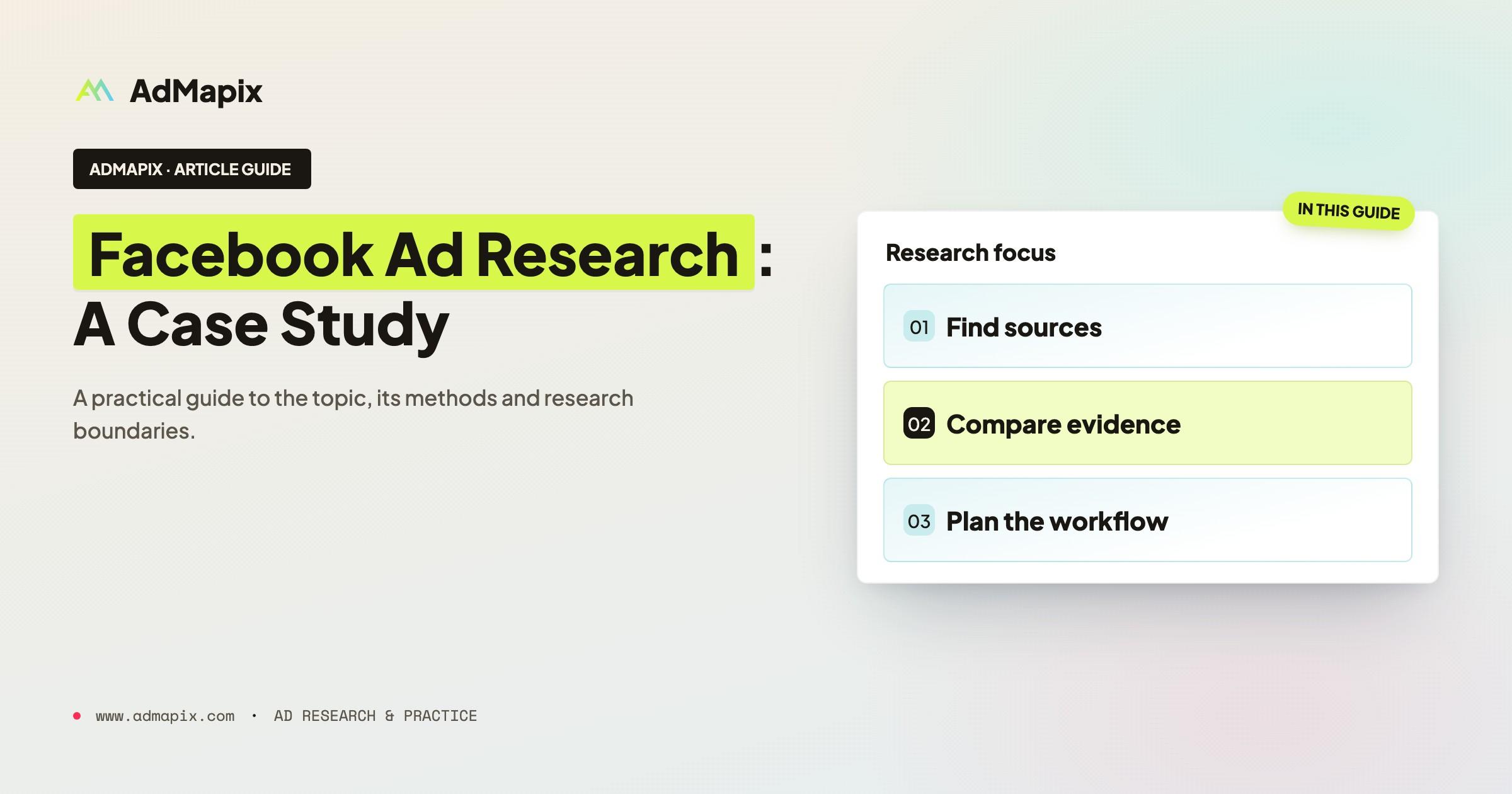
Case Study: How We Found 10 Winning Facebook Ads in 2 Hours
A practical winning Facebook ads case study showing the filters, scoring system, and ad intelligence workflow we use to find strong ad candidates fast.