
Cross-Channel Ad Attribution in 2026: A Practical Guide for Performance Teams
A practical cross-channel ad attribution guide for performance teams: how to compare ROAS across platforms when every platform claims credit differently, build incrementality testing into your workflow, and make budget decisions without perfect data.
Cross-channel attribution: every platform claims credit for the same conversion. Your job is to figure out who actually deserves it.
The Cross-Channel Attribution Problem in One Paragraph
You run ads on Meta, Google, and TikTok. A user sees your Meta ad on Monday, Googles your brand on Wednesday, clicks a TikTok ad on Friday, and converts. Meta claims the conversion (view-through). Google claims it (brand search click). TikTok claims it (last click). All three report the same conversion. If you add up platform-reported conversions, you get 3x actual conversions.
This is not a bug — it's how every ad platform's attribution works. And it's the single biggest source of misallocated budget in performance marketing.
This article gives you a practical framework for comparing ROAS across platforms, running incrementality tests without a data science team, and making budget decisions when attribution data is imperfect.
Step 1: Normalize Platform Data Before Comparing
Before comparing ROAS across platforms, normalize for their different attribution defaults:
| Platform | Default attribution window | View-through included? | What gets double-counted |
|---|---|---|---|
| Meta | 7-day click, 1-day view | Yes | Brand searches after ad exposure |
| Google Ads | 30-day click | No (by default) | Brand searches, repeat visits |
| TikTok | 7-day click, 1-day view | Yes | Similar to Meta |
| Programmatic | Varies by DSP | Usually yes | Everything |
Normalization steps before comparing:
- Set all platforms to the same click attribution window (7-day recommended)
- Compare click-through ROAS only — exclude view-through conversions from cross-platform comparisons
- Segment brand vs non-brand conversions on Google Ads — brand search conversions are often capturing demand created by other channels
After normalization, Meta ROAS might drop 30-50% from its reported number. Google ROAS might drop 20-40% after removing brand search. That's the real baseline for comparison.
Step 2: Run Cheap Incrementality Tests
Full geo-holdout tests are expensive and complex. But you can run simpler incrementality tests with your existing setup:
Conversion lift tests (Meta): Meta offers native conversion lift measurement. It holds back a randomized control group and measures the conversion difference. Run this quarterly for your top campaigns. If Meta reports 2.0x ROAS but the conversion lift study shows only 1.3x incrementality, you know how much of Meta's reported ROAS is capturing organic demand.
Brand search segmentation (Google): Separate Google Ads performance into branded and non-branded. If 60% of your "Google Ads ROAS" comes from brand search, and brand search volume correlates with your Meta/TikTok spend, Google is double-counting what other channels drove. Treat brand search as a separate budget line and allocate it based on defensive necessity, not ROAS comparison with prospecting.
Platform pause test (any platform): For one week, pause spend on a single platform (or a single campaign) and measure total conversions — not just that platform's reported conversions, but your total business conversions. If total conversions barely drop, that platform/campaign wasn't driving incremental conversions. This is the cheapest incrementality test available.
Step 3: Build a Simple Multi-Touch Model (in Google Sheets)
You don't need an enterprise MMM. For most teams, a simple position-based attribution model in a spreadsheet is more actionable:
- First touch (discovery): 20% credit
- Middle touches (consideration): 30% credit (split across middle channels)
- Last touch (conversion): 50% credit
Not because this split is "correct" — no model is perfectly correct. But because it forces you to recognize that channels doing discovery work (often Meta, TikTok) deserve partial credit even if they're not the last click, and channels doing conversion capture (often Google brand search) don't deserve full credit for closing demand other channels created.
Compare the position-based ROAS with each platform's self-reported ROAS. The gap tells you how much each platform is overclaiming.
Step 4: Make Budget Decisions With Imperfect Data
The teams that win at attribution aren't the ones with perfect models. They're the ones that make decisions despite imperfect data.
Decision framework when attribution is uncertain:
If all normalized metrics point the same direction → act with confidence. If Meta has the highest position-based ROAS, highest marginal ROAS, and passes incrementality testing → it deserves more budget.
If metrics conflict → use the most conservative one. If Meta reports great ROAS but fails incrementality testing → the incrementality result is closer to truth. Hold or reduce budget.
If you can't measure incrementality → use the channel diversity rule. No more than 60% of budget in any single channel. If you can't measure which channel is truly driving conversions, diversification is your attribution insurance.
Weekly Attribution Cadence
- Monday: Pull normalized, click-only ROAS for each platform (last 7 days)
- Wednesday: Segment Google Ads brand vs non-brand; check correlation between brand search volume and other channel spend
- Friday: Update the position-based attribution spreadsheet; compare with platform-reported numbers
Monthly: run one incrementality test (conversion lift or platform pause)
FAQ
Why do all ad platforms claim the same conversion?
Because each platform's attribution operates independently. Meta attributes based on its own ad views/clicks. Google does the same. TikTok does the same. There's no central arbiter that deduplicates — each platform tracks from its own pixel/data. This is by design, not a bug.
What's the simplest incrementality test I can run?
The platform pause test. Pause one platform for 5-7 days. Measure total business conversions (not platform-reported). If total conversions don't drop meaningfully, that platform wasn't driving incremental conversions. No data science required.
Do I need a marketing mix model (MMM)?
Not until your monthly ad spend exceeds $100K-200K. Below that, normalized last-click comparison + simple position-based modeling + occasional incrementality tests give you 80% of the decision value at 5% of the cost.
How does AdMapix fit into attribution?
AdMapix provides the competitive layer: when your normalized ROAS drops, is it because of attribution issues or because a competitor increased spend in your auction? Competitive intelligence separates internal measurement problems from external competitive pressure — two things that look identical in platform dashboards. See reports.
Bottom Line
Cross-channel attribution will never be perfect. Don't wait for perfect data to make decisions.
Normalize what platforms report. Run cheap incrementality tests. Use position-based modeling to distribute credit. And when data conflicts, trust the conservative metric. The goal isn't perfect attribution — it's better budget decisions than last quarter.
Turn these observations into your next creative study
Open the creative library and select samples for your market, network and research question.
Related Articles
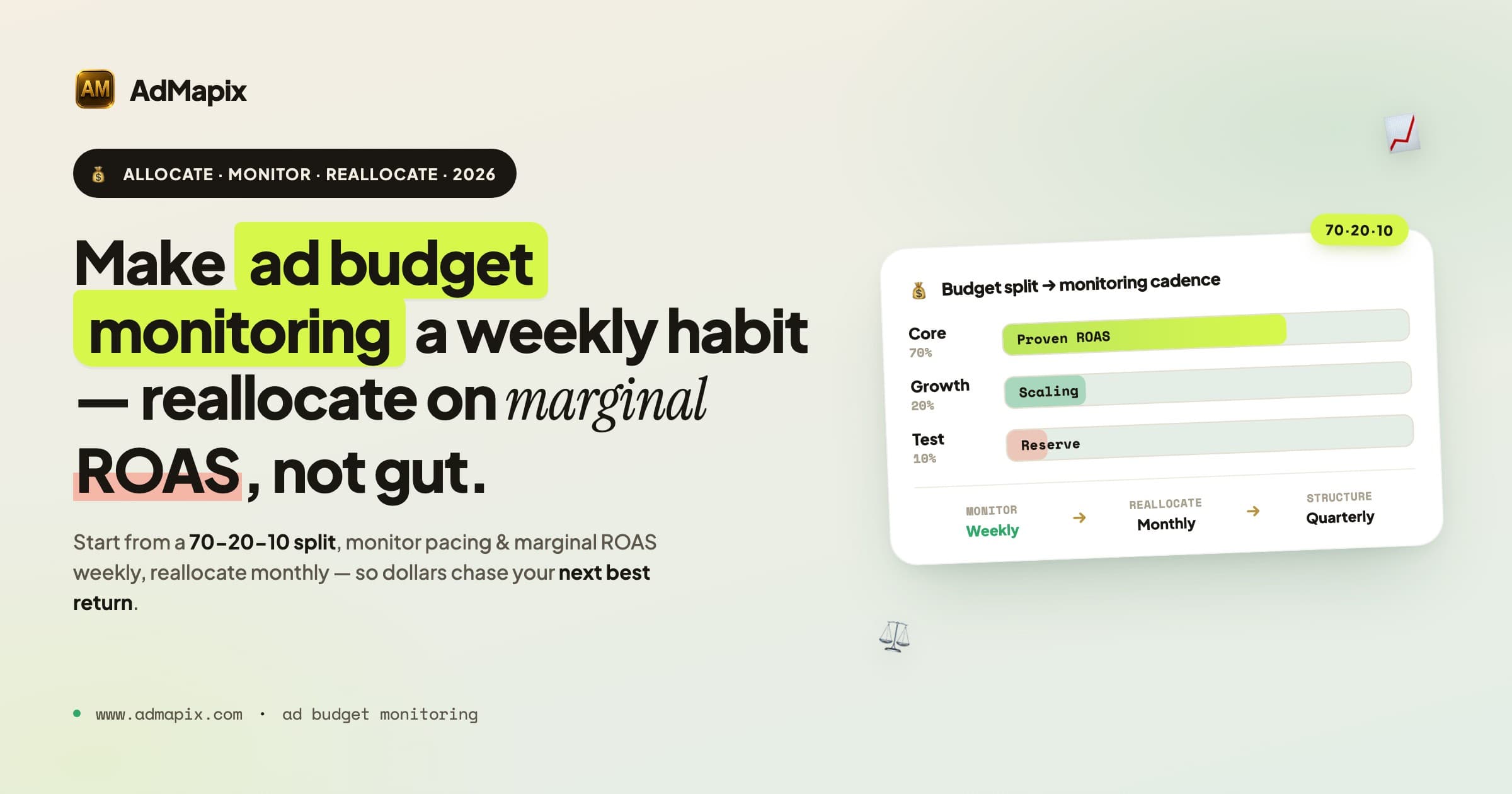
Ad Budget Optimization Framework 2026: Monitoring, Pacing & Reallocation
A 7,500-word 2026 framework for ad budget monitoring, tracking, and optimization: the 70-20-10 split, marginal ROAS, competitor ad budget signals, budget pacing, a weekly tracking dashboard, and a monthly reallocation workflow.
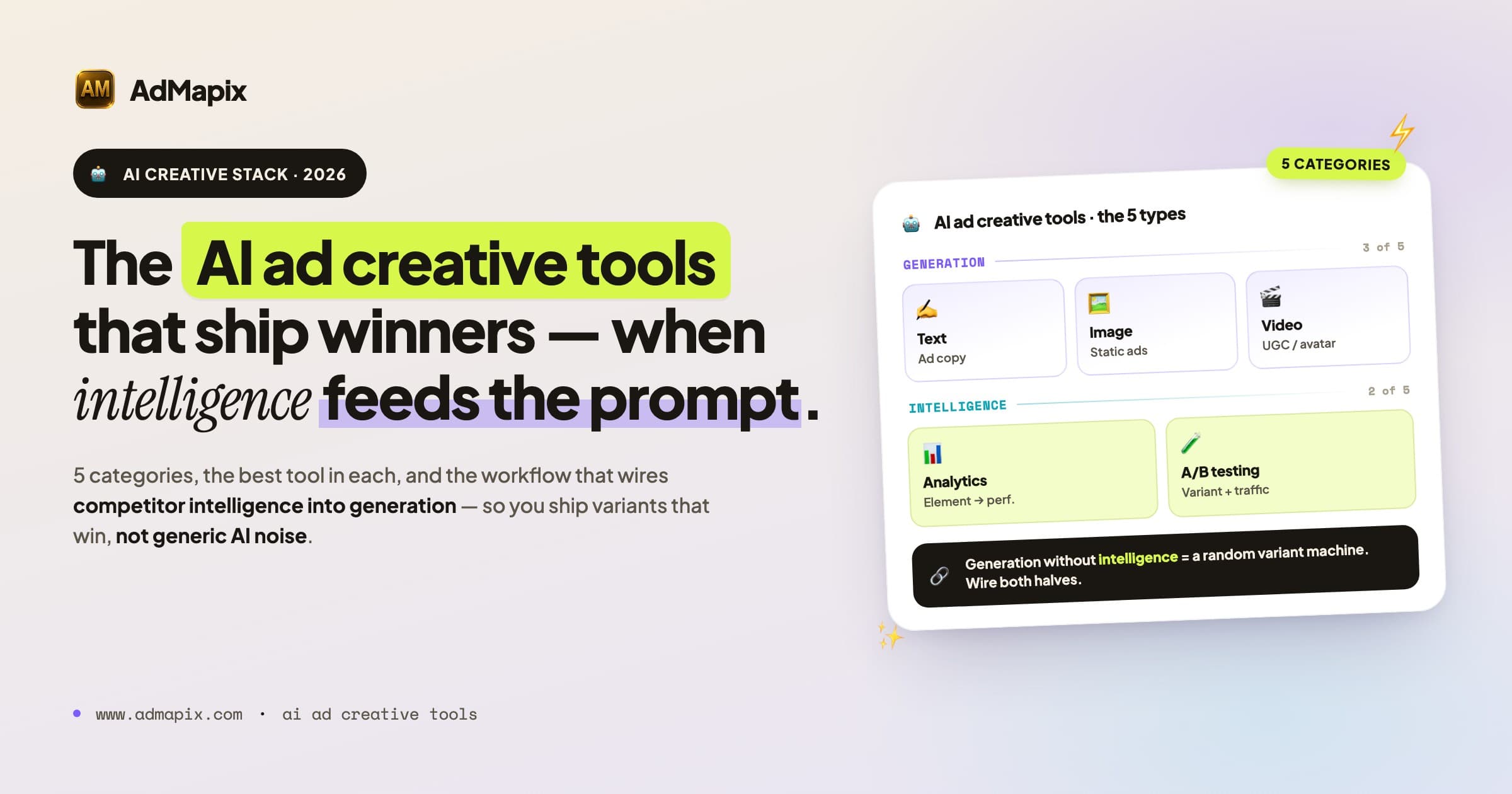
AI Ad Creative Tools in 2026: The 5 Categories, Best Tools & a Workflow That Actually Converts
A practical 2026 guide to AI ad creative tools — the 5 categories (text, image, video, analytics, A/B testing), best tools per category, prompt templates, a competitive-intelligence-fed workflow, AI UGC ads, platform disclosure rules, and how to ship variants that win instead of generic AI noise.
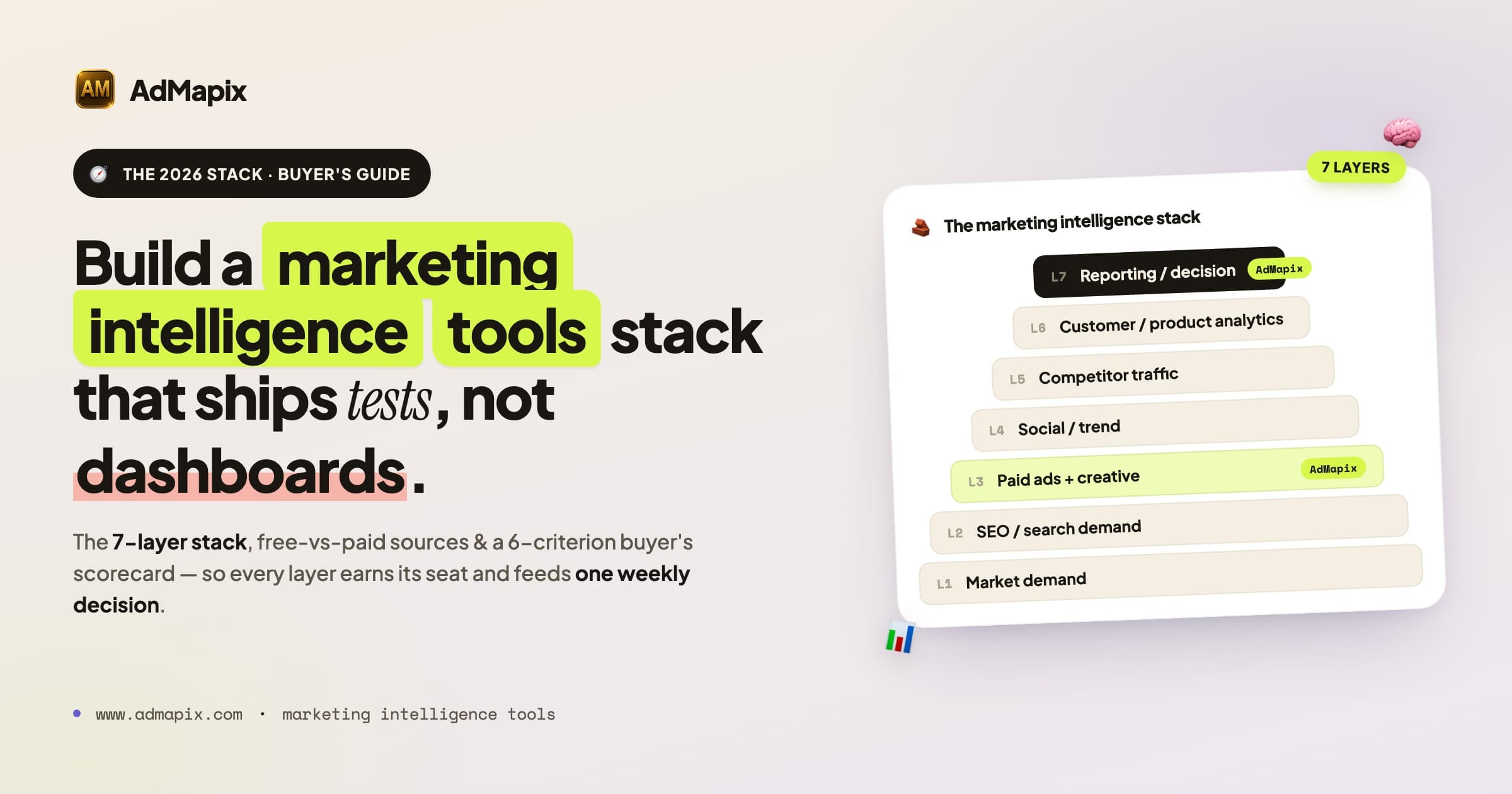
Marketing Intelligence Tools in 2026: The 7-Layer Stack, Software Compared & Buyer's Scorecard
A practical 2026 guide to marketing intelligence tools and software — the 7-layer stack, free vs paid sources, a 6-criterion buyer's scorecard, stacks by team stage and industry, build-vs-buy math, ROI, and a weekly decision workflow that turns signals into tests.