
TikTok Ad Spy Tools for TikTok Shop in 2026: Free & Paid Compared (Seller's Guide)
A 2026 seller's guide to TikTok ad spy tools for TikTok Shop — free official sources, paid tools compared (PiPiAds, Minea, Kalodata, FastMoss, AdMapix), a shoppable-video teardown framework, a repeatable research SOP, and what public ad data can and cannot prove.
By the AdMapix Research Team — Updated June 21, 2026
TikTok Ad Spy Tools for TikTok Shop in 2026: Free & Paid Compared
TikTok ad spy tools are the software and free public surfaces that let TikTok Shop sellers see which products competitors are pushing, how their shoppable videos are built, and whether a pattern is repeating across a market — before spending a dollar scaling it. The best one is not the biggest database; it is the tool that gets your team from "interesting ad" to a testable creative brief or product test fastest. This 2026 guide is for TikTok Shop sellers, ecommerce operators, creator-commerce teams, and agencies. It covers the free official stack, the paid tools worth comparing (PiPiAds, Minea, Kalodata, FastMoss, AdMapix), a shoppable-video teardown framework, a repeatable research workflow, pricing context, and — critically — exactly what public ad data can and cannot prove.
TL;DR — TikTok Ad Spy Tools in One Screen
- A TikTok ad spy tool earns its price when it turns a competitor's ad into your next test, not when it has the largest archive.
- Start free with TikTok Shop Seller Center and TikTok Creative Center; add a paid tool only when weekly research volume outgrows them.
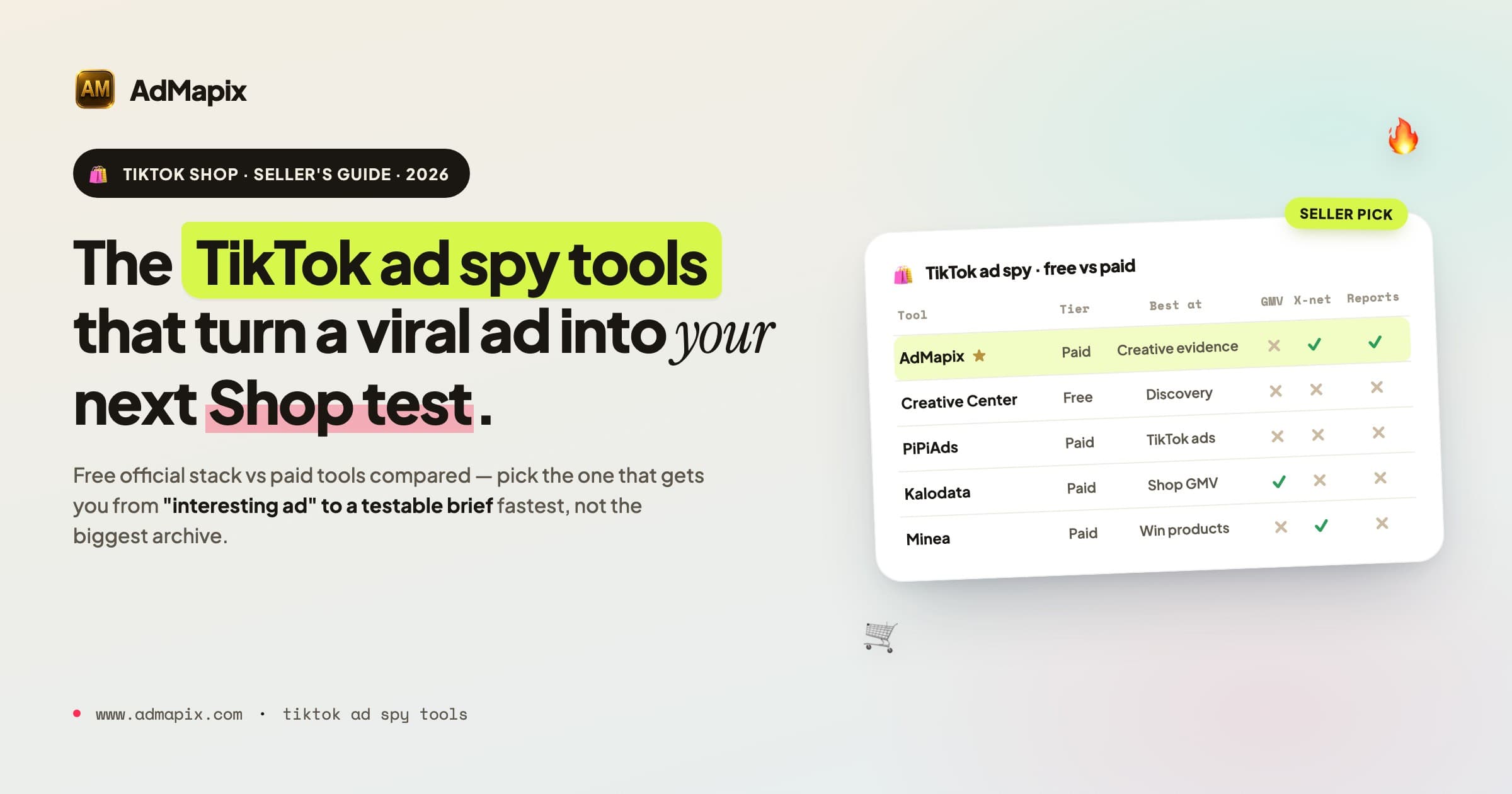
- PiPiAds leans TikTok-first ad discovery; Minea leans product research and winning-product sourcing; Kalodata and FastMoss lean TikTok Shop GMV/analytics; AdMapix leans cross-network creative search, saved media, video breakdowns, and shareable reports.
- Compare tools on the decision they improve — run the same 3–5 competitor brands through each, same country and date window, and see which produces a brief you could hand a creator the same day.
- Public ad data proves creative, offer, format, and recency — never spend, ROAS, or GMV. Treat every competitor ad as a hypothesis; validate with your own store, ad, and CRM data.
- On TikTok Shop, the first 3 seconds, the proof moment, and the CTA matter more than a static thumbnail. A tool that can't show video structure can't show what actually converts.
What TikTok Shop Sellers Actually Need From an Ad Spy Tool
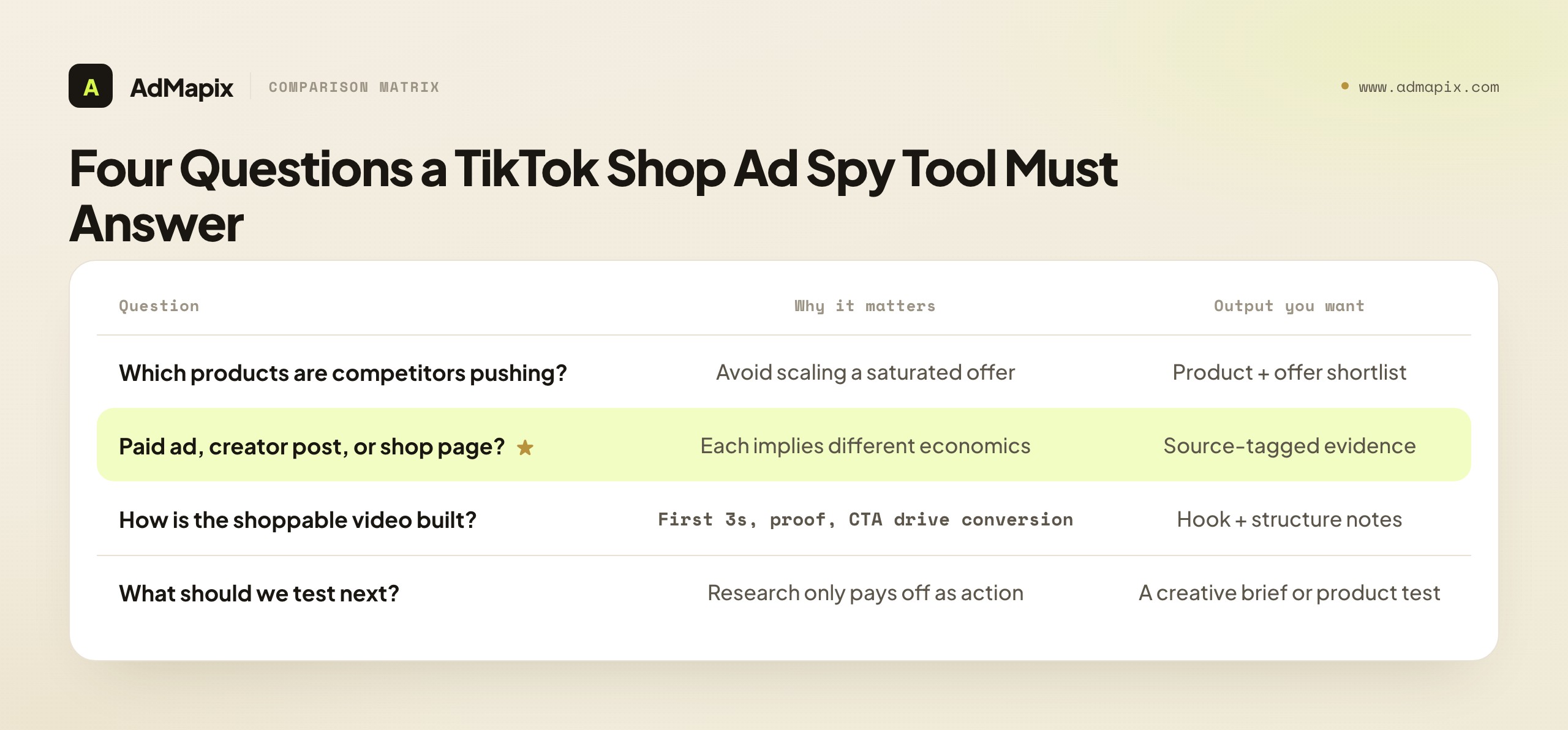
The job is not collecting screenshots, it is turning competitor activity into your next move. TikTok Shop blends discovery commerce, creator content, shoppable video, LIVE selling, and in-app checkout, so a useful tool has to separate paid ads from organic creator posts and tie both back to a product and an offer. Most sellers searching this topic are trying to answer four questions before they commit budget.
| Question | Why it matters on TikTok Shop | Output you want |
|---|---|---|
| Which products are competitors actively pushing? | Stops you scaling a saturated or fading offer | Product and offer shortlist |
| Is this a paid ad, a creator post, or a shop page? | Each implies a different cost and strategy | Source-tagged evidence |
| How is the shoppable video built? | The first 3 seconds, proof, and CTA drive conversion | Hook and structure notes |
| What should we test next? | Research only pays off if it becomes action | A creative brief or product test |
If a tool cannot answer at least the first and last question for your market, it will not change a decision no matter how large its archive is. This is the single most common reason sellers churn off a paid spy tool within a month: they bought a feed, not a decision engine. The feed is dazzling for a week, then it becomes another tab nobody opens, because it never closes the loop to "so we should test X."
A second thing sellers underestimate: TikTok Shop is not Meta. The signal that matters is not just the ad creative — it's the bundle of product + creator + shoppable format + offer + price point. A Facebook ad spy tool ported to TikTok that only shows you the video misses half the decision. You need the product behind the video, whether a creator or the brand posted it, and how the in-app checkout offer is framed. Keep that whole bundle in view or you'll copy a hook that's winning for reasons you can't see.
Why TikTok Shop Ad Spying Is Different (2026 Context)
Three TikTok Shop realities in 2026 change how you read competitor ads, and most generic "ad spy" advice ignores all three.
Creator content blurs the paid/organic line. A huge share of TikTok Shop GMV comes from affiliate creators and Spark Ads (brand-boosted creator posts), not classic in-feed ads. A video that looks organic may be a paid Spark Ad; a video that looks like an ad may be an unpaid affiliate post that happened to pop. If your tool can't distinguish these, you'll mis-price the competitor's strategy — assuming a cheap affiliate win required a big paid budget, or vice versa.
GMV Max changed the optimization surface. TikTok's GMV Max automates much of campaign setup around a product and creative pool, which means competitors increasingly compete on creative volume and product-offer fit rather than manual bid craft. For spying, that raises the value of reading which products and angles a competitor feeds the machine, and lowers the value of guessing bid strategy you can't see anyway.
Short shelf life. TikTok creative fatigues fast — winning shoppable angles can saturate in days, not weeks. A "long-running" TikTok ad is a weaker signal than a long-running Meta ad; longevity here often means a neglected affiliate post, not a scaled winner. Weight repetition across creators and recency over raw run-days.
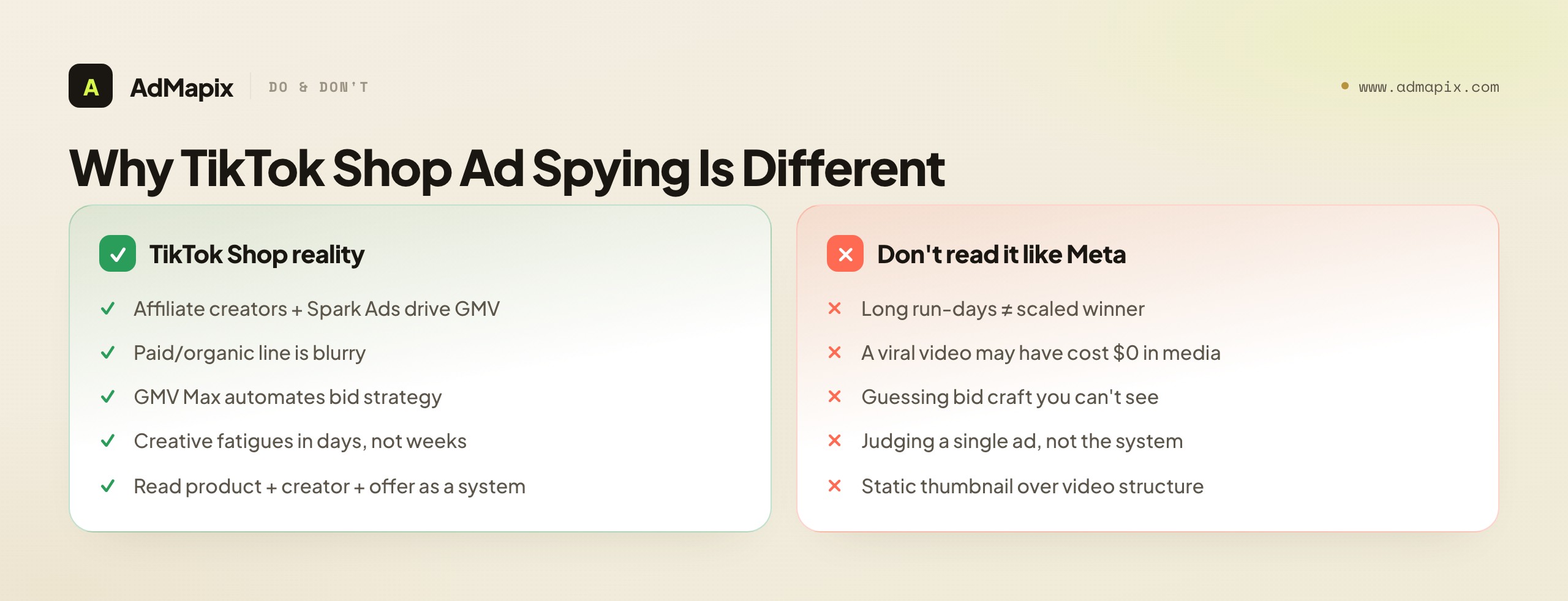
The practical upshot: on TikTok Shop you are reading a product-creative-offer system, not a single ad. The tools that help most are the ones that surface that system, not just a wall of videos.
A Quick TikTok Shop Ad-Spy Glossary
If you're new to the platform, these terms recur throughout every tool and this guide. Getting them straight prevents the most common misreads.
| Term | What it means | Why it matters for spying |
|---|---|---|
| Shoppable video | An in-feed video with a tappable product link to in-app checkout | The creative is the storefront; structure drives conversion |
| Spark Ads | Paid boosting of an existing organic creator/brand post | Makes a paid ad look organic — easy to mis-tag the source |
| Affiliate creator content | Creators posting for commission, often unpaid by the brand | A viral-looking win may have cost the brand $0 in media |
| GMV Max | TikTok's automated campaign type optimizing around a product + creative pool | Competitors compete on product-offer fit and creative volume, not bids |
| Top Ads | Creative Center's ranked feed of high-performing ads by region/objective | The best free starting point for discovery |
| GMV | Gross Merchandise Value — total sales through the shop | The closest public proxy to "is it actually working" (via analytics tools) |
| LIVE selling | Real-time shopping streams with in-stream checkout | A distinct format spy tools may or may not capture |
Keep this open while you read competitor research: the difference between a Spark Ad and an affiliate post, or between run-days and rising GMV, is the difference between a correct and a backwards read of a competitor's strategy.
Free TikTok Ad Spy Tools: How Far the Official Stack Gets You
Sellers searching "free TikTok ad spy" or "TikTok ad spy free" are right to start here — the official surfaces are genuinely useful and cost nothing. The trick is knowing exactly where they stop.
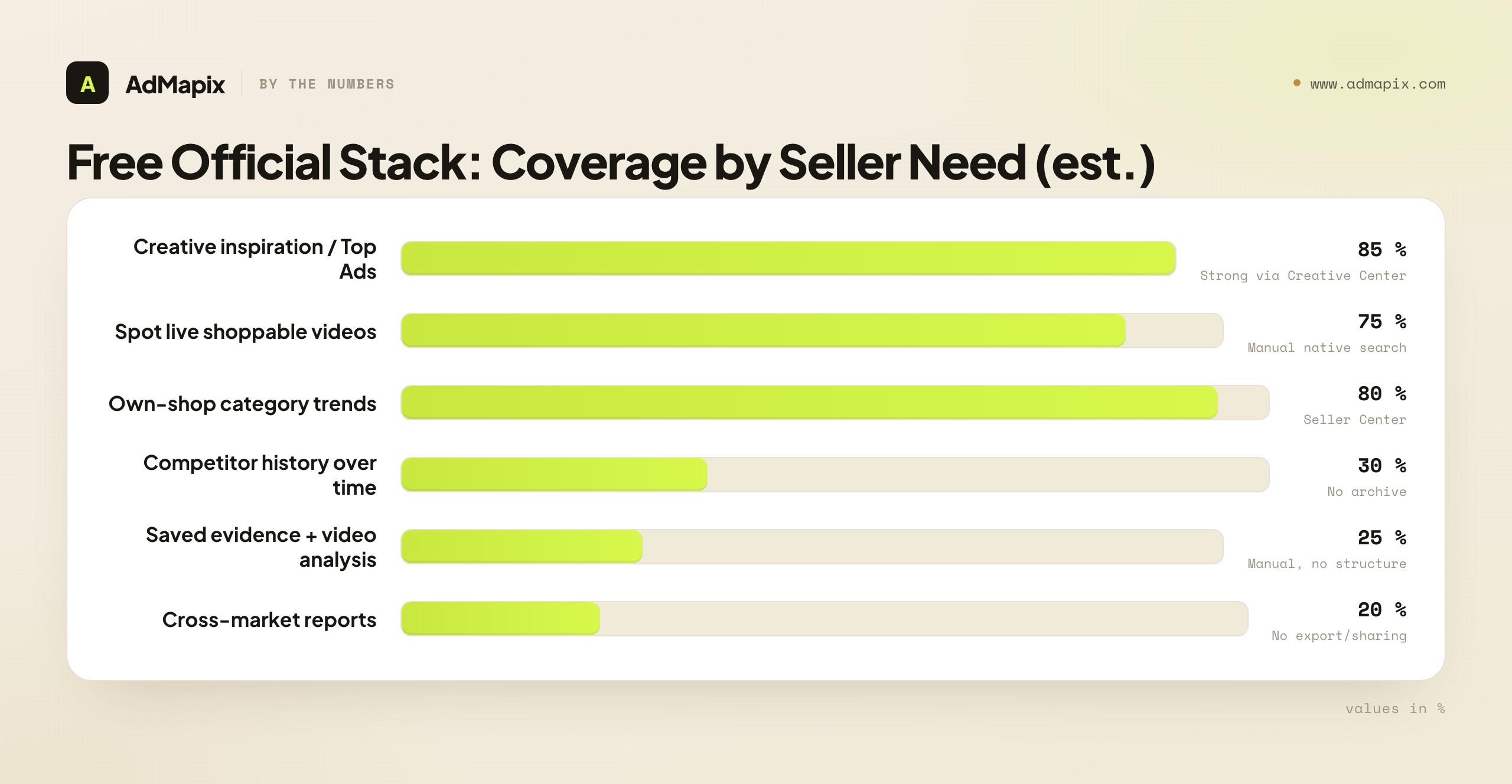
| Free source | Best for | Where it stops |
|---|---|---|
| TikTok Creative Center | Top Ads, trending hashtags/songs, keyword insights, creative inspiration by region | No competitor history; no saved evidence; not Shop-specific |
| TikTok Shop Seller Center | Category trends, product/marketplace signals for your own shop | Inside your account; not a competitor archive |
| Native TikTok search + hashtags | Spot live creator content and shoppable videos in your niche | Manual, ephemeral, no source-tagging or export |
| TikTok Shop product/affiliate pages | See the actual product, price, and which creators promote it | No paid-ad context; no longitudinal tracking |
A free workflow that actually works. You can run real research at $0 if you're disciplined:
- Open Creative Center → Top Ads, filter to your country and the e-commerce objective, and sort by metrics like CTR or likes to surface heavily-engaged shoppable creative.
- For each promising ad, identify the product, then search that product on TikTok and in the Shop to see which other creators are running it (repetition = signal).
- Screenshot or screen-record the video, and log the hook, proof moment, offer, and CTA in a shared sheet with the country and date.
- Cross-check the product's momentum in your Seller Center category trends.
This covers a surprising amount — roughly the first 60–70% of what a small seller needs. Where it breaks is exactly where paid tools earn their keep: competitor history over time, saved evidence with context, structured video analysis, cross-market comparison, and shareable reports. The moment you're tracking more than a handful of competitors weekly, or need to hand a client a deck, the manual free stack stops scaling.
For a deeper free-source walkthrough, our TikTok Creative Center tutorial and TikTok Ad Library explained cover the official surfaces filter-by-filter.
How to Compare TikTok Shop Ad Spy Tools
Compare tools on the decision they improve, not on raw database size. Run the same three to five real competitor brands through each tool, using the same country and date window, and watch which one produces a brief you could hand to a creator the same day. Five criteria separate a tool that informs action from one that just fills a folder.
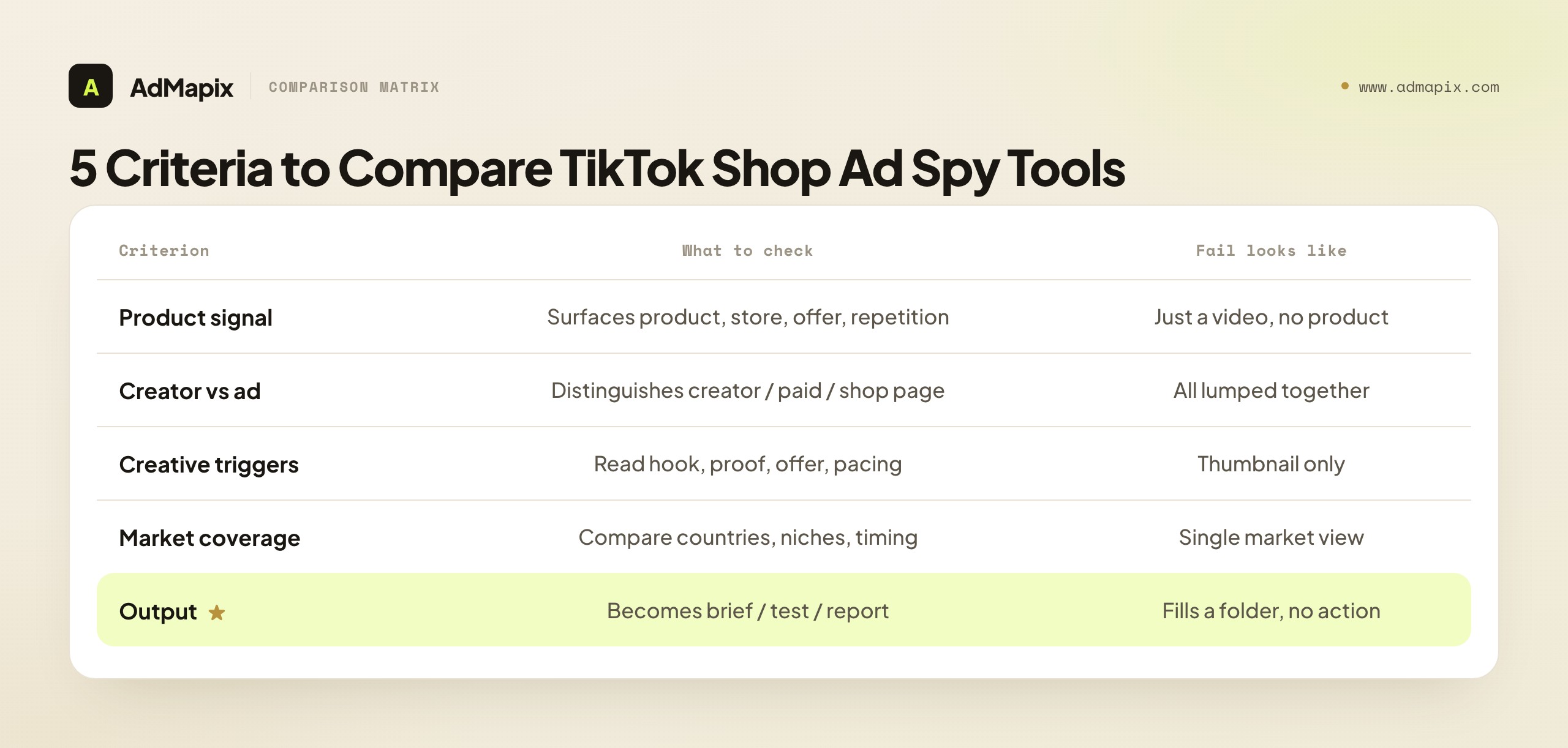
| Criterion | What to check |
|---|---|
| Product signal | Does it surface the actual product, store, offer, and repeated seller patterns, not just a video? |
| Creator and shoppable video | Can you tell creator-led content, paid ads, and shop/product pages apart? |
| Creative triggers | Can you read the hook, proof moment, offer, and pacing from the video itself? |
| Market coverage | Can you compare countries, niches, and launch timing in one workflow? |
| Output | Does research convert into a brief, a product test, a GMV Max test, or a report? |
Score each tool pass/fail on these five during a trial. A tool that passes Product signal + Output is already useful; one that passes all five is a keeper. A tool that nails Market coverage but fails Output (no briefs, no exports) will quietly waste your team's time — beautiful data, no decisions.
The Paid Tools, Compared
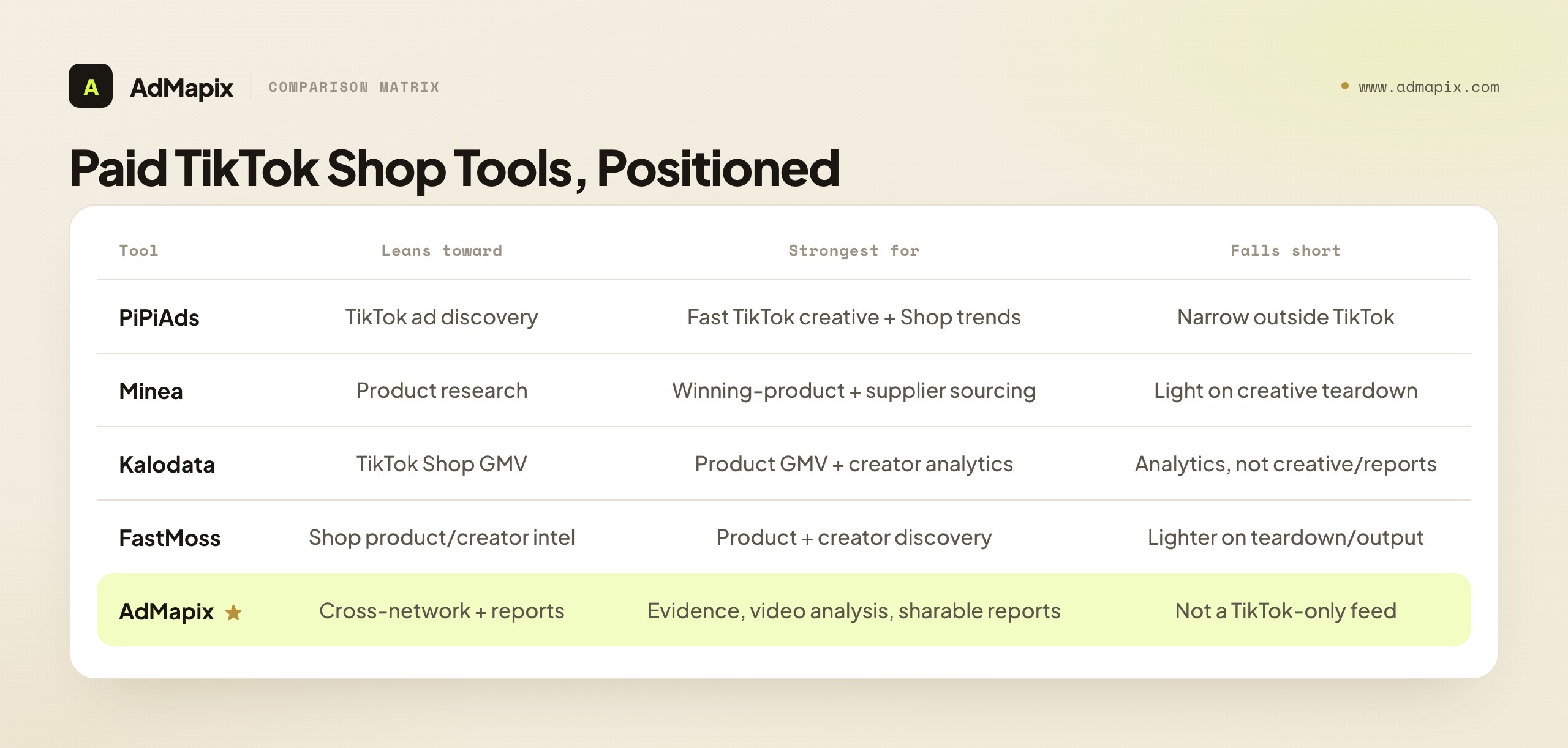
No single tool is "best" — each specializes. Here's the honest positioning of the main options a TikTok Shop seller will encounter, what each is strongest at, and where it falls short. Treat this as a map, not an endorsement; verify current features and pricing on each official page before buying.
PiPiAds — TikTok-first ad discovery
PiPiAds built its name as a TikTok ad spy tool and remains TikTok-centric, with a large library of TikTok in-feed ads, filtering by metrics, landing-page and product links, and Shop-trend features. In practice, sellers use it to filter by metrics like likes, run-time, or country, then click through to the product and landing page to reconstruct the offer — a fast path from "this ad is everywhere" to "here's the product and price behind it." Strongest for: teams whose primary job is discovering TikTok ad creative and Shop product trends quickly. Falls short: coverage is narrower outside TikTok, and deep product sourcing is secondary to ad discovery; pair it with a cross-network or GMV tool when you need more than discovery.
Minea — product research & winning-product sourcing
Minea leans toward ecommerce product research: daily winning products, ad spy across networks, and supplier/sourcing signals. The typical Minea workflow is reversed from PiPiAds — you start from a product surfaced in the winning-products feed, then look at the ads running it, rather than starting from an ad. That makes it a strong fit when your weekly question is "what should we add to the catalog," and it connects sourcing signals so you can move from idea to supplier in one place. Strongest for: product-led or dropship-style sellers whose bottleneck is what to sell, not how the ad is built. Falls short: less focused on deep paid-creative teardowns of the shoppable video itself, so pair it with a teardown habit or tool before scaling spend.
Kalodata — TikTok Shop GMV & analytics
Kalodata is built specifically around TikTok Shop data — product GMV, creator/influencer performance, video and LIVE analytics by market. This is the closest a public tool gets to "is it actually working," because GMV and creator sales velocity are commercial outcomes, not just engagement. Sellers use it to confirm that a product surfaced in a creative tool is also climbing in real sales across multiple creators — the two-signal validation that separates a genuine winner from a viral-but-unprofitable clip. Strongest for: sellers who want to read commercial signals (which products and creators are actually moving GMV) rather than only creative. Falls short: it's an analytics lens, not a cross-network creative-archive or reporting workflow; you still need a way to turn numbers into a creative brief.
FastMoss — TikTok Shop product & creator intelligence
FastMoss occupies similar ground to Kalodata: TikTok Shop product discovery, creator rankings, and trend tracking by region. The two are close enough that most sellers trial both and keep whichever has better coverage for their specific markets and categories — the data models differ, and one will usually feel sharper for your niche. FastMoss's creator rankings are especially useful when your strategy is affiliate-led: finding which creators are already moving GMV in your category tells you who to recruit, not just what to sell. Strongest for: product and creator discovery with a commercial slant. Falls short: same as Kalodata — strong on data, lighter on creative teardown and shareable client output.
AdMapix — cross-network creative search, evidence & reports
AdMapix fits when you need broad competitor creative evidence across networks, saved media, structured video analysis, and shareable reports — rather than a single platform's feed or a pure analytics dashboard. Strongest for: agencies and multi-market sellers who study TikTok Shop alongside Meta, YouTube, and Google, and need research that becomes a shareable output. Falls short: it is not a TikTok-only product feed or a supplier-sourcing tool; for those single jobs a specialist will feel more direct.
The realistic setup for most growing teams is not one tool — it's a specialist for its strongest job plus a cross-network/reporting layer. A TikTok-first creative team might pair PiPiAds (discovery) with AdMapix (cross-network evidence + reports). A sourcing-led seller might pair Minea (products) with Kalodata or FastMoss (GMV validation). Buy for the bottleneck, then add the layer that turns findings into action.
For broader head-to-heads beyond TikTok Shop specifically, see our best TikTok ad spy tools and best ad spy tools 2026 comparisons.
How to Run a 7-Day Tool Trial (So You Buy the Right One)
Most of these tools offer a trial or low-cost first month. Don't waste it browsing the feed — run a controlled bake-off against a real decision. Here's a trial protocol that produces a confident buy/skip call in a week:
- Day 1 — Fix the inputs. Pick one real decision (e.g., "which hook to test next for our skincare SKU"), one country, one 30-day date window, and the same 3–5 competitor brands. Write them down so every tool gets identical inputs.
- Days 2–3 — Run each candidate. Feed the identical inputs into each tool. Time how long it takes to reach a shortlist of competitor videos and to extract product, source (creator vs ad), and offer for each.
- Day 4 — Score the five criteria. For each tool, mark pass/fail on Product signal, Creator-vs-ad, Creative triggers, Market coverage, and Output. Note where you had to leave the tool and rebuild work in a doc.
- Day 5 — Produce a real brief. Using only the best tool, write an actual creative brief you'd hand a creator. If you can't, that tool fails Output regardless of how good its data looked.
- Days 6–7 — Sanity-check against free. Could the free official stack have reached the same brief with two more hours of manual work? If yes for your current volume, stay free. If the tool clearly saved hours or surfaced what you couldn't find manually, it's a buy.
A demo shows you a tool's best case; a controlled trial on a real decision shows you its median case — which is what you'll live with month after month. Buy on the median, not the demo.
Which Tool Fits Which Seller
There is no single best tool, only a best fit for your bottleneck. A sourcing-led seller and an agency reporting to clients have different jobs, so they should buy different things. Match the tool to the work in front of you.
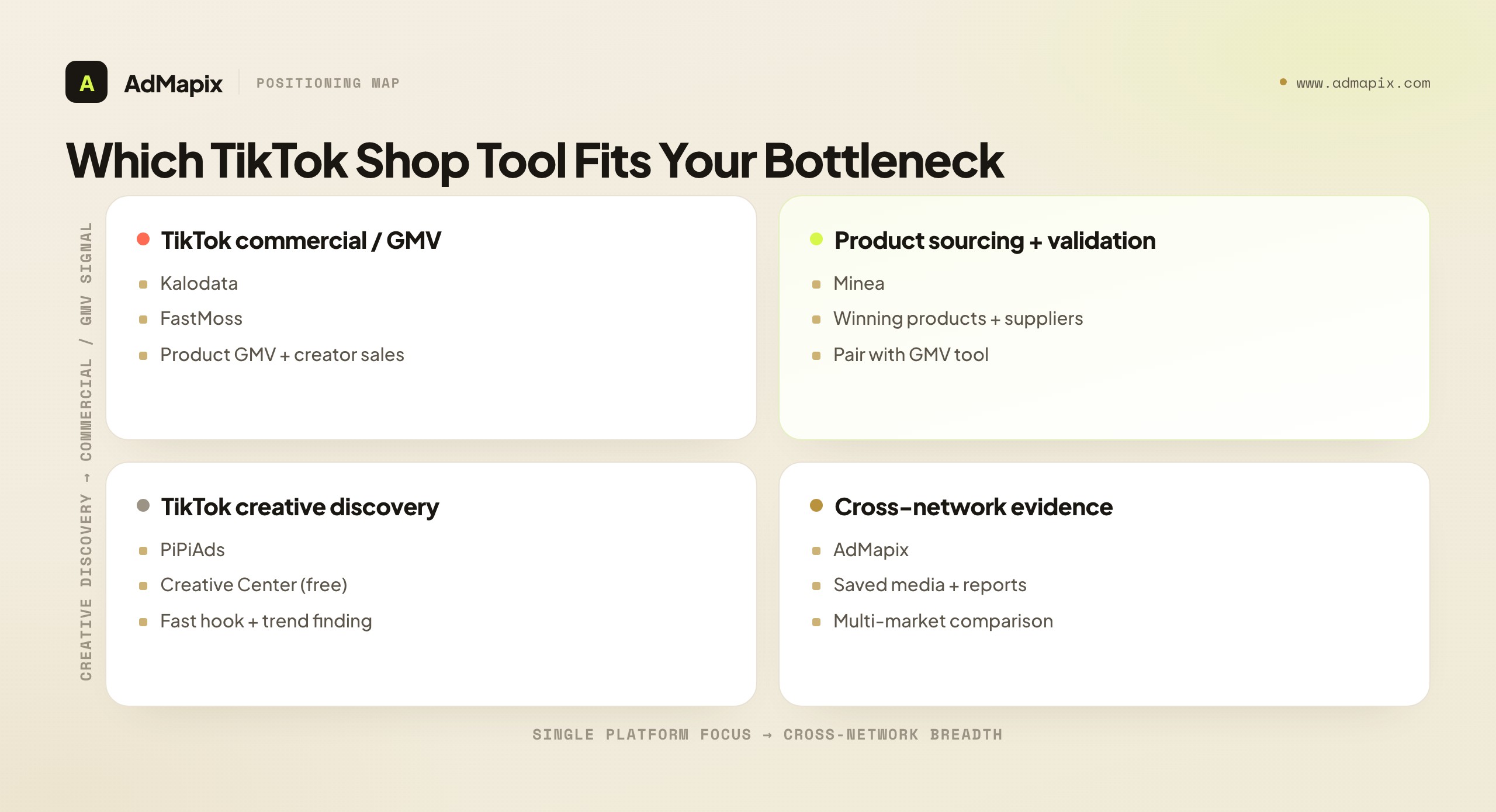
| Team or use case | Practical recommendation | Where it falls short |
|---|---|---|
| New TikTok Shop seller | Use Seller Center and Creative Center first; add a paid tool when weekly volume grows | Free tools show inspiration, not competitor history |
| TikTok-first creative team | Test PiPiAds when TikTok ad discovery and Shop trends are the priority | Narrower outside TikTok; product sourcing is secondary |
| Product-led / sourcing seller | Test Minea (creative) or Kalodata/FastMoss (GMV) when validating winning products is the bottleneck | Less focused on deep paid-creative breakdowns |
| Agency / multi-market seller | Use AdMapix when video analysis and country comparison must become reports | Not a one-platform TikTok-only feed; broader by design |
Pricing Context: What You're Actually Paying For
Sellers fixate on monthly price; the number that matters is cost per decision. Pricing in this category clusters into three tiers, and the right tier follows your research volume, not your ambition.
| Tier | Typical monthly range | What it buys | Right for |
|---|---|---|---|
| Free | $0 | Official TikTok surfaces, manual logging | New sellers, <5 competitors, single market |
| Specialist | ~$30–150 | One platform's deep feed/analytics (PiPiAds, Minea, Kalodata, FastMoss) | Single clear bottleneck (TikTok discovery or product sourcing or GMV) |
| Cross-network / workflow | ~$100–300+ | Multi-network search, saved media, video analysis, reports | Agencies, multi-market, recurring client reporting |
Two pricing traps to avoid. First, stacking two specialists that overlap (two TikTok-discovery tools) instead of pairing complementary jobs — you pay twice for the same signal. Second, buying the workflow tier before a workflow exists. A reporting layer amplifies a process; it doesn't create one. Prove the weekly rhythm on free tools first, then buy the tier that removes your specific bottleneck. Exact prices change often — confirm on each vendor's page, since plan limits and feature names shift quarterly in this space.
To make the "cost per decision" idea concrete: if a $99/month tool helps you produce four solid creative briefs a month, that's roughly $25 per brief. If even one of those briefs becomes a winning angle on a product doing four figures of monthly GMV, the tool has paid for itself many times over. Conversely, a $39/month tool that produces nothing you act on is infinitely expensive, because the denominator is zero. Judge tools on briefs-and-tests produced, not the sticker price — a more expensive tool that consistently changes your decisions is cheaper than a bargain tool that doesn't.
The Shoppable Video Teardown Framework
On TikTok Shop, the creative is the storefront. A spy tool that shows the video but doesn't help you read its structure leaves the most valuable signal on the table. Use this fixed teardown every time so competitor videos become comparable and copyable-into-briefs (adapt, never lift).
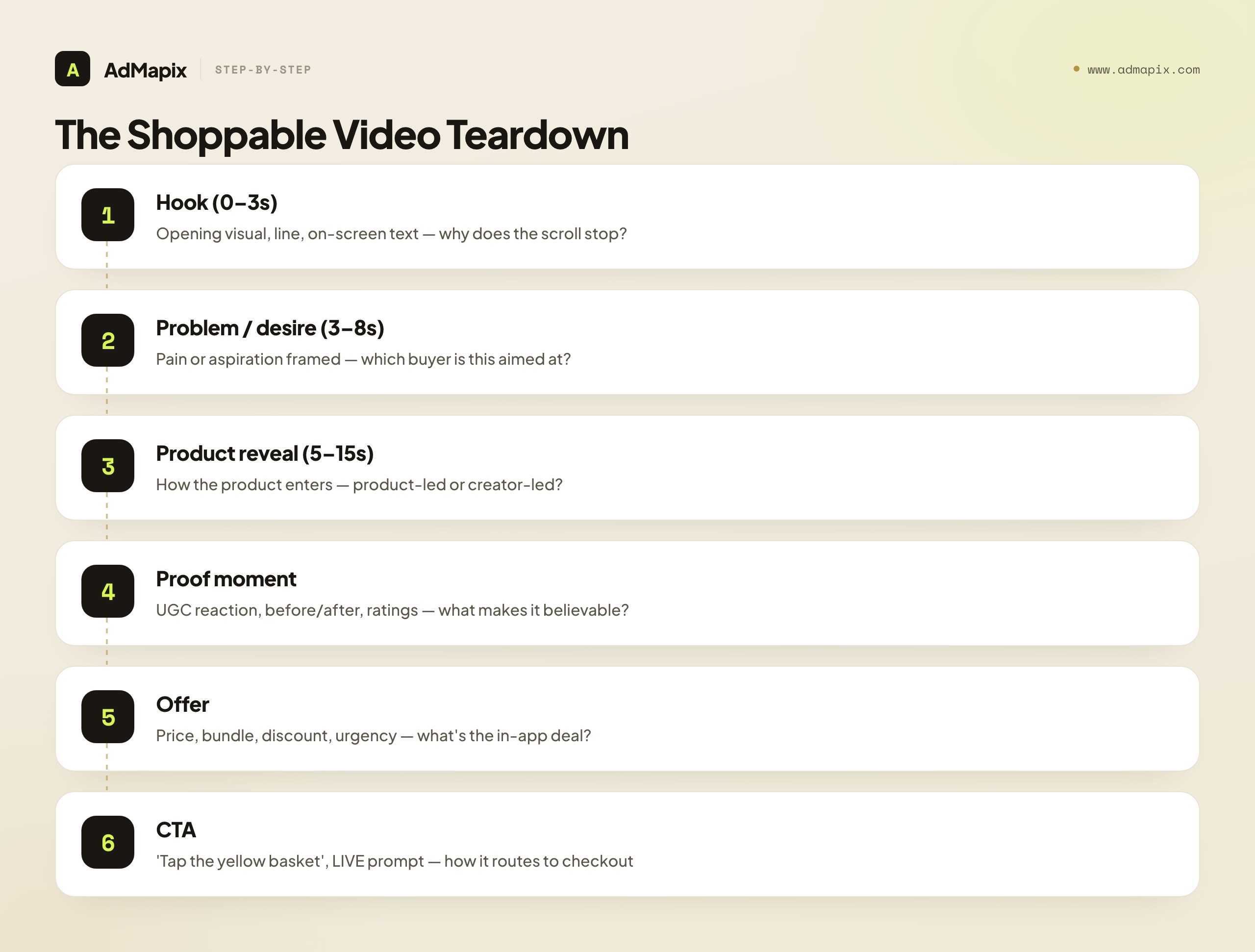
| Segment | What to capture | The question it answers |
|---|---|---|
| Hook (0–3s) | Opening visual, spoken line, on-screen text, pattern interrupt | Why does the scroll stop here? |
| Problem / desire (3–8s) | Pain or aspiration framed, who it's for | What buyer is this aimed at? |
| Product reveal (5–15s) | How and when the product enters, demo vs. talking-head | Is this product-led or creator-led? |
| Proof moment | UGC reaction, before/after, results, social proof, ratings | What makes it believable? |
| Offer | Price, bundle, discount, urgency, free shipping, Shop badge | What's the actual deal in-app? |
| CTA | "Tap the yellow basket," LIVE prompt, link in bio | How does it route to checkout? |
Run this on every saved competitor video and you'll start seeing the patterns — the hook archetypes, proof formats, and offer structures that repeat across winning creators in your niche. Those repeating patterns are your test backlog. A single video is an anecdote; the same hook-proof-offer structure across five creators in two weeks is a hypothesis worth a creative brief.
Hook Archetypes That Repeat on TikTok Shop
Across thousands of shoppable videos, the hooks that win cluster into a handful of archetypes. Tag every teardown with one to make patterns legible:
- Problem-callout: "If you struggle with [X], watch this." Pain-aware buyers.
- Result-first: opens on the after-state or transformation. High-trust categories (beauty, home).
- Unboxing/POV: "POV: your [product] just arrived." Discovery and impulse.
- Creator-reaction: genuine surprise/delight at the product. Affiliate-led, high authenticity.
- Demo-in-3-seconds: the product doing its job immediately. Gadgets, tools, problem-solvers.
- Price/offer shock: "I can't believe this is only $X." Impulse SKUs, promo cycles.
The strategic move isn't to copy the most common archetype — it's to find the underserved one in your niche. If every competitor opens with result-first beauty transformations and nobody's running creator-reaction POVs, that gap is where a fresh angle can break through.
A Repeatable Research Workflow
The workflow matters more than the tool. Name the decision first, then collect evidence the same way every time so results are comparable across tools and weeks.
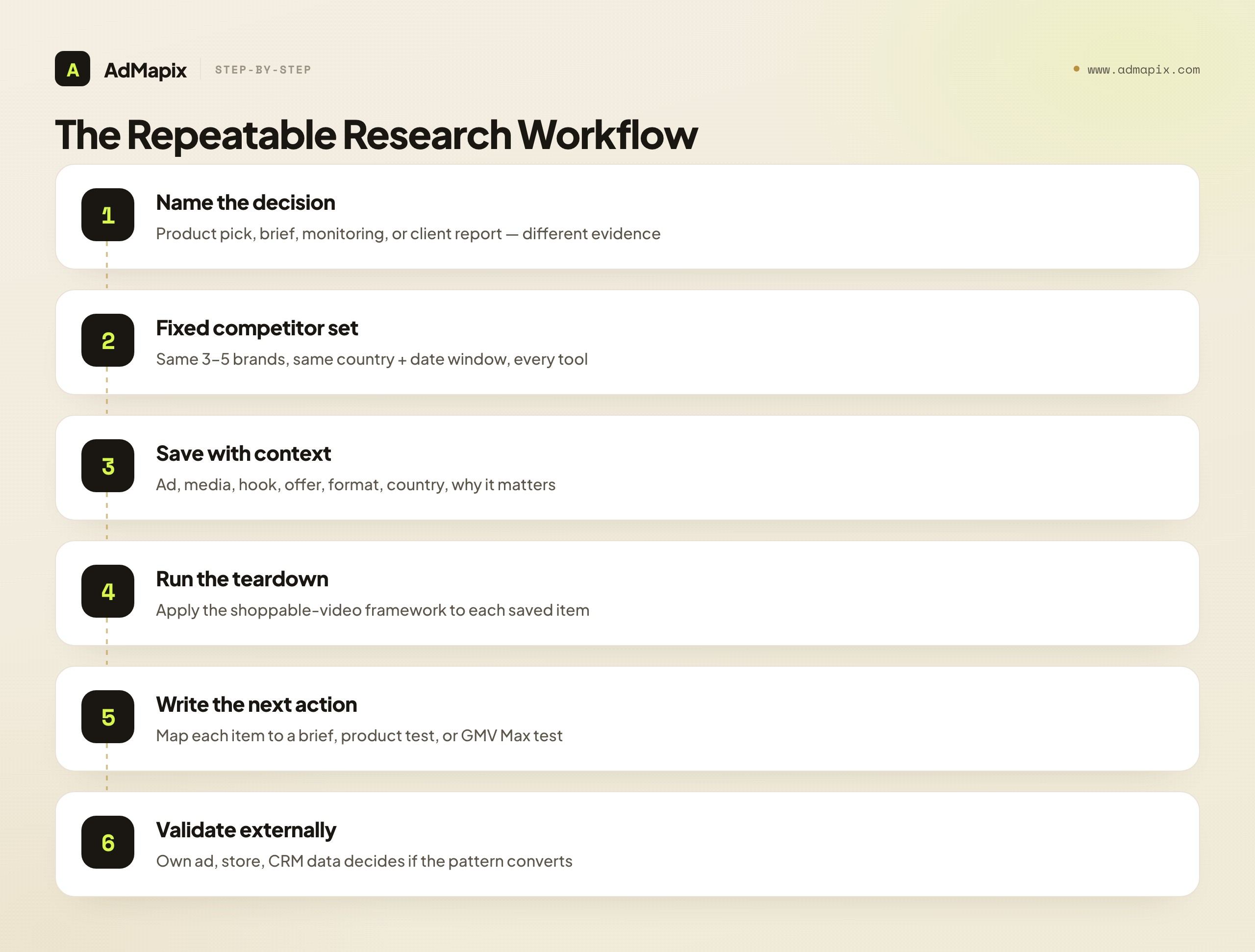
- Name the decision. Product selection, creative brief, competitor monitoring, video analysis, and client reporting are different jobs that need different evidence.
- Use a fixed competitor set. Search the same three to five real brands in each tool with the same country and date window.
- Save evidence with context. Keep the source ad, media, hook, offer, format, country, and one line on why it matters.
- Run the teardown. Apply the shoppable-video framework above to each saved item so structure is captured, not just the clip.
- Write the next action. Each saved item should map to a brief, a product test, a GMV Max test, a landing-page test, or a client note.
- Validate externally. Owned ads, product, store, and CRM data decide whether the observed pattern actually converts.
The discipline is what makes it pay off: same competitors, same window, same teardown, every week. That consistency is what lets you spot a change — a competitor switching hooks, a new product entering rotation, a price drop appearing in ad copy before the shop banner updates. Change is the signal; a static snapshot is just trivia.
From Spy Insight to a GMV Max Test
Research only counts when it ships. On TikTok Shop in 2026, "shipping" usually means feeding a product-and-creative hypothesis into a GMV Max campaign, because GMV Max automates much of the bid and placement work that older playbooks obsessed over. That shifts the seller's job toward two things competitor analysis directly informs: which product-offer to test and which creative angles to feed the pool. Both come straight out of your teardown.
Here's the bridge from a saved competitor pattern to a live test, step by step:
- Convert the pattern into a hypothesis. "Three competitors are winning with a demo-in-3s hook on this product category; we believe a demo hook will beat our current result-first control on add-to-cart rate."
- Build the creative pool, don't copy. Produce 3–5 variants on the underserved angle you found — different presenters or proof moments, same core hypothesis. GMV Max rewards a healthy pool, not a single hero.
- Match the offer to the market read. If competitors converge on "free shipping today," your offer needs parity or a clear reason to differ; the teardown already told you the going rate.
- Set one clean success metric. Add-to-cart rate or cost per order against your existing control, over a fixed window (often 7–14 days given TikTok's fast fatigue).
- Read results against the hypothesis, not vanity. A variant that wins on views but loses on orders failed. Feed the winning angle back into the next teardown cycle.
The reason to keep spying and testing tightly coupled is TikTok's speed. By the time an angle is obviously saturated in your spy tool, the window is closing. The teams that win run the loop weekly — spy, teardown, brief, GMV Max test, learn — so they're testing the next underserved angle while competitors are still scaling the last saturated one. This is the same insight-to-test discipline our competitor ad analysis framework formalizes for cross-platform work; on TikTok Shop the loop just runs faster.
What Public Ad Data Can and Cannot Prove
Ad spy tools show what competitors ran, not whether it worked. Public-facing tools, including official TikTok surfaces, reveal creative, format, offer, and rough recency, but they do not expose verified spend, true ROAS, conversion rate, or GMV. Treat every competitor ad as a hypothesis, not proof.
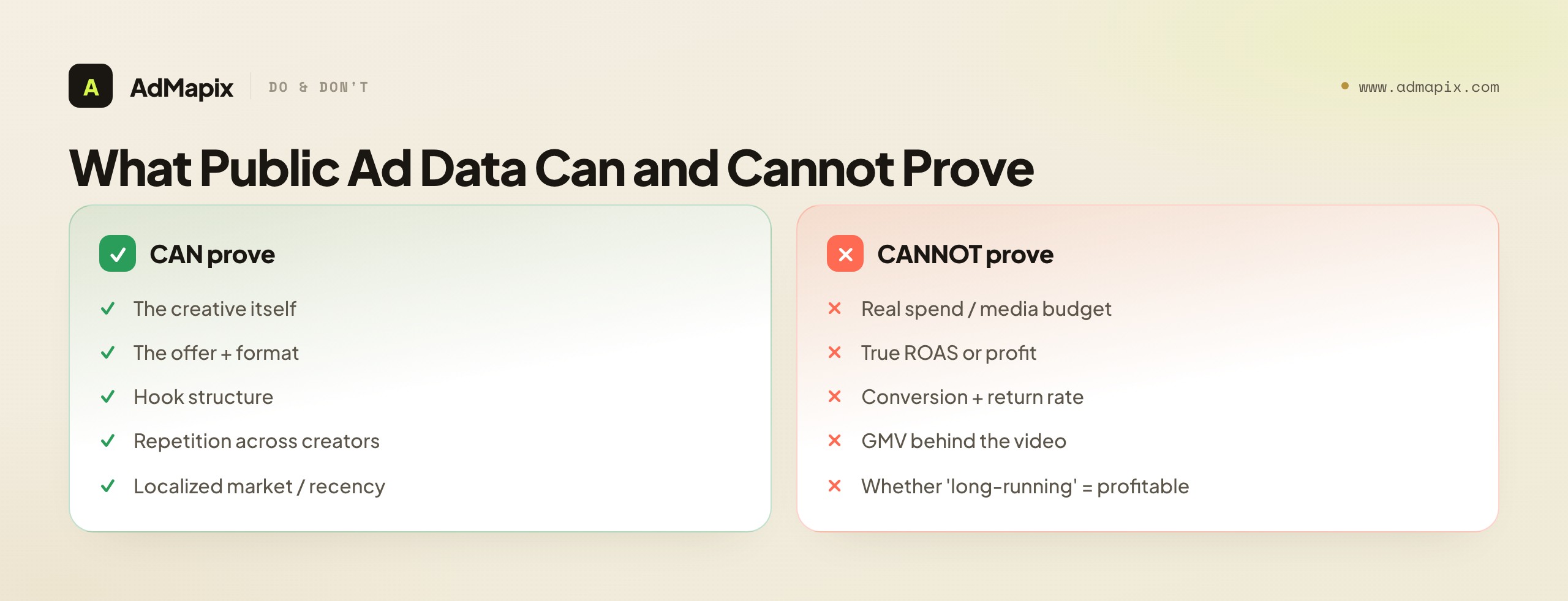
- What public data can show: the creative itself, the offer, the format, the hook structure, repetition over time, which creators are running it, and which market a video appears localized for.
- What it cannot show: real spend, profit, conversion rate, return rate, or whether a "long-running" video is actually profitable rather than just a neglected affiliate post.
- How to close the gap: validate patterns with your own ad results, product, store, and CRM data before scaling.
This caveat is sharper on TikTok Shop than on Meta, for two reasons. First, the affiliate model means a viral-looking video may have cost the brand nothing in media — so "they're scaling this" can be flatly wrong. Second, TikTok Shop's GMV and creator analytics tools (Kalodata, FastMoss) give a commercial proxy that pure ad-creative tools don't — product GMV and creator sales velocity are closer to truth than ad longevity. If a video's product also shows rising GMV across multiple creators, that's a far stronger signal than the video running for a while. Stack creative evidence with commercial evidence before you scale.
It helps to rank signals by how much weight they deserve. From strongest to weakest: (1) rising product GMV across several independent creators — the closest thing to proof a public tool offers; (2) the same hook-offer structure repeating across multiple creators in a short window — a strong creative pattern; (3) a single high-engagement video — interesting, but one data point; (4) a single long-running video — the weakest signal on TikTok, since longevity often means a neglected affiliate post rather than a scaled winner. When you brief a test, cite the strongest signal you have, and label its confidence (low / medium / high) so the team scales on evidence, not on the most recent screenshot someone found exciting.
Choosing a Tool by Niche and Region
The "best" TikTok Shop ad spy tool isn't universal — it shifts with your category and your markets, because tool data coverage is uneven. A tool that's deep in US beauty can be thin in Southeast Asian electronics, and choosing on a generic feature list instead of your niche-and-region coverage is the most common reason a tool disappoints after purchase.
| Your situation | What to weight most | Practical lean |
|---|---|---|
| US / UK, beauty & personal care | Creative volume + hook variety; saturated, fast-rotating creative | A creative-depth tool (PiPiAds, AdMapix) to keep up with rapid rotation |
| Southeast Asia (ID, PH, VN, TH) | Regional GMV + creator coverage in-market | A tool with proven SEA depth (FastMoss, Shoplus-class) — verify in trial |
| Electronics / 3C / gadgets | Product validation + demo-style ad structure | GMV tools (Kalodata, FastMoss) to confirm real sales, not just views |
| Fashion / apparel | Trend velocity + creator fit | Creator-strong tools; trends move weekly, so freshness matters most |
| Home / kitchen / "TikTok made me buy it" | Viral-hook discovery + saturation check | Creative discovery + a saturation read before you enter late |
| Cross-border / multi-market | Coverage breadth across your exact countries | Test each candidate on your real markets; coverage varies most here |
Two rules cut through the noise. First, GMV-led tools and creative-led tools answer different questions, and your niche decides which matters more: high-consideration categories (electronics, supplements) need commercial proof that a product actually sells before you invest in creative, so a GMV tool leads; impulse categories (beauty, home gadgets) live or die on the hook, so a creative-discovery tool leads. Second, regional coverage is the single most under-tested dimension — a tool's estimates are only as good as the signals it captures in your country, so a tool that looks comprehensive in a US demo can be sparse in Indonesia or Brazil. Never take coverage on faith; prove it on your exact niche and markets in the trial.
How to Verify Data Quality in a Trial
Every tool in this space markets "millions of ads" and "real-time data." Those claims are unfalsifiable until you test them on something you can independently check. Here's a fast, concrete way to separate genuine coverage from marketing during a free trial — before money is committed.
- Run a product you already know. Search a product in your niche whose rough performance you can verify (one you sell, or a well-known winner). Does the tool's data — GMV ranking, creator list, ad examples — match your real-world sense of it? If a product you know is selling well ranks near the bottom or is missing entirely, the tool's signal is weak in your market, full stop.
- Check freshness against a live trend. Note a product or hook you've seen rising on your own TikTok feed this week. How quickly does it appear in the tool? A tool that surfaces a clearly-rising product days late will keep you a step behind, and "real-time" is just a slogan until you've timed it.
- Test coverage depth, not just breadth. Don't be impressed by the total ad count. Search your exact category in your exact country and judge whether the results are rich or thin. Breadth across markets you don't sell in is worthless; depth in your one market is everything.
- Probe the metadata. For each ad, can you see the date first seen, the creator, the landing product, and (ideally) the ad copy? A tool that shows you a video stripped of context forces you to re-derive everything manually, which erases its time savings.
- Export a real deliverable. Can you get the data out in a format your team uses — a brief, a board, a client report? A tool with great data trapped behind a clumsy or paywalled export is a tool your team will quietly abandon.
The meta-rule: judge the output on a task you can verify, not the feature grid. A ten-minute test of a known product tells you more about a tool's real value than an hour reading its marketing page — and it's the single best protection against buying coverage that evaporates the moment you point it at your actual niche.
Common Mistakes
- Buying before naming the decision. A tool cannot help if you cannot state the next action it should inform.
- Comparing only price or database size. A cheaper or larger archive still wastes time if it does not fit your workflow.
- Treating competitor ads as proof. They create hypotheses; only performance data validates them.
- Ignoring video structure. On TikTok Shop, the first 3 seconds, the proof moment, and the CTA usually matter more than a static thumbnail.
- Confusing creator posts with paid ads. They have different economics; tagging the source prevents copying the wrong playbook — and on TikTok this mistake is especially costly given the affiliate model.
- Reading run-days like Meta. A long-running TikTok video is a weak winner-signal; weight repetition across creators and rising product GMV instead.
- Skipping reporting. If findings cannot be shared, the research will not survive the next planning meeting.
A Worked Example: Niche Entry in 14 Days
To ground the workflow, here's a composite example (anonymized from real 2026 seller patterns) of using TikTok ad spy tools to enter a niche.
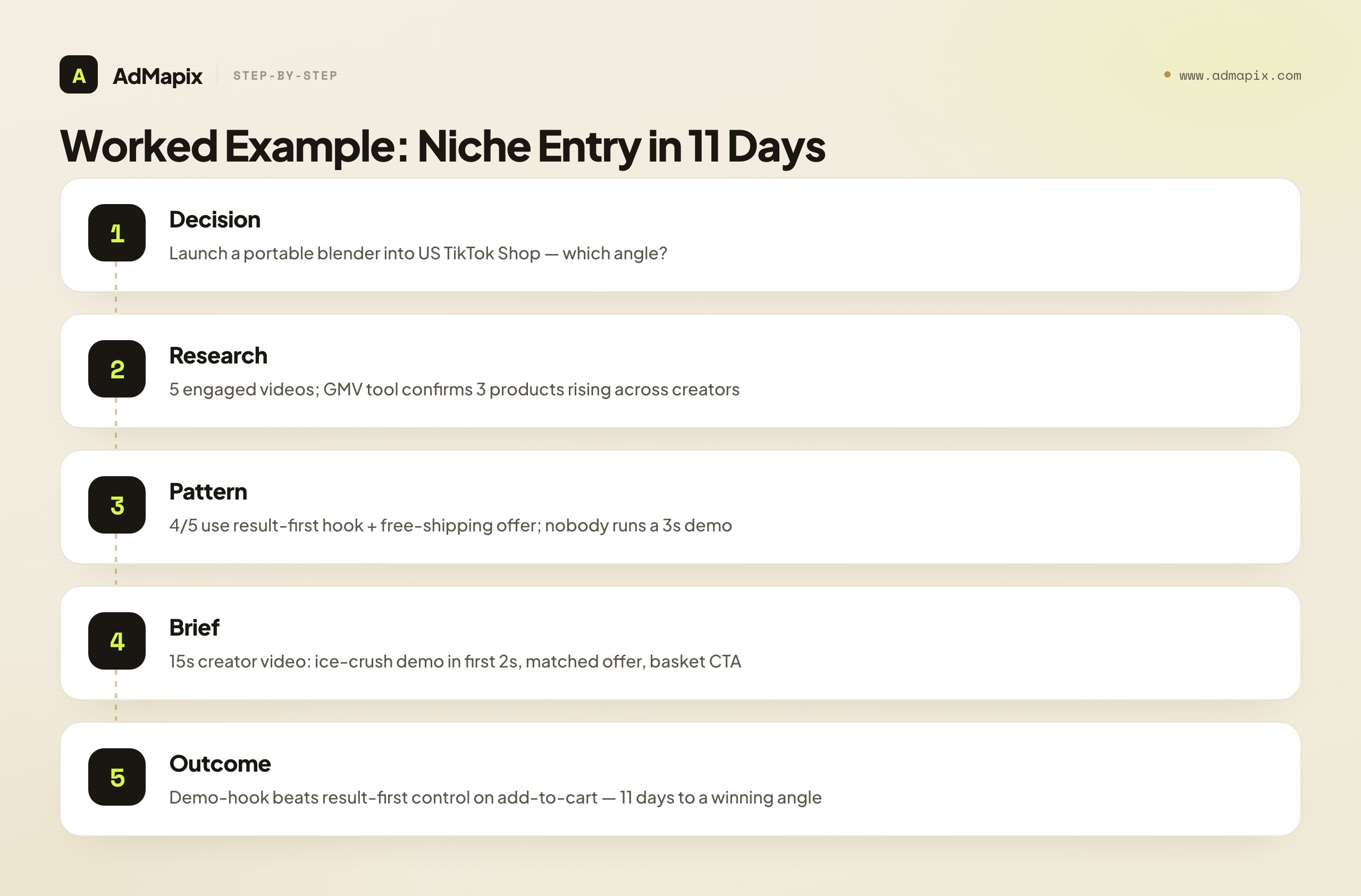
Decision: Should we launch a portable blender SKU into the US TikTok Shop market, and with what angle?
Research (days 1–4): Free Creative Center surfaced five heavily-engaged blender shoppable videos. A specialist GMV tool confirmed three of those products showed rising creator sales velocity (not just views). Teardown across all five revealed a pattern: four of five opened with a result-first hook (the smoothie already made) and used a "$X, free shipping today" offer; none used a demo-in-3-seconds showing the blender crushing ice on camera.
Inference: The result-first angle was saturated; the underserved lane was a fast, satisfying demo hook proving the product's core capability.
Brief: 15-second creator video — open on ice crushing in the first 2 seconds (demo-in-3s), one proof moment (smoothie poured), offer matched to competitors, CTA to the yellow basket. Target a 14-day GMV Max test against a result-first control.
Outcome: The demo-hook variant beat the result-first control on add-to-cart rate, and the learning ("lead with the capability, not the outcome, in this saturated niche") seeded the next three briefs. Total elapsed: 11 days from research to a winning angle.
The point isn't the specific result — it's that free + specialist + a teardown framework + a fixed workflow produced a defensible, testable angle without guessing at competitor spend. That's what TikTok ad spy tools are actually for.
When to Use AdMapix
AdMapix fits when you need broad competitor creative evidence across networks, saved media, video analysis, and reports, rather than a single platform's feed. It is best for agencies and multi-market sellers who study TikTok Shop alongside other channels and need research that becomes a shareable output. It is not the right pick if you only ever want a TikTok-only product feed or pure supplier sourcing, where a specialist tool will feel more direct.
A practical stack keeps a specialist tool for its strongest job, then uses Search AdMapix for wider cross-network discovery, Media to store evidence with context, Video Analysis to break down hooks and pacing, and Reports to package findings. If the same competitor set needs weekly review, run it once in Search AdMapix and keep the saved creatives in Media. When the workflow starts saving real briefing time, create an account from Login or compare seats on Pricing.
For the analysis discipline behind the tool, our competitor ad analysis framework lays out the 5-dimension scoring system, and spy on ads across all platforms maps the cross-network workflow that TikTok-only tools can't cover.
FAQ
What are TikTok ad spy tools?
TikTok ad spy tools are software and free public surfaces that let sellers and marketers see which TikTok and TikTok Shop ads competitors are running — the creative, product, offer, format, and which creators are promoting it. The best tools turn that evidence into a testable creative brief or product test, rather than just displaying a feed of videos. They span free official sources (Creative Center, Seller Center) and paid specialists (PiPiAds, Minea, Kalodata, FastMoss) plus cross-network workflow tools like AdMapix.
What is the best TikTok Shop ad spy tool?
There is no universal best. The right tool depends on whether your bottleneck is product discovery, TikTok creative research, separating creator content from ads, reading GMV signals, or building cross-market reports. Define that decision first, then pick the tool that produces a usable brief fastest for your competitor set. PiPiAds suits TikTok-first creative discovery, Minea suits product sourcing, Kalodata and FastMoss suit GMV/creator analytics, and AdMapix suits cross-network evidence and reporting.
Is there a free TikTok ad spy tool?
Yes. TikTok's own Creative Center (Top Ads, trends, keyword insights) and Shop Seller Center (category and product trends) are free and genuinely useful for baseline research, covering roughly the first 60–70% of a small seller's needs. They fall short on competitor history over time, saved evidence with context, structured video analysis, and shareable reports — which is where paid tools earn their price. Start free, then add a paid tool when weekly research volume outgrows the manual workflow.
Are official TikTok tools enough for ad research?
For baseline inspiration, yes. Seller Center and Creative Center show trends, Top Ads, and creative tools at no cost. They fall short when you need competitor history over time, saved evidence with context, structured video analysis, and repeatable reports you can share with a team or client. Most sellers outgrow the free stack once they track more than a handful of competitors weekly or need to report to clients.
Can ad spy tools show how much a competitor is spending on TikTok Shop?
No. Public ad spy tools and official TikTok surfaces do not expose verified spend, ROAS, or GMV. They show the creative, offer, format, and rough recency. On TikTok Shop this caveat is sharper because the affiliate model means a viral-looking video may have cost the brand nothing in media. Estimate intent from repetition across creators and rising product GMV, then validate with your own performance data before scaling.
How do I tell a paid TikTok ad from an organic creator post?
It's often hard, which is exactly why source-tagging matters. Paid placements (including Spark Ads that boost creator posts) may carry an "Ad" or "Sponsored" label, but affiliate creator content can look identical to paid ads. Use a tool that distinguishes ad placements from organic posts where possible, and when in doubt, tag it as ambiguous rather than assuming. Mis-tagging the source leads to copying the wrong economics — assuming a cheap affiliate win needed a big paid budget, or the reverse.
Should I copy a competitor's TikTok Shop ad?
No. Use competitor ads as evidence for a hypothesis, then adapt the hook, proof, offer, and format to your own brand and product reality. A pattern repeating across creators signals a worthwhile test, not a guarantee of profit, since public tools cannot show spend or ROAS. Run the shoppable-video teardown to understand why a structure works, then build your own angle — ideally targeting an underserved hook archetype in your niche.
How is TikTok Shop ad spying different from Facebook ad spying?
TikTok Shop is a product-creator-offer system, not just an ad feed. A large share of GMV comes from affiliate creators and Spark Ads, the paid/organic line is blurry, creative fatigues in days rather than weeks, and GMV Max automates much of bid strategy. So you weight product and creator repetition and rising GMV over ad run-days, and you read the shoppable video's structure (hook, proof, offer, CTA) rather than a static image. Tools and habits built only for Meta's Ad Library miss these signals.
How often should I run TikTok Shop ad research?
Use a weekly rhythm on a fixed competitor set, with quick mid-week scans to catch fast-moving trends (TikTok creative fatigues in days). Run the same 3–5 brands through your tools with the same country and date window, apply the teardown, and produce at least one brief or product test. Anything less frequent than weekly misses the fast trend cycles that define TikTok Shop; daily is overkill unless you're scaling aggressively.
Which TikTok ad spy tool is best for agencies?
Agencies and multi-market sellers usually need cross-network evidence, saved media, video analysis, and shareable reports rather than a single TikTok feed — which is where a workflow tool like AdMapix fits, often paired with a TikTok specialist for deep platform discovery. The deciding factor for agencies is the Output criterion: research has to become a client-ready report, not just a folder of saved videos. Validate that reporting workflow during a trial before committing seats.
Which TikTok ad spy tool is best for my niche and region?
There's no universal best — it depends on your category and markets, because tool coverage is uneven. For impulse categories like beauty and home gadgets, lead with a creative-discovery tool (the hook decides the sale). For high-consideration categories like electronics or supplements, lead with a GMV tool that proves a product actually sells before you invest in creative. For Southeast Asia, prioritize a tool with verified in-market creator and GMV depth, since US-strong tools are often thin there. The only reliable test is to run your exact category in your exact country during a trial and judge whether the data is genuinely rich or just looks impressive in a US demo.
How do I know if a TikTok ad spy tool's data is actually good?
Test it on something you can independently verify. Search a product in your niche whose rough performance you already know — if a product you know is selling well ranks near the bottom or is missing, the tool's signal is weak in your market. Check freshness by timing how fast a trend you've seen on your own feed appears in the tool. Test depth, not breadth: search your exact category and country and judge whether results are rich or thin, ignoring the headline "millions of ads" claim. Finally, confirm you can export a real deliverable. A ten-minute test on a known product reveals more than an hour reading marketing copy.
Key Takeaways
- Pick a TikTok ad spy tool by the decision it improves this week, not by database size.
- Start with free official TikTok tools (Creative Center, Seller Center) — they cover the first 60–70% of small-seller needs — then add a paid tool when weekly volume grows.
- Match the tool to the bottleneck: PiPiAds (TikTok discovery), Minea (sourcing), Kalodata/FastMoss (GMV), AdMapix (cross-network evidence + reports).
- Read the shoppable video as a system — hook, proof, offer, CTA — not a static thumbnail; weight creator repetition and rising GMV over ad run-days.
- Treat every competitor ad as a hypothesis and validate it with your own ad, store, and CRM data before scaling.
The throughline across every section of this guide is the same: a TikTok ad spy tool is only as valuable as the decisions it changes. The biggest archive, the slickest feed, and the lowest price all matter less than whether your team can run a fixed competitor set, tear down the shoppable videos, and walk out of the weekly review with a brief or a GMV Max test. Start free, prove that rhythm, buy the tool that removes your specific bottleneck, and keep spying and testing tightly coupled — because on TikTok Shop, the window between spotting an angle and watching it saturate is measured in days, not months.
Sources
Links verified as of June 21, 2026; plan limits and feature names change, so confirm details on each official page before buying.
- TikTok Shop Seller Center — discovery-commerce platform for sellers, creators, shoppable video, LIVE, and in-app shopping.
- TikTok Creative Center — Top Ads, trends, and official creative inspiration for TikTok advertisers.
- PiPiAds — TikTok and Facebook ad intelligence for ecommerce, DTC, and TikTok Shop.
- Minea — ecommerce product research, ad spy, daily winning products, and supplier research.
- Kalodata — TikTok Shop analytics for product GMV, creators, and video/LIVE performance.
- FastMoss — TikTok Shop product, creator, and trend intelligence by market.
Turn these observations into your next creative study
Open the creative library and select samples for your market, network and research question.
Related Articles
Minea Ad Spy Review (2026): What It Does Well, Its Limits & When to Switch
A hands-on, honest Minea ad spy review for 2026 — what Minea genuinely does best (winning-products feed, multi-network ad library, influencer signals), where it runs out of room, who it fits, a tier-by-tier pricing reality check, a fair scoring model, and exactly when to add a creative-intelligence layer like AdMapix instead.
Atria Ad Library in 2026: What It Solves and What to Check Before You Buy
A 2026 buying-decision guide to the Atria ad library — what its AI-powered collect, summarize, and ideate stack actually does, the four criteria that decide whether it is worth paying for (channel coverage, filter speed, AI insight quality, and brief handoff), a test-before-you-buy method you can run in a trial, the honest limits of what any ad library can prove, and where it fits versus a cross-network creative-evidence layer.
Paid Ads Analytics Tools 2026: Compared by Job, Channels and Price
Eight paid ads analytics tools compared by job, channels and entry price (checked September 2026), followed by the metrics, data-trust hierarchy and workflow that decide which of those numbers you can act on.