
TikTok Ad Library (Commercial Content Library): How to Search It in 2026
The TikTok Ad Library is the Commercial Content Library at library.tiktok.com. It covers paid ads served in the EEA, UK and Switzerland only. This guide gives the direct URLs, a step-by-step search workflow, every visible and hidden field, retention rules, the December 2025 DSA commitments and what they change during 2026, and when a third-party tool is the right surface instead.
By the AdMapix Research Desk — Updated September 7, 2026
Quick answer. The "TikTok Ad Library" is officially called the Commercial Content Library and lives at library.tiktok.com. It is free, needs no login, and lists paid ads that were shown to users in the European Economic Area, the United Kingdom and Switzerland. It does not contain US-only campaigns, ad spend, or click metrics. Ads stay searchable for about one year after they were last shown. If you need US ads, cross-platform search, or anything older than a year, you need a different surface, and this guide tells you which one.
Before we start: which TikTok ad library do you actually mean?
Every week we see four different products called "the TikTok ad library" in the same Slack thread. Before we walk through anything, let's draw a clean line between them. If you search the wrong tool, you will waste thirty minutes and walk away convinced TikTok is hiding data that is actually sitting in a different URL.
| Product | URL | Who it's for | Scope | Login |
|---|---|---|---|---|
| Commercial Content Library (CCL) | library.tiktok.com | Public, journalists, researchers, competitive analysts | Paid ads served in the EEA, UK and Switzerland | None |
| Creative Center Top Ads Dashboard | ads.tiktok.com/business/creativecenter | Advertisers hunting creative inspiration | Curated top-performing ads, global, by industry and region | TikTok for Business account |
| Creative Library (inside Ads Manager) | ads.tiktok.com → Assets → Creative Library | Media buyers inside one ad account | Only creatives uploaded to your own account | Your ad account |
| Third-party "TikTok ad library" tools | AdMapix and other creative-research services | Competitive researchers, creative strategists | Cross-platform, longer retention, text and hook search | Vendor account |
The Top Ads Dashboard is the one we covered in our Creative Center walkthrough. It is a curated best-of feed, not a transparency archive, and it lives behind an advertiser login. The Creative Library inside Ads Manager is not a market research surface at all; it only lists creatives already uploaded to your own account. Third-party tools exist precisely because the first three don't talk to each other.
This post is about the first one: TikTok's Commercial Content Library, the public transparency tool the platform ships under the EU Digital Services Act (DSA).
Direct links
| What you want | Go to |
|---|---|
| Search paid ads | https://library.tiktok.com/ads |
| Disclosed branded content from creators | library.tiktok.com → "Other commercial content" tab |
| Creative Center Top Ads (inspiration, needs login) | https://ads.tiktok.com/business/creativecenter/inspiration/topads/pc/en |
| TikTok's own explanation of the library | TikTok Help Center → "Commercial Content Library" |
1. What the Commercial Content Library actually is
TikTok launched the CCL on July 20, 2023, carrying the paid-ad inventory that ran from October 1, 2022 onward. The product exists because the European Union designated TikTok a Very Large Online Platform under the DSA and obliged it to publish a searchable repository of ads served in the region. That is also why the scope has not expanded: the CCL is an EU compliance surface, not a global voluntary disclosure.
As of September 2026 the archive still only covers ads delivered to users in the EEA, the UK and Switzerland. US advertisers running US-only campaigns will not appear, and neither will LATAM, MENA or APAC buys unless the same campaign also served European impressions. When the TikTok US ownership deal closed on January 22, 2026, the reorganisation announcement contained no CCL expansion commitment, and we have found no official announcement of a US ad library since. Marketing Dive's coverage of the advertiser pitch is explicit that no transparency expansion was on the table. US advertisers still have exactly two official TikTok research surfaces: Creative Center Top Ads and, if they hold an ad account, their own Ads Manager.
Country coverage at a glance
| Region | In the CCL? | Notes |
|---|---|---|
| EU member states (27) | Yes | Filter by individual country |
| Iceland, Liechtenstein, Norway (EEA) | Yes | Same DSA scope |
| United Kingdom | Yes | Included since launch |
| Switzerland | Yes | Included since launch |
| United States, Canada | No | Use Creative Center Top Ads or a third-party index |
| LATAM, MENA, APAC | No | Only if the same campaign also served European users |
One more contrast worth making up front. Meta's Ad Library started as a political-ad archive in May 2018 under direct US Congressional pressure after Cambridge Analytica, then expanded to a global commercial archive in March 2019, and later layered DSA obligations on top. TikTok's repository has the opposite origin story. TikTok banned all paid political advertising globally in 2019, confirmed in its current politics and elections policy, so there is no political-ad-spend table to inherit. The EU forced commercial-ad transparency onto a platform that had no prior disclosure habit. Different genesis, different product surface, different blind spots.
Access itself is frictionless. You do not need a TikTok account or a developer token, and the site does not rate-limit ordinary browser use. The browsing UX is a search box with a country selector and a date-range picker. For programmatic use there is a separate Commercial Content API. TikTok describes it as open to the public and researchers: anyone can apply from any country with a developer account and a work email, and TikTok reviews applications within about two working days. The data it returns is currently EU-only. We come back to it below.
2. What you see versus what's hidden
This is the field map we hand new analysts before we let them touch the tool.
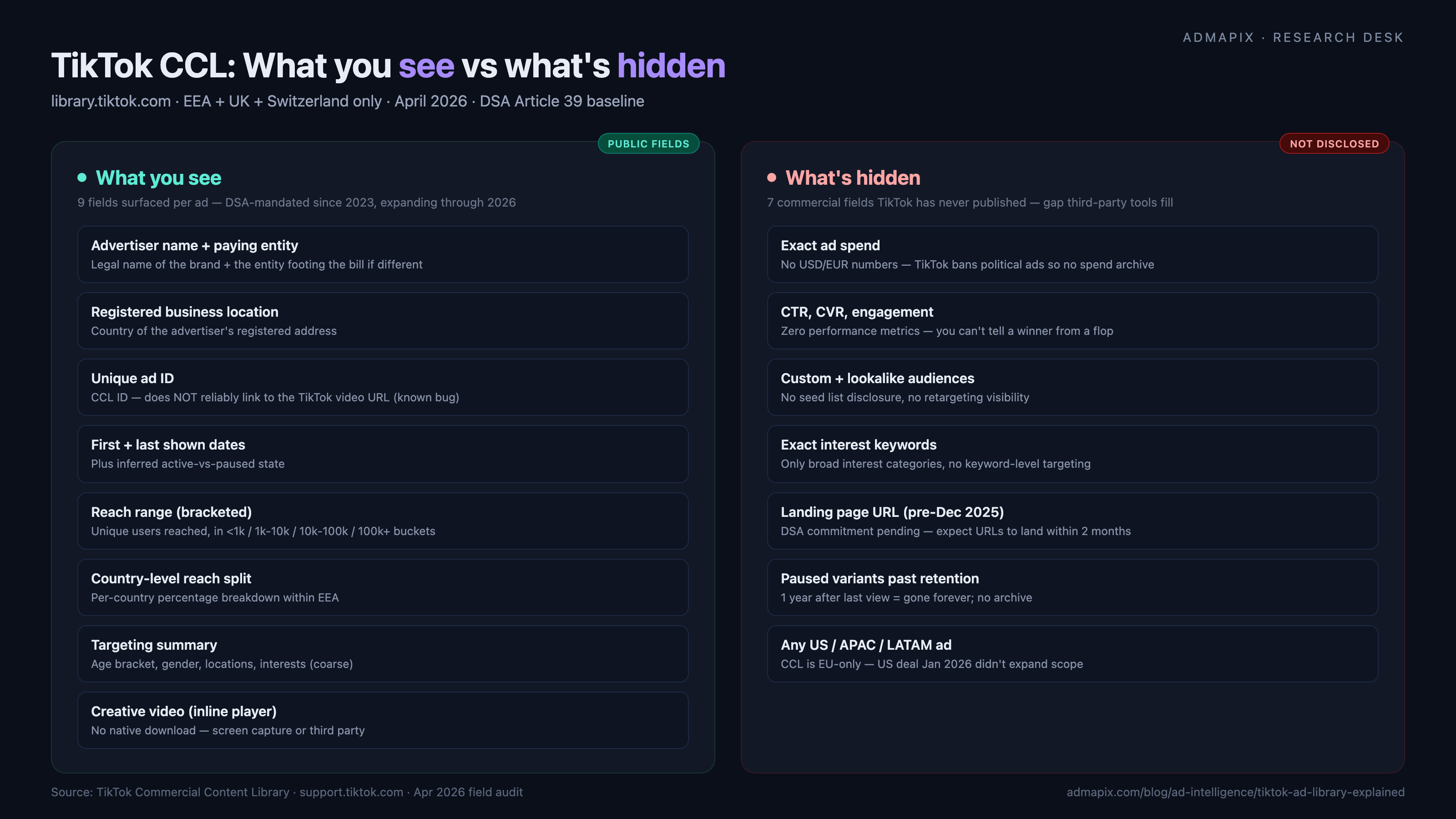
Visible per ad
- Advertiser name (handle and verified business name)
- Paying entity, if different from the advertiser
- Registered business location
- Unique ad ID
- First shown date
- Last shown date
- Reach range (unique users), bracketed rather than exact
- Country-level reach breakdown across served European countries
- Targeting summary: age bracket, gender, location, and interest categories where used
- Creative video playable inline
Hidden or unavailable
- Exact spend in any currency
- Click-through rate, conversion rate, any downstream funnel metric
- Custom audiences (matched lists, pixel-based retargeting)
- Lookalike seed definitions
- Paused variants that have aged out of the one-year retention window
- Exact interest keywords inside a cluster (you see "fitness" as a category, not the specific sub-interests)
- Creative-level A/B variant relationships
Changing during 2026: the destination URL inside the ad and the aggregated demographics of users actually reached. Both are part of the DSA commitments described in section 4. Treat them as "check the live panel" fields rather than guaranteed-present or guaranteed-absent.
Two points beginners miss. First, the reach range is bucketed, not continuous. A medium-sized DTC brand typically shows a band like "100,000–1,000,000 users", which is too wide for spend-back math. Second, the retention clock runs from the last time the ad was shown, not from the day it was paused. A paused ad that keeps picking up residual impressions keeps resetting the clock. This is why you occasionally find CCL entries for ads whose landing pages 404'd months ago.
Our last full field audit was on April 12, 2026, searching Gymshark across UK and DE delivery: 147 active ad IDs, roughly 60% with populated reach ranges. The remaining 40% showed "reach data pending" placeholders, all for ads first shown inside the previous seven days, which matches the lag TikTok documents in its help center. Targeting summaries were populated in every record; paying-entity fields in 82% of the sample, usually blank when advertiser and payer are the same legal entity. Destination URLs were absent across the board at that date. We re-check the panel monthly and will replace this paragraph when the URL field is consistently present.
3. How to actually filter the archive
The interface is deceptively simple, which is the first trap. The second trap is trusting the search bar.
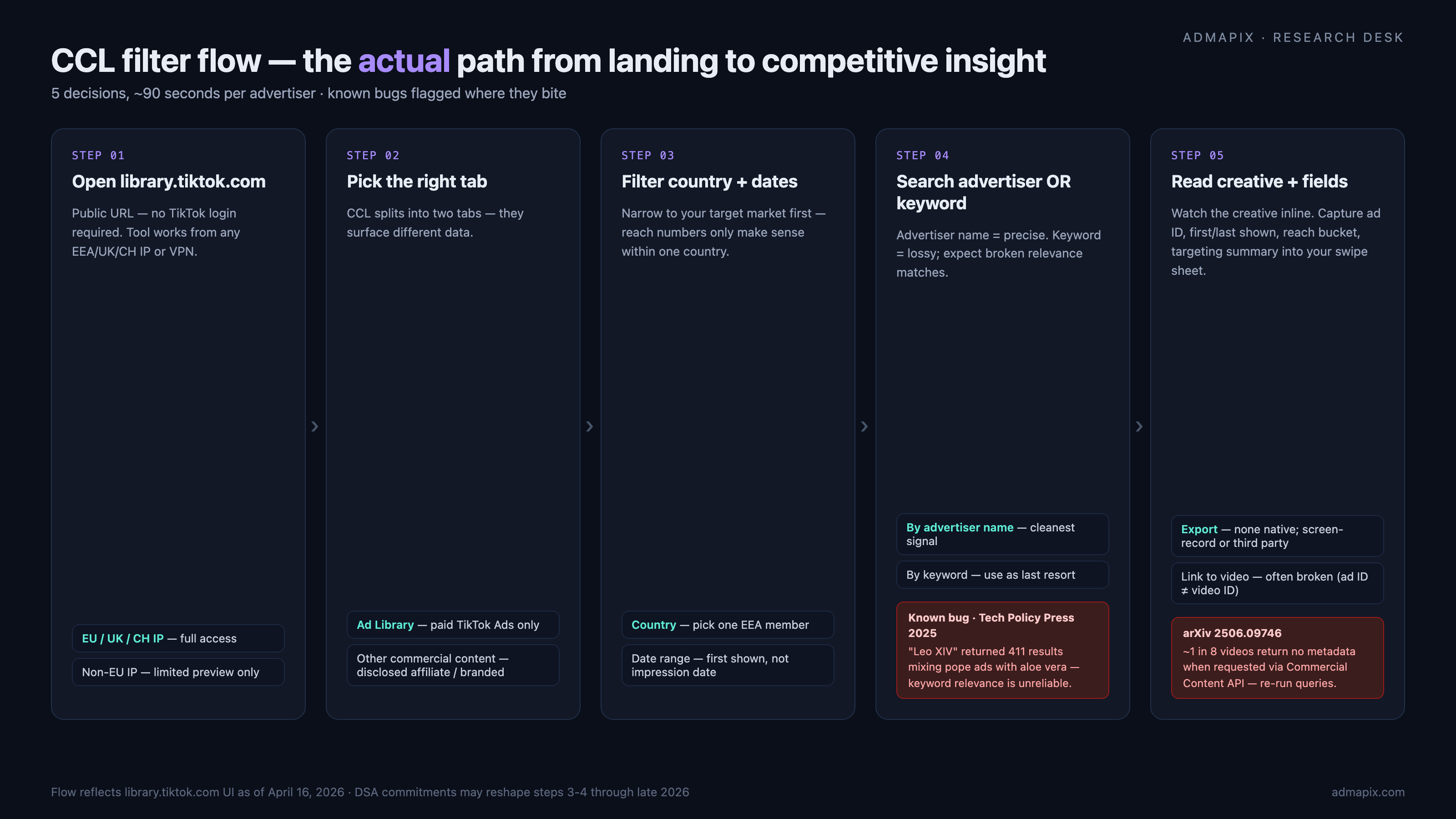
Walk through it in this order:
- Open library.tiktok.com/ads. No login modal appears. If one does, you are on the wrong URL, probably ads.tiktok.com.
- Pick a tab. Default is "Ad Library". Switch to "Other commercial content" to inspect disclosed branded-creator posts, which since September 1, 2025 must carry the commercial-content disclosure toggle for any paid partnership. These are a different corpus; we leave them out of advertiser audits.
- Set country before anything else. The country selector constrains every downstream field. Leaving it on "All regions" inflates reach ranges by aggregating cross-border delivery.
- Set a date range. The default window is short. Push it to the full one-year retention window first, then narrow once you know the size of the corpus.
- Filter by advertiser or keyword. The advertiser filter works on verified name match, not fuzzy handle. The keyword filter runs against ad-copy text and is where the relevance bugs bite.
- Open each ad and record the ID. The ad ID is the only stable join key if you later want to compare the same creative across weeks. Copy it into your tracking sheet with the first-shown date.
About those relevance bugs. In 2025, independent researchers Martin Degeling and Fabio Votta published an audit through Tech Policy Press documenting two failures we were still able to reproduce in spring 2026. First, keyword relevance collapses outside exact-string matches: a query for "Leo XIV" returned hundreds of results in which most were aloe vera DTC ads, because the tokenizer split the substring and matched it to "vera". Second, and more structurally damaging, many ad IDs in the CCL don't link back to the original TikTok video, which blocks any attempt to join CCL reach metadata to organic engagement signals.
A complementary paper, arXiv 2506.09746 from AI Forensics and BSoG, found that roughly one in eight videos requested through the Commercial Content API returned no metadata at all: the record exists but the payload is empty. If you are building a longitudinal dataset, budget for that missing-metadata rate as structural, not transient.
A repeatable weekly routine
| Step | What to record | Why |
|---|---|---|
| Same country, same advertiser list, every Monday | Ad IDs, first/last shown, reach band | Consistent snapshots beat ad-hoc swipes |
| New IDs since last week | Hook in the first 3 seconds, offer, format | Launch cadence is the most reliable signal the CCL gives you |
| IDs that disappeared | Date last seen | Retirements tell you what the advertiser stopped funding |
| Reach band changes | Old band → new band | The only proxy for scale the CCL offers |
For the full loop that wraps the CCL, Creative Center and third-party tools into a 30-minute routine, see the TikTok ads research playbook.
4. TikTok CCL versus Meta Ad Library, honestly
We keep this comparison in the research desk wiki and pull it out every time someone asks "why doesn't TikTok show spend like Meta does?"
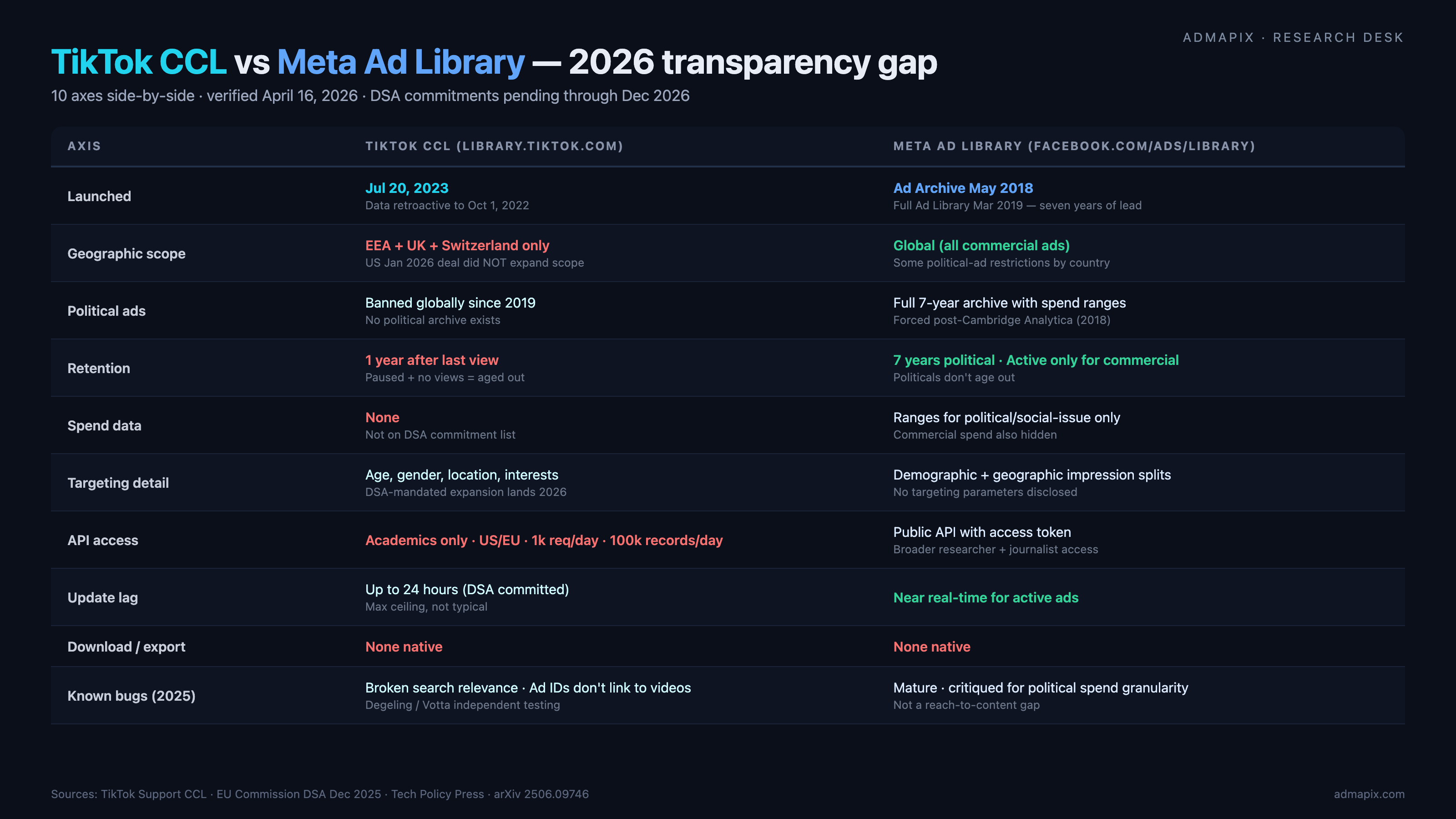
| Axis | TikTok CCL (library.tiktok.com) | Meta Ad Library |
|---|---|---|
| Launched | Jul 20, 2023 (data from Oct 1, 2022) | Ad Archive May 2018; full Ad Library Mar 2019 |
| Geographic scope | EEA + UK + Switzerland only | Global (all commercial ads) |
| Political ad scope | Bans political ads entirely | 7-year archive with spend ranges |
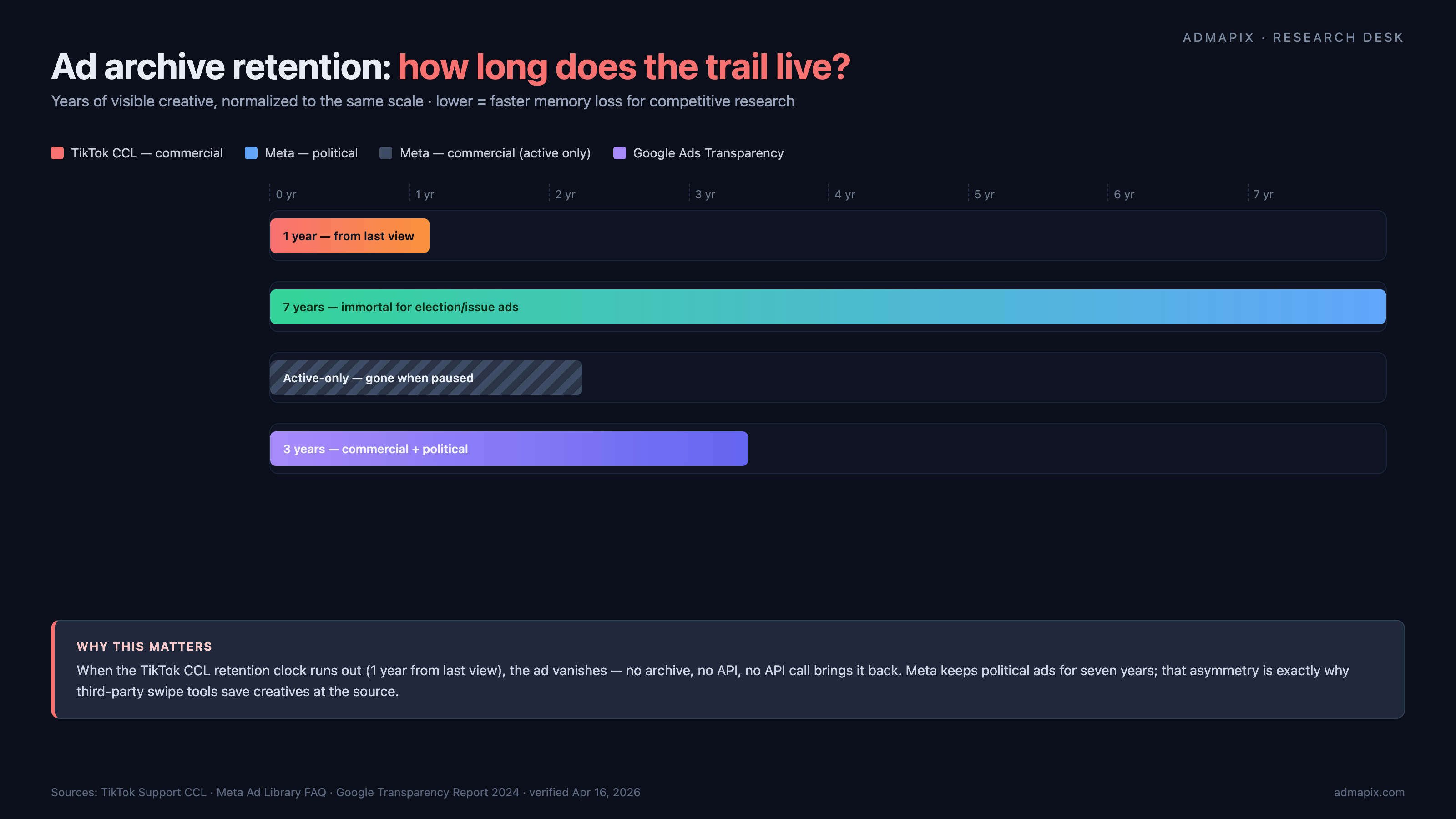
| Retention | About 1 year after last shown | 7 years for political; active only for commercial |
| Spend data | None | Ranges for political and social-issue ads only |
| Targeting detail | Age, gender, location, interests; demographics of users reached being added under the DSA commitments | Demographic and geographic impression breakdowns in the EU |
| API access | Commercial Content API, open to public and researchers by application; EU data only | Public API with access token (broader) |
| Update lag | Committed maximum 24 hours (DSA commitment) | Near real-time for active ads |
| Download | None native | None native |
| Known bugs (2025) | Broken search relevance; ad IDs not linking to videos | Mature but criticised for political spend granularity |
Why is the gap this wide? Meta's product was built under Cambridge Analytica political pressure in 2018, giving it seven years to mature, layer on political-ad spend, harden its API, and absorb DSA obligations into an existing surface. TikTok's CCL was born inside the DSA in 2023 with no prior transparency muscle, and because TikTok never ran political ads there was no political-ad-spend precedent to extend. If you want the flip side of this comparison from Meta's vantage point, our Meta Ad Library complete guide covers the other side of the moat, and the Google Ads Transparency Center guide covers the third major archive.
What changed in 2026: the DSA commitments
On December 5, 2025, the European Commission accepted TikTok's binding commitments under the DSA, resolving preliminary findings issued in May 2025. The official Commission announcement lists four changes to the repository:
| Commitment (Commission wording, paraphrased) | Explicit deadline in the announcement |
|---|---|
| Provide the full content of the advertisement as it appears in users' feeds, including the URLs contained in the ad's link | None stated; falls within the overall 2-to-12-month rolling window |
| Update the repository more quickly, with information available within a maximum of 24 hours | 24 hours is the committed cadence |
| Provide the targeting criteria selected by advertisers plus aggregated data on gender, age group and Member State of users reached | None stated; within the rolling window |
| Introduce additional search options and filters | None stated; within the rolling window |
The rolling window means every commitment is due by December 2026 at the latest. TikTok has not published a public changelog for the library, so the practical way to know whether a commitment has landed is to open an ad detail panel and look for a destination link and an "audience reached" breakdown. When you see them consistently, the first and third commitments are live. We update this section as each one lands.
5. When to reach for a third-party tool
Five gaps keep showing up in our audits where the CCL is structurally not the right surface, even after the DSA commitments land.
- US and other non-European markets. The CCL cannot show you a single US-only campaign. A TikTok ad spy tool that indexes ads by observing feeds in the target country is the only way to see US creative at advertiser level.
- Cross-platform search. The CCL cannot answer "show me every Gymshark ad running on TikTok, Meta and Google this quarter". You would have to pivot across three portals with three schemas and manually reconcile advertiser names.
- Post-retention preservation. Once the one-year clock expires, the creative is gone. If you want to study the seasonal rotation a competitor ran in Q2 2025, the CCL has already dropped it.
- Hook and transcript search. The CCL keyword filter tokenizes poorly; remember the Leo XIV incident. Dedicated tools search transcribed audio and on-screen text, which lets you query "every ad opening with a hook about sleep quality" rather than a literal string.
- Team-shareable workspaces. The CCL has no favourites, tags, folders, comments or share URLs that carry filter state. Every analyst starts from zero.
TikTok Shop sellers hit a sixth gap: the CCL shows the ad but not the product, price or creator behind a shoppable video. Our TikTok Shop ad spy tools comparison covers that specific job.
Where AdMapix fits: cross-platform creative search across Meta, TikTok and Google, with hook and transcript queries and an indexed corpus that includes US delivery the CCL never shows. The Starter plan is $19.90 per month (checked September 2026 on /pricing); a free tier is available to try searches before paying. If the gaps above are biting your team, sign in and run your first competitor query.
6. FAQ
Q1. Why can't I see ad spend in TikTok's Ad Library?
TikTok has never published per-ad spend, and the DSA commitments accepted in December 2025 didn't require it. EU transparency rules mandate targeting and reach data, not budget. Meta only publishes spend for political and social-issue ads, and TikTok bans political ads globally, so neither platform gives you commercial ad spend officially. If a dashboard claims to show you exact TikTok spend, it is modeled, not reported.
Q2. Is the TikTok Ad Library free?
Yes. library.tiktok.com is public, requires no TikTok login, and does not rate-limit normal browser traffic. The separate Commercial Content API for programmatic access is also free; TikTok says it is open to the public and researchers by application, currently returning EU data only. If you see a "paywalled TikTok Ad Library", you are looking at a third-party tool, not TikTok's own product.
Q3. Does the TikTok Ad Library cover the United States?
No. Only ads served to users in the EEA, the UK and Switzerland are included. A US brand appears only if the same campaign also delivered European impressions, and then you only see the European slice of it. For US creative research use Creative Center Top Ads or a third-party index.
Q4. Does TikTok's Ad Library include TikTok Shop videos and creator posts?
Paid TikTok Shop ads, yes. Organic creator videos, no. They appear only if the creator toggled the "Commercial content disclosure" switch, required since September 1, 2025 for affiliate and paid partnerships, and only in the "Other commercial content" tab. Undisclosed creator posts are structurally outside the archive.
Q5. How far back does the TikTok Ad Library go?
Ads are retained about one year from the last time they were shown, not from their launch date. Historical data technically goes back to October 1, 2022, the CCL's data-collection start, but anything that stopped being shown before September 2025 has aged out by now. That is a much shorter window than Meta's seven-year political-ad archive, and it is the single biggest reason longitudinal analysis of TikTok advertising needs a third-party archival layer.
Q6. Can I download TikTok ads as MP4 files?
Not natively. library.tiktok.com lets you watch ads inline but offers no download button and no bulk export. Third-party tools and browser extensions pull the underlying video URL to save creatives for swipe files. Check each tool's terms-of-service alignment with TikTok before bulk downloading, especially for analysis that will be shared externally.
Q7. Why does Meta's Ad Library show so much more than TikTok's?
Meta built its archive in 2018 and 2019 under US Congressional pressure, then expanded under the DSA, so it has seven years of political-ad spend data, global commercial coverage, and a mature public API. TikTok's CCL only launched in July 2023, covers one region, and is still rolling out its December 2025 DSA commitments. The two platforms are at very different transparency maturities, not different levels of corporate goodwill.
One action before you close this tab
Tomorrow morning, open library.tiktok.com/ads, set the country to your biggest European market, search your number-one competitor, and note which three fields are blank. That is your intelligence gap. Then run the same advertiser in the Creative Center and in a cross-platform index, and compare what each surface adds.
Turn these observations into your next creative study
Open the creative library and select samples for your market, network and research question.
Related Articles
TikTok Ads Research in 2026: 7-Step Workflow + 10 Hook Patterns
A methodology-first TikTok ads research playbook: the free stack, a 30-min weekly SOP, 10 hook patterns advertisers we track actually win with, and a bulletproof brief template.
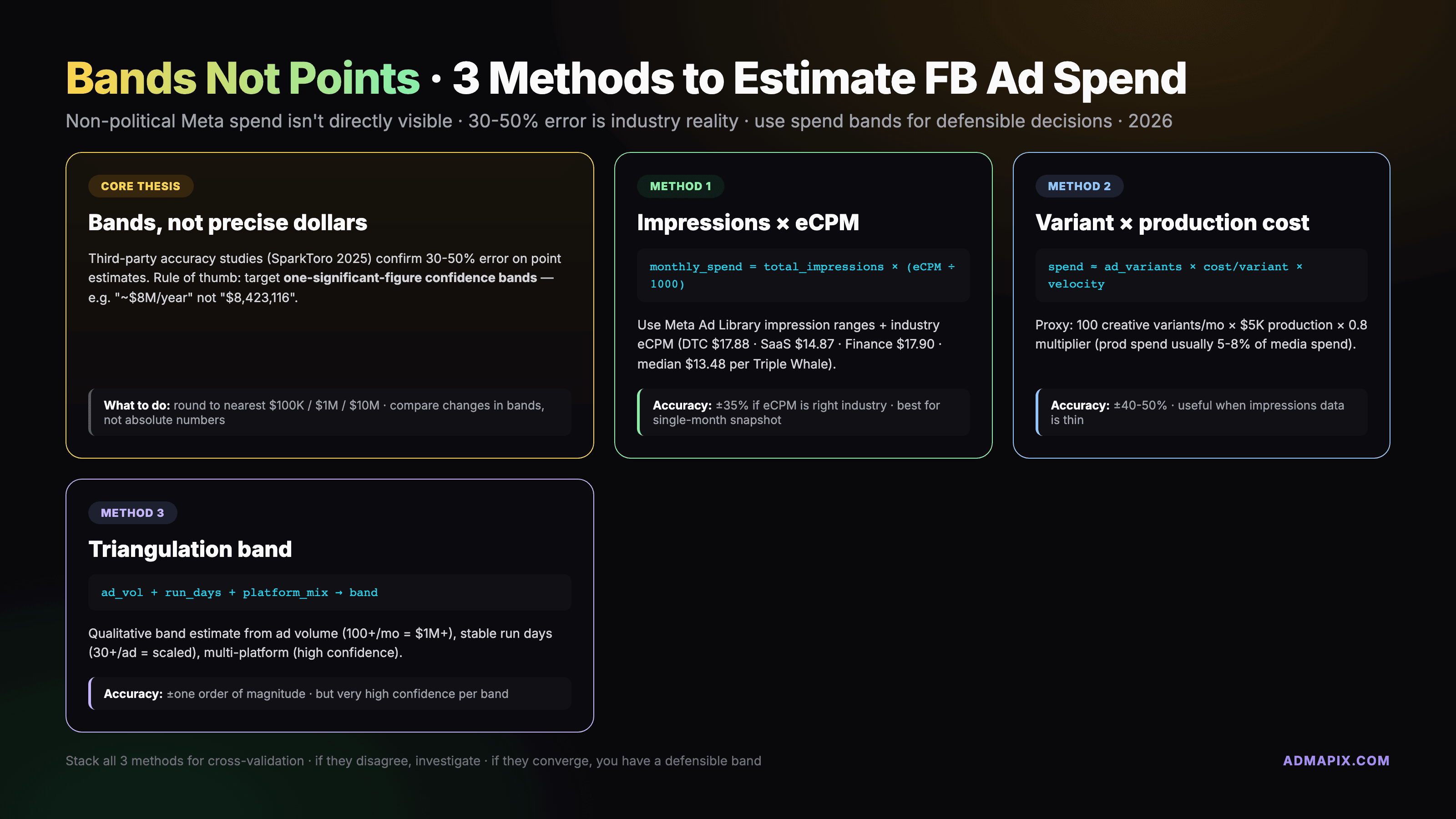
How to Monitor Competitors' Facebook Ad Spend in 2026 (3 Methods + Worked Example)
Non-political Meta ad spend is not publicly visible. Here are three defensible inference methods, a worked $10M DTC example, and the 2026 EU cumulative-spend rollout explained.
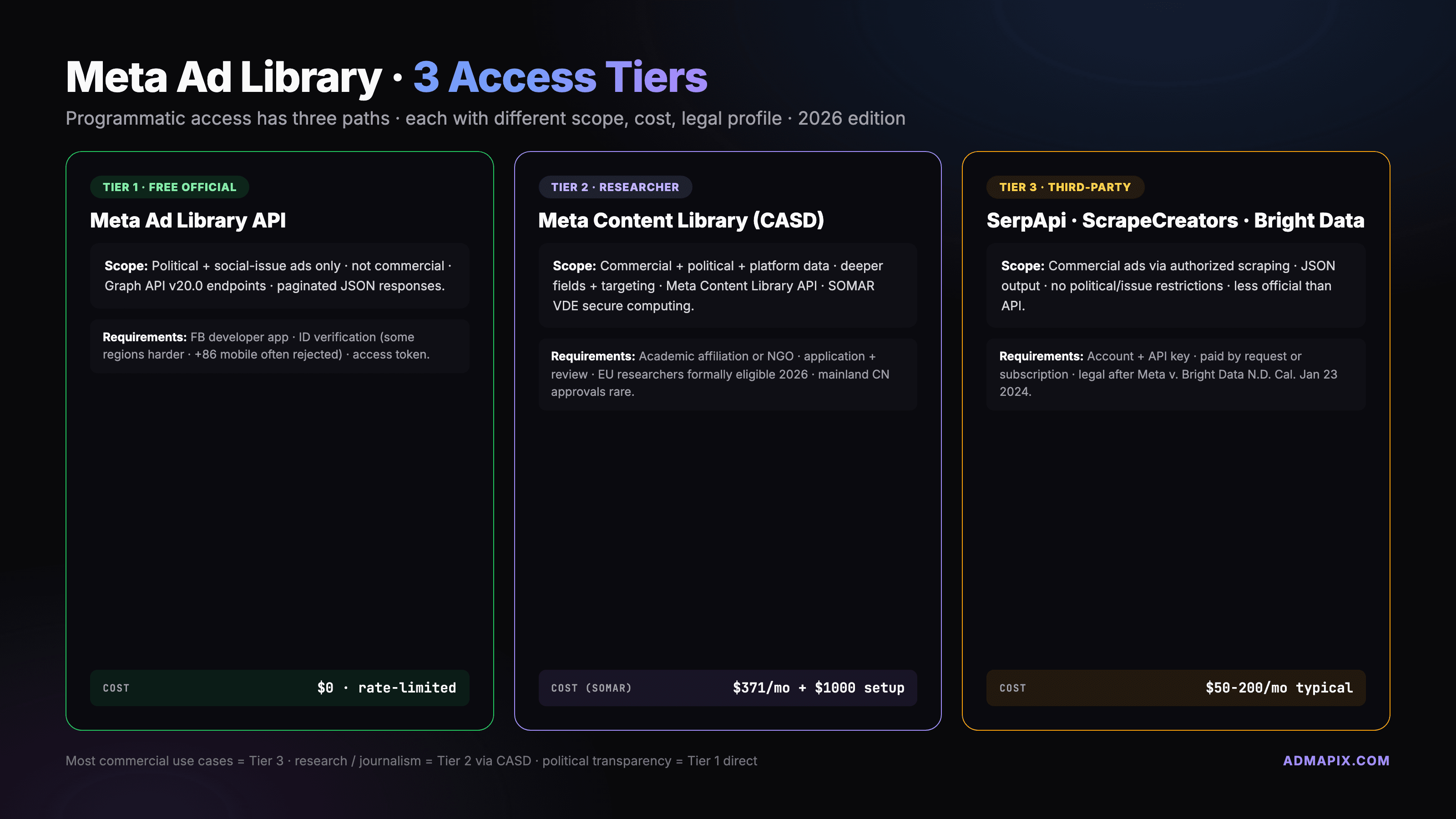
Meta Ads Library API 2026: Graph API v20.0, Impressions, Spend & Python
Developer guide to the Meta Ads Library API: Graph API v20.0 endpoints, free access limits, impressions/spend fields, Python and curl examples, CASD access, and why commercial ads differ from the UI.