
TikTok Ads Research in 2026: 7-Step Workflow + 10 Hook Patterns
A methodology-first TikTok ads research playbook: the free stack, a 30-min weekly SOP, 10 hook patterns advertisers we track actually win with, and a bulletproof brief template.
By the AdMapix Research Desk — Updated April 16, 2026
TikTok ads research in under 60 words: spin up three free tools — TikTok Creative Center (ads.tiktok.com/business/creativecenter), the Commercial Content Library at library.tiktok.com (EU, UK, and Switzerland only), and the Top Ads Spotlight editorial picks — then run our 7-step weekly workflow (Mon trend scan through Sun shortlist) in about 30 minutes, extracting from a 10-hook pattern library we'll hand you below.
That is the whole playbook. The rest of this guide shows you how to execute it without drowning in the For You Page.
What TikTok Ads Research Actually Is (vs Casual Scrolling)
Most "TikTok research" workflows we inherit from new clients are really just the account lead scrolling the For You Page for twenty minutes a day and calling it "market sensing." That is not research. It is algorithmic indulgence.
TikTok ads research is the systematic collection and comparison of paid creative signals across verticals, geographies, and time windows, with the express goal of producing a testable creative brief. The key word is paid. An organic dance trend with 40M views tells you nothing about whether a 30-second ad in the skincare vertical will convert for women 25-34 in Texas.
Four operational distinctions:
- Paid vs organic signal. Research mode looks only at creatives flagged as ads.
- Structured vs browsing. You filter by vertical, region, format, and window.
- Comparative vs impressionistic. You log what you see so week-over-week deltas become visible.
- Output-bound vs open-ended. Every session ends with something written down: a hook log, a shortlist, a brief.
Internalize those four rules and the rest of this guide is just tooling and cadence. Our TikTok Creative Center tutorial walks through every dashboard step-by-step if you need the orientation first.
The Free Research Stack: Creative Center, Commercial Content Library, Top Ads Spotlight
You can do roughly 80% of professional-grade TikTok ads research without paying a cent. Three complementary pieces:
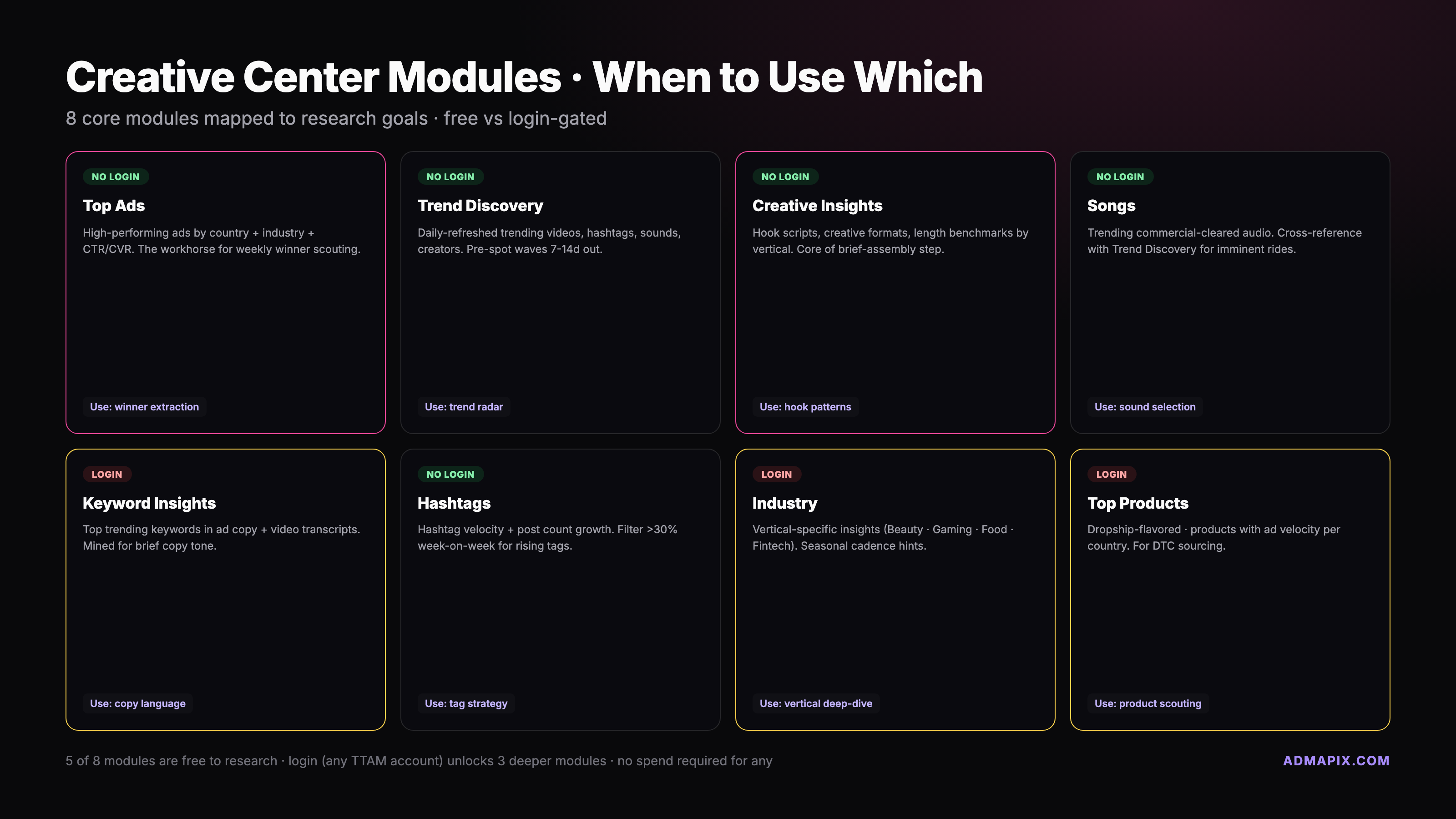
TikTok Creative Center
The Creative Center (ads.tiktok.com/business/creativecenter) is TikTok's owned research surface. Four modules that matter for ads research in 2026:
- Top Ads / Top Ads Spotlight — the editorial and algorithmic list of best-performing paid creatives. Filter by region (30+ markets), vertical (20+ taxonomies updated late 2025), objective, and window (7/30/90/180 days).
- Trend Discovery (Moments / Signals / Forces) — TikTok's 2026 three-tier trend taxonomy. Moments are spike-shaped viral beats (3-10 days); Signals are behavior shifts (2-8 weeks); Forces are macro-trends with a multi-quarter arc. Use Forces for positioning, Signals for angles, Moments for sound and hook patches.
- Keyword Insights — popular ad-copy keywords by vertical and region. Essential for captions and hooks.
- Symphony Creative Studio — the in-house AI toolkit. AI generation, dubbing in 30+ languages, and the digital avatar library that went GA in Q1.
Commercial Content Library
The Commercial Content Library (CCL) lives at library.tiktok.com and is TikTok's closest equivalent to Meta's Ad Library. Critical disclaimer: CCL only shows ads targeted to users in the European Economic Area, the UK, and Switzerland. If you run US, SEA, or LATAM campaigns, CCL is an EU-benchmarking tool, not your core traffic source.
What CCL gives you beyond Creative Center: roughly 12 months of historical ad data per advertiser, targeting parameters (country, age, gender), active-vs-paused status, and verified advertiser identity. What it does not give: spend data, non-EU creative, or real-time data (roughly 24-hour lag).
Top Ads Spotlight
Not a separate product — a curated editorial surface inside Creative Center where TikTok's creative strategy team highlights standout work. Less comprehensive than Top Ads but higher craft-density. A Monday scan to feed taste, not decisions.
2026 Creative Center Updates You Should Know
TikTok shipped more advertiser-side tooling in the last nine months than in the previous three years combined. Four updates changed our research workflow in 2026:
- Symphony Creative Studio general availability. The AI toolkit left beta in January. AI-generated scripts, ad video generation from a product URL, dubbing into 30+ languages, and the digital avatar library are all live. Symphony-assisted creatives are now a distinct and growing category in your research.
- Trend Moments / Signals / Forces tiering. The flat "trending" list was replaced with a three-tier structure. You can finally filter by trend durability, separating 5-day sound cues from 6-month positioning shifts.
- Berlinale entertainment ad solutions. Announced at Berlinale 2026 — TikTok now sells packaged entertainment-adjacent formats into the EU market. If you track streaming, gaming, or publishing, a fresh wave of creatives appeared in CCL during Q1.
- Research API expansion. The Commercial Content API opened to more researcher categories with an expanded field set. If you have engineering, pulling CCL data programmatically is now realistic.
Net effect: more raw material, better structured metadata, and a trend taxonomy that does not lie to you about durability. We save roughly two hours a week on trend curation since the three-tier system launched.
The 7-Step Weekly TikTok Research Workflow
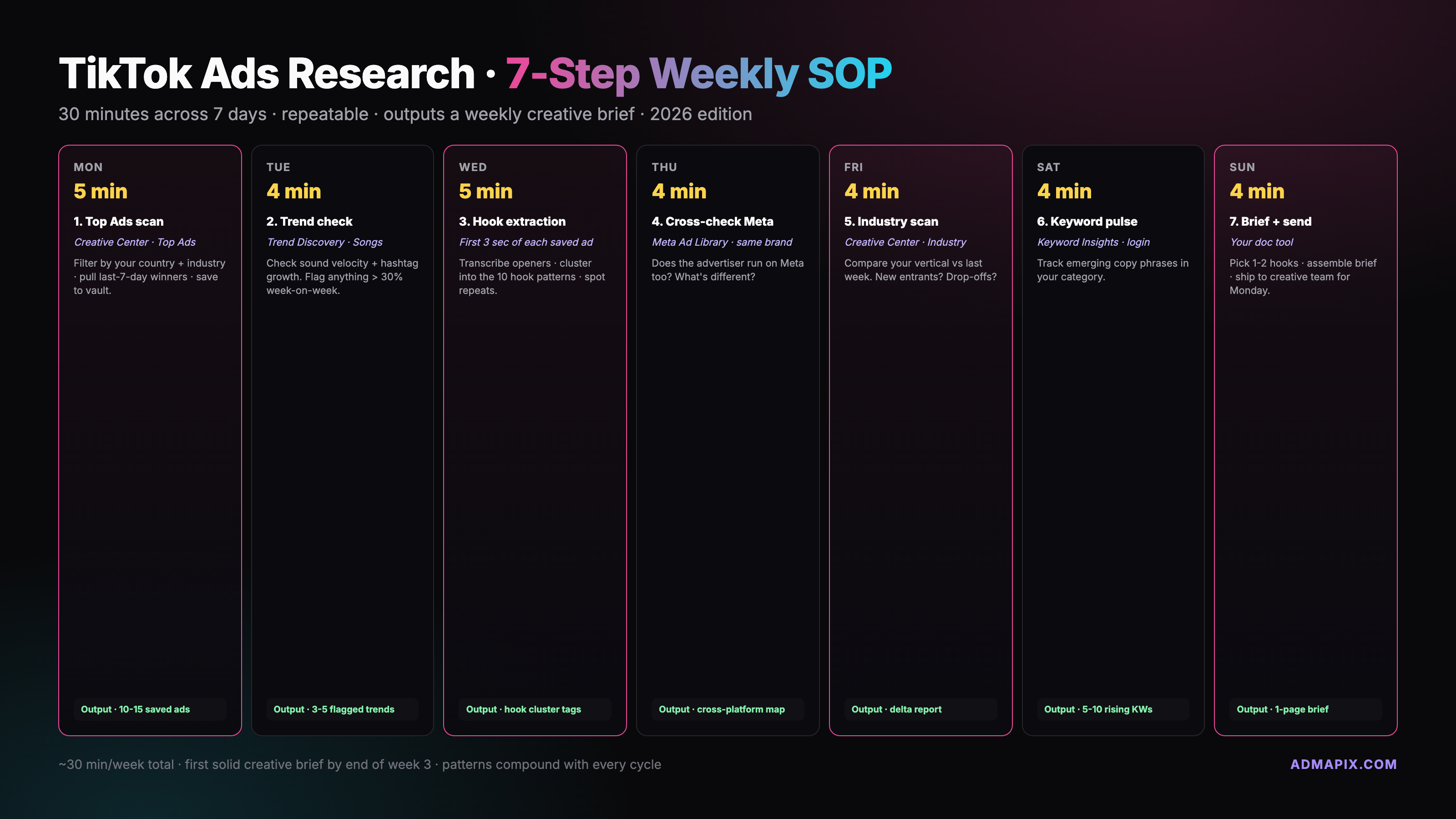
This is the core. We run this SOP across every DTC and app account we manage. Total budget: about 30 minutes a week, spread across seven 3-8 minute sessions. The distributed schedule matters — compressing it into one Monday block loses the week-over-week delta detection.
Step 1 — Monday: Trend Scan (5 min)
- What. Creative Center → Trend Discovery. Check Moments (7 days) and Signals (30 days) for your vertical and region. Skip Forces — those only change quarterly.
- When. Monday morning, before creative meetings.
- Output. 3-5 bullet points in a running doc: which sounds, motifs, or consumer behaviors are trending this week.
Step 2 — Tuesday: Top Ads Pull (5 min)
- What. Creative Center → Top Ads. Filter by your vertical, top GEO, objective, and 30-day window. Scan the top 20. Log the top 5: advertiser, hook (first 3 seconds in words), CTA, format (UGC / studio / animation), duration.
- When. Tuesday — 24 hours after Monday lets you see if trends surface here.
- Output. 5 rows in your Top Ads log sheet.
Step 3 — Wednesday: CCL Advertiser Deep-Dive (5 min)
- What. Pick 3 advertisers from Tuesday (ideally 2 direct competitors + 1 adjacent-category winner). Search each in CCL. For non-EU accounts, substitute with their public TikTok profile + sponsored content search. Note: total ads running, active-vs-paused ratio, targeting parameters (if EU), cadence.
- When. Wednesday mid-morning.
- Output. A one-row-per-advertiser summary.
Step 4 — Thursday: Hook Extraction (5 min)
- What. Review Tuesday's log. For each ad, write the first-3-second hook as a one-sentence pattern (not a quote) and classify it against the 10-hook library below. New patterns get added. Goal: vocabulary, not transcript collection.
- When. Thursday.
- Output. 5 classified hook entries.
Step 5 — Friday: Cross-Platform Verification (5 min)
- What. Take your 3 Wednesday advertisers. Look them up in Meta Ad Library. Same creative on FB/IG Reels? Same hook? Different hook? Log the deltas. This separates a "TikTok-native" win from a "cross-platform repurpose" win — two completely different production budgets.
- When. Friday morning.
- Output. A cross-platform comparison row per advertiser.
For a deeper playbook, see our guide on how to spy on ads across every ad network and the Instagram-native and YouTube spying walkthrough.
Step 6 — Saturday: Brief Draft (5 min)
- What. Fill in audience, hook pattern, proof, offer, CTA, and first-3-second storyboard for next week's test creatives. Use the week's research directly — do not invent.
- When. Saturday morning.
- Output. 1-3 draft briefs.
Step 7 — Sunday: Review + Shortlist (2 min)
- What. Re-read Saturday's briefs cold. Kill the weakest. Flag the strongest for Monday's production kickoff.
- When. Sunday evening.
- Output. A production-ready brief shortlist.
Total: 32 minutes per week for a workflow that, in our tracking, increases winning-creative hit rate by 30-40% versus unstructured research. The distributed schedule beats batching because pattern recognition needs incubation time between pull and synthesis.
The 10 Winning Hook Patterns Library
Every top-performing TikTok ad opens with one of roughly ten hook patterns. Memorize these and you will never again stare at a blank brief. Each pattern below includes what it does, a concrete example, when to deploy it, and which Creative Center module surfaces it most reliably.
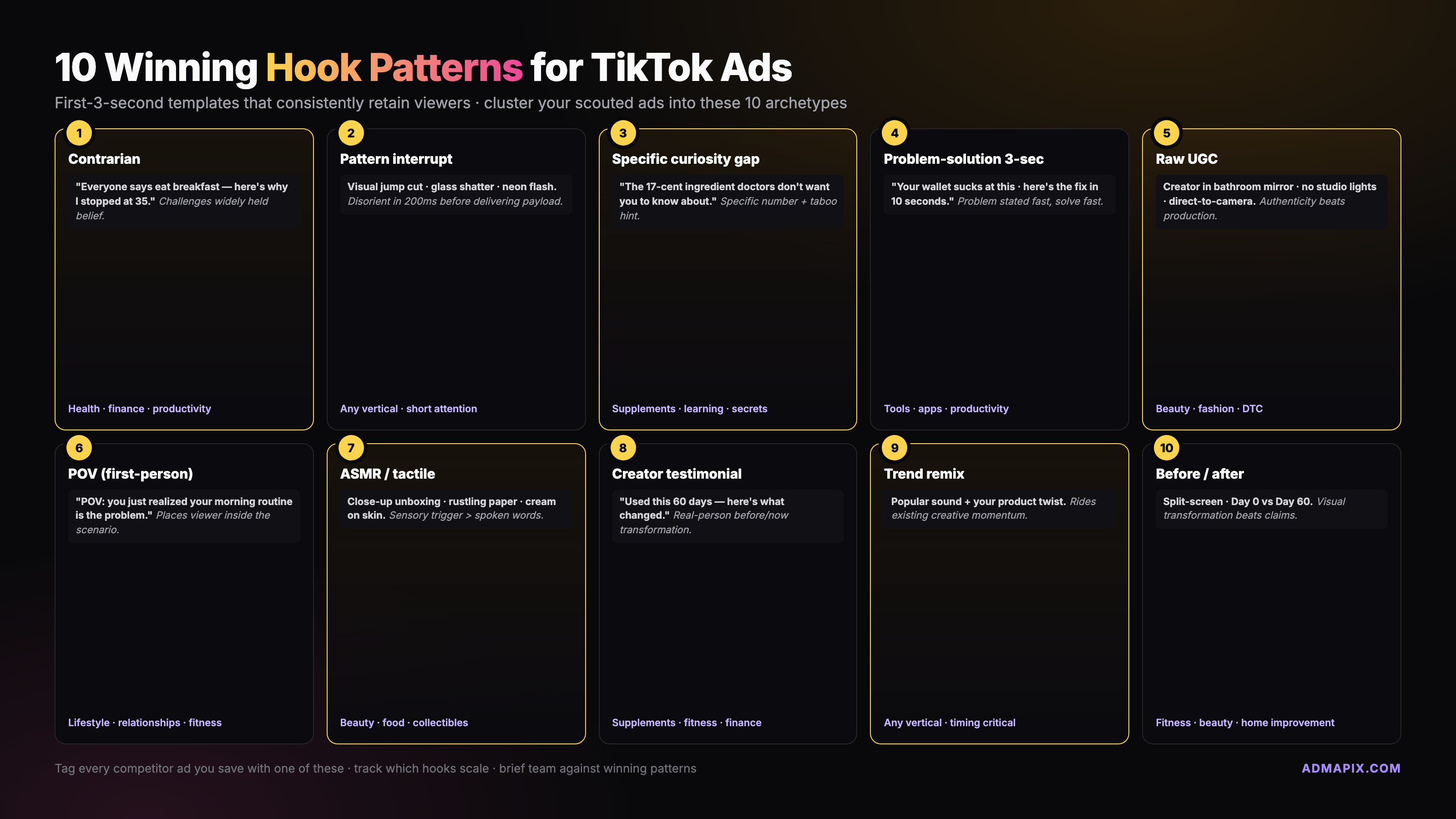
1. Contrarian
- Description. Open by contradicting a widely-held belief in the category.
- Example. "Stop drinking lemon water in the morning. It is wrecking your enamel."
- When to use. Saturated verticals where the baseline advice is a cliche.
- Where to find it. Top Ads, wellness and finance verticals.
2. Pattern Interrupt
- Description. Visual or audio jolt in frame one — unexpected cut, sudden volume shift, or jarring color.
- Example. A silent 0.3-second freeze-frame of someone screaming before the voiceover starts.
- When to use. High-scroll verticals (beauty, gaming) where thumb-stop is the whole game.
- Where to find it. Trend Discovery — Moments tier.
3. Specific Curiosity Gap
- Description. Name something with impossible specificity that has no reason to exist.
- Example. "The 3.5-second pause that tripled my Shopify conversion rate."
- When to use. Info-dense verticals (SaaS, education, finance) where viewers reward concreteness.
- Where to find it. Top Ads, B2B and education verticals.
4. Problem-Solution 3-Second
- Description. State a sharp problem in 1.5 seconds, promise the solution in the next 1.5.
- Example. "My protein powder tasted like chalk. Here is what fixed it."
- When to use. Evergreen DTC. Workhorse pattern for supplements, cleaning, home goods.
- Where to find it. Top Ads Spotlight, DTC verticals.
5. Raw UGC
- Description. Intentionally un-produced. Vertical phone camera, bad lighting, no cuts for the first 4 seconds.
- Example. Creator holding the product, mid-sentence, as if you walked in on them.
- When to use. High-trust-requirement verticals (supplements, skincare, anything ingested).
- Where to find it. Top Ads filtered by "UGC" format tag.
6. POV
- Description. First-person framing that casts the viewer as protagonist.
- Example. "POV: you are the founder who just realized your Meta CAC tripled overnight."
- When to use. Niche personas where identification is the sell (founder tools, parenting, gaming).
- Where to find it. Trend Discovery — Signals tier.
7. ASMR
- Description. Hyper-close, hyper-audible product interaction. Unboxing, crinkle, spray, pour.
- Example. A 6-second close-up of a serum dropper at 95% volume with no dialogue.
- When to use. Beauty, food, home goods, fragrance, stationery.
- Where to find it. Top Ads Spotlight, beauty and food verticals.
8. Creator Testimonial
- Description. Recognizable or semi-recognizable creator speaks to camera with direct endorsement.
- Example. "I was skeptical too. Then I used this for 14 days."
- When to use. When you have creator licensing and your audience trusts creators more than brands.
- Where to find it. Top Ads — creator-verified filter.
9. Trend Remix
- Description. Take a current Trend Moment (sound, format, meme) and map it onto your product.
- Example. Using the current viral sound as the backbone of a product-in-use demo.
- When to use. When a Moment is cresting in your vertical and you can ship in 48 hours.
- Where to find it. Trend Discovery — Moments tier. Ship fast or miss the window.
10. Before-After
- Description. Transformation shot opening. 1 second before, 1 second after, then the voiceover.
- Example. Skin close-up day 1 vs day 30, cold cut, voiceover in second 3.
- When to use. Results-heavy verticals (fitness, skincare, cleaning, home renovation).
- Where to find it. Top Ads, beauty and fitness verticals.
Your Thursday extraction job is simply to classify each new hook you see against these 10. Anything that does not fit is either a genuinely new pattern (rare — maybe 1 per quarter) or a poorly-executed attempt at one of the 10 (common).
Cross-Referencing with Meta Ad Library
A single-platform view is an incomplete advertiser view. Any serious DTC operator is running TikTok, Meta, and often YouTube concurrently. Cross-referencing is how you read the whole strategy.
Our Friday process: copy the advertiser name from CCL or Top Ads → open Meta Ad Library, set country, paste name → scan for identical or near-identical creative. Log three things: overlap percentage, platform-specific creative, and launch sequence (Meta before TikTok or vice versa).
The triangulation insight: advertisers with high Meta→TikTok overlap are usually "lift" shops — repurposing 9:16 creative across platforms. Advertisers with platform-specific creative are running dedicated TikTok production, which is a higher-budget, higher-conviction signal. The latter is stronger competitive intelligence.
For a full Meta Ad Library walkthrough, see our Instagram-native and YouTube spying guide.
Paid Deep-Research Tools: When Free Stops Being Enough
The free stack hits a ceiling when you need historical depth, non-EU transparency, multi-advertiser comparison at scale, or cross-platform search in one query. Three paid tools dominate this tier in 2026:
- PiPiAds. The deepest TikTok-specific spy tool on the market. Chinese-origin, Chinese-first UI, unparalleled coverage of TikTok Shop creative and APAC advertisers that rarely appear in Creative Center filters. If TikTok Shop is your channel, close to mandatory.
- BigSpy. Breadth over depth. Covers TikTok, Meta, YouTube, Pinterest, X, and Instagram in one search. Lower TikTok coverage than PiPiAds but fast for single-query cross-platform scans.
- AdMapix. Cross-platform ad library with NLP search — you type natural language queries ("skincare ads for women 25-34 with before-after hooks") instead of stacking filter dropdowns. TikTok, Meta, YouTube, Instagram Reels, and native ads in a unified index. Our head-to-head comparison with PiPiAds, BigSpy, and six others is in the best ad spy tools 2026 guide.
Pricing lives at admapix.com/pricing. A free trial is the right move before you swap anything out.
Turning Research Into a Brief: Template and Export Format
Every Saturday step produces one of these. The template has six fields. Longer briefs have lower shipped-creative rates in our tracking — we kept cutting until we hit the minimum viable set.
| Field | Content |
|---|---|
| Audience | One-line persona. Who is the TikTok user this lands on? Demographic + psychographic. |
| Hook pattern | One of the 10 (or documented new pattern). |
| Proof | The single strongest evidence point. UGC clip, stat, quote, demo. |
| Offer | What are you selling and at what friction? |
| CTA | Exact words. Not "learn more" — the actual caption text. |
| First-3s storyboard | Shot-level breakdown of seconds 0.0-3.0. Every on-screen element. |
Export. We ship briefs as a single-tab Google Sheet (one row per brief) or a shared Notion database. Both are trivial to hand off to creators or internal production teams. Avoid Word/PDF briefs — they break the sheet-native research workflow and creators rarely read them.
Example (skincare DTC):
- Audience: Women 25-34, acne-prone, tried 3+ products, skeptical of "miracle" claims.
- Hook pattern: Contrarian (Pattern 1).
- Proof: 14-day time-lapse from real customer (usage rights cleared).
- Offer: $12 starter kit, free shipping, 60-day money-back.
- CTA: "Try the starter kit for $12 — link in bio."
- First-3s storyboard: 0.0-0.5 close-up of hand holding competitor product. 0.5-1.0 jump cut to face saying "stop using this." 1.0-3.0 face-forward voiceover "— if you are under 30, here is why."
Brief drafted in 5 minutes on Saturday. Creator or internal production picks it up Monday. Test running by Thursday.
Common Research Mistakes That Waste Entire Quarters
Five mistakes come up over and over with accounts we audit.
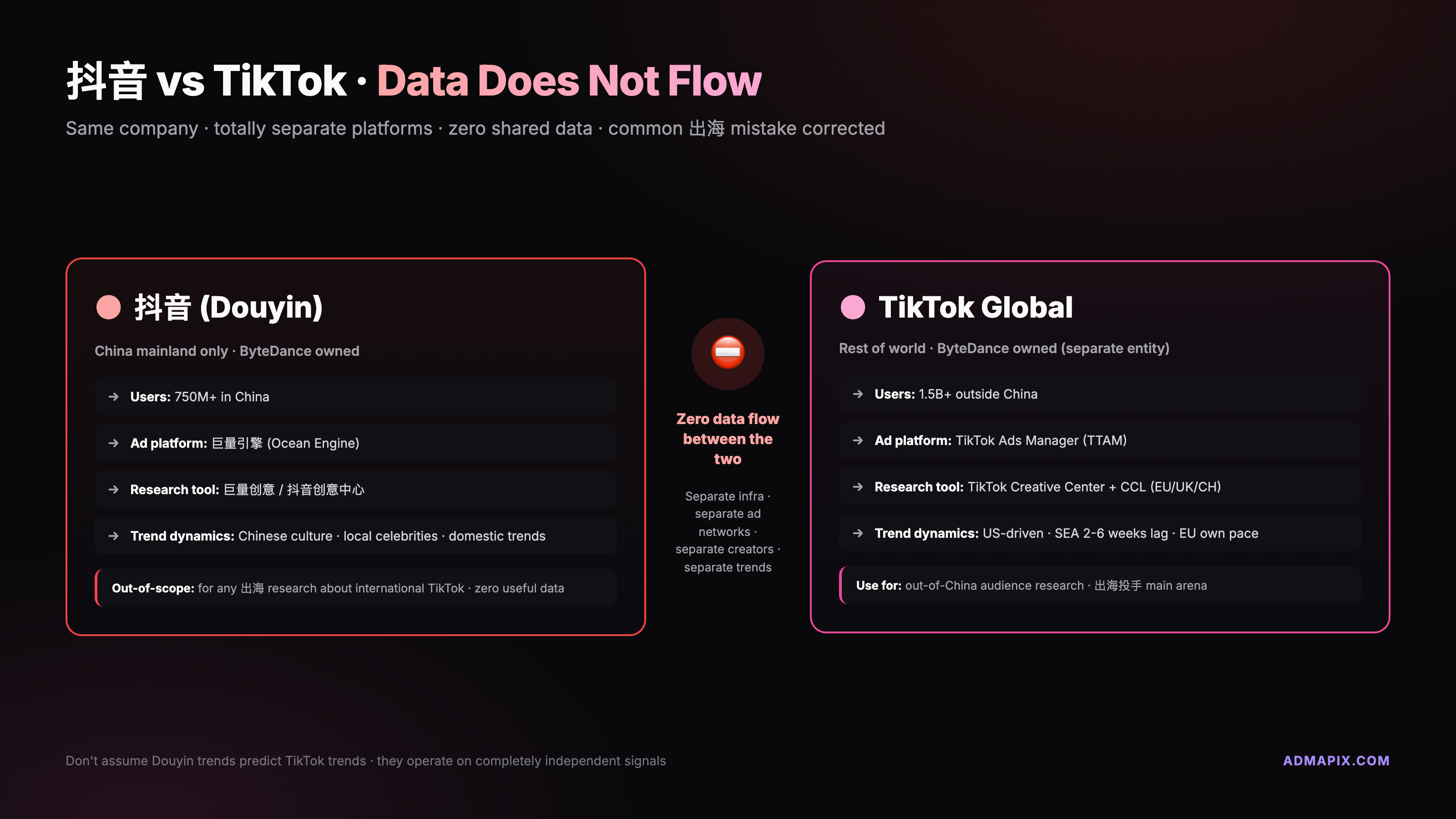
1. Douyin data is not TikTok data
The single biggest mistake we see from 出海 (China-origin outbound) advertisers. Douyin (抖音, the domestic Chinese app) and TikTok (the international app) share a parent company and a rendering engine. They share zero data, user base, algorithm weights, or creator ecosystem.
A Douyin top-performing creative tells you essentially nothing about TikTok performance. Different languages, music rights, shopping UX, cultural references, purchase behavior. We have seen teams burn $40K+ in media spend because the content lead kept benchmarking against Douyin hot list data. Treat them as separate platforms that happen to look similar.
2. SEA trends lag the US by 2-6 weeks
If you run Singapore, Malaysia, Thailand, Indonesia, or Philippines traffic, do not research in the US and ship in SEA on day one. Trends migrate with vertical variation: beauty 2-3 weeks, finance 4-6 weeks, cultural/narrative trends 6+ weeks if at all. Filter Creative Center by your actual sell-in GEO.
3. Bot-inflated view counts
View counts can be bot-inflated, especially on creatives pushed through engagement-seeking ad buys in low-CPM regions. Do not treat view count as a quality signal. Triangulate with comment count (harder to bot), comment sentiment, and whether the ad is still running.
4. Paused-ad ghosts
CCL and third-party tools show paused ads alongside active ones. A creative paused on day three because it tanked looks identical to one retired after 90 days because the offer expired. Filter for "currently active" when you can. When you cannot, cross-check Meta Ad Library — if the same advertiser also runs it there with 30+ days live, odds are it is genuinely working.
5. Comment sentiment as a lie detector
A creative can have 2M views and be a commercial failure. Cheapest fidelity check: scroll the top 20 comments. Complaints about pricing or misleading claims mean the ad converts attention into resentment. Requests for product links are the real signal.
FAQ
Is TikTok ads research actually free?
Yes. The full Creative Center (Top Ads, Trend Discovery, Keyword Insights, Symphony Creative Studio), the Commercial Content Library, and Top Ads Spotlight are all free with a TikTok for Business login. Paid tools like PiPiAds, BigSpy, and AdMapix add historical depth and cross-platform search but are strictly complementary — you can run a professional research workflow entirely on the free stack.
What is the difference between Creative Center and Commercial Content Library?
Creative Center is TikTok's advertiser-facing research and creative toolkit — global coverage, curated Top Ads, trend taxonomy, AI creative studio. Commercial Content Library is the regulated ad transparency database — EU, UK, and Switzerland only, with advertiser names, targeting parameters, and active/paused status. Use Creative Center for creative inspiration and trend research. Use CCL for advertiser-specific competitive audits in EU markets.
Can I see TikTok ads from any country?
In Creative Center Top Ads, yes — you can filter by 30+ markets. In Commercial Content Library, no — CCL is legally restricted to ads targeted at EU, UK, and Switzerland users. If you need non-EU advertiser-specific transparency, you will need a paid tool like PiPiAds (strong APAC coverage) or AdMapix (cross-platform global coverage).
How often should I do TikTok ads research?
Weekly is the sweet spot for most advertisers. The 7-step workflow above runs about 30 minutes a week distributed across seven days. Daily is overkill unless you are a major brand running high-volume creative testing. Monthly is too slow — you will miss the Trend Moments tier entirely, since those spike-and-decay within 3-10 days.
Can I reference Douyin data for my TikTok campaigns?
Essentially no. Douyin and TikTok are separate platforms with separate data, separate algorithms, separate creator ecosystems, and separate user behavior. Cross-referencing is a category mistake. If you are 出海 and coming from the domestic Chinese market, reset your research expectations: start over with Creative Center, TikTok-native competitors, and regional data for your actual target market.
What is the best tool for TikTok Shop research?
For TikTok Shop specifically, PiPiAds has the deepest native coverage — Chinese-origin tool with APAC and Shop-specific filters that Creative Center does not expose. For general TikTok advertiser research with Shop as one channel, AdMapix and BigSpy both cover Shop creatives with broader platform overlap. Our full best ad spy tools comparison breaks down the Shop-specific strengths of each.
Closing: Research Is a Cadence, Not a Crusade
TikTok ads research does not reward marathon sessions. It rewards cadence. Thirty minutes a week beats a six-hour monthly deep-dive on every metric we have ever measured. The distributed schedule lets pattern recognition happen between sessions, the weekly rhythm surfaces deltas, and the tight budget forces you to classify rather than collect.
Three free tools handle 80% of the work. The 10-hook library handles most of the classification. The brief template turns research into shipped creative. The rest is discipline.
Anchor your learning in our TikTok Creative Center tutorial. When you need cross-platform depth, compare paid options at admapix.com/pricing.
Further reading (authority sources)
- TikTok Creative Center — official Top Ads dashboard
- TikTok Commercial Content Library — EU/UK/CH ad transparency
- TikTok Newsroom — Symphony and Research API announcements — official 2026 product updates
- Darkroom — 2026 TikTok ads creative rules — industry rulebook reference
- Sendshort — TikTok hook analysis — hook pattern studies
- HeyOrca — TikTok ad creative breakdowns — creative teardown library
Turn these observations into your next creative study
Open the creative library and select samples for your market, network and research question.
Related Articles
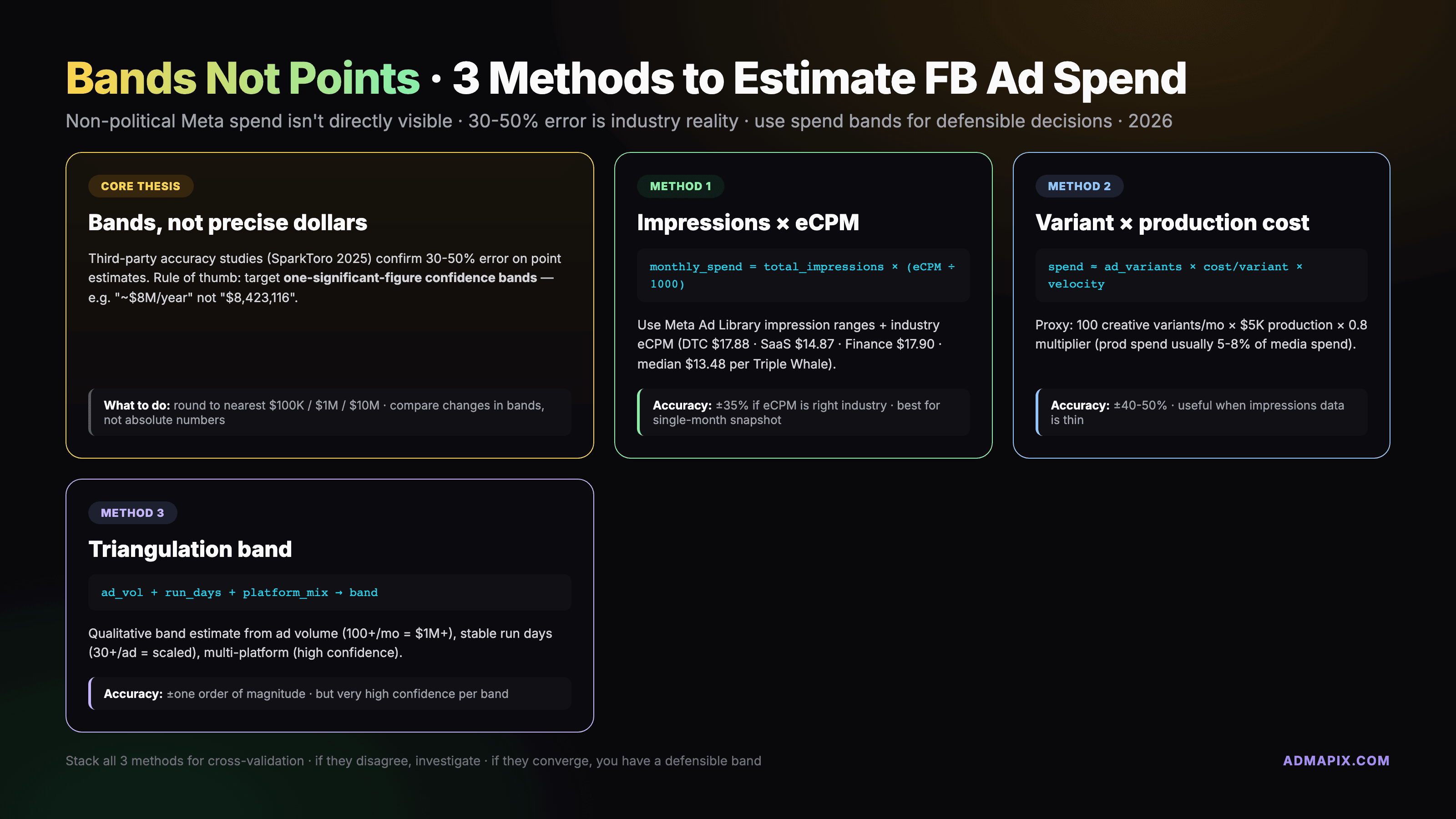
How to Monitor Competitors' Facebook Ad Spend in 2026 (3 Methods + Worked Example)
Non-political Meta ad spend is not publicly visible. Here are three defensible inference methods, a worked $10M DTC example, and the 2026 EU cumulative-spend rollout explained.
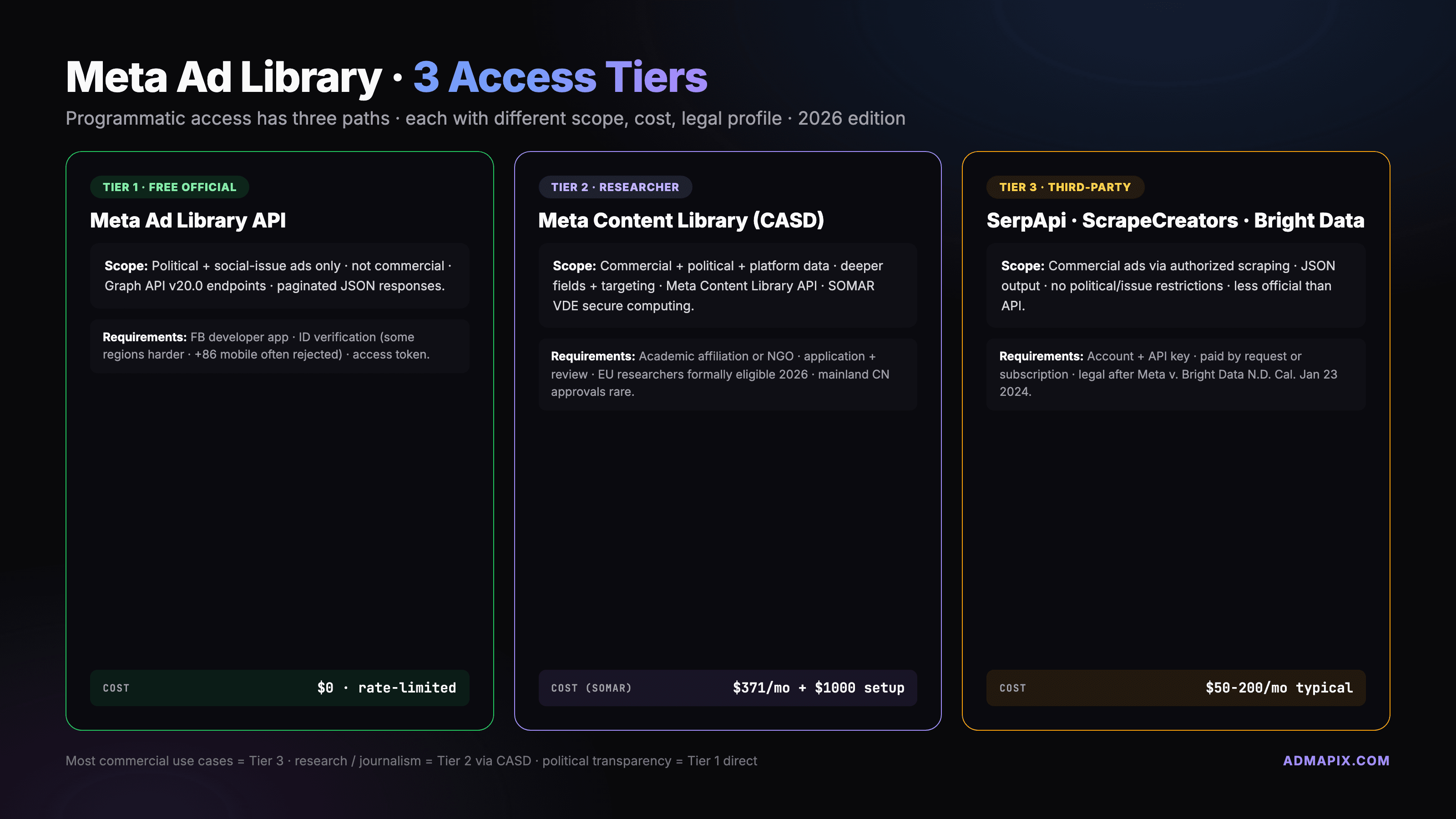
Meta Ads Library API 2026: Graph API v20.0, Impressions, Spend & Python
Developer guide to the Meta Ads Library API: Graph API v20.0 endpoints, free access limits, impressions/spend fields, Python and curl examples, CASD access, and why commercial ads differ from the UI.
How to Use Facebook Ads Library: Filters, Fields & Competitor Research
Use the official Meta Facebook Ads Library with a repeatable workflow for market and category filters, evidence capture, field limits, weekly competitor tracking, and lawful creative research.