How to Spy on Instagram, YouTube & Native Ads (2026 Field Guide)
A reference-book spoke covering the three ad channels that most spy guides skip: Instagram, YouTube, and native. Free workflows, paid tools, 2026 updates.
By the AdMapix Research Team — Updated April 16, 2026
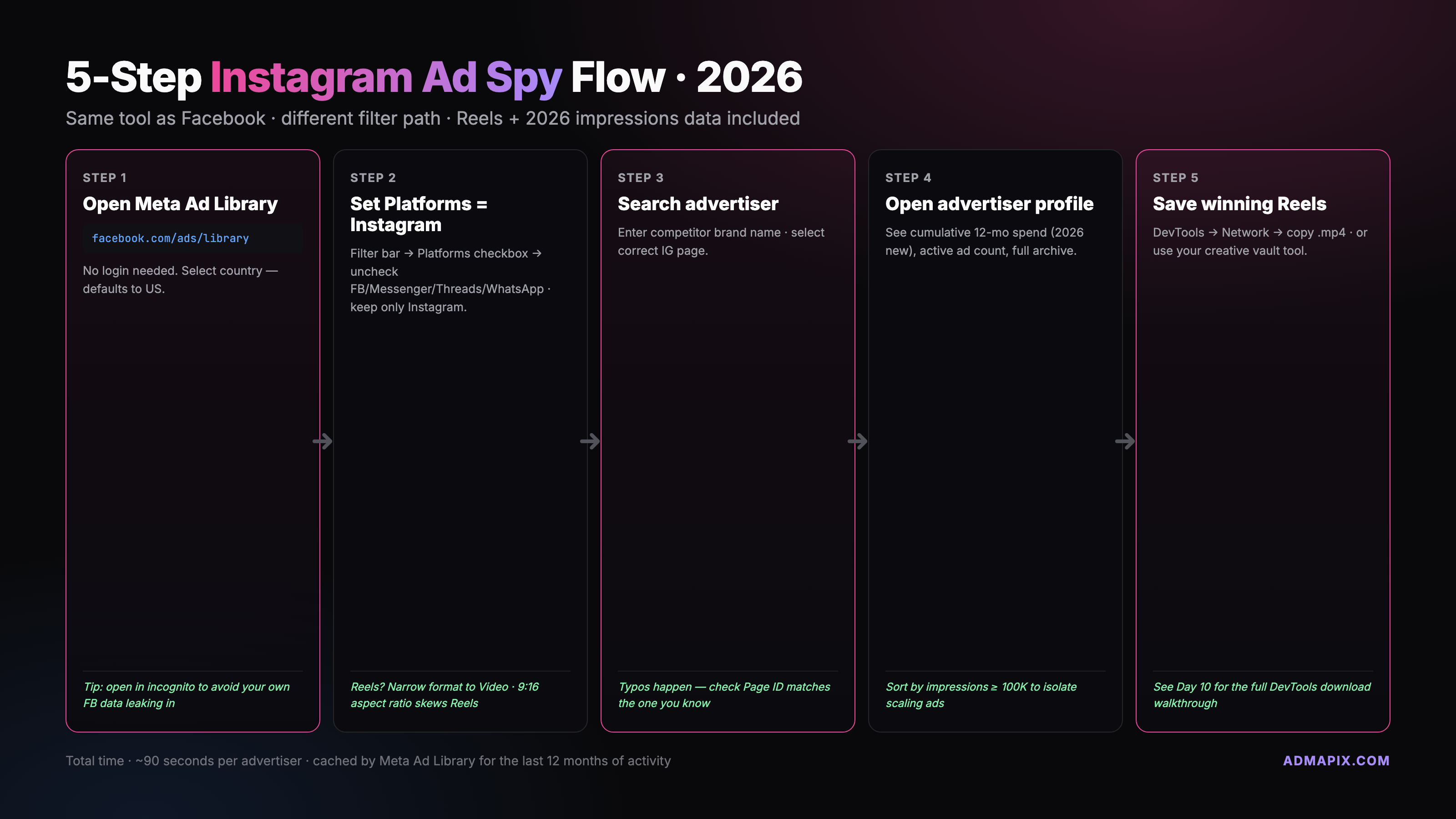
How to spy on Instagram ads in 5 steps: (1) open the Meta Ad Library at facebook.com/ads/library, (2) set the Platforms filter to Instagram only, (3) search the advertiser name or keyword, (4) open each ad profile and check the date-range + impressions band, (5) save winning Reels into a tracked sheet. For YouTube, swap in Google Ads Transparency Center with the YouTube filter. For native, none of the free libraries apply — Adbeat is the wedge.
The three ad channels nobody covers
Every "spy on competitor ads" post on page one of Google covers Facebook, TikTok, and Google Search. Three channels quietly eat the rest of most media plans and get short-changed: Instagram (treated as a Meta afterthought, even though Reels carries 26% of IG ad impressions as of Q3 2025, up from 19% YoY), YouTube (buried inside Google help docs), and native recommendation ads — the "You may also like" widgets under every news article, which have no transparency portal at all.
We use all three channels in production. We've tested every public library and paid tool listed here across US, UK, and SEA accounts. This post is the consolidated field guide. If you want the full 6-platform overview, see our cross-platform spy guide; this spoke goes deep on the three competitors skip.
How to spy on Instagram ads
Meta Ad Library is the primary source of truth for Instagram ads — it's public, free, and covers 100% of active IG ads. Most people use it wrong because they never switch off the Facebook placement. Here's the tighter workflow.
1. Open the Ad Library and isolate Instagram. Go to facebook.com/ads/library. Pick your country, set Ad Category = "All ads", and type an advertiser or keyword. Then open Filters → Platforms and uncheck Facebook, keep only Instagram. Most guides stop at "use Meta Ad Library" and never mention this toggle. You'll immediately see IG-only creative, which is typically shorter and more video-heavy than the FB equivalent. For the full Ad Library walkthrough, see our Meta Ad Library guide.
2. Use the 2026 impressions filter. As of April 2026, Meta extended the impressions-range filter (previously limited to political and issue ads) to all Instagram ads in supported regions. Sort descending — any advertiser sitting in the top impression bands for 30+ consecutive days is running a scaling campaign, not a test.
3. Separate Reels, Feed, and Stories. Meta doesn't give you a clean placement checkbox for Reels vs Feed vs Stories, but you can proxy it: Media Type = Video + duration < 15s usually surfaces Story-native creative; Media Type = Video + aspect ratio 9:16 plus end-frame call-to-action usually surfaces Reels. Feed video sits in between. Paid tools do this cleaner — AdSpy has an explicit placement = "Reels Inline" filter, and PiPiAds added a dedicated IG Reels module in 2026.
4. Check date-range consistency. The Ad Library shows "Started running on" — if an ad has been live for 45+ days without variation, it's a control creative that's beaten every challenger. Those are the ones you want to deconstruct: hook, visual pattern, caption structure, CTA.
5. Free "consumer-feed spy" method. Follow your top 5 competitors on a clean burner Instagram account. Engage with niche content (saves, 5-second video watches). Within 48 hours the algorithm will force-feed you their ads in your Feed, Reels tab, and Stories tray — including geo-targeted variants the Ad Library can show but not sort. This costs $0 and catches creative the Library only surfaces reactively.
How to spy on YouTube ads
Google Ads Transparency Center at adstransparency.google.com is the closest thing to a YouTube Ad Library. Search an advertiser, filter "Where ad ran" = YouTube, and you get every public YouTube ad they've run. Our full walkthrough is in the Google Ads Transparency Center guide — this section covers the YouTube-specific wrinkles.
2026 Shorts / in-stream split. The Transparency Center now separates YouTube Shorts (9:16 vertical, sub-60-second) from YouTube in-stream (16:9 horizontal, pre/mid/post-roll) and from Bumper (≤ 6 sec) and Discovery (in-feed). Use the Format filter or check aspect ratio directly. Shorts inventory behaves differently from in-stream both in bid dynamics and creative norms — treat them as separate creative pipelines, not one asset library.
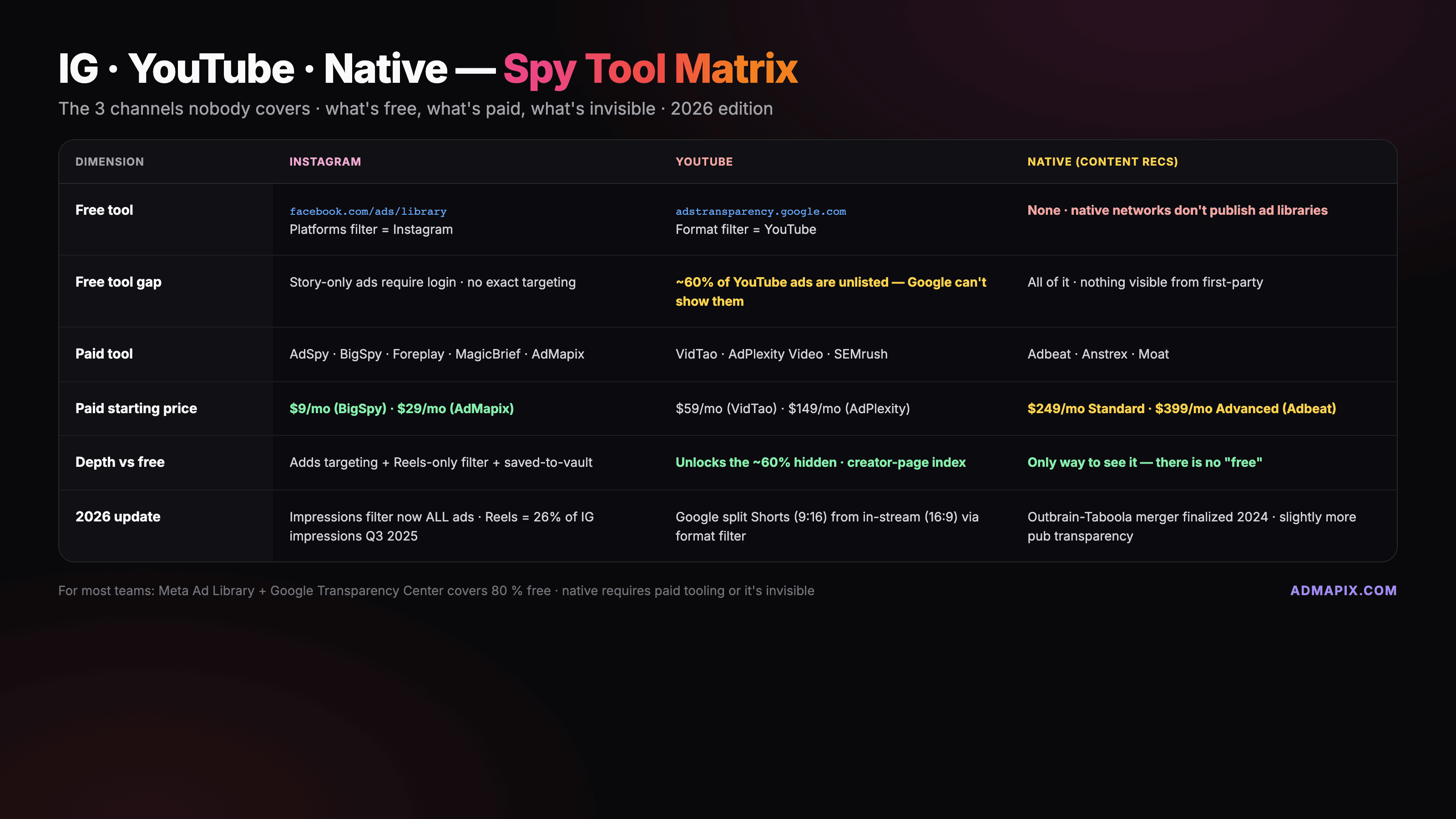
The unlisted-ads moat. Here's the part most guides miss: roughly 60% of YouTube video ads are uploaded as private or unlisted videos and never appear on the advertiser's public channel or in YouTube search. They exist only as ad units. Google Ads Transparency Center does surface many of these, but it does not guarantee 100% coverage of unlisted inventory — and its historical window is short (advertiser-dependent, usually months not years). VidTao and AdPlexity Video crawl these aggressively, store them with long retention, and let you search by keyword, CTA language, or landing-page URL. For any YouTube-heavy competitor, treat VidTao as the source of truth and Transparency Center as the verification layer.
Manual method. Run YouTube on a non-Premium throwaway account (Premium kills ads, so research accounts must skip it). Build a watch-history that matches your target audience profile — niche, geo, demographic — over 5–7 days. Competitor ads will start serving. Screen-record a 30-minute watch session with browser DevTools Network tab open to capture ad URLs.
How to spy on native ads
Native recommendation ads are the channel most spy guides don't even acknowledge. These are the "You may also like" and "Promoted stories" widgets that sit below or alongside articles on publisher sites — CNN, Forbes, Daily Mail, Yahoo, the Weather Channel, every mid-tier news site. They drive a huge share of affiliate, DTC, and health/finance demand, and they are invisible to Meta Ad Library and Google Ads Transparency Center because they don't run on Meta or Google inventory.
The 10 networks worth tracking
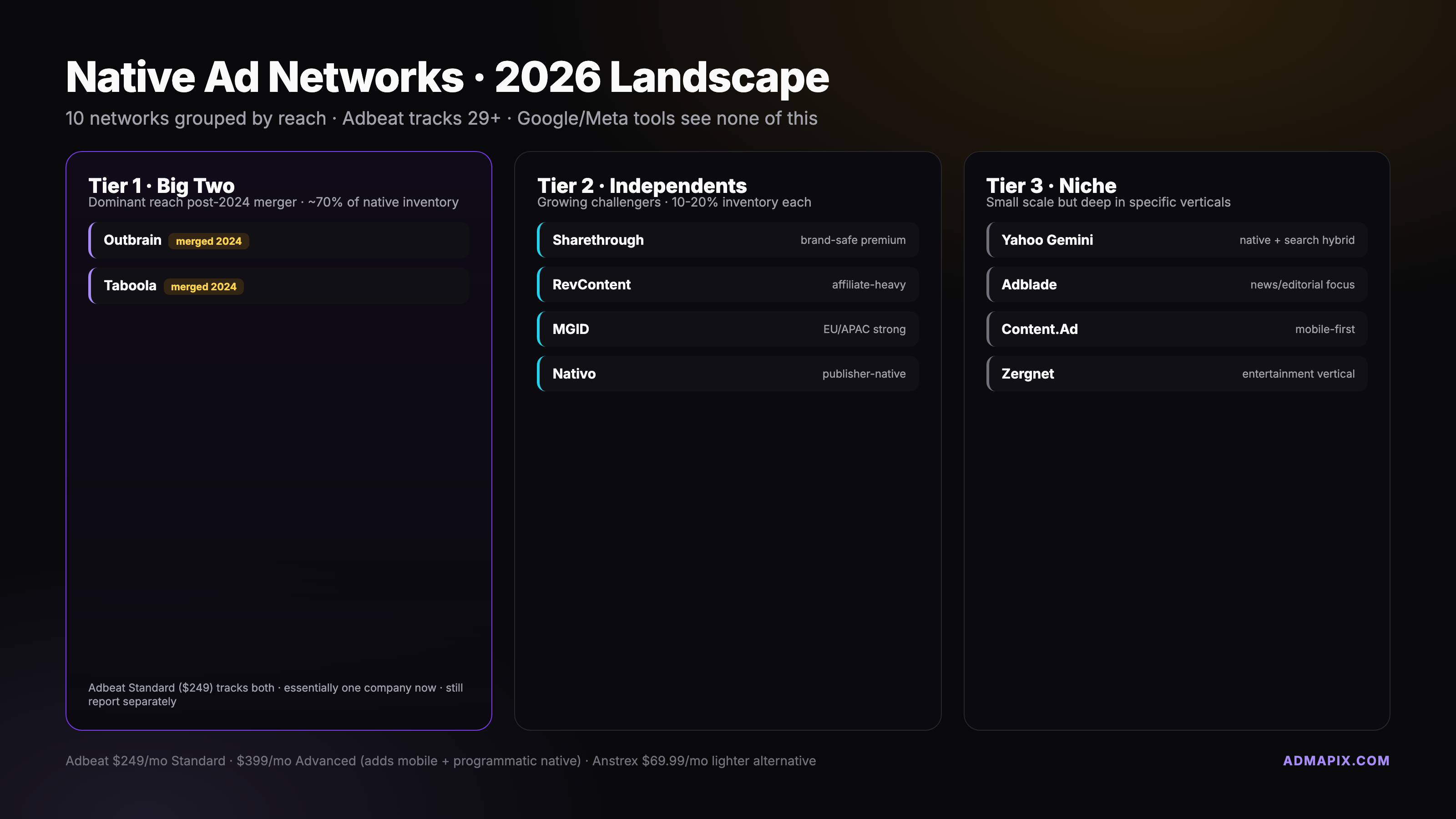
The native supply is fragmented across roughly ten networks: Outbrain, Taboola, Sharethrough, RevContent, MGID, Yahoo Gemini (now Yahoo Native), Adblade, Content.Ad, Nativo, and Zergnet. Outbrain and Taboola completed their long-rumored merger in 2024, consolidating the top two networks into a single publicly-traded supply pool. In practice, most premium US publishers now run Outbrain-Taboola combined inventory; RevContent and MGID dominate mid-market; Sharethrough and Nativo focus on in-feed native inside publisher CMSs; Content.Ad, Adblade, and Zergnet sit on long-tail supply.
Why traditional spy tools see nothing
Unlike Meta and Google, no native network publishes an advertiser-facing ad library. There is no outbrain.com/ads/library. Taboola has a publisher-side dashboard (backstage.taboola.com) but it's access-gated. The ads themselves live on third-party publisher pages, rotate per session, and serve geo-targeted variants — meaning manual screenshotting from a single desktop gives you maybe 5% visibility.
Adbeat is the primary paid tool
Adbeat is the de-facto native-ads research tool. It tracks 29+ networks including all ten listed above, stores historical data going back years, and covers 15,000+ advertisers. Pricing starts at $249/month Standard (desktop display + limited native) and $399/month Advanced (full native + mobile + historical export). There is no cheaper tier — if you're serious about native, this is the budget line-item.
Budget-tier alternatives: Anstrex covers 27 native networks at $59.99/month, with strong Taboola, Outbrain, MGID, and RevContent coverage but thinner US premium-publisher depth. SpyOver and SpyNative sit in the $40–90/month range — good for affiliate marketers on a tight budget, weaker historical data.
Free / low-cost manual methods: Browse high-traffic publishers (Daily Mail, CNN, Forbes, Yahoo) in incognito across 3 geo-cleared sessions and screenshot the recommendation widgets. Clear cookies between sessions. The same thumbnail appearing across 5+ publishers for 2+ weeks = proven winner. Focus on the headline-curiosity-gap pattern more than the creative image — native ads are won at the headline layer.
Cross-platform comparison matrix
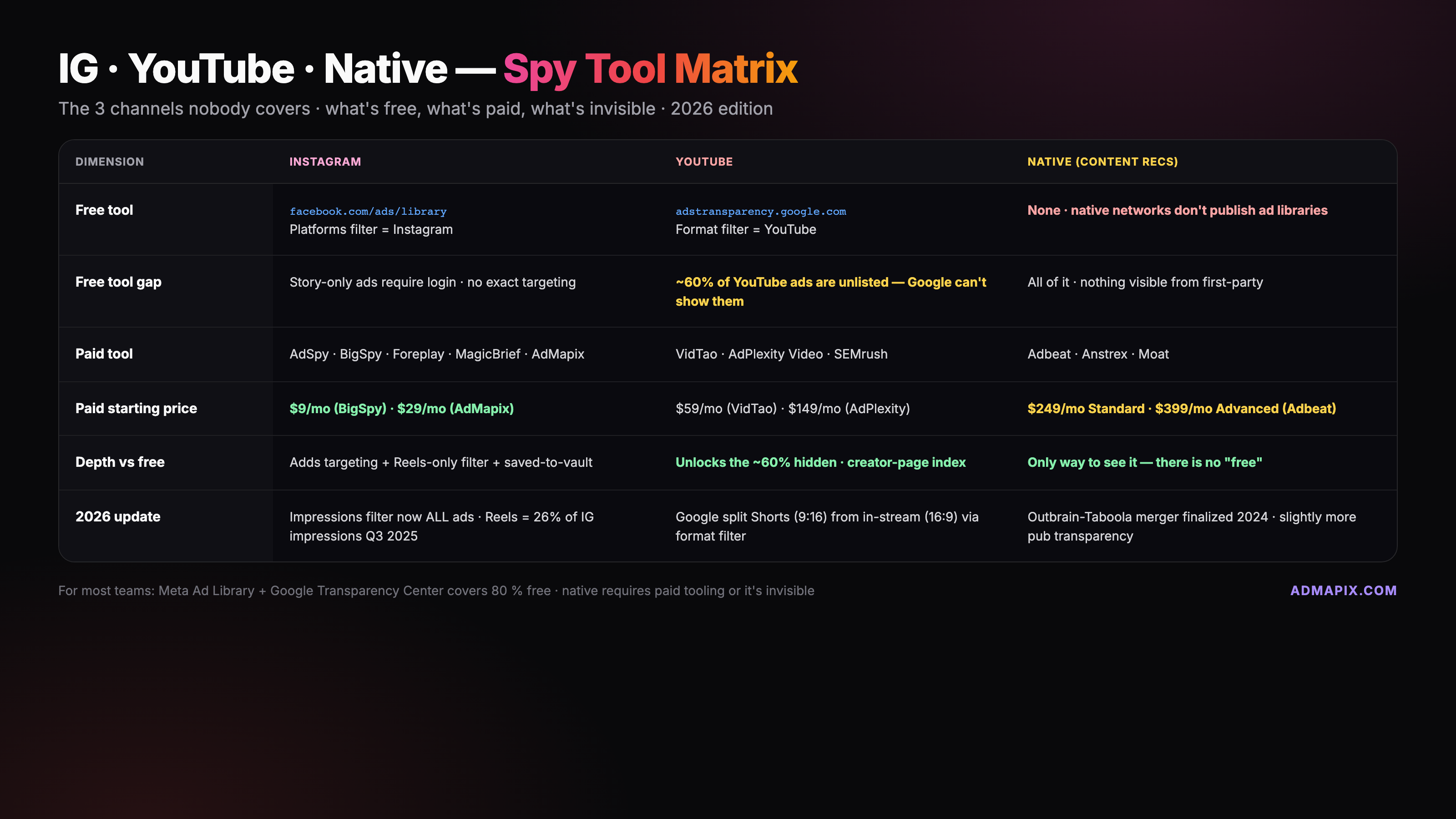
This is the table to bookmark. Numbers reflect April 2026.
| Channel | Free tool | Free tool gap | Paid tool | Paid starting price | 2026 update |
|---|---|---|---|---|---|
| Meta Ad Library | No explicit Reels/Feed/Stories split | AdSpy / PiPiAds | $149 / $77 per month | Impressions filter extended to all IG ads | |
| YouTube | Google Ads Transparency Center | ~60% of video ads are unlisted, short historical window | VidTao / AdPlexity Video | $99 / $249 per month | Shorts (9:16) now split from in-stream (16:9) |
| Native | None — no transparency portal exists | Zero coverage without paid tool | Adbeat / Anstrex | $249 / $59.99 per month | Outbrain-Taboola merger consolidated supply pool |
A few operators run AdMapix as a cross-platform consolidation layer — one tool across IG + YouTube + other channels, rolled up into a single dashboard rather than logging into four different spy tools. That's the problem we solve; it's adjacent to the workflow below rather than a replacement for channel-native tools.
Workflow — which channel to scrape first by your goal
Don't try to spy everything at once. Prioritize by funnel fit.
- DTC / dropshipping. Instagram and TikTok dominate your paid mix; native is usually irrelevant. Start with Meta Ad Library free sweep on Monday, AdSpy or PiPiAds deep dive on Wednesday. Skip YouTube unless you're doing unboxing or long-form demo ads. Skip native entirely.
- SaaS / B2B. YouTube long-form in-stream and native content-recommendation ads drive the bulk of top-of-funnel demand. Google Ads Transparency Center + VidTao for YouTube (mandatory). Adbeat for native (mandatory if budget allows). Instagram optional — check for brand-awareness campaigns but don't over-index.
- Affiliate / arbitrage. Native is your home turf. Adbeat if you can afford it, Anstrex if you can't. Instagram and YouTube are secondary supply.
- Brand / awareness. All three channels matter. Use Transparency Center for reach estimates, Meta Library for creative reference, Adbeat for native placement visibility.
Weekly cadence we use: Mondays, free-tool sweep across Meta Library + Google Transparency (30 minutes). Wednesdays, one paid-tool deep dive on rotation (AdSpy → VidTao → Adbeat, one per week). Fridays, log winners into a scoring sheet with thumbnail, hook, CTA, landing-page URL, and first-seen date. For the full paid-tool comparison across all channels, see our best ad spy tools 2026 round-up.
Legal and ethical edges
Meta Ad Library, Google Ads Transparency Center, and Taboola's publisher-side dashboard are public data — using them is safe. Paid tools like Adbeat, AdSpy, VidTao, and Anstrex crawl at scale under their own terms-of-service arrangements, which is why you pay them; doing the same scraping yourself likely violates the underlying network ToS. Never screenshot a trademarked creative and republish it to your own marketing — studying and adapting patterns is fair use, copy-paste is not. Native networks frequently carry health, finance, and crypto creatives that are geo-restricted or regulated differently by jurisdiction — a US-legal ad is not automatically legal in the EU or UK. When spying into categories you don't run in yourself, check jurisdiction before borrowing angles.
FAQ
1. Can I spy on Instagram Story ads specifically? Yes. In Meta Ad Library, filter Media Type = Video and look for duration under 15 seconds with 9:16 aspect ratio — most of those are Story-native. For a cleaner filter, AdSpy exposes an explicit Story placement option and PiPiAds lets you filter by IG placement type.
2. Does Meta Ad Library separate Reels from Feed video? Not with a dedicated placement checkbox. Media Type = Video covers both. Use aspect ratio (9:16 = Reels-likely) and duration (Reels usually 15–60 seconds, Feed video often longer) as proxies, or switch to AdSpy / PiPiAds for explicit Reels filtering.
3. How do I find unlisted YouTube ads? Google Ads Transparency Center surfaces many but misses a meaningful share — roughly 60% of YouTube video ads are unlisted, and Transparency Center's historical window is short. VidTao and AdPlexity Video crawl unlisted ad units aggressively with multi-year retention and are the only reliable way to see what Transparency Center doesn't.
4. Is there a free native ad library like Meta's? No. None of the native networks — Outbrain, Taboola, Sharethrough, RevContent, MGID, or the others — publish an advertiser-facing ad library. The 2024 Outbrain-Taboola merger improved publisher-side transparency slightly but did not create a public library. Adbeat or manual publisher-page browsing are the only options.
5. Did the Outbrain-Taboola merger make native spy easier? Slightly. The merged entity operates a larger publisher supply pool with more standardized reporting on the publisher side. On the advertiser side — which is what spy tools care about — nothing fundamentally changed. You still need Adbeat or Anstrex.
6. Can I run this workflow from China? Instagram and YouTube require a VPN to access both the platforms and their transparency libraries. Native ad networks (Outbrain, Taboola, Sharethrough, RevContent, etc.) are mostly accessible without a VPN, but Adbeat's coverage is heavily US and EU — for Chinese outbound teams targeting US / EU markets, Adbeat works; for SEA-only targeting, coverage thins out.
{
  "@context": "https://schema.org",
  "@type": "FAQPage",
  "mainEntity": [
    {
      "@type": "Question",
      "name": "Can I spy on Instagram Story ads specifically?",
      "acceptedAnswer": {
        "@type": "Answer",
        "text": "Yes. In Meta Ad Library, filter Media Type = Video and look for duration under 15 seconds with 9:16 aspect ratio. For cleaner filtering, AdSpy and PiPiAds expose explicit Story placement options."
      }
    },
    {
      "@type": "Question",
      "name": "Does Meta Ad Library separate Reels from Feed video?",
      "acceptedAnswer": {
        "@type": "Answer",
        "text": "Not with a dedicated placement checkbox. Use aspect ratio (9:16) and duration as proxies, or switch to AdSpy or PiPiAds for explicit Reels filtering."
      }
    },
    {
      "@type": "Question",
      "name": "How do I find unlisted YouTube ads?",
      "acceptedAnswer": {
        "@type": "Answer",
        "text": "Google Ads Transparency Center surfaces many but misses a meaningful share — roughly 60% of YouTube video ads are unlisted. VidTao and AdPlexity Video crawl unlisted ad units aggressively and are the reliable source."
      }
    },
    {
      "@type": "Question",
      "name": "Is there a free native ad library like Meta's?",
      "acceptedAnswer": {
        "@type": "Answer",
        "text": "No. Native networks including Outbrain, Taboola, Sharethrough, RevContent, and MGID do not publish advertiser-facing ad libraries. Adbeat or manual publisher browsing are the only options."
      }
    },
    {
      "@type": "Question",
      "name": "Did the Outbrain-Taboola merger make native spy easier?",
      "acceptedAnswer": {
        "@type": "Answer",
        "text": "Slightly. The merged entity operates a larger publisher supply pool with more standardized publisher-side reporting. On the advertiser side, nothing fundamentally changed — Adbeat or Anstrex are still required."
      }
    },
    {
      "@type": "Question",
      "name": "Can I run this workflow from China?",
      "acceptedAnswer": {
        "@type": "Answer",
        "text": "Instagram and YouTube require a VPN. Native ad networks are mostly accessible without a VPN. Adbeat coverage is heavily US and EU — good for outbound teams targeting those markets, thinner for SEA-only targeting."
      }
    }
  ]
}
Related reading: cross-platform 6-channel spy playbook · Meta Ad Library guide · Google Ads Transparency Center walkthrough · best ad spy tools 2026 · AdMapix pricing
Sources: Meta Ad Library, Google Ads Transparency Center, Adbeat, Outbrain Newsroom (Taboola merger), VidTao, AdSpy.
See what competitors are really running
Search 6M+ ad creatives, landing pages, and weekly spend across 200+ countries. No credit card, no commitment.
Related Articles

Video Ad Production at Scale: AI Tools, Templates, and Testing Frameworks for 2026
A practical guide to scaling video ad production: AI generation tools that actually work, template systems for rapid iteration, platform-specific format requirements, and how to build a testing flywheel that improves performance with every batch.
Retargeting Ads Strategy in 2026: Competitor Analysis, Segmentation, and Creative Testing
A data-driven retargeting ads strategy combining competitor intelligence, audience segmentation, and creative testing. Learn what competitors run for retargeting and how to build a testable retargeting workflow.
LinkedIn Ads Competitor Research: How to Analyze B2B Rivals in 2026
A systematic approach to LinkedIn Ads competitor research: use the LinkedIn Ads Library, infer targeting from ad copy patterns, analyze B2B landing pages, and turn findings into testable LinkedIn campaign hypotheses.