
Grand Games UA Playbook 2026: 13.7 Billion Impressions Built From Four Videos — Inside a Permutation Machine
A publisher-level teardown of Grand Games A.Ş. across Block Out! and Magic Sort! in the US. Sixty measured ad instances carry 13.7 billion impressions, but Block Out!'s entire 12.2-billion fleet resolves to just four distinct videos and eighteen playable end cards — one 59-second video appears in thirteen instances with thirteen different playables. The breakout that took it from 613 million to 8.1 billion was not a new video: it was a new playable attached to a video already 63 days old.
Grand Games A.Ş. runs two titles in the US on a creative operation that is almost entirely combinatorial. Across Block Out! - Color Sort Puzzle and Magic Sort!, sixty measured ad instances carry 13,734,799,422 impressions.
But Block Out!'s share of that — 12,213,063,666 impressions across thirty ad instances — resolves to only four distinct video assets and eighteen distinct playable end cards. A single 59-second video appears in thirteen separate instances, each paired with a different playable, and those thirteen carry 66.5% of the title's impressions.
The most useful number in the dataset is what happened on 2026-05-27. That is the date the account's 5.08-billion-impression instance began — and the video inside it was not new. It had been running since 2026-03-25 and had produced 613 million impressions across five pairings. What arrived on 2026-05-27 was a new playable. That one playable, across its four pairings, now accounts for 6,436,317,728 impressions — 52.7% of everything Block Out! has delivered.
What one row means here
Before any of the counts below, one definition has to be nailed down, because getting it wrong produces confidently false conclusions.
Each row returned by creative search is an ad instance: a distinct delivery record with its own impression count, placement count and date range. It is not automatically a distinct piece of production. Multiple instances routinely share the same underlying video, differing only in which playable end card is attached.
Checking asset fingerprints (videoFp and playHtmlFp) on Block Out!'s thirty instances returns:
| Count | |
|---|---|
| Ad instances | 30 |
| Distinct videos | 4 |
| Distinct playable end cards | 18 |
| Instances that are pure playable (no video) | 8 |
| Instances carrying a playable | 30 / 30 |
Impressions are reported per instance and are not double-counted, so every impression total in this article is unaffected by the distinction. What it changes is any claim about how many things Grand Games made — and on this account that difference is a factor of five.
This is the same structure a teardown of Wildlife Studios' Block Craft 3D found in the same market and the same month, where 850 ad instances resolved to 168 videos and 96 playables, with one video appearing in 68 instances against 67 different playables. Grand Games is running a smaller, denser version of the identical machine.
All figures are AdMapix third-party estimates for the United States, pulled 2026-08-19. Methodology at the end.
Executive summary (TL;DR)
- Four videos, eighteen playables, thirty instances. Block Out!'s entire measured US fleet is built from four video files. The largest appears in 13 instances with 13 distinct playables.
- One playable carries the account. Playable
94e47300…first appeared 2026-05-27 and now sits in four instances totalling 6,436,317,728 impressions — 52.7% of Block Out!'s fleet. It has been paired with three different videos and run standalone. - The breakout was a playable swap, not a new video. The 59-second workhorse video launched 2026-03-25 and produced 613,481,451 impressions in its first five pairings. From 2026-05-27, paired with the new playable, its remaining eight instances produced 7,512,957,090.
- Nothing at Block Out! has ever been switched off. 30 of 30 instances were live on the pull date, including one first seen 147 days earlier.
- Magic Sort! is a genuinely different fleet. 30 instances resolve to 17 videos and 19 playables — far less reuse — spanning eight distinct durations from 1 second to 116 seconds.
- Magic Sort!'s delivery is bimodal, and one side got shut down. 17 instances deliver 1,319–1,748 impressions per placement; 13 deliver 7,635–8,423. Nothing in between. All 13 high-density instances are Android, and 9 of them have stopped.
- The 2026-08-04 event was not a format test. Seven instances stopped on that single day, spanning four different videos and three different durations (56s, 59s, 116s). Duration cannot explain it; inventory can.
- Watch the app IDs. A second, unrelated title with the identical name "Block Out! - Color Sort Puzzle" from a different publisher sits on the same US download chart.
The publisher at a glance
| Block Out! - Color Sort Puzzle | Magic Sort! | |
|---|---|---|
| Store record(s) | iOS 6752672568 | iOS 6499209744 + Android com.grandgames.magicsort |
| Ad instances measured | 30 | 30 |
| Distinct videos | 4 | 17 |
| Distinct playables | 18 | 19 |
| Total impressions | 12,213,063,666 | 1,521,735,756 |
| Share of publisher total | 88.9% | 11.1% |
| Total placements | 4,714,589 | 852,919 |
| Impressions per placement | 2,590 | 1,784 |
| Oldest instance first seen | 2026-03-25 | 2025-07-25 |
| Account age (days) | 147 | 390 |
| Average instance age | 64.3 days | 111.1 days |
| Instances still live | 30 / 30 | 21 / 30 |
| Instances with a playable | 30 / 30 | 27 / 30 |
The asymmetry that matters is not the impression gap. It is the instances-per-video ratio: Block Out! runs 7.5 instances per video, Magic Sort! runs 1.8. These are two different operating models inside one publisher, and the productive one is the one that treats the video as a reusable component.
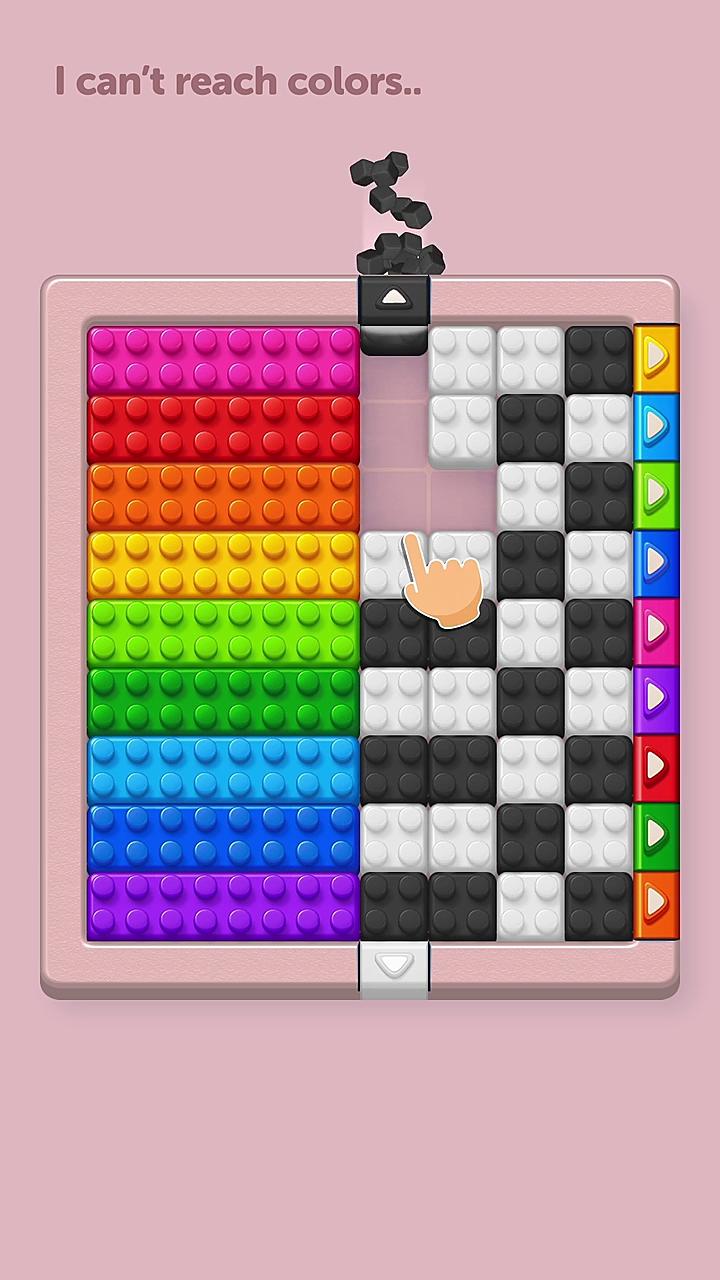 Video V1 — the 59-second file behind thirteen of Block Out!'s thirty ad instances. Across all thirteen pairings it carries 8,126,438,541 impressions and 3,603,667 placements, first seen 2026-03-25.
Block Out!: thirty instances, four videos
The full measured fleet, sorted by impressions. Every one was live on 2026-08-19. V1–V4 label the four distinct videos; P## labels the distinct playable end cards.
| # | Impressions | Placements | Impr/plc | First seen | Days | Duration | Video | Playable |
|---|---|---|---|---|---|---|---|---|
| 1 | 5,077,378,266 | 2,051,212 | 2,475 | 2026-05-27 | 84 | 59s | V1 | P1 |
| 2 | 2,073,756,069 | 1,048,542 | 1,978 | 2026-06-23 | 57 | 59s | V1 | P2 |
| 3 | 1,478,074,913 | 275,923 | 5,357 | 2026-07-24 | 26 | — | none | P3 |
| 4 | 1,197,774,404 | 357,572 | 3,350 | 2026-06-01 | 79 | — | none | P1 |
| 5 | 307,571,690 | 80,481 | 3,822 | 2026-05-20 | 91 | — | none | P4 |
| 6 | 290,564,442 | 89,546 | 3,245 | 2026-06-18 | 62 | — | none | P5 |
| 7 | 271,003,392 | 75,914 | 3,570 | 2026-06-19 | 61 | — | none | P6 |
| 8 | 184,321,957 | 105,227 | 1,752 | 2026-04-25 | 116 | 59s | V1 | P7 |
| 9 | 178,944,428 | 93,190 | 1,920 | 2026-06-21 | 59 | 59s | V1 | P6 |
| 10 | 123,050,019 | 95,298 | 1,291 | 2026-03-25 | 147 | 59s | V1 | P8 |
| 11 | 121,610,438 | 37,475 | 3,245 | 2026-05-19 | 92 | 59s | V1 | P9 |
| 12 | 117,530,027 | 74,744 | 1,572 | 2026-05-12 | 99 | 59s | V1 | P10 |
| 13 | 114,653,564 | 58,008 | 1,977 | 2026-06-06 | 74 | 60s | V2 | P1 |
| 14 | 84,620,098 | 27,439 | 3,084 | 2026-07-29 | 21 | — | none | P11 |
| 15 | 84,306,356 | 26,388 | 3,195 | 2026-06-24 | 56 | — | none | P12 |
| 16 | 66,969,010 | 17,187 | 3,896 | 2026-05-16 | 95 | 59s | V1 | P4 |
| 17 | 60,213,388 | 23,810 | 2,529 | 2026-06-26 | 54 | 59s | V1 | P13 |
| 18 | 46,511,494 | 23,336 | 1,993 | 2026-05-29 | 82 | 59s | V3 | P1 |
| 19 | 45,546,507 | 14,106 | 3,229 | 2026-07-29 | 21 | 59s | V1 | P11 |
| 20 | 33,142,639 | 10,044 | 3,300 | 2026-07-29 | 21 | 60s | V2 | P11 |
| 21 | 32,602,924 | 8,599 | 3,791 | 2026-06-24 | 56 | 60s | V2 | P12 |
| 22 | 31,799,715 | 18,692 | 1,701 | 2026-06-27 | 53 | 59s | V1 | P12 |
| 23 | 30,504,159 | 11,251 | 2,711 | 2026-05-27 | 84 | 60s | V2 | P10 |
| 24 | 26,097,706 | 17,267 | 1,511 | 2026-06-21 | 59 | 60s | V2 | P2 |
| 25 | 25,209,647 | 13,475 | 1,871 | 2026-06-17 | 63 | 60s | V2 | P5 |
| 26 | 24,214,601 | 16,195 | 1,495 | 2026-06-23 | 57 | 59s | V1 | P14 |
| 27 | 23,214,584 | 15,604 | 1,488 | 2026-07-09 | 41 | 59s | V4 | P15 |
| 28 | 21,104,116 | 7,989 | 2,642 | 2026-07-02 | 48 | 59s | V1 | P16 |
| 29 | 20,865,091 | 13,324 | 1,566 | 2026-07-09 | 41 | 59s | V4 | P17 |
| 30 | 19,908,022 | 6,751 | 2,949 | 2026-07-20 | 30 | — | none | P18 |
| Total | 12,213,063,666 | 4,714,589 | 2,590 | — | 64.3 avg | — | 4 videos | 18 playables |
Read the last two columns rather than the first. V1 occupies thirteen rows. P1 occupies four. Eight rows have no video at all.
Extending the sample to 45 instances (three pages) barely changes the picture: 45 instances, 12,391,287,870 impressions, five distinct videos, twenty-three distinct playables, 45 of 45 live. The fifth video contributes 19,016,514 impressions — 0.2%.
The four videos
Collapsing the thirty instances onto their underlying video assets produces a much shorter table, and a much clearer one.
| Video | Duration | Instances | Distinct playables | Impressions | Share | First seen |
|---|---|---|---|---|---|---|
| V1 | 59s | 13 | 13 | 8,126,438,541 | 66.5% | 2026-03-25 |
| V2 | 60s | 6 | 6 | 262,210,639 | 2.1% | 2026-05-27 |
| V3 | 59s | 1 | 1 | 46,511,494 | 0.4% | 2026-05-29 |
| V4 | 59s | 2 | 2 | 44,079,675 | 0.4% | 2026-07-09 |
| (pure playable) | — | 8 | 8 | 3,733,823,317 | 30.6% | 2026-05-20 |
Three things fall out.
V1 is the account. One 59-second file, thirteen pairings, two-thirds of the impressions. Treated as a single asset it carries 8,126,438,541 impressions across 3,603,667 placements inside the 30-day window, against a file first seen 147 days ago. We do not divide that by 147: the impression field covers the window, not the file's lifetime, so that division would understate it roughly fivefold.
Every video pairing is unique. V1's thirteen instances use thirteen different playables. V2's six use six. There is not a single case in this fleet of the same video and the same playable appearing in two rows. The account is enumerating combinations, not duplicating them.
Three of the four videos are 59 seconds; one is 60. So the format discipline the impression table hints at is real — but the sample size is four, not eight. A publisher that has made four videos in 147 days and kept them all at one length is doing something different from a publisher that made eight and converged. The correct reading is not "never deviated across eight productions." It is "barely produces video at all, and reuses what it has."
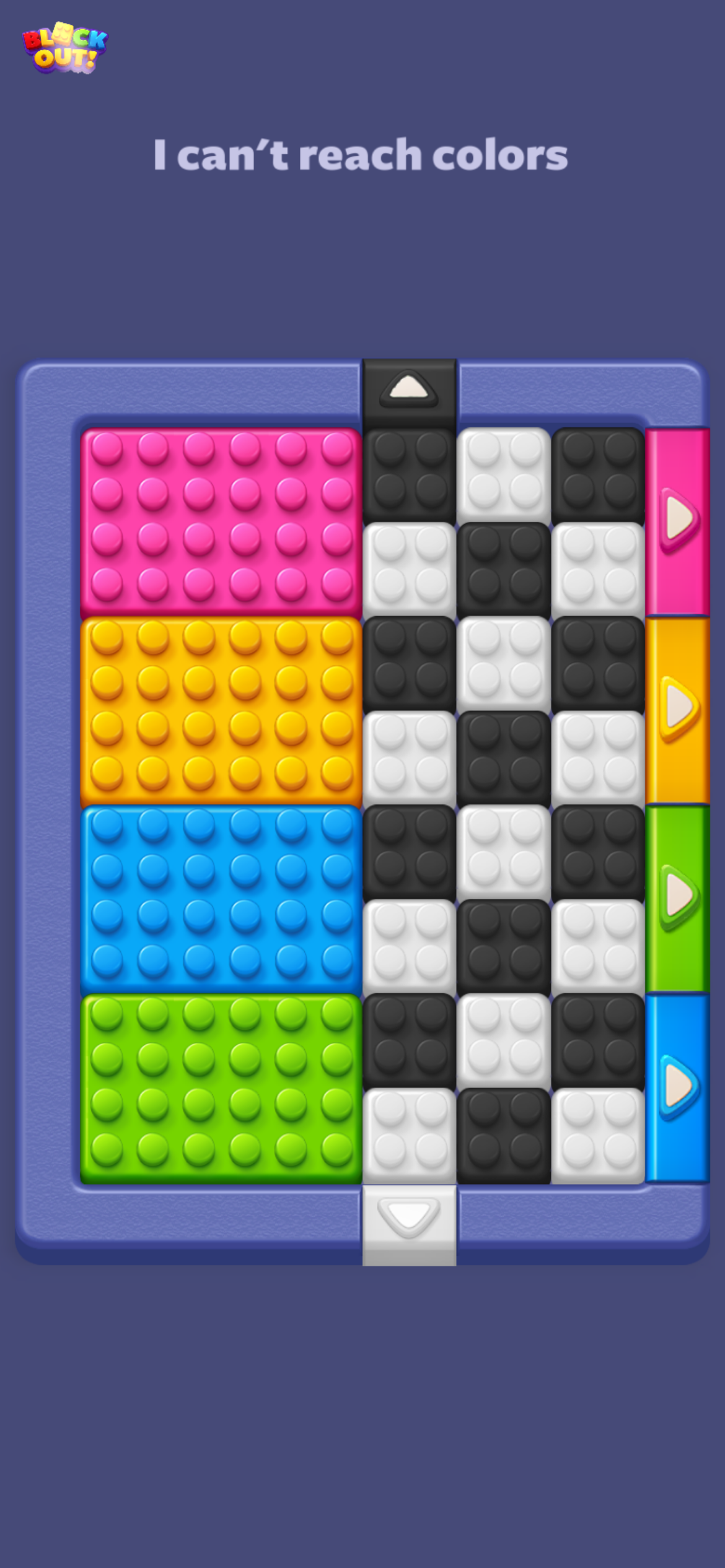 Playable P2, attached to video V1 in instance #2 — 2,073,756,069 impressions across 1,048,542 placements, first seen 2026-06-23. The same video with a different tail delivered 5.08 billion under playable P1.
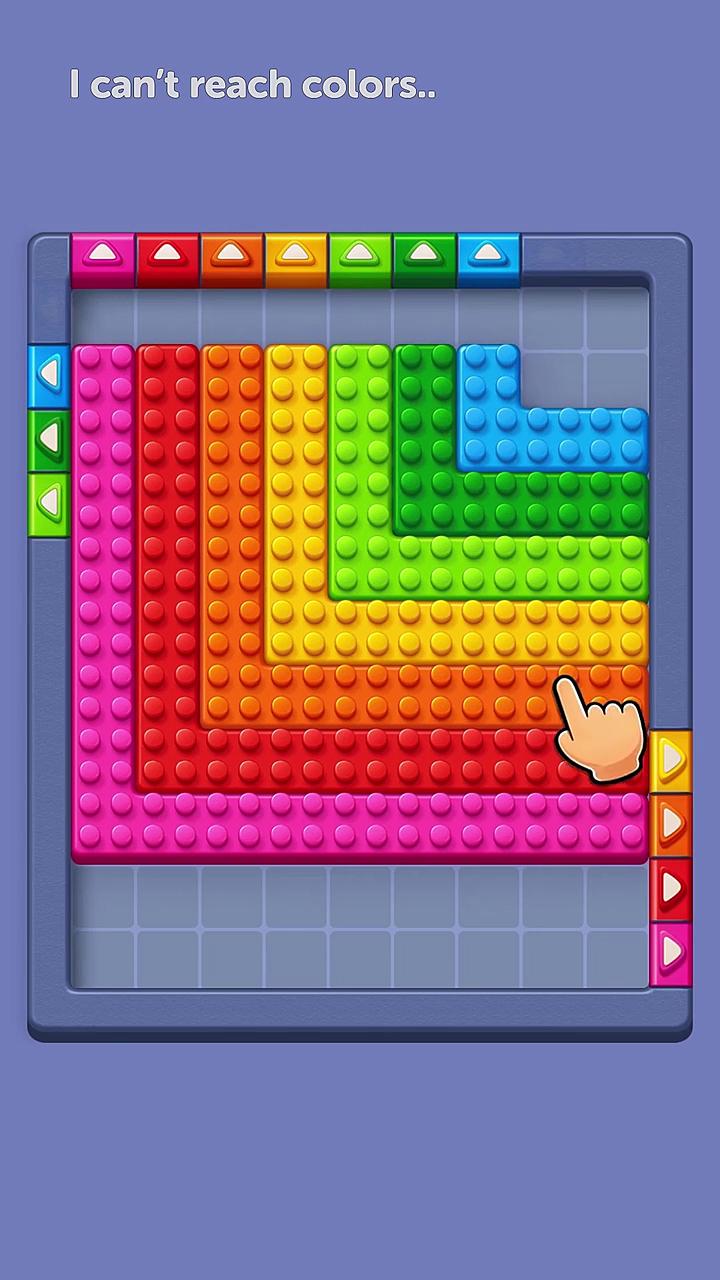 Video V2 — 60 seconds, six instances against six different playables, 262,210,639 impressions total. The second of only four videos in the entire Block Out! fleet.
The breakout was a playable, not a video
This is the correction that changes the strategic reading of the account.
Video V1 was first observed on 2026-03-25. Sorted by first-seen date, its thirteen instances split cleanly at one date:
| First seen | Playable | Impressions | Placements |
|---|---|---|---|
| 2026-03-25 | P8 | 123,050,019 | 95,298 |
| 2026-04-25 | P7 | 184,321,957 | 105,227 |
| 2026-05-12 | P10 | 117,530,027 | 74,744 |
| 2026-05-16 | P4 | 66,969,010 | 17,187 |
| 2026-05-19 | P9 | 121,610,438 | 37,475 |
| 2026-05-27 | P1 | 5,077,378,266 | 2,051,212 |
| 2026-06-21 | P6 | 178,944,428 | 93,190 |
| 2026-06-23 | P2 | 2,073,756,069 | 1,048,542 |
| 2026-06-23 | P14 | 24,214,601 | 16,195 |
| 2026-06-26 | P13 | 60,213,388 | 23,810 |
| 2026-06-27 | P12 | 31,799,715 | 18,692 |
| 2026-07-02 | P16 | 21,104,116 | 7,989 |
| 2026-07-29 | P11 | 45,546,507 | 14,106 |
Before 2026-05-27: five pairings, 613,481,451 impressions. From 2026-05-27 onward: eight pairings, 7,512,957,090 impressions — 12.2 times as much, from the same video file.
Now follow the playable rather than the video. P1's earliest appearance anywhere in this fleet is 2026-05-27 — the breakout date. It went on to appear in four instances:
| Instance | Video | Duration | Impressions | First seen |
|---|---|---|---|---|
| #1 | V1 | 59s | 5,077,378,266 | 2026-05-27 |
| #18 | V3 | 59s | 46,511,494 | 2026-05-29 |
| #4 | (none — standalone) | — | 1,197,774,404 | 2026-06-01 |
| #13 | V2 | 60s | 114,653,564 | 2026-06-06 |
| Total | 6,436,317,728 | 52.7% of fleet |
One playable end card, four deployments — behind three different videos and once on its own — and more than half of everything the title has delivered.
The old reading of this account was "four billion-impression creatives arrived in a 58-day window." The fingerprints say those four instances are one video and three playables: instances #1 and #2 share video V1; instances #1 and #4 share playable P1. It was not four productions. It was a small number of components, recombined, with one component doing the work.
Why this matters operationally. If you believed the breakout was a new video, the lesson would be "keep shipping video until one hits." The data says the video had already been in market for 63 days doing nothing remarkable. What changed was the interactive tail. That reverses where the production budget should go.
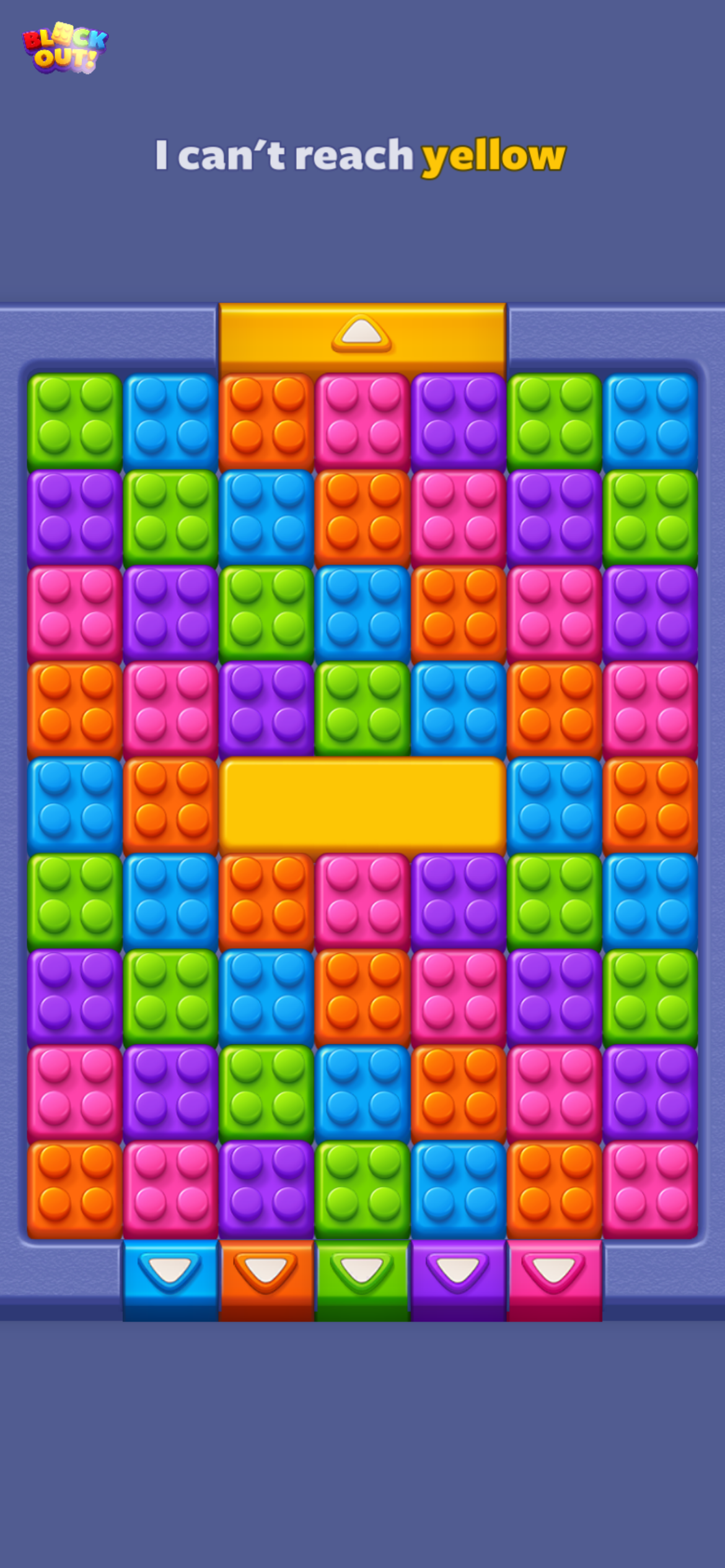 Playable P1 — first seen 2026-05-27, deployed in four instances behind three different videos and once standalone. Combined: 6,436,317,728 window impressions across 2,490,128 placements — 52.7% of the title.
 Video V3 — 59 seconds, used in exactly one instance, paired with the same playable P1 that powered the account's breakout. 46,511,494 impressions in 82 days.
The playable side of the machine
Eighteen distinct playables across thirty instances, and the reuse is deliberate rather than incidental.
| Playable reuse | Count of playables |
|---|---|
| Used in 4 instances | 1 (P1) |
| Used in 3 instances | 2 |
| Used in 2 instances | 5 |
| Used in 1 instance | 10 |
Eight of the eighteen playables appear more than once. Combined with four videos, that produces a genuine cross-product: P1 sits behind V1, V2, V3 and nothing; P11 sits behind V1, V2 and nothing; P12 sits behind V1, V2 and nothing.
Eight instances are pure playable with no video at all, carrying 3,733,823,317 impressions — 30.6% of the title's total, and they include the fleet's densest asset. Instance #3 delivers 5,357 impressions per placement, the highest in the account.
So the interactive unit is not an end card bolted onto a video. In roughly a third of this fleet's volume there is no video in the record at all, and the playable is the ad.
Production cadence, restated in component terms:
| Unit | Count over 147 days | Cadence |
|---|---|---|
| Ad instances | 30 | one per 4.9 days |
| Distinct playables | 18 | one per 8.2 days |
| Distinct videos | 4 | one per 37 days |
The earlier framing of "ships a new creative every ten days" was close on the playable line and wrong by nearly 4x on the video line. Grand Games ships a new playable roughly weekly and a new video roughly monthly.
 Playable P3, running standalone with no video — 1,478,074,913 impressions across 275,923 placements at 5,357 impressions per placement, the highest delivery density in the Block Out! fleet.
 Playable P4 — 307,571,690 impressions standalone, and separately paired with video V1 in instance #16 for another 66,969,010. One of eight playables deployed in more than one configuration.
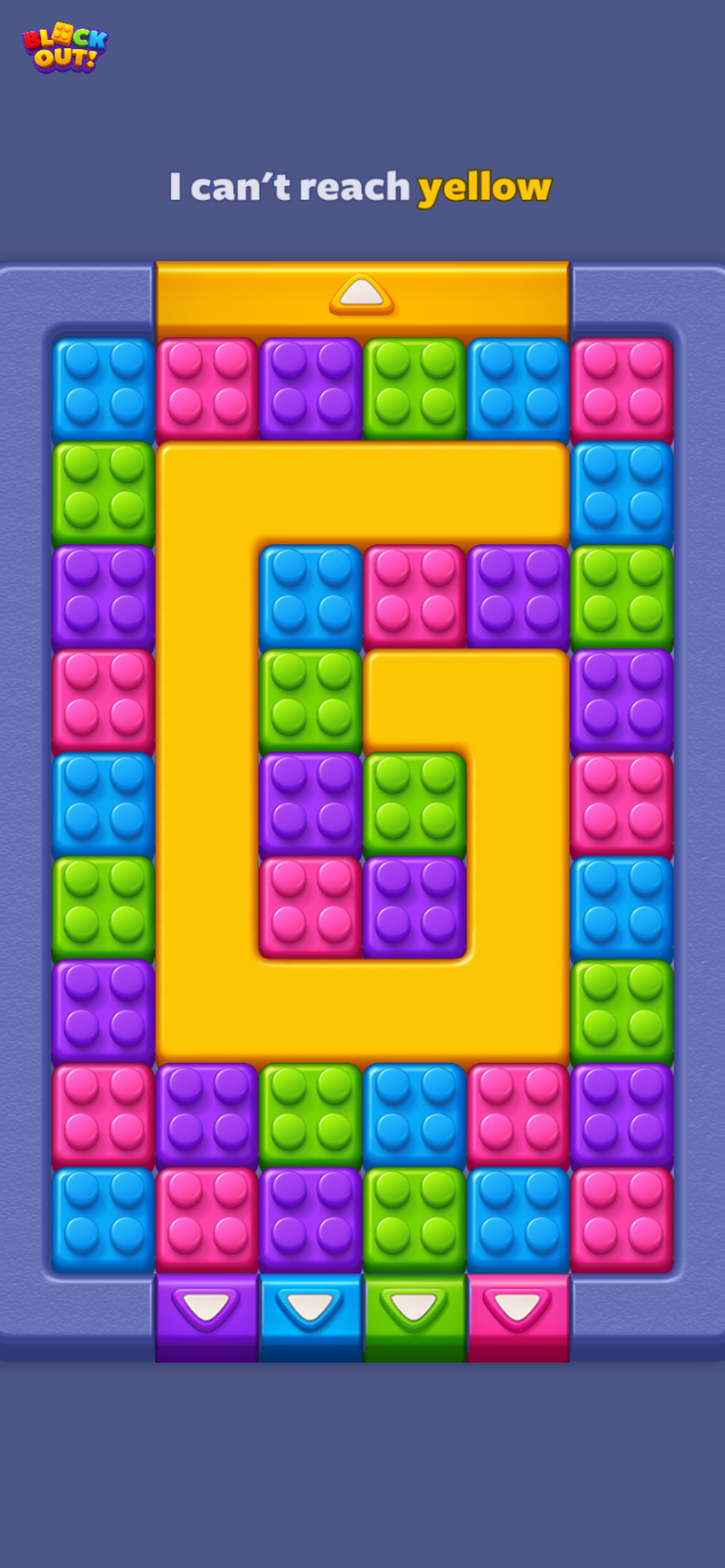 Playable P5 — 290,564,442 impressions standalone in instance #6, and 25,209,647 more behind video V2 in instance #25.
Concentration, correctly measured
Ranked by instance, Block Out! looks moderately concentrated: the top instance takes 41.6%, the top three 70.7%.
Ranked by component, it is far more concentrated than that:
| Unit | Impressions | Share of fleet |
|---|---|---|
| Video V1 (13 instances) | 8,126,438,541 | 66.5% |
| Playable P1 (4 instances) | 6,436,317,728 | 52.7% |
| Instances containing neither V1 nor P1 | 2,727,685,663 | 22.3% |
Those first two rows overlap — instance #1 contains both — so they do not sum. The point is the exposure. Four-fifths of this title's delivery passes through one of two files. If either fatigues, there is no depth behind it: the second-largest video contributes 2.1%.
Instance-level counting hides this completely. Fifteen rows in the top half of the table look like fifteen bets. They are two.
Magic Sort!: a different machine entirely
| # | Impressions | Placements | Impr/plc | First seen | Last seen | Days | Duration | Store |
|---|---|---|---|---|---|---|---|---|
| 1 | 320,528,142 | 224,012 | 1,431 | 2025-12-21 | live | 241 | 30s | iOS |
| 2 | 175,117,254 | 130,316 | 1,344 | 2026-03-24 | live | 148 | 59s | Android |
| 3 | 108,826,834 | 82,495 | 1,319 | 2026-03-24 | live | 148 | 59s | Android |
| 4 | 95,132,029 | 63,270 | 1,504 | 2026-07-14 | live | 36 | 59s | iOS |
| 5 | 89,636,465 | 57,378 | 1,562 | 2026-02-28 | live | 172 | — | Android |
| 6 | 68,256,990 | 47,807 | 1,428 | 2025-07-25 | live | 390 | — | Android |
| 7 | 58,548,680 | 40,862 | 1,433 | 2025-11-13 | live | 279 | 29s | iOS |
| 8 | 54,379,019 | 6,669 | 8,154 | 2026-07-08 | 2026-08-04 | 42 | 116s | Android |
| 9 | 53,997,052 | 30,898 | 1,748 | 2026-04-05 | live | 136 | — | Android |
| 10 | 49,362,762 | 33,901 | 1,456 | 2026-04-28 | live | 113 | 59s | iOS |
| 11 | 42,253,942 | 5,534 | 7,635 | 2026-07-08 | live | 42 | — | Android |
| 12 | 40,850,023 | 4,850 | 8,423 | 2026-07-26 | 2026-08-04 | 24 | 116s | Android |
| 13 | 32,725,064 | 20,539 | 1,593 | 2026-05-02 | live | 109 | 59s | iOS |
| 14 | 32,156,604 | 3,876 | 8,296 | 2026-03-30 | live | 142 | 59s | Android |
| 15 | 31,722,230 | 3,966 | 7,999 | 2026-07-09 | 2026-08-04 | 41 | 59s | Android |
| 16 | 27,132,627 | 3,399 | 7,983 | 2026-07-08 | 2026-08-04 | 42 | 56s | Android |
| 17 | 24,496,403 | 16,218 | 1,510 | 2026-04-29 | live | 112 | 59s | iOS |
| 18 | 22,092,439 | 2,870 | 7,698 | 2026-07-08 | 2026-08-04 | 42 | 59s | Android |
| 19 | 20,524,681 | 12,085 | 1,698 | 2026-07-19 | live | 31 | — | Android |
| 20 | 20,519,969 | 2,554 | 8,034 | 2026-07-08 | 2026-08-04 | 42 | 59s | Android |
| 21 | 20,394,768 | 14,144 | 1,442 | 2026-03-24 | live | 148 | 59s | iOS |
| 22 | 20,111,633 | 11,903 | 1,690 | 2026-08-01 | live | 18 | — | Android |
| 23 | 18,961,281 | 2,413 | 7,858 | 2026-07-25 | 2026-08-04 | 25 | 59s | Android |
| 24 | 14,892,690 | 1,806 | 8,246 | 2026-03-31 | live | 141 | 59s | Android |
| 25 | 14,248,580 | 1,738 | 8,198 | 2026-07-08 | 2026-08-02 | 42 | 59s | Android |
| 26 | 14,005,933 | 8,070 | 1,736 | 2026-07-31 | live | 19 | 1s | iOS |
| 27 | 13,272,402 | 1,656 | 8,015 | 2026-07-21 | 2026-07-28 | 29 | 28s | Android |
| 28 | 13,155,009 | 1,602 | 8,212 | 2025-09-27 | live | 326 | 60s | Android |
| 29 | 12,599,123 | 8,011 | 1,573 | 2026-05-05 | live | 106 | 59s | iOS |
| 30 | 11,835,128 | 8,077 | 1,465 | 2026-03-25 | live | 147 | — | iOS |
| Total | 1,521,735,756 | 852,919 | 1,784 | — | — | 111 avg | — | — |
Thirty instances here resolve to seventeen distinct videos and nineteen distinct playables — an instances-per-video ratio of 1.8 against Block Out!'s 7.5. Only five videos appear more than once, and the most-reused appears three times.
Duration variety is real at the video level too: across the seventeen videos, recorded durations are 1, 28, 29, 30, 56, 59, 60 and 116 seconds. This is not a recombination machine. It is a conventional creative pipeline producing distinct assets.
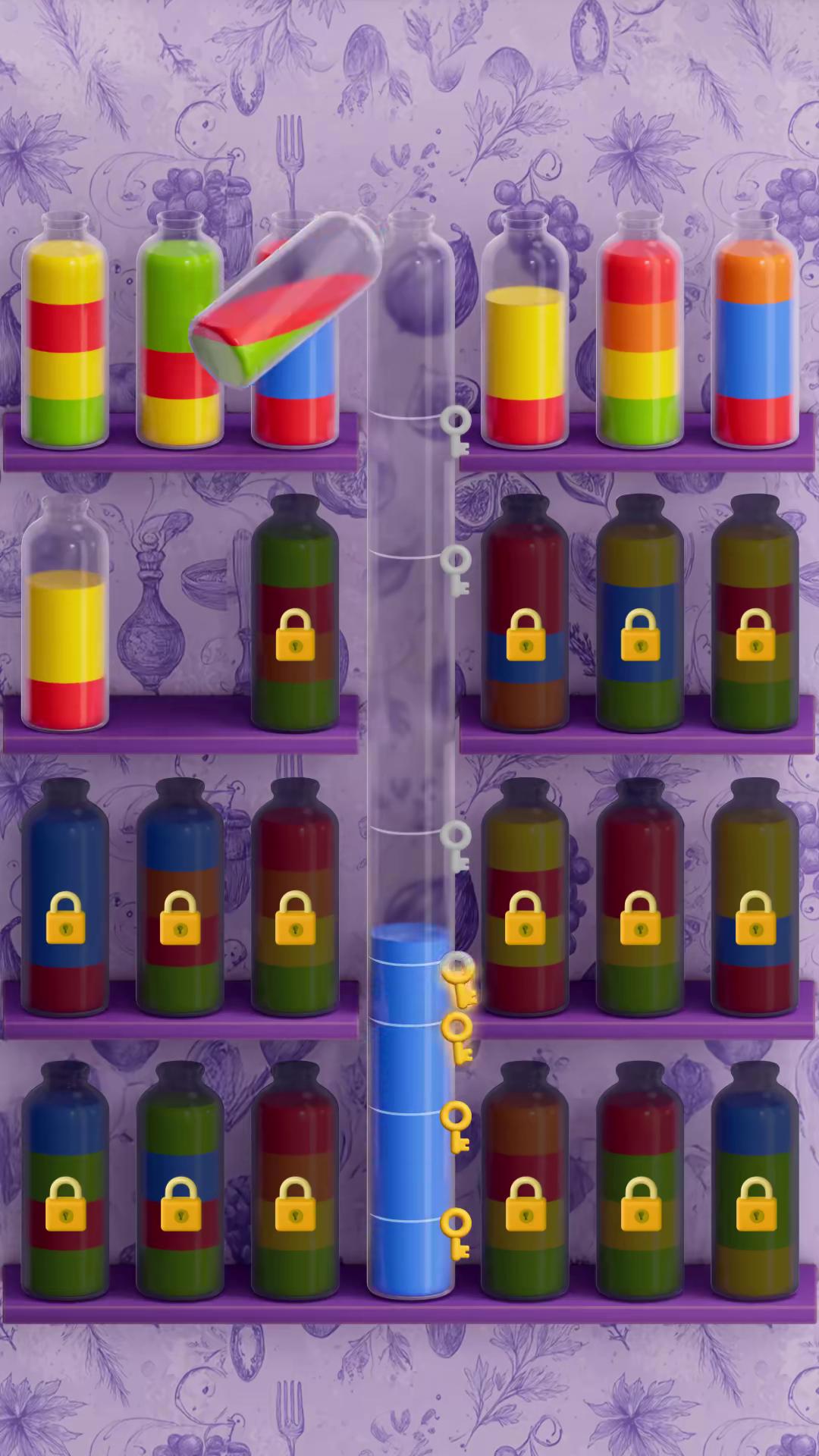 Magic Sort! instance #1 — 30 seconds, 320,528,142 impressions across 224,012 placements, first seen 2025-12-21 and still running after 241 days. Its video appears in only one instance.
Magic Sort! delivers in two separate regimes
The impressions-per-placement column above is not a spread. It is two populations with an empty gap between them.
| Population | Instances | Impr/placement | Impressions | Share | Placements | Share | Still live |
|---|---|---|---|---|---|---|---|
| Low density | 17 | 1,319 – 1,748 | 1,176,098,941 | 77.3% | 809,986 | 95.0% | 17 / 17 |
| High density | 13 | 7,635 – 8,423 | 345,636,815 | 22.7% | 42,933 | 5.0% | 4 / 13 |
Nothing in this fleet delivers between 1,748 and 7,635 impressions per placement. The high-density group takes 5.0% of placements and produces 22.7% of impressions.
Two properties sort the split cleanly:
Store. All thirteen high-density instances run on the Android record com.grandgames.magicsort. The iOS record 6499209744 is 100% low-density across all ten of its instances.
Survival. Every single stopped instance in this fleet is high-density. All seventeen low-density instances were live on the pull date; nine of the thirteen high-density instances were not.
Note what does not sort it: demoadCnt runs 1–3 in both groups, unlike the Playrix accounts where that field separates the two regimes exactly. And duration does not sort it either — 59-second instances appear on both sides.
The 2026-08-04 shutdown, corrected
An earlier version of this teardown read the two 116-second instances as a long-form format test that was launched, measured and killed. Fingerprint and stop-date checks change that reading in two ways.
First: the two 116-second rows are one video. Both carry videoFp b441a3857c…. They are a single 116-second file deployed with two different playables, first seen 2026-07-08 and 2026-07-26, both last observed 2026-08-04. The correct statement is "one 116-second video, two pairings, both stopped on the same day" — not two separate long-form productions.
Second, and more important: the 116-second pair was not what got shut down. Seven instances stopped on 2026-08-04, and they are not a duration cohort.
| Impressions | Placements | Impr/plc | Duration | Video | First seen | Days live |
|---|---|---|---|---|---|---|
| 54,379,019 | 6,669 | 8,154 | 116s | A | 2026-07-08 | 42 |
| 40,850,023 | 4,850 | 8,423 | 116s | A | 2026-07-26 | 24 |
| 31,722,230 | 3,966 | 7,999 | 59s | B | 2026-07-09 | 41 |
| 27,132,627 | 3,399 | 7,983 | 56s | C | 2026-07-08 | 42 |
| 22,092,439 | 2,870 | 7,698 | 59s | B | 2026-07-08 | 42 |
| 20,519,969 | 2,554 | 8,034 | 59s | D | 2026-07-08 | 42 |
| 18,961,281 | 2,413 | 7,858 | 59s | D | 2026-07-25 | 25 |
| 215,657,588 | 26,721 | 8,071 | 3 durations | 4 videos | — | — |
Four distinct videos. Three distinct durations. All seven Android. All seven in the high-density band. Two more instances stopped within the same week — one on 2026-08-02 and one on 2026-07-28 — also Android, also high-density, at 59 and 28 seconds.
Duration cannot be the variable. Fifty-nine-second instances appear among both the stopped and the surviving. What all nine stopped instances share is the store record and the delivery regime. Across the three stop dates combined, nine of the thirteen high-density instances — 69% — are now dark, while all seventeen low-density instances are untouched. On 2026-08-04 alone, seven of those thirteen stopped.
The honest conclusion is narrower than the original and more useful: this was not a verdict on long-form creative. It looks like a placement or inventory change on the Android side, executed on a single date, that took out assets of every length running in that regime. Four high-density Android instances survived it — including one first seen 2025-09-27 and still live after 326 days — so it was not a blanket shutdown of the regime either.
What this means for anyone reading stop-dates as strategy: a shared stop date across several assets is strong evidence of a single decision, but it tells you nothing on its own about what was decided. Grouping the stopped set by every attribute you have — here duration, video, store and density — is what separates "they killed a format" from "they turned off a channel."
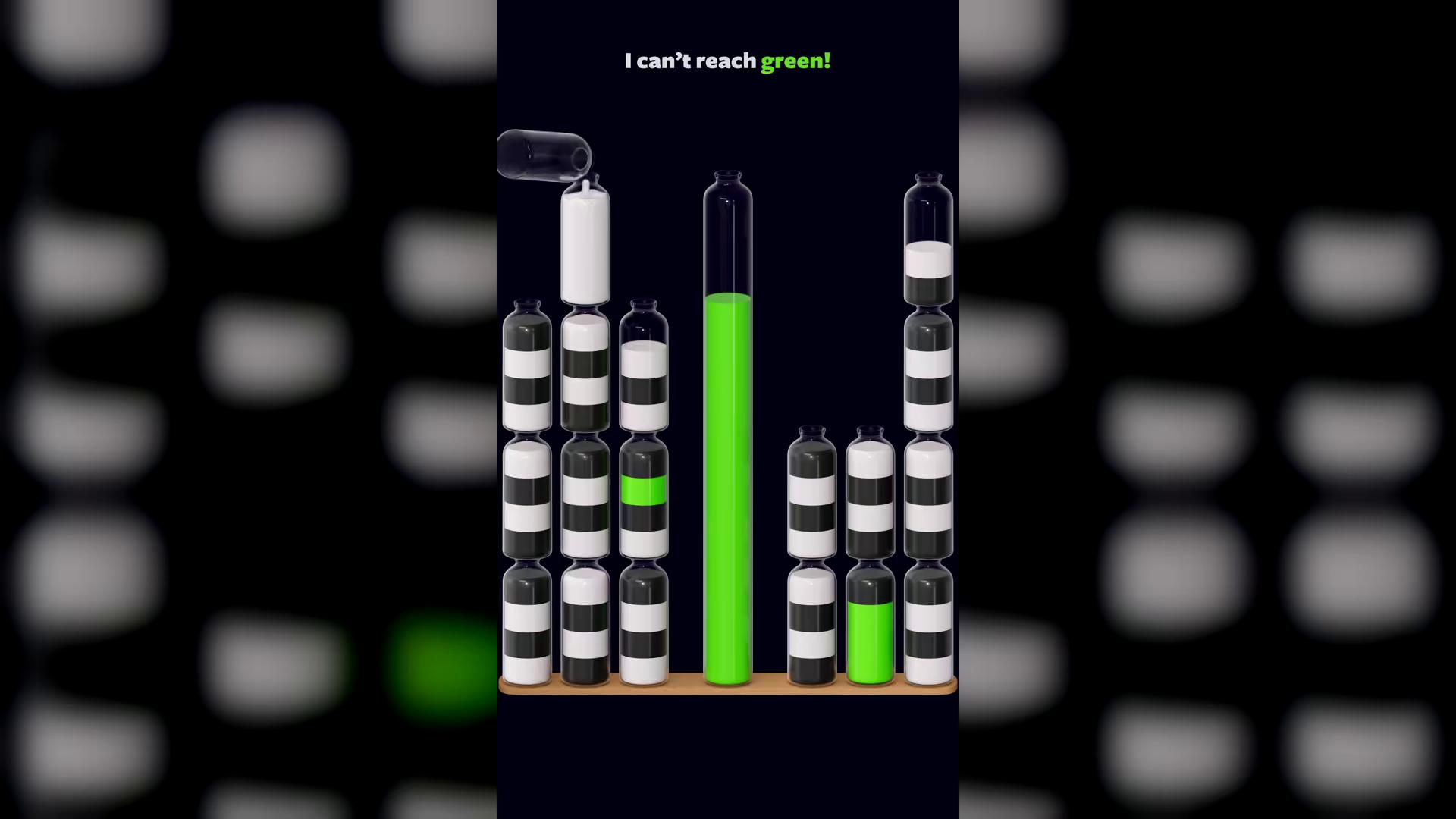 The single 116-second Magic Sort! video. Two instances, two playables, 95,229,042 impressions combined, both last observed 2026-08-04 — alongside five other instances spanning three more videos.
 The playable attached to the second 116-second pairing — 40,850,023 impressions across just 4,850 placements at 8,423 per placement, live for 24 days before the 2026-08-04 stop.
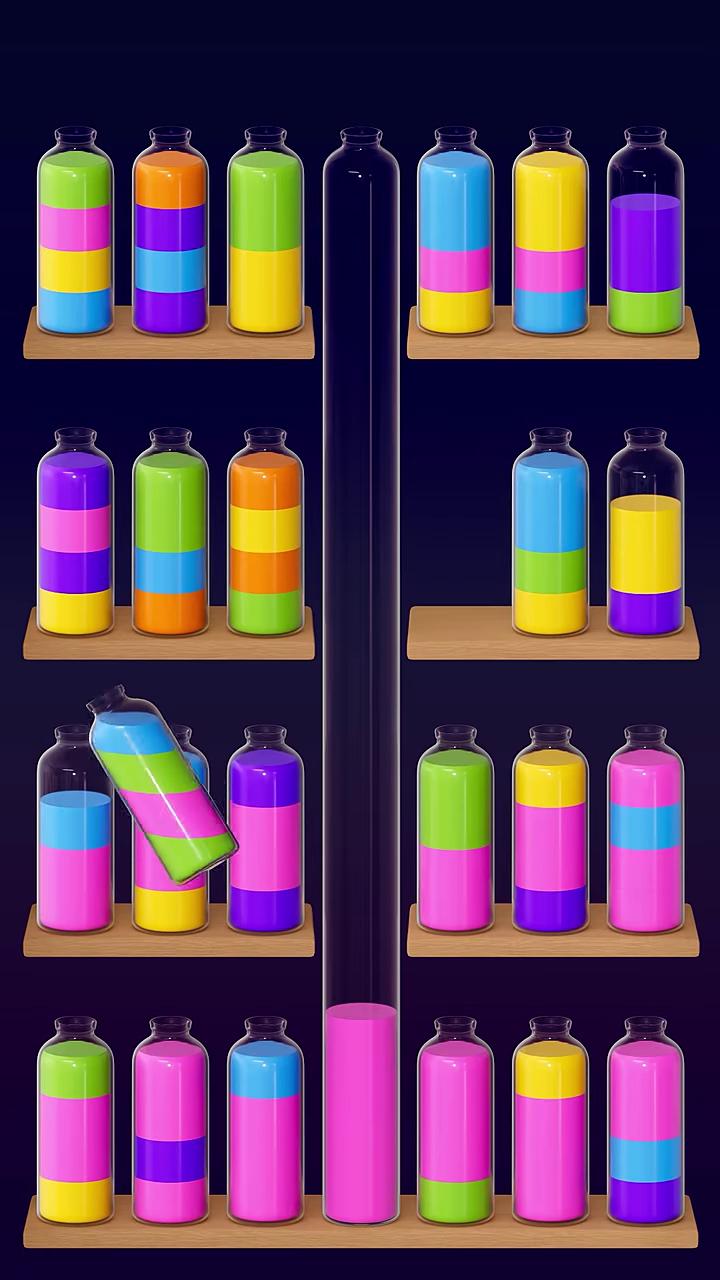 Magic Sort! instance #14 — 59 seconds, 8,296 impressions per placement, first seen 2026-03-30 and still live after 142 days. One of four high-density Android instances that survived 2026-08-04.
The store split at Magic Sort!
| Store record | Instances | Videos | Playables | Impressions | Share | Impr/plc | Still live |
|---|---|---|---|---|---|---|---|
iOS 6499209744 | 10 | 7 | 7 | 639,628,032 | 42.0% | 1,463 | 10 / 10 |
Android com.grandgames.magicsort | 20 | 11 | 12 | 882,107,724 | 58.0% | 2,121 | 11 / 20 |
The Android record carries twice as many instances, more of the volume, and all of the churn. Every retirement in the Grand Games portfolio — nine instances — sits on this one store record.
That is a useful thing to know before benchmarking the publisher. Pull only the iOS side and Grand Games looks like a company that never turns anything off across both titles: 30 of 30 at Block Out!, 10 of 10 at Magic Sort!. Pull the Android side and you find the entire experimentation and shutdown history.
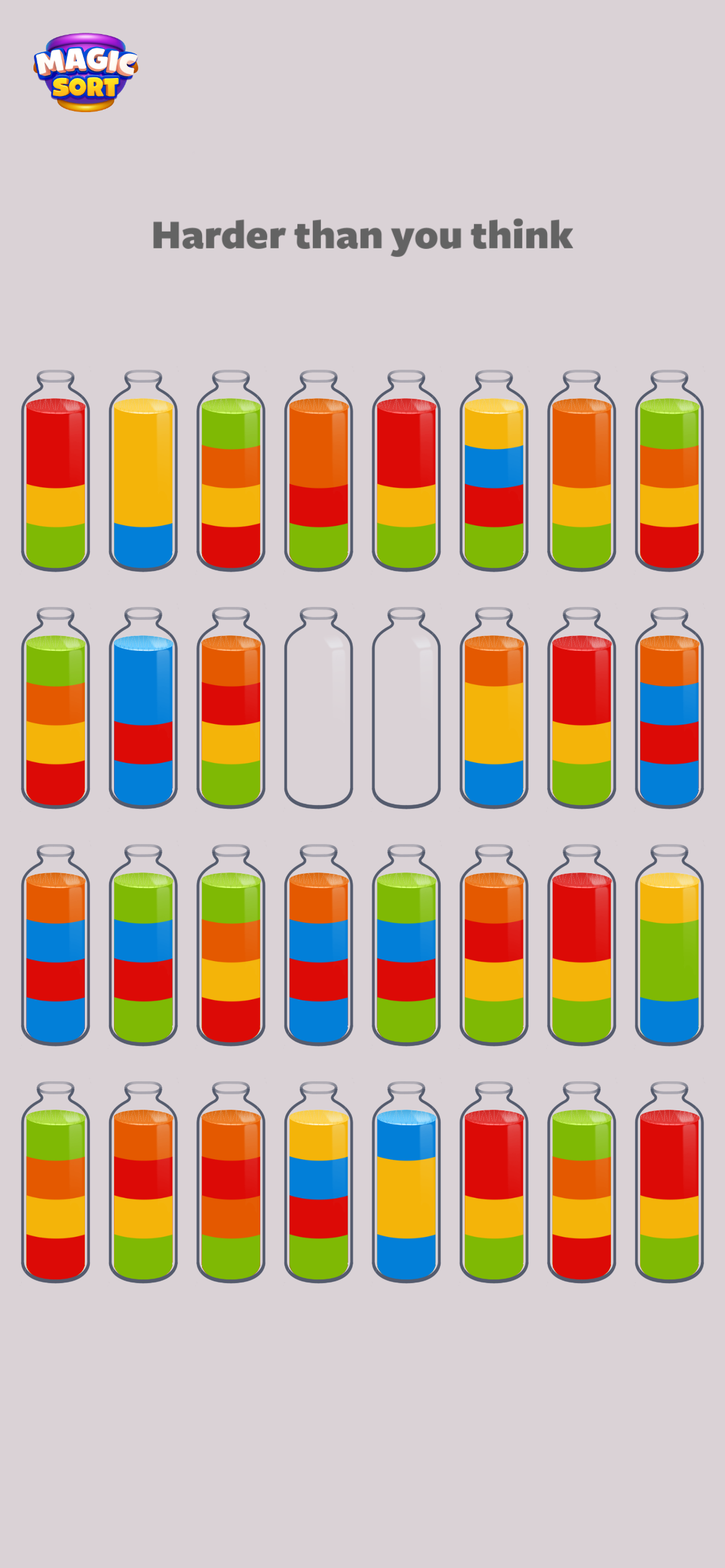 Magic Sort! instance #6 — the publisher's oldest measured asset. A standalone playable first seen 2025-07-25 and still live after 390 days, at 1,428 impressions per placement.
 Magic Sort! instance #5 — standalone playable, 89,636,465 impressions across 57,378 placements, 172 days live. Low-density regime, and untouched by the August shutdown.
Two titles, two operating models
Lined up on the metrics that survive fingerprint deduplication, the two titles are not the same playbook at different speeds. They are different playbooks.
| Block Out! | Magic Sort! | |
|---|---|---|
| Ad instances | 30 | 30 |
| Distinct videos | 4 | 17 |
| Instances per video | 7.5 | 1.8 |
| Distinct durations produced | 2 (59s, 60s) | 8 (1s–116s) |
| Pure-playable instances | 8 / 30 | 7 / 30 |
| Largest single video's share | 66.5% | 21.1% |
| Retirements | 0 | 9 |
| Delivery regimes | one (1,291–5,357) | two (1,319–1,748 and 7,635–8,423) |
| Impressions | 12,213,063,666 | 1,521,735,756 |
Magic Sort! makes many videos, tries many lengths, buys in two different inventory regimes and turns things off. Block Out! makes almost no video, holds one length, buys in a single regime and turns nothing off.
The framing that best fits the data is not "laboratory and production line," which implies the second inherited a settled answer from the first. Magic Sort! is still producing new videos at eight different lengths right now, including a 1-second asset first seen 2026-07-31. It has not concluded anything.
What Block Out! actually demonstrates is a different unit of production. Its team is not iterating on video; it is iterating on playables and letting the same four videos ride. That is a cheaper loop, and on this evidence a far more productive one — 8.1 billion impressions from one video file.
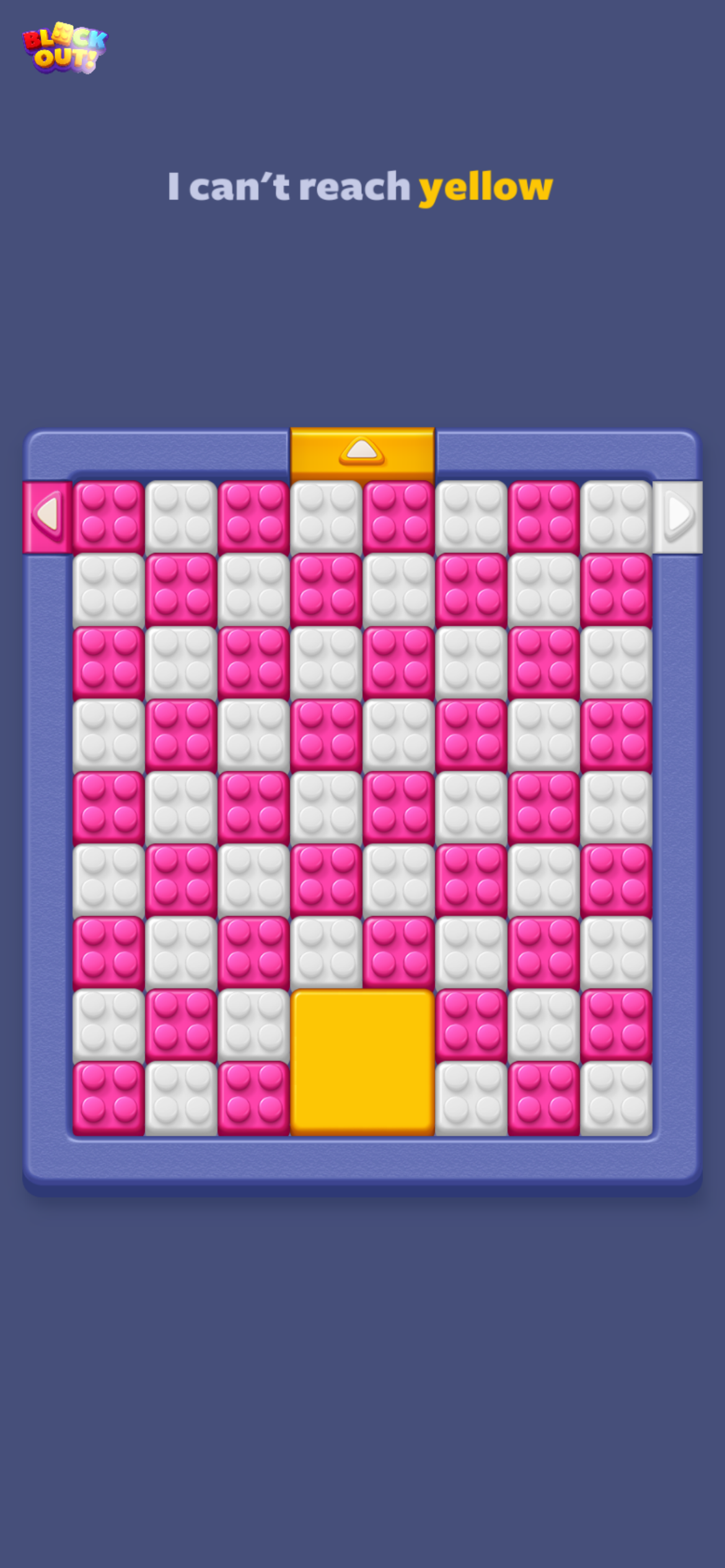 Playable P11 — deployed three ways on a single day, 2026-07-29: standalone (84,620,098 impressions), behind video V1 (45,546,507) and behind video V2 (33,142,639).
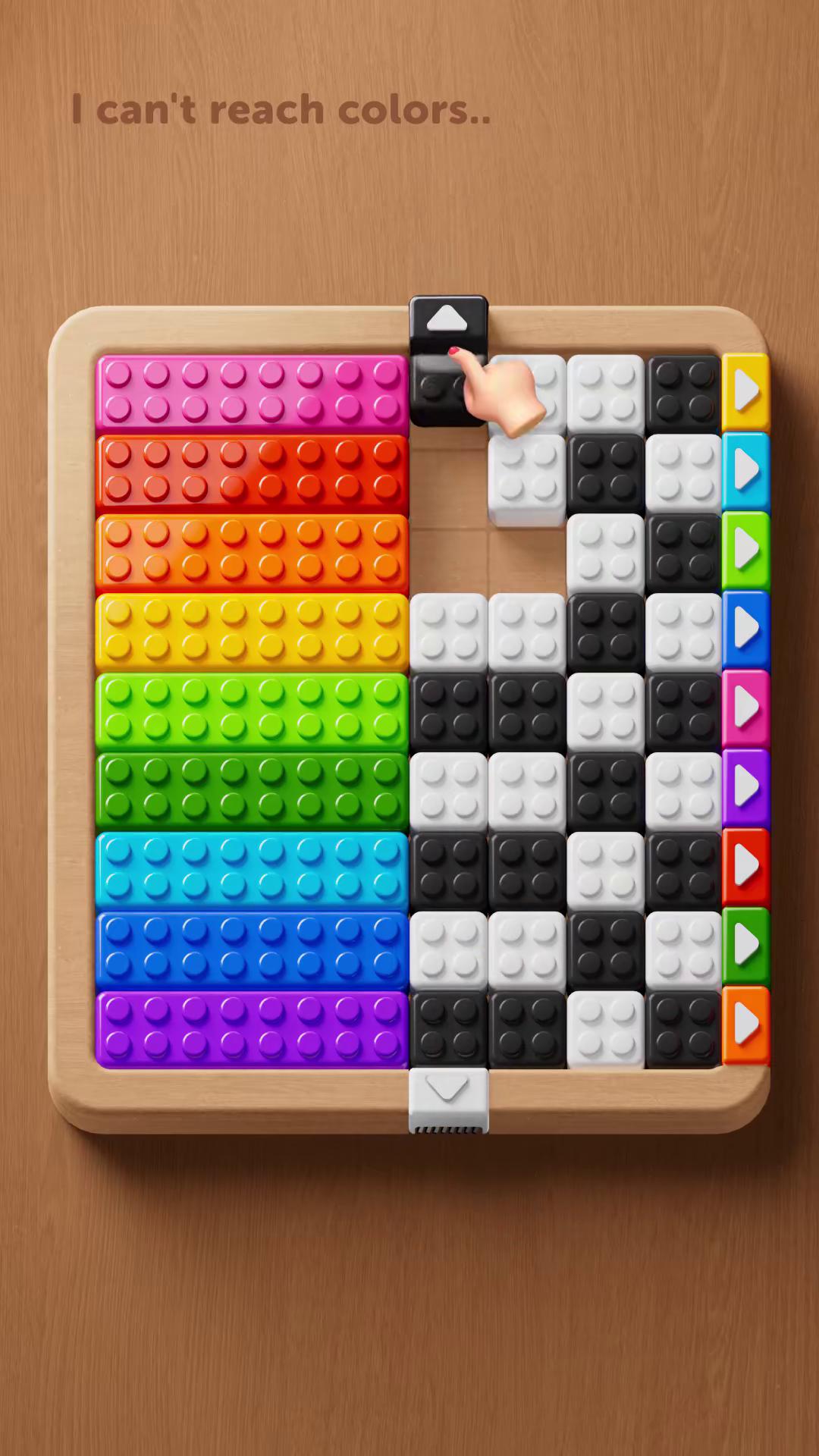 Video V4 — 59 seconds, first seen 2026-07-09, the newest of Block Out!'s four videos. Two instances, two playables, 44,079,675 impressions.
Grand Games' two titles diverge on production unit, but the publisher holds one habit in common: an answer is chosen and then held. The contrast worth reading next is Century Games, which runs three US titles and lets each pick its own format doctrine — playable ratio, density ordering and format mix all change from title to title across 45 creatives, the oldest of which has been running 698 days. Grand Games answers "video or playable?" once and applies it everywhere; Century Games answers it three times and gets three different answers.
Intensity, at instance and component level
| Unit | Impressions | Days | Impressions per day |
|---|---|---|---|
| Playable P1 (4 instances) | 6,436,317,728 | 84 | not reported — see note |
| Block Out! instance #1 | 5,077,378,266 | 84 | 60,444,979 |
| Block Out! instance #3 | 1,478,074,913 | 26 | 56,849,035 |
| Video V1 (13 instances) | 8,126,438,541 | 147 | not reported — see note |
| Block Out! instance #2 | 2,073,756,069 | 57 | 36,381,685 |
| Magic Sort! instance #1 | 320,528,142 | 241 | 1,329,992 |
Component-level intensity reorders the account. Playable P1 outruns the single largest instance because it is running in four places at once.
That is the number to benchmark against, and it is invisible at instance level. Anyone tracking Grand Games by top-instance impressions would be watching a 5.08-billion asset while the actual 6.44-billion asset — the playable inside it — went unnamed.
The name collision you have to check for
There are two different games called "Block Out! - Color Sort Puzzle" visible in US data at the same time:
| Identifier | Publisher | |
|---|---|---|
| A | com.playtimegames.blockout.colorsor | Play Time Games |
| B | 6752672568 | Grand Games A.Ş. |
Version A appears on the US download chart with 1,768,050 downloads. Version B is the one carrying the 12.2 billion impressions analysed here. Every creative figure in this article was filtered to store ID 6752672568; nothing from version A is included, and its download number is deliberately not paired with any impression figure here, because they describe different apps.
There is a second identifier trap in this dataset that is easier to miss. The developerId field is not stable across endpoints or across records — the same product can carry different developer IDs on its ranking row and its creative rows. Join on store ID, verify the product, and treat developer ID as a display attribute rather than a key.
What transfers to your UA program
If your playable build cost is the bottleneck: this is the direct argument for decomposing the ad. Block Out! produced four videos and eighteen playables and got thirty measured deliverables out of them. Building thirty integrated creatives would have cost several times as much. Version the layers independently and test the cross-product.
If you benchmark competitors by creative count: stop counting rows. Thirty rows here is four videos. A competitor that looks like it out-produces you 30-to-8 may be out-producing you 4-to-8 and simply recombining better. Fingerprint before you count, and report videos, playables and instances as three separate numbers.
If you are deciding where to put production budget: the breakout on this account was a playable attached to a 63-day-old video. Before that swap the video had produced 613 million impressions; after it, 7.5 billion. If your creative review only looks at video, you would have retired that file as a mediocre performer two months before it carried the account.
If you read stop-dates as strategy: the 2026-08-04 cohort is the cautionary case. Two same-length assets stopping together looked like a format verdict. Seven assets across four videos and three durations stopping together, all on one store record and all in one delivery regime, is a channel decision. Group the stopped set by every attribute you have before naming the cause.
If you are competing with Grand Games: the concentration is the exposure, and it is worse than instance-level analysis suggests. Two files — one video and one playable — sit behind roughly four-fifths of Block Out!'s delivery, with a second-largest video contributing 2.1%. There is no depth behind the leaders.
A falsifiable prediction
Prediction: when Block Out! is re-pulled on 2026-11-01, its top 30 ad instances will still resolve to six or fewer distinct videos, and playable 94e47300… will still appear in at least three of them.
The basis: four videos in 147 days is a cadence of one per 37 days, so roughly two more would be expected by November; and Grand Games has retired nothing on this title across its entire observable history. If the video count instead rises above six, the account has changed its unit of production — which would be a more significant shift than any impression movement.
The interesting failure mode is P1 disappearing, because it would be the first retirement this title has ever made, and it would remove 52.7% of its delivery. We will re-pull and report either way.
How to reproduce this teardown
- Fingerprint before you count anything. Group rows by
videoFpandplayHtmlFpbefore reporting a creative count, a duration distribution or a launch cadence. On this account every one of those three metrics was wrong by 3–5x at row level. - Report three numbers, not one: ad instances, distinct videos, distinct playables. Their ratios are the finding. 7.5 instances per video is a permutation machine; 1.8 is a conventional pipeline.
- Follow components through time, not just rows. Sorting video V1's instances by first-seen date is what exposed that the breakout was a playable swap. Row-level sorting hides it because the breakout row looks like a new asset.
- Compute impressions per placement and check for a gap, not a spread. Magic Sort!'s two regimes are 4.4x apart with nothing in between, and the split predicts which instances got shut down.
- Group every stopped asset by every attribute you have. Duration, video fingerprint, store record and delivery regime. The attribute that is constant across the stopped set is the candidate cause; the one that varies is not.
- Filter creative data by store ID, never by app name, and do not use
developerIdas a join key.
Methodology and data notes
- Source: AdMapix creative search and ranking APIs, queried 2026-08-19, country filter
US, sorted by impressions descending. - Sample: the top 30 ad instances by impressions for each title. This is a change from an earlier version of this article, which used the top 15 per title; the larger sample was taken so that video-reuse patterns would be visible rather than truncated. Block Out! instances were filtered to iOS store ID
6752672568(Grand Games); Magic Sort! instances span iOS6499209744and Androidcom.grandgames.magicsort. A 45-instance extension of the Block Out! sample is reported where it changes the counts. - "Ad instance" means one row of delivery data with its own impression count, placement count and date range. It is not a distinct production. "Distinct video" and "distinct playable" are counts of unique
videoFpandplayHtmlFpvalues. - Impressions are reported per instance and are not double-counted, so impression sums are unaffected by instance-to-asset collapsing. Counts of assets, duration distributions and production cadences are affected, and are reported at asset level throughout.
- "Days live" is the span between the first-observed timestamp and the pull date. An instance is treated as live only if its last-observed date equals 2026-08-19. Nine Magic Sort! instances did not meet that test and are labelled with their actual last-observed dates.
- "Placements" (
showCnt) counts recorded creative appearances, not unique users or unique publishers. Impressions-per-placement is a distribution-shape indicator, not a frequency metric. - Impressions are third-party estimates, not publisher-reported figures and not spend.
- An instance marked stopped means it ceased being observed in monitored placements on that date. It is strong evidence the advertiser stopped serving it, but cannot fully exclude a shift into unmonitored inventory. For the 2026-08-04 cohort, seven separately launched instances sharing one stop date makes a deliberate decision the far more likely reading.
- Publisher identity was verified by store ID. The
developerIdfield was not used as a join key because it is not stable across endpoints in this source. - Store information is available on the App Store and via Grand Games' company site. The Block Craft 3D comparison figures come from a teardown of that title pulled on the same date with the same method.
- Coverage is limited to creatives observable through third-party monitoring, and figures change as new instances enter rotation.
Frequently Asked Questions
How many ads is Grand Games actually running in the US? Sixty measured ad instances across two titles as of 2026-08-19, carrying 13,734,799,422 impressions — but that is a count of delivery records, not productions. Block Out!'s thirty instances resolve to four distinct videos and eighteen distinct playable end cards; Magic Sort!'s thirty resolve to seventeen videos and nineteen playables.
What is Grand Games' best-performing ad asset? Measured as a component rather than a row, it is a playable end card first seen 2026-05-27. Deployed in four instances — behind three different videos and once standalone — it has delivered 6,436,317,728 impressions across 2,490,128 placements, or 52.7% of Block Out!'s total. The largest single instance carries 5,077,378,266 impressions, but 1.36 billion of the playable's volume sits in other rows.
Why does Block Out! have only four videos? Because its production unit is the playable, not the video. Over 147 days it shipped a new playable roughly every 8.2 days and a new video roughly every 37 days, then ran the cross-product: video V1 alone appears in thirteen instances with thirteen different playables. Eight instances have no video at all and carry 30.6% of the title's impressions.
Did Grand Games kill a long-form video format in August 2026?
No — that reading does not survive the data. Two 116-second instances stopped on 2026-08-04, but they share a single videoFp (one video, two pairings), and five other instances stopped the same day spanning three more videos and two more durations (56s and 59s). All seven were Android and all seven were in the high-density delivery band. Duration cannot be the variable, because 59-second instances appear among both the stopped and the surviving.
Why do Magic Sort!'s ads have such different delivery rates? Because the fleet runs in two separate regimes. Seventeen instances deliver 1,319–1,748 impressions per placement and thirteen deliver 7,635–8,423, with nothing in between. All thirteen high-density instances are on the Android store record, the iOS record is entirely low-density, and every stopped instance in the fleet is high-density.
Is Block Out! bigger than Magic Sort! because it is newer or because it is better run? Neither framing quite fits. Block Out! carries 88.9% of the publisher's measured impressions from a fleet whose oldest instance is 147 days old, while Magic Sort! has been in market 390 days. But the structural difference is the reuse ratio: 7.5 instances per video against 1.8. Magic Sort! is still producing new videos at eight different lengths, including a 1-second asset first seen 2026-07-31, so it has not settled on an answer that Block Out! then inherited.
Are there two different games called Block Out! - Color Sort Puzzle?
Yes. One is published by Play Time Games (com.playtimegames.blockout.colorsor) and appears on the US download chart with 1,768,050 downloads; the other is Grand Games' iOS title 6752672568, which carries the creative volume analysed here. They are unrelated products, and creative data should never be joined to ranking data by app name — or by developerId, which is not stable across endpoints in this dataset.
Want to know whether a competitor's thirty creatives are actually thirty creatives? Asset fingerprints, per-instance impressions, placement counts, first-seen and last-seen dates, duration and playable attachment are all live in AdMapix, filterable by country, publisher and store ID. Create a free account to run this teardown on any publisher in your category, or see plans for full historical coverage.
Data source: AdMapix third-party ad intelligence estimates, United States, retrieved 2026-08-19. Impression and download figures are modelled estimates for comparative analysis and are not publisher-reported. Figures change as new instances enter rotation.
Related Reading
- Ad strategy teardowns (series index) — every teardown in the series, in publication order
- Mobile game ads guide: formats, examples and research — the format matrix, research workflow and KPI guardrails every teardown in this series applies
- Roblox — 1.5B US impressions, 61% of it launched inside three days
- Oakever Games — publisher-level app attribution and estimated creative reach
- Century Games — one publisher, three titles, playable vs video decided between them
Turn these observations into your next creative study
Open the creative library and select samples for your market, network and research question.
Related Articles
Township Ad Strategy in 2026: Two Fleets in One Account — 5% of Placements Deliver 71% of Impressions, and One Creative Has Run for 910 Days
A creative-level teardown of Playrix's US user acquisition for Township. Its 30 measured creatives split into two populations that never overlap: seven deliver 1,120 to 1,410 impressions per placement, the other twenty-three deliver 25 to 33. The seven take 5.1% of placements and produce 71.4% of impressions. The same split appears across Gardenscapes and Homescapes, and Township's oldest active creative was first seen on 2024-02-21 — 910 days before this pull.
Rips by Triumph Ad Strategy in 2026: The Standing Start — 6 Billion Impressions From a Fleet With No Creative Older Than 134 Days
A creative-level teardown of Triumph Arcade's US user acquisition for Rips by Triumph, the only title in this teardown series ranking on both the US download chart and the revenue chart. Its top 30 ad entries account for 5.98 billion impressions in the 30 days to 2026-08-19, and not one was first seen before 2026-04-07. A single 47-second asset launched 2026-06-30 carries 63.0% of that total — 9.9 times the second-largest entry — and the account runs zero playables.
Gossip Harbor Ad Strategy in 2026: One 25-Second Video File Carries 70.5% of Everything
A creative-level teardown of Microfun's US user acquisition for Gossip Harbor. Fifteen ad entries account for 6,381,902,914 impressions, all still live — but they resolve to only fourteen distinct video files, and one 25-second file appearing under two entries carries 70.5% of all delivery. The whole interactive layer is a single playable shared across five entries. Rewritten from scratch after the underlying data changed roughly 2x in one day; the correction is documented in full.