
Competitor Ads: How to Find, Analyze, and Track Rival Campaigns
A practical guide to finding competitor ads across search, display, social, video, native, and landing pages, then turning visible patterns into campaign tests.
Competitor ads research works best as an operating system: discovery, analysis, tracking, and testing.
Competitor Ads: How to Find, Analyze, and Track Rival Campaigns
Competitor ads can show how rivals position their offers, which channels they prioritize, what claims they repeat, and how they move buyers from attention to action. They can also mislead you if you treat one screenshot as strategy.
The useful way to research competitor ads is not to copy headlines or guess private budgets. It is to build a repeatable system: find visible ads, separate observation from inference, analyze the message and funnel, track changes over time, and turn the strongest pattern into one campaign test.
This guide is the pillar workflow for competitor ads research. If you need a narrower workflow, use the related guides on ad tracking for competitive research, Google Ads competitor analysis, competitor PPC ads, competitor display ads, and competitor ad spend.
What Competitor Ads Research Can and Cannot Prove
Before you start, define what you can observe and what you must infer. This keeps the research credible.
| Visible evidence | Reasonable inference | What it does not prove |
|---|---|---|
| Active public ad examples | The competitor is testing or running a message | Exact budget, bids, audience targeting, or ROAS |
| Repeated search visibility | The query or intent is strategically important | Exact keyword list or match type |
| Multiple display or social creatives | A theme may be worth testing | Full creative inventory or spend level |
| Dedicated landing page | The offer has funnel support | Conversion rate or profitability |
| Repeated CTA or offer | The competitor values that action | Whether the offer works better than yours |
| Creative refresh over time | Campaign learning or iteration may be happening | Internal experiment results |
Competitor ads research is strongest when multiple public signals agree. One ad is a clue. A repeated offer across search, display, social, and a landing page is a pattern.
The Competitor Ads Operating System
Use a four-layer system instead of a random swipe file.
| Layer | Question | Output |
|---|---|---|
| Discovery | Where can we see competitor ads? | Sources, URLs, screenshots, dates, query context |
| Analysis | What message and funnel pattern is visible? | Hook, offer, proof, CTA, landing page notes |
| Tracking | Is the pattern repeated or changing? | Weekly status, new creatives, retired offers, channel spread |
| Testing | What should we try in our own campaigns? | One hypothesis, owner, channel, review date |
This structure matters because many teams collect competitor ads but never use them. A good system turns public evidence into better marketing decisions.
Where to Find Competitor Ads
There is no single place to see every competitor ad. You need channel-specific sources and a consistent way to record what you find.
| Source | What to look for | Best use |
|---|---|---|
| Google search results | Search ads by query, device, location, and landing page | High-intent PPC research |
| Google Ads Transparency Center | Public advertiser examples and creative references | Google ecosystem visibility |
| Meta Ads Library | Active social ads and page-level ad examples | Paid social message research |
| TikTok Creative Center | Top ad examples, formats, hooks, and creative styles | Short-form video inspiration |
| Display placements | Banner formats, offers, image systems, landing URLs | Display creative tracking |
| Native ad placements | Sponsored content angles and advertorial hooks | Problem-aware or discovery-stage messaging |
| Competitor landing pages | Message match, proof, CTA, objection handling | Funnel analysis |
| Your own Auction Insights | Overlap and position context in shared Google auctions | Account-side competitive pressure |
When you research competitor ads, always record source, date, channel, query or placement context, advertiser, ad copy, creative angle, landing URL, and your confidence level.
How to Research Competitor Ads Without Collecting Noise
The most common mistake is taking screenshots for the sake of screenshots. Instead, start with a controlled research set.
Use five buckets:
| Bucket | Example | Why it matters |
|---|---|---|
| Category | "ad intelligence tool" | Captures broad commercial demand |
| Problem | "track competitor ads" | Shows pain-led positioning |
| Comparison | "alternative to [tool]" | Shows switching and substitution demand |
| Brand-adjacent | "[your brand] alternative" | Reveals conquesting and brand-defense pressure |
| Use case | "find competitor display ads" | Reveals feature-specific intent |
For each bucket, define the country, device, browser state, and check frequency. A clean method prevents false conclusions caused by personalization, location, auction timing, or one-off retargeting.
If you need recurring collection, use AdMapix reports rather than scattered screenshots. Reports make it easier to compare the same competitors, queries, and creatives over time.
How to See Competitor Ads Across Channels
People often search for "see competitor ads" as if there is a universal database. In practice, you see competitor ads through a mix of public libraries, live search checks, platform-specific tools, and landing-page monitoring.
| Channel | How to see competitor ads | What to capture |
|---|---|---|
| Search | Run controlled queries and review public Google ad examples | Query, advertiser, headline, description, landing URL |
| Display | Track visible banners, placements, dimensions, and offers | Creative theme, format, CTA, landing page |
| Social | Review public ad libraries and platform creative centers | Hook, format, creator style, offer, page context |
| Video | Study public video ad examples and repeated hooks | First three seconds, proof, offer, CTA |
| Native | Review sponsored content units and advertorial pages | Content angle, headline, image, disclosure, CTA |
| Landing pages | Monitor campaign pages and paid-style URLs | Message match, proof, conversion path |
The key is consistency. A single check shows a moment. A weekly tracker shows whether a competitor is scaling a theme, testing a new hook, or retiring an offer.
A Framework for Analyzing Competitor Ads
Do not review ads with vague comments like "good creative" or "weak copy." Use a fixed framework so different team members score the same ad in the same way.
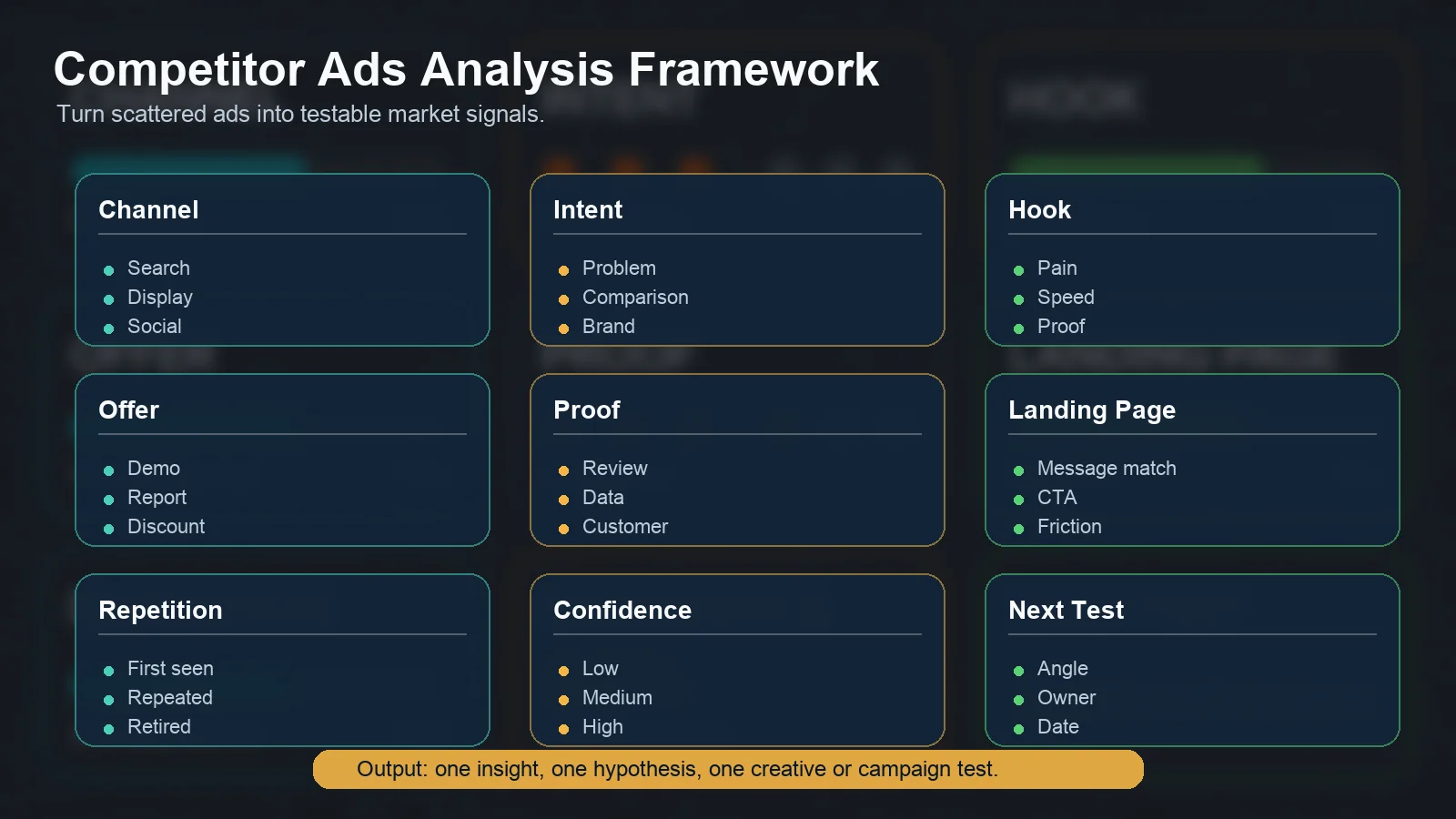
The output of competitor ads analysis should be one insight, one hypothesis, and one test.
| Field | Question to answer | Example note |
|---|---|---|
| Channel | Where did the ad appear? | Google search, Meta, TikTok, display, native |
| Intent | What buyer stage does it target? | Problem-aware, comparison, brand, transactional |
| Hook | What gets attention first? | Speed, cost, risk reduction, proof, novelty |
| Offer | What action or asset is promoted? | Demo, free trial, report, audit, template |
| Proof | Why should the buyer believe it? | Customer count, benchmark, example report, case study |
| Landing page | Does the page match the ad promise? | Dedicated page, homepage, pricing page, report page |
| Repetition | Is the message repeated across channels or weeks? | One-off, repeated, scaling, retired |
| Confidence | How strong is the evidence? | Low, medium, high |
| Next test | What should we try? | Headline test, proof block, landing page CTA, offer angle |
This approach keeps analysis actionable. The goal is not to build a museum of rival ads. The goal is to identify a market pattern that can improve your own campaign.
How to Spy on Competitor Social Media Ads Ethically
The phrase "spy on competitor social media ads" is common, but the practical work should be ethical, public, and evidence-based. Use public ad libraries, visible creative centers, and your own observation. Do not scrape private user data, bypass platform controls, or make claims you cannot verify.
For social ads, focus on creative patterns:
| Pattern | What it tells you |
|---|---|
| Repeated opening hook | The competitor may believe the pain point works |
| Multiple variants of the same offer | The offer is important enough to test |
| Creator-style videos | The brand may be pursuing native-feeling acquisition |
| Proof-heavy creatives | The market may require trust before conversion |
| Short-lived creatives | The team may be testing fast or reacting to fatigue |
| Same landing page across many ads | The funnel may be central to the campaign |
When you record social ads, capture the creative format, first-frame hook, CTA, destination URL, visible engagement context when available, and whether the same concept appears in multiple versions.
How to Spy on Winning Competitors Google Ads Without Overclaiming
Many teams ask how to spy on winning competitors Google Ads. The more accurate phrasing is: how to study visible Google Ads signals and infer which competitor patterns may be worth testing.
Use this process:
- Build a query set across category, problem, comparison, brand-adjacent, and use-case terms.
- Check results in a clean environment by country and device.
- Record advertiser, ad copy, assets, landing page, and date.
- Compare the ad promise with the landing page promise.
- Review your own Auction Insights where eligible.
- Track the same terms weekly before calling a pattern "winning."
Google's Auction Insights documentation is useful for understanding shared-auction context, but it does not reveal a competitor's full account. Avoid claiming you know exact bids, exact Quality Score, private keyword lists, or conversion rates.
For deeper Google-specific workflows, use our Google Ads competitor analysis and competitor PPC ads guides.
Build a Weekly Competitor Ads Tracker
A useful tracker should be small enough to maintain and detailed enough to support decisions.
Track these fields:
| Field | Why it matters |
|---|---|
| Date | Shows when the evidence was observed |
| Competitor | Identifies repeated advertisers |
| Channel | Prevents mixing search, display, social, and native signals |
| Query or placement | Explains why the ad appeared |
| Creative hook | Captures the attention angle |
| Offer | Shows what the competitor wants the buyer to do |
| Proof | Reveals credibility strategy |
| Landing URL | Connects ad message to funnel |
| Status | Active, repeated, changed, retired, unknown |
| Confidence | Labels how much weight the evidence deserves |
| Action | Forces the research to influence tests |
This tracker pairs naturally with competitor display ads monitoring, creative ads library research, and competitor ad spend confidence scoring.
Turn Competitor Ads into Campaign Tests
Competitor research only matters if it changes a decision. Use the pattern to create a test, not a copy.
| Competitor pattern | Bad response | Better response |
|---|---|---|
| Rival leads with speed | Copy the headline | Test a speed angle with your own proof |
| Rival uses a report CTA | Publish a generic report | Test a useful benchmark or diagnostic asset |
| Rival repeats pricing claims | Cut prices immediately | Test value framing, proof, and pricing page clarity |
| Rival appears on comparison terms | Panic bid on every query | Build a focused comparison campaign |
| Rival uses stronger proof | Add vague logos | Add verifiable evidence and tighter landing-page copy |
The best output is a testing backlog with owner, channel, hypothesis, asset requirement, and review date. Keep the research cycle practical.
Use the Right Competitor Ads Guide for Each Job
This pillar guide covers the operating system. Use the following deep dives when the task is narrower.
| If you need to... | Use this guide |
|---|---|
| Track competitor ad changes over time | Ad tracking for competitive research |
| Analyze search ads and Google auction context | Google Ads competitor analysis |
| Choose a Google search ads spy workflow | Google Search Ads spy tool |
| Review keyword, copy, and landing-page patterns | Competitor PPC ads |
| Monitor banners and visual ad systems | Competitor display ads |
| Estimate budget pressure directionally | Competitor ad spend |
| Understand brand-term conquesting | Competitor bidding on brand keywords in Google Ads |
This structure helps avoid duplicate analysis. The pillar explains how the system works. The spoke guides explain how to execute each specialized workflow.
Common Mistakes
| Mistake | Better approach |
|---|---|
| Treating one ad as proof of strategy | Look for repetition across time and channels |
| Copying competitor copy | Convert the pattern into your own test |
| Ignoring landing pages | Analyze message match and conversion path |
| Mixing public evidence with private assumptions | Label observation and inference separately |
| Reporting exact spend from public ads | Use directional confidence scoring |
| Tracking too many fields | Keep a small tracker your team will maintain |
| Forgetting to act | Assign one next test for each strong pattern |
FAQ
What are competitor ads?
Competitor ads are paid messages run by rival brands across search, display, social, video, native, and other advertising channels. They are useful for understanding visible positioning, offers, and funnel patterns.
How do I find competitor ads?
Find competitor ads by combining public ad libraries, controlled search checks, social creative centers, display placement monitoring, native ad observation, landing-page reviews, and your own account-side competitive reports where available.
Can I see all ads from a competitor?
Usually no. Public tools show useful examples, but they do not guarantee a complete view of every ad, audience, spend level, keyword, bid, or conversion result.
How can I research competitor ads without copying them?
Research competitor ads by recording evidence, classifying intent, analyzing the hook, offer, proof, landing page, and repetition, then turning the pattern into an original test for your own campaign.
Is it okay to spy on competitor social media ads?
It is okay to study public competitor social media ads through official ad libraries and visible creative surfaces. Avoid private data, platform abuse, or unsupported claims.
How do I know which competitor ads are winning?
You cannot know for certain from the outside. Stronger signals include repeated creative, multiple variants, consistent landing pages, continued visibility over time, and alignment across channels.
How often should I track competitor ads?
For active paid acquisition categories, weekly tracking is practical. Slower markets may only need monthly reviews. Use the same query set, competitors, and fields each time.
Conclusion
Competitor ads research should make your own marketing sharper. Find visible campaigns, separate facts from inference, analyze repeated patterns, track changes, and turn the strongest insight into a specific test.
If you want a repeatable way to monitor competitor ads, start with AdMapix reports. If you need continuous tracking across competitors and channels, review pricing.
Turn these observations into your next creative study
Open the creative library and select samples for your market, network and research question.
Related Articles
Competitor Display Ads: Examples & Targeting Clues
Find competitor display ad examples, record placement context and develop audience hypotheses without claiming access to private targeting settings.
Competitor PPC Ads in 2026: How to Research Keywords, Copy, Landing Pages, and Ad Rank
A 2026 guide to researching competitor PPC ads — what paid search ads can and cannot prove, a five-step weekly workflow, how to find rivals' search ads, infer keyword intent, score ad copy, analyze landing pages and ad-rank signals, and turn every finding into a testable campaign decision.
Google Ads Competitor Analysis: 6 Ways to Find What Rivals Run
Google Ads competitor analysis guide: use Transparency Center, SERP checks, PPC data, and ad intelligence workflows to understand rival campaigns.