Creative Ads Library: Where to Find Winning Ad Creative Examples
A practical guide to creative ads libraries: where to find ad examples, how to filter them, and how to build your own swipe file.

A useful creative ads library combines public libraries, platform research tools, and your own tagged swipe file.
By the AdMapix Research Team
A creative ads library is not just a folder of screenshots. The useful version is a research system: where to find creative ads examples, how to tag them, how to score them, and how to turn the best patterns into original tests.
If you only save ads, the library becomes clutter. If you organize the examples by hook, offer, proof, format, landing page fit, and test priority, the library becomes a competitive advantage. It supports faster briefs, cleaner creative reviews, and better ad creative AI prompts.
This guide explains where to find a creative ads library, how to use a tiktok ads creative library workflow, and how to build your own ad creative library without copying competitors.
What a Creative Ads Library Actually Is
A creative ads library is a searchable collection of ad examples used for research, briefing, and testing.
It can include:
| Asset | Why it matters |
|---|---|
| Static images | Useful for offer framing, layout, proof blocks, and CTA ideas. |
| Short-form videos | Useful for hooks, pace, creator style, and product demonstration. |
| Search ads | Useful for message match, keyword intent, and offer positioning. |
| Landing pages | Useful for checking whether the ad promise survives after the click. |
| Team notes | Useful for turning inspiration into repeatable creative decisions. |
The goal is not to collect as many ads as possible. The goal is to find the few patterns worth testing.
A strong creative ads library answers five questions:
| Question | Why it matters |
|---|---|
| What hook is getting attention? | The first few seconds or first line usually decides whether the ad gets a chance. |
| What offer is being repeated? | Repetition can show market demand, margin pressure, or seasonal promotion strategy. |
| What proof is used? | Reviews, demos, numbers, creator usage, and expert quotes change trust. |
| What format is common? | A TikTok creator clip, Meta carousel, and Google search ad solve different jobs. |
| What should we test next? | A library is only useful when it creates a clear testing queue. |
Best Free Sources for Creative Ads Examples
There is no single complete creative ads library. Each source shows a different slice of the market.
Meta Ads Library
Meta's official Ads Library help page is useful context before using Meta Ads Library for competitor ad creative research across Facebook and Instagram.
Use it when you want to check:
| Signal | What to look for |
|---|---|
| Active ads | Which messages are live now. |
| Page-level volume | Whether a brand is testing many variants or only a few evergreen ads. |
| Format mix | Image, video, carousel, and catalog patterns. |
| Offer language | Discounts, bundles, trials, quizzes, demos, and urgency. |
| Landing page match | Whether the ad promise is repeated after the click. |
Meta is a good starting point for creative ads examples, but it is not a full performance database. Treat it as evidence of what a brand is willing to run, not proof of what is profitable.
TikTok Creative Center
TikTok Creative Center is useful for short-form video inspiration and trend research.
For a tiktok ads creative library workflow, save examples by:
| Tag | Example |
|---|---|
| Opening hook | Problem statement, direct demo, creator confession, price shock, before/after. |
| Visual pace | Fast cuts, product close-up, UGC monologue, screen recording, reaction shot. |
| Proof type | Review, usage demo, creator endorsement, side-by-side comparison. |
| CTA style | Shop now, try the tool, get the template, download the app, take the quiz. |
| Replication risk | Safe pattern, crowded angle, claim risk, brand mismatch. |
TikTok is strong for creative format discovery. It is weaker for long-term competitor tracking because trends can change quickly and the visible sample can overrepresent viral formats.
If TikTok is a priority channel, pair this article with our TikTok Creative Center tutorial and TikTok ads research guide.
Google Ads Transparency Center
Google Ads Transparency Center helps you inspect advertisers and visible Google ad formats.
Use it to collect:
| Signal | Why it matters |
|---|---|
| Search-style messaging | Shows how a competitor frames intent and value. |
| Display creative | Shows brand claims, product visuals, and promotional hooks. |
| YouTube examples | Helps compare video ideas outside TikTok and Meta. |
| Regional visibility | Useful when competitors localize offers or claims by market. |
Google data is not a replacement for PPC keyword tools. It is better used as a public creative source that complements search ads intelligence and landing-page research.
YouTube and Manual SERP Checks
Manual checks still matter. Search a target keyword, inspect the SERP, save visible ad copy, and click through to the landing page when appropriate.
Manual review is slower, but it captures context that a library may miss:
| Manual signal | Why it matters |
|---|---|
| Query intent | The same advertiser may use different copy for problem, comparison, and pricing keywords. |
| SERP layout | Ads can compete with organic results, AI answers, shopping units, or review pages. |
| Landing-page promise | A strong ad can fail if the next page changes the offer. |
| Competitor clusters | You can see which brands repeatedly appear together. |
Use manual checks for your highest-value queries, not every keyword.
How to Build Your Own Ad Creative Library
A team-owned ad creative library is more useful than a generic public archive because it reflects your market, audience, and testing history.
Start with a simple structure:
| Folder or view | What belongs there |
|---|---|
| Competitor examples | Ads from direct competitors and substitute products. |
| Category examples | Ads from adjacent markets with similar buyer psychology. |
| Platform examples | Meta, TikTok, Google, YouTube, native, and app store placements. |
| Hook bank | Screenshots or clips organized by opening angle. |
| Offer bank | Discount, bundle, trial, free tool, quiz, consultation, demo. |
| Proof bank | Reviews, usage numbers, expert quotes, before/after, UGC proof. |
| Test queue | Ideas approved for future production. |
Do not make the library depend on one person. If only one strategist knows how examples are tagged, the library will decay.
Tag and Score Creative Ads
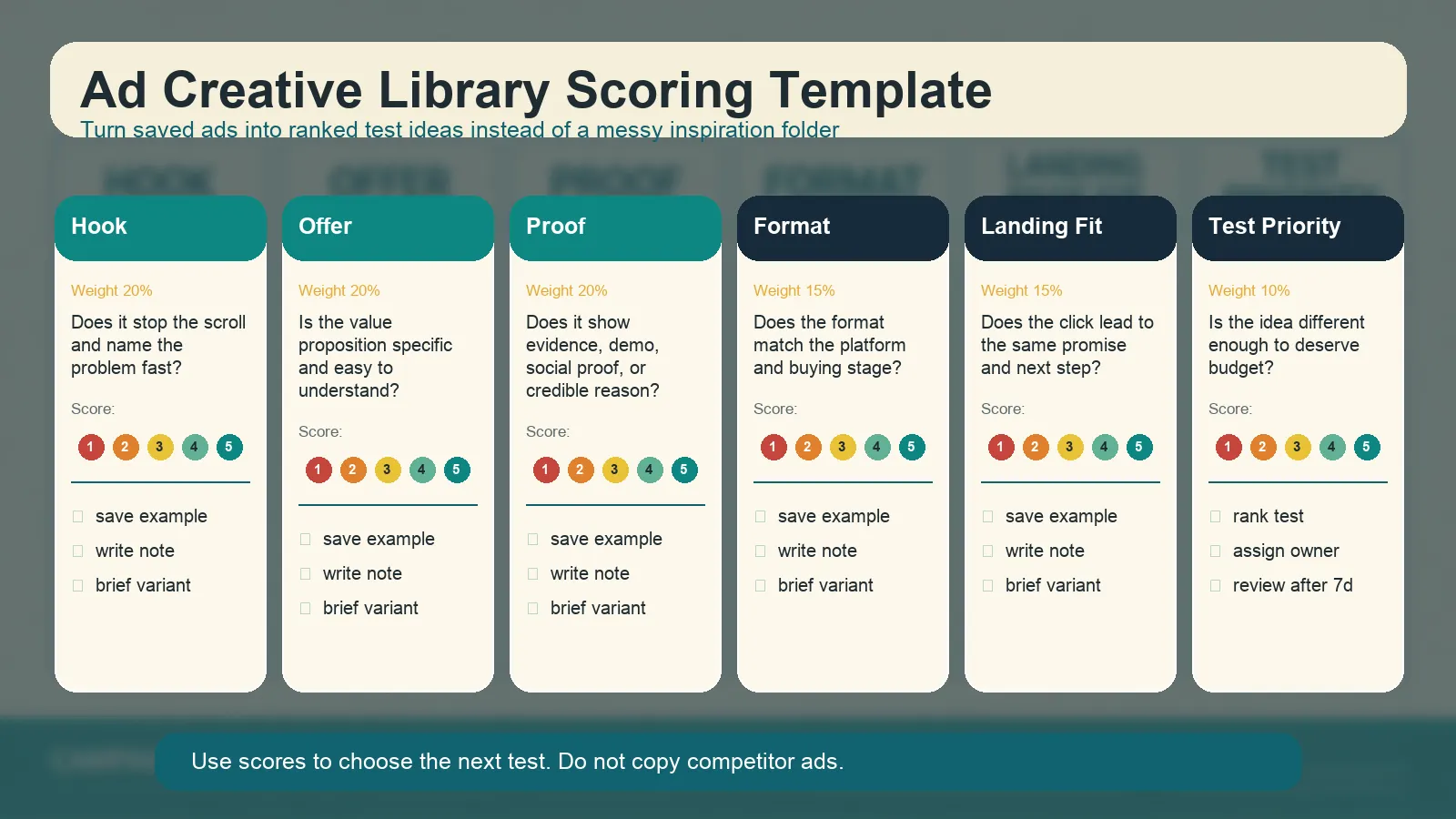
Scoring turns saved ad examples into usable creative research instead of a messy inspiration folder.
The most common failure is saving ads without context. A good ad creative library needs a tagging system.
Use these tags:
| Tag | Options |
|---|---|
| Platform | Meta, TikTok, Google, YouTube, native, app store, display. |
| Funnel stage | Awareness, problem-aware, comparison, retargeting, conversion. |
| Hook type | Pain point, outcome, demo, creator story, objection, curiosity, price. |
| Offer type | Discount, free trial, bundle, audit, template, lead magnet, limited drop. |
| Proof type | Review, metric, demo, press, expert, creator, customer story. |
| Format | UGC video, founder video, carousel, static, search ad, display banner. |
| Landing match | Strong, partial, weak, unknown. |
| Test priority | High, medium, low, archive. |
Then score each saved ad from 1 to 5:
| Dimension | Scoring question |
|---|---|
| Hook | Would the target audience stop and understand the problem quickly? |
| Offer | Is the value proposition specific enough to test? |
| Proof | Is there a credible reason to believe the claim? |
| Format | Does the format fit the channel and buying stage? |
| Landing page fit | Does the next page continue the same promise? |
| Test priority | Is the idea different enough to deserve budget? |
This prevents the library from becoming a mood board. The score tells the team which examples should influence briefs.
A Practical TikTok Ads Creative Library Workflow
TikTok examples are easy to collect and easy to misuse. Do not copy surface-level trends. Extract the mechanism.
Use this workflow:
- Pick one product category, market, or competitor set.
- Search TikTok Creative Center and competitor accounts for active examples.
- Save 15 to 30 ads into your library.
- Tag the first three seconds of each ad.
- Write the emotional trigger behind the hook.
- Identify the proof type.
- Score whether the idea fits your brand and landing page.
- Turn the top patterns into original briefs.
For example, do not write “copy this creator script.” Write “test a first-person problem confession followed by a quick product demo and one proof point.”
That difference matters. The first instruction creates imitation. The second creates a reusable creative mechanism.
Connect the Library to AI Creative Briefs
A creative ads library becomes more powerful when it feeds AI briefs, but only if the inputs are structured.
Weak prompt:
Make me ads like these competitors.
Better prompt:
We found three recurring mechanisms in competitor ad creative examples: a direct pain-point hook, a short proof demo, and a price objection close. Generate five original TikTok ad concepts for our product using those mechanisms, without copying competitor wording or claims.
That is why Day44 supports Day43 rather than competing with it. Day43 explains the ad creative AI workflow. This article explains the library and research inputs that make that workflow useful.
If you need tools for recurring monitoring, compare options in our ad intelligence tools guide. If you want report-ready competitor examples, use AdMapix reports. For ongoing creative monitoring, review pricing.
Common Mistakes
| Mistake | Why it hurts |
|---|---|
| Saving ads without tags | The team cannot retrieve examples when writing briefs. |
| Copying competitor wording | It creates brand risk, legal risk, and weak differentiation. |
| Treating viral ads as proven winners | Visibility is not the same as profit. |
| Ignoring landing pages | The ad may work because the page, offer, or funnel does the heavy lifting. |
| Overweighting one platform | A TikTok hook may not work in Google Search or Meta retargeting. |
| Never deleting old examples | A library full of outdated ads becomes slow and misleading. |
Review your library monthly. Archive examples that are no longer useful, merge duplicate hooks, and promote tested patterns into a separate “validated learning” view.
FAQ
What is a creative ads library?
A creative ads library is a structured collection of ad examples, notes, tags, and scores used to research competitors, brief creative teams, and plan new tests.
Where can I find creative ads examples for free?
Free sources include Meta Ads Library, TikTok Creative Center, Google Ads Transparency Center, YouTube searches, manual SERP checks, and competitor landing-page reviews.
Is TikTok Creative Center the same as a tiktok ads creative library?
TikTok Creative Center can be one source for a tiktok ads creative library, but a complete library should also include your own tags, scores, notes, competitor context, and test history.
How should I organize an ad creative library?
Organize by platform, competitor, funnel stage, hook type, offer type, proof type, format, landing-page fit, and test priority. The exact tool matters less than consistent tagging.
Can I copy ads from a creative ads library?
No. Use a creative ads library to understand mechanisms, not to copy wording, visuals, claims, or brand assets. The safest output is an original brief based on observed patterns.
How does a creative ads library help ad creative AI?
It gives AI better inputs. Instead of asking for generic ads, you can brief AI with proven mechanisms, audience insights, offer constraints, compliance rules, and examples of what to avoid.
Final Takeaway
A creative ads library is valuable when it turns examples into decisions. The workflow is simple: find ads, tag the mechanism, score the quality, write a brief, test an original version, and feed the learning back into the library.
If you want a report-ready creative ads library built from competitor patterns, start with AdMapix reports.
See what competitors are really running
Search 6M+ ad creatives, landing pages, and weekly spend across 200+ countries. No credit card, no commitment.
Related Articles
Video Ad Production at Scale: AI Tools, Templates, and Testing Frameworks for 2026
A practical guide to scaling video ad production: AI generation tools that actually work, template systems for rapid iteration, platform-specific format requirements, and how to build a testing flywheel that improves performance with every batch.
Retargeting Ads Strategy in 2026: Competitor Analysis, Segmentation, and Creative Testing
A data-driven retargeting ads strategy combining competitor intelligence, audience segmentation, and creative testing. Learn what competitors run for retargeting and how to build a testable retargeting workflow.
LinkedIn Ads Competitor Research: How to Analyze B2B Rivals in 2026
A systematic approach to LinkedIn Ads competitor research: use the LinkedIn Ads Library, infer targeting from ad copy patterns, analyze B2B landing pages, and turn findings into testable LinkedIn campaign hypotheses.