Competitor Bidding on Brand Keywords in Google Ads: Rules and Response Plan
What to do when competitors bid on your brand keywords in Google Ads: policy limits, legal considerations, defensive campaigns, and monitoring workflows.

A good response separates evidence collection, Google policy review, legal assessment, and campaign defense.
By the AdMapix Research Team
Competitor bidding on brand keywords in Google Ads can be frustrating, but the right response is not panic or retaliation. The right response is evidence first: confirm what is happening, separate Google Ads policy from trademark law, set up stronger brand defense, and monitor whether the competitor presence is repeated or only temporary.
This article is not legal advice. Trademark rules depend on jurisdiction, facts, and counsel review. Google Ads policy also does not equal trademark law. Use this as a PPC response framework, then involve legal counsel when trademark use, confusion, or enforcement decisions matter.
If you need the broader legal-policy overview first, read our guide on competitor brand keywords in Google Ads. This Day47 article focuses on what to do when the competitor is already bidding or appearing around your brand searches.
Quick Answer
In Google Ads, competitors may appear around your brand keywords for several reasons:
| Scenario | What it usually means |
|---|---|
| Competitor bids on your brand term as a keyword | Google Ads trademark policy generally does not restrict use of trademarks as keywords. |
| Competitor uses your trademark in ad text | This is more sensitive and may be restricted after a valid trademark complaint and review. |
| Competitor appears because of broad match | It may not be deliberate brand conquesting. |
| Competitor compares itself to your brand | Policy, trademark risk, and landing-page truthfulness all matter. |
| Your CPC rises on brand terms | Check auction data before assuming one competitor caused it. |
The practical response:
- Capture evidence.
- Identify whether the trademark is used as a keyword, in ad text, or on the landing page.
- Review Google Ads trademark policy.
- Ask legal counsel about trademark and confusion risk.
- Strengthen defensive brand campaigns.
- Monitor repeat activity and cost impact.
What Competitor Brand Bidding Means
Competitor brand bidding means an advertiser tries to appear when users search for a brand name, product name, or trademark associated with another company.
Examples:
| Search query | Possible advertiser behavior |
|---|---|
| Your brand name | Competitor bids on your brand keyword. |
| Your brand + pricing | Competitor tries to intercept high-intent comparison traffic. |
| Your brand + alternative | Competitor uses comparison positioning. |
| Your brand misspelling | Competitor targets typo traffic. |
| Your product name | Competitor targets product-level demand. |
Not every appearance is intentional. Broad match, automated bidding, dynamic search ads, and query expansion can create overlap. That is why you should document the facts before escalating.
Google Policy vs Trademark Law
Google's trademarks policy is the key official source for policy review.
The important distinction:
| Topic | Practical meaning |
|---|---|
| Trademark as keyword | Google Ads policy says it will not restrict using trademarks as keywords. |
| Trademark in ad text | Google may restrict use after a trademark owner complaint and review, especially for direct competitors or confusing use. |
| Trademark on landing page | The landing page alone is not the same as trademark use in the ad. |
| Legal risk | Google policy does not replace trademark law or legal advice. |
| Complaint process | Trademark owners can submit complaints for Google review. |
This distinction matters. A competitor bidding on your brand keyword may not be the same as a competitor using your brand name in the ad headline.
Use this classification:
| What you see | Risk level | Next step |
|---|---|---|
| Competitor appears on your brand query but does not use your brand in copy | Usually a PPC defense issue first. | Capture SERP, check Auction Insights, adjust brand campaign. |
| Competitor uses your trademark in ad copy | Higher policy and legal sensitivity. | Capture evidence, review policy, involve counsel. |
| Competitor implies affiliation or official status | Higher misrepresentation risk. | Capture evidence and escalate faster. |
| Competitor landing page compares your brand | Fact-specific. | Review claims, substantiation, and legal context. |
Do not make legal conclusions from a single screenshot. Build an evidence file.
How to Detect Brand Bidding Competitors Google Ads Activity
Detection should be repeatable.
Use these methods:
| Method | What it shows |
|---|---|
| Manual SERP checks | Who appears on brand, brand + pricing, brand + alternative, and misspelling queries. |
| Auction Insights | Overlap and impression-share context inside your own Google Ads account. |
| Search terms report | Whether competitor-adjacent queries are triggering your ads. |
| Google Ads Transparency Center | Public advertiser examples where visible. |
| Ad tracking reports | Repeated activity across weeks, not one-off screenshots. |
| Landing page monitoring | Whether competitor copy and page claims changed together. |
Google's Auction Insights help explains how account-level auction comparisons can show overlap with other advertisers. It does not prove exact competitor spend, but it can support the monitoring picture.
For a broader system, use our Google Ads competitor analysis guide and search ads intelligence workflow.
Evidence Checklist
Before you respond, capture:
| Evidence | Why it matters |
|---|---|
| Query | Shows the exact brand or brand-adjacent search. |
| Date and time | SERPs change; evidence needs a timestamp. |
| Location and device | Results can vary by geography and device. |
| Screenshot | Shows visible ad copy and placement. |
| Landing page URL | Shows where the ad sends users. |
| Ad text | Separates keyword bidding from trademark use in copy. |
| Repetition | Shows whether this is recurring behavior. |
| Cost impact | CPC, impression share, conversion rate, or lost traffic signals. |
The evidence file should be calm and factual. Avoid labels like “illegal” unless counsel has reviewed it.
Defensive Campaign Setup
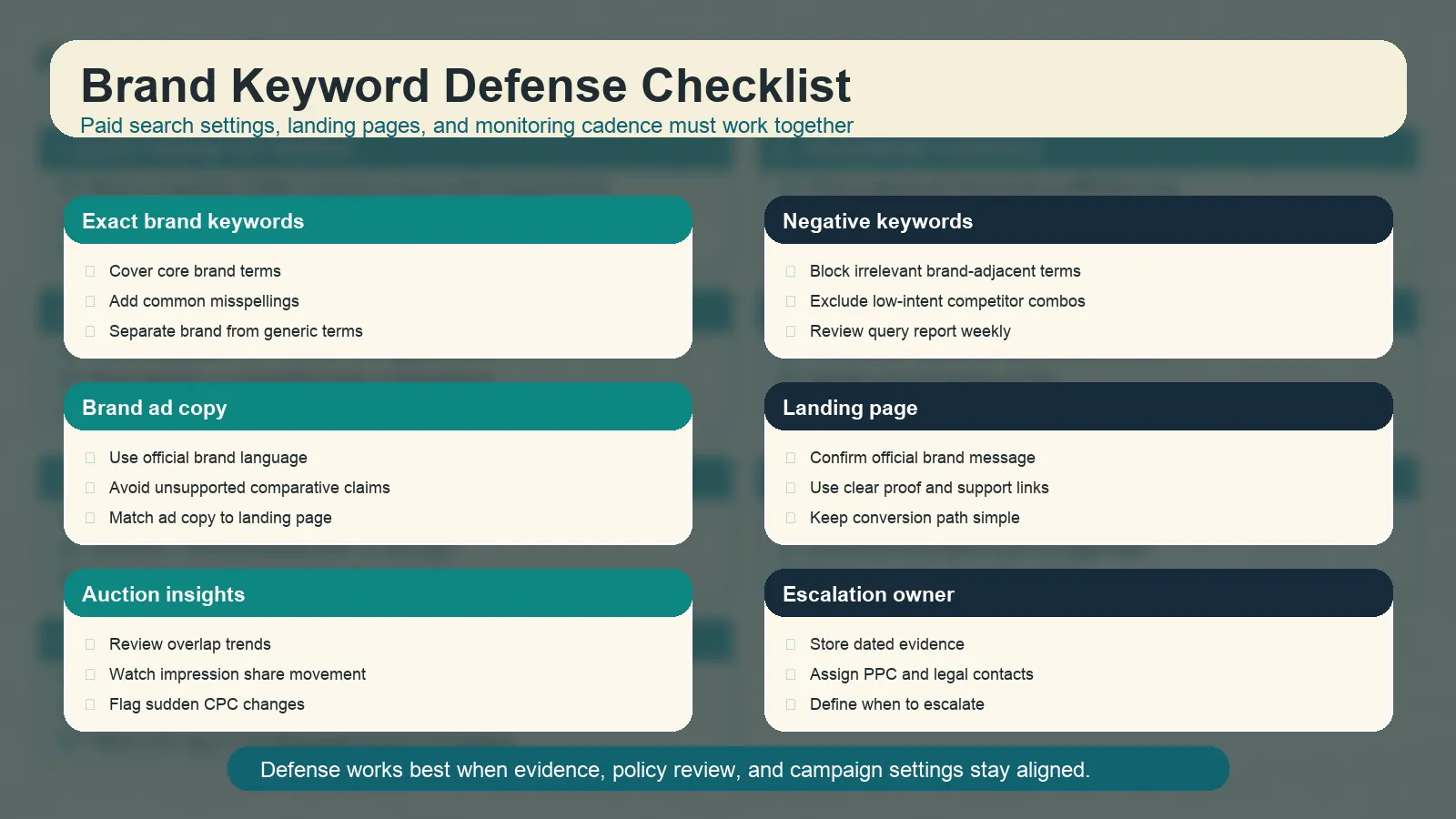
Brand defense is strongest when paid search settings, landing pages, and monitoring cadence work together.
Your first PPC job is to make sure your own brand coverage is strong.
Review:
| Area | Defensive action |
|---|---|
| Exact brand keywords | Cover core brand terms, product names, and common misspellings. |
| Match types | Separate exact brand terms from broader brand-adjacent discovery. |
| Negative keywords | Prevent low-intent or irrelevant competitor combinations from wasting budget. |
| Brand ad copy | Make the official result clear without unsupported claims. |
| Landing page | Send brand searches to a page that confirms trust, proof, and next step. |
| Extensions/assets | Use sitelinks, callouts, structured snippets, and relevant proof. |
| Auction Insights | Monitor overlap, impression share, and top-of-page changes. |
| Conversion tracking | Confirm brand campaigns are measured properly. |
Google's conversion tracking help is relevant because brand-defense decisions should not be based on impressions alone. Track lead quality, conversion rate, and downstream value.
Should You Bid on Competitor Brand Terms Too?
Sometimes teams respond by bidding on competitor keywords. That can work, but it can also waste money, annoy users, and create legal or brand risk.
Use this decision table:
| Question | If yes | If no |
|---|---|---|
| Do users compare you with this competitor? | A comparison landing page may be useful. | Generic competitor bidding may convert poorly. |
| Can you make a truthful, differentiated claim? | Test carefully with proof. | Do not run vague attack copy. |
| Is the CPC acceptable? | Set strict budget and conversion thresholds. | Monitor instead of bidding. |
| Does legal approve the approach? | Document approved language. | Do not proceed. |
| Is the landing page relevant? | Use a clear comparison or alternative page. | Build the page before spending. |
Competitor bidding is not automatically smart just because a competitor is doing it to you.
Messaging and Legal Checklist
Before launching or responding, review:
| Checklist item | Why it matters |
|---|---|
| Trademark use in ad text | Direct competitor use can be sensitive under Google policy. |
| Affiliation language | Avoid implying partnership, certification, or official status unless true. |
| Comparative claims | Substantiate claims before running them. |
| Landing-page clarity | Make it clear who the advertiser is. |
| Complaint evidence | Store screenshots, URLs, query, dates, and account observations. |
| Counsel review | Use legal counsel for trademark and jurisdiction-specific questions. |
The safest path is usually defensive clarity: own your brand result, make your official page obvious, and respond to competitor claims with proof rather than emotional copy.
Monitoring Workflow
Competitor brand bidding can spike during launches, funding announcements, seasonal promotions, review-site campaigns, or category news.
Use this cadence:
| Cadence | Task |
|---|---|
| Daily during incidents | Check priority brand queries and capture new violations or copy changes. |
| Weekly normally | Review SERP captures, Auction Insights, CPC, impression share, and conversion quality. |
| Monthly | Update negative keywords, landing pages, legal evidence folder, and competitor watchlist. |
| Quarterly | Reassess whether competitor bidding is worth a response or only monitoring. |
For recurring monitoring, connect this to your ad tracking workflow and ad spend tracking process. If you need recurring evidence without rebuilding the process manually, use AdMapix reports or review pricing.
FAQ
Can competitors bid on my brand keywords in Google Ads?
Competitors may be able to bid on brand keywords. Google's trademark policy says it does not restrict using trademarks as keywords, but use of trademarks in ad text can be more restricted after complaint review.
Is bidding on competitor keywords Google Ads legal?
It depends on jurisdiction and facts. Google Ads policy is not the same as trademark law. Ask qualified counsel before making legal conclusions or launching aggressive competitor campaigns.
What about using competitor brands in Google Ads copy?
Sometimes this is restricted, especially for direct competitors or confusing, deceptive, or misleading use. Review Google's trademark policy and involve counsel if your brand or a competitor brand appears in ad text.
What should I do if a competitor uses my trademark in ad text?
Capture evidence, check Google's trademark policy, preserve screenshots and landing-page URLs, consult counsel, and consider submitting a trademark complaint through Google's process if appropriate.
How do I detect brand bidding competitors Google Ads activity?
Use manual SERP checks, Auction Insights, search terms reports, Transparency Center, landing-page monitoring, and weekly ad tracking reports. Look for repeat evidence, not one-off appearances.
Should I bid on competitor brand terms too?
Only if you have a compliant strategy, relevant landing page, clear proof, acceptable economics, and legal approval. Retaliatory bidding without a plan often wastes budget.
Final Takeaway
Competitor bidding on brand keywords in Google Ads is a response workflow, not just a policy question. First collect evidence. Then separate keyword bidding from trademark use in ad copy. Review Google policy, involve counsel where needed, strengthen your own brand defense, and monitor whether the behavior repeats.
If you need recurring evidence of brand bidding and competitor search ads, start with AdMapix reports.
See what competitors are really running
Search 6M+ ad creatives, landing pages, and weekly spend across 200+ countries. No credit card, no commitment.
Related Articles
Cross-Channel Ad Attribution in 2026: A Practical Guide for Performance Teams
A practical cross-channel ad attribution guide for performance teams: how to compare ROAS across platforms when every platform claims credit differently, build incrementality testing into your workflow, and make budget decisions without perfect data.
Ad Budget Optimization Framework: How to Allocate Paid Media Budget in 2026
A practical ad budget optimization framework for 2026: how to split budget across channels, campaigns, and regions using competitive signals, performance data, and marginal ROAS analysis — not gut feel.
AI Ad Creative Tools in 2026: What Actually Works for Paid Media Teams
A practical guide to AI ad creative tools in 2026: what each tool category actually does, how to integrate AI generation with competitive intelligence, and a workflow that produces testable ad variants instead of generic output.