AdPlexity Alternative in 2026: 7 Tools Compared (Native, Push, Social & Pricing)
A 2026 guide to choosing an AdPlexity alternative — why teams switch, a 7-tool comparison with pricing and channel coverage, the per-product cost trap, a migration plan, and an honest read on when AdMapix fits and when AdPlexity is still the right call.
By the AdMapix Research Team — Updated June 21, 2026
AdPlexity Alternative in 2026: 7 Tools Compared (Native, Push, Social & Pricing)
Looking for an AdPlexity alternative usually means one specific thing is missing from your current setup: maybe paid-social creatives, maybe video breakdowns, maybe client-ready reports, maybe a price that fits more than one channel. AdPlexity is a strong specialist for affiliate intelligence across native, push, desktop, mobile, and YouTube, so the real question isn't "what beats it" but "what job is it not doing for me." This 2026 guide is for affiliate marketers, media buyers, agencies, and app marketers. It gives you a decision framework, a seven-tool comparison with pricing and channel coverage, a migration plan, and an honest read on where AdMapix fits and where it doesn't — based on the channel and output you need, not a feature ranking.
The honest framing up front: AdPlexity is a genuinely strong affiliate-intelligence specialist, and most people searching for an alternative don't have an AdPlexity quality problem — they have a coverage-or-cost problem. AdPlexity sells separate products for Native, Desktop, Mobile, Adult, Push, and YouTube, which is efficient if you live in one channel and expensive if you need several. So the real question isn't "what beats AdPlexity," it's "which specific gap am I feeling — a channel, a creative type, a report, or a price — and what's the right-sized tool for that." This guide answers the second question.
TL;DR — Choosing an AdPlexity Alternative
- AdPlexity is the right pick when your core job is specialist affiliate intelligence: offers, native and push funnels, traffic sources, and landing pages.
- Switch or add a tool when the bottleneck is paid social, app creatives, video analysis, or repeatable reporting — not affiliate campaign data.
- The best alternative is the one that closes your specific gap, because AdPlexity's pricing is per-product and stacking modules gets expensive fast.
- The field splits into affiliate/native-push specialists (Anstrex, AdSpy for Meta, native tools), broad libraries (BigSpy), and cross-network/reporting layers (AdMapix).
- AdMapix fits as a cross-network creative search, saved media, video analysis, and reporting layer — not a like-for-like native or push spy replacement.
- Name your gap first. Channel, creative type, reporting, or price — each points to a completely different alternative.
Why People Look for an AdPlexity Alternative
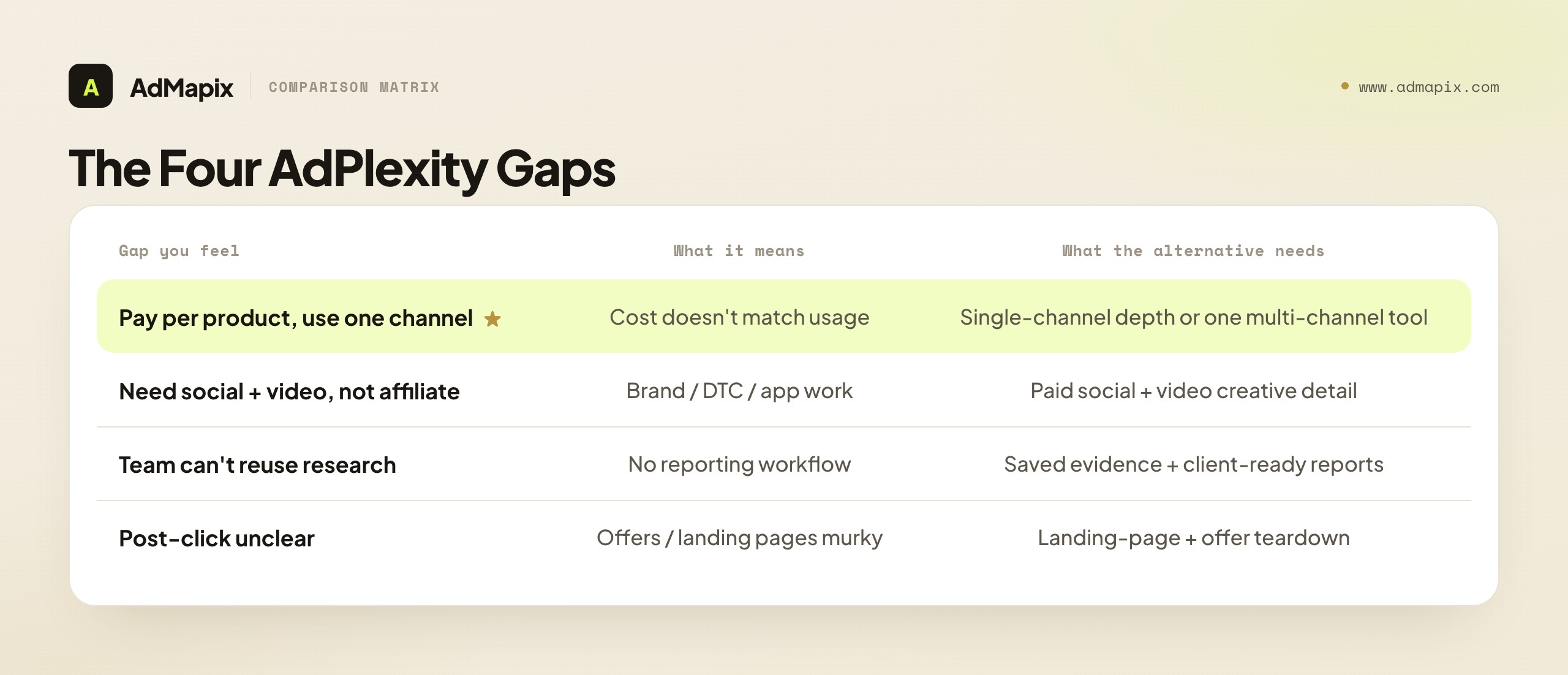
Most people search for an AdPlexity alternative because of one of four gaps, not because the tool is bad. AdPlexity sells separate products for Native, Desktop, Mobile, Adult, Push, and YouTube, which is efficient if you live in one channel and frustrating if you need several. Naming your gap is the whole decision.
| Gap you are feeling | What it usually means | What the alternative needs to do |
|---|---|---|
| "I only buy one channel but pay for a suite" | Cost doesn't match usage | Single-channel depth, or one tool covering several channels |
| "I need social and video creatives, not just affiliate traffic" | Brand, DTC, or app work | Paid social and video coverage with creative-level detail |
| "My team can't reuse the research" | No reporting workflow | Saved evidence and client-ready reports |
| "I want post-click context" | Landing pages and offers unclear | Landing-page and offer teardown |
Let's expand each, because the right alternative depends entirely on which gap is biting:
The cost gap. AdPlexity's per-product model means a media buyer who works native and push and wants YouTube is buying three subscriptions. If you genuinely buy all those channels and use the depth, that's fair. But if you live in one channel and pay for a suite — or want several channels without three invoices — the cost-to-usage mismatch is the trigger. The fix is either single-channel depth at a lower price, or one tool that spans the channels you actually buy.
The creative-type gap. AdPlexity is built around affiliate traffic — native, push, the post-click funnel. If your work shifted toward brand, DTC, SaaS, or app creative on paid social and video, you're researching a different object than AdPlexity indexes. Affiliate funnels and Meta/TikTok brand creative are different datasets, and a native-push specialist isn't built for the second.
The reporting gap. AdPlexity surfaces campaigns and funnels, but if your deliverable is a recurring competitor report for a client or stakeholder — saved evidence with rationale, exported cleanly — you need a reporting workflow, not just a search tool. Screenshotting a spy tool every week doesn't scale.
The post-click gap. Some teams find the offer, tracker, and landing-page context unclear in their current setup and want a sharper teardown of the funnel behind the ad. This one often keeps you in the affiliate lane but points to a different specialist.
Diagnose which of the four is your real driver before you shop. Buying a paid-social tool to solve a cost gap (or a cheap native tool to solve a reporting gap) is how teams end up with two subscriptions and the same unmet need.
How to Compare AdPlexity Alternatives
Compare alternatives by the next decision they help you make, not by database size. A bigger ad count doesn't improve a weekly competitor review, an offer test, or a creative brief; the right output does. Run the same three to five competitors, the same countries, and the same time window through every tool, then judge each by whether it produces something you can act on.
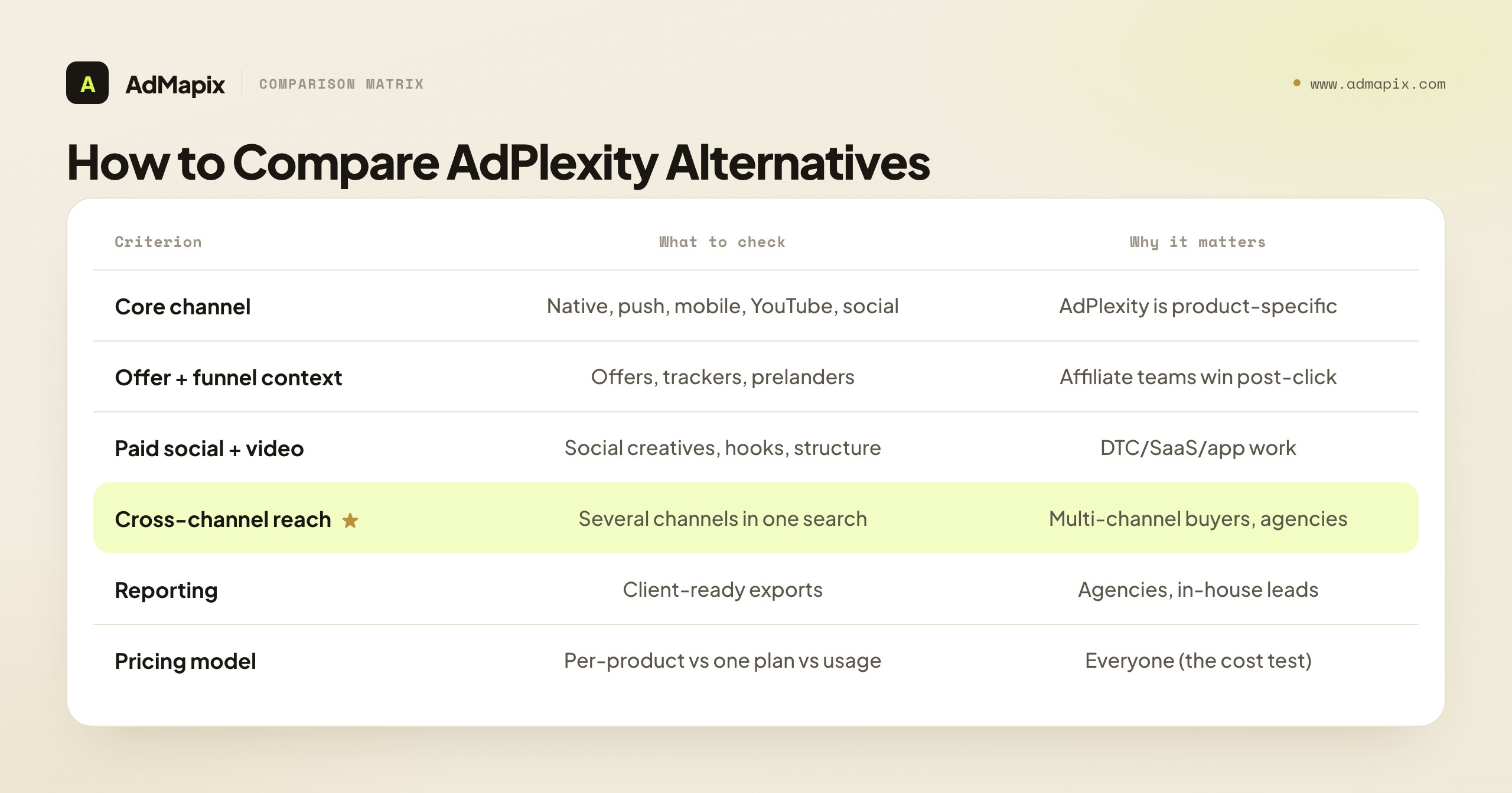
| Criterion | What to check | Why it matters |
|---|---|---|
| Core channel | Native, push, desktop, mobile, YouTube, or social | AdPlexity is product-specific, so the channel decides the shortlist |
| Offer and funnel context | Offers, trackers, networks, advertisers, prelanders | Affiliate teams win on the post-click funnel, not the ad alone |
| Paid social and video | Social creatives, hooks, video structure | DTC, SaaS, and app work needs creative-level detail |
| Cross-channel reach | Whether several channels sit in one search | Multi-channel buyers, agencies |
| Saved evidence | Save the source ad, media, and rationale | Anyone building briefs |
| Reporting | Client-ready exports without manual screenshots | Agencies, in-house leads |
| Pricing model | Per-product vs. one plan, vs. your actual usage | Everyone (the cost test) |
The deciding question is never "which tool has the most ads." It's "which tool closes my specific gap — a channel, a creative type, a report, or a price — and produces something I can act on this week." The last clause is what separates a targeted fix from another expensive subscription.
The AdPlexity Alternatives, Compared
No single tool is "best" — each closes a different gap. Here's the honest positioning of the main options an AdPlexity user will weigh. Treat it as a map, not an endorsement; verify current features and pricing on each vendor's page, since plans shift quarterly in this category.
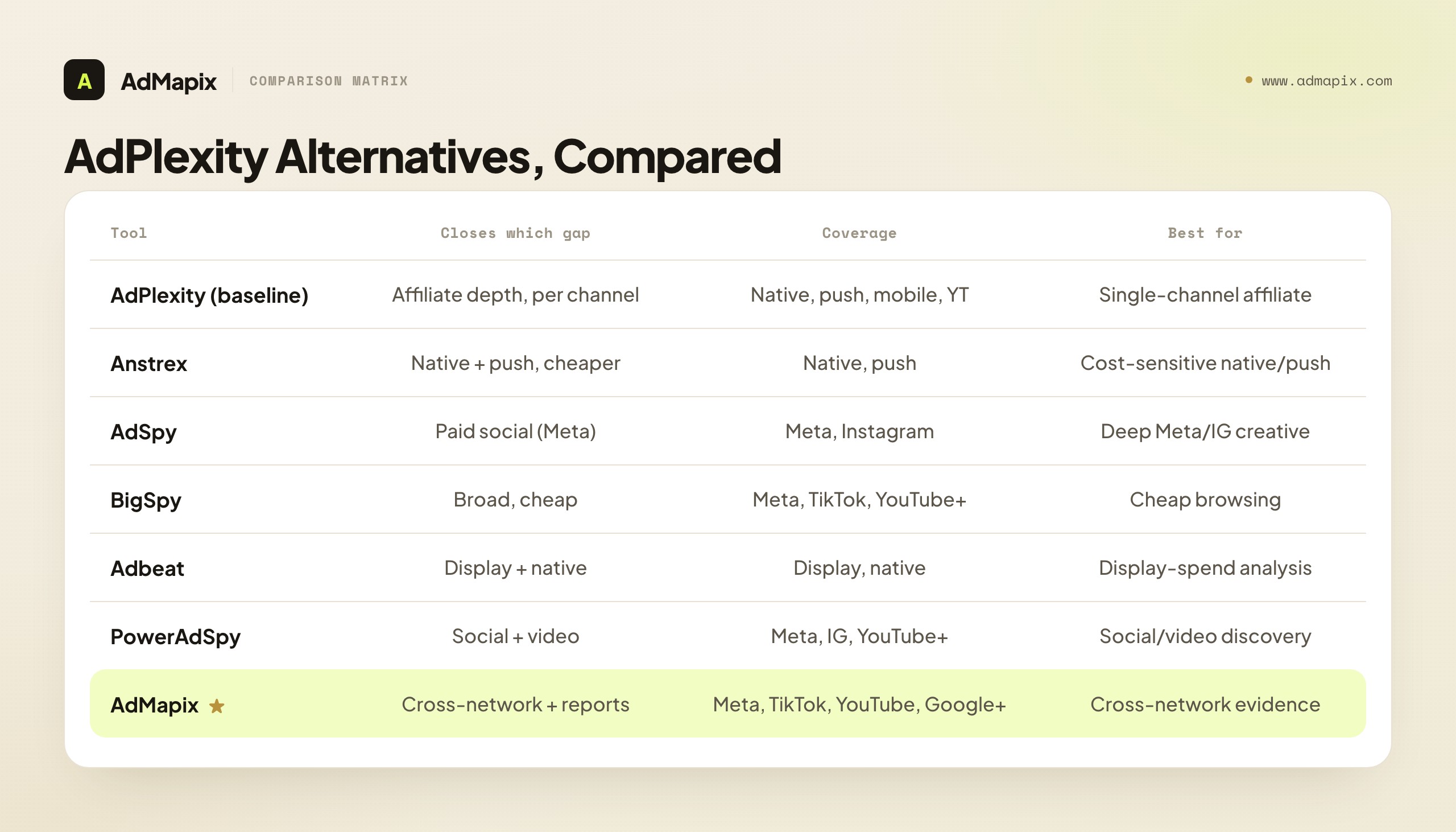
| Tool | Closes which gap | Channel coverage | Pricing posture | Best for |
|---|---|---|---|---|
| AdPlexity (baseline) | Affiliate depth, per channel | Native, push, desktop, mobile, YouTube | Per-product | Single-channel affiliate depth |
| Anstrex | Native + push, cheaper | Native, push | Lower flat price | Cost-sensitive native/push buyers |
| AdSpy | Paid social (Meta) | Meta, Instagram | Higher flat monthly | Deep Meta/IG creative research |
| BigSpy | Broad multi-platform | Meta, TikTok, YouTube+ | Lower-cost tiers | Cheap cross-channel browsing |
| Adbeat | Display + native intelligence | Display, native | Enterprise-leaning | Display-spend + publisher analysis |
| PowerAdSpy | Social + video creatives | Meta, IG, YouTube, more | Mid-tier | Social/video creative discovery |
| AdMapix | Cross-network + reports | Meta, TikTok, YouTube, Google+ | Public plans | Cross-network evidence + reporting |
Reading notes. Anstrex is the closest like-for-like if your gap is cost — it covers native and push at a lower flat price than buying two AdPlexity products. AdSpy is the Meta specialist for the paid-social creative-type gap. BigSpy trades depth for a cheap, broad library. Adbeat anchors the display-and-native intelligence end, leaning enterprise, strong on display spend and publisher analysis (our Adbeat alternative guide covers that lane). PowerAdSpy closes the social-and-video creative gap with a mid-tier multi-channel library. AdMapix is the cross-network and reporting layer — the fit when your gap is multi-channel coverage or reporting rather than affiliate depth.
For the full field beyond the AdPlexity-specific lens, our best ad spy tools 2026 comparison ranks everything, ad spy tools by channel maps tools to channels (directly useful given AdPlexity's per-channel model), and best ad intelligence tools focuses on the creative-intelligence end.
Anstrex — the cost-gap native/push answer
If your gap is "I pay per product but only need native and push," Anstrex is the natural first stop. It covers native and push ad spy at a lower flat price than stacking AdPlexity's separate Native and Push products, with offer, funnel, and landing-page context that affiliate teams rely on. It's a like-for-like in the affiliate lane — same job, lower cost — which makes it the obvious move when cost-to-usage is your trigger and you don't need channels beyond native/push. Where it's lighter is the breadth (no paid-social or video depth) and the reporting layer. If your gap is purely cost within native/push, Anstrex closes it directly.
AdSpy & PowerAdSpy — the creative-type gap
These two address the "I need social and video creatives, not affiliate traffic" gap, from different angles. AdSpy is the Meta/Instagram specialist — one of the largest Facebook ad archives with powerful filtering, at a higher flat monthly price, for teams who need real depth on paid-social creative. PowerAdSpy spans more channels (Meta, Instagram, YouTube, and more) at a mid-tier price, trading some per-channel depth for breadth across social and video. If your work moved from affiliate funnels into brand/DTC/app creative, one of these is your lane — AdSpy for Meta depth, PowerAdSpy for multi-channel social/video breadth. Neither is built for native/push affiliate funnels, so they complement rather than replace AdPlexity if you straddle both worlds.
BigSpy & Adbeat — breadth and display
BigSpy is the budget breadth play: a large multi-platform library at a low price, good for cheap browsing across channels, lighter on the offer/funnel context and reporting that serious affiliate or agency work needs. Adbeat sits at the other end — display and native intelligence with strong publisher and display-spend analysis, leaning enterprise. They bracket the field: BigSpy for cheap volume, Adbeat for deep display intelligence. Neither is a drop-in AdPlexity affiliate replacement, but each closes a specific adjacent gap.
AdMapix — the cross-network and reporting layer
AdMapix sits in the cross-network creative-intelligence and reporting layer: one search across Meta, TikTok, YouTube, Google and more, with saved media, hook-by-hook video analysis, and shareable reports. It's the fit when your gap is multi-channel coverage or reporting load rather than affiliate-funnel depth. The honest boundary: it's not a like-for-like native or push spy — for the post-click affiliate funnel (offers, trackers, prelanders), a native/push specialist like AdPlexity or Anstrex is more direct. AdMapix earns its place when the job is cross-network creative evidence and reports, not affiliate campaign teardowns. More on exactly where it fits below.
Pricing: The Per-Product Cost Trap
Price is where the AdPlexity-alternative decision is often made, because the whole reason many people are here is per-product pricing for multi-channel needs. Here's how the tiers break down, and the test that prevents overspending.
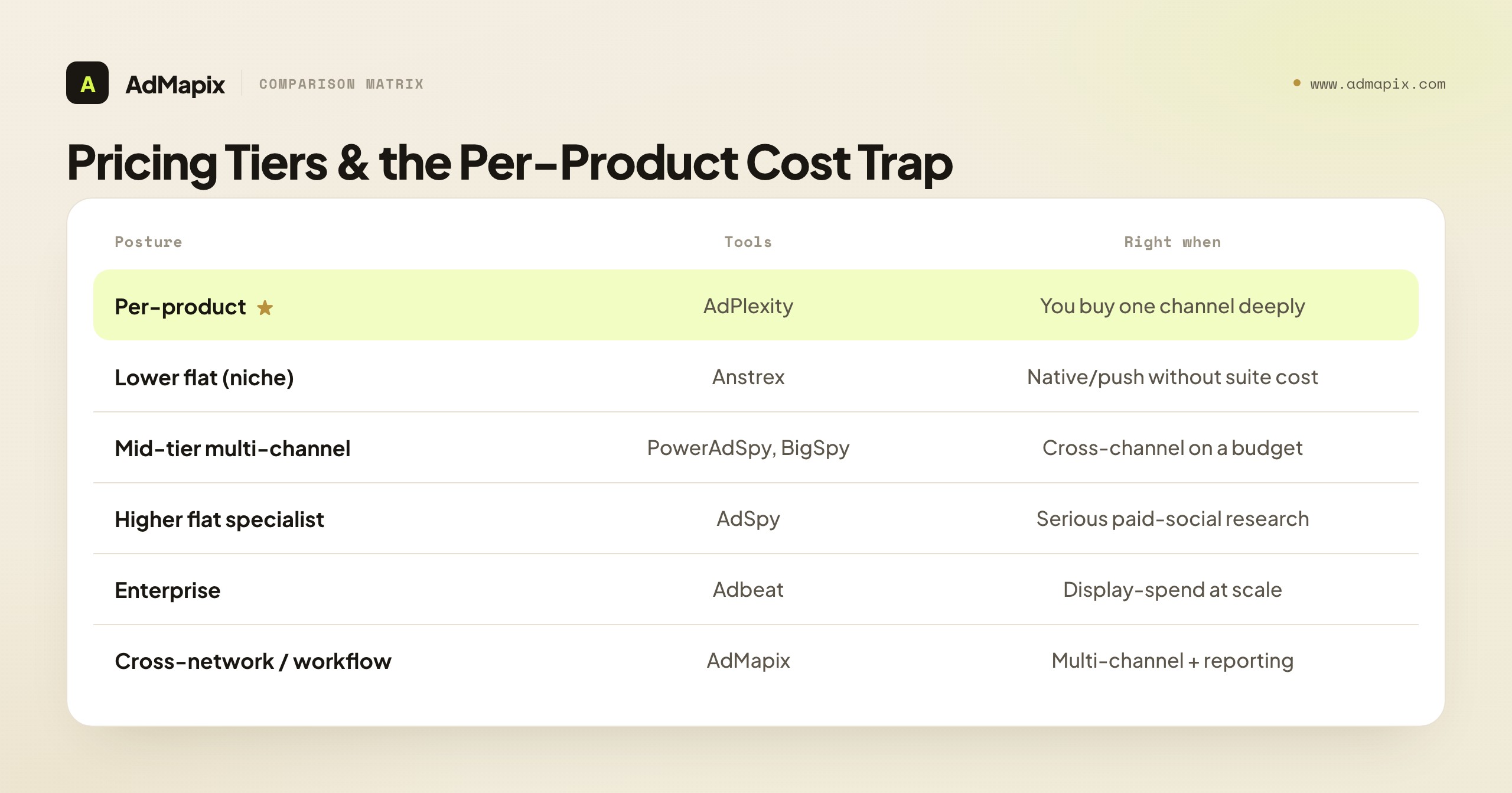
| Pricing posture | Tools | What you get | Right when |
|---|---|---|---|
| Per-product | AdPlexity | Deep single-channel affiliate intel | You buy one channel deeply |
| Lower flat (niche) | Anstrex | Native + push at one price | Native/push without the suite cost |
| Mid-tier multi-channel | PowerAdSpy, BigSpy | Social/video breadth | Cross-channel on a budget |
| Higher flat (specialist) | AdSpy | Deep Meta archive | Serious paid-social research |
| Enterprise | Adbeat | Display + publisher intelligence | Display-spend analysis at scale |
| Cross-network / workflow | AdMapix | Multi-network search, evidence, reports | Multi-channel + reporting |
The cost trap is specific to AdPlexity's model: adding channels means adding subscriptions. If you buy Native, then add Push, then want YouTube, you're paying three product fees — and at that point a single multi-channel tool often costs less than the stack. The test is one question: how many AdPlexity products would you need to cover the channels you actually buy? If the answer is one, AdPlexity's per-product model is efficient — you only pay for what you use. If it's two or three, a single cross-channel tool usually wins on both cost and workflow. Run that count before renewing, and confirm current pricing on each vendor's page, since plans shift quarterly.
Match the Tool to Your Gap
The comparison tells you what each tool does; this 2×2 tells you which one you need, on the two axes that actually decide it — whether your job is affiliate funnels or brand/social creative, and whether you need single-channel depth or cross-channel reach.
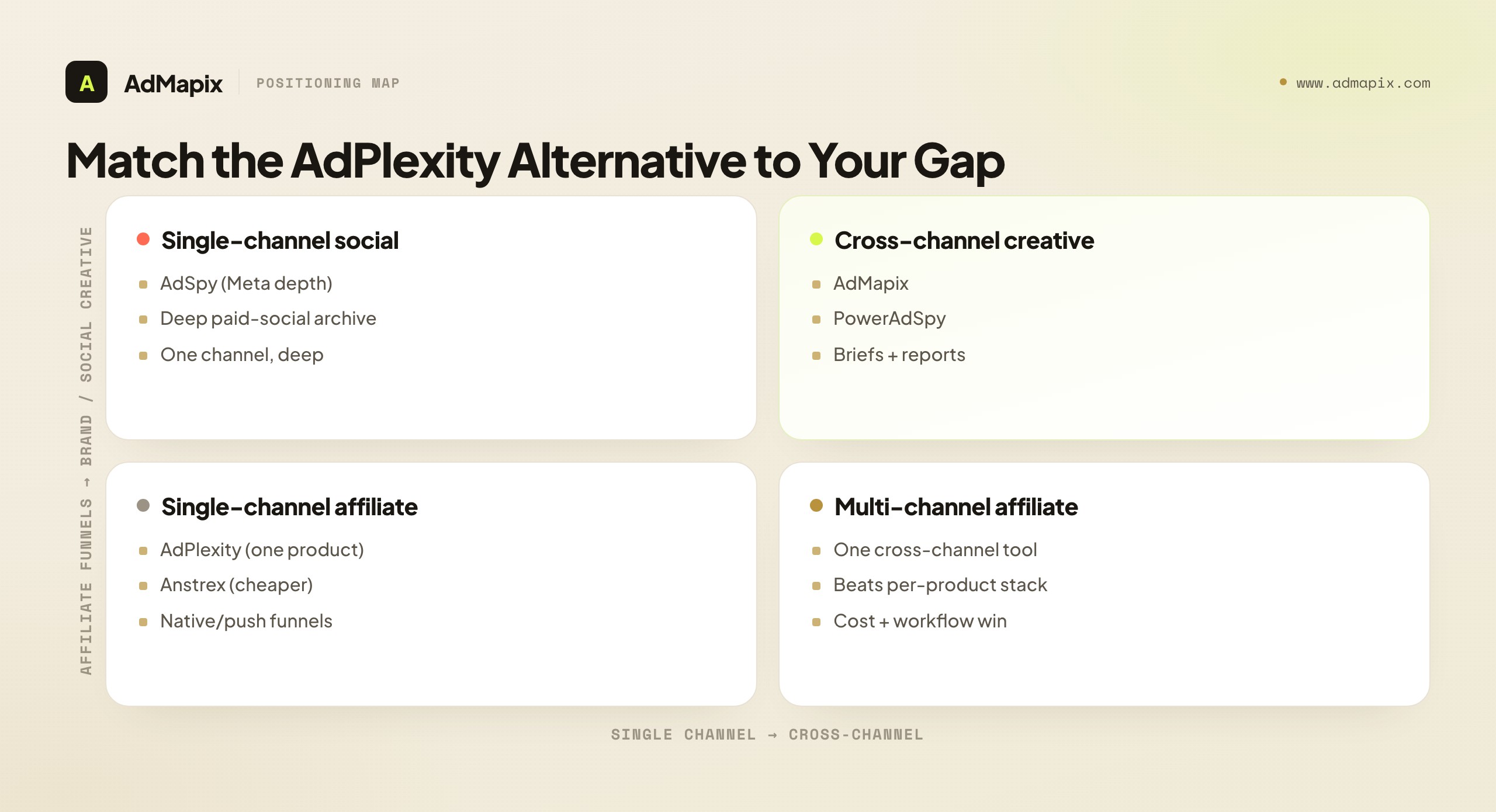
The read: if you're affiliate-focused and single-channel, AdPlexity (one product) or Anstrex (native/push, cheaper) fits — stay in the affiliate lane. If you're affiliate-focused but multi-channel, the per-product math pushes you toward a single cross-channel tool. If you're brand/social-focused and single-channel, AdSpy (Meta depth) is the lane. And if you're brand/social-focused and cross-channel, a cross-network layer like AdMapix or a multi-channel social tool like PowerAdSpy covers more ground. Plot yourself honestly on the two axes and the seven-tool list collapses to one or two.
AdPlexity vs AdMapix: A Direct Comparison
Since many readers weighing a cross-network move are comparing AdPlexity to a workflow-shaped option, here's the honest side-by-side. This isn't "AdMapix wins everything" — they live in different lanes, and the table shows exactly where each leads.
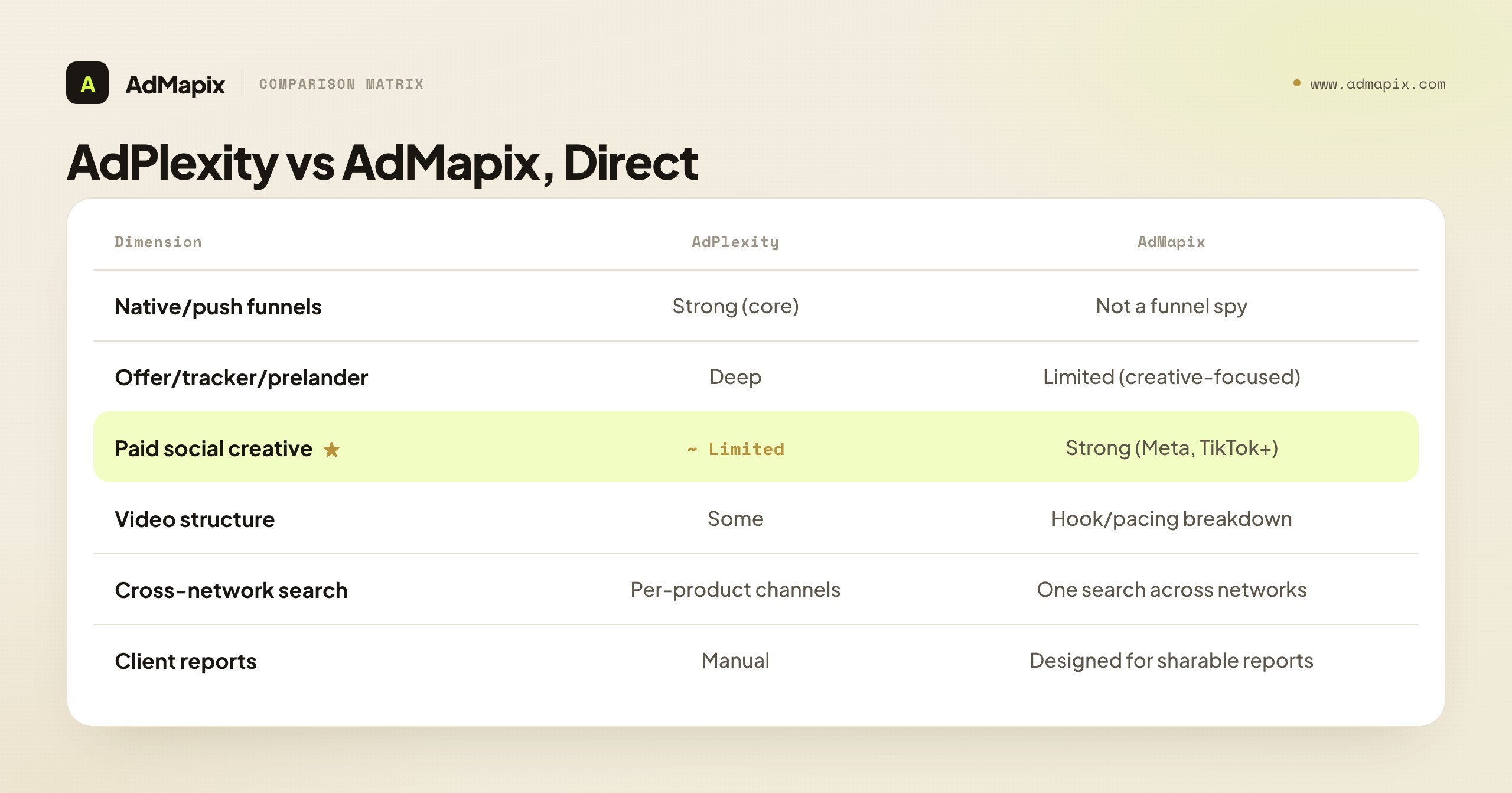
| Dimension | AdPlexity | AdMapix |
|---|---|---|
| Native/push affiliate funnels | Strong — its core | Not a native/push funnel spy |
| Offer/tracker/prelander context | Deep | Limited (creative-focused) |
| Paid social creative | Limited | Strong (Meta, TikTok+) |
| Video structure analysis | Some | Hook/pacing breakdowns |
| Cross-network search | Per-product channels | One search across networks |
| Client-ready reports | Manual | Designed for shareable reports |
| Pricing vs. multi-channel | Per-product (adds up) | One plan across networks |
The honest takeaway: if your job is the native/push affiliate funnel — offers, trackers, prelanders — AdPlexity is more direct and AdMapix isn't a replacement for that slice. AdMapix earns its place when your real, recurring job is cross-network creative evidence and reporting, and the per-product cost of covering several channels in AdPlexity has stopped making sense. That's a coverage-and-cost decision, not a "which is better" one.
The Realistic Setup: One Tool or Two?
As with most "alternative" decisions, the answer is often not a clean replacement — it's a right-sized tool, sometimes paired:
- An affiliate buyer expanding into paid social might keep a native/push specialist (AdPlexity or Anstrex) for funnels and add a social/cross-network tool for the brand-creative job.
- A multi-channel affiliate might drop AdPlexity's per-product stack for a single cross-channel tool that covers the channels they buy at one price.
- An agency might keep an affiliate tool for affiliate clients and add a cross-network reporting layer for everything else.
Buy for your sharpest gap first; add a second tool only when a distinct, separate need is costing real hours. The waste pattern is stacking per-product subscriptions you use a fraction of, or two tools covering the same channel; the leverage pattern is pairing complementary jobs — affiliate funnels with social creative, or discovery with reporting. The test is whether each tool earns its price in the job it does.
The Right Pick by Team Type
The framework so far is abstract; here's the concrete read by the kind of team actually making this decision, because the gap that matters shifts with what you do.
Affiliate media buyer. You live in native and push funnels — offers, trackers, prelanders are your edge. AdPlexity (or Anstrex, cheaper) is your lane, and the question is rarely whether to leave the affiliate world but whether the per-product cost matches your channels. If you buy only native, one product is efficient. If you buy native and push and want YouTube, the three-subscription stack is the trigger, and a single cross-channel tool or a cheaper native/push specialist closes the cost gap. The mistake for this team is buying a brand-creative tool that has no affiliate-funnel depth — it doesn't index what you research.
DTC / brand performance marketer. Your work moved from affiliate traffic into brand creative on paid social and video. AdPlexity's affiliate-funnel depth is the wrong object for you — you need social-creative detail (AdSpy for Meta, PowerAdSpy for multi-channel) or a cross-network creative layer. This is the profile most likely to feel AdPlexity is "missing social and video," because the job genuinely changed lanes from funnels to brand creative.
Agency / freelancer. Your bottleneck is rarely finding ads — it's turning research into client-ready, repeatable deliverables across multiple accounts, channels, and ad types (some clients are affiliate, some brand). A per-product affiliate stack covers only the affiliate clients, and screenshotting funnels doesn't scale to ten accounts. This is where a cross-network creative-and-reporting layer earns its price in billable hours, often kept alongside an affiliate specialist for the affiliate clients specifically.
App / mobile UA marketer. Your creative spans mobile and several networks, and you care about creative velocity more than affiliate funnels. AdPlexity's Mobile product covers part of this, but if your creative lives across Meta, TikTok, YouTube, and app networks, a cross-network tool usually beats stacking per-channel products. The cost trap bites hardest here because mobile UA is inherently multi-network.
A Repeatable Competitor Research Workflow
Whichever tool you land on, the workflow matters more than the tool — a great tool with no process still produces a folder of screenshots. Here's the repeatable loop that turns any of these tools into decisions.
- Name the decision first. Offer test, creative brief, competitor monitoring, or client report — different jobs need different evidence. Don't open the tool until you know what choice it's informing.
- Use a fixed competitor / offer set. Search the same 5–10 real competitors, advertisers, or offers every week, in the same geo and window, so results are comparable across weeks and tools.
- Save evidence with context. Keep the source ad, the funnel or media, the offer, the hook, the geo, and one line on why it matters. Context is what makes evidence reusable months later.
- Run the teardown, not just the screenshot. For affiliate work, capture the offer, prelander, and traffic source. For brand creative, capture the video structure — the first-3-second hook, the proof moment, the CTA. The funnel or the structure is what you can act on; the snapshot is just an anecdote.
- Convert each pattern into an action. Every saved item should map to an offer test, a creative brief, a landing-page test, or a client note. Research that doesn't produce an action is sightseeing.
- Diff over time. The highest-value output is the change — a competitor's new offer, a new hook, a new traffic source. A weekly diff against last week is where the actionable intelligence lives.
This loop is tool-agnostic on purpose. The reason to pick one tool over another is how much manual labor it removes from steps 3–6 — and whether you're paying per channel for steps you run or steps that sit idle. A right-sized tool removes labor from the steps you actually run; a per-product stack charges you per channel whether you work it or not.
Two Worked Examples: Staying vs Right-Sizing
Abstract frameworks are easy to agree with and hard to apply, so here are two composite walkthroughs (anonymized from 2026 accounts) showing the decision in motion — one buyer who should stay on AdPlexity, one who should right-size.
Example 1 — the buyer who should stay. A solo affiliate media buyer runs native campaigns almost exclusively, living in offers, prelanders, and traffic sources. Their whole weekly job is finding winning native funnels and reverse-engineering the post-click experience, and AdPlexity Native does exactly that — deep funnel context, landing-page teardowns, traffic-source detail. They considered switching after a cross-network tool's ad caught their eye, but running the framework, their channel is exactly native, their gap is nonexistent (they use the depth), and they'd only ever need one AdPlexity product, so there's no cost trap. The disciplined call was to stay. The lesson: with one channel and one product, AdPlexity's per-product model is efficient, not a trap — the trap only appears when you stack channels.
Example 2 — the agency that should right-size. A performance agency adopted AdPlexity Native for an affiliate client, then bought Push and Mobile as the client list grew, and now pays for three products. Running the audit, they found that half their clients are DTC brands whose creative lives on Meta and TikTok — channels AdPlexity doesn't cover — so they were also paying for AdSpy on the side and manually stitching reports across four tools. Three AdPlexity products plus a Meta tool, four invoices, hours of manual report assembly. They right-sized: kept one affiliate specialist for the genuinely affiliate clients, and moved the brand clients to a single cross-network creative-and-reporting layer that covered Meta, TikTok, and YouTube in one plan and exported reports directly. Fewer invoices, less stitching, same coverage. The lesson: a per-product stack assembled client-by-client rarely matches a whole agency's real channel mix — audit the stack against the work, not the history.
The two examples bookend the whole decision. Most readers sit somewhere between them, and the framework's job is to tell you which way you're trending — toward one efficient product, or toward a per-product stack that a single cross-channel tool would beat. Run your real channel count and gap honestly and the answer is usually obvious, even when a per-product upsell makes adding "just one more channel" feel painless in the moment but expensive over a year.
Common Mistakes When Choosing an AdPlexity Alternative
- Stacking per-product subscriptions you barely use. The defining cost mistake. Count how many products you'd need for the channels you actually buy before adding another.
- Confusing the lanes. Expecting a brand-creative tool to surface affiliate funnels, or an affiliate tool to teardown paid-social video. Name your lane first; they index different objects.
- Comparing on database size. The biggest ad count is worthless if it doesn't get you to an offer test, a brief, or a report. Compare on output.
- Replacing when you should add. If affiliate funnels are still your edge, keep the specialist and add a tool for the new job. Don't lose funnel depth you still use.
- Cancelling before validating. Cancel-then-switch leaves a coverage gap with no fallback. Always run parallel first.
- Ignoring the workflow. A tool is only as good as the saved searches, teardowns, and reports you build on it. The best tool with no loop loses to a lesser tool with a disciplined one.
How to Migrate or Right-Size Without Losing Research
If you decide to switch, drop a product, or right-size, migrate deliberately so you keep the research equity you've built.
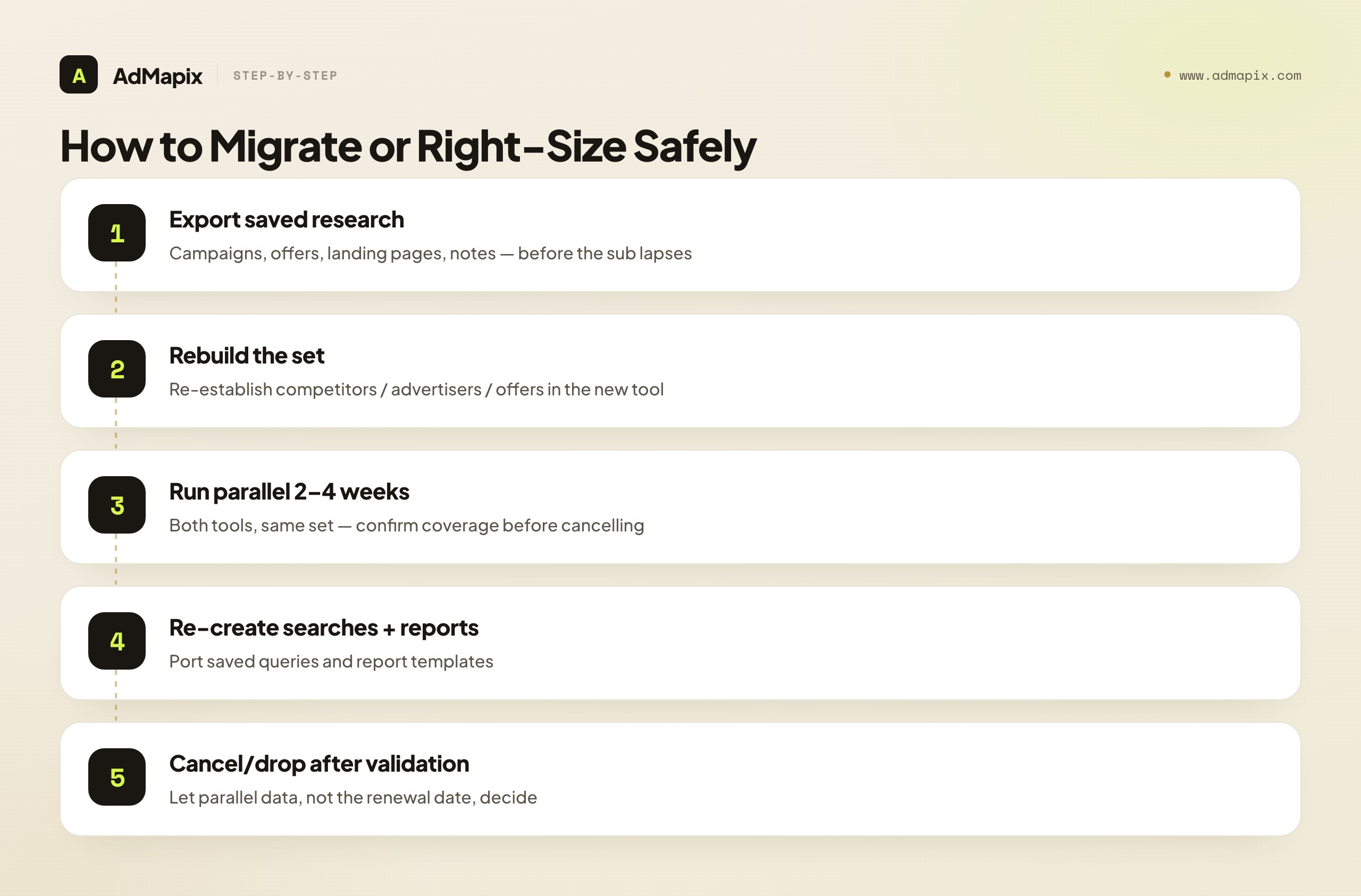
Step 1 — Export your saved research. Pull saved campaigns, offers, landing pages, watchlists, and notes from AdPlexity before any subscription lapses. Even a manual export of your tracked advertisers and best funnels preserves months of accumulated knowledge.
Step 2 — Rebuild your competitor / offer set. Re-establish your fixed list of competitors, advertisers, or offers in the new tool first. This backbone makes weekly research repeatable, and getting it in place early means your cadence resumes immediately.
Step 3 — Run a parallel period. For two to four weeks, run both tools on the same set. This confirms the new tool covers what you relied on AdPlexity for before you cancel, and surfaces any gap — a geo, a traffic source, a funnel detail — while you still have a fallback.
Step 4 — Re-create saved searches and report templates. Port the recurring searches and report structures that made your old workflow fast. The tool is only as good as the saved workflow on top of it.
Step 5 — Cancel only after coverage is validated. Once the parallel period confirms coverage, cancel or drop the product. If it reveals the new tool doesn't cover the affiliate-funnel depth you still need, the answer may be a specialist for funnels plus a cross-network tool for creative, rather than one tool for both. Let the data, not the renewal date, decide.
The parallel period keeps the move reversible until you're certain. Cancel-then-switch is how teams discover a coverage gap with no fallback and resubscribe at a worse price.
When AdPlexity Is Still the Right Call
Intellectual honesty requires the reverse case: plenty of teams should keep AdPlexity. Keep it if:
- You live in one affiliate channel and use the depth. If native (or push) is your whole job and you use AdPlexity's funnel, offer, and landing-page depth, the per-product model is efficient — you pay for exactly what you use.
- The post-click funnel is your edge. Affiliate teams win on offers, trackers, and prelanders, not the ad alone, and AdPlexity's depth there is purpose-built.
- You don't need social, video, or reports. If your deliverable is your own next campaign — not a client report — and you don't research paid-social brand creative, the specialist depth is exactly right.
- The product count matches your channels. If you'd only ever need one AdPlexity product, there's no cost trap — keep it.
The strongest reason to leave is coverage or cost genuinely outgrowing the per-product model — not dissatisfaction with the affiliate depth itself. If your scope still fits one product, then staying put is the disciplined call.
How AdMapix Fits (and When It Doesn't)
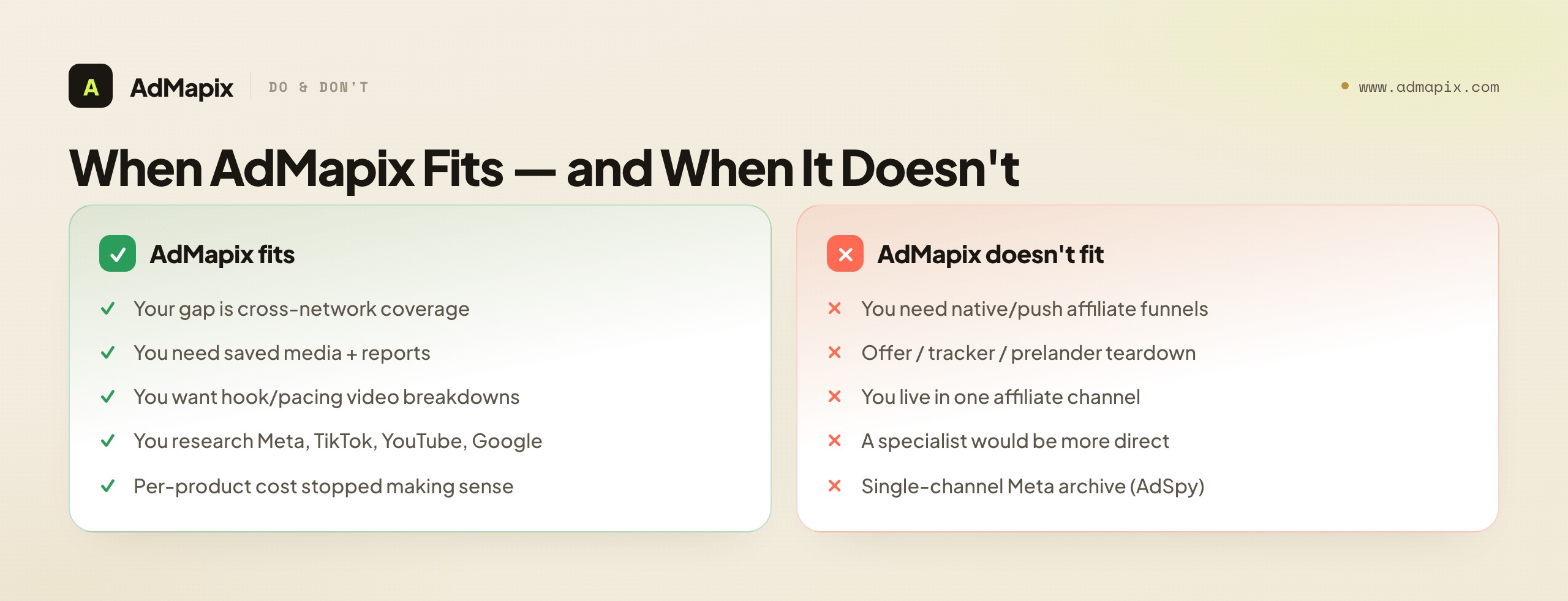
AdMapix fits when your gap is cross-network coverage or reporting: one search across Meta, TikTok, YouTube, Google and more, with saved media, hook-by-hook video analysis, and client-ready reports — without per-product subscriptions for each channel. It's best for multi-channel buyers and agencies whose job is competitor creative and reporting across networks. It is not the right pick for the native/push affiliate funnel (offers, trackers, prelanders) — that's the AdPlexity/Anstrex lane — and it isn't a single-channel paid-social archive like AdSpy.
In practice the fit looks like this: run your competitor set through Search AdMapix for cross-network creative discovery, store evidence with context in Media, break down winning hooks with Video Analysis, and package findings into a report. The honest boundary: AdMapix doesn't teardown affiliate prelanders or surface push-traffic-source detail — for that, a native/push specialist is more direct. If your job is "competitor creative across channels, understood and reported," that's the fit; if it's affiliate funnels, keep the specialist. Compare seats on pricing when the cross-network workload starts costing real hours.
For the analysis discipline behind the tool, our competitor ad analysis framework lays out the 5-dimension scoring system, and spy on ads across all platforms maps the cross-network workflow that per-channel tools can't cover in one place.
To make the fit concrete, here are two scenarios where AdMapix is clearly the right move beyond AdPlexity — and one where it isn't. Right call #1: an agency paying for three AdPlexity products plus a separate Meta tool, manually stitching reports across four systems for a mixed affiliate-and-brand client book; moving the brand clients to one cross-network creative-and-reporting layer covers Meta, TikTok, and YouTube in a single plan, exports client-ready reports, and collapses four invoices toward two. Right call #2: a DTC performance team whose creative spans Meta, TikTok, and YouTube needs the same competitor's creative across all three with hook-by-hook teardowns — a per-channel affiliate tool covers none of that, while a cross-network layer does it in one search. Not the right call: a solo native affiliate buyer who lives in offers, prelanders, and traffic sources — for them AdPlexity Native (or Anstrex) is more direct, and AdMapix's cross-network breadth would be coverage they pay for and never use, with no affiliate-funnel teardown where they need it. The discipline cuts both ways: we'd rather a single-channel affiliate buyer keep AdPlexity than pay us for breadth that doesn't teardown their funnels.
A Decision SOP: Switch, Add, or Stay
To make this concrete, here's the decision sequence we'd run.
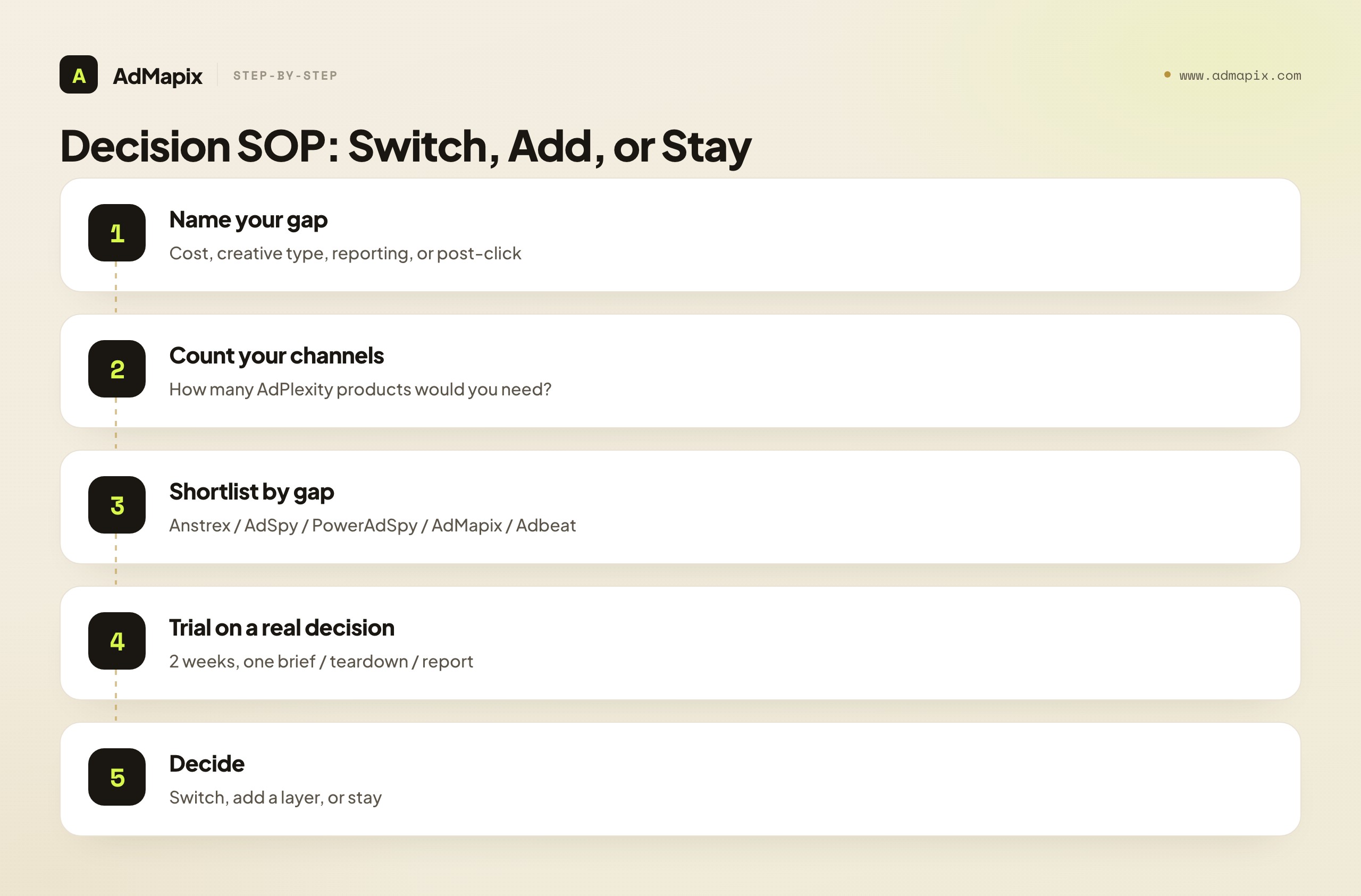
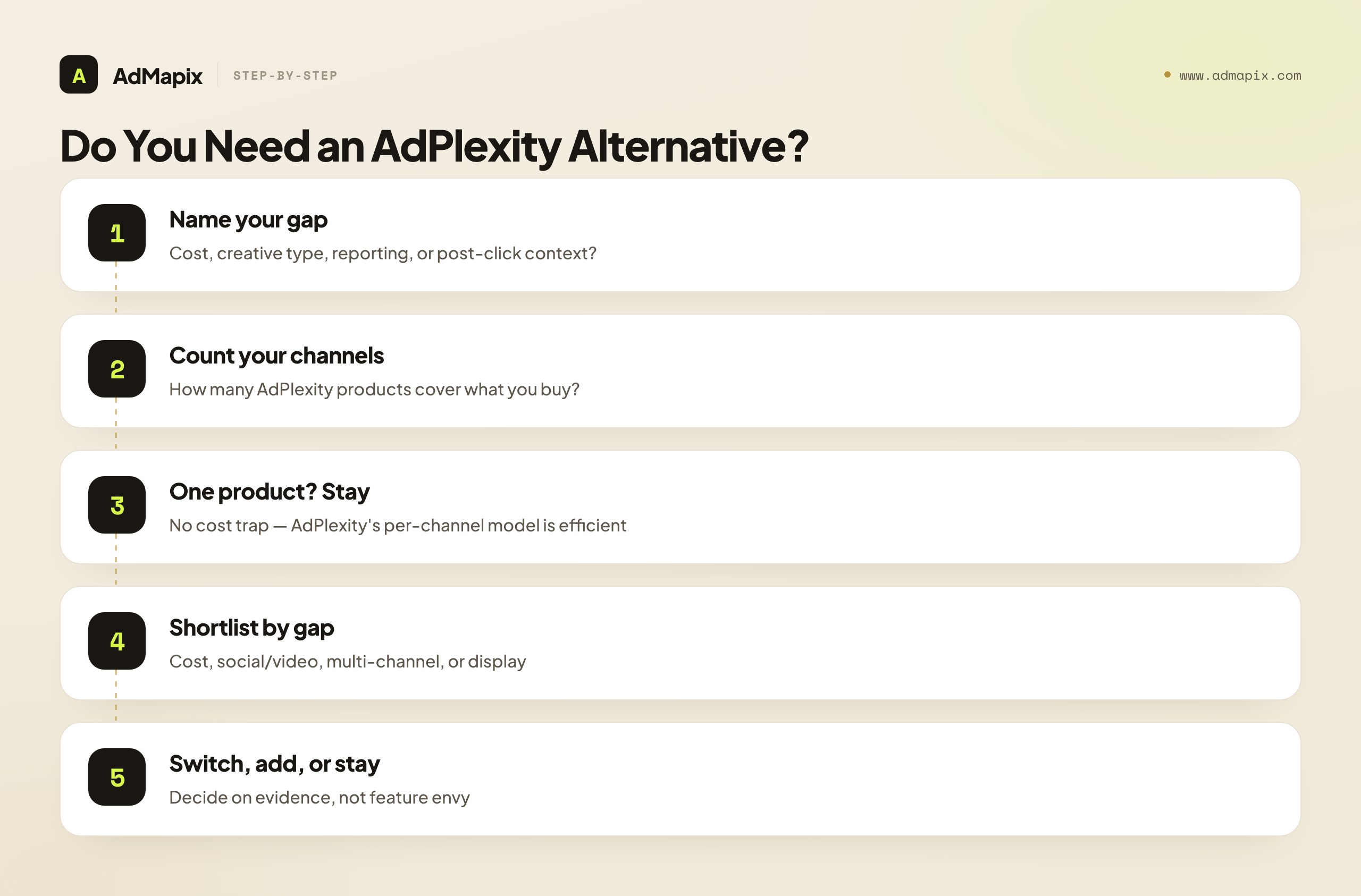
- Name your gap. Cost, creative type, reporting, or post-click context — the one actually costing you hours or dollars this month.
- Count your channels. How many AdPlexity products would cover what you buy? One = no cost trap; two-plus = consider a cross-channel tool.
- Shortlist by gap, not brand. Cost → Anstrex; social/video → AdSpy/PowerAdSpy; multi-channel + reporting → AdMapix; display → Adbeat.
- Trial against a real decision. Run your set through the top candidate for two weeks; produce one real brief, funnel teardown, or report.
- Run parallel before cancelling. Keep AdPlexity live during the trial; cancel or drop a product only after coverage is confirmed.
- Decide: switch, add, or stay. Switch if one tool covers your real job; add a layer if you straddle affiliate and social; stay if one product still fits.
The sequence keeps the decision evidence-based rather than driven by feature-list envy or a competitor's recommendation. Your gap and your channel count decide it — not the size of anyone's ad database.
What Changed in 2026 (and Why It Affects Your Choice)
The ad-intelligence landscape shifted enough in 2026 that the right AdPlexity alternative today isn't the one you'd have picked two years ago. Three changes matter for this decision.
Channels converged, making per-product models leakier. Creative angles now jump between native, social, and video formats faster than ever — a hook that wins on native gets adapted for TikTok within days. A team studying only one channel through one product increasingly misses where an angle started or where it's spreading. This is the structural reason the per-product cost trap bites harder now: the job genuinely got more cross-channel, so paying per channel covers less of the real picture than it used to.
Paid social and video pulled ahead as the creative center of gravity. As affiliate-native buyers expanded into DTC and app work, the creative that decides outcomes increasingly lives on Meta, TikTok, and YouTube — channels an affiliate-funnel specialist covers thinly or not at all. That shift is why "I need social and video, not just affiliate traffic" became one of the most common reasons to look past AdPlexity, even among teams who still run native campaigns.
Reporting became the agency differentiator. As more teams manage competitor research for clients, the deliverable shifted from "find the ad" to "report the competitive picture, repeatably, across channels." Per-product tools that surface campaigns but don't export clean reports leave that work manual. The tools gaining ground are the ones that turn research into a shareable artifact, because at agency scale the report is the product.
The throughline: in 2026, match the tool to your channels and your output matters more than ever, because creative converged across channels and reporting became the deliverable. The per-channel affiliate specialist is still excellent for single-channel funnel work, but the right alternative for a multi-channel or reporting-driven team increasingly spans networks in one plan.
Red Flags When Evaluating an AdPlexity Alternative
A short field guide to the warning signs that a candidate tool will disappoint, so you catch them during the trial rather than after you've paid.
- Hidden per-add-on pricing. If a tool's headline price covers one channel and every other channel is a paid add-on, you may be walking into the same per-product trap under a new name. Confirm what one plan actually covers.
- Database size as the headline pitch. When a tool leads with "millions of ads" rather than what you can do with them, it's usually compensating for a thin workflow. Output beats archive.
- Lane mismatch hidden by marketing. An affiliate tool implying it has social-creative depth, or a creative tool implying it has affiliate-funnel teardowns. Test against your actual gap and weekly decision, not the feature list.
- No saved-evidence or export path. If you can't save funnels or creatives with context or export a report, every insight has to be rebuilt manually each week.
- Thin coverage on claimed channels. A tool that claims five channels but has stale or shallow data on three of them is single-channel depth dressed as breadth. Verify each claimed channel during the parallel period.
- Thumbnail-only "video analysis." If the video feature is just a playable clip, it's not a teardown. Creative teams need structure, not a player.
Catch these during a two-week parallel run and you avoid the most common post-purchase regrets in this category. The way to make a trial surface them is to test against a real decision — an offer test, a creative brief, a client report — not the demo, timing how long it takes and noting where you had to leave the tool. A demo shows the best case; a real trial shows the median case you'll live with. If the trial tool didn't close your specific gap faster and at a price matched to your channels, it fails the only test that matters.
Channel Coverage at a Glance
Because the per-product model makes channel coverage the crux, here's a snapshot of how many major channels each tool meaningfully covers in one plan — the single chart that explains most AdPlexity switching decisions.
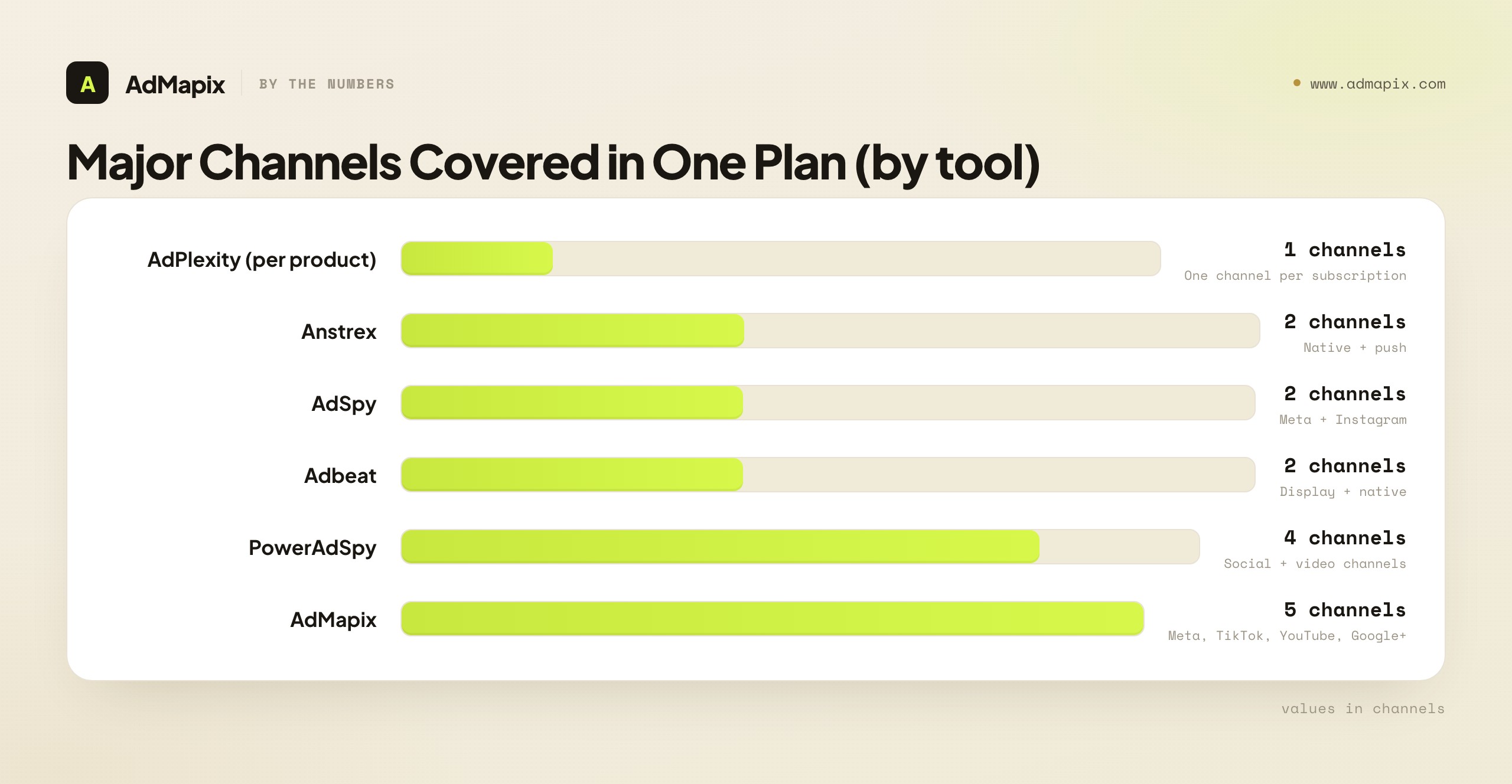
The pattern: specialists (AdPlexity per product, Anstrex, AdSpy) go deep on one or two channels; broad tools (BigSpy, PowerAdSpy) and cross-network layers (AdMapix) span more in one plan. Neither is better in the abstract — per-channel depth wins when you buy one channel, one-plan breadth wins when you buy several. Your channel count, more than any feature, predicts which side of the trade you want.
FAQ
What is the best AdPlexity alternative in 2026?
There's no single best — it depends on which gap AdPlexity left open. For cost within native/push, Anstrex. For paid-social creative, AdSpy (Meta depth) or PowerAdSpy (multi-channel social/video). For display intelligence, Adbeat. For cross-network coverage and client-ready reports without per-product fees, AdMapix. For cheap broad browsing, BigSpy. Define your real gap first — cost, creative type, reporting, or post-click context — and the right tool follows from your job, not from database size.
Why do people look for an AdPlexity alternative?
Usually one of four gaps, not a quality problem. AdPlexity sells separate products per channel, so a multi-channel buyer pays for a stack (the cost gap). Others need paid-social or video creative rather than affiliate funnels (the creative-type gap), or a reporting workflow their team can reuse (the reporting gap), or sharper post-click offer/landing-page context (the post-click gap). Naming which gap is biting is the whole decision, because each points to a completely different alternative.
Is there a cheaper AdPlexity alternative?
Yes, depending on your channels. Anstrex covers native and push at a lower flat price than stacking AdPlexity's separate Native and Push products, which is the most common cost fix. For broad browsing, BigSpy is low-cost. The official free libraries (Meta Ad Library, TikTok Creative Center) cover baseline non-affiliate discovery at no cost. The cheapest right answer depends on which channels you actually buy — count your AdPlexity products first, then compare.
What's the difference between AdPlexity and AdSpy?
They're in different lanes. AdPlexity is an affiliate-intelligence specialist — native, push, and the post-click funnel (offers, trackers, prelanders), sold per channel. AdSpy is a paid-social specialist — a deep Meta/Instagram ad archive with powerful filtering. If your job is affiliate funnels, AdPlexity's lane fits; if it's paid-social brand/DTC creative, AdSpy's does. They're complementary, not interchangeable — a team straddling both worlds often runs one of each.
Should I replace AdPlexity or add a second tool?
Often add, not replace. If you live in affiliate funnels and use AdPlexity's depth, keep it and add a social or cross-network tool for the job it doesn't do. Only do a clean replacement when a single alternative covers everything you actually use — which for a multi-channel buyer on the per-product model is often a single cross-channel tool. Stacking two tools covering the same channel is waste; pairing complementary jobs (affiliate funnels + social creative) is leverage.
How does AdMapix compare to AdPlexity?
They live in different lanes. AdPlexity is an affiliate-funnel specialist — strong at native/push offers, trackers, and prelanders, sold per channel. AdMapix is a cross-network creative-intelligence and reporting layer — strong at "pull competitor creative across Meta, TikTok, YouTube and more, break down why it works, and turn it into a report," in one plan. If your job is affiliate funnels, AdPlexity is more direct; if it's cross-network creative and reporting, AdMapix fits the gap the per-product model leaves.
Can a AdPlexity alternative show me offers and landing pages?
Some can, some can't — it depends on the lane. Affiliate-specialist tools like Anstrex surface offers, trackers, and landing-page/prelander context the way AdPlexity does, because that post-click funnel is the affiliate lane's whole point. Cross-network creative tools (including AdMapix) focus on the ads themselves and generally provide less affiliate-funnel detail. If post-click offer and landing-page context is your gap, stay in the affiliate-specialist lane rather than moving to a creative-focused tool.
Do I need video analysis or are ad examples enough?
It depends on your role. For affiliate funnel work, the offer and prelander often matter more than video structure. For brand, DTC, or app creative, understanding why a winning video works — the hook in the first two seconds, the proof moment, the pacing — is the job, and a playable example isn't a teardown. If your work shifted toward paid-social and video creative, hook-by-hook analysis is the difference between copying a thumbnail and adapting a structure.
How do I migrate off AdPlexity without losing my research?
Migrate in parallel, don't cancel-then-switch. Export your saved campaigns, offers, landing pages, and notes first; rebuild your competitor and offer set in the new tool; then run both side by side for two to four weeks on the same set. The parallel period confirms coverage before you cancel and surfaces any gap while you still have a fallback. Cancel or drop a product only after coverage is validated — let the parallel data, not the renewal date, decide.
When should I just keep AdPlexity?
Keep it when you live in one affiliate channel and use the depth, when the post-click funnel (offers, trackers, prelanders) is your edge, when you don't need paid-social or video creative or client reports, and when you'd only ever need one AdPlexity product (so there's no cost trap). The strongest reason to leave is coverage or cost outgrowing the per-product model — not dissatisfaction with the affiliate depth. If your scope still fits one product, staying is the disciplined, correct call.
Is Anstrex a good AdPlexity alternative?
Anstrex is the closest like-for-like if your gap is cost within native and push. It covers both channels at a lower flat price than stacking AdPlexity's separate Native and Push products, with the offer, funnel, and landing-page context affiliate teams rely on. It's the obvious move when your trigger is cost-to-usage and you don't need channels beyond native/push. Where it's lighter is breadth — no paid-social or video depth — and the reporting layer. If your gap is purely cost in the affiliate lane, Anstrex closes it directly; if your gap is social, video, or reporting, look elsewhere.
How many AdPlexity products do I actually need?
That's the single most useful question to answer before renewing, because AdPlexity's per-product model means cost scales with channels. Count the channels you genuinely buy and work weekly — native, push, desktop, mobile, YouTube. If the honest answer is one, the per-product model is efficient and you're not overpaying. If it's two or three, you're in the cost trap, and a single cross-channel tool usually costs less than the stack and removes the manual work of switching between products. Run the count first; it decides most of the decision on its own.
Can a cross-network tool replace AdPlexity for affiliate work?
Not fully, and that's the honest boundary. Cross-network creative tools (including AdMapix) excel at the ads themselves across Meta, TikTok, YouTube, and more, but they generally don't teardown affiliate funnels — offers, trackers, prelanders, traffic sources — the way a native/push specialist does. If affiliate-funnel depth is your edge, keep a specialist for that job. A cross-network tool is the right addition when you also need social/video creative or reporting, and the right replacement only when your job has fully moved out of affiliate funnels into brand creative.
Bottom Line
An AdPlexity alternative is worth it when a specific gap opens — a channel you can't afford to stack, a creative type it doesn't cover, a report it can't produce, or a price that no longer matches your usage. AdPlexity is genuinely strong at affiliate funnels, and switching away while affiliate depth is still your core job is a step backward, not forward — the gap, not dissatisfaction, is the real trigger.
Name your gap, count your channels, shortlist by that gap rather than by brand, trial against a real decision, and run parallel before you cancel. For cost within native/push, look at Anstrex; for paid-social creative, AdSpy or PowerAdSpy; for display, Adbeat; for cheap browsing, BigSpy; and for cross-network creative intelligence and reporting in one plan, AdMapix. If one affiliate product still fits, keep AdPlexity — the disciplined move is matching the tool to the gap, not chasing the biggest database. And whichever tool you land on, the disciplined weekly loop around it — fixed competitor set, evidence with context, teardowns, and a diff over time — matters more than the tool itself.
The single most clarifying thing you can do before any of this is count your channels and name your gap in one sentence — "I buy native and push and need them at one price," or "my creative moved to Meta and TikTok and I need teardowns," or "I owe clients a weekly cross-channel report." That one sentence eliminates most of the seven options immediately and turns a vague "find an AdPlexity alternative" into a precise, answerable choice. The per-product model is genuinely efficient for the single-channel affiliate buyer and genuinely expensive for the multi-channel one; everything else in this guide is just helping you figure out, honestly, which of those two you are — and then matching the tool to that answer rather than to whichever vendor argues loudest.
Sources
- Meta Ad Library — official free archive of live Meta ads
- TikTok Creative Center — official free TikTok ad and trend discovery
- Google Ads Transparency Center — public cross-format competitor ad research
- AdPlexity — affiliate ad intelligence across native, push, desktop, mobile, and YouTube
- Anstrex — native and push ad spy with offer and landing-page context
See what competitors are really running
Search 6M+ ad creatives, landing pages, and weekly spend across 200+ countries. No credit card, no commitment.
Related Articles
Semrush Ad Intelligence Alternative in 2026: PPC Research or Creative Evidence?
A 2026 decision framework for choosing a Semrush ad intelligence alternative — when PPC keyword and spend research wins, when competitor creative and video evidence wins, how AdClarity fits, a fair-trial method, and how to build a two-layer stack.
Pathmatics Alternative in 2026: Ad Spend Intelligence vs. Creative Workflow
A complete 2026 buyer's guide to choosing a Pathmatics alternative — why teams look past Pathmatics (now Sensor Tower), what it actually measures, a layered comparison of spend-intelligence suites versus creative-workflow tools across coverage, data type, price, and fit, who should choose which, a practical migration plan, the honest limits of estimated spend, and where a lighter cross-network creative tool like AdMapix fits.
Moat Alternative in 2026: Ad Verification vs. Creative Intelligence
A complete 2026 buyer's guide to choosing a Moat alternative — why teams look past Oracle Moat, what Moat actually does (viewability, invalid traffic, brand safety), the critical split between the ad-verification layer and the creative-intelligence layer, a layered comparison across coverage and fit, who should choose which, a practical migration plan, the honest limits of public creative data, and where a creative-research tool like AdMapix fits.