
SpyTok Pricing: $49 Starter, $59 Growth & TikTok Ad Alternatives
SpyTok’s documented organic TikTok workflow, monthly and annual pricing, free access, and conflicting refund terms, with eight paid-ad examples showing when a separate advertising research tool fits.
SpyTok Pricing: $49 Starter, $59 Growth & TikTok Ad Alternatives
AdMapix Research — prepared with Codex and checked against the dated source sample.
Last updated: 2026-11-12
SpyTok lists Starter at $49/month and Growth at $59/month as of November 12, 2026, while the paid TikTok examples below cover 2026-10-13 to 2026-11-11. Its public pages describe organic TikTok posts from app accounts, format discovery, and creator briefs; they do not mention paid-ad tracking. For UA managers, creative strategists, and app growth teams, that distinction determines which research subscription belongs in the workflow. If your next deliverable is an organic creator script, investigate SpyTok’s format research. If it is a paid-ad reference board, investigate advertising sources. This guide puts the subscription terms first, explains the conflicting refund language, and uses actual advertising examples to show what a separate paid-creative research task involves.
Quick Answer
SpyTok’s documented job is finding organic TikTok formats for app marketers and turning those references into adaptation briefs. Paid advertising research calls for a separate source selection.
- Monthly pricing: Starter is $49 and Growth is $59. Annual billing is $299 and $399 respectively, according to the pricing page checked November 12, 2026.
- Free access: the same page offers one AI credit with a free account and public example browsing without registration.
- Refunds: pricing and policy pages say 30 days; the homepage says 14 days. Confirm the applicable terms before purchasing.
- Paid-ad alternatives: consider TikTok’s official research tools and AdMapix according to the evidence you need. The US TikTok search examined here contains 30 advertising records representing 27 distinct video files.
How much does SpyTok cost, and what are the subscription terms?
SpyTok’s pricing page, as of November 12, 2026, lists two paid plans with monthly and annual billing. The annual option displays a monthly equivalent but charges the stated yearly amount.
| SpyTok plan | Monthly billing | Annual billing displayed | Annual charge | Listed inclusions |
|---|---|---|---|---|
| Starter | $49/month | $24.92/month | $299 yearly | Daily viral posts for rising apps; one app with a personalized feed; 10 AI video briefs monthly; three collections holding 30 posts each |
| Growth | $59/month | $33.25/month | $399 yearly | Every viral post behind rising apps, in the vendor’s wording; three apps with personalized feeds; 50 AI video briefs monthly; industry and format filters |
Source: SpyTok pricing, checked November 12, 2026. These are SpyTok’s published terms, not AdMapix plans.
The buying question is whether your team needs research for one app or several, and how many adaptation briefs it expects to produce. A team investigating a single app can compare its planned output with Starter’s listed allowance. A team preparing briefs across several apps can examine Growth’s additional feeds and briefs. This is a comparison of published entitlements, not a judgment about brief quality.
The pricing FAQ also describes a free entry point: create an account to receive one AI credit for a first adaptation brief. It says visitors can browse top-post examples by industry and format without signing up. That gives a prospective customer a concrete starting task: find a relevant reference and assess whether the resulting brief matches their production needs.
Cancellation and refunds are separate questions. According to the same pricing FAQ, users can cancel anytime and retain access until the end of their current billing period. It lists major credit cards, including Visa, Mastercard, and American Express, plus debit cards through Stripe. No enterprise or custom tier is listed on that page.
The refund wording needs confirmation. The pricing page and refund policy say new subscribers may request a full refund within the first 30 days of their initial subscription. The policy directs requests to support@spytok.com. However, the homepage FAQ says there is a 14-day refund policy, “no questions asked.” Both statements were present in the pages checked on November 12, 2026.
Before relying on either period, ask SpyTok which terms apply to your purchase and keep the response with your subscription receipt. The discrepancy is specific: the public pages give different refund periods. It does not establish how an individual request will be handled.
What does SpyTok track, and who does its documented workflow fit?
SpyTok describes a research workflow built around TikTok posts published by app accounts, followed by AI-assisted adaptation briefs. Its homepage, as of November 12, 2026, organizes that workflow into “Ideate,” “Discover,” and “Adapt.”
At the first stage, the site says a user supplies an App Store, Play Store, or website URL. SpyTok says its AI profiles the app, audience, and competitive landscape. At the discovery stage, it describes surfacing posts, metrics, formats, and outlier scores from similar apps. At the adaptation stage, it lists beat-by-beat scripts, hook variants, and product-placement notes for creators or an internal team. These are descriptions from SpyTok’s homepage, not capabilities we have tested.
The same page claims more than 500,000 analyzed TikTok posts across more than 2,000 app accounts, coverage of more than 20 app categories, and scanning of more than 100,000 new posts weekly. Those are vendor-reported figures as of November 12, 2026. Examples of categories listed there include fitness, finance, productivity, lifestyle, and gaming.
That documented scope is relevant when an app marketer’s question is: “Which organic content formats should our creators adapt?” It connects the reference post to a production deliverable. A buyer should therefore assess relevance to their app category, whether the reference makes sense for their audience, and how much editing a proposed script needs before filming.
SpyTok’s definition of an outlier score also matters. Its homepage FAQ says the score compares a post’s performance with that account’s average. Its example describes a 10× outlier as a post receiving 10× the views of the creator’s typical post. The baseline is the account’s usual view performance. The definition does not describe an install rate or a return on advertising spend.
For teams researching paid campaigns, the documentation leaves different questions unanswered. The homepage and pricing page checked on November 12, 2026 do not mention paid-ad creatives, ad spend, ad impressions, or TikTok Ads Manager data. They also do not document an API. This makes paid-ad research an undocumented use case in those pages; it does not justify claiming that SpyTok cannot support an unlisted function.
Which SpyTok alternatives fit organic research and paid-ad research?
Choose an alternative by the next artifact your team needs: an organic creator brief, an advertising reference, or an organized paid-creative research collection. A tool name containing “spy” does not settle that choice.
| Your immediate job | Starting point | What to establish before committing |
|---|---|---|
| Find organic formats from app accounts | SpyTok’s public examples and documented brief workflow | Relevant app categories, useful reference posts, and a brief that fits production |
| Investigate TikTok’s own research surfaces | TikTok Creative Center and Commercial Content Library guidance | The applicable tool, market scope, available fields, and access conditions |
| Examine indexed paid-ad examples | AdMapix search | Correct network and country filters, listing identity, dates, and usable creative references |
| Produce both organic and paid concepts | Separate reference collections for each task | Which source supports each observation and which result your own test will measure |
For TikTok’s official tools, start with our Creative Center guide and Commercial Content Library guide. Those pages carry the dated documentation and explain the respective workflows and coverage boundaries; use them to choose the appropriate official surface.
AdMapix is an advertising intelligence product for researching indexed creatives. The examples below demonstrate a specific paid-ad research task: sorting a dated TikTok-network selection, checking associated listings, and describing visible hooks. That is a different deliverable from SpyTok’s documented organic-post adaptation workflow.
For a broader shortlist beyond this brand-specific decision, the parent TikTok ad spy tool comparison provides additional research paths. Here, the useful comparison is between jobs, rather than an unsupported ranking of products.
How was the US TikTok evidence collected?
The advertising evidence comes from a US TikTok-network search for 2026-10-13 to 2026-11-11, fetched on 2026-11-12. The query contained no keyword and no single-product restriction; results were requested in descending order of estimated impressions across three pages of ten records.
The frozen network mapping identifies the selected channel as TikTok. Listing associations were retained from the returned product records rather than inferred from names appearing in captions. The eight illustrated examples below are the highest-ranked records in this selection, associated with FOX Broadcasting Company, Cricket Wireless, and Samsung.
| Measurement | Result for this US TikTok selection |
|---|---|
| Advertising records | 30 |
| Distinct video files, deduplicated by fingerprint | 27 |
| Records containing video | 30 |
| Distinct image files | 0 |
| Distinct playable files | 0 |
| Third-party model-estimated impressions in the measurement window | 13,532,177 |
| Top record’s share of the selection’s estimated impressions | 16.2% |
The original batches, request parameters, and checksums are available in the public frozen source package. It makes the source selection and calculations reproducible. The record total and video total answer different questions: repeated use of a video can produce multiple advertising records.
What this sample can and cannot show:
- It shows indexed advertising records under the stated country, network, date, and ranking settings. It is not a complete advertiser fleet or a census of TikTok advertising.
- Impression figures are third-party model estimates for the specified window, not observed delivery, spend, installs, revenue, profit, or lifetime totals. Product-search aggregates are excluded.
- Contact sheets show frames at 0, 2, 5, and 10 seconds, except the Cricket example, which shows 0, 2, and 5 seconds. They support visual observations, not claims of complete playback, audio inspection, or campaign performance.
- Listing associations identify the reported product relationship. They do not independently identify the ad buyer. Discovery dates do not establish uninterrupted delivery or effectiveness.
- SpyTok information comes from its public pages checked November 12, 2026. AdMapix has not tested SpyTok; this article does not assess its interface, data accuracy, or output quality.
The evidence makes a useful paid-research distinction tangible: the highest-ranked example is a creator-style domestic scene, while other examples use an explainer, an animated character, or a visual guessing prompt. These are production approaches a team can organize before choosing what to test.
To build that kind of reference set for your own project, sign up or log in to inspect paid TikTok creatives in AdMapix, then apply the network, country, and date filters relevant to your brief.
What do the creator-style paid-ad examples show?
The creator-style examples place a commercial message inside recognizable situations: a room at home, a returning college student, a doorway exchange, and a presenter’s explanation. Their production value for researchers lies in the specific scene, text, and branding choices visible in each contact sheet.
The following table connects every illustrated example to its reported listing and its own window estimate. Figures refer to the numbered images throughout this article.
| Figure | Frozen record ID | Reported listing | Visible creative approach | Model-estimated impressions, 2026-10-13 to 2026-11-11 |
|---|---|---|---|---|
| 1 | 3285663ca780d1dfca7c534a53371ad9 | FOX Broadcasting Company | Domestic scene with sports-streaming branding | 2,189,791 |
| 2 | a771a09b675c7d89099f019d60277e3c | FOX Broadcasting Company | College-homecoming premise | 1,700,686 |
| 3 | 6bac949f9bc3130c6ce9db886f125ec1 | FOX Broadcasting Company | Doorway scene and contrasting character appearances | 1,339,742 |
| 4 | 46f15efa37bce7331c1ee7ce5196914e | FOX Broadcasting Company | Presenter with an election-seat graphic | 1,205,453 |
| 5 | 0cf84a0776f0759d33ca0977456af0a5 | Cricket Wireless | Monthly-bill message and animated character | 1,152,500 |
| 6 | 13fb326cd7d03c6cb0de19e41e77dd5b | Samsung | Colorful characters and wireless-switching message | 762,910 |
| 7 | ca7a25d7efef62f99fda8126c0a3a2b1 | FOX Broadcasting Company | Phone-shaped cake guessing prompt | 652,706 |
| 8 | 08cc97ceefaaef8b617fb74c9cd773fd | FOX Broadcasting Company | Referee costume and household game-day joke | 498,460 |
Figure 1: a domestic scene keeps the streaming brand visible.
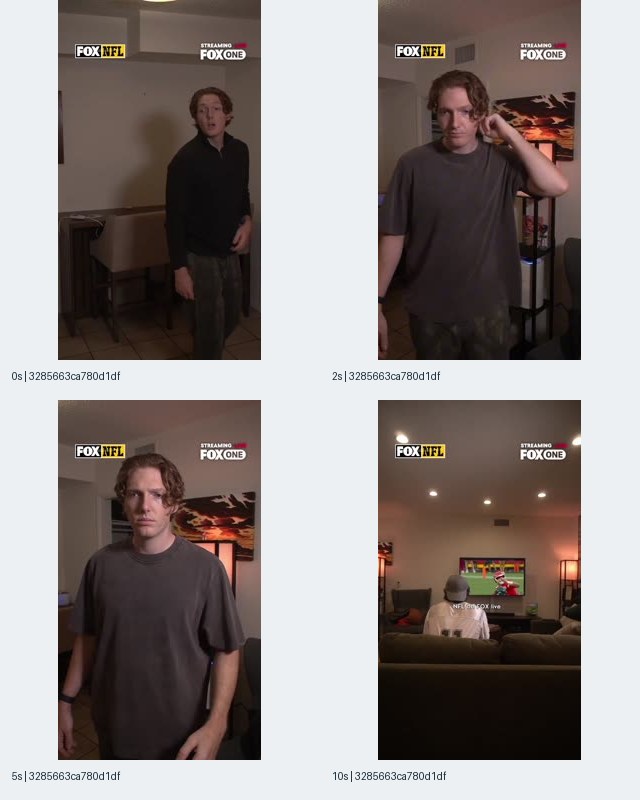
Figure 1. Reported listing: FOX Broadcasting Company. Frozen record ID: 3285663ca780d1dfca7c534a53371ad9. The sampled frames show a domestic interior, changing camera distance, and FOX NFL and FOX One branding.
At 0 seconds, a person stands farther from the camera in dark clothing. The 2- and 5-second frames show closer views of a person in a gray shirt. At 10 seconds, the view includes a sofa and a television displaying football. The visible branding connects the domestic scene with the streaming message carried by the record’s caption.
For a creative brief, the useful extraction is “show the viewing situation while retaining a recognizable brand cue.” A hypothesis worth testing is that a familiar situation can introduce a streaming use case without beginning with a feature list. The shoot would still need an original scenario and an explicit product action.
Figure 2: the caption establishes the social role.
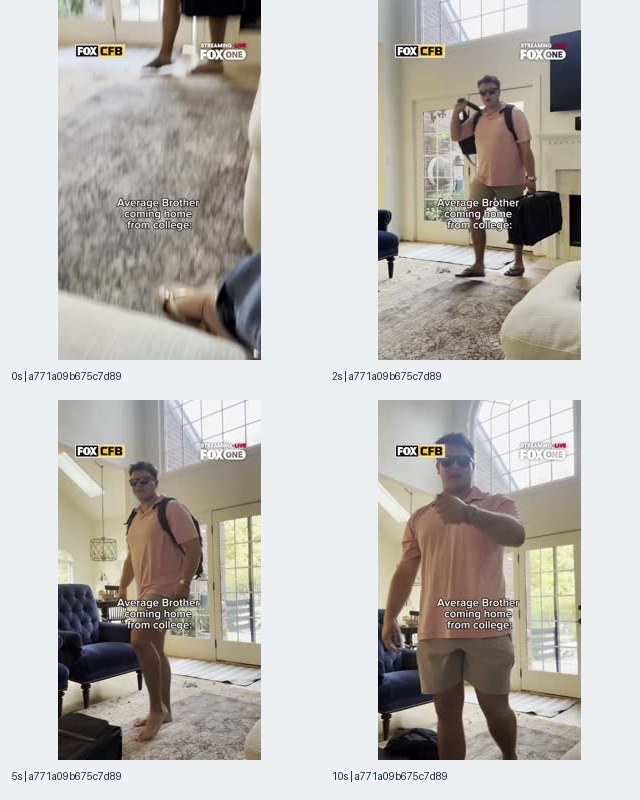
Figure 2. Reported listing: FOX Broadcasting Company. Frozen record ID: a771a09b675c7d89099f019d60277e3c. Frames at 0, 2, 5, and 10 seconds pair a college-homecoming caption with an arrival scene and FOX college-football branding.
The text “Average Brother coming home from college” establishes the premise. In the 2-second frame, sunglasses, a backpack, and luggage reinforce that arrival context. Later sampled frames bring the person closer to the camera. The research note should distinguish the literal caption from any imagined dialogue.
The production lesson is practical: a relationship label can explain a character before a scene develops. For an app brief, a team might test an original role such as “the friend who organizes everything,” then show the relevant app action. That is a proposed adaptation principle, not evidence that the homecoming format caused the estimate shown above.
Figure 3: costume and expression create contrasting character cues.
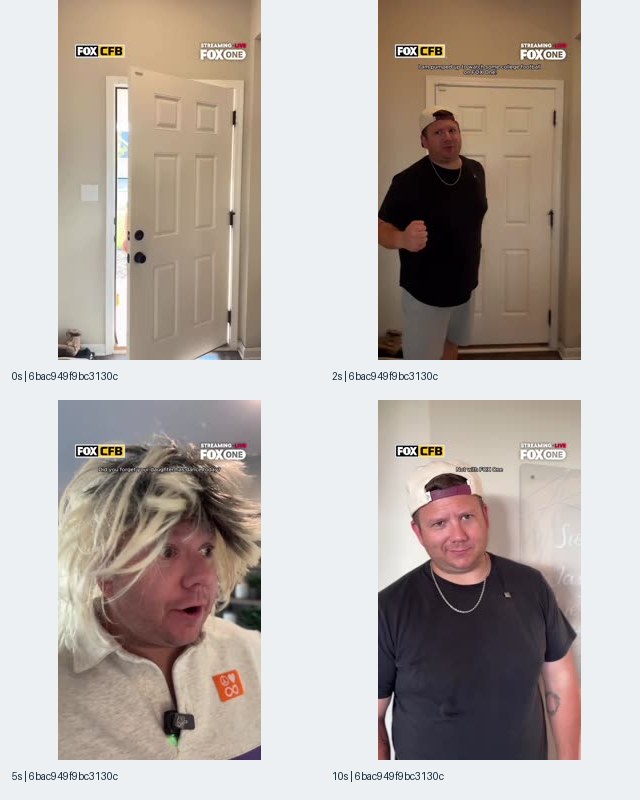
Figure 3. Reported listing: FOX Broadcasting Company. Frozen record ID: 6bac949f9bc3130c6ce9db886f125ec1. The 0-, 2-, 5-, and 10-second frames show a doorway setup and contrasting character appearances under college-football streaming branding.
An open front door provides the first setting. A person in a backward cap appears at 2 seconds, a wig-wearing character fills the 5-second frame, and the cap-wearing person appears again at 10 seconds. The frames support a note about visual character contrast; they do not establish the complete exchange.
A useful brief would specify the character difference, the camera framing, and where the product enters the interaction. “Make a funny skit” is too vague to reproduce or evaluate. “Use contrasting reactions to the same product situation” gives the production team a concrete mechanism to develop.
Figure 4: a presenter shares the frame with explanatory information.
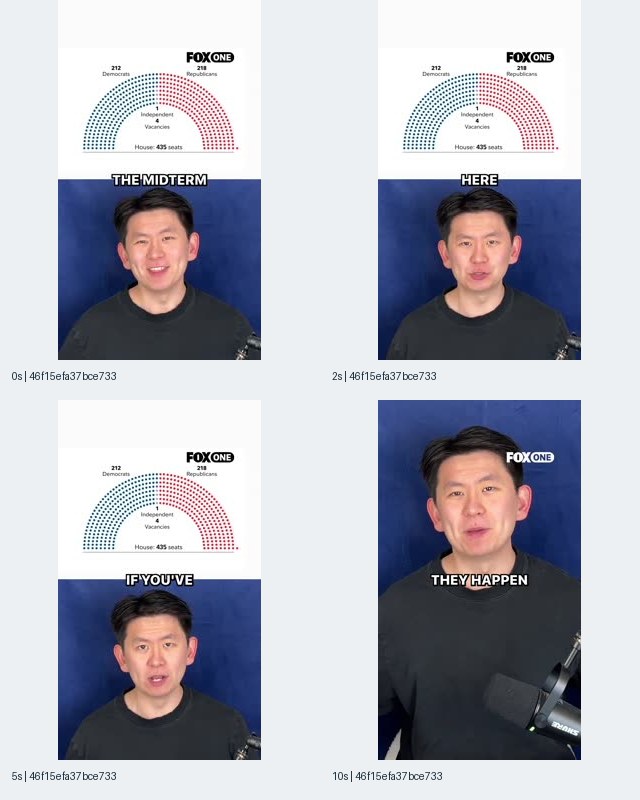
Figure 4. Reported listing: FOX Broadcasting Company. Frozen record ID: 46f15efa37bce7331c1ee7ce5196914e. Frames at 0, 2, 5, and 10 seconds show a presenter, an election-seat graphic, changing text, and FOX One branding.
The early frames divide attention between the presenter and a semicircular seat graphic. The 10-second frame gives the presenter more of the screen and includes a microphone. This is a reference for the organization of explanatory information, not a source for validating the political figures printed in the graphic.
An app team could apply the same briefing question to a factual demonstration: what should the viewer inspect while the presenter speaks? The answer might be an actual interface, a documented comparison, or a completed task. Keep the supporting visual readable and tie every explanatory claim to evidence your team can verify.
How do product messages and curiosity prompts change the creative brief?
The next examples make the research task more specific: identify whether the ad foregrounds a benefit, visualizes a product claim, asks the viewer to guess, or turns a familiar activity into a joke. Each mechanism calls for different production assets and a different test hypothesis.
Figure 5: the bill-related benefit is written into the opening frame.
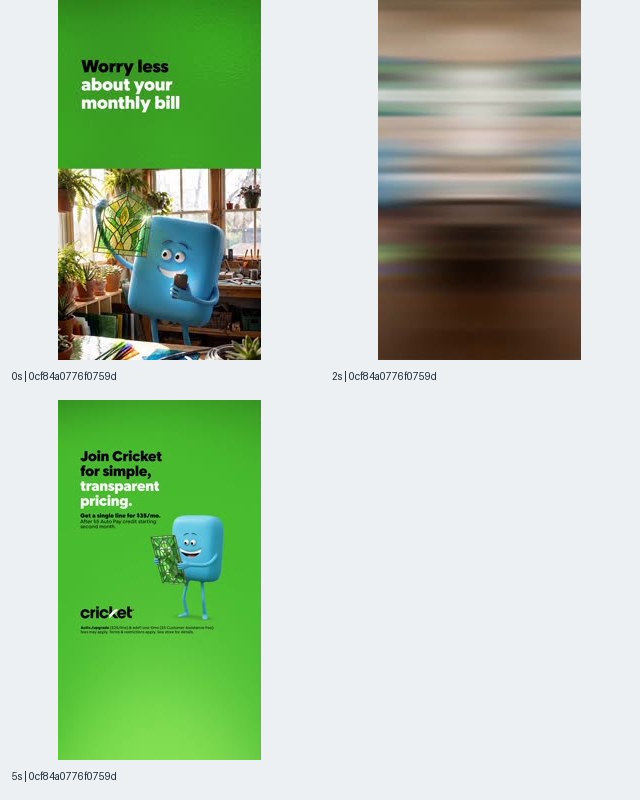
Figure 5. Reported listing: Cricket Wireless. Frozen record ID: 0cf84a0776f0759d33ca0977456af0a5. Frames at 0, 2, and 5 seconds show monthly-bill copy, a blue character, a blurred intermediate frame, and a green branded pricing message.
The opening reads “Worry less about your monthly bill,” pairing a financial concern with a character in a bright interior. At 5 seconds, the visible text emphasizes simple, transparent pricing. The observation is about message hierarchy: the customer concern receives prominent space before the later branded offer presentation.
For a subscription app, an original test could compare an opening focused on a verified billing benefit with an opening focused on a feature. The hypothesis is that the billing message changes which concern viewers recognize first. Any price or eligibility claim would need current product documentation before production.
If your team needs more references for that decision, inspect indexed FOX One creatives and apply TikTok, US, and date filters. Use the search to examine relevant examples rather than assuming a keyword alone establishes the correct listing or network.
After identifying a useful message structure, sign up or log in to research the next paid TikTok examples for your own brief. Keep the visible benefit and the proposed test question together as you build the collection.
Figure 6: colorful characters illustrate a switching message.
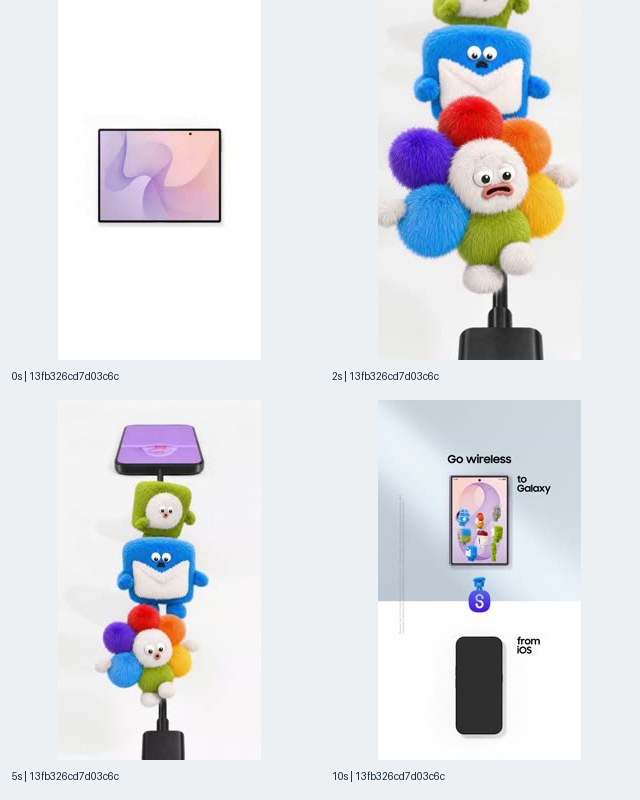
Figure 6. Reported listing: Samsung. Frozen record ID: 13fb326cd7d03c6cb0de19e41e77dd5b. Frames at 0, 2, 5, and 10 seconds show screens, colorful characters, a cable connector, and a wireless-switching message.
The 2- and 5-second frames place fuzzy characters in a vertical arrangement around a device and connector. The 10-second frame contains “Go wireless,” “to Galaxy,” and “from iOS.” The record’s caption describes Smart Switch moving a user’s belongings to Galaxy; that is the advertiser’s product claim.
The creative reference is the use of concrete visual characters to express an abstract transfer. For an app team, the equivalent brief should name exactly what is moving or changing and what the viewer needs to understand. A metaphor can supply a visual idea, while a factual demonstration supplies evidence for the underlying promise.
Figure 7: a guessing question gives the viewer a defined task.
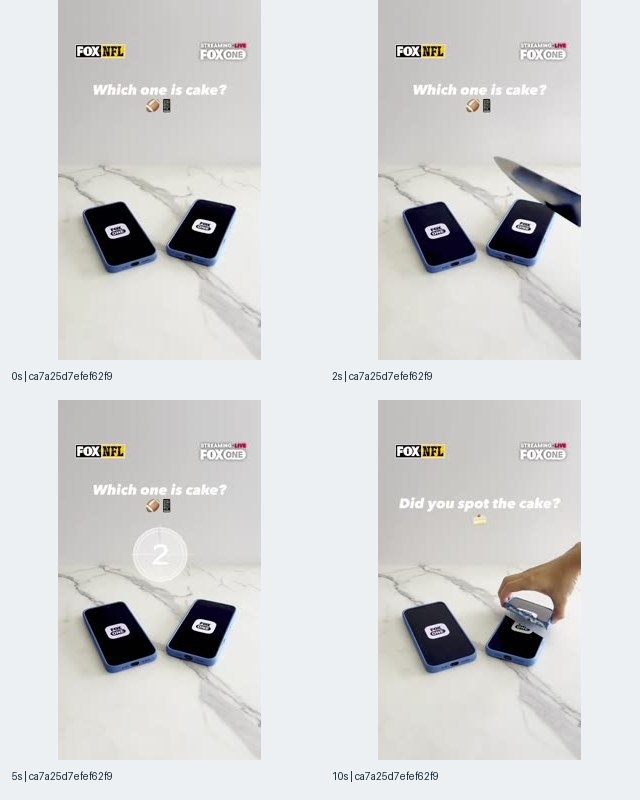
Figure 7. Reported listing: FOX Broadcasting Company. Frozen record ID: ca7a25d7efef62f99fda8126c0a3a2b1. Frames at 0, 2, 5, and 10 seconds pair “Which one is cake?” with phone-shaped objects and a later “Did you spot the cake?” prompt.
The first frame asks a narrow question about objects already visible. A knife appears in the 2-second frame, a countdown numeral appears at 5 seconds, and a hand lifts a cut section at 10 seconds. FOX NFL and FOX One branding remain visible in the sampled frames.
For a brief, distinguish the attention device from the product connection. The hypothesis is that a concrete guessing task encourages interest in a reveal. Your own concept still needs a reason for the question to involve the product. A puzzle about an unrelated object could generate an entertaining reference without explaining why someone should use the app.
Figure 8: the costume makes the joke’s frame legible.
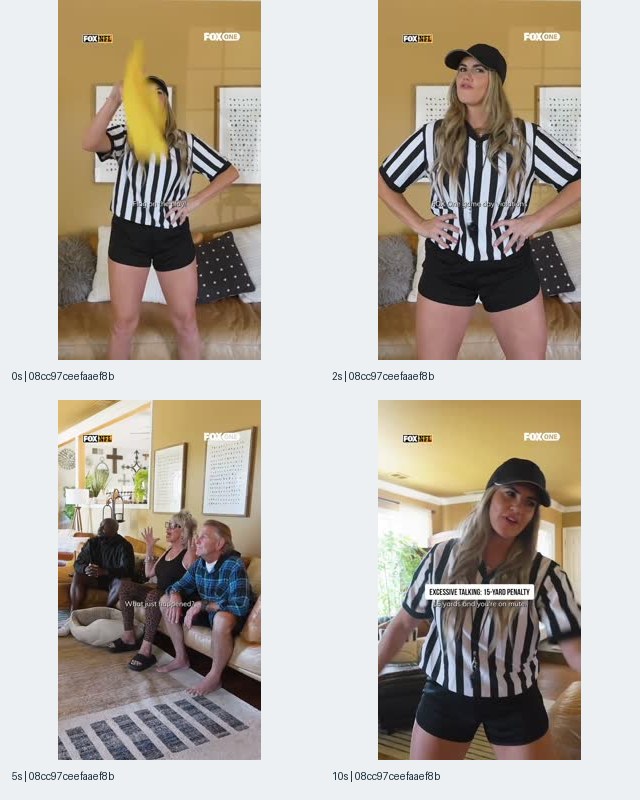
Figure 8. Reported listing: FOX Broadcasting Company. Frozen record ID: 08cc97ceefaaef8b617fb74c9cd773fd. The 0-, 2-, 5-, and 10-second frames show a referee costume, a yellow flag, a sofa reaction shot, and a penalty caption.
The striped shirt and flag establish the sports-official role visually. At 5 seconds, the image switches to people seated on a sofa. At 10 seconds, the referee-costumed person appears with “Excessive talking: 15-yard penalty” text. The visible joke applies a sports rule to a household viewing situation.
A production team can turn that observation into a specific question: which recognizable rule or ritual fits our product’s actual use case? The proposed test might apply a familiar organizing ritual to a productivity app. It should use original characters, wording, and footage, with the product benefit written into the scene rather than added as an afterthought.
How should a team turn these references into a brief and avoid common mistakes?
Build the brief around an observable mechanism and a testable product message. The research is useful when another team member can trace the idea to a reference and understand what the original production is meant to establish.
Start by naming the deliverable. An organic creator script needs reference posts and an understanding of the account context. A paid-creative brief needs advertising references plus the product promise your campaign will test. Keep those research collections distinguishable even when both use skits, presenters, or demonstrations.
For paid references, record the network, country, measurement dates, listing association, and record identifier. Deduplicate video files before describing creative variety. In this search, 30 records resolve to 27 video files; counting every row as a different production would misstate the amount of distinct media.
Then write the observation without interpretation. For Figure 7, a defensible entry is: “Two phone-shaped objects appear beneath a cake question; a knife, countdown numeral, and lifted cut section appear in later sampled frames.” Write the hypothesis separately: “A product-relevant guessing question may make viewers curious about the demonstration.”
The handoff can use a compact worksheet:
| Brief field | Example instruction |
|---|---|
| Source reference | Figure 7, FOX Broadcasting Company listing, with the dated source record |
| Observable mechanism | A question about visible objects followed by sampled reveal imagery |
| Original product promise | State one benefit supported by the app’s current functionality |
| Proposed concept | Ask viewers to predict the result of a real product action |
| Required footage | Original setup, actual action, visible result, and brand identification |
| Hypothesis | A prediction prompt may improve attention to the product demonstration |
| Evaluation | Compare with a direct demonstration under matched campaign conditions; select the success metric before launch |
Keep the following mistakes out of the handoff:
- Calling a reference a winner: use “candidate reference” until your own campaign evidence supports a performance judgment.
- Mixing outlier views with ad impressions: retain each metric’s source and definition instead of putting them on a shared performance scale.
- Copying an entire execution: borrow the mechanism and develop original dialogue, characters, visuals, and product context.
- Treating a sampled frame as the ending: label the timestamp and request the complete source if the final sequence matters to production.
- Planning measurement after filming: decide what changes between variants and what result will determine the next action before the shoot.
For file handling, our TikTok ad-saving workflow explains how to preserve accessible references with their source information. The production package should remain understandable even if a teammate never opens the original research session.
When should you use AdMapix alongside SpyTok?
Use AdMapix when the immediate task is to inspect indexed advertising creatives and assemble evidence for a paid-creative brief. Evaluate SpyTok when its documented organic app-account research and adaptation workflow matches the deliverable you need.
Disclosure: AdMapix is our own product, so the recommendation here is tied to the paid-research task demonstrated in this article. The example starts with a network-filtered search, preserves listing associations, separates advertising records from distinct media, and turns visible creative choices into production questions.
A practical first session is narrow: choose a relevant advertiser or product term, confirm the listing association, apply TikTok and your target country, and record the date range. Examine whether the available references help answer a real question, such as how to introduce a benefit or connect a skit to a product action. Check the AdMapix methodology for how to interpret the data, and use the live pricing page for current plans and access terms.
If that is your next task, sign up or log in to build your own paid TikTok creative shortlist. Bring a product promise and a production question; use the references to write a test your team can actually run.
FAQ
Is SpyTok free?
SpyTok offers limited free access according to its pricing FAQ, checked November 12, 2026. A free account receives one AI credit for a first adaptation brief. The page also says visitors can browse top-post examples by industry and format without signing up. This is distinct from the entitlements listed for its paid subscriptions.
How much does SpyTok cost?
As of November 12, 2026, SpyTok pricing lists Starter at $49/month and Growth at $59/month with monthly billing. Annual options are billed at $299 and $399 respectively, displayed as $24.92 and $33.25 per month. Check the annual charge when budgeting rather than treating the displayed equivalent as a monthly payment schedule.
Does SpyTok have an API?
The homepage and pricing page checked on November 12, 2026 do not document an API. That establishes a documentation gap, not proof that no API exists. If programmatic access is essential, ask SpyTok directly about availability, authentication, permitted use, returned fields, and commercial terms before designing an integration around it.
Does SpyTok show TikTok ads?
SpyTok’s public homepage describes organic posts from app accounts, metrics, outlier scores, and adaptation briefs. The pages checked November 12, 2026 do not mention paid-ad creatives, ad spend, ad impressions, or TikTok Ads Manager data. Confirm a paid-ad requirement directly with SpyTok; the advertising examples in this article come from a separate AdMapix search.
Does SpyTok offer refunds?
Its pricing page and refund policy describe a 30-day money-back guarantee for new subscribers, but its homepage FAQ says 14 days. Both appeared in the November 12, 2026 check. Confirm which period applies before relying on either statement. The policy directs refund requests to support@spytok.com.
What is SpyTok’s outlier score?
According to the homepage FAQ, the score compares a post’s performance with the account’s average. SpyTok illustrates this with a 10× outlier receiving 10× the views of the creator’s typical post. That definition concerns relative post views. It does not establish paid campaign efficiency, attributed installs, or the likely result of adapting the format.
What happens if I cancel SpyTok?
The pricing FAQ, checked November 12, 2026, says users can cancel anytime and retain access until the end of their current billing period. Cancellation therefore needs to be considered separately from requesting a refund. For annual billing, confirm the applicable access period and refund terms with SpyTok before committing to the yearly charge.
What are the key takeaways?
SpyTok’s published offer is specific enough to evaluate against an organic-content brief, while the paid-ad examples demonstrate a separate research workflow.
- Choose by deliverable: organic app-account formats and adaptation briefs align with SpyTok’s documented workflow; paid references require an advertising source.
- Read the billing commitment: compare monthly charges with the actual yearly invoice, then confirm the conflicting refund periods.
- Preserve the evidence unit: this US TikTok selection contains 30 advertising records and 27 distinct video files.
- Extract a mechanism: scene setup, role captions, explanatory graphics, benefit copy, and guessing prompts can become original production instructions.
- Test the hypothesis yourself: the useful output is a brief with a clear product promise, required footage, and a predetermined evaluation method.
Sources
The sources below establish the dated product descriptions, subscription terms, advertising evidence, and research workflow used in this article.
- SpyTok homepage — checked 2026-11-12: spytok.com. Source for the app-account focus, vendor-reported coverage, Ideate–Discover–Adapt workflow, outlier-score definition, and homepage refund wording.
- SpyTok pricing — checked 2026-11-12: Plans and pricing FAQ. Source for monthly and annual billing, plan inclusions, free access, cancellation, payment methods, and pricing-page refund language.
- SpyTok refund policy — checked 2026-11-12: Refund policy. Source for the stated new-subscriber guarantee and refund-request contact; read alongside the conflicting homepage statement.
- AdMapix frozen advertising evidence — fetched 2026-11-12: Public source package. Contains public batches, request parameters, and checksums for the US TikTok search covering 2026-10-13 to 2026-11-11, including the records and image associations discussed here.
- AdMapix search workflow — observation dated 2026-11-12: FOX One creative search. A starting point for inspecting indexed references; apply the country, network, and date settings described in the methodology. Live results can change.
- AdMapix methodology and product terms — applied to this 2026-11-12 analysis: Data methodology and live pricing. Product facts supplied for this article were reviewed on 2026-08-13; current commercial terms should be checked on the live page.
- TikTok official-tool reading paths — included in this 2026-11-12 guide: Creative Center documentation guide and Commercial Content Library documentation guide. Consult their dated sources for tool-specific scope and access details.
Turn these observations into your next creative study
Open the creative library and select samples for your market, network and research question.
Related Articles
AppMagic Alternatives 2026: Pricing by Demo, Options by Job
Choose an AppMagic alternative by research job, with verified Sensor Tower ownership and demo-pricing context, AdMapix’s capabilities and gaps, and eight dated AppLovin creative examples.
Holiday Marketing Campaigns for Subscription Apps
Use eight dated advertising references to plan subscription app holiday campaigns, distinguish access claims from verified offers, and build original briefs for trials, annual plans, and seasonal creative tests.
Facebook Carousel Ads vs Single-Image Ads: Compare the Product Message
Compare Facebook carousel and single-image product messaging through eight dated advertising references, a matched production brief, and a practical testing workflow that separates visual evidence from unmeasured performance.