
AppMagic Alternatives 2026: Pricing by Demo, Options by Job
Choose an AppMagic alternative by research job, with verified Sensor Tower ownership and demo-pricing context, AdMapix’s capabilities and gaps, and eight dated AppLovin creative examples.
AppMagic Alternatives 2026: Pricing by Demo, Options by Job
AdMapix Research — prepared with Codex and checked against the dated source sample.
Last updated: 2026-11-12
AppMagic alternative decisions now start with pricing by demo and a choice of research jobs; the advertising examples below cover 2026-10-13 to 2026-11-11. Sensor Tower acquired AppMagic on May 12, 2026. As of November 12, AppMagic’s pricing page leads to a demo request and lists no prices. For UA managers and creative teams, AdMapix is an option for competitor ad creatives, app-store rankings, and app-level download and revenue estimates. Teams needing retention, engagement, or Steam analytics need additional coverage. This guide maps those jobs before you commit to a tool, then uses real AppLovin creative examples to show what your team can turn into a production brief.
Quick Answer
AdMapix addresses the creative-research and app-estimate parts of an AppMagic replacement. It does not replace AppMagic’s advertised retention, engagement, or Steam capabilities.
- Competitor creatives: consider AdMapix for videos, playables, creative research, and recurring competitor monitoring.
- App-level market signals: AdMapix provides store rankings and estimated downloads and revenue.
- Retention, engagement, and Steam: AdMapix does not offer these datasets.
- ASO and keywords: this article does not establish AdMapix as an ASO keyword tool.
AppMagic’s demo is free, but the checked page does not establish a free product tier. AdMapix has a limited free plan; current access and commercial terms belong on the live pricing page.
What changed at AppMagic in 2026?
AppMagic became part of Sensor Tower, and its current pricing path requires a demo before pricing details are shared. These are separate verified facts; the sources do not establish that the acquisition caused a pricing change.
Sensor Tower’s May 12, 2026 announcement describes AppMagic as its new small and medium-sized business offering. AppMagic’s May 15 announcement confirms that focus within Sensor Tower’s broader intelligence ecosystem.
As checked on November 12, 2026, AppMagic’s pricing address redirects to its demo-request page. The page says: “After your personalized demo, our sales team will help you choose the most suitable tools and share pricing details with you.” It also says requesting a demo is free and carries no obligation.
That establishes today’s buying process. It does not establish a price increase, the removal of a free plan, or what an account without a contract includes.
For readers comparing AppMagic versus Sensor Tower, the ownership question is settled: AppMagic belongs to Sensor Tower. Product equivalence is a different question. The announcement positions AppMagic as the SMB offering without saying that the products have identical features. Our Sensor Tower alternative guide addresses the parent-company decision separately.
Which AppMagic alternative fits each research job?
Choose an alternative against the report or brief your team needs to produce. AdMapix overlaps with AppMagic on creative research and app-level market estimates, while other advertised AppMagic jobs require separate evaluation.
| Research job | AppMagic’s advertised scope, checked 2026-11-12 | Verified AdMapix fit | Buying decision |
|---|---|---|---|
| Competitor ad creatives | Advertising across networks, regions, and creative formats | Creative search, videos, playables, exposure trends, and competitor monitoring | Evaluate with your actual competitor list |
| App-level downloads, revenue estimates, and store rankings | Mobile revenues, downloads, trends, and competitor metrics | App-store rankings and app-level estimated downloads and revenue | Compare matching apps, dates, countries, and store scope |
| Retention and engagement | Retention, session counts, session length, and related metrics | Not offered | Require these fields explicitly from another source |
| ASO and keywords | Keywords, Apple Ads, and other advertising and ASO research | Not established here as an ASO keyword tool | Evaluate a dedicated keyword workflow |
| PC and Steam | Games, DLCs, publishers, revenue, playtime, and followers | Steam analytics not offered | Keep a verified Steam source |
For a creative team, the purchasing question is whether the tool helps explain a hook and produce a useful brief. For a portfolio researcher, it may be whether the tool supplies comparable app estimates. For a lifecycle team, retention and session data can be essential even when creative discovery is already covered.
If SocialPeta is on your shortlist, use our existing SocialPeta versus AppMagic comparison as a separate starting point. This article does not rate untested third-party products or carry forward their older pricing claims.
What does AdMapix cover beyond ad creatives?
AdMapix combines creative research with app-store rankings, download and revenue trends, SDK information, and competitor analysis. It is an advertising and app-research product, so its role extends beyond a screenshot library.
The verified website copy, checked on November 12, 2026, labels app downloads and revenue as estimates. App pages combine iOS and Android by default, and the source lags about five days. Product exposure and channel data lag about one day; creatives follow the daily scan. These are freshness descriptions, not a guaranteed hourly refresh commitment.
Competitor Watch scans new videos and playables, exposure trends, ad channels, and download/revenue estimates daily. It sends at most one digest email per day.
For a growth team, that supports a recurring app snapshot alongside creative references. The estimates remain app-level figures, not audited company financials or market-size reports. Providers use different estimation methods; compare a few apps you know under matching conditions before adopting a source for planning. Neither provider’s accuracy was tested here.
How was the evidence selected?
This article matches verified product statements to research jobs and examines a dated US AppLovin creative package. It is a workflow comparison, not a hands-on test of AppMagic or other third-party tools.
The advertising package was fetched on 2026-11-12, with the explicit measurement window 2026-10-13 to 2026-11-11, country US, and an empty keyword query. The search used the two channel identifiers labeled AppLovin in the frozen filter response. It collected five pages of ten records, sorted by estimated impressions in descending order.
The frozen public source package includes the batches, request parameters, and checksums needed to reproduce the documented analysis. Linked store IDs establish the app associations used below; this is not a collection of AppMagic advertisements.
| Evidence measure | Frozen result | Meaning |
|---|---|---|
| Advertising records | 50 | Individual ad instances |
| Records containing video | 18 | Video-bearing instances, including reuse |
| Unique video files | 12 | Distinct video fingerprints |
| Records containing a playable | 41 | Playable-bearing instances, including reuse |
| Unique playable files | 35 | Distinct playable fingerprints |
| Unique image fingerprints | 0 | No image assets in that field; the article illustrations are video contact sheets |
| Third-party modeled impressions | 227,688,480,566 | Estimated total for the specified window and returned records |
| Top-record share | 11.5% | Share of the returned records’ modeled impressions |
| Top-five share | 34.6% | Combined share within the same sample |
What this sample can and cannot show:
- It shows returned app associations, file reuse, source-network filtering, and visible creative structure.
- It is an impression-ranked selection, not the complete AppLovin network, a complete advertiser fleet, or evidence of coverage on other networks.
- Impressions are third-party model estimates for the stated window, not observed delivery, spend, installs, conversion, profit, or lifetime totals. Product-search aggregates are excluded.
- Records and unique assets are counted separately. Fingerprint arrays are flattened before deduplication; video and playable totals are not added into an undefined asset total.
- Each contact sheet shows frames at 0, 2, 5, and 10 seconds. Those observations do not establish complete playback, an ending, interactive behavior, or the installed app experience.
- No AppMagic, Sensor Tower, or other third-party tool was tested for interface quality, accuracy, speed, or support.
To apply the same evidence structure to your competitors, sign up or log in to AdMapix and inspect their linked apps, creative formats, and dated results.
What can a creative team learn from these eight examples?
The examples supply concrete briefing material: a board, an emotional situation, a numerical choice, an audience statement, or a sequence of promises. Their value is the specific observation a team can turn into an original test hypothesis.
1. How does Vita Mahjong layer benefits over a board?
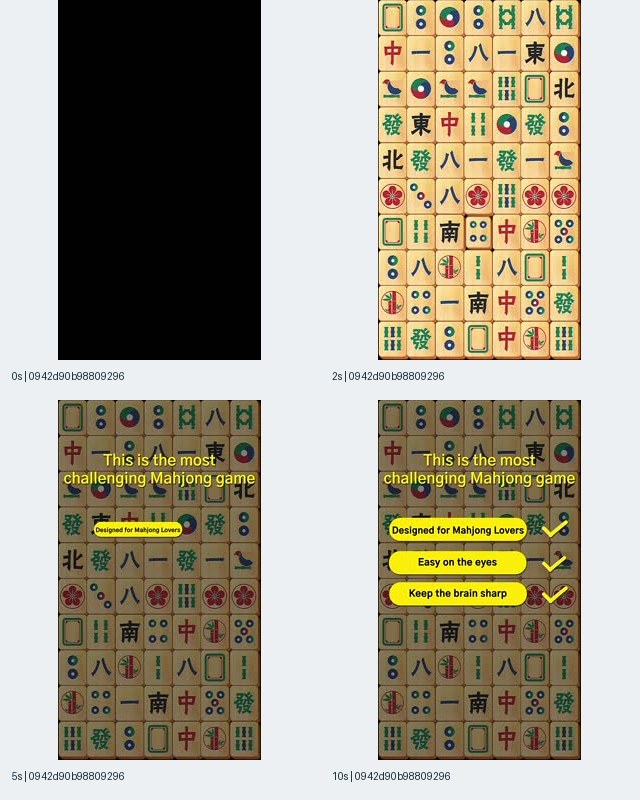
Figure 1. Vita Mahjong, linked iOS listing 6468921495; record 0942d90b98809296d26536141fec0d43. AppLovin contact sheet at 0, 2, 5, and 10 seconds.
The first sampled frame is black. The board appears at two seconds; later frames overlay yellow challenge text and benefit lines including “Easy on the eyes” and “Keep the brain sharp.” The visible progression moves from tiles to a text-led explanation of their appeal.
Test hypothesis: a readability message may create a different expectation from a difficulty message. Brief original variants around one supported promise at a time, keeping the board treatment consistent. The mental-sharpness language is advertising copy, not an established product benefit.
2. How does Gossip Harbor establish a character situation?
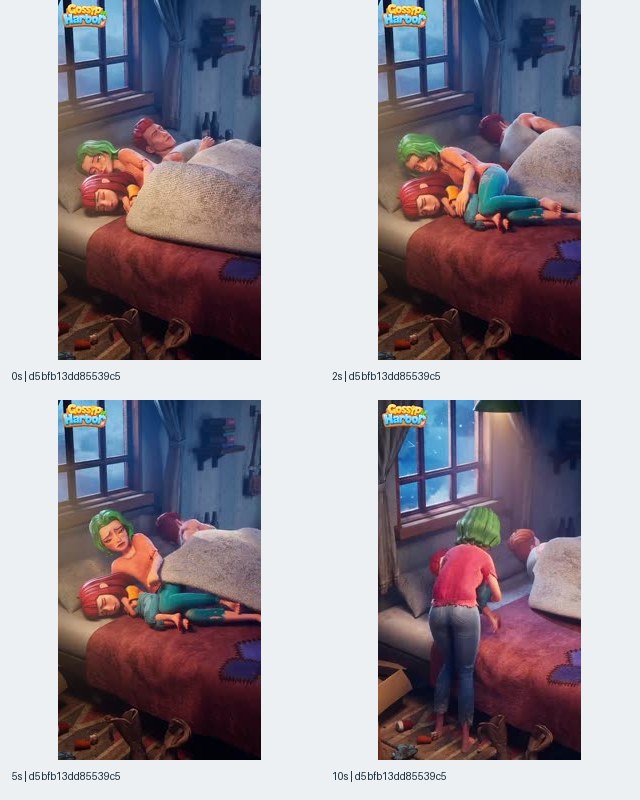
Figure 2. Gossip Harbor, linked iOS listing 1623318294; record d5bfb13dd85539c5dbb0628fe13fe587. AppLovin contact sheet at 0, 2, 5, and 10 seconds.
The frames show three animated characters in a bedroom, with changes in posture and blanket position. At ten seconds, the green-haired character stands beside the bed. No puzzle board is visible in these frames.
Test hypothesis: a clearly readable reaction could make a character-led opening easier to understand. A production brief should specify the expression and situation it wants viewers to recognize, then connect that setup to a truthful product demonstration. It need not invent a resolution for this reference scene.
3. What does Candy Crush Saga communicate through repetition?

Figure 3. Candy Crush Saga, linked iOS listing 553834731; record c28263ebff00bb9ed41382a18cd7b13b. AppLovin contact sheet at 0, 2, 5, and 10 seconds.
A dense grid of colored candies and a prominent logo recur across the sampled timestamps. The composition remains similar; these frames do not document a clear sequence of moves or a cascade.
The useful briefing detail is visual hierarchy: recognizable shapes fill the screen while branding stays near the top. Test hypothesis: for an original puzzle ad, highlighting one actionable match may make the intended action clearer than presenting a uniformly dense board. Evaluate comprehension before committing to a production series.
4. How does Total Battle make numerical choices visible?
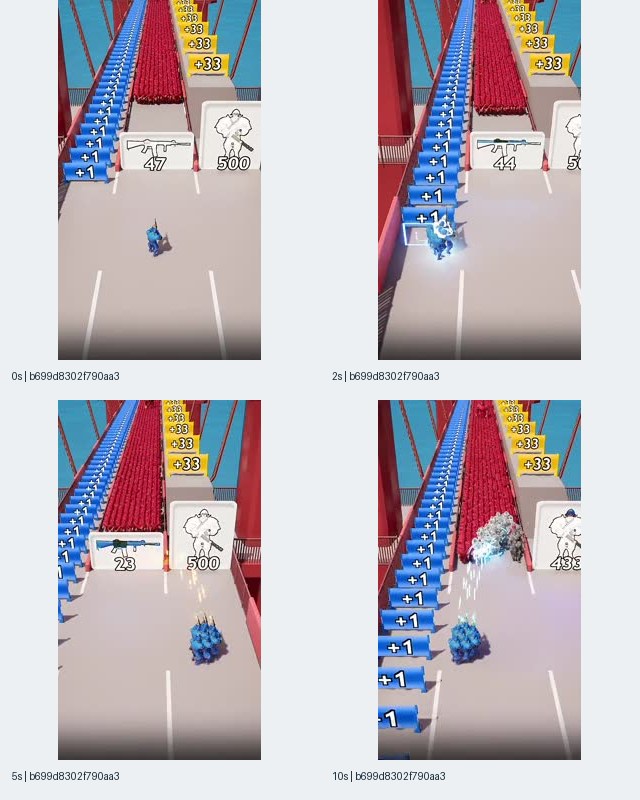
Figure 4. Total Battle, linked Scorewarrior iOS listing 1274132545; record b699d8302f790aa3d7ae023ff8e1b470. AppLovin contact sheet at 0, 2, 5, and 10 seconds.
The bridge scene contains blue units, a line of blue “+1” gates, dense red formations, and white panels with weapon or character outlines and changing numbers. Later sampled frames show a larger blue formation and visible projectiles.
Test hypothesis: placing the next numerical choice near the moving units may make the action easier to follow. An original brief should identify the choice, the visible consequence, and the relationship to the actual game before experimenting with camera distance or text size.
For references around your own app, inspect indexed mobile-game creatives in AdMapix, then select the country and network relevant to your brief. The broader mobile-game ad research guide provides the topic framework.
5. How does the second Gossip Harbor example use its setting?
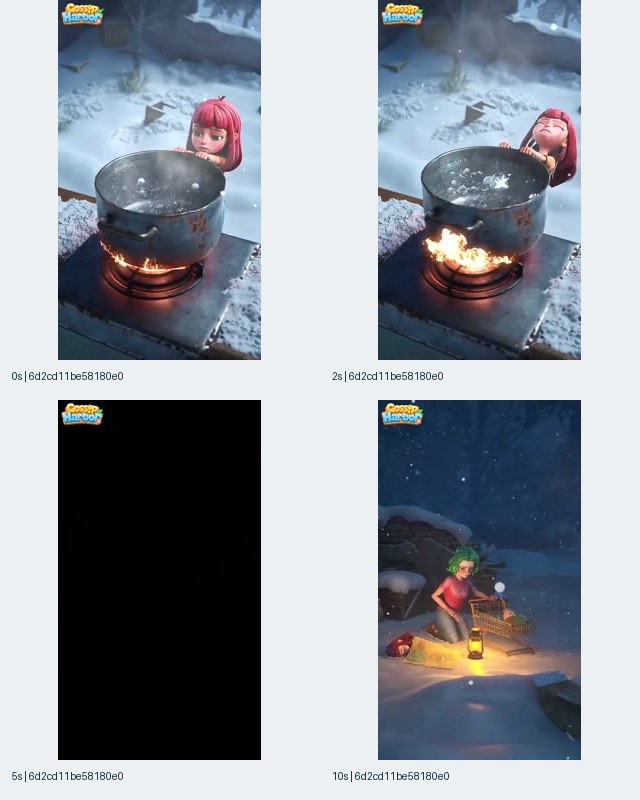
Figure 5. Gossip Harbor, linked iOS listing 1623318294; record 6d2cd11be58180e003ab207113da29cc. AppLovin contact sheet at 0, 2, 5, and 10 seconds.
At zero and two seconds, a child is visible behind a large steaming pot above flames in a snowy setting. The five-second frame is black apart from the logo. At ten seconds, the scene shows a green-haired adult, a cart, a lantern, and a figure under a yellow covering outdoors.
Warm light against blue snow is a concrete visual reference. Test hypothesis: that contrast could make an original scene’s focal point easier to locate on a phone. The brief should specify lighting and composition rather than assume the intervening story or its outcome.
To follow new creative examples for the apps you research, sign up or log in to AdMapix and add them to Competitor Watch.
6. How does Duolingo name its audience?
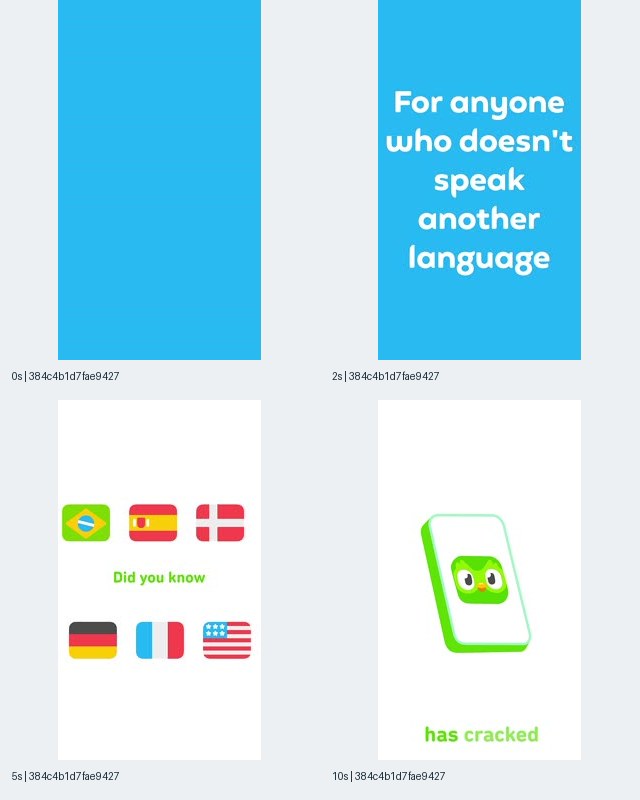
Figure 6. Duolingo, linked iOS listing 570060128; record 384c4b1d7fae94277b022d747a1c2efe. AppLovin contact sheet at 0, 2, 5, and 10 seconds.
The two-second frame says, “For anyone who doesn’t speak another language.” At five seconds, flags surround “Did you know”; at ten seconds, a phone illustration contains the green owl icon above “has cracked.”
The audience statement arrives before the illustrated app identity. Test hypothesis: directly naming a beginner’s situation may help an original learning-app ad communicate relevance. Write a complete, supported promise for your own product rather than completing the reference’s unfinished sentence from inference.
7. How does a TikTok-linked creative make scale readable?

Figure 7. Linked Android listing com.zhiliaoapp.musically; record a246b93b44dd4a510b06fa3e0e6a087f. This is an AppLovin-filtered advertising example promoting TikTok, shown at 0, 2, 5, and 10 seconds.
A small boat sits beside an enormous sea creature viewed from above. The early frames ask whether the viewer has seen a whale this big. The boat supplies a familiar size reference, while the later frames change the viewpoint.
Test hypothesis: comparative scale can make an unusual object immediately understandable. A game team could develop an original scene using a familiar character or vehicle beside a much larger object. The transferable idea is the composition, without asserting that the depicted creature is real.
8. How does Word Tiles build a text-only pitch?
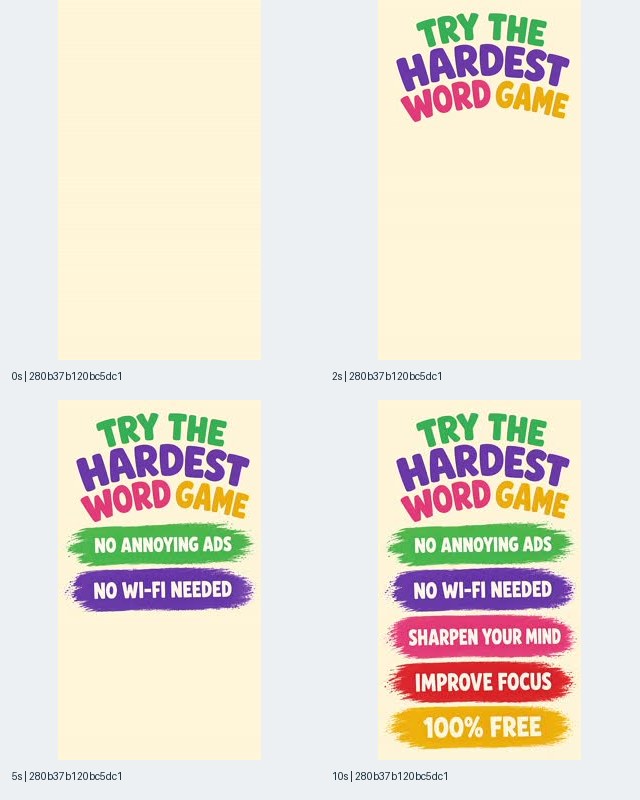
Figure 8. Word Tiles - Relaxing Puzzle, linked iOS listing 6783815362; record 280b37b120bc5dc1e42da91290228542. AppLovin contact sheet at 0, 2, 5, and 10 seconds.
The zero-second frame is pale and blank. A colorful challenge headline appears at two seconds. Later frames add painted text bands containing claims such as “No annoying ads,” “No Wi-Fi needed,” and “100% free,” alongside mind and focus messaging.
These are the advertiser’s claims, not verified app features. Test hypothesis: introducing one supported benefit at a time may improve readability compared with displaying the entire list immediately. For an original brief, confirm each claim against the current product and test the lettering at the intended display size.
How should UA teams evaluate an alternative in practice?
Evaluate a tool by whether it can produce your required deliverable for known apps under consistent conditions. A creative brief, an app-estimate report, and a retention analysis need different acceptance criteria.
- Name the decision. Write the output first: a competitor hook brief, an app-ranking snapshot, a download/revenue comparison, a keyword map, or a retention report.
- Lock the app identity. Record store IDs and verified product relationships. A matching name alone is insufficient.
- Fix country, dates, and source. Preserve the filters with your findings. Keep later measurement windows separate.
- Check assets and evidence. Distinguish advertising instances from unique videos and playables. Annotate visible text, objects, actions, and timestamps.
- Compare estimates consistently. Use matching app, country, store, and date scopes. Record source lag and whether iOS and Android are combined.
- Request missing coverage explicitly. Ask for the retention fields, keyword outputs, or Steam measures your workflow needs, alongside current access terms.
- Deliver an original test brief. State the observation, hypothesis, supported product promise, production variable, and measurement plan for your own campaign.
For example, Figure 1 can become a brief comparing a readability promise with a challenge promise over the same original board demonstration. The creative team receives a clear variable to change; the UA team chooses a success metric from its own account. A separate app-estimate worksheet supplies market context without claiming that the reference ad caused an app’s downloads or revenue.
What mistakes make an AppMagic replacement decision unreliable?
The main mistake is buying against a broad product label instead of checking the fields and outputs your team actually needs.
- Confusing free access with a free demo. AppMagic confirms a free demo; the checked page does not establish free-tier entitlements.
- Using old prices as current quotes. Request AppMagic pricing for your requirements and check AdMapix’s live commercial terms.
- Assuming ownership means identical products. Sensor Tower’s acquisition establishes the company relationship, not feature equivalence.
- Counting reused videos as new production. Keep instance counts and file counts separate.
- Using ad age as an efficiency denominator. Do not divide window impressions by time since first seen or treat longevity as proof of performance.
- Joining datasets by app name. Confirm product IDs before attaching creatives or estimates to an app.
- Choosing the more flattering estimate. Resolve scope and method differences before using provider figures in a plan.
- Misstating AdMapix’s gaps. It has download and revenue estimates. Its stated gaps here are retention, engagement, and Steam; ASO keyword capability is not established.
When should AdMapix be your next step?
Use AdMapix when your immediate output is a competitor creative brief, an app-level market snapshot, or a recurring watchlist. Those jobs match its verified creative research, store-ranking, estimate, and monitoring scope.
Disclosure: AdMapix is our product, so we describe its documented fit and gaps rather than present it as an independently tested winner. A limited free plan offers a starting point. Check the live AdMapix pricing page for current plans and access terms.
Keep a separate source when retention, session behavior, or Steam analytics is essential. For ASO keyword work, verify the required keyword fields before treating any creative-research product as a substitute.
If competitor ads are the task you need to finish now, sign up or log in to AdMapix, find your target apps, and inspect their creatives with a fixed country and date range. Start with a brief your team can act on, then expand the tool stack only where the work requires it.
FAQ
Is AppMagic free?
AppMagic confirms that requesting a demo is free and carries no cost or obligation. As of November 12, 2026, the checked pricing page does not list a free product plan or explain what an account without a contract includes. Free demo access should therefore be distinguished from free access to its datasets.
How much does AppMagic cost?
As of November 12, 2026, AppMagic’s pricing page redirects to a demo-request page and lists no prices. It says the sales team shares pricing after a personalized demo. Ask for a quote covering your required research jobs; older public prices and third-party comments do not establish current terms.
Who owns AppMagic now?
Sensor Tower acquired AppMagic on May 12, 2026. Sensor Tower’s announcement positions AppMagic as its small and medium-sized business offering, and AppMagic’s May 15 announcement confirms that direction. Neither supplied announcement states a purchase price or establishes a detailed change to the product’s plans.
How should I compare AppMagic versus Sensor Tower?
Treat them as offerings under the same company rather than independent owners. Sensor Tower describes AppMagic as its SMB offering, but that does not establish identical features or access. Compare the specific data fields and commercial terms needed for your work; this article does not provide a hands-on feature comparison.
Is there a free AppMagic alternative for mobile-game ads?
AdMapix has a limited free plan that can provide a starting point for competitor creative research. Check its live pricing page for current access limits. That is a narrower proposition than a free replacement for all AppMagic capabilities: retention, engagement, Steam, and ASO requirements still need their own coverage checks.
Can AdMapix replace AppMagic for revenue and downloads?
AdMapix provides app-level estimated downloads and revenue, alongside store rankings. Its app pages combine iOS and Android by default and describe a source lag of about five days. It can address that research task, but provider estimates use different methods. Compare familiar apps under matching conditions before adopting either source for planning.
Does AdMapix provide retention or Steam analytics?
No. AdMapix does not offer retention and engagement data or Steam analytics. If your work requires cohort retention, session counts, session length, or Steam measures such as playtime and followers, keep a source that explicitly supplies those fields. Creative and app-estimate coverage does not fill those requirements.
Is AdMapix an ASO keyword tool?
This article does not establish AdMapix as an ASO keyword tool. Its verified scope here covers creative research, app-store rankings, and app-level download and revenue estimates. AppMagic advertises keywords and Apple Ads research. For an ASO replacement, evaluate the actual keyword outputs you need separately from store rankings.
What are the key takeaways?
An AppMagic alternative should replace a defined research job, with current access terms and evidence your team can inspect.
- Sensor Tower acquired AppMagic on May 12, 2026; as of November 12, AppMagic pricing is shared after a demo and no prices are listed.
- AdMapix covers competitor creatives, app-store rankings, and app-level download and revenue estimates.
- Retention, engagement, and Steam remain outside AdMapix’s scope; ASO keyword capability is not established here.
- The US AppLovin package contains 50 advertising records, 12 unique videos, and 35 unique playables for 2026-10-13 to 2026-11-11.
- Turn visible creative observations into original test hypotheses, and evaluate provider estimates using apps and scopes you understand.
Sources
The product comparison uses dated official statements and verified AdMapix scope; the visual analysis uses the reproducible advertising package linked below.
- AppMagic demo and pricing information, checked 2026-11-12: pricing after a personalized demo, free-demo terms, and advertised mobile, advertising, ASO, retention, engagement, and Steam scope.
- Sensor Tower acquisition announcement, dated 2026-05-12, checked 2026-11-12: acquisition and SMB positioning.
- AppMagic acquisition announcement, dated 2026-05-15, checked 2026-11-12: confirmation of ownership and stated focus.
- Frozen US AppLovin source package, fetched 2026-11-12, measurement window 2026-10-13 to 2026-11-11: search batches, parameters, checksums, record associations, fingerprint counts, and window estimates.
- AdMapix search workflow and AppLovin research workflow: entry points for applying the 2026-11-12 creative-research example. A live search may return different results from the frozen package.
- AdMapix methodology: public reference for data interpretation; applied to the 2026-11-12 observations and their stated US AppLovin scope.
- AdMapix live pricing: current commercial terms. The supplied product-facts reference was reviewed 2026-08-13; the additional website scope statements used in this article were checked 2026-11-12.
Turn these observations into your next creative study
Open the creative library and select samples for your market, network and research question.
Related Articles
Holiday Marketing Campaigns for Subscription Apps
Use eight dated advertising references to plan subscription app holiday campaigns, distinguish access claims from verified offers, and build original briefs for trials, annual plans, and seasonal creative tests.
Facebook Carousel Ads vs Single-Image Ads: Compare the Product Message
Compare Facebook carousel and single-image product messaging through eight dated advertising references, a matched production brief, and a practical testing workflow that separates visual evidence from unmeasured performance.
YouTube Video Ads: Match Scripts to Landing-Page Offers
Use eight dated advertising contact sheets, original script examples, and a practical audit workflow to align opening hooks, product claims, calls to action, and landing-page offers.