
SocialPeta vs AppMagic in 2026: Ad Creative Intelligence or App Market Intelligence?
A 2026 decision guide for choosing between SocialPeta and AppMagic: ad creative analysis vs mobile app market intelligence, a job-by-job comparison, what each tool's data can and can't prove, pricing and access, when to run both, and where AdMapix fits.
By the AdMapix Research Desk — Updated June 21, 2026
SocialPeta vs AppMagic in 2026: Ad Creative Intelligence or App Market Intelligence?
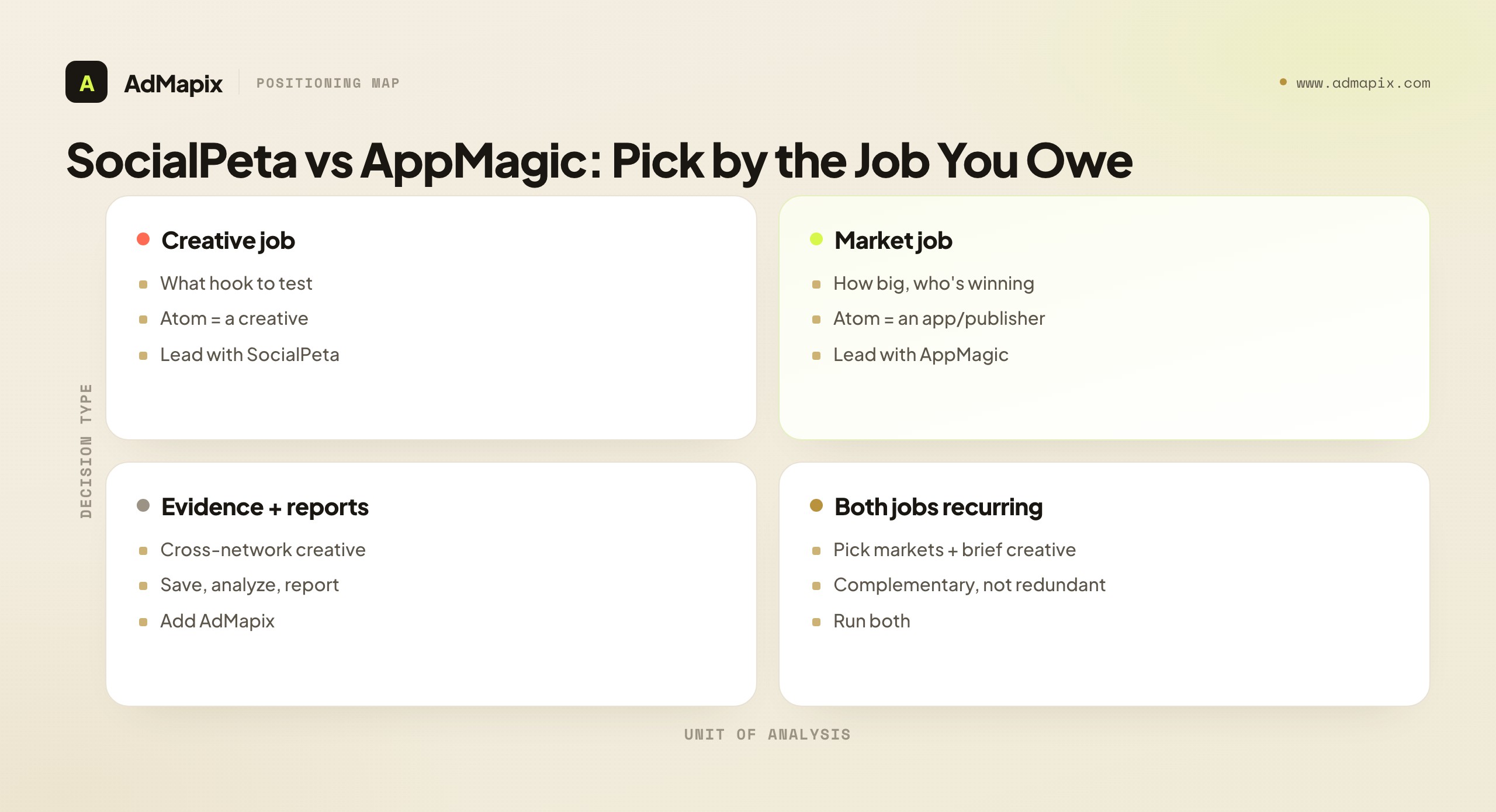
SocialPeta and AppMagic solve different problems, so the choice is rarely close once you name the job. Pick SocialPeta when your weekly bottleneck is understanding competitor ad creatives and UA patterns — hooks, formats, and what to test next. Pick AppMagic when you need to size markets, track downloads and revenue, and classify the mobile app and game landscape. The word "intelligence" is in both names, but the unit of analysis is fundamentally different: SocialPeta's atom is a creative, AppMagic's atom is an app or publisher. Get that distinction right and the decision makes itself.
This guide is for mobile game studios, app marketers, UA managers, creative strategists, and agencies who have to defend a tool budget. It gives you a decision framework keyed to the job you owe next week, a job-by-job comparison (not a feature-count contest), the hard limits of what either tool's public data can and can't prove, pricing-and-access realities (both are demo-led), when running both actually makes sense, and where AdMapix fits if competitor creative evidence and shareable reports are the real gap.
The core principle, up front: don't ask "which tool is better" — ask "which decision do I owe next week." A creative brief points to SocialPeta (or a creative-evidence layer); a market-or-revenue bet points to AppMagic. Forcing one tool to do the other's job is the single most common and most expensive mistake in this category.
If you're weighing other tool pairings, see our KaloData vs FastMoss comparison for the TikTok Shop equivalent, and best ad spy tools 2026 plus marketing intelligence tools for the full landscape.
TL;DR — SocialPeta vs AppMagic in 2026
- They answer different questions. SocialPeta = ad creative intelligence (hooks, formats, creative tracking across a large multi-country ad database). AppMagic = app market intelligence (classification, downloads, revenue estimates, trendspotting).
- The unit of analysis decides the tool. If your atom is a creative you study and iterate from, that's SocialPeta. If your atom is an app or publisher you size, rank, and trend, that's AppMagic.
- Choose by the decision you owe. "What hook do we test?" → SocialPeta. "How big is this genre and who's winning on revenue?" → AppMagic.
- Both estimate; neither measures competitor internals. You can see creatives and modeled downloads/revenue; you cannot confirm a rival's true spend, ROAS, targeting, or genuine top performer.
- Both are demo-led on pricing. Neither publishes a simple self-serve price; plan a sales conversation and verify regions, freshness, and data scope for your titles.
- Running both is reasonable when both jobs are active — AppMagic for market modeling, SocialPeta for creative analysis. If one job dominates, buy for it first.
What Each Tool Actually Does
SocialPeta is an ad creative intelligence platform; AppMagic is a mobile app market intelligence platform. The shared word "intelligence" hides the real difference: the unit of analysis. SocialPeta's atom is a creative — an ad you can study, deconstruct, and iterate from. AppMagic's atom is an app or publisher — an entity you can size, rank, classify, and trend over time.
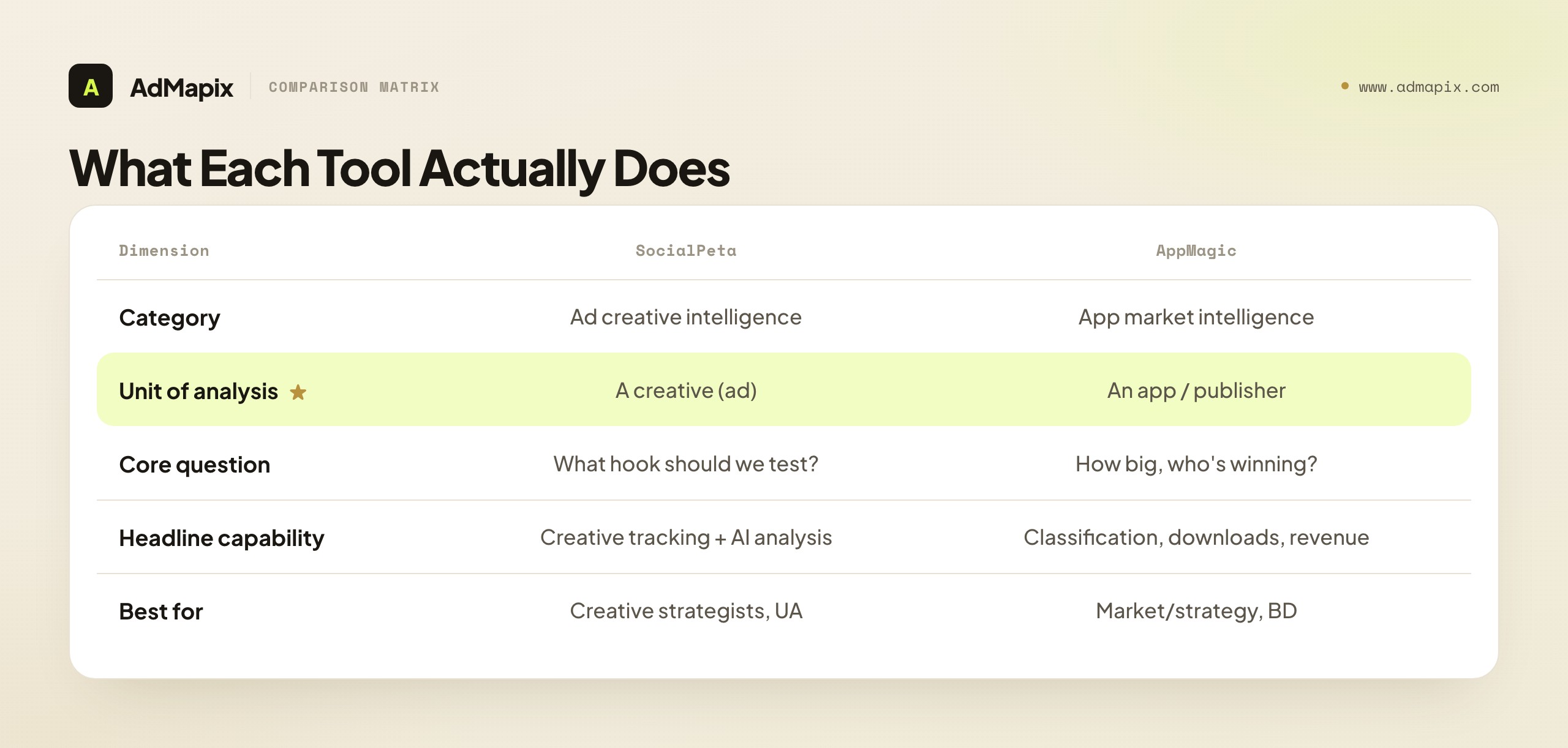
| Dimension | SocialPeta | AppMagic |
|---|---|---|
| Category | Ad creative intelligence | App market intelligence |
| Unit of analysis | A creative (ad) | An app / publisher |
| Core question it answers | "What hook should we test?" | "How big is this market, who's winning?" |
| Headline capability | Creative tracking, hook/format patterns, AI-assisted creative analysis | App classification, downloads, revenue estimates, trendspotting |
| Best for | Creative strategists, UA creative testing | Market/strategy, BD, category research |
| Data shape | Multi-country ad creative database | App/publisher metrics over time |
That distinction drives everything downstream. If your question is "what hook are competitors running and what should we test," you're in SocialPeta territory — its creative-level tracking and AI-assisted analysis are built for exactly that. If your question is "how big is this genre, who is winning on revenue, and is the category growing," you're in AppMagic territory — its download/revenue modeling and app classification answer the market question. Trying to force one tool to do the other's job is where teams waste the most money: a creative team buying a full market suite and using 10% of it, or a strategy team buying a creative tool and finding it has no market sizing.
Comparison by Job, Not by Feature Count
The useful comparison isn't which platform lists more features — both list plenty. It's which platform improves your next decision. Map your actual job to the better-fit tool.
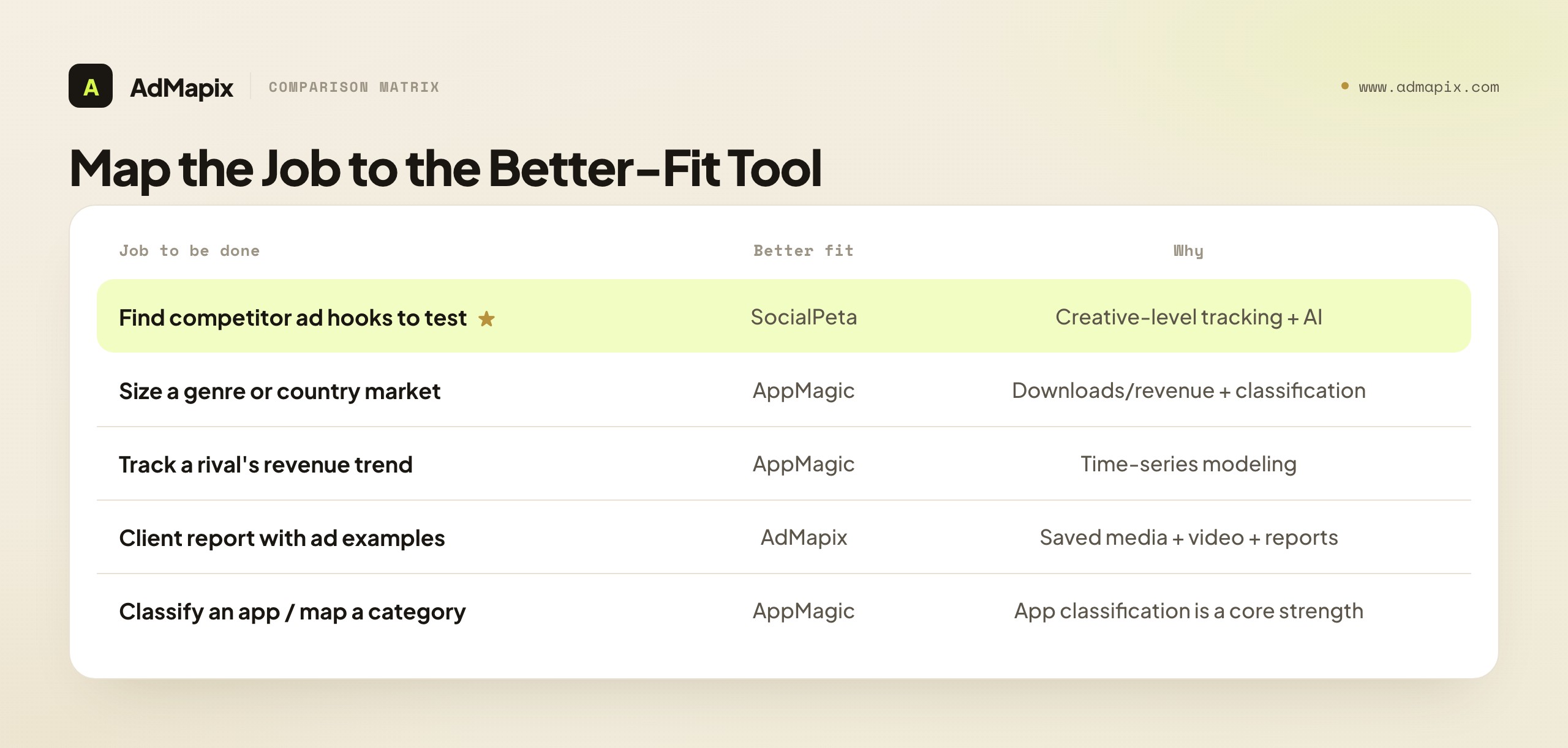
| Job to be done | Better primary fit | Why |
|---|---|---|
| Find competitor ad hooks and formats to test | SocialPeta | Creative-level tracking + AI-assisted creative analysis |
| Size a genre or country market | AppMagic | Download/revenue estimates + app classification |
| Track a rival publisher's revenue trend | AppMagic | Time-series revenue and download modeling |
| Build a weekly creative brief | SocialPeta or AdMapix | Both center on creative evidence, not market models |
| Show a client visible ad examples + video notes | AdMapix | Saved media, video breakdowns, report output |
| Decide which market to enter next | AppMagic | Category trends + competitive landscape |
| Classify an app/genre or map a category | AppMagic | App classification is a core AppMagic strength |
| Analyze why a video ad converts | SocialPeta or AdMapix | Creative deconstruction, not market metrics |
The point of the table: most teams need one tool excellent at their primary job, plus a lightweight way to cover the secondary one — not a single suite that's mediocre at both. The "which is better" framing is a trap; the right question is always "better for what job."
SocialPeta in Depth: When Creative Is Your Bottleneck
SocialPeta is at its best when your weekly job is creative — understanding what competitors are running and deciding what to test. Its strengths cluster around the creative as the unit of analysis.
Where SocialPeta shines:
- Creative tracking at scale. A large, multi-country ad creative database means you can find competitor ads across markets and formats, not just in one geo — useful for UA teams running global creative.
- Hook and format patterns. Because the atom is the creative, SocialPeta is built to surface recurring hooks, formats, and angles — the raw material for a creative brief.
- AI-assisted creative analysis. It layers analysis onto the raw creatives, helping you read what's structurally common across a category's ads rather than eyeballing one at a time.
Where SocialPeta's focus is a limit:
- It's not a market-sizing tool. If you need to know how big a genre is or model a publisher's revenue trend, that's not SocialPeta's job — you'll be reaching for AppMagic.
- Creative ≠ performance. Like every creative tool, it shows what's running, not what's winning — frequency is a hypothesis, not proof (more on this below).
The summary: SocialPeta rewards a creative-led workflow. If your bottleneck is "what do we test next," its creative database and analysis are pointed at exactly that question.
AppMagic in Depth: When the Market Is Your Bottleneck
AppMagic is at its best when your job is market and strategy — sizing opportunities, tracking competitors' scale, and classifying the landscape. Its strengths cluster around the app/publisher as the unit of analysis.
Where AppMagic shines:
- App classification. AppMagic is notably strong at classifying apps and games into categories and sub-genres — the foundation for any market map. This classification depth is a genuine differentiator, not a checkbox feature.
- Downloads and revenue estimates. It models downloads and revenue over time, so you can compare relative scale and direction across apps, publishers, and categories.
- Trendspotting. It surfaces rising apps and categories, which is the input to a market-entry or portfolio decision.
- Advertising analysis. It includes an advertising layer too, though its center of gravity is market data, not creative deconstruction.
Where AppMagic's focus is a limit:
- It's not a creative-brief tool. Its advertising analysis exists, but if your daily job is reading hooks and deconstructing video structure to brief tests, a creative-first tool fits better.
- Estimates are modeled. Downloads and revenue are estimates derived from signals, reliable for ranking and direction but not audited financials.
The summary: AppMagic rewards a market-led workflow. If your bottleneck is "how big is this, who's winning, and is it growing," its classification and modeling answer the strategic question.
Pricing and Access: Both Are Demo-Led
Neither vendor publishes a simple self-serve price list, so plan a sales conversation before you commit. AppMagic routes buyers through a demo request flow for current access and pricing, and SocialPeta's public pages also lead to demo-led contact rather than a checkout. Treat any price you've heard secondhand as stale until a vendor rep confirms it for your seat count and data scope.
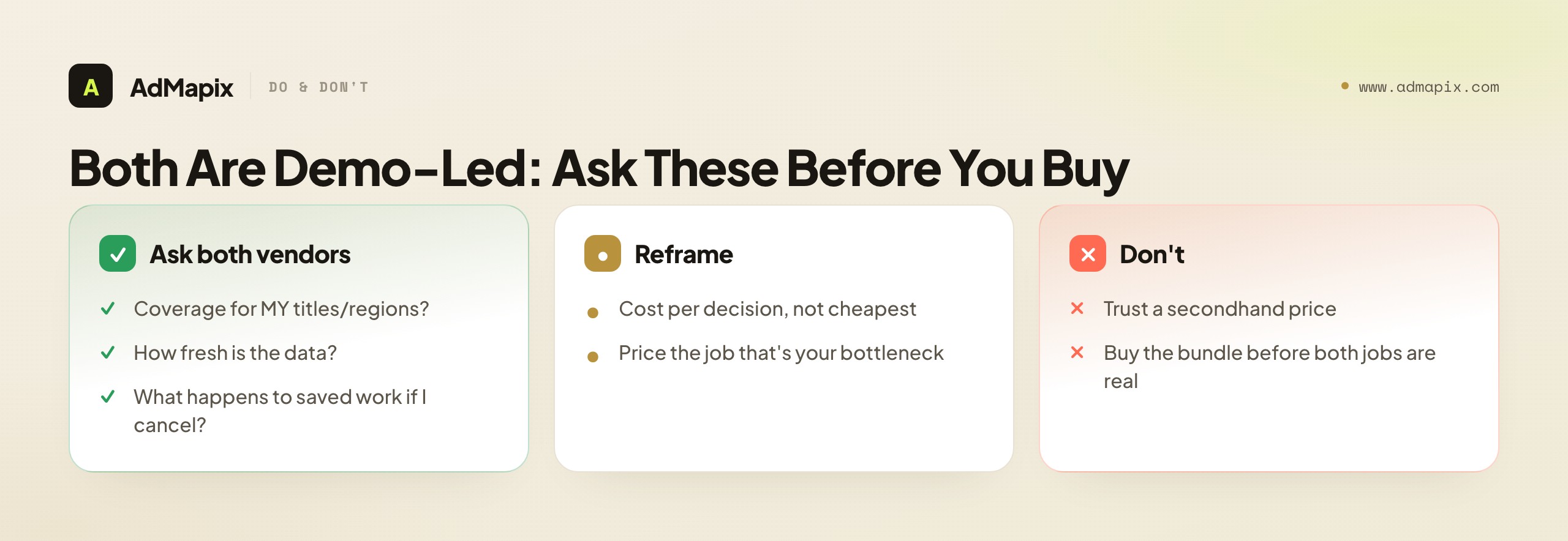
When you book the calls, ask the same three questions of both, because the answers matter more than headline feature lists:
| Question to ask both vendors | Why it matters |
|---|---|
| Which regions and networks are covered for my titles? | Coverage varies by geo and network; a tool strong in one market can be thin in yours |
| How fresh is the data? | Stale creative or lagging revenue estimates undercut the whole purpose |
| What happens to my saved work if I cancel? | Lock-in risk; you want your tagged research portable |
The "cost per decision made" framing beats "cheapest." A tool that's cheaper but thin in your markets, slow to refresh, or that traps your saved work costs more in wasted time than the price difference saves. Decide which job (creative or market) is your bottleneck, then price the tool that solves that job for your coverage.
What Public Competitive Data Can and Cannot Prove
Both tools observe public signals, and both estimate rather than measure your competitors' internals. Keep the boundary clear so you don't over-read the data — this is the discipline that keeps a tool-comparison deck (and your downstream decisions) defensible.
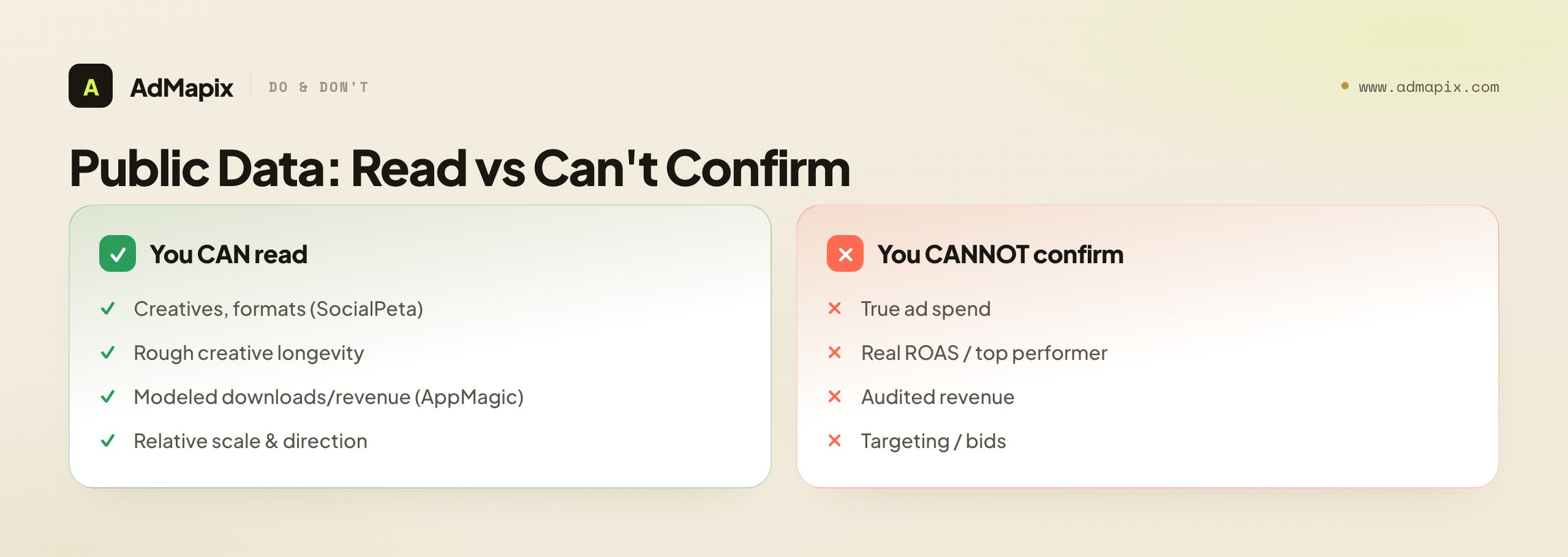
| You CAN read | You CANNOT confirm |
|---|---|
| What creatives a competitor runs, in which formats (SocialPeta) | A competitor's true ad spend |
| Roughly how long a creative has been live | Real ROAS or which creative genuinely wins for them |
| Modeled downloads and revenue for apps/games (AppMagic) | Audited revenue or exact download counts |
| Relative scale and direction across publishers | Exact targeting, geos, or bid strategy |
| Frequency of a creative or a rising category | That a frequent creative actually converts |
Two specific cautions. First, a creative appearing frequently is a hypothesis worth testing, not proof that it converts — frequency reflects what's served (and what you sampled), not confirmed performance. Second, AppMagic's downloads and revenue are modeled estimates, excellent for ranking and trend direction but not financial statements. Use either tool to generate hypotheses, then validate with your own campaign analytics, store data, and business metrics. The tool tells you where to look; your data tells you what's true.
How to Trial Them Fairly
Don't decide from feature pages or this article alone — decide from a parallel trial on your competitors and markets. The most common comparison error is feeding the two tools different inputs and calling the result a verdict.
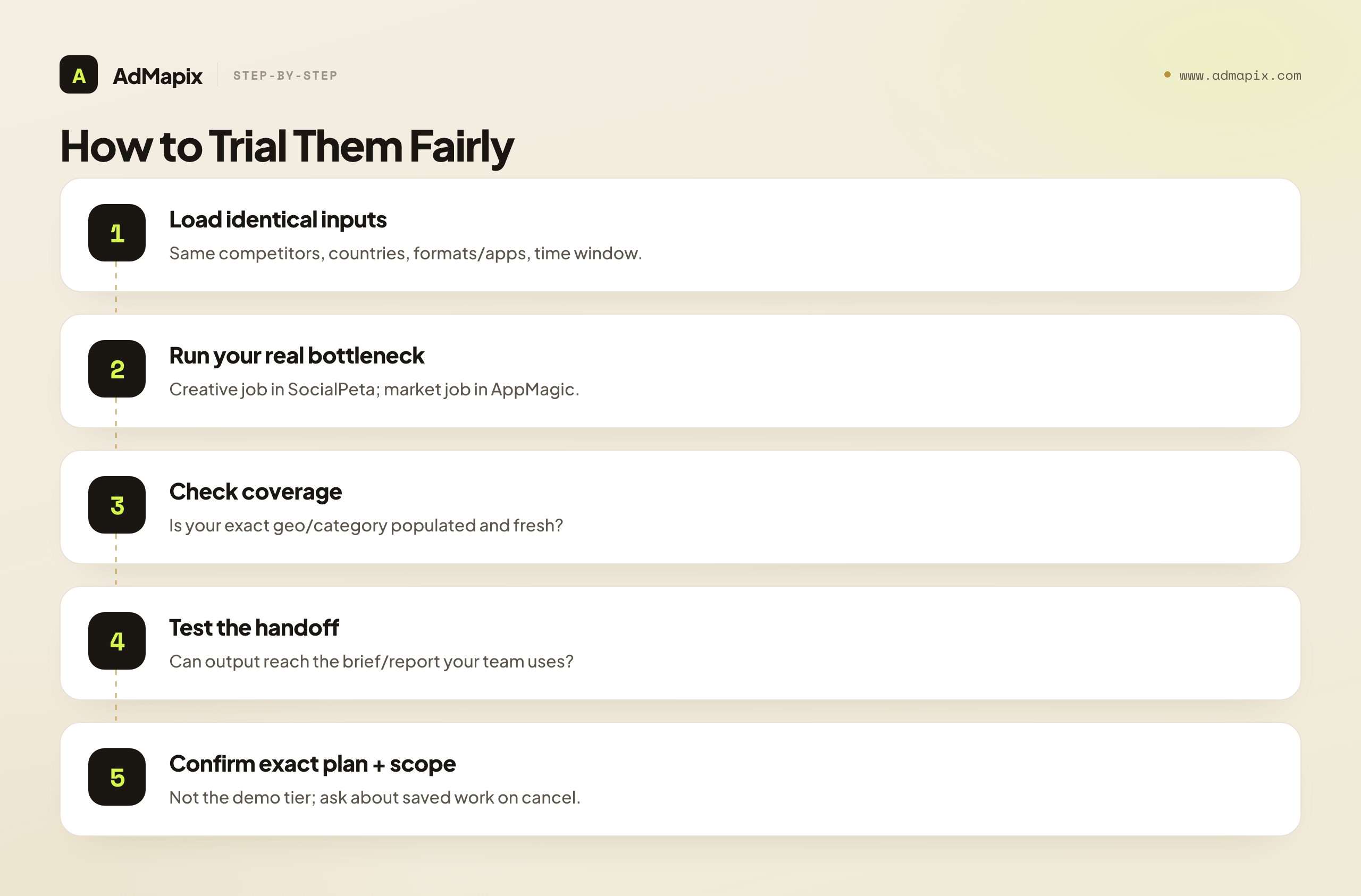
- Load identical inputs. Same competitors, same countries, same formats (for SocialPeta), same app/genre set (for AppMagic), same time window. Mismatched inputs make the comparison noise.
- Run your real bottleneck job. If your job is creative, time how fast SocialPeta gets you to a usable hook/format shortlist. If it's market, time how fast AppMagic gets you a defensible market-size or revenue-trend read.
- Check coverage in your markets. Is your exact geo and category actually populated and fresh, or sparse? This is where a demo can mislead — verify on your real niche.
- Test the export/handoff. Can you get the output into the brief, report, or deck your team actually uses?
- Confirm the exact plan and data scope you'd buy, not the demo tier — and ask what happens to saved work on cancellation.
The meta-rule: judge the output on the job you actually owe, not the feature grid. A tool earns its price by improving your next decision — a sharper creative brief or a defensible market call. If you can't trace a candidate to a better decision in your trial, it's the wrong tool no matter how long its feature list.
A Worked Example: Two Teams, Two Right Answers
Frameworks land better when you watch them run. Here are two teams facing the same category, arriving at different right tools — which is the whole point.
Team A — a UA creative team at a mobile game studio. Their weekly bottleneck is creative fatigue: CPI is climbing and they need fresh hooks. They trial both tools on their genre. In SocialPeta, they reach a shortlist of competitor hooks and formats across markets quickly — the creative database is pointed at exactly their question, and they leave with three testable angles. In AppMagic, they can see their competitors' downloads and revenue trends, which is interesting but doesn't tell them what creative to ship next. For their bottleneck — what to test — SocialPeta (or a creative-evidence layer) wins. They pick SocialPeta, and note they'll add a market tool only if portfolio strategy becomes a recurring question.
Team B — a publishing/BD team deciding which genre to enter. Their bottleneck is a portfolio bet: is the hybrid-casual merge category still growing, who's winning on revenue, and is there room to enter? They trial the same genre. In AppMagic, they get a defensible market-size read, a revenue-ranked competitive landscape, and a trend line showing whether the category is rising — exactly their decision. In SocialPeta, they can see the creatives competitors run, which is useful context but doesn't size the market or model revenue. For their bottleneck — the market bet — AppMagic wins. They pick AppMagic, and plan to add a creative tool once they've decided to enter and need to brief launch creative.
Same category, opposite conclusions. That's the entire lesson of SocialPeta vs AppMagic: the tools aren't ranked on an absolute scale; they're matched to a job. Team A optimized for creative throughput and chose the creative tool; Team B optimized for a market decision and chose the market tool. Both were right for their job — and both correctly deferred the other tool until that job became real.
When Running Both Actually Makes Sense
Many teams do run SocialPeta and AppMagic together, and the pairing is reasonable — but only when both jobs are genuinely active. AppMagic handles market modeling and category research; SocialPeta handles creative analysis. The combination covers the full "what market, and what creative for it" arc.
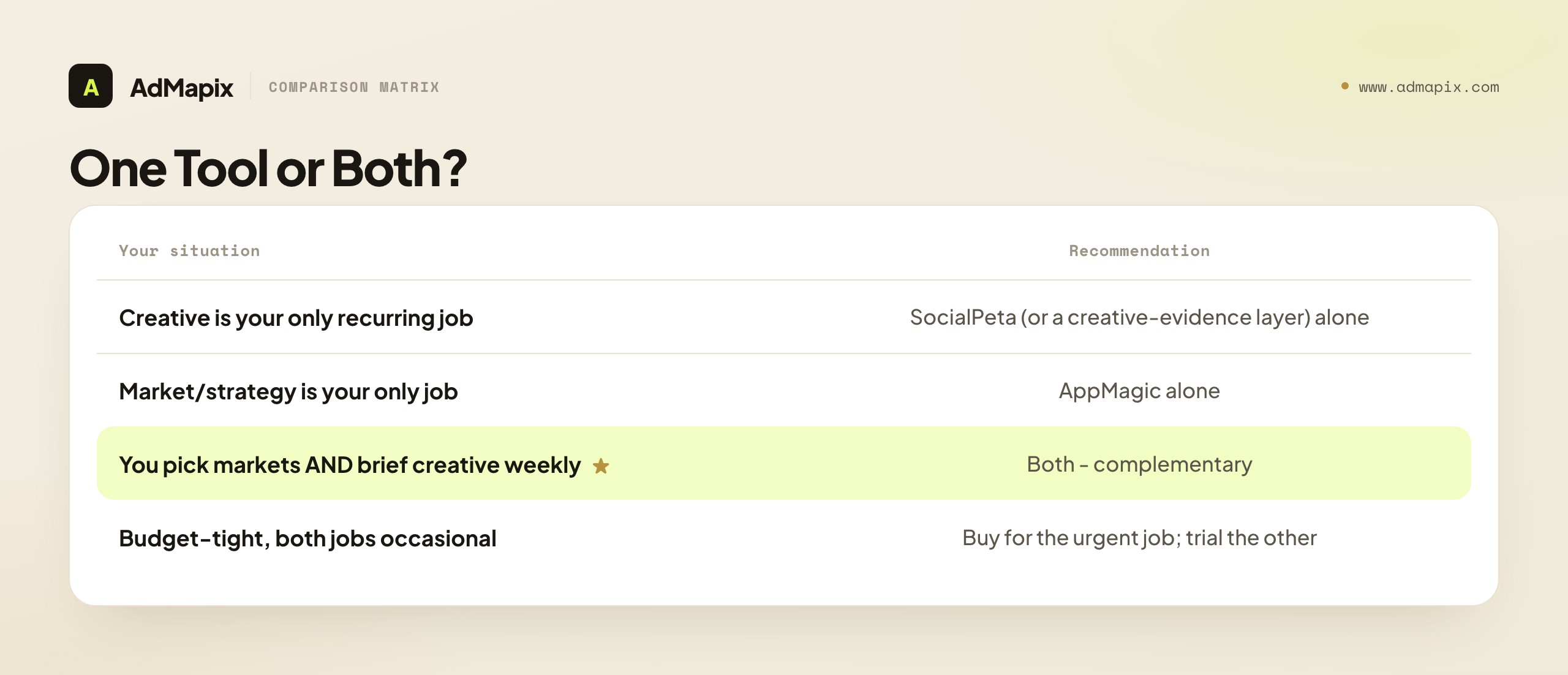
| Your situation | One tool or both? |
|---|---|
| Creative is your only recurring job | SocialPeta (or a creative-evidence layer) alone |
| Market/strategy is your only recurring job | AppMagic alone |
| You both pick markets and brief creative weekly | Both — they're complementary, not redundant |
| Budget-constrained, both jobs occasional | Buy for the more urgent job; trial the other |
| Agency serving varied clients | Often both, since client jobs vary |
The honest test before adding the second tool: does it improve a decision your current stack can't? If a creative team is eyeing AppMagic mainly for "nice to see competitor revenue," that's curiosity, not a decision driver — defer it. If a market team is eyeing SocialPeta because they've decided to enter a genre and now must brief launch creative, that's a real new capability. Add the second tool when a second job becomes recurring, not because the bundle looks complete.
The Full Arc: From Market Bet to Shipped Creative
When both jobs are active, the most useful way to think about SocialPeta and AppMagic isn't "which to buy" but "where each sits in the arc from a market decision to a shipped, validated creative." Mapping that arc shows exactly where each tool earns its place — and where neither one finishes the job.
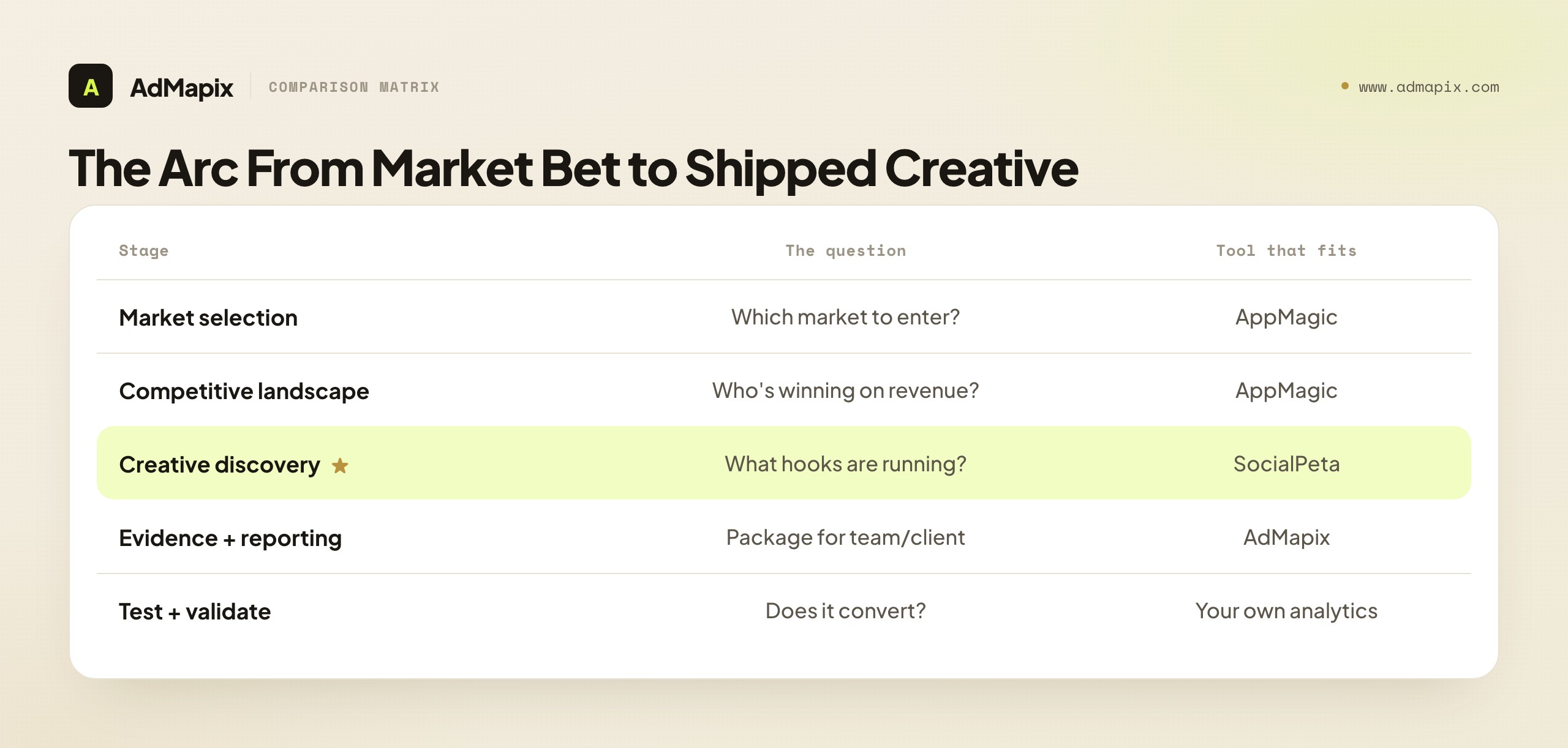
| Stage of the arc | The question | Tool that fits |
|---|---|---|
| 1. Market selection | Which genre/market should we enter or invest in? | AppMagic (sizing, revenue trend, classification) |
| 2. Competitive landscape | Who's winning on revenue, and is the category growing? | AppMagic (publisher/revenue modeling) |
| 3. Creative discovery | What hooks and formats are competitors running? | SocialPeta (creative database, AI analysis) |
| 4. Creative deconstruction | Why does a specific video ad work? | SocialPeta or AdMapix (video breakdown) |
| 5. Evidence + reporting | Package the findings for the team/client | AdMapix (saved media, reports) |
| 6. Test + validate | Does the adapted angle actually convert? | Your own campaign analytics |
Read down that arc and the division of labor is clear: AppMagic owns the front of the funnel (which market, who's winning), SocialPeta owns the middle (what creative is out there), and the back (evidence packaging, then validation) belongs to a reporting layer plus your own data. No single tool owns the whole arc — which is exactly why "buy one suite to do everything" disappoints. A market team that buys only AppMagic is well-served through stage 2 and then stuck at "now what creative?"; a creative team that buys only SocialPeta is well-served at stages 3–4 and unaided on market selection.
The practical takeaway: figure out which stage is your recurring bottleneck and buy the tool that owns it. If your team lives at stages 1–2, AppMagic is the lead purchase. If you live at stages 3–4, SocialPeta (or a creative-evidence layer) is the lead. And the stage most teams under-invest in is stage 5 — turning research into a shareable, reusable artifact — which is precisely the gap a reporting-capable creative tool fills, and the reason teams running either specialist tool often still add one.
What SocialPeta and AppMagic Don't Cover
Every tool comparison should name the shared blind spots, because they reveal what neither tool does — and therefore what you might still need. SocialPeta and AppMagic are strong at their respective jobs, but two gaps recur for teams that run them.
The first gap is cross-network creative consolidation with a clean reporting handoff. SocialPeta has a large creative database, and AppMagic has an advertising layer, but the specific job of "search competitor ads across networks, save the strongest, deconstruct the video, and ship a client-ready report" is a distinct workflow that a market-intelligence tool isn't built for and that even a creative-analysis tool may not finish at the reporting end. For agencies especially, the deliverable — a packaged, shareable report — is half the value, and it's the half most likely to fall through the cracks between a market tool and a creative-analysis tool.
The second gap is the hard privacy boundary both share. Neither SocialPeta nor AppMagic can confirm a competitor's true ad spend, real ROAS, exact targeting, or which creative is genuinely their top performer. SocialPeta shows what's running; AppMagic estimates scale. Both are honest about being estimate-and-observation tools, and any reading you do has to respect that — which means the validation step (your own data) is non-optional regardless of which tool you buy.
| Shared blind spot | What it means for you |
|---|---|
| Cross-network creative + clean reporting | The "search, save, deconstruct, report" workflow may need a dedicated layer |
| True spend / ROAS / top performer | Private to the competitor — both tools estimate, neither confirms |
| Validation | Only your own campaign and store data proves what works |
Naming these isn't a knock on either tool — it's what tells you whether your stack is complete. If your recurring need is the cross-network-evidence-and-report job, that's a gap a market tool and a creative-analysis tool may both leave open, and it's exactly where a tool like AdMapix slots in (covered below). If your recurring need is purely market sizing or purely creative hooks, the relevant specialist tool covers it and the blind spots may not matter to you.
A Buyer's Checklist for Either Tool
Whichever job leads, run every candidate through the same checklist during its demo and trial. The vendors differ on specifics, but these are the dimensions that actually separate a good fit from an expensive mismatch.
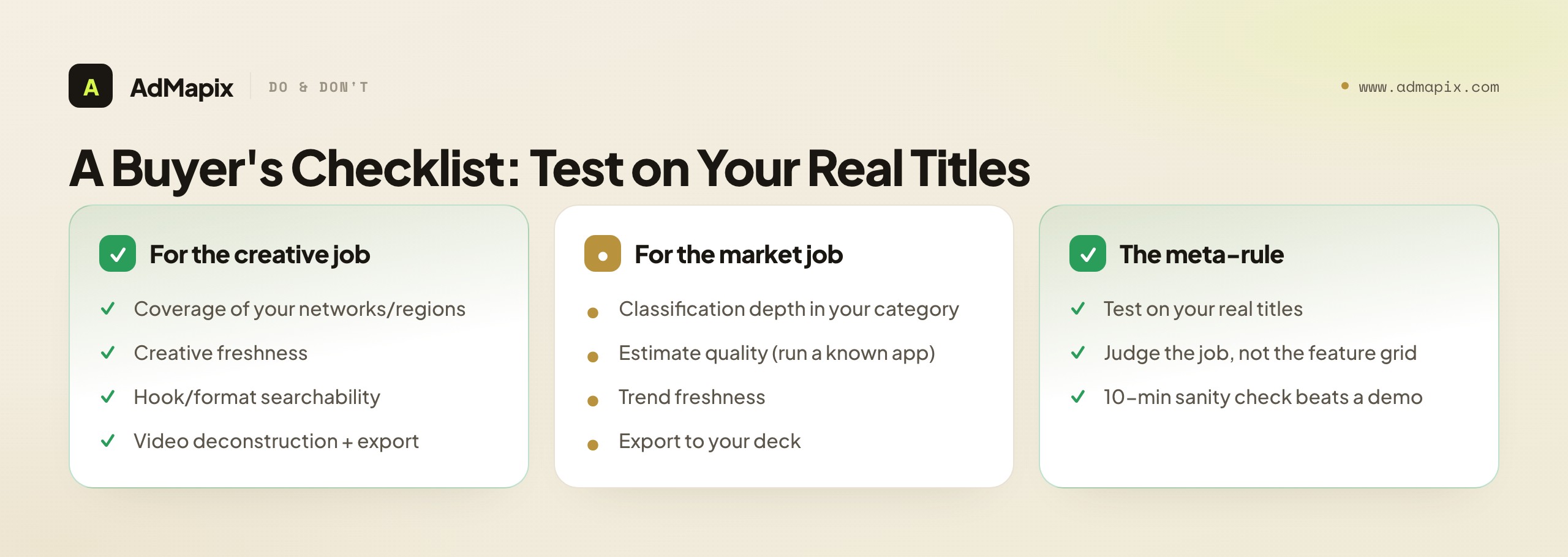
For the creative job (SocialPeta or a creative-evidence layer):
- Coverage of your networks and regions. Are the networks and geos your competitors actually use well-represented for your titles?
- Creative freshness. How current is the creative database? Stale creative undercuts a "what to test now" workflow.
- Hook/format searchability. Can you filter to your genre and format, or only browse?
- Video deconstruction + export. Can you break down a video and get the insight into a brief?
For the market job (AppMagic):
- Classification depth in your category. Is your exact genre/sub-genre classified well? This is AppMagic's strength, but verify it for your niche.
- Estimate quality in your markets. Do the download/revenue estimates track reality for an app you know? Run a known title to sanity-check.
- Trend freshness. Are category trends current enough to inform a real-time market bet?
- Export to your deck. Can the market read reach the strategy doc your team uses?
The meta-rule for the whole checklist: judge each tool on the recurring job you actually owe, tested on your real titles and markets — not on the feature grid. A ten-minute sanity check (a known app in AppMagic, a known competitor's creatives in SocialPeta) tells you more about real fit than an hour of demo slides, and it's the single best protection against buying coverage that evaporates the moment you point it at your actual niche.
How This Maps to Your Role
| If you are... | Lead with | Add when... |
|---|---|---|
| A UA creative strategist | SocialPeta (or AdMapix for evidence + reports) | Portfolio/market decisions become recurring |
| A growth/strategy lead picking markets | AppMagic | You move from "which market" to "what creative" |
| A publishing/BD team | AppMagic | Launch creative briefing becomes the job |
| An agency creative team | SocialPeta + AdMapix for client reports | A client needs market sizing |
| A solo indie dev | Whichever matches your single biggest bottleneck | The second job genuinely recurs |
The through-line: match the lead tool to your dominant, recurring job, and add the second only when a second job becomes recurring. Most wrong purchases in this space come from buying the "complete" pairing before both jobs are real, or from buying for a job that isn't actually your constraint.
Decision Scenarios: Common SocialPeta vs AppMagic Situations
Most real decisions are variations on a handful of recurring situations. Find the one closest to yours for a direct answer.
"I'm a UA creative lead and my CPI is climbing." Your bottleneck is fresh creative, so lead with SocialPeta (or a creative-evidence layer). Knowing a competitor's revenue trend won't tell you what hook to ship next week — you need the creative database and hook analysis. Add a market tool only if portfolio/market decisions become a recurring part of your job, which for a pure creative role they usually aren't.
"I'm deciding whether to enter a new genre." Your bottleneck is a market bet, so lead with AppMagic. You need the genre's size, the revenue-ranked landscape, and the trend direction — exactly its classification and modeling strengths. Defer the creative tool until you've decided to enter and need to brief launch creative; buying it now is buying for a job you don't yet have.
"I'm an agency and my clients' jobs vary." You probably need both over time, but stage them by client. A client who needs you to brief creative weekly justifies the creative tool; a client weighing a market entry justifies AppMagic. The deliverable across both is usually a report, which is the gap a reporting-capable creative-evidence layer fills — so for agencies, that layer is often the highest-leverage single addition regardless of which specialist tool a given client needs.
"I have budget for exactly one tool." Buy for your single biggest recurring bottleneck, full stop. Don't split a one-tool budget across two half-purchases, and don't buy the "more complete" suite if 80% of your weeks are one job. The discipline is ruthless: which decision do you make most often, and which tool owns it?
"Leadership wants competitor revenue numbers." AppMagic gives you modeled estimates — useful for direction and ranking, but set expectations that they're not audited figures. If leadership also wants "what are competitors doing creatively," that's a second, different job pointing at SocialPeta or a creative-evidence tool. Name the two questions separately so you buy for both only if both recur.
"I already own one and wonder if I'm missing out on the other." Apply the one test that cuts through it: does the second tool improve a decision your current stack can't make? If you own AppMagic and your creative briefing is suffering for lack of competitor hook evidence, yes — add a creative tool. If you own SocialPeta and you're merely curious about competitor revenue, that's curiosity, not a decision driver; defer it. Add the second tool when a second job becomes recurring, never because the pairing looks tidy.
The thread through every scenario: name the recurring bottleneck, buy the tool that owns it, and treat the second tool as a separate decision gated on a second recurring job. Almost every wrong purchase in this category comes from buying for a job that isn't actually your constraint, or from buying the "complete" pairing before both jobs are real.
Switching, Migration, and Stacking Notes
A few practical considerations once you've chosen — or are reconsidering — your tools.
On switching within a job. If you're moving between tools that do the same job (one creative tool to another, or one market tool to another), it's a genuine migration: trial the new one on your real titles in parallel, confirm its coverage is stronger in your markets, export anything you want to keep, then cancel — never cancel first. Coverage quality varies more by market and category than feature pages suggest, so the parallel trial on your data is the only reliable test.
On adding across jobs. Moving from SocialPeta to AppMagic (or vice versa) isn't a migration at all — it's adding a second capability for a second job. If you're "switching" from a creative tool to a market tool because you realized you need market data, you're not replacing anything; you're discovering that your job changed. Recognize that, because it reframes the decision from "which is better" to "do I now have two recurring jobs."
On stacking with a creative-evidence layer. Many teams end up with a specialist tool (SocialPeta or AppMagic) plus a cross-network creative-evidence-and-reporting layer, because the specialist tool owns its job but doesn't own the "search-save-deconstruct-report" workflow end to end. That stack is reasonable when reporting and cross-network evidence are recurring needs — common for agencies and multi-network UA teams. The honest test is the same as always: add the layer when its job (packaged, shareable competitor-creative evidence) is recurring, not because the stack looks complete.
On budget discipline. The recurring temptation in this category is to buy the tidy "market tool + creative tool + reporting layer" trio before all three jobs are real. Resist it. Start with the one tool that owns your dominant bottleneck, add the second when its job recurs, and add the third only when packaged reporting becomes a weekly need. A stack built job-by-job as needs emerge costs less and gets used more than a complete stack bought on speculation.
Common Mistakes
- Buying a full market suite for a creative-only job. If the decision is just "what do we test next," a creative-evidence workflow is often enough and far cheaper than a market suite you'll barely use.
- Buying a creative tool for a market-sizing job. The reverse error — a creative tool won't model a genre's size or a publisher's revenue trend.
- Reading competitor ad frequency as performance proof. A heavily-served ad is a testable angle, not a guaranteed winner.
- Treating modeled revenue as audited financials. AppMagic's estimates are directional, great for ranking and trend, not exact dollars.
- Comparing tools on mismatched inputs. Run the same competitors, countries, formats, and time windows in each, or the comparison is noise.
- Forgetting the handoff. Research only pays off when it becomes a brief, a report, a test hypothesis, or a budget move.
- Trusting a quoted price. Both vendors are demo-led; confirm current pricing and data scope directly before purchase.
Where These Tools Sit in the Wider Landscape
SocialPeta and AppMagic aren't the only options in their respective categories, and a quick map of the landscape helps you understand what you're really choosing between — and which adjacent comparisons might matter more for your situation.
On the market-intelligence side, AppMagic competes with broader, more established suites like Sensor Tower and data.ai (App Annie's successor lineage), as well as other app-intelligence tools. AppMagic's particular reputation is for strong, granular app classification and trendspotting — it's often chosen by teams who value that classification depth and a more focused, modern interface over the breadth (and price) of the largest incumbents. That's exactly why the SocialPeta vs Sensor Tower comparison is a different question from this one: Sensor Tower is a wider, more enterprise data platform, so that pairing weighs creative depth against a broader suite, whereas SocialPeta vs AppMagic weighs creative depth against a classification-and-trend-focused market tool. Pick the comparison that matches the alternatives you're actually evaluating.
On the creative-intelligence side, SocialPeta competes with other ad-creative platforms and spy tools, including cross-network creative tools and category-specific ones. SocialPeta's reputation is for a large multi-country creative database and AI-assisted creative analysis — it's often chosen by UA teams who run global creative and need broad geographic coverage of competitor ads. The relevant adjacent comparisons here are with other creative-intelligence tools, mapped in our best ad spy tools 2026 roundup.
| Side of the comparison | SocialPeta / AppMagic's lane | Adjacent alternatives |
|---|---|---|
| Market intelligence | AppMagic: classification + trendspotting focus | Sensor Tower, data.ai, other app-intel suites |
| Creative intelligence | SocialPeta: large multi-country creative DB | Cross-network creative tools, category-specific spy tools |
| Cross-network evidence + reports | (Neither owns this fully) | AdMapix and similar creative-evidence layers |
The practical reason this map matters: the right comparison depends on your real shortlist. If you're choosing between a creative tool and a market tool because you're not sure which job you have, this article (SocialPeta vs AppMagic) is the right frame. If you've decided you need market intelligence and are choosing among market tools, then AppMagic vs Sensor Tower vs data.ai is your comparison. If you've decided you need creative intelligence, then it's SocialPeta vs the other creative tools. Naming which decision you're making keeps you from comparing apples to oranges — which, fittingly, is the same discipline that makes the SocialPeta-vs-AppMagic choice itself easy: name the job, then compare only the tools that do it.
One more landscape note worth internalizing: across both sides, the data is observation-and-estimate, never a window into competitor account internals. Whether you end up with a market tool, a creative tool, or both, the validation step — your own campaign analytics and store data — is the constant. No tool in this entire landscape confirms a competitor's true spend or ROAS, so the discipline of treating every tool's output as a hypothesis to test, not a fact to act on blind, applies universally. That's not a limitation of SocialPeta or AppMagic specifically; it's the nature of competitive intelligence built on public signals.
When to Use AdMapix
AdMapix is for the moment when your actual gap is competitor creative evidence and a report you can hand off — not market modeling. It's a cross-network ad creative search tool: you search live ads across markets, save the media, run video analysis, tag what matters, and turn the patterns into a report.
A practical stack keeps your specialist tool for its strongest job and layers AdMapix for discovery and evidence. Use Search AdMapix for wider competitor creative discovery across networks, Media to keep saved examples in one place, Video Analysis to break down what makes a video ad work, and Reports to package findings for a client or stakeholder. Compare access on Pricing once the workflow is repeatable, and create an account from Login when it starts saving briefing time.
AdMapix fits creative and UA teams and agencies that live in competitor ads week to week. It's not the right primary tool if your core job is market sizing, revenue trend modeling, or app category research — that's what AppMagic is built for, and pairing the two (AppMagic for market, AdMapix for creative evidence and reports) is a reasonable stack. Like SocialPeta and AppMagic, AdMapix shows you what's running, not a competitor's private spend or true ROAS — those stay private, and we don't invent them. For the broader competitor workflow, see paid ads competitor research.
FAQ
Is SocialPeta or AppMagic better?
Neither is better in the abstract, because they target different jobs. SocialPeta is better for ad creative intelligence and UA hook analysis — its atom is the creative. AppMagic is better for mobile app and game market intelligence, including downloads, revenue estimates, and category trends — its atom is the app or publisher. Choose by the decision you need to make next week, not by which has more features.
What's the core difference between SocialPeta and AppMagic?
The unit of analysis. SocialPeta is built around the creative — you study, deconstruct, and iterate from ads, which makes it a creative-brief tool. AppMagic is built around the app/publisher — you size, rank, classify, and trend entities over time, which makes it a market-intelligence tool. App classification and download/revenue modeling are AppMagic strengths; creative tracking and hook analysis are SocialPeta strengths.
Is AppMagic pricing public?
No. AppMagic directs buyers through a demo request flow rather than publishing self-serve prices, so verify current access and pricing directly with the vendor for your seat count and data scope. SocialPeta's public pages are also demo-led, so plan a sales conversation for both before committing budget, and treat any secondhand price as stale.
Can I use SocialPeta and AppMagic together?
Yes, and many teams do. AppMagic handles market modeling and category research while SocialPeta handles creative analysis — they're complementary, not redundant. The pairing only makes sense if both jobs are genuinely active for your team; if one job dominates, buy for that job first and add the second when a second job becomes recurring.
Do these tools prove which competitor creative is winning?
No. Public competitive data shows what's running and estimates scale, but it can't confirm a rival's spend, ROAS, or true top performer. A creative appearing frequently is a hypothesis worth testing, not proof it converts. Use either tool to form hypotheses, then validate with your own campaign analytics and store metrics before scaling a test.
Are AppMagic's download and revenue numbers accurate?
They're modeled estimates derived from public signals, not audited financials. They're reliable for ranking and direction — comparing relative scale across apps and publishers, or reading whether a category is growing — but not for exact dollar figures. Use them to size and prioritize, then validate with your own store data where you have it.
Which tool should I trial first?
Trial the one matching your immediate bottleneck. If you need to pick a hook to test this week, trial SocialPeta first. If you need to size a market or model a competitor's revenue trend, trial AppMagic first. Load the same competitors, countries, and time window into whichever you test so the comparison is fair, and verify coverage in your exact markets.
How is this different from comparing SocialPeta and Sensor Tower?
SocialPeta vs AppMagic pits a creative tool against a market-intelligence tool with a particular strength in app classification and trendspotting. SocialPeta vs Sensor Tower is a different comparison — Sensor Tower is a broader, more established market-and-advertising intelligence suite, so that pairing weighs creative depth against a wider data platform. Pick the comparison that matches the alternatives you're actually evaluating.
Where does AdMapix fit alongside these tools?
AdMapix fits when the gap is competitor creative evidence and shareable reporting rather than market data. It covers cross-network ad creative search, saved media, video analysis, tagging, and reports — which complements AppMagic's market intelligence or sits beside SocialPeta's creative analysis. It's a creative-evidence-and-reports layer, not a market-sizing tool.
Do I need both a market tool and a creative tool?
Only if you run both jobs recurringly. If you both pick markets and brief creative every week, a market tool (AppMagic) plus a creative tool (SocialPeta or AdMapix) is a sensible stack. If one job dominates, buy for it first. Adding the second tool before its job is recurring is the most common way teams overspend in this category.
Related Reading
- KaloData vs FastMoss — the TikTok Shop tool-comparison equivalent
- KaloData alternatives — picking a TikTok Shop tool by job
- Best ad spy tools 2026 — the full creative-intelligence landscape
- Marketing intelligence tools — the wider tool stack
- Mobile app ad spy tool — the cross-network creative-research method
- Paid ads competitor research — the broader competitor workflow
Sources
Official pages checked as of June 21, 2026. Pricing, product names, availability, and access can change, so verify the exact plan before purchase or migration.
- SocialPeta — positions itself as an AI-powered ad creative analysis platform with real-time ad tracking, creative analysis, market signals, and a large multi-country creative database.
- AppMagic — describes mobile app market intelligence with app classification, advertising analysis, trendspotting, and revenue and download insights.
- AppMagic demo request — the vendor's flow for current access and pricing.
Key Takeaways
- Name the decision first: a creative brief points to SocialPeta, a market or revenue bet points to AppMagic — the unit of analysis (creative vs app/publisher) is the deciding line.
- Compare on the same competitors, countries, formats, and time windows, or the result is noise.
- Treat both vendors as demo-led and confirm pricing and data scope directly before buying.
- Read competitor data as hypotheses to test, never as proof of what's winning; AppMagic's revenue is modeled, not audited.
- Add AdMapix when your real bottleneck is creative evidence and reports you can hand off, and run both specialist tools only when both jobs are recurring.
Bottom Line
SocialPeta vs AppMagic isn't a contest between a better and a worse tool — it's a choice between two different jobs. SocialPeta's unit of analysis is the creative, so it wins when your bottleneck is "what hook do we test next." AppMagic's unit of analysis is the app or publisher, so it wins when your bottleneck is "how big is this market, who's winning on revenue, and is it growing." App classification and download/revenue modeling are AppMagic's strengths; creative tracking and hook analysis are SocialPeta's.
Name the decision you owe next week, trial both on identical inputs in your real markets, treat all the data as hypotheses to validate with your own metrics, and confirm demo-led pricing directly. Run both only when both jobs are recurring. And when the real gap is competitor creative evidence and a report you can hand off — rather than market modeling — that's where a cross-network creative tool earns its place.
When competitor creative research and reporting becomes weekly work, start with AdMapix Search, keep examples searchable in Media, and break down structure in Video Analysis — built for exactly that job, alongside whichever specialist tool fits your dominant decision.
Turn these observations into your next creative study
Open the creative library and select samples for your market, network and research question.
Related Articles
Anstrex vs Adbeat in 2026: Native Affiliate Spy or Display Intelligence Platform?
A 2026 head-to-head of Anstrex vs Adbeat — native and push affiliate funnel research with a landing-page ripper versus display competitive intelligence with publisher paths and estimated spend trends, compared on channel, data type, depth, pricing shape, and use-case fit, with a test-before-you-buy method and the honest limits of what each tool's public data can prove.
MagicBrief Alternative in 2026: Migration Plan + Foreplay vs Atria vs AdMapix Compared
MagicBrief shuts down July 31, 2026. A complete 2026 migration guide and comparison of MagicBrief alternatives — Foreplay, Atria, Canva Grow, and AdMapix — by what they replace, a migration-risk checklist, and how to rebuild your swipe file and briefs before the deadline.
SocialPeta Alternative in 2026: 7 Tools Compared (Without Overbuying)
A 2026 guide to choosing a SocialPeta alternative — why teams overbuy mobile ad intelligence, a 7-tool comparison with pricing and coverage, the creative-vs-market-data distinction, a migration plan, and an honest read on when AdMapix fits and when SocialPeta is still right.