
Holiday Marketing Campaigns for Subscription Apps
Use eight dated advertising references to plan subscription app holiday campaigns, distinguish access claims from verified offers, and build original briefs for trials, annual plans, and seasonal creative tests.
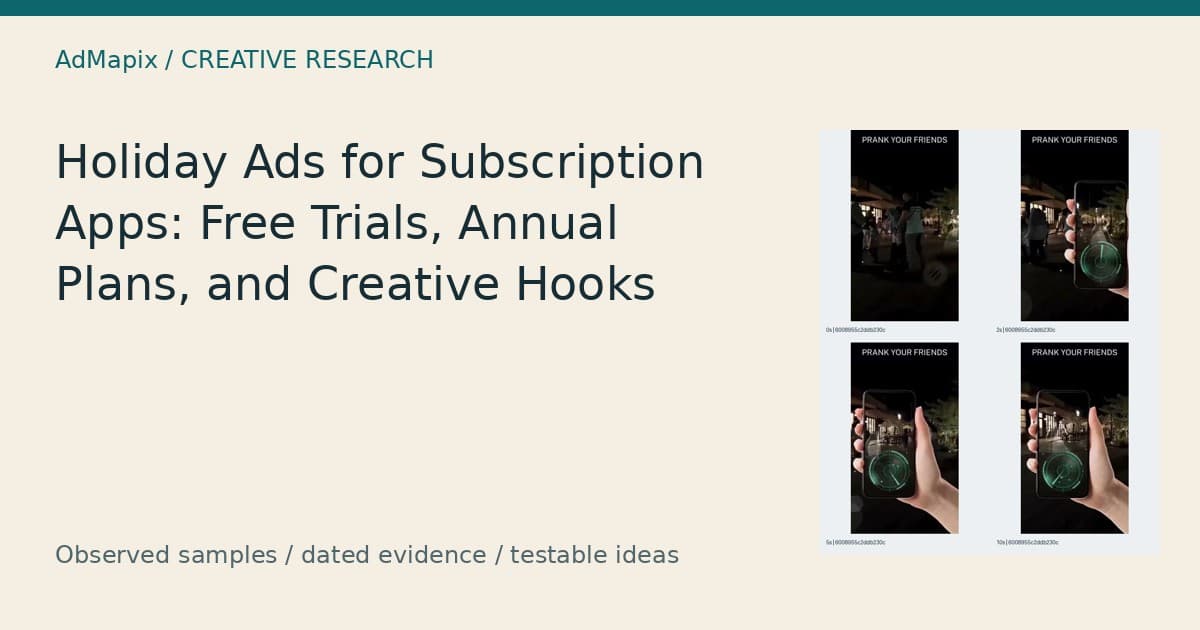
Holiday Marketing Campaigns for Subscription Apps
Holiday marketing campaigns for subscription apps should connect a timely reason to use the product with a clear explanation of the commitment. A seasonal headline cannot resolve uncertainty about what is free, when billing starts, or why an annual plan deserves an upfront payment. For app growth managers and creative teams preparing holiday campaigns, the useful starting point is therefore an offer and message audit.
The dated sample examined here makes that distinction concrete. A US search for “subscription” returned subscription management tools, entertainment ads promising free access, retail messaging rejecting subscriptions, and a cryptocurrency ad comparing a subscription payment with another purchase. These examples reveal ways advertisers frame commitment and value. They do not establish a winning holiday offer, a verified annual-plan promotion, or conversion performance. This guide turns those observations into original creative briefs, offer checks, and a practical testing workflow.
Last updated: 2026-10-12.
AdMapix Research — prepared with Codex and checked against the dated source sample. Editorial ownership: Brad at AdMapix. This disclosure does not imply personal human review. AdMapix is our product.
Quick Answer
Subscription app holiday campaigns need a demonstrable benefit, an accurate offer, and a landing experience that preserves the same promise.
- Use seasonal occasions to explain when the product helps; confirm that the occasion fits the actual feature.
- Distinguish free access, a free trial, an introductory offer, and an annual subscription before writing creative.
- Treat the advertising examples below as message references, not verified holiday campaigns or performance benchmarks.
- Use AdMapix to inspect indexed creatives, then validate your own terms and measure results in your own acquisition and billing systems.
What a Subscription Team Should Decide Before Making Holiday Ads
The first decision is which uncertainty the campaign must resolve: whether the product is useful, whether its price is justified, or whether subscribing feels like too much commitment. Each problem needs a different creative brief. An entertaining opener may introduce a product benefit, but it cannot explain an unclear renewal condition. An annual discount may answer a price objection while leaving the viewer uncertain about using the app beyond the holiday.
Write the intended decision in a sentence before commissioning assets. For example: “Help eligible new users understand what they can accomplish during the trial and what happens afterward.” That brief differs from “Help existing monthly subscribers compare the annual option.” It also differs from “Introduce a seasonal feature without changing the commercial offer.” Combining these goals makes it difficult to know what the finished ad is supposed to communicate.
The sampled ads are useful because they expose several meanings of subscription. In some records, the term appears in a product name. Elsewhere it appears in a rejection of recurring fees. Another advertiser uses it as a comparison with an unrelated purchase. A keyword match therefore identifies a research lead, not a shared business model.
For a broader foundation, the mobile app advertising research guide explains the discovery task. This article focuses on the narrower handoff from public examples to a holiday offer and creative test.
Your campaign brief should name the intended user, the product action, the commercial decision, and the evidence needed to support each claim. If the team cannot agree on those elements, producing more seasonal variations will multiply the ambiguity.
Methodology: What This Dated Sample Can Establish
This analysis uses a bounded US keyword sample for the exact measurement window 2026-09-12 to 2026-10-11, retrieved on 2026-10-12. The query was “subscription.” The collection requested three pages of ten records each, with estimated impressions requested in descending order. It contains thirty advertising records and is not a complete inventory of any advertiser, app category, network, or holiday campaign.
The public frozen source package contains the captured batches, request parameters, and checksums. Those materials make the collection process reproducible and allow readers to check the article against the preserved responses. A live search can change after collection; it need not reproduce the same returned records or values.
The sample contains fourteen distinct video fingerprints, seven distinct image fingerprints, and three distinct playable fingerprints. Twenty-two records contain a video association, and nine contain a playable association. These are different counting units. A record can contain both a video and a playable association, so the record counts should not be added as if they described separate populations. The fingerprint categories also should not be collapsed into an unexplained total of “creatives.”
The visual evidence consists of eight supplied advertising images. Six are contact sheets with frames at 0, 2, 5, and 10 seconds; two are static images. Observations refer only to those frames and images, together with the corresponding captured advertising copy. This article does not claim complete video playback, audio inspection, app testing, checkout testing, or interaction with the associated playable files.
Product references follow the linked store identifiers reported in the captured records. A visible logo, familiar app name, or recognizable scene does not override that association. Conversely, a reported listing association does not establish who purchased the advertising or verify every function suggested by its imagery. Where a visual and listing appear difficult to reconcile, the uncertainty remains explicit.
The records do not provide a verified, reader-interpretable network mapping for this analysis. Accordingly, the examples are not labeled Meta, TikTok, YouTube, or another advertising network. The US setting describes the query filter, not independently verified targeting, language suitability, or offer eligibility.
All impression values below are third-party model estimates for the stated window. They are not observed delivery, spend, installs, profit, or lifetime totals. Product-level search aggregates are excluded. No daily delivery calculation, conversion ranking, or inference from advertising longevity is used.
Finally, the supplied seasonal research context concerns an earlier annual search-interest cycle. It provides a reason to investigate holiday planning, not evidence that these eight examples were holiday campaigns or that a particular offer will perform this season.
Evidence Table: Eight References and Their Actual Research Roles
The eight illustrated references support different questions about attention, commitment, product presentation, and source attribution. Their estimated impressions provide dated record context; they do not rank the quality of their ideas. The identifiers below are the opening characters of the corresponding record IDs in the public source package.
| Figure and record | Reported linked listing | Visible or captured message | Window model-estimated impressions | Appropriate research use |
|---|---|---|---|---|
1 · 6008955c2ddb | Subscription Tracker & Manager · com.subscription.tracker.manager.bills | “PRANK YOUR FRIENDS” above a nighttime phone demonstration | 2,432,542 | Check visual-to-product alignment before adapting a seasonal idea |
2 · bbab5a89e299 | FreeDrama · com.drama.free | Fantasy drama with an “All episodes are completely free” banner | 1,523,919 | Study how an access claim accompanies content imagery |
3 · 9bee49754233 | Feenko · 6747262759 | Drive-through interaction; no complete offer visible in sampled frames | 1,391,233 | Separate scene recognition from product explanation |
4 · a63bb3f6ada8 | Feenko · 6747262759 | Interview setting with Feenko signage and a fragment reading “$50” | 681,131 | Identify the context required before using a monetary claim |
5 · b1b9e5aaec3f | FreeDrama · com.drama.free | Period romance with a recurring free-access banner | 426,480 | Compare story treatment while retaining the commercial message |
6 · 371528f078fc | Stitch Fix · com.stitchfix.stitchfix and 1022579925 | Outfit image; associated copy says no subscription is required | 313,426 | Study concrete product value alongside commitment reassurance |
7 · b69287c6cb04 | Binance · com.binance.dev | A subscription payment contrasted with buying Bitcoin | 283,086 | Examine opportunity-cost framing without adopting the financial proposition |
8 · 5b10b3c99c7d | CineVibe · com.cinevibe.videodash | Movie-access imagery, reaction shots, and “NO SUBSCRIBE” | 218,495 | Examine comparison structure and the proof burden of broad access claims |
The table deliberately combines heterogeneous examples. That is the central lesson of this query: searching for subscription language does not isolate subscription businesses or subscription offers. Before building a comparison, decide whether each result is evidence about the product, the commercial claim, or merely the language surrounding recurring payments.
The Stitch Fix row also illustrates why a single record should not be duplicated into separate totals simply because it links to multiple store entries. Preserve the record-level estimate and the listing associations as separate facts.
Figure 1: A Seasonal-Looking Hook Still Needs Product Verification
The first contact sheet shows a prank-oriented phone demonstration, while the captured record links it to Subscription Tracker & Manager. That mismatch makes it an attribution and message-alignment example. It does not justify describing the app as a ghost detector, inventing a Halloween promotion, or treating the visible demonstration as a verified product feature.
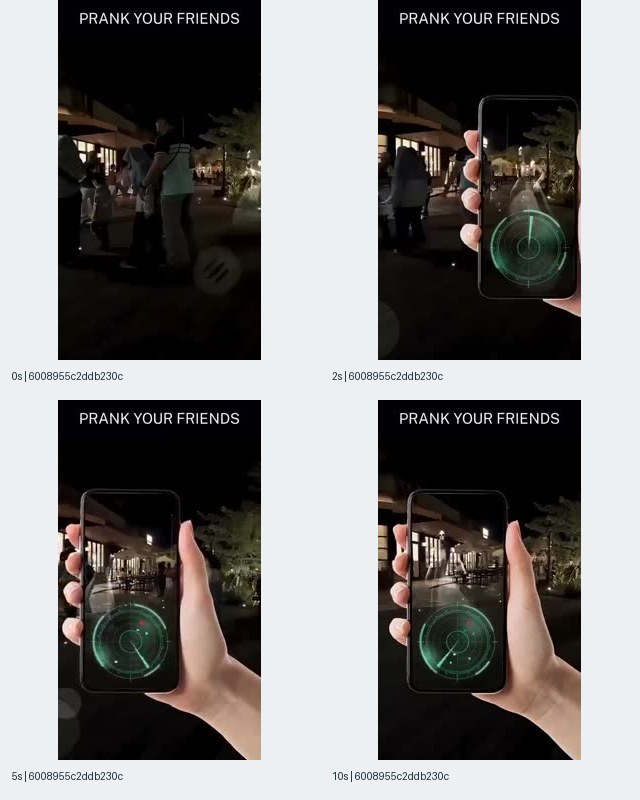
Figure 1. Record 6008955c2ddb230c3e2e7f8ba7396411, reported linked listing Subscription Tracker & Manager. Observed frames: 0, 2, 5, and 10 seconds. The contact sheet establishes the visible prank framing, not app functionality or campaign performance.
At the first sampled timestamp, the scene is a dark outdoor walkway. Later sampled frames place a hand-held phone prominently in front of that environment, with a circular green display occupying part of the screen. The headline remains visible in the supplied frames. Together, these elements offer a concrete visual premise: use a phone to create a surprising social moment.
The seasonal interpretation is a hypothesis. A creative team might associate darkness, a radar-like display, and prank language with Halloween. None of those elements proves that the original campaign was scheduled for Halloween, used a seasonal audience, or carried a holiday offer.
For a subscription app, the transferable planning question is whether the opening scene can be connected to a real product action. A budgeting app could demonstrate organizing recurring payments before seasonal shopping. A photo app could demonstrate an available costume-editing feature. These would be original concepts, contingent on actual functionality, rather than reproductions of the sampled advertisement.
Put a verification field beside every proposed demonstration in the brief: “Where can production see this action in the current product?” If the answer is missing, the scene is not ready to become a product claim. This prevents an engaging visual reference from becoming a misleading promise during the handoff between research, scripting, and editing.
Figure 2: Free Access and a Free Trial Are Different Offers
The fantasy-drama example pairs content imagery with a broad free-access claim, not an explicit time-limited trial. Its value for subscription marketers is the visibility of the commercial promise alongside the entertainment. The article can describe that promise as advertising language, but the supplied material does not verify actual catalog access, charges, eligibility, or the duration of availability.
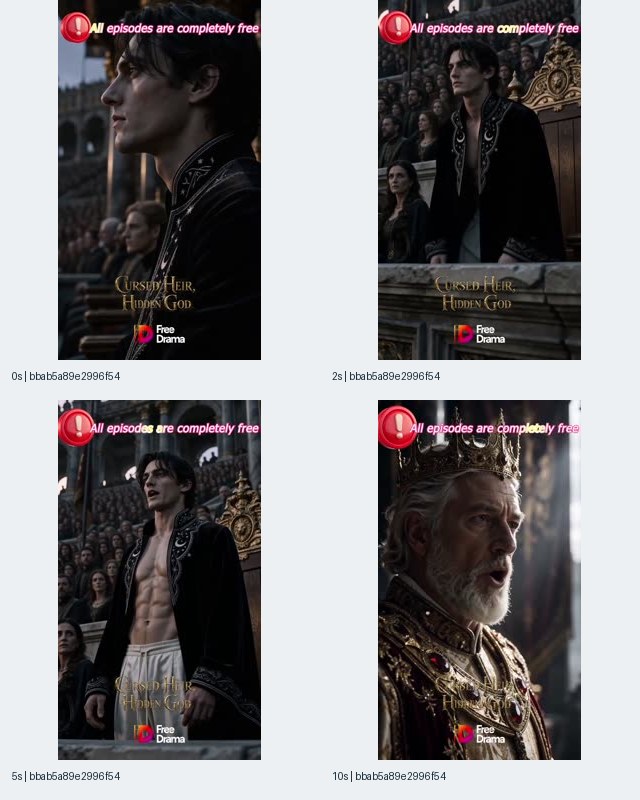
Figure 2. Record bbab5a89e2996f54c0e7929fcc08f04e, linked listing com.drama.free. Observed frames: 0, 2, 5, and 10 seconds. Free-access wording is a captured advertiser claim, not an independently tested commercial term.
The supplied frames move between a central character and a court-like setting, including an older crowned figure. FreeDrama branding and the access banner remain visible across the sampled images. The source copy separately advertises free dramas and says no subscription is required. That is enough to identify an access-based proposition; it is not enough to explain the service’s complete monetization model.
A holiday streaming campaign can learn from the division of jobs. The imagery supplies a reason to care about the content, while the banner addresses access. If your product offers a trial instead, that second layer must explain the actual trial. Replacing the original wording with an equally broad “free” claim would change the meaning of your offer.
A suitable original hypothesis might be: “Showing the trial’s included content beside the trial condition will help eligible viewers understand what they receive.” The test concerns comprehension first. Whether that clarity changes paid conversion requires your own data.
The production brief should therefore specify which titles or features are included, which audience qualifies, and what happens when the introductory period ends. It should also distinguish on-screen copy from accompanying ad text. If a cropped placement loses the accompanying description, the visible asset should still leave a substantially accurate impression of the offer.
You can inspect indexed creatives containing “subscription” in AdMapix and apply the same distinction: identify whether each result promises ongoing free access, temporary access, or freedom from a recurring commitment. Live results may differ from this frozen sample.
Figure 3: A Familiar Scene Does Not Explain a Subscription Product
The drive-through contact sheet provides a recognizable social setting but does not explain Feenko’s product mechanism in the sampled frames. The record’s linked listing identifies the research association; the visible restaurant setting does not establish a restaurant partnership, endorsement, or the advertising buyer. Those distinctions matter when a creative team borrows scene structure from an unrelated reference.
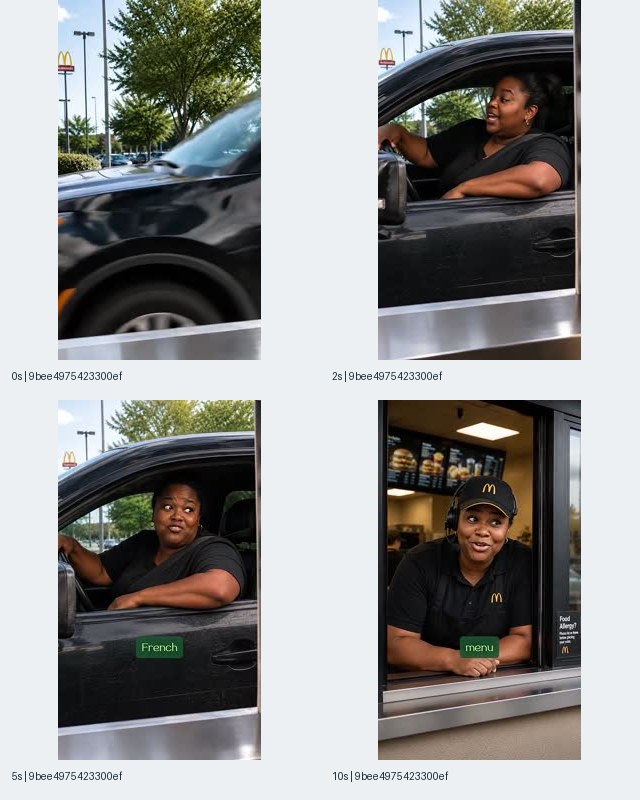
Figure 3. Record 9bee4975423300ef9bfd0605a1618adf, reported linked listing Feenko, store ID 6747262759. Observed frames: 0, 2, 5, and 10 seconds. The excerpt does not establish the full dialogue or offer.
At the sampled timestamps, a car arrives, a driver appears at the window, and a worker is shown inside. The isolated subtitle words are insufficient to reconstruct a conversation. They also do not explain how the scene eventually relates to subscription cancellation. The complete transition may occur elsewhere in the source video, but it was not observed here.
For holiday planning, use this example to examine the bridge between an everyday situation and the app’s benefit. A travel subscription might start with packing; a learning app might start with a family conversation; a recipe app might start with a shopping decision. The brief still needs to specify the action that connects the situation to the product.
A useful storyboard field is “the moment the product becomes necessary.” If the storyboard contains only a familiar scene and a final logo, that bridge may be missing. Add an actual interaction: selecting a relevant lesson, saving a shopping list, or finding a piece of content that is available under the advertised plan.
This does not mean every ad must begin with a screen recording. It means the team should know what the opening prepares the viewer to understand. Treat scene familiarity as a creative choice to test, rather than evidence that the viewer will recognize the product or accept its commercial terms.
Figure 4: A Visible Dollar Amount Is Not a Complete Offer
The Feenko interview reference contains a monetary fragment, but the sampled frames do not establish what the amount means. It could belong to a question, comparison, example, or other part of the conversation. A subscription campaign should not convert such a fragment into a verified price, saving, refund, or customer result.
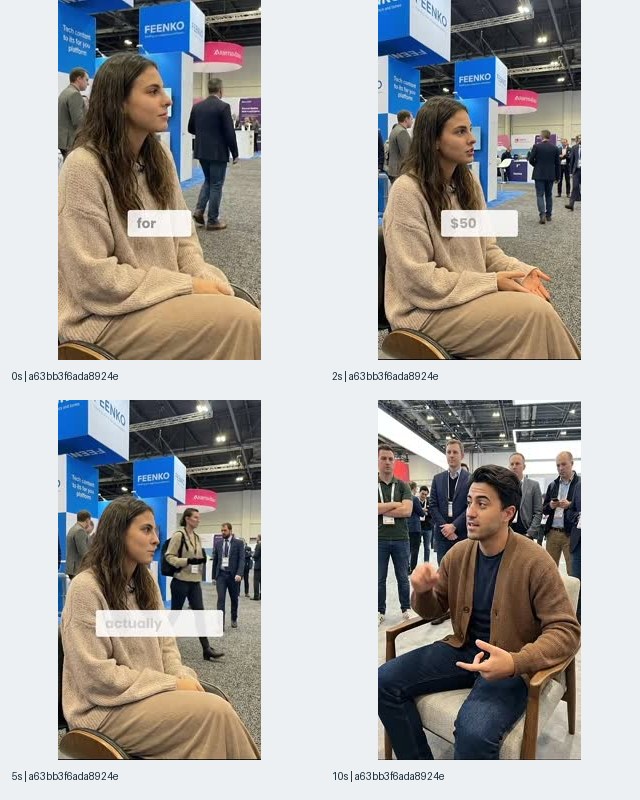
Figure 4. Record a63bb3f6ada8924e41a6d281ab927a97, linked listing Feenko, store ID 6747262759. Observed frames: 0, 2, 5, and 10 seconds. The visible “$50” fragment has insufficient context to support an offer or savings claim.
The exhibition setting includes visible Feenko signage, seated participants, and people in the background. The composition supports describing an interview-style presentation. It does not establish whether participants are customers, employees, actors, or independent interviewees. Their presence cannot be turned into a testimonial without additional evidence.
For an original holiday ad, an interview format can be used to surface a specific question about commitment. A presenter might ask which plan fits occasional use or what changes after a trial. The answer should come from the current product and billing documentation. If the scene is scripted, production should preserve that status rather than imply an unsupplied customer experience.
Monetary language needs a separate claim record. Write down the amount, currency, comparison basis, period, eligibility, and source of verification. “Save on the first annual term” and “save every year” are materially different claims even when their headline amount looks similar.
The practical adaptation is therefore the explanatory format: a question followed by a clear answer and supporting product evidence. It is not the isolated amount or an assumption that an interview setting makes a claim credible. Before shooting, ask whether the exact statement could be supported without the speaker’s confidence or the event backdrop. If not, the evidence is doing too little work.
Figure 5: Change the Story Without Accidentally Changing the Promise
The second FreeDrama example changes the narrative setting while retaining a visible free-access message. It illustrates a useful production distinction between the story used to attract attention and the commercial promise attached to that story. The supplied examples do not establish an intentional experiment, but they provide material for designing one in your own account.
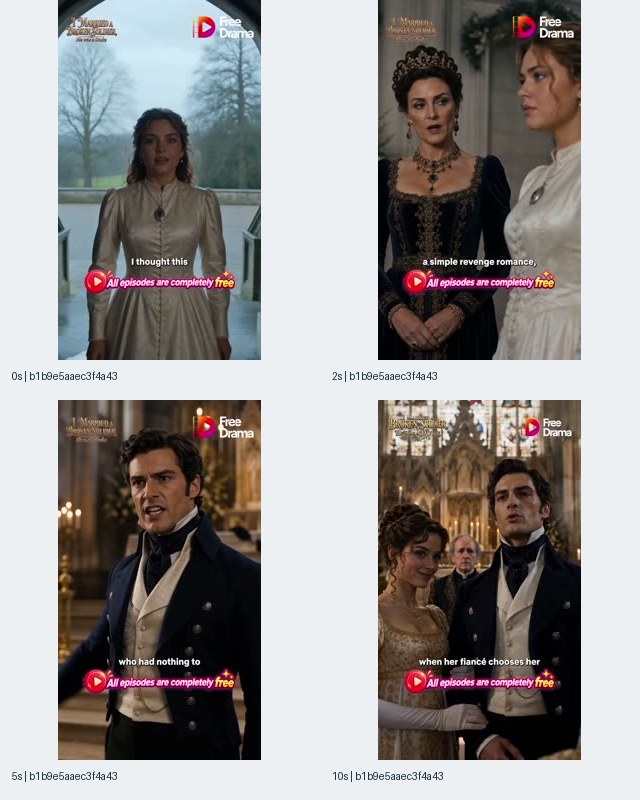
Figure 5. Record b1b9e5aaec3f4a43237f13e9e20467f1, linked listing com.drama.free. Observed frames: 0, 2, 5, and 10 seconds. The contact sheet supports observations about visible story framing and repeated offer text, not a complete plot summary.
The sampled images feature period clothing and ornate interiors. Short subtitle fragments suggest a romance-related narrative, but they do not establish the full story. The recurring free-access banner provides a commercial layer separate from those fragments. That separation is the element a subscription creative team can usefully analyze.
Suppose your app has an approved holiday trial. One original variation could show a quiet evening use case; another could show an available feature relevant to travel. If the question is which context communicates the benefit more clearly, retain the same trial eligibility, duration, included functionality, renewal explanation, and destination. Otherwise, the two assets ask different commercial questions.
Give editors a fixed offer block and a variable story block. The fixed block should be versioned with the approved terms. The variable block can contain the scene, demonstration, pacing, and headline that production is allowed to change. This makes it easier to catch an accidental promise change during localization or a last-minute cutdown.
The result is a cleaner testable hypothesis: “This seasonal context may make the same product benefit more relevant.” It is not “This story is proven to sell subscriptions.” Public examples can help formulate the former. Only your own controlled comparison and downstream results can support a performance conclusion.
Figure 6: Show the Benefit Before Asking for a Commitment
The Stitch Fix image presents a concrete outfit, while the associated copy addresses subscription commitment separately. The image itself does not show a trial, annual plan, holiday discount, or recurring charge. Its relevance is the order of explanation: viewers can inspect a tangible product arrangement before interpreting the accompanying commercial reassurance.

Figure 6. Static image from record 371528f078fca1f261041bd7a7bc9391, linked to the reported Stitch Fix Android and iOS listings. “No subscription required” appears in the associated advertising copy, not on this image.
The dress, boots, and bag form a coordinated arrangement with limited visual distraction. A creative team might interpret the styling as suitable for cooler-weather occasions, but that is a hypothesis, not proof of a named holiday campaign. There is no need to invent a seasonal discount to extract a useful lesson from the composition.
For a subscription app, the analogous production task is to make the benefit inspectable. A design app might show an actual invitation created with included tools. A language app might show an available lesson relevant to travel. A planning app might show a real shared list. Each example would need product verification, but the principle is straightforward: show what the user receives in a form they can understand.
The commercial line then explains access to that benefit. If the output requires a paid plan, the creative should not imply that it belongs to a permanently free tier. If the image represents several features with different access rules, either simplify the example or make the distinction clear.
This reference also helps small teams evaluate static production. A static asset can be considered when the product outcome is visible without a temporal demonstration. That is a format-selection hypothesis, not a claim that static ads cost less to acquire customers. Production simplicity, message clarity, and acquisition efficiency are separate questions and should be assessed separately.
Figure 7: Opportunity-Cost Framing Makes the Alternative Purchase Explicit
The Binance image contrasts a subscription payment with buying Bitcoin. It is evidence of comparison framing, not a subscription app offer or a recommendation about financial behavior. For subscription marketers, the useful question is how to explain the value of their own product without making an unsupported claim about what a different purchase would achieve.

Figure 7. Static image from record b69287c6cb04e322884afcd5138f4c43, linked listing com.binance.dev. The dollar amount and Bitcoin comparison are captured advertising language. They do not establish returns, suitability, or current offer availability.
The headline uses a familiar expense as its comparison point. The image also includes a distinct call to action and a small-print risk statement. This analysis does not validate the completeness of that statement or infer that the creative was approved for a particular market. The US query filter alone would not support that conclusion.
A subscription app can adapt the structural idea by comparing verifiable options within its own product. For example, a plan-selection ad could explain which features belong to a monthly option and which belong to an annual option. The comparison becomes useful when both choices are described accurately and the user can see the tradeoff.
Avoid transferring the emotional force of the original comparison into invented savings. A productivity app cannot assume every user replaces another paid service. A fitness app cannot treat an unrelated purchase as an equivalent outcome. If the comparison depends on individual behavior, identify that condition or choose a simpler benefit claim.
For a holiday brief, a defensible hypothesis might be: “Showing the specific uses included in the subscription may help viewers judge its relevance alongside other seasonal purchases.” Production could demonstrate those uses without assigning an unsupported monetary value to them. The test should assess whether the message improves understanding and attracts suitable users, rather than merely whether the comparison earns attention.
Figure 8: A Broad Catalog Claim Creates a Broad Verification Task
The CineVibe contact sheet combines a reaction performance, recognizable entertainment branding, and claims about free movie access. Those elements establish how the ad presents itself. They do not verify catalog size, licensing, service availability, the absence of charges, or an affiliation with the brands shown. The reported linked listing remains CineVibe.
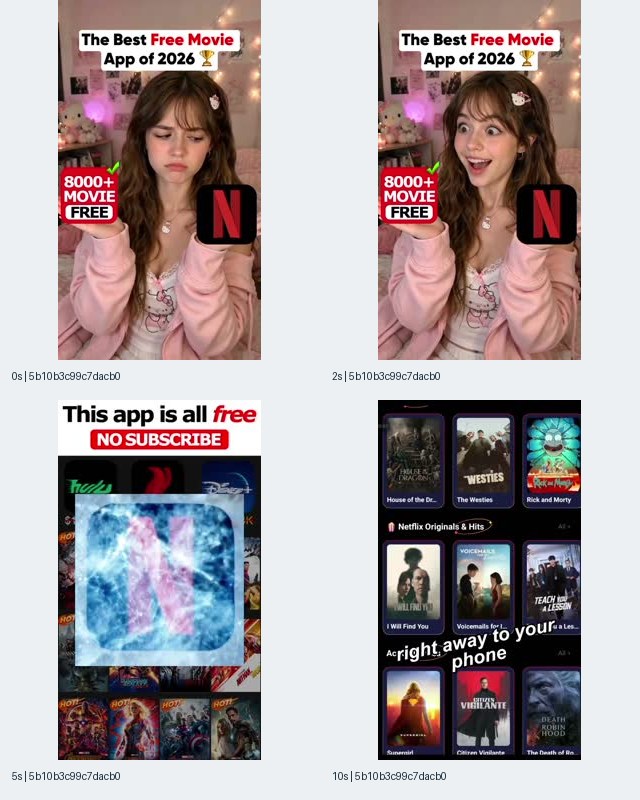
Figure 8. Record 5b10b3c99c7dacb083685f6063e689c2, linked listing com.cinevibe.videodash. Observed frames: 0, 2, 5, and 10 seconds. Brand graphics and title images are visible creative elements, not proof of affiliation or catalog rights.
At the opening sampled frames, the presenter holds a comparison pose with different graphics placed near her hands. Later frames show stronger free-access language and a title grid. This supports describing a comparison-to-catalog presentation. It does not establish every transition, the spoken script, or what happens after a click.
The practical lesson is that a broad promise requires correspondingly specific support. If your own subscription campaign presents a selection of holiday content, confirm that the displayed items are available to the advertised audience under the advertised plan. If access varies by region or entitlement, production needs that information before the final composition is approved.
A more focused original concept may be easier to substantiate: show a verified feature or an accurately described selection, then explain the access condition. That is a recommendation about evidence and communication, not a prediction that a narrower claim will convert better.
This example also demonstrates duplication in the source sample. Record 1711afc12692382168155462d61a8e50 shares the same video fingerprint as the illustrated CineVibe record. Those are separate advertising records associated with the same underlying video file. Treating them as separate creative concepts would exaggerate the apparent variety of the references available to your team.
What These Examples Suggest About Holiday Relevance
The sample supports several hypotheses about explaining value and commitment, but it does not identify a proven holiday advertising formula. Seasonal relevance should therefore be constructed from your product’s actual use cases. Begin with the occasion, identify the user’s task, and show the feature that helps with that task before attaching a commercial offer.
A holiday occasion can change the context of use without changing the plan. Travel may make a language lesson relevant. A gathering may make a shared planning feature useful. Seasonal content may give an entertainment user a timely reason to browse. These are proposed scenarios; none is a measured outcome from the supplied advertising records.
Separate seasonal context from seasonal entitlement. A festive visual treatment can accompany the ordinary product. A limited seasonal feature changes what the user receives. A holiday discount changes the commercial terms. An expiring trial changes the access period. These distinctions belong in the brief because the same headline can otherwise leave different team members imagining different offers.
| Campaign layer | Planning question | Evidence required before publication |
|---|---|---|
| Occasion | Why might someone use this now? | A plausible use case and relevant product functionality |
| Feature | What can the user actually do? | Current product demonstration or documented availability |
| Entitlement | Which plan includes it? | Current access rules for the intended audience |
| Offer | What commercial condition changes? | Approved eligibility, charge, duration, and renewal terms |
| Deadline | What ends, and when? | An actual operational expiry and a consistent destination |
The distinction also protects evergreen production. A useful feature demonstration can remain available after a seasonal offer ends if the commercial layer is removed or replaced accurately. Plan that version before launch instead of attempting to rescue an expired advertisement through hurried editing.
The objective is a believable relationship between the calendar and the product. A holiday label alone does not provide that relationship, and the supplied search-interest context does not prove that any particular occasion will increase demand for your app.
Build an Offer Taxonomy Before Comparing Competitors
Free access, free trials, introductory discounts, and annual plans answer different commercial questions and should occupy separate rows in your research sheet. Grouping them under “holiday deals” conceals the conditions that matter to a subscriber. The sampled free-access and no-subscription claims make this especially important: their wording should not be repurposed as evidence about trial or annual-plan conversion.
| Offer type | What the user must understand | What the sample establishes | What your team must verify |
|---|---|---|---|
| Free access | Which functions or content are available without payment | Several advertisers make free-access claims | Scope, limitations, availability, and any other monetization conditions |
| Free trial | Temporary access and what happens afterward | No fully verified trial journey is supplied | Eligibility, duration, payment requirement, renewal, and cancellation path |
| Introductory discount | A lower charge under specified initial conditions | Some captured copy mentions promotional access | Exact eligible charge, period, restrictions, and subsequent price |
| Annual subscription | Upfront commitment for a defined term | No verified annual-plan campaign is supplied | Total charge, included benefits, renewal, and comparison basis |
| No subscription required | A purchase or access path without mandatory recurring enrollment | Stitch Fix copy uses this claim | The actual transaction model and any optional recurring elements |
The broader sample includes YOXO copy mentioning a free month and conditions involving activation or number porting. That is a useful lead for identifying conditional introductory language. It is not sufficient to verify a complete checkout journey, and the Romanian-language copy should not be silently treated as an English-language US offer.
Use the Black Friday competitor offer tracker when your research question becomes how promotions change across observations. Keep the subscription-specific fields here: access duration, recurring obligation, renewal, eligibility, and included features.
When terms are absent, write “not supplied” rather than filling the cell with a likely industry practice. Missing information is actionable: it tells the researcher what to check and tells the creative team what cannot yet be claimed. A comparison with visible gaps is more useful than a complete-looking table assembled from assumptions.
How to Brief a Free-Trial Holiday Campaign
A free-trial campaign should explain the useful experience available during the trial and the commercial transition that follows it. The supplied examples do not establish an effective trial length or a winning trial script. Your task is to design a clear proposition for your actual product, then test whether eligible users understand and use it as intended.
Start with an achievable product action. “Try premium” names an access level but leaves the benefit abstract. “Create a holiday invitation using the included editor” gives production a demonstrable action, provided that the editor is genuinely included and the claim accurately describes the experience. The action should be feasible within the trial rather than depend on a result the product cannot promise.
Next, define the access boundary. Specify the eligible audience, the trial duration, whether a payment method is required, which features are included, and the charge and billing interval that follow. Record how cancellation works and whether cancelling ends access immediately or at the end of the trial. These are questions for your own verified terms, not assumptions to copy from another advertiser.
The storyboard can then connect benefit and condition:
| Creative component | Suggested job | Production instruction |
|---|---|---|
| Opening | Establish the seasonal task | Show a situation relevant to the actual feature |
| Demonstration | Make the trial’s value inspectable | Use the current product and included functionality |
| Offer explanation | Describe temporary access accurately | Insert approved duration and eligibility language |
| Commercial transition | Explain what follows | Preserve the verified renewal and charge information |
| CTA | Set the next-step expectation | Match the destination and the action the viewer will encounter |
This is a proposed structure, not an observed sequence from the sample. Before media testing, conduct a comprehension check with the finished asset and destination. Ask a viewer to explain what they receive, when payment occurs, and how they would avoid renewal if they choose not to continue. Record their answer without coaching them toward the intended response.
If the answer differs from the actual offer, revise the communication before treating acquisition results as a clean creative test. A campaign can attract trial starts while leaving users confused about the obligation. That possibility makes paid conversion, refunds, cancellations, and support questions relevant downstream checks rather than optional details.
How to Explain an Annual Plan Without Hiding the Commitment
An annual-plan campaign should make the total commitment understandable and connect it to a credible reason for continued use. A holiday occasion can introduce the product, but it does not itself demonstrate year-round value. No annual-plan offer is verified in the supplied sample, so the following framework is a proposed planning method rather than a finding about any sampled advertiser.
Begin with the product’s recurring utility. A yearly commitment may be easier to explain when the app supports a repeated task, an ongoing learning path, or a regularly used content service. The advertisement should show the relevant functionality without promising that every subscriber will maintain the same usage pattern. If the benefit exists only during a short occasion, reconsider whether the annual plan is the right message for that creative.
When presenting an equivalent monthly amount, preserve the annual billing fact. A divided comparison can help someone assess a price, but it should not imply that payment occurs monthly when the actual charge is upfront. The total due, subscription term, and renewal conditions need a clear place in the offer explanation and destination.
A savings claim requires a defined comparison. Let the current monthly charge be M and the current annual charge be A. A comparison with twelve monthly payments uses 12 × M as its basis. Before publishing a saving derived from that relationship, verify that the plans are comparable, the prices apply to the same market and audience, and the comparison describes the intended term. Do not assume an introductory annual price also applies at renewal.
An original annual-plan brief might contain these elements:
- The recurring task the app supports beyond the holiday.
- The features actually included in the advertised plan.
- The total charge and the period it covers.
- The exact basis of any comparison with another plan.
- The renewal condition and the destination where it is explained.
- A hypothesis about which benefit presentation helps suitable users choose.
Also distinguish a self-purchased subscription from a gift. Gift eligibility, redemption timing, account ownership, and renewal behavior may differ. If gifting is not supported, holiday language should not imply that it is.
The test question should concern the message you changed. Comparing an annual offer with a monthly offer can be a legitimate commercial experiment, but it changes the commitment itself. It should not be reported as a pure test of a seasonal headline or visual style.
Create a Promise Map From the Ad to the Product
A promise map checks whether the same benefit and commercial condition survive every step from the advertisement to product access. This matters for subscription apps because the user may encounter an ad, a store page, onboarding, a paywall, and a billing confirmation before using the advertised feature. A correct sentence in one location does not resolve a contradictory impression elsewhere.
Create a row for each material claim, then inspect its treatment across the journey. Do this with your own current product and destination; no such external journey was tested for the sampled advertisers in this article.
| Promise | Ad asset | Destination | Onboarding or paywall | Product access |
|---|---|---|---|---|
| Seasonal feature | What is visibly demonstrated? | Is the same feature described? | Is the relevant plan identified? | Can the eligible user perform it? |
| Trial access | Is temporary access clear? | Are conditions preserved? | Is the billing transition understandable? | Does access match the advertised scope? |
| Annual commitment | Is the billing basis accurate? | Is the total charge visible? | Does the selected plan match? | Are the included benefits available? |
| Promotion deadline | What exactly expires? | Is the same deadline used? | Does eligibility behave accordingly? | Is the user’s entitlement consistent? |
Pay particular attention to the default selected plan. An ad inviting users to explore a trial should not rely on an unexplained transition into a different purchase option. Similarly, a destination that changes by device or geography needs its own verification; the desktop version alone does not establish the mobile journey.
For scripting detail, the guide to matching video scripts with landing-page offers provides a related workflow. Its relevance here is promise consistency, not evidence that the current sample came from YouTube.
Give each unresolved mismatch an owner. Product can confirm functionality, billing can confirm charges, creative can revise the asset, and acquisition can confirm the destination configuration. The map becomes useful when it produces a decision about a specific claim, rather than a general request to “make the messaging clearer.”
A Practical Research Workflow From Query to Creative Brief
A useful research workflow ends with an original hypothesis supported by identifiable evidence, not a folder of advertisements labeled as winners. The subscription query demonstrates why filtering, identity checks, and offer classification must happen before creative interpretation. You can use the following sequence for a holiday planning session without claiming that the source sample proves a complete market pattern.
Define the decision. Choose the question the brief must answer: explaining trial access, presenting annual value, introducing a seasonal feature, or addressing a commitment objection. Record the intended market, eligible user, and product version. This prevents unrelated examples from becoming persuasive merely because their visuals are memorable.
Capture the query context. Save the keyword, market filter, measurement bounds, retrieval date, requested ordering, and page limit. If you broaden the research to holiday terms, record that as a new query. Do not mix a broader result set into the original sample while retaining the original sample label.
Check each linked listing. Preserve the store identifier and reported name beside the ad record. Separate visible branding from the linked destination. The prank reference and drive-through scene show why that distinction belongs early in the process. Unclear alignment should generate a verification task, not an invented explanation.
Separate records from media. Identify repeated video, image, and playable files before counting concepts. Keep record-level context, but select references based on what they contribute to the brief. The repeated CineVibe video is useful evidence about reuse; it does not create an additional observed story treatment.
Classify the commercial message. Mark free access, temporary access, discounted access, annual commitment, or no required subscription only when the supplied copy supports that label. Keep an unknown category. Add the exact quoted condition where available, and distinguish text visible in the image from copy stored alongside it.
Annotate only what was observed. For a contact sheet, describe the supplied timestamps. For a static image, describe its composition. Do not fill missing dialogue, transitions, or final calls to action from intuition. If the unresolved detail matters to the brief, request additional evidence in the research process.
Write the hypothesis. Connect an observation to a proposed change in your own asset: “Because this reference pairs a concrete output with commitment reassurance, we will test a verified product output beside our approved trial explanation.” The observation and proposed effect are separate parts of the sentence.
Choose the evidence needed for production. Attach the current product demonstration, approved offer terms, relevant content permissions, destination version, and claim owner. Public competitor imagery can inspire structure, but it cannot supply permission to reuse the image or proof for your own product claim.
Define the decision after testing. State what result would support further testing, what would trigger a revision, and what would leave the outcome inconclusive. Use your own measurement capabilities and commercial constraints. The public record’s estimated impressions should not become your success threshold.
The final research packet should allow a person who did not conduct the search to understand the reference, locate it, see the uncertainty, and build an original asset from the brief.
An Original Holiday Creative Brief You Can Adapt
A production-ready brief specifies the claim, the demonstration, the offer, and the test variable in language that writers and editors can apply. The example below is a hypothetical brief for a subscription planning app. It is not a customer case, a tested campaign, or a description of any sampled product. Every feature and commercial condition would need confirmation before production.
Scenario: A planning app wants to introduce an existing shared-list feature to eligible new users preparing a holiday gathering. The team is considering a trial campaign but has not yet inserted the approved commercial terms.
Research observation: The Stitch Fix reference presents a concrete arrangement, while associated copy separately addresses commitment. The FreeDrama references keep access language visible alongside the content imagery. These observations suggest a way to separate the useful outcome from the access explanation.
Hypothesis: Showing the shared-list action and the approved trial condition together may help eligible viewers understand both the product benefit and the commitment. The hypothesis concerns comprehension and subsequent qualified use; it does not predict a guaranteed conversion increase.
| Brief field | Proposed instruction |
|---|---|
| Audience | Eligible new users with a genuine shared-planning need; eligibility must match the offer |
| Product action | Create a list and share it using the current app, if those functions are verified |
| Opening situation | A person organizing tasks for a gathering |
| Demonstration | Show the actual steps and a readable example list |
| Main benefit | Explain the verified coordination function without promising time savings that have not been measured |
| Offer block | Insert approved trial duration, eligibility, payment, renewal, and cancellation language |
| CTA | Describe the next action at the actual destination |
| Fixed elements | Product version, offer terms, destination, audience eligibility, and measurement definitions |
| Variable element | Seasonal situation versus an ordinary planning situation |
| Evidence to retain | Product capture, offer approval, final asset, destination capture, and test record |
A possible script draft begins: “Getting the gathering organized? Put the tasks in one shared list.” The next scene demonstrates the verified action. The offer block then explains access using approved terms, followed by the destination-matched CTA. The script must remain conditional until the product actually supports the displayed behavior.
The comparison asset should show the same feature in an ordinary planning context. Retain the same offer and demonstration depth. If the seasonal version contains more explanation or a different plan, the team will have changed more than the occasion.
For an annual-plan concept, use a separate brief. Show several verified recurring uses without implying measured frequency or guaranteed habit formation. Explain the annual commitment directly. Do not reuse the trial brief’s ending and assume the commercial decision is equivalent.
Production acceptance should include a readable feature demonstration, accurate offer text, consistent destination, and a clear record of which part varies. Missing commercial facts should block the relevant claim from being finalized; they should not be replaced by familiar language from another advertiser.
How to Test Creative Without Mistaking Attention for Subscription Value
A subscription creative test needs a defined downstream outcome because clicks, trial starts, and paid subscriptions describe different events. The source sample contains no conversion or billing evidence, so it cannot determine which of the illustrated structures produces better subscribers. The measurement design below is a recommendation for your own campaign, using data you are authorized to access.
Start by naming the experimental question. A seasonal-context test compares the same offer and product benefit in different situations. An offer test compares commercial terms or plan choices. A format test compares ways to present the same promise. These can all be worthwhile, but their conclusions should match the variable that actually changed.
For a seasonal-context experiment, retain the approved offer, eligibility, destination, optimization objective, and measurement definitions. Use random assignment where your testing environment supports it. If assignment is not controlled, document the limitations and avoid presenting the comparison as a clean causal result. Differences in audience, calendar period, or delivery conditions can affect what you observe.
Define the funnel events before launch:
| Event | What it can help answer | What it does not establish alone |
|---|---|---|
| Qualified destination visit | Did the ad bring a relevant visitor to the intended page? | Whether the visitor understood or accepted the offer |
| Trial enrollment | Did an eligible user begin the trial? | Whether the trial produced useful product experience |
| Activation | Did the user complete the defined meaningful action? | Whether the user will pay or remain subscribed |
| First paid conversion | Did the trial or purchase path produce a charge? | Whether the customer will retain or request a refund |
| Continued use or renewal | Did value persist into a later period? | The complete lifetime value of an immature cohort |
| Refund, cancellation, or support contact | Did the journey produce a potential mismatch or service issue? | The cause without further investigation |
Each rate needs a denominator and a maturation rule. Trial-to-paid conversion should use trials that have had the opportunity to reach the paid transition. Comparing a newly acquired cohort with an older cohort can make the newer group appear weaker simply because the relevant event has not yet occurred.
Choose your primary decision metric from the campaign objective and your actual measurement reliability. Keep other metrics as diagnostic or guardrail information. A lower cost per trial may be attractive, but it does not settle the decision if activation deteriorates or the paid transition becomes less satisfactory. Conversely, a clearer offer might reduce unqualified enrollments while changing the quality of the remaining cohort. That is a possibility to investigate, not an assumed outcome.
Use baseline data to plan the required sample and decision horizon. No universal budget, duration, or significance threshold can be inferred from these public advertisements. Avoid stopping a comparison solely because an early result looks favorable, and record tracking changes that could affect interpretation.
The creative testing framework can help structure the test record. Preserve the actual assets and offer versions alongside results so later teams can distinguish a message lesson from a pricing or destination change.
Plan the Holiday Launch Around Offer Readiness and Cohort Timing
A holiday launch schedule should follow the readiness of the product, offer, and measurement system rather than a universal countdown. The supplied seasonal context does not establish an optimal launch date, and the advertising sample does not measure holiday demand. Build a schedule that allows the team to verify the journey and observe the events needed for its decision.
Before production locks, confirm that the advertised feature will remain available for the intended campaign period. Confirm the eligibility rules, commercial terms, and expiry behavior. If a promotion requires an app release or a billing configuration change, connect the creative approval to that dependency. A finished video cannot compensate for an unavailable entitlement.
Before media begins, verify the final destination on the devices and account states relevant to the campaign. Check new users and existing users where their experiences differ. Preserve screenshots and the version of the offer that each asset describes. This is an internal launch recommendation, not a claim that these checks were performed on the sampled advertisers.
During the campaign, review whether the commercial promise remains accurate. A changed catalog, revised price, exhausted promotion, or altered eligibility rule may require an asset update. Distinguish that maintenance work from a response to creative performance; otherwise, the test history can become difficult to interpret.
After the offer closes, stop or revise messages that imply current availability. Keep measuring cohorts that have not yet reached the paid transition or relevant retention milestone. A promotion’s calendar end is not necessarily the end of its measurement period.
Finally, archive an ordinary-use version if the underlying demonstration remains valid. The team can then study whether the seasonal context contributed to the result without preserving an expired commercial claim in ongoing production.
Common Mistakes That Make Holiday Subscription Research Misleading
The most consequential mistakes change the meaning of the evidence before the campaign is even produced. They usually arise when a team treats a keyword, a visual impression, or a modeled metric as if it answered a different question. The corrections below keep the research useful without inventing certainty.
Calling every result a subscription business. The query includes tools that manage subscriptions, services advertising no subscription, and unrelated products using subscriptions as a comparison. Classify the role of the keyword before comparing offers.
Calling seasonal-looking imagery a holiday campaign. A dark scene or an outfit can inspire a seasonal hypothesis. Neither establishes a campaign calendar. Record the visible cue and keep the seasonal interpretation separate.
Converting “free” into “free trial.” The two phrases describe different commitments. If trial terms are not supplied, the ad cannot serve as a verified trial example.
Promoting a subtitle fragment into a savings claim. The Feenko interview sheet contains an amount without enough context. Preserve the uncertainty instead of attaching a commercial meaning to it.
Treating a visible brand as the linked advertiser. Restaurant signage and entertainment graphics do not replace the reported store association. They also do not prove a partnership or identify the advertising buyer.
Counting records as concepts. Repeated video fingerprints can appear under different records. Keep record-level analysis separate from the number of distinct media files and from your editorial classification of creative ideas.
Using estimated impressions as a conversion score. The estimates describe a specified window and source model. They cannot establish customer quality, acquisition cost, spend, or profitability.
Dividing a window estimate by an ad’s age. That calculation combines incompatible periods. This article does not use it, and the resulting number should not guide holiday pacing.
Changing the offer while claiming to test the hook. A different trial, price, or renewal condition changes the proposition. Label the experiment accordingly or keep the terms fixed.
Copying reassurance without verifying it. Phrases about cancellation, payment requirements, or permanent access are commercial claims. Use the actual product terms, including when describing AdMapix itself.
When AdMapix Fits the Workflow
AdMapix fits the discovery and evidence-organization stage when a team needs indexed advertising examples to inform an original brief. In this workflow, its role is to help researchers inspect references and preserve their context. The frozen sample demonstrates why that context includes the query, dates, linked listings, record identity, and distinctions between records and media files.
The product does not replace your billing system, product QA, or experiment analysis. Public creative evidence cannot confirm a competitor’s trial-to-paid conversion, establish the profitability of an annual offer, or reveal the reason a particular ad was repeated. Those questions need evidence beyond the supplied sample.
A practical handoff is to bring a narrowly defined research question: “How do indexed ads explain access without confusing temporary and ongoing availability?” Select references that answer that question, label their limits, and use the resulting brief to build a product-accurate test. Evaluate the workflow by whether it helps your team make that handoff clearly.
When deciding whether to add AdMapix to your research process, check the current plans and commercial terms. Prices and allowances can change, so this guide does not reproduce them. No paid-plan trial is promised.
Product facts supplied for this article were reviewed on 2026-08-13. They do not establish a verified hourly refresh commitment. Use the live product information for a purchase decision and the dated source package for the findings in this article.
FAQ
These answers distinguish what the dated advertising sample shows from the product and measurement work a subscription team still needs to perform. They are practical planning questions, not claims drawn from observed search-query demand or customer interviews.
What makes a holiday campaign relevant for a subscription app?
A relevant campaign connects an actual seasonal task with a feature the app can demonstrate. The holiday may change the context, the available content, or the commercial offer, but those are separate decisions. Start with the user’s task, verify the feature and entitlement, and explain the commitment accurately. Seasonal imagery alone does not establish that relationship or guarantee demand.
Should a holiday ad promote a free trial or an annual plan?
Choose according to the decision the eligible user needs to make and the terms your product can support. A trial introduces temporary access and a later transition; an annual plan asks for a longer commitment. The supplied sample does not establish which performs better. Test them as different commercial propositions, with appropriate downstream outcomes and enough time for those outcomes to mature.
Does “no subscription required” mean a product is entirely free?
No. It describes the absence of a required recurring commitment, not necessarily the absence of every charge. A service may have another purchase model or optional paid elements. In this sample, that wording is captured advertising copy rather than a tested checkout condition. Preserve the exact claim and verify the current transaction model before drawing a broader conclusion.
Can the sample identify the best-performing holiday ads?
No. The collection was bounded by a keyword, market filter, date window, requested ordering, and page limit. Its impression values are third-party model estimates, and it contains no conversion, spend, or profit evidence. The eight illustrations support analysis of visible messages and structures. They are not a performance ranking or a verified set of holiday campaigns.
How should an annual-plan saving be presented?
State the comparison basis, total commitment, applicable period, and any eligibility conditions. If you compare an annual charge with monthly payments, confirm that the plans and market prices are comparable. Distinguish an introductory charge from renewal. An equivalent monthly amount should not imply monthly billing when the actual payment is annual. Validate the final wording against your own current terms.
Can these references be adapted for a specific advertising network?
They can inform an original concept, but this analysis does not verify their source networks. Do not describe them as examples from a particular network on the basis of their dimensions, editing style, or media labels. For your own campaign, adapt the verified concept to the intended placement and confirm the current requirements through the sources your team uses for that launch.
How should a small team begin without producing many variants?
Start with one unresolved decision, one verified benefit, and one approved offer. Create a focused comparison that changes a clearly defined element, such as the seasonal context. Preserve the destination and measurement definitions, then inspect comprehension and downstream behavior. The appropriate number of assets depends on your resources and test design; the sample does not supply a universal production quota.
Key Takeaways
The actionable output of this research is a clear offer and a testable creative brief, supported by dated references and explicit limits.
- The thirty-record US sample contains different uses of subscription language, not a complete subscription-app or holiday advertising market.
- The eight images reveal visible presentation choices; they do not prove app functionality, complete video narratives, or conversion performance.
- Free access, trials, introductory discounts, and annual plans require different commercial explanations.
- Seasonal context should connect to an actual product action, with the same promise preserved through the destination and access journey.
- Evaluate original campaigns with your own mature cohorts and business outcomes; use public creative evidence to formulate hypotheses.
Sources
The findings rely on the dated advertising collection, its supplied images, and the documented scope of the AdMapix workflow. Recommendations and original creative examples are planning proposals, not completed experiments.
- Frozen advertising source package — retrieved 2026-10-12: Public records, request parameters, batch checksums, and source associations. Scope: “subscription” query, US filter, 2026-09-12 to 2026-10-11, thirty advertising records. The eight figure captions identify their corresponding records.
- AdMapix methodology — scope applied to the 2026-10-12 observation: Public methodology and data boundaries. Relevant to interpreting indexed advertising evidence and separating source estimates from privately measured business outcomes.
- AdMapix product/search workflow — research context dated 2026-10-12: Subscription creative search. This is the live discovery route, not a permanent reproduction of the frozen result set.
Commercial product facts supplied for preparation were reviewed on 2026-08-13; current purchase conditions belong on the live pricing page linked above. No external platform documentation, complete video playback, app test, or live campaign experiment is claimed.
Turn these observations into your next creative study
Open the creative library and select samples for your market, network and research question.
Related Articles
Facebook Carousel Ads vs Single-Image Ads: Compare the Product Message
Compare Facebook carousel and single-image product messaging through eight dated advertising references, a matched production brief, and a practical testing workflow that separates visual evidence from unmeasured performance.
YouTube Video Ads: Match Scripts to Landing-Page Offers
Use eight dated advertising contact sheets, original script examples, and a practical audit workflow to align opening hooks, product claims, calls to action, and landing-page offers.
UGC Creator Brief for Product Demo Ads: Shots, Claims, and Proof to Request
Build a practical UGC creator brief with eight source-linked visual references, product and claim worksheets, shot requirements, delivery specifications, and acceptance criteria.