
Sensor Tower Alternative for Ad Creative and App Intelligence
Looking for a Sensor Tower alternative? Compare app intelligence, ad creative research, pricing access, and best-fit use cases for growth teams.
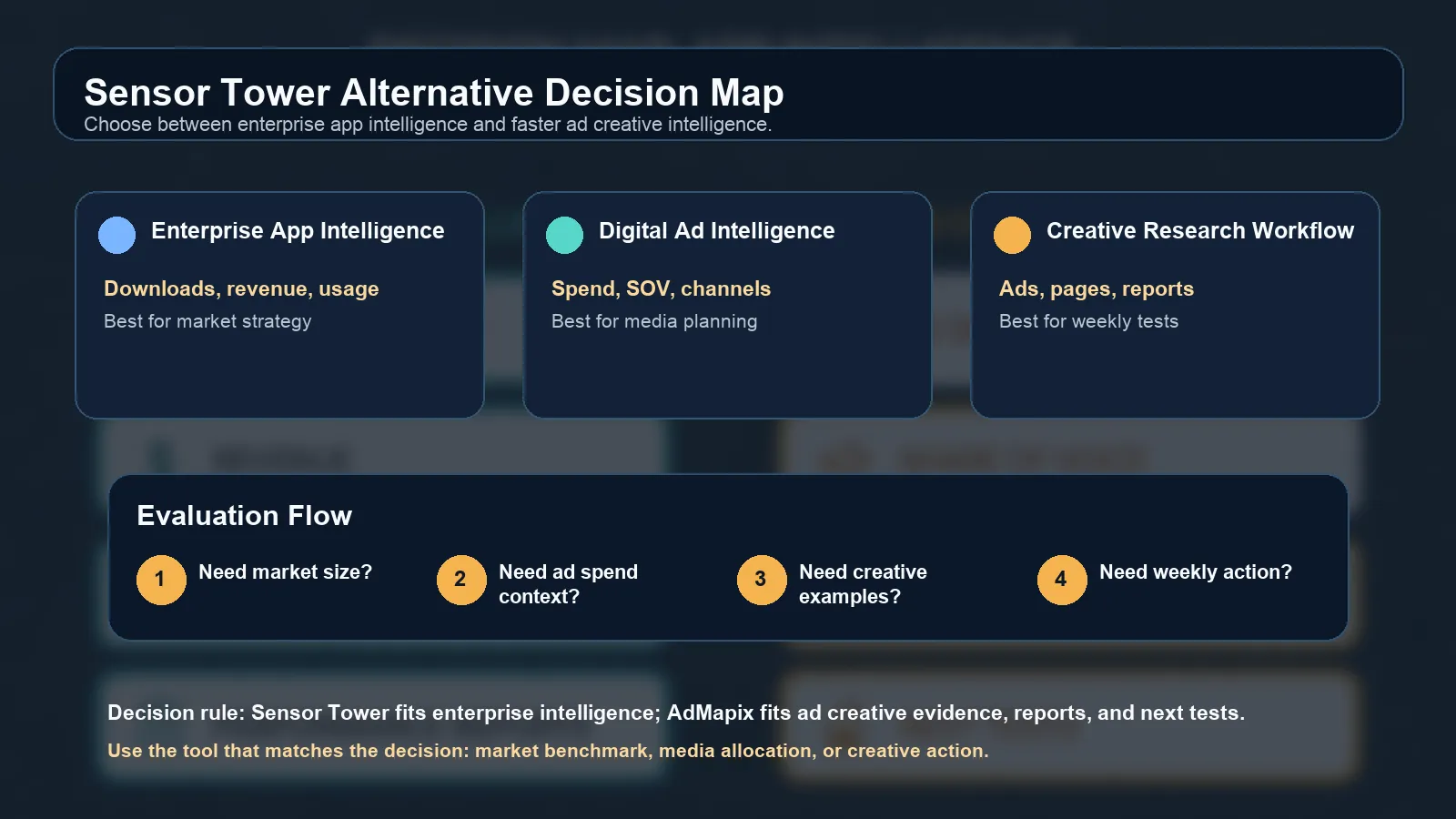
Sensor Tower Alternative for Ad Creative and App Intelligence
By the AdMapix Research Desk · Updated June 19, 2026
Sensor Tower is one of the best-known names in app intelligence tools. It helps teams understand mobile app markets, downloads, revenue, usage, advertising activity, audience behavior, and competitive movement across the digital economy.
That strength also explains why many teams search for a Sensor Tower alternative. They may not be looking for a weaker or cheaper copy of Sensor Tower. They may need a narrower workflow: competitor ad creative research, weekly monitoring, client-ready reports, faster creative teardown, or an ad intelligence process that connects examples to the next test.
This guide compares Sensor Tower, Sensor Tower pricing expectations, and the practical cases where a sensor tower alternative for ads makes sense. The goal is not to dismiss Sensor Tower. The goal is to help app marketers, performance teams, agencies, and founders choose the right intelligence workflow.
For broader research stacks, compare this with ad spy tools by channel, best ad intelligence tools, and the Foreplay.co alternative guide.
Quick Answer
- Most people searching for a Sensor Tower alternative don't want a cheaper Sensor Tower - they want a narrower ad-creative workflow instead of an enterprise market-data suite.
- Keep Sensor Tower when the weekly job is app market sizing, download and revenue estimates, or board-level reporting.
- Switch to (or add) an ad intelligence workflow like AdMapix when the weekly job is competitor ad monitoring, creative teardown, landing-page context, and turning examples into the next test.
- Decide by workflow fit, not brand awareness - and confirm Sensor Tower pricing directly, since it is sales-led.
What Sensor Tower Does
Sensor Tower is positioned around digital market intelligence. Its product pages describe use cases across app intelligence, audience insights, advertising insights, store performance, market trends, and competitive research.
For app growth teams, the most relevant value is usually market visibility:
| Sensor Tower use case | What the team is trying to learn |
|---|---|
| App category research | Which apps, publishers, and markets are growing |
| Download and revenue estimates | How large an app or category may be |
| Usage and engagement signals | Whether users appear to keep using an app |
| Ad intelligence | Where advertisers spend, which creatives appear, and which regions or networks matter |
| Audience and market insights | Which segments and behavioral patterns matter |
| Executive reporting | How a market, competitor, or portfolio is moving |
Sensor Tower became even broader after its official announcement that data.ai joined Sensor Tower. That acquisition increased the importance of Sensor Tower in enterprise mobile intelligence and app market research.
If the job is "understand the app market," Sensor Tower is naturally on the shortlist.
Sensor Tower Pricing and Access Reality
Sensor Tower pricing is not something teams should guess from old screenshots or third-party forum posts. As checked on April 17, 2026, Sensor Tower's public product pages emphasize actions such as "Request Demo" or "Sign Up for Free" rather than a simple self-serve price table for every enterprise product.
That means the safe way to evaluate Sensor Tower pricing is to confirm directly with Sensor Tower sales for your required product, region, seat count, data modules, and usage needs.
When comparing pricing, ask these questions:
| Pricing question | Why it matters |
|---|---|
| Which product modules are included? | App intelligence, ad intelligence, audience data, and reports may be packaged differently |
| How many users need access? | Agencies, app studios, and investors often need several seats |
| Which countries and app stores matter? | Global coverage can change both value and complexity |
| Do you need exports or API access? | Reporting and data workflows may require more than a dashboard |
| Is the team making market decisions or creative decisions? | Enterprise market intelligence and weekly creative research are different jobs |
The cheapest tool is not always the right tool. But a sales-led enterprise platform can be too heavy if the only weekly job is to review competitor ads and create test ideas.
Where Sensor Tower Is Strong
Sensor Tower is strongest when the team needs broad app market context and reliable directional intelligence.
| Strength | Why it matters |
|---|---|
| App market view | Teams can understand category, geography, download, revenue, and publisher movement |
| Digital advertising context | The App Advertising Insights page describes paid user acquisition strategy, share of voice, ad spend context, creatives, and competitor channel strategy |
| Enterprise research workflows | Larger teams can use structured data for board, investor, strategy, and portfolio conversations |
| App growth planning | UA teams can connect market movement with country, category, and competitor signals |
| Historical context | Directional time-series data helps teams avoid overreacting to one visible ad |
This is why Sensor Tower often fits mobile app publishers, game studios, agencies with enterprise clients, investment teams, and large consumer brands. The tool is designed to answer bigger market questions, not only to save a few ad examples.
Where Teams Need a Sensor Tower Alternative
Teams usually search for a Sensor Tower alternative when the tool does not match the weekly workflow.
| Signal | What it usually means |
|---|---|
| The team mainly wants creative examples | A lighter ad spy or creative intelligence workflow may be enough |
| Reports need to be client-ready every week | The team needs fast narrative output, not only a dashboard |
| The user cares about landing pages | Ad creative without post-click context is not enough |
| The team wants test ideas | Market data must become creative, copy, offer, or funnel actions |
| Budget is constrained | Enterprise app intelligence may be more than the current stage needs |
| Search intent is ad-focused | A sensor tower alternative for ads should prioritize ad evidence and workflow speed |
This is not a feature-count issue. It is a workflow-fit issue. If the team asks "which country is growing fastest for this category?" Sensor Tower is relevant. If the team asks "what did competitors launch this week, what angle are they repeating, and what should we test next?" an ad intelligence workflow may be a better starting point.
Sensor Tower vs AdMapix
Use this scorecard when comparing sensor tower vs admapix.
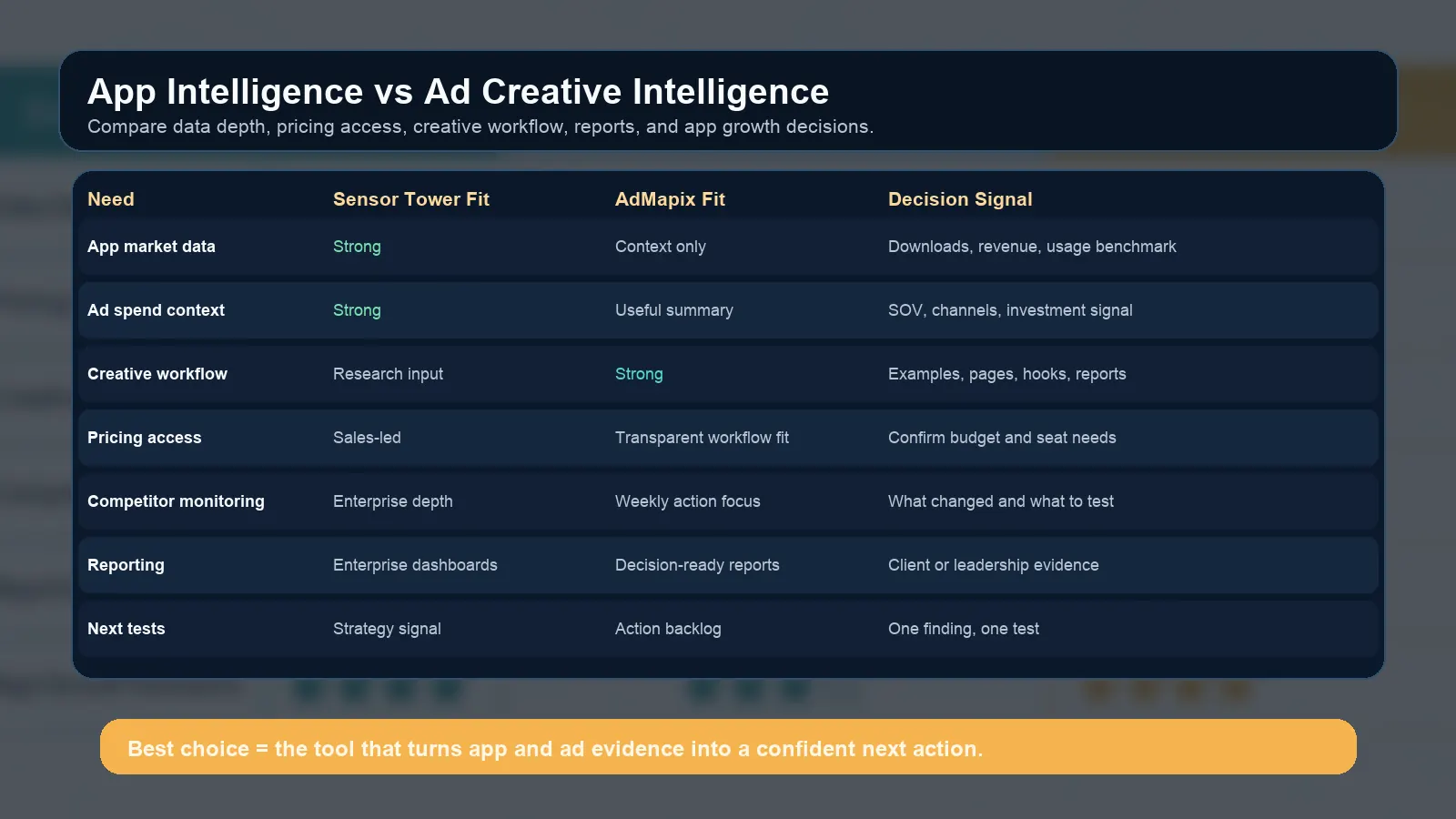
The scorecard separates app market intelligence from ad creative research and next-test planning.
| Need | Sensor Tower fit | AdMapix fit |
|---|---|---|
| App market sizing | Strong fit for category, app, publisher, and market-level intelligence | Not the primary job |
| App advertising intelligence | Strong fit when the team needs market and paid UA context | Strong fit when the team needs competitor ad evidence and creative workflow |
| Creative teardown | Useful when creatives are part of the research module | Stronger when teams need fast ad examples, landing-page context, and test notes |
| Weekly monitoring | Strong for market movement and enterprise reporting | Strong for competitor ad changes, channel notes, and recurring reports |
| Pricing access | Often sales-led for enterprise needs | Easier to map to a recurring ad intelligence workflow |
| Next tests | Indirect, through analyst interpretation | Direct, through findings, confidence, and suggested actions |
Sensor Tower is closer to an enterprise app and digital market intelligence platform. AdMapix is closer to a practical ad intelligence and competitor monitoring workflow. Some mature teams can use both. Smaller teams usually need to choose which decision happens every week.
What AdMapix Shows That a Market Estimate Cannot
Scorecards are easy to dispute, so here is a real, reproducible check. Disclosure: AdMapix is our product, and this is a first-party query against our own index - not a third-party estimate.
In June 2026, an AdMapix search for match 3 game returned creatives that had been indexed the same day we ran it. Of the top 20 results:
- 19 of 20 were video, and 5 carried a playable-HTML demo - the exact ad formats a UA team needs to brief.
- Each creative was tagged to its app, developer, and first-seen date.
- Match-3 veteran AWEM (Cradle of Empires) was running several distinct creatives at once - a live iteration signal.
Sensor Tower tells you that category's spend trend and download estimates. AdMapix shows the actual creatives, playables, and per-advertiser iteration behind that trend - which is what becomes a test brief. Run the same match 3 game search to reproduce it.
Alternatives by Use Case
The phrase "Sensor Tower alternative" is too broad unless the use case is clear.
| Use case | Better evaluation path |
|---|---|
| App category market sizing | Compare enterprise app intelligence tools |
| Paid user acquisition planning | Compare app intelligence tools with ad intelligence coverage |
| Competitor ad monitoring | Compare ad spy tools, official ad libraries, and AdMapix reports |
| Creative research | Compare swipe files, creative libraries, and creative intelligence workflows |
| Search or PPC analysis | Use Google search ads spy tool workflows and search intent checks |
| Agency reporting | Compare export quality, report narrative, source evidence, and client handoff speed |
If your team sells into leadership, investors, or strategy, app market intelligence matters. If your team ships ads every week, workflow speed and evidence quality matter more.
Evaluation Checklist
Before buying Sensor Tower or a Sensor Tower alternative, run a seven-part evaluation.
- Define the weekly decision. Is it market sizing, ad creative planning, budget allocation, competitor monitoring, or client reporting?
- List the sources required. Do you need app stores, ad networks, social ads, search ads, landing pages, reports, or all of them?
- Separate estimates from evidence. Estimated spend, download, and revenue data should not be treated like account-level truth.
- Check output quality. Can the tool create a report, brief, or test backlog without manual rework?
- Confirm pricing directly. Do not rely on outdated Sensor Tower pricing posts.
- Run a real competitor test. Use five competitors and one market, then compare the findings.
- Decide what action changes. If the tool does not change a campaign, creative test, market priority, or report, it may not be worth the subscription.
The best evaluation uses your real workflow. Demo data is useful for orientation, but it does not prove fit.
A Practical Weekly Workflow
If your team needs ad intelligence more than market intelligence, start lightweight and structured.
| Step | What to do |
|---|---|
| Choose competitors | Pick five direct competitors and two aspirational brands |
| Pick channels | Separate Meta, TikTok, Google Search, YouTube, native, display, and app ads |
| Capture evidence | Save ad examples, landing pages, offers, hooks, and visible proof |
| Label confidence | Mark one-off examples separately from repeated patterns |
| Write the insight | Summarize what changed and why it matters |
| Create the test | Turn the finding into a creative, copy, offer, or landing-page test |
| Report weekly | Share evidence, not only opinions |
Use AdMapix reports when you need recurring competitor monitoring and a report-ready evidence workflow. Use pricing when the team needs to map that workflow to a subscription.
Want to see the ad side on real data? An AdMapix search pulls a competitor's active creatives - video, playable, and static - with the app, format, and first-seen date attached, ready to drop into a weekly brief.
Common Mistakes
| Mistake | Better approach |
|---|---|
| Treating Sensor Tower as only an ad spy tool | Evaluate it as a broader app intelligence and market intelligence platform |
| Treating every alternative as cheaper Sensor Tower | Define whether you need app data, creative research, or reports |
| Trusting old Sensor Tower pricing screenshots | Confirm pricing directly with the official sales flow |
| Copying competitor creatives | Extract patterns, then rebuild with your own proof and brand context |
| Ignoring landing pages | Creative research is incomplete without the post-click path |
| Mixing market data and creative actions | Keep market insight and creative test planning separate |
The wrong comparison creates bad buying decisions. A tool can be excellent and still not fit your current operating rhythm.
FAQ
What is Sensor Tower?
Sensor Tower is a digital market intelligence and app intelligence platform used for mobile app, advertising, audience, category, and competitive research.
What is the best Sensor Tower alternative?
The best Sensor Tower alternative depends on the job. For enterprise app market data, compare app intelligence tools. For competitor ad research, creative teardown, and weekly reports, compare ad intelligence workflows such as AdMapix.
Is Sensor Tower an ad spy tool?
Sensor Tower includes advertising intelligence use cases, especially around app advertising insights, share of voice, creatives, and competitor channel strategy. It is broader than a simple ad spy tool because it also covers app and market intelligence.
How much does Sensor Tower cost?
Sensor Tower pricing should be confirmed directly with Sensor Tower. Its public product pages commonly use request-demo and sales-led flows, so do not rely on outdated third-party pricing claims.
When should I use AdMapix instead of Sensor Tower?
Use AdMapix when the weekly job is competitor ad monitoring, creative evidence collection, landing-page review, and report-ready next-test planning. Use Sensor Tower when the job requires broader app market intelligence and enterprise data coverage.
Can app growth teams use both Sensor Tower and AdMapix?
Yes. A mature app growth team may use Sensor Tower for market and app intelligence, then use AdMapix for competitor ad research, creative teardown, landing-page context, and recurring reports.
Key Takeaways
- Sensor Tower is an enterprise app and digital-market intelligence platform; an ad intelligence workflow is a different job.
- Search for a "Sensor Tower alternative" only after you name the weekly decision - market sizing and creative testing point to different tools.
- Treat estimated spend, downloads, and revenue as directional, not account-level truth.
- For competitor ad evidence, playables, and report-ready next tests, an AdMapix-style workflow is the faster starting point.
- Confirm Sensor Tower pricing directly through its sales flow; ignore old screenshots.
Conclusion
Sensor Tower is a strong choice when a team needs app intelligence tools for market sizing, app performance context, audience insights, and digital advertising intelligence. It is especially relevant for enterprise app growth, gaming, investment, and strategy teams.
A Sensor Tower alternative becomes relevant when the team needs faster ad creative research, weekly competitor monitoring, landing-page evidence, and action-oriented reports. In that case, choose by workflow rather than brand awareness. If your next decision is about market direction, evaluate Sensor Tower carefully. If your next decision is about what ad to test next week, start with AdMapix reports or review pricing.
Sources
- Sensor Tower and App Advertising Insights - product positioning and ad-intelligence use cases (accessed June 2026).
- data.ai joins Sensor Tower - official acquisition announcement.
- First-party data: AdMapix creative index, "match 3 game" query, June 2026. Format and freshness figures are reproducible by running the same search.
Turn these observations into your next creative study
Open the creative library and select samples for your market, network and research question.
Related Articles
Foreplay.co Alternative: When Creative Teams Need Ad Intelligence Too
Compare Foreplay.co with ad intelligence alternatives. Learn when Foreplay is enough for swipe files and when teams need broader competitor ad tracking.
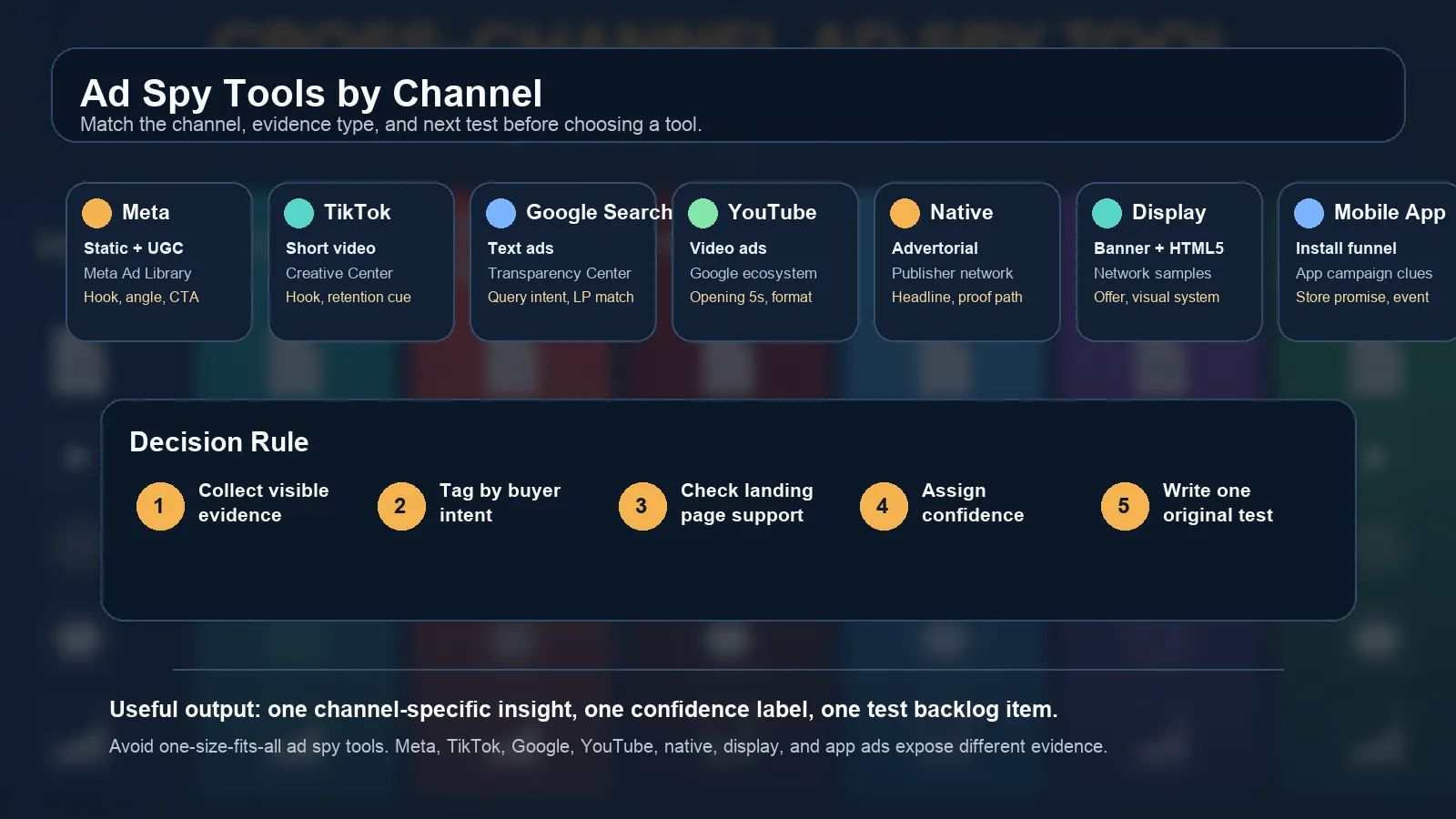
Ad Spy Tools by Channel: Meta, TikTok, Google, YouTube, Native
Choose ad spy tools by channel. Compare Meta, TikTok, Google Search, YouTube, native, display, and mobile app ad research workflows.
Google Search Ads Spy Tool: What You Can Actually See
Learn what a Google search ads spy tool can actually show, what remains private, and how to combine Transparency Center, SERP checks, and PPC intelligence.