
Best Mobile Game Ad Formats Across Platforms: A 2026 UA Playbook
A platform-by-platform guide to the best mobile game ad formats in 2026: which formats do the heavy lifting on Meta, Google, TikTok, AppLovin, and Unity; why the right format depends on platform, genre, and funnel stage; a format-selection framework; a creative-testing cadence; and the honest limits of what competitor ads can and cannot tell you about which format wins.
Updated June 21, 2026 — written and reviewed by the AdMapix Research team.
Best Mobile Game Ad Formats Across Platforms: A 2026 UA Playbook

Most user-acquisition (UA) teams ask about the best mobile game ad formats in the least useful way possible: "What's the best ad format for mobile games?" The real question is narrower and far more practical — which format helps this game, on this platform, at this funnel stage, while staying cheap enough to produce and refresh fast? That is why the best mobile game ad formats are never identical across Meta, Google, TikTok, AppLovin, and Unity. Platform behavior changes how attention is won. Genre changes how much explanation a user needs before installing. And production cost changes how fast your team can learn. If you run campaigns for a casual, puzzle, role-playing game (RPG), strategy, or hybrid-casual title, this playbook will help you choose a format mix that matches how users actually decide to install.
This guide is for mobile-game UA managers, creative leads, and studio founders who have to defend a creative roadmap and a format budget. We will go platform by platform — Meta, Google, TikTok, AppLovin, and Unity — name the formats that reliably do the heavy lifting on each and where they fail, give you a selection framework keyed to funnel stage and genre, lay out a testing cadence, and draw the honest line between what competitor creatives can teach you (format and structure) and what they never can (spend, installs, retention, return on ad spend). For neighboring reading, start with the mobile game ads guide, the playable ads guide, and our creative testing framework.
TL;DR — Best Mobile Game Ad Formats by Platform
- There is no single best format. The best mobile game ad format is the one that does the job you need done — for a specific game, platform, and funnel stage — cheaply enough to refresh often.
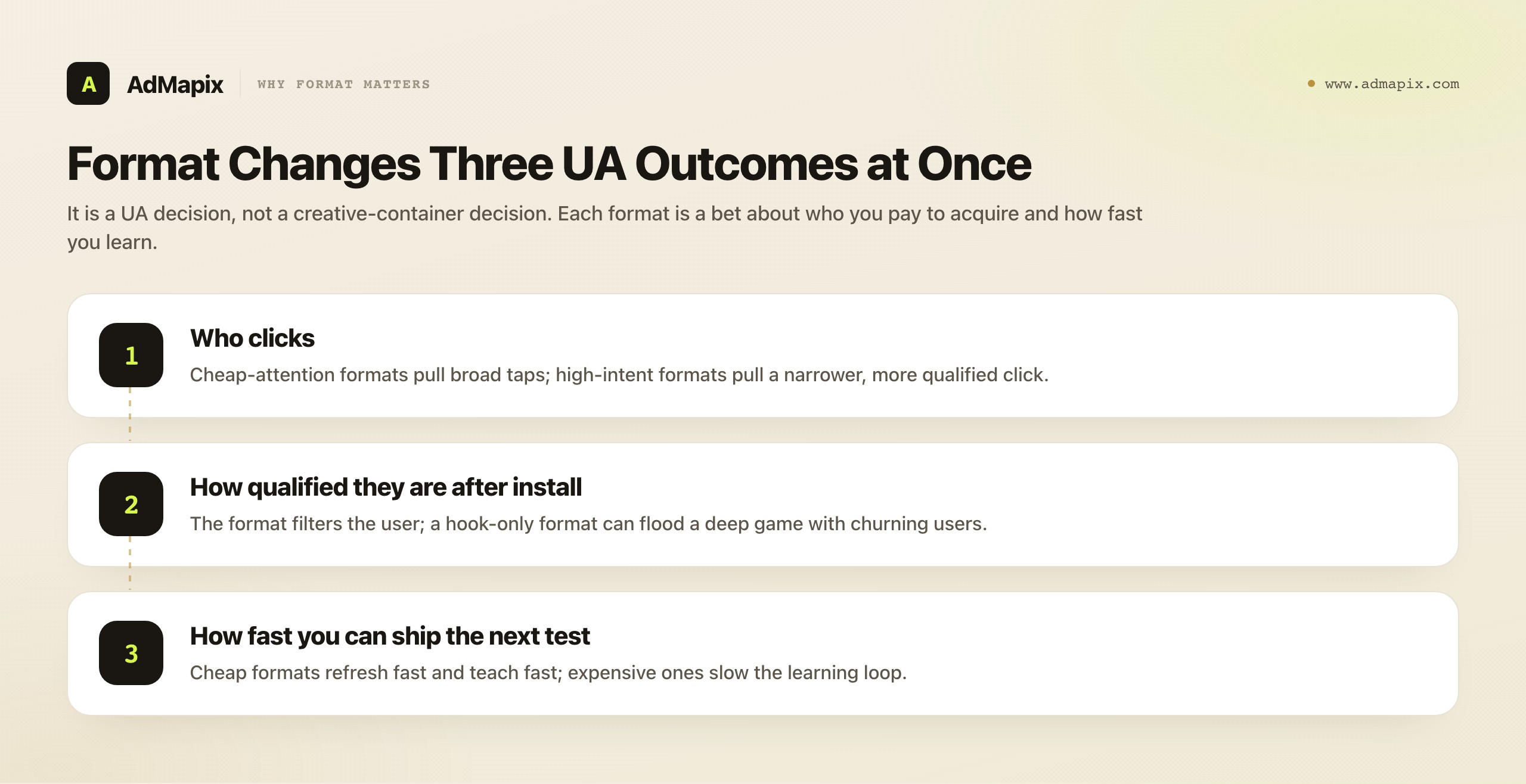
- Format changes three things at once: who clicks, how qualified they are after install, and how fast your team can ship the next test. Treat it as a UA decision, not a creative-container decision.
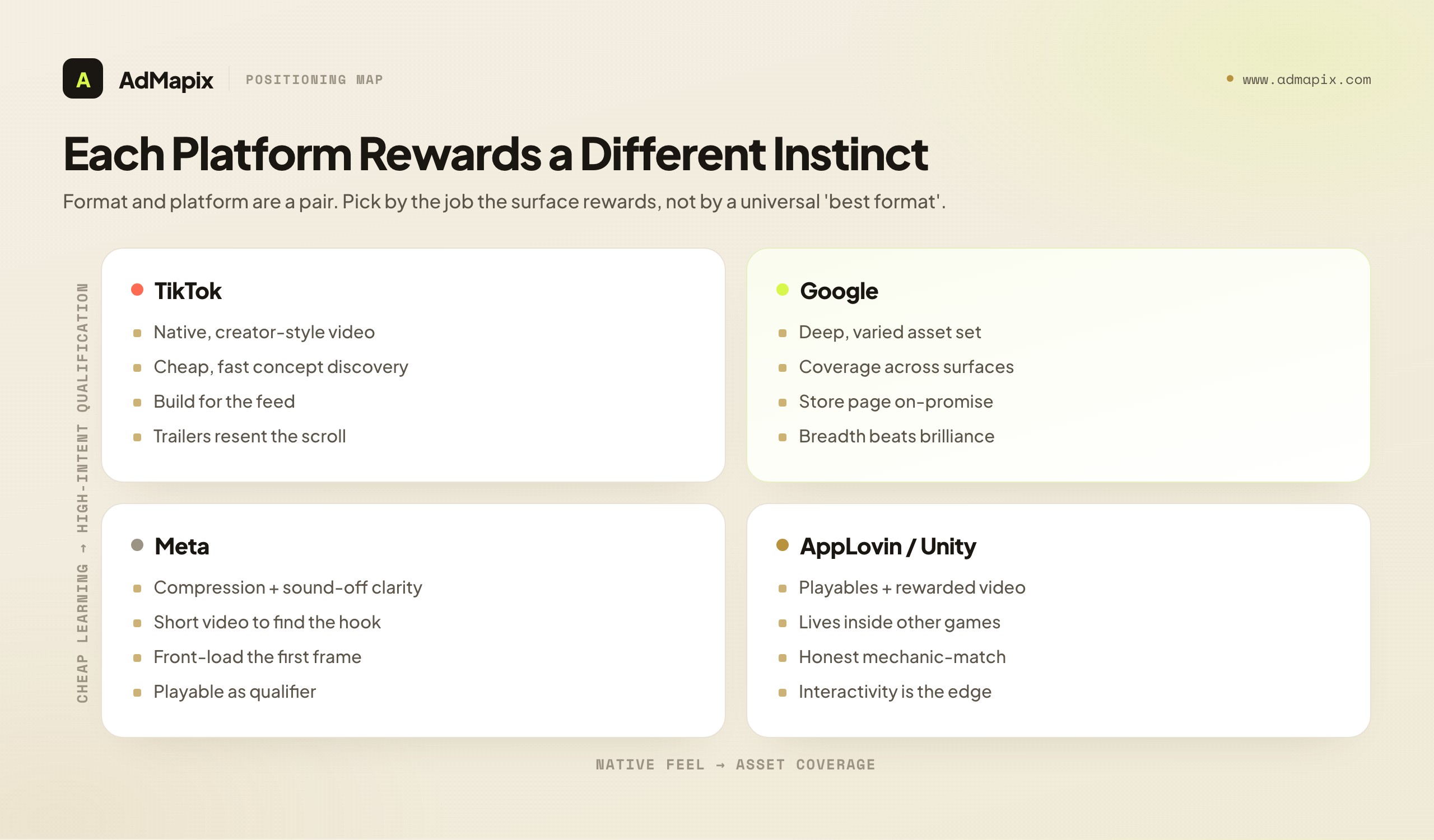
- Each platform rewards a different instinct. Meta rewards compression and instant readability; TikTok rewards native, creator-style storytelling; Google rewards asset coverage across YouTube, Display, Search, and Play; AppLovin and Unity reward playables and rewarded-video formats inside other games.
- Playables are the highest-intent format and the most expensive to make. Use them to qualify, not to prospect cheaply; lead with cheaper video to find the message, then build the playable around the winner.
- Genre dictates how much you must explain. Hyper-casual and casual win with one-mechanic hooks; mid-core and RPG need to communicate depth and progression, which favors longer video and playables.
- Run a portfolio, not a bet. The healthiest format mix pairs a cheap, fast learning format with a higher-intent qualifying format on each platform, refreshed on a fatigue-aware cadence.
- Competitor ads reveal format and structure, never results. You can see which formats rivals run; you cannot see spend, installs, retention, or ROAS. Use that evidence to narrow tests; use your own analytics to pick the winner.
Why Format Is a UA Decision, Not a Creative One
Ad format is not just a creative container. It changes three things at once, and all three are UA outcomes: who clicks, how qualified they are after install, and how fast your team can make the next test. That is why format decisions create downstream UA problems that look, at first, like targeting or bidding problems.
If you over-index on the cheapest attention format, you often get installs that look good at the top of the funnel and bad everywhere else. A short, curiosity-driven clip may pull cheap taps for a casual game, but that same style can flood a mid-core campaign with users who never make it through onboarding. On the other side, if you lead with expensive formats like playables or polished trailers before proving the core message, you slow learning and burn production time on concepts that were never validated. The format you pick is, in effect, a bet about which kind of user you want to pay to acquire and how fast you are willing to learn.
The platform layer matters just as much. Meta rewards clarity — users scroll fast across mixed placements, often with sound off, so the message must be instantly readable. TikTok rewards credibility and native feel — the feed is entertainment-first, so an ad must feel like content before it feels like persuasion. Google rewards asset coverage, because an App campaign distributes across YouTube, Display, Search, and Play surfaces, and a thin asset set starves delivery and learning. AppLovin and Unity reward formats that live inside other games — rewarded video and interactive end cards that interrupt a play session and must earn the next tap. A useful mental model: Meta rewards compression, TikTok rewards native storytelling, Google rewards coverage and intent alignment, and the in-app networks reward formats that survive an interruption. The right question is never "which format wins?" but "which format does the job I need done here?"
The Format Landscape at a Glance
Before going platform by platform, it helps to see the heavy-lifting formats lined up against the platforms that reward them. The table below is a starting map, not a verdict — your genre and funnel stage will tilt it.
| Platform | Formats that usually do the heavy lifting | Why they work | Strongest fit | Where they usually fail |
|---|---|---|---|---|
| Meta | Short gameplay video, vertical Reels/Stories cutdowns, selective playables, clear statics | Fast scroll across mixed placements, often sound-off; message must be instantly readable | Casual scale, broad prospecting, mechanic-led hooks | Slow cinematic intros, vague branding, audio-dependent ads |
| TikTok | Creator-style vertical video, raw gameplay clips, voiceover explainers, social/meme edits | Entertainment-first feed; ads must feel native before persuasive | Casual hooks, character-led content, creator credibility, discovery | Static-first ads, trailer-only strategy, heavy end cards that break feed flow |
| Full asset mix: short + mid video, images, text, store-aligned assets, selective interactive | App campaigns distribute across very different surfaces; one format limits delivery | Broad coverage, YouTube demand capture, Play conversion support, mid-core qualification | Relying on one trailer, missing portrait assets, weak image library, misaligned store page | |
| AppLovin | Playables, rewarded video, interactive end cards | Lives inside other games; must earn the next tap after an interruption | High-intent qualification, casual + hybrid-casual scale | Long non-skippable video, mismatched mechanic, no interactive payoff |
| Unity | Rewarded video, playables, interstitial video | In-game placements; rewarded context primes attention but caps patience | Casual + mid-core scale, playable-led qualification | Cinematic-only creative, slow hooks, no clear reward tie-in |
The pattern to notice: the same game concept can succeed in one format on one platform and fail in another without the message being wrong. A polished trailer that performs on YouTube can die on TikTok because it does not feel native; a sound-off static that scales on Meta can be invisible inside a rewarded-video slot on Unity. Format and platform are a pair, and you choose them together.
Meta: Reward Compression
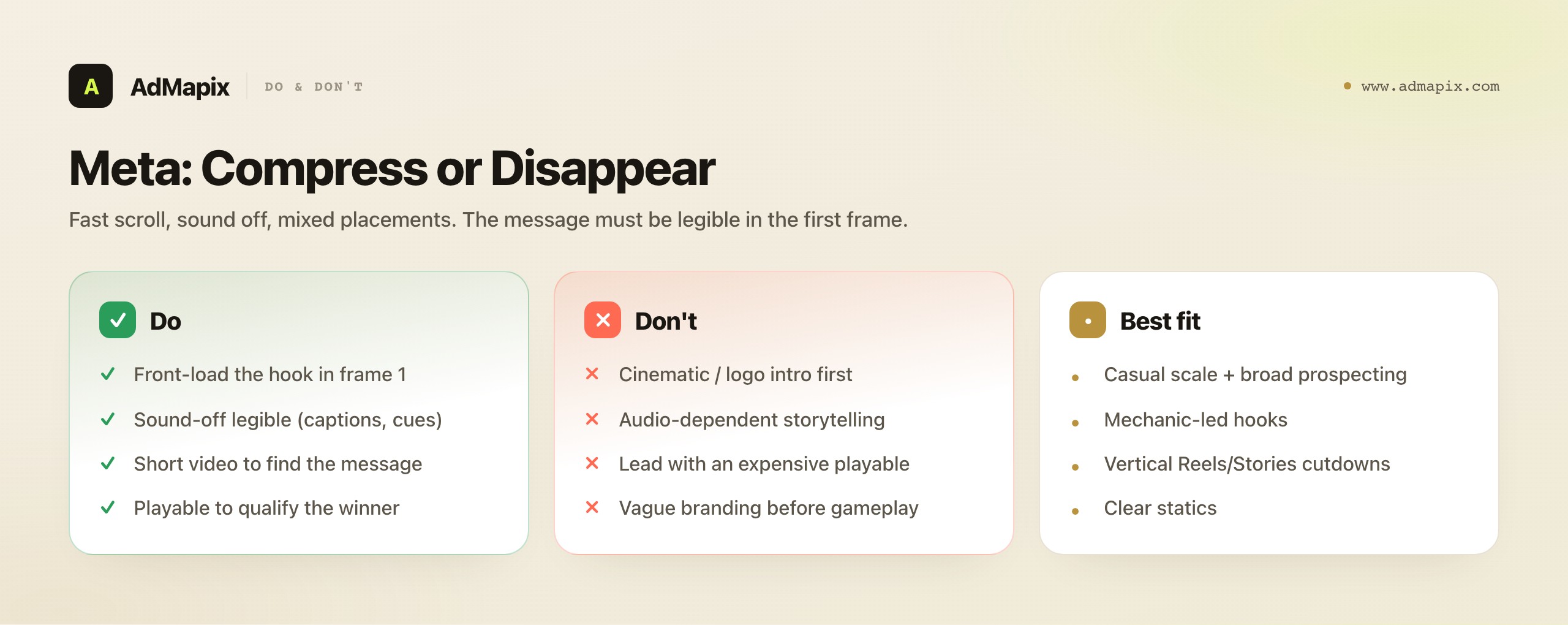
Meta is the platform that punishes hesitation. Users move fast across Feed, Reels, and Stories placements, frequently with the sound off, and an ad has a fraction of a second to be legible. The formats that do the heavy lifting are therefore the ones that compress a message: short gameplay video (the core workhorse), vertical Reels and Stories cutdowns of that video, selective playables, and clear statics that read instantly even paused and silent.
The dominant failure mode on Meta is the slow start. A cinematic intro, a logo animation, or a brand sting before any gameplay is wasted budget, because the viewer who scrolls at second one never reaches the point. The strongest Meta game creatives front-load the hook — the mechanic, the tension, or the payoff — in the first frame, and treat the brand as something the converted user discovers, not the cold scroller. Sound-off legibility is the second discipline: captions, on-screen cues, and visual storytelling that needs no audio. If your ad only makes sense with sound, you have built an ad for a minority of Meta viewers.
Playables have a specific role on Meta: they are the qualifier, not the prospector. A playable on Meta works best once you have found a hook that pulls cheap attention via video, and you want to filter for users who will actually engage with the core loop. Leading with a playable before validating the message is a common, expensive mistake — you spend on an expensive asset to discover something a cheap video could have told you. Meta's own Advantage+ and creative best-practice docs reinforce the principle: give the system varied, clear creative and let it find the audience, rather than betting everything on one polished asset.
The deeper reason Meta rewards compression is structural: its delivery system is creative-hungry. Advantage+ and broad-targeting setups lean heavily on the creative to do the targeting work, which means the format and message are much of your strategy. A varied set of clear, fast, sound-off-legible video gives the system room to find pockets of demand; a single asset, however polished, gives it nothing to optimize across. This flips the old instinct of pouring everything into one hero creative. On modern Meta, the format strategy that wins is a fleet of compressed, legible creatives in vertical and square ratios, refreshed before they fatigue, with the occasional playable bolted on to qualify the strongest hooks. Think breadth of clear assets, not depth of one cinematic.
It also pays to be deliberate about placement-aware cutdowns. The same gameplay video should exist as a 9:16 Reels/Stories cut, a 1:1 Feed cut, and where relevant a shorter loopable version — each trimmed so the hook still lands in the first frame at that aspect ratio. Teams that ship one 16:9 master and let the system auto-crop routinely bury their hook off-frame on the highest-volume vertical placements. The format discipline on Meta is not just "make short video"; it is "make short video that stays legible after the crop."
Google: Reward Coverage
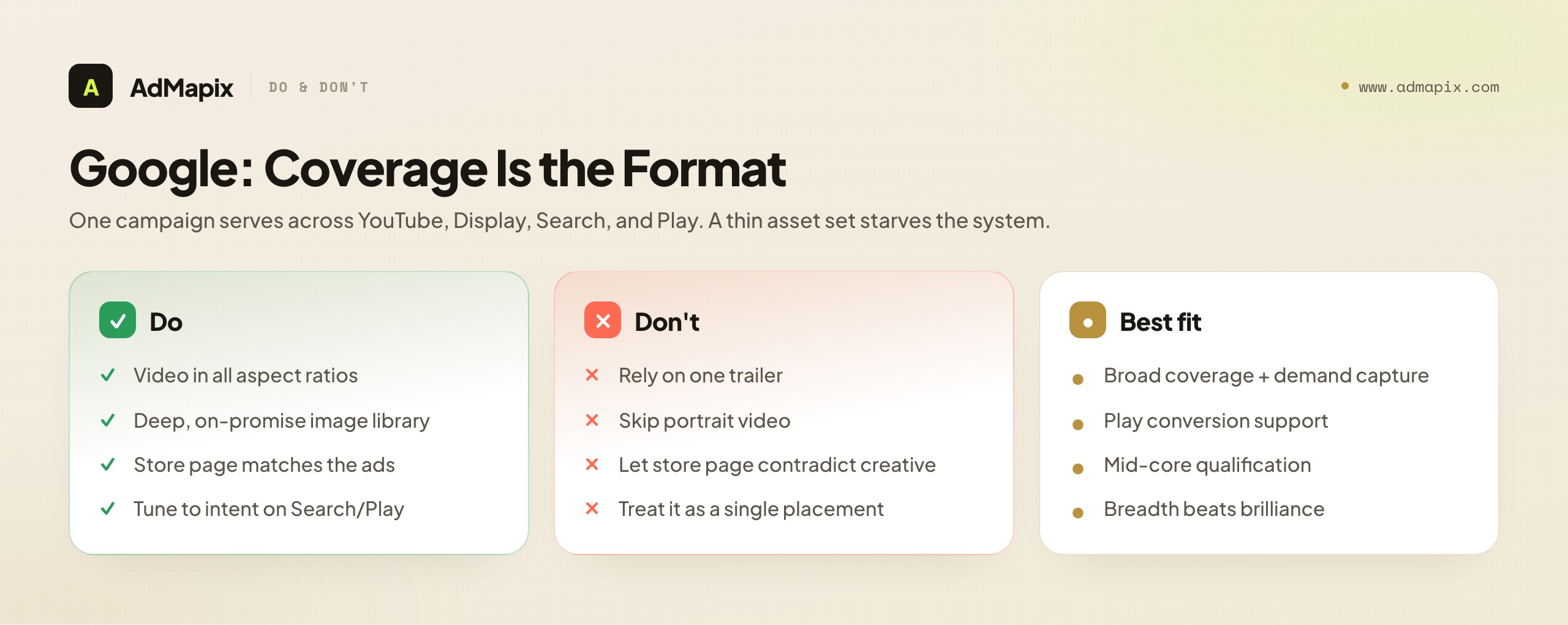
Google App campaigns (formerly Universal App Campaigns) work fundamentally differently from a single-placement buy. One campaign distributes your assets across YouTube, the Display Network, Search, and the Play Store, and Google's system assembles ads from whatever asset types you provide. That changes the format question entirely: on Google, the "format" you are really choosing is the breadth and quality of your asset library. A thin set — one trailer, no portrait video, a weak image library — starves the system, limits where it can serve, and slows learning. A full set lets it find demand across very different surfaces.
The heavy-lifting "formats" on Google are therefore a mix: short and mid-length video in multiple aspect ratios (landscape, portrait, square), a strong image library, well-written text assets, store-aligned assets that match your Play listing, and selective interactive assets where they fit. The single biggest Google mistake is relying on one trailer and calling it done. The second is neglecting portrait video, which starves the fast-growing vertical surfaces. The third is a store page that contradicts the ads — if your creative promises one experience and the Play listing shows another, conversion suffers at the last step.
Google also rewards intent alignment in a way the social platforms do not, because Search and Play surfaces capture users who are already looking. A creative and store page tuned to the same promise as a high-intent query converts better than a generic trailer. For the rules of what is permitted, Google's App campaign asset guidance and the Play developer policies are the primary sources — and worth reading before you scale, because a misleading creative is a policy risk as well as a retention one. The practical takeaway: on Google, breadth beats brilliance. Feed the system a deep, varied, on-promise asset set and let coverage do the work.
There is a subtler point about how Google's surfaces differ in what they ask of an asset. A YouTube placement is a lean-back, sound-on environment where a longer, more narrative cut can breathe — closer to a trailer than a feed ad. A Display placement is a glance environment where a strong static or short loop does the job. A Search or Play placement is intent-driven, where alignment with the user's query and a clean store listing matter more than creative flash. Because one App campaign serves all of these, the asset set has to satisfy contradictory environments at once, which is precisely why breadth is the strategy — you are not making one ad, you are stocking a shelf the system pulls from per surface. The store page sits at the end of every one of those paths, so a Play listing that contradicts the ads leaks conversion no matter how good the upstream creative is. Treat the store page as your most important "asset," because it is the only one every install touches.
The other Google-specific discipline is asset hygiene over time. The system needs enough variety to keep learning, but stale or low-performing assets drag delivery. A healthy App campaign rotates in fresh video and images on a cadence, retires consistently weak assets, and keeps the strongest store-aligned creative stable. Teams that "set and forget" a Google campaign watch performance decay not because the strategy was wrong but because the asset shelf went stale. Coverage is the format, and coverage has to stay fresh.
TikTok: Reward Native Storytelling
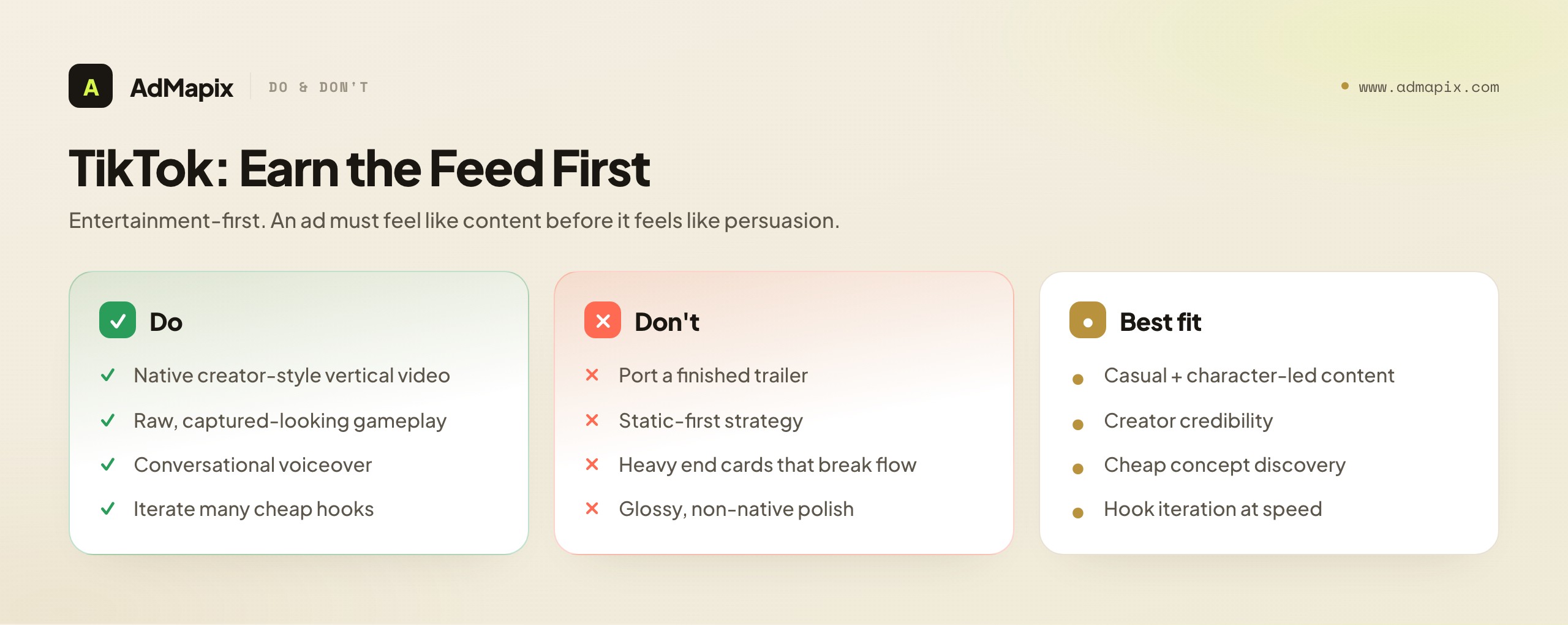
TikTok is an entertainment-first feed, and the cardinal rule is that an ad must feel like content before it feels like an ad. The formats that win are creator-style vertical video, raw gameplay clips that look captured rather than produced, voiceover explainers in a conversational register, and social or meme-style edits that ride a native format. The platform punishes anything that smells like a TV spot dropped into the feed: a polished, trailer-only strategy, static-first creative, or heavy end cards that break the scroll flow.
The reason is the viewer's mindset. On Meta, the user tolerates an ad if it is instantly clear; on TikTok, the user resents an ad that announces itself. Native feel buys you the attention that lets the hook land. This is why creator credibility carries so much weight — a real-seeming person reacting to, narrating, or playing the game lowers the viewer's guard far more than a glossy render. It is also why TikTok is the best platform for concept discovery: the native format is cheap to iterate, so you can test many hooks fast and let the feed tell you which framing resonates.
The format trap on TikTok is treating it like a second YouTube — porting a finished trailer and expecting it to perform. The fix is to build for the feed: vertical, fast, native, captioned, and structured so the first second feels like organic content. Playables and interactive formats exist on TikTok too, but the platform's center of gravity is native video, and most teams get their cheapest learning there. TikTok's business help center documents the spec and creative guidance; the spirit of all of it is the same — earn the feed before you sell. For a deeper read on reverse-engineering what is working in this surface, see our best TikTok ad spy tools breakdown.
The economic argument for TikTok-style native video is speed of learning. Because native creative is cheap and fast to produce — a screen recording, a voiceover, a quick edit — you can run many distinct hooks in parallel and let the feed surface which framing resonates, often within days. That iteration velocity is the platform's real gift to a UA team: it is the cheapest place to discover a hook that you then carry, adapted, to more expensive formats and surfaces. Treating TikTok purely as a scaling channel and not as a discovery engine wastes its biggest advantage. The teams that get the most from it run a deliberately high count of cheap native variants in the discovery phase, then concentrate spend behind the framings the feed validates.
One nuance worth naming: native does not mean low-effort. The best TikTok game creatives look casual but are tightly structured — a hook in the first second, a clear reason the game is fun, a payoff, and a CTA — all wearing the clothes of organic content. The skill is hiding the structure inside a native register, not abandoning structure. A genuinely sloppy clip rarely converts; a tightly structured clip that reads as organic is the format that wins. And because the audience and the creators skew toward authenticity, claims and characters that feel real outperform polished renders — which is why creator-style and "real person reacts" formats are so durable on this surface.
AppLovin and Unity: Reward Formats That Survive an Interruption
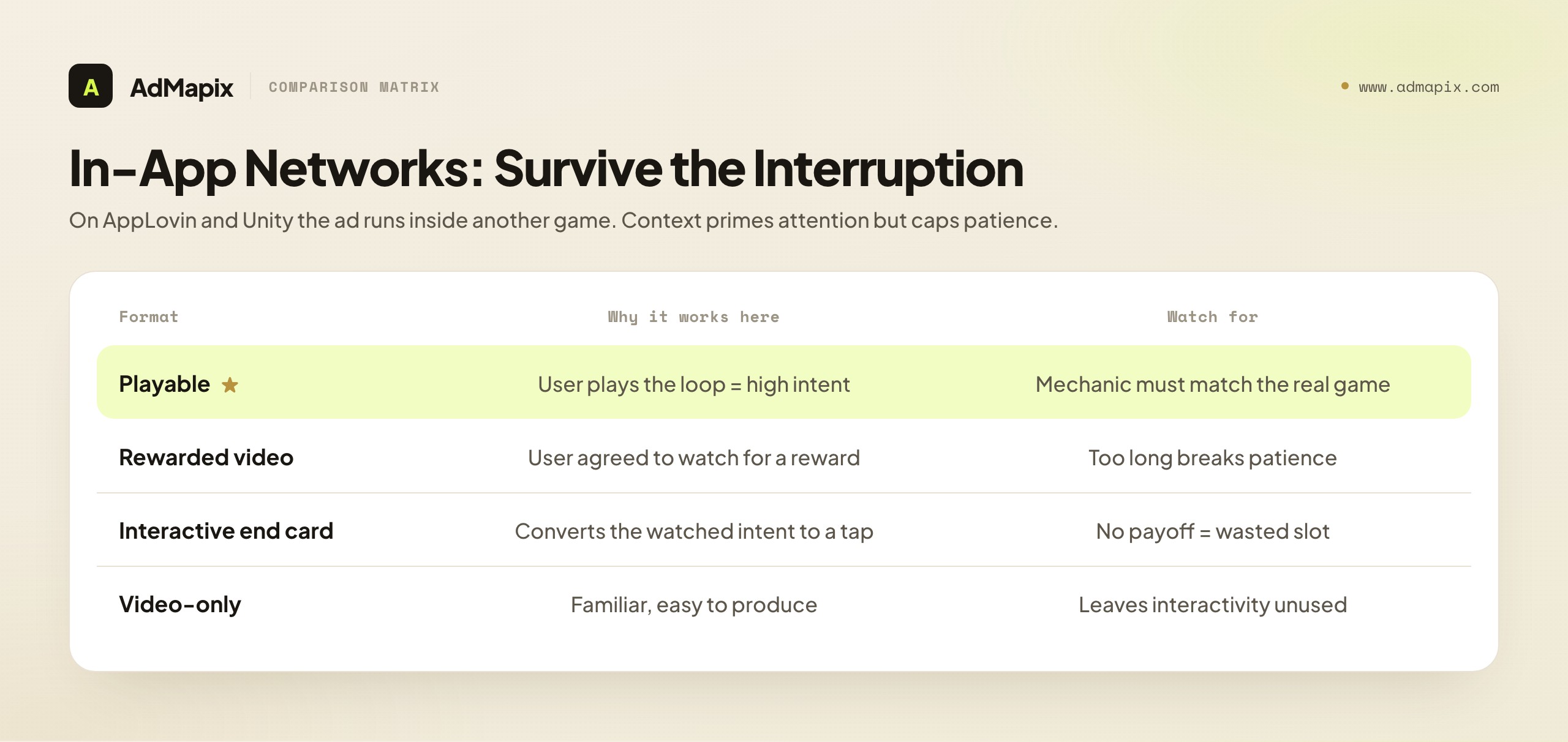
AppLovin and Unity (along with the broader in-app ecosystem) are a different world from the social platforms, because the ad lives inside another game. The user is mid-session, often watching a rewarded video to earn currency or continue play, and your ad has to earn the next tap during a deliberate interruption. The formats that dominate are playables, rewarded video, and interactive end cards — and the genre fit is tilted heavily toward casual and hybrid-casual titles, because the audience is already a mobile-game player.
Playables are the signature format here, and for good reason: a rewarded-video viewer who has just played a 15-second demo of your core loop is a far more qualified install than one who merely watched a clip. The in-app context primes attention (the user agreed to watch) but caps patience (they want their reward and to return to their game), so the format must front-load the playable experience and end on a clean install prompt. Rewarded video that runs too long, a playable whose mechanic does not match the real game, or an end card with no interactive payoff all break the format's logic.
This is also where the mechanic-match question bites hardest. Because the audience is composed of active gamers, a playable that promises one mechanic and delivers another in the actual game produces especially visible day-1 churn — the user did the thing, installed, and found a different game. The discipline that wins on AppLovin and Unity is honest, fast, satisfying playables built around a real loop. Both networks publish creative specs and best practices in their respective documentation; the strategic point is that these networks reward interactivity, so a video-only strategy here is leaving the platform's strongest format on the table. For the broader picture of these networks as intelligence sources, see ironsource ad intelligence, mintegral ad intelligence, and moloco ad intelligence.
There is a structural design rule unique to these placements: the playable must reach a satisfying moment before the user's patience for the reward runs out. A rewarded-video viewer is, in a sense, a hostage who agreed to the terms — they will watch to earn currency, but they are counting the seconds until they can return to their own game. So the format logic inverts the usual "build to a payoff" arc: front-load the playable interaction immediately, let the user feel one win fast, and present the install prompt at the peak of that satisfaction rather than after a slow build. A playable that spends its first five seconds on a logo, a tutorial overlay, or a cinematic intro has misread the placement entirely. The best in-app creatives treat every second as borrowed time.
A second consideration is the interplay between rewarded video and the playable. Many of the strongest in-app strategies use a short rewarded video to set context and curiosity, then hand off to a playable end card where the user actually interacts — the video earns the attention, the playable converts it. Treating the two as separate, competing formats misses how they compound. And because the in-app audience is genre-adjacent (a user playing a casual game is a strong prospect for another casual game), format fit and genre fit reinforce each other here more than on any social platform. This is why hyper-casual and hybrid-casual titles disproportionately dominate AppLovin and Unity inventory: the format, the genre, and the audience all point the same direction.
A Framework for Choosing the Right Format Mix
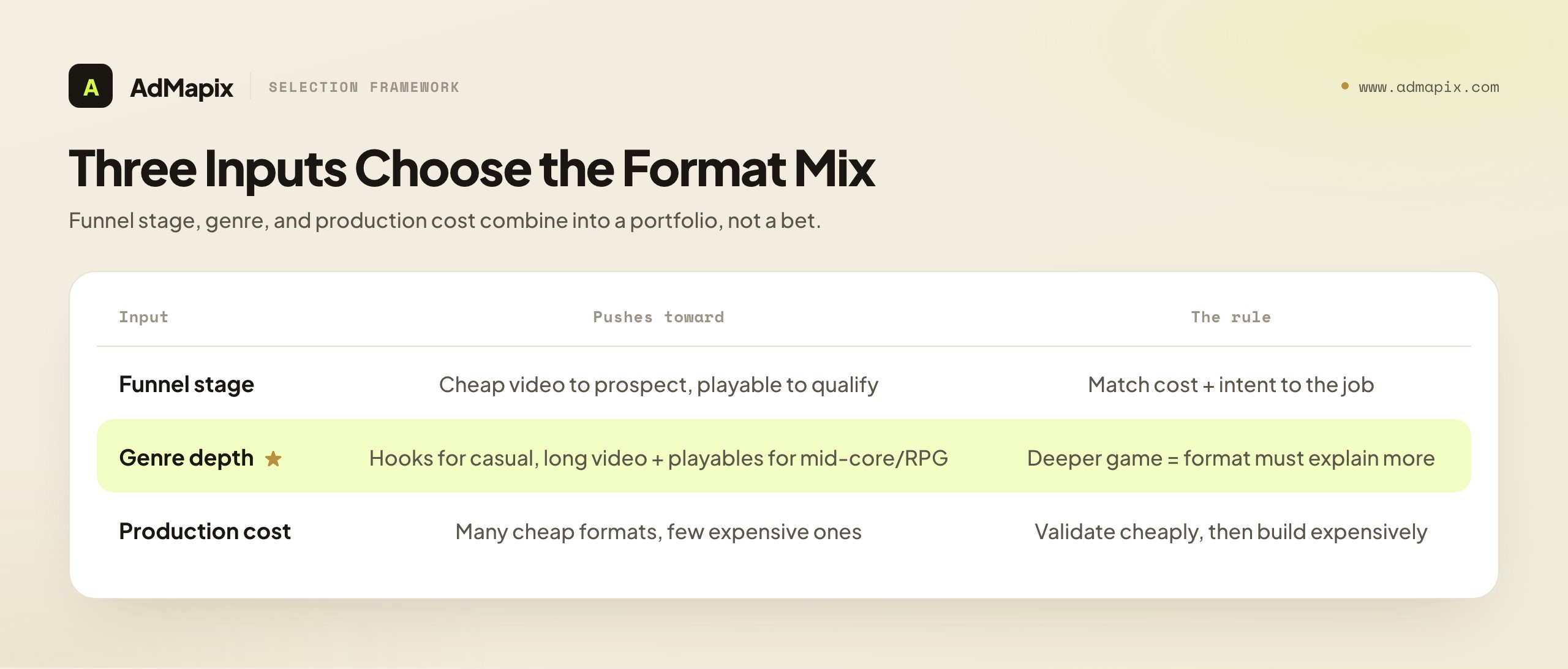
With the platforms mapped, here is the decision framework. Three inputs — funnel stage, genre, and production cost — combine to point at a format mix for each platform.
Input 1: funnel stage. Prospecting (cold, broad) favors cheap, fast, attention-winning formats — short video and statics — because you are casting wide and need to learn fast. Qualification (filtering for users who will engage) favors higher-intent formats — playables and longer video that communicate depth. Re-engagement and conversion-support favor store-aligned and intent-matched assets. Match the format's cost and intent to the job the stage is doing.
Input 2: genre. Hyper-casual and casual titles win with one-mechanic hooks — the format needs only to make a simple loop look fun and easy, which short video and playables do brilliantly. Mid-core, strategy, and RPG titles must communicate depth, progression, and meta — a one-second hook cannot carry that, so longer video, narrative cutdowns, and playables that show progression earn their cost. The deeper the game, the more explanation the format must support.
Input 3: production cost and refresh speed. Every format has a cost-to-learn. A static or a raw gameplay clip is cheap and fast, so you can run many; a playable or a polished cinematic is expensive and slow, so you run few and only after validating the concept. The healthiest roadmap pairs a cheap learning format (to find the message) with a higher-intent qualifying format (built around the validated message) on each platform.
Put together, the framework produces a portfolio, not a bet. On Meta: short video to find the hook, then a playable or static built around the winner. On Google: a deep, varied asset set across aspect ratios, kept on-promise with the store page. On TikTok: many cheap native video iterations to discover the framing, then double down on the resonant one. On AppLovin and Unity: a fast, honest playable as the spearhead, supported by rewarded video. The mix shifts with genre and stage, but the principle holds — pair cheap learning with high-intent qualification, and refresh before fatigue.
A common question is whether to run the same format mix on every platform or specialize per platform. The answer is specialize, but reuse the concept. The validated hook, payoff, and promise should travel across platforms; the format wrapper should change to fit each surface. So a single winning idea becomes a compressed Meta video, a native TikTok cut, a broad Google asset set, and an in-app playable — four expressions of one concept, each native to its platform. This is the cheapest way to scale a winner: you are not inventing four ideas, you are dressing one idea four ways. It is also why a creative-evidence read that captures the concept behind a competitor's ads, not just the format, is so much more useful than a screenshot folder — concepts port; screenshots do not.
Matching Format to Genre and Funnel Stage
It is worth making the genre-by-stage logic explicit, because this is where teams most often pick the wrong format and blame the platform. The table below is a practical default, not a law — your own tests override it.
| Genre | Prospecting format | Qualification format | The explanation problem |
|---|---|---|---|
| Hyper-casual | Short mechanic-led video, statics | Playable (single loop) | Almost none — show the loop, keep it instant |
| Casual / puzzle | Fail-state / satisfying-solve video | Playable (one solve) | Low — one mechanic carries it |
| Hybrid-casual | Hook video + meta tease | Playable showing the meta layer | Moderate — must hint at depth without slowing the hook |
| Mid-core / strategy | Narrative or progression video | Longer playable / gameplay deep-dive | High — depth and meta need room to land |
| RPG | Character / world cinematic + gameplay | Progression video, store-aligned assets | High — must communicate world, characters, progression |
The "explanation problem" column is the crux. The more a genre depends on depth the user cannot see in one second, the more the format has to carry — and the more a too-short, hook-only format will mislead the install. A puzzle game can thrive on a one-mechanic hook; an RPG that leads with a one-second hook attracts users who churn when they meet the actual systems. Pick the format that gives the genre enough room to tell the truth about itself. For the puzzle case specifically, our puzzle game ad examples library goes deep on hooks and mechanic-match.
The Anatomy That Travels Across Formats
Underneath the platform and genre differences, high-performing mobile-game creatives share an anatomy that is portable across formats — and understanding it lets you adapt one strong concept into a video, a static, and a playable without starting from scratch each time. There are four parts.
The hook (0–2 seconds). Whatever the format, the opening must create a reason to keep watching or to tap: a tension, a fail state, a satisfying moment, or a reward tease. In video it is the first frame and the first beat; in a static it is the whole image; in a playable it is the first interaction. A weak hook sinks every format equally. This is the part you test most aggressively, because it carries the most variance in performance.
The clarity beat (2–6 seconds). Once attention is won, the creative must make the offer legible — what the game is, what the user does, why it is satisfying — without tipping into a tutorial. This is where genre depth lives: a casual game needs almost none of it, an RPG needs a lot. In a playable, the clarity beat is the guided interaction. The most common cross-format failure is skipping clarity entirely (great hook, confused viewer) or over-doing it (a wall of explanation that kills momentum).
The payoff. Every format needs a moment of reward — the level clears, the cascade fires, the character is revealed, the meta layer is glimpsed. The payoff is the emotional reason the user installs; without it the hook was a tease with no resolution. In rewarded in-app formats the payoff must come early because patience is short; on YouTube it can build longer.
The call to action. The install prompt should feel like the natural way to continue the experience the creative created, not a bolted-on banner. The best CTAs tie directly to the payoff ("keep solving," "save them now," "build your kingdom"), so the click feels like a continuation rather than an interruption.
When you hold this anatomy steady and vary the format around it, you get cheap reuse: one validated concept becomes a Meta video, a TikTok native cut, a Google asset set, and an in-app playable, each adapted to its surface but carrying the same proven hook, clarity, payoff, and CTA. This is also why studying competitor creatives by anatomy — not just by format — is so productive: you can extract a rival's hook-and-payoff logic and rebuild it in your format mix, which is exactly the kind of structural read a creative-evidence layer supports.
Allocating Budget Across Formats
A format strategy that never touches budget is just an opinion. The practical question every UA lead faces is how to split spend across formats, and the honest answer is that you allocate to learning early and to winners later. Here is the logic.
In the discovery phase of a new game or a new platform, weight budget toward cheap, fast formats — short video and statics on Meta, native iterations on TikTok, a broad asset set on Google. The goal here is not efficiency; it is information. You are buying clarity about which hooks and formats resonate, and cheap formats buy that clarity at the lowest cost per learning. Spending heavily on a polished playable in this phase is paying premium prices for information a cheap test would surface.
As winners emerge, shift weight toward the higher-intent formats built around the validated message — playables on Meta and the in-app networks, deeper video for mid-core and RPG. Now you are paying for quality of install, not for learning, and the higher production cost is justified because the concept is proven. The mistake teams make is allocating statically — a fixed 30% to playables regardless of phase — instead of letting the allocation follow the learning curve. Early, the mix should be heavy on cheap learning; late, heavy on proven qualification.
A final allocation discipline is reserving a standing slice for refresh. Because every format fatigues, a healthy budget keeps a portion always funding the next iteration of proven formats, so that when a winner declines you already have its refresh in flight rather than scrambling. The teams that scale steadily treat refresh as a line item, not an emergency. None of this requires knowing a competitor's spend — which you cannot — only disciplined reading of your own funnel.
A Testing Cadence That Respects Fatigue
Choosing a format mix is the start; keeping it alive is the discipline. Mobile-game creative fatigues fast, and a winning format degrades as the audience sees it repeatedly. A fatigue-aware cadence keeps the portfolio fresh without thrashing.
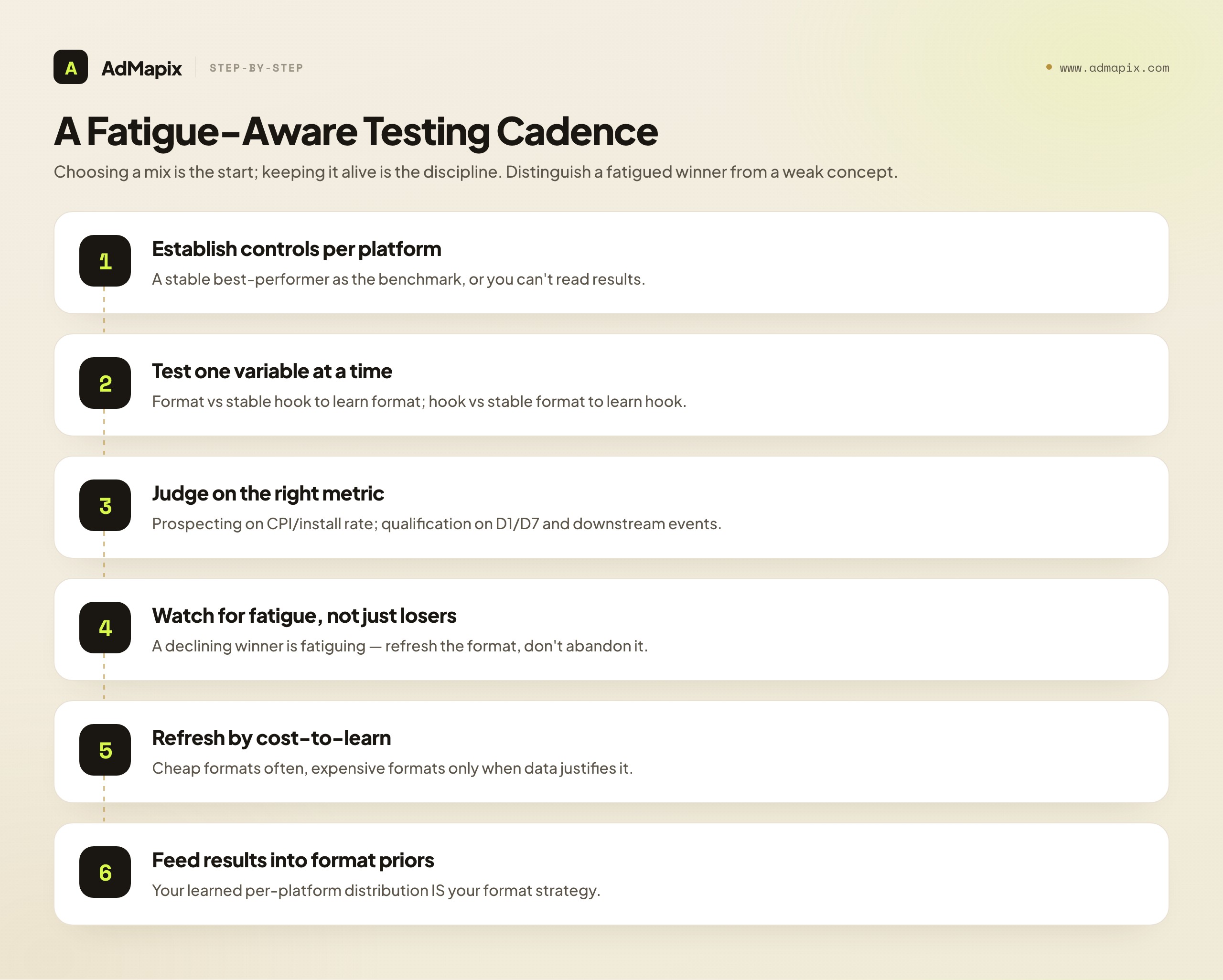
Step 1 — Establish controls per platform. Each platform needs a stable, best-performing creative as the benchmark against which new formats and concepts are judged. Without a control, you cannot tell whether a new format won or the platform simply changed.
Step 2 — Test one variable at a time where you can. Format, hook, and offer are different levers. Change the format against a stable hook to learn about format; change the hook against a stable format to learn about hook. Confounding them teaches you nothing.
Step 3 — Judge on the right metric for the stage. Prospecting formats are judged on cost per click and install rate; qualification formats on day-1 and day-7 retention and downstream events. A playable that loses on raw CTR but lifts D7 may be the better qualifier — the metric must match the format's job.
Step 4 — Watch for fatigue, not just for losers. A format that was winning and is now declining is fatiguing, not failing — the fix is a refresh of the same format, not abandoning it. Distinguish a fatigued winner from a structurally weak concept.
Step 5 — Refresh the cheap formats fast, the expensive ones deliberately. Because cheap formats are fast to produce, refresh them often; because playables and cinematics are expensive, refresh them only when the data justifies the cost. The cadence follows the cost-to-learn.
Step 6 — Feed results back into your format priors. Over time you learn which formats win for your game on each platform. That learned distribution — not a generic best-practices list — is your real format strategy. The mechanics of running these fights well are in our creative testing framework and ad creative fatigue analysis.
Measuring Format Performance Without Fooling Yourself
A format strategy is only as good as the way you judge it, and the most common self-inflicted wound is judging every format by the same top-of-funnel metric. Click-through rate and cost per install are seductive because they appear fast and look clean, but they systematically favor cheap-attention formats and punish qualifiers. A playable will often lose on raw CTR to a curiosity-bait video while winning on day-7 retention and downstream monetization — and a team that judges on CTR alone will kill its best qualifying format.
The fix is to attach the right metric to the right format job. Prospecting formats, whose job is cheap, broad learning, are fairly judged on cost per click, install rate, and cost per install. Qualification formats, whose job is to filter for users who will stick, must be judged further down the funnel — day-1 and day-7 retention, tutorial completion, and early monetization events. Re-engagement and store-aligned assets are judged on conversion at the last step. Read each format against the job you assigned it, and the picture inverts the naive one: the "expensive" playable that looked inefficient on CPI is often the cheapest source of retained users.
The second discipline is to look past the click to the cohort. A format that drives a flood of cheap installs that churn by day one is more expensive, per retained player, than a format that drives fewer, costlier, stickier installs. This is exactly the trap of over-indexing on the cheapest attention — it optimizes a number that does not pay your bills. Build a habit of pairing every top-of-funnel format metric with at least one retention or monetization metric from the same cohort, and the format decisions stop fooling you. None of this requires competitor data; it requires honest reading of your own funnel, which is the only place format truth lives.
Reading Competitor Formats: What You Can and Can't Learn
Studying which formats competitors run is genuinely useful — and routinely overinterpreted. Be precise about the boundary.
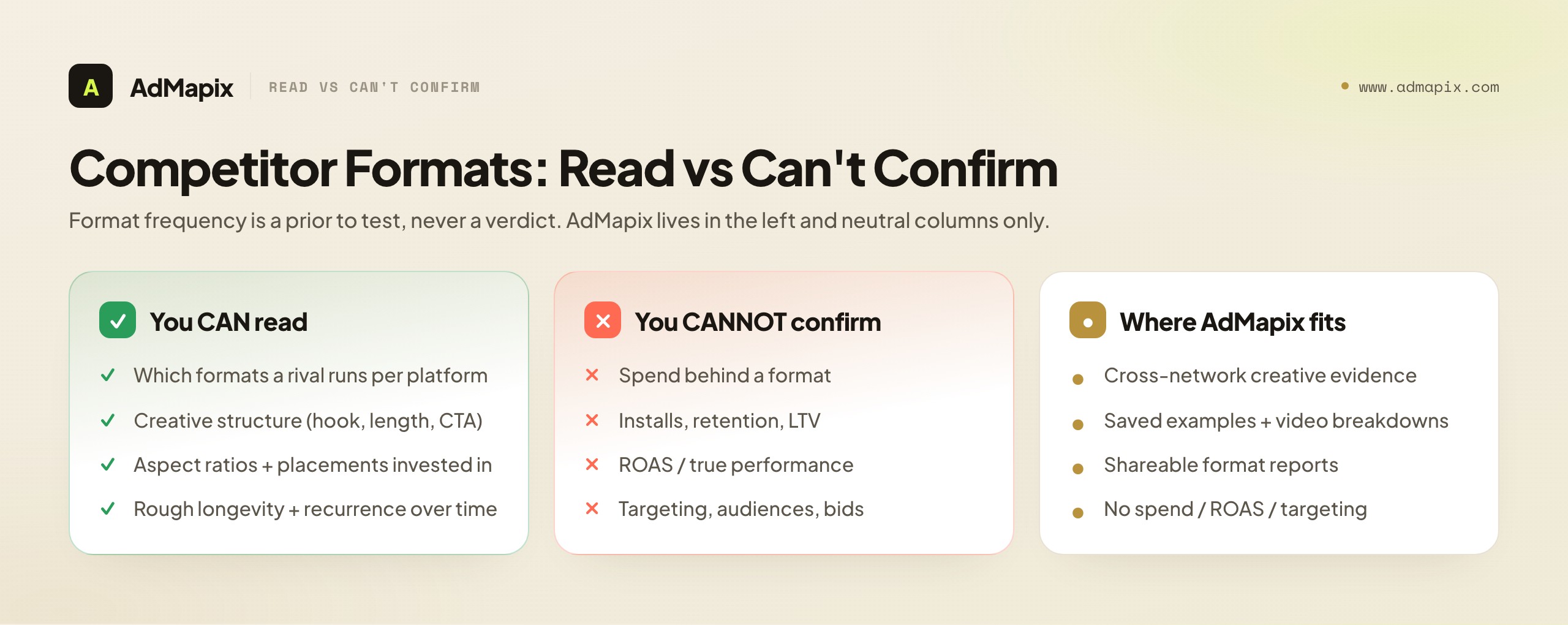
What competitor creatives reveal: the format a rival is running on a given platform (video, static, playable, rewarded), the structure of that creative (hook, length, mechanic shown, offer, CTA), the aspect ratios and placements they invest in, and — observed over time across an ad library — rough longevity and which formats recur across many advertisers. Counting format frequency across rivals is a soft signal of what the category believes works.
What competitor creatives never reveal: how much a rival spent behind a format, how many installs it drove, the install rate, retention, or lifetime value of the users it acquired, the return on ad spend, or the targeting and bids behind it. None of that is public, for anyone, using any tool. A format that appears everywhere might be a category-wide winner — or a cheap-to-produce default nobody bothered to challenge. So treat format frequency as a prior to test, not a verdict.
This is exactly where a creative-evidence layer like AdMapix fits, described honestly. AdMapix is searchable, cross-network ad-creative evidence — saved examples, video breakdowns, and recurring reports — so you can see which formats and structures advertisers are running across Meta, Google, TikTok, and the in-app networks without opening five ad libraries by hand. It is fast for discovery and for packaging examples into a shareable report. It cannot show competitor spend, install volume, retention, ROAS, or targeting, because that data is not public — and any tool that claims to is selling a model dressed as a fact. Use the format evidence to narrow which formats to test; use your own analytics to decide which one wins for your game. For the wider toolkit, see the advertising intelligence guide, the ad creative database, and the mobile game ad spy tool overview.
Common Format Mistakes Across Platforms
A handful of format errors recur across UA teams regardless of platform. Most come from treating format as a fixed choice rather than a job-specific one.
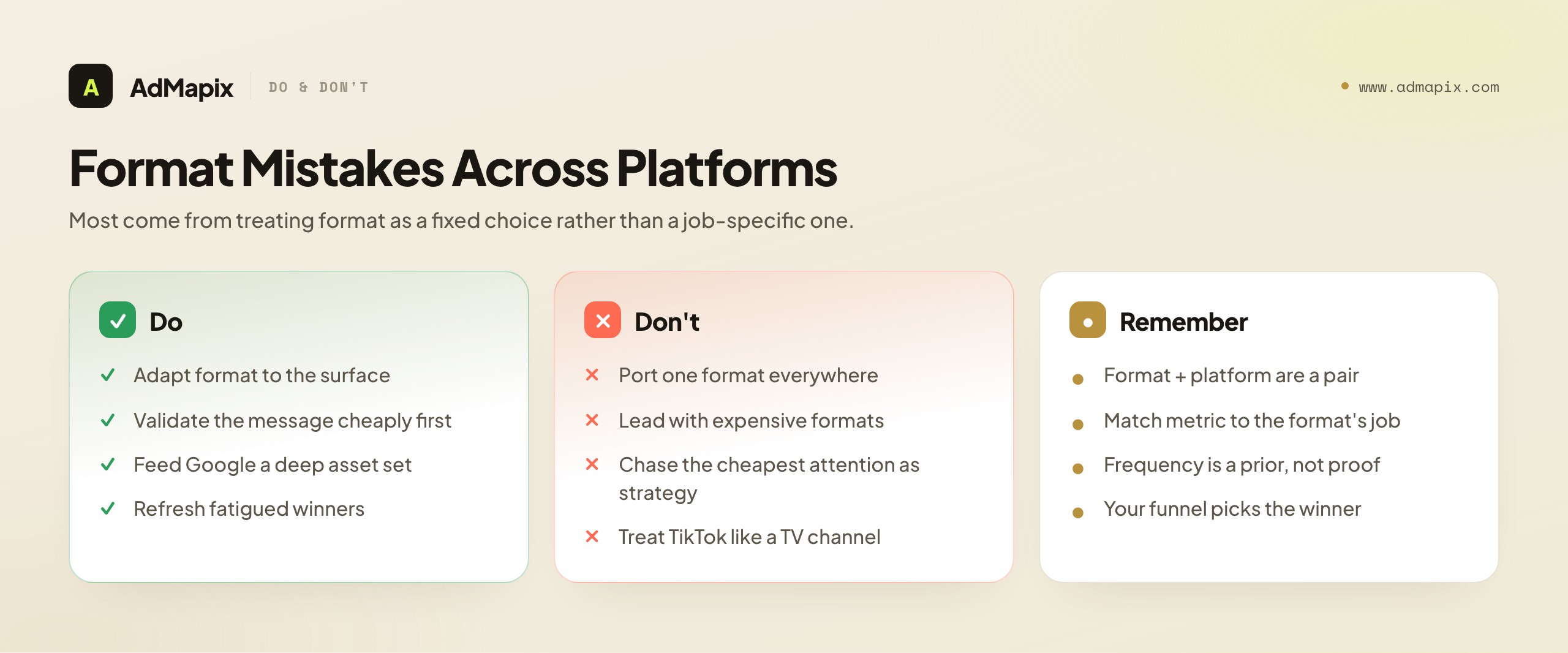
Picking one format and porting it everywhere. A YouTube trailer dropped onto TikTok, or a sound-on Meta ad reused in a Unity rewarded slot, ignores that format and platform are a pair. Adapt the format to the surface.
Leading with expensive formats before validating the message. Building a polished playable or cinematic before a cheap video proves the hook spends production budget to learn something a fast format could have told you.
Over-indexing on the cheapest attention. Chasing the cheapest taps fills the funnel with users who look good at the top and churn everywhere else. Cheap attention is a learning tool, not a strategy.
Starving Google's asset set. Running one trailer, no portrait, and a thin image library limits where Google can serve and slows learning. Breadth is the format on Google.
Treating TikTok like a TV channel. Polished, non-native, trailer-only creative resents the feed and underperforms. Build for the feed.
Ignoring fatigue. Abandoning a fatigued winner instead of refreshing it throws away a proven format. Distinguish fatigue from failure.
Mistaking competitor format frequency for proof. "Everyone runs playables" is a prior, not evidence that playables will win for your game. Test it.
How AdMapix Fits a Format Strategy
To be concrete about the role of a creative-evidence layer in format decisions: AdMapix helps with the discovery and packaging half of the loop, not the measurement half. You can search cross-network to see which formats and structures advertisers run on each platform, study saved examples and video breakdowns without juggling separate ad libraries, and assemble the strongest examples into a shareable report that justifies a format roadmap to a studio lead or client. That collapses the most tedious part of format research — surveying multiple platforms by hand — into a search.
What it does not do, and what no external tool can, is tell you which format actually won for a competitor or will win for you. The funnel-stage, genre, and cost judgments, and the final pick, all still depend on your own briefs and your own analytics. The honest mental model is: AdMapix (and tools like it) make format discovery fast and cross-network; your creative team owns the build; your test program and funnel own the verdict. Keep that division clear and you get the speed of a creative-intelligence layer without mistaking its evidence for outcomes. The natural next reads are the ad creative intelligence workflow for mobile UA teams and the in-game advertising overview.
In practice, the workflow looks like this. When you are deciding the format mix for a new title or a new platform, you start by surveying what the category is doing — which formats recur across rivals, how their creatives are structured, which aspect ratios and placements they invest in. That survey is the slow, multi-library chore a creative-evidence layer collapses into a search, and it gives you a prior: a sense of which formats the category believes work. You then translate that prior into a test plan, build a small portfolio that pairs cheap learning with high-intent qualification per platform, ship it against controls, and let your funnel render the verdict. The competitor evidence shapes the hypotheses; your data picks the winners. That clean separation — public evidence for direction, private analytics for decisions — is the discipline that keeps a format strategy both fast and honest.
FAQ
What is the single best mobile game ad format?
There isn't one. The best mobile game ad format is the one that does the job you need done — for a specific game, on a specific platform, at a specific funnel stage — cheaply enough to refresh often. A one-mechanic short video can be best for a casual prospecting campaign on Meta; a playable can be best for qualification on AppLovin; a deep asset set can be best for coverage on Google. Pick by the job, not by reputation.
Which formats work best on Meta for games?
Formats that compress a message and read instantly: short gameplay video (the workhorse), vertical Reels and Stories cutdowns, clear sound-off statics, and selective playables for qualification. Meta punishes slow cinematic intros and audio-dependent ads because users scroll fast and often with sound off. Front-load the hook in the first frame and treat the brand as something the converted user discovers.
How is Google different from the social platforms for game ads?
Google App campaigns distribute one asset set across YouTube, Display, Search, and Play. So on Google the "format" you choose is really the breadth and quality of your asset library — short and mid video in multiple aspect ratios, a strong image set, text, and store-aligned assets. A thin set starves delivery and slows learning. Breadth beats brilliance, and your store page must match the promise of your ads.
Why do trailers fail on TikTok?
Because TikTok is entertainment-first and resents anything that announces itself as an ad. A polished, non-native trailer breaks the feed's flow. What works is native, creator-style vertical video, raw gameplay clips, and conversational voiceover that feels like content first and persuasion second. TikTok is also the best platform for cheap, fast concept discovery because native video is quick to iterate.
Are playables worth the production cost?
Often, but as a qualifier, not a cheap prospector. A playable produces the highest-intent installs because the user has already played your loop — especially valuable on AppLovin and Unity, where the audience is active gamers. The mistake is leading with an expensive playable before a cheap video has validated the hook. Find the message first, then build the playable around the winner.
How do AppLovin and Unity differ from Meta and TikTok?
On AppLovin and Unity the ad lives inside another game, usually as rewarded video or a playable shown mid-session. The context primes attention (the user agreed to watch for a reward) but caps patience (they want to return to their game). These networks reward interactivity, so playables and interactive end cards are the strongest formats, and a video-only strategy leaves the best format unused. Mechanic-match matters most here because the audience are gamers who will notice a mismatch.
How should genre change my format choice?
By how much you must explain. Hyper-casual and casual win with one-mechanic hooks, so short video and single-loop playables suffice. Mid-core, strategy, and RPG titles must communicate depth, progression, and meta, which a one-second hook cannot carry — they need longer video, narrative cutdowns, and playables that show progression. The deeper the game, the more the format must do to tell the truth about it and avoid attracting users who churn.
Can I tell which format is winning for a competitor?
You can see which formats a competitor runs and how their creatives are structured, but not whether those formats are winning. Spend, installs, retention, lifetime value, and ROAS are not public for any advertiser, and no external tool can show them. Format frequency across rivals is a soft prior — a sign the category believes a format works — not proof it will work for your game. Use it to choose tests; let your funnel decide.
How often should I refresh creative per format?
Refresh on a fatigue-aware cadence, not a fixed calendar. Cheap, fast formats (statics, raw clips) can be refreshed frequently; expensive formats (playables, cinematics) only when the data justifies the cost. The key skill is distinguishing a fatigued winner (declining after winning — refresh the same format) from a structurally weak concept (never worked — abandon it). See our ad creative fatigue analysis for the signals.
Where does AdMapix help in format strategy?
AdMapix is a cross-network creative-evidence layer: it makes format discovery fast — seeing which formats and structures advertisers run on each platform, studying saved examples and video breakdowns, and packaging them into a shareable report — without opening multiple ad libraries by hand. It does not (and cannot) show competitor spend, installs, retention, or ROAS. Use it to narrow which formats to test; use your own analytics to pick the winner. See the ad creative database for more.
Related reading: Pair this with the mobile game ads guide, the playable ads guide and puzzle game ad examples, the creative testing framework and ad creative fatigue analysis, the in-game advertising overview, and the broader advertising intelligence guide, ad creative database, and mobile game ad spy tool.
Turn these observations into your next creative study
Open the creative library and select samples for your market, network and research question.
Related Articles
Meta Ads Library vs Ad Intelligence Tools for Game UA (2026): Which to Use, When, and Why
A definitive 2026 comparison of the Meta Ads Library vs dedicated ad intelligence tools for mobile game user acquisition — where the free transparency library genuinely helps, the structural limits that create blind spots for game UA creative research, a side-by-side capability matrix, the exact decision criteria for when to add a paid intelligence layer, and an honest account of what neither can show.
Ad Creative Intelligence Workflow for Mobile UA Teams in 2026: Find, Analyze, Brief & Build
A complete 2026 ad creative intelligence workflow for mobile UA teams — the four-stage loop to find winning competitor creatives, analyze why they work, brief production from them, and build a sustainable competitive-intelligence system, with the data inputs, a fixed taxonomy, tiered competitor monitoring, an observation-to-hypothesis method, a structured brief format, a weekly operating cadence, team-size tool choices, and the learning log that makes each cycle compound.
Meta Ads API Alternative in 2026: Ad Library API, Marketing API, or a Creative Layer?
A 2026 guide to choosing a Meta ads API alternative — what the Ad Library API, Marketing API, and Graph Ads Archive each actually expose and where they stop, how a creative-intelligence layer fills the saved-media, video-breakdown, and reporting gap, exactly what public Meta data can and cannot prove (creative yes; spend, targeting, and ROAS no), and a decision framework matched to the job you are doing.