
Ad Creative Fatigue Analysis in 2026: Signals, Thresholds & Refresh Decisions
A 2026 guide to diagnosing ad creative fatigue — what fatigue looks like in the data, how to read cost-per-result, frequency, CTR, and retention signals together, how to tell fatigue apart from funnel, tracking, auction, and seasonal causes, how fatigue speed differs by channel and funnel stage, how to set a refresh threshold, when to refresh versus rebuild, how to run a creative pipeline that stays ahead of fatigue, and where competitor research informs the next variant.
Ad Creative Fatigue Analysis in 2026: Signals, Thresholds & Refresh Decisions
By the AdMapix Research Team — Updated June 21, 2026
Ad creative fatigue is when an ad's performance declines because the same audience has seen it too many times — not because the targeting, budget, or tracking changed. The hard part isn't noticing that performance dropped; it's telling fatigue apart from a bad day, a seasonal dip, a broken landing page, or an auction shift, because each of those looks like fatigue at a glance and each demands a completely different fix. In 2026, with creative lifespans compressed to days on the fastest channels and audiences more ad-saturated than ever, a wrong diagnosis is expensive in both directions: refresh a creative that wasn't fatigued and you throw away a winner; ignore real fatigue and you bleed budget into ads the audience has tuned out. This guide is for performance marketers, media buyers, and creative strategists who want a concrete way to read the signals, separate fatigue from its imposters, set a threshold, and decide whether to refresh, rotate, or hold.
We've watched thousands of accounts misdiagnose fatigue, and the pattern is consistent: teams either kill winners on a single bad day or keep spending into genuinely exhausted creatives because they never wrote down what fatigue looks like for their audience. This guide focuses on the diagnosis and the decision — reading the signals together, ruling out the imposters, and knowing when to act. For the system that produces the next creative once you've decided to refresh, see our creative testing framework; for the metrics and tools that surface these signals, see our paid ads analytics tools guide. This guide is the diagnostic layer that sits between them — the part that decides whether a creative is actually fatigued and what the cheapest fix is.
TL;DR — Ad Creative Fatigue in One Screen
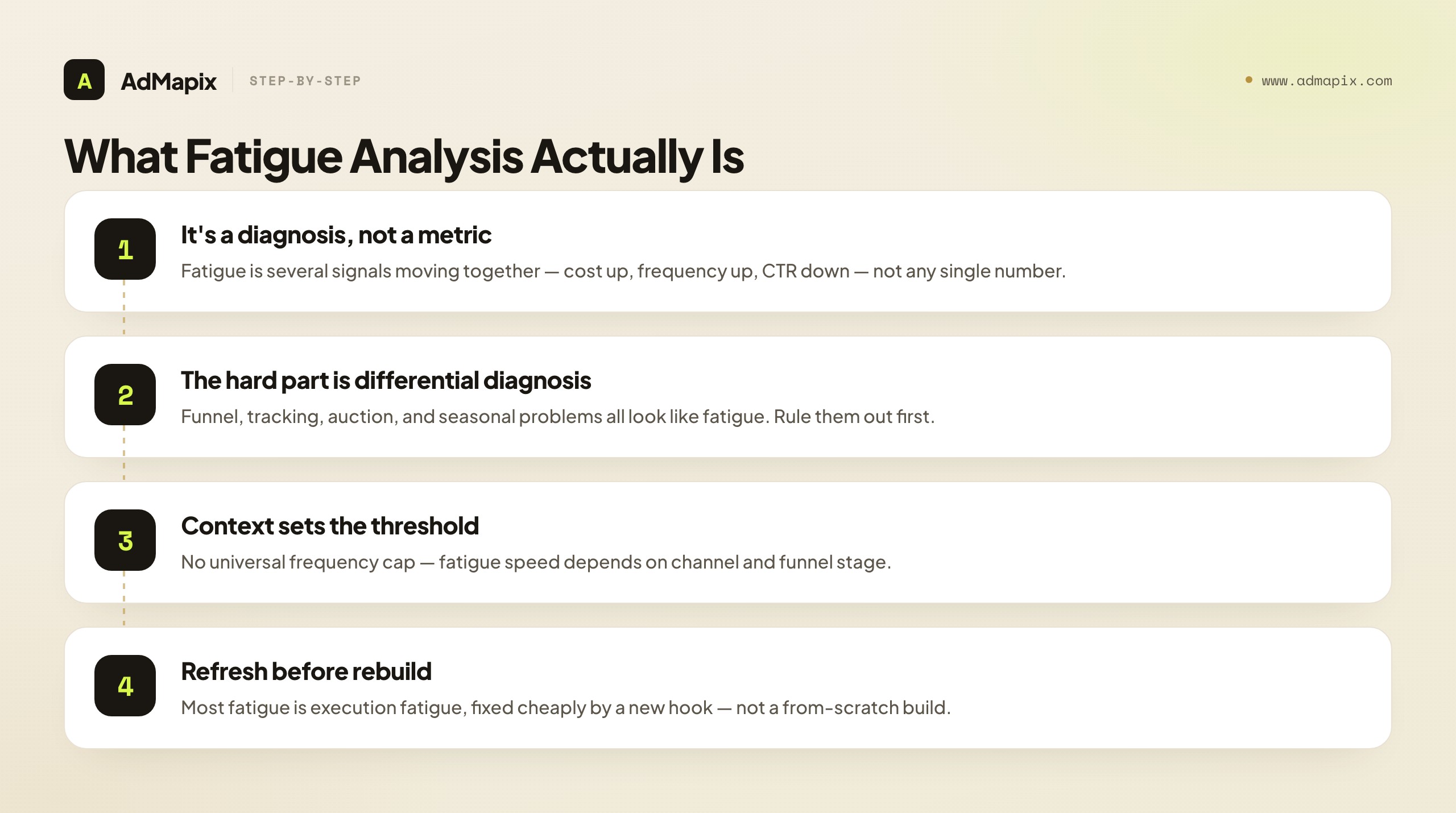
- Creative fatigue is rising cost per result driven by repeated exposure — not by a targeting, budget, or tracking change. Confirm the cause before you act, because the fix for fatigue is different from the fix for every imposter.
- No single metric proves fatigue. It's a diagnosis from several signals moving together: cost per result rising as frequency rises and CTR falls, on the same creative, over multiple days.
- The hardest skill is differential diagnosis. A cost spike with flat frequency is an auction or tracking problem; falling CVR with steady CTR is a funnel problem; a one-day jump is noise. None of those are fatigue, and refreshing the creative won't fix them.
- Fatigue speed varies by channel and funnel stage. A tight retargeting pool on a fast channel saturates in days; a large prospecting audience on a slow channel takes weeks. Read the signals against your own context, not a universal number.
- Platform flags are a prompt, not a verdict. Meta's "Creative fatigue" status (cost per result roughly 2x prior ads) tells you to investigate, not to kill the ad — a small audience can trip it without being fatigued.
- Write a refresh threshold. A rule tied to audience size and funnel stage keeps fatigue calls consistent instead of relitigated every week.
- Refresh before you rebuild. A new hook or format on a winning concept usually beats a brand-new build, and the cheapest intervention that works is the right one.
What Fatigue Actually Looks Like in the Data
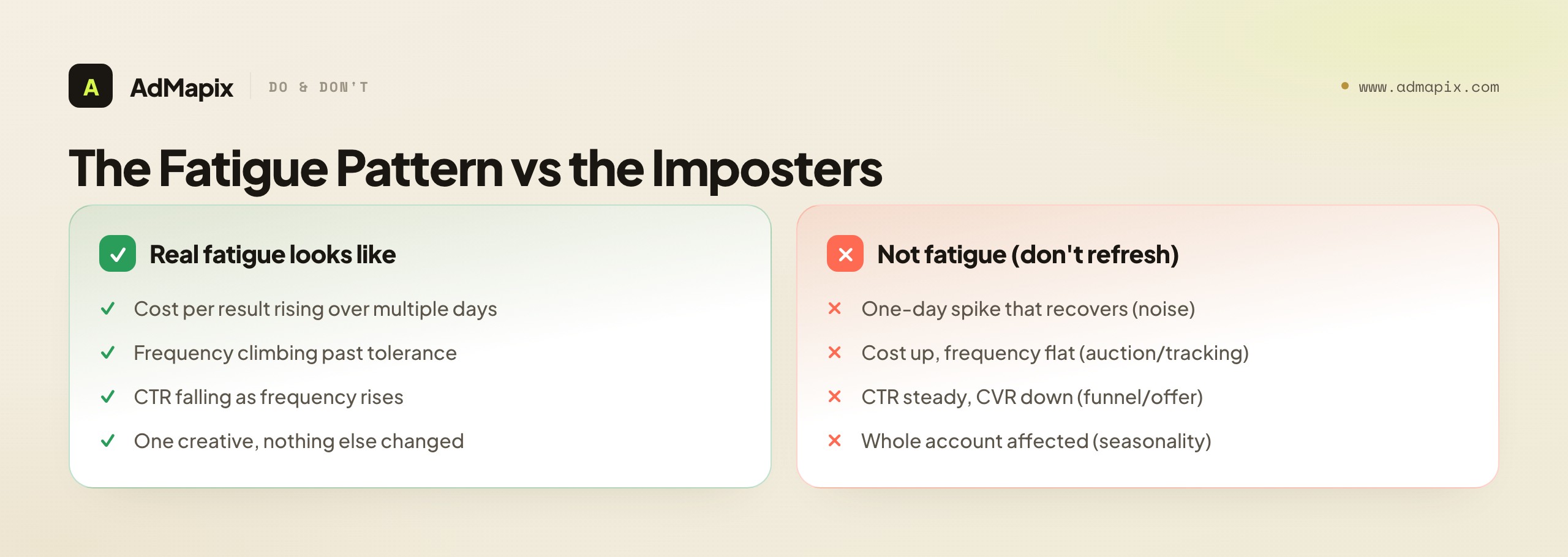
Fatigue shows up as a slow, sustained rise in cost per result paired with climbing frequency and a falling click-through rate on the same creative. One bad day is noise; a multi-day decline as frequency crosses your audience's tolerance is the signal. The defining feature is the correlation over time: fatigue isn't any single number being bad, it's three numbers moving together in a specific pattern — cost per result up, frequency up, CTR down — sustained long enough to rule out noise.
Before you blame the creative, rule out the cheaper explanations: a budget jump that pushed delivery into weaker inventory, a landing-page or checkout change, a tracking break, a competitor outbidding you, or simple seasonality. Each of these can raise cost per result while the creative is perfectly fine, and each has a different fix. Refreshing the creative when the real problem is a broken pixel or a seasonal lull wastes the refresh and leaves the actual problem unsolved.
The practical test is the correlation. If cost per result rises as frequency rises and CTR falls, fatigue is the likely cause — the audience has seen the ad enough times that the hook no longer earns attention, so you pay more for each result. If cost per result spikes while frequency is flat, look elsewhere; that's usually an auction, tracking, or funnel problem wearing a fatigue costume. The entire discipline of fatigue analysis is reading whether the signals move together in the fatigue pattern or whether one of them is out of step, which points at a different cause.
Reading the Core Signals
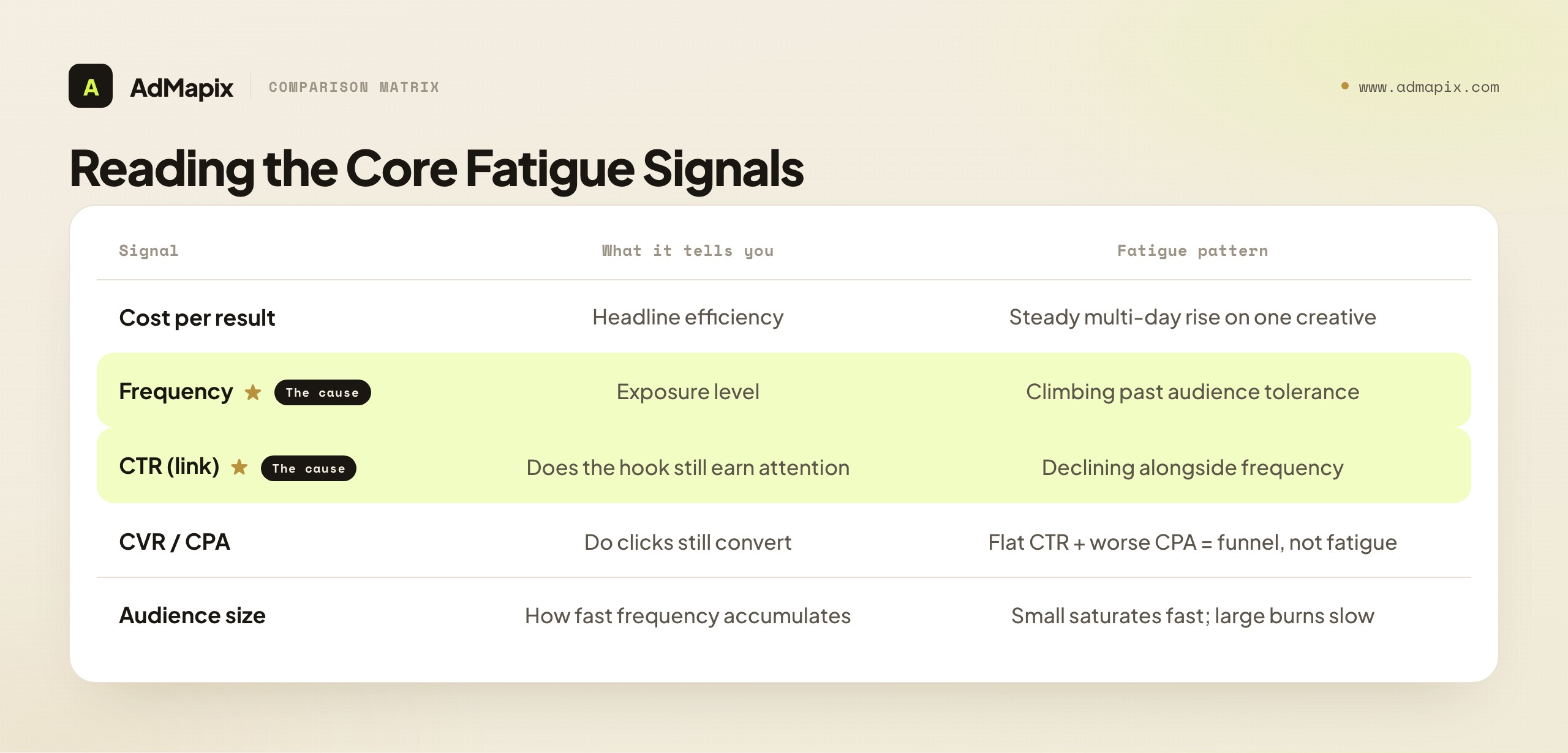
No single metric proves fatigue; you read them together. Each signal below answers a different question, and they only become a diagnosis when they move in the same direction at the same time. Reading any one in isolation is how teams misdiagnose.
| Signal | What it tells you | Fatigue pattern | False alarm |
|---|---|---|---|
| Cost per result | The headline efficiency number | Steady multi-day rise on one creative | One-day spike, then recovers |
| Frequency | How many times the audience saw it | Climbing past your audience's tolerance | Still low; audience not saturated |
| CTR (link) | Whether the hook still earns attention | Declining alongside frequency | Stable; people still click |
| CVR / CPA | Whether clicks still convert | Flat CTR but worse CPA points to landing/offer, not fatigue | Stable conversion |
| Audience size | How fast frequency accumulates | Small audience saturates quickly | Large audience; slow burn |
The two signals that anchor the diagnosis are frequency and CTR, because fatigue is fundamentally an overexposure story: frequency measures the exposure, CTR measures whether the audience still responds to it. When frequency climbs and CTR falls together, the audience is seeing the ad too much and responding less — the textbook fatigue mechanism. Cost per result is the headline symptom (it's what you feel in the budget), but frequency and CTR are the cause you can read. Audience size is the modifier that explains the speed — a small audience accumulates frequency fast, so it fatigues fast, while a large audience burns slowly. And CVR is the differential-diagnosis signal: if CTR is steady but CVR fell, the problem is past the click (the funnel), not the creative.
There's a leading-versus-lagging distinction worth internalizing, because it determines how early you can catch fatigue. Frequency is a leading indicator — it climbs before performance visibly suffers, so a rising frequency on a small audience is an early warning that fatigue is coming, before cost per result has moved much. CTR is a near-real-time indicator — it falls as the audience habituates, often before the cost-per-result rise is undeniable. Cost per result is the lagging indicator — by the time it's clearly up, fatigue is well underway and you've already spent at the higher cost for days. The practical implication: watch the leading and near-real-time signals (frequency and CTR) to catch fatigue early, rather than waiting for the lagging signal (cost per result) to make it obvious. A team that monitors frequency and CTR trends acts on fatigue days before a team that waits for cost per result to spike — and those days are budget saved. Reading the signals in their leading-to-lagging order is what turns fatigue analysis from reactive (catching it after it's hurt) into proactive (catching it as it begins).
The Hard Part: Telling Fatigue From Its Imposters
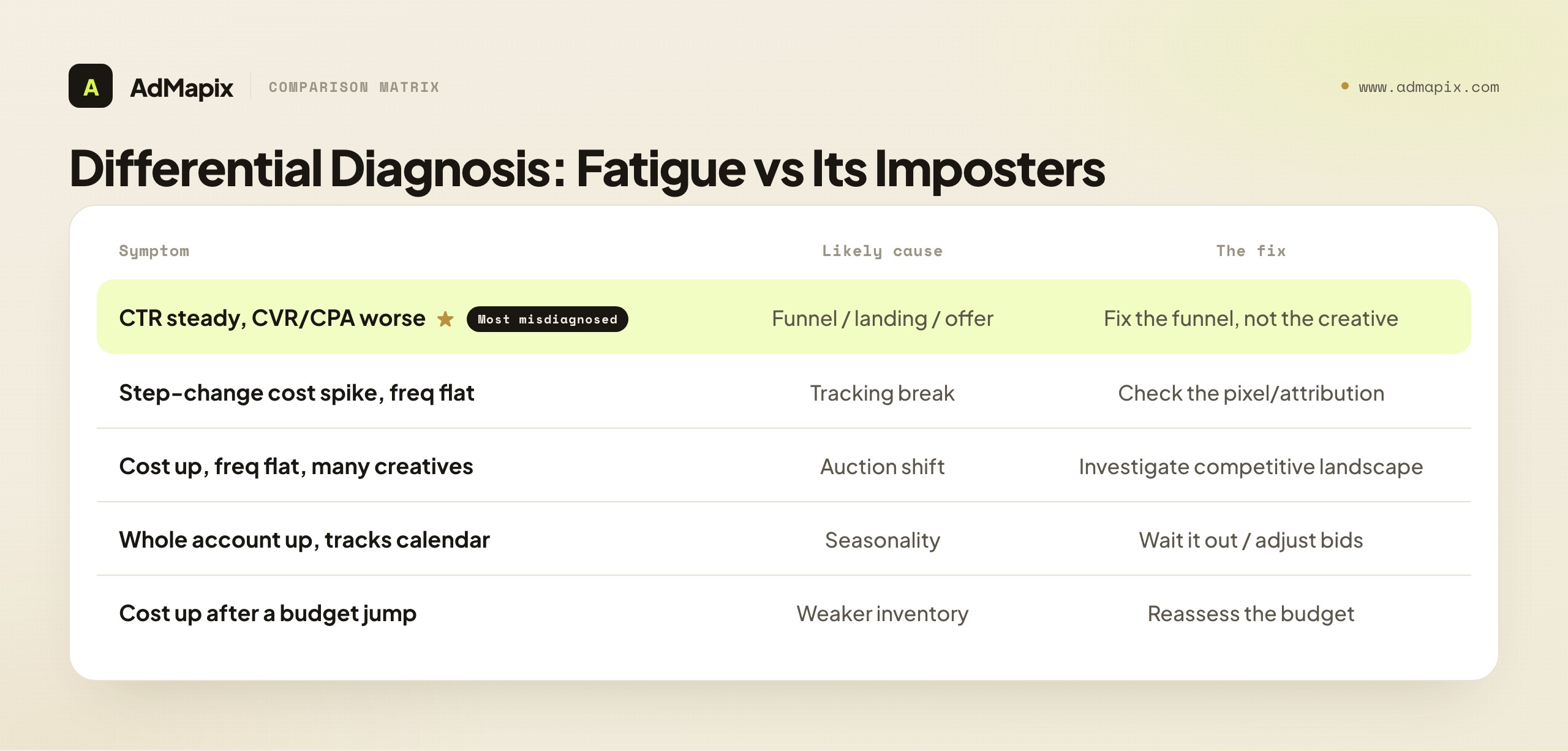
The single most valuable skill in fatigue analysis is differential diagnosis — distinguishing real fatigue from the several other problems that raise cost per result and look identical at a glance. Most "fatigue" calls are wrong not because the math is hard but because teams never check whether something else explains the decline. Refreshing the creative is the wrong fix for every imposter below, so ruling them out first is what saves the refresh budget.
The imposters and how to tell them apart from fatigue:
- Funnel / landing-page problems. If CTR is steady (the hook still earns clicks) but CVR or CPA worsened, the problem is after the click — a landing-page change, a broken checkout, an offer that stopped converting. This is the most common fatigue misdiagnosis. The tell: the ad is still doing its job (earning clicks), but the conversion fell. Fix the funnel, not the creative.
- Tracking breaks. A pixel failure, an attribution-window change, or a measurement bug can make cost per result look like it spiked when the ads are fine — the conversions are happening but not being recorded. The tell: an abrupt, step-change drop rather than a gradual decline, often with frequency flat. Check tracking before touching creative.
- Auction shifts. A competitor entering your auction, raising bids, or launching a campaign can push your cost per result up regardless of your creative. The tell: cost rises with flat or even falling frequency (you're winning fewer impressions at higher prices), and it often hits multiple creatives at once. Investigate the competitive landscape, not the creative.
- Seasonality and demand shifts. A seasonal lull, a post-peak reset, or a category-wide demand drop raises cost per result across the board. The tell: it affects the whole account, not one creative, and it tracks a known calendar event. Wait it out or adjust bids; don't refresh.
- Budget jumps pushing into weaker inventory. A big budget increase can force delivery into lower-quality placements, raising cost per result. The tell: the cost change coincides with a budget change. Reassess the budget, not the creative.
The discipline that makes this work: before you call fatigue, run the checklist — is CTR falling (fatigue) or steady (funnel)? Is frequency rising (fatigue) or flat (auction/tracking)? Is it one creative (fatigue) or the whole account (seasonality/budget)? Did anything change in tracking, the landing page, or the budget at the same time? Only when the answer is "CTR falling, frequency rising, one creative, nothing else changed" is the diagnosis genuinely fatigue. That checklist is the core of fatigue analysis — the math is trivial, the differential diagnosis is where the value is.
Platform Fatigue Signals: Meta, Google, and TikTok
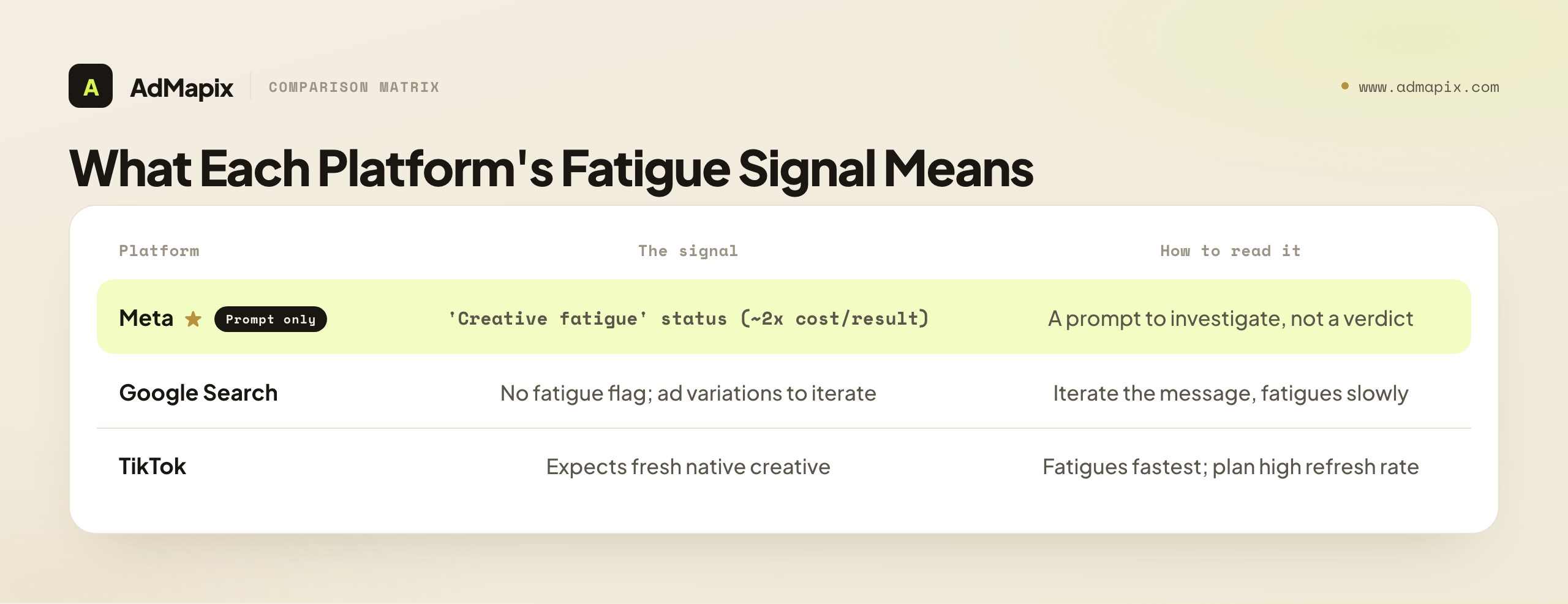
The major platforms surface fatigue-adjacent signals, but each is a prompt to investigate rather than a verdict — knowing what each platform actually tells you keeps you from over-trusting an automated flag. The platforms see your delivery data, but they don't run your differential diagnosis, so their signals still need human reading.
Meta states it shows a Creative fatigue status and recommends action when an ad's cost per result is at least twice as much as ads you previously ran. That's a useful prompt, but treat it as a starting point: a small retargeting audience can hit that 2x threshold simply because it's small and expensive, not because the creative is exhausted. The flag tells you cost per result is high relative to history; it doesn't tell you why, which is exactly the differential diagnosis you still have to run.
Google Ads doesn't frame fatigue the same way, but it provides the refresh mechanism: Google notes that ad variations let you test and iterate creative messages — for example, swapping a headline or call to action — across campaigns. That's the practical response to fatigue on Search and across Google's surfaces: iterate the message on a proven concept rather than rebuild. On the discovery and video side, fatigue behaves more like social, where frequency against a defined audience drives the decline.
TikTok's creative environment fatigues fastest of all, because the platform rewards native, fresh, high-volume creative and punishes anything that feels like a stale ad. TikTok's own guidance emphasizes TikTok-first, vertical, sound-on creative featuring real creators — which is partly a fatigue-management philosophy: the platform expects a high refresh rate, so the practical fatigue threshold on TikTok is shorter than on Meta or Google. Reading platform signals correctly means knowing that the same frequency number means different things on different channels.
A word on why you can't simply outsource fatigue decisions to the platforms' automated flags and rotation. The platform sees your delivery data, but it doesn't know your margins, your funnel, your seasonal calendar, or whether a cost-per-result rise is fatigue or a tracking break — so its flag is necessarily a blunt instrument that can only see "cost per result is high relative to your history." It can't run the differential diagnosis that distinguishes fatigue from its imposters, and it doesn't know that a small retargeting audience is supposed to be expensive. Automated rotation has the same limit: it can swap creatives on a schedule, but it can't tell whether the swap is warranted or whether the underlying problem is a funnel break that a new creative won't fix. The platforms' tools are useful prompts and useful mechanics, but the judgment — is this really fatigue, and what's the cheapest fix — stays human. Treating the platform's flag as the start of your diagnosis rather than the end of it is the difference between fatigue analysis and blindly obeying a dashboard, and it's why the human differential diagnosis this guide describes can't be automated away.
Fatigue Speed by Channel and Funnel Stage
There's no universal fatigue threshold, because how fast a creative fatigues depends on the channel and the funnel stage — reading fatigue against your own context, not a fixed number, is what separates accurate diagnosis from cargo-culting someone else's rule. The same creative fatigues at wildly different speeds depending on where and to whom it runs.
| Context | Fatigue speed | Why | Practical read |
|---|---|---|---|
| TikTok, broad prospecting | Fast (days) | Native-creative expectation, high scroll velocity | Plan a high refresh rate |
| Meta, broad prospecting | Moderate (1-3 weeks) | Large audience, slower frequency climb | Watch the cost-per-result trend |
| Meta, tight retargeting | Fast (days) | Small audience saturates quickly | Watch frequency vs. CTR |
| Google Search | Slow (weeks+) | Query-driven, intent refreshes the audience | Iterate messages, not whole creatives |
| B2B / LinkedIn | Slow (weeks) | Small, defined audience but needs repetition to land | Don't over-refresh; let claims sink in |
The two variables that set fatigue speed are audience size (small audiences accumulate frequency fast, so they fatigue fast) and channel norms (TikTok expects fresh creative and fatigues fast; Search refreshes its audience through new queries and fatigues slowly). A tight retargeting pool on any channel fatigues quickly because the same few thousand people see the ad repeatedly; a large prospecting audience on a slow channel can run the same creative for weeks. The B2B case is a useful inversion: the audience is small (which should mean fast fatigue) but the long buying cycle means buyers need repetition to absorb a considered claim, so over-refreshing B2B creative can prevent the message from ever landing — fatigue management there means resisting the urge to refresh too soon.
The strategic takeaway: don't chase a universal frequency cap or a fixed "refresh every N days" rule. Read fatigue against your specific channel and funnel stage, because the same signals mean fast fatigue in a TikTok retargeting set and slow, healthy delivery in a Google Search campaign. The context sets the threshold, which is why the next section ties the threshold to the situation.
Setting a Refresh Threshold
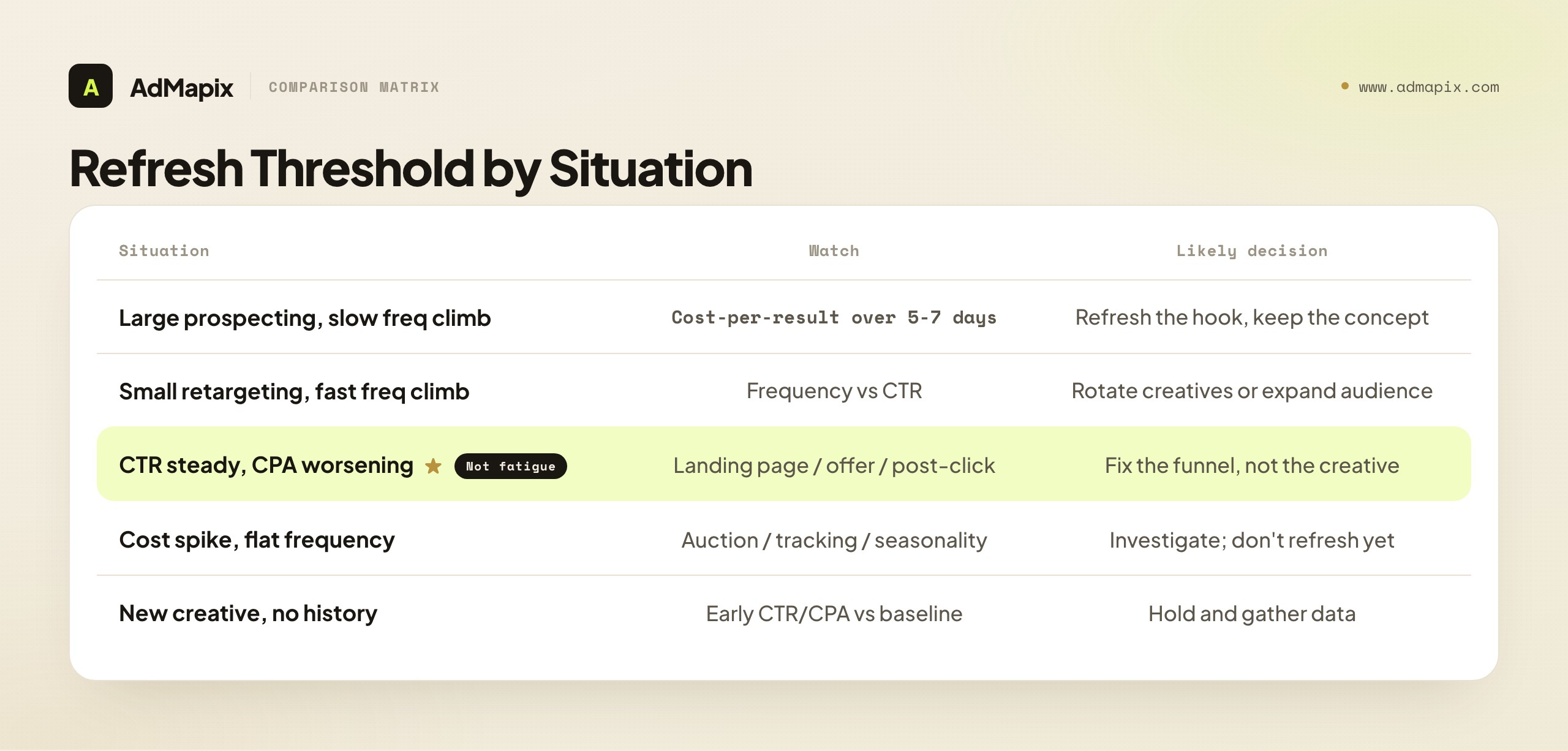
A refresh threshold is a written rule that converts the signals into a decision, so you're not relitigating the same judgment call every week. The right threshold depends on audience size, funnel stage, and how much budget the creative carries — a prospecting set at scale tolerates higher frequency than a tight retargeting pool, and a creative carrying most of your spend warrants faster action than a minor one.
| Situation | Watch | Likely decision |
|---|---|---|
| Large prospecting audience, slow frequency climb | Cost-per-result trend over 5-7 days | Refresh the hook, keep the concept |
| Small retargeting audience, fast frequency climb | Frequency vs. CTR | Rotate creatives or expand the audience |
| CTR steady but CPA worsening | Landing page, offer, post-click flow | Fix the funnel, not the creative |
| Cost spike with flat frequency | Auction, tracking, seasonality | Investigate; don't refresh yet |
| New creative, no history | Early CTR and CPA vs. account baseline | Hold and gather data before judging |
The lowest-cost intervention usually wins. Google Ads notes that ad variations let you test and iterate creative messages — for example, swapping a headline or call to action — across campaigns. That maps directly to fatigue work: change one variable on a proven concept before you commission an entirely new asset. A written threshold isn't about precision — there's no perfect frequency number — it's about consistency: a rule the whole team applies the same way every week, so fatigue decisions don't drift with whoever's looking at the dashboard that day. Write the threshold, tie it to the situation, and revisit it quarterly as your channels and audiences change.
Refresh vs. Rebuild: Choosing the Cheapest Effective Fix
Once you've confirmed fatigue, the decision is how much to change — and the principle is to make the smallest change that solves it, because a winning concept with a fatigued hook is far more valuable than a blank page. Rebuilding from scratch when a hook swap would have worked wastes production budget and discards a proven concept.
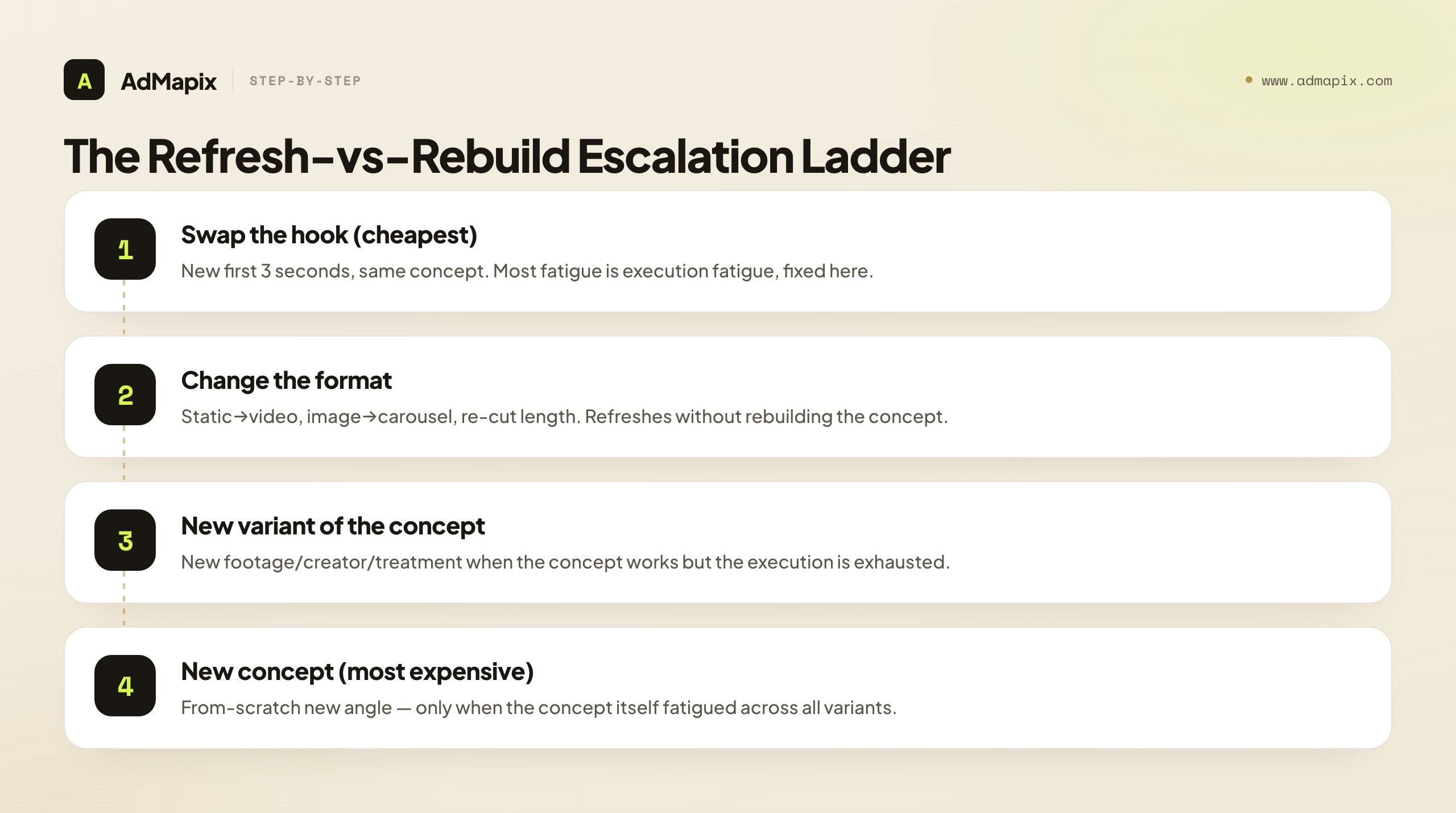
The escalation ladder, cheapest to most expensive:
- Swap the hook (cheapest). Change the first three seconds or the opening line while keeping the body, offer, and concept. Often the hook is what fatigued (the audience recognizes it and scrolls), so a new hook on the same proven concept revives performance at minimal cost. For the hook patterns to test, see our ad hook examples guide.
- Change the format. Run the same concept as a different format — a static winner as video, a single image as a carousel, a video re-cut to a different length. Format change refreshes the creative without rebuilding the concept.
- Refresh the proof or offer framing. Swap the metric, the testimonial, or the way the offer is presented, keeping the core concept. New proof can revive a fatigued creative because it gives the audience a new reason to look.
- New variant of the concept (moderate). A genuinely new execution of the same winning concept — new footage, new creator, new visual treatment — when the concept still works but the specific execution is exhausted.
- New concept (most expensive). A from-scratch build with a new angle, reserved for when the concept itself has fatigued across all its variants, or when you need to diversify the creative portfolio rather than revive one creative.
The strategic rule: escalate up the ladder only as far as you need to. Start with the hook swap, because it's cheapest and frequently sufficient, and only build a new concept when the concept itself is exhausted. Most fatigue is execution fatigue (the audience is tired of this specific ad), not concept fatigue (the audience is tired of this angle) — and execution fatigue is fixed cheaply, by a new hook or format, not by abandoning a winning concept. Knowing the difference between execution and concept fatigue is what keeps your refresh costs down and your winners alive longer.
Staying Ahead of Fatigue: The Creative Pipeline
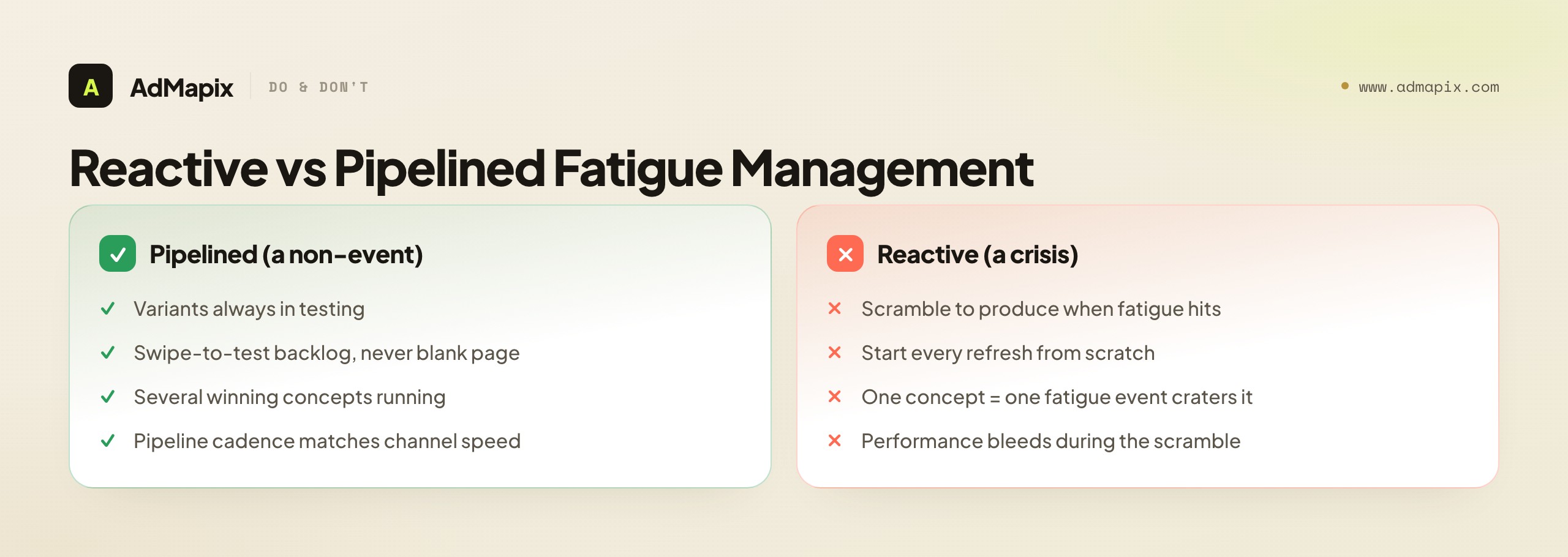
The teams that handle fatigue best don't react to it — they run a creative pipeline that has the next variant ready before the current one fatigues, so fatigue becomes a planned handoff rather than an emergency. Reacting to fatigue means a scramble to produce a refresh while performance bleeds; staying ahead means the refresh is already tested and waiting.
The pipeline mindset that prevents fatigue emergencies:
- Always have variants in testing. While a winner runs, the next hook swaps and format variants are already in test, so when fatigue hits, the replacement is proven and ready. This is the difference between a planned refresh and a panicked one.
- Maintain a swipe-to-test backlog. A library of tested and untested creative ideas (informed by competitor research and your own wins) means you never start a refresh from a blank page. For building this, see our creative ads library guide.
- Diversify the creative portfolio. Running several distinct winning concepts simultaneously means no single fatigue event craters the account — when one concept tires, the others carry the load while you refresh.
- Match the pipeline cadence to the channel's fatigue speed. A TikTok-heavy account needs a faster pipeline (more variants, more often) than a Google Search account; size the creative production to the channel's fatigue rate.
The strategic synthesis: fatigue is inevitable, so the goal isn't to prevent it but to make it a non-event. An account with a healthy pipeline treats fatigue as a routine handoff — the fatigued creative steps down, the pre-tested replacement steps up, performance never dips. An account without a pipeline treats every fatigue event as a crisis, scrambling to produce a refresh while cost per result climbs. The pipeline is where fatigue analysis connects to the broader creative testing framework: the testing system feeds the pipeline, and the pipeline absorbs fatigue without drama.
The Mechanism: Why Creative Fatigues
Understanding why creative fatigues — the underlying mechanism — makes the signals legible and the fixes obvious, because fatigue isn't random performance decay; it's a specific, predictable response to overexposure. Once you understand the mechanism, the cost-per-result rise stops being a mystery and becomes a symptom you can trace to its cause.
The mechanism has three reinforcing parts:
- Attention habituation. The first time someone sees an ad, the hook is novel and earns attention; the tenth time, the brain has learned to ignore it, so the hook stops working. This is why CTR falls as frequency rises — the audience has habituated to the creative and scrolls past it. The hook isn't worse; the audience is just no longer surprised by it.
- Auction economics. As the responsive portion of an audience converts or tunes out, the platform has to show the ad to less responsive people (or show it more often to the same people) to keep spending the budget — which raises the cost per result. Fatigue is partly a story about the platform running out of fresh, responsive audience for a given creative.
- Audience exhaustion. A finite audience has a finite number of people who'll respond to a given creative. Once the responsive ones have acted, continuing to run the same creative means paying to reach the unresponsive remainder — diminishing returns by definition. Small audiences hit this wall fast; large ones take longer.
These three combine into the fatigue curve: early on, the creative reaches fresh, responsive audience cheaply; as frequency climbs, habituation and audience exhaustion set in, the platform works harder to spend the budget, and cost per result rises. The reason a new hook revives performance is that it resets the attention-habituation part of the mechanism — the audience that tuned out the old hook is surprised by a new one, even though the concept and audience are the same. And the reason audience expansion also helps is that it resets the audience-exhaustion part — fresh people who haven't seen the creative respond to it again. Knowing the mechanism tells you which lever to pull: a new hook resets habituation, a bigger audience resets exhaustion, and a genuinely new concept resets both.
Fatigue by Creative Type
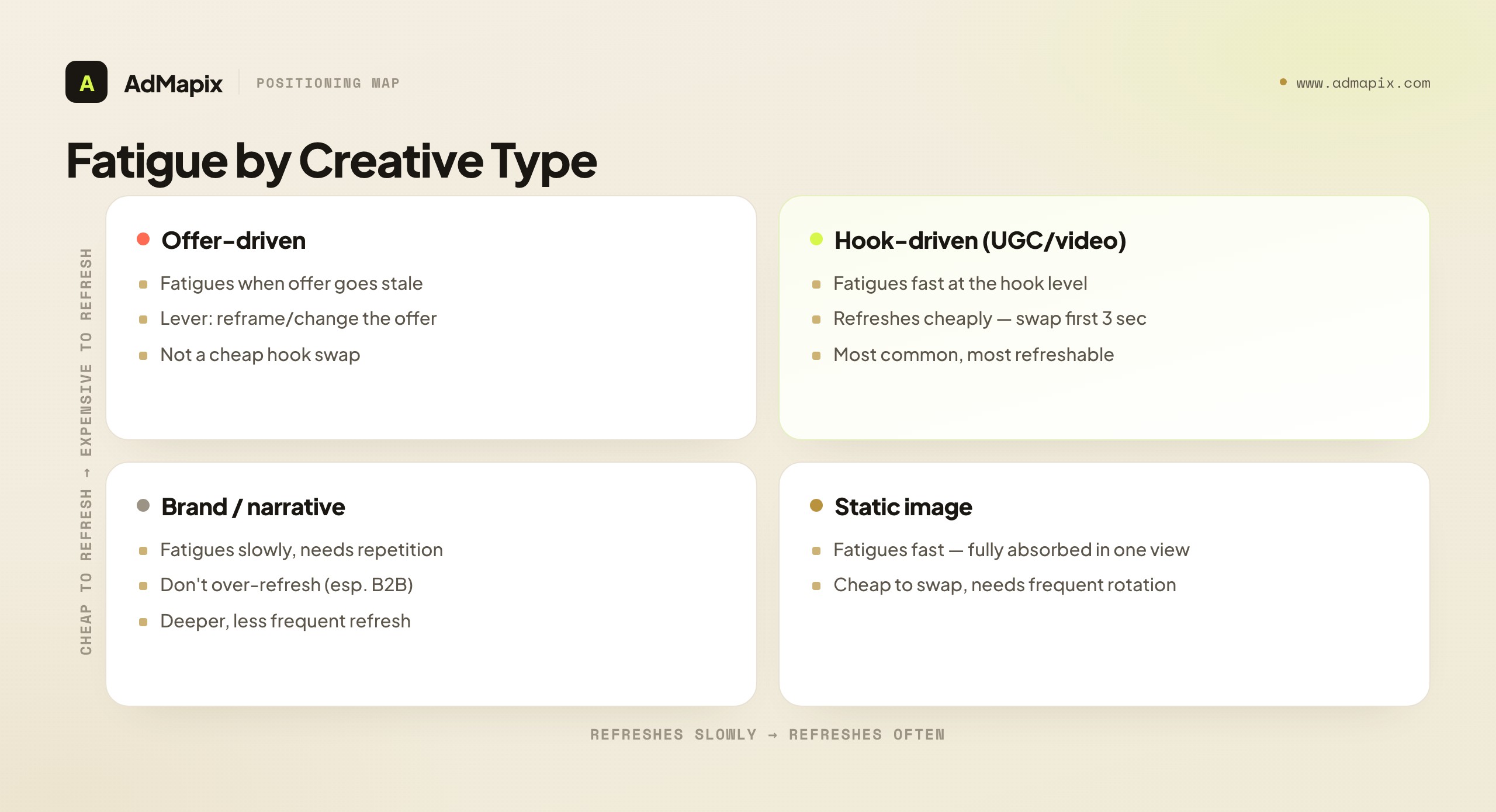
Different creative types fatigue at different rates and in different ways, so reading the creative type tells you what kind of fatigue to expect and how to refresh it. The mechanism is universal, but how it plays out depends on what the creative is.
- Hook-driven creative (UGC, short-form video). Fatigues fast at the hook level — the audience learns to recognize and skip the opening, so CTR drops quickly. The good news: it refreshes cheaply, because swapping the hook (the first three seconds) often revives the whole creative. This is the most common and most refreshable fatigue.
- Offer-driven creative. Fatigues when the offer stops feeling fresh or the audience that wanted the offer has acted. Refreshing the hook helps less here; the lever is reframing or changing the offer itself, because the offer is what carried the conversion.
- Proof-driven creative (testimonials, before/after, logos). Fatigues more slowly because proof doesn't go stale the way a hook does, but when it fatigues, a new proof point (a different testimonial, a fresh metric) revives it.
- Brand / narrative creative. Fatigues slowly and benefits from repetition — especially in B2B and considered purchases where the audience needs multiple exposures to absorb the message. Over-refreshing brand creative can prevent it from doing its job.
- Static image creative. Fatigues fast because there's less to hold attention across repeated views — a single static frame is fully absorbed in one viewing, so repeated exposure adds nothing. Static needs more frequent rotation than video.
The strategic read: match your refresh expectation to the creative type. Hook-driven and static creative need frequent, cheap hook-and-format refreshes; offer-driven creative needs offer reframing; proof- and brand-driven creative fatigue slowly and need less frequent, deeper refreshes. Misreading the type leads to the wrong refresh — swapping the hook on offer-fatigued creative, or constantly refreshing brand creative that needed repetition — so identify what kind of creative you're refreshing before you decide how.
A Worked Diagnosis: Is It Really Fatigue?
Principles stick when applied, so here's how the differential diagnosis runs on a real-looking case. Say a Meta prospecting creative that was your top performer shows cost per result up 40% over the last week, and your dashboard is flagging it. The instinct is to refresh — but you run the checklist first.
Check frequency and CTR. Frequency has climbed from 2.1 to 4.8 over the week, and link CTR has fallen from 1.8% to 1.1%. Both are moving in the fatigue direction — exposure up, response down. This is the first real fatigue signal: the two anchor metrics moving together.
Check CVR. Conversion rate from click is steady — the people who do click are converting at the same rate as before. This rules out the funnel: if CVR had dropped with CTR steady, you'd be looking at a landing-page or offer problem, not fatigue. Steady CVR with falling CTR points back at the creative.
Check the scope. Is it just this creative or the whole account? You check the other active creatives — they're stable. The cost-per-result rise is isolated to this one creative, which rules out seasonality and account-wide auction shifts (those would hit everything).
Check for changes. Did anything change in tracking, the landing page, or the budget this week? You verify: the pixel is firing normally, the landing page is unchanged, and the budget held steady. Nothing else changed, which rules out the tracking and budget imposters.
The diagnosis. Frequency up, CTR down, CVR steady, one creative, nothing else changed — this is genuine fatigue, confirmed by ruling out every imposter. And because frequency climbed on a prospecting audience and the concept was a strong performer, this is execution fatigue (the audience is tired of this specific ad), not concept fatigue. The fix: swap the hook on the same concept — the cheapest rung of the ladder — and expand the audience slightly to reset exhaustion. You don't rebuild, because the concept still works; you refresh the execution that fatigued. The whole diagnosis took five minutes of reading the dashboard, and it saved you from either ignoring real fatigue or over-spending on an unnecessary rebuild. The takeaway: the checklist turns a vague "performance dropped, probably fatigue" into a confident, specific diagnosis and the cheapest fix that resolves it.
The Budget Cost of Misdiagnosing Fatigue
Misdiagnosing fatigue is expensive in both directions, so understanding the budget cost is what motivates the diagnostic discipline this guide insists on. The two failure modes — false positive and false negative — each waste money in a specific way, and avoiding both is worth real budget.
The two costly errors:
- The false positive (refreshing a non-fatigued creative). You see cost per result rise, call fatigue, and refresh — but the real problem was a funnel break or a seasonal lull. You've now spent production budget on an unnecessary refresh, discarded a creative that was actually fine, and left the real problem (the funnel, the season) unsolved, so cost per result stays high. Triple waste: production cost, lost winner, unsolved problem.
- The false negative (ignoring real fatigue). You miss genuine fatigue — maybe you trusted that the creative was a proven winner, or you didn't have a threshold — and keep spending into a creative the audience has tuned out. Every day of delay is budget spent at a rising cost per result, money you'd have saved by refreshing on time. The cost compounds daily until you act.
The budget math makes the case for diagnostic rigor: a false positive wastes the cost of a refresh plus a lost winner; a false negative wastes the daily overspend until you catch it. Both are avoidable with the differential diagnosis — the false positive by ruling out the imposters before refreshing, the false negative by having a written threshold that flags real fatigue before it compounds. The five minutes of diagnosis this guide describes is cheap insurance against both errors, which is why the teams that diagnose rigorously consistently spend less on creative and waste less on misdiagnosed problems than the teams that react to every cost-per-result wiggle. Fatigue analysis isn't academic — it's directly a budget-efficiency practice, and the five-minute diagnosis pays for itself many times over in avoided waste.
A Weekly Fatigue Review Cadence
Fatigue analysis works best as a routine weekly review rather than a panic triggered by a bad day, so building it into a regular cadence is what keeps both false positives and false negatives low. A weekly review catches real fatigue before it compounds and prevents the single-bad-day overreactions that kill winners.
A workable weekly fatigue review:
- Scan the cost-per-result trends. Look at each significant creative's cost-per-result trend over the trailing 7 days, not the single most recent day. You're looking for sustained direction, not noise.
- Flag the movers, run the checklist. For any creative trending up, run the differential diagnosis — frequency, CTR, CVR, scope, recent changes — to separate real fatigue from the imposters. Most flagged creatives won't be fatigue; the checklist tells you which are.
- Act on the confirmed cases. For confirmed fatigue, escalate the refresh ladder to the cheapest fix that works — usually a hook swap from your pipeline. For the imposters, route to the right fix (funnel, tracking, bids) instead of a refresh.
- Check the pipeline. Confirm the next variants are in testing for your highest-spend creatives, so the next fatigue event has a ready replacement. The weekly review is also where you keep the pipeline full.
The discipline that makes the cadence work is reviewing trends, not snapshots — a weekly look at 7-day trends catches fatigue early without overreacting to daily noise, which is the balance that single-day reactions and infrequent reviews both miss. A team that runs this review weekly catches fatigue at the right moment, refreshes from a ready pipeline, and routes the imposters to their real fixes — turning fatigue from a recurring crisis into a managed, routine part of the account. This cadence is where fatigue diagnosis becomes an operating habit rather than a reactive scramble.
Account-Level Fatigue and Creative Diversity
Fatigue isn't only a per-creative problem — it has an account-level dimension, where the diversity of your creative portfolio determines how exposed the whole account is to fatigue. An account leaning on one or two creatives is fragile: when they fatigue, the whole account's performance drops at once. An account running several distinct winning concepts is resilient: when one fatigues, the others carry the load.
The account-level fatigue dynamics worth managing:
- Concentration risk. If most of your spend rides on one or two creatives, you've concentrated your fatigue risk — a single fatigue event craters the account. Diversifying spend across several proven concepts spreads the risk so no single fatigue event is catastrophic.
- Correlated fatigue. If all your creatives share the same concept, hook, or audience, they tend to fatigue together — refreshing the hook on all of them at once doesn't help if the audience is tired of the underlying concept. Genuine diversity (different concepts, angles, and audiences) is what prevents correlated fatigue from hitting everything simultaneously.
- Audience overlap. Running many creatives to the same small audience accelerates fatigue across all of them, because the audience sees the combined frequency of every creative. Account-level frequency, not just per-creative frequency, is what the audience actually experiences — so a tight audience with many creatives fatigues faster than the per-creative numbers suggest.
- The portfolio refresh rhythm. A healthy account refreshes creatives on a staggered schedule, so they don't all fatigue and need refreshing at the same moment. Staggering the refresh keeps a steady supply of fresh creative entering as fatigued creative exits, smoothing performance rather than letting it sawtooth.
The strategic synthesis: manage fatigue at the portfolio level, not just the creative level. A diversified portfolio of several distinct winning concepts, refreshed on a staggered schedule, with account-level frequency monitored alongside per-creative frequency, is far more resilient to fatigue than an account riding one winner. The single-creature account is always one fatigue event from a performance crisis; the diversified account treats each fatigue event as a routine swap that the rest of the portfolio absorbs. Building that diversity is a creative-production decision (you need enough distinct concepts in the pipeline) that connects directly to the creative testing framework — the testing system is what generates the distinct winning concepts a resilient portfolio needs.
Why Fatigue Moves Faster in 2026
Creative fatigue has accelerated in recent years, and understanding why explains why fatigue analysis matters more now than it did a few years ago — the structural shifts in advertising have made creative the primary lever and fatigue a more frequent, more consequential event. Three changes have compressed the fatigue cycle.
First, privacy changes shifted the work from targeting to creative. As behavioral targeting narrowed and signal degraded, the creative itself does more of the work the algorithm used to do — which means creative is under more load, tested harder, and fatigues faster as it carries more of the performance burden. In a world where you can't target as precisely, the creative has to win on its own merits more often, and winning creatives get scaled harder and exhaust faster.
Second, audiences are more ad-saturated. People see more ads across more surfaces than ever, so their tolerance for any single repeated creative is lower — the habituation that drives fatigue sets in faster because the audience is already saturated. A creative that might have run for a month a few years ago fatigues in weeks now, simply because the audience's collective ad exposure is higher.
Third, the fastest channels reward freshness structurally. TikTok and the short-form-video surfaces are built to reward native, fresh creative and punish anything that feels like a stale ad, so the channels themselves accelerate the fatigue cycle. As spend has shifted toward these fast-fatigue channels, the blended fatigue rate across accounts has risen.
The practical consequence: fatigue analysis is more important in 2026 than it was, because creative fatigues faster, carries more of the performance load, and a misdiagnosis costs more. The teams that win are the ones that treat creative as a renewable resource requiring constant, managed replenishment — diagnosing fatigue accurately, refreshing cheaply and quickly, and running a pipeline that stays ahead of the accelerated cycle. Fatigue used to be an occasional event; in 2026 it's a constant operating condition, which is exactly why a rigorous, routine diagnostic practice has become a competitive advantage rather than a nice-to-have. The accounts that scale efficiently in this environment are the ones that diagnose fatigue precisely, refresh from a ready pipeline, and never confuse a tired creative with a broken funnel.
What Public Ad Data Can and Cannot Prove
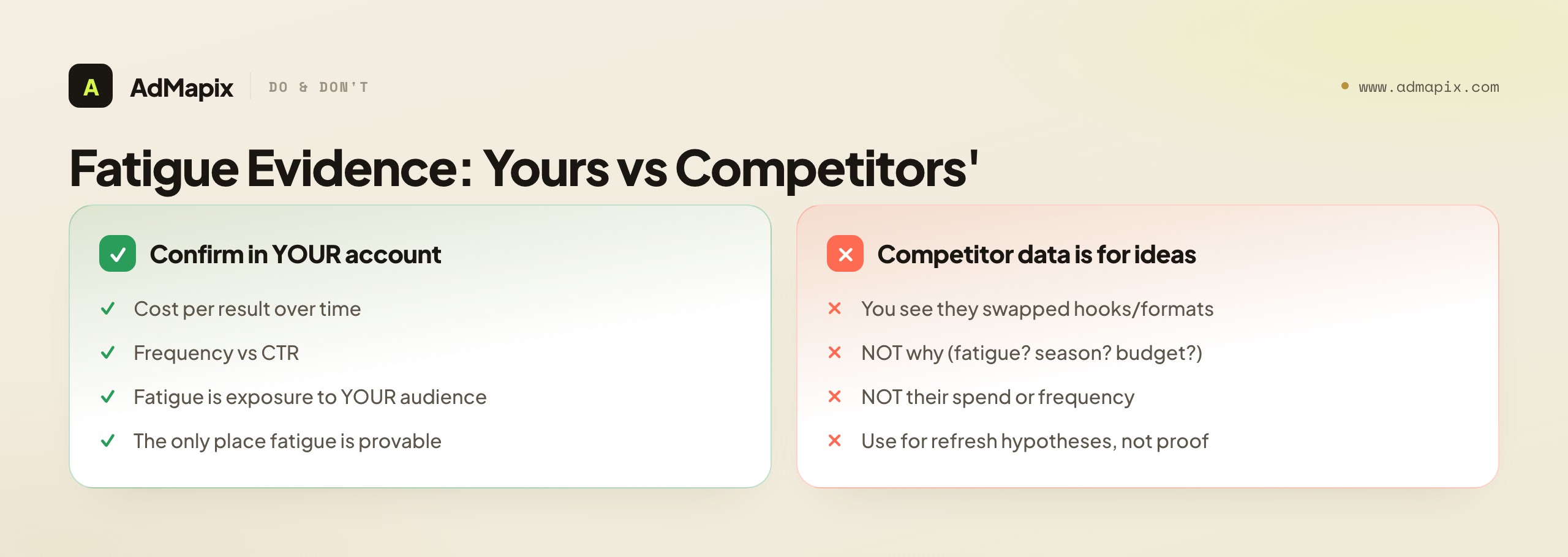
Public ad libraries and competitor research can show you what others are running and how often a creative reappears, but they cannot show you the spend, frequency, or performance behind it. You can see that a competitor swapped hooks, changed a format, or rotated a batch of variants. You cannot see whether they did it because of fatigue, a seasonal push, or a fresh budget.
That distinction matters for fatigue specifically. Fatigue is defined by exposure to your audience, so it can only be confirmed in your account metrics — cost per result, frequency, and CTR over time. No competitor's public ad data can tell you their creative fatigued, because the spend and frequency that define fatigue are private. What competitor research can do is inform your refresh: seeing how competitors refresh (how often they rotate, what they swap, which formats they cycle through) gives you hypotheses for your own next variant. Use competitor data to generate ideas for the refresh, and confirm fatigue only in your own metrics — that's the honest, useful boundary. For turning competitor refresh patterns into your own test backlog, our how to spy on competitors' ads guide covers the workflow.
Common Ad Creative Fatigue Mistakes
- Killing a creative on one bad day. Fatigue is a trend, not a spike. Wait for a multi-day pattern before acting.
- Confusing funnel problems with fatigue. Falling CVR with steady CTR is a landing-page or offer issue, not creative exhaustion — and refreshing the creative won't fix it.
- Skipping the differential diagnosis. A cost spike with flat frequency is auction or tracking, not fatigue. Run the checklist before you call fatigue.
- Trusting the platform flag blindly. A small retargeting audience can trip Meta's 2x cost-per-result threshold without being fatigued.
- Chasing a universal frequency cap. Fatigue speed varies by channel and funnel stage; read the signals against your own context, not a fixed number.
- Rebuilding from scratch every time. A new hook or format on a winning concept is cheaper and often outperforms a brand-new build — escalate the ladder only as far as you need to.
- Refreshing without a written threshold. Without a rule, every fatigue call becomes a fresh argument and decisions drift.
- Reacting instead of pipelining. No creative pipeline means every fatigue event is a scramble; a healthy pipeline makes it a routine handoff.
When to Use AdMapix
AdMapix doesn't measure fatigue inside your ad account — your platform dashboards do that. AdMapix helps with the step after you decide to refresh: figuring out what the new creative should be. Use Search AdMapix to pull cross-network ad creatives from competitors in your category, Media to save the variants worth a closer look, Video Analysis to break down pacing and hooks in winning video ads, and Reports to turn a refresh cycle into a recurring competitor report instead of a one-off scramble.
It fits performance marketers, media buyers, and agencies who need searchable creative evidence to inform refresh decisions. It's not the right tool if you only need in-account fatigue alerts, frequency caps, or automated rotation — that lives in your ad platform, not here. AdMapix sits in the cross-network creative-intelligence slot: it feeds your creative pipeline with competitor-informed ideas so your next refresh is an informed bet, not a blank-page scramble. Compare workflows for solo marketers, in-house teams, and agencies on Pricing, or jump straight in from Login once you want to replace screenshot folders with a searchable swipe file.
FAQ
What is ad creative fatigue?
Ad creative fatigue is the decline in an ad's performance caused by the same audience seeing it too many times. It shows up as rising cost per result and frequency with a falling click-through rate on the same creative — driven by overexposure, not by a change in targeting, budget, or tracking. Because it's defined by exposure to your specific audience, it can only be confirmed in your own account metrics.
How do I know if an ad is fatigued or just having a bad day?
Look for a sustained multi-day trend, not a single spike. Genuine fatigue shows cost per result rising as frequency rises and CTR falls. A one-day jump that recovers, or a cost spike with flat frequency, points to auction, tracking, or seasonal causes instead. The single most useful check is the correlation: do cost-per-result, frequency, and CTR move together in the fatigue pattern, or is one out of step?
How do I tell fatigue apart from a funnel or tracking problem?
Read CTR and frequency. If CTR is steady (the hook still earns clicks) but CVR or CPA worsened, the problem is after the click — a funnel or offer issue, not fatigue. If cost per result spiked with flat frequency, especially as a step change across multiple creatives, suspect a tracking break or an auction shift. Real fatigue is CTR falling, frequency rising, on one creative, with nothing else changed.
What frequency means a creative is fatigued?
There's no universal number. Tolerance depends on audience size, funnel stage, channel, and offer. A tight retargeting pool saturates far faster than a large prospecting audience, and TikTok fatigues faster than Google Search. Read frequency against your own CTR and cost-per-result trend rather than chasing a fixed threshold — the context sets the number.
Does Meta tell me when a creative is fatigued?
Meta shows a Creative fatigue status and recommends action when an ad's cost per result is roughly twice your previously run ads. Treat it as a prompt to investigate frequency, audience size, and CTR — not as an automatic instruction to turn the ad off. A small, expensive retargeting audience can trip the threshold without being fatigued, so the flag still needs your differential diagnosis.
How does fatigue speed differ by channel?
TikTok fatigues fastest because it expects fresh, native creative and punishes stale ads; plan a high refresh rate. Meta prospecting fatigues moderately (1-3 weeks for large audiences), while Meta tight retargeting fatigues fast (days). Google Search fatigues slowly because new queries refresh the audience. B2B/LinkedIn fatigues slowly and actually needs repetition to land, so over-refreshing there hurts. Match your refresh cadence to the channel.
Should I refresh the creative or rebuild it?
Refresh first. If a concept worked, change one variable — usually the hook, headline, or format — before building a new asset from scratch. Most fatigue is execution fatigue (the audience is tired of this specific ad), fixed cheaply by a new hook or format, not concept fatigue (the audience is tired of the angle), which is the only case that justifies a from-scratch rebuild. Escalate the refresh ladder only as far as you need to.
How do I stay ahead of fatigue instead of reacting to it?
Run a creative pipeline: always have variants in testing while a winner runs, maintain a swipe-to-test backlog so you never start from a blank page, diversify across several winning concepts so no single fatigue event craters the account, and match the pipeline cadence to the channel's fatigue speed. A healthy pipeline turns fatigue from an emergency into a routine handoff.
Can competitor ad data tell me when their creative fatigued?
No. Public ad data shows what competitors run and how often a creative reappears, but not the spend, frequency, or performance behind it — and fatigue is defined by those private numbers. Use competitor refresh patterns to generate hypotheses for your own next variant, then confirm fatigue only in your own account metrics.
What's the biggest mistake in fatigue analysis?
Skipping the differential diagnosis — calling fatigue without ruling out the imposters. Most wrong fatigue calls are funnel problems, tracking breaks, auction shifts, or seasonality misread as creative exhaustion, and refreshing the creative fixes none of them. Before you call fatigue, run the checklist: is CTR falling, is frequency rising, is it one creative, and did nothing else change? Only then is it genuinely fatigue.
Related Reading
- Creative Testing Framework: Systematically Test & Rank Creatives — the testing system that feeds your refresh pipeline.
- Paid Ads Analytics Tools: Metrics, Stack & Data Trust — the metrics and tools that surface the fatigue signals.
- Ad Hook Examples: 7 First-3-Second Patterns — the hook patterns to test when you refresh a fatigued creative.
- Creative Ads Library: Build a Swipe-to-Test System — building the backlog that keeps your pipeline full.
- How to Spy on Competitors' Ads in 2026 — turning competitor refresh patterns into your own test ideas.
- Ad Budget Optimization Framework — how refresh decisions tie into budget allocation.
Sources
- Meta creative fatigue recommendations — Meta describes a Creative fatigue status and recommends action when cost per result is at least twice that of ads previously run.
- Google Ads ad variations — Google Ads explains that ad variations let you test and iterate creative messages, including headline or call-to-action changes, across campaigns.
- TikTok creative best practices — TikTok recommends TikTok-first, vertical 9:16 assets with sound, content in safe zones, and creators, employees, or customers on screen.
- Meta Ads Library — the public archive for observing how competitors refresh and rotate their creatives over time.
Sources checked as of June 21, 2026. Platform features and recommendations change — verify each URL before relying on specifics in an operating playbook. AdMapix surfaces cross-network ad creatives to inform refresh decisions; it does not measure in-account fatigue metrics, which live in your ad platform.
Turn these observations into your next creative study
Open the creative library and select samples for your market, network and research question.
Related Articles
Creative Testing Framework in 2026: Isolate, Prioritize & Scale Winning Ads
A 2026 creative testing framework — why confounded variables ruin most tests, how to isolate one variable per experiment, how to prioritize the backlog by impact and falsifiability, the test record that makes results reusable, how to read statistical significance and sample size without fooling yourself, the win/loss/flat decision rules, the testing-velocity question, how to scale winners and diversify the portfolio, and how competitor evidence feeds the hypothesis stage.
Competitor Ad Report Template: A Copyable Structure for Reports People Actually Act On (2026)
A complete, copyable competitor ad report template for agencies, growth teams, and founders. The five sections every report needs — executive summary, evidence table, creative teardown, public-data caveats, and next tests — plus the exact fields each evidence row must carry, the metrics that belong in the report, the cadence to run it on, and an honest line on what public ad data can and cannot prove. Built to turn screenshot dumps into decisions: scale, refresh, test, or monitor.
B2B Ad Creative Examples in 2026: Formats, Offers & Proof for LinkedIn and Google
A 2026 teardown library of B2B ad creative examples — how to read each one by buyer role, format, offer, and proof, with role-by-role breakdowns for CFOs, IT/security, RevOps and demand gen, an offer ladder mapped to funnel stage, a proof-type taxonomy, LinkedIn vs Google format comparisons, a worked competitor teardown, and a workflow that turns a folder of screenshots into a brief or test backlog.