
Ad Hook Examples in 2026: 7 First-3-Second Patterns (with UGC Breakdowns)
A complete 2026 library of ad hook examples organized into seven repeatable patterns — problem, proof, objection, comparison, curiosity, offer, and transformation — with UGC hook breakdowns, platform-by-platform differences for TikTok, Meta, and YouTube, an industry-by-industry hook map, a hook-testing workflow that ships variants, the metrics that actually grade a hook, and a worked teardown that turns a competitor opener into a running test.
Ad Hook Examples in 2026: 7 First-3-Second Patterns (with UGC Breakdowns)
By the AdMapix Research Team — Updated June 21, 2026
The best ad hook examples are worth studying as patterns, not as lines to copy. A hook is the first one to three seconds of a video ad — or the opening line of a static or text ad — whose only job is to stop the scroll and earn the next three seconds of attention. In 2026, with average feed sessions faster and creative fatigue more brutal than ever, the hook is the single highest-leverage frame in the entire ad: nail it and the rest of your creative gets a chance to work; miss it and your best offer, your sharpest body copy, and your strongest CTA never get seen. This guide breaks down seven hook patterns that cover almost every high-performing opener — problem, proof, objection, comparison, curiosity, offer, and transformation — with concrete example shapes, dedicated UGC breakdowns, platform-by-platform differences, an industry map, and a workflow that turns a competitor's hook into a test you can actually run. It is written for creators, ecommerce and SaaS marketers, agencies, and creative strategists who keep saving screenshots but never turn them into briefs.
We have torn down tens of thousands of paid social and UGC creatives across ecommerce, apps, and SaaS, and the pattern is always the same: teams that "collect good hooks" without a system end up with a swipe folder nobody reopens, while teams that treat hooks as patterns to translate and test ship a winning opener every week. The difference is never access to examples — anyone can scroll a feed or open an ad library. The difference is having a vocabulary to name what you are seeing and a workflow to convert it into a variant. This article gives you both.
TL;DR — Ad Hooks in One Screen
- A hook is the first 1-3 seconds of a video ad (or the opening line of a static/text ad) whose only job is to stop the scroll and buy the next three seconds of attention. On vertical feeds it is a combined visual + audio + on-screen-text event, not just a copy line.
- Seven patterns cover almost every winning opener: problem, proof, objection, comparison, curiosity, offer, and transformation. Naming the pattern tells you exactly what to swap when you adapt it.
- The first frame carries the hook, not the full opening sentence. Two ads with identical words perform differently based on the visual interrupt, which is why copying the line without the frame fails.
- UGC hooks follow the same seven patterns but win on authenticity cues — a real face, an unpolished setting, a native-to-platform feel — that a produced ad cannot fake.
- Platform changes the execution, not the pattern. TikTok rewards native sound-on creator hooks, Meta rewards thumb-stopping clarity at speed, YouTube rewards a fast value promise before the skip.
- The output of hook research is a test backlog, not a swipe folder. Each saved example should become exactly one variant where the hook is the only changed variable.
- Public data shows the creative, never the result. "This hook is everywhere" is a hypothesis to test in your own account, never proof it is profitable.
What an Ad Hook Actually Is (and Isn't)
An ad hook is the opening moment of an ad whose entire purpose is to interrupt a scroll and earn continued attention — nothing more, and nothing less. It is not your value proposition, not your offer, and not your brand story. Those come after the hook has done its job. Confusing the hook with the pitch is the most common conceptual error in creative strategy, and it produces openers that try to explain the product in second one instead of simply earning second two.
The honest definition matters because it sets the bar correctly. A hook succeeds if the viewer keeps watching. That is the only thing it is responsible for. A clever line that nobody stays to hear is a failed hook; a plain line over a frame that stops the thumb is a successful one. On a vertical feed, the decision to stay or scroll happens before a sentence finishes, which is why the hook is really four simultaneous things rather than one: a visual interrupt, an audible first second, an on-screen text line readable with sound off, and a pattern doing a specific job.
What a hook isn't: a place to be subtle. Subtlety is a luxury you earn in the body, once the viewer has committed. The first frame is not the moment for a slow build, a logo animation, or a tasteful establishing shot. Every one of those is a scroll trigger. The ads that win the open are the ones willing to be slightly louder, slightly faster, and slightly more specific than feels comfortable — because comfortable is invisible on a feed designed to be skimmed at speed.
The 7 Hook Patterns at a Glance
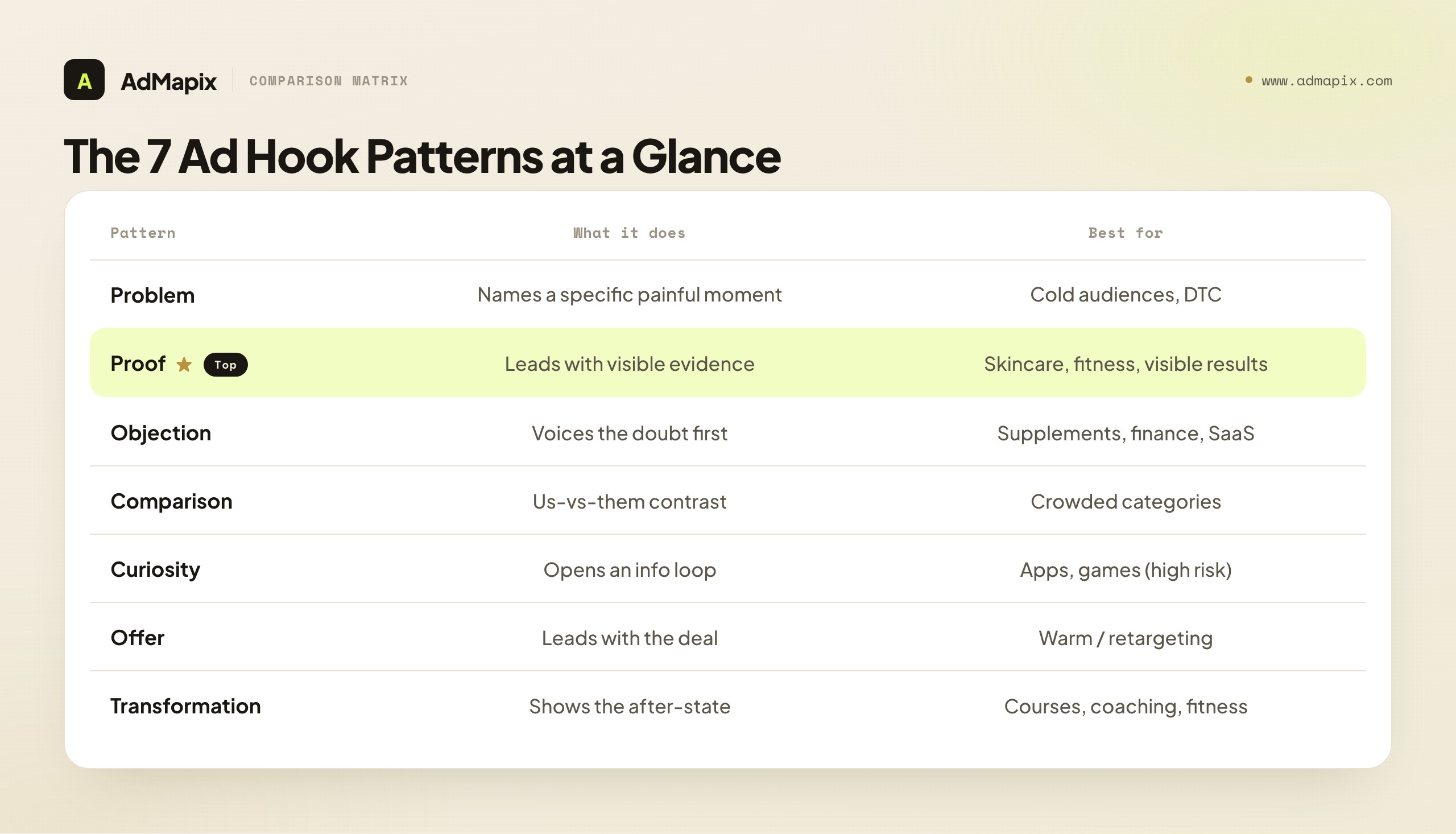
Most winning openers are one of seven patterns, and knowing the pattern tells you what to swap. Below is each pattern, the implied job it does, an example shape, and why it earns attention. Treat the example lines as templates: replace the bracketed parts with your product, audience, and offer.
| Pattern | What it does | Example shape | Why it works |
|---|---|---|---|
| Problem | Names a painful, specific moment | "If your [thing] keeps [annoying outcome], stop doing this." | Pattern-matches the viewer's own frustration in the first second |
| Proof | Leads with visible evidence | "This is what [N] days of [using product] looks like." (before/after on screen) | Shows, doesn't tell; bypasses skepticism |
| Objection | Says the doubt out loud first | "I thought [common objection] too, until…" | Disarms the exact reason people scroll past |
| Comparison | Sets up an us-vs-them contrast | "Most [category] do [old way]. We do [new way]." | Creates a fast, clear mental frame |
| Curiosity | Opens a loop the brain wants closed | "Nobody tells you the real reason [outcome] happens." | Triggers an information gap the viewer needs to resolve |
| Offer | Leads with the deal or stakes | "[Strong offer] ends [time] — here's what you get." | High-intent viewers act on value, not story |
| Transformation | Shows the after-state up front | "Here's how I went from [before] to [after]." | Sells the destination, then back-fills the path |
The rest of this guide takes each pattern in turn, deepens the examples, and shows the failure modes — because a pattern used badly is worse than no pattern at all.
Pattern 1: The Problem Hook
The problem hook names a painful, specific moment in the viewer's life and does it fast enough that they recognize themselves before they can scroll. It is the default opener for cold audiences who do not yet know they have a need, because it manufactures the need by making the pain vivid.
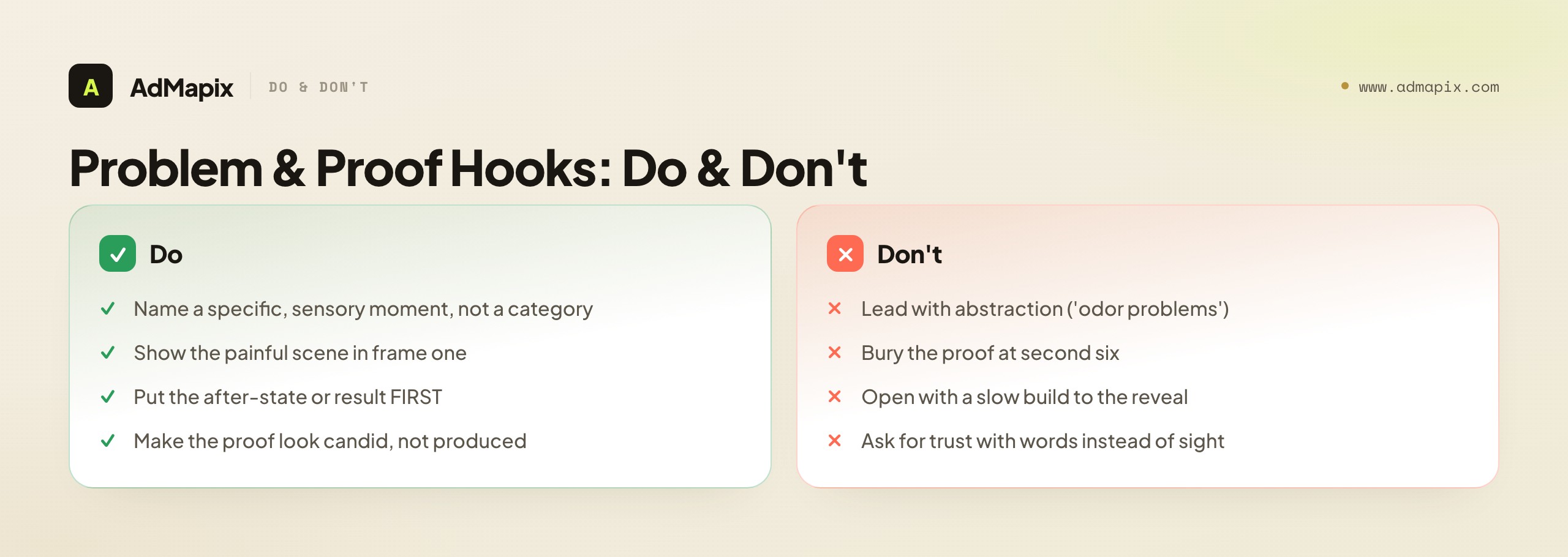
The entire skill of the problem hook lives in specificity of the moment. "Odor problems" is invisible; "the gym bag that still smells after three washes" is a thumb-stop, because it is a precise, sensory, recognizable scene. Generic pain is wallpaper. Specific pain is a mirror. The tighter and more concrete the moment, the harder the viewer pattern-matches it to their own experience and the longer they stay to see if you have the fix.
Example shapes that work: "If you keep waking up at 3 a.m. and can't fall back asleep, this is for you." "POV: you've reorganized this drawer four times this month." "Still copy-pasting between five tabs to send one report?" Notice each one is a scene, not a category. The failure mode is abstraction — leading with the problem space ("sleep issues," "disorganization," "manual workflows") instead of the lived moment. When a problem hook flops, abstraction is almost always why.
The problem hook also has a visual half that copywriters forget. The strongest version shows the painful moment in the first frame — the messy drawer, the cluttered desktop, the frustrated face — so the on-screen text and the image reinforce each other. A problem stated in text over an unrelated pretty shot is weaker than the same words over the actual mess.
Pattern 2: The Proof Hook
The proof hook leads with visible evidence and lets the result do the talking before any claim is made. It wins decisively in categories where the product visibly changes something you can see: skincare, cleaning, fitness, hair, home transformation, and software where a dashboard or output is the payoff. The rule is brutal and simple: the first frame should already show the result, not the setup.
Most proof hooks fail by burying the proof. They open with a creator talking, a product on a shelf, or a slow build toward the reveal — and the reveal arrives at second six, long after the scroll. The fix is to invert the edit: put the after-state, the before/after split, or the satisfying result first, then explain. "This is what 14 days looks like" over a side-by-side beats "Let me tell you about my skincare journey" every single time, because it bypasses skepticism with sight instead of asking for trust with words.
Proof hooks are especially strong because they pre-empt the viewer's defenses. People discount claims automatically; they discount their own eyes much less. A visible transformation, a real measurement on screen, a live demonstration of the thing working — these do an end-run around the skeptical filter that kills text claims. The strongest proof hooks feel almost like the viewer caught the result by accident, which is why so many high-performing ones are shot to look candid rather than produced.
Pattern 3: The Objection Hook
The objection hook says the viewer's doubt out loud, first, before they can use it as a reason to scroll. It is the most underused pattern relative to how well it performs, and it is the strongest opener for higher-priced, skeptical, or "too good to be true" categories — supplements, finance, SaaS, anything where the real blocker is disbelief rather than awareness.
The mechanism is disarmament. Every viewer in a skeptical category is holding an objection ("this won't work for me," "it's probably overpriced," "I've tried this before"). If your ad pretends the objection doesn't exist, the viewer's guard stays up and the objection wins by default. If your opener voices the objection — "I thought $X for a planner was insane too…" — you've taken the viewer's own argument out of their hands and signaled that you're honest enough to name it. That honesty buys attention.
Example shapes: "I was skeptical that an app could actually fix my posture…" "Everyone told me cold email was dead in 2026…" "If you think you've tried every productivity tool, so did I." The pattern always names the doubt the viewer already has, then pivots on "until" or "but here's what changed." The failure mode is naming an objection the audience doesn't actually hold — a strawman doubt feels like a script, not a confession, and it lands flat. Good objection hooks require knowing the real reason your specific audience hesitates, which is exactly the kind of thing competitor research surfaces.
Pattern 4: The Comparison Hook
The comparison hook sets up a fast us-versus-them contrast that gives the viewer a clear mental frame in one sentence. It is built for crowded categories where you need a differentiated position immediately, before the viewer lumps you in with everyone else they've already scrolled past.
The contrast is the whole engine. "Most [category] do [old, painful way]. We do [new, easier way]." establishes a villain (the old way), a hero (your approach), and a reason to keep watching (which side am I on?) — all in the time it takes to read one line. The comparison hook works because the brain processes contrast faster than it processes description. Telling someone what you are is slow; showing them what you are not is instant.
Example shapes: "Most meal kits cook in 30 minutes. This one's done in 8." "Other CRMs make you build the dashboard. Ours ships with it." "Everyone else sells you a course. We give you the templates." The strongest comparison hooks pick a villain the audience already resents — the tedious old way they're sick of — so the contrast feels like relief, not marketing. The failure mode is a weak or invented contrast: if the "old way" isn't genuinely annoying, or the difference isn't real, the frame collapses and you've just badmouthed your category for nothing.
Pattern 5: The Curiosity Hook
The curiosity hook opens an information loop the brain feels compelled to close. It is the highest-risk, highest-reward pattern in the set: it earns the click better than almost anything, and it punishes you harder than anything when the payoff is weak. Use it only when the body actually delivers on the loop you open.
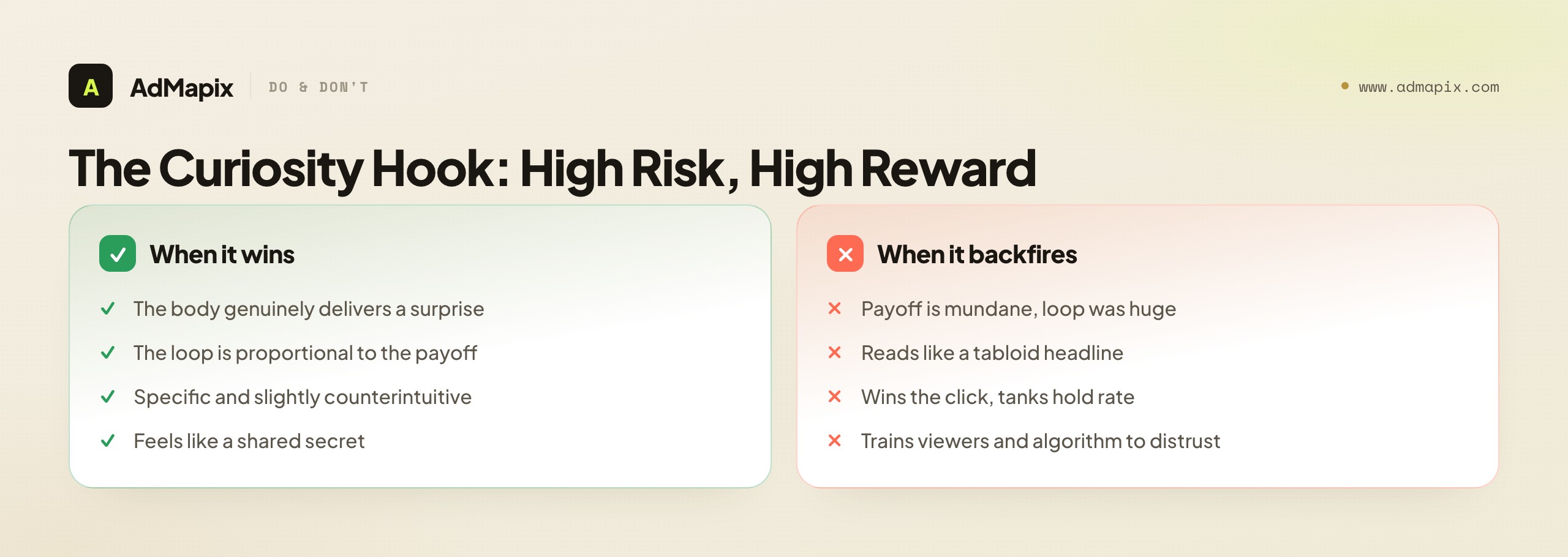
The mechanism is the information gap — the itch a half-told fact creates. "Nobody tells you the real reason [outcome] happens" opens a gap the viewer needs filled. "I deleted three apps after I found this one" implies a reveal worth staying for. The brain treats an open loop like an unfinished task and stays to resolve it. That pull is genuinely powerful, which is exactly why it's dangerous: if the resolution doesn't match the size of the loop you opened, you've trained both the viewer and the algorithm to distrust you. A curiosity hook that over-promises wins the three-second view and tanks the hold rate, conversion, and your long-run account health.
The discipline that makes curiosity safe: open a loop proportional to your actual payoff. If your reveal is a genuinely surprising tip, a big loop is earned. If your reveal is mundane, a giant cliffhanger is a lie the body can't cover. The best curiosity hooks feel like a secret being shared, not a tabloid headline — specific, slightly counterintuitive, and fully delivered by the time the ad ends.
Pattern 6: The Offer Hook
The offer hook leads with the deal or the stakes and skips the story entirely. It belongs to warm and retargeting audiences who already understand the product and just need a reason to act now. For cold audiences it usually fails — you can't lead with a discount on something nobody knows they want — but for the bottom of the funnel it is often the single most efficient opener you can run.
The logic is intent-matching. A high-intent viewer who's already seen your product three times doesn't need another problem-agitation cycle; they need value and a reason to move. "48 hours left: build your starter kit for $29" respects that intent by getting straight to it. The offer hook's power is its honesty about where the viewer is in the journey — it stops selling the dream and starts closing the deal.
Example shapes: "Your cart's waiting — here's 20% to finish it." "Free shipping ends tonight, and here's everything in the bundle." "Last batch of the year — when it's gone, it's gone." The strongest offer hooks pair the deal with either scarcity (time, quantity) or a quick value stack (what you get), because a bare discount is weaker than a discount the viewer can immediately picture using. The failure mode is using the offer hook on cold traffic, where it reads as desperate and converts poorly because there's no established desire for the discount to act on.
Pattern 7: The Transformation Hook
The transformation hook shows the after-state up front, then back-fills the path that got there. It fits journey-driven products where the before/after gap is the entire pitch: courses, coaching, fitness, beauty, finance, language learning, anything where the promise is "you, but better."
The move is to sell the destination first. "Here's how I went from [painful before] to [desirable after]" leads with the outcome the viewer wants, which creates immediate aspirational pull, then earns continued attention by promising the how. It's adjacent to the proof hook but distinct: proof shows the product working; transformation shows a person changed. That human arc is what makes it stick — viewers project themselves onto the protagonist and stay to see whether the path is one they could walk.
Example shapes: "Six months ago I couldn't run a mile. This morning I ran ten." "I went from 200 cold emails a day to inbound only — here's the shift." "Three sentences of Spanish to a full conversation in 90 days." The strongest transformation hooks make the before relatable and the after specific and credible — an exaggerated or vague after-state ("I made millions!") triggers disbelief and breaks the spell. The failure mode is an unbelievable transformation; the second the viewer doubts the after-state, the entire hook inverts from aspiration to skepticism.
UGC Ad Hooks: The Same Patterns, Played Native
User-generated-content hooks deserve their own treatment because UGC is now the dominant creative format across paid social, and its hooks follow the same seven patterns while winning or losing on a different axis: authenticity. A UGC hook is not a separate species of opener — it is one of the seven patterns delivered by a real person in a native-to-platform way that a polished studio ad structurally cannot fake.
The reason UGC hooks convert is that they don't look like ads in the first frame. The scroll reflex is partly an ad-detection reflex; a glossy product shot or a brand logo trips it instantly. A real face in a real bedroom, filmed on a phone, with native captions and platform-native sound, slips past that reflex because it reads as content first and ad second. That single extra beat of attention — the time before the viewer realizes it's an ad — is where the UGC hook does its work.
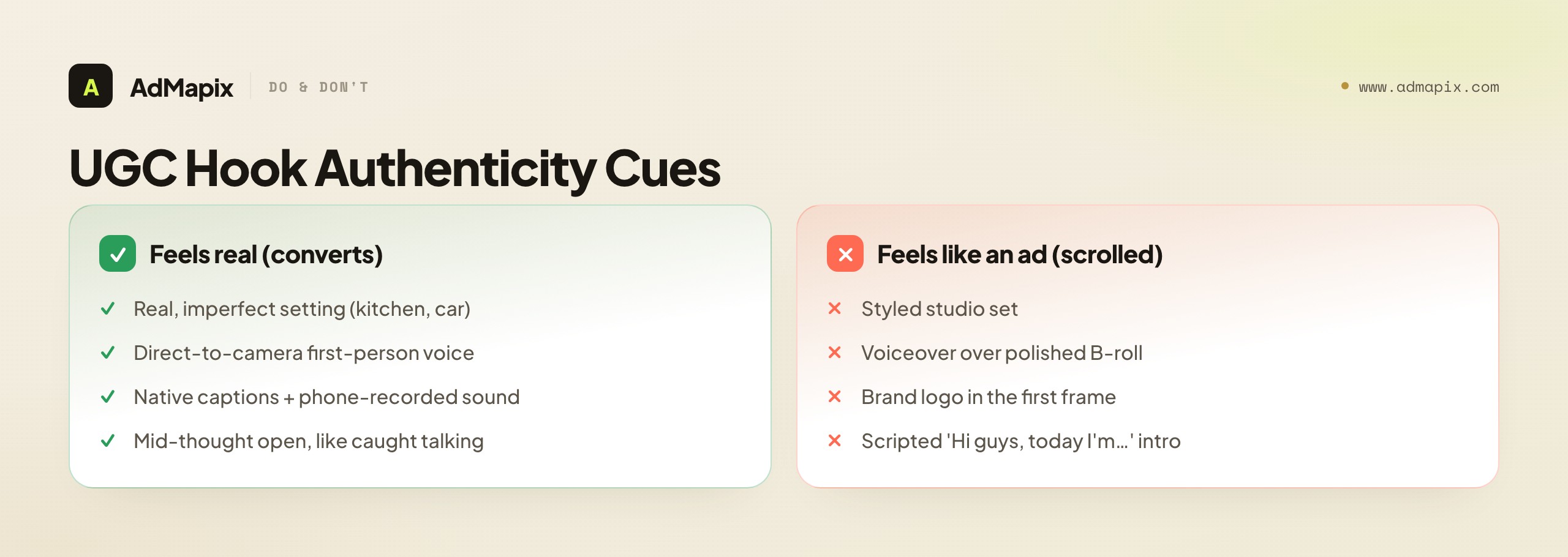
The authenticity cues that make a UGC hook land:
- A real, imperfect setting. A genuine kitchen, car, or bathroom out-converts a styled set, because polish signals "ad."
- Direct-to-camera, first-person voice. "I" and "you" and a face talking to the lens, not a voiceover over B-roll.
- Native captions and sound. On-screen text in the platform's own caption style, and audio that sounds recorded on a phone, not mixed in a studio.
- A mid-thought open. The best UGC hooks start as if you've caught the person already talking — "…so this is the thing I was telling you about" — which feels like content, not a scripted intro.
Mapped to the seven patterns, UGC excels at problem ("POV: you've tried every concealer and they all crease"), proof (a real person showing a real before/after), objection ("I genuinely thought this was a scam"), and transformation (a personal journey). It is weaker, natively, at the offer hook, which tends to feel produced. The strategic point: when you study a UGC hook, separate the pattern (which of the seven) from the authenticity execution (what makes it feel real) — because you need to translate both, and most teams copy the words while missing the realness that actually carried it.
Why the First Frame Decides the Hook
The hook is carried mostly by the first visible frame and the first audible second, not the full opening sentence. On vertical feeds, viewers decide to stay or scroll before a sentence finishes, so the literal words matter less than the visual interrupt, the on-screen text, and whether the sound is worth keeping on.
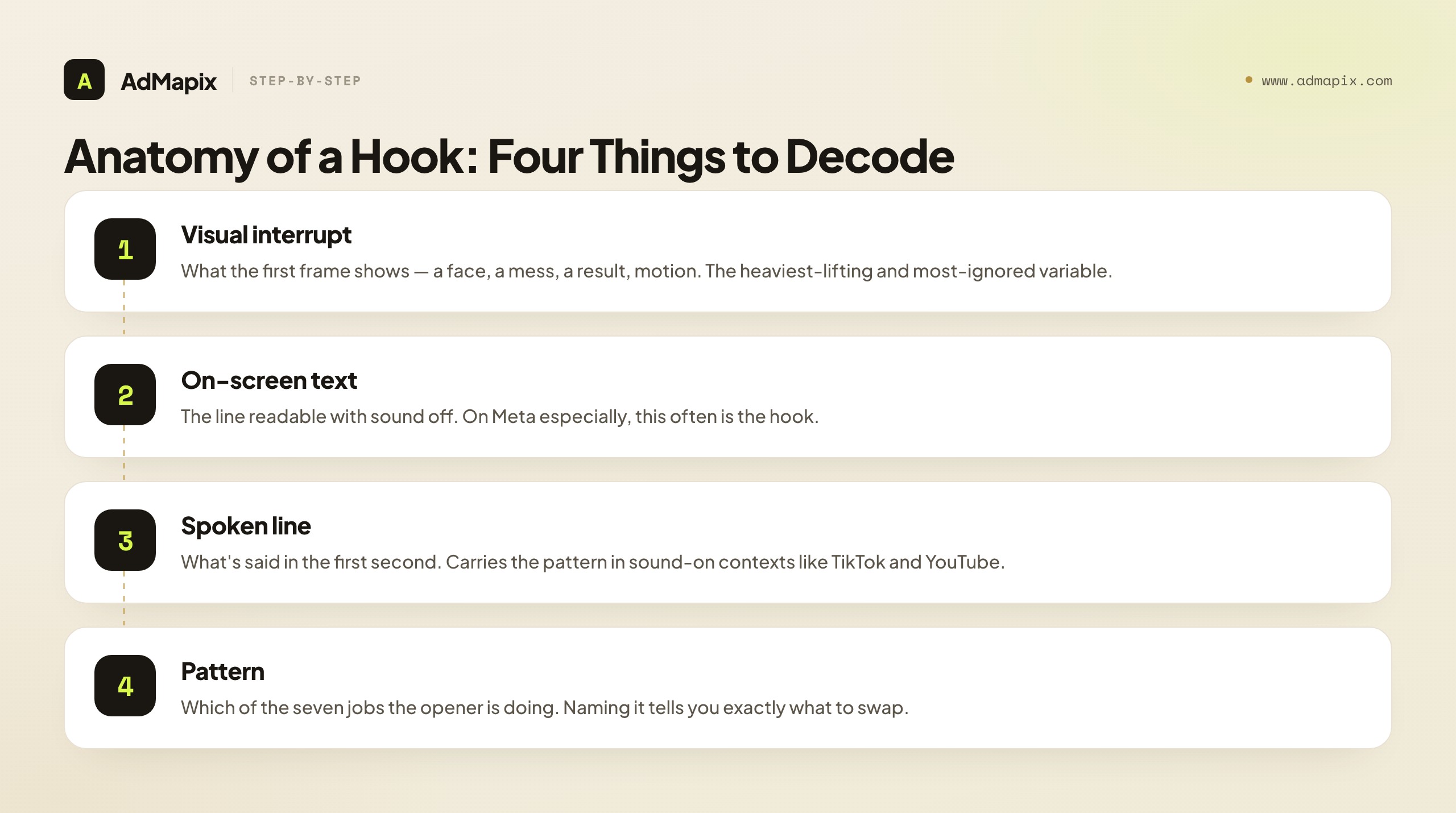
TikTok's own creative guidance reflects this: it recommends TikTok-first, vertical 9:16 assets, designed-for-sound creative, content inside the visible safe zone, and featuring real creators, employees, or customers. In practice that means a hook is a visual + audio + text event, not a copy line. When you study an example, separate four things:
- Visual interrupt — what the first frame shows (a face, a mess, a result, motion, a pattern break).
- On-screen text — the line the viewer reads even with sound off.
- Spoken line — what is said in the first second.
- Pattern — which of the seven jobs the opener is doing.
This matters because two ads can use the same words and perform very differently based on the frame. Copying the line without the frame is why "copying hooks" usually fails. When you save a competitor example, you are really saving four variables, and the one most teams ignore — the visual interrupt — is frequently the one doing the heaviest lifting. A great line over a boring frame loses to a mediocre line over a frame that stops the thumb.
Hooks by Platform: TikTok vs Meta vs YouTube
The seven patterns are universal, but the execution that wins changes by platform, because each feed has a different viewing context, a different scroll speed, and a different relationship with sound. Studying a hook without accounting for where it ran is how a TikTok winner dies on a Meta placement.
| Platform | Viewing context | What the hook must do | Execution that wins |
|---|---|---|---|
| TikTok | Sound-on, creator-native, fast scroll | Read as content, not an ad, instantly | Native UGC, real voice, on-screen captions, mid-thought open |
| Meta (Reels/Feed) | Mixed sound, broad audience, thumb-stop | Be legible at speed with sound off | Bold visual interrupt, big on-screen text, fast cut in second 1 |
| YouTube (skippable) | Lean-back, sound-on, 5-sec skip clock | Promise value before the skip button | Fast value statement, name the payoff, hold the most interesting frame |
| Shorts | Sound-on, fast scroll, discovery | Stop the swipe like TikTok | Creator-native, punchy first frame, caption-forward |
TikTok rewards hooks that don't feel like advertising — the more native, sound-on, and creator-driven, the better. A produced, logo-forward open is a scroll trigger here more than anywhere. Meta spans a broader, often older audience consuming with sound off as much as on, so the on-screen text and the visual interrupt carry disproportionate weight; the hook has to be legible and thumb-stopping in a silent first frame. YouTube skippable is the odd one out: the viewer is in a lean-back, sound-on mindset with a five-second skip clock ticking, so the hook's job is to promise enough value, fast enough, that skipping feels like a loss. The same proof hook is a candid phone clip on TikTok, a bold captioned split-screen on Meta, and a "here's exactly what you'll learn in 30 seconds" value promise on YouTube.
Hooks by Industry: Which Pattern Leads Where
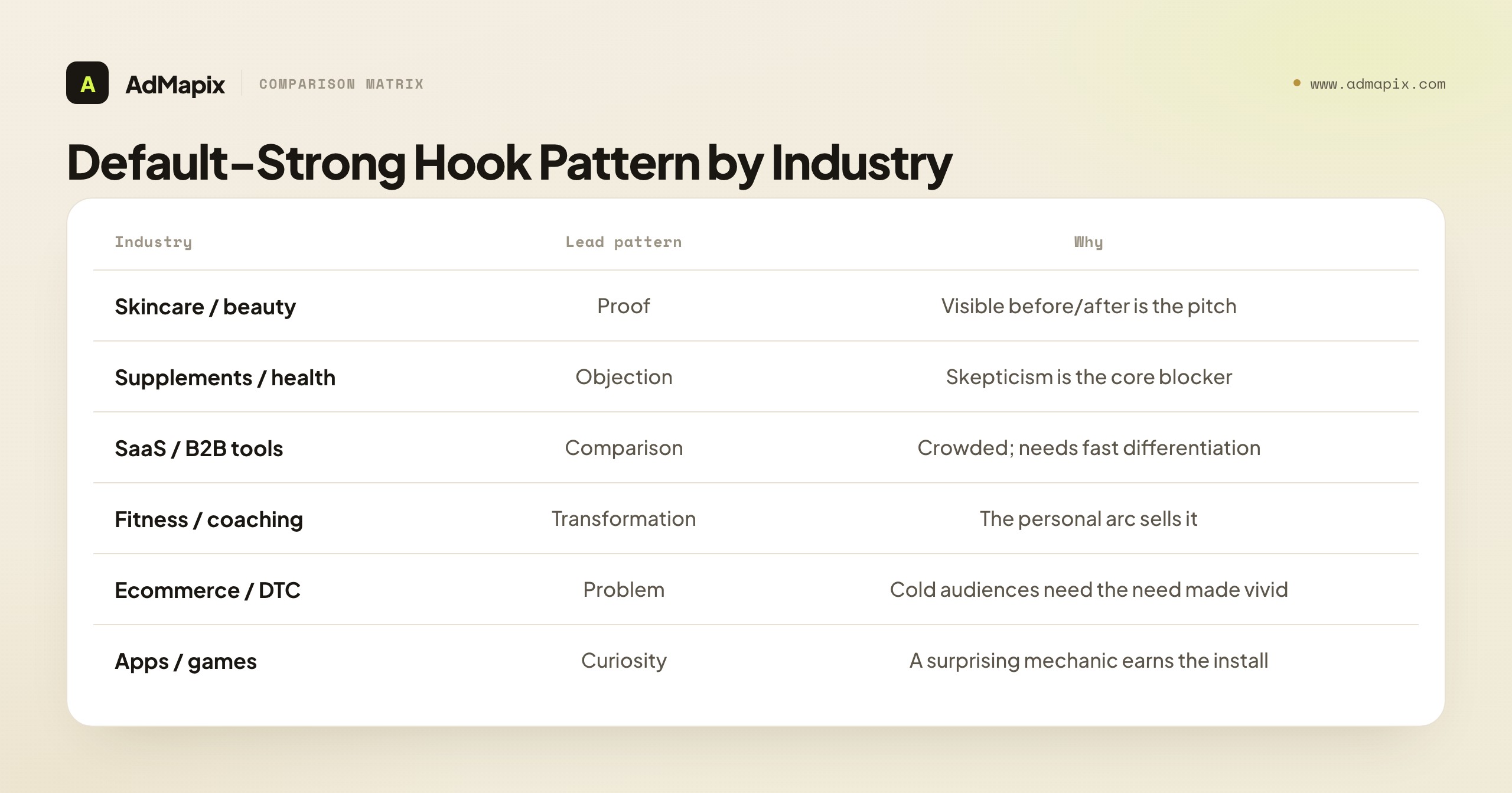
Pattern choice isn't only about the funnel stage — it's also about the category, because some industries have a default opener that simply works more often. This isn't a rule to obey blindly, but a strong starting bet you can then test against.
| Industry | Default-strong pattern | Why | Secondary pattern |
|---|---|---|---|
| Skincare / beauty | Proof | Visible before/after is the whole pitch | Transformation |
| Supplements / health | Objection | Skepticism is the core blocker | Proof |
| SaaS / B2B tools | Comparison | Crowded category, needs fast differentiation | Problem |
| Fitness / coaching | Transformation | The personal arc sells the program | Proof |
| Ecommerce / DTC | Problem | Cold audiences need the need manufactured | Offer |
| Finance / fintech | Objection | "Too good to be true" must be disarmed | Curiosity |
| Apps / games | Curiosity | A surprising mechanic earns the install | Proof |
| Courses / info products | Transformation | Outcome-led aspiration drives signup | Curiosity |
Read this as a prior, not a prescription. A skincare brand should start by testing proof hooks because the category rewards them, but the winning brands constantly test against the grain — a problem hook in a proof category, an objection hook in a transformation category — and occasionally find an under-exploited angle that the whole category has missed. The industry map tells you where to point your first three variants; your own test data tells you where the real winner is.
Hooks Across the Funnel: Cold, Warm, and Retargeting
Pattern choice tracks not just industry but funnel stage, because the same viewer needs a different opener depending on how much they already know about you. Mapping the seven patterns onto two axes — how aware the audience is of their problem, and how high their purchase intent is — turns "which hook?" into a positioning decision instead of a guess.
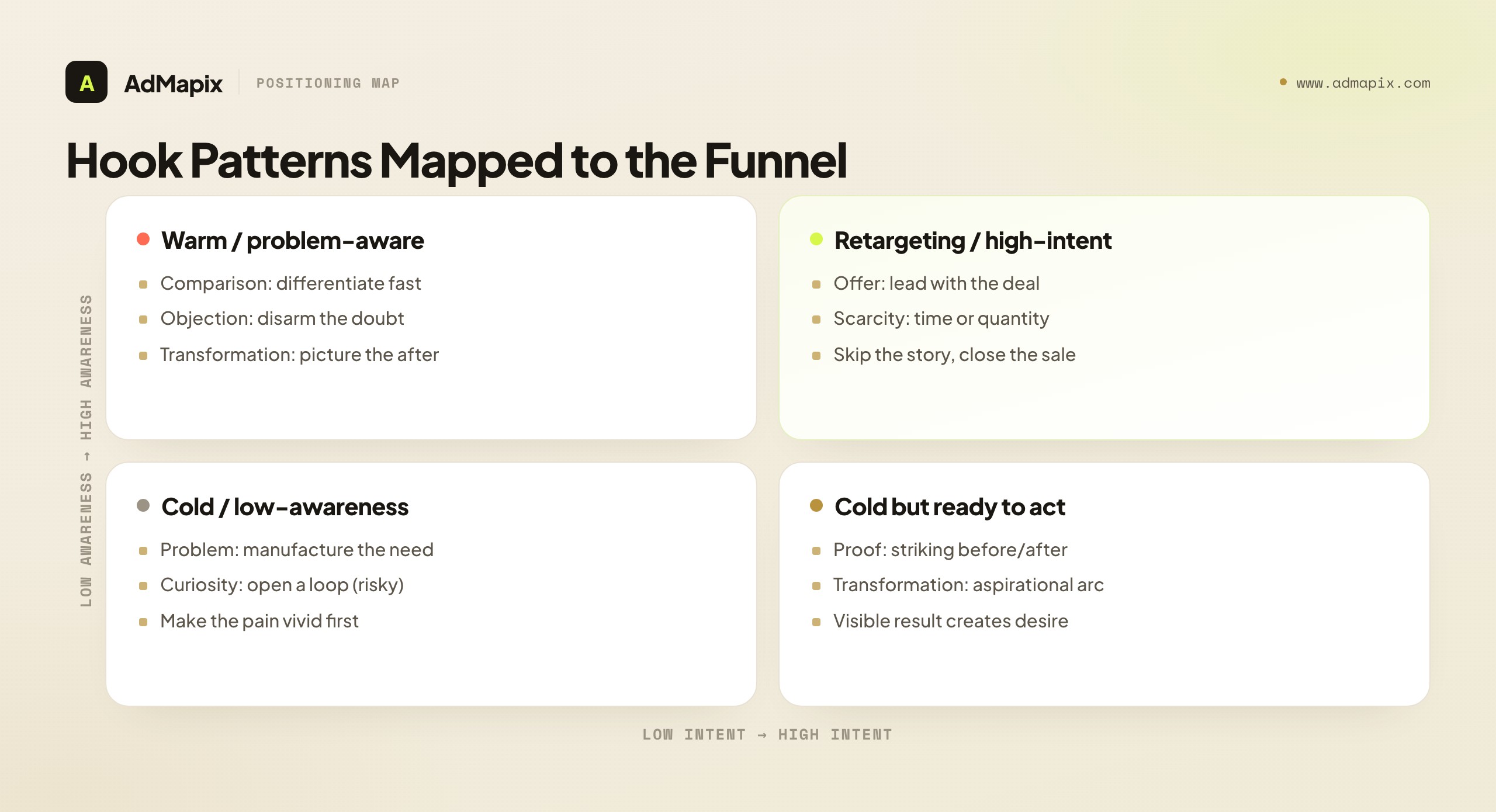
Cold, low-awareness audiences don't yet know they have a need, so you have to manufacture it. The problem hook is your workhorse here: name the painful moment so vividly the viewer recognizes themselves. Curiosity also plays at the cold top of funnel, because an information gap earns attention even from people who weren't looking for you — but it's risky, since cold viewers have the least patience for a weak payoff. Proof and transformation work cold too, especially in visible-result categories, because a striking before/after can create desire from a standing start.
Warm, problem-aware audiences know they have the problem and are weighing solutions. This is comparison and objection territory: they're comparing options (so differentiate fast) and harboring doubts (so disarm them). A warm viewer who's seen three meal-kit ads doesn't need the problem re-explained — they need a reason yours is different and a hand-wave of their hesitation. Transformation also converts well here, because a problem-aware viewer can picture themselves in the after-state.
Retargeting, high-intent audiences already know you and just need a reason to act. This is the offer hook's home turf: skip the story, lead with the deal or the scarcity, respect their intent. A problem or proof hook on a retargeting audience often underperforms a clean offer, because you're re-selling someone who's already sold on the product and just needs the nudge. The mistake teams make is running the same cold problem hook across all three stages — burning retargeting budget re-agitating a pain the viewer already feels acutely.
The strategic takeaway: don't pick one hook pattern for a campaign. Map your patterns to funnel stages, run problem and curiosity cold, comparison and objection warm, and offer to retargeting — then test within each stage. A funnel-aware hook strategy beats a one-pattern-fits-all strategy every time, because it meets each viewer where they actually are.
A Hook-Testing Workflow That Actually Ships Variants
The useful output of studying hooks is a ranked test backlog where each item is one swappable variable. Inspiration that never becomes a variant is wasted. Here is a workflow that turns examples into running tests.
| Step | Action | What you save |
|---|---|---|
| 1. Collect | Pull competitor and category ads from public sources | Source URL, date, advertiser, format |
| 2. Label | Tag each by pattern, visual interrupt, on-screen text, offer | Pattern + hook breakdown |
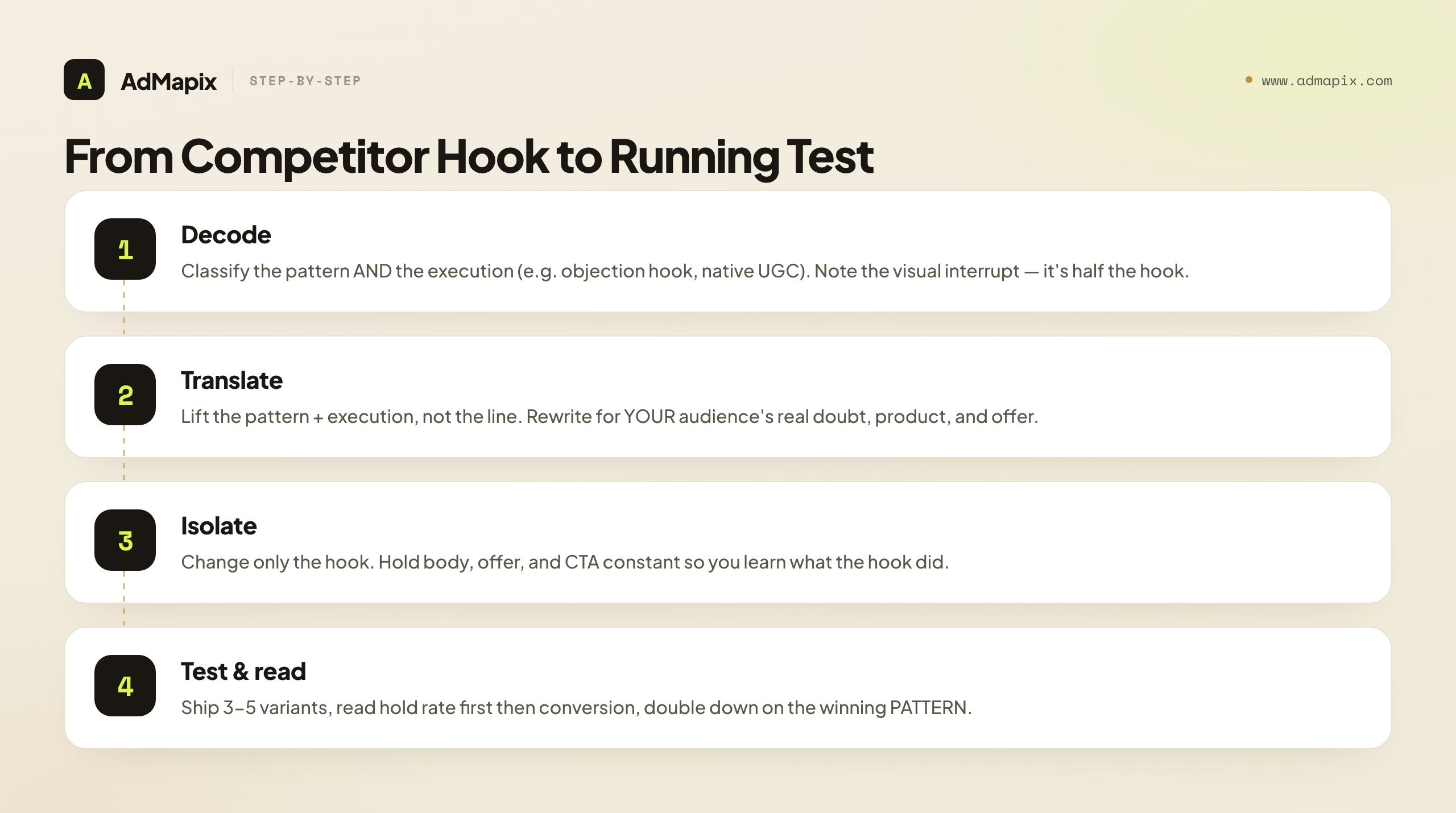
| 3. Translate | Rewrite the pattern for your audience, product, and offer | 1-2 hook variants per example |
| 4. Isolate | Change only the hook; hold body, offer, and CTA constant | One variable per test |
| 5. Run | Ship 3-5 hook variants against the same body | Variant set + audience |
| 6. Read | Watch hold rate / 3-second view-through, not just CTR | Winning pattern, not winning line |
| 7. Iterate | Double down on the winning pattern, vary the execution | Next brief |
Google's Ads documentation frames this kind of structured iteration through ad variations, which let you test and roll out creative changes — including headline and call-to-action edits — across many ads at once. The principle holds beyond Google: isolate the variable, and you learn which pattern moves the metric, not just which random line happened to win.
The discipline most teams skip is step 4, isolation. It is tempting to ship a new hook and a new body and a new offer because the inspiration arrived as a complete ad. Resist it. If you change three things and the ad wins, you've learned nothing transferable — you can't tell whether the hook, the body, or the offer carried it, so you can't double down. Hold everything constant except the opener, and a hook test becomes a machine that produces reusable knowledge instead of one-off lucky winners.
How to Grade a Hook: The Metrics That Matter
A hook is judged on retention, not clicks. The most common measurement mistake is grading hooks by click-through rate, which rewards clickbait and punishes the honest opener that earns a longer, higher-converting watch. The hook's job is to win the next three seconds, so the metrics that grade it are the ones that measure whether the viewer stayed.
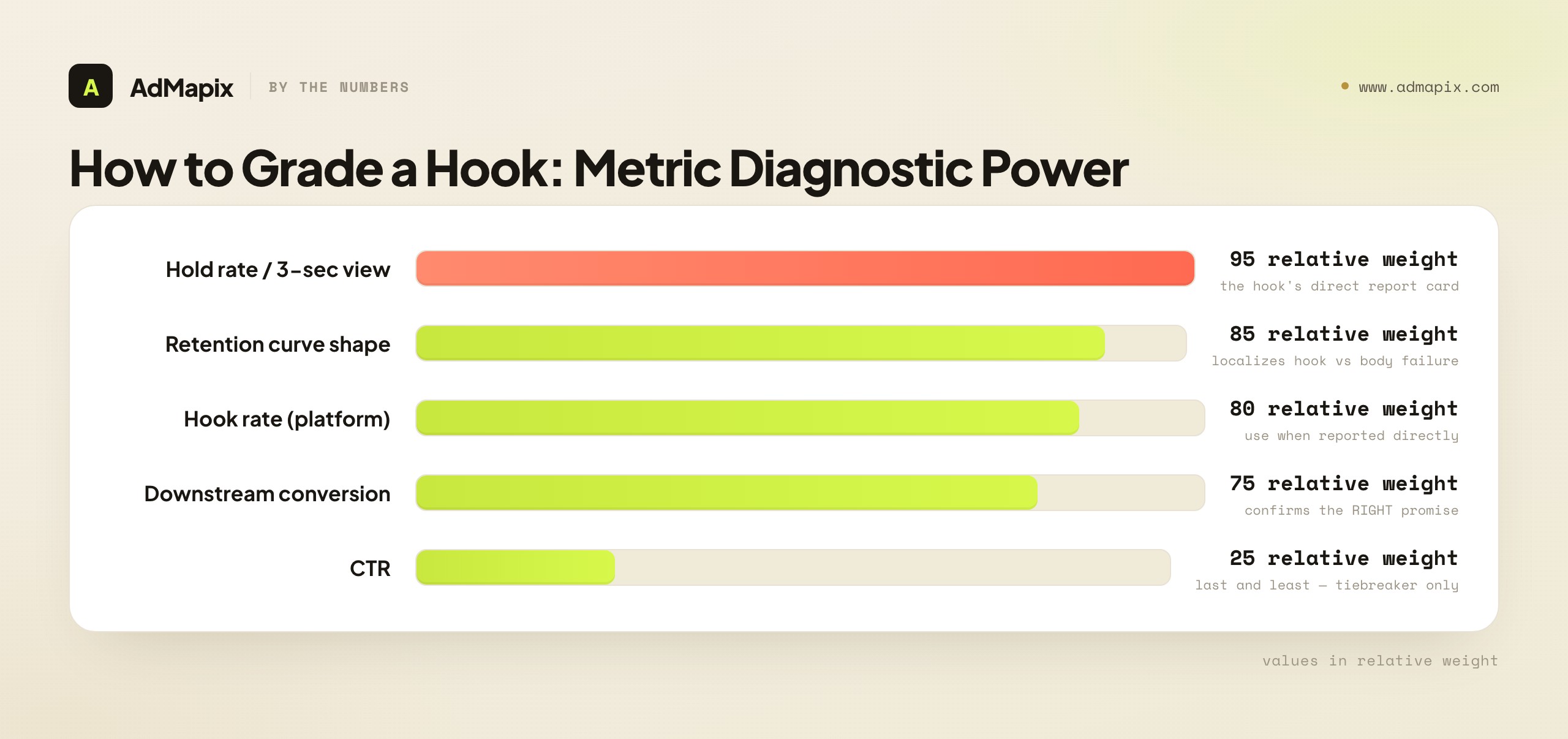
The hierarchy of hook metrics, from most to least diagnostic:
- Hold rate / 3-second view-through. The cleanest signal: what fraction of impressions watched past the hook window. This is the hook's direct report card.
- Retention curve shape. Where viewers drop off. A cliff in the first two seconds is a hook problem; a cliff at second ten is a body problem. The shape localizes the failure.
- Hook rate (platform-specific). Many platforms report a "hook rate" or equivalent early-retention metric directly — use it as the primary read when available.
- Downstream conversion. The ultimate judge: a hook that wins retention but tanks conversion was the wrong promise. Always close the loop to the metric that pays the bills.
- CTR — last and least. Useful only as a tiebreaker. A high CTR with low conversion usually means the hook over-promised and the body couldn't deliver.
The practical method: read the retention curve first to confirm the hook is doing its job, then check downstream conversion to confirm it's the right job. A hook that improves hold rate but not conversion isn't a winner — it's a more attractive package around a body or offer that still needs work. Grading on retention plus conversion together is what keeps you from optimizing into clickbait that wins the open and loses the sale.
A Worked Teardown: From Competitor Hook to Running Test
Principles stick when you watch them applied, so here's how a single competitor hook reads when you run the full method. Say you're a sleep-supplement brand and you find a rival's UGC ad performing across the category. You're not going to copy it — you're going to decode it and translate it.
The decode. First frame: a tired-looking real person sitting on the edge of a bed in a dim room, phone-shot, native captions. Spoken line: "I genuinely thought nothing would fix my 3 a.m. wake-ups." On-screen text mirrors it. You classify it instantly: this is an objection hook (voicing the "nothing works for me" doubt) delivered in native UGC execution (real person, real bedroom, mid-thought open). The pattern and the realness are doing the work together — the objection disarms skepticism, and the UGC framing makes the confession believable.
The translation. You don't lift the line; you lift the pattern plus execution. Your audience's specific doubt might be different — maybe it's "I've tried melatonin and it stopped working" rather than the generic "nothing works." So you write a hook that voices your audience's real objection, in the same native UGC frame: a real person, a real bedroom, a mid-thought confession, captions on. You also note the visual interrupt (the tired person on the bed edge) because that frame is half the hook, and you build your own equivalent rather than a polished studio version that would lose the realness.
The isolation and test. You ship three hook variants — one objection ("I thought melatonin was my only option"), one problem ("the 3 a.m. wake-up that ruins the next day"), one transformation ("from four wake-ups a night to sleeping through") — against the same body and offer, so you're testing which pattern wins for your audience, not which random line. You read hold rate first, then conversion. Maybe the objection hook wins the open but the transformation hook wins the sale — now you know your audience responds to aspiration over disarmament, and your next five briefs lean transformation. That's the method working: one competitor ad became a structured test that produced reusable knowledge, and you never copied a single word.
What Public Ad Data Can and Cannot Prove
Public creative research can show you the hook, format, and offer, but it cannot show you whether the ad actually worked. This is the single most common mistake in hook research. A competitor's ad being live, or appearing many times in an ad library, is not proof of profitability — it can mean a test that's still running, a brand-awareness buy, or simply a budget you can't see.
From public sources you can reliably observe:
- The creative itself: visual interrupt, on-screen text, spoken hook, format, length.
- The offer and call-to-action shown in the ad.
- The landing path and, sometimes, the advertiser and region.
- How long a creative has been running and whether variants exist.
From public sources you cannot prove:
- Spend, ROAS, CPA, conversion rate, or revenue.
- Audience targeting or exclusions.
- Whether the ad is winning or just testing.
So treat "this hook is everywhere" as a hypothesis to test, not a result to copy. There is one useful inference public data does support: longevity. A creative that has been running continuously for many weeks, with variants, is a stronger hypothesis than one that appeared once and vanished — sustained spend is a weak profitability proxy because advertisers rarely fund losers for long. But longevity is a hint, not a verdict; the only performance data you can trust is your own.
Common Ad Hook Mistakes
- Copying the line, not the pattern. The words carry less than the frame and the offer; lift the pattern and rebuild the execution for your audience.
- Saving hooks without context. A screenshot with no source URL, date, format, or pattern tag is almost useless three weeks later.
- Assuming "running = winning." A live or frequently seen ad proves nothing about spend or ROAS; it's a hypothesis, not a result.
- Testing too many variables at once. Change the hook and the body and the offer and you learn nothing about the hook.
- Judging hooks by CTR alone. A clickbait curiosity hook can win the click and tank the body; watch hold rate and downstream conversion.
- Letting curiosity write a check the ad can't cash. If the payoff doesn't match the loop you opened, you train the algorithm and the viewer to distrust you.
- Ignoring the visual interrupt. Obsessing over the copy line while the first frame is a boring product shot wastes the most powerful half of the hook.
- Porting a hook across platforms unchanged. A native TikTok UGC open dies as a logo-forward Meta ad; translate the execution to the placement.
Building a Hook Swipe-to-Test Library
A folder of screenshots is where good hooks go to die. The asset that compounds is a structured swipe-to-test library — a living catalog where every saved example is already broken into its variables and tagged so it can become a brief in minutes, not rediscovered from scratch weeks later. The difference between a swipe folder and a swipe-to-test library is the difference between hoarding and a system.
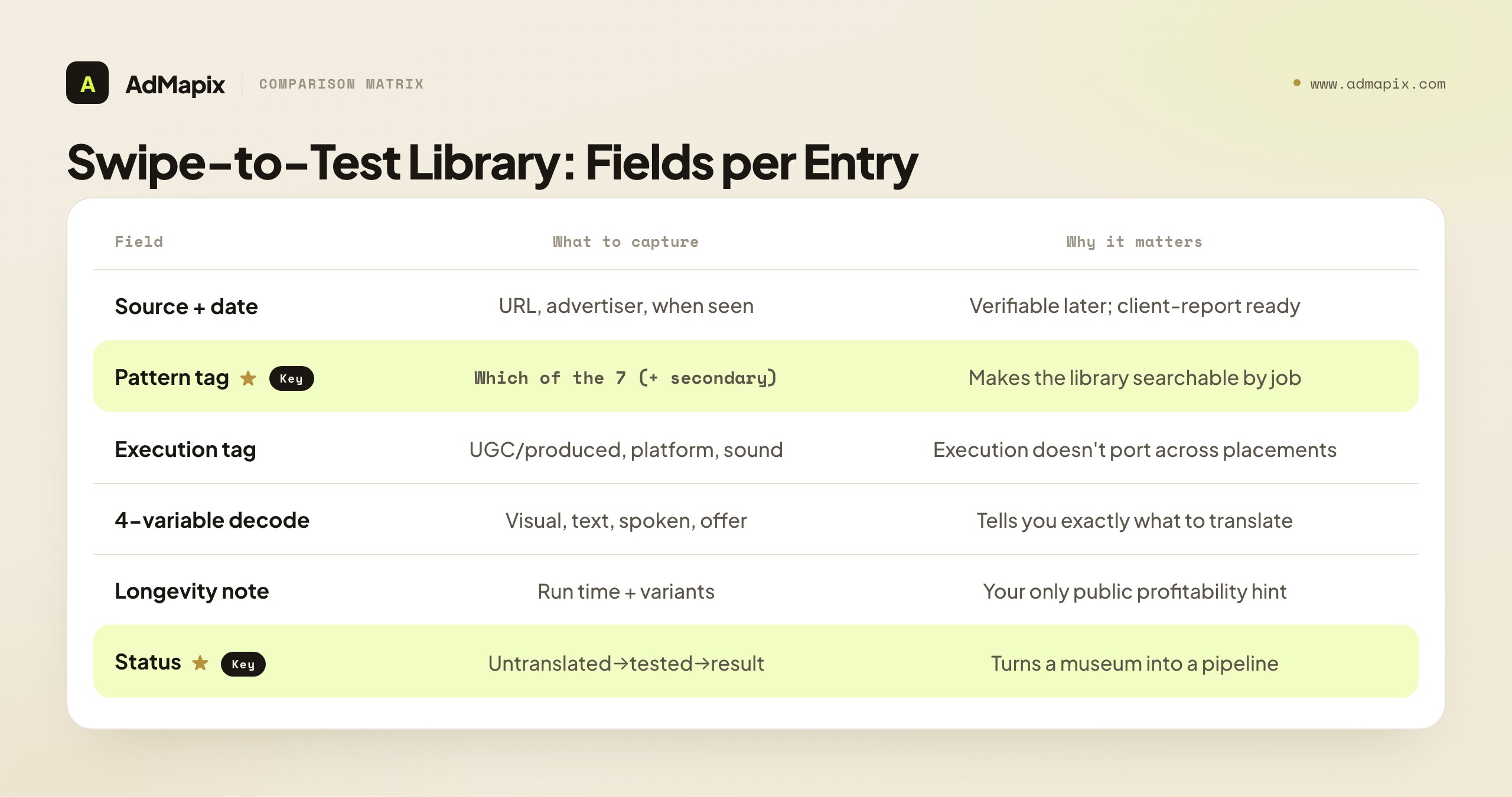
Every entry in the library should capture, at minimum, these fields:
- Source and date. The URL, the advertiser, and when you saw it. Without this, a screenshot is unverifiable three weeks later and useless for a client report.
- Pattern tag. Which of the seven (and the secondary pattern if it blends two). This is the field that makes the library searchable by job rather than by vibe.
- Execution tag. UGC vs. produced, sound-on vs. sound-off design, and the platform it ran on — because execution doesn't port across placements unchanged.
- The four-variable decode. Visual interrupt, on-screen text, spoken line, and offer, each noted separately so you know what to translate.
- Longevity note. How long it's been running and whether variants exist — your only public profitability hint.
- Status. Untranslated → translated → tested → result. This single field turns the library from a museum into a pipeline.
The status field is what most teams miss and what makes the library actually pay off. A hook with status "untranslated" is a to-do; one tagged "tested → won" is a proven pattern you should be exploiting more; one tagged "tested → lost" is a learning that stops you re-testing a dead end. Reviewed weekly, the library becomes a backlog you draw briefs from on demand instead of a graveyard you scroll for inspiration when a deadline looms.
The library also unlocks pattern-level analysis you can't do from scattered screenshots. Once fifty hooks are tagged by pattern, execution, and result, you can see which patterns win for your audience, which executions your wins cluster around, and which categories you've under-tested. That meta-view — "our objection hooks beat our problem hooks two to one, and we've barely touched curiosity" — is the strategic payoff of structure, and it's invisible to anyone still working out of a screenshot folder.
When to Use AdMapix
AdMapix fits the moment your hook research outgrows screenshots and spreadsheets. Use Search AdMapix to find ad creatives across networks by keyword, brand, or category; Media to save the examples worth keeping with their source and date; Video Analysis to break a video down into its hook, structure, and pacing; and Reports to turn a pattern into a shareable brief for your team or client. Compare solo, team, and agency plans on Pricing, or jump back in from Login.
It's a good fit if you run paid social or UGC at volume, manage multiple brands or clients, and need a repeatable way to go from "saw a hook" to "shipped a test." It is not the right tool if you only run a handful of ads a quarter, never test creative variants, or are looking for guaranteed competitor spend and ROAS numbers — no public tool can give you those, because that data is private. AdMapix sits in the "cross-network creative intelligence" slot of the stack: it removes the manual collection so your time goes to the analysis and translation that actually produce winning hooks.
FAQ
What is an ad hook?
An ad hook is the first 1-3 seconds of a video ad, or the opening line of a static or text ad, whose only job is to stop the scroll and earn the next few seconds of attention. On vertical feeds it is really a combined visual, audio, and on-screen-text event, not just a copy line — the first frame does most of the work.
What are the main types of ad hooks?
Most effective hooks fall into seven patterns: problem (name a pain), proof (show evidence), objection (voice the doubt), comparison (us vs. them), curiosity (open a loop), offer (lead with the deal), and transformation (show the after-state). Naming the pattern tells you which parts to swap when you adapt it for your own product.
How long should a video ad hook be?
The hook is effectively the first 1-3 seconds, and the first frame does most of the work. Viewers decide to stay or scroll almost immediately, so put the visual interrupt and on-screen text up front rather than building to it. If your hook needs a slow build to land, it's too slow for a feed.
What makes a good UGC hook specifically?
A UGC hook uses one of the seven patterns but wins on authenticity: a real, imperfect setting, a direct-to-camera first-person voice, native captions and phone-recorded sound, and often a mid-thought open that feels like content rather than an ad. When you study a UGC hook, separate the pattern (which of the seven) from the authenticity execution (what makes it feel real) — you need to translate both.
Can I just copy a competitor's hook?
Copying the exact line rarely transfers, because performance depends on the frame, the offer, and the audience as much as the words. Lift the pattern instead — and for UGC, the authenticity execution too — then rebuild the visual, text, and offer for your own product and run it as a test.
Do hooks work differently on TikTok, Meta, and YouTube?
The seven patterns are universal, but the execution changes. TikTok rewards native, sound-on, creator-driven opens that don't feel like ads. Meta spans a broader, often sound-off audience, so bold on-screen text and a thumb-stopping first frame carry more weight. YouTube skippable needs a fast value promise before the five-second skip. Translate the execution to the placement rather than porting a hook unchanged.
Which hook pattern should I use for my industry?
Use the industry as a starting bet, not a rule: proof leads in skincare and beauty, objection in supplements and finance, comparison in SaaS, transformation in fitness and courses, problem in DTC ecommerce, curiosity in apps and games. Start your first variants with the category-default pattern, then test against the grain — under-exploited angles often hide where the whole category clusters on one opener.
How do I know if a competitor's hook actually worked?
You usually can't from public data. A live or frequently appearing ad shows the creative and offer, but not spend, ROAS, or conversion rate. Sustained longevity with variants is a weak profitability hint, but not proof. Treat a recurring hook as a hypothesis worth testing in your own account, where you control the only performance data you can trust.
How many hook variants should I test at once?
Ship 3-5 hook variants against the same body, offer, and CTA so the hook is the only thing changing. Read hold rate or 3-second view-through first, then downstream conversion, then double down on the winning pattern and vary its execution next. Changing more than one variable at a time means you can't tell what won.
What metric should I use to grade a hook?
Grade hooks on retention, not clicks. Hold rate or 3-second view-through is the cleanest direct signal, the retention-curve shape tells you whether a drop-off is a hook problem (early cliff) or a body problem (later cliff), and downstream conversion confirms the hook made the right promise. CTR is the least diagnostic — a high CTR with low conversion usually means the hook over-promised.
Related Reading
- Ad Creative AI: Tools and Workflows for 2026 — how AI fits into producing and varying the hooks this guide describes.
- Competitor Ad Analysis in 2026: The 5-Dimension Framework, Templates & SOP — the scoring system that hook research plugs into.
- How to Spy on Competitors' Ads in 2026 (30-Min/Week Workflow) — the weekly cadence for collecting the examples you translate.
- TikTok Ads Research Guide — platform-specific research for the channel where native hooks matter most.
- Creative Ads Library: How to Build and Use One — turning saved hooks into an organized, reusable swipe-to-test system.
Sources
- TikTok creative best practices — recommends TikTok-first, vertical 9:16, designed-for-sound creative, safe-zone content, and featuring real creators, employees, or customers.
- TikTok Creative Center — Top Ads, Trends, Creative Tools, and Creative Studio for studying live creative.
- Google Ads ad variations — explains testing and rolling out creative changes, including headline and call-to-action edits, across campaigns.
- Meta Ads Library — the free public archive for observing active hooks and creative across Meta placements.
Official sources checked as of June 21, 2026. Platform docs, ad products, and APIs change, so re-verify these URLs before building an automated workflow or client report. AdMapix surfaces public ad creatives across networks; it does not expose advertiser spend, targeting, or ROAS, which remain private.
Turn these observations into your next creative study
Open the creative library and select samples for your market, network and research question.
Related Articles
Ad Creative Database in 2026: How to Build a Searchable Library for Hooks, Offers, and Proof
A complete 2026 guide to building an ad creative database — why a screenshot folder stops working, the core schema that makes ads queryable, a controlled tagging vocabulary, where to source ads, how to query patterns instead of single ads, the workflow that turns saved ads into briefs, the honest limits of public data, a worked example, and where a cross-network tool like AdMapix fits.
Outbrain Ad Spy Tool in 2026: Native Ad Research for the Open Web
How to research Outbrain native ads from public evidence in 2026 — what a spy tool can and cannot prove, how to decode headline-and-thumbnail hooks, advertorial landing paths, retargeting trails, and how to turn patterns into testable native campaigns.
Ad Creative Fatigue Analysis in 2026: Signals, Thresholds & Refresh Decisions
A 2026 guide to diagnosing ad creative fatigue — what fatigue looks like in the data, how to read cost-per-result, frequency, CTR, and retention signals together, how to tell fatigue apart from funnel, tracking, auction, and seasonal causes, how fatigue speed differs by channel and funnel stage, how to set a refresh threshold, when to refresh versus rebuild, how to run a creative pipeline that stays ahead of fatigue, and where competitor research informs the next variant.