
In-Game Advertising: What Brands and Game Studios Need to Know
A practical 2026 guide to in-game advertising formats, inventory types, brand safety, measurement, examples, and competitor research.
In-game advertising works best when the placement, format, player moment, and measurement plan are designed together.
By the AdMapix Research Desk - Updated April 16, 2026
In-game advertising is the practice of placing brand, app, or commerce messages inside a game environment. It can look like a billboard inside a racing game, a rewarded video after a failed mobile level, a playable demo inside another game, a sponsored tournament, or an offerwall that gives players currency for completing an action.
The category is easy to misunderstand because different teams use the same phrase for different things. A brand marketer may mean "intrinsic in-game advertising" inside a 3D world. A mobile UA manager may mean in-app ad inventory inside free-to-play games. A game studio may mean monetization placements such as rewarded ads and interstitials. A performance team may mean playable ads distributed through ad networks.
This guide separates those meanings and gives teams a practical operating model. If you need broader app-install creative planning, read our mobile game ads guide. If you need game-specific Meta campaigns, see Facebook ads for games. If you need revenue design, start with mobile game monetization. This article focuses on in-game advertising itself: where ads appear, which formats fit, how to measure quality, and how to research competitor patterns before buying media.
What Counts As In-Game Advertising?
In-game advertising includes paid messages delivered within or around a game experience. The most useful definition is operational: the player is in a game context, and the ad either appears inside the environment, during a game break, in exchange for value, or as an interactive game-like unit.
Use this taxonomy:
| Type | What it is | Best buyer fit | Main risk |
|---|---|---|---|
| Intrinsic in-game advertising | Ads integrated into the game world, such as billboards, posters, arena signage, branded objects, or native 3D placements. | Brand awareness, category association, sports, entertainment, consumer goods. | Weak context fit or poor measurement. |
| Rewarded ads | Player opts in to watch an ad for in-game value. | App installs, game UA, commerce offers, monetization. | Reward can train low-quality behavior if overused. |
| Interstitial ads | Full-screen ad shown at a natural break. | Performance campaigns and ad monetization. | Interruption can damage retention and ratings. |
| Playable ads | Interactive ad unit that lets a user try a simplified experience. | Game UA, puzzle/casual apps, interactive game ads. | Fake mechanics can win clicks and lose trust. |
| Sponsorship or product placement | Brand appears as part of an event, mode, item, skin, tournament, or branded challenge. | Brand campaigns and community activation. | Poor fit can feel forced. |
| Offerwalls | Player completes third-party tasks for currency or rewards. | Monetization and direct-response campaigns. | Incentivized actions may not equal long-term value. |
This matters because "in game ads" is not one media channel. Each format has a different player psychology, creative requirement, and measurement plan.
Mobile, PC, And Console Inventory Are Not The Same
Mobile gaming advertising is usually more performance-driven. The ad appears in a free-to-play app, and the campaign is judged by installs, revenue, completion, rewarded engagement, or post-install quality. Mobile inventory is measurable and scalable, but it can be crowded and sensitive to poor ad pacing.
PC and console in-game advertising is more often brand-led, especially when ads are placed inside 3D game environments or sponsored events. The advertiser cares about context, brand safety, audience fit, exposure quality, and lift. Performance measurement is possible, but it may not look like mobile app-install reporting.
| Inventory | Common formats | Measurement bias | Best use case |
|---|---|---|---|
| Mobile free-to-play games | Rewarded video, interstitial, playable, banners, offerwalls. | Completion, CTR, installs, retention, revenue, ARPDAU. | App growth and monetization. |
| PC and console games | Intrinsic placements, sponsorship, branded items, event integrations. | Viewability, exposure duration, attention, brand lift, sentiment. | Brand awareness and cultural relevance. |
| Esports and live events | Sponsorship, overlays, team or tournament packages. | Reach, engagement, community sentiment, lift. | Audience association and community building. |
| Browser and instant games | Display, playable, rewarded, sponsorship. | Click, completion, session quality, conversion. | Lightweight acquisition and retargeting. |
For advertisers, the question is not "Should we buy in-game advertising?" The question is "Which game context creates a believable player moment for our message?"
In-Game Advertising Formats And Examples
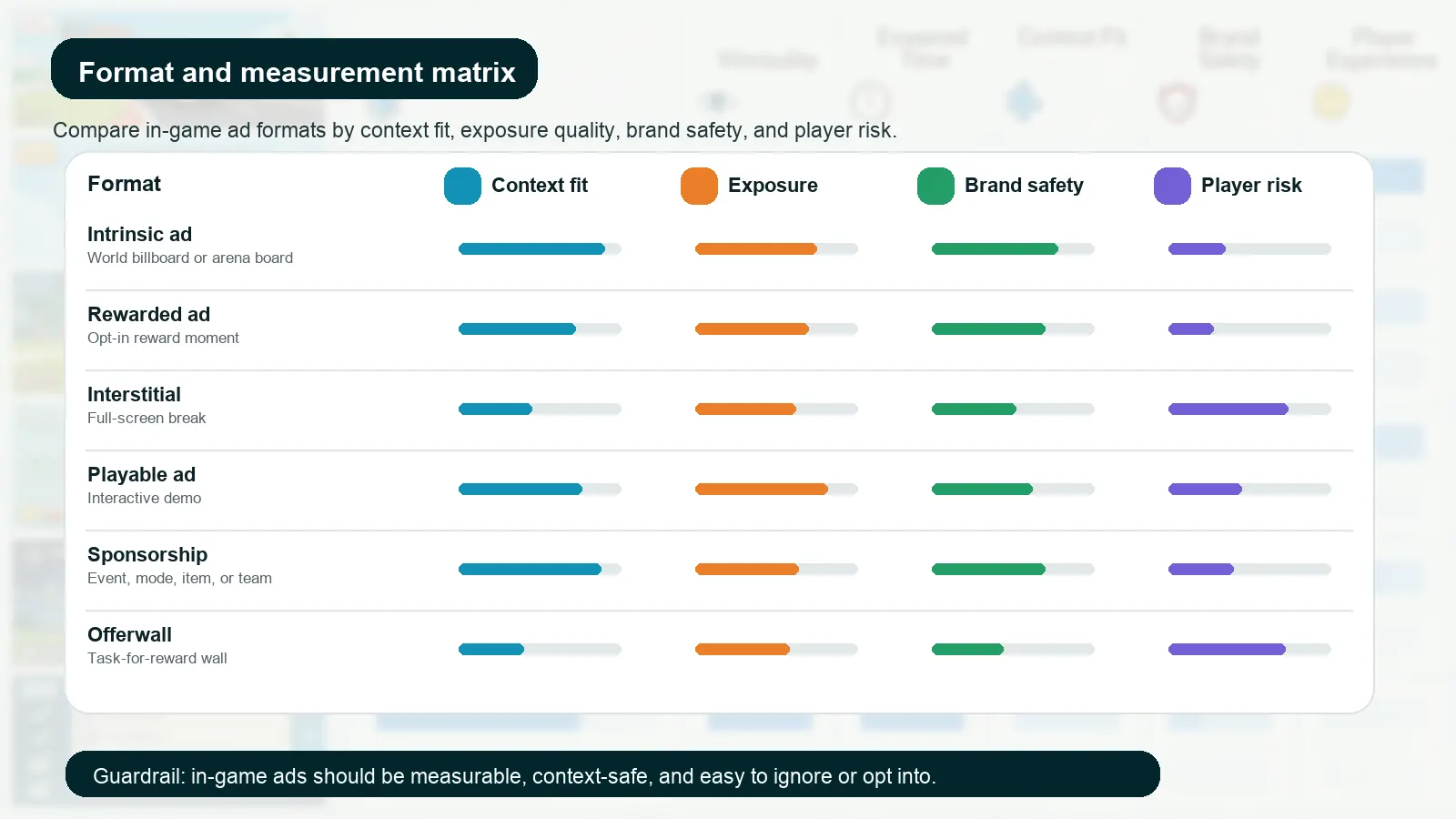
Use a format and measurement matrix before briefing creative or buying inventory.
Intrinsic In-Game Advertising
Intrinsic in-game advertising places ads inside the game world. A racing game might include trackside boards. A sports game might include stadium signage. A city-building game might include branded storefronts. A simulation game might include a sponsored object that feels native to the scene.
The value is context. The player does not need to leave the game. The brand appears inside a moment that can feel natural if the creative, placement, and game genre match.
Strong use cases:
| Scenario | Why it works |
|---|---|
| Sports, racing, and arena games | Real-world advertising already exists in similar environments. |
| City, lifestyle, and simulation games | Brands can appear as shops, objects, or signage without breaking the scene. |
| Music, entertainment, and culture events | Sponsored presence can support a time-boxed experience. |
| Youth and gaming audiences | Game context can add relevance when the placement is respectful. |
The IAB release on intrinsic in-game measurement guidelines is useful because it shows the industry moving toward more consistent measurement language for this format. The practical takeaway: do not buy intrinsic placements without defining viewability, exposure time, player context, and brand-safety constraints first.
Rewarded Ads
Rewarded ads are common in free-to-play games because they give the player control. The player chooses to watch an ad in exchange for something useful: a revive, extra move, currency, multiplier, chest, event attempt, or speed-up.
Rewarded ads are often the safest starting point for game monetization because they are opt-in. They can also work for app advertisers when the rewarded moment creates high completion rates. Google AdMob documents rewarded ads as a distinct format, which reflects the same operating principle: the user receives a reward for voluntarily watching or interacting with the ad.
Good rewarded ad moments:
| Player moment | Better reward |
|---|---|
| Failed level | Continue, revive, or one extra move. |
| Resource shortage | Small refill that helps now but does not break balance. |
| Daily return | Bonus chest, multiplier, or event token. |
| Long wait | Time reduction or instant completion. |
The risk is not the format. The risk is pacing. If rewarded ads become the main way to make progress, the game may feel designed around friction rather than fun.
Source: Google AdMob rewarded ads.
Interstitial Ads
Interstitial ads are full-screen ads shown at breaks. They are easy to add and easy to abuse. They should appear only when the player has reached a natural pause: after a level, after a result screen, between attempts, or after a completed action.
Bad interstitial timing creates anger because it interrupts agency. A player choosing a move, aiming, fighting, solving, building, or collecting does not want a surprise full-screen ad.
Use this rule:
Interstitial safety = natural break + low frequency + fast close + no progress lossMeasure interstitials with retention, session length, complaints, store rating movement, and revenue per daily active user. Revenue can rise while long-term value falls.
Source: Google AdMob interstitial ads.
Playable Ads And Interactive Game Ads
Playable ads are ads that let the user interact before installing or converting. They are especially useful for puzzle, casual, merge, word, arcade, simulation, and simple strategy mechanics. Interactive game ads can also work for non-game products when the interaction teaches the value proposition.
Good playable ads have four properties:
| Property | What it means |
|---|---|
| Immediate goal | The user knows what to do in seconds. |
| Visible feedback | One action changes the screen. |
| Honest sample | The interaction resembles the real product or first session. |
| Fast payoff | Win, fail, unlock, or reveal happens quickly. |
Bad playable ads often use a fake mini-game. That can generate clicks, but it can also create low-quality installs and negative reviews. If the playable teaches a false promise, the campaign is borrowing attention from future retention.
Source: Meta playable ad format.
Sponsorships, Product Placement, And Branded Events
Sponsorship is broader than a single ad unit. A brand may sponsor a tournament, in-game event, skin, item, challenge, creator activation, or live stream. This can create deeper association than a standard unit, but it needs more creative and community judgment.
The best sponsorships answer:
| Question | Why it matters |
|---|---|
| Why does this brand belong here? | Context fit protects trust. |
| What does the player receive? | Value reduces the feeling of intrusion. |
| Is the game audience appropriate? | Brand safety starts with audience and content. |
| How will success be measured? | Reach alone is not enough. |
For game studios, sponsorship can be meaningful revenue. For advertisers, it can reach audiences who avoid traditional media. For both sides, forced integration is the failure mode.
Offerwalls
Offerwalls let players earn in-game rewards by completing third-party actions. They can work in games with hard-currency economies, but they should be used carefully. Incentivized actions may create volume without durable value. Offerwalls need fraud controls, clear user expectations, and economy safeguards.
Free Game Advertising: What Is Actually Free?
Some searchers use the phrase "free game advertising" while looking for no-cost ways to promote a game. That is different from paid in-game advertising, but it belongs in the same planning conversation because early teams often mix both.
Free does not mean effortless. It means you trade time, content, community work, and distribution discipline instead of media budget.
Useful free or low-cost options:
| Method | What to do |
|---|---|
| Store page optimization | Improve title, subtitle, screenshots, video, keyword coverage, and review prompts. |
| Organic short video | Publish gameplay hooks, fail states, challenges, and progression clips. |
| Community seeding | Share development updates, event plans, and playable clips where the genre audience already gathers. |
| Creator outreach | Offer early access, codes, or event moments to small creators. |
| Public ad library research | Study competitor hooks before paying for production. |
| Cross-promotion | Promote between your own games or partner with adjacent apps. |
| Product-led loops | Add shareable levels, invite mechanics, guild moments, or social challenges. |
The main mistake is treating free promotion as a substitute for positioning. A weak hook remains weak even with zero media cost. Start by defining the player fantasy, then choose free channels that can show it clearly.
Measurement: What To Track Before Spending
In-game advertising needs a measurement plan before creative production. Otherwise teams optimize the easiest metric and miss the business risk.
For intrinsic in-game advertising, measure:
| Metric | What it protects |
|---|---|
| Viewability | Was the ad actually visible in the game environment? |
| Exposure duration | Did the player have enough time to notice it? |
| Context fit | Did the placement make sense inside the scene? |
| Attention proxy | Did camera angle, screen size, and player behavior support attention? |
| Brand lift | Did recall, favorability, or intent move? |
| Sentiment | Did the community accept or reject the integration? |
For mobile rewarded, interstitial, and playable inventory, measure:
| Metric | What it tells you |
|---|---|
| Completion rate | Whether users tolerate or value the ad moment. |
| Interaction rate | Whether playable or interactive units create active interest. |
| CTR | Whether the ad drives the next step. |
| Store conversion rate | Whether the promise matches the landing page. |
| CPI or CPA | Whether acquisition is cost-efficient. |
| D1/D7 retention | Whether installs survive beyond curiosity. |
| ROAS or LTV | Whether paid growth can scale. |
| Session impact | Whether ads harm play behavior. |
Do not judge a campaign by CTR alone. In-game context can produce high engagement because the player is already active. That engagement only matters if it converts into brand lift, installs, purchases, retention, or revenue quality.
Brand Safety And Player Experience Guardrails
Brand safety in games is not only about avoiding violent or adult content. It is also about placement quality, audience age, user-generated content, chat, genre expectations, platform policies, and player sentiment.
Use this checklist before buying or selling in-game ads:
| Guardrail | Question |
|---|---|
| Genre fit | Does the brand belong in this type of game? |
| Scene fit | Does the ad appear near appropriate content? |
| Audience age | Are age rating, consent, and targeting constraints clear? |
| UGC and chat | Could the ad appear near uncontrolled user content? |
| Frequency | Will the ad feel repeated or intrusive? |
| Reward balance | Does the reward distort the economy? |
| Creative honesty | Does the ad accurately represent the product? |
| Technical quality | Does the unit load fast and avoid crashes? |
| Measurement agreement | Are viewability, exposure, and conversion definitions aligned? |
For game studios, the safest ad is not the one with the highest eCPM. It is the one that monetizes without damaging trust. For brands, the safest game is not just a large audience. It is a context where the brand can appear without looking out of place.
Competitor Research Workflow For In-Game Ads
Before you buy in-game advertising or build a monetization plan, study the market. The goal is not to copy. The goal is to understand which formats, hooks, and placements repeat across successful competitors.
Run this workflow:
- List 10 direct competitors and 10 adjacent games.
- Capture current ads from public ad libraries, app stores, and game sessions.
- Tag each ad by format: intrinsic, rewarded, interstitial, playable, sponsorship, offerwall.
- Tag player moment: level fail, reward claim, daily return, progression, event, social proof.
- Tag promise: challenge, power, collection, relaxation, competition, savings, status.
- Compare the ad to the store page and first session.
- Mark evidence of scale: repeated hooks, long-running creatives, multiple languages, or format variants.
- Create original briefs based on pattern gaps, not direct copies.
AdMapix can help teams turn this into a repeatable research loop: use reports to collect creative patterns, then connect findings to briefs, channel plans, and landing-page checks. If you are comparing plans, review pricing before building the workflow into a weekly process.
A Practical Test Plan
For a brand campaign:
| Step | Action |
|---|---|
| 1 | Choose a game genre where the brand naturally belongs. |
| 2 | Define acceptable scenes, age ranges, geos, and exclusions. |
| 3 | Select one intrinsic or sponsorship format and one measurement partner or method. |
| 4 | Set exposure, attention, and brand-lift targets before launch. |
| 5 | Review screenshots or in-game placement recordings. |
| 6 | Compare results by game, scene, and creative variant. |
For a game studio monetization test:
| Step | Action |
|---|---|
| 1 | Start with one rewarded placement at a real player need. |
| 2 | Add frequency controls before adding more inventory. |
| 3 | Measure retention, session length, ad revenue per DAU, and complaints. |
| 4 | Test interstitials only at natural breaks. |
| 5 | Use mediation carefully, but do not let revenue waterfalls hide player damage. |
| 6 | Review competitor placements weekly. |
Unity LevelPlay and similar mediation platforms can help manage multiple ad sources, but the strategy still starts with player moments and guardrails, not with adding more placements.
Source: Unity LevelPlay.
FAQ
What is in-game advertising?
In-game advertising is paid advertising placed within or around a game experience. It can include intrinsic placements inside the game world, rewarded ads, interstitials, playable ads, sponsorships, product placement, and offerwalls.
What are examples of in-game ads?
Examples include billboards inside a racing game, a rewarded video for an extra move, an interstitial after a level, a playable demo for another game, a sponsored tournament, a branded skin, or an offerwall that gives currency for completing an action.
Are rewarded ads in-game advertising?
Yes. Rewarded ads are a common form of in-game advertising in mobile games because the player watches or interacts with an ad in exchange for in-game value.
What is intrinsic in-game advertising?
Intrinsic in-game advertising means ads integrated into the game environment itself, such as signage, posters, branded objects, or native placements that appear inside gameplay scenes.
How is in-game advertising measured?
Measurement depends on format. Intrinsic placements need viewability, exposure time, context fit, attention, and brand lift. Mobile rewarded, interstitial, and playable ads need completion, interaction, CTR, conversion, retention, ROAS, and player-experience checks.
How can brands research competitor game ads?
Brands can review public ad libraries, app store pages, game sessions, creator content, and AdMapix reports. The best workflow tags format, player moment, promise, store-page match, and repeated creative patterns before briefing new work.
Bottom Line
In-game advertising is not a single format. It is a set of player-context media choices. The right plan connects format, game genre, creative promise, measurement, and brand safety before spend begins.
For brands, the opportunity is attention inside a high-engagement environment. For game studios, the opportunity is revenue that respects player experience. For UA teams, the opportunity is interactive game ads and competitor research that improve install quality. The teams that win will not simply buy more inventory. They will understand the player moment better than competitors.
Turn these observations into your next creative study
Open the creative library and select samples for your market, network and research question.
Related Articles
Meta Ads Creative for Mobile Games: 9 Facebook Ad Angles to Test
A practical 2026 guide to Meta and Facebook ads creative for mobile games: playable ads, UGC reactions, fail hooks, progression loops, app campaign setup, competitor research, and KPI guardrails.
Mobile Game Ads Guide: Formats, Real Examples, and Competitor Research
A practical 2026 guide to mobile game ads formats, creative examples measured from live US fleets, channel fit, research tools, competitor research, testing plans, and KPI guardrails.
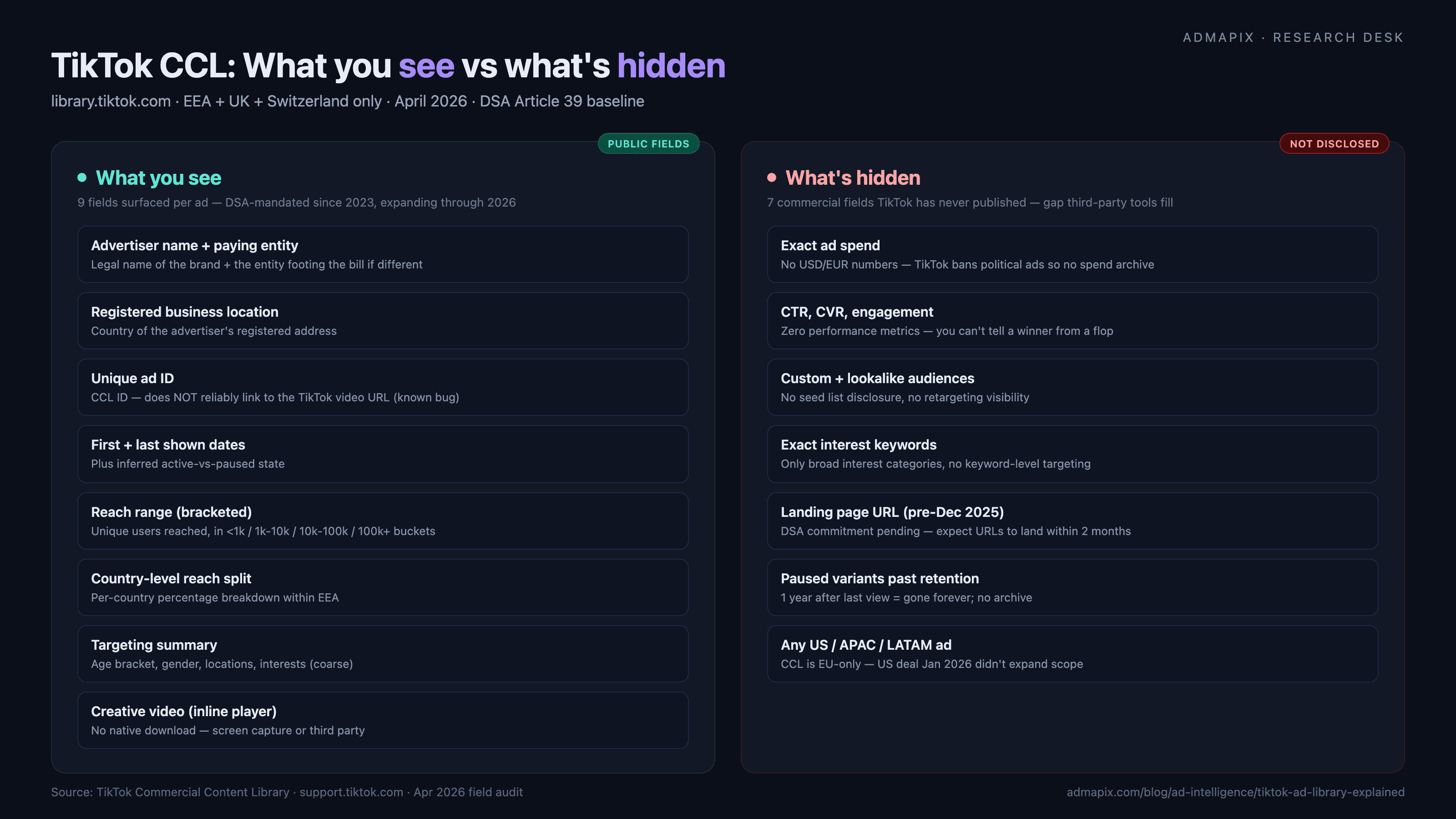
TikTok Ad Library (Commercial Content Library): How to Search It in 2026
The TikTok Ad Library is the Commercial Content Library at library.tiktok.com. It covers paid ads served in the EEA, UK and Switzerland only. This guide gives the direct URLs, a step-by-step search workflow, every visible and hidden field, retention rules, the December 2025 DSA commitments and what they change during 2026, and when a third-party tool is the right surface instead.