
Meta Ads Creative for Mobile Games: 9 Facebook Ad Angles to Test
A practical 2026 guide to Meta and Facebook ads creative for mobile games: playable ads, UGC reactions, fail hooks, progression loops, app campaign setup, competitor research, and KPI guardrails.
Facebook ads for games work best when the team treats creative as a testing system, not a one-off video order.
By the AdMapix Research Desk - Updated April 16, 2026
Examples covered in this guide: playable ads, fake gameplay / fail-and-fix hooks, UGC creator reactions, progression loops, reward reveals, level-fail hooks, live-ops event ads, and comeback retargeting concepts for mobile games.
Facebook ads for games still work in 2026, but the playbook has changed. You cannot brief three generic trailers, launch a broad app campaign, and expect Meta to discover the right players on its own. Meta can automate bidding, audiences, placements, and delivery. It cannot invent a strong player fantasy from weak creative.
This guide is for mobile game founders, UA managers, creative strategists, and agencies planning Facebook game ads or Meta app campaigns. The focus is practical: which creative angles to test first, how to structure a clean campaign, what competitor signals to collect, and how to judge quality beyond CPI.
Searchers may call this topic "facebook ads for games," "mobile game facebook ads," or broader "game advertising." The intent is usually the same: how should a game team turn Meta's reach into installs that keep playing?
If you need the broader channel and format map, read our mobile game ads guide. If you need the full go-to-market plan, start with mobile game marketing strategy. This page is narrower: Facebook ads for games, especially Meta app promotion campaigns where creative variety and event signal decide whether the algorithm can learn.
Why Facebook Ads Still Matter For Games
Facebook is not just the old feed. Meta's app advertising ecosystem spans Facebook, Instagram, Reels, Stories, Messenger, and Audience Network inventory. Meta's own Advantage+ app campaign documentation describes automated optimization across bidding, audiences, and placements, while still depending on app setup through the Meta SDK or a mobile measurement partner. That means the media system is powerful, but the inputs still matter.
Sources: Meta Advantage+ app campaigns, Meta Advantage+ placements, Facebook Audience Network.
For game advertisers, Facebook and Instagram are still useful for five jobs:
| Job | Why it matters for games |
|---|---|
| Broad discovery | Meta can find players outside narrow interest groups when event signal is clean. |
| Creative testing | Reels, Feed, Stories, and Audience Network expose different viewing behaviors. |
| Retargeting | Lapsed installers and tutorial drop-offs can receive specific comeback offers. |
| Live-ops promotion | Events, seasons, heroes, and limited rewards need repeat awareness. |
| Social proof | Creator reactions, guild clips, rankings, and comments can make a mechanic feel alive. |
The mistake is treating Meta as a magic install machine. It is closer to a creative-routing system. If you feed it one vague trailer, it has little to route. If you feed it distinct hooks, representative gameplay, and post-install events, it has a better chance to match the right promise to the right player.
The 9 Creative Angles To Test First
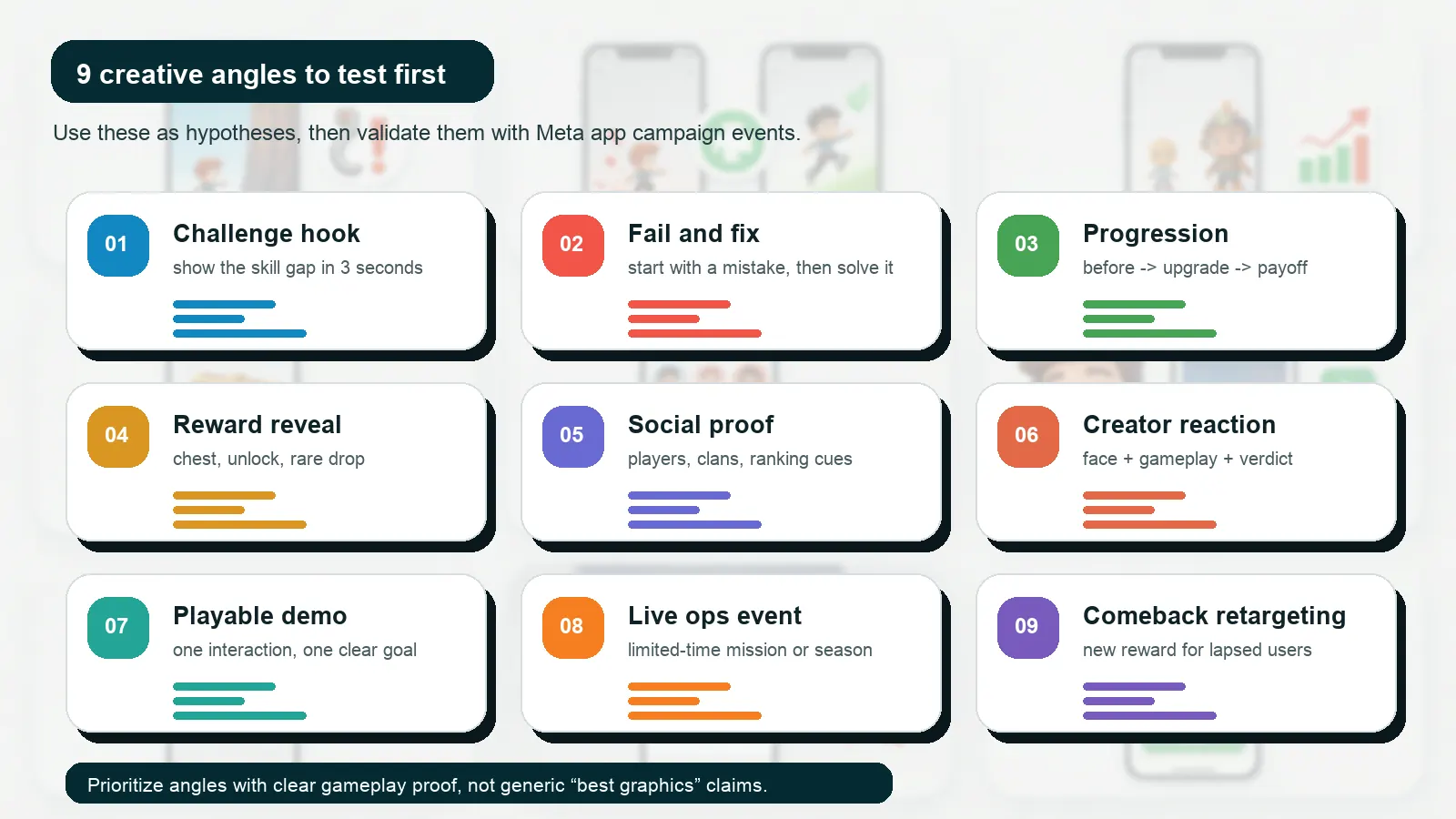
Use these nine angles as hypotheses. Do not scale an angle until it proves both click quality and post-install quality.
You do not need nine finished productions on day one. You need nine hypotheses that are visibly different enough for Meta's delivery system and your creative team to learn from.
1. Challenge Hook
The challenge hook asks the viewer to solve something immediately. It works for puzzle, word, merge, hypercasual, strategy-choice, and casual skill games.
Use it when one move changes the visible state. Start with a near-fail level, a blocked path, a wrong upgrade choice, or a timer. The viewer should understand the problem before they know the game title.
Good brief:
| Element | Direction |
|---|---|
| Opening | Show the player one mistake away from failing. |
| Visual proof | Display the move that changes the outcome. |
| Store match | First store screenshot should show the same mechanic. |
| KPI guardrail | Check store conversion and day-1 retention, not CTR alone. |
2. Fail And Fix
Fail-and-fix ads open with a bad choice, then show a better choice. They work because failure creates tension faster than a polished success scene.
Examples:
| Weak version | Stronger version |
|---|---|
| "Build your city." | "This wall placement gets destroyed. Move it here instead." |
| "Upgrade your hero." | "I wasted my first rare item. This build clears the boss." |
| "Solve puzzles." | "Most players tap the red block first. That loses the level." |
This angle is especially useful when the game has meaningful choices. Avoid fake failures that do not exist in the product.
3. Progression
Progression ads show transformation: weak to strong, empty to upgraded, broken to fixed, village to empire, level 1 to level 50. They work for RPG, strategy, simulation, idle, tycoon, merge, decoration, and collection games.
The progression should be visual. If the viewer needs a paragraph to understand the upgrade path, the ad is doing too much. Show before, decision, payoff.
The quality risk is delayed gratification. If the ad promises a satisfying transformation but the game hides that payoff behind hours of grind, Meta may find cheap installers who churn early.
4. Reward Reveal
Reward reveal ads compress value into one moment: chest opening, free hero, event bonus, revive, rare drop, battle pass reward, or welcome pack.
The best reward ads explain why the reward changes the next action.
| Generic reward | Better reward |
|---|---|
| "Claim 1,000 coins." | "Claim 1,000 coins to unlock your first rare tower." |
| "Free hero today." | "Free healer helps new players clear the third boss." |
| "Watch for reward." | "Revive once and finish the level instead of restarting." |
Reward angles can create low-quality installs if they overpromise abundance. Use them when the first-session economy can support the claim.
5. Social Proof
Social proof makes the game feel active. It is useful for clan strategy, RPG, gacha, party, competitive puzzle, sports, casino-style, and live-service games.
Signals to test:
| Signal | When to use it |
|---|---|
| Guild or clan moment | The game has real team behavior. |
| Ranking or leaderboard | Competition matters to the player fantasy. |
| Creator comment | A human reaction explains the mechanic. |
| Event participation | The game has visible live-ops cadence. |
| Player review angle | The ad can quote a clear benefit without sounding fake. |
Do not manufacture community proof if the product cannot back it up. Store ratings, screenshots, and onboarding should reinforce the same promise.
6. Creator Reaction
Creator reaction ads translate game mechanics into emotion. A player may not understand your UI, but they understand surprise, frustration, relief, and pride.
Strong creator prompts:
| Prompt | Why it works |
|---|---|
| "I thought this puzzle was easy until the last move." | Sets up challenge and payoff. |
| "One wrong upgrade ruined my run." | Shows consequence and strategy. |
| "This boss changed after I switched skills." | Makes progression concrete. |
| "My clan saved the match in the final seconds." | Shows social proof and urgency. |
Avoid generic sponsorship reads. The creator should play, react, and teach the hook.
7. Playable Demo
Playable ads matter for games because they let people try a small interaction before installing. Meta describes playable ads as interactive previews for mobile app advertisers, with a lead-in video, game demo, and call to action.
Source: Meta playable ads.
Use playables when:
| Good fit | Poor fit |
|---|---|
| One-tap, drag, merge, aim, or choose mechanics | Long narrative or menu-heavy loops |
| Immediate win/fail feedback | Progression that needs many sessions |
| A demo that matches the real first session | Fake mini-game unrelated to the product |
| Clear post-demo CTA | Confusing transition to store page |
Playable ads are not automatically better than video. They are better when the interaction is the reason someone wants to install.
8. Live-Ops Event
Live-ops ads give existing and new players a reason to act now. They can feature a season, limited hero, tournament, collaboration, map, challenge, or comeback reward.
This angle works well for retargeting and reactivation, but it can also attract new players when the event explains the game's fantasy quickly.
The core question: can a cold viewer understand why this event matters without knowing the entire game?
9. Comeback Retargeting
Comeback retargeting is for lapsed installers, tutorial drop-offs, previous payers, or players who engaged with ads but did not install. The creative should not repeat the original broad acquisition hook.
Better comeback angles:
| Audience | Message |
|---|---|
| Tutorial drop-off | "Finish the first boss with the new starter bonus." |
| Lapsed player | "The event you missed is back for 72 hours." |
| Non-payer | "Try the new reward path before the season ends." |
| High-intent clicker | "See the actual gameplay behind the ad." |
Keep retargeting honest. If the user left because onboarding was weak, the comeback ad should lead to a better first action, not just a discount.
Campaign Setup Notes For Meta App Campaigns
Creative is the main topic, but Facebook ads for games also need clean technical setup. If events are noisy, Meta can optimize toward the wrong players.
Use this checklist before scaling:
| Setup area | What to confirm |
|---|---|
| App connection | The iOS and Android app are correctly connected in Meta tools and your MMP if used. |
| Event signal | Install, tutorial complete, level milestone, purchase, subscribe, or retention events are mapped consistently. |
| Optimization event | The campaign is not stuck optimizing for cheap installs if quality is poor. |
| SKAN and privacy setup | iOS reporting expectations are clear and not overinterpreted in the first 24 hours. |
| Placement coverage | Advantage+ placements can test across Feed, Reels, Stories, Messenger, and Audience Network when appropriate. |
| Creative diversity | Assets differ by angle, not just color, crop, or caption. |
| Store match | Store page, screenshots, and first session support the ad promise. |
Meta's Conversions API documentation notes that it can support app events and help manage event data across sources. For app advertisers, this reinforces the practical point: post-install signal is part of the creative system, not a separate analytics chore.
Source: Meta Conversions API.
Competitor Research Before Writing Creative Briefs
Before producing Facebook game ads, inspect what direct and adjacent competitors are already repeating. The goal is not to copy their ad. The goal is to identify which player fantasies are being funded.
Run this workflow:
- List 10 direct competitors and 10 adjacent games that share the same player fantasy.
- Open Meta Ads Library and search brand or studio pages.
- Save active and repeated ads into a swipe file.
- Tag each ad by the nine angles above.
- Record the first visual, the first action, the promise, the CTA, and the likely audience.
- Compare the app store page with the ad promise.
- Use AdMapix reports or your own spreadsheet to track repeated patterns weekly.
- Turn the pattern into an original brief with a clear hypothesis.
Competitor research should produce decisions like these:
| Observation | Useful decision |
|---|---|
| Every top competitor uses a puzzle fail-state hook. | Test a fail-state hook, but use a different mechanic or emotion. |
| Most RPG ads show reward pulls but not team composition. | Test reward reveal against team-building proof. |
| Strategy games in the category overuse cinematic battles. | Test a tactical decision angle with real UI proof. |
| Live-ops ads repeat weekly. | Build a seasonal creative calendar, not one campaign burst. |
If you need a deeper Meta transparency workflow, read our Facebook Ads Library complete guide.
Testing Plan: How Many Ads To Launch First
Do not launch one ad per angle and call it a test. You need enough variants to separate the angle from production quality, but not so many that the team cannot learn.
A practical starting plan:
| Stage | Creative set | Goal | Kill rule |
|---|---|---|---|
| Angle test | 9 angles, 1 to 2 rough variants each | Find which player promise earns attention. | Stop angles with weak hold rate and weak click quality. |
| Format test | Top 3 angles across Reels, Feed, Stories, and playable if relevant | Find surface-format fit. | Stop formats that win CTR but lose store CVR. |
| Quality test | Winning angles with event optimization | Validate install quality. | Stop if tutorial completion or day-1 retention underperforms. |
| Scale test | 3 to 5 winners with refreshed hooks | Increase spend without creative fatigue. | Refresh when frequency rises and quality drops. |
Good creative testing asks one question at a time. If you change the hook, character, format, CTA, and landing page simultaneously, you will not know what worked.
KPI Guardrails Beyond CPI
CPI is useful, but it is not a truth source. Facebook ads for games can produce cheap installs that never finish onboarding.
Track these metrics together:
| Metric | What it tells you |
|---|---|
| Hook hold rate | Whether the opening visual earns attention. |
| CTR | Whether the promise creates intent. |
| Store CVR | Whether store assets match the ad. |
| Install-to-open | Whether the install flow is healthy. |
| Tutorial completion | Whether the first session matches expectations. |
| Day-1 retention | Whether the promise attracts real players. |
| Purchase or payer proxy | Whether monetization quality exists. |
| ROAS or value event | Whether scale can become profitable. |
The most dangerous ad is not the one with high CPI. It is the one with low CPI, high CTR, and weak retention. That usually means the creative is interesting but the promise is wrong.
Common Mistakes In Facebook Game Ads
| Mistake | Why it hurts |
|---|---|
| Only testing polished trailers | Trailers often hide the actual first-session reason to install. |
| Treating all videos as different because crops differ | Meta needs different concepts, not cosmetic variants. |
| Using fake gameplay | Short-term clicks can damage store CVR and retention. |
| Optimizing for installs too long | Cheap installers may not become real players. |
| Ignoring store-page match | Users click one promise and see another one in the store. |
| Copying competitor ads too literally | You inherit their surface pattern without their product context. |
| Launching without event QA | Bad signal teaches the campaign the wrong lesson. |
Recommended First Brief
If you are starting from zero, brief this first batch:
| Slot | Creative angle | Format | Hypothesis |
|---|---|---|---|
| 1 | Challenge hook | Reels-style vertical video | Players understand the core mechanic fast. |
| 2 | Fail and fix | Feed/Reels video | A visible mistake creates stronger curiosity than a perfect run. |
| 3 | Progression | Short gameplay montage | The upgrade fantasy drives store intent. |
| 4 | Reward reveal | Story/Reels video | Event reward improves click quality without hurting retention. |
| 5 | Creator reaction | Creator-led video | Human emotion explains the mechanic better than UI. |
| 6 | Playable demo | Playable or interactive-style video | One interaction creates higher-intent installs. |
Then add three backup concepts from social proof, live-ops, and comeback retargeting once you have audience data.
FAQ
Are Facebook ads good for mobile games in 2026?
Yes, when the campaign has enough creative variety, clean app events, and store-page match. Meta can automate delivery, but game advertisers still need distinct player fantasies and reliable post-install quality signals.
What is the best Facebook ad format for games?
There is no universal best format. Short gameplay videos, creator reactions, Reels-style clips, playable ads, and live-ops ads can all work. The best format is the one that makes the game's core action understandable and believable.
Should I use playable ads for games?
Use playable ads when one interaction can explain the fun. They are strongest for puzzle, merge, hypercasual, strategy-choice, and simple action loops. Avoid them when the playable demo does not match the real game.
How many creatives should I test first?
Start with 9 angles and 1 to 2 rough variants per angle if budget allows. If budget is limited, test 5 to 6 angles first, but make each angle meaningfully different.
Can I copy competitor Facebook game ads?
No. Use competitor ads to identify repeated patterns, hooks, and player fantasies. Then create an original brief that fits your actual gameplay, store page, and onboarding.
What should I optimize for after installs?
Move toward quality events such as tutorial completion, level milestone, payer proxy, subscription, or value events once you have enough signal. Install volume without quality can mislead the campaign.
Final Take
Facebook ads for games are not won by the prettiest trailer. They are won by the clearest player promise, the best creative testing loop, and the cleanest post-install signal. Start with the nine angles above, validate them against store conversion and retention, and keep the competitor research loop running.
If you want to shorten research, use AdMapix reports to collect competitor game ads, tag creative angles, and brief your next Meta test from live category patterns. If your team needs ongoing creative intelligence, compare plans on AdMapix pricing.
Turn these observations into your next creative study
Open the creative library and select samples for your market, network and research question.
Related Articles
Mobile Game Ads Guide: Formats, Real Examples, and Competitor Research
A practical 2026 guide to mobile game ads formats, creative examples measured from live US fleets, channel fit, research tools, competitor research, testing plans, and KPI guardrails.
TikTok Ad Library (Commercial Content Library): How to Search It in 2026
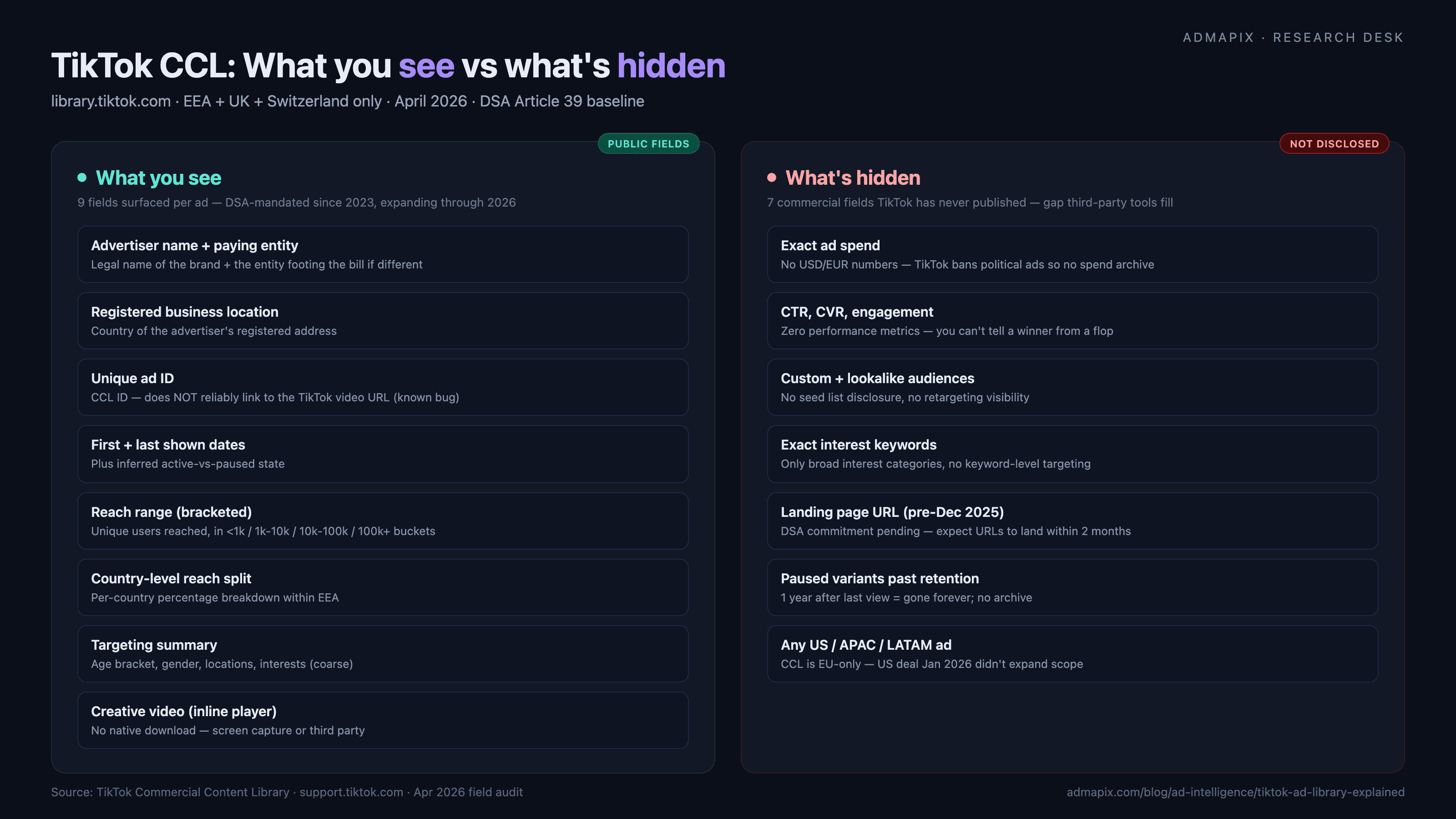
The TikTok Ad Library is the Commercial Content Library at library.tiktok.com. It covers paid ads served in the EEA, UK and Switzerland only. This guide gives the direct URLs, a step-by-step search workflow, every visible and hidden field, retention rules, the December 2025 DSA commitments and what they change during 2026, and when a third-party tool is the right surface instead.
TikTok Ads Research in 2026: 7-Step Workflow + 10 Hook Patterns
A methodology-first TikTok ads research playbook: the free stack, a 30-min weekly SOP, 10 hook patterns advertisers we track actually win with, and a bulletproof brief template.