
Mobile Game Monetization: Ads, IAP, and Hybrid Revenue Models
A practical 2026 guide to mobile game monetization, covering ad revenue, IAP, hybrid models, rewarded ads, interstitials, player experience, and competitor research.
Mobile game monetization should connect revenue mechanics with player quality, retention, and competitor research.
By the AdMapix Research Desk - Updated April 16, 2026
Mobile game monetization is not one decision. It is a system of choices about when to show ads, what to sell, which players to segment, how to protect retention, and how to learn from competitors without copying them.
The simple question is "How does this game make money?" The better question is "Which revenue model fits the player fantasy without damaging long-term value?"
This guide is for game founders, product managers, UA teams, monetization managers, and indie developers planning mobile game ad revenue, in-app purchases, rewarded ads, interstitial ads, subscriptions, battle passes, or hybrid monetization. It also answers the common long-tail question: how much do mobile games make per ad?
If you are still planning acquisition, start with mobile game marketing strategy. If you need ad creative and channel planning, read mobile game ads guide and Facebook ads for games. This article focuses on what happens after the player arrives.
What Mobile Game Monetization Includes
Mobile game monetization is every mechanism that turns player engagement into revenue. The main models are:
| Model | Revenue source | Best fit |
|---|---|---|
| Rewarded ads | Player opts in to watch an ad for value. | Casual, puzzle, arcade, merge, simulation, and games with clear rewards. |
| Interstitial ads | Full-screen ad appears at natural breaks. | High-session-volume games where interruption can be controlled. |
| Banner ads | Persistent small placement. | Utility-like screens, idle states, low-intensity games. |
| In-app purchases | Player buys currency, items, cosmetics, boosts, heroes, or bundles. | Games with progression, collection, status, or convenience value. |
| Battle pass | Time-boxed progression track with free and paid rewards. | Live-service games with missions, events, and recurring engagement. |
| Subscription | Recurring access to benefits. | Games with daily value, VIP features, no-ad upgrades, or convenience. |
| Offerwalls | Player completes third-party tasks for in-game rewards. | Games with hard currency sinks and users willing to trade time. |
| Hybrid model | Ads plus IAP plus live-ops offers. | Most scaled free-to-play games. |
The best model depends on player intent. A hypercasual player may accept rewarded ads and light interstitials. A strategy player may tolerate fewer ads but pay for acceleration, pass progression, or event bundles. A collector may spend on characters and cosmetics. A puzzle player may watch rewarded ads for extra moves.
The model should follow the game loop, not the other way around.
Ads, IAP, Or Hybrid: Which Model Fits?
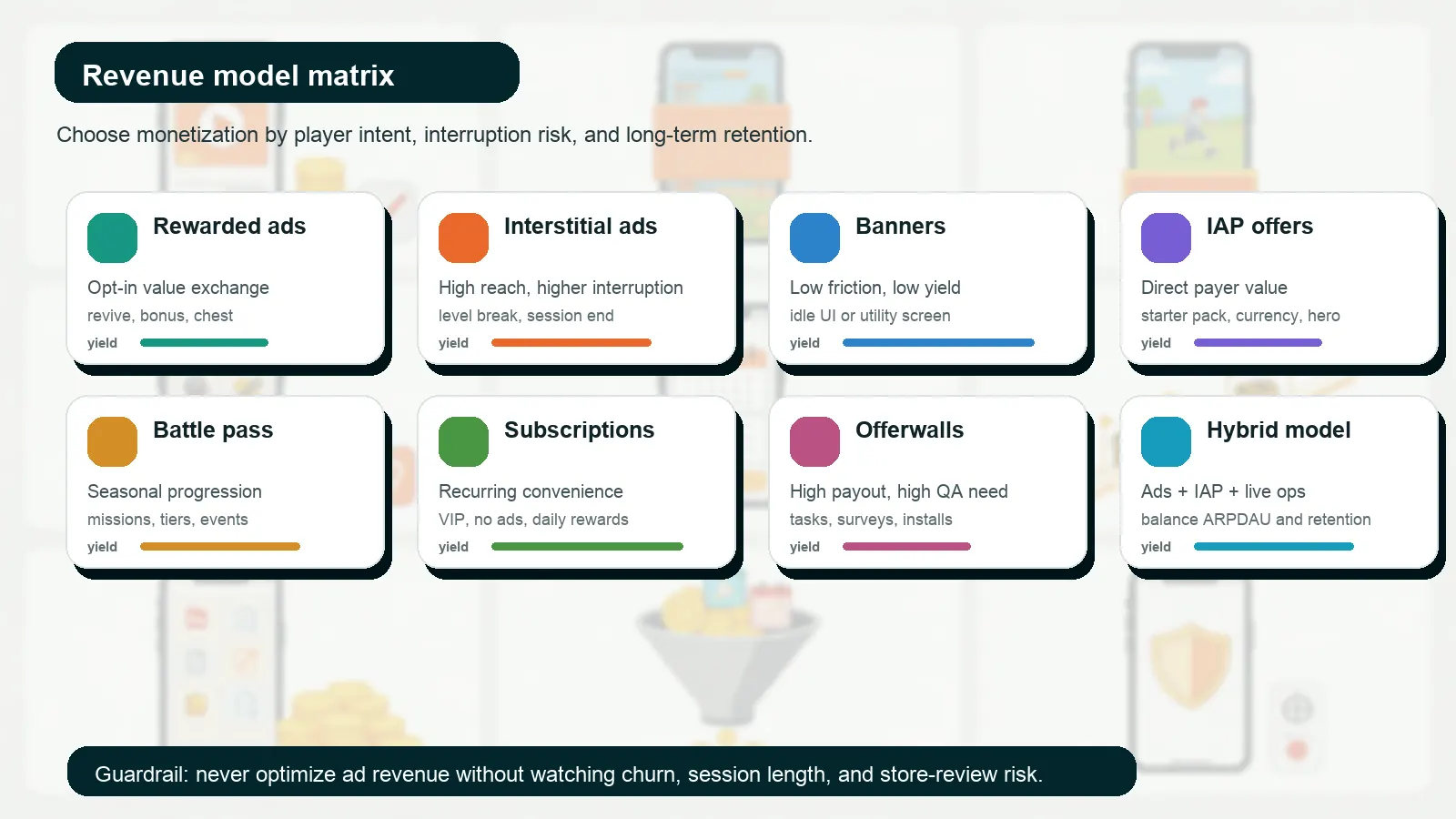
Use a revenue model matrix before adding more ad placements or more purchase offers.
Use this decision table:
| Game pattern | Better monetization bias | Why |
|---|---|---|
| Very short sessions, broad audience, low payer intent | Ads-first | More users can monetize without payment friction. |
| Strong progression, collection, or competition | IAP-first or hybrid | Players have reasons to buy power, speed, cosmetics, or status. |
| Puzzle, merge, arcade, casual skill | Rewarded ads plus light IAP | Extra moves and retries create natural opt-in value. |
| Strategy, RPG, gacha, simulation | Hybrid with live-ops | Events, pass, bundles, and selective ads can coexist. |
| Premium-feeling game with loyal users | IAP, subscription, or paid remove-ads | Too many ads can hurt trust. |
| Kids or sensitive audiences | Policy-first monetization | Ad content, tracking, purchases, and consent need stricter handling. |
Official ad platforms describe the mechanics differently, but the operating principle is consistent: ads perform best when the placement fits the user moment. Google AdMob separates rewarded and interstitial formats, Unity LevelPlay organizes multiple ad formats for mediation and in-app bidding, and Meta Audience Network has historically emphasized placement-level optimization.
Sources: Google AdMob rewarded ads, Google AdMob interstitial ads, Unity LevelPlay, Meta Audience Network.
Rewarded Ads: The Safest Ad Revenue Starting Point
Rewarded ads are usually the safest mobile game ad revenue format because the player chooses to watch in exchange for value. That opt-in behavior changes the psychology. The player feels more control, and the developer can place the ad near a real game need.
Strong rewarded ad moments:
| Moment | Reward idea |
|---|---|
| Failed level | Continue, revive, or extra move. |
| Daily return | Bonus chest or multiplier. |
| Resource shortage | Small currency refill. |
| Hard choice | Try another strategy without losing progress. |
| Event participation | Extra attempt or token. |
Bad rewarded ad moments:
| Mistake | Why it hurts |
|---|---|
| Reward is irrelevant | Player learns ads are not worth watching. |
| Reward breaks balance | Non-paying users overfarm value and spend less. |
| Ad is placed before the player cares | No motivation means low engagement. |
| Rewarded ad replaces game design | The ad becomes a patch for weak pacing. |
The first monetization test for many mobile games should be one rewarded placement, not ten ad placements. Add it where the player already wants help.
Interstitial Ads: Useful, But Easy To Overuse
Interstitial ads can generate meaningful revenue, but they carry higher interruption risk. They should appear at natural breaks, not in the middle of agency, choice, combat, or puzzle-solving.
Better interstitial timing:
| Safer timing | Riskier timing |
|---|---|
| After a level ends | During the level |
| After a reward screen closes | Before the reward is understood |
| Between sessions | During an active decision |
| After a failed attempt | Before the player sees why they failed |
Interstitial ads need frequency controls. Watch:
| Metric | What it protects |
|---|---|
| Session length | Users may shorten sessions if interruption is too high. |
| Day-1 and day-7 retention | Ads can damage early trust. |
| Store rating changes | Ad complaints can show up quickly. |
| Crash and load time | Full-screen ads can expose technical issues. |
| Ad revenue per DAU | Revenue can rise while total value falls. |
If interstitial revenue grows while retention falls, you may be pulling value forward instead of increasing lifetime value.
IAP: Sell Progress, Identity, Convenience, Or Status
In-app purchases work when the player understands the value of buying. A purchase is not just a price point. It is a shortcut, expression, collection item, or competitive advantage.
Common IAP types:
| IAP type | Player motivation |
|---|---|
| Starter pack | Reduce early friction and create first purchase behavior. |
| Currency bundle | Speed up progression or unlock choices. |
| Cosmetic item | Express identity without power imbalance. |
| Hero, card, or unit | Collection, strategy, rarity, and status. |
| Boost or skip | Convenience and pacing control. |
| Remove ads | Trust and premium-feeling upgrade. |
| Battle pass | Recurring goals and seasonal value. |
IAP-first games need economy discipline. If the game gives too much value for free, paying feels unnecessary. If the game withholds too much value, non-payers churn before they understand why paying matters.
Good monetization design makes the first purchase feel like a sensible next step, not a ransom.
Hybrid Monetization: The Default For Many Scaled Games
Hybrid monetization combines ads, IAP, and live-ops offers. It is powerful because different players monetize differently.
| Player segment | Better offer |
|---|---|
| New free player | Rewarded ads, starter pack, soft onboarding offers. |
| Engaged non-payer | Rewarded ads, battle pass preview, limited bundle. |
| First-time payer | Starter bundle, no-ad upgrade, event unlock. |
| Repeat payer | Battle pass, cosmetics, progression offers. |
| Lapsed player | Comeback reward, event return, selective ad suppression. |
The mistake is showing every monetization option to every user. Hybrid monetization needs segmentation. A new player should not see the same pressure as a veteran. A payer should not be punished with the same ad frequency as a non-payer. A lapsed player may need a better comeback path before seeing aggressive offers.
How Much Do Mobile Games Make Per Ad?
There is no universal answer. A mobile game makes money per ad based on ad format, country, audience, mediation setup, demand quality, seasonality, category, user value, and policy constraints.
Use the formula:
Revenue per impression = eCPM / 1000Examples:
| eCPM | Revenue per ad impression |
|---|---|
| $2 | $0.002 |
| $5 | $0.005 |
| $10 | $0.010 |
| $20 | $0.020 |
| $40 | $0.040 |
That does not mean every player is worth that amount. You also need fill rate, show rate, engagement rate, session count, retention, and ad frequency.
More useful formulas:
Ad revenue per DAU = impressions per DAU x fill rate x eCPM / 1000
ARPDAU = total daily revenue / daily active users
LTV = expected lifetime revenue per user
Example:
| Input | Value |
|---|---|
| DAU | 10,000 |
| Rewarded impressions per DAU | 0.8 |
| Interstitial impressions per DAU | 1.2 |
| Blended eCPM | $8 |
| Estimated daily ad revenue | 10,000 x 2.0 x $8 / 1000 = $160 |
This is only a planning estimate. Real revenue depends on market, user behavior, mediation competition, ad quality, and retention impact.
The better question is not "How much does one ad make?" It is "How much total value can this ad placement create without lowering retention or IAP?"
Player Experience Guardrails
Mobile game monetization fails when revenue pressure gets ahead of player trust.
Use these guardrails:
| Guardrail | What to check |
|---|---|
| First-session protection | Avoid aggressive interstitials before the player understands the game. |
| Clear opt-in value | Rewarded ads should feel useful, not mandatory. |
| Frequency cap | More ads can reduce session length and retention. |
| Payer treatment | Avoid showing too many ads to paying users unless the offer is opt-in. |
| Store review watch | Monitor ad complaints and perceived paywalls. |
| Economy balance | Ads and IAP should not destroy progression pacing. |
| Age and policy fit | Sensitive audiences require stricter ad and purchase design. |
The highest short-term ARPDAU version is not always the best business version. A lower-ad experience can produce stronger retention, better reviews, and higher long-term LTV.
Competitor Monetization Research
You cannot see a competitor's full revenue dashboard, but you can study public signals.
Start with:
| Signal | What it can reveal |
|---|---|
| Competitor ads | Player fantasies they are funding. |
| Store screenshots and videos | Monetization surfaces, events, rewards, pass, bundles. |
| In-game onboarding | When ads and offers appear. |
| Reviews | Complaints about ads, paywalls, balance, and popups. |
| Live-ops calendar | Event cadence and recurring monetization hooks. |
| Ad creative repetition | Which offers or events are worth promoting repeatedly. |
Use AdMapix reports to collect competitor ads and tag monetization signals: reward reveal, battle pass, starter pack, event comeback, no-ad upgrade, gacha pull, or creator reaction around value. If you do not use a tool, build the same workflow in a spreadsheet.
The research question is not "What price do they charge?" It is:
| Research question | Why it matters |
|---|---|
| Which value moment do they advertise? | Reveals what the market understands quickly. |
| Do they sell power, identity, progress, or convenience? | Helps position your own offers. |
| How often do they promote events? | Indicates live-ops cadence. |
| Do reviews complain about ads? | Warns against overusing the same format. |
| Does the store page show monetization? | Shows whether monetization is part of the promise. |
A Practical Monetization Test Plan
Do not launch every revenue feature at once. You need to isolate the effect of each placement or offer.
| Stage | Test | Goal |
|---|---|---|
| Baseline | Measure retention, session length, and progression before new monetization. | Know what you might damage. |
| Rewarded ad test | Add one opt-in placement at a high-intent moment. | Validate ad revenue without hurting trust. |
| Interstitial timing test | Add one natural-break placement with frequency control. | Find safe interruption limits. |
| Starter IAP test | Add a low-friction starter pack. | Understand first-purchase intent. |
| Hybrid segment test | Different offers for new, engaged, payer, and lapsed users. | Increase value without one-size-fits-all pressure. |
| Competitor research loop | Review competitor ad and event signals weekly. | Feed better offer and creative ideas. |
Before each test, write a kill rule. Example: "If D1 retention drops by more than X relative to baseline, stop or reduce frequency." Your threshold depends on the game, but the rule should exist before the test starts.
FAQ
How do mobile games make money?
Mobile games make money through ads, in-app purchases, subscriptions, battle passes, offerwalls, premium downloads, or hybrid models. Free-to-play games usually combine ads and purchases, then use live-ops events to create recurring reasons to return and spend.
How much do mobile games make per ad?
Revenue per ad impression equals eCPM divided by 1000. A $10 eCPM equals about $0.01 per impression before broader business factors. Real revenue depends on geography, format, fill rate, session count, retention, and mediation setup.
Are rewarded ads better than interstitial ads?
Rewarded ads are usually safer because the player opts in for value. Interstitial ads can earn meaningful revenue but need careful timing and frequency caps because they interrupt play.
What is hybrid monetization?
Hybrid monetization combines ads, IAP, battle passes, subscriptions, or offerwalls. It works because different player segments monetize differently. The key is segmentation and player experience control.
Should paying users still see ads?
Sometimes, but be careful. Paying users often expect a better experience. Rewarded ads can still work if they are optional and useful, while forced ads may damage trust and future spending.
How do I research competitor monetization?
Study competitor ads, store pages, screenshots, reviews, onboarding, events, and repeated creative themes. Use AdMapix reports to tag monetization signals from live ads, or maintain a structured spreadsheet.
Final Take
Mobile game monetization is not about adding more ads or more offers. It is about matching the revenue model to player intent, then protecting retention while you increase ARPDAU.
Start with one clear rewarded placement, one carefully timed ad break, one starter IAP hypothesis, and one competitor research loop. Measure the effect on revenue and player quality together. If you need competitor monetization signals faster, use AdMapix reports. If you want ongoing creative and monetization research workflows, compare plans on AdMapix pricing.
Turn these observations into your next creative study
Open the creative library and select samples for your market, network and research question.
Related Articles
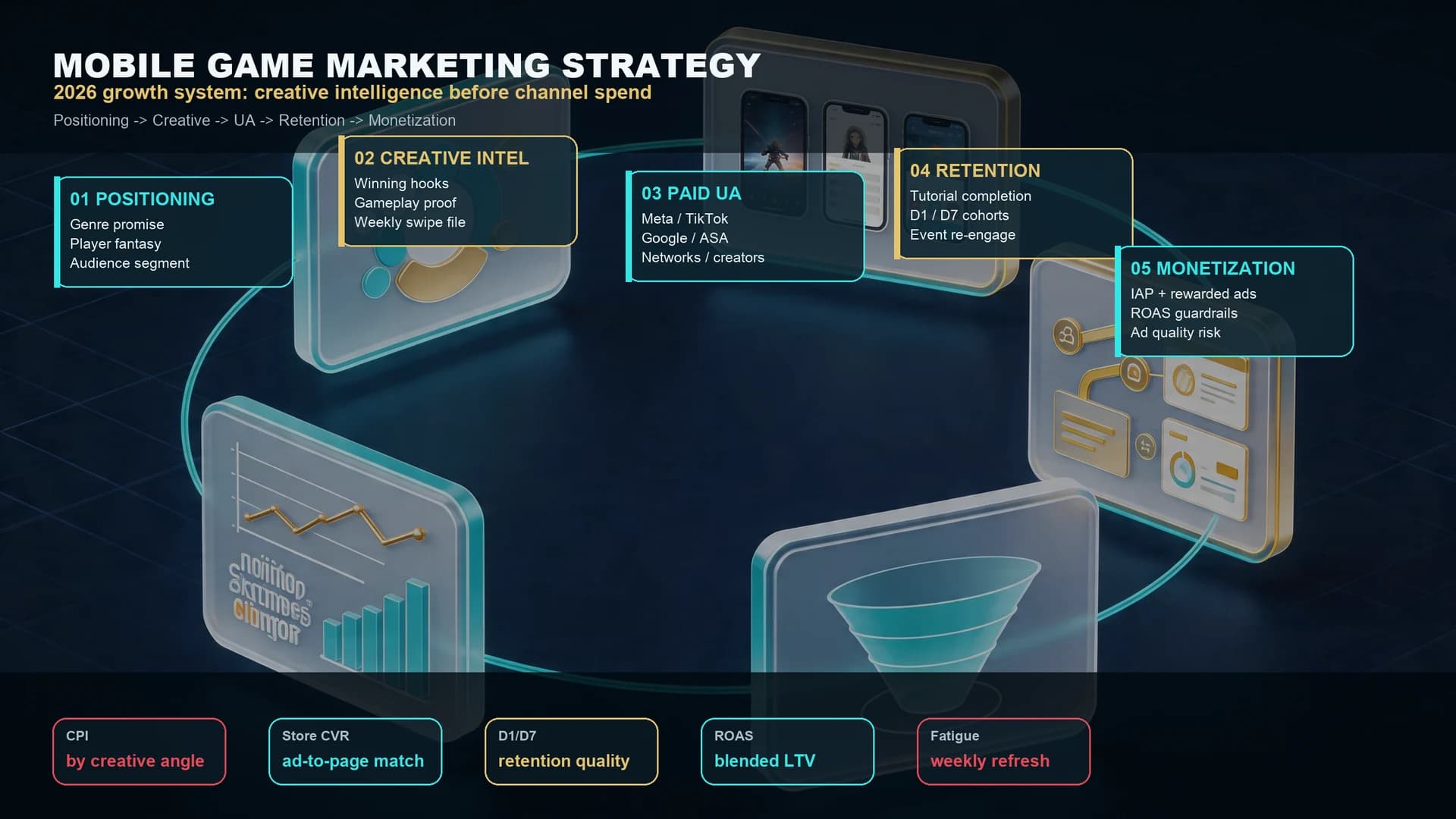
Mobile Game Marketing Strategy: A 12-Step UA & Creative Playbook (2026)
A practical mobile game marketing strategy guide for 2026 covering creative intelligence, paid UA, soft launch KPIs, ASO, retention loops, and competitor ad research.
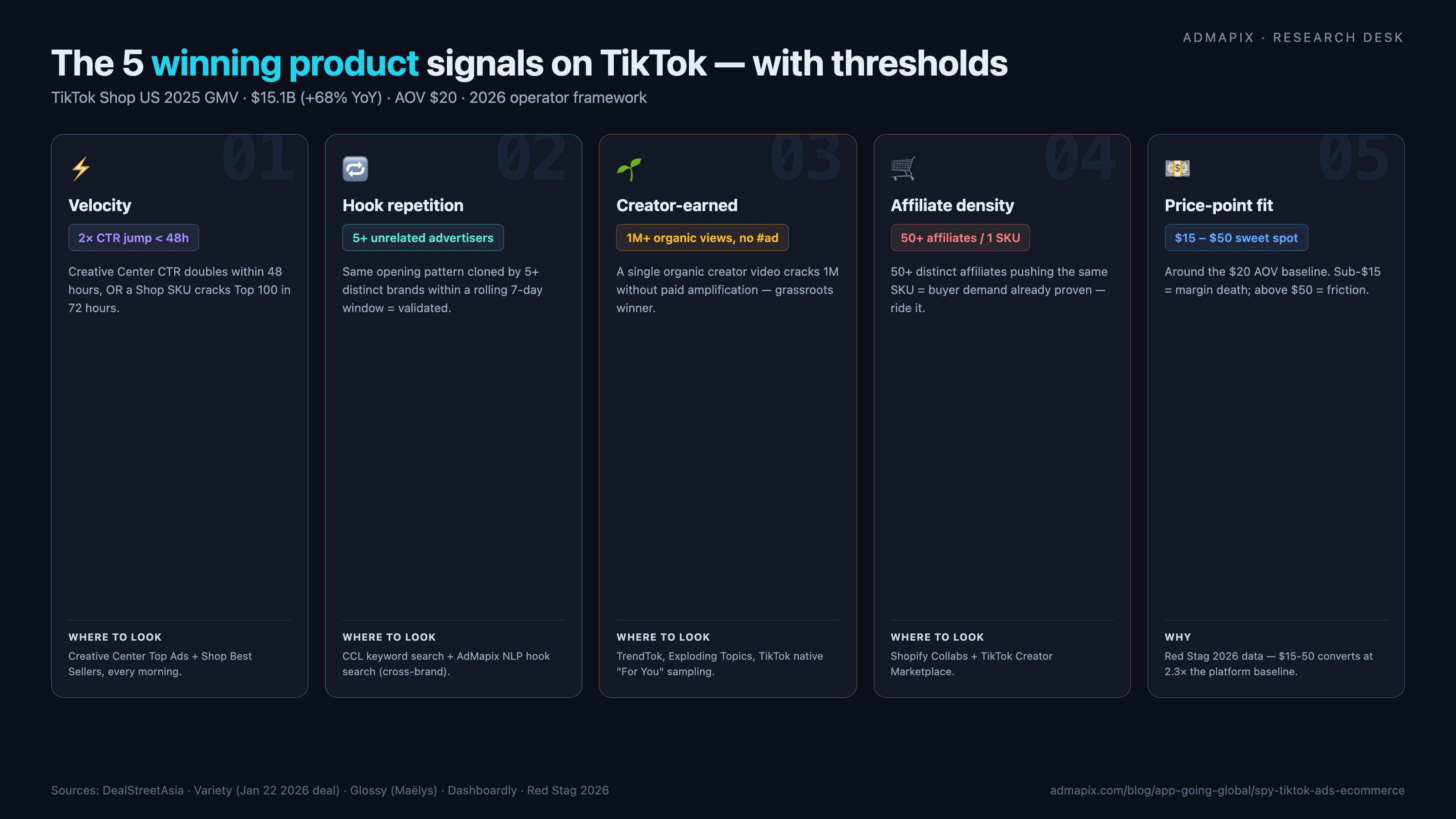
TikTok Ad Spy for E-commerce: The Operator Manual (Post Jan-2026 Deal Update)
TikTok Shop closed 2025 at $15.1B US GMV (+68% YoY) and the Oracle-led US joint venture closed January 22, 2026. This operator manual covers five winning-product signals we test against every Monday, a seven-step creative extraction workflow, a tool stack with 2026 prices, a security callout, and the Maëlys $108.5M case study — for operators who want a repeatable loop, not a listicle.
How to Find Winning Products on Facebook Ads Library (2026)
A practical product-research workflow: record observable ad evidence, verify the offer and supplier, calculate your costs, and test candidates without assuming profitability.