
ironSource Ad Intelligence in 2026: LevelPlay, ironSource Ads & Creative Evidence
The 2026 guide to ironSource ad intelligence after the Unity merger: how to tell LevelPlay, ironSource Ads, and Unity UA apart, why there's no public library, what creative evidence you can and can't observe, a workflow, format reading, and turning patterns into UA briefs.
By the AdMapix Research Desk — Updated June 21, 2026
ironSource Ad Intelligence in 2026: LevelPlay, ironSource Ads & Creative Evidence
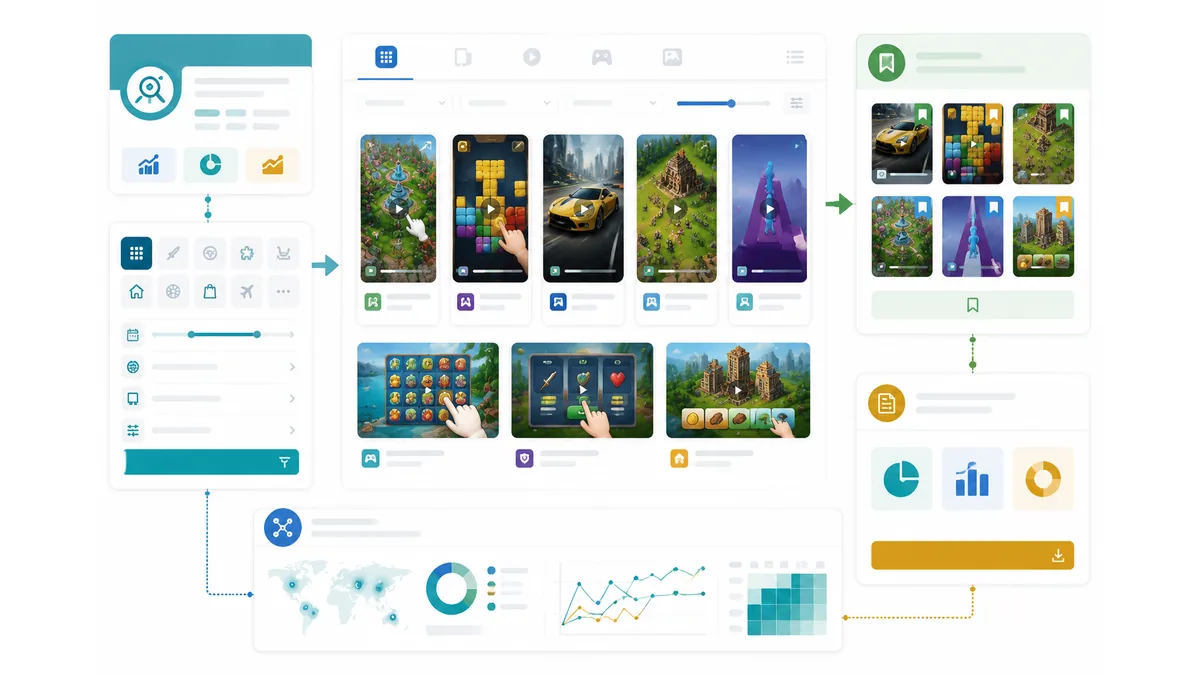
If you're researching ironSource ad intelligence in 2026, the first thing to fix is the name. ironSource is now part of Unity, so the products you actually research are Unity LevelPlay (mediation and monetization) and ironSource Ads (a network for monetization and user acquisition). And the second thing to fix is the expectation: there is no public "ironSource ad spy" database that exposes a competitor's full campaign library, spend, or targeting. So ironSource ad intelligence isn't a lookup — it's understanding what the Unity products actually do, collecting the creative evidence you legitimately can, and turning scattered observations into a repeatable workflow.
This guide is for mobile game UA teams, monetization managers, app publishers, agencies, and founders who keep hitting the post-merger naming confusion and the "where's the library?" wall. It covers the three Unity surfaces you might mean by "ironSource," the hard line between what public data can and can't prove (spend, ROAS, and targeting are off-limits), a five-step workflow, how to read creatives by format (ironSource is interstitial- and rewarded-heavy), and how to turn patterns into UA test briefs. We'll be honest throughout: you can study the creative, never the private numbers.
The core principle, up front: the most common ironSource research error is treating mediation, a network, and a UA suite as one product — and the second is expecting a library that doesn't exist. Fix both, capture creative evidence with strict provenance, and the research becomes defensible and useful.
For adjacent networks, see our Unity Ads spy tool guide (ironSource is now Unity-owned, so they overlap), the AppLovin ads spy tool and Moloco ad intelligence deep dives, the genre-wide mobile game ad spy tool playbook, and the full landscape in best ad spy tools 2026.
TL;DR — ironSource Ad Intelligence in 2026
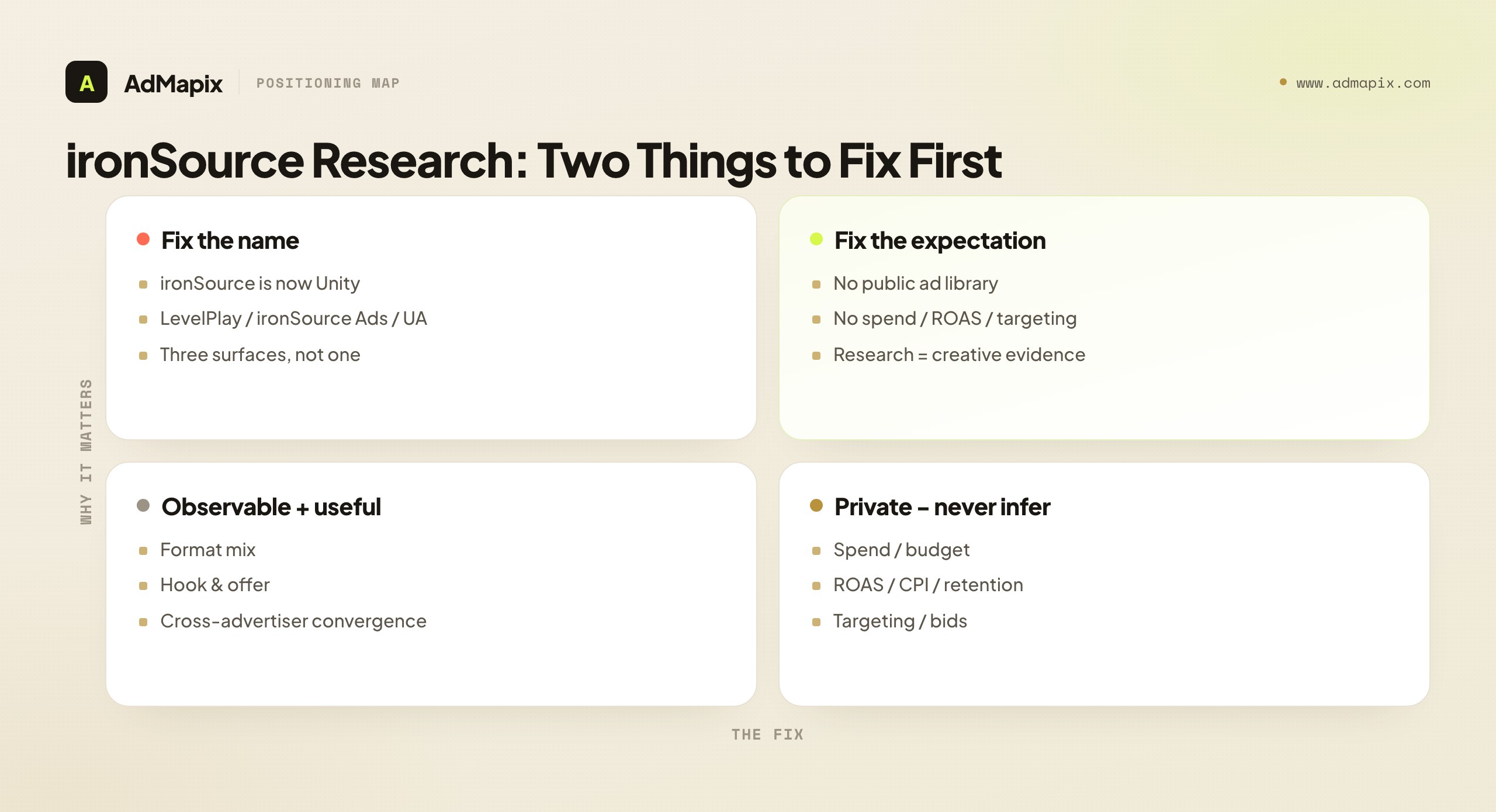
- ironSource is now Unity. The products you research are Unity LevelPlay (mediation/monetization control) and ironSource Ads (a network for monetization and UA) — treat them as separate surfaces, not one monolithic "ironSource."
- There's no public ironSource ad library. No tool reveals a competitor's spend, ROAS, or targeting on ironSource/Unity — that data is private and account-level.
- The evidence you can collect is creative. Video and playable ads, hooks, offers, formats, app category, and the source and date of each example — captured with strict provenance.
- Confirm the product before you research. A mediation question (LevelPlay), a UA question, and a creative question are three different things; mixing them produces meaningless comparisons.
- Read each format on its own rules. ironSource's interstitial- and rewarded-heavy inventory means format is a strong signal — a playable, a rewarded video, and an interstitial each do different jobs.
- The workflow ends in a brief. Confirm the product, define the set, capture evidence with provenance, separate public from private, and convert each pattern into a testable output.
ironSource After the Unity Merger: What Each Product Is
ironSource ad intelligence today means understanding three distinct Unity surfaces, not one monolithic "ironSource." Unity completed its merger with ironSource in 2022, and the product names you research now live under the Unity Grow and LevelPlay umbrellas. Treating them as one product is the single most common research error, because mediation, a network, and a UA suite each answer a completely different question.
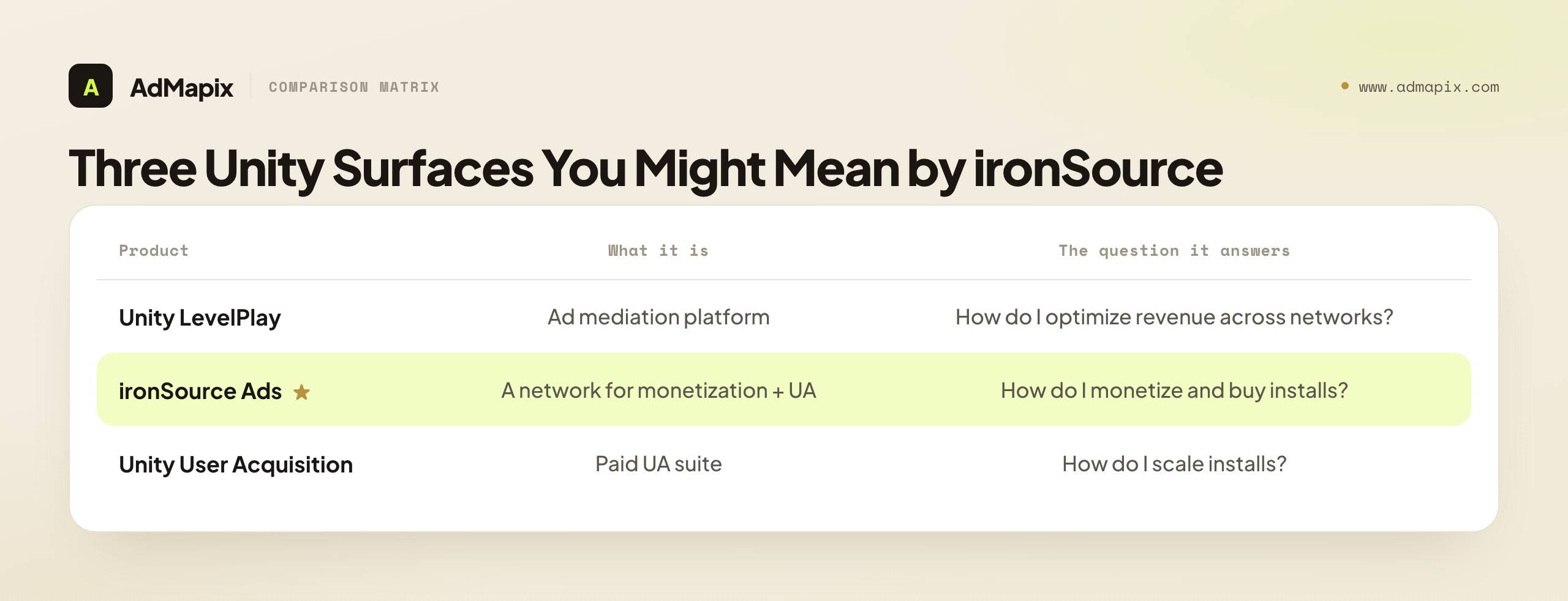
| Product | What Unity describes it as | The question it answers |
|---|---|---|
| Unity LevelPlay | Ad mediation platform for revenue, UA, and monetization control | How do I manage and optimize ad revenue across multiple networks? |
| ironSource Ads | A solution to manage monetization and acquire high-quality users | How do I both monetize and buy installs through one network? |
| Unity User Acquisition | A suite to attract high-value users with scalable, targeted advertising | How do I scale installs and grow a game with paid UA? |
When a teammate says "check ironSource for competitor ads," clarify which surface they mean before you start, because each leads to a different research path:
- A mediation question (LevelPlay) is about your own monetization stack — which networks you orchestrate and how revenue optimizes across them. It's not a competitor-creative question at all.
- A UA question is about where and how installs are bought — strategy and economics you can mostly only infer.
- A creative question is about what ads competitors actually run — and this is the only part where outside-in evidence is genuinely possible.
Getting this distinction right up front saves hours, because researching "ironSource" without specifying the surface is how teams end up comparing a monetization signal to a UA creative and drawing a meaningless conclusion. The rest of this guide focuses on the creative question, since that's where competitor research can actually produce evidence.
What Public Data Can and Cannot Prove
Public ironSource and Unity sources prove product scope and positioning, not competitor performance. This is the line that keeps your research honest and your client decks defensible.
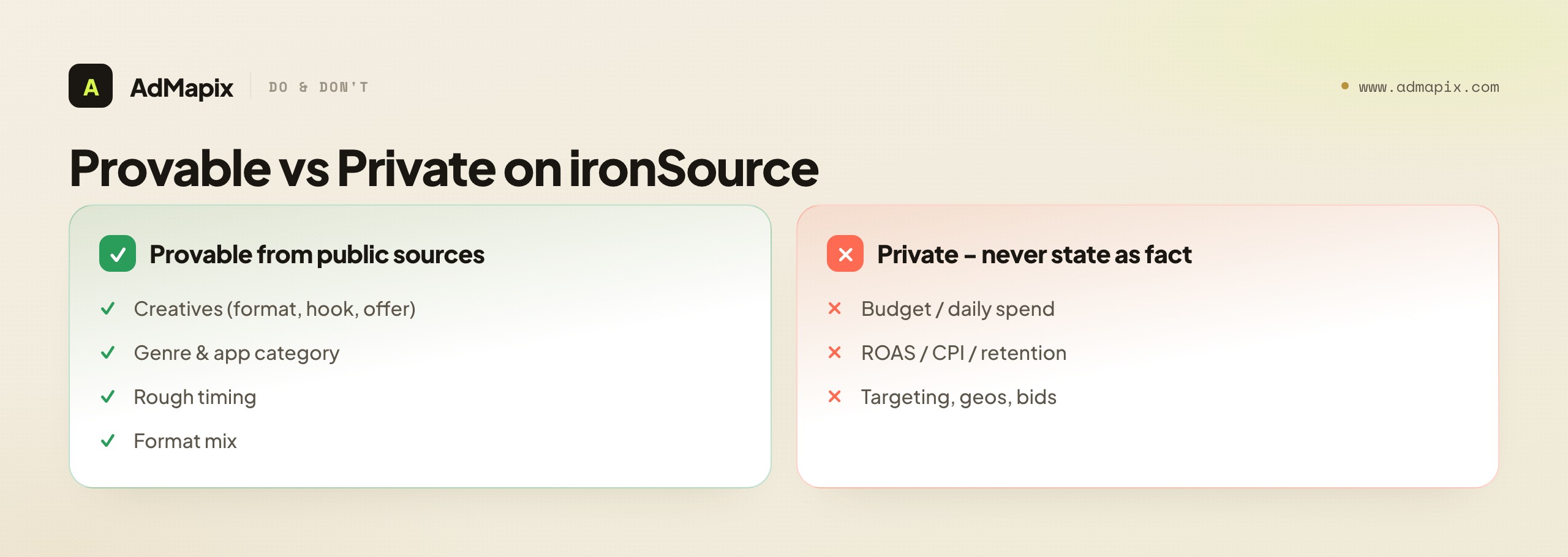
What the official pages can prove: that a product exists, what category it sits in (mediation vs network vs UA suite), and what it claims to do. What no public ironSource source can prove: a specific competitor's campaign budget, ROAS, impression volume, audience targeting, or bid strategy. Those are account-level numbers that live inside private dashboards.
| Signal | Provable from public sources? | Notes |
|---|---|---|
| Which product a competitor likely uses | Partly (inferred) | Mediation/network presence leaves some footprints |
| The creatives they run (format, hook, offer) | Yes | Observable across networks |
| Genre, app category, rough timing | Yes | From the creative and store listing |
| Campaign budget / daily spend | No | Account-level, private |
| ROAS, retention, CPI | No | Never infer from a creative |
| Targeting, geos, bid strategy | No | Private; localization is a hint, not proof |
The one layer you can build outside-in is creative evidence — the ads themselves. Across mobile ad networks you can observe what a competitor ships: the format (rewarded video, interstitial, playable, banner), the hook in the first seconds, the offer, the genre and app category, and roughly when and where it ran. You cannot reverse-engineer spend from a creative. State that limit explicitly whenever you present findings, and you avoid the trap of dressing up guesses as data — which, on a network with no library, is the single fastest way to lose a client's or a CMO's trust.
A Repeatable ironSource Ad Intelligence Workflow
The reliable method is to anchor on official scope first, then collect creative evidence with strict provenance, then convert patterns into a decision. Each step exists to prevent a specific failure mode.
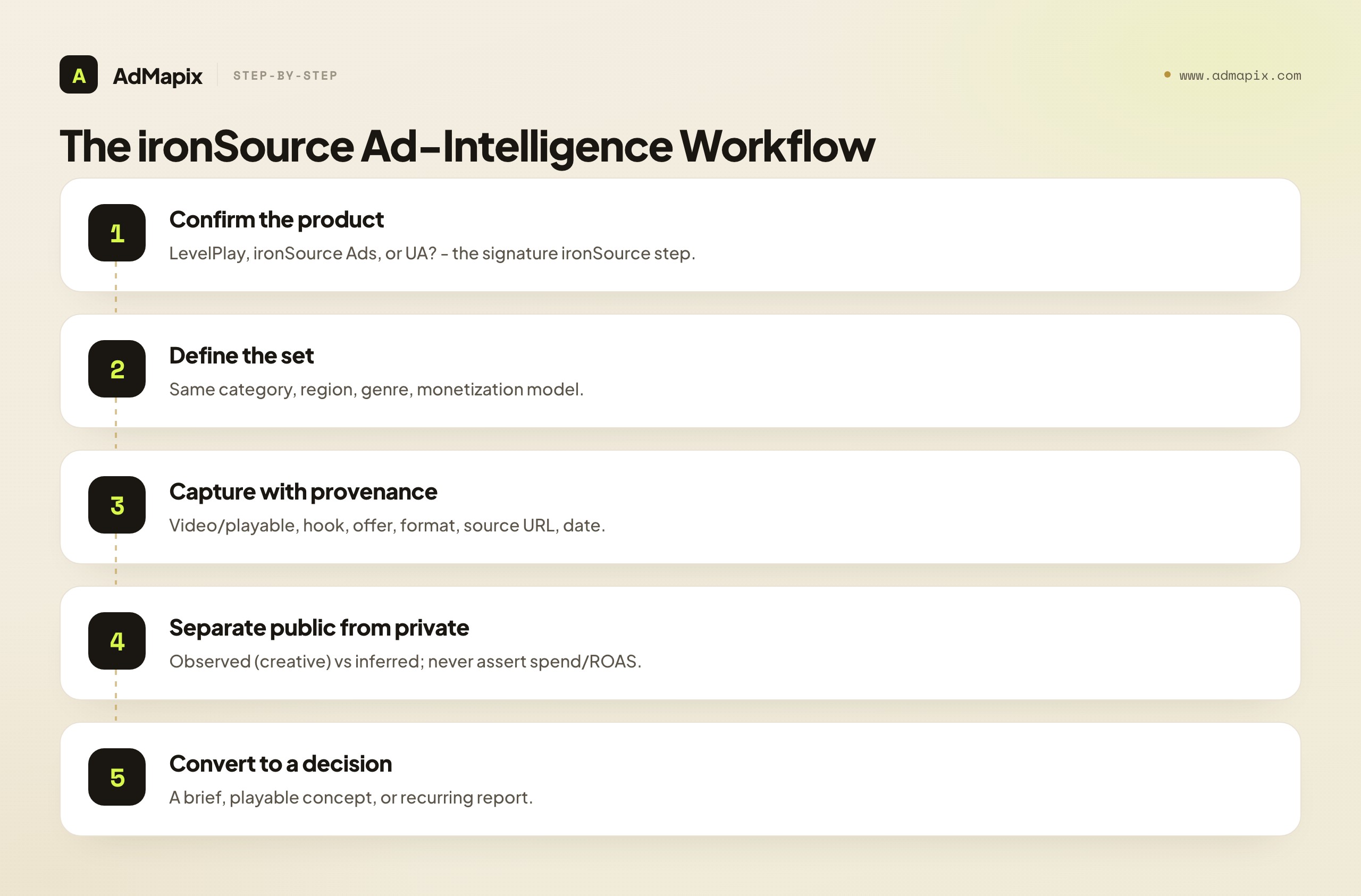
| Step | What you do | Why it matters |
|---|---|---|
| 1. Confirm the product | Decide whether the question is about LevelPlay, ironSource Ads, or UA | Stops you mixing monetization and acquisition signals |
| 2. Define the competitor set | Same app category, region, genre, and monetization model | Keeps comparisons apples-to-apples |
| 3. Capture creative evidence | Save the video/playable, hook, offer, format, app category, source URL, and date | Creates reusable, citable proof instead of a memory |
| 4. Separate public from private | Tag every claim observed (creative) or inferred (never assert spend/ROAS) | Keeps the analysis defensible |
| 5. Convert to a decision | Write a creative brief, playable concept, or recurring report | Turns research into a test you can run |
The step most teams skip is step 4. It's tempting to look at a polished playable and write "they're spending heavily on this" — but a strong creative is evidence of intent, not of budget. Keep observed and inferred in separate columns. And the step unique to ironSource is step 1: because the post-merger product naming is genuinely confusing, confirming whether you're researching LevelPlay (your stack), ironSource Ads (a network), or Unity UA (install buying) is what stops the whole analysis from comparing incompatible things. Research that never becomes a brief produces zero installs — so every loop ends at step 5. For the broader competitor-to-test discipline, see paid ads competitor research.
Reading ironSource Creatives by Format
Different ad formats answer different questions, so judge an ironSource-network creative by what its format is designed to do. ironSource's heritage is monetization and in-app inventory, so its delivery skews toward rewarded and interstitial placements — which makes format an especially telling read here. A rewarded video that opens mid-action is optimizing for completion and reward intent; a playable is testing the actual core loop before install; a static or banner is fighting for a glance. Comparing a playable's "hook" to a banner's "hook" as if they were the same is how research goes wrong.
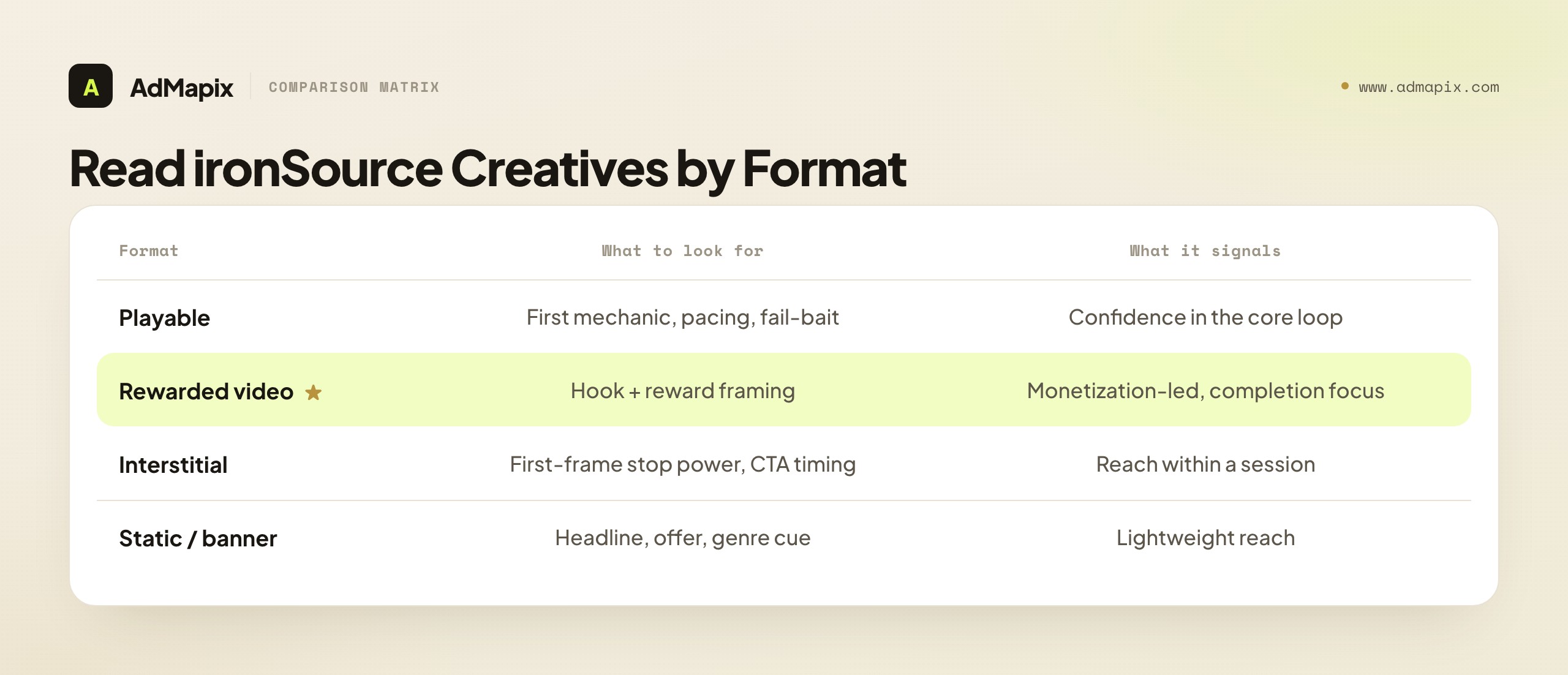
| Format | What it is | What to look for | What it usually signals |
|---|---|---|---|
| Playable ad | Interactive demo of the core loop | Which mechanic shows first, difficulty pacing, fail-bait | Confidence in the core loop as a conversion driver |
| Rewarded video | Opt-in video shown for an in-app reward | Hook in the first seconds, reward framing | Monetization-led placement, completion focus |
| Interstitial video | Full-screen video between sessions | Pacing, CTA timing, offer | Reach and awareness within a session |
| Static / banner | Single image creative | Headline, offer, visual genre cue | Lightweight reach, genre signaling |
Two reads matter most on ironSource specifically. First, the interstitial is a defining format — ironSource's inventory is interstitial-heavy, so a competitor leaning on full-screen interstitial video is playing to the network's strength, and the first-frame stop power of those creatives is worth close study (the user is mid-session and wants to dismiss it). Second, rewarded-video framing reveals monetization intent — a creative built for opt-in, reward-completion placements is a different animal than a scroll-stopping social video, and the value-stack pacing (how it layers benefits over the runtime) is the craft to study. Logging the format of every ironSource creative you capture is non-optional, because on this network the format mix is one of your strongest signals.
Reading Playable and Video Structure in Depth
Beyond the format category, the structure within each creative is where the real intelligence lives. ironSource is playable- and rewarded-heavy, so these two formats deserve the closest read.
For a playable, work through the interaction in order: the first tap (does it get a finger on screen in 2 seconds?), the tutorial framing (does it teach the real mechanic or a fake/simplified one?), the friction-to-reward ratio (taps to the satisfying payoff), the fail-and-retry loop (the "I can do better" driver), and the end-card handoff to the store. Fake-mechanic playables — showing a mechanic the game lacks — win installs and tank retention, so catalog them as a what-not-to-do, not a model. Because playables are interactive HTML5 you usually can't save the file, so record the interaction flow in writing; that teardown survives even though the playable doesn't, and it's enough to brief your own version.
For rewarded and interstitial video, the first three seconds and a single clear payoff carry the result, but the mental state differs. A rewarded viewer opted in for a reward, so the ad can show more and sell harder — study the value-stack pacing. An interstitial viewer wants to dismiss it, so first-frame stop power matters more than anything. Map each video's spine: cut speed, when the mechanic is revealed, where proof lands, and CTA timing. Scoring a rewarded video and an interstitial with one rubric flattens the very differences that decide performance on ironSource's placements.
Why Creative Is the Lever on a Game UA Network
On ironSource Ads and Unity UA, as on every modern game network, the algorithm does much of the audience work — you feed it creative and event signals, and it finds the users that creative converts. The targeting lever UA managers used to master is increasingly the algorithm's job. What remains in human hands is the creative, the format choice, and the objective you optimize toward.
That makes creative research the highest-leverage competitive work available: on a network where the algorithm handles targeting, the creative is the primary differentiator — and the one thing you can observe. Studying competitor creative is studying the biggest determinant of UA success, not a secondary activity. The "I can't see their targeting or spend" complaint matters less than it seems, because there's less targeting to see and spend was never observable anyway; the decisive, observable lever is the creative, and disciplined evidence capture surfaces exactly that.
Reading the Implied Objective
A subtle but valuable read on ironSource creatives is the objective a competitor seems to be chasing — and because ironSource's heritage is monetization, this read is especially worth making. A creative's format and framing often hint at whether the advertiser is optimizing for installs, deeper engagement, or a monetization event, which tells you something about their UA economics you can't get from the creative alone.
- A rewarded-video creative selling the core loop and immediate fun is usually chasing installs and early engagement — common for ad-monetized and hyper-casual games where volume and completion matter most. ironSource's rewarded inventory is a natural fit, so this is a frequent read.
- An interstitial previewing progression, collection, or a power fantasy is often chasing deeper engagement and IAP intent — common for mid-core and RPG titles optimizing toward purchase or high-value events.
- A creative leading with a deal, bundle, or limited offer signals a monetization-event objective — pushing toward a first purchase rather than just an install, which fits ironSource's monetization-led DNA.
You can't confirm the objective from outside, so this stays an inference, labeled as such. But it's a useful one: if every mid-core competitor in your genre runs progression-fantasy interstitials apparently optimized toward deep events, and you're running install-chasing hyper-casual rewarded hooks, that mismatch may explain why your acquired users monetize worse. Reading the implied objective alongside the format and creative is how you catch a strategic gap, not just a creative one — and on a monetization-rooted network like ironSource, this read is more legible than on a pure-acquisition feed. As always, the objective read is a hypothesis that feeds a test, never a fact you assert about a competitor's strategy.
How to Brief a Test From ironSource Research
The step most teams skip is turning a captured pattern into a brief a producer can shoot. A pattern in a format-mix map isn't a deliverable; a brief is. Here's how to write one that survives production.
State the hypothesis as a testable claim. Not "competitors run rewarded-first" but "leading with a near-solve hook in our rewarded creative will lift install rate versus our current full-board reveal." Name the change, the expected effect, and the metric.
Specify the structure and format, not the asset. Describe the beats and the format to produce them in (rewarded video, per your format-mix read), adapting the competitor's structure to your real mechanic — never reuse their footage. The reusable intelligence is the skeleton and the format choice, not the skin.
Set the success metric and kill condition before production. "Beat control on install rate over a 7-day test; kill if it underperforms by 15%+." Writing the kill condition before you're invested removes sunk-cost emotion from the decision.
Cite the repetition evidence and confidence. "Six independent competitors converged on this rewarded near-solve hook, each running many variants over two months — high confidence." This makes the bet evidence-backed and the result interpretable.
Honor the genre's promise on a real mechanic. The hook must fit your genre's emotional promise and map to a real moment in your game — never a fake mechanic, which churns the users it acquires. A brief built this way is the bridge between ironSource research and shipped, validated creative; without it, even excellent research dead-ends in a document.
A Worked Example: From ironSource Creatives to a UA Test
Here's the whole workflow on a real decision. A casual-game studio buying installs through ironSource Ads sees a competitor's category presence growing and wants to know which creative angle to test next — and their "research" is a folder of screenshots nobody acts on, plus a teammate insisting "we should check ironSource for their spend."
Confirm the product + set. The UA manager first corrects the framing: ironSource Ads is a network they buy through, and there's no way to see the competitor's spend — so the research question is creative, not financial. She locks the set: casual puzzle games, US market, ad-monetized, and pays attention to format from the start.
Capture + format read. Over a week she captures ~20 competitor creatives with full provenance — format, hook, mechanic, offer, source, date. Logging format, a pattern emerges: the fastest-growing competitors run rewarded-video creatives with a "near-solve" hook (the player one move from clearing a board) plus interstitials that lead with the same near-solve — a consistent hook across the two formats ironSource favors. Her studio's creatives bury the near-solve until late.
Separate + classify. She keeps observation ("near-solve hook, rewarded + interstitial, run across many variants by three competitors") apart from inference ("looks like it's working" — labeled a guess), and marks spend/ROAS unknown. The convergence across three advertisers, plus the variant volume, makes "near-solve hook in the first 2 seconds" a strong hypothesis, not an anecdote.
Brief + validate. Her brief isolates the opener: "near-solve hook in seconds 0–2 vs our current full-board reveal, in both rewarded and interstitial, everything else held constant, 7-day test, kill if 15% under control." She builds it on her game's real boards (no fake mechanic), ships it, and it lifts install rate and holds D1. The competitor creatives didn't tell her what to copy — the convergent hook-and-format pattern told her what to test, and her own funnel confirmed it.
The lesson: confirming the product killed the "check their spend" dead end; reading format surfaced that the hook worked across both of ironSource's favored placements; and her own data, not the competitor's apparent growth, proved the win.
It's worth naming what she didn't do, because it's where most teams go wrong. She didn't waste a day trying to "find the competitor's ironSource budget" — she recognized that's unobservable and reframed the question as creative. She didn't act on the single creative she'd seen most often — she acted on the hook that recurred across three independent advertisers and many variants, the strongest form of the repetition signal. She didn't copy the competitor's footage — she adapted the near-solve structure to her own real boards, staying on the right side of both copyright and retention. And she didn't present "they're scaling this" as a fact to her studio lead — she framed it as a high-confidence hypothesis backed by convergence and variant volume, then let her 7-day test be the judge. Each of those is a discipline this guide has named, and together they're the difference between research that compounds into wins and research that produces a folder of admired-but-unactioned screenshots. The method isn't complicated; it's consistently applied, every week, which is exactly why the studios that run it out-iterate the ones that don't — and on ironSource, fixing the product confusion up front is the step that unlocks the rest. Skip that first step and even the most disciplined creative capture downstream gets attributed to the wrong surface, the wrong objective, and ultimately the wrong test; fix it, and every subsequent step in the workflow lands where it should, compounding cleanly into a creative pipeline that consistently out-tests competitors who never bothered to untangle what "ironSource" even means in 2026.
ironSource Ad Research Tools, Compared
There's no "ironSource ad library" with a search bar, because Unity publishes none. Tools split by how they help you capture and analyze the creative you can observe across the game-network landscape.
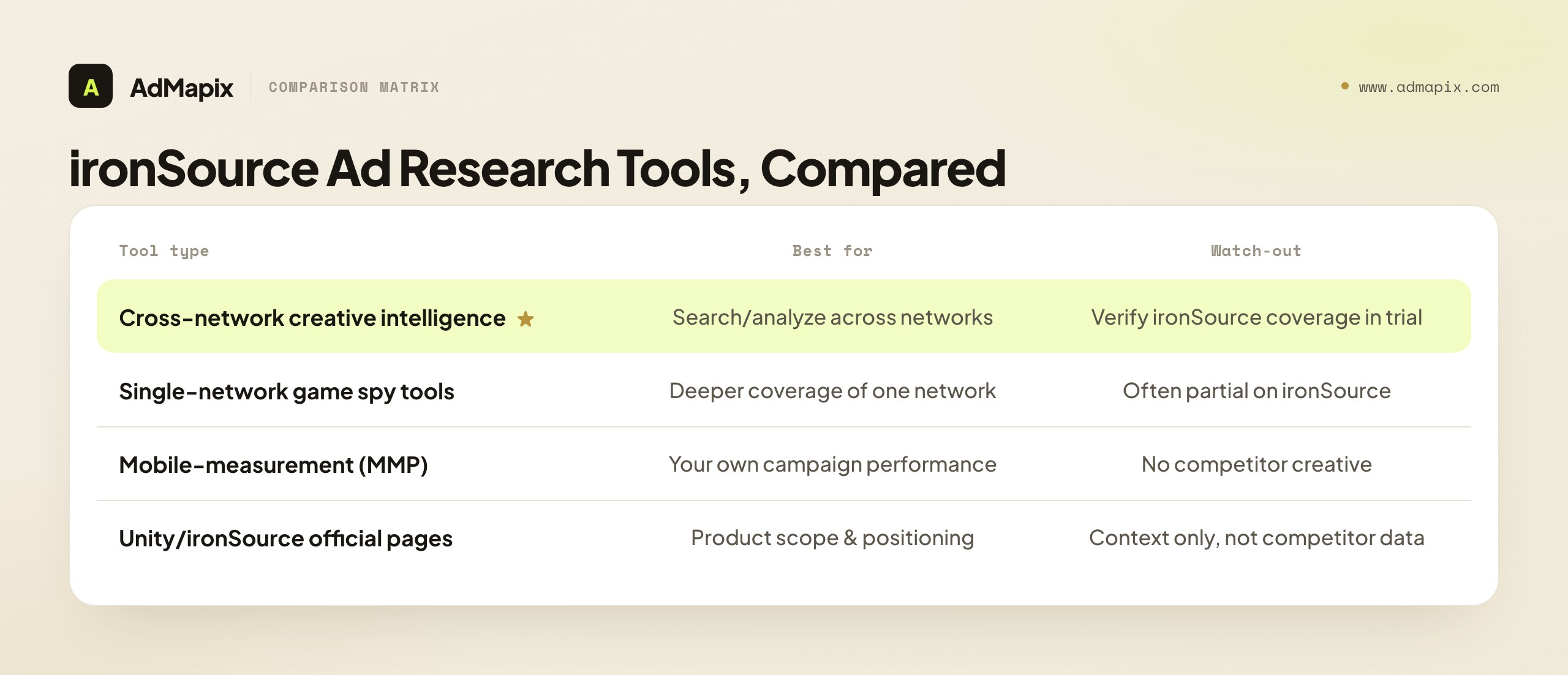
| Tool type | Best for | Watch-out |
|---|---|---|
| Cross-network creative intelligence (e.g., AdMapix) | Searching, saving, analyzing & reporting game creatives across networks | Verify ironSource/Unity coverage for your genre in a trial |
| Single-network game spy tools | Deeper coverage of one network | Often partial on ironSource; blind to other networks |
| Mobile-measurement partners (MMPs) | Your own campaign performance | Show your data, not competitor creative |
| Unity/ironSource official pages | Product scope and positioning | Context only — not competitor data |
No tool gives you an ironSource "ad library" because there isn't one. What good tools give you is a way to aggregate, search, and analyze the creatives observable across the in-app ecosystem, plus the cross-network view showing how the same studio adapts a concept across ironSource, Unity, AppLovin, and more. Because ironSource and Unity now share inventory, treating them together in your research set is practical. Judge any tool on its actual coverage of your genre and networks in a trial. For the full landscape, see best ad spy tools 2026 and marketing intelligence tools.
A Repeatable Weekly Research Loop
ironSource creative research compounds as a habit. Here's a lightweight weekly loop that takes under an hour and builds a real asset over time.
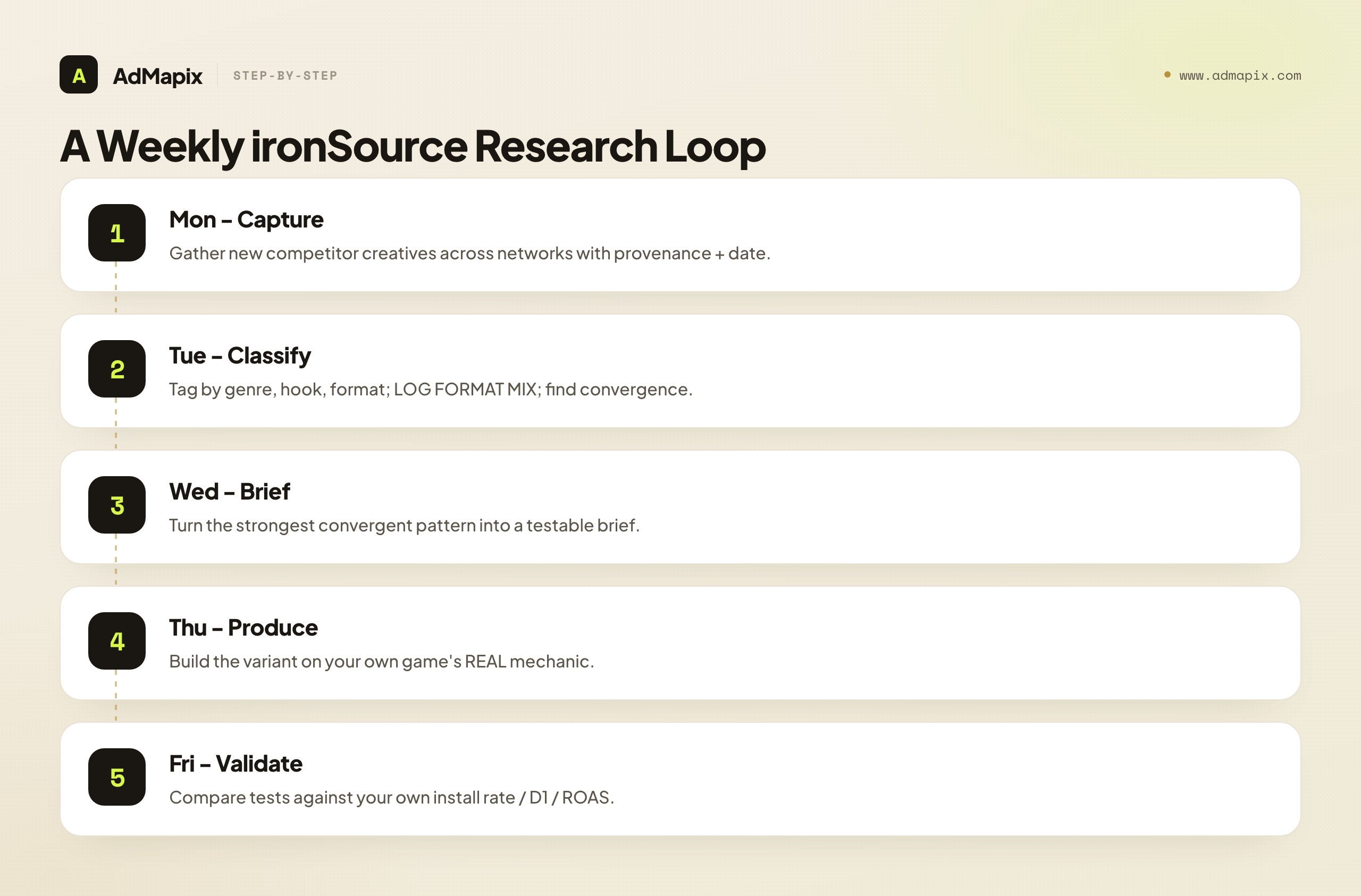
| Day / step | Action | Output |
|---|---|---|
| Monday — capture | Gather new competitor creatives across networks with full provenance + date | Fresh, dated, cited evidence |
| Tuesday — classify | Tag by genre, hook, format; log the format mix; find cross-advertiser convergence | Updated genre + format map |
| Wednesday — brief | Turn the strongest convergent pattern into a testable creative brief | A ready-to-produce concept |
| Thursday — produce | Build the variant on your own game's REAL mechanic | A test-ready creative |
| Friday — validate | Compare last week's tests against your own install rate / D1 / ROAS | Promote, kill, or iterate |
Three rules keep it honest: confirm the product and log the format every time (ironSource's surfaces and formats are its defining signals); trust convergence over a single creative (many variants across many advertisers is the real signal); and always end on your own data (a strong creative is intent, not proof; only your test proves performance). A team running this loop for a quarter builds a dated, searchable, cited history of what's serving in their genre — an asset no single audit matches. For the cross-platform version, see how to spy on competitors' ads in 2026.
Research at Scale: Agencies and Portfolios
Everything above scales differently when you research ironSource for several games or clients at once, and a few adjustments keep a multi-account workflow from collapsing.
The core change is structure for reuse by genre and format, not by client. An agency running ironSource research for six game clients needs the evidence tagged so a format-and-hook insight found for Client A's puzzle game is instantly findable when Client B launches a puzzle game — because creative patterns transfer by genre, not by account. Tag genre and mechanic first, client second.
The second adjustment is making the research a billable deliverable. A recurring per-client report showing the genre's format mix, convergent hooks, and the specific tests you briefed — plus an explicit note on the product surfaces in play (LevelPlay vs ironSource Ads vs UA) so the client isn't confused — is proof of work that renews retainers. A folder of screenshots is invisible labor; a dated, structured report is a deliverable.
The third is separating shared genre intelligence from account-specific reads. A genre-wide convergence applies to every client in that vertical; a specific competitor a single client tracks is account-bound. Keep the shared layer reusable and the account layer scoped. At portfolio scale, this doesn't hold together by hand — which is where a tool that makes captured game creatives searchable, cross-network, and reportable becomes the only way the workflow survives more than a couple of accounts.
ironSource in the Game-Network Landscape
ironSource isn't the only library-less game network, and understanding how it relates to its peers — especially now that it's Unity-owned — sharpens your research. The major in-app game networks and DSPs share a defining trait: none publishes a public ad library. But they differ in emphasis, which affects what creative you'll observe and how to weight it.
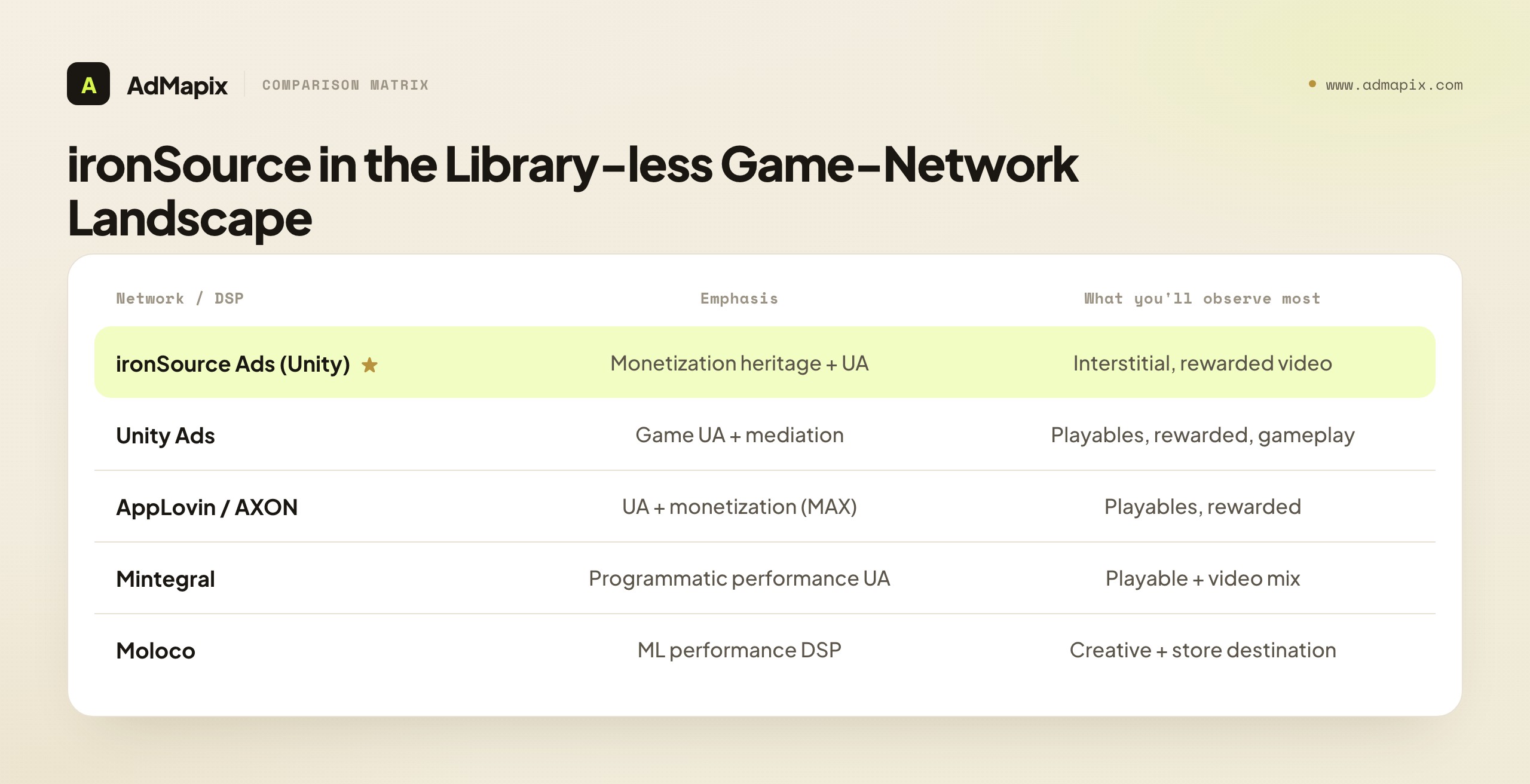
| Network / DSP | Emphasis | What you'll observe most | Research note |
|---|---|---|---|
| ironSource Ads (Unity) | Monetization heritage + UA | Interstitial, rewarded video | Format mix is a strong read; now shares Unity inventory |
| Unity Ads | Game UA + mediation, ROAS/events | Playables, rewarded, gameplay | Overlaps with ironSource post-merger — see the Unity guide |
| AppLovin / AXON | UA optimization + monetization (MAX) | Playables, rewarded | Playable-heavy; separate MAX from AXON |
| Mintegral | Programmatic performance UA | Playable + video mix | Variant volume and breadth |
| Moloco | ML performance DSP | Creative + store destination | Pure-DSP read — see Moloco ad intelligence |
The practical implication: because all are library-less, the research method is the same across them — capture observable creatives, classify by pattern, never infer spend. But ironSource's specific heritage in monetization and interstitial inventory means its format-mix read is especially central, and its post-merger overlap with Unity means you should treat the two together in a research set (they increasingly share inventory and tooling). The broader lesson is that a cross-network tool beats a single-network one: your competitors run across ironSource, Unity, AppLovin, and more, and seeing how one studio adapts a concept across all of them teaches you more than any single network's slice. For the network-by-network method, see mobile app ad spy tool.
Building a Format-Mix Map
The concrete output that makes ironSource research uniquely actionable is a format-mix map: a structured view of which formats each competitor leans on, in what proportion, for which concepts. Because ironSource's inventory skews interstitial- and rewarded-heavy, the format mix is your highest-value artifact — and most teams never build it because the social-feed mindset treats all creative as one bucket.
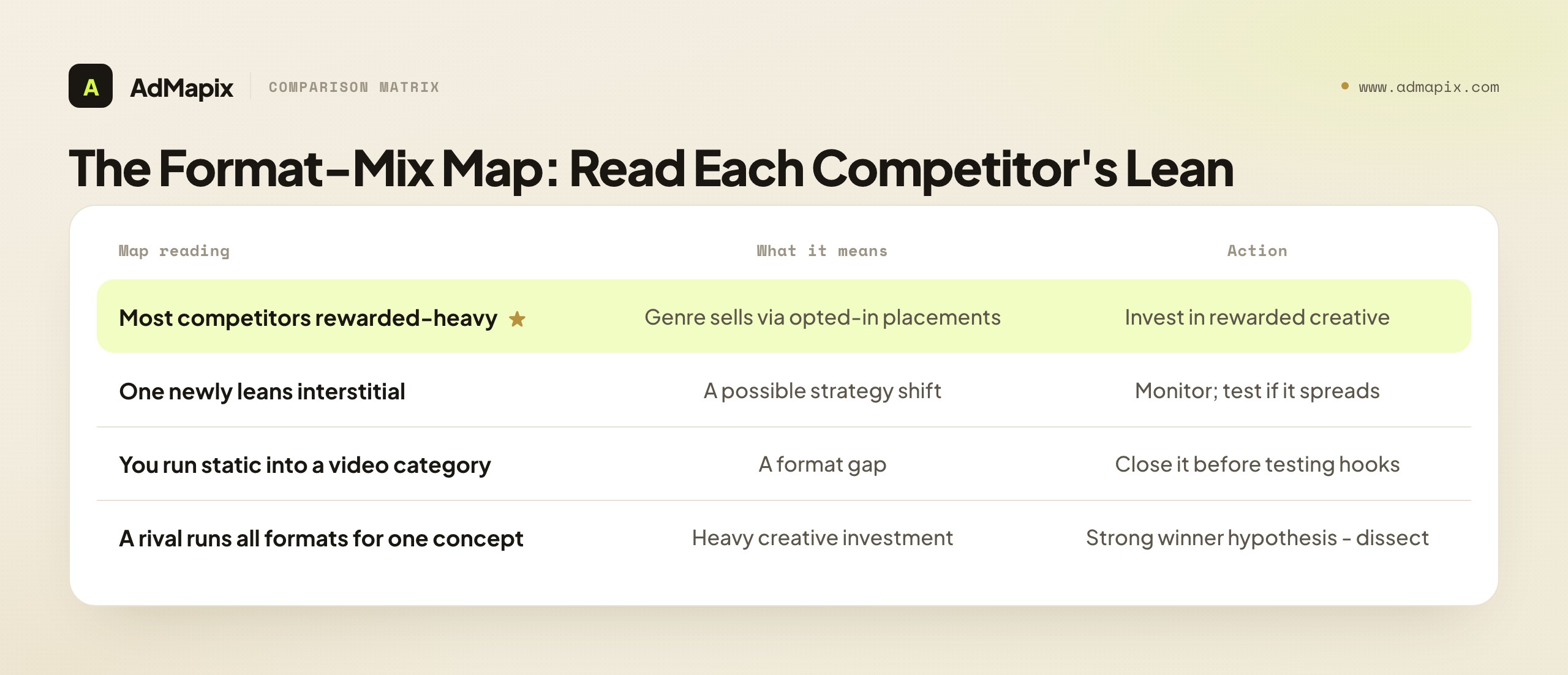
The map is simple. List your tracked competitors down one axis and the formats (playable, rewarded video, interstitial, static) across the other, then estimate each competitor's lean from your captured sample — for example, "Competitor A: 50% interstitial, 30% rewarded, 20% playable." Two readings fall out:
- Per-competitor lean. An interstitial-heavy competitor is betting on full-screen reach and first-frame stop power; a rewarded-heavy one is optimizing for opted-in, completion-focused impressions. Each lean is a strategic read you can position against.
- Category-wide convergence. When most competitors independently lean the same way (e.g., "everyone in casual runs rewarded-first"), that's a strong category pattern — the format your genre has decided sells best. If your studio is under-invested in that format, the map just found your biggest gap.
| Map reading | What it means | Action |
|---|---|---|
| Most competitors are rewarded-heavy | The genre sells through opted-in, completion-focused placements | Invest in rewarded creative |
| One competitor newly leans interstitial | A possible strategy shift to watch | Monitor; test if it spreads |
| You run static-heavy into a video/playable category | A format gap | Close it before testing hooks |
| A competitor runs all formats for one concept | Heavy creative investment in that concept | Strong "winner" hypothesis — dissect it |
Rebuild the format-mix map each weekly loop, and over a quarter it reveals movement — formats entering and exiting favor in your genre, which is a lifecycle read a one-off audit misses. The format-mix map is what makes ironSource research defensible: instead of "I saw some interstitials," you get "the casual category has converged on rewarded-first delivery over the last two months, and we're under-invested in rewarded creative" — a sentence a studio lead will fund.
Repetition: The Strongest Signal You Get
Since you can't see spend or ROAS on ironSource, you need proxies — and repetition is the strongest honest proxy public evidence offers. But reading it well is what separates a defensible deck from a guess. There are three kinds of repetition, and they're not equally strong.
| Type of repetition | What it suggests | Strength |
|---|---|---|
| Many variants of one concept by one advertiser | That advertiser likely found a winner and is iterating it | Medium-strong |
| The same concept run over a long time | Durability — it kept earning its place in rotation | Medium-strong |
| The same structure across many independent advertisers | A genre-wide pattern that works | Strongest |
The weakest reading is "I saw this ad a lot," because what you saw is shaped by what the system served you, not by true frequency. The strongest is cross-advertiser convergence: when six independent studios in your genre all run the same near-solve rewarded hook, that agreement can't be explained by your sampling bias — it reflects six separate teams' creative decisions landing on the same structure. The second-strongest is variant volume from a single advertiser: building a playable, three video cuts, and a static around one concept signals real investment you don't make in a concept you don't believe in.
The practical method: rank every pattern by which kind of repetition supports it, label each pattern's confidence (high / medium / low) explicitly in your brief, and put genre-wide convergence at the top of your test backlog. This ranking discipline turns "repetition" from a vague intuition into a defensible signal — and on a network with no spend data, it's the closest thing to a performance read you'll get without running the test yourself. Even the strongest repetition signal, though, is a hypothesis: genre-wide convergence tells you a structure works in the category, not that it'll work for your game. So the repetition read always ends as a test brief your own funnel validates, never a conclusion you act on blind.
Getting Started: Your First ironSource Research Sweep
If this is your first structured ironSource research session, here's the minimum viable version you can run today.
First, fix the names. Spend ten minutes confirming that ironSource is now Unity, and that "ironSource" might mean LevelPlay (mediation), ironSource Ads (a network), or Unity UA. Decide which surface your question is really about — for competitor creative research, it's the network/UA side, and the answer is creative evidence, not spend.
Second, pick one genre and 3–5 competitors in your target market and monetization model. A tight set produces sharper convergence than a broad sweep.
Third, gather a starting sample with full provenance — a cross-network tool plus in-app observation, capturing format, hook, mechanic, offer, source, and date for each creative, and logging the format mix. Aim for 15–20 creatives. Label everything observed / inferred / unknown from the start.
Fourth, find one convergent pattern — the single clearest thing multiple competitors independently do (a format lean, a hook convergence) that you don't. Act on what recurs across advertisers and variants, not the creative you happened to see most. That's your first test.
Fifth, write one brief and ship one test on your own game's real mechanic, isolating one variable, with a metric and kill condition set before production. One shipped, validated test beats a research doc that never becomes a creative.
Then repeat weekly. The first sweep is the hardest — you're building the muscle, the genre-and-format map, and the discipline of fixing the product confusion from scratch. By week three the loop takes under an hour, and the map shows not just what's converging but how the format mix and hooks are moving over time — the timing intelligence that turns a research habit into a UA edge.
What the ironSource-Unity Merger Means for Researchers
The 2022 ironSource-Unity merger isn't just a naming headache — it reshaped the game-UA network landscape in ways that matter for how you research competitors. Three consequences are worth internalizing, because they change what your evidence set should look like.
First, ironSource and Unity increasingly share inventory and tooling, which means a competitor's creative may serve across both surfaces, and treating them as two unrelated networks under-counts that competitor's reach. The practical move is to research the combined Unity-ironSource surface as one ecosystem in your competitor set, not as separate silos. A studio you see running rewarded creative on ironSource is very likely the same studio whose playables you see on Unity — and reading both together gives you their fuller creative strategy.
Second, the merger concentrated a large share of in-app game UA inventory under one company. Between Unity Ads, ironSource Ads, and LevelPlay's mediation reach, a substantial portion of where mobile games are advertised and monetized now sits in one place. For competitor research, that concentration is double-edged: it means more of your competitors' game-UA creative passes through Unity-ironSource surfaces (more to potentially observe), but it also means none of it comes with a public library (the concentration didn't add transparency). The research method — capture observable creative, never infer spend — is unchanged; the scope of what runs through these surfaces just grew.
Third, the naming confusion is a durable trap, not a temporary one. Years after the merger, "ironSource," "ironSource Ads," "LevelPlay," "Unity Ads," and "Unity UA" still circulate as if they were five separate things, and teammates, clients, and even vendors mix them up constantly. The researcher who can crisply say "you mean ironSource Ads, the network — not LevelPlay, the mediation layer" saves their team from comparing incompatible signals. This clarity is itself a deliverable: a research brief that explicitly states which surface each finding pertains to is more credible and more actionable than one that blurs them.
| Merger consequence | What it changes for research |
|---|---|
| Shared inventory across Unity + ironSource | Treat them as one ecosystem in your competitor set |
| Concentrated game-UA inventory | More competitor creative flows through these surfaces — but still no library |
| Durable naming confusion | Always state which surface (LevelPlay / ironSource Ads / Unity UA) a finding is about |
The broader takeaway: the merger made the "fix the names, capture the creative, never infer spend" discipline more important, not less. As game-UA inventory concentrates under Unity-ironSource, the teams that research the combined surface methodically — confirming the product, logging the format mix, ranking by repetition strength — will read their competitive landscape more accurately than teams still treating ironSource as a standalone network with a library it never had.
Common Mistakes
- Expecting a full public ad library. ironSource and Unity publish product context, not a searchable record of every competitor campaign and its budget. Plan for evidence collection, not a lookup.
- Confusing mediation with UA. LevelPlay (monetization control) and the UA suite answer different questions; mixing them produces meaningless comparisons. This is the signature ironSource error.
- Treating "ironSource" as one product. Post-merger, it's LevelPlay, ironSource Ads, and Unity UA — three surfaces. Confirm which one a question is about before researching.
- Judging every format the same way. A playable, a rewarded video, and an interstitial have different jobs and should be evaluated on different criteria.
- Overclaiming private data. Inferring spend, ROAS, or targeting from a visible creative is a guess, not evidence — and the fastest way to lose trust.
- Copying fake-mechanic playables. A playable showing a mechanic the game lacks wins installs and tanks retention — note it as a what-not-to-do, don't replicate it.
- Saving screenshots with no provenance. A creative without its source URL, date, and app category is hard to cite and easy to misread later.
When to Use AdMapix
AdMapix fits after you've confirmed official scope and started collecting creatives — it's the layer that turns scattered examples into a searchable, reportable system. It's built for cross-network ad creative search, so you can study how competitors advertise across networks rather than re-checking one product page at a time.
Use Search AdMapix to widen creative discovery across networks, Media to keep saved examples searchable and tagged, Video Analysis to break down how a video or playable ad is structured, and Reports to turn the patterns into a team- or client-ready output. Compare access levels on Pricing, and create an account from Login when this research becomes recurring instead of one-off.
It's for UA and creative teams who run competitor research often and need evidence they can search, tag, and hand to a client. It's not for anyone hoping to pull a specific competitor's spend, ROAS, or targeting — no public tool, including AdMapix, exposes private account data. We're honest about that because a tool claiming to know a competitor's ironSource spend would be inventing numbers, and on a game network those numbers stay private.
FAQ
Is ironSource the same company as Unity now?
Yes. Unity and ironSource completed their merger in 2022, and the products you research today sit under Unity. The relevant surfaces are Unity LevelPlay for mediation and monetization control and ironSource Ads as a network for monetization and user acquisition. When researching "ironSource," always confirm which of these surfaces a question is actually about.
Is there an ironSource ad library to spy on competitors?
No. There's no official public ironSource ad library that exposes a competitor's full campaign set, spend, or targeting. You can collect the creatives themselves — formats, hooks, and offers — but performance numbers stay private and account-level. "ironSource ad intelligence" therefore means building your own creative-evidence workflow, not searching a database that doesn't exist.
What is the difference between LevelPlay and ironSource Ads?
LevelPlay is Unity's ad mediation platform for managing revenue, user acquisition, and monetization control across networks — it orchestrates your own stack. ironSource Ads is described as a network solution to manage monetization and acquire high-quality users — it's a network you buy and monetize through. One is a control layer over many networks; the other is a single network. Confusing them is the most common ironSource research error.
What can I actually learn from a competitor's ironSource creatives?
You can learn the format mix (playable, rewarded, interstitial, static), the hook in the first seconds, the offer, the genre and app category, and roughly when and where a creative ran. On ironSource specifically, the format mix is a strong signal because the network is interstitial- and rewarded-heavy. You cannot derive spend, ROAS, or audience targeting from a creative alone — those are private.
How is researching ironSource different from researching Meta or TikTok?
Meta and TikTok run public ad-transparency libraries that list active ads per advertiser. ironSource (Unity) doesn't, so the workflow shifts from "look it up" to "collect and pattern-match." There's also the post-merger naming layer ironSource uniquely adds — you must first confirm whether the question is about LevelPlay, ironSource Ads, or Unity UA, which has no parallel on the social platforms.
Why does format mix matter so much on ironSource?
Because ironSource's heritage and inventory skew toward rewarded and interstitial placements, the format a competitor leans on reflects which placements and economics they're betting on. A rewarded-heavy strategy signals monetization-led, completion-focused intent; an interstitial-heavy one plays to the network's reach. On a video-first social feed this read is weaker; on ironSource the format mix is one of your most telling signals.
How do I read an ironSource playable I can't download?
Playables are interactive HTML5, so you usually can't save the file — record the interaction in writing. Note the first tap (finger on screen in 2 seconds?), the tutorial framing (real or fake mechanic?), the friction-to-reward ratio, the fail-and-retry loop, and the end-card handoff. That written teardown survives even though the playable doesn't, and it's enough to brief your own version on a mechanic you can honestly deliver.
Can I see a competitor's ironSource spend or ROAS?
No. Spend, ROAS, retention, CPI, and targeting are account-level data that ironSource and Unity don't expose publicly. You can observe and infer from the creatives themselves, but any report stating a competitor's ironSource spend as fact is fabricating it. Label spend, ROAS, and targeting as unknown, and let your own test data be the only performance truth.
How often should I run ironSource creative research?
A weekly 30–60 minute loop suits most game UA teams: capture new creatives with provenance, log the format mix, classify patterns, brief a test, and validate last week's results. High-spend studios and agencies may go twice weekly; pre-launch teams might do a focused one-time dive on 3–5 genre leaders. Match the cadence to how fast you ship new creative.
Where does AdMapix fit in ironSource ad intelligence?
AdMapix comes after the official-source check. It lets you search ad creatives across networks, save the strongest examples as searchable media, tag and analyze video or playable structure, and turn the patterns into recurring reports — so research stops living in scattered screenshots. It doesn't provide private account metrics; it organizes the public creative evidence you gather into a repeatable, cross-network workflow.
Related Reading
- Unity Ads spy tool — the Unity-side guide (ironSource is now Unity-owned)
- AppLovin ads spy tool & ad intelligence — an adjacent game network deep dive
- Moloco ad intelligence — researching an ML performance DSP
- Mobile game ad spy tool — the genre-wide game UA playbook
- Mobile app ad spy tool — the broader cross-network app method
- Best ad spy tools 2026 — the full tool landscape
Sources
Official sources verified as of June 21, 2026. Mobile ad network products, names, and documentation change over time, so confirm the current official path before building a recurring workflow.
- Unity LevelPlay — describes LevelPlay as an ad mediation platform for revenue, user acquisition, and monetization control.
- ironSource Ads in Unity Docs — describes ironSource Ads as a solution to manage monetization and acquire high-quality users.
- Unity User Acquisition docs — describes the User Acquisition suite as a way to attract high-value users and grow a game with scalable, targeted advertising.
- Unity Ads — the Unity Ads product, now sharing inventory and tooling with ironSource post-merger.
Bottom Line
ironSource ad intelligence in 2026 starts by fixing two things: the name (ironSource is now Unity — LevelPlay, ironSource Ads, and Unity UA are three surfaces) and the expectation (there's no public library exposing spend, ROAS, or targeting). The right research is a discipline: confirm which product a question is about, capture the observable creative evidence with strict provenance (format, hook, offer, especially the format mix on this rewarded- and interstitial-heavy network), separate what you can prove from what you can only infer, and turn convergent patterns into UA test briefs.
You can't see private numbers; you can see the creative and the format mix — and on a network where the algorithm handles targeting, that creative is the lever that most decides outcomes. Confirm the product, capture with provenance, read the format, trust convergence over any single creative, and validate with your own funnel. That's how ironSource ad intelligence becomes a creative pipeline instead of a screenshot graveyard — and the same method transfers to every library-less game network your competitors run.
The broader takeaway reaches past ironSource. As game-UA inventory concentrates under Unity-ironSource and spend keeps flowing through other library-less networks — AppLovin, Mintegral, Moloco — the research method built here is the one that travels: fix the product naming, capture observable creative with provenance, log the format mix, rank patterns by repetition strength, refuse to infer private numbers, and let your own funnel be the final judge. The teams that internalize this aren't just better at researching ironSource; they're built for the network landscape mobile game UA actually runs on, where the easy library lookup never existed and the durable edge belongs to whoever turns observable creative into validated tests fastest, week after week. The absence of an ironSource ad library — and the naming confusion the merger layered on top of it — isn't a wall; it's a filter that rewards the studios disciplined enough to do the evidence work properly while their competitors wait for transparency that isn't coming. Run the loop, fix the names, trust convergence over frequency, and the discipline compounds into a competitive advantage that no amount of guessing about competitor spend can match.
When manual screenshotting across the game networks stops scaling, start with AdMapix Search, keep examples searchable in Media, and break down structure in Video Analysis — built for exactly this job, across the library-less networks where mobile game UA actually happens and where disciplined creative evidence, not a public library, is the only competitive advantage available to the studios willing to do the work week after week.
Turn these observations into your next creative study
Open the creative library and select samples for your market, network and research question.
Related Articles
App Store Competitor Keyword Ads in 2026: How to Research, Structure, and Bid Them
A complete 2026 guide to App Store competitor keyword ads — what they are, why Apple treats competitor terms as their own campaign, how to decide which rival names are worth bidding on, how to structure an exact-match competitor campaign with CPT and rank discipline, how to build a switcher-focused custom product page, the unit economics and stop-loss rules that keep it profitable, the search evidence to capture first, the honest limits of public data, and where AdMapix fits.
Twitter Ads Library in 2026: Where X Ads Live Now and What You Can Actually See
A complete 2026 guide to the Twitter Ads Library — why there is no product by that name, how the X Ads Repository works as a DSA transparency tool, exactly what it shows and hides, why access is EU-scoped, how to read funding-entity and reach data, how to research X competitors inside and outside the EU, how it compares to other ad libraries, the honest limits of public ad data, and where a cross-network creative tool like AdMapix fits.
Apple Search Ads Spy Tool in 2026: What You Can Actually See, Track, and Reverse-Engineer
A complete 2026 guide to Apple Search Ads competitive research — why no spy tool can pull a rival's private bids or spend, what the live App Store ad slot actually proves, how ASA's structure (Basic vs Advanced, the four campaign types) shapes what you can observe, a repeatable keyword-tracking workflow, how to read bid and rank signals from your own account, how to turn observations into a keyword map and a bid-test plan, the honest limits, and where AdMapix fits.