
Unity Ads Spy Tool in 2026: How to Research Mobile Game UA Creatives Without a Library
The 2026 guide to researching Unity Ads competitors: why there's no public Unity ad library, what creative evidence you can and can't observe, a game-UA workflow, reading playable and video structure, format-mix analysis, and turning patterns into testable UA briefs.
By the AdMapix Research Desk — Updated June 21, 2026
Unity Ads Spy Tool in 2026: How to Research Mobile Game UA Creatives Without a Library
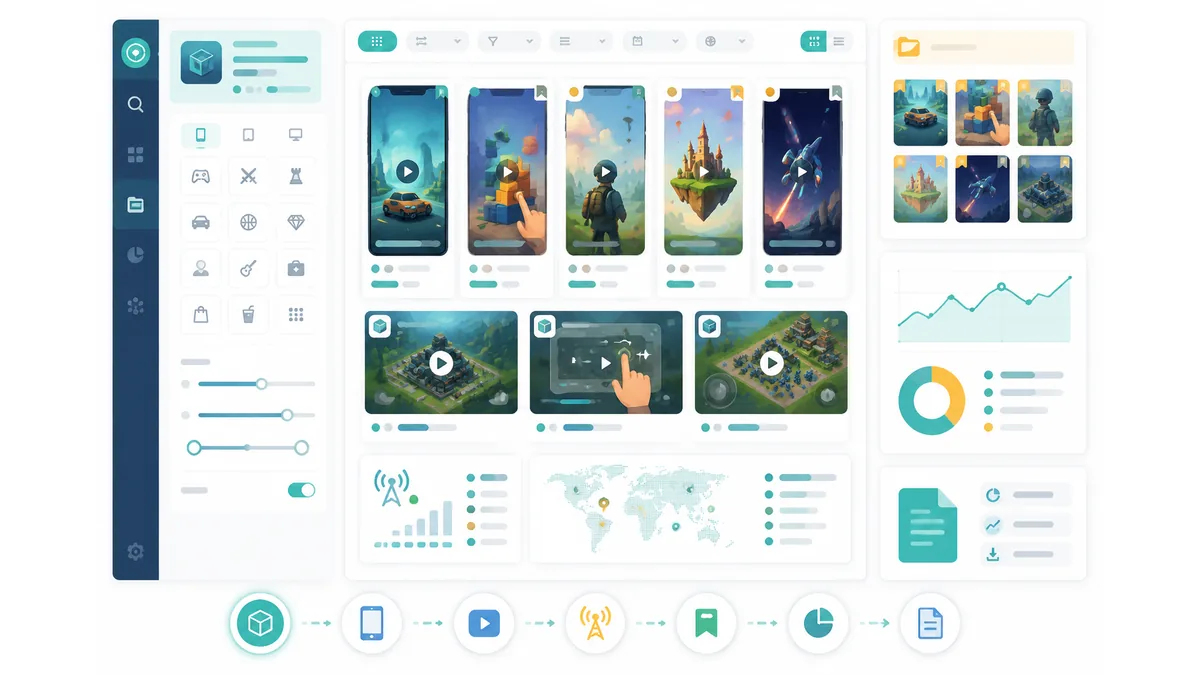
There is no official Unity Ads spy tool that exposes a competitor's full campaign library — because Unity Ads is a user-acquisition and monetization network, not a public ad-transparency library. Unlike Meta or TikTok, Unity publishes product documentation, not a searchable feed of who's running which creatives. So useful research means tracking the creative patterns you can observe: playable hooks, video pacing, the format mix, the event or ROAS goal the ad implies, and the concepts a studio repeats across formats. "Unity Ads spy tool" is, in that sense, the wrong search — and this guide is about what to do instead.
It's written for mobile game UA managers, game studios, creative strategists, and UA agencies who want a repeatable way to capture that evidence and convert it into test briefs. It covers why a game UA network changes the research task, the hard line between what creative evidence can and can't prove (spend, ROAS, and targeting are off-limits), a game-specific workflow, how to read playable and video structure (Unity is playable- and rewarded-heavy), format-mix analysis, and how to turn patterns into UA briefs. We'll be honest throughout: you can study the creative, never the private numbers.
The core principle, up front: the realistic goal isn't "see every Unity ad my competitor runs" — it's "collect enough creative evidence to infer the patterns that matter and build better tests." The one honest inference public evidence supports is that a concept a studio runs in many variants over time is probably a tested winner worth testing against — a hypothesis, never a measured result.
For the broader app-network method, see our mobile app ad spy tool guide; for adjacent networks, the AppLovin ads spy tool and Moloco ad intelligence deep dives; for the games-wide playbook, mobile game ad spy tool; and for the full landscape, best ad spy tools 2026.
TL;DR — Researching Unity Ads in 2026
- No tool legally exposes a competitor's complete Unity Ads campaign library. Unity is a UA/monetization network with no public ad library — research means reading observable creative patterns, not private account data.
- Focus on what you can verify: playable hooks, video pacing, format mix (rewarded vs interstitial vs playable vs static), the genre and mechanic shown, and the offer or event the ad optimizes toward.
- Repetition is the strongest public signal — but it's a hypothesis, not proof. A concept run in many variants over time is probably a winner worth testing against; label it as a hypothesis, never a measured number.
- You cannot infer spend, ROAS, CPI, retention, or targeting from a visible creative. Any report stating those as fact is fabricating them.
- Score each format on its own rules. A playable, a rewarded video, an interstitial, and a static all do different jobs — one rubric flattens them.
- The workflow ends in a brief. Read official context, define a tight set, capture evidence with context, separate observation from inference, and convert each cluster into one testable output.
Why a Game UA Network Changes the Research Task
Unity Ads is a user-acquisition and monetization network for mobile games, not a public ad library, so it doesn't publish a searchable feed of who's running which creatives. That single fact reshapes the whole task. Meta and TikTok run public ad-transparency libraries; mobile game networks like Unity expose product documentation, not competitor campaigns. So the realistic goal is not "see every Unity ad my competitor runs" but "collect enough creative evidence to infer the patterns that matter and build better tests."
| Question you might ask | Answerable for Unity Ads? |
|---|---|
| "Show me every creative competitor X runs on Unity" | No — no public library exists |
| "What's competitor X's Unity budget or ROAS?" | No — account-level, private |
| "What's their targeting and bid strategy?" | No — private |
| "What playable hooks and formats are common in my genre?" | Yes — with disciplined evidence capture |
| "What concept should I test next?" | Yes — that's the whole point |
What that evidence looks like for game UA: the playable's first interaction, the video's first three seconds, the failure or reward loop being shown, the genre and core mechanic on display, the call to action, and the format. Group those by genre, mechanic, and offer, and you get a creative map you can act on — even without a single private number. The shift is from "look it up" (the library mindset) to "collect and pattern-match" (the evidence mindset), and getting that shift right is most of the battle.
Unity occupies a specific spot in the game-UA ecosystem: it's a network with its own owned-and-operated game inventory plus a UA product optimizing toward ROAS and in-app events. That matters because the creatives that survive on Unity are the ones that earned installs at the advertiser's target event — so repeated creative patterns are a read on what's working for that objective, in that genre, on that inventory. It's a narrower, more game-specific signal than a general social feed, which is exactly what makes it useful when you read it against your own genre.
What Public Creative Evidence Can and Cannot Prove
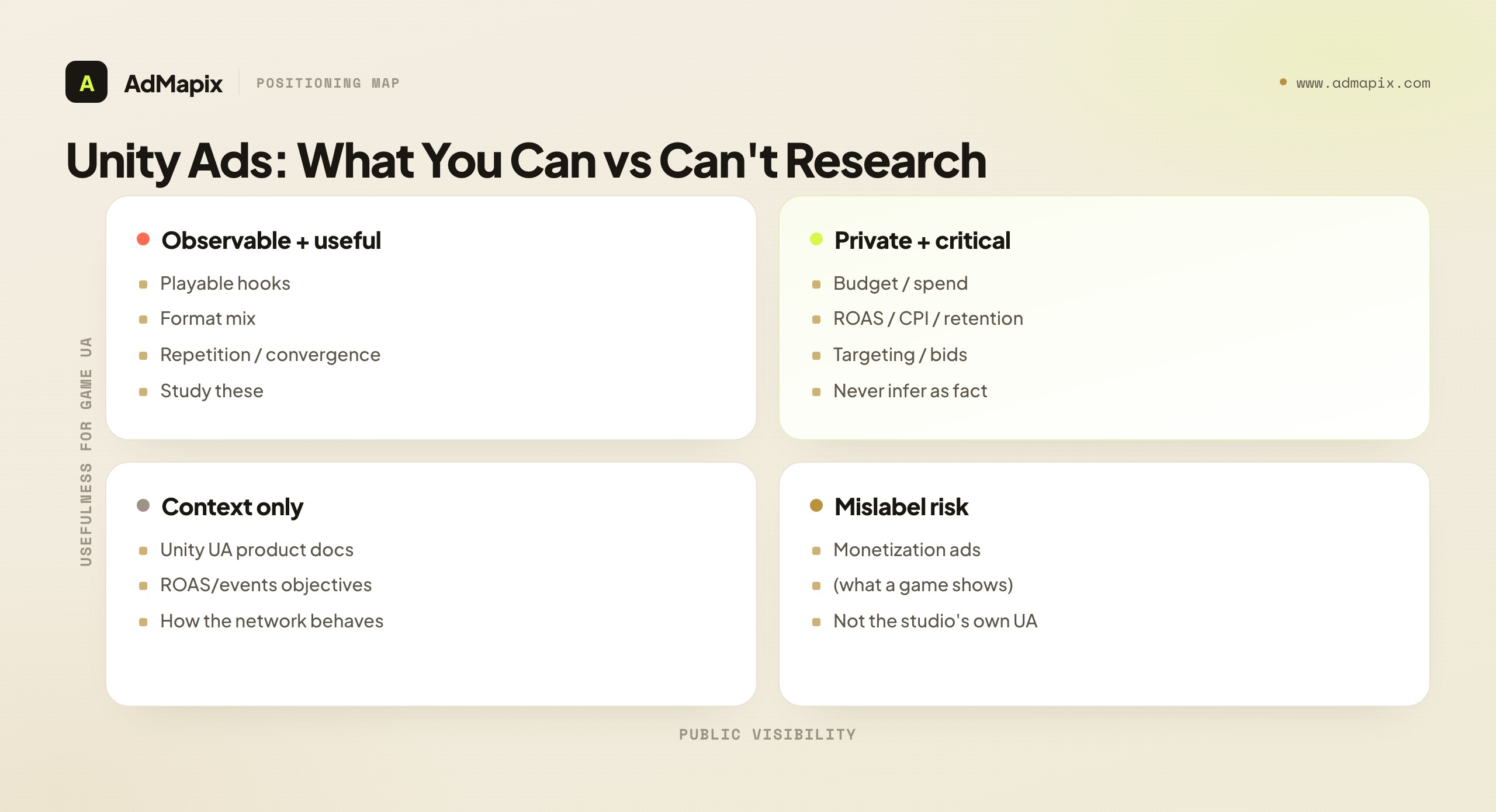
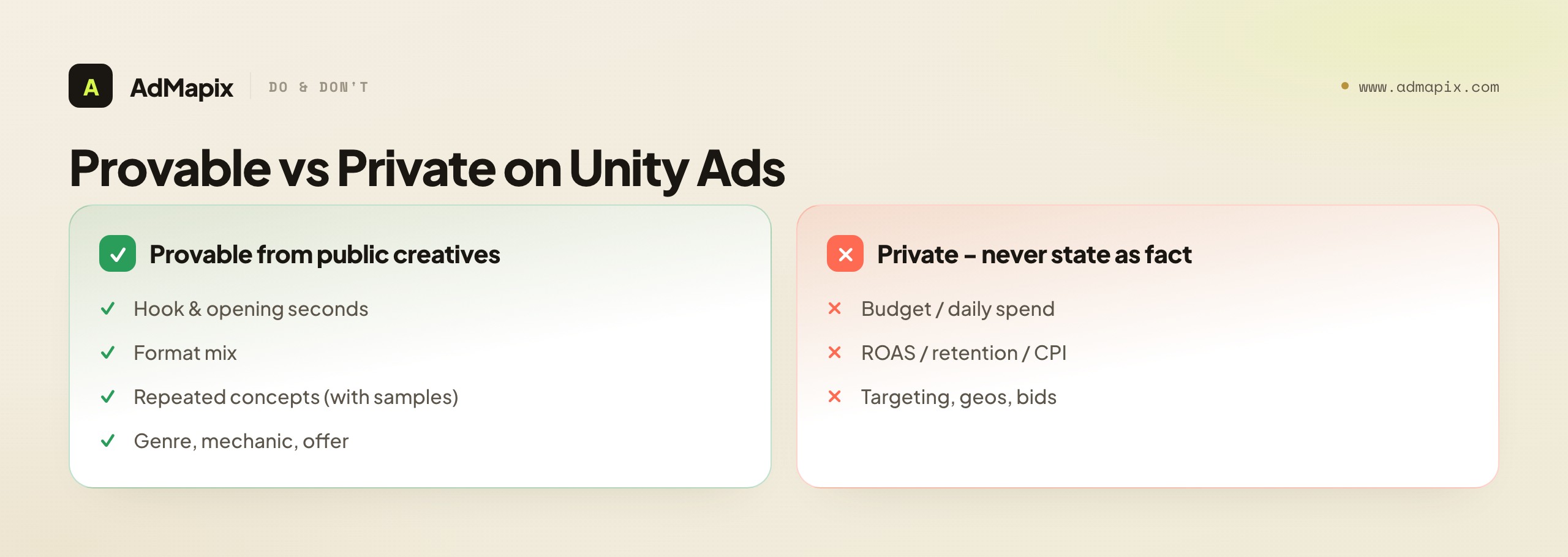
Public creative evidence proves what a competitor is showing and repeating; it cannot prove what they're spending or earning. This distinction is what keeps your conclusions defensible — and on a network with no library, it's the most important discipline you have.
| Signal | Provable from public creatives? | Why |
|---|---|---|
| Hook and opening seconds | Yes | The creative itself is the evidence |
| Format mix (playable, rewarded, interstitial, video) | Yes | Visible in the ad delivery and asset type |
| Repeated concepts across variants | Yes, with enough samples | Repetition across many saved examples signals a tested winner |
| Genre, mechanic, and offer framing | Yes | Observable in the creative and store listing |
| Campaign budget / daily spend | No | Not exposed by mobile networks |
| Exact ROAS, retention, or CPI | No | Account-level data only; never infer it from a creative |
| Targeting, geos, bid strategy | No | Private; visible localization is a hint, not proof |
The one honest inference you can make: if a studio runs many variants of the same concept over time, it's probably a winner worth testing against. That's a hypothesis, not a measured result, and it should be labeled as one in any report. The discipline that keeps a Unity research deck credible is putting observable facts (format, hook, repetition) in one column and inferences (the offer is working) in another, clearly marked — and never letting a private number (spend, ROAS, targeting) appear as fact. Overclaiming a competitor's budget is the fastest way to lose a studio lead's or a client's trust.
Repetition: The Strongest Signal You Get (and How to Read It)
Since you can't see spend or ROAS on Unity, you need proxies — and repetition is the strongest honest proxy public evidence offers. But "repetition" is doing a lot of work, and reading it well is what separates a defensible Unity research deck from a guess. There are three distinct kinds of repetition, and they're not equally strong.
| Type of repetition | What it suggests | Strength |
|---|---|---|
| Many variants of one concept by one advertiser | That advertiser has likely found a winner and is iterating it | Medium-strong |
| The same concept run over a long time | Durability — it kept earning its place in rotation | Medium-strong |
| The same structure across many independent advertisers | A genre-wide pattern that works for the objective | Strongest |
The weakest reading of repetition is "I saw this ad a lot," because — as on any algorithmic network — what you saw is shaped by what the system served you, not by true frequency. The strongest reading is cross-advertiser convergence: when six independent studios in your genre all run the same merge-then-defend playable, that agreement can't be explained by your sampling bias. It reflects six separate teams' creative decisions and six separate models all landing on the same structure — which is about as close to "this works in the category" as external evidence gets.
The second-strongest is variant volume from a single advertiser. When a studio produces a playable, three video cuts, and a static all around one concept, that breadth signals real creative investment — you don't build five assets for a concept you don't believe in. Combined with longevity (the concept persists over weeks), variant volume is a solid "this is probably a winner" hypothesis for that advertiser, though weaker than genre-wide convergence because it's a single team's bet.
The practical method: rank every pattern you find by which kind of repetition supports it. A genre-wide convergence goes to the top of your test backlog; a single advertiser's variant-heavy concept goes next; a creative you merely saw often, with no convergence or variant evidence, stays a low-confidence note. Label each pattern's confidence (high / medium / low) explicitly in your brief, so the team scales on the strength of the evidence, not on whichever ad someone found most memorable. This ranking discipline is what turns "repetition" from a vague intuition into a defensible signal — and on a network with no spend data, it's the closest thing to a performance read you'll get without running the test yourself.
A final caution: even the strongest repetition signal is a hypothesis, not a measured result. Genre-wide convergence tells you a structure works in the category; it doesn't tell you it'll work for your specific game, audience, and monetization model. So the repetition read always ends the same way — as a test brief your own funnel validates, never as a conclusion you act on blind. Repetition narrows what to test; your data decides what wins.
A Repeatable Research Workflow
Start from official context, then build your own evidence layer, because the network won't hand you the competitive view. These steps are specific to game UA, not a generic process.
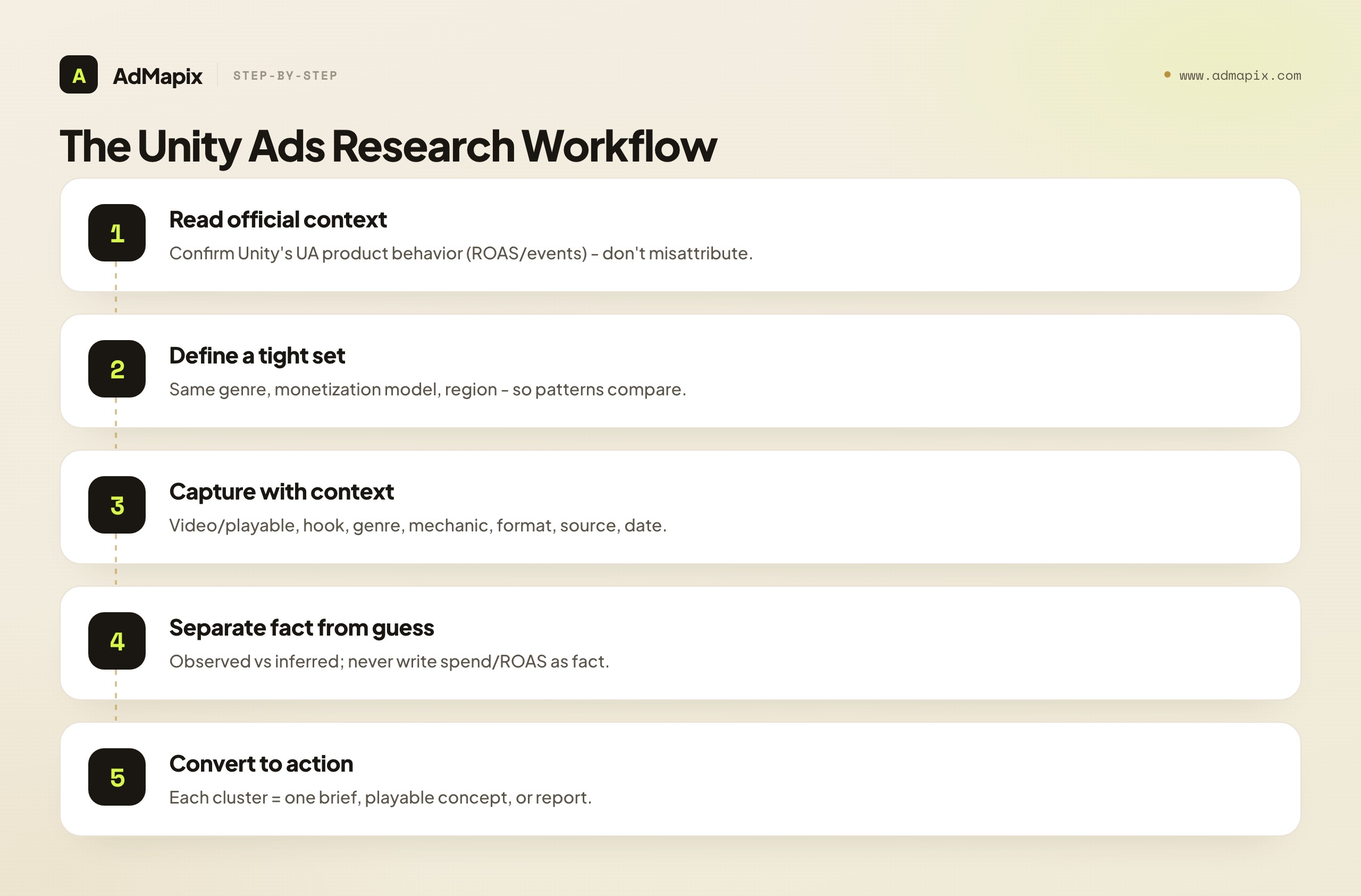
Step 1: Read the official context first
Confirm what Unity's UA product actually does — acquisition campaigns optimized toward ROAS and in-app events — so you don't misattribute a creative to the wrong objective. Unity's docs describe the User Acquisition suite as a way to attract high-value users with scalable, targeted advertising. Official context tells you how the product behaves; it never tells you what a specific competitor runs.
Step 2: Define a tight competitor set
Lock the same genre, the same monetization model (IAP vs ad-monetized vs hybrid), and the same region. A puzzle game's rewarded-video creative tells you little about a 4X strategy game's interstitials. The tighter the set, the more meaningful the patterns — and on Unity specifically, monetization model matters, because an ad-monetized game's UA economics (and therefore its creative strategy) differ from a hard-IAP game's.
Step 3: Capture creative evidence with context
For each example, save the video or playable, the hook, genre, mechanic, CTA, format, source, date, and one line on why it matters. Evidence without context is a screenshot folder. On Unity, where you get no impression or spend data automatically, capturing context yourself is the entire job — a creative with no date and source decays into trivia within weeks.
Step 4: Separate observation from inference
Record what you saw (format, hook, repetition) apart from what you suspect (the offer is working). Never write spend, ROAS, or targeting as fact. This two-column discipline is what makes the eventual brief — and the report behind it — credible.
Step 5: Convert patterns into action
Each cluster of similar creatives should produce one output: a video brief, a playable concept, a positioning angle, or a recurring report — not just a tidier archive. Research that never ships a test produces zero installs. For the broader competitor-to-test discipline, see paid ads competitor research.
Reading Format Mix: Unity's Defining Signal
Because Unity is heavy on rewarded, interstitial, and playable inventory, the format mix a competitor runs is one of your most telling reads — more so than on a video-first social feed. The format a studio chooses isn't cosmetic; it reflects where they think their game's value is best demonstrated and which placement economics they're betting on.
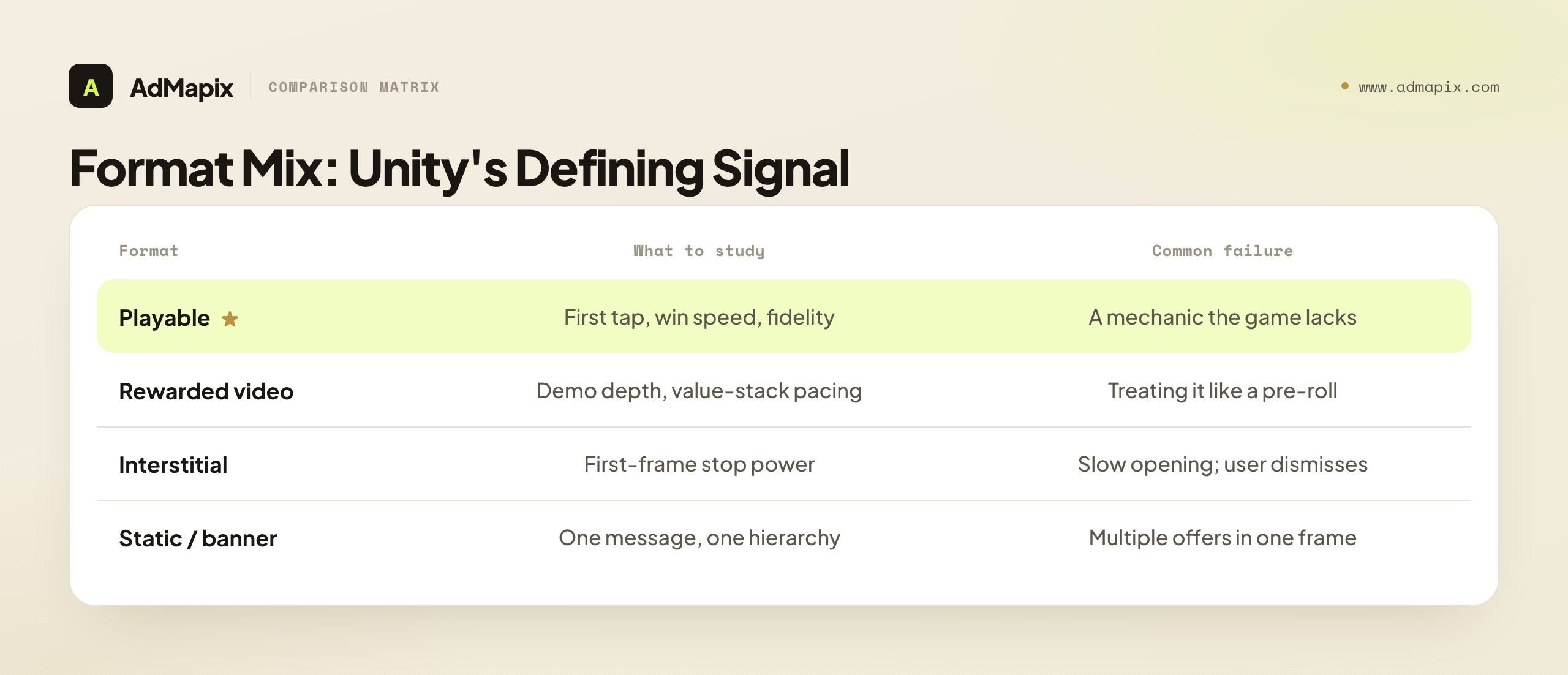
| Format | What the placement is | What to study | Common failure |
|---|---|---|---|
| Playable | An interactive demo before install | First tap, win speed, fidelity to the real game | A mechanic the game doesn't have |
| Rewarded video | User opted in for an in-app reward | Demo depth, value-stack pacing | Treating it like a skippable pre-roll |
| Interstitial | Full-screen between game moments | First-frame stop power | Slow opening; the user wants to dismiss it |
| Static / banner | Low-friction, low-impact | One message, one hierarchy | Cramming multiple offers in one frame |
Three reads come out of format mix. First, a competitor leaning heavily on playables is betting that their core loop is best sold through interaction — common for puzzle, merge, and hyper-casual, where the mechanic is the hook. Second, a rewarded-heavy strategy suggests they're optimizing for opted-in, higher-intent impressions and can afford a deeper demo. Third, the spread of formats signals investment: a studio producing playables and multiple video cuts and statics for one concept is committing real creative resources to it, which (combined with repetition over time) strengthens the "this is a winner" hypothesis. When you study a Unity competitor, log the format of every creative, because the mix itself is intelligence the social-feed mindset overlooks.
Reading Playable and Video Structure
The value in game creatives is in their structure, so judge each format on its own terms. On Unity, the playable deserves the closest read, because it's both a dominant format and the one whose effectiveness lives in interaction a screenshot can't capture.
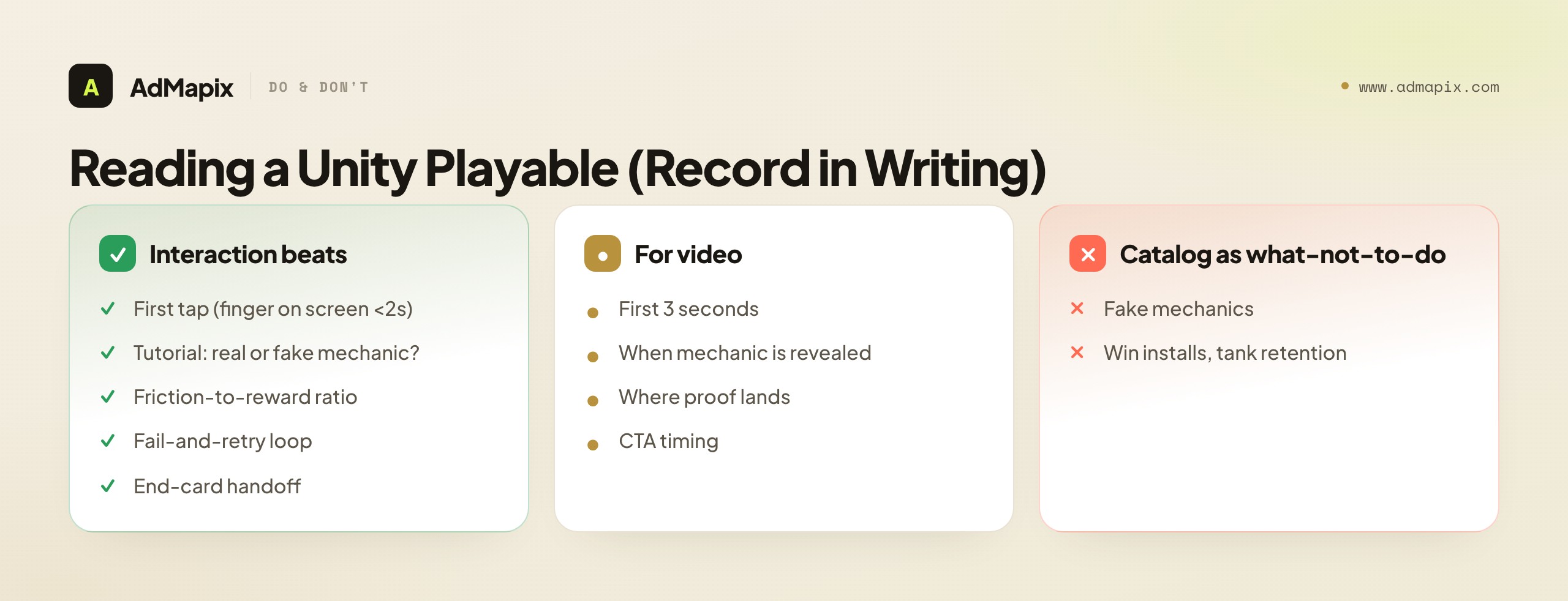
For a playable, work through: the first interaction (does it get a finger on screen in 2 seconds?), the tutorial framing (does it teach the real mechanic or a fake/simplified one?), the friction-to-reward ratio (taps to the satisfying payoff), the fail-and-retry loop (the "I can do better" driver), and the end-card handoff to the store. Fake-mechanic playables — showing a mechanic the game lacks — win installs and tank retention, so catalog them as a what-not-to-do, not a model. Because playables are interactive HTML5 you usually can't save the file, so record the interaction flow in writing; that teardown survives even though the playable doesn't.
For a video, the first three seconds and a single clear payoff carry the result. Map the spine: how fast the cuts are, when the mechanic is revealed, where proof lands, and when the CTA hits. For rewarded video specifically, the user opted in, so the ad can show more and sell harder — study the value-stack pacing (how it layers benefits over the runtime), which is a different craft than a scroll-stopping feed video. Scoring all of these with one rubric flattens the very differences that decide performance.
Reading the Objective: ROAS vs Event Optimization
A subtle but valuable read on Unity is the objective a creative implies. Unity's UA product optimizes toward ROAS and in-app events, and a creative's framing often hints at which goal a competitor is chasing — which tells you something about their UA strategy and economics.
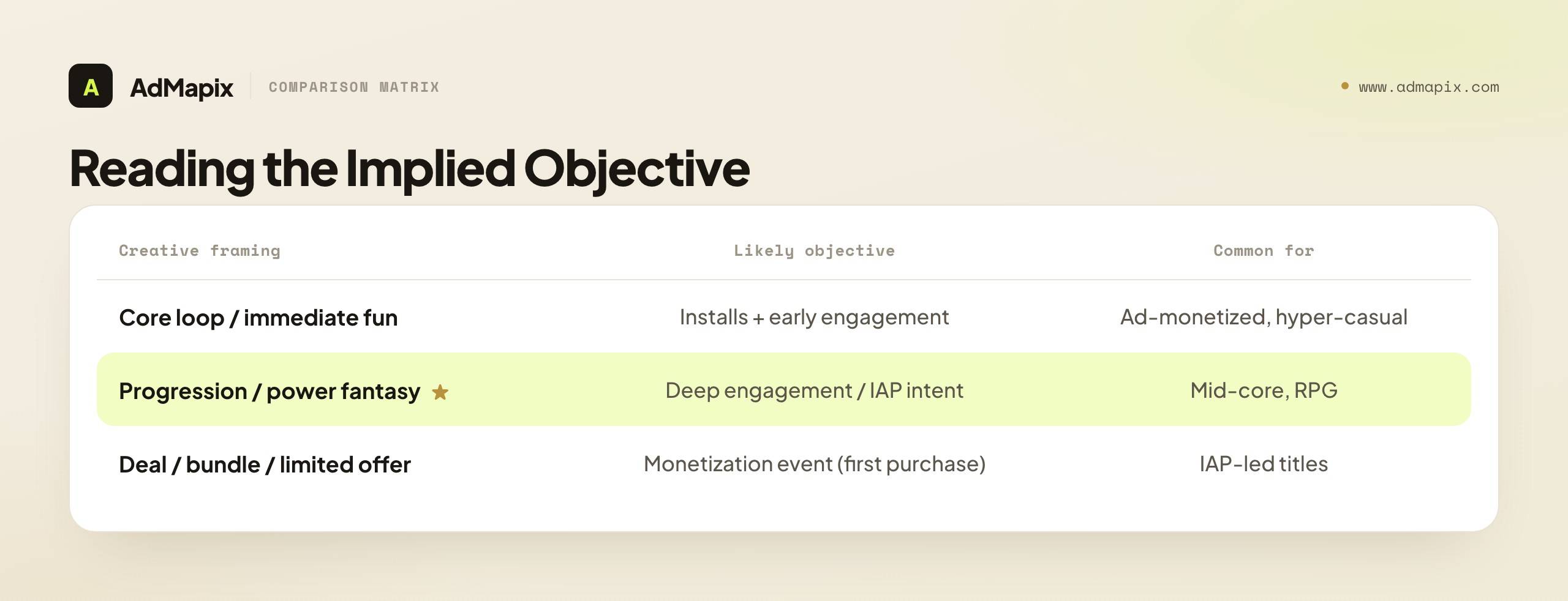
- A creative that sells the core loop and immediate fun is usually chasing installs and early engagement — common for ad-monetized and hyper-casual games where volume and D1 matter most.
- A creative that previews progression, collection, or a power fantasy is often chasing deeper engagement and IAP intent — common for mid-core and RPG titles optimizing toward purchase or high-value events.
- A creative that leads with a deal, bundle, or limited offer is signaling a monetization-event objective — pushing toward a first purchase rather than just an install.
You can't confirm the objective from outside, so this stays an inference, labeled as such. But it's a useful one: if every mid-core competitor in your genre is running progression-fantasy creative optimized (apparently) toward deep events, and you're running install-chasing hyper-casual hooks, that mismatch may explain why your acquired users monetize worse. Reading the implied objective alongside the creative is how you catch a strategic gap, not just a creative one — and it's a read the "just look at the hook" approach misses entirely.
How to Brief a Test From Unity Research
The step most teams skip is turning a captured pattern into a brief a producer can actually shoot. A pattern in a format-mix map isn't a deliverable; a brief is. Here's how to write one that survives contact with production.
State the hypothesis as a testable claim. Not "competitors run playable-first" but "adding a playable to our format mix for this concept will lift install rate versus our current video-only delivery." A hypothesis names the change, the expected effect, and the metric — so the test has a clear pass/fail.
Specify the structure and format, not the asset. Describe the beats to recreate on your own game — "merge for 8 seconds, trigger a 5-second raid the player taps to defend, win-state by second 15" — and the format to produce it in (playable, per your format-mix read). Adapt the competitor's structure to your real mechanic; never reuse their footage, which is a legal risk and a creative dead end. The reusable intelligence is the skeleton and the format choice, not the skin.
Set the success metric and kill condition before production. "Beat control on install rate over a 7-day test; kill if it underperforms control by 15%+." Writing the kill condition before you're invested in the creative is what keeps a borderline result from becoming a "let's give it two more weeks" graveyard.
Cite the repetition evidence and its confidence. Note why you're testing this — "six independent competitors converged on this playable structure, each running many variants over two months" — and label the confidence (high, because it's genre-wide convergence plus variant volume). This tells the team the bet is evidence-backed, and makes the result interpretable: if a high-confidence convergent pattern fails for your game, that's a meaningful learning about your specific audience, not just a dud ad.
Honor the genre's promise and your real mechanic. Make sure the brief's hook fits your genre's emotional promise and maps to a real moment in your game — never a fake mechanic, which acquires users who churn. The structure adapts; the mechanic must be one you can honestly deliver, so the installs you win actually retain.
A brief built this way — testable hypothesis, structural-and-format beats, pre-set metric and kill condition, cited repetition evidence with confidence, genre-fit hook on a real mechanic — is the bridge between Unity research and shipped, validated creative. Without it, even excellent research dead-ends in a document. With it, every weekly loop ends in a producible test, and your Unity intelligence compounds into a creative pipeline that out-iterates competitors who only collect screenshots. This is also where keeping the evidence organized pays off: when the brief cites "six competitors, two months, many variants," that claim has to be backed by a searchable, dated library — which is exactly the artifact the weekly loop builds and a tool like AdMapix maintains.
Why Creative Is the Lever on a Game UA Network
On Unity's UA product, as on every modern game network, the model does much of the audience work — you feed it creative and event signals, and it finds the users that creative converts. The targeting lever UA managers used to master is increasingly the algorithm's job. What remains in human hands is the creative, the format choice, and the objective you optimize toward.
That makes creative research the highest-leverage competitive work available: on a network where the algorithm handles targeting, the creative is the primary differentiator — and the one thing you can observe. Studying competitor creative is studying the biggest determinant of UA success on Unity, not a secondary activity. The "I can't see their targeting" complaint matters less than it seems, because there's less targeting to see; the decisive, observable lever is the creative, and that's exactly what disciplined evidence capture surfaces.
A Worked Example: From Unity Creatives to a UA Test
Here's the whole workflow on a real decision. A merge-game studio running UA on Unity sees a competitor's category presence growing and wants to know which creative angle to test next — and their "research" is a folder of screenshots nobody acts on.
Official context + set. The UA manager confirms she's reading Unity's UA product context (ROAS/events optimization), not its mediation/monetization side, so she frames the research correctly. She locks the set: merge games, US market, hybrid monetization, playable + video formats.
Capture + format mix. Over a week she captures ~20 competitor creatives with full context — format, hook, mechanic, CTA, source, date. Logging the format mix, a pattern jumps out: the three fastest-growing competitors run playables heavily (not just video), and those playables all show a "merge, then defend in a 30-second raid" combined loop. Her studio's playables show only the merge.
Separate + classify. She keeps observation ("merge-then-defend playable, US English, run across many variants") apart from inference ("looks like it's scaling" — labeled a guess), and marks spend/ROAS unknown. The convergence across three independent advertisers, plus the many variants each runs (the repetition signal), makes "merge-then-defend playable" a strong hypothesis, not an anecdote.
Brief + validate. Her brief isolates the addition: "add a 5-second raid-defense beat after the merge in our playable, win-state by second 15, vs our merge-only control." She builds it on her game's real raid mechanic (no fake mechanic), ships it against control, and it lifts install rate and holds D1. The competitor playables didn't tell her what to copy — the convergent format-and-structure pattern told her what to test, and her funnel confirmed it.
The lesson: reading format mix surfaced what a video-only look would have missed; the repetition-plus-convergence discipline made the pattern trustworthy; and her own data, not the competitor's apparent success, proved the win.
It's worth noting what didn't happen in that example, because it's where most teams go wrong. She didn't copy the competitor's footage — she adapted the structure to her own raid mechanic, which kept her on the right side of both copyright and retention (a fake raid would have churned the users it acquired). She didn't act on the single creative she'd seen most often — she acted on the structure that recurred across three independent advertisers and many variants, the strongest form of the repetition signal. And she didn't present "they're scaling this" as a fact to her studio lead — she framed it as a high-confidence hypothesis backed by convergence and variant volume, then let her own 7-day test be the judge. Each of those choices is a discipline this guide has named, and together they're the difference between research that compounds into wins and research that produces a folder of admired-but-unactioned screenshots. The method isn't complicated; it's just consistently applied, every week, which is exactly why the studios that run it out-iterate the ones that don't. Discipline applied weekly, not cleverness applied once, is what compounds into a creative-research edge that competitors relying on occasional, unstructured screenshot binges simply cannot match over a full year of disciplined, evidence-driven UA testing.
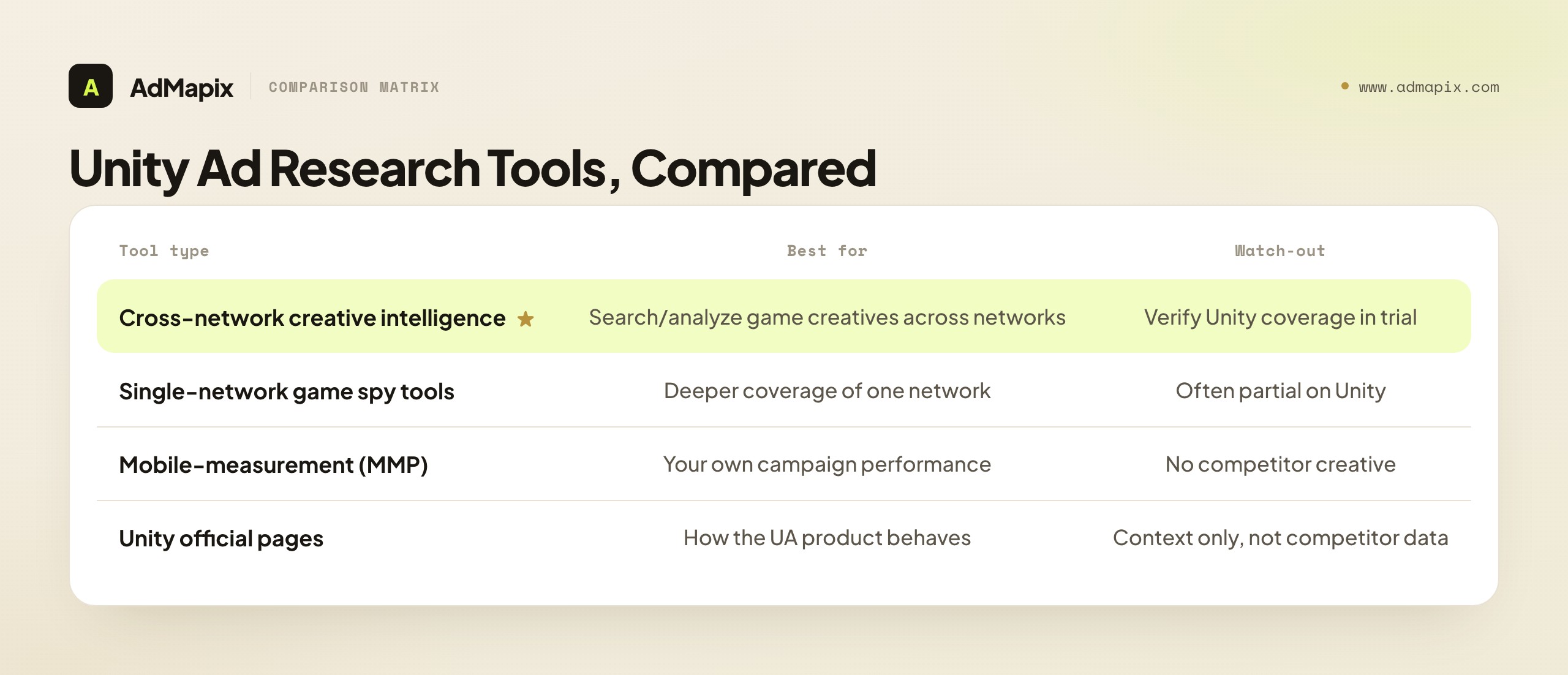
Unity Ad Research Tools, Compared
There's no "Unity Ads library" with a search bar, because Unity publishes none. Tools split by how they help you capture and analyze the creative you can observe across the game-network landscape.
| Tool type | Best for | Watch-out |
|---|---|---|
| Cross-network creative intelligence (e.g., AdMapix) | Searching, saving, analyzing & reporting game creatives across networks | Verify Unity/in-app coverage for your genre in a trial |
| Single-network game spy tools | Deeper coverage of one network | Often partial on Unity; blind to other networks |
| Mobile-measurement partners (MMPs) | Your own campaign performance | Show your data, not competitor creative |
| Unity official pages | How the UA product behaves | Context only — not competitor data |
No tool gives you a Unity "ad library" because there isn't one. What good tools give you is a way to aggregate, search, and analyze the game creatives observable across the in-app ecosystem, plus the cross-network view showing how the same studio adapts a concept across Unity, AppLovin, ironSource, and more. Judge any tool on its actual coverage of your genre and networks in a trial — aggregation depth varies, and a tool strong on social can be thin on the game networks where most installs originate. For the full landscape, see best ad spy tools 2026 and marketing intelligence tools.
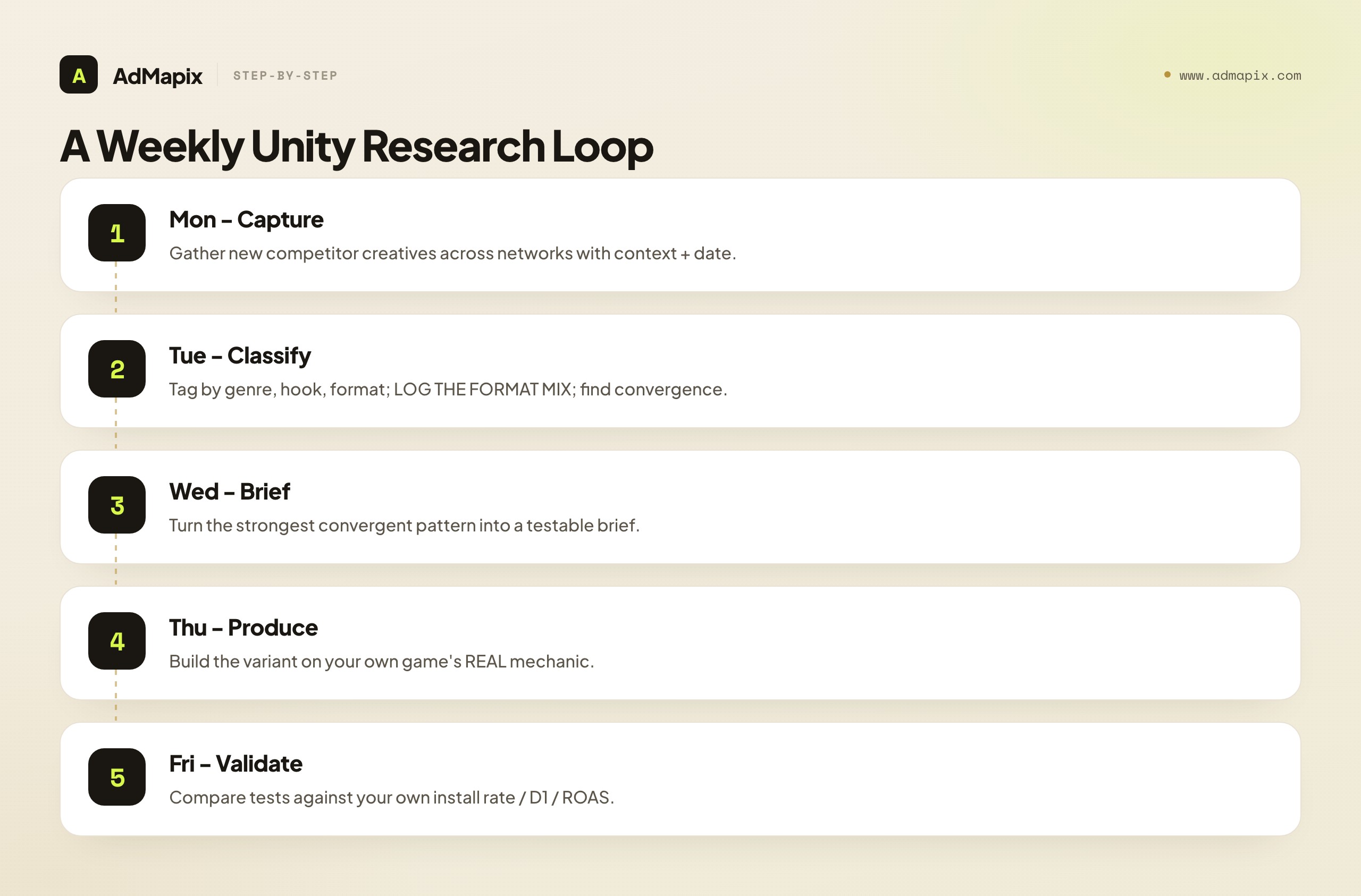
A Repeatable Weekly Research Loop
Unity creative research compounds as a habit. Here's a lightweight weekly loop that takes under an hour and builds a real asset over time.
| Day / step | Action | Output |
|---|---|---|
| Monday — capture | Gather new competitor creatives across networks with full context + date | Fresh, dated evidence |
| Tuesday — classify | Tag by genre, hook, format, mechanic; log the format mix; find convergence | Updated genre + format-mix map |
| Wednesday — brief | Turn the strongest convergent pattern into a testable creative brief | A ready-to-produce concept |
| Thursday — produce | Build the variant on your own game's REAL mechanic | A test-ready creative |
| Friday — validate | Compare last week's tests against your own install rate / D1 / ROAS | Promote, kill, or iterate |
Three rules keep it honest: log the format mix every time (it's Unity's defining signal); trust repetition-plus-convergence over a single creative (many variants across many advertisers is the real signal); and always end on your own data (repetition suggests a winner; only your test proves it). A team running this loop for a quarter builds a dated, searchable history of what's serving in their genre and which formats and hooks are converging — an asset no single audit matches. For the cross-platform version, see how to spy on competitors' ads in 2026.
How Research Differs by Game Genre on Unity
The workflow is universal, but emphasis shifts by genre, because what a creative must prove differs — and Unity's playable-heavy inventory rewards different reads per genre.
| Genre | Dominant Unity format | Signature read | The trap |
|---|---|---|---|
| Puzzle / match-3 | Rewarded playable | Near-solve / wrong-move fail-bait | Fake mechanics the game lacks |
| Merge / hybrid-casual | Playable + video | Build-then-defend combined loop | Showing only half the loop |
| Hyper-casual | Short video + playable | One satisfying mechanic in 3s | Over-explaining a one-tap game |
| 4X / strategy | Interstitial + vertical video | Power, stakes, fake tactical battle | A fast-win hook for a slow game |
| RPG / mid-core | Video + playable | Progression / hero power fantasy | Combat the real game gates |
The cross-genre rules: games live on the hook and the mechanic reveal, and on Unity the playable interaction carries more of that weight than on a video-first network, so weight your playable teardowns heavily. And the hook must match the genre's emotional promise — puzzle sells tension-and-relief, strategy sells power-and-stakes, hyper-casual sells instant satisfaction. A structurally clever creative that misframes the genre acquires the wrong users who churn. For the genre-wide playbook, see mobile game ad spy tool.
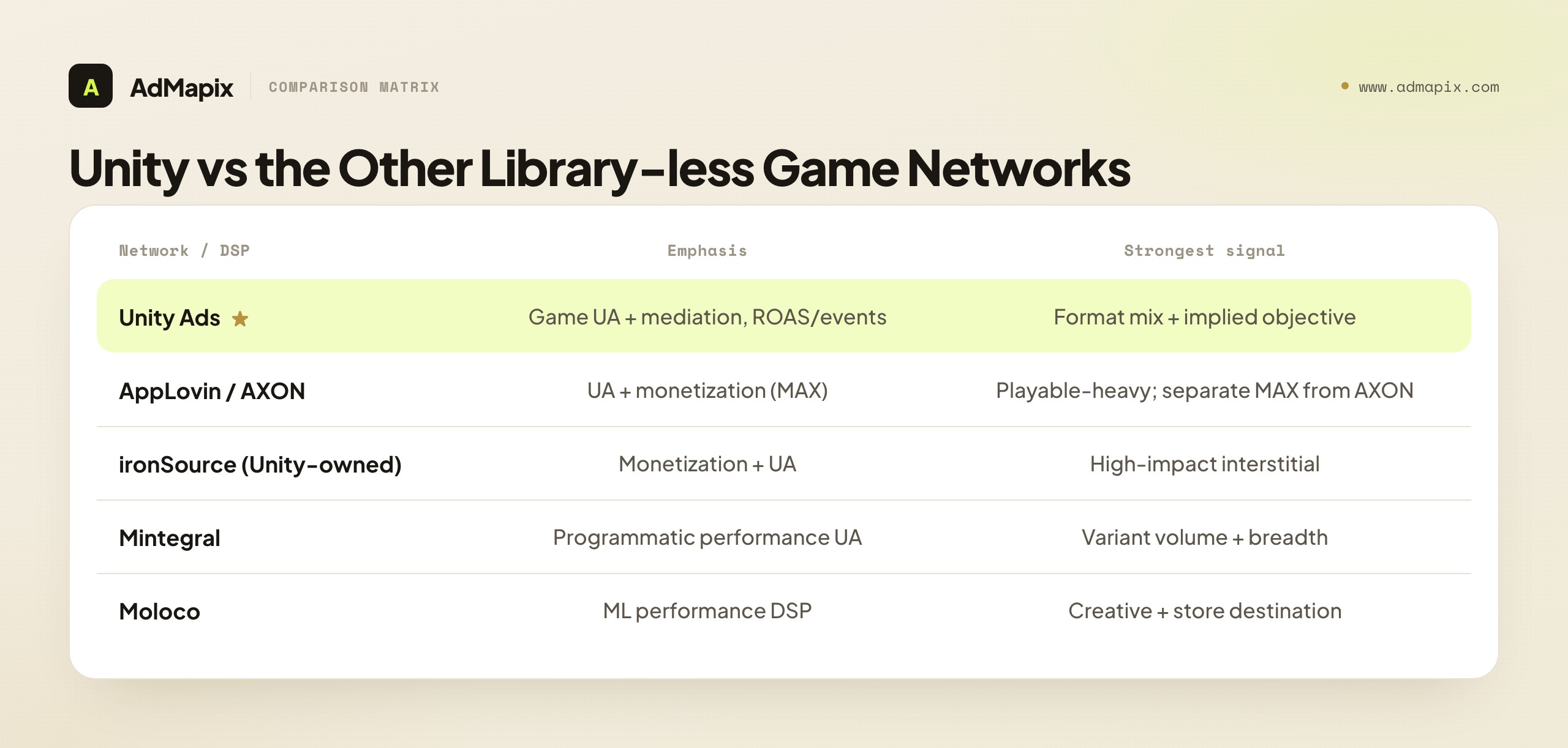
Unity vs the Other Game Networks
Unity isn't the only library-less game UA network, and understanding how it relates to its peers sharpens your research and tells you where Unity's signal is uniquely useful. The major in-app game networks and DSPs — Unity, AppLovin (AXON), ironSource, Mintegral, Moloco — share a defining trait: none publishes a public ad library. But they differ in emphasis, which affects what creative you'll observe and how to weight it.
| Network / DSP | Emphasis | What you'll observe most | Where its signal is strongest |
|---|---|---|---|
| Unity Ads | Game UA + mediation, ROAS/events | Playables, rewarded video, gameplay | Game-specific format mix + objective read |
| AppLovin / AXON | UA optimization + monetization (MAX) | Playables, rewarded | Playable-heavy; separate MAX from AXON — see the AppLovin guide |
| ironSource | Monetization + UA (now Unity-owned) | Interstitial, rewarded | High-impact interstitial creative |
| Mintegral | Programmatic performance UA | Playable + video mix | Variant volume and breadth |
| Moloco | ML performance DSP | Creative + store destination | Pure-DSP read — see Moloco ad intelligence |
The practical implication: because all are library-less, the research method is the same across them — capture observable creatives, classify by pattern, never infer spend. But Unity's signal is uniquely game-specific and format-rich: its owned game inventory and playable-heavy delivery mean the format mix and the implied objective are especially legible reads, more so than on a pure-DSP like Moloco where the destination is your main signal. Note also that ironSource is now part of Unity, so the two share inventory and increasingly overlap — a practical reason to treat them together in a game-UA research set. The broader lesson is that a cross-network tool beats a single-network one: your competitors run across Unity, AppLovin, ironSource, and more, and seeing how one studio adapts a concept across all of them teaches you more than any single network's slice. For the network-by-network method, see mobile app ad spy tool.
Building a Format-Mix Map
The concrete output that makes Unity research uniquely actionable is a format-mix map: a structured view of which formats each competitor leans on, in what proportion, for which concepts. Because format mix is Unity's defining signal, this map is your highest-value artifact — and most teams never build it because the social-feed mindset treats all creative as one bucket.
The map is simple. List your tracked competitors down one axis and the formats (playable, rewarded video, interstitial, static) across the other, then estimate each competitor's lean from your captured sample — for example, "Competitor A: 60% playable, 30% rewarded video, 10% static." Two readings fall out:
- Per-competitor lean. A playable-heavy competitor is betting their loop sells through interaction; a rewarded-heavy one is optimizing for opted-in, higher-intent impressions. Each lean is a strategic read you can position against.
- Category-wide convergence. When most competitors independently lean the same way (e.g., "everyone in merge runs playable-first"), that's a strong category pattern — the format your genre has decided sells best. If your studio is running video-first into a playable-first category, the map just found your biggest gap.
| Map reading | What it means | Action |
|---|---|---|
| Most competitors are playable-heavy | The genre sells through interaction | Invest in playable production |
| One competitor newly leans rewarded | A possible strategy shift to watch | Monitor; test if it spreads |
| You run static-heavy into a video/playable category | A format gap | Close it before testing hooks |
| A competitor runs all formats for one concept | Heavy creative investment in that concept | Strong "winner" hypothesis — dissect it |
Rebuild the format-mix map each weekly loop, and over a quarter it reveals movement — formats entering and exiting favor in your genre, which is a lifecycle read a one-off audit misses. The format-mix map is what makes Unity research defensible: instead of "I saw some playables," you get "the merge category has converged on playable-first delivery over the last two months, and we're under-invested in playables" — a sentence a studio lead will fund.
Unity Research at Scale: Agencies and Portfolios
Everything above scales differently when you research Unity for several games or clients at once, and a few adjustments keep a multi-account workflow from collapsing.
The core change is structure for reuse by genre and format, not by client. An agency running Unity research for six game clients needs the evidence tagged so a format-mix insight found for Client A's match-3 is instantly findable when Client B launches a match-3 — because creative and format patterns transfer by genre, not by account. Tag genre and mechanic first, client second.
The second adjustment is making the research a billable deliverable. A recurring per-client report showing the genre's format-mix map, the convergent hooks, the implied-objective reads, and the specific tests you briefed is proof of work that renews retainers and aligns the client on creative direction. A folder of screenshots is invisible labor; a dated format-mix map is a deliverable.
The third is separating shared genre intelligence from account-specific reads. A genre-wide format convergence applies to every client in that vertical; a specific competitor a single client tracks is account-bound. Keep the shared layer reusable and the account layer scoped, so you're not re-researching the same genre convergence per client while still giving each the competitor-specific read they came for. At portfolio scale, this simply doesn't hold together by hand — which is where a tool that makes captured game creatives searchable, cross-network, and reportable becomes the only way the workflow survives more than a couple of accounts.
Getting Started: Your First Unity Research Sweep
If this is your first structured Unity research session, here's the minimum viable version you can run today.
First, anchor on what Unity Ads is — a game UA and monetization network with a UA product optimizing toward ROAS and events, and no public ad library. Ten minutes of official context stops you hunting for a library that doesn't exist.
Second, pick one genre and 3–5 competitors in your target market and monetization model. A tight set produces sharper convergence than a broad sweep.
Third, gather a starting sample with full context — a cross-network tool plus in-app observation, capturing format, hook, mechanic, CTA, source, and date for each creative, and logging the format mix. Aim for 15–20 creatives. Label everything observed / inferred / unknown from the start.
Fourth, find one convergent pattern — the single clearest thing multiple competitors are independently doing (a format-mix lean, a hook convergence, a combined-loop structure) that you aren't. Resist acting on the creative you saw most; act on what recurs across advertisers and variants. That's your first test.
Fifth, write one brief and ship one test on your own game's real mechanic, isolating one variable, with a metric and kill condition set before production. One shipped, validated test beats a research doc that never becomes a creative.
Then repeat weekly. The first sweep is the hardest — you're building the muscle, the genre-and-format map, and the discipline from scratch. By week three the loop takes under an hour and the map does the heavy lifting, showing not just what's converging but how the format mix and hooks are moving over time — the timing intelligence that turns research into an edge.
Common Mistakes
- Expecting a full public ad library. Mobile game networks expose product docs, not competitor campaigns. Plan for evidence collection, not a lookup.
- Confusing monetization with user acquisition. Unity surfaces both; a mediation/monetization signal answers a different question than a UA creative does. Mislabeling corrupts the set.
- Judging every format the same way. A playable, a rewarded video, an interstitial, and a static have different jobs and should be evaluated on different criteria.
- Ignoring the format mix. On Unity the mix is a defining signal — a playable-heavy strategy means something a video-only read misses.
- Inferring private numbers. Reading budget, ROAS, or targeting off a visible creative is guesswork dressed as data, and it eventually costs a test.
- Copying fake-mechanic playables. A playable showing a mechanic the game lacks wins installs and tanks retention — note it as a what-not-to-do, don't replicate it.
- Stopping at collection. If the evidence never becomes a brief, a backlog item, or a client report, the research had no output.
When to Use AdMapix
AdMapix is for game UA teams, studios, and agencies that have already checked the official context and now need to collect, search, and operationalize creative evidence at scale. It is not a Unity account dashboard and won't show a competitor's private spend, ROAS, or targeting — if that's what you need, no tool can provide it.
Use Search AdMapix to find game creatives across networks by genre and keyword, Media to keep saved examples searchable and tagged, Video Analysis to break down video and playable-ad structure, and Reports to turn a creative pattern into a team- or client-ready output. Compare access levels on Pricing. When this becomes recurring work, run the same genre and competitor set in Search AdMapix, save the strongest variants in Media, summarize the pattern in Reports, and create an account from Login once the workflow starts replacing scattered screenshots. We're honest about the boundary because a tool claiming to know a competitor's Unity spend would be inventing numbers — and on a game UA network, those numbers stay private.
FAQ
Is there an official Unity Ads spy tool?
No. Unity Ads is a UA and monetization network, not a public ad-transparency library, so there's no official feed of competitor campaigns. Research instead relies on collecting observable creatives — playables, videos, hooks, and formats — and reading the patterns they reveal. "Unity Ads spy tool" is really the wrong search; the right one is "how do I research Unity creative evidence," which this guide answers.
Can I see a competitor's Unity Ads budget or ROAS?
No. Budget, ROAS, retention, CPI, and targeting are account-level data that mobile networks don't expose publicly. You can only observe and infer from the creatives themselves. Any report stating a competitor's spend as fact is fabricating it — label spend, ROAS, and targeting as unknown.
What creative signals are worth tracking for Unity Ads?
Track the first three seconds of video, the playable's first interaction, the format mix (rewarded, interstitial, playable, static), the genre and core mechanic, the offer or event being pushed, and which concepts repeat across variants. On Unity, the format mix is an especially telling signal, and repetition over time is the strongest public indicator of a tested winner.
How is this different from a Meta or TikTok ad library?
Meta and TikTok run public ad-transparency libraries that list active ads per advertiser. Mobile game networks like Unity don't, so the workflow shifts from "look it up" to "collect and pattern-match." That's why disciplined evidence capture — with format, hook, source, and date — matters far more here than on a network with a searchable library.
What's the difference between Unity's UA and monetization sides for research?
Unity's UA product is what advertisers use to acquire players; its monetization/mediation tools help publishers earn from their own inventory. For competitor research you care about the UA creatives advertisers run, not the ads a game shows to monetize its users. Confusing the two — treating ads you see inside a competitor's game as their UA strategy — corrupts the research set, because those are other advertisers' ads.
How do I read a Unity playable I can't download?
Playables are interactive HTML5, so you usually can't save the file — record the interaction in writing. Note the first tap (finger on screen in 2 seconds?), the tutorial framing (real or fake mechanic?), the friction-to-reward ratio, the fail-and-retry loop, and the end-card handoff. That written teardown survives even though the playable doesn't, and it's enough to brief your own version on a mechanic you can honestly deliver.
Why does format mix matter so much on Unity?
Because Unity is heavy on rewarded, interstitial, and playable inventory, the format a competitor chooses reflects where they think their game's value is best demonstrated and which placement economics they're betting on. A playable-heavy strategy, a rewarded-heavy strategy, and a broad format spread each tell you something different — and the spread itself signals creative investment. On a video-first social feed this read is weaker; on Unity it's central.
How often should I run Unity creative research?
A weekly 30–60 minute loop suits most game UA teams: capture new creatives, log the format mix, classify patterns, brief a test, and validate last week's results. High-spend studios and agencies may go twice weekly; pre-launch teams might do a focused one-time dive on 3–5 genre leaders. Match the cadence to how fast you ship new creative.
Can a tool show me a competitor's Unity playables?
Many cross-network tools surface playable concepts alongside video and static, since playables are a major Unity format. You can study the interaction design — first tap, tutorial framing, reward timing, end-card — then adapt the concept to your own game's real mechanic. As always, you can see the creative but not its performance; whether the playable beat the competitor's other formats stays private.
Where does AdMapix fit in this workflow?
AdMapix fits after the official-context check: search game creatives across networks, save and tag examples as searchable media, analyze video and playable structure, and turn patterns into reports. It doesn't provide private account metrics. It organizes the public creative evidence you gather into a repeatable, cross-network workflow — replacing scattered screenshots with a searchable, reportable library.
Related Reading
- Mobile game ad spy tool — the genre-wide game UA playbook
- Mobile app ad spy tool — the broader cross-network app method
- AppLovin ads spy tool & ad intelligence — an adjacent game network deep dive
- Moloco ad intelligence — researching an ML performance DSP
- Best ad spy tools 2026 — the full tool landscape
- Paid ads competitor research — the broader competitor workflow
Sources
Official sources checked as of June 21, 2026. Mobile network products and documentation change, so verify the current official path before building a recurring workflow.
- Unity Ads — describes Unity Ads as supporting user acquisition from ROAS to events and creative-testing campaigns.
- Unity Ads User Acquisition docs — describes the User Acquisition suite as a way to attract high-value users and grow a game with scalable, targeted advertising.
- Unity user acquisition solutions — focuses on reaching high-quality users for mobile app and game growth.
- Unity Ads monetization — the monetization/mediation side, distinct from user acquisition.
Bottom Line
There's no official Unity Ads spy tool, because Unity Ads is a game UA and monetization network with no public ad library — so "Unity Ads spy tool" is the wrong search, and chasing it leads to disappointment or to tools that overpromise on data they can't actually access. The right research is a discipline: read Unity's official context, capture the observable creative evidence (playables, video, hooks, and especially the format mix), separate what you can prove from what you can only infer, and turn convergent, repeated patterns into UA test briefs your own funnel validates.
You can't see spend, ROAS, or targeting; you can see the creative, the format mix, and the implied objective — and on a network where the algorithm handles targeting, that creative is the lever that most decides outcomes. Capture with context, read the format mix, trust repetition-plus-convergence over any single creative, and validate with your own funnel. That's how Unity Ads research becomes a creative pipeline instead of a screenshot graveyard — and the same method transfers to every library-less game network your competitors run.
The broader takeaway reaches past Unity. As more game-UA spend flows through library-less networks — Unity, AppLovin, ironSource (now Unity-owned), Mintegral, Moloco — the research method built here is the one that travels: read the official context, capture observable creative, log the format mix, rank patterns by repetition strength, refuse to infer private numbers, and let your own funnel be the final judge. The teams that internalize this aren't just better at researching Unity; they're built for the network landscape mobile game UA actually runs on, where the easy library lookup never existed and the durable edge belongs to whoever turns observable creative into validated tests fastest. The absence of a Unity ad library isn't a wall — it's a filter that rewards the studios disciplined enough to do the evidence work properly, week after week, while their competitors wait for a library that's never coming.
When manual screenshotting across the game networks stops scaling, start with AdMapix Search, keep examples searchable in Media, and break down structure in Video Analysis — built for exactly this job, across the library-less networks where mobile game UA actually happens and where disciplined creative evidence, not a public library, is the only competitive advantage available to the teams willing to do the work.
Turn these observations into your next creative study
Open the creative library and select samples for your market, network and research question.
Related Articles
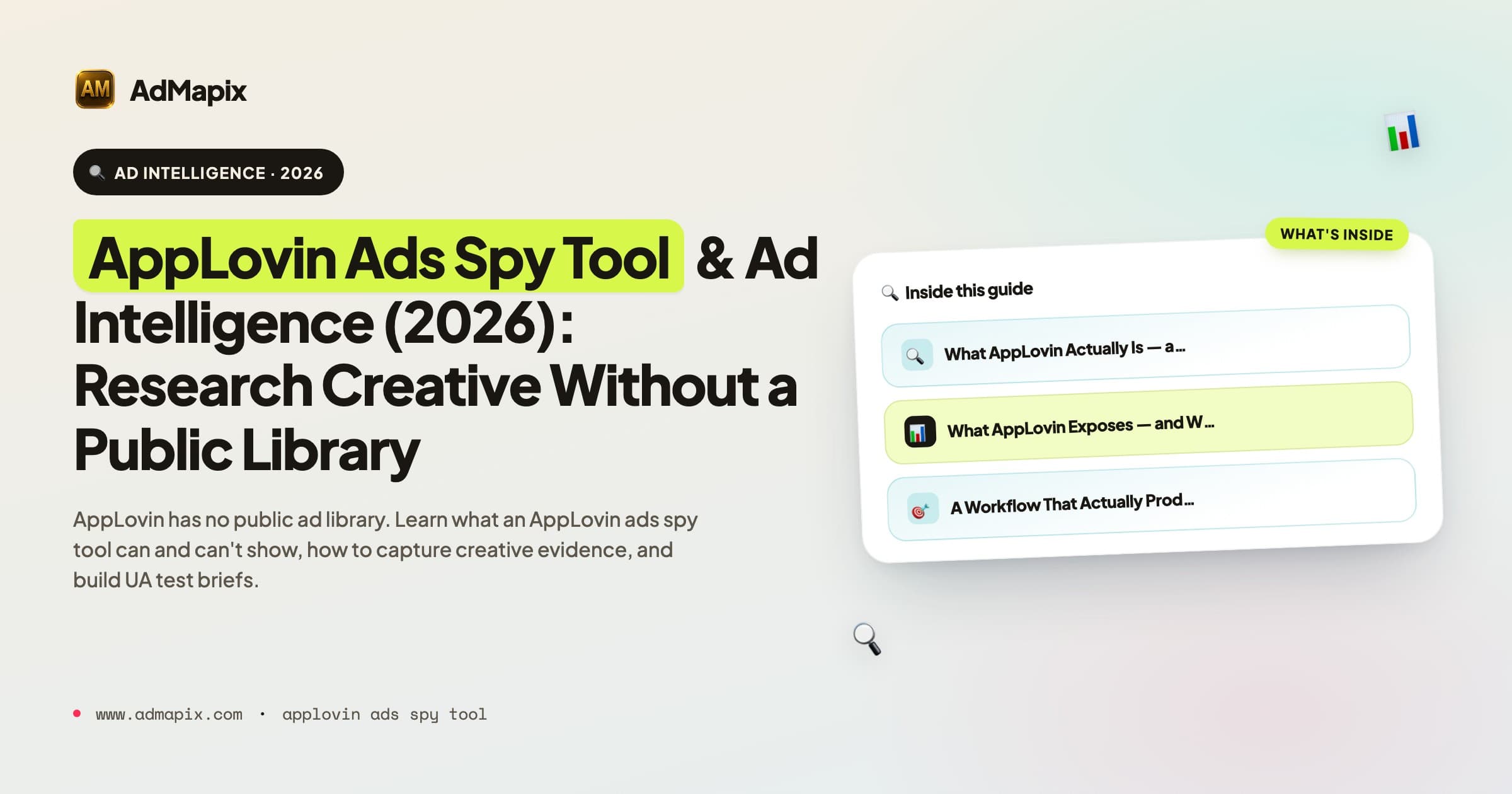
AppLovin Ads Spy Tool & Ad Intelligence (2026): Research Creative Without a Public Library
The 2026 guide to AppLovin ad intelligence and spy tools: why AppLovin has no public ad library, what you can and can't observe, a creative-evidence workflow, how to read video and playable structure, mediation vs UA, and turning patterns into UA test briefs.
ironSource Ad Intelligence in 2026: LevelPlay, ironSource Ads & Creative Evidence
The 2026 guide to ironSource ad intelligence after the Unity merger: how to tell LevelPlay, ironSource Ads, and Unity UA apart, why there's no public library, what creative evidence you can and can't observe, a workflow, format reading, and turning patterns into UA briefs.
App Store Competitor Keyword Ads in 2026: How to Research, Structure, and Bid Them
A complete 2026 guide to App Store competitor keyword ads — what they are, why Apple treats competitor terms as their own campaign, how to decide which rival names are worth bidding on, how to structure an exact-match competitor campaign with CPT and rank discipline, how to build a switcher-focused custom product page, the unit economics and stop-loss rules that keep it profitable, the search evidence to capture first, the honest limits of public data, and where AdMapix fits.