
LinkedIn Ads Competitor Analysis: A Complete B2B Workflow for Reading, Tagging, and Out-Positioning Rival Campaigns
A flagship 2026 guide to LinkedIn ads competitor analysis for B2B teams. How to use the LinkedIn Ad Library, read competitor ads as messaging and offer hypotheses, tag every creative on six dimensions, run offer and format analysis, build recurring competitor reports, and turn it all into briefs and tests — with an honest account of what LinkedIn's public data can and cannot prove, and where AdMapix fits as a creative-evidence layer.
LinkedIn Ads Competitor Analysis: A Complete B2B Workflow for Reading, Tagging, and Out-Positioning Rival Campaigns
Updated June 21, 2026 — written and reviewed by the AdMapix Research team.
LinkedIn ads competitor analysis is the discipline of systematically reading the ads your competitors run on LinkedIn — their audiences, promises, offers, formats, and landing-page intents — and converting that evidence into your own briefs and tests. It is one of the highest-signal forms of B2B competitive intelligence available, because LinkedIn's targeting model (job title, seniority, company size, industry) forces advertisers to be unusually explicit about who they are selling to and what wedge they are leading with. A single demo-request ad aimed at "VP of Engineering at 200+ employee companies" tells you the segment, the pain, and the conversion path in one frame. You almost never get that clarity from a competitor's homepage.
This guide is the practical, end-to-end workflow for B2B SaaS marketers, paid-social managers, demand-gen leaders, agencies, and sales-led growth teams who want a repeatable system rather than another folder of screenshots. We will cover where the data comes from (the LinkedIn Ad Library), how to read competitor ads honestly as messaging and offer hypotheses rather than proof of performance, a six-dimension tagging scheme that turns a pile of creatives into a comparable dataset, offer and format analysis, recurring reporting, and the hard limits of what any public LinkedIn data can and cannot tell you. This is a workflow article — it complements, rather than duplicates, our reference on the LinkedIn Ads Library itself and the developer-focused LinkedIn Ad Library API explainer. For the underlying method that applies across every channel, start with the competitor ad analysis framework.
TL;DR — LinkedIn Ads Competitor Analysis in One Screen
- Start in the LinkedIn Ad Library. It is a public, searchable database of ads served on LinkedIn (roughly the last year), searchable by advertiser without a login. It is the canonical, free starting point to confirm a competitor is actively advertising.
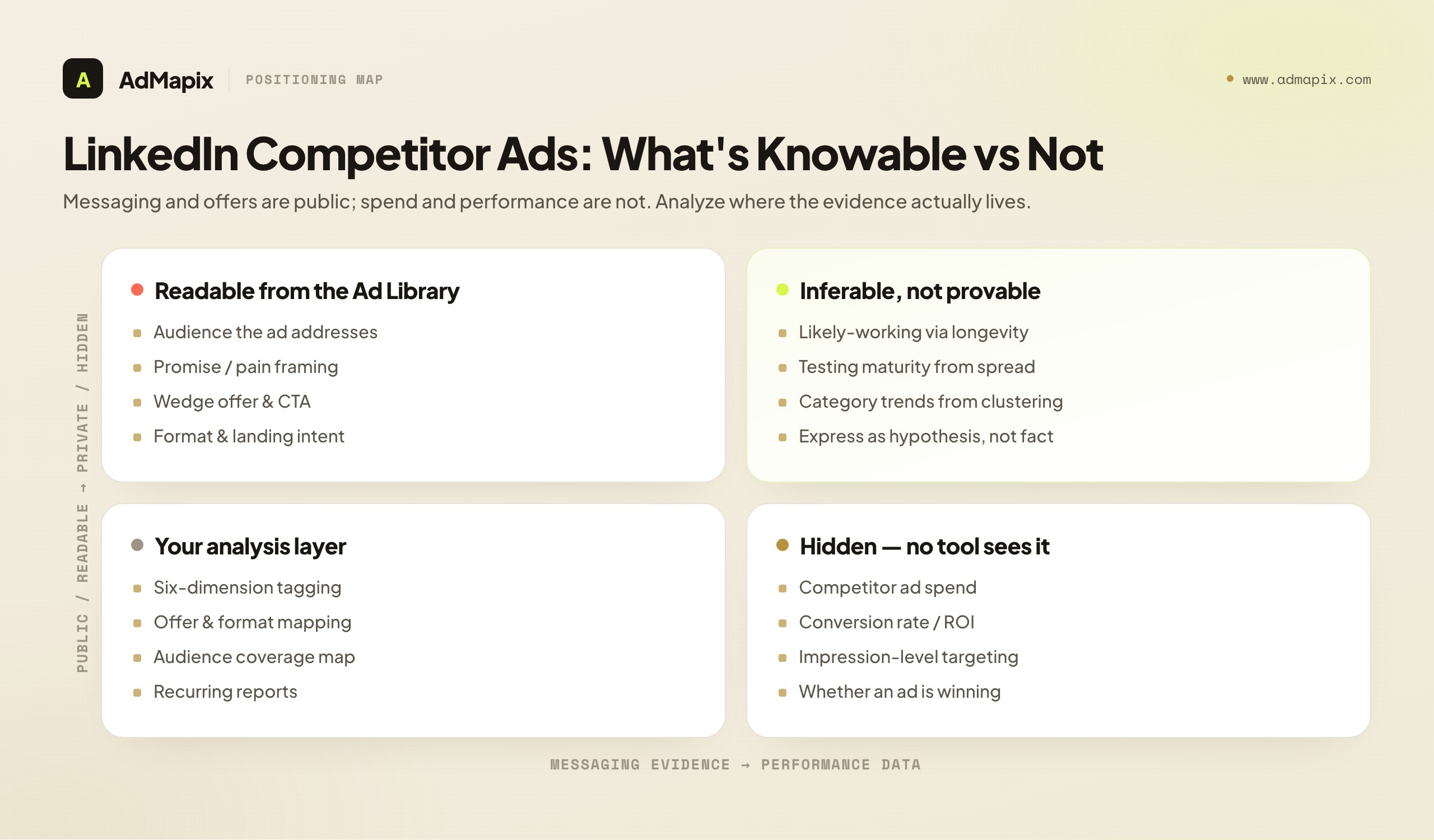
- Read ads as hypotheses, not proof. Competitor creatives reveal messaging, offers, audiences, and formats — what the rival is saying. They do not reveal spend, conversion rate, ROI, ROAS, or whether the ad is working. Treat every creative as a hypothesis about the market.
- Tag every ad on six dimensions: audience, promise/pain, offer, format, call to action (CTA), and landing-page intent. Tagging is the step that converts screenshots into a comparable dataset where patterns become visible.
- Offer analysis is the highest-leverage move. Lining up every competitor's wedge offer (trial, demo, calculator, report, webinar) side by side often reveals a gap you can own.
- Format strategy is a maturity signal. The spread of formats (single image, video, document, carousel, thought-leader/event) and the number of variants tells you how mature a competitor's testing program is.
- Make it recurring, not one-off. The strategic insight lives in change over time — new offers, new segments, abandoned messages. A standing monthly report beats a one-time audit.
- AdMapix is a creative-evidence layer, not a spend tracker. It saves creative evidence, analyzes video, tags ads, and produces recurring competitor reports. It cannot show you a competitor's LinkedIn spend, conversion rate, or ROI — and we will say so plainly wherever it matters.
Why LinkedIn Competitor Ads Are Unusually High-Signal
Before the workflow, it is worth understanding why LinkedIn ads repay competitive analysis so well, because the reason shapes how you read them. On most channels, advertisers can be vague — a brand-awareness video that says nothing specific, a lifestyle image with a logo. LinkedIn's economics push hard against vagueness.
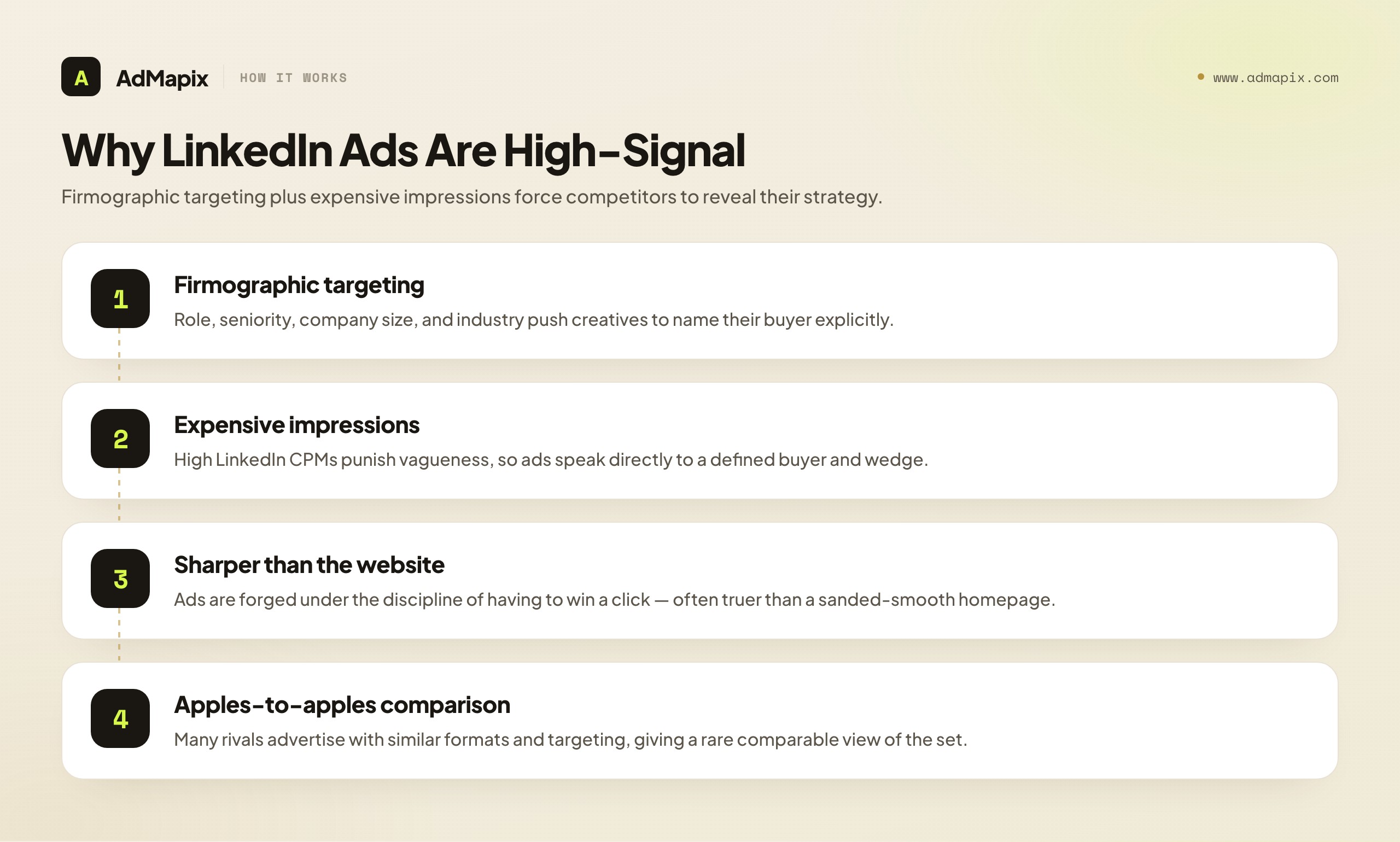
LinkedIn's targeting is built around professional firmographics: job function, seniority, company size, industry, skills, groups. Crucially, LinkedIn impressions are expensive relative to consumer platforms, so advertisers cannot afford to spray-and-pray. The cost pressure forces precision: the creative has to speak directly to a defined buyer or it bleeds budget. The practical consequence for you, the analyst, is that LinkedIn ads tend to name their buyer and their wedge. You see the segment in the imagery and copy ("for RevOps leaders," "engineering teams shipping daily"), the pain in the headline, the offer in the CTA, and the conversion intent in the destination. That is a remarkable amount of strategy revealed in a single unit.
There is a second reason LinkedIn ads are worth reading: they expose positioning competitors rarely publish elsewhere. A company's website is a consensus document, sanded smooth by every internal stakeholder. Its ads are sharper, because ads have to win attention and a click against a feed. The wedge offer in a LinkedIn ad — the one thing the company is willing to bet ad budget on as the entry point to its funnel — is often a truer statement of strategy than the homepage hero. When you read competitor LinkedIn ads, you are reading the version of their pitch that was forged under the discipline of having to perform.
The third reason is comparability. Because so many B2B competitors advertise on LinkedIn with similar formats and similar firmographic targeting, the channel gives you a rare apples-to-apples view across a competitive set. You can line up six rivals' demo offers, or five rivals' approaches to the same buyer persona, and the comparison is genuinely meaningful in a way that cross-channel comparison rarely is.
The LinkedIn Ad Library: Your Starting Point
The canonical starting point for LinkedIn ads competitor analysis is the LinkedIn Ad Library — a publicly available database of ads that have run on LinkedIn, searchable by advertiser, without requiring you to log in. It exists as part of LinkedIn's ad-transparency effort and includes ads served at least once within roughly the past year. LinkedIn documents the library and what it surfaces in its official Ad Library help center, and much of this transparency is shaped by the EU's Digital Services Act ad-repository requirements, which obligate large platforms to maintain searchable records of the ads they serve. Our dedicated LinkedIn Ads Library reference covers the interface, search behavior, and quirks in detail; here we focus on how to use it for competitor analysis specifically.
The Ad Library's job in your workflow is confirmation and retrieval. Before you build any analysis around a competitor, confirm in the Ad Library that they are actually running ads, and retrieve the spread of what is live. The spread matters as much as any single creative: a competitor running two creatives is testing lightly; one running thirty across five formats is running a mature, well-funded program. That count is a free read on their advertising maturity and likely budget posture — though note carefully that it is a posture signal, not a spend figure. The Ad Library does not publish what anyone spent.
Be honest about what the Ad Library does and does not include. It shows ads that ran, the advertiser, the creative, and certain transparency details. It does not show how much was spent, how the ad performed, what conversion it drove, who exactly was targeted at the impression level, or whether the ad is currently a winner or a dud the advertiser forgot to pause. It is a record of what was said to the market, not a record of what worked. Internalize that distinction now, because the entire integrity of your analysis depends on never confusing "this ad exists" with "this ad is succeeding."
A note for the technically inclined: many teams ask whether they can pull the Ad Library programmatically to automate competitor monitoring. The honest answer is nuanced and worth its own treatment — see our LinkedIn Ad Library API explainer, which lays out what programmatic access genuinely exists versus what people assume exists. For the manual workflow in this guide, the web Ad Library is entirely sufficient.
Read Competitor Ads as Hypotheses, Never as Proof
This is the principle that separates credible LinkedIn competitor analysis from confident nonsense, so it gets its own section. Every competitor ad you find is a hypothesis the competitor is testing, not a result they have validated.
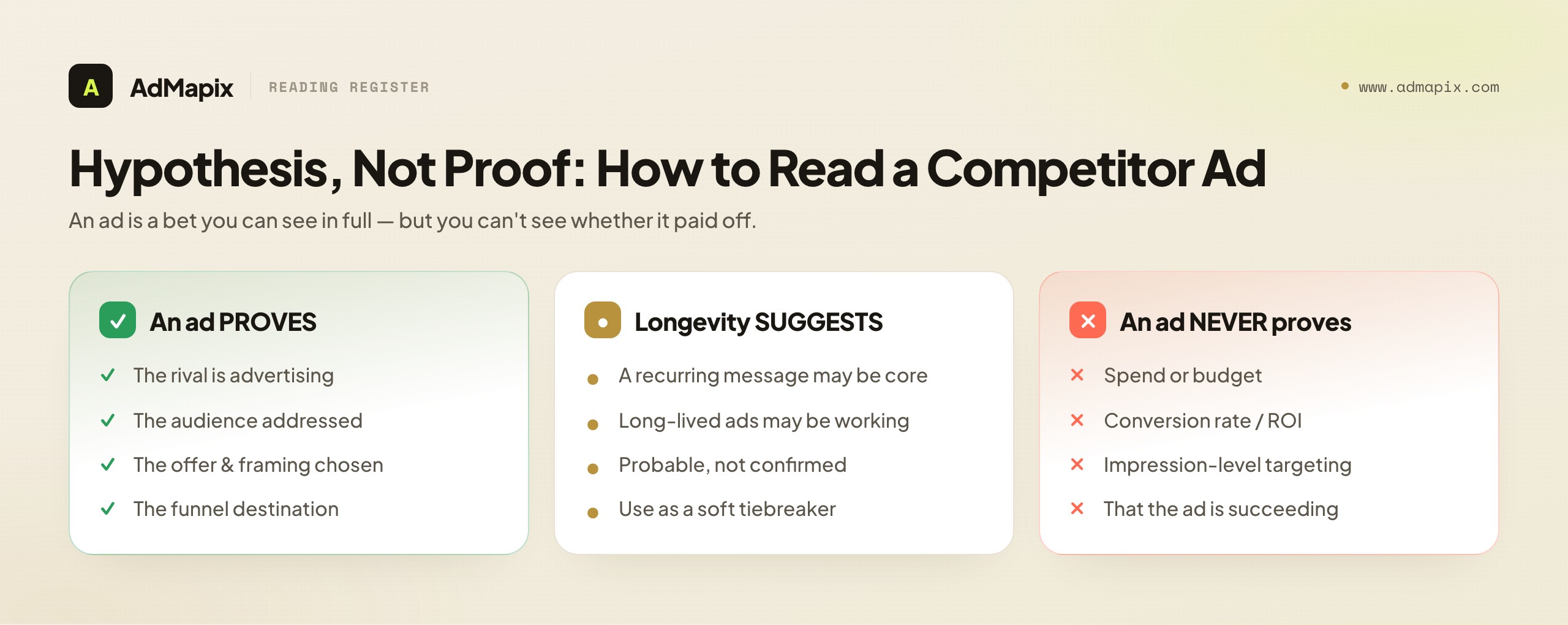
Consider what an ad actually is from the outside: a bet. The advertiser is betting that this audience, with this pain, responds to this offer, in this format, with this CTA, landing here. You can see the bet in full. What you cannot see is whether the bet paid off. The competitor might be three days into a test that they will kill next week. They might be running an ad that performs terribly but that nobody has gotten around to pausing. They might be running a deliberately mediocre ad to satisfy a brand mandate while their real performance budget goes elsewhere. From the outside, all of these look identical to a winning ad.
So the correct reading of any competitor LinkedIn ad is: "This rival believes, or is testing the belief, that [audience] responds to [offer] framed as [promise]." That is a genuinely valuable input — it tells you where a competitor is placing bets and how they are framing the market. But it is an input to your hypotheses, not a conclusion about their results. The moment you write "Competitor X's demo offer is converting well" based on having seen the ad, you have invented data, and the first time that invention is exposed your whole research function loses credibility.
There is one signal that nudges a hypothesis toward "probably working": longevity and repetition. An ad that has been live for a long time, or a message that recurs across many of a competitor's creatives, is more likely to be performing than a brand-new one-off — advertisers tend to keep and replicate what works. This is the LinkedIn analogue of the frequency signal in mobile creative research. It is still correlational, still imperfect, but it is the best free proxy you have. Use it as a tiebreaker, never as proof. The honest register is "this message recurs across many of their live ads and has been live a while, suggesting it may be a core, performing play" — not "this is their best ad."
The Five-Step LinkedIn Competitor Analysis Workflow
Here is the repeatable workflow. The goal is to move from "here are some ads" to "here is what we should do differently next sprint" — a deliverable, not a screenshot folder.
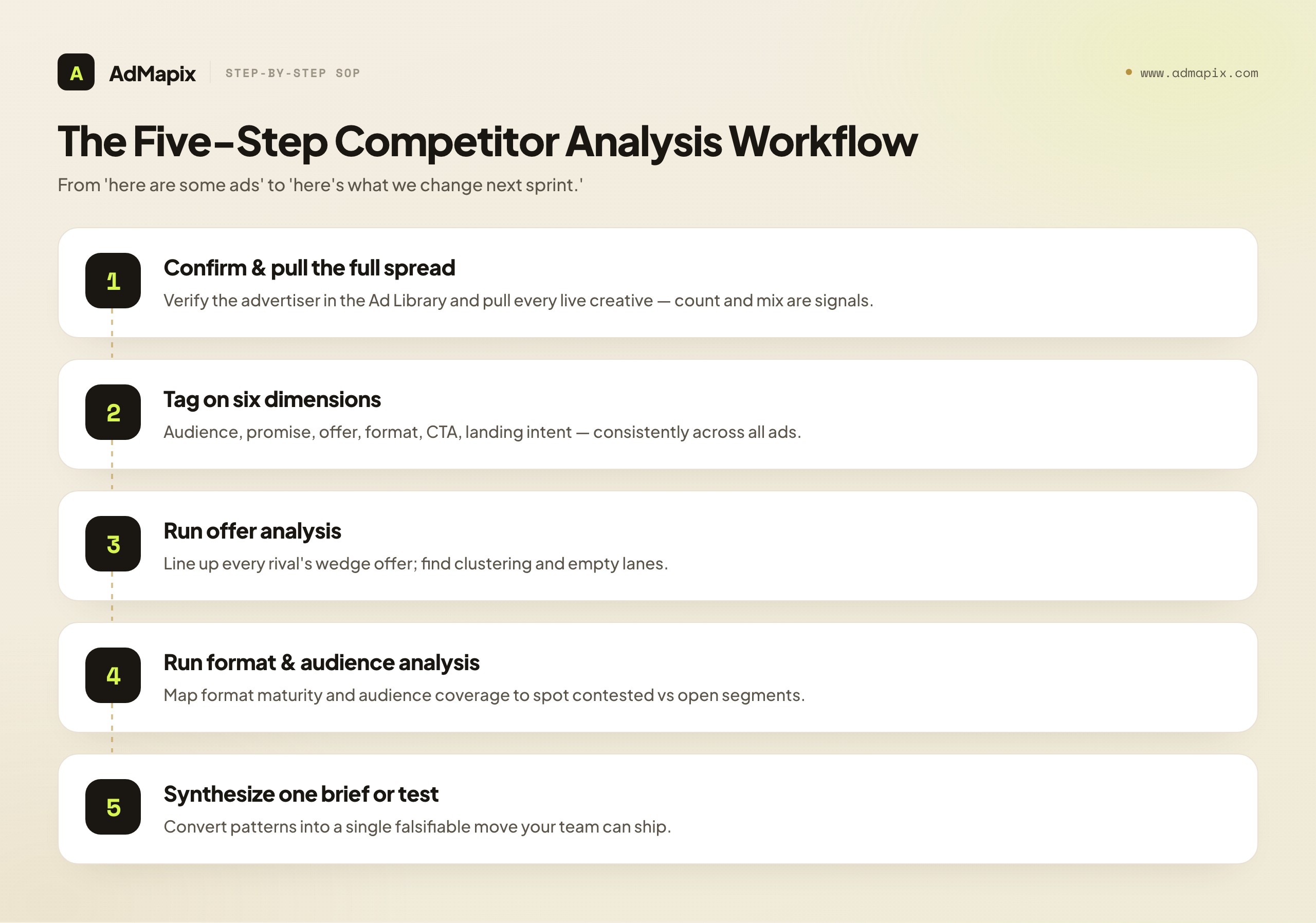
Step 1 — Confirm the advertiser and pull the full spread. Search the competitor's company name in the LinkedIn Ad Library to verify they are running ads and see everything live. Pull the full set, not a cherry-picked favorite — the count, format mix, and variant spread are signals in themselves.
Step 2 — Tag each ad on six dimensions. For every creative, record audience, promise/pain, offer, format, CTA, and landing-page intent (the six-dimension scheme detailed in the next section). Tagging is the step that turns a pile of creatives into a comparable dataset.
Step 3 — Run offer analysis across the competitive set. Line up every competitor's wedge offer side by side. Where do they cluster? What is missing? An offer gap that no rival is filling is often your cleanest opportunity.
Step 4 — Run format and audience analysis. Map which formats each competitor uses for which audience. The pattern reveals testing maturity and shows you which format/audience combinations the category believes in — and which it has left open.
Step 5 — Synthesize into one brief or test. Convert the patterns into a single, specific, falsifiable move: a new wedge offer to test, a segment nobody is addressing, a format gap to fill, a sharper promise. A research cycle that does not end in a testable brief was entertainment, not intelligence.
This loop should run on a cadence (monthly is a sane default for most B2B categories), because the strategic value is in watching the bets change over time.
The Six-Dimension Tagging Scheme
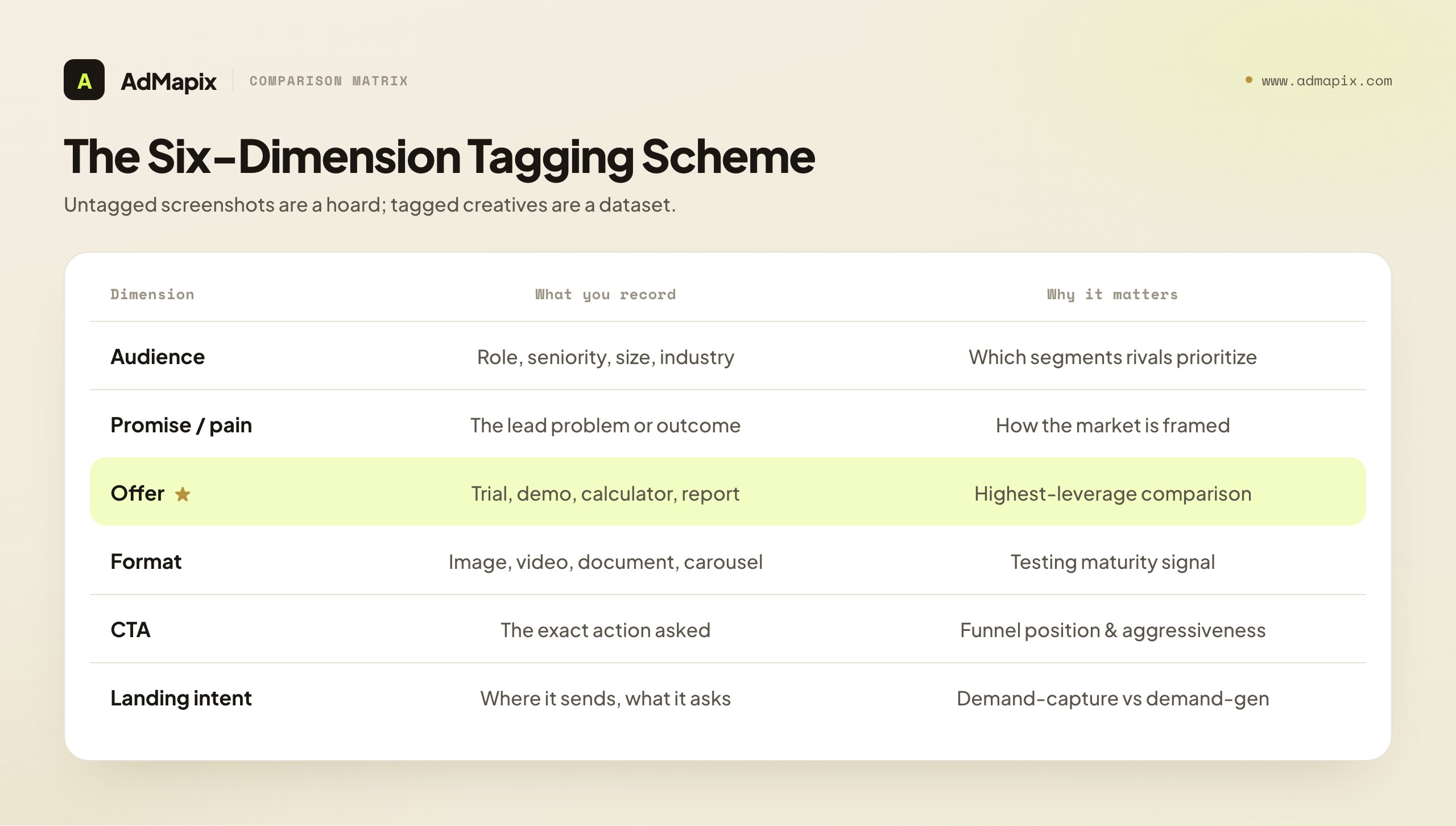
Tagging is the heart of the workflow. Untagged screenshots are a hoard; tagged creatives are a dataset. Tag every competitor ad on these six dimensions, consistently, so patterns surface across the whole set.
| Dimension | What you record | Why it matters |
|---|---|---|
| Audience | The buyer the ad targets (role, seniority, company size, industry) — read from copy, imagery, and explicit callouts | Reveals which segments competitors prioritize and which they ignore |
| Promise / pain | The core problem or outcome the ad leads with | Shows how rivals frame the market and where framing clusters or differs |
| Offer | The wedge (free trial, demo, ROI calculator, report, webinar, template, assessment) | The single highest-leverage comparison; offer gaps are opportunities |
| Format | Single image, video, document/PDF, carousel, thought-leader/personal, event, conversation | Signals testing maturity and which formats the category trusts |
| CTA | The exact button/action (Request demo, Download, Register, Learn more, Sign up) | Reveals where in the funnel the ad is pointed and how aggressive the ask is |
| Landing-page intent | Where the ad sends and what it asks for (gated form, product page, calculator, content) | Distinguishes demand-capture from demand-gen and reveals funnel strategy |
The discipline is consistency. Use the same vocabulary for every ad — a fixed list of offer types, a fixed list of formats — so that when you sort and count, the counts mean something. The first time you tag a competitive set, you will be tempted to invent a new tag for every ad; resist it. A small, stable taxonomy is what makes the patterns legible. As you scale, version the taxonomy deliberately, the way you would version code, rather than letting it sprawl.
Once a competitive set is tagged, the analysis often does itself. Sort by offer and the clustering jumps out. Sort by audience and the unaddressed segments appear. Sort by format and the maturity differences become obvious. The insight was always in the data; tagging is what makes it visible.
Offer Analysis: The Highest-Leverage Move
If you only had time for one cut of the data, make it offer analysis. The wedge offer — the entry point a competitor is willing to spend ad budget to push — is the truest single statement of their funnel strategy, and comparing offers across a competitive set is where the sharpest opportunities surface.
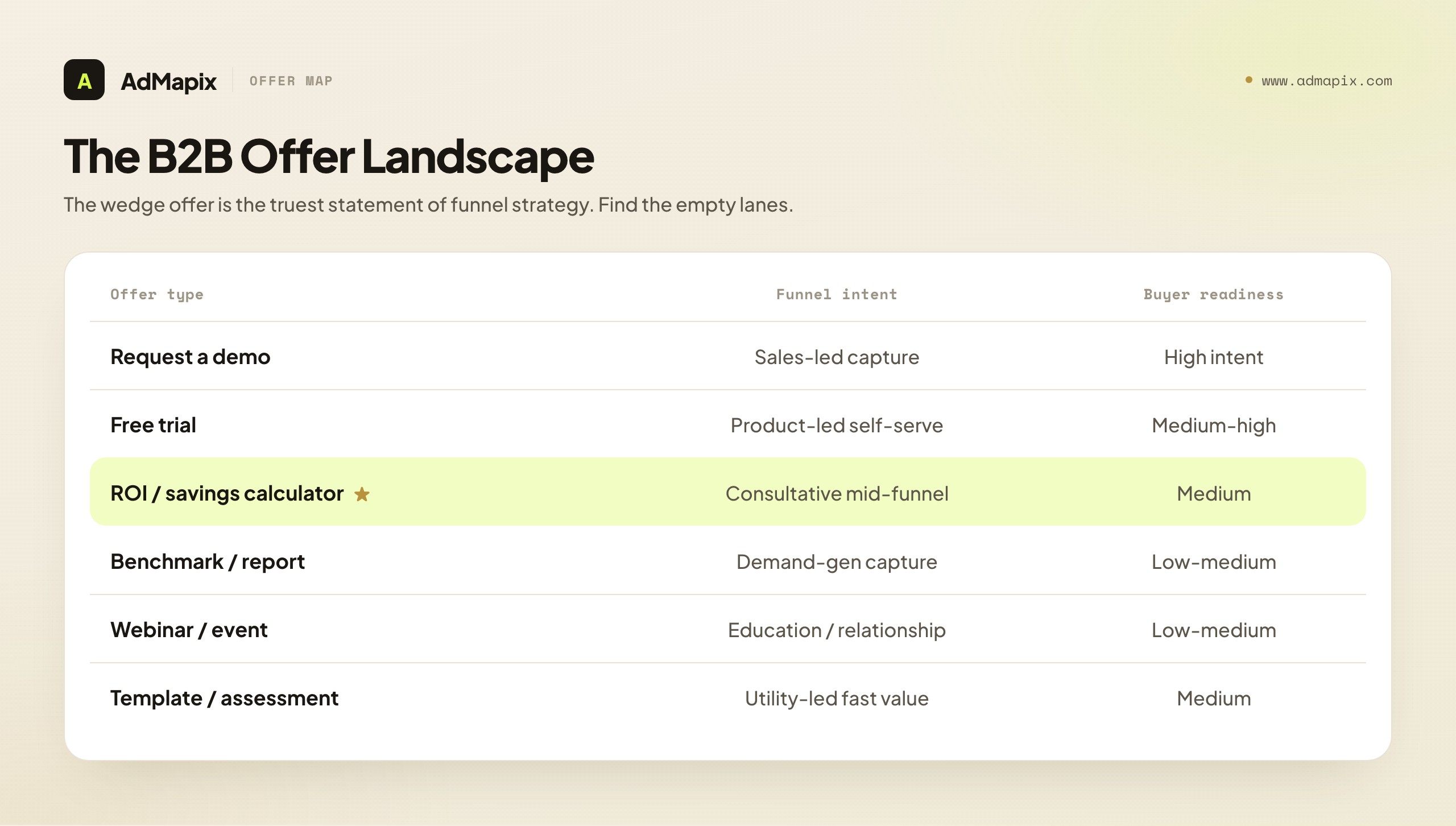
Start by enumerating the offer landscape across all competitors. In most B2B categories the offers cluster into a recognizable set: demo request (sales-led, high-intent, expensive lead), free trial (product-led, lower-friction, self-serve), ROI/savings calculator (consultative, mid-funnel), gated report or benchmark (demand-gen, top-funnel, lead-capture), webinar or event (relationship/education), template or assessment (utility-led, fast value), and content download (broad top-funnel). Each offer type implies a different funnel philosophy and a different buyer readiness.
Now look at the distribution across your competitive set. Three patterns are worth hunting for:
Clustering. If every competitor is leading with "request a demo," the category has a sales-led consensus — and a product-led trial offer, or a fast utility offer, may be a wedge nobody is contesting. Clustering reveals consensus, and consensus is sometimes a blind spot you can exploit.
Gaps. An offer type that no competitor runs is either a bad idea for the category (sometimes true) or an unclaimed lane (often true). A calculator in a category full of demo requests, or a benchmark report where everyone else gates a generic ebook, can capture demand the category is leaving on the table. Gaps are your cleanest opportunities, but test them — a gap can also be a graveyard.
Sophistication. Notice how offers are framed, not just which offer. "Get a demo" is a generic ask; "See your team's exact savings in 4 minutes" is a sophisticated one. The sophistication of the offer framing is a competitive signal in itself — a category where everyone runs lazy offer copy is a category where sharp offer copy stands out cheaply.
The deliverable from offer analysis is a single decision: which wedge offer to test next, and how to frame it, informed by where the competitive set clusters and where it leaves room. That decision, made from evidence, is the entire payoff of the exercise.
Format and Audience Analysis
Beyond the offer, two more cuts repay attention: format strategy and audience coverage.
Format strategy as a maturity read. Map each competitor's format mix. A rival running only single-image ads is either early in their LinkedIn maturity or deliberately minimalist. One running single image, video, document ads, carousels, and thought-leader/personal posts is running a mature, multi-format program — and the breadth tells you they are testing seriously and likely spending meaningfully. Document (PDF) ads and thought-leader content are particularly telling: they require more production investment and signal a competitor that has moved past basic demand capture into content-led demand generation. When you see a competitor's format mix broaden over successive monthly reports, you are watching their program mature in real time.
Audience coverage as an opportunity map. Tag the buyer each ad targets, then map the coverage across the competitive set. You are looking for two things. First, contested segments — the buyers every competitor is targeting, where you will fight hardest and pay most. Second, uncontested segments — buyers your category serves but few rivals are actively advertising to. An uncontested segment is a cheaper place to win attention, and finding one through this analysis is among the most valuable outcomes the whole workflow produces. Be careful, again, with inference: the absence of ads to a segment in the Ad Library means you did not find ads to it, not that the competitor definitively ignores it. But a clear, repeated absence across a competitive set is a reasonable basis for a hypothesis worth testing.
The format-and-audience cut, combined with the offer cut, gives you a three-dimensional map of the competitive set: who each rival targets, what they offer, and how they package it. Three competitors might all chase the same buyer with the same demo offer but in completely different formats — and that is a real, actionable difference your analysis should surface.
Building Recurring LinkedIn Competitor Reports
A one-time competitor audit is a snapshot; the strategic value is in the trend. The teams that get the most from LinkedIn competitor analysis run it as a recurring report, not a one-off project. Here is how to structure that.
Cadence. Monthly suits most B2B categories — long enough that meaningful changes accumulate, short enough that you catch a new offer or campaign before it is obvious in the market. Fast-moving categories or active competitive launches may justify a tighter loop.
What to track over time. The report's value is change: new offers a competitor has introduced, messages they have abandoned, segments they have entered or exited, formats they have added, and shifts in the volume or variety of their creative. A new offer appearing across multiple competitors is an early signal of a category trend. A competitor quietly dropping a message they pushed hard last quarter is a tell that it underperformed. These deltas are the intelligence; the static snapshot is just the baseline they are measured against.
Structure of the report. A useful recurring report has: an executive summary of the most important shifts since last period, an offer-landscape view, an audience-coverage map, a format-maturity read per competitor, notable new creatives with your reading of each, and — critically — a recommendations section that converts observations into specific briefs or tests. The recommendations are the product. A report that observes but never recommends is overhead.
Sample and limit disclosure. Every report should state plainly what it is built on: which competitors, what date range, that the data is from the public Ad Library, and that it reflects messaging not performance. This is what lets readers weight the conclusions correctly and protects your credibility. A report that quietly implies it knows competitor performance is a report that will eventually be caught out.
This recurring-report step is exactly where a tool earns its keep, because doing it manually every month is slow and easy to let slip — which leads to the honest scoping of where AdMapix fits.
Where AdMapix Fits — and Where It Honestly Does Not
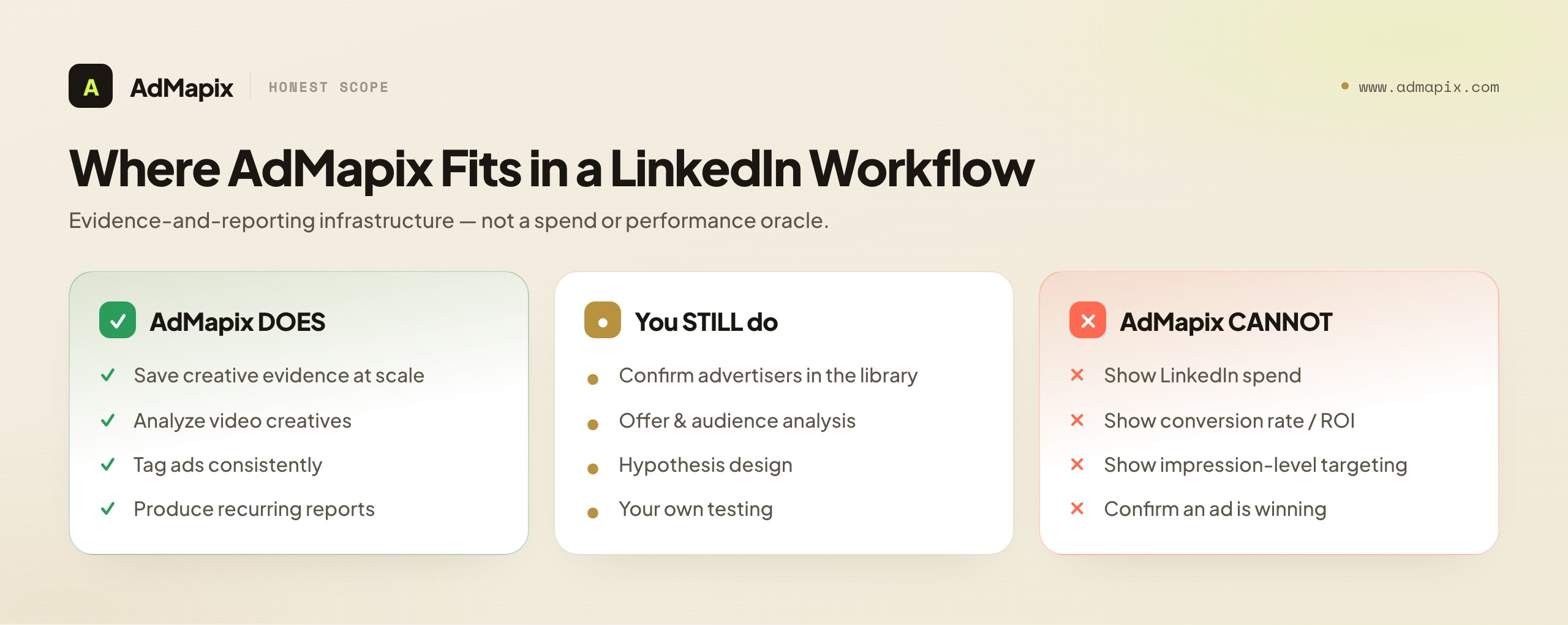
Let us be precise. AdMapix is a creative-evidence layer. In a LinkedIn competitor-analysis workflow, it is built to help with the parts that do not scale by hand: saving creative evidence so it does not live in a screenshot folder, analyzing video creatives, tagging ads consistently, and producing the recurring competitor reports described above. When your one-off screenshot habit stops scaling — usually around the point where you are tracking more than a handful of competitors monthly — that is the seam AdMapix is designed to fill.
What AdMapix is not, and cannot be: a LinkedIn spend tracker, a conversion-rate or ROI source, an impression-level targeting window, or a performance oracle. None of those are derivable from public LinkedIn ad data, because LinkedIn does not publish spend, performance, or impression-level targeting in its Ad Library. No tool can conjure that data, and any vendor claiming to show you a competitor's LinkedIn spend or ROI is selling a model dressed up as a measurement. AdMapix gives you organized, analyzable, reportable creative evidence — the "what they're saying" layer done at scale — and is explicit that the "how it's performing" layer is not publicly knowable.
So the right framing is: you (or AdMapix) collect and organize the creative evidence; the analysis lenses in this guide (six-dimension tagging, offer analysis, format/audience mapping) extract the insight; and the recurring report turns it into briefs. AdMapix accelerates the evidence-and-reporting infrastructure around a workflow you still own. That is a real and useful job, and it is a fundamentally different job from the impossible one of revealing competitor internals. For how creative-evidence layers sit next to the broader tool landscape, see best ad intelligence tools and best ad spy tools 2026.
Common Mistakes in LinkedIn Competitor Analysis
The failure modes are consistent. Avoid these and you will be ahead of most teams running this analysis.
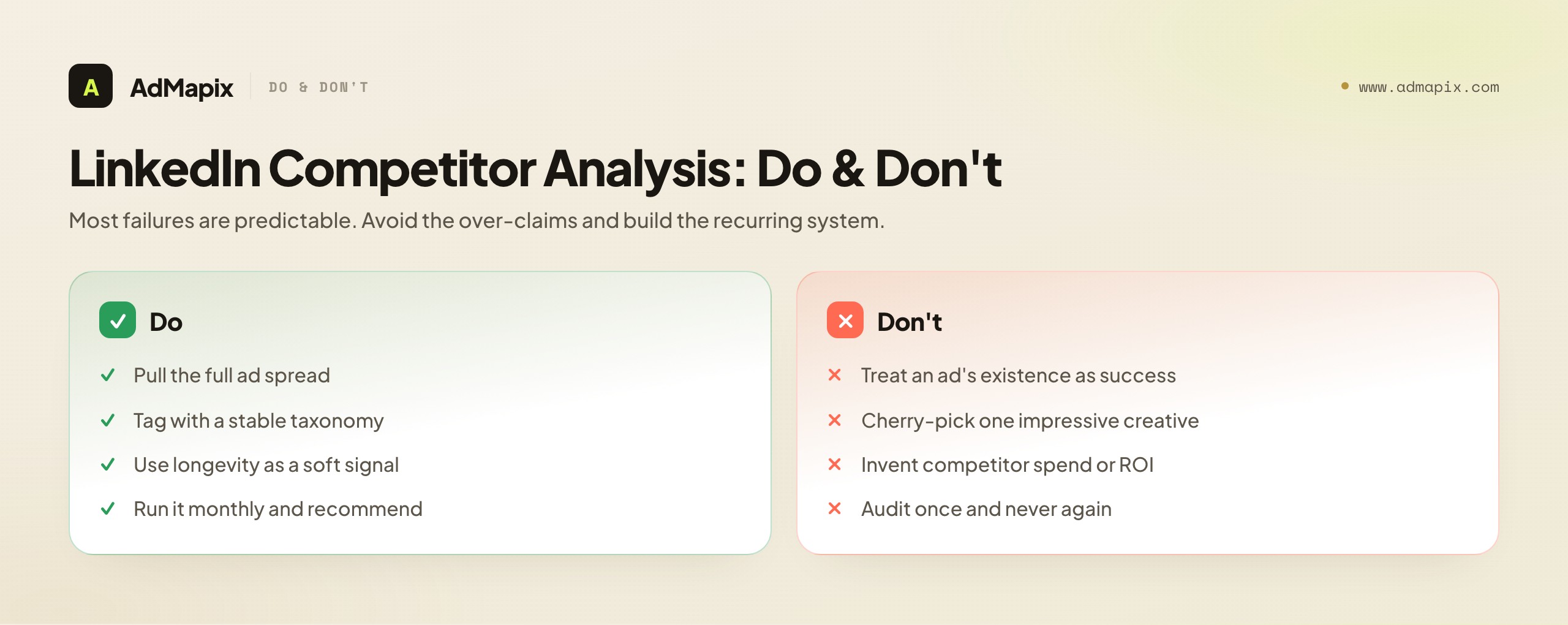
Confusing existence with performance. The cardinal sin: assuming a competitor's ad is working because it exists. An ad is a bet, not a result. Fix: read every ad as a hypothesis, and use longevity/repetition only as a soft likelihood signal.
Cherry-picking creatives. Pulling a competitor's most impressive ad and treating it as representative. Fix: always pull the full spread; the count and mix are part of the data.
Inventing spend numbers. Asserting competitor LinkedIn budgets you cannot know. Fix: state plainly that spend is not in the public data, and confine claims to messaging and offers.
Inconsistent tagging. Inventing a new tag for every ad so nothing is comparable. Fix: a small, stable taxonomy enforced across the whole set.
Reading targeting as fact. Treating your inference of the audience as confirmed targeting. Fix: phrase audience as "the ad appears to address," and remember impression-level targeting is not public.
One-and-done audits. Running the analysis once and never again. Fix: make it recurring; the value is in the deltas.
Observing without recommending. Producing a beautiful report that ends with no decision. Fix: every report ends in specific briefs or tests.
Over-trusting the absence of ads. Concluding a competitor ignores a segment because you found no ads to it. Fix: treat absence as a hypothesis to test, not a confirmed gap.
A Worked Example: Out-Positioning in a Crowded B2B Category
To make the workflow concrete, here is an illustrative (composite) case. You sell a RevOps platform and want to find an angle against five established competitors all advertising heavily on LinkedIn.
Confirm and pull. You search all five in the Ad Library and pull every live creative — 41 ads in total, ranging from one competitor with 3 ads to another with 19.
Tag. You run the six-dimension scheme across all 41. The tagging takes an afternoon and produces a clean dataset.
Offer analysis. Four of the five competitors lead overwhelmingly with "request a demo." Only one runs a calculator, and nobody runs a benchmark report or an assessment. The category has a sales-led demo consensus — and two offer lanes (benchmark, assessment) sit empty.
Format analysis. The two largest competitors run a broad mix including document ads and thought-leader posts; the three smaller ones run mostly single-image demo ads. Format maturity tracks size, as expected, and the document/thought-leader lane is thinly contested.
Audience analysis. Everyone targets RevOps and Sales Ops leaders. Almost nobody is advertising to the finance stakeholders who increasingly co-own the RevOps budget — a visible, repeated absence across the set.
Synthesis. The patterns point to a clear bet: run a benchmark-report wedge offer (an empty lane), in document/thought-leader format (thinly contested), aimed partly at the finance co-owner audience (almost untargeted). Each element is grounded in the competitive evidence and each is a falsifiable hypothesis.
Brief and test. You write a single brief — "Test a 'RevOps Spend Benchmark' document ad targeting RevOps + Finance leaders against our current demo-request single-image ad" — and run it. Your own analytics, not the competitor analysis, will tell you if the bet pays off. Whatever the result, it updates your read of the category for next month's report.
Note what the example never claims: it never states any competitor's spend, conversion rate, or ROI. It works entirely from public creative evidence, expressed as hypotheses, and ends with your test as the arbiter. That is responsible, high-leverage LinkedIn competitor analysis.
Decoding LinkedIn Ad Formats and What Each One Reveals
A LinkedIn ad's format is not just a packaging choice — it is a fingerprint of the advertiser's intent, budget, and funnel position. Reading formats well lets you infer a competitor's strategy before you have read a single word of their copy. Here is what each major LinkedIn format actually tells you when you find it in a rival's spread.
LinkedIn maintains its own catalog of the formats it sells in the LinkedIn ad formats guide, which is a useful cross-reference when you are classifying a competitor's spread.
Single-image sponsored content is the default unit of LinkedIn advertising — a static image, a headline, body copy, and a CTA button. Its ubiquity makes it the baseline against which everything else is measured. When a competitor runs only single-image ads, you are usually looking at one of two things: an early-stage program that has not yet matured into testing other formats, or a deliberately lean demand-capture operation pointing high-intent traffic at a demo. The single-image ad is cheap to produce and fast to iterate, so the number of single-image variants a competitor runs is a clean read on how actively they are testing. Three near-identical single-image ads with different headlines is a competitor running a headline test in public; you are watching their optimization loop from the outside.
Video ads signal a meaningfully larger production commitment. Video is expensive to make well, and a competitor investing in it has decided the format earns its cost — usually because they are selling something that benefits from demonstration (a product walkthrough), emotion (a customer story), or authority (a founder explaining a category shift). When you find competitor video, analyze the first three seconds above all else: LinkedIn autoplays muted in-feed, so the opening frames and any burned-in captions carry the entire hook. A competitor whose video opens with a bold on-screen claim has learned the muted-autoplay lesson; one whose video opens with a slow logo animation has not, and that is a competitive weakness you can exploit with a sharper hook. Video also tends to sit higher in the funnel than a single-image demo ad, so its presence often means a competitor is investing in demand generation, not just capture.
Document ads (also called carousel PDFs or "thought leadership" document units) let advertisers serve a multi-page swipeable PDF directly in-feed, often gated behind a lead form after the first few pages. They are one of the most telling formats in B2B because they require real content investment — a genuine report, framework, or benchmark — and they signal a competitor running a content-led, lead-capture motion rather than a pure demo push. When you see document ads in a rival's spread, read the topic carefully: it tells you what authority position the competitor is trying to claim. A document ad titled "The 2026 State of RevOps Benchmark" is a competitor staking a claim to category-defining data, which is a far more sophisticated play than a generic "Get a demo." Document ads are also where you most often find offer gaps, because many competitors never invest in them.
Carousel ads (multi-card swipeable images) are used for sequenced storytelling — a problem-agitate-solve arc across cards, a feature tour, or a set of customer logos and proof points. Their presence signals a competitor comfortable with a more involved creative narrative. Read the card sequence as a window into how the competitor structures their pitch: what they lead with, what they save for the middle, and what CTA they land on.
Thought-leader ads (sponsored posts boosted from an individual's personal profile rather than the company page) are a sophistication marker. They exploit the fact that LinkedIn users trust people more than brands, so the ad reads as a person's post rather than corporate marketing. A competitor running thought-leader ads has internalized one of LinkedIn's most durable lessons and is operating a mature program. When you find them, note whose profile is being amplified — a founder, a head of product, a named expert — because that choice reveals the authority the competitor is renting to sell.
Conversation and message ads (interactive or direct-message formats) are higher-intent, more intrusive units typically reserved for nurture and event promotion. Their presence in a spread signals a competitor running a multi-touch sequence rather than a single-shot acquisition play.
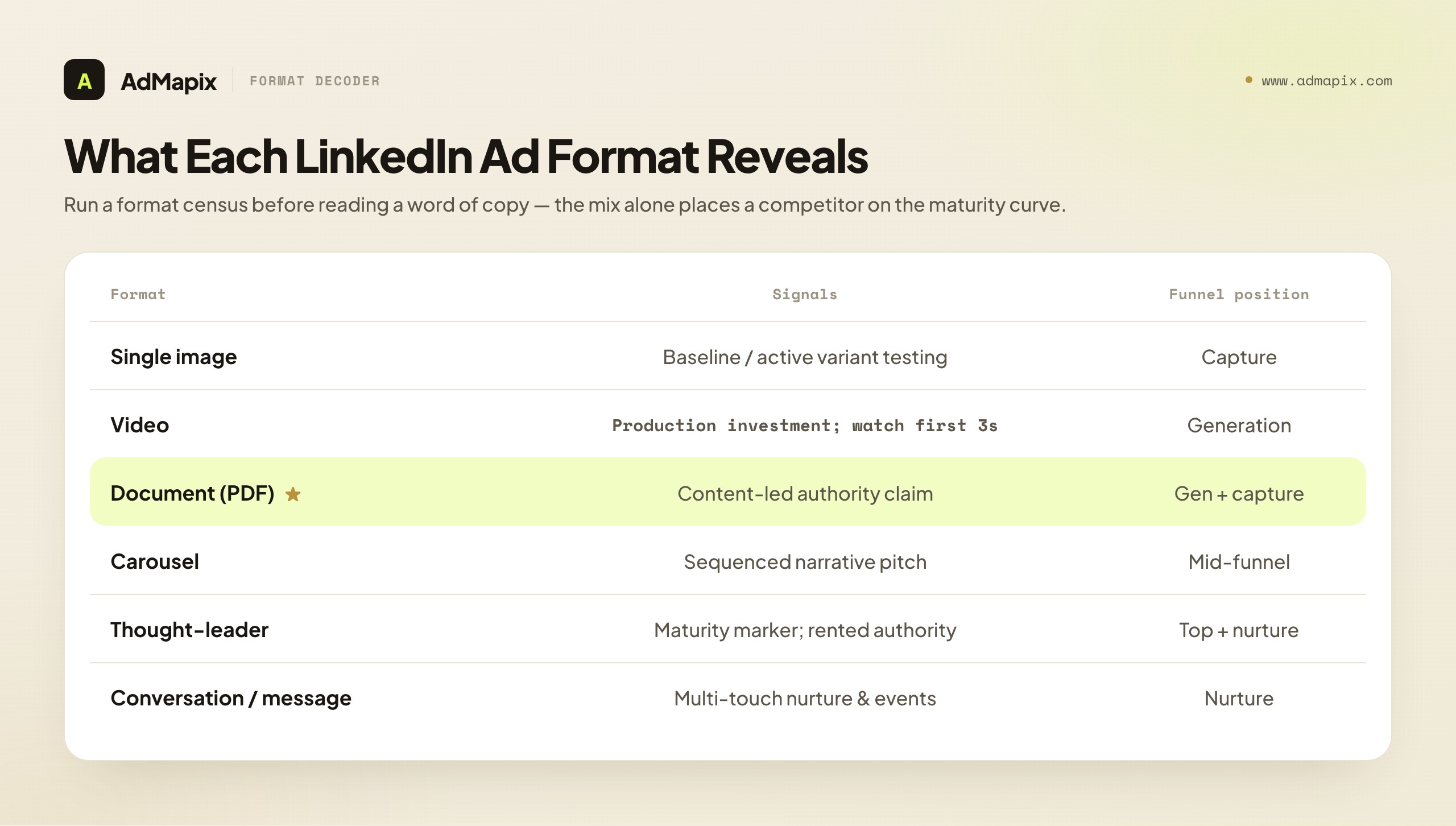
The practical upshot: when you pull a competitor's spread, do a format census before you read a word of copy. The mix alone — heavily single-image, or broad across video and documents and thought-leader — places the competitor on a maturity curve and tells you whether they are capturing demand, generating it, or both. A category where every competitor sits at the single-image-demo end is a category where a competitor who moves into documents and thought-leader content can claim the authority lane cheaply. That is a strategic read you can make from formats alone, before any deeper analysis.
Reading the Landing Page: The Hidden Half of Every Competitor Ad
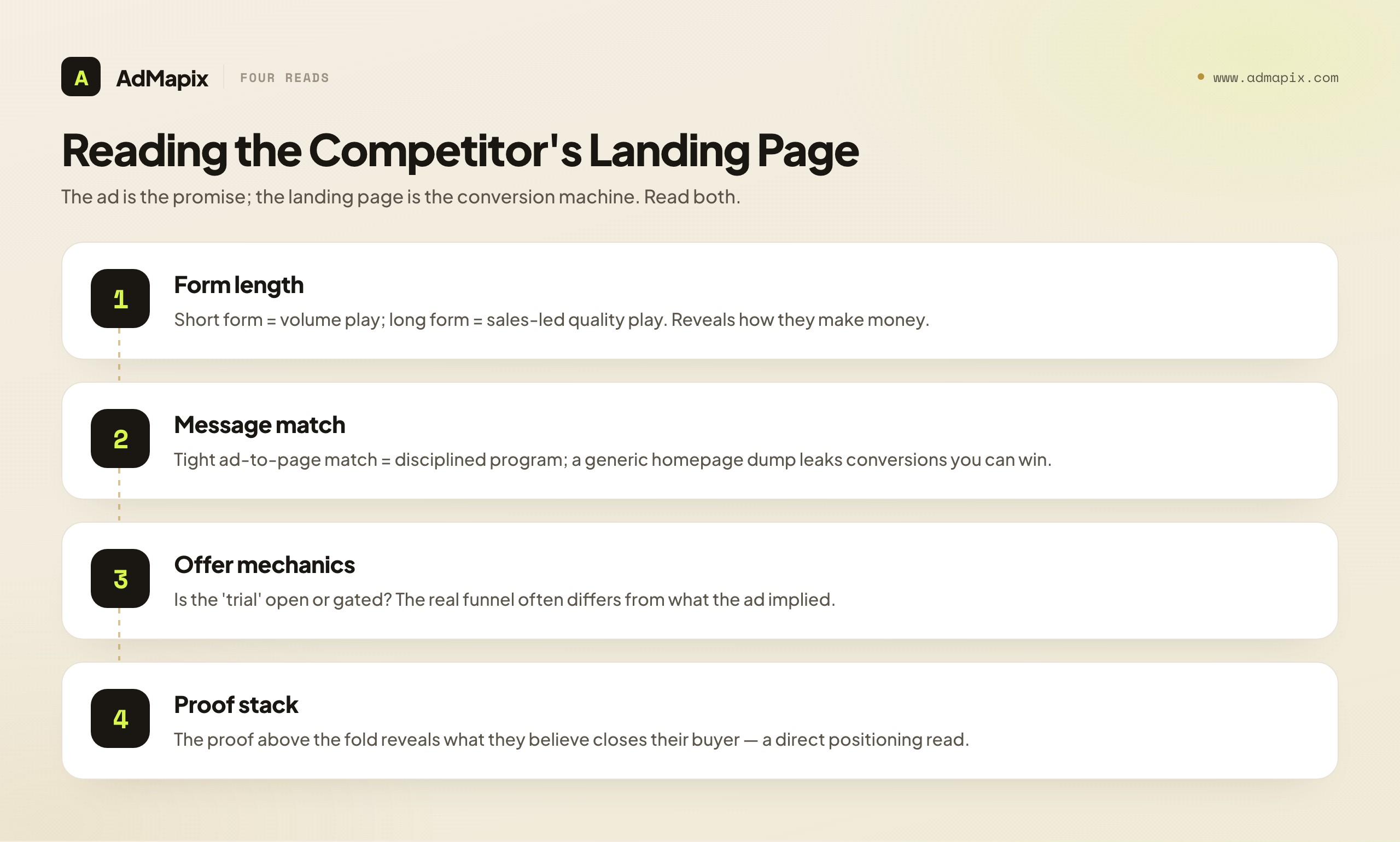
Most LinkedIn competitor analysis stops at the ad creative. That is a mistake, because the ad is only half the story — the destination it points to is the other half, and it is often where the real strategy lives. The creative is the promise; the landing page is the conversion machine. Reading both together turns a partial picture into a complete one.
When you find a competitor ad in the Ad Library, follow its click through to the destination (carefully, and ideally not while logged into accounts you do not want associated with the click). What you are reading on the other side is the competitor's conversion philosophy, and it tells you things the ad alone cannot.
The form length is a strategy statement. A landing page that asks for name and email only is a competitor optimizing for volume and willing to do qualification later. One that asks for company size, role, phone number, and a "what are you trying to solve" free-text field is a competitor optimizing for lead quality and routing straight to sales. Neither is right or wrong, but the choice reveals whether the competitor's funnel is volume-led or sales-led — and that, in turn, tells you how they likely make money and where they are vulnerable. A volume-led competitor is beatable on lead quality; a sales-led one is beatable on friction and speed.
The message match is a quality signal. Does the landing page deliver on the ad's promise, or is there a jarring disconnect between the ad's specific hook and a generic homepage? A tight message match — the ad promises "see your RevOps savings" and the page is a savings calculator — is the mark of a disciplined program. A loose match — a specific ad dumping the visitor on a generic homepage — is a competitive weakness, because it leaks conversions, and it tells you the competitor's execution is not as tight as their ad creative suggested. You can often out-convert a competitor not by having a better ad, but by having tighter message match than they bothered to build.
The offer mechanics tell you the real funnel. Is the demo a true demo (sales call) or a self-serve product tour? Is the "free trial" credit-card-gated or open? Is the calculator a real interactive tool or a glorified lead-capture form with a number at the end? These mechanics are the actual product of the funnel, and they often differ from what the ad implied. A competitor whose ad says "free trial" but whose page demands a sales call before access is running a bait-and-switch that frustrates buyers — and that friction is an opening for you.
The proof stack reveals positioning. What logos, testimonials, stats, and certifications does the landing page lead with? The proof a competitor chooses to put above the fold is the proof they believe closes their buyer — which is a direct read on what their buyer cares about most. If every competitor's landing page leads with enterprise logos, the category is buying on safety and social proof; a competitor (you) leading with a hard ROI number or a speed-to-value stat is differentiating on a different axis.
Crucially, none of this landing-page reading violates the honesty principle, because you are observing what the competitor built, not inferring how it performs. You can see the form, the message match, the offer mechanics, and the proof stack directly. What you still cannot see is the page's conversion rate. So the register stays the same: "the competitor has built a high-friction, sales-led conversion path with enterprise-logo proof" is an observation; "their landing page converts at 4%" is an invention. Stay on the right side of that line and the landing-page read roughly doubles the strategic value you extract from every competitor ad.
Turning Competitor Analysis Into Your Own Creative Brief
The entire workflow exists to produce one thing: a brief that makes your next campaign sharper. A research cycle that ends in a report nobody acts on was a hobby, not intelligence. Here is how to translate the competitive evidence into a concrete creative brief your team can ship — and how to do it without simply copying what rivals are already doing.
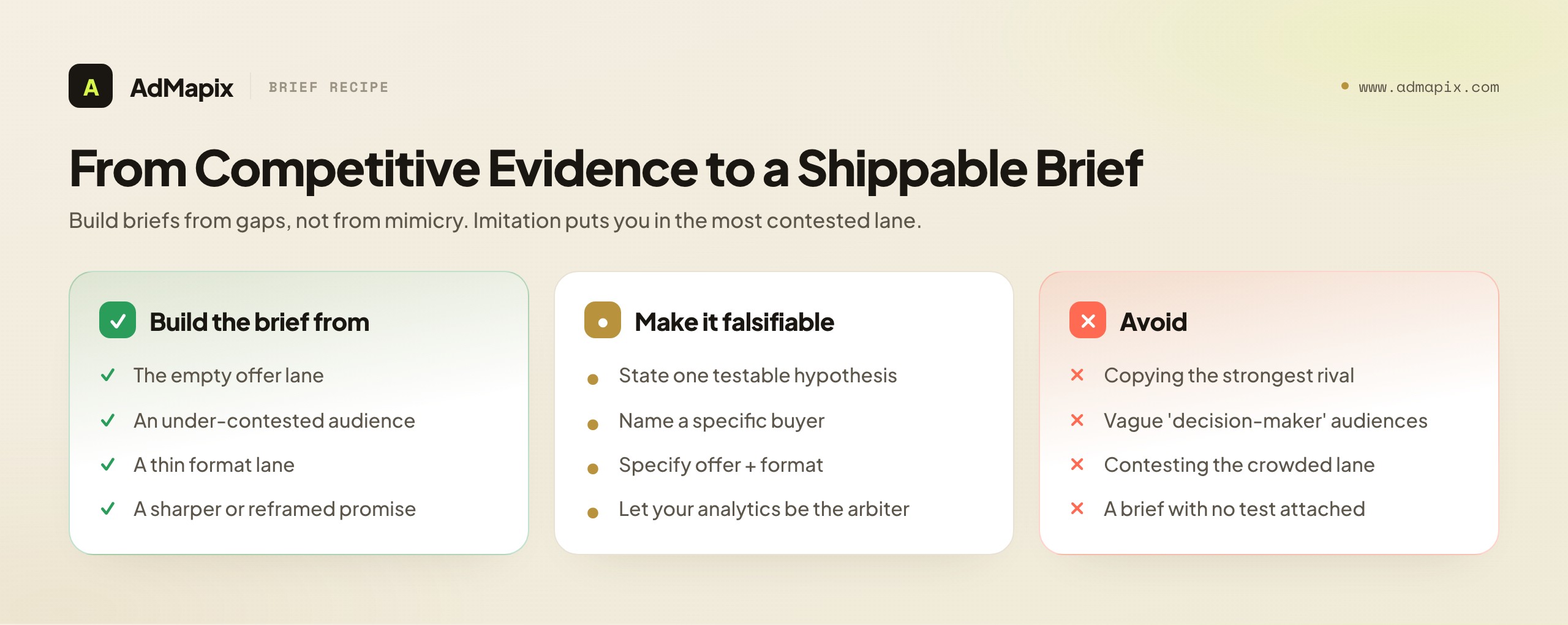
The temptation, once you have a tagged competitive set in front of you, is to imitate the strongest-looking competitor. Resist it. Imitation puts you into the most contested lane against an incumbent with more budget and a head start — a losing position. The point of competitor analysis is not to match the competitive set but to find the gap in it, and a good brief is built from gaps, not from mimicry.
Start the brief from the offer gap. Your offer analysis surfaced where competitors cluster and where the lanes are empty. The brief leads with the offer decision: are you contesting a crowded lane with a sharper version (only if you can genuinely out-execute), or claiming an empty lane (usually the better bet)? An empty offer lane — a benchmark report in a demo-saturated category, an interactive assessment where everyone else runs static ebooks — is the strongest foundation for a brief because it gives you the whole lane to yourself.
Build the audience from the coverage map. Your audience analysis showed contested and uncontested segments. The brief should name a specific buyer, and where possible an under-contested one — the finance co-owner nobody addresses, the practitioner everyone ignores in favor of the VP. A brief that says "B2B decision-makers" is no brief at all; one that says "Heads of RevOps at 200–1000 employee SaaS companies, plus their Finance co-approvers" is something a creative team can actually execute against.
Choose the format from the maturity read. Your format census showed where the category is mature and where it is thin. If competitors have left the document and thought-leader lanes thin, the brief should specify that format, because format gaps are as real as offer gaps and often cheaper to win.
Write the promise against the framing clusters. Your promise/pain tagging revealed how the category frames the problem. The brief's headline should either sharpen the dominant framing (if you can say it better) or deliberately reframe (if the dominant framing has a weakness you can exploit). When every competitor leads with "save time," a brief that leads with "stop losing deals to slow handoffs" reframes the same pain in a way that may cut through precisely because it is different.
Make the brief falsifiable. The brief must state a hypothesis your own analytics can test: "We believe Heads of RevOps + Finance co-approvers will respond to a benchmark-report document ad reframing the pain as deal-velocity loss, better than our current demo single-image ad." That is a sentence you can run, measure, and be proven right or wrong about. A brief that cannot be falsified by your own data is a wish, not a hypothesis.
The discipline here connects directly to your testing program — a strong brief is the input to a creative testing framework, and the quality of the brief largely determines the quality of what you learn from the test. Competitor analysis without a brief is observation; a brief without a test is speculation; the full loop — evidence, brief, test, result, updated read — is the only thing that compounds into durable advantage. Run that loop monthly and the competitive picture you hold gets sharper every cycle while your rivals are still cherry-picking screenshots.
How This Complements the LinkedIn Ad Library Reference
A quick orientation, because these topics overlap. The LinkedIn Ads Library reference answers "what is the Ad Library and how do I use the interface" — it is the tool documentation. This article answers "given the Ad Library, how do I run a rigorous competitor-analysis workflow that ends in decisions" — it is the methodology. The LinkedIn Ad Library API explainer answers "can I access this programmatically and what are the limits" — it is the developer angle. Read together they cover the full surface: what the data source is, how to analyze it, and how (or whether) to automate it. If you are building a serious B2B competitive-intelligence practice, you will eventually want all three; this workflow is the one that turns the data into action.
FAQ
What is LinkedIn ads competitor analysis?
It is the practice of systematically reading the ads your competitors run on LinkedIn — their audiences, promises, offers, formats, CTAs, and landing-page intents — and converting that evidence into your own briefs and tests. It is a B2B competitive-intelligence discipline, not a one-time screenshot exercise. The output is a recurring understanding of how rivals position to the market and where there are gaps you can exploit, expressed as testable hypotheses rather than claims about competitor performance.
Where do I find competitor ads on LinkedIn?
In the LinkedIn Ad Library, a public database of ads served on LinkedIn (roughly the last year), searchable by advertiser without a login. It is the canonical, free starting point: search a competitor's company name to confirm they are advertising and to pull the full spread of their live creatives. See our dedicated LinkedIn Ads Library reference for interface details. The Ad Library shows what ran and the creative itself, but not spend, performance, or impression-level targeting.
Can LinkedIn ads competitor analysis show me a competitor's ad spend or ROI?
No. The LinkedIn Ad Library does not publish spend, conversion rate, ROI, or impression-level targeting, and no tool can derive those from public data. What you can learn is the competitor's messaging, offers, audiences, and formats — the "what they're saying" layer. The "how it's performing" layer is private. Be skeptical of any vendor claiming to show LinkedIn competitor spend; for this channel, such figures are unverifiable models, not measurements.
How should I read a competitor's LinkedIn ad?
As a hypothesis, never as proof. An ad is a bet the competitor is making or testing — that this audience responds to this offer in this format. You can see the bet in full but not whether it paid off. The correct reading is "this rival believes, or is testing, that [audience] responds to [offer] framed as [promise]." Longevity and repetition (an ad that has been live a while or a message that recurs across many creatives) are soft signals that the bet may be working, but they are correlational, not proof.
What dimensions should I tag competitor ads on?
Six: audience (the buyer targeted), promise/pain (the problem or outcome led with), offer (the wedge — trial, demo, calculator, report, webinar), format (single image, video, document, carousel, thought-leader), CTA (the exact action), and landing-page intent (where it sends and what it asks). Consistent tagging on these six turns a pile of creatives into a comparable dataset where patterns — clustering, gaps, maturity differences — become visible when you sort and count.
What is offer analysis and why does it matter most?
Offer analysis lines up every competitor's wedge offer side by side to reveal clustering, gaps, and sophistication differences. It matters most because the wedge offer is the truest single statement of a competitor's funnel strategy, and comparing offers across a set often surfaces the sharpest opportunity — an empty offer lane nobody is contesting, or a category-wide consensus that a different offer could disrupt. The deliverable is one decision: which wedge offer to test next, and how to frame it.
How often should I run LinkedIn competitor analysis?
Monthly suits most B2B categories — frequent enough to catch new offers and campaigns before they are obvious, infrequent enough that meaningful change accumulates between reports. The strategic value is in the deltas: new offers, abandoned messages, entered or exited segments, broadening format mixes. A standing recurring report beats a one-off audit, because the static snapshot is only useful as a baseline against which to measure change.
How does this differ from the LinkedIn Ads Library reference and the API guide?
The LinkedIn Ads Library reference is tool documentation — what the library is and how to use the interface. This article is methodology — how to run a rigorous competitor-analysis workflow that ends in decisions. The LinkedIn Ad Library API explainer is the developer angle — whether and how you can access the data programmatically. They are complementary: data source, analysis method, and automation. A serious B2B practice eventually wants all three; this workflow is the one that turns the data into action.
How does AdMapix help with LinkedIn competitor analysis?
AdMapix is a creative-evidence layer that accelerates the parts that do not scale by hand: saving creative evidence, analyzing video, tagging ads consistently, and producing recurring competitor reports. It is the right fit once one-off screenshots stop scaling. What it cannot do — because LinkedIn does not publish it — is show competitor spend, conversion rate, ROI, or impression-level targeting. It organizes and reports the "what they're saying" layer at scale; the "how it's performing" layer is not publicly knowable by any tool.
Can I trust the absence of competitor ads to a segment?
Cautiously. The absence of ads to a segment in the Ad Library means you did not find ads to it within your search and date range — not that the competitor definitively ignores it. A single absence proves little. But a clear, repeated absence across a whole competitive set is a reasonable basis for a hypothesis worth testing: that the segment is under-contested and may be a cheaper place to win attention. Treat it as a lead to validate with your own test, not a confirmed gap.
Related Reading
To build a complete B2B competitive-intelligence practice, pair this workflow with the LinkedIn Ads Library reference and the LinkedIn Ad Library API explainer, ground your method in the competitor ad analysis framework, and broaden your view with best ad intelligence tools, best ad spy tools 2026, and the advertising intelligence guide. For turning patterns into a deliverable, see our competitor ad report template.
Turn these observations into your next creative study
Open the creative library and select samples for your market, network and research question.
Related Articles
Pinterest Ads Library in 2026: The Ads Repository, Its Limits, and How to Research Promoted Pins
A complete 2026 guide to the Pinterest Ads Library — why it is really the DSA-driven Ads Repository, why access is EU-focused, exactly what it shows and hides, how to research promoted Pins when the repository is region-locked, how to read Pinterest creative by Pin format and category, the third-party spy methods that fill the gaps, the honest limits of public ad data, and where a cross-network creative-intelligence layer like AdMapix fits.
LinkedIn Ads Library in 2026: How to Find Competitor Ads and What It Shows
A complete 2026 guide to the LinkedIn Ads Library — how to access it from a company Page or by advertiser name, exactly which fields it shows and hides, how to read run-window longevity as a soft signal, the EU targeting disclosure, how it compares to Meta and Google ad libraries, the third-party tools that fill its gaps, the honest limits of public ad data, and where a cross-network creative-intelligence layer like AdMapix fits.
LinkedIn Ad Library API: What Actually Exists, What Doesn't, and the Workflow That Works in 2026
A developer-grade, honest explainer of the LinkedIn Ad Library API question. There is no public Ad Library API; LinkedIn runs a browse-only transparency website and a separate Advertising API for managing your own accounts. This guide untangles the two, explains what each returns, covers access, the legal and technical reality of scraping, the EU DSA context, and the manual-plus-tooling workflow CI teams actually use.