
Kingshot Ad Strategy: Hooks, Video Reuse, and Playable Links
A verified US iOS sample connects 30 Kingshot advertising records to 19 video files and 12 playable files, with eight timestamped visual analyses and practical briefs that separate creative observations from unmeasured performance.
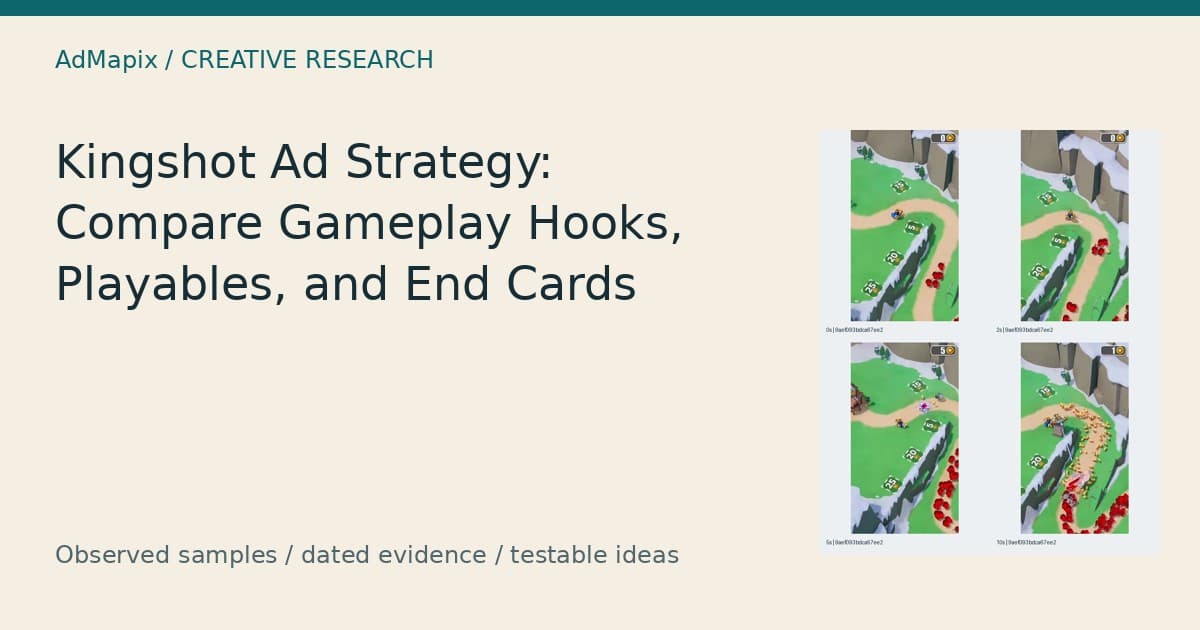
Kingshot Ad Strategy: Hooks, Video Reuse, and Playable Links
Kingshot advertising in this dated US sample combines visible defense scenarios with several different introductions: a cinematic king, a creator holding a phone, a persistent reaction overlay, a speaker labeled “Michael Owen,” and an animated royal character. The records also show video files associated with different playable files. These observations support a practical creative comparison, but they do not establish which hook, playable, or ending converts best.
For user acquisition managers and creative teams, the useful decision is which element to investigate or test next. This article examines eight timestamped contact sheets, separates advertising records from underlying files, and turns the visible patterns into original production briefs. The September 2026 snapshot provides a fixed reference for that work without treating a changing search result as a complete campaign history.
Last updated: 2026-09-15.
AdMapix Research — prepared with Codex and checked against the dated source sample.
Editorial ownership: Brad at AdMapix. This identifies editorial responsibility and does not imply personal human review of this automated draft. AdMapix is our product.
Quick Answer
The Kingshot sample shows variation in how an ad introduces a defense scenario, alongside reuse of video and playable files across advertising records.
- The bounded US sample contains 30 advertising records, 19 distinct video files, and 12 distinct playable files for the measurement window 2026-08-17 to 2026-09-15.
- The eight illustrated examples support comparisons of visible hooks, captions, presentation, and gameplay imagery.
- File associations establish reuse; they do not establish a controlled experiment or prove that an associated playable appeared as a particular end card.
- Use the findings to design separate hook, interaction, and transition tests. Evaluate results with your own campaign and product data.
What a Kingshot Creative Teardown Can Help You Decide
A useful Kingshot teardown helps a team choose a specific creative question, such as whether to introduce the game through an immediate tactical problem or through a person or character first.
Those alternatives appear in the supplied images. One example starts directly on a winding battlefield. Another opens with a crowned character and an advertising-related question. A creator example starts with a person holding a phone, while a different example places the creator above gameplay from the opening frame. These are concrete differences a production team can describe and reproduce structurally using its own assets.
The decision becomes less useful when it expands into “copy Kingshot’s winning strategy.” The sample does not contain acquisition costs, installs, retention, revenue, or experimental assignments. It also does not reveal every creative associated with the game. Calling a visible pattern a winner would add an outcome that the evidence never measured.
Instead, separate three jobs. Creative research identifies what is visible. Production planning chooses an original way to test a related idea. Campaign analysis determines whether that idea works for your product and audience. Keeping those jobs distinct makes the eventual test easier to interpret.
This article belongs within the broader mobile game ads guide, but its scope is deliberately narrower: a dated, verified iOS product sample and the opening frames supplied for selected videos. It is a working reference for creative decisions, rather than a reconstruction of an advertiser’s private media plan.
Methodology: Product Identity, Dates, Country, and Sample Limits
This analysis uses a frozen AdMapix source sample fetched on 2026-09-15, with an explicit US measurement window of 2026-08-17 to 2026-09-15, and visual observations limited to the supplied contact sheets.
The research query was Kingshot. Product identity was established through the verified US iOS listing, app ID 6739554056, named Kingshot and listing Century Games Pte. Ltd. as the seller. The supplied verification also records the bundle identifier com.run.tower.defense. The creative requests used the verified iOS product ID, rather than relying on a matching game name.
The collection covered three pages of ten records, ordered by descending model-estimated impressions for the specified window. That produces a bounded sample of 30 records. It is not a census of Kingshot advertising, a random sample of all placements, or a measurement of the full publisher portfolio. Lower-ranked records, other countries, other windows, and material outside the source’s visibility can differ.
Some records include an additional linked store entry. That does not expand this article into an Android analysis. The verified sampling scope remains the iOS reference listing. Product association also does not identify the buyer, payer, agency, or account that arranged an individual placement.
The source records contain a numeric advertising-source code, but the supplied package does not establish its network-name mapping. Accordingly, this article identifies the source as the dated AdMapix index sample and makes no claim that these examples ran on Meta, TikTok, AppLovin, Unity, or another named network. Vertical presentation and creator overlays cannot establish a delivery platform.
The visual evidence consists of eight video contact sheets, each showing frames labeled 0, 2, 5, and 10 seconds. These are selected observations within longer video files. We did not watch the complete videos, listen to their complete audio, execute the linked playables, play Kingshot, or inspect the final install transitions. Changes between sampled frames support descriptions of the states shown, but not a frame-accurate edit timeline.
File counts come from distinct fingerprint values across the supplied records. A record can contain both a video and a playable association, and the same video can appear in several records. Counts therefore remain separate by file type. A screenshot made from a video is not counted as an independently indexed image creative.
Any impression value below is a third-party model estimate for the stated measurement window. It is not observed delivery, spend, installs, profit, or lifetime exposure. Product-search aggregates are excluded because their time scope is unsuitable for this comparison. No daily intensity, impression-to-age ratio, or inferred return on investment is calculated.
The public frozen source package contains the batches, request parameters, and checksums needed to reproduce and inspect the dated research basis. Repeating a live search later may produce different results; the frozen package preserves the basis of this article.
Evidence Table: Records, Files, and the Illustrated Examples
The central quantitative finding is that 30 advertising records resolve to fewer underlying video files, while playable associations overlap with video-bearing records.
| Measure | Frozen sample finding | What the number means |
|---|---|---|
| Advertising records | 30 | Returned instances in the bounded US sample |
| Records containing video | 27 | Records with an associated video file |
| Distinct video files | 19 | Video fingerprints after deduplication |
| Records containing a playable association | 29 | Records with an associated playable file |
| Distinct playable files | 12 | Playable fingerprints after deduplication |
| Records with a playable and no video | 3 | Derived directly from the supplied record contents |
| Distinct indexed image files | 0 | No image fingerprints in this sample; video contact sheets are separate editorial illustrations |
The following table ties every illustrated example to its source record. Record references are shortened prefixes that can be matched to the complete identifiers in the public source package. The impression column uses the advertising-record estimate, not the separate values attached to linked app entries.
Scope for every estimate in this table: US request, 2026-08-17 to 2026-09-15; third-party model estimates, not observed delivery.
| Figure | Record reference | Visible presentation | Record’s estimated impressions |
|---|---|---|---|
| 1 | 9aef093bdca67ee2 | Defense scenario from the opening frame | 26,340,840 |
| 2 | 7e7bf2ce463dbc0a | Cinematic king and advertising-related captions | 13,855,611 |
| 3 | 4fe63d65d1d0e7ab | Game scenes with large isolated words | 5,699,664 |
| 4 | 382938cd1fc79ba4 | Person holding a phone, followed by an inset above gameplay | 2,228,405 |
| 5 | 57dbc071efc062c6 | Creator overlay above gameplay from the opening frame | 1,830,378 |
| 6 | e604d95fe894997b | Selfie presentation with an on-screen “Michael Owen” label | 1,642,510 |
| 7 | c07faa6897b74f62 | Animated king on horseback, followed by defense imagery | 1,185,338 |
| 8 | edd93696109ea671 | Cinematic king aboard a ship, followed by game imagery | 327,591 |
These estimates explain the records’ position within a sample selected by estimated impressions. They do not turn the table into a creative effectiveness ranking. Differences could coexist with differences in opportunity, placement, timing, or other unobserved conditions. The visual analyses below therefore focus on construction and testable questions.
Figure 1: An Immediate Defense Problem Makes the Opening Legible
The first example introduces a tactical scene immediately, allowing the viewer to inspect the path, approaching enemies, and marked positions before any separate presenter appears.
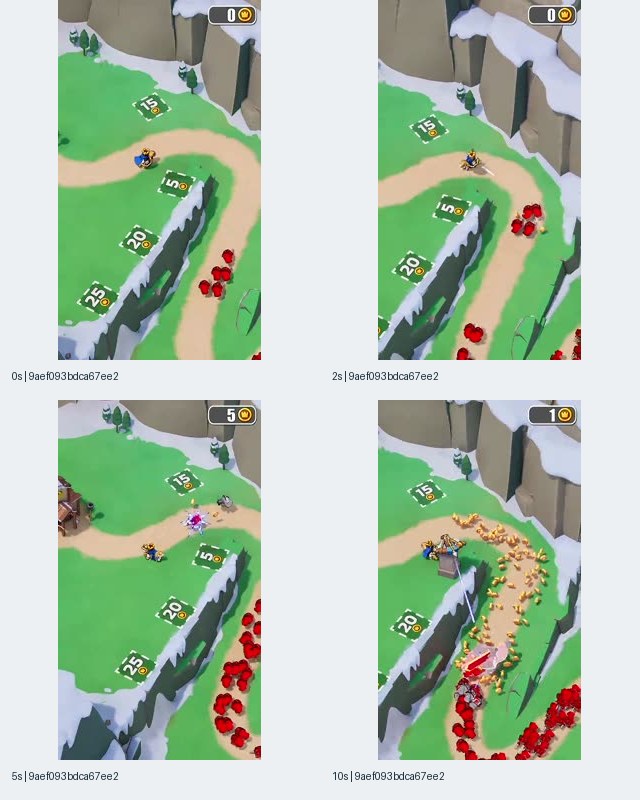
Figure 1. Contact sheet from record 9aef093bdca67ee2, linked to the verified Kingshot iOS listing. Only the labeled 0-, 2-, 5-, and 10-second frames were observed; the images do not establish campaign performance or interactive behavior.
At the opening, a small character occupies a grassy area beside a winding path bordered by snowy cliffs. Marked positions display numbers with coin symbols. Red enemies are visible farther along the route. The composition gives the viewer a spatial problem: there is a route to defend and a set of possible positions around it.
By the 5-second frame, additional combat imagery is visible near the character. At 10 seconds, a tower-like structure and a much denser battle scene appear. That change supports a description of visible escalation. It does not establish which player input caused the tower to appear, how the currency system operates, or whether the sequence matches a playable’s rules.
The numbered positions deserve separate attention from the moving enemies. They introduce possible decisions into an otherwise watchable battle. A viewer can notice that positions have different displayed values, even without understanding the underlying economy. The source does not prove that viewers read those values or that they improve engagement; it provides a useful hypothesis about decision visibility.
For an original brief, the transferable structure is “show the threat, show the available choice, then show a changed defensive state.” Use your own product’s actual action and feedback. If the player can place a defense, make that placement readable. If the player instead controls a character, avoid borrowing a placement interface that suggests an unavailable action.
A suitable test would compare an opening with clearly visible decision markers against the same scene with a simpler presentation. Keep the threat, camera, and outcome consistent. The hypothesis would be that exposing the choice helps viewers understand the intended action. Understanding should be checked directly before assuming that a more information-dense frame is a better acquisition creative.
This example is also useful later in the article because its underlying video appears in other records with different playable associations. The visible hook and the attached interactive file are separate research objects.
Figure 2: A Cinematic King Introduces an Advertising Objection
The second example places an advertising-related question in front of the gameplay, using a cinematic royal character and large captions to frame the proposition.
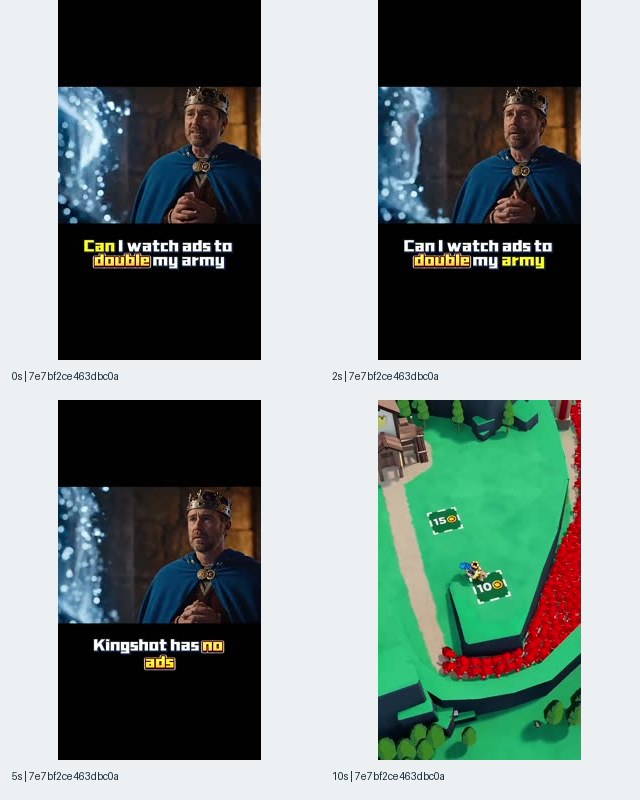
Figure 2. Contact sheet from record 7e7bf2ce463dbc0a, linked to Kingshot iOS app ID 6739554056. Captions are advertising claims visible in the supplied frames, not independently verified statements about the app.
The 0- and 2-second frames show a crowned, blue-cloaked character beside a luminous visual effect. Beneath the cinematic image, the caption reads “Can I watch ads to double my army,” with individual words highlighted. At 5 seconds, the visible caption reads “Kingshot has no ads.” By the 10-second frame, the contact sheet shows a game scene with a character, marked positions, and a dense red enemy line.
The interesting construction is the relationship between the question and the subsequent claim. The opening raises a familiar advertising mechanism within mobile games: viewing an ad in exchange for an advantage. The later caption presents an answer associated with Kingshot. This is an observable message sequence across the selected frames, although the complete dialogue and intervening edits remain unseen.
The claim needs careful handling in a research report. “The ad says Kingshot has no ads” is supported. “Kingshot has no ads” is a product assertion requiring evidence about the app’s current behavior, version, region, and relevant conditions. This source sample does not supply that verification. The visual treatment should not erase the distinction.
For a creative team, the reusable idea is an objection-led introduction. Begin with a concern your own audience actually expresses, then provide an answer your product can substantiate. A defense game might address control complexity or the clarity of its first objective. There is no need to inherit the source’s specific promise to test the narrative structure.
The cinematic framing also creates a transition question. Does the character prepare the viewer for the gameplay, or does the gameplay require a fresh explanation when it appears? A future test could keep the substantive promise constant while comparing a cinematic delivery with a direct gameplay delivery. That would investigate presentation without simultaneously changing the offer.
The evidence supports studying that choice. It does not establish that cinematic production improved attention, reduced acquisition cost, or reached a particular demographic.
Figure 3: Large Words Add a Separate Reading Layer
The third example combines game scenes with oversized words, making the relationship between caption timing and visible action the main research question.
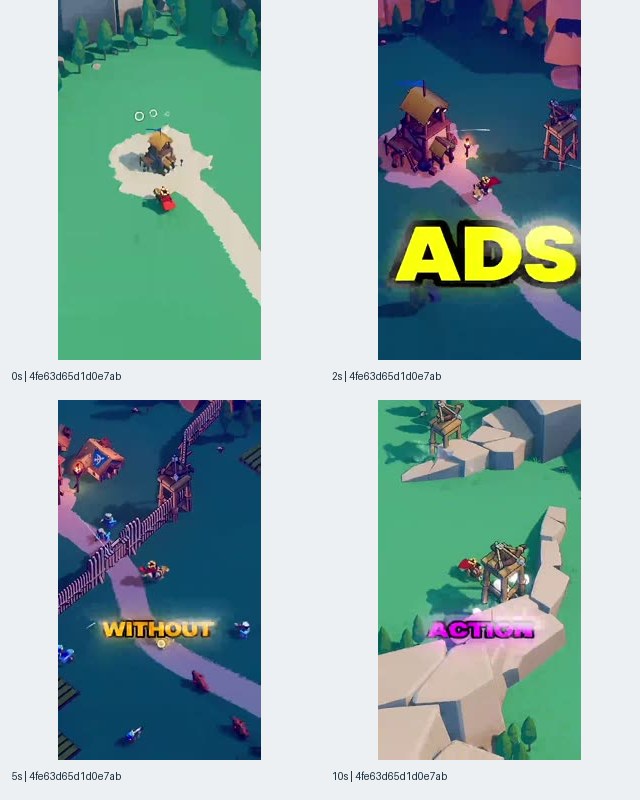
Figure 3. Contact sheet from record 4fe63d65d1d0e7ab, associated with the verified Kingshot iOS listing. The sampled words are separate observations; they do not supply a complete transcript.
The opening frame shows a small building in an open grassy area, a path, and a nearby character. The 2-second frame changes to a darker scene with buildings and defensive structures, overlaid by a large yellow “ADS.” The 5-second frame shows “WITHOUT,” and the 10-second frame shows “ACTION” near a character and a defensive structure among rocks.
These words should not be stitched into a sentence. There may be other words before, between, or after the supplied frames. Audio could also change how each word functions. A responsible annotation records the visible text and the scene beneath it, leaving the complete script unresolved.
The creative observation is still useful. Large words can become the most visually prominent element even when the underlying scene contains movement, enemies, or a building task. That produces a production choice: should the viewer’s first task be to read a proposition or to understand a game action?
For a brief based on this example, ask the editor to identify what each caption contributes at the moment it appears. A caption might name the objective, explain a rule, express a reaction, or make a product promise. Those jobs are different. A word that only repeats an obvious action may compete with the action for attention, while a short instruction could clarify an otherwise ambiguous scene. Those are hypotheses to test through comprehension and campaign evidence.
A useful original variant would preserve the same game sequence while changing only the caption approach. One version could name the player’s immediate objective. Another could show the scene with minimal explanatory text. Both should preserve enough visible information for a viewer to describe the next action accurately.
This video also appears in multiple records with different playable files. That association makes it especially important to avoid crediting every record difference to the large-word treatment. The visible video can remain the same while another component of the advertising record changes.
Figure 4: Showing the Phone Creates a Presentation Bridge
The fourth example moves from a person holding a phone to gameplay with a smaller presenter inset, providing a visible bridge between a claimed personal experience and the game scene.
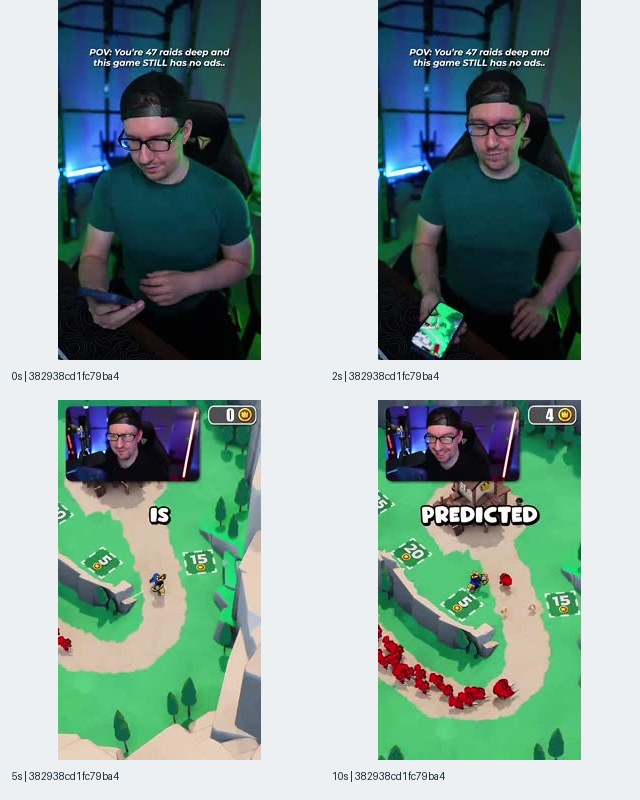
Figure 4. Contact sheet from record 382938cd1fc79ba4, linked to the verified Kingshot iOS listing. The “47 raids” statement is on-screen advertising copy, not a verified record of the presenter’s play history.
The opening frames show a seated person wearing glasses and a backward cap in a room with colored lighting. The on-screen text reads, “POV: You’re 47 raids deep and this game STILL has no ads.” At 2 seconds, the person holds the phone screen toward the camera. The later sampled frames show gameplay occupying the main screen, with the presenter in an inset near the top.
The phone gesture matters because it introduces a physical object between the speaker and the game footage. Visually, it suggests a connection between the person’s claim and the experience being shown. It does not verify that the subsequent footage came from that device, that the person completed the stated number of raids, or that the statement applies to every current version of the app.
For production planning, the reusable structure is a transition from person to device to game. The creative question is whether that bridge makes the premise easier to follow than an abrupt cut. An original version should use a truthful demonstration and a presenter whose words accurately describe what the product team can verify.
The later inset also changes the division of screen space. The presenter remains available as a source of reaction, while the game becomes the main information surface. That is different from keeping a full-screen speaker throughout the opening. The source does not reveal how viewers split their attention, but it gives the team a clear layout variable to investigate.
A prospective test could compare the device-reveal bridge with an immediate inset presentation while keeping the script, speaker, gameplay, and destination consistent. The hypothesis would concern continuity and comprehension. If the two edits also use different offers, different scenes, and different durations, the resulting comparison would no longer isolate the bridge.
The “no ads” line should remain in a claims register until independently substantiated for any product that wants to use it. A creator-style delivery does not lower the evidence needed for a factual promise.
Figure 5: A Persistent Creator Overlay Changes the Starting Point
The fifth example starts with gameplay and a creator overlay together, so its observable difference from Figure 4 is the opening layout rather than the mere presence of a person.
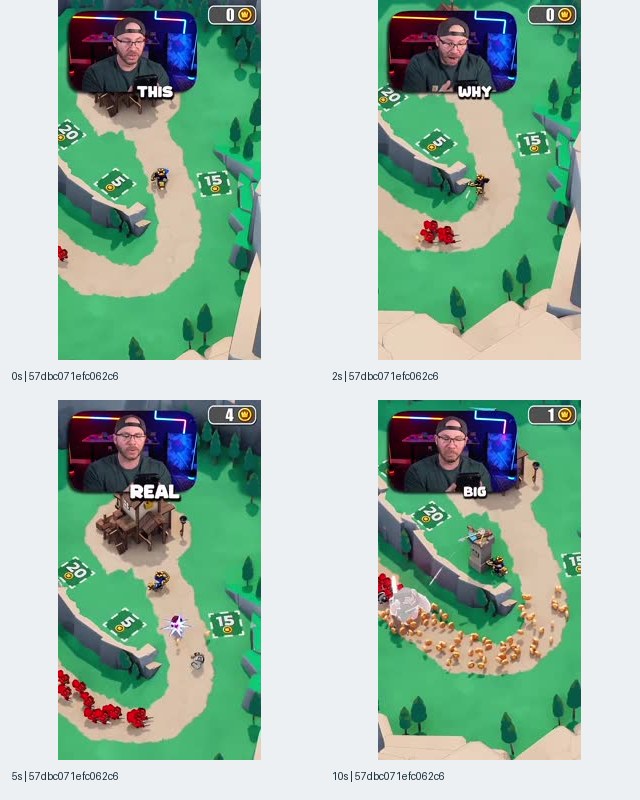
Figure 5. Contact sheet from record 57dbc071efc062c6, linked to Kingshot iOS app ID 6739554056. Gameplay and the creator inset are both visible at the opening timestamp.
The upper part of the frame contains a presenter against a brightly lit background. Beneath it, a character stands near a winding path and marked defensive positions. Red enemies appear on the path in the later sampled states, while a tower and a busier combat scene are visible at 10 seconds.
The isolated captions visible in the contact sheet include “THIS,” “WHY,” “REAL,” and “BIG.” As with Figure 3, they are not a complete transcript. They show that text accompanies the presenter-and-game layout, but they do not establish the full claim or the reasoning of the spoken commentary.
The comparison with Figure 4 is productive because it avoids the broad and imprecise label “creator ad.” Figure 4 first gives the person most of the screen and includes a phone reveal. Figure 5 provides the game scenario immediately and keeps the person in a smaller window. A creative library should preserve that difference in its tags.
An original brief could ask whether viewers understand the game faster when the presenter appears alongside the action from the start. The competing hypothesis is that a full-screen introduction might make the initial premise easier to notice before the game adds visual complexity. The supplied sample does not decide between those possibilities.
The layout also raises a practical editing question: does the inset cover information the viewer needs? A presenter window can obscure routes, units, counters, or a building destination. Before a paid test, inspect your own version at the size at which the creative will be viewed and ask someone unfamiliar with the scene to explain the available action. That is a proposed production check, not an evaluation performed on Kingshot here.
This record’s video is associated elsewhere in the sample with a different playable file. If a team uses it as a reference, the archive should retain both the video-level description and the record-level attachment. Otherwise, the same opening can be counted repeatedly as separate creative concepts.
To inspect related indexed examples, search Kingshot in AdMapix. Check the linked product ID and displayed filters before comparing a live result with this frozen US sample.
Figure 6: A Named-Speaker Presentation Delays the Visible Game Explanation
The sixth example centers on a selfie-style speaker throughout the supplied timestamps, making personal address and on-screen identity cues observable while leaving the later gameplay transition unknown.
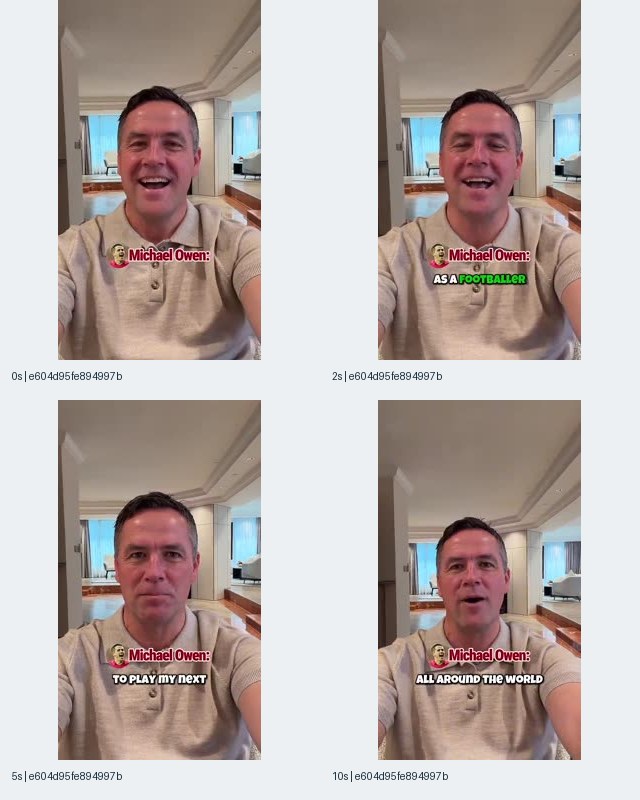
Figure 6. Contact sheet from record e604d95fe894997b, associated with the verified Kingshot iOS listing. “Michael Owen” is the visible label in the creative; this article does not independently authenticate the speaker or an endorsement arrangement.
The four supplied frames show a person addressing the camera in a bright domestic-looking interior. The name label remains visible, while caption fragments include “AS A FOOTBALLER,” “TO PLAY MY NEXT,” and “ALL AROUND THE WORLD.” No game scene is visible in these selected frames.
That observation should be stated narrowly. It does not mean the complete video contains no gameplay. The source lists a longer video file, and the contact sheet ends its observations at 10 seconds. The material after that point could change the structure substantially. The evidence only supports describing the opening sample as speaker-led.
The name treatment creates a recognition cue within the ad. Whether a viewer recognizes the person, trusts the presentation, or associates it with the game is not measured. It would be equally unsupported to infer a football-fan targeting segment from the caption. A creative can address an interest without revealing the targeting settings behind its delivery.
For a team considering a spokesperson approach, this example suggests a useful distinction between recognition and explanation. Recognition concerns who appears. Explanation concerns what the viewer learns about the product. A brief should name both jobs rather than assuming that a recognizable presentation automatically communicates the game’s appeal.
An original test could compare a truthful presenter introduction with a version that introduces the same product action earlier. Keep the substantive message and destination stable. The hypothesis would be that earlier product explanation changes understanding or qualified engagement; it would not be that this source proves celebrity-style openings perform better.
The production handoff should also specify exactly what is known about the reference. Record the visible label, the quoted caption fragments, and the absence of gameplay within the sampled timestamps. Leave speaker authentication, contract terms, full script, and later scenes unresolved. That produces a useful reference without importing assumptions about identity or endorsement into the brief.
Figure 7: An Animated Royal Character Precedes the Defense Scene
The seventh example begins with an animated king on horseback and then shows defense gameplay, giving the team a reference for a character-led opening with visual escalation.
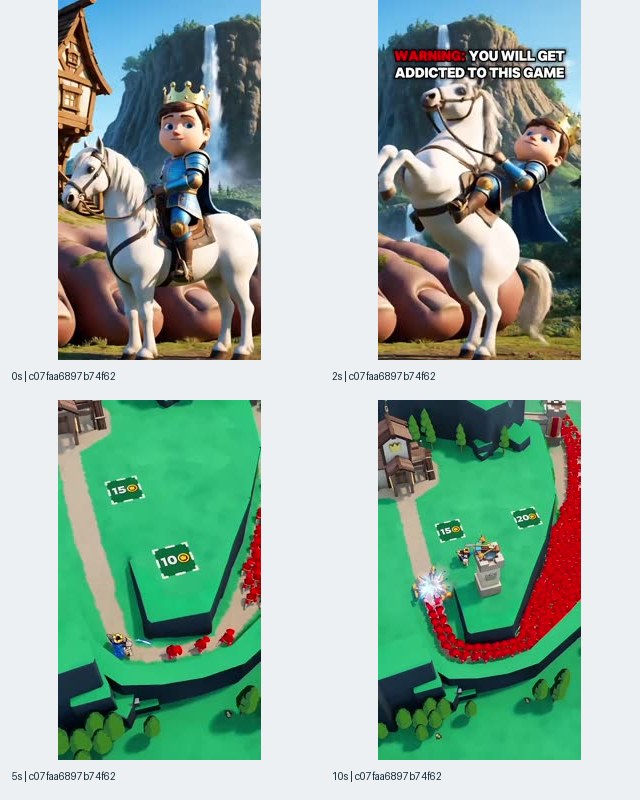
Figure 7. Contact sheet from record c07faa6897b74f62, linked to the verified Kingshot iOS listing. The warning caption is promotional language; the frames do not measure player behavior or establish how the animation was produced.
At 0 seconds, a crowned animated character sits on a white horse near a timber building, rocks, and a waterfall. The 2-second frame shows the horse rearing and a caption reading, “WARNING: YOU WILL GET ADDICTED TO THIS GAME.” At 5 seconds, the contact sheet shows a top-down defense scene. At 10 seconds, a tower stands near a path filled with red enemies.
The character and horse provide a different introduction from the numbered battlefield in Figure 1. The opening establishes a royal fantasy setting before presenting the tactical scene. The visible movement between the first two sampled states also gives the editor a physical event around which to organize attention.
It would be speculative to claim that the opening is humorous for all viewers, that it targets children, or that it was generated by a particular production tool. Those interpretations are not established by the frames. The supported description is animated royal imagery followed by a defense scenario.
The caption is also a prediction about player experience, not evidence of that experience. A research team can tag it as a strong engagement promise while declining to repeat it as an editorial fact. For an original adaptation, a concrete description of an available action is easier to substantiate than a universal prediction about how people will feel.
A useful production question is whether the royal character supplies continuity when the ad moves into the game view. The two sampled settings share a fantasy context, but the camera, visual detail, and task change. A future version could preserve a character, object, or objective through the transition so that the gameplay feels like a continuation of the opening premise. That is a design hypothesis, not an observed advantage.
The same playable file is associated with this record and with other visually different videos in the sample. That relationship supports examining the interactive component separately from the horse-and-king introduction.
Figure 8: A Free-to-Play Message Arrives Before the Game Scene
The eighth example places a free-to-play claim inside a cinematic shipboard scene before showing a settlement and opposing unit lines in the sampled game footage.
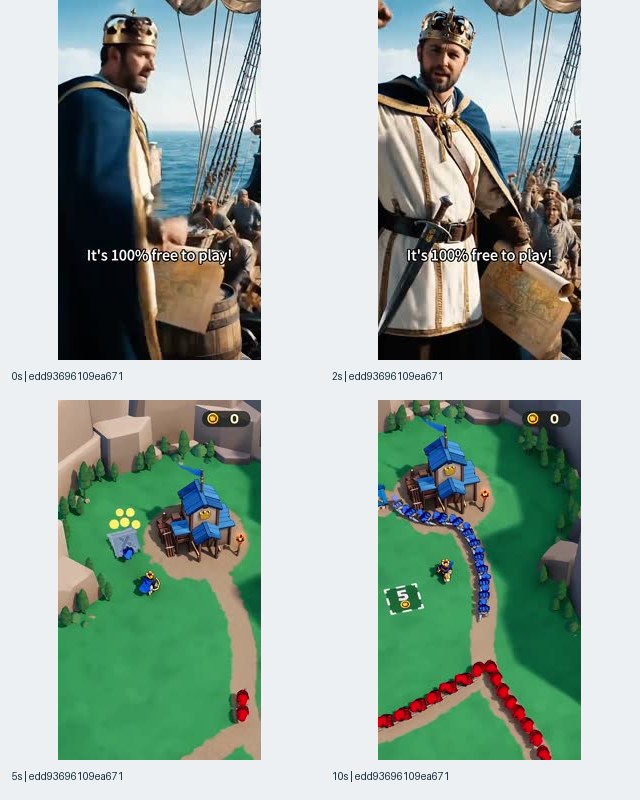
Figure 8. Contact sheet from record edd93696109ea671, associated with Kingshot iOS app ID 6739554056. The free-to-play wording is a visible ad claim, not a verification of purchase conditions or the complete player experience.
The opening frames show a crowned character in a blue cloak aboard a ship, with rigging, other people, and open water in the background. The caption reads, “It’s 100% free to play!” The 5-second frame shows a blue-roofed building and a character in a grassy settlement. By 10 seconds, blue units extend from the building area while red units approach along branching paths.
The offer and the fantasy setting are presented before the visible game task. That is a meaningful contrast with Figure 1, where the viewer begins directly inside the tactical scene. A creative team can investigate whether the audience needs the access proposition first or whether a clear action provides a stronger introduction for its own product.
The free-to-play wording should not be expanded beyond what it says. It does not, by itself, establish that all features are free, that there are no optional purchases, or that there are no other conditions relevant to a player. The supplied evidence does not include an app walkthrough or current purchase verification.
The later frames also differ from the snowy-cliff example. They include a settlement building and visible blue units, making the relationship between base, friendly units, and incoming enemies available for analysis. A brief could use that structure to explain where defenders come from or what they protect, provided the team’s own product actually supports the depicted relationship.
One original test idea is to compare an access-led opening with an objective-led opening while holding the subsequent game scene constant. A second, separate question concerns how the cinematic setting hands off to the settlement. Combining both questions in a single edit would make it harder to know which change mattered.
The record’s lower estimated impression value within the illustrated set is not a reason to dismiss the structure. The sample offers no comparable opportunity, cost, or conversion data. A less prominent reference can still supply a relevant production question.
What Video Reuse Reveals About the Sample’s Structure
The record-to-file relationships show that some Kingshot videos are reused with different playable associations, which makes the attachment a separate unit of research from the opening creative.
The clearest example is Figure 1’s video. It appears in five records in the supplied sample, and each of those records has a different playable fingerprint. The corresponding record prefixes are 9aef093bdca67ee2, 4bf65696137aeb8, 214b82f87e1bbf1, 82a8d99bfc2848f, and 9476a71b1c27bc2. The file identity is shared even though the advertising instances differ.
That finding changes how a library should count the material. These are five record-level combinations involving one video file, rather than five independently produced gameplay videos. It also changes how an analyst describes variation: the supplied evidence locates the difference in the associated playable files, without showing what those files do when executed.
The same principle appears elsewhere. Figure 2’s video occurs in two records with different playable associations. Figure 3’s video occurs in three such records. Figure 5’s video occurs in two. Those relationships are directly traceable to the frozen records and help explain why 27 video-bearing records resolve to 19 distinct video files.
| Illustrated video | Records containing that video in this sample | Distinct associated playable files across those records | Supported interpretation |
|---|---|---|---|
| Figure 1 | 5 | 5 | One video file appears in several different recorded combinations |
| Figure 2 | 2 | 2 | The cinematic question-led video has differing playable associations |
| Figure 3 | 3 | 3 | The large-word video is reused across differing associations |
| Figure 5 | 2 | 2 | The persistent creator-overlay video has differing associations |
A different fingerprint establishes file-level difference under the source’s identification system. It does not establish a different mechanic, visual layout, difficulty curve, or install prompt. Those differences require inspection of the interactive material itself.
The structure is consistent with modular creative assembly, but the business explanation remains a hypothesis. Reuse could accompany experimentation, distribution requirements, production reuse, or other processes that are not visible here. The records do not document an experiment assignment or its result.
For a working archive, preserve two views. The video view holds the hook analysis once. The advertising-record view holds the individual attachment, date information, listing association, and window estimate. This keeps the creative team from repeatedly briefing the same opening while allowing a researcher to retain meaningful differences between its recorded combinations.
What the Playable Associations Establish—and What They Leave Open
The sample establishes the presence and reuse of playable files, but it does not provide an observed interaction walkthrough for those files.
A playable ad is an advertising experience that allows an interaction rather than only passive viewing. An associated playable file can be relevant to an ad’s interactive component, but the record association alone does not tell us when a viewer encountered it, which gesture it accepted, or how it led toward installation.
In this sample, 29 records contain playable associations and 12 playable fingerprints are distinct. Three records have a playable association without a video file. Their complete record prefixes are d33c84576694d0c, fb5251c41f82c2a, and 8c20cae30d7d952. That is a record-structure observation. It is not a statement that the complete advertising program uses only those standalone experiences.
The attachments also connect visually different videos. Figures 1, 3, and 5 share the same associated playable fingerprint in their illustrated records. Figures 4, 7, and 8 share another. This is useful for planning inspection: a researcher can investigate the shared interactive file once and then ask how well each different introduction prepares a viewer for it.
The unresolved questions are concrete. What is the first interactive state? Is there a visible instruction? Does the viewer drag, tap, choose a position, or perform another action? What feedback follows? Can the experience reach more than one outcome? When and how does the installation prompt appear? None of those questions is answered by the supplied video contact sheets.
A future playable review should preserve the starting state, the action taken, the resulting state, and the transition toward the destination. It should distinguish a suggested action from an action that was actually attempted. If behavior changes across attempts, that change belongs in the record rather than being silently resolved into one preferred walkthrough.
The playable ads guide provides a broader development and evaluation workflow. For this Kingshot sample, the appropriate next step is inspection of the associated interactive material before making claims about guidance, reward timing, or usability.
The article therefore compares playable relationships, not playable conversion. That is still valuable: knowing which component is shared tells the team where a focused follow-up can answer several creative questions at once.
Why the Supplied Frames Cannot Rank End Cards
The supplied frames do not show the videos’ final states, so they cannot establish an end-card design comparison or identify an end-card winner.
An end card is the closing advertising state that presents a next action, often an installation invitation. It can be static or interactive. A playable file associated with a video may be relevant to that closing experience, but association and placement are different facts. Neither the file count nor a frame at 10 seconds proves the final sequence.
This matters because several screenshots look like moments that could support interaction: a character near a numbered position, a tower beside a path, or a battle that appears to be escalating. Those visuals can occur within a video. They are not evidence that the viewer can manipulate the scene at that point.
A completed end-card comparison would need to observe the closing state and the transition into it. For each version, preserve the final video context, first end-card state, instruction, visible action button, response to input, and destination behavior. If the transition is not available, mark it unobserved. Do not fill the gap with an assumption based on a similar-looking creative.
The most useful prospective question is continuity. If a video invites the viewer to place a defense, does the next interactive state present that action clearly? If the opening promises uninterrupted play, does the closing message preserve the same meaning? If the video centers on a person, how does the final state explain the game without depending on missing context?
Those questions can guide a test brief today, but the answers require additional evidence. This is why the article’s title emphasizes hooks, video reuse, and playable links rather than claiming a complete comparison of ending designs.
For a production team, an unobserved ending is a manageable gap. Assign it as a specific follow-up instead of treating it as a reason to discard all opening analysis. The opening evidence can remain useful while the closing experience is investigated separately.
A Practical Framework for Comparing the Eight Openings
The eight examples are easier to compare when the team tags the viewer’s initial task rather than using broad format labels alone.
“Gameplay ad,” “creator ad,” and “cinematic ad” describe presentation, but they leave the decision incomplete. Figure 4 and Figure 5 both include a creator, yet one begins with a person and a phone reveal while the other presents gameplay immediately. Figures 2 and 8 both use cinematic royal imagery, yet their visible propositions concern different issues.
Use a short set of descriptive fields that can be filled from the source without guessing audience response.
| Dimension | Question to record | Example from this sample | What remains a hypothesis |
|---|---|---|---|
| First visible task | What can a viewer inspect immediately? | Figure 1 exposes a battlefield and marked positions | Whether this accelerates understanding |
| Message entry | What proposition appears before gameplay? | Figure 2 raises an advertising-related question | Whether that concern motivates the audience |
| Presenter placement | How much screen space does the person occupy? | Figures 4 and 5 begin with different layouts | Whether either layout improves qualified attention |
| Text function | Does text explain, react, or promise? | Figure 3 shows prominent isolated words | Whether the complete sequence clarifies the scene |
| Product visibility | Is the game visible in the sampled opening? | Figure 6 remains speaker-led through the supplied frames | Whether later explanation compensates for the delay |
| Transition cue | What connects the introduction to the game scene? | Figure 7 moves from royal animation to defense imagery | Whether viewers perceive a coherent continuation |
| Access proposition | What does the ad say about starting play? | Figure 8 displays a free-to-play claim | Whether that proposition changes installation intent |
The framework should allow “unknown.” An empty audio field is more accurate than an invented transcript. An unobserved final state is more useful than a generic “install now” tag copied from another creative. Unknowns identify the next research task.
The team should also preserve disagreements in interpretation. An editor may read a caption as an instruction while a strategist reads it as a promise. Resolve the disagreement by checking the complete source when available, or retain both interpretations as hypotheses. A shared vocabulary is valuable because it exposes uncertainty, not because it forces every reference into a confident label.
After tagging, choose a comparison that changes one meaningful element. The frame set supports questions about the opening task, presenter layout, and timing of product explanation. It does not support a numeric scoring system that claims to predict campaign performance.
How to Handle “No Ads,” “Free to Play,” and Recognition Claims
Visible advertising claims should be recorded as claims and substantiated independently before a team reuses their substance in an original creative.
The distinction matters across several examples. Figure 2 says “Kingshot has no ads.” Figure 4 combines a similar proposition with a “47 raids” experience statement. Figure 7 predicts that the viewer will become “addicted.” Figure 8 says the game is “100% free to play.” Figure 6 uses a name label and football-related caption fragments.
These are different kinds of assertions. A product-feature claim needs current product evidence. A personal-experience statement needs evidence about the stated experience. A prediction about how every viewer will feel is not a measured outcome. An on-screen identity label does not, by itself, authenticate the speaker or document an endorsement relationship.
A practical claims register can remain simple. Preserve the exact visible wording, identify the timestamp, name the supporting evidence needed, and decide whether the proposed original version can be substantiated. If the supporting evidence is absent, change the brief before production rather than hoping a presenter’s delivery makes the wording acceptable.
The same discipline applies to gameplay promises expressed without words. A numbered placement zone may suggest player choice. A sudden tower appearance may suggest a rapid upgrade. A large enemy crowd may suggest a particular challenge. The visual sequence should be checked against the team’s own product experience before it becomes an acquisition promise.
That does not establish that any Kingshot example is misleading. This article has not played the app or verified the complete player journey. It identifies the questions a team would need to answer before making either a positive product claim or a negative mismatch claim.
For creative research, borrow the communication problem rather than the unsupported assertion. “Answer an interruption concern,” “show the first objective,” and “connect the speaker to the game scene” are useful brief directions. They can be expressed through original, supportable content without copying the source wording, characters, or presenter identity.
A Reader Workflow: From Kingshot Search to a Research Shortlist
A repeatable workflow turns this sample into a shortlist of research questions by preserving product identity, deduplicating files, and separating observations from proposed experiments.
Start with the decision. Write the question the team needs to answer before collecting more examples. “Should our first frame show the defense problem?” is specific enough to guide selection. “What is Kingshot doing?” is too broad to determine when the research is complete. The question should connect to a production choice the team can actually change.
Lock the product reference and scope. For this article, that means the verified iOS app ID 6739554056, the US filter, and the dated measurement window. In your own research, record the relevant store identifier and the observation date. A matching name can be a discovery clue, but the linked identity should determine whether a record belongs in the product-specific analysis.
Preserve the retrieval conditions. Record the country, date bounds, ordering, and sample limit alongside the saved results. A newest-discovered view and a highest-estimated-impression view answer different questions. A later researcher should be able to understand why the examples entered the shortlist without recreating your browsing history.
Separate records from files. Maintain the video file as a reusable reference and the advertising record as the container for its associations. In the Kingshot sample, this prevents Figure 1’s video from appearing as five unrelated creative concepts. It also keeps the differing playable files visible for follow-up rather than discarding them during deduplication.
Annotate the observed timestamps. Describe what the viewer can see, what text is legible, and whether a person, game scene, or cinematic setting dominates. Use exact quotes only for the words supplied. Do not create a continuous transcript from isolated caption fragments. Add an explicit note when the audio or final state is unavailable.
Create a short hypothesis beside each observation. For Figure 5, the observation is that gameplay and the presenter appear together from the opening frame. A hypothesis might be that this layout improves immediate understanding compared with a full-screen presenter introduction. The hypothesis should identify what you would measure and what result would challenge the idea.
Choose follow-ups by the missing evidence. If the decision concerns a playable, inspect the interactive experience. If it concerns a promise, verify the current product facts. If it concerns a transition, obtain the relevant continuous sequence. More opening screenshots will not answer a question about a closing install state.
Hand off a production-ready shortlist. Each selected reference should have a source, a visible observation, an original adaptation, a controlled variable, and an unresolved-evidence note. This creates a compact research deliverable that an editor or developer can use without inheriting hidden assumptions.
For a small team, the shortlist can be narrower than the research set. Select the references that answer the current decision, while retaining the larger archive for later questions. The objective is a clear next experiment, not a larger collection for its own sake.
An Original Brief Built from the Defense and Creator Examples
A practical brief can combine lessons from the sample while keeping the proposed creative original and the experimental question narrow.
Consider a team whose own game includes a real defensive placement mechanic. Its current creative shows the battlefield, but the team does not know whether a short presenter introduction would make the objective clearer. Figures 1, 4, and 5 provide structural references for that question without establishing which approach should win.
The following is a proposed brief, not a Kingshot campaign result or a completed customer case.
| Brief field | Proposed content |
|---|---|
| Research question | Does immediate gameplay with a small presenter explanation improve understanding of our first defensive action? |
| Source observation | Figure 1 begins on the battlefield; Figure 4 begins with a person; Figure 5 begins with person and gameplay together |
| Product prerequisite | Our game genuinely supports the action shown, and the captured sequence reflects that mechanic |
| Control | Existing gameplay opening with the current explanatory treatment |
| Variant | The same opening scene with a small presenter inset explaining the immediate objective |
| Element held constant | Battlefield state, visible action, subsequent outcome, substantive promise, and destination |
| Primary creative hypothesis | A concurrent explanation may help viewers identify what they can control |
| Early check | Ask unfamiliar viewers to describe the objective and available action without prompting |
| Campaign evaluation | Use the team’s own acquisition and downstream quality data under a defined test setup |
| Unresolved reference detail | The complete scripts and interactive endings of the Kingshot examples were not observed |
The storyboard should begin with the product action, because that is the stable component being tested. Show the approaching threat and the available placement. The presenter’s line should explain the decision using ordinary language. Avoid claims about universal enjoyment, effortless success, or conditions that the game cannot demonstrate.
The next scene should show the consequence of the same action. If the tower changes the battle state, make that relationship visible through the team’s own capture. Do not insert an unrelated spectacle solely because a source frame contains a dense enemy crowd. The proposed creative needs a coherent action-and-feedback sequence.
The closing experience should remain constant across the hook comparison. If the team changes the playable, difficulty, or install invitation at the same time, the test becomes a comparison of bundles. That can be a valid business decision, but it cannot answer the narrower question about presenter placement.
The research handoff should include an explicit rejection condition. If viewers focus on the presenter and cannot describe the game action, the explanation may be competing with the scene. If comprehension is unchanged, the team should not claim the creator treatment solved that problem merely because it looks more elaborate.
This brief extracts an actionable question from the sample while leaving performance to a properly observed test.
How to Test Hooks, Playables, and Transitions Separately
Hooks, playable mechanics, and closing transitions should be evaluated as separate variables when the team wants to understand which component changes the result.
The Kingshot sample is useful because it contains evidence of component reuse. That structure suggests an experimental discipline for your own production system: preserve stable components while changing the part under investigation. It does not prove that the advertiser used the same discipline or that any observed combination was experimentally selected.
For a hook test, keep the subsequent game sequence and closing experience consistent. Compare the opening task: immediate gameplay, presenter introduction, or a supportable objection-led statement. Define the question before deciding which metric matters. An opening intended to explain a mechanic should be checked for understanding, not judged only by whether it attracts a glance.
For a playable test, keep the video introduction and substantive promise consistent where possible. Change a clearly identified interaction element, such as the instruction treatment or the first available choice. Record what differs in behavior, not only which file name changed. A different file can contain a small technical revision; the test record should describe the actual user-facing variable.
For a transition test, preserve both the opening content and the interactive objective while changing how the viewer enters that objective. The issue may be a sudden reset of the scene, an unclear instruction, or a mismatch between the action shown and the action requested. Capture the handoff continuously so that the team can see what context the viewer carries forward.
The creative testing framework offers a broader structure for isolating variables and recording decisions. Applied here, it means documenting a control, variant, expected mechanism, evaluation method, and condition under which the hypothesis would be rejected.
Choose metrics from the team’s actual instrumentation. Attention measures can help describe an opening, interaction measures can describe a playable, and acquisition or product measures can assess downstream outcomes. None should be silently substituted for another. A higher interaction rate does not automatically establish better retained users, just as a high model-estimated impression count in a public index does not establish profitable delivery.
Also document the test conditions that can change interpretation: audience eligibility, placement, optimization objective, destination, measurement availability, and observation period. The purpose is not to manufacture perfect certainty. It is to know whether the evidence supports a component-level conclusion or only a result for the tested bundle.
When results are inconclusive, preserve the uncertainty and choose a targeted follow-up. Do not resolve it by returning to the competitor’s estimated impressions and declaring the more visible reference correct.
Common Mistakes That Change the Meaning of This Sample
The most consequential mistakes in a Kingshot teardown come from changing the unit, scope, or evidence level while keeping the same confident wording.
Counting every record as a new video inflates production variety. The sample contains 30 advertising records and 19 distinct video files. Figure 1’s video appears repeatedly with different playable associations. A report that calls each occurrence a newly produced video misdescribes the creative operation visible in the records.
Adding video and playable counts into one unexplained asset total hides overlap. The formats coexist within many records, and a playable may be shared across different videos. Report the file types separately and preserve their relationships. A single total can be used only after the team defines exactly what it intends to count.
Treating estimated impressions as performance invents an outcome. The table contains third-party estimates for a fixed window. It does not contain conversion, spend, or profit. A creative’s position in an impression-sorted sample can prioritize inspection, but it cannot establish whether the creative is efficient or worth copying.
Dividing window impressions by record age mixes incompatible scopes. A first-observed date describes source history, while the impression estimate belongs to the selected window. Their ratio would not measure the creative’s actual daily delivery. This article omits that derived metric rather than assigning it a misleading label.
Calling a playable attachment an observed end card skips a missing step. The record establishes an association. It does not show placement timing, the final video state, the accepted interaction, or the install transition. Obtain those observations before writing a detailed end-card comparison.
Turning creator style into a platform claim confuses appearance with distribution. A vertical video, bright caption, or presenter inset can appear in different environments. The supplied source code has no verified network-name mapping here, so a network-specific conclusion would be unsupported.
Repeating source promises as product facts launders advertising copy into editorial evidence. “No ads,” “free to play,” and the “47 raids” line remain visible claims. The article did not verify the app’s complete behavior or the presenter’s experience. Preserve the attribution every time the wording matters.
Treating a bounded sample as a complete strategy removes the selection limit. The research covers a specified US window and a limited number of impression-ordered records linked to the verified iOS reference. It cannot establish what all Kingshot advertising looks like, how the Android program operates, or how the publisher allocates its total budget.
Each correction makes the brief more useful because it identifies what the evidence actually changes about the next decision.
When AdMapix Fits This Research Task
AdMapix fits teams that need to discover indexed creative references, preserve their source context, and turn visible patterns into a research shortlist for original testing.
In this article, the concrete value is the connection between the images and the records. A gameplay video can be examined once, recognized when it appears again, and compared through its differing playable associations. A creator introduction can be described at the observed timestamps without being confused with a complete script. A product ID keeps the reference tied to the intended listing.
That workflow is useful for an in-house creative team planning a new opening, an agency preparing a source-linked client report, or a user acquisition manager deciding which interactive component needs closer inspection. The useful deliverable is a brief with traceable observations and explicit hypotheses.
AdMapix should not be used as a substitute for your own campaign analytics, product testing, or verification of an endorsement or purchase condition. The frozen sample cannot answer private-account questions simply because its creative examples are searchable. No verified hourly refresh service-level commitment is asserted here, and a live result should always be checked against its displayed scope.
If this is the workflow your team needs, review live AdMapix pricing before choosing access. Commercial terms can change, so this evergreen article does not reproduce plan prices or credit quotas and does not promise a paid-plan trial.
The decision is whether searchable creative evidence helps your team make a clearer production choice. Start from the question you need to answer, inspect relevant indexed examples, and connect the resulting brief to your own evaluation process.
FAQ
What does this Kingshot ad strategy sample actually show?
It shows different visible opening approaches and reuse relationships within a bounded US sample linked to the verified Kingshot iOS listing. The records contain 30 advertising instances, 19 distinct video files, and 12 distinct playable files. Eight contact sheets support visual analysis at selected timestamps. The sample does not establish the complete campaign strategy, private targeting, conversion results, or profitability.
Are these records linked to the verified Kingshot app?
The creative collection used the verified iOS app ID 6739554056, and the illustrated records are linked to that listing. The supplied store verification names Kingshot and Century Games Pte. Ltd. This establishes the reference product association used in the article. It does not identify the buyer or payer behind an individual ad, and the analysis does not extrapolate to Android advertising.
Does the “Kingshot has no ads” caption prove the app has no ads?
No. It proves that the caption appears in the supplied advertising frames. Establishing the app’s current advertising behavior would require separate product evidence with appropriate version, region, and usage context. This article did not play the app or verify its complete player experience. The same distinction applies to the “47 raids” experience statement and other promotional claims.
Why are there more advertising records than video files?
An underlying video can appear in more than one advertising record, including records with different playable associations. In this sample, Figure 1’s video appears in five records with five different playable fingerprints. Deduplicating the video file prevents those occurrences from being counted as five separate productions, while retaining the records preserves their meaningful attachment and source differences.
Can the twelve playable files be treated as twelve end-card designs?
No. The count establishes distinct playable fingerprints, not twelve visually inspected ending designs or twelve different mechanics. The supplied contact sheets show selected video frames and do not document interactive execution. A complete end-card review would need to inspect the closing state, transition, guidance, accepted input, response, and installation path before comparing the designs or their behavior.
Which Kingshot hook performs best in this sample?
The supplied evidence cannot answer that question. It includes model-estimated impressions for a defined window, but no comparable acquisition costs, conversion outcomes, or controlled test assignments. The examples can support hypotheses about clarity, presenter placement, and transition continuity. Determining which hook works for your game requires a test using your own delivery conditions and downstream product data.
Which advertising networks are represented?
The frozen records include a numeric source code, but this package does not establish its network-name mapping. The article therefore makes no named-network attribution. Creator overlays, vertical dimensions, and playable associations cannot independently identify a delivery platform. Use the dated AdMapix source scope as the reference here, and require verified network evidence before writing a platform-specific conclusion.
How should a small team use these examples?
Choose a production question narrow enough to test, such as whether gameplay should appear before a presenter introduction. Save the relevant source observations, verify your own product claims, and build an original variant that changes the selected element while keeping other components stable. If searchable references would help that routine, inspect the AdMapix workflow and current pricing without assuming a paid trial is available.
Key Takeaways
The actionable finding is that opening presentation and recorded interactive associations can be studied separately without inventing a performance verdict.
- Keep 30 records, 19 video files, and 12 playable files as distinct sample measures.
- Compare the viewer’s initial task: reading a promise, watching a person, recognizing a character, or inspecting a battlefield.
- Preserve video reuse and playable associations when organizing the archive.
- Treat promotional wording as source claims, and mark unobserved interaction and endings explicitly.
- Use the sample to write original hypotheses; use your own tests to decide what to produce, refine, or scale.
Sources
The article’s factual basis is the frozen September 2026 source package, the supplied store verification, and the eight timestamped contact sheets; product-workflow references provide context rather than campaign-performance evidence.
- Frozen source sample — observed 2026-09-15: Public Kingshot research package. Contains public batches, request parameters, checksums, record associations, and the basis for the bounded US window of 2026-08-17 to 2026-09-15. All numeric sample findings and illustrated record references are traceable to this package.
- Product identity — supplied verification dated 2026-09-15: Kingshot US App Store listing, app ID 6739554056. Supports the iOS reference identity and seller association used here; it does not establish an individual ad’s buyer or payer.
- AdMapix research methodology — referenced for this 2026-09-15 analysis: AdMapix methodology. Read alongside the article’s explicit window, file-count definitions, estimated-impression limits, and bounded sampling conditions. The supplied product facts were reviewed on 2026-08-13.
- Creative discovery workflow — referenced 2026-09-15: Kingshot search in AdMapix. A route for inspecting related indexed creatives; live results can change and do not replace the frozen package or its verified iOS scope.
Visual scope: Figures 1–8 are source-linked advertising contact sheets with observations at 0, 2, 5, and 10 seconds. They are evidence of visible creative construction, not proof of campaign performance, complete video content, playable behavior, or the installed game experience.
Turn these observations into your next creative study
Open the creative library and select samples for your market, network and research question.
Related Articles
Kalodata vs TikTok Creative Center: Choose by Research Task
Choose between creative inspiration and product commerce research using eight skincare examples, a dated US sample, and a practical workflow that separates observations, estimates, and testable ideas.
Facebook Ad Copy Examples: Match Copy, Visuals, Proof and Offers
Compare complete Facebook ad headlines and bodies with eight source images, archived offers and bounded video observations, then turn the findings into an original creative brief.
Block Blast Ad Strategy: Video Hooks and Creative Reuse in a Verified iOS Sample
A verified US iOS sample links 30 advertising records to 12 video fingerprints and 15 playable fingerprints, with eight visual analyses and practical plans for original creative tests.