
Competitor Price Analysis: Compare Offers and Proof
Use eight dated advertising examples to distinguish discounts, coupons, bundles, shipping, and incomplete trial claims, then build a traceable offer comparison and original testing brief.
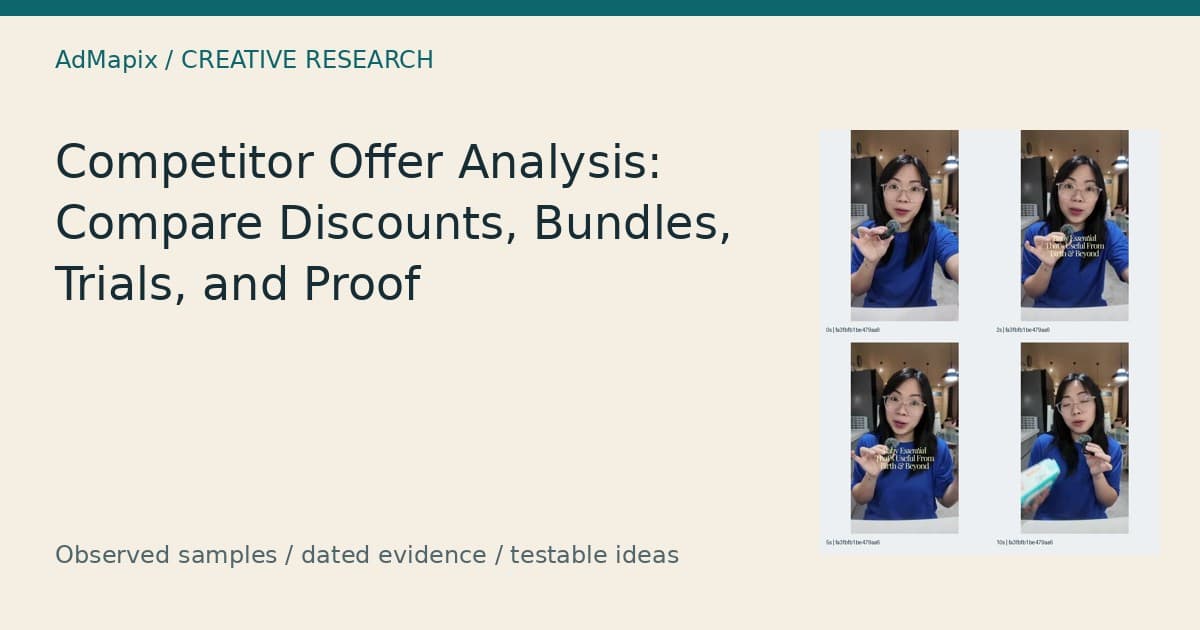
Competitor Price Analysis: Compare Offers and Proof
Competitor price analysis should compare what a customer can actually buy, the conditions attached to the offer, and the evidence supporting the promise. A headline discount is only one part of that comparison. Coupons, product quantities, shipping thresholds, financing, and return terms can change the decision even when the advertised percentage looks attractive.
For growth teams, creative strategists, and agencies preparing a promotion, the immediate task is to separate visible advertising claims from verified purchase terms. This guide uses a dated sample of sale-related advertising and eight supplied screenshots or contact sheets to show how. The examples support an offer-classification workflow and original test ideas. They do not establish which retailer is cheapest, which promotion converted best, or whether an archived offer remains available.
AdMapix Research — prepared with Codex and checked against the dated source sample.
Editorial ownership: Brad at AdMapix. This automated preparation disclosure does not imply personal human review. AdMapix is our product.
Last updated: 2026-10-12.
Quick Answer
Competitor price analysis works best when each offer is recorded as a complete customer proposition: product, quantity, advertised price, discount mechanism, eligibility, additional costs, deadline, and supporting evidence.
- Preserve qualifiers such as “up to,” “selected lines,” and “coupon.” They determine what the headline means.
- Compare equivalent products and purchase conditions before ranking prices. Different categories can provide creative references without forming a valid price comparison.
- Treat product demonstrations, lifestyle images, and testimonials as different kinds of evidence. None automatically verifies the advertised saving.
- Keep incomplete terms unresolved. This sample contains no sufficiently documented trial offer to benchmark.
- Use AdMapix to discover relevant indexed creatives, then verify the commercial terms separately before making a pricing or production decision.
What Decision Should Competitor Price Analysis Support?
A useful offer comparison should resolve a specific decision, such as whether to explain an existing discount more clearly, introduce a bundle, or investigate a shipping objection. Starting with “what are competitors doing?” produces a collection of examples without a clear threshold for action. Starting with a customer decision makes it easier to identify which evidence matters and which attractive screenshots belong outside the comparison.
There are several distinct jobs inside this research. A merchandising team may need an equivalent-product price comparison. A creative team may need to understand how sellers present urgency or demonstrate value. A growth team may need a testable hypothesis about coupon comprehension. An agency may need to explain why a client should investigate a promotion without recommending an immediate price cut.
These jobs require different outputs. An equivalent-product comparison needs matching specifications, quantities, currency, and purchase conditions. A creative comparison can examine unrelated categories because the object of study is the communication structure. A financial decision additionally needs your own costs, margins, fulfillment constraints, and customer behavior.
The attached examples belong primarily to the creative and offer-structure task. Baby wipes, lighting products, clothing, toys, caps, and Christmas trees do not form a comparable shopping basket. Their advertising can still reveal useful distinctions between product explanation, percentage discounts, crossed-out prices, coupons, and event messaging.
Keep direct competitors separate from pattern references. A direct competitor serves a sufficiently similar customer need under comparable buying conditions. A pattern reference offers a useful way to present information. Several examples here link to the same marketplace listing, so they should not be counted as separate competing businesses simply because the advertised products differ.
For the wider research process, use the paid advertising competitive analysis playbook. This article focuses on the narrower decision: how to make an offer comparison accurate enough to inform a brief or a commercial investigation.
Methodology: What the Dated Sample Actually Contains
This analysis uses a bounded AdMapix search sample for the keyword “sale,” requested with the country filter set to US and an explicit measurement window of 2026-09-12 to 2026-10-11. The source package was captured on 2026-10-12 at 08:20 UTC. The requests specified descending estimated impressions and covered three pages of ten records each. These are sampled search results, not a complete advertising fleet or a census of retail promotions.
The supplied count summary reports:
| Measurement | Count | Interpretation |
|---|---|---|
| Advertising records | 30 | Separate returned ad instances |
| Records containing video | 20 | Records with an associated video file |
| Distinct video fingerprints | 11 | Video files after fingerprint deduplication |
| Distinct image fingerprints | 10 | Image files after fingerprint deduplication |
| Distinct playable fingerprints | 0 | No playable files identified in this sample |
| Records containing playable content | 0 | No sampled record has an associated playable |
These categories should remain separate. Thirty advertising records do not mean thirty unique media assets. For example, multiple Homes.com records share the same underlying video fingerprint, and two Shopee records share the flash-sale video represented in Figure 3. Repeated records can carry different text or associations without establishing a new video production.
The analysis uses the supplied record text, linked product identifiers, and eight attached visual references. Figures 1, 2, 3, and 8 are contact sheets showing selected frames labelled 0, 2, 5, and 10 seconds. Observations concern those frames only. Figures 4, 5, 6, and 7 are static images. No full-video viewing, audio transcription, landing-page inspection, checkout test, or product-use test is claimed.
The country filter is a query setting, not proof that every offer is available to a US purchaser. The sample includes Spanish-language MXN pricing, Khmer-language copy, and references to Philippine marketplace promotions. Those are reasons to preserve local context and investigate eligibility, rather than convert everything into a US benchmark.
A named advertising network cannot be verified from the supplied source information. Product associations and media formats do not establish whether an example appeared on Facebook, TikTok, YouTube, or another network. The article therefore does not assign these creatives to a named network.
Linked app identifiers establish the reported product association used here. They do not establish who paid for an ad, who operates a seller account, or whether a presenter is an employee, customer, or affiliate. Marketplace branding likewise does not identify the manufacturer of every pictured product.
Any impression values in the underlying sample are third-party model estimates for the stated window. They are not observed delivery, spend, installs, sales, profit, or lifetime totals. We do not use them to rank offer quality, calculate daily performance, or infer that repeated advertising succeeded. Product-level search aggregates are excluded.
The public frozen source package contains the dated batches, request parameters, and checksums needed to reproduce and audit the source basis. Its scope supports the observations below; it does not resolve missing commercial terms.
Evidence Table: Eight Examples and Their Comparison Limits
The eight visual examples show different offer mechanisms, but none provides a complete checkout-level price comparison. The table preserves the reported listing association alongside the visible message. Its final column identifies the missing information that would change a purchasing or pricing decision. This is more useful than assigning each ad an unsupported score for persuasiveness or calling the largest displayed percentage the strongest offer.
| Figure and reported record | Linked listing identifier | Observable offer or presentation | What remains unresolved |
|---|---|---|---|
| 1. Mommy Chin | Lazada, 785385147 | Presenter, baby-essential message, baby-wipes sale copy | Pack quantity, price, product suitability evidence, and purchase terms |
| 2. Mare, Alam Mo Ba? | Lazada, 785385147 | Lighting-product handling with “LazMega Sale” overlay | Exact product specification, price, saving, and warranty |
| 3. Shopee: Online Shopping App | com.shopee.kh | Flash-sale presentation and copy advertising up to 70% off | Eligible products, reference prices, timing, and shipping conditions |
| 4. Shopee MX: Compra En Línea | com.shopee.mx | Toy display, MXN price, and 50% coupon banner | Purchase quantity and whether the coupon changes the displayed price |
| 5. Gymshark | 1139155460 | “Up to 50% off,” “Last Chance,” and selected-lines qualifier | Eligible items, sizes, actual item prices, and availability |
| 6. Shopee 9.9: Día de Compras | com.shopee.mx | Cap views, crossed-out price, displayed price, coupon banner | Exact variant, reference-price basis, and coupon relationship |
| 7. Shopee MX: Compra En Línea | com.shopee.mx | Christmas tree in a furnished room, price comparison, coupon banner | Tree dimensions, included components, shipping, and coupon terms |
| 8. SALE, linked to Level Shoes | com.levelshoes | Up to 30% off; accompanying copy mentions a shipping threshold | Currency context, eligible products, and truncated service terms |
These examples are editorial references selected from the supplied media. They are not a random subsample from which to estimate how frequently retailers use each offer type.
Classify the Offer Before Comparing the Number
An offer should be classified by how the customer receives value before its headline number is compared with another ad. A percentage reduction, a coupon, a package deal, and a payment schedule describe different mechanisms. Combining them into a single “discount” column removes the conditions that determine the actual purchase and can make a less accessible offer appear more attractive than a straightforward price.
Use a vocabulary that preserves those distinctions:
| Offer type | What it promises | What to capture | Typical comparison error |
|---|---|---|---|
| Displayed selling price | A stated price for an item or package | Currency, variant, quantity, tax and shipping treatment | Assuming the pictured assortment is included |
| Percentage discount | A reduction relative to a reference price | “Up to” qualifier, eligible products, reference basis | Applying the maximum to every product |
| Coupon or voucher | A conditional saving after redemption | Eligibility, minimum spend, cap, stacking, expiry | Subtracting it from an already discounted price without evidence |
| Bundle | Specified products sold together | Exact contents, quantities, package price, separate-price basis | Treating a group photograph as a bundle |
| Shipping benefit | Reduced delivery cost under conditions | Threshold, destination, delivery method, exclusions | Calling shipping free for every basket |
| Financing | A change in payment timing | Total payable, schedule, fees, eligibility | Treating delayed payment as a price reduction |
| Trial | Temporary access or use before another commitment | Duration, features, payment requirement, renewal and cancellation | Confusing a return period with a trial |
| Product reassurance | A reason to believe the purchase will suit the customer | Demonstration, specification, testimonial or supporting document | Treating presentation as verified product performance |
An ad can contain several mechanisms. The Shopee MX examples place product prices next to a coupon message. Level Shoes combines a percentage headline with a shipping statement in the associated copy. These should become separate fields rather than a compressed summary such as “large discount plus extras.”
Also distinguish a mechanism from a campaign label. “Mega Sale,” “Flash Sale,” and “Last Chance” describe a promotional context or urgency message. They do not independently specify a price, discount, or entitlement. The comparison should preserve the label while leaving the economic fields blank when the evidence does not supply them.
A blank field is useful when its meaning is explicit. Use “not visible in supplied image,” “copy truncated,” or “requires checkout verification.” Avoid filling every blank with “none,” which implies the condition or benefit has been checked and found absent.
Figure 1: A Baby-Essential Message Makes Usefulness the Entry Point
The Mommy Chin example presents product usefulness before supplying a visible price comparison. In the selected frames, a presenter appears in a domestic setting, and the overlay describes a baby essential useful “from birth & beyond.” The associated advertising text identifies baby wipes and invites stocking up during a Lazada sale. The evidence supports a utility-led sales message, while the actual saving remains unspecified.
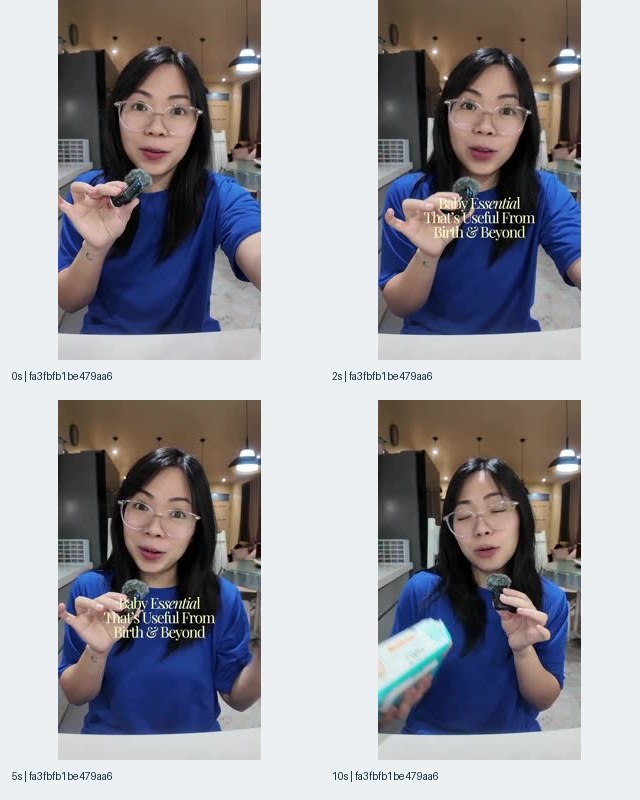
Figure 1. Supplied frames at 0, 2, 5, and 10 seconds from the Mommy Chin record, associated with Lazada listing 785385147. Source record: fa3fbfb1be479aa64ca4a99e3386e194. These frames document presentation, not product suitability or campaign results.
For the worksheet, separate the use claim from the promotion. The use claim concerns usefulness across a life stage. The promotion concerns a sale event and stocking up. Neither supplies pack size, unit price, ingredient information, or evidence supporting suitability from birth.
The associated copy gives September 14–16 as the sale period. Preserve that as an archived advertising claim. It is not a current invitation to shop, and it should not be replaced by the broader measurement window. An ad observation date, a measurement window, and an advertised promotion period are different dates with different jobs.
The presenter and product package provide context for a consumer-use explanation. They do not establish independent endorsement or a verified customer experience. The still frames also cannot tell us which claims were spoken, how the product was demonstrated later, or whether additional qualifications appeared elsewhere in the video.
A useful hypothesis for an original creative brief is that showing the relevant use situation could help viewers understand why a bulk purchase is useful. To investigate that hypothesis, a team would need an accurate pack count, a substantiated product description, and a real unit-price calculation for its own offer.
The resulting brief should ask for a readable package, a clear explanation of the purchase quantity, and an offer statement whose deadline matches the landing page. It should not copy the baby-suitability claim without the necessary product evidence. The transferable lesson is the sequence of customer need, product explanation, and offer—not an unverified promise about safety or savings.
Figure 2: Product Handling Shows Form, but Leaves Price Unanswered
The Mare, Alam Mo Ba? example combines a sale label with close views of a lighting product and its handling. The supplied contact sheet shows packaging, a wrapped light, a fitting, and the light’s surface. This offers more physical product detail than a sale headline alone, but the frames do not establish the product’s electrical specifications, durability, delivered price, or discount.
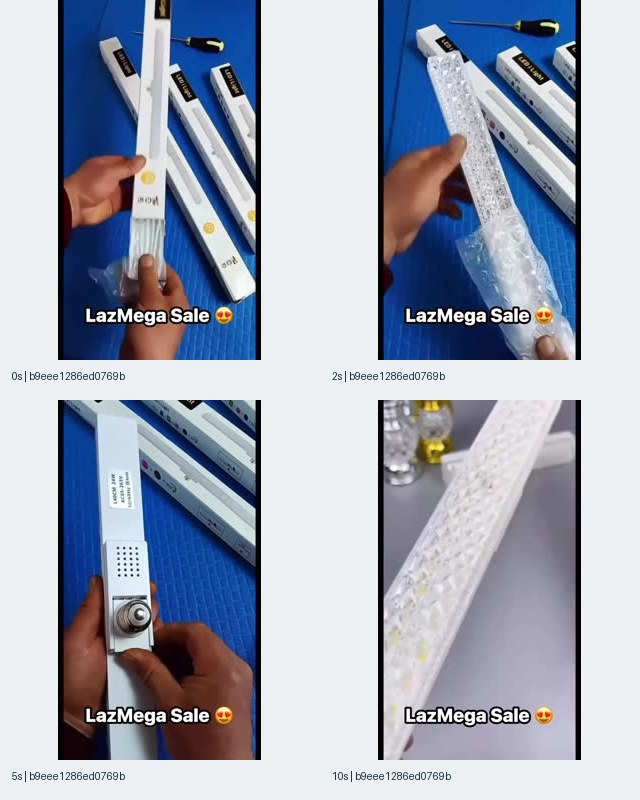
Figure 2. Selected 0-, 2-, 5-, and 10-second frames from the Mare, Alam Mo Ba? record, associated with Lazada listing 785385147. Source record: b9eee1286ed0769b8e6543fc7e28f04a. The visible “LazMega Sale” message supplies event context without a visible price benchmark.
Code this as product-handling evidence plus a general sale message. Do not code it as a measured performance demonstration. Seeing a component handled can help identify its shape or assembly relationship, but it cannot verify brightness, energy consumption, operating life, or installation compatibility.
For a lighting retailer, those missing details determine whether a comparison is meaningful. Similar-looking products can differ in size, power requirements, included fittings, mounting method, and warranty. A cheaper headline becomes irrelevant if the product is unsuitable for the buyer’s installation.
The associated copy includes a shopping link, but this analysis does not follow it or verify the destination. The offer record therefore stops at the supplied advertising evidence. No checkout price or seller identity should be inferred from the existence of that link.
A practical production adaptation would pair a readable specification card with a real demonstration of the exact product sold. If a team wants to compare “product handling first” with “price first,” both versions should use the same product, actual offer, and landing page. Otherwise a result could reflect different commercial propositions rather than the opening sequence.
This example also shows why a visually detailed ad can still be economically incomplete. A creative researcher may have enough information to write a shot reference while a pricing analyst still has insufficient information to populate a comparison row. The two tasks should have separate readiness decisions.
Figure 3: A Flash-Sale Percentage Is a Ceiling, Not a Basket Price
The Shopee flash-sale example advertises an upper-bound discount across a promotional assortment. The contact sheet shows “FLASH SALE,” a prominent 70% message, product imagery, and a circular offer graphic. The associated Khmer-language copy describes discounts of up to 70% and a shipping benefit capped at 20,000 KHR. Those are separate claims, each requiring its own eligibility and redemption checks.
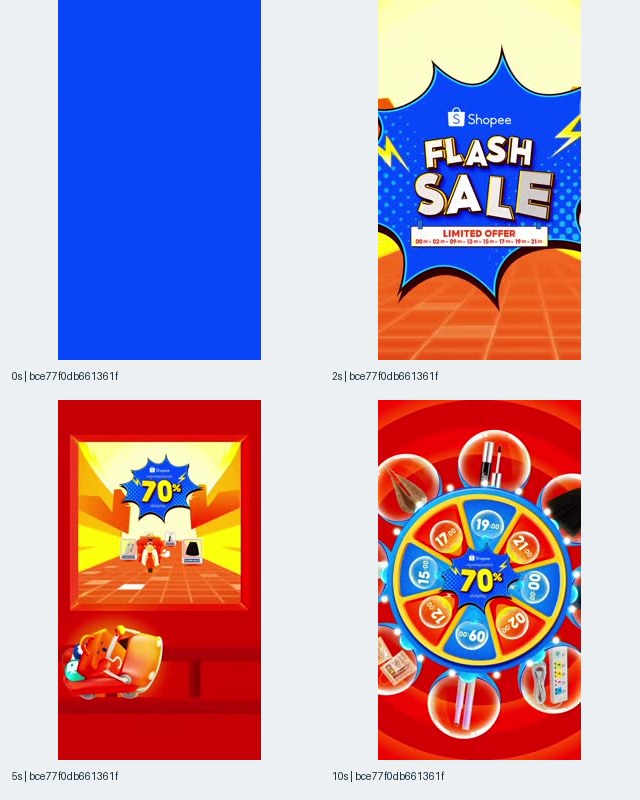
Figure 3. Selected frames at 0, 2, 5, and 10 seconds from a Shopee: Online Shopping App record linked to com.shopee.kh. Source record: bce77f0db661361f74e67b68758c54c3. The percentage and shipping statement are archived advertising claims, not verified current purchase terms.
The central coding rule is to retain “up to.” Replacing “up to 70% off” with “70% off” changes a conditional maximum into a general promise. The source does not establish which products qualify, how many qualify, or what a representative customer would save.
The shipping claim belongs in a separate row or field. Record its advertised cap and currency, then leave unresolved whether it requires a voucher, minimum spend, eligible seller, destination, or delivery method. A maximum shipping subsidy cannot be applied to every basket merely because the headline mentions free delivery.
The circular graphic is also only a visual observation. It does not prove that the ad is interactive, that customers can spin a wheel, or that a game mechanic determines their discount. The sample identifies no playable file. A production team can describe the composition without inventing an interaction.
For competitor comparison, this is a marketplace promotion reference rather than a single-product price quote. The relevant questions are how the campaign communicates assortment, how clearly it expresses conditions, and which details must be checked at product level.
A test hypothesis could ask whether a specific eligible item and its verified price make a broad sale message easier to understand. That would require an original item example whose price and availability are controlled. The source itself supplies no comprehension or conversion results.
Figure 4: A Toy Display Does Not Establish Bundle Contents
The Shopee MX toy image places a product display, an MXN price, and a coupon message in the same composition, but it does not clearly establish the purchase quantity. Multiple containers and colorful toy examples are visible. The displayed price is MXN 304.38, and the banner advertises 50% discount coupons. Those facts are sufficient to describe the ad’s structure, not to calculate the final cost of the pictured assortment.
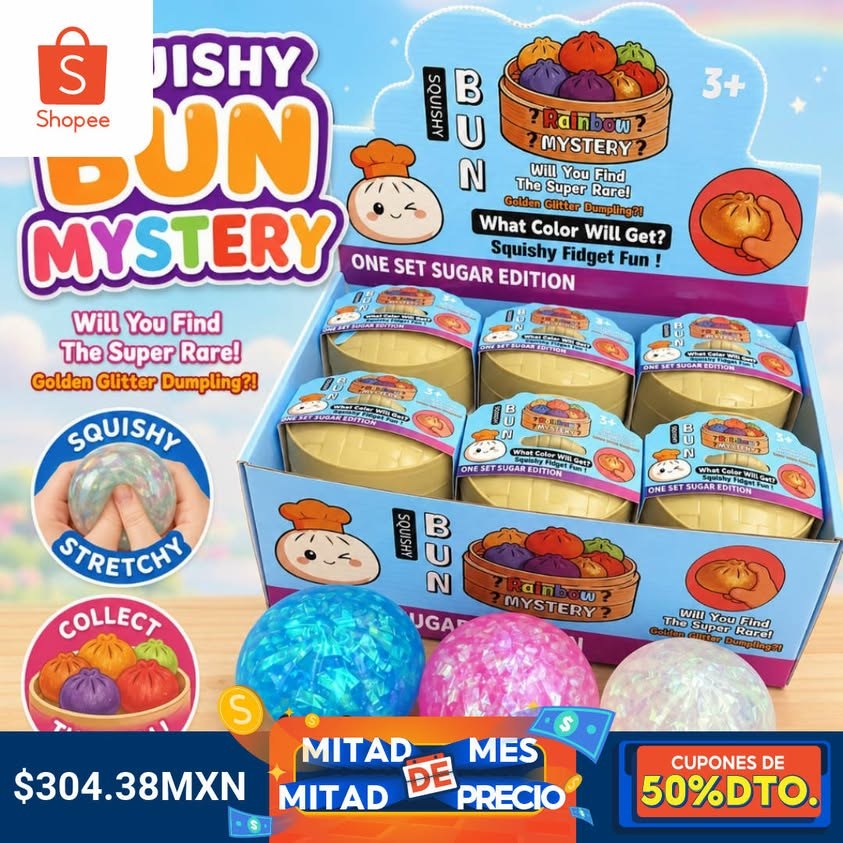
Figure 4. Static image from the Shopee MX: Compra En Línea record linked to com.shopee.mx. Source record: 5311583086ef00b3c6ac452917ee8383. The image does not verify how many toys the stated price buys or whether the coupon is additional.
This is a useful example of the difference between assortment imagery and bundle evidence. A display box can illustrate available choices, retail packaging, or a complete set. Without explicit purchase terms, the analyst should not select one interpretation and write “bundle price.” The quantity field remains unresolved.
The packaging also contains mystery and rarity messaging. That is part of the product proposition, distinct from the monetary offer. It may provide a creative reference for explaining surprise or collectibility, but it does not establish the probability of receiving a particular variant. A team should not turn a visible “super rare” claim into an estimated chance.
The record’s associated text refers to a “6.6 Mega Sale” and buying now while paying later. The image carries a different promotional phrase. Preserve both observations instead of stitching them into a single verified campaign. The package does not resolve the relationship between those labels or establish financing terms for this exact purchase.
For the coupon field, record the visible percentage and explicitly note that stacking is unknown. Do not halve MXN 304.38 to create a supposed checkout price. The price could already reflect some promotion, or the coupon could apply only under separate conditions.
A practical response is to request the exact sellable unit before making any offer recommendation. For an original ad, label the quantity beside the price and identify whether pictured variants are examples or included contents. The hypothesis is that this clarification could reduce purchase misunderstanding; the sample does not measure whether it does.
To inspect related examples, open the AdMapix search for sale creatives and compare how indexed ads separate product quantity, advertised price, and coupon conditions. Live search results can differ from this frozen sample, so retain the date of any new observation.
Figure 5: Gymshark’s Qualifier Changes the Meaning of the Discount
The Gymshark image combines an “up to 50% off” headline with “Last Chance” framing and a selected-lines qualifier. The clothing presentation gives the promotion a visible product context, but it does not establish that every pictured item qualifies for the maximum reduction. A correct comparison preserves the ceiling, the product-selection restriction, and the uncertainty about sizes and availability.
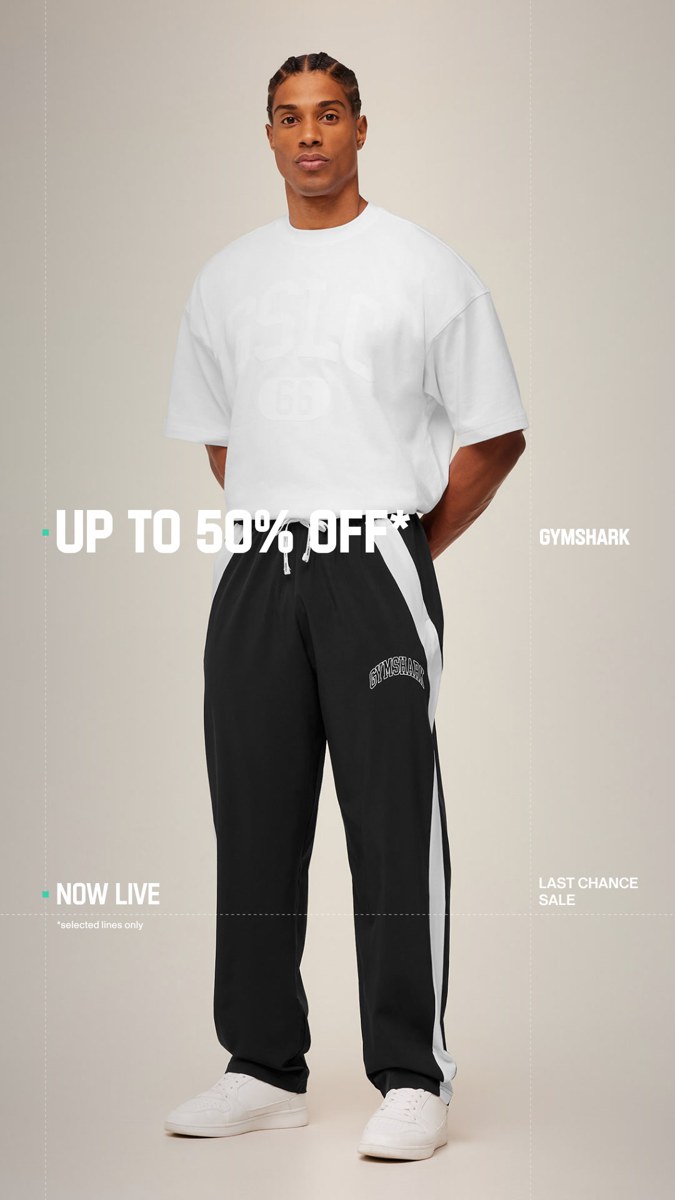
Figure 5. Static image from the Gymshark record linked to listing 1139155460. Source record: eb71556a6a699fe83f87df540d1701b9. The image shows an archived promotion and its qualifier; it does not verify item-level savings or current stock.
Record the headline as written, including its asterisk relationship to the smaller qualification. The phrase “selected lines only” is not decorative copy. It restricts the offer and should survive every stage of summarization, from the research worksheet to the presentation deck.
The distinction matters when comparing this ad with a fixed-price offer. A fixed price for a specified item can be evaluated directly once other costs are known. A maximum percentage across selected lines needs an eligible item and reference price before it becomes comparable. The percentage alone is insufficient.
“Last Chance” should be coded as urgency wording. It does not prove stock scarcity, an exact end date, or a permanent discontinuation. Similarly, “Now Live” describes the archived ad’s message rather than the offer’s status on the date someone reads this article.
The image’s linked listing title contains another sale-related label, while the creative itself communicates Last Chance. Use the stable listing identifier for the association and preserve the visible campaign text separately. A changing app title should not overwrite what the actual image says.
For an original test, a clothing team could compare a broad sale headline against a specific eligible product with its verified price. Keep the same commercial eligibility and clarify whether the whole outfit is included. The decision would concern message specificity, not whether a competitor’s large percentage should force a matching discount.
Figure 6: Crossed-Out Prices and Coupons Need Separate Fields
The Shopee MX cap image contains both a visible reference-price comparison and a coupon banner, which makes it unsuitable for a single undifferentiated discount field. The image shows MXN 607.54 crossed out, MXN 273.40 as the displayed price, and a banner advertising 50% discount coupons. The relationship between the displayed reduction and the coupon remains unverified.

Figure 6. Static image from the Shopee 9.9: Día de Compras record linked to com.shopee.mx. Source record: 1b07584ddf1bb86556f092e74b54b78e. Both displayed prices are historical image text; no additional coupon reduction has been verified.
The worksheet should have a reference-price field, a displayed-price field, and a coupon field. It should also record the source of each: all three appear in the image. A separate verification status should explain that the historical basis of the crossed-out amount and the coupon mechanics have not been checked.
There is no need to calculate an effective discount percentage here. Arithmetic could describe the relationship between the two printed amounts, but it would not establish the validity of the reference price or what a customer paid. Adding another percentage can make a weakly verified comparison look more authoritative than its evidence supports.
The multiple views reveal different aspects of the cap, including its back and interior. They do not establish that several caps are included, nor that every view represents a separately purchasable variant. Count advertised quantities only when the terms specify them.
Visible decorative graphics should also remain visual observations. They do not establish licensing, ownership, authenticity, or infringement. Those questions require evidence beyond the advertising image and are unnecessary to the offer comparison conducted here.
The practical creative lesson is to make the price hierarchy explicit. An original design can state the actual purchase price, explain any conditional coupon, and put eligibility near the relevant number. A useful hypothesis is that separating those elements helps customers distinguish the immediately available price from a possible further saving. That hypothesis needs a comprehension check or controlled test; it is not an observed outcome of this ad.
Figure 7: Lifestyle Context Can Clarify Use While Leaving Specifications Open
The Shopee MX Christmas-tree image shows the product in a furnished room, which supplies a use context without specifying the exact item sold. The banner displays a crossed-out MXN 1,969 and a price of MXN 896.99 alongside the coupon message. A valid comparison still needs the tree’s dimensions, materials, included components, shipping charge, and relationship to the advertised coupon.

Figure 7. Static image from the Shopee MX: Compra En Línea record linked to com.shopee.mx. Source record: 290909323441fca9b5d3f22e291e532d. The setting illustrates a possible use context, not verified dimensions, package contents, or delivery terms.
A lifestyle image can make the intended role of a product legible: here, a tree as part of a seasonal room setting. It cannot establish scale accurately enough for a price benchmark. Camera perspective, staging, and unknown room dimensions make visual estimates a poor substitute for specifications.
Keep contextual objects outside the purchase description unless terms explicitly include them. Furniture, a wreath, candles, and other room details do not become bundle contents because they share the frame. Even a necessary component, such as a stand, should be verified rather than assumed from the scene.
Shipping is especially relevant to comparing physical products with potentially different package sizes. The source does not give delivery cost or packaging information. The correct output is an incomplete delivered-price comparison, not a confident conclusion that the printed selling price is the total customer cost.
The image also uses the same broad promotional banner structure as other Shopee MX references. That supports a visual observation about a recurring layout among these samples. It does not prove a common seller, a coordinated experiment, or an effective template.
An original brief could combine a room view with a specification panel and an accurate list of included components. If the team tests that against a room-only version, the offer and item should remain identical. The hypothesis would concern specification understanding and qualified interest. Any claim about lower returns, higher conversion, or better profitability would require subsequent evidence from the team’s own operation.
Figure 8: A Shipping Threshold Is Visible, but the Trial Is Not
The Level Shoes example supports a percentage-off message and an advertised shipping threshold, but it does not establish a trial. The contact sheet shows “SALE UP TO 30% OFF,” “Shop Now,” the Level Shoes brand, and a website address. The associated text mentions free shipping over $200, then ends with the incomplete phrase “30-day free...” The missing words must remain missing.
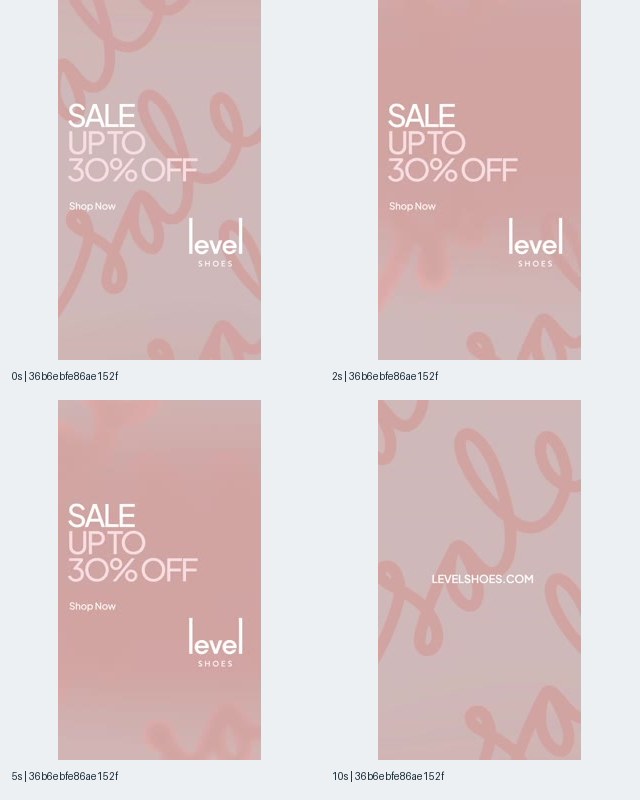
Figure 8. Selected frames at 0, 2, 5, and 10 seconds from the SALE record linked to Level Shoes: Designer Footwear, com.levelshoes. Source record: 36b6ebfe86ae152f487827bde33dbb53. The truncated accompanying copy does not verify a trial or return policy.
The shipping statement is specific enough to record as advertising copy, including its threshold. It is not specific enough to establish eligible destinations, shipping methods, exclusions, or whether the threshold is calculated before or after discounts. The dollar symbol should not be converted into a confirmed currency code solely because the search used a US filter.
The truncated phrase could concern a service policy, but this package does not establish which one. Completing it as “free trial,” “free returns,” or another familiar phrase would introduce information that was never supplied. This matters because each completion would create a different customer promise.
The contact sheet also does not show individual products or item-level prices. Its role is a campaign-level sale announcement. Comparing its maximum percentage directly with the Gymshark headline would reveal a difference in advertised ceilings, not establish which seller offers greater customer value.
The useful production question is whether the promotional announcement gives an interested shopper enough information to understand the next step. A team might test an item-specific version or a clearer shipping condition, but the source supplies no evidence that either would outperform the existing approach.
For the offer worksheet, retain three separate entries: maximum advertised percentage, shipping threshold as written, and incomplete service-policy text. Mark the last as unresolved. That preserves a potentially important follow-up question without presenting a guessed benefit as a fact.
Normalize Prices Only After the Purchase Is Defined
A price becomes comparable when the product, quantity, currency, customer eligibility, and additional charges refer to the same purchase. Before that point, normalization can disguise uncertainty. Converting currencies or calculating unit prices does not repair an unknown bundle quantity, an unmatched specification, or a coupon whose eligibility has not been verified. Define the purchase first, then perform only the calculations its evidence supports.
Start with a comparison key. For physical goods, this should identify the product or model, relevant specifications, variant, quantity, seller where known, and purchase location. The key does not need every catalog attribute. It needs the attributes that would cause a customer to consider the alternatives materially different.
For consumables, quantity and usable units may be central. For clothing, size availability and material can matter. For the lighting example, compatibility and included fittings are necessary. For the tree, dimensions and package contents matter. For software, the equivalent key may include users, billing period, included features, usage limits, and renewal conditions.
A useful worksheet separates the following amounts:
| Price component | Recording rule | When comparison can proceed |
|---|---|---|
| Advertised item price | Preserve amount and currency exactly | Product and quantity are identified |
| Reference price | Record separately from selling price | Its basis is known sufficiently for the intended claim |
| Immediate discount | Identify whether already included | Application to the selected item is verified |
| Coupon saving | Preserve cap, threshold, and eligibility | Redemption conditions and stacking are confirmed |
| Shipping | Record destination and method | The same delivery scenario is used |
| Taxes and required fees | State whether included or additional | The location and purchase context match |
| Deferred benefit | Keep store credit or future vouchers separate | Do not treat it as immediate cash reduction |
For a verified purchase, a working definition of delivered cost is the item amount actually payable, plus required shipping, taxes, and fees, minus confirmed immediate reductions. This is a calculation framework, not a claim about any sampled checkout.
Unit pricing is appropriate only when the denominator represents comparable usable value. A package count is not enough if the units differ materially in size or specification. A bundle containing unrelated items may need a contents comparison rather than a single unit-price figure.
Currency conversion should follow, not precede, these checks. Record the original currency and the date and basis of any conversion you later perform. This article makes no exchange-rate conversion because no dated rate evidence is supplied and the samples do not form a comparable basket.
If a key input remains unknown, show the original advertised amount with its limitation. “Displayed price, shipping and coupon relationship unverified” is an actionable research status. A fabricated total is not.
Compare Bundles by Contents and Customer Need
A bundle comparison needs an explicit list of included products and quantities, plus evidence of how the package price relates to buying the relevant items separately. Grouped photography does not establish a bundle, and a bundle does not automatically create useful savings. The customer may value only part of the package, face different return terms, or need a different quantity than the offer requires.
The toy display in Figure 4 illustrates the quantity problem. The image shows several containers, but it does not establish whether the stated amount purchases a single unit, a set, or the display. The lighting packaging in Figure 2 raises a similar caution: several boxes in a shot do not prove a multipack offer.
The broader source sample contains a more explicit bundle-like claim in the Mega Shop Sale record 0868b0a26c354dc6173df7e2e99b0118. Its text advertises 10 KG of Surf Excel plus 1L of Comfort for ₹399, while also mentioning a separate dry-fruit offer. That supports recording a textual combined-product claim. It does not verify checkout availability, authenticity, fulfillment, or the relationship between the different products mentioned in the copy.
A bundle worksheet should capture the exact contents, substitutions, package price, separately available prices, required commitment, and refund treatment. It should also identify whether the package serves one coherent use case. A cleaning kit and an assortment of unrelated discounted items can share a packaging mechanism while presenting different customer decisions.
Do not calculate “bundle savings” from invented separate prices. If standalone prices are missing, describe the contents and combined advertised amount without assigning a saving. If some items are optional extras, keep them outside the mandatory comparison.
For your own offer design, ask whether the bundle removes a real purchase task. An installation-ready set might reduce the need to identify compatible parts. A replenishment pack might suit a known consumption pattern. These are hypotheses to validate with customer and operational evidence, not benefits proven by a competitor’s photograph.
The decision output can therefore be “investigate an explicitly labelled package” rather than “copy the competitor’s bundle.” That keeps the next step concrete while avoiding a commercial commitment based on ambiguous imagery.
Compare Trials, Returns, Guarantees, and Financing Separately
Trials, returns, guarantees, and financing address different customer concerns and should never share a single “risk-free offer” label. A trial concerns access or use before another commitment. A return policy concerns what happens after a purchase. A guarantee specifies a remedy under defined conditions. Financing changes payment timing. Each can affect willingness to buy, but their obligations and economic consequences differ.
This frozen sample does not contain a sufficiently documented trial offer to evaluate. Figure 8’s “30-day free...” fragment is incomplete. The Shopee MX copy’s “buy today, pay later” wording is a financing claim, not trial evidence. The absence of a verified trial here says nothing about whether the linked businesses offer trials elsewhere.
For future research, capture trial terms as a structured commitment:
| Question | Why the answer matters |
|---|---|
| What can the customer access? | A restricted demonstration differs from usable product access |
| When does the period begin and end? | Registration, activation, and delivery can produce different start points |
| Is payment information required? | Entry conditions affect the customer commitment |
| What happens automatically afterward? | Renewal or conversion terms determine later charges |
| How does cancellation work? | The practical exit process is part of the offer |
| What is excluded? | Feature, territory, customer, and usage restrictions define eligibility |
| What evidence confirms the terms? | An ad headline alone may not contain the complete proposition |
A return comparison needs different fields: eligible goods, condition requirements, deadline, shipping responsibility, refund method, and exclusions. A guarantee needs the trigger, remedy, claim process, and supporting documentation. A financing comparison needs total payable, payment schedule, fees, and eligibility.
For an original campaign, the creative brief should use the commercial term the business actually supports. Do not rewrite a return window as “try it free” unless the complete transaction genuinely supports that promise. Likewise, a deferred payment does not mean the product costs less.
When the required evidence is unavailable, keep the candidate outside any ranked comparison. It can remain in a follow-up queue with a precise question. That approach avoids presenting an incomplete phrase as a verified competitive advantage and gives the commercial owner a clear task to resolve.
Match Each Claim to the Kind of Proof It Needs
Proof is useful only when it addresses the claim being made. A product photograph can show appearance, a demonstration can show a visible action, and documented specifications can support defined capabilities. None of those automatically proves a price saving, medical suitability, durability, customer satisfaction, or campaign performance. The evidence request should therefore be written beside each claim rather than collected as a generic folder of reassuring material.
The samples provide several distinct presentation types. Figure 1 supplies a presenter and product context. Figure 2 supplies handling and component views. Figure 5 shows clothing on a model. Figure 6 offers multiple angles. Figure 7 provides a room setting. Figure 8 relies mainly on campaign text and branding.
Those differences help a creative team decide what must be produced, but they do not create a hierarchy of proven effectiveness. There is no evidence here that a presenter converts better than a product collage, or that a room setting produces fewer returns.
Use a claim-to-evidence table during briefing:
| Proposed claim | Evidence to request | What a screenshot alone cannot settle |
|---|---|---|
| A specific purchase price | Current offer terms for the exact item | Eligibility and final charges |
| A percentage saving | Valid reference and selling prices | Whether the reference applies to this item |
| Included quantity | Sellable-unit description and packaging details | Whether all pictured items are included |
| Product compatibility | Model-specific specifications or verified demonstration | Unseen installation constraints |
| Suitability for a particular user | Appropriate product documentation | Broad suitability from presenter language |
| A return or guarantee benefit | Complete policy and scope | Exceptions and the actual remedy |
| Better commercial performance | Relevant controlled or owned-account evidence | Conversion, incrementality, or profit |
The brief should also state the boundary of the demonstration. If a shot shows assembly, describe assembly. If it shows texture, describe texture. Avoid narration that turns a visible action into a broader claim the footage cannot establish.
For production handoff, the UGC creator product-demo brief provides a relevant structure for requesting shots, product information, and substantiation. Use the competitor reference to identify a communication task, then supply evidence for your own product before writing the final promise.
Build a Copyable Offer Worksheet
An effective offer worksheet keeps source text, interpreted meaning, and verification status in separate columns. This prevents an analyst’s shorthand from becoming a supposed fact when the sheet reaches a designer, commercial lead, or client. The worksheet should make it possible to trace a proposed action back to a dated observation and identify the exact missing term that could change the decision.
Use the following fields as a practical starting point:
| Field | What to enter |
|---|---|
| Observation date | When the evidence was captured |
| Source reference | Record identifier and preserved screenshot or contact sheet |
| Reported advertiser title | The title attached to the record |
| Linked product identifier | The verified listing association, separately from the title |
| Comparison role | Direct competitor, adjacent alternative, or creative reference |
| Product and quantity | Exact item and sellable unit, or explicit uncertainty |
| Original offer wording | A faithful transcription with qualifiers retained |
| Offer mechanism | Price, percentage, coupon, bundle, shipping, financing, trial, or reassurance |
| Displayed monetary terms | Amounts and currencies exactly as supplied |
| Conditions | Eligibility, thresholds, exclusions, deadlines, and stacking |
| Visual proof | What the supplied image or frame actually shows |
| Missing evidence | The information required before comparison or production |
| Working hypothesis | A clearly labelled explanation to investigate |
| Next action and owner | A specific verification, production, or testing task |
A completed row for Figure 6 would identify the cap image as a creative reference, retain both MXN amounts, record the coupon banner separately, and mark the coupon relationship unresolved. Its next action might be to investigate a clearer price hierarchy for your own product. It would not recommend an additional percentage reduction.
A completed row for Figure 8 would preserve the maximum discount and shipping threshold, then quote the incomplete service phrase without completing it. Its next action would be to obtain the full policy wording before classifying the benefit. That is a different task from asking a designer to enlarge the sale headline.
Keep evidence status descriptive. “Visible in image,” “stated in accompanying copy,” “verified in terms,” and “unresolved” are more informative than a single confidence score. A numerical score can conceal which important condition is missing, particularly when a visually polished ad lacks the terms needed for a price comparison.
The worksheet should end with a decision, but the decision can be to investigate, exclude, monitor, or test. An incomplete competitor offer does not need to be converted into a launch recommendation to make the research useful.
Run the Reader Workflow from Search to Decision
A practical offer-analysis workflow moves from a defined decision to a verified comparison, then to an original brief or a focused follow-up task. The process should stop before unsupported commercial conclusions enter the output. The steps below are a recommended reader workflow, not a claim that this article visited stores, redeemed coupons, or completed purchases beyond the supplied evidence.
Define the decision and comparison boundary. Write a sentence describing what the team needs to decide. For example: “Determine whether our promotion needs clearer quantity and coupon wording before considering a price change.” Specify the relevant customer, market, product category, and purchase scenario. This determines which examples can support a price comparison and which remain creative references.
Capture the query context. Record the keyword, country filter, measurement window, retrieval date, pagination limit, and requested sort. Preserve the source set so another team member can understand what was included. A search for “sale” will retrieve broad promotional patterns, but it can also retrieve non-discount uses such as homes “for sale.”
Separate identity from messaging. Record the displayed advertiser title and linked listing identifier independently. The Lazada examples demonstrate why: different presenter or page titles can link to the same marketplace listing. Conversely, a familiar word in copy does not establish ownership. Keep product association distinct from the identity of the buyer who funded the ad.
Deduplicate the media for creative analysis. Count distinct video and image files separately from ad instances. Retain the record-level text because a reused video may appear with different wording. Decide whether the research question concerns media structure, copy variation, or offer variation before choosing the counting unit.
Classify each offer and preserve its wording. Transcribe qualifiers and conditions before summarizing. Split coupon, shipping, financing, and percentage claims into separate fields. Flag truncated copy, ambiguous quantities, and conflicting promotional labels. Do not resolve a conflict by selecting the more attractive interpretation.
Verify equivalent purchase conditions where authorized and available. For a subsequent commercial audit, inspect the exact product and terms, documenting the date and purchase scenario. If location, eligibility, or stock prevents a match, report that limit. Avoid changing the customer scenario until the offer works and then presenting the result as broadly available.
Translate the finding into the smallest useful action. A confusing price hierarchy may call for a copy revision. Missing dimensions may call for a specification panel. An unknown shipping rule may call for further research. A competitor’s maximum discount does not automatically call for a matching price cut.
Write the decision record. Include the observation, limitation, hypothesis, proposed action, required evidence, responsible owner, and expected decision criterion. This makes the work usable even when the next person has not seen the original ad. It also prevents a hypothesis from being retold later as a measured finding.
Preserve versions when the offer changes. Keep historical wording and capture dates rather than overwriting them with current terms. A new creative can reuse an old promotional image, and a current listing can have a different title from an archived record. The comparison should explain which date each statement belongs to.
Turn the Research into an Original, Testable Brief
The useful output of offer research is an original hypothesis with controlled conditions, not a copied discount or borrowed visual. The brief should identify the customer misunderstanding or unanswered question that the new creative addresses. It should then specify what changes, what stays constant, what supporting evidence is required, and how the team will judge the result using its own measurements.
Consider an illustrative brief for a retailer whose verified product offer includes a conditional coupon. This is a proposed test structure, not a campaign observed in the source sample.
| Brief element | Proposed entry |
|---|---|
| Research observation | Figures 4, 6, and 7 place a coupon banner next to a displayed product price |
| Evidence limit | The source does not establish whether the coupon is additional |
| Customer question | What will I pay, and what must I do to receive the saving? |
| Hypothesis | Explaining the coupon condition beside the actual price may improve offer comprehension |
| Creative change | Compare the existing presentation with a version that separates price and coupon eligibility |
| Commercial constants | Same item, quantity, actual terms, destination, and available stock |
| Required materials | Verified offer wording, current product images, and an accurate landing page |
| Initial evaluation | Check whether viewers correctly identify the price, eligibility, and required action |
| Later campaign evaluation | Use relevant owned-account outcomes and predeclared decision rules |
A comprehension check can reveal a wording problem before a paid test. Ask participants to describe what they believe they would receive and pay, then compare their answers with the actual terms. Do not prompt them toward the desired interpretation. Record misunderstandings, including interpretations that would create an overly generous promise.
If the team later conducts a campaign test, distinguish the creative question from the economic question. Changing both the discount and its presentation tests a combined proposition. That may be a legitimate business experiment, but it cannot isolate the effect of clearer copy.
Keep the measurement plan specific to the decision. Clicks alone cannot determine whether a coupon explanation improved qualified purchasing. Where relevant, examine completed purchases, realized revenue, cancellations, returns, and contribution after the costs the business actually incurs. Those are recommended evaluation inputs, not metrics inferred from the competitor sample.
The creative testing framework can help structure the experiment and its decision rules. The competitor evidence supplies a reason to test; the outcome must come from the team’s own properly designed evaluation.
Common Mistakes That Distort Offer Comparisons
Offer analysis becomes unreliable when summaries remove conditions or when visible advertising is used to answer questions it cannot settle. The most damaging mistakes often look like harmless shortcuts: calling every record a new creative, treating every sale mention as a discount, or filling in a familiar phrase. Each shortcut changes the unit or meaning of the evidence and can lead to a different business decision.
Treating the keyword as an offer category. The sample includes Homes.com records using “for sale.” That phrase describes listings available to buy; it does not establish a promotional discount. Exclude those records from a discount comparison while retaining them in the documented search sample.
Turning marketplace products into separate competitors. The toy, cap, and tree examples link to the same Shopee MX listing. Their different products create distinct creative examples, but the evidence does not identify three separate competing businesses or sellers.
Dropping qualifiers during transcription. “Up to” and “selected lines” are essential to the Gymshark and Level Shoes messages. A shorter summary that removes them becomes a different claim. Keep the original wording available beside any normalized description.
Subtracting a coupon twice. A coupon banner next to a discounted price does not establish an extra reduction. Record the mechanisms separately until their relationship is verified. Do not invent a checkout total from the visual arrangement.
Inferring package quantity from photography. Product displays, multiple angles, and contextual props serve different visual purposes. They do not establish how many units are sold or which accessories are included.
Completing truncated copy. The Level Shoes fragment does not prove a trial or return benefit. Preserve the incomplete text and assign a follow-up task. Familiarity with similar advertising is not evidence of the missing words.
Treating a US filter as US eligibility. Currency, language, linked listings, and promotion text remain relevant. A filtered result should not be rewritten into a domestic offer without purchase-context evidence.
Calling repetition or longevity performance proof. Shared media and observation dates support research about reuse and visibility. They do not reveal conversion, spend, or profitability. Dividing window estimates by an ad’s age would also create an invalid performance shortcut.
Copying the offer before checking feasibility. Your inventory, fulfillment costs, returns, and customer needs may differ. The appropriate response may be a clearer explanation of existing value rather than a deeper discount.
When AdMapix Fits the Offer-Analysis Workflow
AdMapix fits the discovery and evidence-organization stage of competitor offer analysis: finding indexed creative examples, examining their associated text and product relationships, and turning those observations into research questions. An ad intelligence tool organizes advertising evidence. It does not, by itself, establish a competitor’s checkout price, customer eligibility, profitability, or the causal effect of a creative choice.
Use the workflow when your team needs references for how offers are presented or wants to keep a dated basis for recurring competitor research. This sample demonstrates the value of having record text, media associations, product identifiers, and capture context together. Those elements make it possible to distinguish a broad campaign message from an item-level price claim.
If your immediate decision is whether to change your own price, additional evidence is necessary. Verify comparable products and customer costs, then use your own commercial information. If the task is to assess campaign effectiveness, use appropriately scoped first-party measurement. A public creative sample cannot substitute for either layer.
A practical decision CTA is: build my offer comparison around a real customer question, then identify which terms still need verification. Start with the sale-search examples linked above and carry only relevant references into the worksheet. The next deliverable should be a defensible decision or test brief, not an unsupported ranking of “winning” offers.
For access and commercial terms, consult the live AdMapix pricing page. This evergreen guide does not freeze plan prices or credit allowances. No paid-plan trial is promised. Evaluate the product against the research task you need to complete and the current terms available when you decide.
FAQ
What is competitor price analysis in advertising research?
Competitor price analysis examines the product, purchase quantity, advertised price, discount mechanism, conditions, and additional costs behind a promotion. Advertising supplies an initial claim to investigate. A valid price comparison usually requires further verification of equivalent products and purchase circumstances. The goal is to support a concrete decision, such as clarifying an offer, investigating a pricing gap, or designing a controlled test.
Can I compare competitors by their largest advertised discount?
You can compare the wording of their advertised maximums, but that does not establish customer savings or overall value. “Up to” discounts may apply to selected products, sizes, or purchase conditions. Coupons may have thresholds and caps. Identify an equivalent item and verify its applicable price before ranking offers. Keep broad campaign headlines separate from completed item-level comparisons.
Does a product display count as a bundle offer?
A product display counts as bundle evidence only when the accompanying terms specify what is sold together. Several boxes, multiple product angles, or a staged room can illustrate assortment or use without defining purchase contents. In this sample, the toy display does not establish the quantity bought at the displayed price. Record that uncertainty rather than calculating a per-item bundle cost.
Are the sampled offers verified for US customers?
No. US was the country filter used for the dated search, but that setting does not verify purchase eligibility. The sample includes MXN prices, Khmer-language copy, and Philippine marketplace references. These observations should remain attached to their original context. A US customer comparison would require separate checks of shipping destinations, currency, stock, account eligibility, and the terms applying to that purchase.
Does the Level Shoes example advertise a free trial?
The supplied evidence does not establish a free trial. Its accompanying copy ends with “30-day free...,” and the missing words are not available. The contact sheet shows a sale message, while the copy also mentions a shipping threshold. Neither resolves the incomplete service-policy phrase. The correct research status is unresolved, not a guessed trial duration or return promise.
Can estimated impressions identify the best competitor offer?
Estimated impressions describe modeled visibility within a specified measurement window. They do not reveal purchases, realized savings, costs, or profit. A bounded search sample also cannot represent every offer an advertiser runs. Use the estimates only within their documented scope, and avoid dividing them by ad age. Choosing an offer for your business requires verified terms and your own evaluation evidence.
What should a small team produce after reviewing these examples?
Produce a short worksheet with source references, exact offer wording, conditions, missing evidence, and one clearly labelled hypothesis. Choose the next action that resolves the most important uncertainty: verify quantity, clarify coupon eligibility, document specifications, or prepare a controlled creative test. A small, traceable decision record is more useful than a large screenshot collection with no distinction between observation and assumption.
Key Takeaways
A dependable offer comparison preserves the purchase conditions and makes uncertainty visible before recommending a commercial change.
- Compare equivalent products and customer circumstances before ranking prices.
- Keep displayed prices, reference prices, coupons, shipping, and financing in separate fields.
- Treat the eight images as creative evidence, not proof of campaign performance.
- Leave bundle quantities and truncated trial or policy wording unresolved until verified.
- Turn the observed communication pattern into an original hypothesis, then evaluate it with your own evidence.
Sources
The source basis is a frozen advertising sample, and the linked product resources explain the research workflow and current access terms. These sources serve different purposes; none supplies missing checkout verification or campaign outcomes.
- Frozen advertising source package, captured 2026-10-12 at 08:20 UTC: Public sample, batches, request parameters, and checksums. Scope: keyword “sale,” US country filter, measurement window 2026-09-12 to 2026-10-11, and 30 returned advertising records. This package supports the counts, reported listing associations, advertising text, and eight numbered visual references.
- AdMapix search workflow: Search indexed sale creatives. The article’s observations are dated 2026-10-12; the live search is a discovery destination and may return different results. It is not a replacement for the frozen source package.
- AdMapix methodology: Product methodology and data boundaries. The supplied product facts were reviewed on 2026-08-13. For this article’s 2026-10-12 observations, estimates remain distinct from observed delivery, record counts remain distinct from unique media files, and product associations remain distinct from verified ad-buyer identity.
All displayed retailer prices and promotion claims are historical advertising observations. No purchase, coupon redemption, complete video playback, external-tool test, or conversion experiment was performed for this article.
Turn these observations into your next creative study
Open the creative library and select samples for your market, network and research question.
Related Articles
Halloween Ads: Seasonal Hooks That Keep the Product Clear
Analyze eight dated Halloween advertising examples and turn seasonal artwork, product demonstrations, and visible claims into original briefs with clear evidence limits and practical testing steps.
Candy Crush Ad Strategy: Puzzle Demos, Event Hooks, and End Cards
A dated US iOS sample connects 30 Candy Crush Saga advertising records to 27 video files and four playable files, with eight visual analyses and practical briefs that separate observed creative structure from untested performance hypotheses.
TikTok Shop Ads: Beauty References for Demonstrations, Proof, and Offers
Compare eight beauty creative references from a dated US skincare sample, distinguish demonstrations from claims and historical offers, and build original briefs without assuming verified TikTok Shop attribution or campaign performance.