
Candy Crush Ad Strategy: Puzzle Demos, Event Hooks, and End Cards
A dated US iOS sample connects 30 Candy Crush Saga advertising records to 27 video files and four playable files, with eight visual analyses and practical briefs that separate observed creative structure from untested performance hypotheses.
Candy Crush Ad Strategy: Puzzle Demos, Event Hooks, and End Cards
Candy Crush advertising in this dated US sample combines recognizable candy imagery with guided puzzle demonstrations, character scenes, seasonal messaging, and a compact branded finish. The useful lesson for mobile-game UA managers and creative teams is how those elements communicate a gameplay promise. The evidence does not establish which execution converts best. Eight timestamped contact sheets let us examine specific openings and selected later frames, while the associated records reveal file reuse and playable attachments. Together, they provide a practical basis for original production briefs. The seasonal references also make timing important: an event message visible in an archived advertisement should never become a claim that the same event is available now.
Last updated: 2026-10-12.
AdMapix Research — prepared with Codex and checked against the dated source sample. Editorial ownership: Brad at AdMapix. This automated preparation disclosure does not imply personal human review. AdMapix is our product, an advertising intelligence service used here to organize indexed creative evidence.
Quick Answer
- The supplied Candy Crush Saga examples show candy imagery, guided moves, blocker-heavy boards, clearing effects, seasonal framing, and a visible branded end card.
- The US measurement window is 2026-09-12 to 2026-10-11. The bounded sample contains 30 advertising records, 27 unique video files, and four unique playable files.
- Blockers and character hazards support challenge or rescue hypotheses. The selected frames do not establish a completed failure sequence or prove that failure hooks improve results.
- Use these references to define an original opening, understandable action, visible consequence, and truthful destination promise. Evaluate performance with your own campaign and product data.
What This Candy Crush Sample Represents
This article examines indexed advertising records associated with the verified Candy Crush Saga iOS listing, rather than reconstructing the game's complete media strategy. The identity anchor is App Store ID 553834731, with seller King.com Limited. The country filter is US, and the collection is limited to three requested pages of ten records each. Those boundaries matter whenever a creative observation becomes a claim about the product.
The research began with the query Candy Crush, then used the verified product identity to retrieve associated creative records. It is therefore a verified-product sample, not a name-match attribution audit. A matching name alone would have been insufficient: familiar game titles can appear in unrelated listings, promotional copy, and search results. Here, the supplied association checks connect the retained records to the reference iOS listing.
That connection does not identify the ad buyer. A store association tells a researcher which product the indexed record links to; it does not reveal the organization paying for a placement, the buying account, the campaign objective, or the audience configuration. Those are separate questions requiring separate evidence.
The word strategy describes the observable creative choices and the hypotheses a production team can derive from them. It does not imply access to King's internal plans. A board-first opening and a personality-first opening are visible alternatives. Whether either was intended for acquisition, reactivation, or another objective remains unknown.
This analysis belongs to the AdMapix ad strategy teardown series. Its findings remain specific to the identity, dates, records, and images described here; examples from other articles do not supply missing performance evidence for Candy Crush.
Why Product Identity Comes Before Creative Interpretation
Product identity determines which examples belong in the research, while the images determine what can be said about their presentation. The verified reference is Candy Crush Saga, not every game containing Candy or Crush in its title and not every installment sharing recognizable branding. Keeping that distinction intact prevents a visually persuasive but incorrectly attributed reference from entering a production brief.
The frozen product information contains a broader upstream identifier list, but the approved sampling scope is the verified iOS listing only. Some individual records also include an Android package association. That does not turn this collection into a separate Android study, and it does not establish an operating-system breakdown of the record-level impression estimates.
A reliable research note therefore keeps several statements separate. The store identity can be verified. The record can be associated with that identity. A logo or board can be visible in an image. The payer and delivery network can still be unknown. None of those unknowns cancels the useful visual evidence, but they limit how far the interpretation can travel.
For a creative team, this distinction also separates inspiration from asset reuse. A hand that directs attention toward a move is a communication pattern. Candy Crush characters, logos, candy designs, and other protected material are specific executions. An original brief should describe the communication job, then rebuild it with the team's own product and authorized assets.
The same discipline applies to an agency presentation. Label the examples as records associated with the verified listing in the dated index. Avoid presenting the collection as an official campaign archive or describing an unknown buyer as a confirmed King advertising account.
Measurement Window and Methodology
The methodology uses the explicit US measurement window 2026-09-12 to 2026-10-11, a verified iOS product identity, and a bounded collection of impression-sorted search results. The package was fetched on 2026-10-12. Visual analysis is limited to the attached timestamped contact sheets; no complete video playback, app session, playable interaction, or external tool test is claimed.
The source requests specified creative content, product ID 553834731, US, the exact start and end dates, and impression-descending sorting. Three pages were requested with ten rows per page. This is a bounded collection produced by those requests, not a census of the advertising fleet. The requested sort also does not make the collection a randomized sample suitable for estimating format prevalence across all advertising.
The frozen public source package preserves the batches, request parameters, source records, and checksums. Those materials make the provenance and calculations reproducible. A later live query may return different records or revised values; it should be documented as a new observation rather than silently substituted for this snapshot.
The counting units are deliberately separate:
| Measure | Value | Meaning within this sample |
|---|---|---|
| Advertising records | 30 | Returned ad instances, not unique media files |
| Unique video files | 27 | Distinct video fingerprints after flattening the array values |
| Records containing video | 28 | Ad instances associated with a video file |
| Unique playable files | 4 | Distinct playable fingerprints |
| Records containing a playable | 5 | Includes attachments and records without video |
| Pure playable records | 2 | Playable present and video absent, verified in the supplied records |
| Unique static-image fingerprints | 0 | Does not mean the videos lack still-looking scenes |
| Reference product | iOS ID 553834731 | Candy Crush Saga, King.com Limited |
| Measurement bounds | 2026-09-12 to 2026-10-11 | US-filtered requests |
The two pure playable records are 8f87b3467c31fccc3eaed2a35de10d1b and 6f3a85e37db67c8aa0f05f7d62be98e9. Reporting them separately prevents the five records containing playables from being mistaken for five standalone interactive executions.
Every impression figure below is a third-party model estimate for the specified window. It is not observed delivery, spend, installs, profit, unique people reached, or a lifetime total. Product-search impression and spend aggregates are excluded. We do not divide window impressions by creative age or calculate a daily delivery rate.
The supplied source codes lack a verified network mapping for this analysis. Accordingly, none of the examples is labelled as a Meta, TikTok, YouTube, Unity, AppLovin, or other network placement. Vertical composition and game imagery cannot establish that attribution.
Evidence Table: The Eight Illustrated Records
The illustrated records connect each visual discussion to a specific source, declared video duration, and window estimate. They were supplied as eight creative references within the larger record sample. Their inclusion here does not establish that they are the eight highest-ranked records, the most effective advertisements, or a representative cross-section of the entire product's advertising.
| Image | Record prefix | Declared video duration | Playable association | Window impression estimate | Visible reference |
|---|---|---|---|---|---|
| 1 | c28263ebff00 | 60 seconds | Present | 2,205,157,993 | Dense candy field and Candy Crush Saga logo |
| 2 | 5e30b52f2474 | 59 seconds | Absent | 226,643,700 | Guided board action and bright clearing effects |
| 3 | 379f618d2786 | 60 seconds | Absent | 204,142,458 | Music Season banner above a constrained board |
| 4 | 4f0d5fb1e1bc | 59 seconds | Absent | 194,919,978 | Character and garden hazard framing above a board |
| 5 | e1e8cc63ebc2 | 6 seconds | Absent | 194,642,565 | Small board, hand cue, and Play Now end card |
| 6 | 9a142e11685b | 60 seconds | Present | 182,742,843 | Segmented board, special candies, and clearing effect |
| 7 | c89e7d66e022 | 30 seconds | Absent | 121,399,374 | Cropped text opener, guided board, graphic transition |
| 8 | 93a5d7314937 | 30 seconds | Absent | 169,349,173 | On-camera speaker, event branding, and candy imagery |
All estimates refer to 2026-09-12 to 2026-10-11, with the US request filter. Duration is source metadata, not the amount of video reviewed. For example, a declared 60-second asset illustrated through its 10-second timestamp leaves most of its runtime visually unexamined here.
The largest estimate among these examples belongs to image 1's record. That makes it a useful reference to investigate, but it supplies no evidence that its opening produced better conversion than the guided puzzle in image 2. The records can differ in placement, distribution, audience, history, attachments, and other unavailable factors.
Nor should an absent playable association be read as proof that every real-world presentation lacked interaction. The narrower statement is that the supplied record contains no playable fingerprint. The distinction preserves what the index actually reports without inventing details about a served advertisement.
Image 1: Candy Imagery Establishes Recognition Before Instruction
Image 1 presents recognizable candy imagery and branding without showing a clearly readable move in the sampled frames. The dense field contains striped candies, wrapped-looking pieces, and multicolored special candies beneath the Candy Crush Saga logo. The broad arrangement appears substantially unchanged at the selected moments. That supports an observation about visual recognition, rather than a claim that the contact sheet demonstrates a complete puzzle solution.
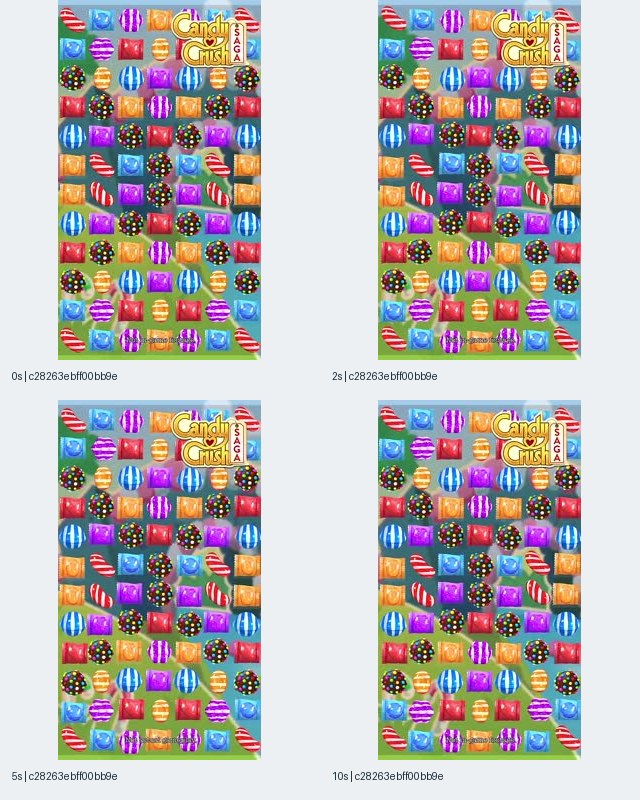
Image 1. Record c28263ebff00bb9ed41382a18cd7b13b, associated with the verified Candy Crush Saga iOS listing. Selected frames: 0, 2, 5, and 10 seconds. The source reports a 60-second video and a playable association; the contact sheet does not show the interactive experience.
The composition gives the viewer a category and a brand before asking them to interpret a rule. Color and repeated candy shapes occupy nearly the whole vertical canvas. There is little surrounding interface to explain an objective, remaining moves, or a particular board constraint. This makes the reference useful for distinguishing product recognition from mechanic explanation.
A hypothesis for an established game is that familiar visual vocabulary may be sufficient to prompt interest among people who already understand the category. That remains a hypothesis. The images do not identify existing players, returning users, or any other audience segment. A production team should not copy the composition on the assumption that its own game has equivalent recognition.
For a less familiar puzzle product, the practical question is whether viewers can describe what they would do after seeing the opening. A field of attractive pieces may communicate mood while leaving interaction unclear. An original alternative could preserve the colorful composition but isolate a target tile, show a valid swap, and expose the resulting change.
This is also a useful quality-control reference. Similar sampled frames do not prove that the complete video is static: movement can occur between the captured timestamps or outside the illustrated interval. The defensible annotation is “stable-looking candy composition at the sampled moments.” That wording gives production a concrete visual observation without filling unseen seconds with an invented narrative.
Image 2: A Guided Move Makes the Puzzle Easier to Follow
Image 2 makes the intended interaction more explicit by placing a large hand over a candy on a board with visible objectives and blockers. Later sampled frames contain bright clearing effects and changed board states. This creates a useful reference for action clarity: the opening supplies a place to look, while the later images show that something consequential has happened.
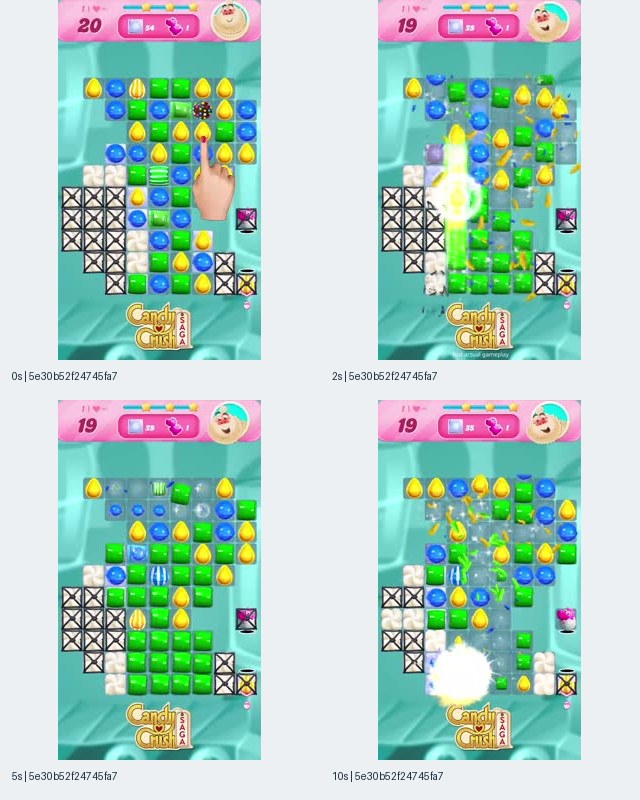
Image 2. Record 5e30b52f24745fa704ecb6650abea386, associated with the verified Candy Crush Saga iOS listing. Selected frames: 0, 2, 5, and 10 seconds. The source reports a 59-second video. The sheet shows selected board states, not every intervening move.
Compared with image 1, this opening provides more instructional context. The board includes blocked cells, candies, and a top interface. The finger directs attention toward a specific part of the board rather than leaving the viewer to scan every possible match. Later bright effects visually emphasize progress, although the contact sheet does not establish every step that produced it.
The transferable production idea is a visible relationship between the problem, the cue, and the consequence. A hand can serve that relationship, but it can also obscure the important tile. A storyboard should therefore specify both the pointer's destination and the information it must leave visible. The audience should be able to see the relevant pieces before the gesture and understand the resulting board afterward.
A matched test could compare a hand cue with a simple highlight while preserving the same board sequence. The hypothesis would concern comprehension: does the more explicit pointer help viewers identify the intended action? A separate question is whether that clarity improves qualified engagement in paid delivery. Those questions need different evidence, and neither has been measured here.
The bright effect also deserves a continuity check. A production reviewer should be able to explain what changed using the before and after states, without relying on the flash itself as proof. If the effect conceals the entire outcome, the advertisement may communicate excitement while failing to communicate the mechanic.
This distinction gives the creative team an actionable revision request: preserve the cue and payoff, but keep the essential tiles readable. It is more useful than a vague instruction to make the advertisement more satisfying.
Image 3: A Seasonal Banner Adds a Reason to Look Now
Image 3 combines a constrained puzzle board with a Music Season banner and a visible limited-time message. The header reads “LIMITED TIME ONLY” and “Until 5 Oct.” Those words establish historical event framing inside the advertisement. They do not establish current event availability, the year intended by the artwork, or whether the event remained accessible when this article was prepared.
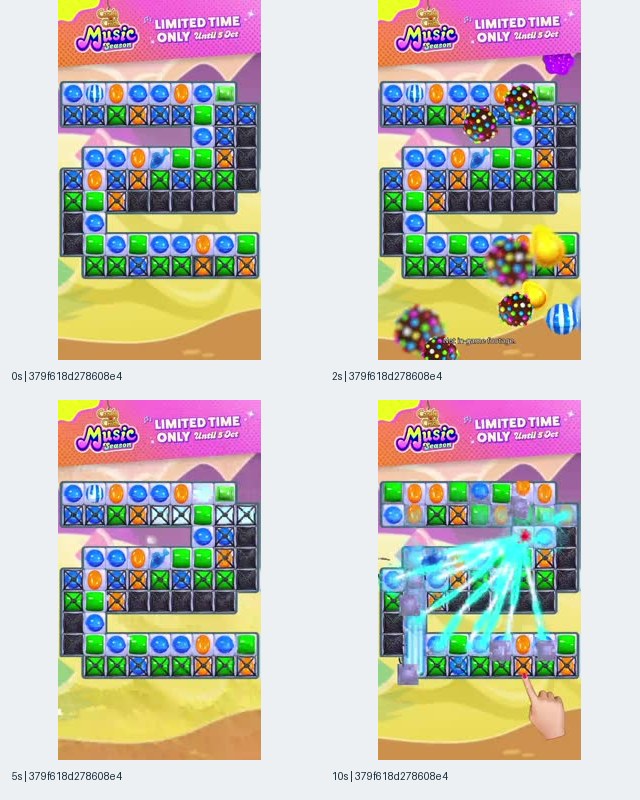
Image 3. Record 379f618d278608e419dd9807f54f60e1, associated with the verified Candy Crush Saga iOS listing. Selected frames: 0, 2, 5, and 10 seconds. The source reports a 60-second video. The seasonal wording is archived creative copy, not a current offer.
The board itself supplies a second layer of information. Its narrow corridors, separated rows, and dark blockers make the playable area visibly constrained. Large candy elements appear over the board in the early sampled sequence, and a later frame contains a bright clearing effect with a hand near the lower area. The reference therefore combines an event reason to pay attention with a recognizable puzzle presentation.
A useful hypothesis is that a seasonal header can give a familiar mechanic a fresh context. That does not mean the seasonal version performs better, or that the event targets returning players. The image supplies the message; audience and effectiveness remain unmeasured.
For a team's own production, separate the reusable board demonstration from the time-sensitive header. The gameplay sequence may remain useful after an event ends, while a deadline-bearing overlay requires a different approval and retirement process. Record who owns the event facts, which markets can access it, and when the copy must be checked again.
The header also consumes screen space. On a small display, event branding can compete with the board objective, and the hand can compete with both. A practical review should ask a viewer to describe the event and the game action separately. If only the event survives, the product demonstration may be too small. If only the board survives, the seasonal message may be decorative rather than understood.
This reference supports an original event-overlay test with a stable board sequence. It does not support copying an archived deadline or treating the presence of seasonal artwork as evidence of a current promotion.
To compare these structures with current indexed references, inspect the Candy Crush search in AdMapix. Recheck the product identity and dates: live search results are a new collection, not an extension of this frozen sample.
Image 4: Character Hazards Create a Different Opening Question
Image 4 opens with a character in a green garden-like environment and later places the character above a candy board near visible hazards. This changes the viewer's initial question from “Which candy should move?” to a possible “What happens to this character?” A rescue interpretation is a reasonable hypothesis, but the selected frames do not establish a complete rescue, failure, or causal connection between a particular match and the character's outcome.
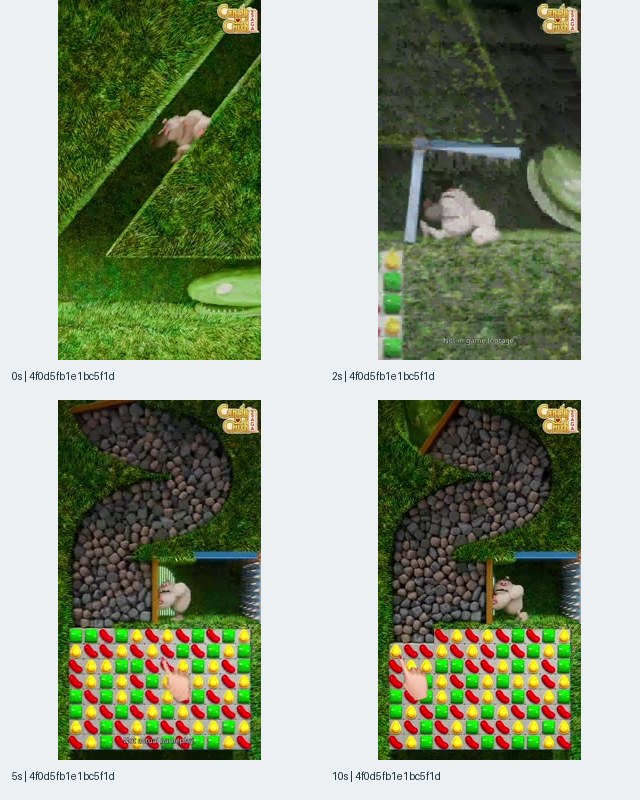
Image 4. Record 4f0d5fb1e1bc5f1d043ec5262695a106, associated with the verified Candy Crush Saga iOS listing. Selected frames: 0, 2, 5, and 10 seconds. The source reports a 59-second video. No complete character outcome is supplied.
The later composition contains several competing areas: the character, a winding stone-filled path, a barrier or opening, a hazard at the side, and a colorful board below. A hand appears over the board. The creative therefore offers both a narrative scene and a concrete interaction surface within the same vertical frame.
The analytical task is to identify whether the relationship between those areas is visible. The sheet shows that they coexist, but it does not demonstrate all the rules connecting them. Claiming that a specific swap releases the character would require a clearer action-to-outcome sequence than the supplied frames provide.
For an original game advertisement, narrative framing should include a product-truth check. If a puzzle move genuinely changes a character's situation, show that causal relationship clearly. If the scene is a stylized illustration, determine how it should be presented so viewers understand what the app actually offers. A small disclaimer in a reference is not a substitute for checking the team's own execution.
A character-first version can be tested against a board-first version using the same supported gameplay promise. Keep the subsequent puzzle action and destination stable. Otherwise, any difference could come from changed mechanics, pacing, or message rather than the opening character.
This reference is valuable precisely because it raises a concrete briefing question: what does the viewer believe their action will accomplish? Answering that question before production helps prevent a dramatic scene from promising an experience the destination does not deliver.
Image 5: A Short Cut Reaches a Clear Branded Finish
Image 5 supplies the clearest visible end card in the illustrated set: a small candy board and hand cue are followed by a Candy Crush Saga logo, character, and green “Play Now” button. The source reports a six-second video, and the contact sheet captures 0, 2, and 5 seconds. This supports a compact board-to-brand structure without requiring an invented account of every intervening animation.
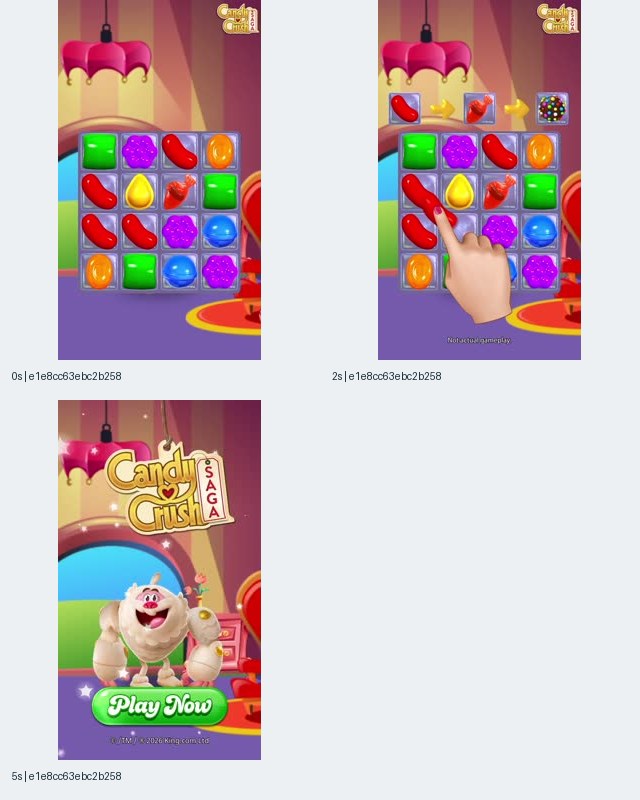
Image 5. Record e1e8cc63ebc2b25882d13f22842c01b0, associated with the verified Candy Crush Saga iOS listing. Selected frames: 0, 2, and 5 seconds. The source reports a six-second video and no playable association. The visible button is part of the captured creative; its behavior was not tested.
The board is simpler to scan than the longer corridor-style layouts elsewhere in the set. The middle frame adds a hand and a small progression graphic above the board. By the later sampled moment, the composition has shifted to the logo, a smiling character, and the call to action. The creative presents a short route from product imagery to a branded invitation.
The practical lesson is to assign a short cut one communication job. A small board can introduce a mechanic or demonstrate a transformation, but a brief that also demands a full event explanation, character story, and feature list risks crowding the available space. The team should decide which meaning must survive if the viewer remembers only one thing.
The end card can then reinforce that meaning. A mechanic-led opening may benefit from retaining some gameplay context. A recognition-led opening may use a more prominent logo. Those are production alternatives to test, not performance conclusions from this reference.
The presence of a Play Now button does not prove that the video itself was interactive, that a viewer clicked, or that the destination loaded successfully. It also does not make every prominent logo elsewhere in the sample an end card. For a longer video, a branded frame captured at 10 seconds may be an intermediate scene.
When reviewing an original short cut, check the final invitation against the actual destination. The game name, visual promise, and available experience should remain consistent after the click. End-card design is part of that continuity, not an isolated decoration added at export.
Image 6: Similar Board Structures Can Support Different Wrappers
Image 6 shows a segmented board resembling the structure in image 3, but the sampled opening lacks that image's prominent seasonal banner. Later frames include oversized candies, the Candy Crush Saga logo, a hand cue, and a bright clearing effect. This makes the pair useful for studying presentation differences around similar puzzle geometry, while the distinct video fingerprints prevent them from being collapsed into one identical file.
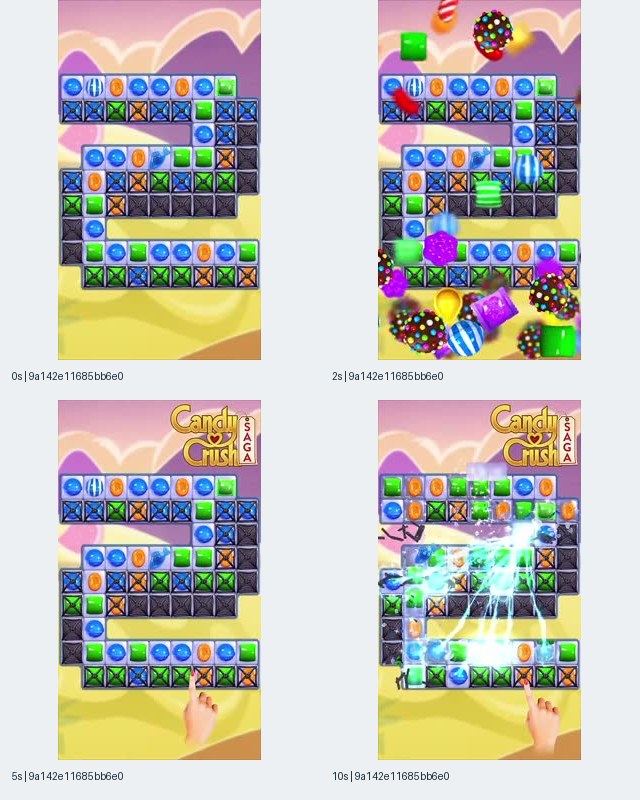
Image 6. Record 9a142e11685bb6e09c2a21cfe06fa1e5, associated with the verified Candy Crush Saga iOS listing. Selected frames: 0, 2, 5, and 10 seconds. The source reports a 60-second video and a playable association. The interactive file was not played or visually assessed here.
The comparison illustrates why a creative library needs both file identity and visual tags. Fingerprints can establish whether the indexed files are identical. A human-readable annotation can describe shared layout, similar colors, or related presentation. Similar-looking files are not necessarily duplicates, and different files do not necessarily represent entirely different creative concepts.
For production, the useful hypothesis concerns modularity. A team might hold a board demonstration stable while testing an event header, logo placement, or opening overlay. That can reduce the amount of footage that must be rebuilt, but the sample does not reveal the original production process or prove that these two references were made through such a workflow.
The playable association adds a separate research question. If a video is paired with an interactive unit, does the latter continue the board promise? The record establishes an attachment relationship, not the attachment's appearance, rules, load behavior, or actual sequence in a served placement. Those details would require direct inspection of the interactive asset.
An original brief should document that boundary explicitly. State what the video demonstrates, what the viewer is invited to try, and what happens if they do not interact. Where the attachment has not been checked, mark it as unreviewed rather than describing a seamless experience.
The bright effect at the later timestamp also reinforces an editing requirement: preserve enough board context to reveal the consequence. Special-candy spectacle can attract attention, but its instructional value depends on whether the viewer can understand what it changes.
Image 7: Text and Graphic Transitions Frame the Board
Image 7 uses large cropped typography before showing guided board imagery and then a bold graphic transition. The first frame does not expose a complete readable sentence, so it cannot support a precise quotation of the opening claim. The later frames show a hand near the lower board and a composition with oversized candy imagery. Together, they demonstrate a message-and-graphics wrapper around puzzle content.
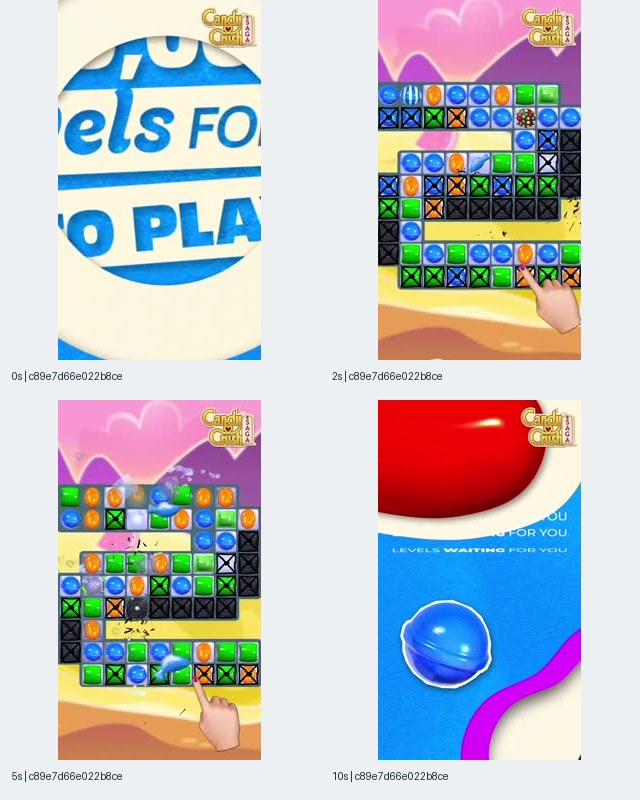
Image 7. Record c89e7d66e022b8ce36c4ea6bc620a78d, associated with the verified Candy Crush Saga iOS listing. Selected frames: 0, 2, 5, and 10 seconds. The source reports a 30-second video. The 10-second graphic is an intermediate observed frame, not a verified final end card.
The opening highlights a common research problem: a dramatic text crop may be intentional motion design, but a still frame can interrupt it before the sentence becomes legible. The analyst should preserve that uncertainty. It would be easy to invent a familiar promotional phrase from partial letters; doing so would turn a visual observation into unsupported copy analysis.
The production lesson is more concrete. Text can create an invitation before the board appears, but the important claim must become readable within the actual sequence. A storyboard review should therefore assess both the attractive transition frame and the complete sentence at its intended reading moment.
The board-and-hand frames provide a useful point of comparison with image 2. Both show guided puzzle content, but their surrounding presentation differs. A matched experiment could use the same original board demonstration with either a text-led introduction or a direct board opening. Keep the verbal promise equivalent, and document whether the text version changes total duration or displaces gameplay.
Localization deserves special attention in this format. A phrase that fits an animated mask in one language may be cropped differently in another. Replacing the words without adjusting layout can remove the very information the opening is supposed to communicate. Review each language at final display size rather than approving only a static text document.
This reference supports a wrapper test and a typography check. It does not establish that the text increases attention, that the graphic frame closes the advertisement, or that the creative belongs to a particular social platform.
Image 8: A Speaker Connects Event Messaging With Product Imagery
Image 8 alternates an on-camera speaker with familiar Candy Crush imagery under Music Season branding. A visible subtitle reads “James Maslow here.” That is a claim made within the advertisement, not independent identity verification by this article. The contact sheet supports analysis of the speaker-to-product structure without establishing an endorsement contract, audience targeting, or the performance of a celebrity-led approach.
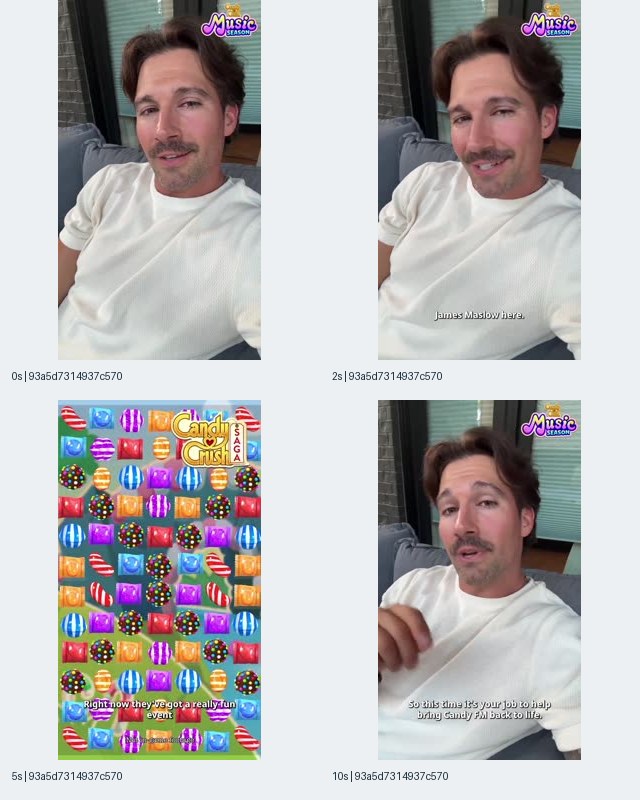
Image 8. Record 93a5d7314937c570bc22ab06a07d167a, associated with the verified Candy Crush Saga iOS listing. Selected frames: 0, 2, 5, and 10 seconds. The source reports a 30-second video. The speaker's identity and commercial relationship were not independently verified.
The early frames show a seated person addressing the camera in an informal setting. The event mark remains visible near the top. The five-second frame switches to candy imagery with an event-related subtitle, and the ten-second frame returns to the speaker with additional captioning. The observed sequence therefore contains both a human presentation and a product reminder.
The central briefing question is what the speaker adds that the board cannot communicate alone. Possible hypotheses include a more conversational invitation, a clearer explanation of the event, or a connection to an entertainment context. None should be described as a demonstrated advantage from this sample.
A team testing the structure should preserve the product claim across variants. Compare a speaker-led opening and a direct product opening that communicate the same supported event or feature. If one version includes a different offer, a different board, and a different end card, the comparison no longer isolates the speaker's contribution.
Subtitle accuracy is part of the production task. Captions should remain understandable over both the person and the product shot, and the message should still make sense without access to the complete spoken track. This article has selected visible subtitles, not a verified transcript of the full video.
Finally, personality rights and event availability belong in the team's own approval record. The public reference does not provide permission to reuse the person's likeness, copy the event, or imply an equivalent partnership. What transfers is the structure: introduce a supported message through a person, connect it visibly to the product, and preserve the promise through the destination.
Failure Hooks Remain a Test Hypothesis
The supplied frames support challenge, constraint, and possible rescue interpretations, but they do not establish that failure hooks are the dominant Candy Crush strategy or that they improve results. A blocked board is not itself a failed attempt. A character near a hazard is not a completed loss. A clearing effect is not proof that the preceding action was deliberately wrong.
A useful definition makes a failure-hook test more precise. The treatment might show an actual unsuccessful move, an explicit loss state, or a clearly understandable imminent consequence. If the execution only shows a difficult-looking board, label it as a challenge setup. These categories can generate different viewer expectations and should not be combined after results arrive.
Image 3 supplies a constrained board. Image 4 supplies a possible character-stakes narrative. Image 6 supplies a large visual payoff. They can inspire distinct experiments, but combining all of them into one variant would make it difficult to explain what produced any outcome difference.
For an original test, write the hypothesis before production: “Showing a supported near-miss before the same solution may increase interest among viewers who understand the mechanic.” Then define what would weaken it. Perhaps viewers misunderstand the move, clicks rise without meaningful gameplay, or the neutral opening produces equivalent downstream results with clearer expectations.
The point is not to avoid dramatic creative. It is to make the drama interpretable and the experiment falsifiable. Use a real or accurately represented product situation, preserve the action-to-consequence relationship, and check the destination promise. This article provides reference structures; the verdict on audience response remains to be measured.
File Reuse and Playable Attachments Need Separate Accounting
The source records reveal specific file relationships that a screenshot-only review would miss. The sample contains 28 video-bearing records but 27 unique video files. Records c28263ebff00bb9ed41382a18cd7b13b and 5a53e4d47eb9847231dba43c24a9fe4d share the same video fingerprint while carrying different playable fingerprints. That is evidence of indexed file reuse, not evidence that one end card outperformed another.
A second relationship runs in the opposite direction. The playable associated with image 1 is also associated with image 6's record, while those records have different video fingerprints. The source therefore supports both a video reused with different playable files and a playable file associated with different videos.
| Relationship | Source evidence | What remains unknown |
|---|---|---|
| Same video, different playables | Image 1 record and record 5a53e4d47eb98 share a video fingerprint | Actual interactive behavior and comparative effectiveness |
| Different videos, same playable | Image 1 and image 6 records share a playable fingerprint | Whether the served handoff was identical |
| Playable without video | Records 8f87b3467c31 and 6f3a85e37db6 have no video fingerprint | Their complete interaction flow and user outcomes |
This is a production reference for modular combinations. A team can maintain separate identifiers for its video, interactive unit, and final advertising assembly. That makes it possible to learn whether a result belongs to an opening, a whole video, an attachment, or a particular combination.
Do not add the video and playable counts into a single creative total without defining what the total means. A video file, a playable file, and their combined ad instance are different units. Keeping them separate is clearer than presenting a larger number that mixes production assets with distribution records.
The practical method for playable ad analysis provides a related framework for examining an interactive unit when it is available. Here, the attachment evidence remains structural: no playable was executed, and no completion, loading, or response behavior was measured.
A Creative Taxonomy That Preserves Evidence Quality
A useful taxonomy records what the reference shows, what the team thinks it may mean, and what still requires testing. Without those distinctions, a tag such as “winning failure ad” can carry several unsupported conclusions into every later search. The Candy Crush examples support a more precise vocabulary built around visible opening, problem, guidance, consequence, event message, and finish.
| Dimension | Useful labels from these references | Question for the brief |
|---|---|---|
| Opening | Candy field, board, cropped text, character scene, speaker | What information arrives first? |
| Puzzle presentation | Compact grid, segmented path, blockers, top interface | What must the viewer understand? |
| Guidance | Hand, highlight, text, no clear cue | Where should attention move? |
| Consequence | Changed board, bright clear, oversized candy effect, unknown | Is the result understandable? |
| Event framing | Music Season mark, limited-time header, absent | Is there a dated reason to act? |
| Brand treatment | Persistent logo, later logo, visible end card | When is the product identified? |
| Attachment | Video only in record, video with playable, pure playable | Which component needs separate review? |
| Confidence | Observed, uncertain interpretation, test hypothesis | What evidence supports the sentence? |
Use an observed label for a visible hand or a supplied file relationship. Use an uncertain interpretation for a possible rescue setup whose full outcome is unseen. Use a hypothesis for a proposed effect on comprehension, clicks, installs, or retention.
Those labels improve collaboration because they make disagreements specific. A designer may agree that a hand is visible but disagree that it clarifies the move. That is a productive difference: the first statement is an observation, and the second can become a test question.
Avoid turning the taxonomy into a numerical quality score unless its meaning is defined. A reference can be visually clear and still perform poorly, or visually unusual and still communicate effectively to a particular audience. The purpose of tagging is to retrieve appropriate examples and write better experiments, not to manufacture a performance ranking from screenshots.
A Practical Research-to-Brief Workflow
The workflow should produce an original, reviewable test brief rather than a folder of attractive examples. Each step below has a concrete output and a stopping condition, so a team can preserve uncertainty while still moving toward production. The broader creative intelligence workflow for mobile UA teams provides a related operating framework.
- Lock the product. Record the verified store ID, product name, seller, and store URL. For this article, that reference is Candy Crush Saga, iOS ID 553834731. Stop attribution claims if the association cannot be verified; continue only with clearly labelled visual inspiration.
- Lock the research scope. Preserve US, the query Candy Crush, the window 2026-09-12 to 2026-10-11, and the three-page limit. A future collection needs its own dates. Do not silently blend results from different pulls into one apparent measurement.
- Separate the units. Maintain one table for advertising records and another for underlying files. Link them through their identifiers. A duplicated video should not become another production concept simply because it appears in another record.
- Write timestamp notes. Describe only the frames actually supplied. For image 1, note the stable-looking candy composition. For image 5, note the visible branded card at five seconds. Do not narrate a complete video from sparse snapshots.
- Choose the communication problem. Decide whether the new creative needs to explain a move, show a consequence, introduce an event, connect a character to gameplay, or clarify the next action. Selecting a problem makes reference choice more disciplined.
- Write the hypothesis and alternative explanation. A hand might improve understanding, or it might merely attract attention while obscuring the board. Document both possibilities. That prevents a favorable click result from automatically becoming a claim about comprehension.
- Build matched versions. Preserve the supported product promise, destination, and major gameplay sequence. Change the intended variable. Where a practical difference cannot be avoided, record it as a limitation rather than calling the test perfectly isolated.
- Check product truth and production readiness. Confirm the mechanic, event conditions, asset permissions, captions, final layout, and destination. The creative team owns presentation; the product owner supplies evidence that the promise is accurate.
- Measure in owned systems. Select an outcome that fits the hypothesis, then add downstream checks. A clearer opening should not be declared successful solely because it generates curiosity clicks. Record delivery conditions and measurement limitations alongside results.
- Archive the decision. Save the reference, observation, hypothesis, storyboard, final files, test conditions, and conclusion. State whether the team will advance, revise, repeat, or stop the idea, and explain which evidence supports that choice.
The handoff between research and production should be readable without the original analyst present. A designer should know exactly which frame inspired the idea, which feature must remain truthful, and which conclusion is still speculative. A buyer should know what the variant changes and what result would justify continuing it.
This workflow also gives small teams a way to limit work. If the current bottleneck is unclear gameplay, start with image 2's action clarity rather than simultaneously commissioning a speaker, an event overlay, and an interactive unit. Prioritize the test that answers the team's actual question.
An Original Brief for a Guided Puzzle Demonstration
A practical brief can turn the hand-and-board observations into an original experiment without copying Candy Crush's art or assuming its audience response. The example below is a proposed test for a team's own match-three game. It is not a reconstruction of a King script, a completed campaign, or a forecast of improvement.
Decision to support: Determine whether explicit guidance makes the team's existing puzzle demonstration easier to understand and attracts players who engage with the actual mechanic.
Product truth required: The product owner supplies a valid board state, a legal move, the resulting state, and confirmation that the shown mechanic is available in the destination experience. The creative uses the team's own art and authorized assets.
Control: Open directly on the board and show the selected move without an added pointer. Preserve enough time and visual space to understand the starting state. Use the existing approved brand treatment and destination.
Variant: Use the same board and move, but add a pointer that identifies the relevant piece before the action. The pointer must not conceal the tile needed to understand the swap. Everything else remains as closely matched as practical.
Opening requirement: A viewer should be able to identify the board and the relevant obstacle. Do not begin at the brightest part of the clearing animation, because that removes the context needed to interpret the result.
Action requirement: The move must remain visible. If a camera effect, caption, or pointer overlaps the critical pieces, revise the composition. A striking gesture that hides the mechanic fails the brief even if the animation looks polished.
Consequence requirement: Show the changed board after the effect. The reviewer should be able to describe what opened, cleared, or became possible. Avoid using spectacle as a substitute for a visible outcome.
End-card requirement: Present the correct game identity and a direct action consistent with the demonstration. Keep the destination and offer the same across versions. A pointer test should not also become a pricing, event, or landing-page test.
Preflight questions: What does the viewer think the move accomplishes? Is that belief accurate? Can the sequence be understood without relying on unseen narration? Does the end card preserve the same promise?
Measurement proposal: Use a comprehension check to identify obvious misunderstandings, then evaluate the paid test through a preselected meaningful gameplay event and downstream quality measures. Keep the definitions and denominators consistent across versions.
Decision logic: Advance only when the evidence supports the intended benefit within acceptable quality limits. If more people click but fewer understand or engage with the mechanic, revise the promise or guidance. If the result is inconclusive, record that outcome rather than labelling either execution a winner.
Test Event Messaging Separately From Gameplay Clarity
An event-overlay experiment should change the event message while preserving the underlying gameplay demonstration. Images 3 and 6 suggest a useful structural comparison, but they are not a controlled experiment: the files differ, the unseen portions are unknown, and the record estimates cannot isolate the effect of the seasonal banner.
For an original campaign, begin with a board sequence that already communicates a supported mechanic. Create one version with the approved event message and another without it, or compare two accurate ways of expressing the same event. Keep the event's availability, eligibility, and destination consistent across the relevant audiences.
The hypothesis might be that a clear event reason increases interest among eligible viewers. An alternative explanation is that the header adds clutter and reduces understanding of the board. Include a comprehension check for both the event and the action, so an apparent attention gain does not hide message confusion.
Date handling belongs in the creative brief. Record the exact event wording, market, applicable time zone, destination state, and person responsible for confirming availability. The archived “Until 5 Oct” reference illustrates why a deadline cannot be detached from its original context and reused as an evergreen claim.
Production should also define an expiration action. A reusable gameplay sequence can remain in the library after a seasonal overlay is retired, but the exported event version needs its own status. Keeping the components separate makes that distinction easier to manage.
This is a proposed workflow, not evidence that the sampled advertisements followed it. The benefit is operational clarity: the team can distinguish a question about gameplay explanation from a question about event relevance, and each result becomes easier to interpret.
Measure the Creative Job With Owned Data
The appropriate outcome depends on what the creative is intended to change, and none of those outcomes can be recovered from the supplied impression estimates. A research sample can identify a hand cue, seasonal banner, or end card. Only a properly documented test can show whether that element improves the team's chosen result under its delivery conditions.
| Creative question | Useful measurement approach | Important limitation |
|---|---|---|
| Is the move understood? | Ask viewers to describe the action and result | Comprehension alone does not establish acquisition value |
| Does the opening sustain attention? | Compare defined viewing events within the same environment | Viewing definitions can differ across platforms |
| Does the promise attract suitable players? | Connect acquisition to a meaningful gameplay event | Tracking and attribution can be incomplete |
| Does the event message help? | Compare eligible audiences with equivalent destinations | Event access and timing can confound the result |
| Does the end card clarify the next step? | Observe destination behavior and subsequent engagement | A button click alone may reflect curiosity |
| Does an interactive attachment help? | Measure interaction and downstream quality separately | Technical differences can affect the experience |
Define the denominator before reading the outcome. A rate among viewers who reached an end card answers a different question from a rate among all delivered impressions. A playable-completion rate answers a different question from an install rate. The report should preserve those distinctions rather than combine them into an undefined engagement score.
Test conditions also matter. Keep market, audience eligibility, destination, attribution settings, and major delivery conditions aligned where possible. If an experiment runs through different placements or optimization processes, document the difference. A result can still be operationally useful without supporting a clean causal claim about one visual element.
Set the decision criteria before launch using the team's baseline, measurement quality, and tolerance for uncertainty. This sample supplies no defensible universal budget, sample size, or stopping threshold. A small directional result may justify another test; it should not automatically justify a broad rollout.
Finally, preserve negative and inconclusive findings. If guidance improves comprehension but not meaningful gameplay, that is a specific learning. If an event header attracts attention while confusing the offer, that is another. The value of the research increases when those outcomes remain attached to the original hypothesis.
End Cards Must Match the Destination Promise
An end card should carry the same supported promise as the opening and the destination. Image 5 shows a visible branded finish, while the other sheets mostly show earlier portions of longer assets. That difference matters: a logo in the middle of a video is branding, but it is not automatically a final conversion screen.
Start the end-card review with the question the opening creates. If the advertisement asks viewers to solve a board, the finish should identify the game and make the next action clear. If the advertisement introduces an event, the destination should explain that event accurately for the viewer's market and eligibility.
The product, creative, and buying teams each own part of this check. Product confirms the mechanic or event. Creative makes the invitation readable. Buying checks that the selected destination and campaign setup lead to the intended experience. A mismatch can arise even when each individual asset looks acceptable in isolation.
For a proposed test, preserve the destination while comparing end-card layouts. A clean logo-and-action card and a board-plus-brand card may produce different understanding, but changing the destination at the same time would introduce another explanation for the result. Document what actually changed.
Do not infer button behavior from an image. The Play Now treatment in image 5 is visible creative evidence, but the sample does not show a click, store load, or installation. An interactive-looking design and an interactive execution are separate facts.
A useful acceptance note is short: “The opening promises this mechanic; the demonstrated action is valid; the finish names the correct product; the destination supports the promise.” If any clause remains unverified, resolve it before treating the export as ready for delivery.
Common Mistakes in Candy Crush Creative Research
The most damaging mistakes arise when a valid observation is assigned the wrong meaning. The records and images can support useful creative decisions, but a report becomes unreliable when it turns a file count into production volume, a timestamp into a full narrative, or an estimate into a performance verdict.
Counting records as videos. This sample has 30 records and 27 unique video files. The difference is real and traceable. Keep record-level distribution questions separate from file-level production questions, and preserve playable counts as their own category.
Calling a window estimate lifetime delivery. Every impression value used here belongs to 2026-09-12 to 2026-10-11. Do not describe it as cumulative history, divide it by time since first observation, or use it to infer a stable daily rate.
Calling every obstacle a failure hook. Blockers create a visible constraint. They do not establish that a player made a wrong move or that the advertisement contains a completed failure. Tag the actual presentation before proposing an audience-response hypothesis.
Inventing motion between frames. A contact sheet can show a hand before a flash and a changed board afterward, but it may omit intervening actions. Describe the sampled sequence and flag the missing detail instead of writing a frame-by-frame account that was never observed.
Confusing branding with an end card. A logo visible at ten seconds in a longer video may be an intermediate treatment. Image 5 supplies a specific branded finish reference; the rest of the set should not be generalized into repeated final-screen behavior.
Reading a face as verified identity or endorsement. A subtitle can be quoted as advertising copy, but the person's identity and commercial relationship require independent evidence. The visual format remains analyzable without making those claims.
Treating an archived event as current. Seasonal wording belongs to the captured creative. Preserve its historical context and verify new event facts before producing or recommending a live promotion.
Inferring a network from the layout. A vertical game advertisement can appear in different environments. The supplied codes do not establish a named network here, so platform-specific conclusions would exceed the evidence.
Calling reuse proof of success. A repeated video fingerprint establishes reuse. It does not explain why the file was reused, how frequently a person encountered it, or whether it produced profitable outcomes.
Ending with inspiration instead of a decision. Each selected reference should lead to a clear production question, an original treatment, a control, a measurement plan, and a documented decision. Otherwise, the collection remains a screenshot archive rather than a working research input.
When AdMapix Fits the Workflow
AdMapix fits the discovery and evidence-organization stage of this process: finding indexed references, checking product associations, inspecting file relationships, and preparing a research handoff. It complements owned campaign measurement by supplying external creative observations. It does not turn those observations into verified private spend, conversion, retention, or profit data.
The practical buying question is whether the service helps the team answer a recurring production question. For this example, the task could be to find guided match-three demonstrations associated with a verified app, distinguish event wrappers from gameplay structure, and preserve enough source context to brief an original test.
A useful handoff contains the product identity, market, explicit dates, selected record identifiers, visible timestamp notes, and a short list of hypotheses. It also states which components remain unexamined, such as a playable attachment or the unseen end of a longer video. That is more actionable than a report that labels every large estimate a winner.
If the team's only need is to measure its own campaigns, its campaign platforms, attribution systems, and product analytics remain the relevant evidence sources. If the bottleneck is external creative discovery and repeatable research, an advertising intelligence workflow can help.
Decision CTA: Build my next puzzle-ad test brief from a verified product search. Choose a specific communication problem, preserve the source context, and commission a matched original variant before making a budget decision.
For current access conditions and commercial terms, consult the live AdMapix pricing page. Prices and credit allowances are intentionally omitted from this evergreen article, and no paid-plan trial is promised.
Keep a Research Cadence Without Rewriting History
A recurring review should preserve comparable evidence rather than replace old observations with whatever the live index shows today. Save each collection with its identity, country, window, retrieval date, and limits. That makes it possible to distinguish a newly observed file from a changed estimate, a different attachment, or an altered sample composition.
A practical cadence begins with the outstanding production questions. If the current test concerns hand guidance, review references that clarify that question. If it concerns seasonal messaging, check event presentation and timing. Do not collect more examples simply to make the library appear larger.
When a familiar record appears again, compare its file and attachment relationships before labelling it new. When it is absent, describe it as absent from the later bounded collection. Absence from a top sample does not establish that advertising stopped, and a first-seen timestamp does not establish the production date of the underlying asset.
Keep the learning record alongside the source record. The source may show a guided move; the team's experiment may show that its own pointer was too large. Saving only the reference loses that important distinction. Saving only the test result loses the origin of the hypothesis.
For a small team, a shared table with stable identifiers and linked briefs can be sufficient. The key requirement is that another person can reconstruct the chain from observation to decision without relying on memory. That chain is what makes creative research reusable across successive production cycles.
FAQ
What does the Candy Crush ad sample cover?
It covers 30 US-filtered advertising records associated with the verified Candy Crush Saga iOS product ID 553834731. The explicit measurement window is 2026-09-12 to 2026-10-11. Three pages of ten records were requested with impression-descending sorting. This is a bounded collection, not a complete catalogue of the game's advertising or a reconstruction of its media plan.
How many unique videos and playables are in the sample?
The sample contains 27 unique video files and four unique playable files across 30 advertising records. There are 28 video-bearing records and five records containing playables, including two pure playable records without video. These counts describe different units. Adding them into a single creative total would require an additional definition and could obscure the actual file relationships.
Does the evidence prove that failure hooks work?
No. The contact sheets show constrained boards, blockers, character hazards, and clearing effects, but they do not establish a complete failure narrative or measure audience response. Use those observations to define a specific hypothesis, then compare a truthful challenge or near-miss treatment with a matched control in owned campaign data. Check downstream gameplay quality as well as immediate engagement.
Which advertising network carried these examples?
A named network is not verified in the supplied package for this analysis. The records contain source codes, but no validated mapping is supplied here. Vertical composition, a pointing hand, or a game logo cannot establish Meta, TikTok, Unity, AppLovin, or another delivery environment. Keep the network unknown until appropriate source evidence is available.
Can this sample establish Android performance?
No. The approved scope is the verified iOS listing. Some records also contain an Android package association, but that does not provide an independently sampled Android dataset or split the record-level estimates by operating system. An Android comparison requires its own verified identity, explicit dates, country filter, counting units, and suitable measurement evidence.
Were the complete videos or playable units tested?
No. The visual analysis uses selected contact-sheet timestamps, generally 0, 2, 5, and 10 seconds, with image 5 showing 0, 2, and 5 seconds. Declared video duration comes from the records. The article does not claim complete playback, audio review, app gameplay, interactive testing, or knowledge of unseen transitions and final scenes.
How should a team test a guided puzzle demonstration?
Use the same supported board state and move in a control and a guided variant. Change the pointer or guidance treatment while preserving the destination, major sequence, and other relevant conditions. Check whether viewers understand the action, then evaluate a meaningful gameplay outcome and downstream quality. Define the decision criteria before launch rather than choosing a favorable metric afterward.
Is a repeated video automatically a winning creative?
No. A repeated fingerprint establishes indexed file reuse, not effectiveness. The same video can be associated with different playables or advertising records for reasons the public sample does not explain. Use the relationship to organize production references and identify questions worth testing. Spend, conversions, retention, and profitability remain separate measurements requiring appropriate evidence.
Key Takeaways
The sample is most useful as a source of specific production questions, with the identity and measurement limits preserved.
- Anchor the research to Candy Crush Saga iOS ID 553834731 and the US window 2026-09-12 to 2026-10-11.
- Keep 30 records, 27 video files, four playable files, and two pure playable records as separate facts.
- Distinguish candy recognition, guided moves, event framing, character stakes, and a visible end card before combining them in a brief.
- Treat failure-hook effectiveness, audience intent, and performance impact as untested hypotheses.
- Build original matched variants, validate the destination promise, and use owned data to decide what deserves further investment.
Sources
The dated source package establishes this article's record scope and visual references; the product and workflow links support identity checking and responsible follow-up research.
- Frozen source package — fetched 2026-10-12: Candy Crush Saga US sample and reproducible request batches. Scope: 30 records associated with verified iOS ID 553834731, measurement window 2026-09-12 to 2026-10-11, eight timestamped contact sheets, request parameters, and checksums. Checksums establish package integrity, not campaign quality.
- Verified product reference — included in the 2026-10-12 package: Candy Crush Saga on the US App Store, ID 553834731, seller King.com Limited. Supports product identity; does not identify the ad buyer or prove advertising performance.
- AdMapix methodology — referenced for this 2026-10-12 analysis: Data methodology and evidence boundaries. Relevant to the distinction between indexed records, creative files, and model estimates; no new live-site test is claimed.
- AdMapix search workflow — follow-up route for this 2026-10-12 analysis: Inspect indexed Candy Crush creative references. Live results require their own identity checks, dates, country, and sample limits and may differ from the frozen collection.
All eight images are source-linked advertising contact sheets. They document selected visual observations and do not establish complete playback, verified network delivery, conversion, spend, or profitability.
Turn these observations into your next creative study
Open the creative library and select samples for your market, network and research question.
Related Articles
TikTok Shop Ads: Beauty References for Demonstrations, Proof, and Offers
Compare eight beauty creative references from a dated US skincare sample, distinguish demonstrations from claims and historical offers, and build original briefs without assuming verified TikTok Shop attribution or campaign performance.
Clash Royale Ad Strategy: Hooks, Gameplay, and Video Reuse
A bounded US sample links 72 Clash Royale advertising records to 57 video files and 12 playable files, with eight timestamped visual analyses and practical briefs that separate creative observations from unmeasured performance.
Black Friday Ads: Build a Competitor Offer Tracker Before Launch
Build a competitor offer tracker from a dated US Black Friday search sample, using eight visual examples to preserve offer conditions, resolve conflicting claims, track versions, and prepare original tests.