
Clash Royale Ad Strategy: Hooks, Gameplay, and Video Reuse
A bounded US sample links 72 Clash Royale advertising records to 57 video files and 12 playable files, with eight timestamped visual analyses and practical briefs that separate creative observations from unmeasured performance.
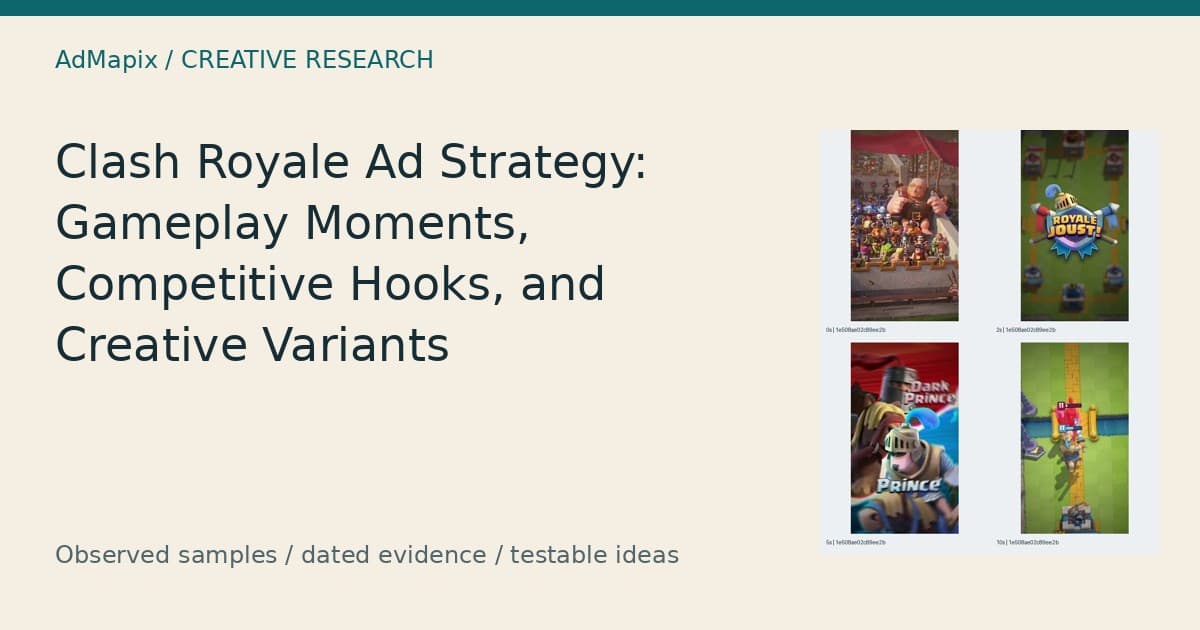
Clash Royale Ad Strategy: Hooks, Gameplay, and Video Reuse
Clash Royale advertising in this dated sample connects recognizable characters with specific arena situations: a bridge confrontation, a threatened tower, an exaggerated resource display, a taunting exchange, or a countdown. The useful finding for user acquisition and creative teams is how those situations are presented and recombined. The evidence does not establish which concept converts best or how much the advertiser spends.
This analysis examines a bounded US sample associated with the verified Clash Royale iOS listing, plus eight timestamped contact sheets. It separates advertising records from underlying media files, explains what each visible example contributes, and turns those observations into original production and testing briefs. For teams planning their next creative batch, the practical decision is which communication problem to test: recognizing the game, understanding a tactical choice, identifying with a character, or anticipating an outcome.
Last updated: 2026-10-12.
AdMapix Research — prepared with Codex and checked against the dated source sample. Editorial ownership: Brad at AdMapix. This automated preparation disclosure does not imply personal human review. AdMapix is our product.
Quick Answer
Clash Royale ad strategy in this sample is best understood through visible gameplay framing and media reuse, rather than inferred budget or performance.
- The US sample for 2026-09-12 to 2026-10-11 contains 72 advertising records, including 66 records with video and 22 with playable associations.
- Those records resolve to 57 distinct video fingerprints and 12 distinct playable fingerprints; record totals are not unique creative totals.
- Eight contact sheets show character introductions, arena confrontations, resource graphics, rivalry, narrative framing, and countdowns.
- A repeated video appears with different playable associations, demonstrating reuse without revealing why those combinations were selected.
- Use these observations to write testable briefs. Conversion, spend, targeting, profitability, and network-specific performance remain unmeasured.
What This Sample Can Help a Creative Team Decide
The sample can help a team choose the next creative question to investigate, because it shows several ways of making an arena battle understandable or emotionally interesting. It cannot choose a media budget or declare a winning audience. A productive research session therefore ends with a brief that names an observable problem, a proposed creative change, and the evidence needed to judge that change in the team's own campaign.
Clash Royale is the mobile game identified here by its verified iOS store listing, ID 1053012308, with seller Supercell Oy. In the supplied imagery, its arena, towers, cards, characters, and resource displays provide the setting for the analysis. We are studying how the sampled advertising depicts that setting, without claiming to have played or independently tested the game.
A creative strategist can use the examples to distinguish several jobs that often get bundled into the word “hook.” One opening identifies a familiar character. Another establishes an immediate threat. Another supplies a premise, such as a wanted poster. A countdown creates an expectation about what will happen within a stated interval. These are different communication choices, even when each eventually includes arena footage.
For a producer, the distinction affects what needs to be built. A resource explanation may require readable interface graphics. A character introduction may require an expressive close-up. A tactical challenge may depend more on camera framing and the clarity of a decision. Commissioning all of them as “more exciting gameplay” leaves the important production choices unresolved.
For a media buyer, the distinction affects the test question. A more legible opening could improve comprehension without changing acquisition quality. A dramatic character shot could attract attention while leaving the mechanic unclear. Those possibilities are hypotheses, and they need separate measurements.
The broader mobile game ads guide provides the topic framework. This article contributes a specific, dated set of creative references and a disciplined way to use them.
Methodology: Dates, Country, Identity, and Observation Limits
This study uses a frozen AdMapix source sample collected on 2026-10-12, with an explicit US measurement window of 2026-09-12 to 2026-10-11. The research query was Clash Royale. The creative requests were restricted to verified product ID 1053012308, requested in descending order of estimated impressions, and bounded at eight pages with ten requested rows per page. The supplied sample contains 72 distinct advertising records after repeated record appearances are handled.
This is a verified-product sample, rather than an attribution audit of unrestricted name-search results. The verified store reference identifies Clash Royale, iOS track ID 1053012308, bundle identifier com.supercell.scroll, and seller Supercell Oy. The upstream product grouping also contained other identifiers, but they were not admitted as additional verified products for this analysis.
Some individual records include an Android listing alongside the verified iOS listing. That association does not turn this into a complete Android sample, an operating-system comparison, or a platform-specific delivery measurement. The inclusion rule remains association with the verified iOS reference. A store association also does not establish the identity of the ad buyer or payer.
The quantitative counts below come from the supplied frozen summary and associated records. Video and playable fingerprints identify underlying files or indexed assets. Their values must be considered individually when a record contains an array of associations. Repeated appearances of an advertising record across retrieval pages do not create additional records, and repeated media fingerprints do not create additional unique files.
The visual analysis is narrower than the record analysis. It covers eight supplied contact sheets, each showing frames labelled 0, 2, 5, and 10 seconds. These observations support descriptions of the selected frames and comparisons between them. They do not establish continuous playback, every intervening transition, audio, voiceover, the complete ending, or the behavior of an attached playable.
An ad library is a searchable collection of advertising records and creative references. AdMapix is an advertising intelligence product used here as the source of that indexed evidence. Its source records include numeric source codes and missing source values, but this package does not supply a verified mapping sufficient to name the advertising networks for these examples. Accordingly, none of the eight images is labelled a Meta, TikTok, YouTube, AppLovin, or other network-specific ad.
Every impression figure in this article is a third-party model estimate for the stated measurement window. It is not observed delivery, unique reach, spend, installs, profit, or a lifetime total. Product-level search aggregates are excluded. We do not divide impressions by the time since a record was first observed, or infer performance from continued appearances in the index.
The frozen source package makes the retrieval batches, request parameters, and checksums public and reproducible. Those checksums support source integrity; they do not establish advertising quality. A later live query can return different records or estimates, so this article's findings belong to the frozen sample and its dates.
Evidence Table: Records, Files, and Illustrated Examples
The central quantitative finding is that the sample contains more advertising records than distinct video files, while playable associations overlap with video records. The table below keeps those units separate. It describes what was returned within the bounded research scope, rather than the complete Clash Royale advertising operation. The illustrated examples are selected visual references within that scope, not a representative survey of every creative approach.
| Measurement | Frozen sample result | Correct interpretation |
|---|---|---|
| Advertising records | 72 | Distinct records in this bounded sample |
| Records containing video | 66 | Records with an associated video, including possible playable associations |
| Distinct video fingerprints | 57 | Underlying indexed video files after fingerprint deduplication |
| Records containing playable associations | 22 | Records linked to playable assets, including video combinations |
| Pure-playable records (no video fingerprint) | 6 | Records with playable fingerprints but no video fingerprints: 52f45f9ceccf7624, cd033169ed88241f, 5524a1c0b66c2133, c07db901e612aef6, 56592c99536b1dd7, 84076f5178880bea |
| Distinct playable fingerprints | 12 | Indexed playable assets after fingerprint deduplication |
| Distinct image fingerprints | 0 | No standalone image fingerprints in this sample; video frames still exist |
| Illustrated video references | 8 | The supplied contact sheets analyzed in this article |
The following table connects each illustration to a specific record. Record references are shortened prefixes of the identifiers in the public source package. Listed durations are source metadata, not a claim that the complete videos were watched.
| Image | Record reference | Listed video duration | Window impression estimate | Visible analytical focus |
|---|---|---|---|---|
| 1 | 1e508ae02c89ee2b | 15 seconds | 1,251,005 | Character display, “Royale Joust,” named matchup, bridge confrontation |
| 2 | 5373c14ce1c47e44 | 15 seconds | 146,697 | Armored unit, purple symbol, arena confrontation, cinematic close-up |
| 3 | 5374bd418a7df6f5 | 15 seconds | 23,512 | Arena overview, tower threat, advancing unit, character close-up |
| 4 | 1b8eb1994606955c | 30 seconds | 16,725 | “Elixir Overkill!” and enlarged resource bars |
| 5 | 2ea222bedeaff36b | 14 seconds | 6,697 | Battle effects, reaction icon, character-labelled taunts |
| 6 | 4de5eb1bde5c752d | 30 seconds | 6,092 | Route cue, question-mark reaction, character crowd, arena effects |
| 7 | c09ddc130846d67f | 15 seconds | 1 | Wanted poster, outlaw introduction, “Hall of Shame” framing |
| 8 | 5464721b5a24b4e0 | 55 seconds | 1 | “In 60 Seconds” premise and countdown overlays |
The estimates help preserve the source context, but they are not a creative scorecard. In particular, the values of 1 for images 7 and 8 should not be interpreted as proof that only one person saw either ad. The package does not explain the model behavior behind those values.
A useful creative reference can therefore remain worth studying even when its delivery estimate is difficult to interpret. Conversely, a larger estimate does not tell us whether the opening was understood, whether anyone installed, or whether the resulting users retained.
Why 72 Records Do Not Mean 72 Creative Concepts
Advertising records, media files, and creative concepts answer different questions, so they should be counted and discussed separately. A record identifies an indexed advertising instance. A video fingerprint identifies a media file. A creative concept describes an idea, such as a rivalry or a resource-management challenge, and requires editorial classification. None of those units can safely substitute for the others.
The difference is visible in this sample without needing a complicated model. Image 1's video fingerprint appears in other records with different playable associations. Counting every appearance as a new video would inflate production volume. Counting every distinct video file as a new concept could still overstate conceptual variety, because different files may share the same premise or differ only in execution.
The reverse issue also matters. Two contact sheets can include a similar character or a similar arena while using different files and different communication structures. Image 1 begins with a character-filled display and later presents a named confrontation. Image 6 includes a similar display scene at a later sampled timestamp, alongside a route cue and reaction graphics. Shared imagery is a useful production observation, but it does not make those files identical.
For a practical research sheet, keep separate fields for record identity, video identity, playable identity, visible premise, and observed timestamps. A concept field might read “named character matchup.” A file field would identify the corresponding media fingerprint. A record field would retain the advertising instance that linked the file to the store listing.
This separation prevents a misleading production narrative. The evidence can show reuse and variation, but it cannot reveal the studio's internal workflow, staffing, production cost, or experimental design. An apparent combination system could reflect testing, trafficking requirements, adaptation, distribution, or other operational choices. Each explanation remains a hypothesis until supported by additional evidence.
The same discipline applies to playables. A playable is an interactive advertising asset intended to let a viewer take an action. A recorded playable association establishes that an asset was linked in the index. It does not establish that the asset loaded successfully, that a viewer interacted, or that its mechanic matched the preceding video.
Image 1: A Named Matchup Gives the Arena a Clear Subject
Image 1 presents recognizable characters and a named confrontation before the sampled bridge scene, giving the creative a specific subject beyond general arena action. The contact sheet supports a sequence of visible states: a crowded character display at 0 seconds, a “Royale Joust!” title at 2 seconds, “Dark Prince” and “Prince” labels at 5 seconds, and opposing units near a bridge at 10 seconds. It does not show every transition between those states.
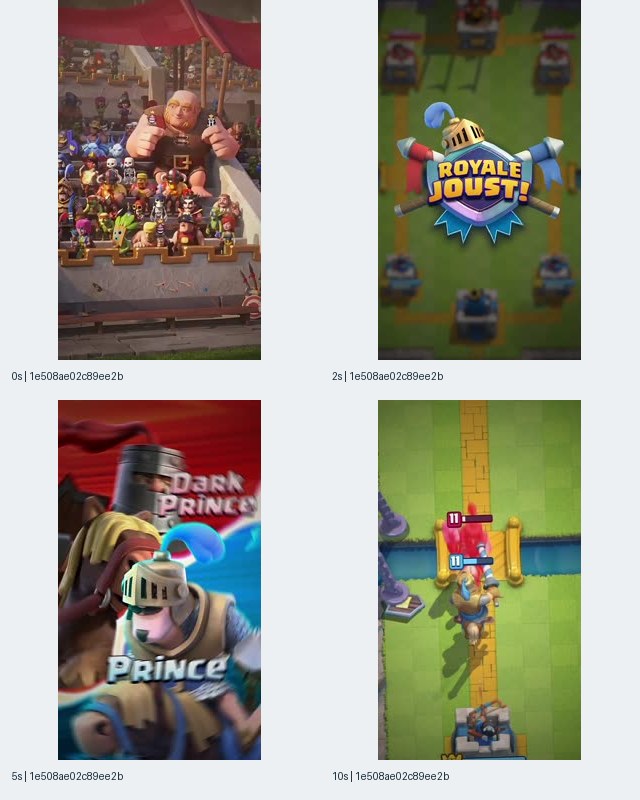
Image 1. AdMapix record 1e508ae02c89ee2b, associated with verified Clash Royale iOS listing 1053012308. Frames labelled 0, 2, 5, and 10 seconds; observed in the source package dated 2026-10-12. These screenshots document creative content, not campaign performance.
The named matchup is the clearest transferable device. “Prince” and “Dark Prince” tell the viewer which figures to compare, while the later arena frame supplies a location where that comparison can matter. A producer studying the example can ask whether the character labels and the gameplay situation refer to the same central question.
The opening display serves a different visual function. It places many characters together around a larger figure, making the game world and its cast prominent. Whether that produces recognition, amusement, or confusion depends on the audience and cannot be determined from the image alone. It is particularly important not to assume that all prospective users already know the characters.
A testable hypothesis for an original game would be: naming the opposing units before showing their encounter helps unfamiliar viewers identify the conflict. The corresponding variation could hold the encounter constant while changing only the introduction. One version presents the two unit names; another begins directly with the battlefield. Both should use the team's own characters and footage.
The first evaluation should be descriptive. Ask viewers which unit is theirs, what the opponent is doing, and what outcome they expect. If the names are remembered but the battlefield remains unclear, the introduction may have established identity without explaining the action. That is a useful production finding even before paid delivery.
Image 1 also introduces the reuse question developed later. Its underlying video is associated with multiple records, so the larger estimate attached to this particular instance cannot be treated as the performance of the video in isolation. The surrounding combination, delivery conditions, and unobserved campaign settings may differ.
Image 2: Character Spectacle and Gameplay Share the Same Reference
Image 2 places arena footage alongside highly stylized purple character imagery, showing two ways of presenting the same advertising subject within the sampled frames. At 0 seconds an armored unit occupies the bridge area. At 2 seconds a bright purple emblem appears against a dark character image. The 5-second frame returns to an arena confrontation, while the 10-second frame shows an expressive close-up surrounded by purple effects.
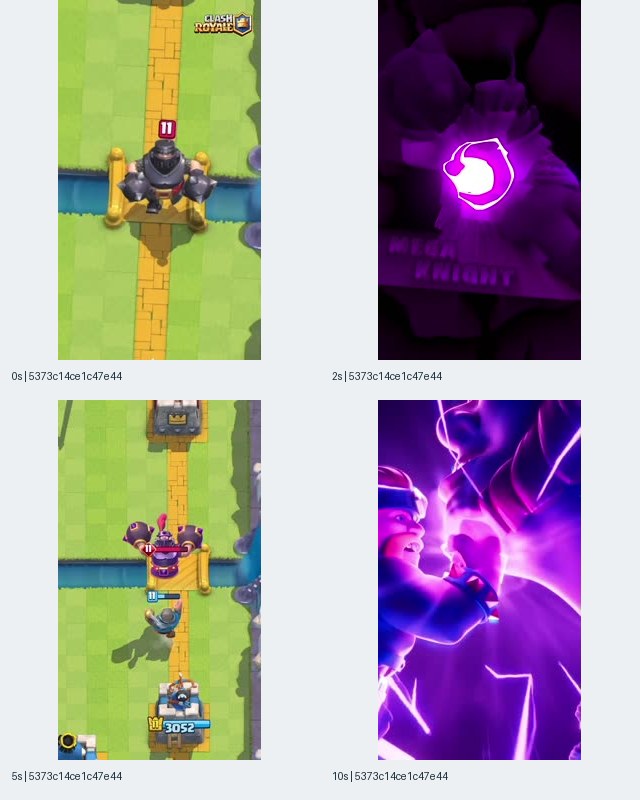
Image 2. AdMapix record 5373c14ce1c47e44, linked to Clash Royale iOS listing 1053012308. Selected frames at 0, 2, 5, and 10 seconds, from the 2026-10-12 source package. The purple imagery is visible creative treatment; its effect on viewers was not measured.
The analytical opportunity is to distinguish visual intensity from mechanical explanation. The close-up gives the character a scale and expression that the overhead arena view cannot provide. The arena view supplies spatial relationships that the close-up does not. Each image type can contribute something different, but the contact sheet alone cannot establish how smoothly the complete video connects them.
It would be tempting to call the purple symbol an upgrade announcement or a demonstrated ability change. The visible treatment may suggest such an interpretation to a familiar player, but that interpretation requires more evidence than the sampled frames provide. The safe observation is that a prominent symbol and color treatment distinguish the character-focused moments.
For an original brief, specify what the cinematic element must explain. If its only job is to create anticipation, say so. If it is supposed to explain a mechanic, require an arena shot that makes the relevant action visible. Otherwise, a production team may deliver a polished character scene while leaving the actual decision unchanged or obscure.
A proposed comparison could hold the gameplay excerpt constant and vary the character introduction. One version uses a close-up; the other uses a readable label over the arena. The hypothesis would concern recognition or comprehension, not an assumed conversion lift. The paid test would then determine whether any attention difference survives into the desired user behavior.
The important production lesson is to preserve a visual connection. Color, silhouette, costume, or another recognizable feature can connect an overhead unit with a larger character image. That connection should be checked with viewers unfamiliar with the game rather than assumed from the creative team's knowledge.
Image 3: A Tower Threat Gives Character Imagery a Tactical Context
Image 3 includes both a visible tower threat and a later character close-up, making it useful for studying how a battle situation can support character presentation. The selected frames show an arena overview with branding at 0 seconds, a fiery impact near a blue tower at 2 seconds, an armored unit approaching the opposing side at 5 seconds, and a large purple-armored character at 10 seconds. They do not establish a complete attack sequence or its final result.
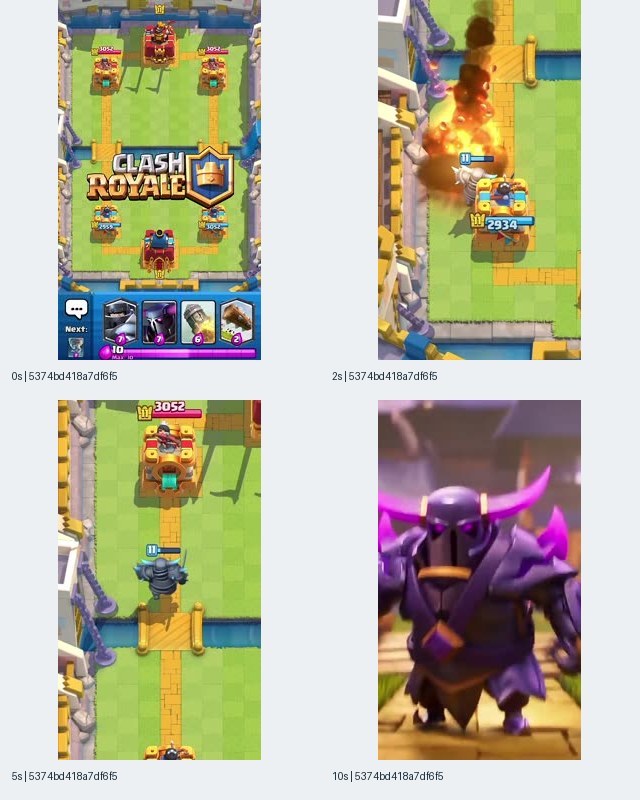
Image 3. AdMapix record 5374bd418a7df6f5, associated with verified Clash Royale iOS listing 1053012308. Frames labelled 0, 2, 5, and 10 seconds; source package dated 2026-10-12. The sheet supports a tactical-context analysis, not a claim about a completed battle.
The tower gives the viewer a concrete object at risk. That is more specific than a general montage of units. A creative team can use the reference to ask whether its own opening makes the objective visible: what needs protecting, what is approaching, and what action could change the situation.
However, a visible threat is not yet a visible decision. The 2-second frame contains effects and a tower, but the contact sheet does not show the player's available choices at that instant. If an original ad is intended to communicate tactical agency, the brief should request enough interface or staging to make the choice understandable.
The relationship between the 5-second unit and the 10-second close-up also deserves careful treatment. The sampled images support visual comparison; they do not prove a particular causal story about that unit's actions. A script should not insert an unsupported narration such as “this move wins the match” simply because the later character looks powerful.
A useful hypothesis is that showing the threatened objective before a character reveal gives unfamiliar viewers a reason to care about the character. Test it against a reveal that lacks the objective setup. Keep the character treatment and the eventual gameplay excerpt stable where possible, so the comparison concerns the presence of a tactical premise.
During review, ask whether viewers can explain the stakes without using the character's name. If they can only say that the armor looks impressive, the creative may be communicating spectacle more clearly than strategy. That may be acceptable for some briefs, but it should be an intentional choice.
Image 4: Enlarged Resource Bars Make an Abstract Constraint Visible
Image 4 explicitly foregrounds elixir through the “Elixir Overkill!” headline and enlarged bars over gameplay, making resource presentation the central visual subject. The 0-second frame shows a branded blue background; the 2-second frame introduces the headline, a purple drop, and a concerned king character. At 5 and 10 seconds, resource bars occupy prominent positions above and below the arena action, with visibly different fill states.
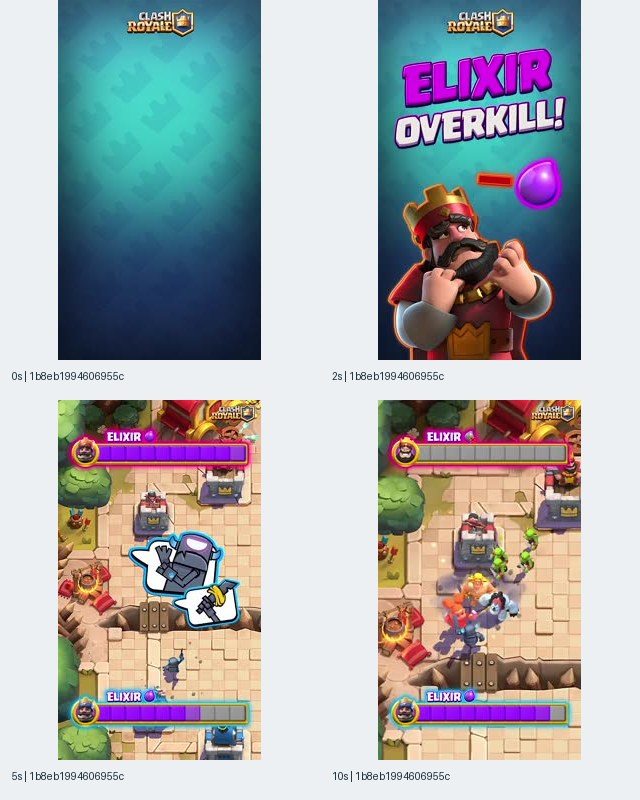
Image 4. AdMapix record 1b8eb1994606955c, linked to Clash Royale iOS listing 1053012308. Selected timestamps: 0, 2, 5, and 10 seconds. Observed in the 2026-10-12 source package; the resource graphics are advertising observations, not independently tested game rules.
This reference is useful because resources can be difficult to explain in a short ad. A viewer may understand that units fight without understanding what limits their deployment. The enlarged bars put a constraint into the foreground, while the character's expression gives that constraint an emotional interpretation.
The sampled frames do not justify a precise claim about resource generation, spending efficiency, or optimal play. A bar that is full in one image and empty in another shows a visual contrast. It does not, by itself, explain every action responsible for that change or establish that the depicted decision was strategically correct.
For a team making an original strategy-game ad, the brief should connect the resource display to one meaningful action. Show the relevant state, show a choice that changes it, and make the consequence readable. Avoid adding several explanatory overlays that compete for attention with the resource itself.
A proposed test could compare native interface scale with an enlarged resource treatment. The hypothesis would be that the enlarged version helps unfamiliar viewers identify the constraint. A comprehension check could ask what prevented another action or why the player waited. The answer should come from the scene, not from a leading question that teaches the mechanic.
The emotional layer can be tested separately. A worried character reaction may make the situation feel consequential, but it could also divert attention from the bar. Treat reaction art as a variable with a specific purpose, rather than a mandatory decoration attached to every gameplay explanation.
To inspect related indexed references, search Clash Royale creatives in AdMapix and compare how each result presents its central decision. A live keyword search is a discovery step: recheck the linked store identity and dates before treating a result as part of this verified sample.
Image 5: Taunts Add Social Meaning to a Battle Moment
Image 5 adds a rivalry layer through character-labelled messages, making it useful for studying how an ad represents the social meaning of a battle. The opening frames contain units, impact effects, and a reaction icon. At 5 seconds the arena is darkened behind messages attributed to Mega Knight, Prince, and Goblin, including “Deleted!” and “U cryin bro?” The 10-second frame is a high-contrast graphic whose eventual role is not established by the sheet.
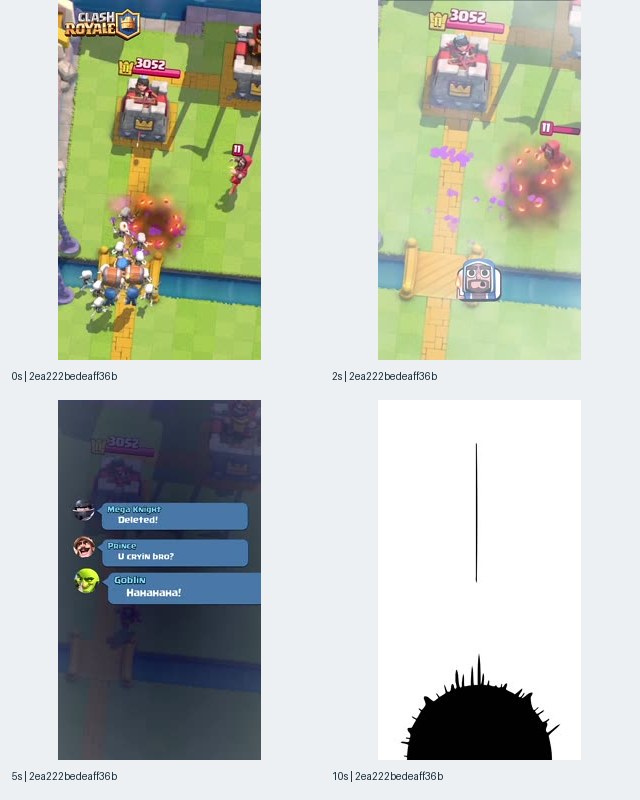
Image 5. AdMapix record 2ea222bedeaff36b, associated with Clash Royale iOS listing 1053012308. Frames at 0, 2, 5, and 10 seconds from the 2026-10-12 source package. The messages are visible advertising content, not verified player conversation or audience feedback.
The chat-style treatment changes the interpretation of the arena moment. It invites the viewer to read the battle through confidence, embarrassment, or rivalry. Those are plausible intended meanings of the creative treatment; the sample does not measure whether viewers experienced them or found them appealing.
That distinction matters when transferring the idea. A character's taunt is not a customer testimonial, a player review, or proof of an active community. If an original ad uses fictional messages, the production brief should describe their narrative role clearly. Otherwise, a team may unintentionally treat decorative dialogue as evidence about real user behavior.
The reference also creates a localization question. Slang carries tone as well as literal meaning. A phrase that seems playful to one audience may sound hostile or awkward to another. A localization brief should therefore describe the desired relationship between the characters and the emotional intensity, rather than requesting a word-for-word substitution.
A testable hypothesis would be that playful rivalry increases interest in the challenge among the intended audience. The comparison should hold the battle moment constant while varying the reaction treatment. A neutral version might identify the outcome without a taunt; a playful version might show a character response. Neither version should promise that viewers will outperform others.
The unresolved 10-second graphic is a useful reminder to stop where the visual evidence stops. It could be a transition or another creative beat, but the sheet does not show enough to classify it confidently. An annotation such as “high-contrast graphic; function unresolved” is more useful than inventing a dramatic ending.
Image 6: Route Cues and Reaction Graphics Create a Question
Image 6 combines a route cue, a question-mark reaction, a crowded character scene, and a later arena effect, giving the reference a question-and-response character without proving the complete narrative. At 0 seconds a dashed red path points toward a tower. At 2 seconds a group near the river appears beneath a colorful question-mark graphic. The 5-second frame shows a character-filled display scene, and the 10-second frame shows arrows and purple effects near the bridge.
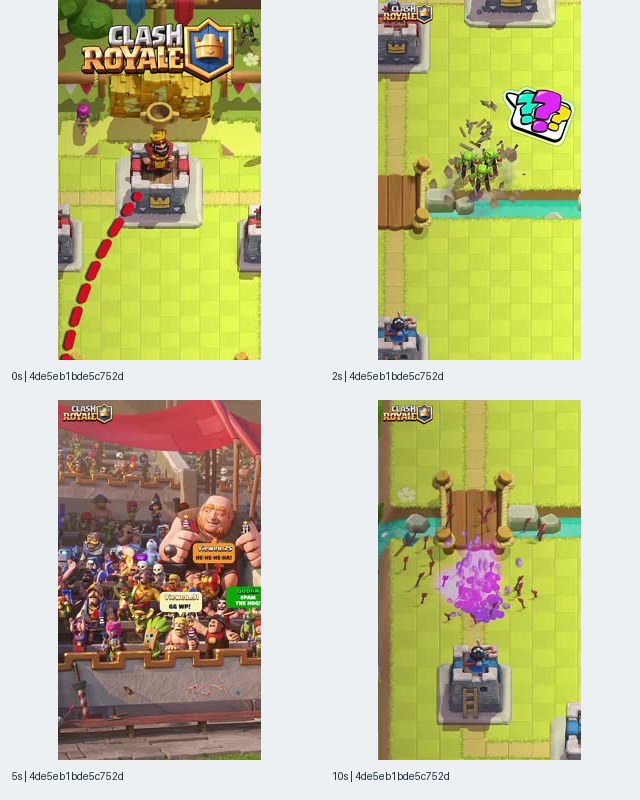
Image 6. AdMapix record 4de5eb1bde5c752d, linked to verified Clash Royale iOS listing 1053012308. Selected frames at 0, 2, 5, and 10 seconds; source package dated 2026-10-12. Similar imagery elsewhere in the article does not make the underlying video files identical.
The dashed path is a concrete attention cue. It points the eye toward a destination and can make an otherwise busy battlefield easier to interpret. Whether it represents an actual game interface, an advertising overlay, or another visual treatment is not independently established here, so the analysis treats it simply as a visible cue.
The question-mark graphic suggests uncertainty or surprise. A producer adapting the structure should identify the exact question the audience is meant to ask. “Where will the units go?” differs from “Which defense should I choose?” If the brief leaves that unresolved, arrows and reaction stickers can create movement without a comprehensible problem.
The character-filled display also appears visually related to the opening scene in image 1. The source assigns these references different video fingerprints. That combination supports a careful conclusion: distinct files can share recognizable imagery. It does not prove how the original scene was produced, whether it was reused from a common master, or whether the complete edits have the same purpose.
For an original production, shared scenes can be planned as reusable components. A team could create its own character reaction shot and use it in different contexts, while keeping a record of the premise each edit is meant to communicate. That is a proposed workflow inspired by the observation, not a reconstruction of the advertiser's internal process.
A useful comprehension test would remove the route graphic from one version while keeping the surrounding footage stable. The hypothesis is that the cue helps viewers identify the destination. If viewers understand the destination equally well without it, the graphic may be unnecessary, leaving more visual space for the actual choice or consequence.
Image 7: A Wanted Poster Supplies a Narrative Premise
Image 7 frames arena action through a wanted-poster story, providing a reference for introducing a goal before explaining the mechanics around it. The 0-second frame shows “Wanted!” and “Red King.” At 2 seconds, a character card reads “Bandit: The Outlaw.” The 5-second frame uses a monochrome treatment with “Hall of Shame,” while the 10-second frame returns to the arena with a clock icon near a unit.
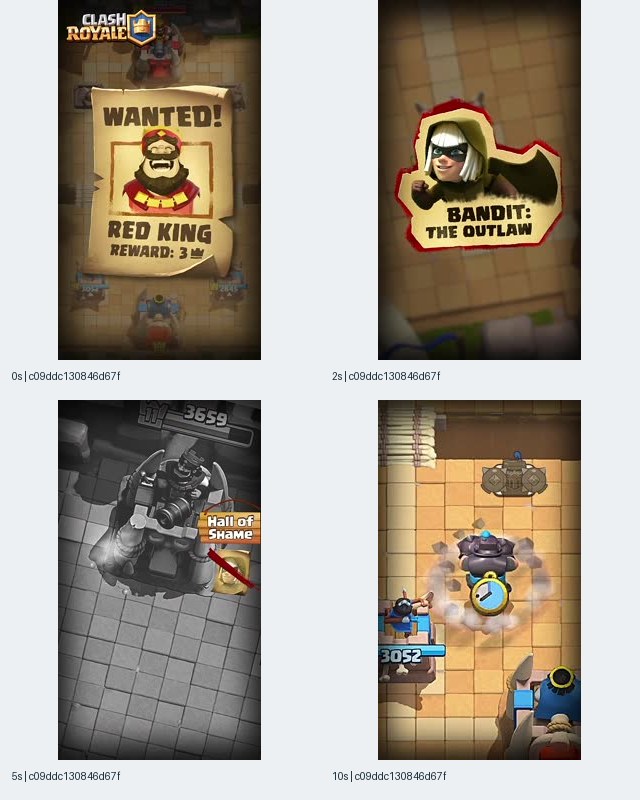
Image 7. AdMapix record c09ddc130846d67f, associated with Clash Royale iOS listing 1053012308. Frames labelled 0, 2, 5, and 10 seconds, in the source package dated 2026-10-12. Its window impression estimate is not a measure of narrative effectiveness.
The wanted poster establishes a target and a tone. It gives the viewer a simple premise that can be understood before identifying every unit on the battlefield. The outlaw label supplies a role for another character. Together, those elements offer a way to read the arena as a story, although the contact sheet does not establish how that story resolves.
A narrative frame can also introduce a mismatch. If a viewer expects a pursuit, capture, or bounty mechanic because of the opening, the subsequent footage needs to clarify what the actual interaction involves. The supplied images do not establish whether those mechanics exist, so the poster should be analyzed as advertising language rather than documentation of a game mode.
For a different game's creative brief, start with the mechanic the product can substantiate. Then choose a story device that helps explain it. A defensive encounter might be framed as guarding a gate; a pursuit mechanic might support a chase premise. The proposed framing should stay close enough to the experience that the viewer's expectation remains useful after installation.
The monochrome “Hall of Shame” frame is another distinct editorial device. It appears to mark an unfavorable or embarrassing moment, but its exact relationship to the surrounding action is not fully visible. A research annotation can record the treatment and wording without claiming a loss condition or a particular player mistake.
A proposed test could compare a narrative title card with a direct tactical prompt over the same gameplay. The hypothesis would concern how quickly viewers understand the objective and whether their expectations match the product. That test would be more informative than simply asking which version looks more entertaining.
Image 8: A Countdown States the Viewing Premise
Image 8 makes time part of the creative premise through “In 60 Seconds” and large countdown overlays. The 0-second frame shows a blurred arena. At 2 seconds the headline and a clock graphic appear. The 5-second frame displays 00:58 over gameplay, and the 10-second frame displays 00:48 with battle effects and reaction icons. These frames establish a countdown treatment without proving its complete timing or payoff.
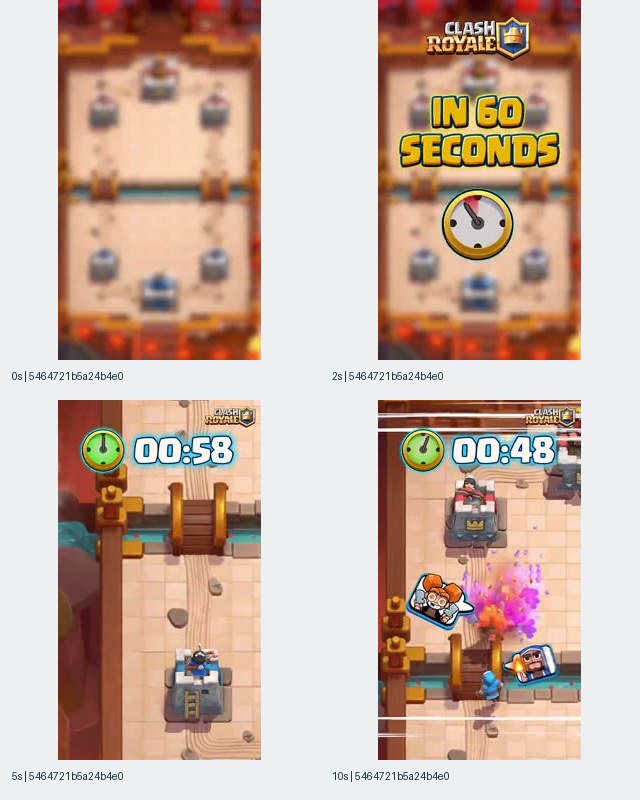
Image 8. AdMapix record 5464721b5a24b4e0, linked to Clash Royale iOS listing 1053012308. Selected frames at 0, 2, 5, and 10 seconds; source package dated 2026-10-12. The record lists a 55-second video, while “In 60 Seconds” is visible creative copy, not independently verified elapsed time.
A countdown can give a viewer an organizing question: what will happen before time runs out? The sample demonstrates that presentation device, but it does not tell us whether the viewer is watching a challenge, an explanation, a compressed sequence, or some combination of those forms across the complete video.
The distinction between the visible timer and the source duration matters. The listed video duration and the on-screen premise are different types of information. Neither should be silently substituted for the other. Likewise, the change between sampled timer values does not justify a claim about playback speed or editing throughout the full video.
For an original brief, define exactly what the timer measures. It could represent a real challenge interval, an edited summary, or a fictional narrative device. The accompanying copy and footage should make that meaning clear. An unexplained clock can create urgency while leaving the product promise vague.
A useful hypothesis is that a stated time-bound objective helps viewers understand what they are waiting to see. Compare the timer treatment with a version that states the same objective without a clock. Keep the gameplay and eventual payoff consistent, so the test concerns the temporal frame rather than a different underlying story.
The payoff also needs an explicit production requirement. If the opening asks the viewer to anticipate an outcome, the ending should make that outcome visible or clearly explain the next action. This is a recommendation for a future creative, not a claim that the supplied video does or does not fulfill its premise. The contact sheet stops too early to decide that.
The Shared Creative Pattern Is a Legible Question
Across the illustrated references, the useful common pattern is a question that can organize the viewer's attention: which character prevails, what threatens the tower, how the resource is used, or what happens before the countdown ends. This is an editorial interpretation of the eight examples, not a measured frequency across all 57 video files. The practical value is a way to describe the communication job of each proposed creative.
A gameplay ad can contain considerable motion while leaving the central question unclear. The references offer several alternatives to relying on motion alone. Names identify participants. A tower gives an objective. A resource bar gives a constraint. A poster supplies a premise. A timer gives a temporal boundary. Each device can be evaluated by whether it helps a viewer understand the intended situation.
The following framework turns those observations into production questions without assigning unsupported effectiveness scores.
| Creative element | What to identify in a reference | What an original brief should specify |
|---|---|---|
| Subject | Character, tower, unit group, or resource | The object the viewer should notice first |
| Question | Confrontation, threat, choice, or timed objective | The exact uncertainty the scene creates |
| Available action | Visible or unresolved | The action the product actually supports |
| Consequence | Visible in selected frames or missing | The result that must be shown clearly |
| Emotional treatment | Reaction, taunt, spectacle, or story | The intended tone and its role |
| Next step | Observed or outside the contact sheet | A call to action consistent with the promise |
A practical review can begin by hiding the creative's title and asking a colleague to describe what is happening. If their description differs from the brief, the team has found a clarity problem before attributing any later campaign result to the hook.
This framework also prevents overgeneralization. Character spectacle is not automatically unsuitable for unfamiliar users, and direct gameplay is not automatically self-explanatory. The relevant question is whether the finished creative communicates its intended premise to the intended audience under the conditions in which it will be shown.
Video Reuse Is Observable; the Experiment Behind It Is Not
The records demonstrate that the same video file can appear with different playable associations, but they do not demonstrate a controlled experiment or reveal its outcome. Image 1's video provides a concrete example. Several identified records use the same video fingerprint while linking to different playable fingerprints, and another record uses that video without a listed playable association. The observable finding is reuse at the asset level.
| Record reference | Video relationship | Playable relationship |
|---|---|---|
| 1e508ae02c89ee2b | Same video as image 1 | Playable association A |
| 3ef77473cb9c34d5 | Same video as image 1 | Different playable association B |
| 4701b5d4a4870236 | Same video as image 1 | Different playable association C |
| f40ce31a0053c748 | Same video as image 1 | No playable association listed |
The letters are explanatory labels for distinct assets in these records. They do not describe the playable layouts, mechanics, or screen order, because those interactions were not inspected in this study.
This distinction changes how a team should read the impression estimates. A difference between records could reflect many conditions outside the video itself. Without comparable delivery conditions and outcome measurements, it cannot identify the better playable or the better combination. Even the absence of a listed association should be described as a metadata observation rather than proof of every viewer's experience.
The records also show the reverse relationship: different video files can share a playable association. For example, the records behind images 1, 2, and 3 link to the same playable fingerprint. That makes the research question more specific. A team examining such combinations should consider whether different video premises lead to the same interaction, and whether that interaction would preserve the expectation created by each opening.
For an original production system, keep the video and interactive asset as separate tracked deliverables. Record which versions are paired, what each promises, and what behavior is expected at the handoff. When a combination changes, preserve the earlier mapping so that later results can be attributed to the correct version.
The playable-versus-video testing guide develops the format comparison. Here, the specific lesson is narrower: the index supports a combination map, while a claim about the best combination requires direct testing.
Build an Original Brief Around One Supported Mechanic
An actionable brief starts with a mechanic the team's own product can demonstrate, then uses the references to choose how to explain that mechanic. The following worked example is a hypothetical production exercise for a different arena game. It is not a reconstructed Clash Royale campaign, a customer case study, or a completed experiment. Its purpose is to show how a visual observation becomes a concrete deliverable.
Assume the team's game allows a player to defend a gate by choosing when to deploy a shield unit. The product team has confirmed that the mechanic and the proposed encounter exist in the current build. The research question is whether new viewers understand the relationship between waiting, deployment, and protecting the gate.
| Brief field | Proposed content |
|---|---|
| Product truth | A shield unit can be deployed to intercept an approaching attacker |
| Communication problem | Viewers see combat but do not understand the timing choice |
| Relevant references | Image 3 for a threatened objective; image 4 for a visible constraint |
| Hypothesis | Making the threat and deployment constraint explicit improves comprehension |
| Opening | Show the gate, approaching attacker, and available shield action together |
| Demonstration | Show the player waiting, then deploying the shield at the intended moment |
| Visible consequence | Show the shield intercepting the attacker while the gate remains visible |
| Tone | Tense but readable; reaction art is optional and tested separately |
| Call to action | Invite the viewer to try the timing challenge in the actual game |
| Unknowns | Attention, acquisition quality, and commercial outcome |
The shot requirements should be precise enough to prevent a cinematic sequence from replacing the promised demonstration. The gate must remain identifiable. The attacker must be distinguishable from the player's unit. The deployment cue must appear before the action it explains. The consequence must be visible long enough to interpret, with final timing decided during production review.
Create one baseline edit before adding variants. The baseline establishes whether the encounter can be understood using the game's own footage and necessary labels. A resource-emphasis variation can enlarge the deployment constraint. A character-emphasis variation can introduce the shield unit more prominently. Those variations answer different questions and should not be merged into one undefined “improved” version.
A claim register belongs beside the storyboard. For every line of copy, record the product evidence that supports it. “Choose when to deploy” requires a real timing choice. “Protect the gate” requires footage showing that objective. Claims about rewards, availability, or progression need their own current support; a dramatic reference image supplies none of those facts.
The handoff should include the source build, approved footage, text layers, character assets, localization notes, and the intended comparison. It should also identify what must remain constant between versions. That makes the finished files useful for testing rather than merely different-looking exports.
Acceptance is a communication check before it is an aesthetic judgment. Ask whether a viewer can identify the threat, the available action, and the consequence without an explanation from the producer. If not, revise the scene or the brief. A polished effect does not resolve an unanswered mechanical question.
Test Attention, Comprehension, and Acquisition Separately
A creative test should measure the job the variation was designed to do, while retaining the downstream business outcome as a separate decision criterion. Attention, comprehension, installation, activation, and retention are related but different observations. The frozen sample contains none of those outcome measurements, so the testing guidance here describes a future process for a team's own campaigns rather than reporting results for Clash Royale.
Start with a hypothesis that can fail. “Make the ad more exciting” is too vague to diagnose. “An enlarged resource display helps unfamiliar viewers explain why the player waits before deployment” specifies both a treatment and an expected observation. The result could support the hypothesis, contradict it, or remain inconclusive.
A comprehension review can precede paid delivery. Show the candidate under realistic viewing conditions and ask open questions about the subject, choice, and consequence. Avoid explaining the mechanic first. Record misunderstandings in the viewer's own words, because those misunderstandings often reveal missing context that the production team no longer notices.
For paid testing, keep the campaign conditions as comparable as the available tools allow. Record the audience definition, market, placement, optimization objective, attribution settings, store destination, and campaign dates. If those conditions differ, report the difference as a limitation. A creative comparison should not quietly become an audience or landing-page comparison.
| Question | Useful owned measurement | What it does not establish alone |
|---|---|---|
| Did the opening attract attention? | Comparable early-view or viewing-duration measures | That the mechanic was understood |
| Did viewers understand the decision? | Structured comprehension responses | That they will install |
| Did the ad prompt action? | Click or store-visit behavior with clear denominators | That the acquired users are valuable |
| Did users experience the promised mechanic? | A defined activation event | Long-term retention or profit |
| Did the result justify production and media cost? | Mature outcome data and actual costs | Future performance under changed conditions |
Do not set a universal winner threshold from these competitor references. The appropriate minimum detectable effect, observation period, and decision rule depend on the team's traffic, baseline behavior, measurement quality, and economics. Define those conditions before inspecting the result, and preserve an inconclusive category rather than forcing every test into a win or loss.
A variation can succeed at its immediate communication job and still be unsuitable for scaling. For example, clearer resource explanation might improve comprehension while reducing early attention. That is a tradeoff to measure, not a contradiction to hide. The creative testing framework offers a broader structure for documenting such decisions.
A Practical Research Workflow From Search to Test Backlog
A useful research workflow preserves the chain from store identity to record, media, observation, hypothesis, and proposed test. That chain lets a producer revisit the actual reference and lets a buyer distinguish public evidence from private campaign results. The workflow below can be followed with the frozen package or adapted to a new live search, provided that a new search receives its own dates and scope.
- Write the decision before searching. Choose a communication problem, such as explaining a resource constraint or introducing a tactical choice. A broad instruction to find “good ads” produces a collection that is difficult to evaluate.
- Confirm the product reference. Record the store ID and seller from a verified listing. Keep product identity separate from the name used in a query and from any presumed advertiser identity.
- Set the observation scope. Specify country, exact start and end dates, sorting, and retrieval limits. Save the scope with the results so that it survives when screenshots are copied into a presentation.
- Deduplicate records and files separately. Preserve unique record identifiers, then flatten and compare media fingerprint associations. Keep videos and playables as separate asset categories.
- Select examples for analytical variety. Choose references that answer different production questions. Do not imply that the selected examples represent the frequency of each approach in the full sample.
- Annotate only what was observed. Attach timestamps to visible wording, scene composition, and interface treatment. Mark unseen audio, transitions, interactions, and endings as unknown.
- Write a hypothesis beside each interpretation. Convert “the timer creates urgency” into “hypothesis: a stated time-bound objective increases anticipation for this audience.” Define how the team would evaluate it.
- Produce a brief and assign the next evidence task. Some ideas need a storyboard; others need product verification, playable inspection, or a controlled campaign test. Make the next action explicit.
The output should be small enough to act on. A research card needs the reference identity, the observed feature, the proposed adaptation, the reason it could matter, and the measurement plan. Additional screenshots are useful only when they resolve an uncertainty or illustrate a different mechanism.
For this article, a completed card could read: “Image 4 foregrounds resource bars at the sampled gameplay timestamps. Hypothesis: enlarging our deployment resource display improves comprehension of the waiting decision. Proposed change: resource display scale. Hold the encounter and copy constant. First evidence needed: open-response comprehension review.”
A second card could use image 7 to investigate narrative framing. Its next task would include verifying that the proposed story does not imply a mechanic the team's product lacks. That is a different production problem, so it deserves a separate brief and separate decision record.
Keep a Clear Boundary Between Observation and Interpretation
A research note becomes more useful when the reader can tell immediately whether a sentence describes a visible fact, an indexed association, or a hypothesis. The eight examples contain enough detail to support specific observations, but they also leave substantial gaps. Writing those gaps explicitly prevents a later presentation from turning a tentative interpretation into a confident claim about the advertiser's strategy.
Consider the difference between “the sheet shows a countdown” and “the countdown improves retention.” The first is supported by image 8. The second needs viewer or campaign evidence that is absent here. Similarly, “the same video appears with different playable associations” is supported by identified records, while “the advertiser found its best end card” requires knowledge of an experiment and its outcomes.
A practical annotation vocabulary can stay simple. Use observed for visible frame content, recorded for source metadata and associations, hypothesis for a proposed explanation, and unknown for missing evidence. These labels are especially helpful when multiple people contribute to a shared research sheet.
| Statement | Status in this article | Evidence required to go further |
|---|---|---|
| Image 1 labels Prince and Dark Prince | Observed | No additional evidence needed for the wording |
| Image 1's video appears in other records | Recorded | Matching media fingerprints establish reuse |
| The named matchup helps unfamiliar viewers | Hypothesis | A suitable comprehension or campaign test |
| Image 4's enlarged bars improve acquisition | Unknown | Controlled delivery and outcome measurements |
| Image 7 depicts the advertiser's best narrative | Unsupported | Comparable results and a defined comparison set |
This approach also improves handoff quality. A producer can act on a clear observation without inheriting an unsupported performance promise. A media buyer can see which uncertainty the proposed test is designed to resolve. An editor can preserve the original meaning when summarizing the research for a different audience.
The same boundary applies to omissions. A missing ending in a contact sheet is not evidence that the video lacks a call to action. A missing network label is not evidence that the ad ran nowhere. Unknown information should remain unknown until a suitable source resolves it.
Common Mistakes When Reading Clash Royale Ad Examples
The most consequential mistakes arise when a visible creative detail is promoted into an unsupported operational or performance conclusion. This sample is rich enough for production analysis, but it does not reveal the advertiser's complete campaign system. The corrections below keep the research useful while preventing the numbers, screenshots, and metadata from being asked to answer questions they cannot resolve.
Treating records as new creative production. The sample's 72 records and 57 video fingerprints describe different units. Repeated video appearances can reflect different associations, and different files can still share an idea. Keep production-volume claims separate from both counts.
Calling an impression estimate a result. The figure beside a record is a third-party model estimate for the stated window. It does not establish acquisition, revenue, profitability, or even unique people reached. Preserve the qualifier wherever the number appears in a report.
Assuming a named game proves the buyer. The verified store ID supports product association. It does not identify who purchased the advertising. A report can use the game name to describe the linked product without claiming to have verified the payer.
Guessing the network from the format. Vertical framing, game footage, and reaction stickers appear in many contexts. The source package does not provide a verified network mapping for these examples, so network-specific conclusions would be invented.
Reading a contact sheet as continuous playback. Selected frames omit movement, sound, and intervening events. Describe the frames at their timestamps. Do not invent a voiceover, a seamless transition, or an ending that was not supplied.
Treating a playable association as an interaction test. A linked asset can be recorded without its behavior being examined. Loading, controls, failure states, completion, and store handoff require their own inspection and evidence.
Inferring fatigue or success from age. First and last observations concern the index. They do not establish continuous delivery, creative fatigue, or successful performance. Dividing window impressions by the time since first observation does not repair that gap.
Copying the surface instead of the question. A purple effect, wanted poster, or taunt is only one execution. The transferable research output is the question it appears to organize and the product truth needed to support an original version.
When AdMapix Fits This Workflow
AdMapix fits the discovery and evidence-organization stage of this work, where a team needs indexed creative references that can be connected to product identity, dated records, and media associations. This article demonstrates that role through a frozen sample and reproducible source package. It does not establish that an intelligence product can replace owned campaign analytics, product validation, or a controlled test.
A practical handoff begins with a research question. Search the relevant game, verify the linked listing, record the observation scope, and choose references that clarify the proposed production decision. Use the examples to prepare a brief with explicit unknowns. Then move the hypothesis into the team's own production and measurement process.
AdMapix is less suitable as the sole basis for a decision that requires private information, such as exact competitor spend, bids, targeting, conversion, or profit. The sample also cannot support an hourly freshness guarantee or a promise of complete coverage. The current product facts do not establish those claims.
For the next decision, inspect Clash Royale references in AdMapix, select a mechanic your own product can demonstrate, and turn the observation into a matched test brief. Consult the live pricing page for current access and commercial terms; this evergreen article does not fix plan prices or quotas, and it does not promise a paid-plan trial.
The AdMapix methodology provides the product-level explanation of data scope and limitations. Read it alongside the frozen source package when deciding which fields belong in a research report and which questions need another source.
FAQ
These answers distinguish the creative findings supported by the dated sample from questions that require campaign, product, or playback evidence. They are intended for teams deciding how to use the references in research and production, rather than for estimating the advertiser's private results.
What does this sample reveal about Clash Royale ad strategy?
It reveals visible ways of presenting arena action, including named character matchups, tower threats, resource displays, taunts, narrative framing, and countdowns. It also documents video reuse across different playable associations. Those findings support creative research and test planning. They do not establish a complete advertising strategy, the intended targeting, or the performance of any individual approach.
Are the 72 records all different Clash Royale videos?
No. The frozen sample contains 72 advertising records, of which 66 contain video associations, resolving to 57 distinct video fingerprints. It also contains 22 records with playable associations and 12 distinct playable fingerprints. These categories overlap. A record is an indexed advertising instance; a video fingerprint identifies an underlying file, and neither count directly measures distinct creative concepts.
Were these ads verified as belonging to Supercell's advertising account?
The records are associated with the verified Clash Royale iOS listing, ID 1053012308, whose verified seller is Supercell Oy. That establishes the product reference used for inclusion. It does not identify the advertising account, buyer, or payer. The article therefore describes product-linked advertising records without claiming independent verification of who purchased the placements.
Do the impression estimates identify the best creative?
No. They are third-party model estimates for the US measurement window of 2026-09-12 to 2026-10-11. The sample contains no conversion, spend, retention, or profitability results. Differences between estimates cannot isolate the effect of a hook, video, or playable. A creative should be evaluated against a defined objective using comparable conditions and the team's own outcome measurements.
Can the eight contact sheets explain the complete videos?
They can explain selected visible moments, but not the complete playback. Each sheet contains frames labelled 0, 2, 5, and 10 seconds. Audio, movement between those points, later scenes, and complete endings were not observed. Listed video durations come from source metadata. The article uses those distinctions to avoid inventing transitions, voiceovers, or outcomes.
Does a playable association prove that the ad was interactive?
It proves that the indexed record links to a playable asset, within the limits of that metadata. It does not establish successful loading, the interaction a viewer received, or the quality of the handoff from video to playable. Those questions require a separate inspection with recorded conditions and observations. No playable interaction test was supplied for this article.
What should a small creative team do with these examples first?
Choose one mechanic your product can demonstrate and one communication problem the references help clarify. Write a brief that separates observed features from a proposed hypothesis. Produce a baseline and a focused variation, check comprehension, and then test under comparable campaign conditions. The goal is a decision the team can evaluate, rather than a larger folder of attractive screenshots.
How much does AdMapix cost, and is there a paid trial?
Use the live pricing page linked above for current commercial terms, because prices and access conditions can change after an article is published. This guide does not enumerate plan prices or credit allowances. The supplied current product facts state that no paid-plan trial is offered, so the workflow should not be interpreted as a promise of one.
Key Takeaways
The most useful outcome of this Clash Royale study is a set of specific creative questions supported by identifiable records and visible frames.
- Keep the scope attached: US, verified iOS listing 1053012308, and 2026-09-12 to 2026-10-11.
- Separate advertising records, video files, playable files, and editorial concepts.
- Use the eight examples to investigate clarity, character recognition, constraints, rivalry, narrative, and anticipation.
- Treat asset reuse as an observable relationship; explanations about testing or performance remain hypotheses.
- Carry each reference into an original brief, then use owned measurements to decide what to retain, revise, or stop.
Sources
The dated source package supports the sample counts, record associations, metadata, and image references; the linked product resources explain the research workflow and its boundaries. No external tool test, full-video playback review, or private campaign-performance dataset was supplied for this article.
- AdMapix frozen source package, collected 2026-10-12: Public sample, retrieval batches, request parameters, and checksums. Scope: US, 2026-09-12 to 2026-10-11, verified iOS product 1053012308, bounded retrieval, 72 advertising records, and the eight illustrated references.
- Verified store identity in the 2026-10-12 source package: Clash Royale on the US App Store. Supports the reference listing and seller identity; it does not verify the advertising buyer or campaign results.
- AdMapix research workflow, referenced 2026-10-12: Clash Royale creative search. A live discovery route; its current results may differ from the frozen sample and require identity checks.
- AdMapix methodology, referenced 2026-10-12: Data methodology and limitations. Product facts supplied for this article were reviewed on 2026-08-13; the creative observations use the separately dated October sample.
- AdMapix commercial terms: Live pricing. Consult the current page when choosing access; no fixed plan prices, quotas, or paid-trial promise are made here.
Turn these observations into your next creative study
Open the creative library and select samples for your market, network and research question.
Related Articles
Black Friday Ads: Build a Competitor Offer Tracker Before Launch
Build a competitor offer tracker from a dated US Black Friday search sample, using eight visual examples to preserve offer conditions, resolve conflicting claims, track versions, and prepare original tests.
Instagram Carousel Ads: Examples for Product Storytelling
Use eight separately captured creative references, clearly labelled hypothetical sequences, production worksheets, accessibility and proof checks, and measurement guidance to plan original Instagram carousel ads.
Kingshot Ad Strategy: Hooks, Video Reuse, and Playable Links
A verified US iOS sample connects 30 Kingshot advertising records to 19 video files and 12 playable files, with eight timestamped visual analyses and practical briefs that separate creative observations from unmeasured performance.