
B2B Ad Creative Examples in 2026: Formats, Offers & Proof for LinkedIn and Google
A 2026 teardown library of B2B ad creative examples — how to read each one by buyer role, format, offer, and proof, with role-by-role breakdowns for CFOs, IT/security, RevOps and demand gen, an offer ladder mapped to funnel stage, a proof-type taxonomy, LinkedIn vs Google format comparisons, a worked competitor teardown, and a workflow that turns a folder of screenshots into a brief or test backlog.
B2B Ad Creative Examples in 2026: Formats, Offers & Proof for LinkedIn and Google
By the AdMapix Research Team — Updated June 21, 2026
The most useful way to study B2B ad creative examples is to read each one by buyer role, ad format, offer type, and proof, instead of admiring the design. A B2B ad rarely closes a deal on its own; its job is to move a specific role one step closer to a demo, a report download, or a sales conversation. In 2026, with B2B buying committees larger and buying cycles longer than ever, the creative that wins is the one that earns a small, reversible commitment from a busy professional who isn't yet ready to talk to sales. This guide breaks down what a strong B2B creative actually contains, gives you a framework to dissect any LinkedIn or Google example, deep-dives the role, offer, and proof dimensions that decide B2B performance, and shows how to turn a folder of screenshots into a creative brief or test backlog. It's written for B2B and SaaS marketers, demand gen leaders, product marketers, agencies, and founders running paid LinkedIn and Search.
We've torn down thousands of B2B creatives across SaaS, fintech, cybersecurity, and professional services, and the same pattern recurs: teams that "collect competitor ads" without a framework end up with a screenshot folder that informs nothing, while teams that read every example on the same dimensions ship sharper briefs and ladder their offers correctly. The edge is never access — anyone can open the LinkedIn Ad Library or Google's Transparency Center. The edge is a reading framework that turns a creative into a decision. This article gives you that framework, then applies it role by role, offer by offer, and proof point by proof point.
TL;DR — B2B Ad Creative Examples in One Screen
- Read every B2B example by four dimensions: who it targets (role), what format it uses, what it offers, and what proof it shows. Design is the last thing to judge, not the first.
- The offer is usually the most important lever. A demo, a benchmark report, a webinar, and a template ask for wildly different levels of commitment — the best ads ladder the offer to how warm the audience is.
- Role is the dimension most teams skip. A great B2B creative signals the exact role in the first line or image; "for businesses" copy is a weak signal you should note as a flaw, not a model.
- Proof is what overcomes B2B skepticism. Logos, a named metric, an analyst quote, a case study, or a compliance certification do the convincing that consumer impulse never has to.
- Format decides how much you can claim and ask. LinkedIn document ads, lead gen forms, video, carousels, and Google Search each fit a different funnel job.
- Public data shows the creative, never the pipeline. You can read the role, format, offer, and landing path; you cannot read spend, cost per lead, or ROAS. Every observation is a hypothesis until your own pipeline confirms it.
- The output is a decision artifact — a brief, a message map, or a test backlog — not a screenshot gallery.
What a Strong B2B Ad Creative Actually Contains
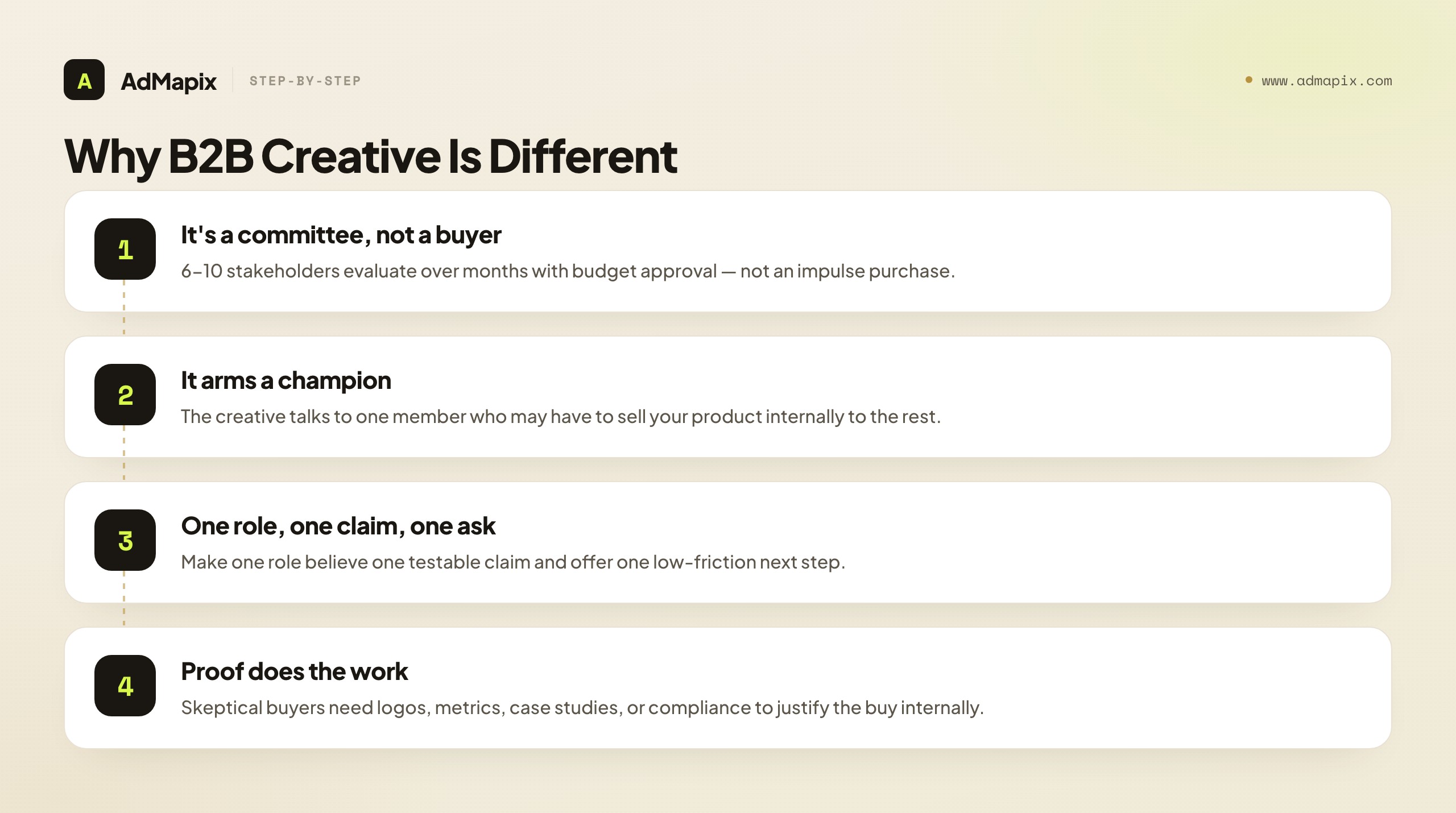
A good B2B ad makes one role believe one claim and offers one low-friction next step. Consumer ads can win on impulse and emotion; B2B buyers usually evaluate in a committee, on a longer timeline, with budget approval involved. That changes what the creative has to do. Instead of triggering a purchase, it has to earn a small, reversible commitment from a busy professional — often before they're even ready to talk to sales.
So when you look at any example, check whether it answers four questions clearly:
- Who is this for? A great B2B creative signals the role in the first line or image — a RevOps leader, a security buyer, a CFO, a head of demand gen. Vague "for businesses" copy is a weak signal that the advertiser doesn't know their buyer or is targeting too broadly.
- What does it claim? One concrete claim beats three vague benefits. "Cut close time by half" is testable; "transform your workflow" is noise the buyer has read a thousand times.
- What proof backs it? B2B buyers are skeptical by default, because they have to defend the purchase internally. Logos, a named metric, an analyst quote, a case study, or a security certification do the convincing.
- What is the ask? The offer sets the friction. A demo is high-commitment; a benchmark report or template is low-commitment. The best ads match the offer to how warm the audience is.
The reason these four questions matter more in B2B than anywhere else is the committee. The average enterprise software purchase now involves six to ten stakeholders and a research process that begins long before anyone fills out a form. Your ad isn't talking to a buyer; it's talking to one member of a committee who may later have to sell your product internally to the others. That reframes the creative's job entirely: it's not just earning a click, it's arming a champion with a claim and a proof point they can repeat in a meeting you'll never attend.
A Framework for Reading Any B2B Ad Example
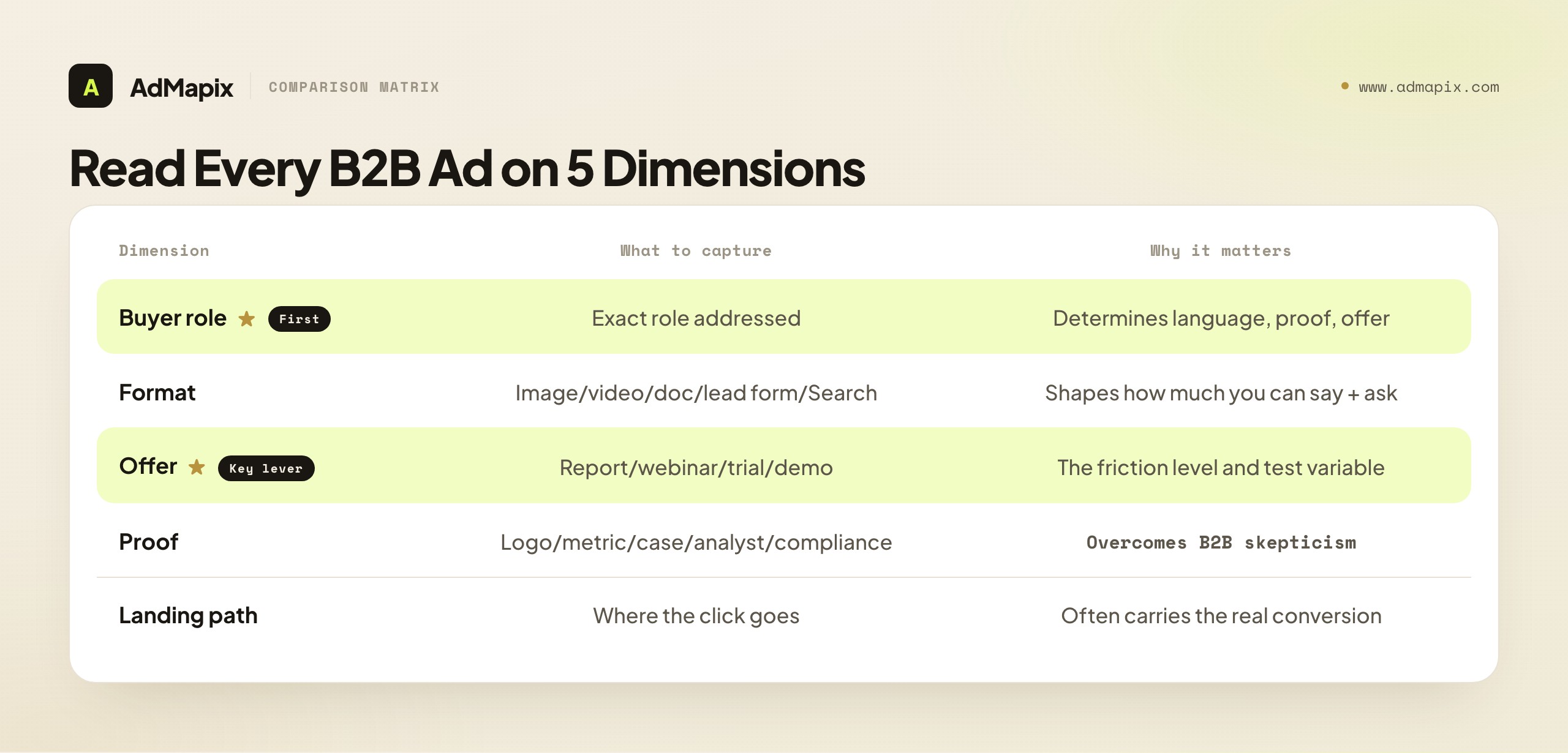
Use one repeatable grid so every example you save is comparable instead of a loose screenshot. The grid below is the core of a usable swipe file: fill it in for each ad and patterns across competitors become obvious.
| Dimension | What to capture | Why it matters |
|---|---|---|
| Buyer role | The specific role the ad speaks to (CFO, IT, RevOps, demand gen) | Role determines language, proof, and offer |
| Format | Single image, video, carousel, document ad, lead gen form, Search, YouTube | Format shapes how much the ad can say and ask |
| Offer | Demo, report, benchmark, webinar, template, consultation, free trial | The offer is the friction level and the test variable |
| Proof | Logo, named metric, case study, analyst quote, security/compliance proof | Proof is what overcomes B2B skepticism |
| Landing path | Where the click goes and whether it keeps the promise | The page often carries the real conversion work |
The discipline is to fill in all five for every ad. If you can't identify the role or the offer, that itself is a finding — the ad is probably underperforming for a reason you can avoid. The grid's real power shows up across a tagged set: thirty competitor ads scored this way reveal which roles the category over-targets, which offers everyone clusters on, and which proof types are table stakes versus differentiators in your space. A single ad is an anecdote; a scored grid of thirty is a market map.
Reading B2B Creative by Buyer Role
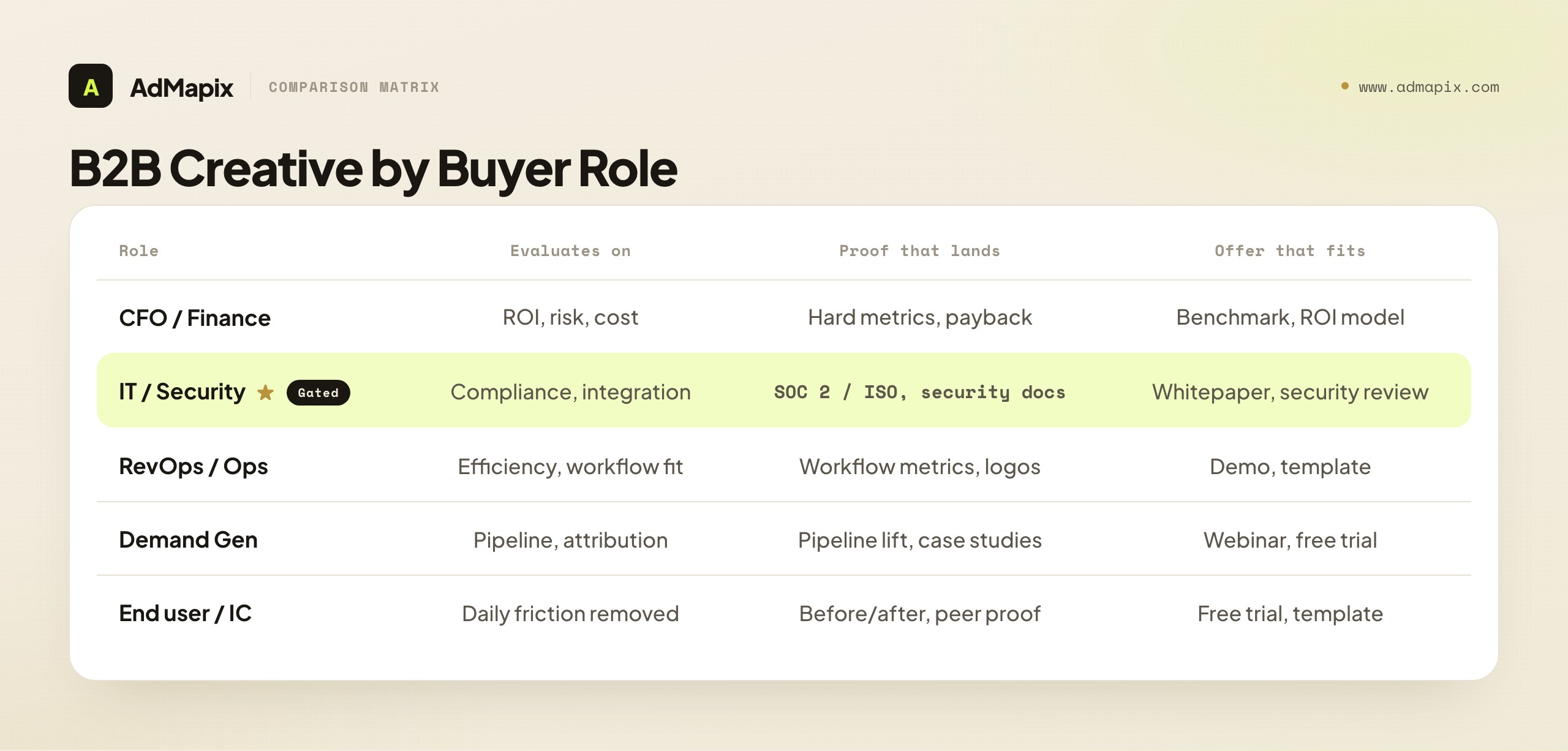
Role is the dimension that most changes the creative, and it's the one teams skip most often, so it deserves a dedicated breakdown. The same product advertised to a CFO, an IT security buyer, a RevOps leader, and a head of demand gen should look like four different ads — different language, different proof, different offer — because each role evaluates on a different axis and answers to a different internal pressure.
| Role | Evaluates on | Proof that lands | Offer that fits | Language register |
|---|---|---|---|---|
| CFO / Finance | ROI, risk, cost certainty | Hard metrics, payback period, references | Benchmark report, ROI model | Outcome and number-led |
| IT / Security | Risk, compliance, integration | SOC 2 / ISO, security docs, architecture | Technical whitepaper, security review | Precise, compliance-dense |
| RevOps / Operations | Efficiency, workflow fit | Workflow metrics, integration logos | Demo, template, workflow teardown | Process and tool-specific |
| Demand Gen / Marketing | Pipeline, attribution, speed | Pipeline lift, case studies, benchmarks | Webinar, benchmark, free trial | Growth and metric-led |
| End user / IC | Daily friction removed | Before/after, peer testimonial | Free trial, template | Practitioner, first-person |
The strategic read: when you tear down a competitor's ad, the first thing to identify is which role it's aimed at, because everything else (proof, offer, language) is downstream of that choice. A common, costly competitor mistake is a role mismatch — running CFO-style ROI language at an IT security audience that actually cares about compliance and integration, or asking an end-user IC to "book a demo" when they have no budget authority. When you spot that mismatch in a competitor's creative, you've found a gap: you can win the same buyer by speaking to what their role actually evaluates on. The ads that quietly outperform are usually the ones whose role-to-proof-to-offer chain is internally consistent.
The Offer Ladder: Matching the Ask to Audience Warmth
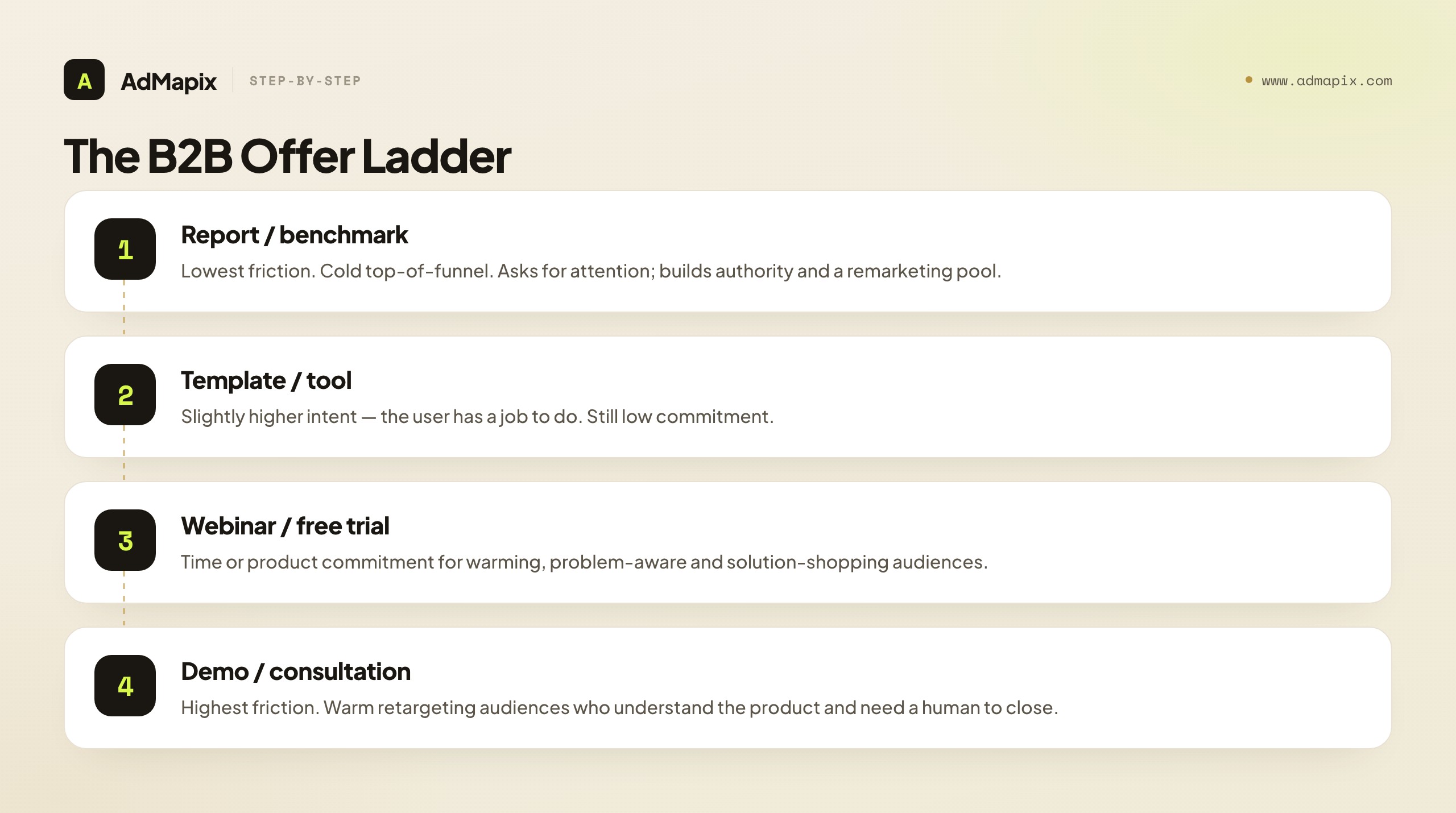
The offer is the single most important variable in B2B creative, because it sets the friction — and the most common B2B mistake is asking a cold audience for a high-commitment next step. Thinking of B2B offers as a ladder, rungs from lowest to highest commitment, turns "what should we offer?" into a funnel decision rather than a guess.
The offer ladder, from lowest to highest friction:
- Content / benchmark report (lowest friction). A genuinely useful asset — a benchmark, a guide, an industry report — that asks only for attention or an email. Ideal for cold, top-of-funnel audiences who don't know you yet. Builds authority and a remarketing pool.
- Template / tool. A practical, immediately usable resource (a calculator, a Notion template, a checklist). Slightly higher intent than a report because the user has a job to do, still low commitment.
- Webinar / event. A time commitment but not a sales commitment. Good for warming a problem-aware audience and demonstrating expertise at depth.
- Free trial / freemium. A real product commitment for product-led motions. Fits warm, solution-shopping audiences ready to evaluate hands-on.
- Demo / consultation (highest friction). A direct sales conversation. Belongs to warm, high-intent, retargeting audiences who already understand the product and need a human to close the gap.
The principle that organizes the ladder: match the rung to audience warmth. A cold prospect who's never heard of you will take a benchmark report but won't book a demo; a warm retargeting audience that's seen your product three times doesn't need another report — they need the demo. When you tear down a competitor's ad, log where on the ladder their offer sits and whether the audience it's aimed at is cold or warm. A heavy ask (book a demo) paired with an obviously cold top-of-funnel format is a hypothesis to test, not a proven play — and often a competitor's mistake you can avoid by laddering your own offers correctly. The strongest B2B advertisers run multiple rungs simultaneously, reports to cold audiences and demos to retargeting, which is itself a readable signal of a mature funnel when you spot it.
Proof Types: What Actually Overcomes B2B Skepticism
B2B buyers are skeptical by default because they have to justify the purchase to other people, so proof is what does the real persuasive work in a B2B creative. Not all proof is equal, and different roles trust different proof types, so cataloging them lets you read whether a competitor's proof actually fits the role they're targeting.
The proof taxonomy, roughly from soft to hard:
- Customer logos. The fastest credibility signal — "companies like you trust us." The composition of the logo wall encodes the ICP: a wall of enterprise logos signals up-market targeting; a "join 4,000+ teams" counter signals SMB volume. Soft proof, but instant.
- Named metrics. A concrete, attributed result ("cut onboarding time 60%"). Much stronger than a logo because it's specific and outcome-led — especially persuasive to CFOs and demand gen leaders who think in numbers.
- Case studies. A named customer, a situation, a result. The strongest narrative proof, because it lets the buyer see themselves in the story. Works across roles but carries extra weight when the named customer resembles the target.
- Analyst and third-party validation. A Gartner, Forrester, or G2 reference. Borrowed credibility that matters most in enterprise and IT/security evaluations where third-party rigor is expected.
- Security and compliance proof. SOC 2, ISO 27001, HIPAA, GDPR, FedRAMP. Not persuasion so much as a gate — for IT and security buyers, the absence of this proof ends the evaluation regardless of how good everything else is.
The strategic read: when you tear down a competitor's ad, check whether the proof type matches the role. A CFO-targeted ad leaning on a single G2 badge is under-proven (the CFO wants a payback number); an IT-security ad with no compliance proof is missing the one thing that role requires; a demand-gen ad with a hard pipeline-lift metric is well-matched. Proof-role mismatches are among the most common and most exploitable competitor weaknesses, because fixing them in your own creative is straightforward once you've named the gap.
B2B Ad Formats and What Each One Is Good At
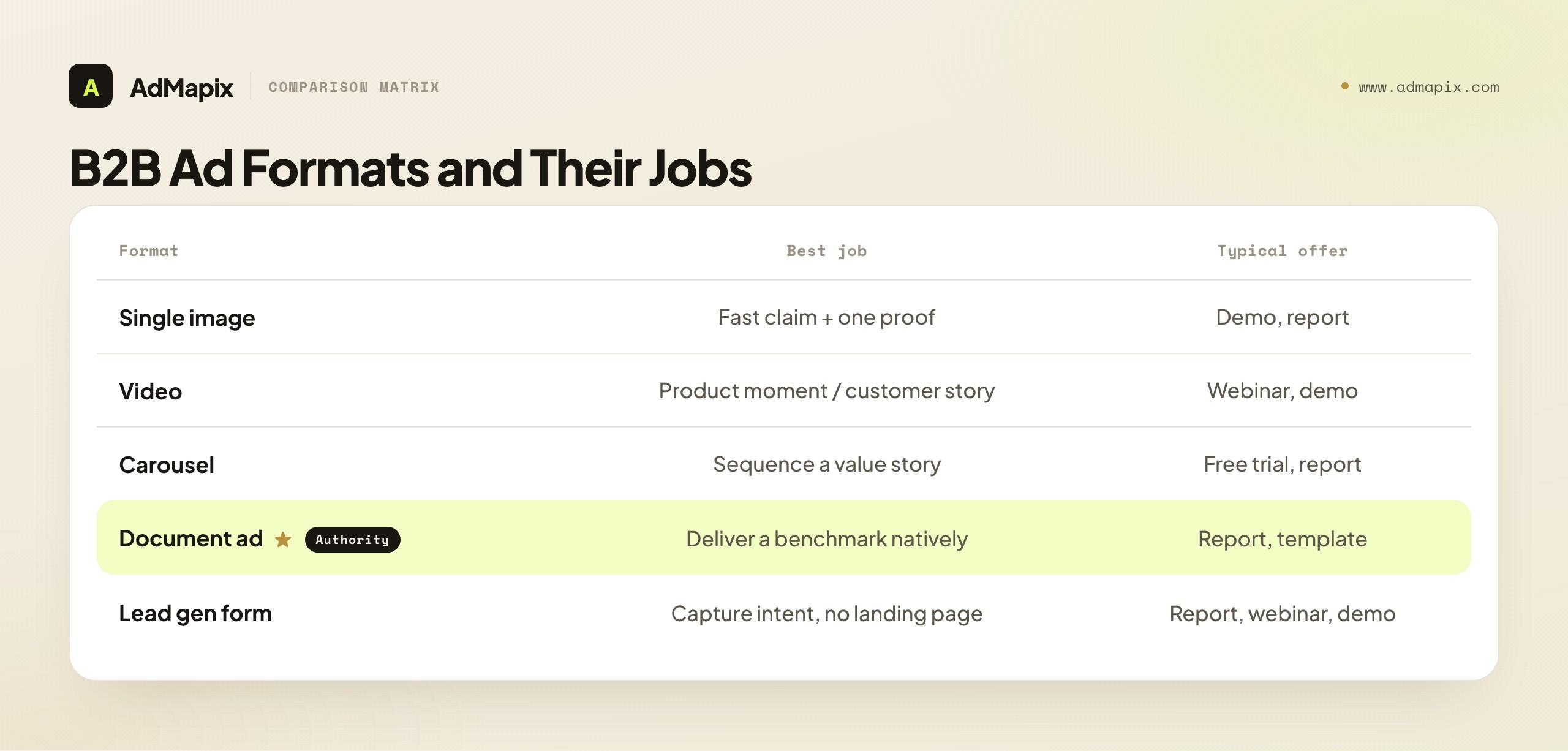
Format is not cosmetic in B2B; it decides how much you can claim and how much you can ask for. LinkedIn's own Ads Guide documents a range of formats — single image, video, carousel, document ads, lead gen forms, sponsored messaging, text, and dynamic ads — and each one fits a different job in the funnel.
| Format | Best job | Typical offer | Watch out for |
|---|---|---|---|
| Single image | Fast claim + one proof point | Demo, report | Too much text crammed into the image |
| Video | Show a product moment or a customer story | Webinar, demo | Burying the role and claim past the first seconds |
| Carousel | Sequence a multi-step value story | Free trial, report | Cards that don't build on each other |
| Document ad | Deliver a benchmark, guide, or template natively | Report, template | Gating value that should be a teaser |
| Lead gen form | Capture intent without a landing page | Report, webinar, demo | High volume of low-intent leads |
A practical read: top-of-funnel formats (video, document ads, carousels) pair best with low-friction offers like reports and benchmarks, while higher-intent formats and lead gen forms can carry demo and trial asks. When an example pairs a heavy ask (book a demo) with a cold top-of-funnel format, treat it as a hypothesis to test, not a proven play.
The format choice also encodes the advertiser's funnel intent in a way you can read. A competitor leaning heavily on document ads is investing in top-of-funnel authority and a nurture pool; one running mostly lead gen forms is optimizing for raw lead volume and cost-per-lead, often under pressure to show pipeline quickly. The native LinkedIn Lead Gen Form versus off-platform landing page choice is especially telling: forms maximize volume and pre-fill profile data but hand you thinner, lower-context leads, while off-platform pages cost conversion rate but capture richer intent and enable the advertiser's own retargeting. Reading a competitor's format mix tells you which way their internal metrics are pushing them.
LinkedIn vs Google: Two Different B2B Creative Jobs
The two primary B2B paid channels demand fundamentally different creative, because they catch the buyer at different moments, and a canonical teardown reads each in its own context. LinkedIn is demand creation against a defined professional identity; Google Search is demand capture against an active query. The same product needs different creative for each.
LinkedIn creative speaks to a role the buyer holds, not a problem they're actively searching. The audience isn't looking for you — you're interrupting their professional feed — so the creative has to earn attention by signaling relevance to their role and offering something worth the interruption. This is where the role-proof-offer chain matters most, where document ads and thought-leadership formats shine, and where lower-friction offers (reports, webinars) generally outperform because the audience is being created, not captured. LinkedIn is the top and middle of a long funnel.
Google Search creative answers an active query from a buyer already in motion. The intent is higher, the creative real estate is smaller (headlines and descriptions), and the job is to match the query and promise a fast path to the answer. Here, higher-friction offers (demo, trial) can work even on relatively new prospects because the search itself signals intent — someone searching "best [category] software" is further along than someone scrolling LinkedIn. Google's Ads Transparency Center lets you see the active ads an advertiser runs across Search, YouTube, and Discover, which is how you read this half of a competitor's motion.
The complete picture comes from reading both together. A competitor's LinkedIn creative shows you how they create and shape demand; their Google creative shows you how they capture it and defend their brand. A rival pushing a new positioning on LinkedIn whose Google brand-defense suddenly intensifies is anticipating a competitive fight. Reading one channel in isolation gives you half the B2B motion — the cross-channel view is what reveals the whole strategy.
Five B2B Examples Worth Collecting
The goal is not volume, it's a small set of examples that each teach a different lesson. Aim to collect these five archetypes for your category, because together they cover the full range of what you need to learn.
- The clean baseline. The clearest, simplest version of a competitor's core claim and offer. This is your reference for what "good and obvious" looks like in your space — the bar everything else clears or fails to.
- The objection-handler. An ad that tackles a hard B2B blocker head-on — price, security, switching cost, or "we already have a tool." Note exactly how it defuses the doubt, because objection-handling is the most transferable B2B creative skill.
- The format showcase. A LinkedIn document ad or lead gen form that uses the format's native strength, not just a repurposed image. This teaches you what the format can actually do when used deliberately.
- The repeated pattern. A claim, proof point, or offer you see across several competitors. Repetition across advertisers is a signal worth testing — though, as always, not proof it works.
- The promise mismatch. An ad whose landing page or lead form fails to deliver what the creative promised. These are the most instructive of all, because they show you exactly what not to do and where a competitor is leaking conversion you can capture.
Collect by archetype rather than by volume because five examples that each teach a distinct lesson beat fifty that all teach the same one. The objection-handler and the promise-mismatch are the two most valuable to hunt for — the first shows you the hardest creative skill executed well, the second shows you a competitor's exploitable weakness.
Where to Find Real B2B Ad Examples
You don't have to guess — two public sources give you live, verifiable creative. LinkedIn Ads is the obvious home for B2B creative, with formats and targeting built around professional roles and companies, and its Ad Library lets you see every active ad a company is running. For Search, YouTube, and Discover, the Google Ads Transparency Center lets you find active ads an advertiser is running across Google surfaces. Both show you the creative and, often, the landing path, which is most of what the framework above needs.
When you pull an example, save the source URL and the date alongside it. Live ads rotate and pages change, so an example with no provenance is hard to defend in a client report a month later. One habit that pays off: log the absence of ads too. A competitor who ran fifteen creatives last month and shows zero today has paused, exhausted a budget cycle, or pivoted — each a meaningful signal that only your own time-series log will preserve, because the libraries keep no public archive of dead ads.
A Worked Teardown: Reading One B2B Competitor Ad
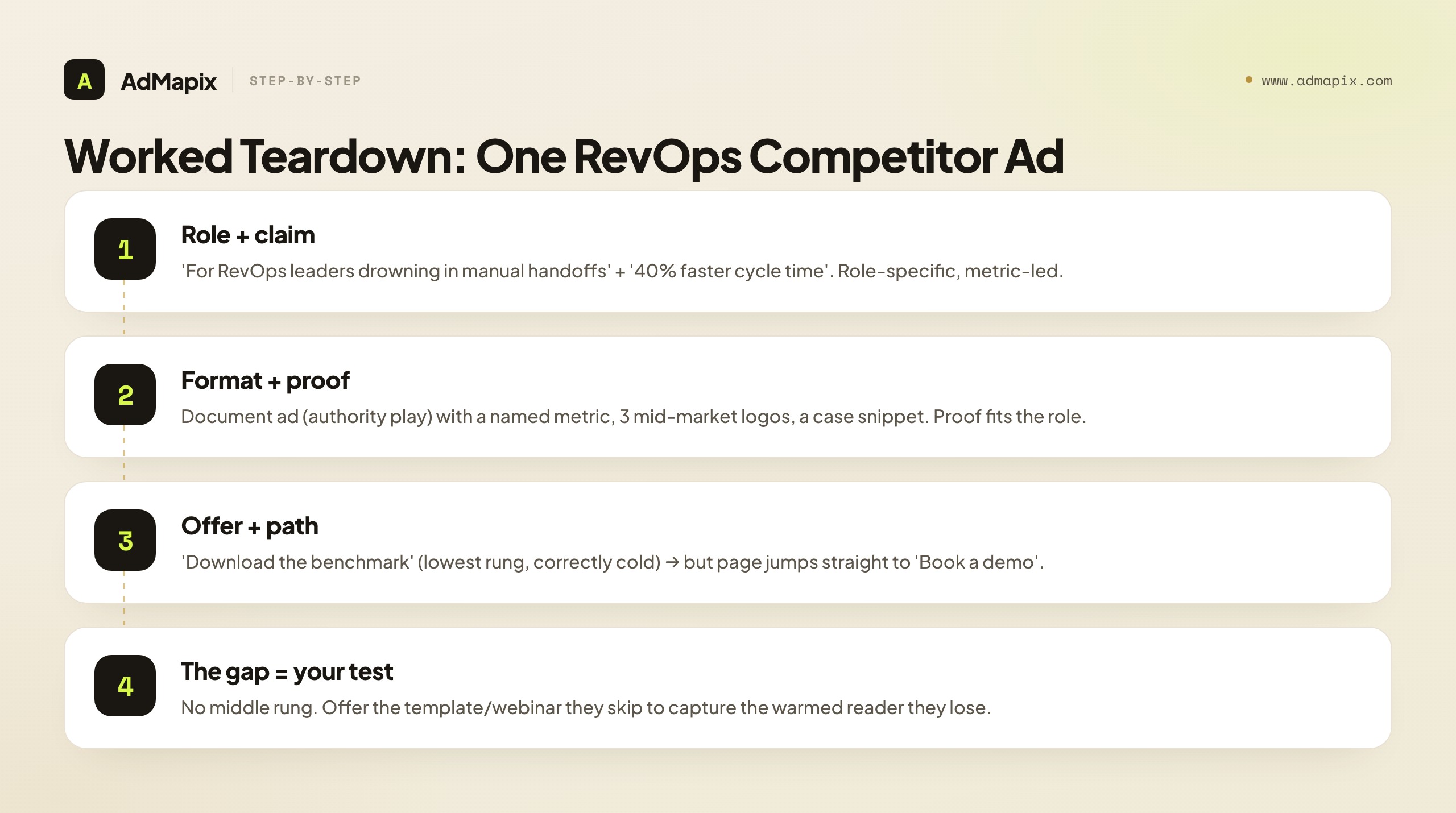
Principles stick when applied, so here's how a single competitor ad reads through the full framework. Say you sell a RevOps automation platform and you find a rival's LinkedIn ad running widely. You're not going to copy it — you're going to decode it and find the gap.
Role. The headline opens "For RevOps leaders drowning in manual handoffs." Instantly you tag the role: RevOps/Operations, named explicitly. Strong — the ad knows exactly who it's for, and the language ("manual handoffs") is process-specific, the register that role responds to. No "for businesses" vagueness here.
Format and claim. It's a LinkedIn document ad — a benchmark carousel titled "The 2026 RevOps Efficiency Benchmark." The claim is concrete: "teams automating handoffs cut cycle time by an average of 40%." Testable, number-led, exactly what a RevOps leader evaluates on. The document format signals a top-of-funnel authority play.
Proof. Inside the document: a named metric (the 40%), three mid-market customer logos, and one case-study snippet. Well-matched proof for the role — RevOps cares about workflow metrics and peer logos, and both are present. The proof type fits the role; no mismatch to exploit here.
Offer and landing path. The CTA is "Download the benchmark" — the lowest rung of the offer ladder, correctly matched to a cold, top-of-funnel document-ad audience. You click through: the benchmark is ungated (smart — builds a retargeting pool), but the only next step on the page is "Book a demo," a jump from the bottom rung straight to the top with nothing in between. That's the gap. The competitor nails the cold-audience entry but offers no middle rung (a template, a webinar) to ladder the warmed reader toward the demo. A warmed RevOps reader who isn't demo-ready has nowhere to go but away.
The synthesis and the tests. You now have a scored read and three hypotheses: (1) replicate the role-specific, metric-led document-ad approach, because it's well-built; (2) match the proof-to-role discipline; and (3) exploit the gap — offer the middle rung the competitor skips (a RevOps workflow template or teardown) to capture the warmed reader they're losing between report and demo. None of this needed a private number. You read role, format, offer, proof, and landing path, found the laddering gap, and turned a competitor's leak into your test.
B2B Creative by Industry: What Changes Across Verticals
Role sets the baseline, but the vertical the B2B product lives in shifts which proof, offer, and claim actually work — and reading a competitor's ad without accounting for its industry leads to copying a play that won't transfer. A few patterns are stable enough to treat as starting bets.
| Vertical | Dominant proof | Default offer | Creative emphasis |
|---|---|---|---|
| SaaS / horizontal tools | Named metrics + logos | Free trial, report | Outcome claim, fast time-to-value |
| Fintech | Compliance + security + ROI | Benchmark, consultation | Trust, regulatory credibility |
| Cybersecurity | Certifications + analyst (Gartner) | Whitepaper, security review | Risk, threat framing, rigor |
| Professional services | Case studies + named clients | Consultation, assessment | Expertise, relationship, outcomes |
| DevTools / infra | Docs + technical proof + adoption | Free tier, docs | Practitioner-first, no fluff |
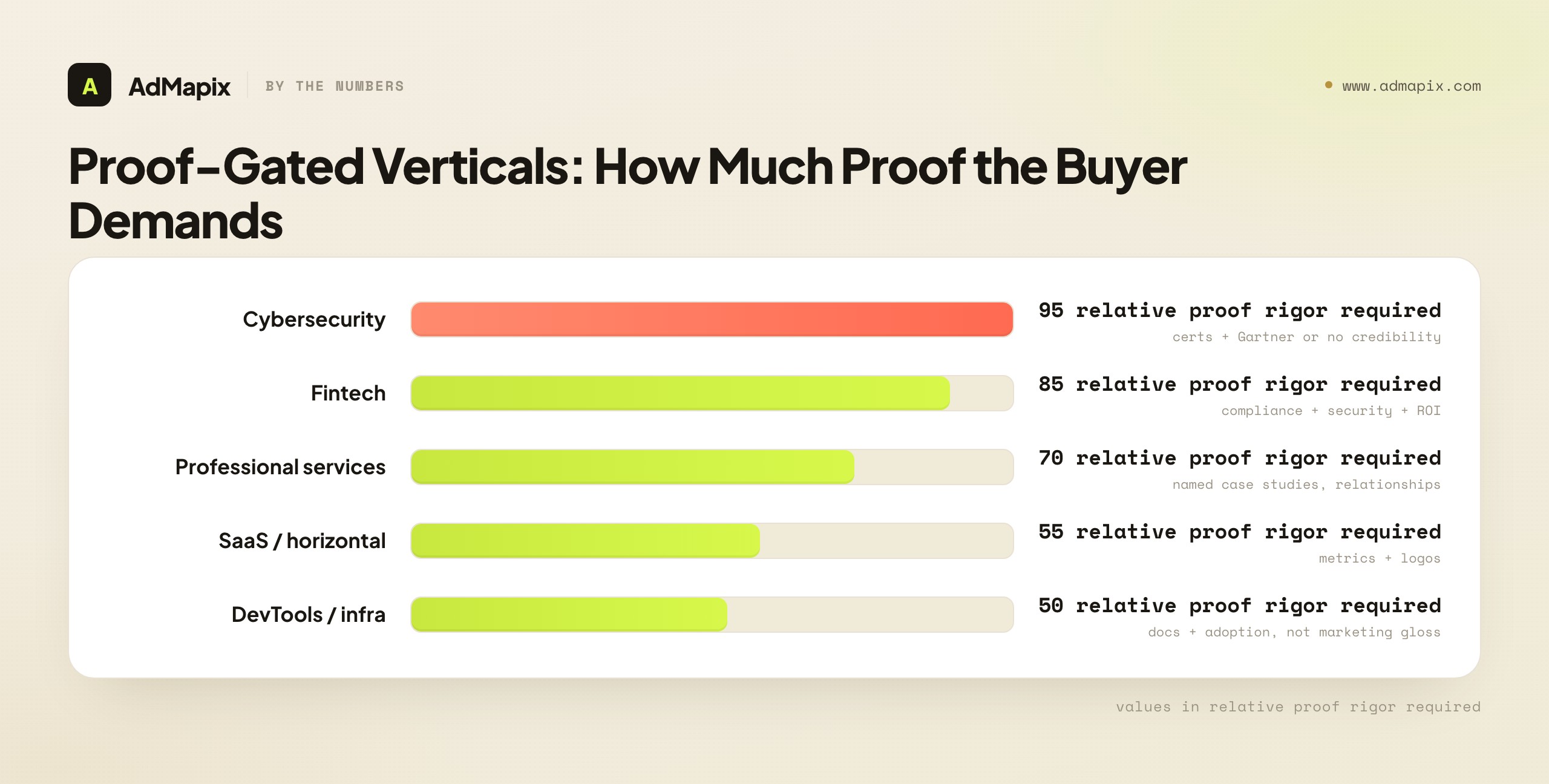
The reads that matter: cybersecurity is the most proof-gated vertical — without certifications and analyst validation, no claim is credible, and the creative leans on risk and rigor rather than upbeat outcomes. Fintech pairs ROI with heavy trust and compliance signaling, because the buyer is risk-averse by mandate. DevTools inverts the usual B2B polish: the audience is practitioners who distrust marketing gloss, so the winning creative is documentation-led, technically precise, and often offers a free tier rather than a sales conversation. Professional services lean hardest on named case studies and relationship cues, because the product is expertise. When you tear down a competitor, read the vertical first — a cybersecurity ad that works because of its Gartner reference teaches you nothing transferable if you're in DevTools, where adoption numbers and docs carry the credibility instead.
Message Match: Reading the Ad-to-Landing-Path Promise
The ad is the promise and the landing path is the delivery, and in B2B the gap between them is where most conversion leaks — which is why a complete teardown always follows the click. Judging a B2B ad without checking where it lands is reading half the creative, because the landing page or lead form often does the real conversion work the ad only sets up.
Strong message match means the landing path delivers exactly what the ad promised: the headline echoes the ad's claim, the offer is the same offer (not a bait-and-switch from "free report" to "book a demo"), the proof deepens rather than disappears, and the form friction matches the offer's commitment level. When you click a competitor's "download the benchmark" ad and land on a page whose headline, offer, and proof all continue the ad's promise, you're looking at a team that understands message match — and that's a high bar to clear, not a gap to exploit.
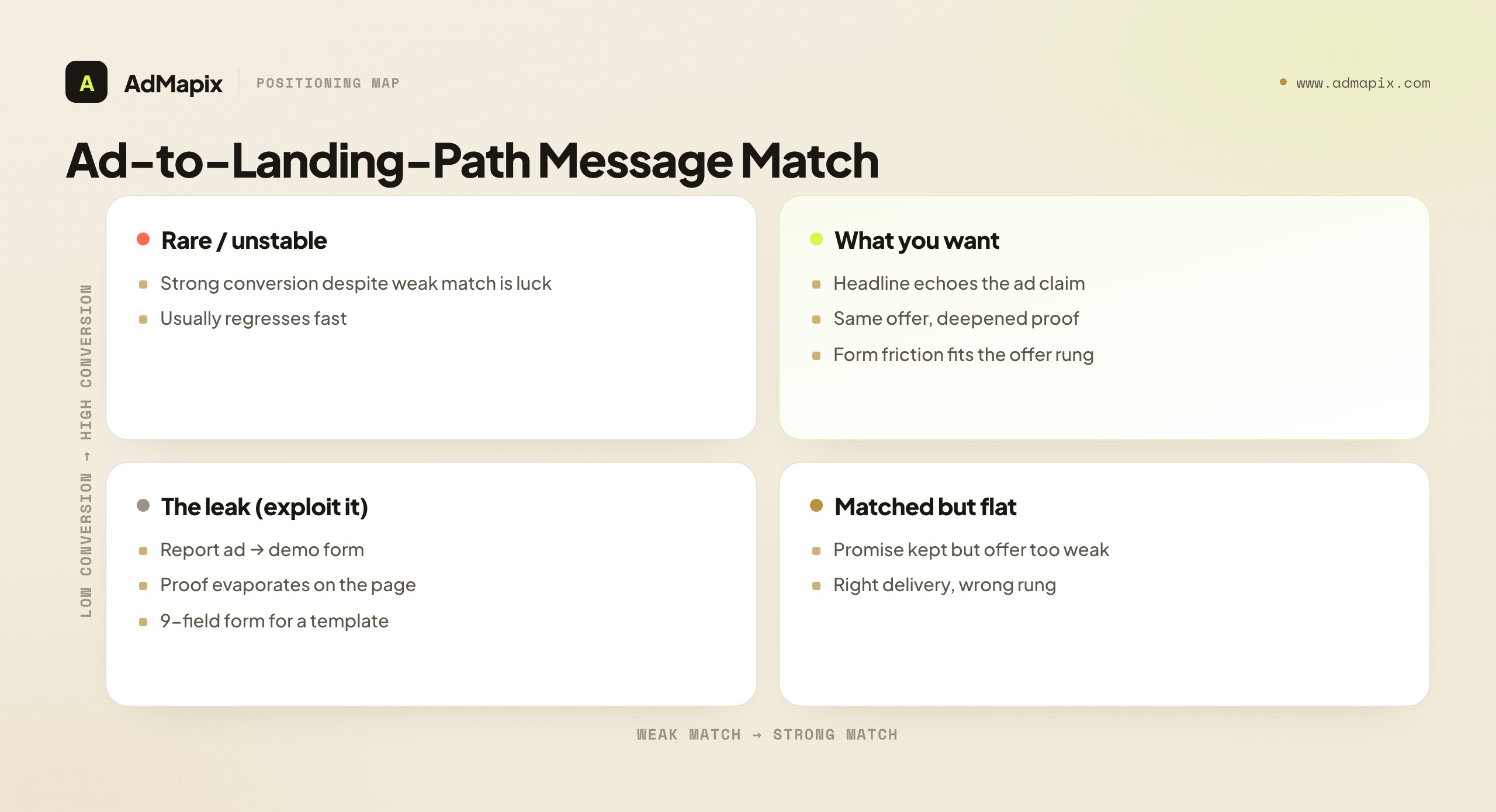
The leaks to hunt for, because they're a competitor's exploitable weakness:
- Promise mismatch. The ad offers one thing, the page asks for another (the report ad that lands on a demo form). The most common and most costly leak.
- Proof evaporation. The ad shows a metric or logos; the landing page drops them, breaking the credibility chain at the moment of conversion.
- Form friction mismatch. A low-friction offer (a template) gated behind a nine-field form with a phone-number requirement — the friction contradicts the offer and bleeds conversion.
- Headline drift. The page headline doesn't echo the ad's claim, so the buyer arrives unsure they're in the right place and bounces.
When your teardown finds a competitor with a strong ad pointing at a leaky page, you've found the cleanest opportunity in B2B competitive research: you don't have to out-create them, you just have to out-execute the delivery they're fumbling. A tighter form, a continued proof chain, and a matched headline can win the same buyer without outspending the rival a dollar.
A B2B Creative Testing and Measurement Workflow
Reading competitor creative generates hypotheses; testing on your own audience is the only thing that grades them — and B2B testing carries constraints that shape the workflow. B2B has lower volume, longer cycles, and offline conversions, so you can't read creative tests the way a high-volume DTC advertiser reads ROAS in 48 hours.
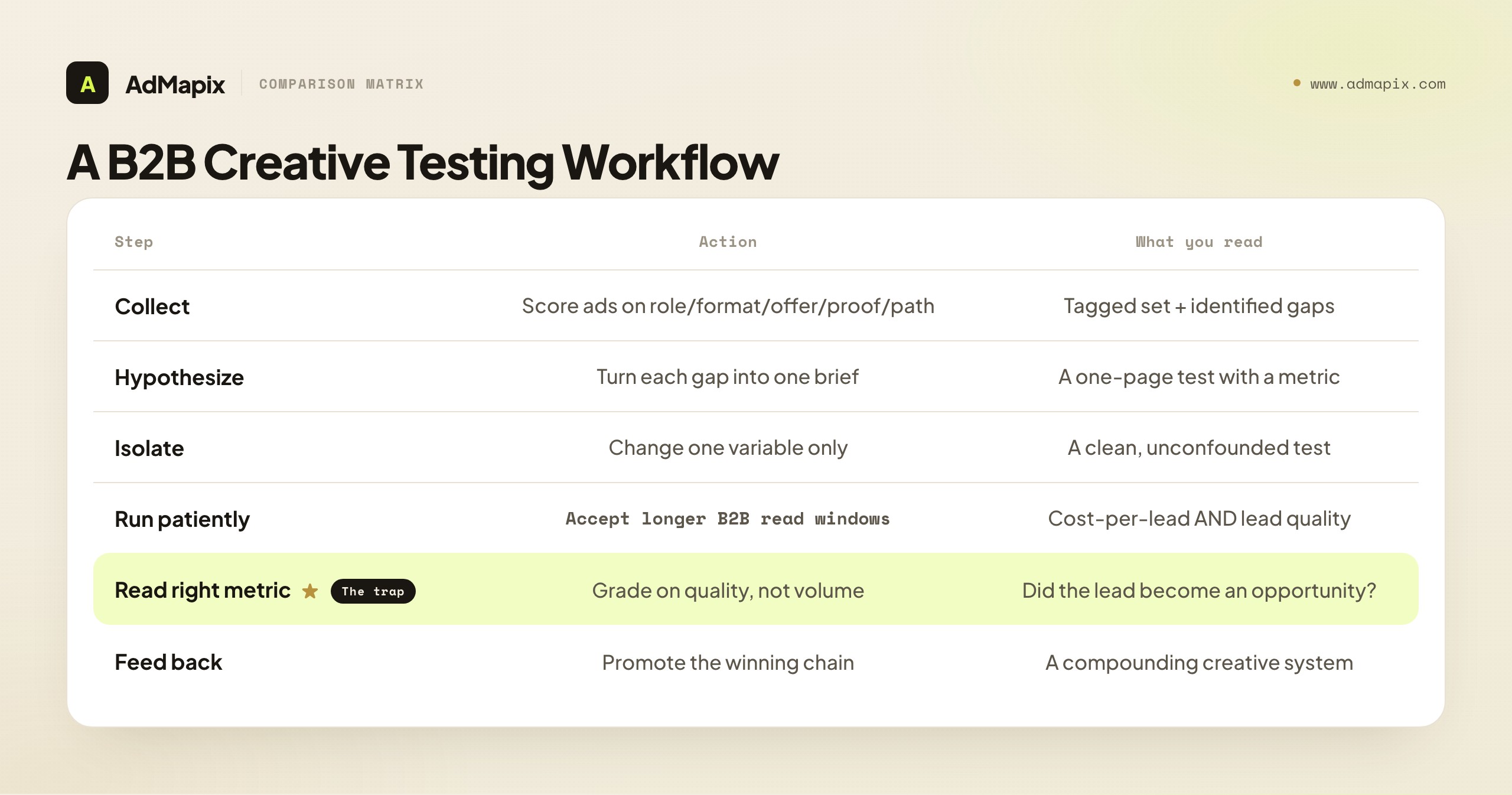
The workflow that respects those constraints:
| Step | Action | What you read |
|---|---|---|
| 1. Collect | Score competitor ads on role, format, offer, proof, landing path | A tagged swipe set + identified gaps |
| 2. Hypothesize | Turn each gap (laddering, proof-role, message-match) into one brief | A one-page test with a metric |
| 3. Isolate | Change one variable — the offer, the proof, or the role angle | A clean test, not a confounded one |
| 4. Run patiently | Accept longer read windows; B2B signal accrues slowly | Cost-per-lead and lead quality, not just CTR |
| 5. Read the right metric | Grade on lead quality and pipeline, not raw lead volume | Whether the lead became an opportunity |
| 6. Feed back | Promote the winning role-offer-proof chain into the next brief | A compounding creative system |
The measurement trap unique to B2B is grading on lead volume instead of lead quality. A creative can win cost-per-lead and lose on pipeline, because it pulled in low-intent downloaders who never become opportunities. A lead gen form ad that doubles your lead count while halving your opportunity rate is a loss disguised as a win. The discipline is to close the loop all the way to the metric that pays — pipeline and closed revenue, not the lead count your ad platform reports. Because B2B conversions happen offline over months, this requires patience and CRM integration that most teams skip, which is exactly why the teams that do close the loop consistently outperform: they grade creative on the only number that matters, and their competitors grade on the number that's easy.
Building a B2B Swipe-to-Brief Library
A folder of competitor screenshots is where good B2B examples go to die. The asset that compounds is a swipe-to-brief library where every entry is already scored on the five dimensions and tagged with the gap it reveals, so it becomes a brief in minutes rather than being re-found weeks later under deadline.
Every entry should capture: source, date, and advertiser; buyer role; format; offer and its rung on the ladder; proof type and whether it matches the role; the landing path and any message-match leak; and a status (untested → briefed → tested → result). The two fields that turn a swipe folder into a strategy tool are the gap tag (laddering gap, proof-role mismatch, promise mismatch) and the status — the first tells you what's exploitable, the second turns the library into a pipeline instead of a museum.
The payoff is the same as for any creative library, amplified by B2B's complexity: once thirty competitor ads are scored this way, you can answer questions no screenshot folder can — which roles the category over- and under-targets, which offers everyone clusters on, which proof types are table stakes versus differentiators, and which competitors consistently leak at the landing path. That market map is the strategic return on disciplined tagging, and it's invisible to anyone still scrolling a shared drive of un-annotated screenshots the night before a brief is due.
What Public Ad Data Can and Cannot Prove
This is the single most important caveat in competitive B2B research: a public ad shows you the creative, not the results. Seeing an ad live, or seeing it many times, does not tell you whether it's profitable. In B2B especially, where deals close offline over months, the gap between "the ad is running" and "the ad is working" is enormous.
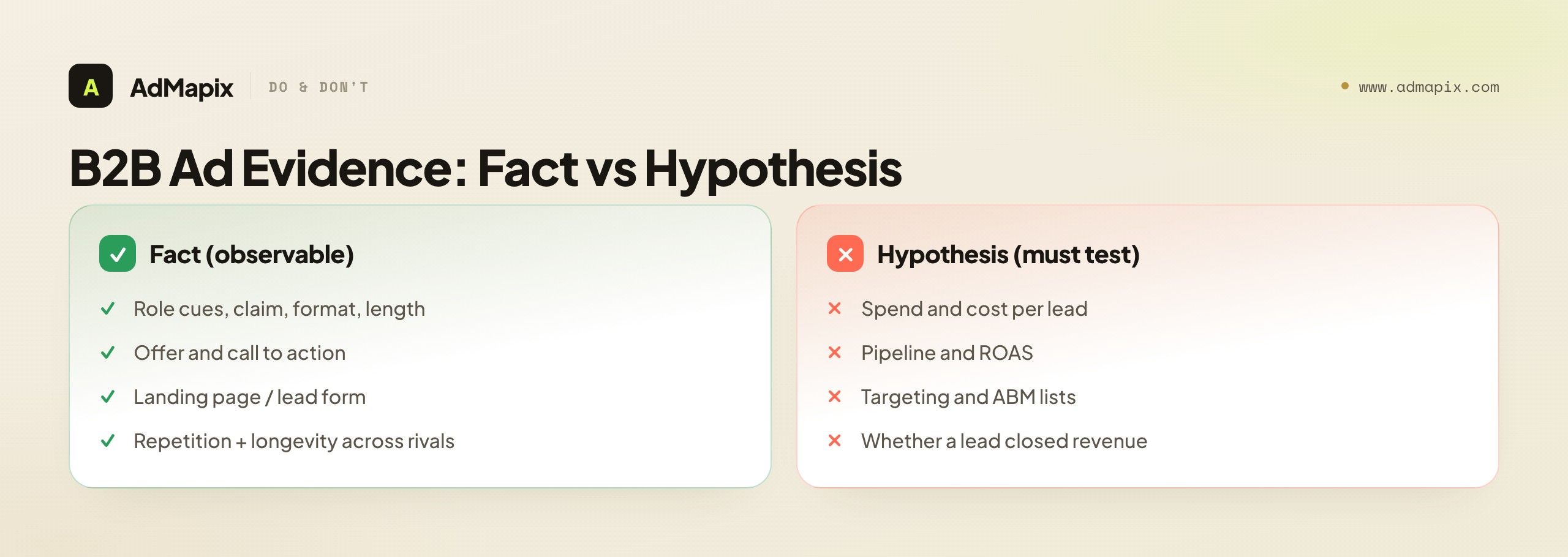
From public sources you can observe:
- The creative itself: role targeting cues, claim, format, and length.
- The offer and call to action shown in the ad.
- The landing page or lead form the click goes to.
- Whether a creative or offer repeats across competitors, and how long it's been running.
From public sources you cannot prove:
- Spend, cost per lead, pipeline, or ROAS.
- Audience targeting, exclusions, or account-based lists.
- Whether a lead became an opportunity or closed revenue.
So treat "every competitor runs this offer" as a hypothesis for your own test, not a result to copy. The one weak inference public data supports is longevity: an ad running continuously for many weeks with variants is a stronger hypothesis than a one-off, because advertisers rarely fund losers for long. But longevity is a hint, not a verdict — the only B2B performance data you can trust is your own pipeline.
Common B2B Ad Creative Mistakes
- Copying the creative, not the strategy. A competitor's demo offer may work because of their brand, pricing, and sales team — none of which transfer with the screenshot.
- Ignoring the role. A B2B ad that doesn't signal who it's for usually underperforms; don't save it as a model without noting that gap.
- Matching a heavy offer to a cold audience. Asking strangers to book a demo is friction; the strongest examples ladder the offer to audience warmth.
- Mismatching proof to role. A CFO-targeted ad with only a G2 badge, or an IT-security ad with no compliance proof, is under-proven for the role it targets.
- Saving examples without notes. An asset with no role, format, offer, proof, or source is nearly useless weeks later.
- Skipping the landing path. The lead form or landing page often decides the conversion; judging only the ad misses half the picture.
- Treating "running" as "winning." Public visibility says nothing about spend, leads, or ROAS.
- Reading one channel only. LinkedIn shows demand creation, Google shows demand capture — read both or you see half the motion.
B2B Creative Fatigue and Refresh Cadence
B2B creative fatigues more slowly than consumer creative but fatigues differently, and misreading the cadence is how teams either burn budget on stale ads or churn through creative faster than they can learn from it. Understanding the rhythm tells you how often to refresh your own creative and how to read a competitor's refresh behavior as a signal.
B2B audiences are smaller and more defined than consumer audiences — you're targeting a finite set of roles at a finite set of companies — which means the same person sees your ad more often, and frequency builds faster against a tight ICP than against a broad consumer pool. But B2B buyers also tolerate repetition better in one specific way: because the buying cycle is long, a prospect may need to see a claim several times across weeks before it lands, so killing a creative the moment its click-through dips can be premature. The art is distinguishing fatigue (the audience has seen it too many times and tuned out) from necessary repetition (the audience needs the reps to absorb a considered claim).
The practical reads:
- Watch frequency against a tight ICP. When you're targeting a few thousand accounts, frequency climbs fast. A creative that's been live for weeks against the same named-account list is more likely fatigued than one running against a broad role filter.
- Refresh the hook and proof, hold the offer. Often the offer is still right but the opener and proof point have gone stale. Rotating the claim angle and the proof (a new metric, a new case study) refreshes a creative without rebuilding the funnel logic.
- Read a competitor's refresh velocity. A rival shipping fresh creative weekly is running a funded testing program; one running the same three ads for months is either coasting or has found something that works and is milking it. New-ad velocity is a readable proxy for both budget and creative-team capacity.
- Don't over-refresh in B2B. Because considered claims need repetition to land, churning creative every few days — fine in DTC — can prevent a B2B claim from ever sinking in. Slower cadence, sharper tests.
The strategic point for competitive research: when you tear down a competitor over time, log their refresh cadence alongside their creative. A sudden spike in new-ad velocity is a budget event worth noting; a long-stable creative set is a claim worth testing against, because if they've run it unchanged for months, it's their strongest hypothesis about what works on your shared buyer.
Reading Account-Based (ABM) Creative Signals
B2B is the home of account-based marketing, so a complete read of competitor creative has to catch the ABM signals that show up in public — and they're more readable than most teams realize. ABM creative looks different from broad-reach creative in identifiable ways, and learning to spot it tells you which specific accounts and personas a competitor is courting, even though the matched-account list itself stays hidden.
The public footprints of an account-based motion:
- Named-segment messaging. Copy that addresses a specific role at a specific kind of company — "For RevOps leaders at Series B SaaS companies," "Built for security teams at regulated fintechs" — is the visible signature of a tightly targeted campaign. The more specific the addressee, the smaller and more expensive the audience, and the more confidently you can reconstruct who they're after.
- Sponsored Messaging and Conversation formats. These inherently account-based formats reach small, high-intent, expensive audiences. A competitor running them is spending up to reach a defined list, often a matched or uploaded account list you can't see but can infer from the message persona.
- A thought-leadership drip aimed at one persona. A steady cadence of document ads all speaking to the same role signals an account-based nurture motion — warm the target accounts with value before sales reaches out, rather than chase this-week conversions.
The most valuable ABM insight is one most teams miss entirely: in B2B, your most instructive competitor is frequently adjacent, not direct. A company with a different product but the same buyer persona is competing for the exact same scarce professional attention and the same budget line, and they may be running the sharpest account-based plays against your buyer while you watch only your feature-for-feature rivals. Always include two or three adjacent competitors — same buyer, different product — in your tracking set, because they often surface the strongest plays against the accounts you care about.
The practical move is to maintain a short list of the named accounts and personas your competitors appear to be courting, inferred from their most specific creative. When a rival's Conversation ads and document drip all converge on, say, "heads of platform engineering at fintechs," you've reconstructed their ABM target closely enough to make a decision: defend those accounts with sharper creative of your own, or recognize the segment is contested and pick a less-defended beachhead. Either way, reading the ABM layer turns a folder of competitor ads into a map of which accounts the category is fighting over — and that map is something no single ad, read in isolation, could ever give you.
When to Use AdMapix
AdMapix fits the moment your B2B creative research outgrows browser tabs and a shared drive. Use Search AdMapix to find ad creatives across networks by brand, keyword, or category; Media to save the examples worth keeping with their source and date; Video Analysis to break a B2B video ad down into its hook, structure, and pacing; and Reports to turn a pattern into a shareable brief or watchlist for your team or client. Compare solo, team, and agency access on Pricing, or jump back in from Login.
It's a good fit if you run paid LinkedIn or Search at volume, track several competitors or manage multiple clients, and need a repeatable way to go from "saw an ad" to "shipped a brief or test." It is not the right tool if you only run a couple of campaigns a year, never adapt creative from competitors, or expect to see rivals' spend, lead volume, or ROAS — no public tool can provide those numbers, because that data is private. AdMapix sits in the cross-network creative-intelligence slot: it removes the manual collection so your time goes to the role-offer-proof analysis that actually sharpens B2B creative.
FAQ
How are B2B ad creative examples different from B2C?
B2B creative usually targets a specific role inside a buying committee, makes one testable claim, and leans on proof (logos, metrics, case studies, security certifications) because buyers are skeptical and budgets need approval. The offer is also lighter and more layered — reports, benchmarks, and webinars before a demo — because the sales cycle is a committee evaluation over months, not an impulse purchase.
What makes a B2B ad creative effective?
It speaks to one role, makes one concrete claim, backs it with credible proof that matches that role, and asks for a next step that fits how warm the audience is. A clear role signal and a low-friction offer for cold audiences usually beat a vague benefit and an immediate demo ask. Internal consistency between role, proof, and offer is the hallmark of a strong B2B creative.
How do I read a B2B ad by buyer role?
Identify the role first, because everything else is downstream of it. A CFO evaluates on ROI and wants hard payback metrics; IT/security evaluates on compliance and needs SOC 2 or ISO proof; RevOps evaluates on workflow efficiency; demand gen evaluates on pipeline. A common competitor mistake is a role mismatch — CFO ROI language aimed at a security buyer, for instance — which is a gap you can exploit by speaking to what the role actually cares about.
Which offer works best in B2B ads?
It depends on audience warmth, not a universal answer. Think of offers as a ladder: benchmark reports and templates (lowest friction) for cold top-of-funnel audiences, webinars and free trials in the middle, demos and consultations (highest friction) for warm retargeting audiences. The strongest examples ladder the offer to the stage, and a common mistake is skipping the middle rungs so a warmed reader has nowhere to go between a report and a demo.
What proof types matter most in B2B creative?
Roughly from soft to hard: customer logos (instant but soft), named metrics (specific and outcome-led), case studies (the strongest narrative proof), analyst/third-party validation like Gartner or G2 (borrowed credibility for enterprise), and security/compliance certifications (a gate, not a nudge, for IT buyers). The key is matching the proof type to the role — a CFO wants a payback number, an IT buyer needs compliance proof, and a mismatch is an exploitable weakness.
Where can I find real B2B ad examples?
LinkedIn's Ad Library is the primary home for B2B creative across single image, video, carousel, document, and lead gen formats, and the Google Ads Transparency Center shows active ads running across Search, YouTube, and Discover. Save the source URL and date with each example, since live ads rotate, and log the absence of ads too — a competitor going dark is itself a signal only your own time-series will preserve.
How is B2B creative on LinkedIn different from Google Search?
LinkedIn is demand creation against a professional identity — you interrupt the feed, so the creative earns attention by signaling role relevance and offering something worth the interruption, favoring lower-friction offers and document/thought-leadership formats. Google Search is demand capture against an active query, with smaller creative real estate and higher intent, so higher-friction offers like demos can work even on newer prospects. Read both to see the full motion.
Can I see how well a competitor's B2B ad performed?
No. Public sources show the creative, offer, and landing path, but not spend, cost per lead, pipeline, or ROAS. Longevity (an ad running for weeks with variants) is a weak profitability hint, not proof. Treat a recurring competitor offer as a hypothesis to test in your own account, where you control the only performance data you can trust.
What should each saved B2B example include?
Capture the buyer role, format, offer, proof point, and landing path, plus the source URL and date. Add the test or recommendation the example suggests — and ideally where the offer sits on the ladder and whether the proof matches the role — so the swipe file feeds decisions instead of just collecting screenshots.
How do I turn B2B competitor ads into something I can actually use?
Score each ad on role, format, offer, proof, and landing path; collect the five archetypes (clean baseline, objection-handler, format showcase, repeated pattern, promise mismatch); and look specifically for laddering gaps and proof-role mismatches you can exploit. Then convert the patterns into a brief, message map, or test backlog with a metric and a decision date — and validate everything against your own pipeline, the only B2B performance data you can trust.
Related Reading
- LinkedIn Ads Competitor Research in 2026: The Complete B2B Intelligence Playbook — the deep dive on researching the channel where most B2B creative lives.
- Competitor Ad Analysis in 2026: The 5-Dimension Framework, Templates & SOP — the scoring system this creative teardown plugs into.
- Ad Hook Examples in 2026: 7 First-3-Second Patterns — the opener craft that B2B video and Search creative also depend on.
- Google Ads Competitor Analysis: 6 Ways to Find What Rivals Run — the demand-capture half of the B2B motion.
- Paid Ads Competitor Research in 2026: The Complete Playbook — the broader competitive-research system B2B creative research sits inside.
- Search Ads Intelligence: Reading the Intent Layer — for decoding the high-intent Search creative that complements LinkedIn.
Sources
- LinkedIn Ads — positions LinkedIn advertising around B2B marketing, role-based targeting, campaign creation, measurement, and ROI.
- LinkedIn Ads Guide — documents formats including single image, video, carousel, document ads, lead gen forms, sponsored messaging, text, and dynamic ads.
- LinkedIn Ad Library — the free, login-optional library of every active ad a company runs on LinkedIn.
- LinkedIn B2B marketing plan — describes a B2B marketing plan as a blueprint for revenue targets, customer understanding, channel strategy, and nurturing prospects into leads.
- Google Ads Transparency Center — lets you find active ads an advertiser runs across Google surfaces such as Search, YouTube, and Discover.
Official sources checked as of June 21, 2026. Platform docs, ad formats, and product pages change, so re-verify these URLs before using a claim in client work. AdMapix surfaces public ad creatives across networks; it does not expose advertiser spend, targeting, lead volume, or ROAS, which remain private.
Turn these observations into your next creative study
Open the creative library and select samples for your market, network and research question.
Related Articles
SaaS Ad Spy Tools in 2026: Reading Competitor Messaging, Offers & Demo Paths
A 2026 guide to SaaS ad spy research — how to read competitor messaging, proof, and demo paths from public LinkedIn and Google ads without faking spend, the five-layer message map, the PLG-vs-sales-led funnel read, the trial-vs-demo offer ladder, category-creation vs differentiation positioning, pricing-transparency signals, SaaS-category nuances for horizontal, vertical, and dev tools, a worked teardown, and a workflow that turns competitor ads into a message map and test backlog.
Dropshipping Ad Spy Tools in 2026: Validating Products, Angles & Offers Before You Test
A 2026 guide to dropshipping ad spy research — the six-signal pre-test filter, how to validate a winning product and read saturation, how to spot supplier and shipping risk in a competitor's ad, the thin-margin economics that decide what you can copy, the impulse and curiosity hooks dropshipping runs on, advertorial and quiz landing-page teardowns, and how to turn competitor ads into a go/no-go decision instead of a screenshot folder.
Agency Ad Intelligence Tools in 2026: Turning Competitor Research Into Client Reports
A 2026 guide to ad intelligence for agencies — how to standardize competitor research across a client portfolio, the fixed capture field list and weekly workflow that survive staff turnover, how to structure a recurring client report, white-label and deliverable considerations, using competitor research to win new business and prove retainer value, the cross-client pattern advantage only agencies have, team roles and scaling, packaging research as a billable service, and the public-data.