
Dropshipping Ad Spy Tools in 2026: Validating Products, Angles & Offers Before You Test
A 2026 guide to dropshipping ad spy research — the six-signal pre-test filter, how to validate a winning product and read saturation, how to spot supplier and shipping risk in a competitor's ad, the thin-margin economics that decide what you can copy, the impulse and curiosity hooks dropshipping runs on, advertorial and quiz landing-page teardowns, and how to turn competitor ads into a go/no-go decision instead of a screenshot folder.
Dropshipping Ad Spy Tools in 2026: Validating Products, Angles & Offers Before You Test
By the AdMapix Research Team — Updated June 21, 2026
A dropshipping ad spy tool earns its keep when it stops you from burning a test budget on a product that was never going to work. Before you spin up a campaign, the ads competitors are already running can tell you which angle is winning, what offer the market expects, whether the proof is credible, whether the product is fresh or already saturated, and where the landing page does the real selling. This guide is the dropshipping-specific companion to our broader ecommerce ad spy tool guide: it assumes the universal capture framework and goes deep on what's unique to dropshipping research — product validation, saturation, supplier and shipping risk, thin-margin economics, and the impulse hooks the model runs on. It's for dropshippers, Shopify store owners, and media buyers who want to turn other people's ads into a go/no-go decision instead of a screenshot folder.
We've torn down thousands of dropshipping creatives, and the dropshipping-specific edge is consistent: the operators who win use competitor ads as a pre-test filter — a go/no-go on the product, the angle, the offer, and the fulfillment risk — before a dollar of test budget is spent. In dropshipping you don't own inventory, so your real assets are the angle, the creative, the offer, and the store experience, which are exactly the things visible in a competitor's ad. This guide shows you how to read all of them, plus the saturation and supplier signals that the universal framework doesn't cover.
TL;DR — Dropshipping Ad Spy Research in One Screen
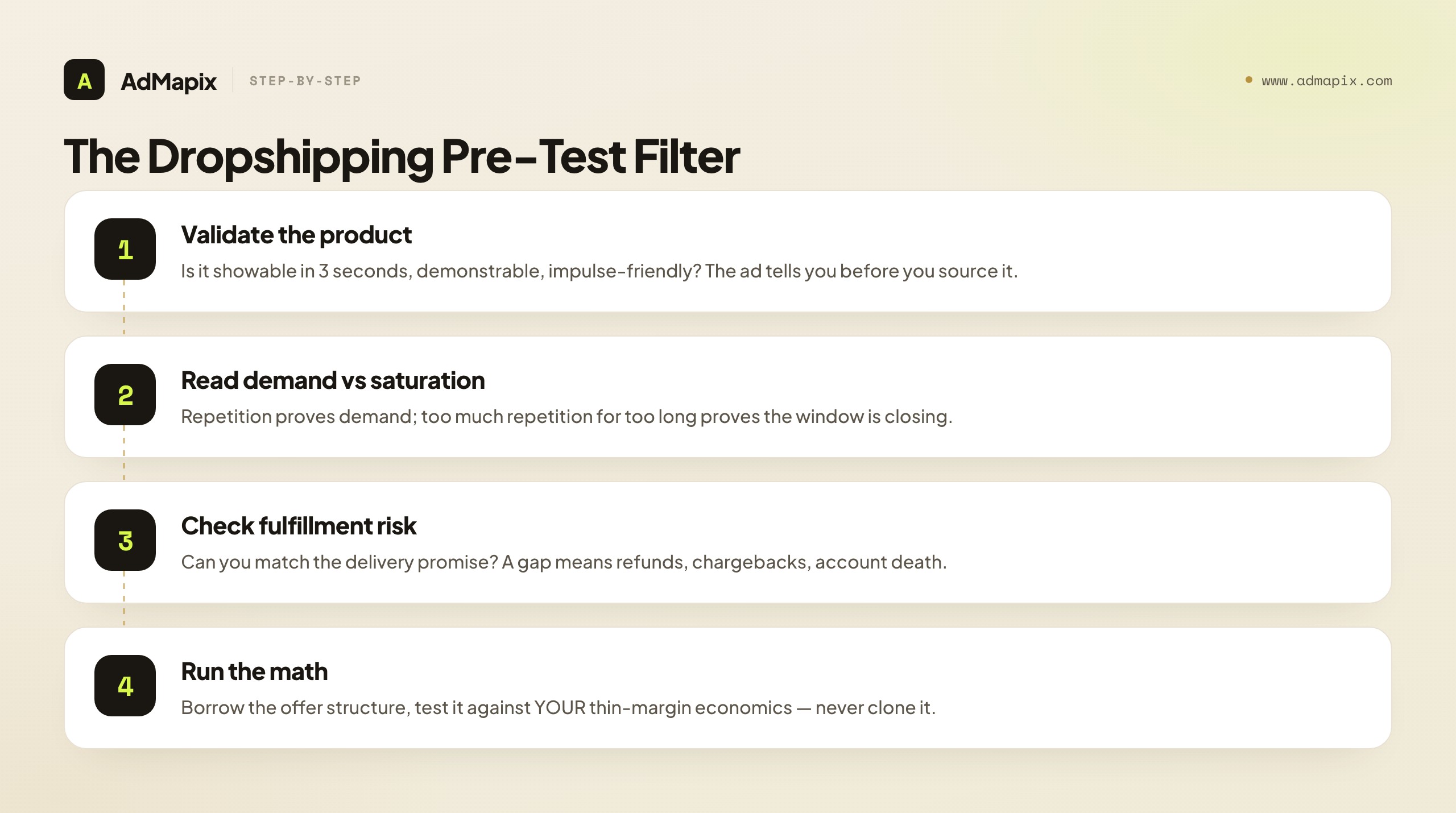
- A dropshipping ad spy tool is a pre-test filter, not a copy machine. Its job is to validate the product, angle, offer, and fulfillment risk before you spend, turning competitor ads into a go/no-go decision.
- Capture six signals per ad: product demo, offer structure, proof type, delivery promise, landing destination, and how often the pattern repeats across sellers. The last three are where dropshipping research diverges from generic ecommerce.
- Repetition across many sellers over weeks is your strongest demand signal — and the best way to tell a real trend from a one-off fresh ad.
- Saturation is the trap. A product everyone is already running may be past its window; reading saturation is as important as reading demand.
- The delivery promise flags fulfillment risk. A "ships in 5 days" you can't match with a 3-week supplier creates refunds and chargebacks that kill the account, not just the campaign.
- Thin margins mean you can't copy a brand's offer. Read every ad through dropshipping economics, not a funded brand's — borrow the structure, test the math.
- Public data proves structure and repetition, never economics. It can't show spend, ROAS, true margin, or supplier reliability. Validate margin and fulfillment separately before calling a product "proven."
Why Dropshippers Spy on Ads in the First Place
Dropshippers spy on ads to shorten the gap between "interesting product" and "validated test." In dropshipping you don't own inventory, so your real assets are the angle, the creative, the offer, and the store experience — exactly the things visible in a competitor's ad. Shopify's dropshipping guide frames the model around suppliers, products, storefronts, marketing, and customer experience, and an ad library lets you study four of those five before committing money.
The goal is not to clone a winning ad. It's to read the market: if five sellers are all running the same problem-solution hook with a 50%-off bundle and a 30-day guarantee, that tells you what buyers already expect to see. Your job is to decide whether you can match that offer profitably and beat it on creative or trust. This is where dropshipping research diverges sharply from the brand-focused approach in the ecommerce hub: a dropshipper isn't building a brand, they're racing to validate and scale a product before the window closes, so the research is a fast pre-test filter rather than a long-term competitive-intelligence practice.
The economics make the filter essential. Dropshipping margins are thin and fulfillment is outsourced, so a single bad product test costs real money with nothing to show for it — no inventory, no brand equity, just a spent budget. The competitor ad library is the cheapest validation you have: it lets you reject the products that were never going to work before you pay to discover it yourself.
The Six-Signal Dropshipping Pre-Test Filter
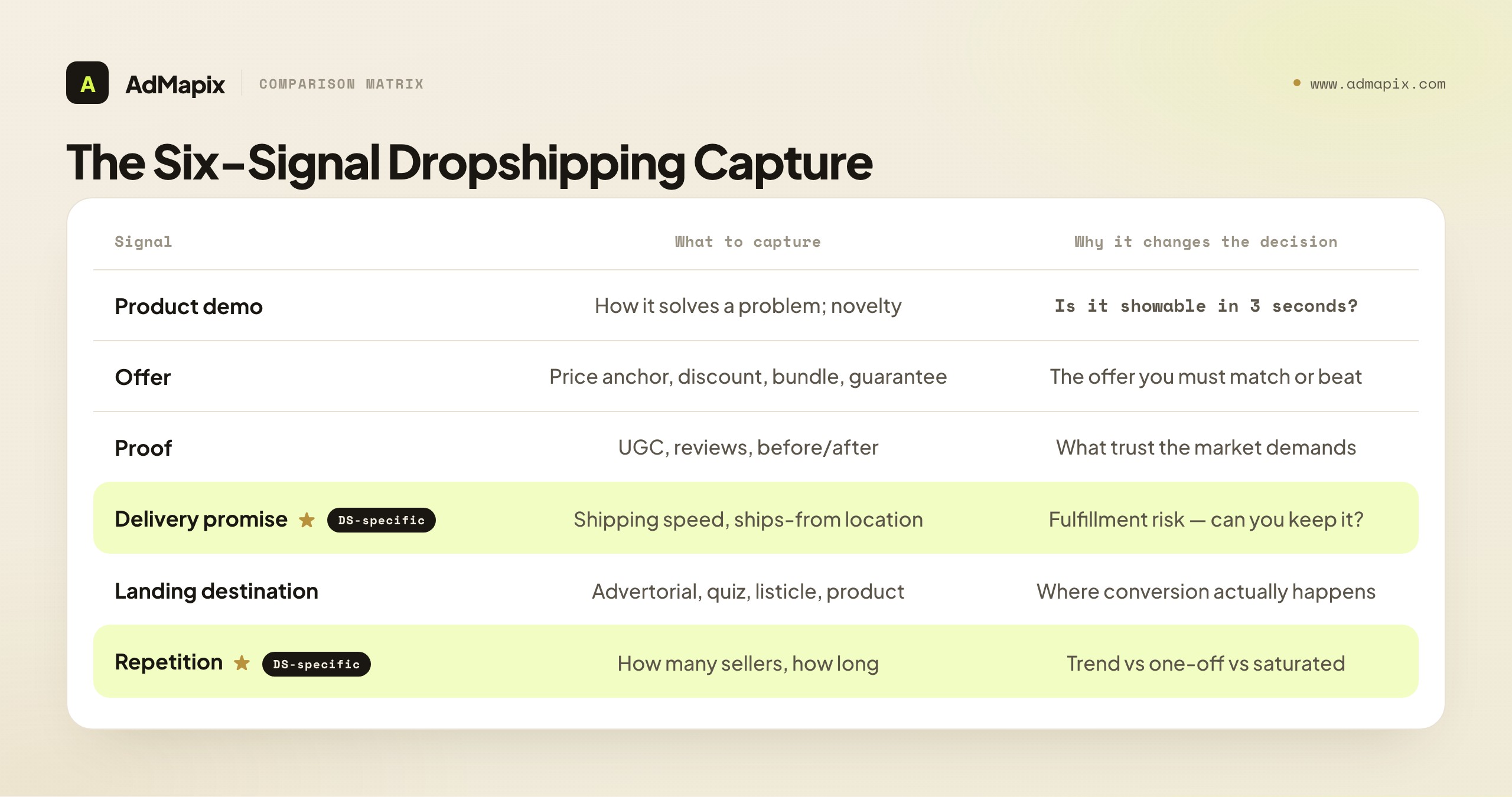
Track the signals that change a buying or testing decision, and ignore the rest. A dropshipping ad has a predictable anatomy, and each part maps to a question you need answered before you test.
| Signal | What to capture | Why it changes your decision |
|---|---|---|
| Product demo | How the product is shown solving a problem; novelty | Decides whether the product is "showable" in 3 seconds |
| Offer | Price anchor, discount, bundle, free shipping, guarantee | Sets the offer you must match or beat to compete |
| Proof | UGC, reviews, before/after, comparison, social proof | Tells you what trust the market already demands |
| Delivery promise | Stated shipping speed, "ships from" location | Flags whether you can fulfill it without long-ship complaints |
| Landing destination | Product page, advertorial, quiz, listicle | Reveals where the real conversion work happens |
| Repetition | How many sellers run the same angle | Distinguishes a trend from a one-off |
If you only have time for two columns, capture the offer and the landing destination. Those are where most dropshipping ads are won or lost, and they're the hardest to reverse-engineer after a campaign is already live. The two signals that make this a dropshipping filter rather than a generic ecommerce one are the delivery promise (the fulfillment-risk read) and repetition across sellers (the demand-and-saturation read) — the rest of this guide goes deep on those plus the product-validation and economics dimensions that decide a go/no-go.
Reading the Product Signal: Is It a Winning Product?
The first go/no-go question in dropshipping is whether the product itself is viable, and the ad tells you most of what you need before you ever source it. A dropshipping winning product has a recognizable profile, and the competitor's creative reveals whether the product clears the bar.
What the product signal tells you about viability:
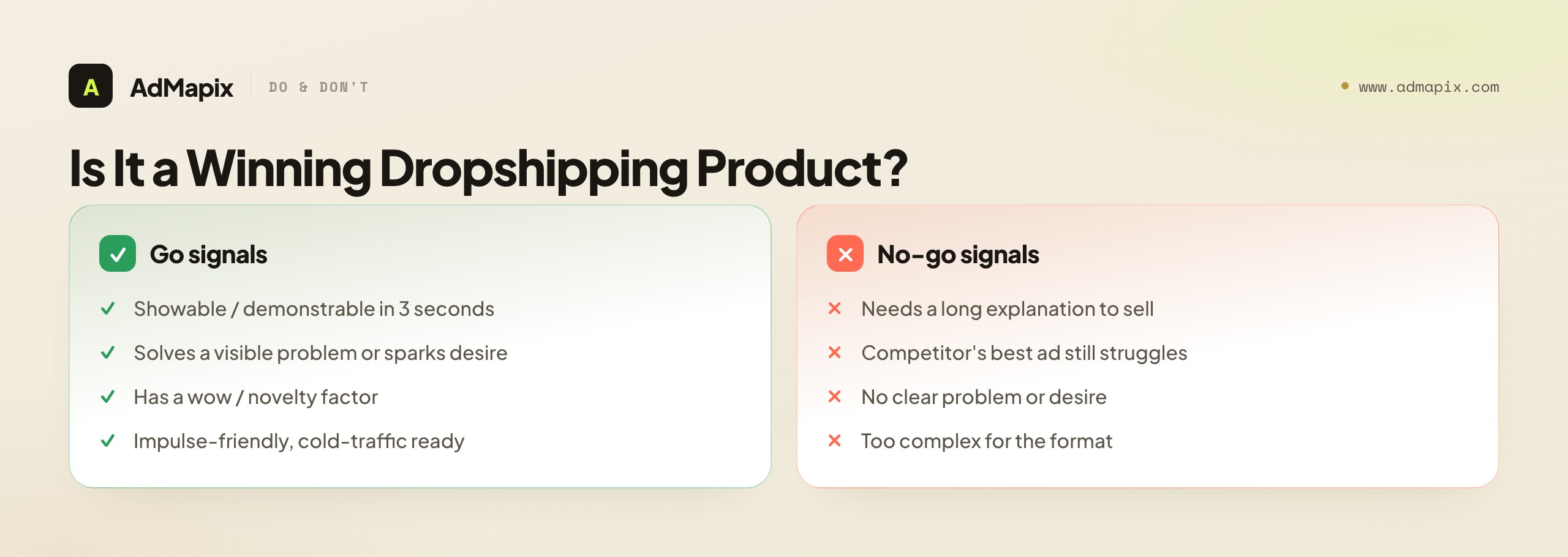
- Is it "showable" in three seconds? Dropshipping lives on impulse, so the product has to demonstrate its value or its satisfying mechanism almost instantly. If the competitor's ad needs a long explanation, the product may be too complex for the format — a no-go signal.
- Does it solve a visible problem or trigger a visible desire? The strongest dropshipping products either fix an annoying problem on screen (the mess, the struggle) or deliver an immediately desirable result. A product the ad struggles to make compelling is a product you'll struggle to sell.
- Is there a "wow" or novelty factor? Dropshipping winners frequently have a surprising mechanism or a "I've never seen that" quality that earns the scroll-stop. If the competitor's ad relies on novelty, note that the window may be short — novelty fades fast.
- Is it a problem-solver or an impulse gadget? Problem-solvers have longer windows and more stable demand; impulse gadgets spike and crash. The product type tells you how fast you need to move and how durable the opportunity is.
The strategic read: the ad shows you whether the product is demonstrable, desirable, and impulse-friendly — the three things a dropshipping product needs — before you commit to sourcing it. A product that one competitor is struggling to make compelling in their best creative is a product you should probably pass on, because if their ad can't sell it, yours likely won't either. The product signal is your first and cheapest filter.
Reading Saturation: Is the Window Still Open?
Demand and saturation are two different reads, and confusing them is the most expensive mistake in dropshipping research — a product everyone is already running may be past its profitable window, not into it. Repetition across sellers is a demand signal, but too much repetition, for too long, is a saturation warning. Reading the difference is what separates entering a trend from chasing a dead one.
The saturation signals to read in the competitor ad landscape:
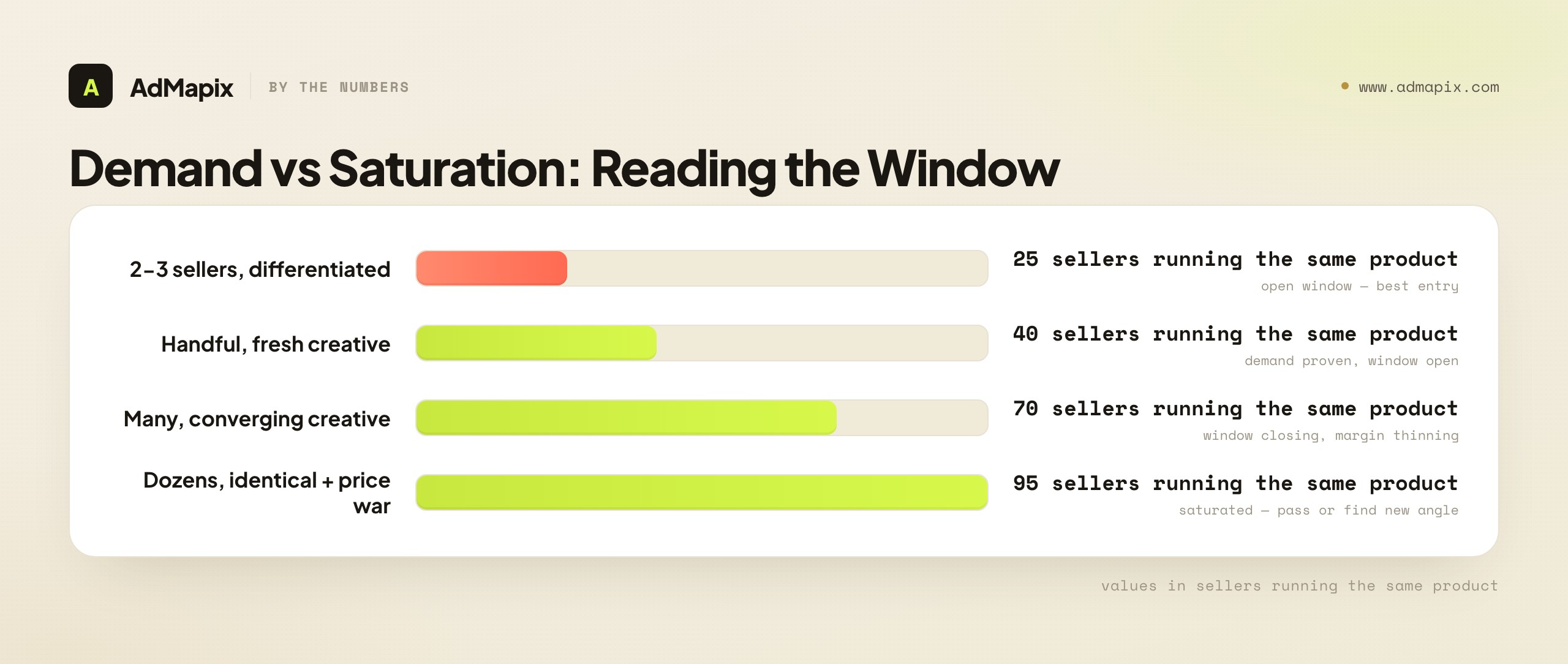
- How many sellers are running it, and for how long? A handful of sellers on a fresh product is an open window. Dozens of sellers all running near-identical creative on a product that's been live for months is a saturated market where margins have been competed away.
- How differentiated is the creative? Early in a product's window, sellers experiment with angles. Late in the window, everyone has converged on the same hook, the same offer, the same advertorial — convergence is a saturation tell.
- Is the offer escalating? When sellers start competing on price — deeper discounts, more aggressive bundles, bigger guarantees — the margin is being competed away, a clear late-window signal.
- Are the ads new or recycled? A flood of brand-new creative on a product signals an opening window or a re-emergence; a landscape of stale, long-running ads with no new entrants signals a window that's closing or a stable, defensible niche.
The strategic synthesis: the ideal entry is a product with enough repetition to prove demand but not so much that the market is saturated and the margin is gone. A product two or three sellers are quietly scaling with differentiated creative is a far better opportunity than one fifty sellers are all running with identical ads and escalating discounts. The saturation read is where dropshipping research earns its keep — it's the difference between catching a wave and paddling out after it's already broken. When you find a saturated product, the right move is usually to pass, or to find a genuinely new angle the saturated sellers haven't tried, rather than entering a price war you can't win on thin margins.
Reading Supplier and Fulfillment Risk in a Competitor's Ad
The delivery promise in a competitor's ad is a fulfillment-risk signal unique to dropshipping research, and reading it correctly stops you from making a promise your supply chain can't keep. Because dropshippers don't control fulfillment, the shipping promise is both a competitive expectation you have to meet and a trap that kills accounts when you can't.
What the delivery and fulfillment signals tell you:
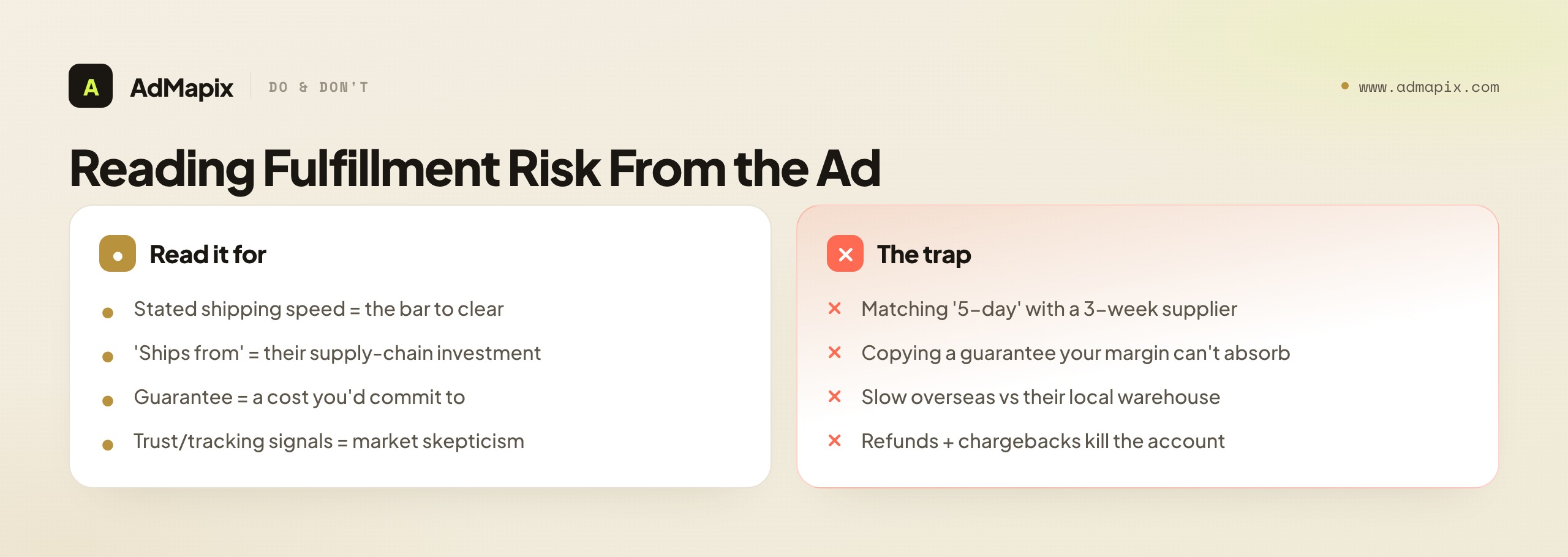
- The stated shipping speed. If competitors all promise "ships in 5-7 days," that's the expectation buyers now hold — and if your supplier ships in three weeks, you either solve the supply chain (a domestic or faster supplier, a 3PL) or you don't enter, because the gap between promised and actual shipping is the number-one source of refunds and chargebacks in dropshipping.
- The "ships from" location. A competitor advertising local or domestic shipping has invested in a faster supply chain (a local warehouse, a 3PL, or a domestic supplier). If you're sourcing the same product from a slow overseas supplier, you can't match their promise — and competing on a worse fulfillment experience is a losing position regardless of creative.
- Return and guarantee language. A "30-day money-back guarantee" sets a return expectation; if your margins or supplier terms can't absorb the resulting return rate, matching that guarantee is a margin trap. Read the guarantee as a cost you're committing to, not just a conversion lever.
- Trust and tracking signals. Competitors emphasizing tracking, fast support, or shipping transparency are responding to the trust deficit dropshipping carries; the level of trust-signaling tells you how skeptical the market for this product already is.
The discipline that protects you: before you test a product, confirm you can actually fulfill the delivery promise the market expects, because matching a competitor's "5-day shipping" with a 3-week supplier doesn't just hurt conversion — it generates refunds, chargebacks, and the account suspensions that end dropshipping businesses. The competitor's delivery promise isn't just a creative element to copy; it's a fulfillment bar you have to clear before you have any business entering the product at all. This is the dropshipping-specific risk the brand-focused ecommerce hub and Shopify guide don't have to weigh as heavily, because brands control their own fulfillment.
Thin-Margin Economics: Why You Can't Copy a Brand's Offer
Every dropshipping competitor's offer makes sense only within their cost structure, and dropshipping's thin margins mean you usually can't copy a funded brand's generous offer without losing money. This is the single most important economic discipline in dropshipping research, because the ad library mixes thin-margin dropshippers with funded brands, and copying the wrong one's offer is how stores go broke on "proven" products.
The economic reads to apply:
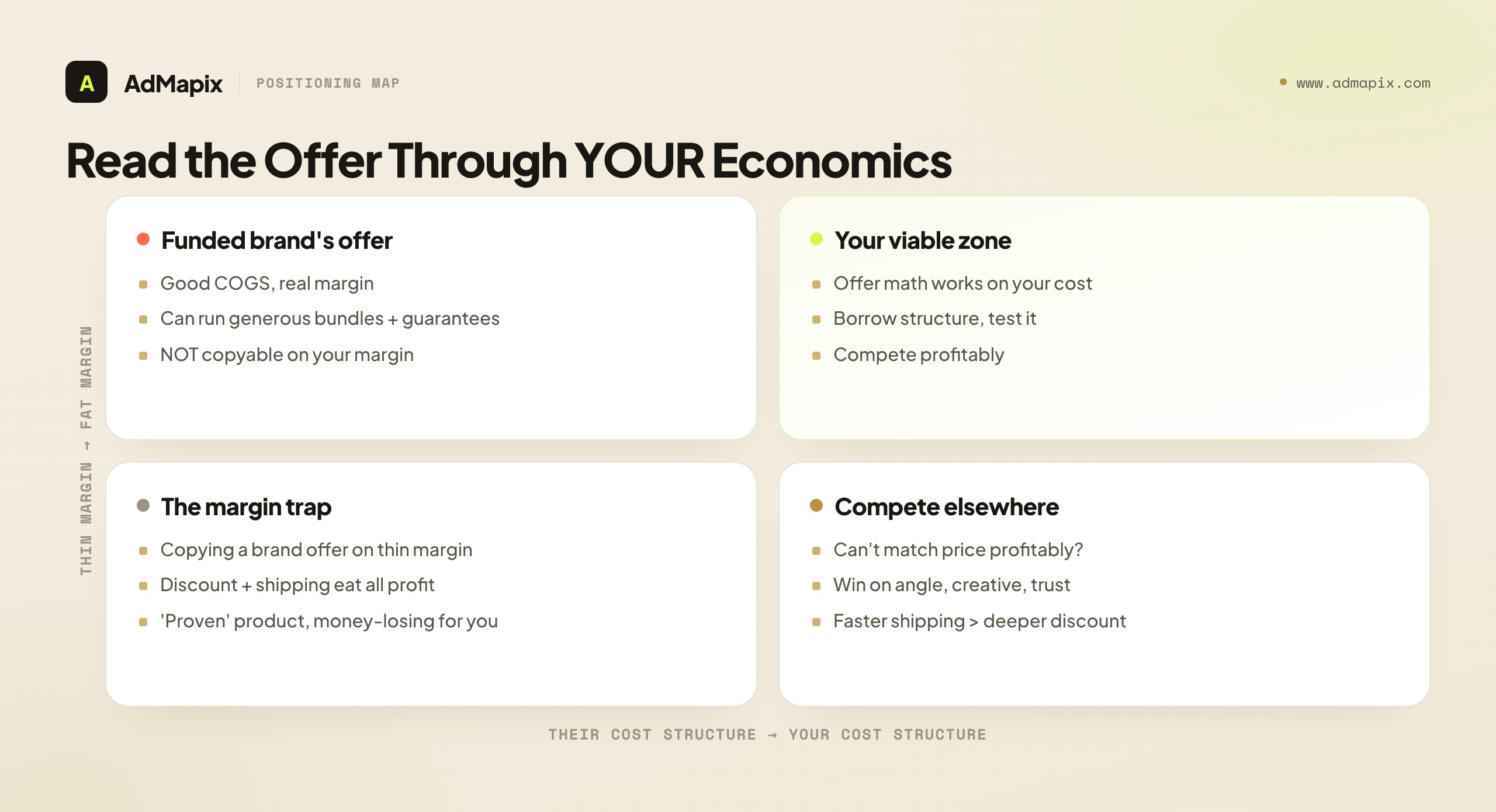
- Is the advertiser a dropshipper or a brand? A funded brand with good COGS and a real margin can run "buy 2 get 1 free, free shipping, 60-day guarantee" profitably. A dropshipper buying the same product at a worse cost, with shipping eating the margin, cannot. The Shopify-footprint reads from the Shopify guide help you tell them apart — a polished brand setup versus a thin generic-theme dropshipping store.
- What does the offer cost in margin? Every discount, bundle, free-shipping promise, and guarantee is a margin commitment. Before you match a competitor's offer, do the math on your cost: source price, shipping cost, ad cost, refund rate, and processing fees. The offer that's profitable for them may be a loss for you.
- What's the realistic refund and chargeback rate? Dropshipping products, especially long-ship ones, carry refund and chargeback rates that quietly destroy margin. A competitor's offer assumes their refund rate; yours may be worse if your fulfillment is slower.
- Can you compete on something other than price? If you can't match a competitor's offer profitably, the answer is usually to compete on a better angle, better creative, or better trust (faster shipping, better support) rather than a deeper discount you can't afford. A price war on thin margins is unwinnable.
The practical rule: read every dropshipping ad through your economics, not the advertiser's, and borrow the offer structure as a hypothesis to test against your real cost — never clone the offer outright. A competitor's "proven" offer is only proven for their cost structure; on your thinner margin, the same offer can turn a winning product into a money-loser. The math, not the creative, is what decides whether you can actually compete.
The Hooks Dropshipping Runs On
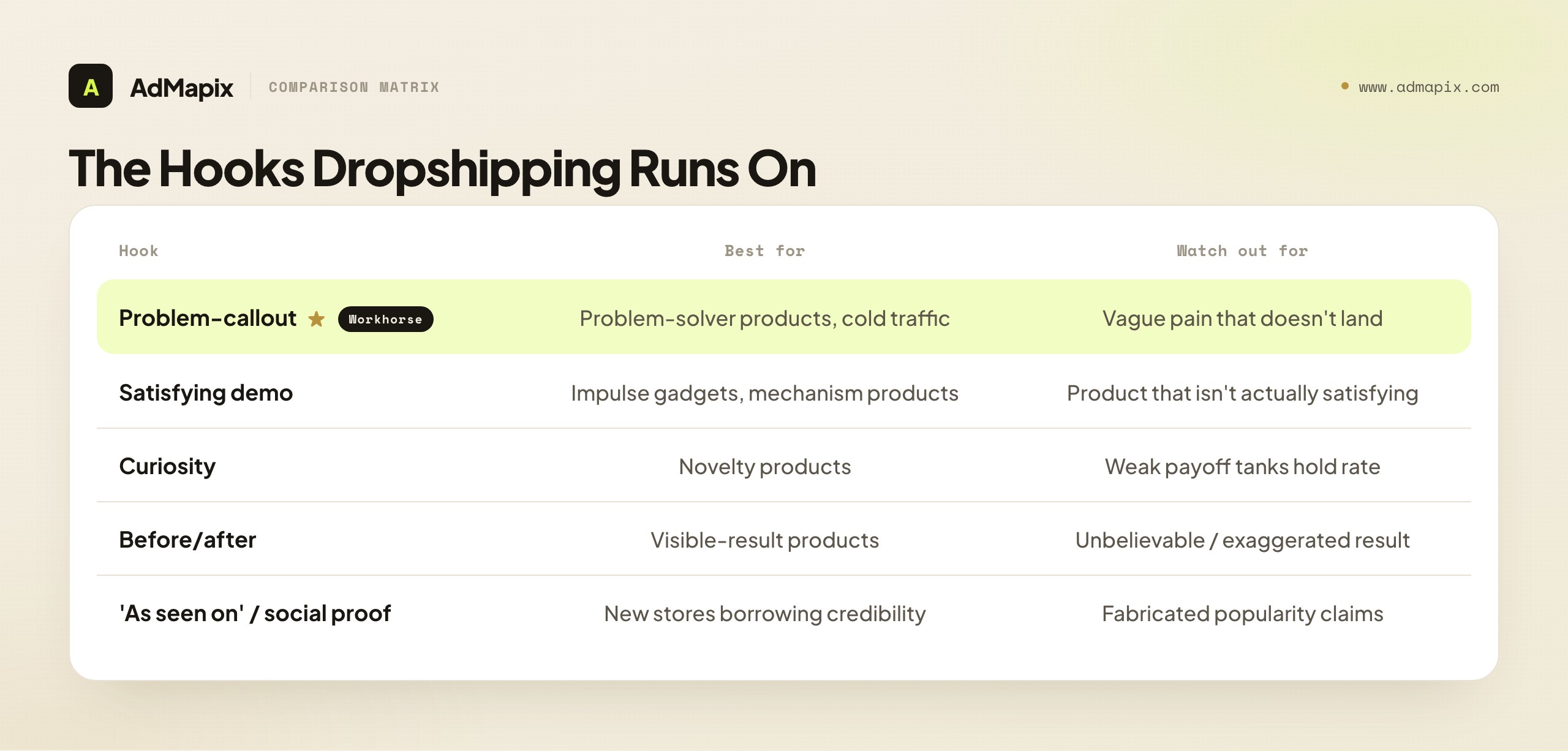
Dropshipping creative leans on a specific set of hooks because the model lives on impulse and curiosity, so knowing the dropshipping hook patterns lets you read a competitor's creative fast and pick the angle to test. While the universal hook patterns from our ad hook examples guide all appear, dropshipping over-indexes on a few because they suit impulse products and cold traffic.
The hooks that dominate dropshipping creative:
- The problem-callout. Opens on a relatable, visible frustration ("still doing X the hard way?") then reveals the product as the fix. The workhorse for problem-solver products, because it manufactures the need for a cold audience that didn't know they wanted the product.
- The satisfying demonstration. Leads with the product doing its satisfying thing — the mechanism, the transformation, the oddly-pleasing result. Works for impulse gadgets where the feel of the product is the pitch.
- The curiosity hook. "Why is everyone buying this?" or an unusual mechanism that opens a loop. High-risk, high-reward, and common in dropshipping because novelty products earn the scroll-stop on curiosity alone — but it punishes a weak payoff hard.
- The before/after transformation. Visible-result products (beauty, fitness, cleaning) leading with the after-state. Strong proof-and-desire in one, when the result is genuinely impressive.
- The "as seen on" / social-proof open. Leveraging perceived popularity ("trending," "viral," "10,000 sold") to borrow credibility a new dropshipping store doesn't have on its own.
The strategic read: when you study a competitor's dropshipping creative, identify which hook they're running and whether it fits the product type — a problem-solver should usually lead problem-callout, an impulse gadget should lead satisfying-demonstration or curiosity. A hook-product mismatch in a competitor's ad (a curiosity hook on a product that needed a clear problem-callout) is a gap you can exploit by running the right hook for the product. And because dropshipping creative fatigues even faster than brand creative, the hook you test should be the one that fits the product, not just the one the saturated sellers have all copied.
The Landing Page: Where Dropshipping Ads Actually Convert
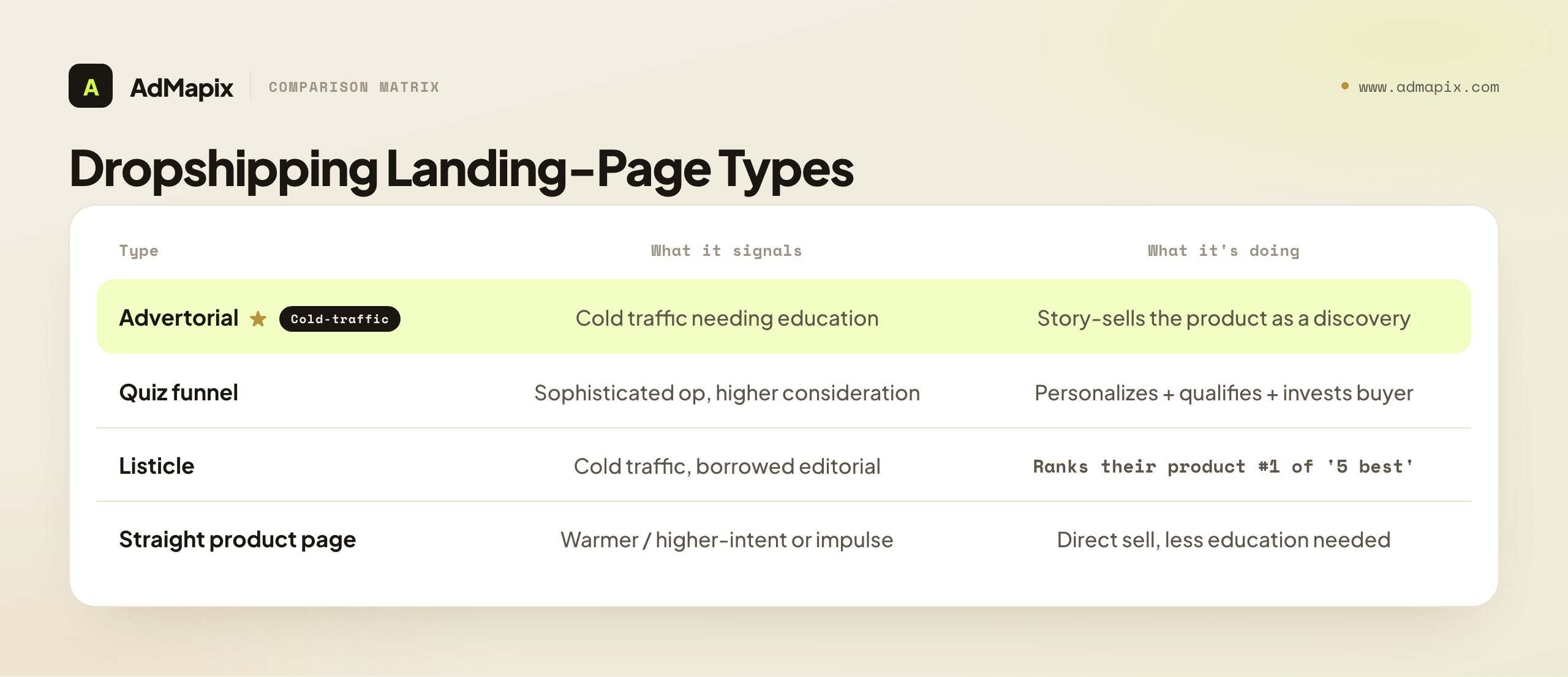
In dropshipping the landing page frequently carries more of the conversion than the ad, so studying the destination — advertorial, quiz, listicle, or product page — is non-negotiable, because that's where the offer is reframed and objections are handled. Skipping the landing page means copying the easy half (the creative) and missing the half where the sale is actually made.
The dropshipping landing-page types and what each signals:
- The advertorial. An "article" that tells a story, builds the problem, and presents the product as the discovery — a cold-traffic education funnel. When a competitor uses an advertorial, they're running cold traffic that needs education before it'll buy, and the advertorial is doing the heavy selling the ad only teased.
- The quiz funnel. A few questions that "personalize" a recommendation toward the product, building investment and qualifying the buyer. Signals a sophisticated operator and a higher-consideration product.
- The listicle. A "top 5 products for X" that conveniently ranks the advertiser's product first. A classic cold-traffic dropshipping play that borrows editorial credibility.
- The straight product page. A direct product page signals warmer or higher-intent traffic, or a simpler impulse product that doesn't need education.
The strategic synthesis is the same leak-hunting logic as the ecommerce hub, sharpened for dropshipping: when you find a competitor running a strong ad into a slow, mismatched, or friction-heavy landing page, you've found a gap you can out-execute. But dropshipping adds a structural lesson — copy the landing-page form, not its content. The advertorial structure, the quiz mechanic, the listicle frame are reusable approaches; the specific copy, the fabricated claims, and the borrowed footage are not yours to take and often not legal to reuse. Study the destination to learn how cold dropshipping traffic gets converted, then build your own honest version of the structure that works.
A Pre-Test Workflow You Can Repeat
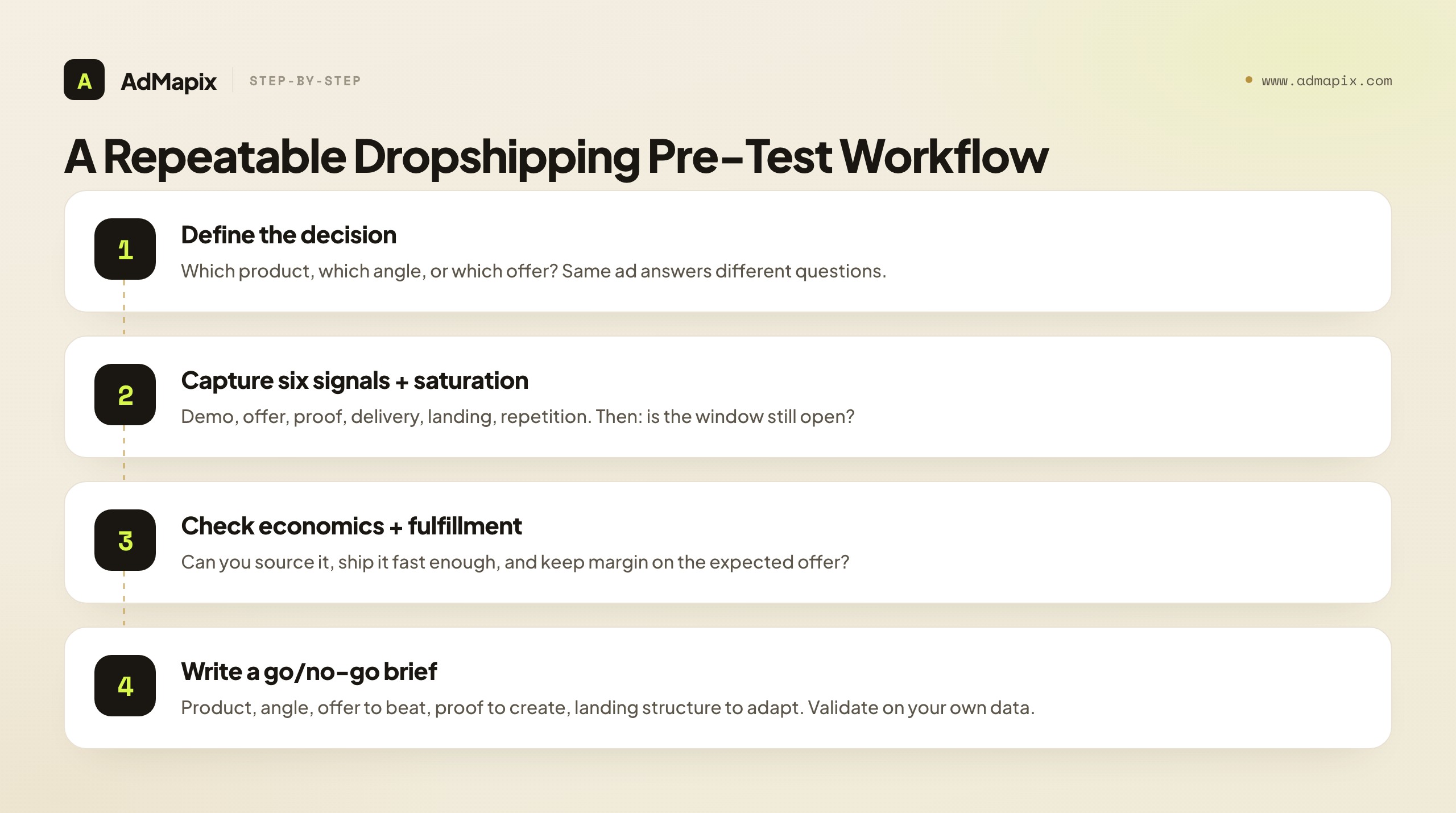
The workflow below turns scattered competitor ads into a decision. Each step produces an artifact you can act on, not just a saved screenshot.
- Define the decision first. Are you deciding which product to test, which angle to lead with, or which offer to run? The same ad answers different questions depending on the decision.
- Check platform context. Shopify's Facebook ad examples guide frames ecommerce ads around product visuals, offers, audience fit, landing pages, and creative testing — use it as the lens for what to read in each ad.
- Capture the six signals. For every saved ad, record the product demo, offer, proof, delivery promise, landing destination, and repetition count.
- Read demand AND saturation. Repetition proves demand, but too much repetition for too long proves saturation. Decide whether the window is open before you go further.
- Separate fact from hypothesis. "The ad uses a before/after hook" is a fact. "This product is profitable" is a hypothesis you still have to test.
- Check your economics and fulfillment. Before testing, confirm you can source the product, hit a comparable delivery promise, and keep margin after the offer the market expects. Shopify's start dropshipping guide covers finding suppliers and store setup for this step.
- Write the test brief. Convert the pattern into a shortlist: product, lead angle, offer to match or beat, the proof you'll create, and the landing structure you'll copy in form (not content).
The dropshipping-specific discipline layered on top of the universal workflow is steps 4 and 6 — the saturation read and the fulfillment check. A product can pass the demand test and still fail the saturation test (the window's closed) or the fulfillment test (you can't ship it fast enough), and both failures are cheaper to discover in research than in a spent test budget. Most dropshippers skip these two checks and pay for the lesson in burned ad spend.
What Public Ad Data Can and Cannot Prove
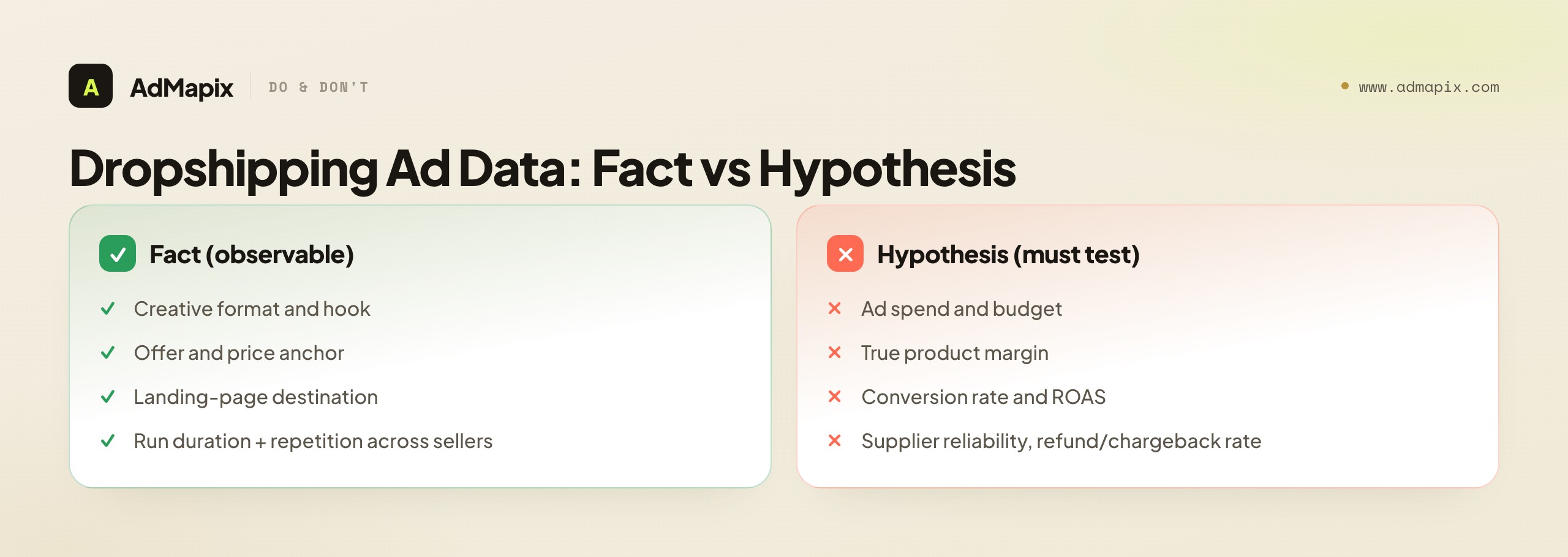
Public ad libraries prove that an ad exists, ran, and used a specific creative, offer, and landing path. They don't prove that the ad is profitable. This distinction matters more in dropshipping than almost any other niche, because a high-margin-looking offer can still lose money on a long-ship product with a high refund rate.
| Public ads CAN show | Public ads CANNOT show |
|---|---|
| Creative format and hook | Ad spend or budget |
| Offer and price anchor | True product margin |
| Landing-page destination | Conversion rate or ROAS |
| Run duration / repetition | Supplier reliability and lead time |
| Stated shipping promise | Actual refund and chargeback rate |
The practical rule: treat an ad that has run a long time and is repeated by many sellers as a strong demand signal, but never assume the economics carry over to your supplier and your shipping times. Repetition is the closest free proxy for demand you have, and run duration is the closest free proxy for "this is working for someone" — but neither proves your economics work. Validate margin and fulfillment separately before you call a product "proven," because the gap between a public demand signal and your private unit economics is exactly where dropshippers lose money on "validated" products.
Common Dropshipping Ad Spy Mistakes
- Cloning the ad and ignoring the math. A competitor's creative doesn't make their margin yours. Long shipping times and supplier costs can erase the offer you copied.
- Treating a single fresh ad as validation. One new ad is noise. A pattern repeated across many sellers over weeks is signal.
- Confusing demand with an open window. A product fifty sellers already run with identical ads is saturated, not validated; reading saturation is as important as reading demand.
- Promising a delivery speed you can't keep. Matching a competitor's "ships in 5 days" with a 3-week supplier creates refunds and chargebacks that kill the account, not just the campaign.
- Saving ads without notes. An asset with no URL, date, offer, delivery promise, and landing destination is a screenshot, not evidence — you won't remember why you saved it.
- Skipping the landing page. The ad gets the click; the advertorial, quiz, or product page gets the sale. If you only study creatives, you miss where conversion actually happens.
- Copying a brand's offer on a dropshipper's margin. A funded brand's generous offer is a margin trap on thin dropshipping economics; read every ad through your own cost.
A Worked Teardown: One Dropshipping Product, Go or No-Go
Principles stick when applied, so here's how a single competitor product reads through the full pre-test filter, ending in a go/no-go. Say you find a posture-corrector product running across Meta and you're deciding whether to test it.
Product signal. The ad opens on someone slouched at a desk (visible problem), then shows the corrector and a straightened posture (visible result). It's demonstrable in three seconds, solves a relatable problem, and is impulse-friendly. Product signal: go — this is a showable, problem-solving product that fits the format.
Repetition and saturation. You search the product across the ad library. You find dozens of sellers running near-identical creative — the same slouch-to-straight hook, the same "50% off today," the same before/after — and many ads have been live for months. Worse, the offers are escalating (60% off, buy-2-get-1, free corrector with purchase). This is the critical read: saturation. The product has clear demand, but the window is closed — dozens of sellers have converged on identical creative and are now competing on price, which means margin has been competed away. Saturation signal: strong caution.
Delivery and fulfillment. Several competitors advertise "ships in 5-7 days" and "ships from US warehouse." You check your sourcing: the only supplier you can find ships from overseas in 2-3 weeks. You cannot match the delivery promise the market now expects, which means refunds, chargebacks, and angry buyers comparing your shipping to the faster competitors. Fulfillment signal: no-go unless you solve the supply chain.
Economics. The market offer is now "60% off + free shipping." On your sourcing cost plus overseas shipping plus the refund rate a 3-week ship will generate, that offer is a money-loser. The funded sellers with US warehouses and bulk pricing can run it; you can't. Economics signal: no-go on the current offer.
The decision. Three of five signals say no: the product is saturated, you can't match the delivery promise, and the expected offer is unprofitable on your economics. The go/no-go is no-go — not because the product is bad (it clearly has demand), but because the window is closed and your fulfillment and margin can't compete with the entrenched sellers. The pre-test filter just saved you a test budget you'd have lost. This is the filter working: a product that looks "proven" by demand is a trap once you read saturation, fulfillment, and your own economics. The right move is to keep looking for a product with demand but an open window and a fulfillment path you can actually win.
The Dropshipping Creative Lifecycle and Why Speed Matters
Dropshipping creative and products move faster than almost anything in ecommerce, so understanding the lifecycle tells you how to read a competitor's timing and how fast you have to move. A dropshipping product has a window — it opens when a few sellers find it, widens as demand proves out, and closes as the market saturates and margins compress — and reading where a product sits in that window is the core of the timing decision.
The lifecycle reads that matter:
- A product with a few sellers and fresh, differentiated creative is early. This is the open window — demand is proving out but the market isn't crowded, so margins are intact and there's room to enter with a good angle.
- A product with growing seller count and converging creative is mid-window. Demand is strong but competition is building; you can still enter, but you need a genuinely better angle or a fulfillment edge, not just another identical ad.
- A product with many sellers, identical creative, and escalating discounts is late. The window is closing; entering now means a price war on thin margins you can't win. Pass, or find a new angle the saturated sellers haven't tried.
- New-ad velocity is the timing signal. A flood of brand-new creative on a product signals an opening or re-emerging window; a landscape of stale, long-running ads with no new entrants signals either a closed window or a stable niche.
The speed lesson is structural to dropshipping: because windows close, the operators who win move fast on the products in their open window and pass quickly on the saturated ones. The research isn't a leisurely competitive-intelligence practice (as it can be for a brand) — it's a fast, repeated filter that has to keep pace with how quickly dropshipping products cycle. Most dropshippers lose money not on bad products but on late products: catching a wave after it's already broken because they read demand without reading the window. Reading the lifecycle is what keeps your timing on the right side of the curve.
Dropshipping Ad Research by Product Category
The pre-test filter is universal, but the patterns shift by product category, so reading a competitor through their category tells you which signals to weight and which windows move fastest. Dropshipping spans distinct product types, each with its own creative, hook, and saturation rhythm.
- Impulse gadgets. Fast windows, curiosity and satisfying-demo hooks, low consideration, and rapid saturation — these spike and crash quickly, so timing and speed matter most. The novelty that makes them work also makes the window short.
- Problem-solver products. Longer windows and more stable demand, problem-callout hooks, and a need for credible proof because the buyer wants to believe the fix works. More forgiving on timing, more demanding on trust.
- Beauty and personal care. Before/after and UGC-demonstration hooks, heavy proof requirements (skepticism is high), and frequent subscription/replenishment angles from the more sophisticated sellers. Long windows for genuine performers, but proof is the gate.
- Home and kitchen. Demonstration hooks (the product solving a household annoyance), bundle offers, and education-heavy landing pages. Moderate windows, with the landing-page experience mattering more than in pure impulse categories.
- Pet products. Strong emotional and desire-led hooks, high impulse, and durable demand because the audience is committed — a category with more stable windows but intense competition.
The strategic use: read a competitor's product against its category's defaults, then weight the filter accordingly. For an impulse gadget, weight saturation and speed heaviest (the window is short); for a problem-solver or beauty product, weight proof and fulfillment heaviest (the buyer is skeptical and the relationship is longer). Reading the category tells you which of the six signals will make or break the go/no-go before you even score the ad in detail.
A Weekly Dropshipping Research Workflow
The whole pre-test research system runs in well under an hour a week, and for dropshipping the cadence matters more than for any other model because product windows close fast — research that lags the market by weeks means chasing saturated products. Weekly (or even more often for fast-moving niches) is the right resolution.
| Day / step | Focus | Action | Output |
|---|---|---|---|
| Monday — scan | New products + windows | Check the ad library for new products and new sellers in your niche | Fresh products + window reads logged |
| Wednesday — validate | The go/no-go | Run the six-signal filter on the top candidates; check fulfillment + economics | A shortlist of genuine go's |
| Friday — brief | The test | Write the go/no-go and a test brief for each green-lit product | Test backlog with product, angle, offer |
Three rules keep the loop honest, sharpened for dropshipping. First, read the window, not just the product — a product that passes the demand test can still fail the saturation test, and catching that in the Monday scan saves a wasted test. Second, always check fulfillment before economics before creative — there's no point perfecting a hook for a product you can't ship fast enough to sell, so the fulfillment gate comes first. Third, end on a go/no-go, not a folder — the deliverable is a decision (test this product with this angle and offer, or pass), because in dropshipping the cost of not deciding is a closed window. A dropshipper running this loop weekly stays on the open side of product windows while competitors chase saturated trends.
Building a Searchable Dropshipping Swipe Library
A folder of saved dropshipping ads is where good research goes to die — and in dropshipping it dies fast, because the products it holds saturate quickly. The asset that compounds is a searchable, tagged swipe library where every entry is scored on the six signals plus a window read, so it becomes a go/no-go in minutes and you can track how products move through their lifecycle over time.
Every entry should capture: source URL, date, and seller; the product and its demo angle; the offer and price anchor; the proof type; the delivery promise and ships-from; the landing-page type; the repetition (how many sellers, how long); a window read (early / mid / late / saturated); and a status (watching → tested → result). The two fields that make this a dropshipping library are the window read (is the opportunity still open?) and the fulfillment note (can you actually ship it?) — the first tells you about timing, the second about feasibility, and together they decide more go/no-go calls than the creative does.
The time-series value is uniquely important in dropshipping. Because you log products with dates and window reads, you can watch a product move from early to saturated across weeks — which teaches you the shape of windows in your niche and helps you recognize an opening window faster next time. A product you watched saturate is a lesson in timing; a product you caught early and tested is a win. Over a few months, the library becomes a map of how products cycle in your category, which is worth more than any single product find, because it sharpens the timing instinct that separates profitable dropshippers from the ones perpetually one step behind the wave.
Tools, Free Methods, and Staying Legal
You don't need to buy anything to start dropshipping ad research, and you shouldn't over-buy. The free foundation covers most of what a solo operator needs: the Meta Ads Library shows the active ads competitors run (the primary dropshipping research surface), the TikTok Creative Center surfaces trending products and ads, and a spreadsheet holds your tagged swipe library with its window reads. The most valuable dropshipping-specific reads — saturation (search the product, count the sellers, check run duration) and fulfillment (click through, read the delivery promise, check the ships-from) — cost nothing and require no tool. That manual saturation-and-fulfillment read is the dropshipping edge, and it's free.
A paid cross-network tool earns its place when manual collection stops scaling — when you're scanning multiple niches across channels every week, need searchable history to track how products move through their windows, or want to brief a team without re-doing the research. For the full landscape, see the best ad spy tools in 2026 roundup and the universal framework in the ecommerce ad spy hub. The trap is the same one the hub warns about: no tool reads saturation, checks your fulfillment, or runs your margin math for you — that's the analysis, and it's the whole edge.
One discipline that protects you legally as much as financially: borrow structure, never assets. The product angle, the offer logic, the hook pattern, the advertorial form are approaches you can adapt; a competitor's actual footage, photography, copy verbatim, fabricated claims, and trademarks are not yours to reuse and often not legal to. Dropshipping has a particular temptation here because the products are interchangeable and the creative is easy to rip — but reusing a competitor's exact creative isn't research, it's appropriation, and the fabricated-claim advertorials some sellers run are a legal liability you don't want to inherit. Build your own honest version of the structure that works, and your research stays clean competitive intelligence rather than a copyright and false-advertising risk.
Reading a Competitor's Full Dropshipping Funnel
The ad is only the entry point, and a complete dropshipping read follows the whole funnel — ad to landing page to upsell to post-purchase — because that's where the competitor either makes the unit economics work or quietly loses money. Studying the ad alone gives you the hook; studying the full funnel gives you the business model, which is what actually decides whether the product is viable on your economics too.
What to read across the full funnel:
- The ad-to-landing handoff. Does the offer and angle continue cleanly into the landing page, or is there a message-match gap that bleeds the click? A strong ad into a mismatched advertorial is a leak you can out-execute.
- The landing-page sell. On the advertorial, quiz, or product page, how does the competitor reframe the offer, stack the proof, and handle objections? This is where most of the dropshipping conversion work happens, and where you learn how cold traffic gets converted for this product.
- The upsell and AOV play. Watch for cart-drawer upsells, post-purchase offers, and bundles — because dropshipping margins are thin, the upsell is often where the competitor actually makes the order profitable. A competitor with a strong upsell stack can afford a front-end offer you can't match on a single-product sale, which is a crucial economic read.
- The post-purchase and retention signals. Subscription options, follow-up offers, and "complete your order" flows reveal whether the competitor is playing for repeat purchases (which funds a more aggressive acquisition offer) or running a pure one-time-sale model (thinner economics, more dependent on the front-end margin).
The strategic synthesis: a competitor's front-end offer only makes sense in the context of their full funnel economics. A seller running a "free product, just pay shipping" offer is probably making the money on a post-purchase upsell or a subscription, not the front-end sale — and copying their free-product offer without their back-end is a guaranteed loss. Reading the full funnel is how you avoid the most expensive dropshipping mistake: matching a competitor's front-end offer while missing the back-end that makes it profitable. The full-funnel read turns a confusing "how can they possibly afford that?" offer into a readable economic model you can decide whether to match.
Where Dropshipping Opportunities Actually Hide
The best dropshipping opportunities aren't the products everyone is already running — they're the ones with proven demand but an open window or an unexploited angle, and competitor research is how you find them. The instinct to chase whatever's "trending" leads straight into saturated markets; the discipline of reading windows and gaps is what surfaces the genuine opportunities.
Where the openings tend to be:
- A proven product entering a new geo or audience. A product saturated in the US market may have an open window in another region where few sellers have brought it yet. The demand is validated; the local competition isn't there yet.
- A proven product with an unexploited angle. When every seller runs the same problem-callout on a product, the desire-led or curiosity angle nobody's tried may be an opening — same validated product, differentiated entry.
- An adjacent or improved product. A variant, a bundle, or an upgraded version of a saturated product can reset the window — you're riding the proven demand for the category while sidestepping the saturated exact-match competition.
- A product early in its window in an underserved niche. The pet, hobby, and specialty niches often have proven products with fewer sellers than the mainstream gadget categories, where the window stays open longer because the audience is smaller and less contested.
The strategic move is to use competitor research not to find what's popular (popular usually means saturated) but to find what's proven but not yet crowded — the gap between validated demand and open competition. That gap is where dropshipping margins live, and reading it well is the difference between entering a market and entering a price war. A disciplined operator scanning for open windows and unexploited angles consistently finds better opportunities than one chasing the trending products everyone else has already piled into.
This is the through-line of the entire dropshipping research practice: every signal in the pre-test filter — product, saturation, fulfillment, economics, hooks, landing pages, full funnel — feeds one decision, which is whether to spend a test budget or pass. The operators who win aren't the ones who find the most products; they're the ones who say no fastest to the saturated, unfulfillable, and unprofitable ones, so their test budget only ever touches products with a real chance. Competitor ads are the cheapest, fastest filter you have for making that call before the money is spent — and used as a filter rather than a copy machine, they're the single highest-leverage tool in a dropshipper's research stack.
When to Use AdMapix
AdMapix is for dropshippers and media buyers who do this research every week and want it searchable instead of scattered across tabs. Use Search AdMapix to find product ad creatives across networks, Media to save the winning examples, Video Analysis to break down the hook, pacing, and demo in video ads, and Reports to turn a batch of ads into a shareable test backlog. Pricing compares access for solo store owners, in-house teams, and agencies.
It's not the right tool if you only need to look up one ad once, or if you want a guarantee that a product will be profitable — no ad library can promise that, because margin and fulfillment live in your supplier, not in the creative. AdMapix sits in the cross-network creative-intelligence slot: it removes the manual collection so your time goes to the saturation read, the fulfillment check, and the test brief that actually decide a product. When the research becomes a recurring loop, teams can start from Login.
FAQ
What is a dropshipping ad spy tool?
It's a tool that lets you search and save the ad creatives competitors are running so you can study product angle, offer, proof, and landing pages before you test. For dropshipping it works best as a pre-test filter that validates demand, saturation, and offer expectations — not as a way to copy a competitor's ad verbatim. The goal is a go/no-go decision, not a screenshot folder.
Can a spy tool tell me if a product is profitable?
No. It can show that an ad ran, how long, what offer it used, and where it sent traffic. It can't show spend, conversion rate, ROAS, true margin, or supplier lead time. Profitability depends on your sourcing and shipping, which you have to validate separately — the gap between a public demand signal and your private economics is exactly where dropshippers lose money.
How do I know a product is a real trend and not a one-off?
Look for repetition over time. A product angle run by many independent sellers, with ads that have stayed live for weeks, is a stronger demand signal than a single fresh ad. But also read saturation: dozens of sellers all running identical creative on a months-old product is a closed window, not an open one. Capture the run duration and the number of sellers using the same hook.
How do I tell if a product is already saturated?
Saturation shows up as many sellers running near-identical creative, converged on the same hook and offer, with escalating discounts (a sign margin is being competed away) and few new entrants. The ideal entry is enough repetition to prove demand but not so much that the market is crowded and the margin is gone. A product two or three sellers are quietly scaling with differentiated creative beats one fifty sellers are all running.
Why does the delivery promise in a competitor's ad matter?
Because it's the fulfillment bar you have to clear. If competitors promise "ships in 5-7 days" and your supplier takes three weeks, the gap creates refunds, chargebacks, and account suspensions that end the business — not just the campaign. Read the delivery promise and the "ships from" location as a supply-chain requirement, and confirm you can actually meet it before you test the product.
Can I copy a competitor's offer?
Only if your economics match theirs. A funded brand with good COGS can run a generous offer that's a margin trap for a thin-margin dropshipper buying the same product at a worse cost. Borrow the offer structure as a hypothesis, then do the math on your own source price, shipping, ad cost, and refund rate before matching it. If you can't match it profitably, compete on angle, creative, or trust instead of a discount you can't afford.
Why does the landing page matter as much as the ad?
Because in dropshipping the landing page often carries the conversion: an advertorial, quiz, or product page reframes the offer and handles objections the ad can't. If you study only the creative and skip the destination, you copy the easy part and miss where the sale is made. Copy the landing-page form (the advertorial structure, the quiz mechanic) — not its specific copy, claims, or footage, which aren't yours to reuse.
What should each saved ad include?
Save the source URL, the date, the product demo, the offer and price anchor, the proof type, the stated delivery promise, the landing-page destination, and how often the pattern repeats across sellers. Those fields let the ad become evidence for a test brief instead of a forgotten screenshot — and the delivery promise and repetition count are the dropshipping-specific fields that decide fulfillment risk and saturation.
How is dropshipping ad research different from brand ad research?
A brand is building long-term equity, so its research is an ongoing competitive-intelligence practice; a dropshipper is racing to validate and scale a product before the window closes, so its research is a fast pre-test filter. Dropshipping research weighs saturation, supplier/shipping risk, and thin-margin economics far more heavily, because the model can't absorb a bad product test the way a funded brand can. See the ecommerce hub and Shopify guide for the brand-focused angles.
How do I turn dropshipping competitor ads into a test decision?
Run the six-signal filter, read demand against saturation (is the window open?), check that you can fulfill the delivery promise and keep margin on your economics, then write a go/no-go: product, lead angle, offer to match or beat, proof to create, and landing structure to adapt. The competitor ads generate the hypotheses; your own margin, fulfillment, and test data make the decision — those are the only numbers you can trust.
Related Reading
- Ecommerce Ad Spy Tools: The Complete Guide — the hub with the universal capture framework this guide builds on.
- Shopify Ad Spy Tools: Researching Shopify Store Ads — reading the Shopify funnel and app stack behind a dropshipping store.
- Find Winning Products in the Facebook Ads Library — product validation through the Meta Ad Library.
- Ad Hook Examples: 7 First-3-Second Patterns — the opener craft behind every impulse dropshipping ad.
- Spy on TikTok Ads for Ecommerce — the TikTok-specific research workflow for impulse and discovery products.
- Best Ad Spy Tools in 2026 — the full landscape of research tools.
Sources
- Shopify: Dropshipping guide — frames the model around suppliers, products, storefronts, marketing, and customer experience.
- Shopify: How to start dropshipping — covers finding products, suppliers, store setup, and marketing.
- Shopify: Facebook ad examples — frames ecommerce ads around product visuals, offers, audience fit, landing pages, and creative testing.
- Meta Ads Library — the free public archive of active ads across Facebook and Instagram, the primary surface for studying dropshipping ads.
Official sources checked as of June 21, 2026. Platform docs and ad formats change, so verify current URLs before relying on a claim. AdMapix surfaces public ad creatives across networks; it does not expose advertiser spend, margin, supplier data, or conversion data, which remain private.
Turn these observations into your next creative study
Open the creative library and select samples for your market, network and research question.
Related Articles

Agency Ad Intelligence Tools in 2026: Turning Competitor Research Into Client Reports
A 2026 guide to ad intelligence for agencies — how to standardize competitor research across a client portfolio, the fixed capture field list and weekly workflow that survive staff turnover, how to structure a recurring client report, white-label and deliverable considerations, using competitor research to win new business and prove retainer value, the cross-client pattern advantage only agencies have, team roles and scaling, packaging research as a billable service, and the public-data.
TikTok Shop GMV Max Ads 2026: Competitor Creative, Product & Offer Research
A 2026 guide to TikTok Shop GMV Max ads — what GMV Max automates, why it shifts competitive research from bids to creative and offer, a five-signal capture framework, a weekly research workflow, what public ad data can and cannot prove, and where a cross-network creative-intelligence layer like AdMapix fits.
Ecommerce Ad Spy Tools in 2026: The Complete Guide to Researching Competitor Product Ads
A complete 2026 guide to ecommerce ad spy tools — what to capture from every competitor product ad, the five-signal framework that turns screenshots into a test backlog, platform-by-platform coverage across Meta, TikTok, Google and native, a DTC creative-research workflow, offer and proof teardowns, landing-page and funnel analysis, how to choose between free ad libraries and cross-network tools, and what public data can and can't prove.