
Agency Ad Intelligence Tools in 2026: Turning Competitor Research Into Client Reports
A 2026 guide to ad intelligence for agencies — how to standardize competitor research across a client portfolio, the fixed capture field list and weekly workflow that survive staff turnover, how to structure a recurring client report, white-label and deliverable considerations, using competitor research to win new business and prove retainer value, the cross-client pattern advantage only agencies have, team roles and scaling, packaging research as a billable service, and the public-data.
Agency Ad Intelligence Tools in 2026: Turning Competitor Research Into Client Reports
By the AdMapix Research Team — Updated June 21, 2026
For an agency, an ad intelligence tool is the system that turns one-off competitor screenshots into a repeatable client deliverable: the same evidence is collected the same way for every account, tagged consistently, and rolled up into a recurring report that ties what competitors are running to what you recommend the client do next. The hard part isn't finding a competitor ad — anyone can open a transparency library. The hard part is doing it across ten or twenty clients every week without the quality collapsing, without it living in one person's tabs, and without overclaiming what a public ad actually proves. In 2026, with clients demanding evidence behind every creative recommendation and competitive pressure rising, the agency that systematizes competitor research turns it from an ad-hoc favor into a defensible, billable service. This guide is for performance and creative agencies, media buyers, account strategists, and growth consultants who already do competitor research ad hoc and want to make it a process. By the end you'll have a workflow, a field list, a report structure, and a clear line between what public ad data can and cannot support in a client deck.
We've worked with agencies running competitor research across portfolios of every size, and the pattern is consistent: the agencies that win don't have better access to competitor ads (everyone has the same libraries) — they have a repeatable process that produces the same report shape for every client, survives staff turnover, and ties evidence to a recommendation every cycle. The competitor ad is an input; the billable output is a consistent, decision-driven deliverable. This guide is that process, plus the agency-specific moves — white-label reporting, new-business pitching, retainer-value proof, and the cross-client pattern advantage — that turn research into revenue.
TL;DR — Agency Ad Intelligence in One Screen
- An agency ad intelligence tool should standardize how competitor evidence is collected, tagged, and reported across every client — the value is consistency at scale, not surfacing ads.
- The deliverable is a decision artifact, not a screenshot folder: a recurring client report that ties competitor changes to a recommendation and a next test.
- Standardize the process, not the findings. A fixed field list, a shared tag scheme, and clear ownership are what make research comparable month over month and resilient to staff turnover.
- Agencies have a unique advantage: cross-client pattern recognition. Researching ten accounts in a vertical reveals category-wide patterns no single in-house team can see.
- Competitor research wins new business. A sharp competitive teardown in a pitch is one of the most effective ways to demonstrate value before a contract exists.
- It proves retainer value. A recurring competitor report is visible, recurring evidence that the agency is watching the market — which protects the retainer at renewal.
- Public data proves what ran, never what worked. Keep the boundary explicit in every client-facing claim: prove the creative and offer, label spend and ROAS as inferences you can't see.
Why Agency Research Is a Different Problem
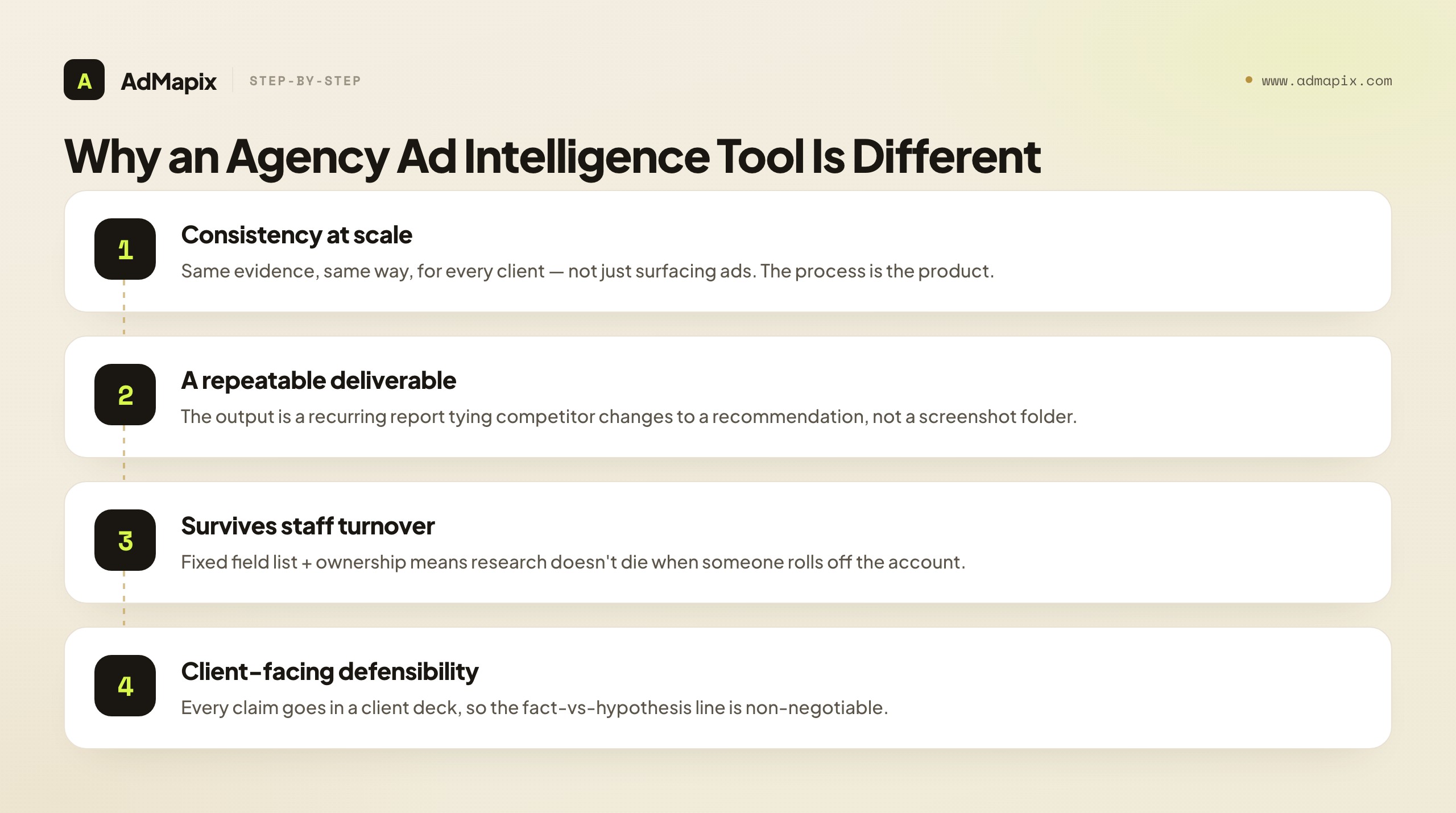
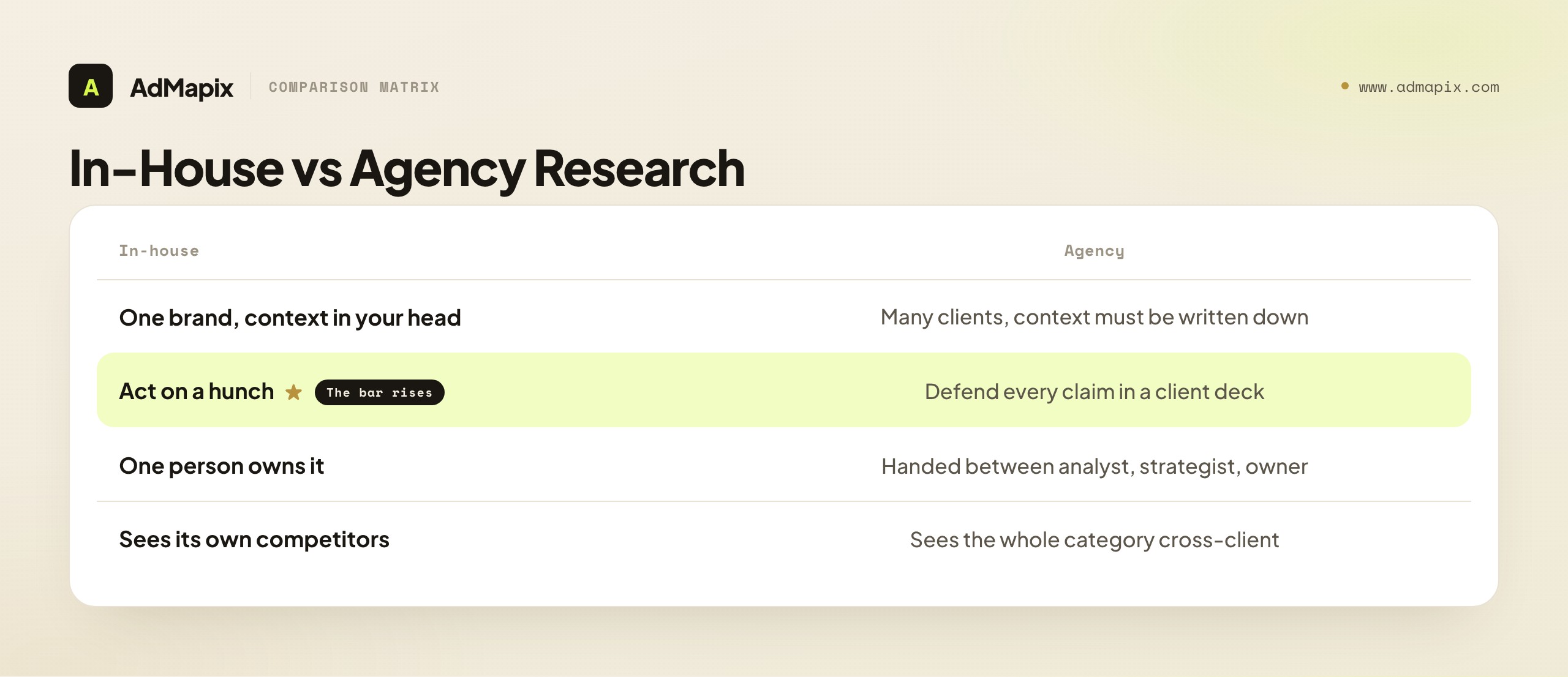
Agency ad intelligence is harder than in-house research because the work has to be uniform across many clients and survive staff turnover. An in-house marketer researches one brand and carries the context in their head. An agency runs the same motion across a portfolio, often handed between an account owner, a media buyer, a creative strategist, and an analyst — so anything that lives in one person's tabs and memory breaks the moment they go on leave or roll off the account.
That's why the unit of work for an agency isn't "a competitor ad" but "a process that produces the same report shape for any client." The competitor ad is an input. The output is a repeatable artifact a client recognizes month over month: what changed, the evidence, and the recommendation. If the format drifts every cycle, the client can't compare it to last month, and the research stops being worth billing for.
There's a second structural difference: an agency's research is client-facing, which raises the bar on defensibility. An in-house marketer can act on a hunch about a competitor; an agency that puts a claim in a client deck has to be able to defend it when the client pushes back. "This is their top-performing ad" is a hunch an in-house team might run with — but in a client report, stated as fact, it's a credibility risk, because no public source proves performance. The agency context forces a discipline most in-house research never needs: a hard line between observable fact and inference, maintained in every deliverable, because the agency's reputation rides on it.
What to Capture for Every Client
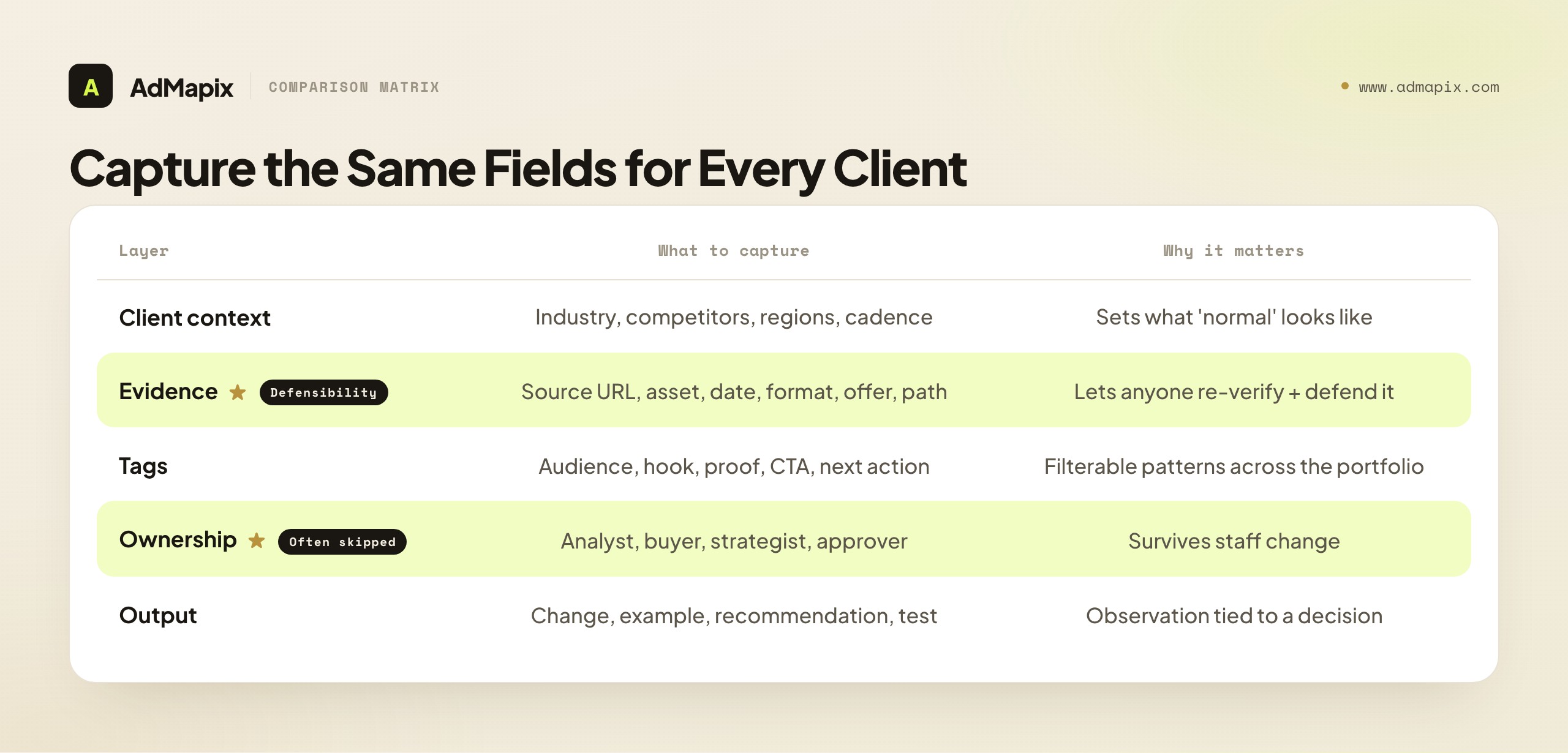
Capture a fixed set of fields for every saved ad so any team member can interpret it later without asking the person who saved it. The single most common failure in agency research is a screenshot with no source, no date, and no reason it was saved — six weeks on, nobody can tell whether it still matters.
| Layer | What to capture | Why it matters for the client report |
|---|---|---|
| Client context | Industry, named competitors, regions, products, reporting cadence | Scopes the research and sets what "normal" looks like for this account |
| Evidence | Source URL, asset, capture date, format, offer, landing path | Lets anyone re-verify the ad and defend the claim in a deck |
| Tags | Audience, hook, proof, CTA, format, next action | Turns scattered ads into filterable patterns across the portfolio |
| Ownership | Account owner, media buyer, creative strategist, analyst, approver | Makes the report repeatable when people change accounts |
| Output | Competitor change, example, offer map, recommendation, next test | The actual deliverable — observation tied to a decision |
The field list is the cheap insurance. It costs a few extra seconds per save and removes almost every "why did we keep this?" conversation later. The two fields agencies skip most often and regret most are capture date (without it, you can't tell a competitor's current ad from a stale screenshot) and ownership (without it, research orphaned by a staff change is unusable). Both are trivial to capture and expensive to lack.
A Repeatable Weekly Workflow
The workflow runs the same six steps for every client so the output is comparable across accounts and weeks. Standardize the steps, not the findings — the findings change, the process shouldn't.
- Define the decision first. Decide whether this cycle informs messaging, offer, creative format, landing page, or a specific client recommendation. Research with no decision attached becomes a gallery.
- Set the competitor set with the client. Agree on the named competitors and regions up front so the report is consistent and you're not researching the wrong brands.
- Capture evidence on the fixed field list. Source URL, date, asset, format, offer, landing path — every time, no exceptions.
- Tag for patterns, not storage. Use the same tags across clients so you can answer "which competitors all moved to a free-trial offer this month."
- Separate fact from hypothesis. Mark what the ad proves (it ran, the creative, the offer, the landing path) separately from what you infer (why it might be working).
- Produce the artifact. Roll the evidence into the recurring report: what changed, the examples, the offer map, and the recommended next test.
The discipline that makes this scale across a portfolio is that the process is identical for every client even though the findings differ — which means a new analyst can be trained on the steps once and run them for any account, and a client report looks the same whether it's produced by the account owner or a stand-in covering during leave. That uniformity is the entire point: it's what turns competitor research from a senior strategist's personal craft into a repeatable agency capability that doesn't break when people move.
Structuring the Client Report
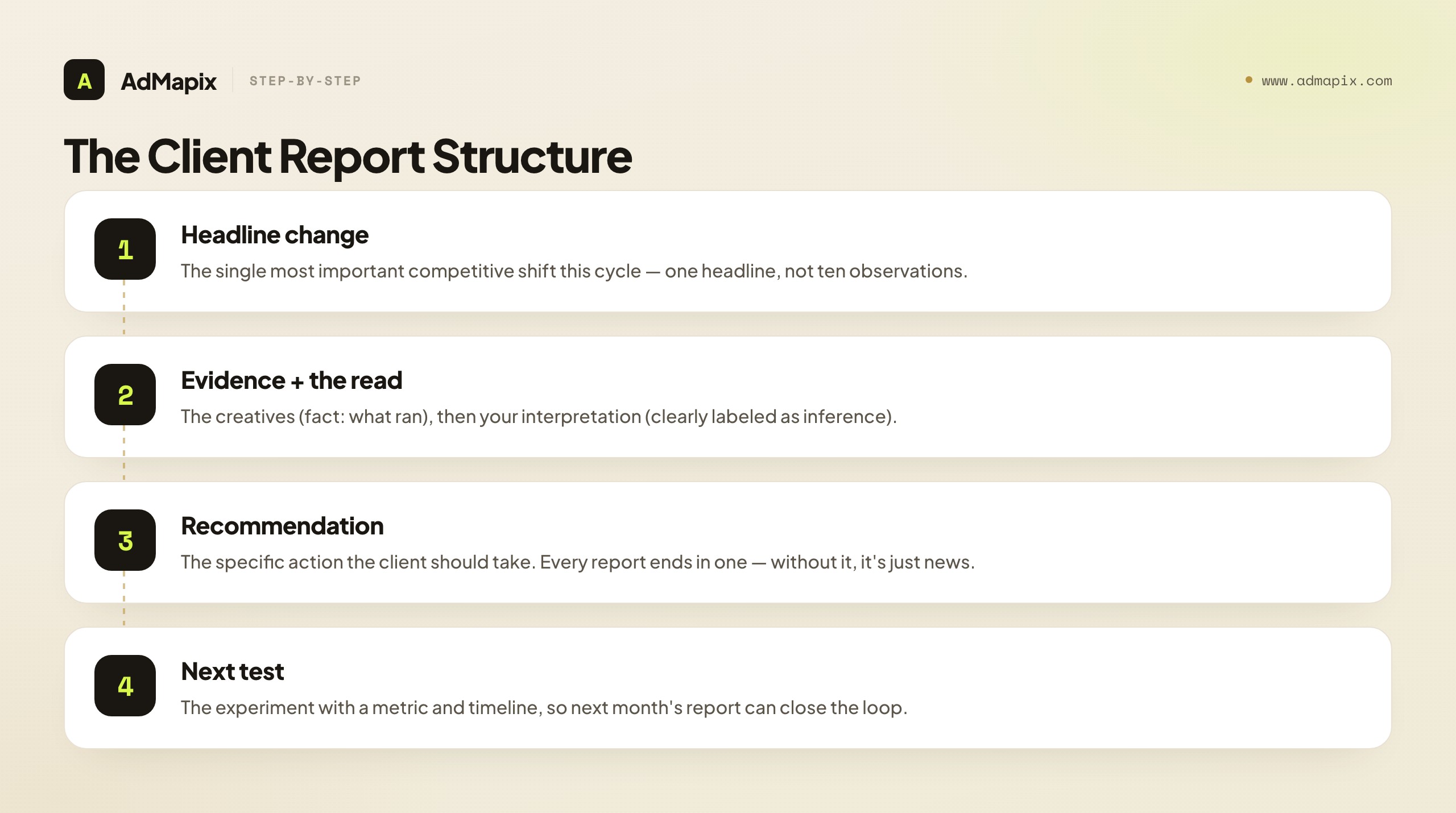
The client report is the actual deliverable, so its structure matters as much as the research behind it — a consistent, decision-driven report shape is what makes the research billable and comparable month over month. The report isn't a dump of competitor ads; it's a tight narrative that ties what changed to what the client should do.
A report structure that works across clients and cycles:
- The headline change. Lead with the single most important competitive shift this cycle — a competitor's new offer, a repositioning, a new format, a spend signal (longevity, not budget). One headline, not ten observations.
- The evidence. The specific creatives, with source and date, that support the headline change. Observable facts only — what ran, the creative, the offer, the landing path.
- The read. Your interpretation of what the change means, clearly labeled as inference. This is where your expertise shows, and where the fact/hypothesis line must be visible so the client knows what's proven versus inferred.
- The recommendation. The specific action the client should take in response — a creative test, an offer change, a positioning adjustment. Every report ends in a recommendation, because a report without one is just news.
- The next test. The concrete experiment that follows from the recommendation, with a metric and a timeline, so next month's report can close the loop on whether it worked.
The report structure is itself a deliverable standard: hold it steady so the client can compare this month to last month and see the agency's recommendations playing out over time. A client who can trace "you recommended X, we tested it, here's the result" across reports sees an agency that's accountable and strategic — which is exactly what protects the retainer. Drifting report formats, by contrast, make the research feel ad hoc and disposable, which is how a competitor-research line item gets cut at the next budget review.
White-Label and Deliverable Considerations
Many agencies deliver competitor research under their own brand or a client's, so white-label and deliverable polish are agency-specific concerns the research process has to accommodate. How the report looks and whose brand it carries affects whether the client perceives it as a premium deliverable or a raw data dump.
The white-label and deliverable considerations that matter:
- Brand presentation. Whether the report carries the agency's brand (reinforcing the agency's value) or the client's (for clients who present it upward internally) is a positioning choice. Either way, a polished, branded deliverable reads as more valuable than a screenshot in an email.
- The narrative wrapper. Raw competitor evidence isn't a deliverable; the agency's analysis and recommendation wrapped around it is. The white-label value an agency adds is the interpretation and recommendation, not the ads themselves — which anyone could find. Make the analysis the visible product.
- Consistency as a brand signal. A report that looks the same every month, with the same structure and quality, signals reliability and process maturity — which is part of what the client is paying for. Inconsistent deliverables undercut the premium positioning.
- The defensibility standard. A white-label report carries the agency's reputation into the client's organization, sometimes to people the agency never talks to. That raises the stakes on the fact/hypothesis discipline — an overclaim in a white-label deck can damage the agency's credibility with stakeholders it can't directly reassure.
The strategic point: the deliverable is where an agency's research becomes a product, and the product is the analysis and recommendation, professionally presented, not the raw competitor ads. Agencies that treat the report as a polished, consistent, defensible deliverable charge for it as a service; those that send raw screenshots give away the most valuable part of their work and train clients to see competitor research as free.
Using Competitor Research to Win New Business
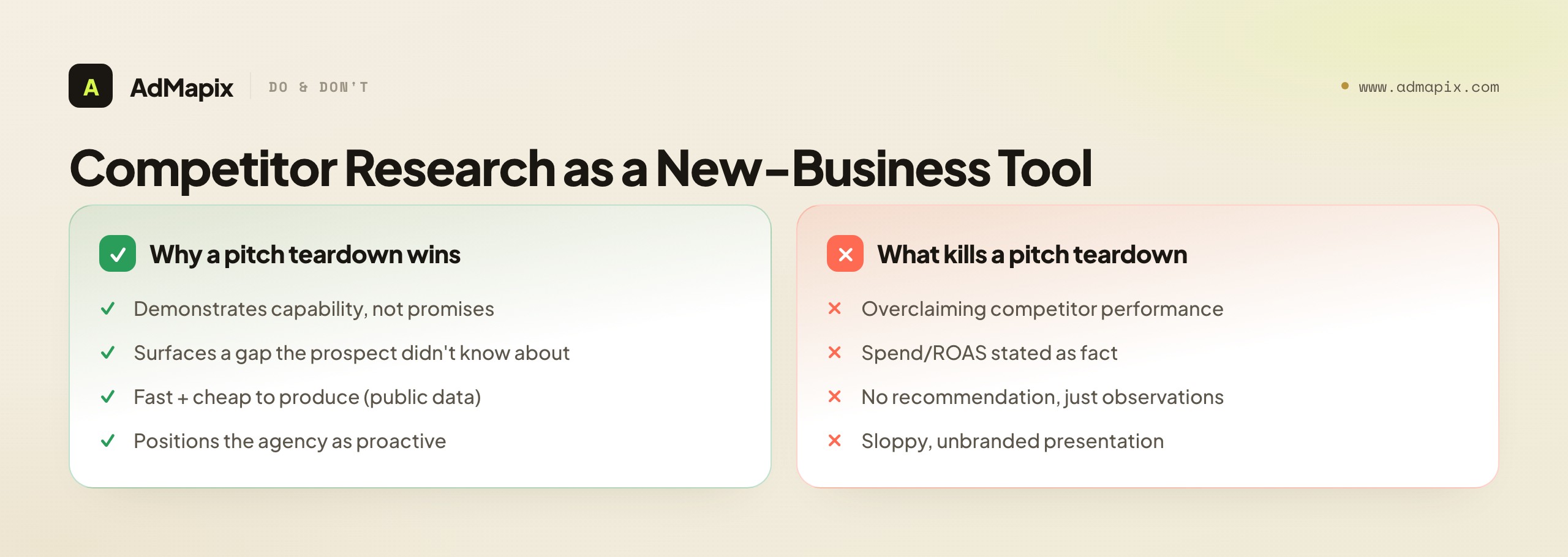
A sharp competitive teardown is one of the most effective new-business tools an agency has, because it demonstrates value before a contract exists — and competitor ad research is the cheapest, fastest way to produce one. When you walk into a pitch with a teardown of the prospect's competitors' ads, you've shown rather than told what working with you looks like.
How competitor research wins pitches:
- It demonstrates capability, not promises. Anyone can claim competitive insight; showing a prospect a teardown of their competitors' current ads, with patterns and a recommendation, proves it. The pitch becomes a sample of the actual work product.
- It surfaces a gap the prospect didn't know they had. A teardown that reveals a competitor's winning angle the prospect isn't running, or a leak in the prospect's own funnel versus competitors, creates urgency — you've found a problem worth paying to solve.
- It's fast and cheap to produce. Because competitor research is public-data and process-driven, an agency can produce a credible teardown for a prospect in hours, making it economical to invest in pitches you're serious about winning.
- It positions the agency as proactive. A teardown signals the agency watches the market actively, which is exactly the posture a client wants from an agency — proactive competitive intelligence, not reactive campaign execution.
The discipline that makes pitch teardowns work is the same fact/hypothesis line — a pitch teardown that overclaims competitor performance is as damaging as one in a client report, because a sophisticated prospect will catch it. A teardown that's rigorous about what it proves (the competitor's creative, offer, and positioning) versus what it infers (why it might work) demonstrates not just capability but credibility, which is what wins the kind of clients worth having. The best new-business teardowns make the prospect think "they understand my market better than my current agency does" — and that's the moment the pitch is won.
Proving Retainer Value With Recurring Research
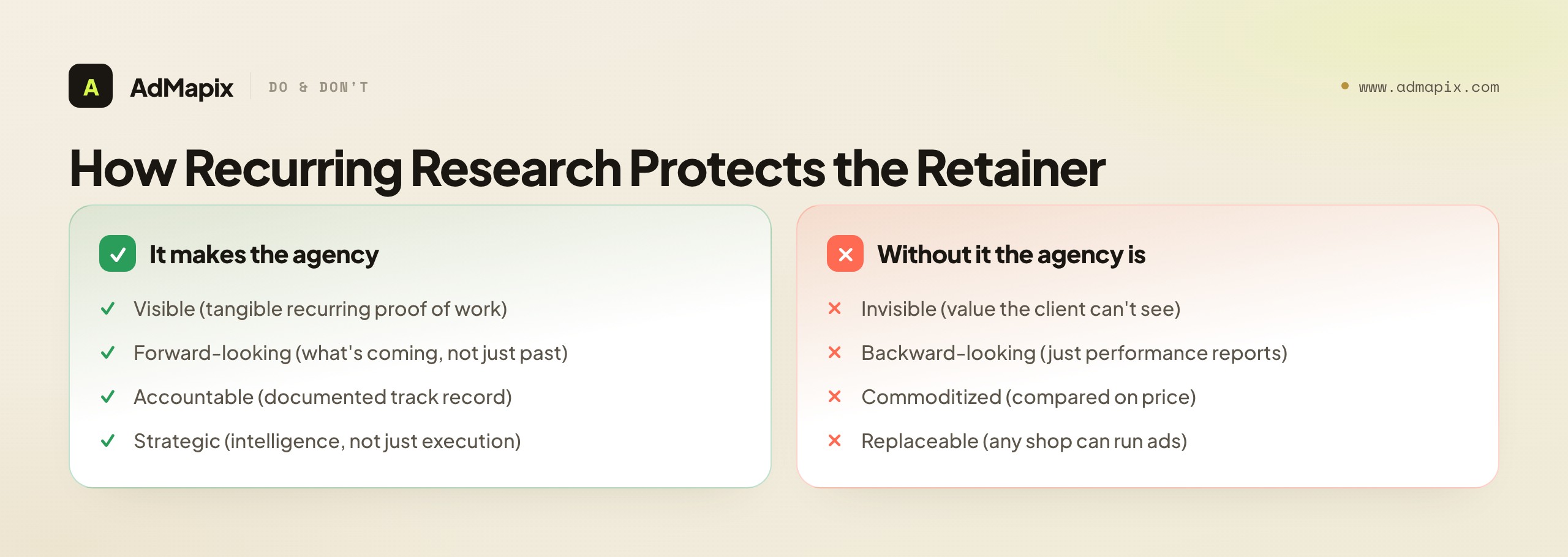
The recurring competitor report is one of the most effective retainer-protection tools an agency has, because it's visible, recurring evidence that the agency is actively watching the market on the client's behalf. In a world where clients scrutinize every retainer line, a deliverable that shows up reliably every cycle with fresh competitive intelligence is hard to cut.
Why recurring research protects the retainer:
- It's visible work. Much of an agency's value (optimization, strategy, judgment) is invisible to the client. A competitor report is tangible, recurring proof that work is happening — it makes the agency's vigilance legible.
- It's forward-looking, not just reporting on the past. Performance reports tell the client what already happened; competitor research tells them what's coming and what to do about it. That forward-looking posture is more strategically valuable and harder to commoditize.
- It compounds into a track record. Over months, the recurring report builds a documented history of "we spotted this competitor move, recommended this response, and here's how it played out." That track record is the strongest argument at renewal.
- It differentiates from cheaper competitors. Any agency can run campaigns; one that delivers consistent competitive intelligence is providing a strategic service that justifies a premium retainer and resists being undercut by a cheaper execution-only shop.
The strategic synthesis: a recurring competitor report converts an agency from a campaign executor (easily compared on price and easily replaced) into a strategic partner (judged on insight and harder to replace). At renewal, the client isn't just deciding whether to keep running ads — they're deciding whether to give up the competitive intelligence the agency provides. That reframing, built on a consistent recurring deliverable, is one of the highest-ROI uses of competitor research an agency has, because retaining a client is far cheaper than winning a new one.
The Cross-Client Pattern Advantage
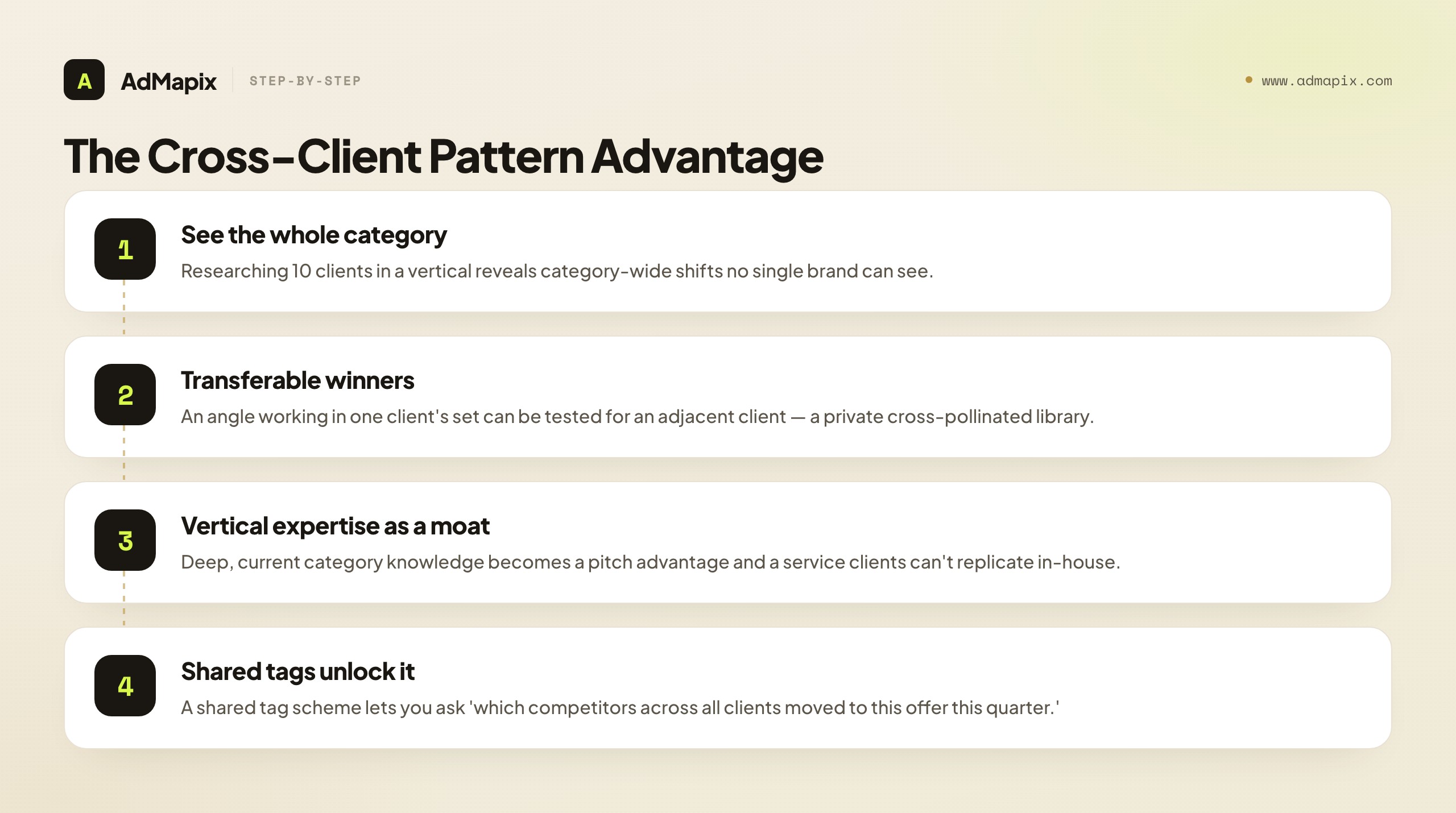
Agencies have one competitive-intelligence advantage no in-house team can match: cross-client pattern recognition. An agency researching ten clients in a vertical sees the whole category at once, which surfaces patterns, shifts, and opportunities invisible to any single brand watching only its own competitors. This is the agency's structural edge, and the tool and process should be built to exploit it.
What the cross-client view reveals:
- Category-wide shifts. When the same offer, format, or positioning starts appearing across multiple clients' competitive sets in a vertical, the agency sees a category-wide trend forming before any single client could — and can advise every client in the vertical to respond early.
- Transferable winners. A creative angle or offer structure that's working in one client's competitive set can be tested for an adjacent client, giving the agency a private library of cross-pollinated, market-tested ideas no in-house team has access to.
- Vertical expertise as a moat. An agency that researches many clients in a vertical accumulates deep, current knowledge of that category's creative conventions, offer norms, and positioning landscape — which becomes a pitch advantage and a service quality the client can't replicate in-house.
- Benchmark context. With many accounts in a category, the agency can tell a client what's "normal" for the vertical (typical offers, common formats, standard proof) and where the client or its competitors deviate — context a single brand can't generate alone.
The strategic point: the cross-client pattern advantage is the single best reason a client should buy competitive intelligence from an agency rather than do it in-house, and an agency that articulates and delivers on it has a durable differentiation. The tooling and process should make cross-client pattern recognition easy — a shared tag scheme across accounts is what lets an agency answer "which competitors across all our fintech clients moved to this offer this quarter," which is a question no in-house team can even ask. Building the research system to surface cross-client patterns is how an agency turns its portfolio from an operational burden into an intelligence asset.
One boundary to respect while exploiting this advantage: the cross-client view is about public competitor patterns, not about sharing one client's private data or strategy with another. Reading that several clients' competitors made the same public move is legitimate category intelligence; passing one client's confidential plans, performance, or strategy to a competing client is a breach of trust and often of contract. The discipline is to keep the cross-client synthesis at the level of public-market patterns — what the category is doing, drawn from publicly observable competitor ads — and never at the level of any individual client's private information. Done right, the cross-client advantage is built entirely on public data aggregated across accounts, which is exactly why it's both powerful and clean.
Team Roles and Scaling the Research
As an agency's portfolio grows, competitor research has to scale without the quality collapsing, which means clear team roles and a process that distributes the work — the research can't stay a senior strategist's personal craft if it's going to cover twenty accounts every week. Defining who does what is how an agency makes competitor research a scalable capability rather than a bottleneck.
A workable division of labor:
- The analyst / researcher runs the weekly capture: scanning competitors, saving evidence on the fixed field list, tagging consistently. This is the high-volume, process-driven work that a trained analyst can do across many accounts.
- The creative strategist turns the tagged evidence into reads and creative recommendations — the interpretation layer that requires judgment and category knowledge.
- The account owner owns the client relationship, sets the competitor set with the client, and ensures the report ties to the client's goals and decisions.
- The approver / lead maintains the quality bar and the fact/hypothesis discipline before anything goes to the client, protecting the agency's credibility.
The scaling principle is to push the high-volume, standardizable work (capture and tagging) down to analysts running a fixed process, and reserve the senior time for the interpretation and recommendation that actually require expertise. An agency that has every senior strategist doing their own ad-hoc research can't scale; one that has analysts running a standardized capture process feeding strategists who do the interpretation can cover a large portfolio at consistent quality. The tool and the fixed field list are what make this division possible — they let the work be handed between roles without context loss, which is the whole reason a standardized process beats individual craft at agency scale.
Packaging Competitor Research as a Billable Service
Competitor research only pays off for an agency if it's packaged and priced as a service rather than given away as an unbilled favor, so the final move is turning the process into a product clients pay for. Many agencies do competitor research invisibly inside campaign management and never capture its value; the ones that package it explicitly create a new revenue line and a stronger retention tool.
Ways agencies package competitor research:
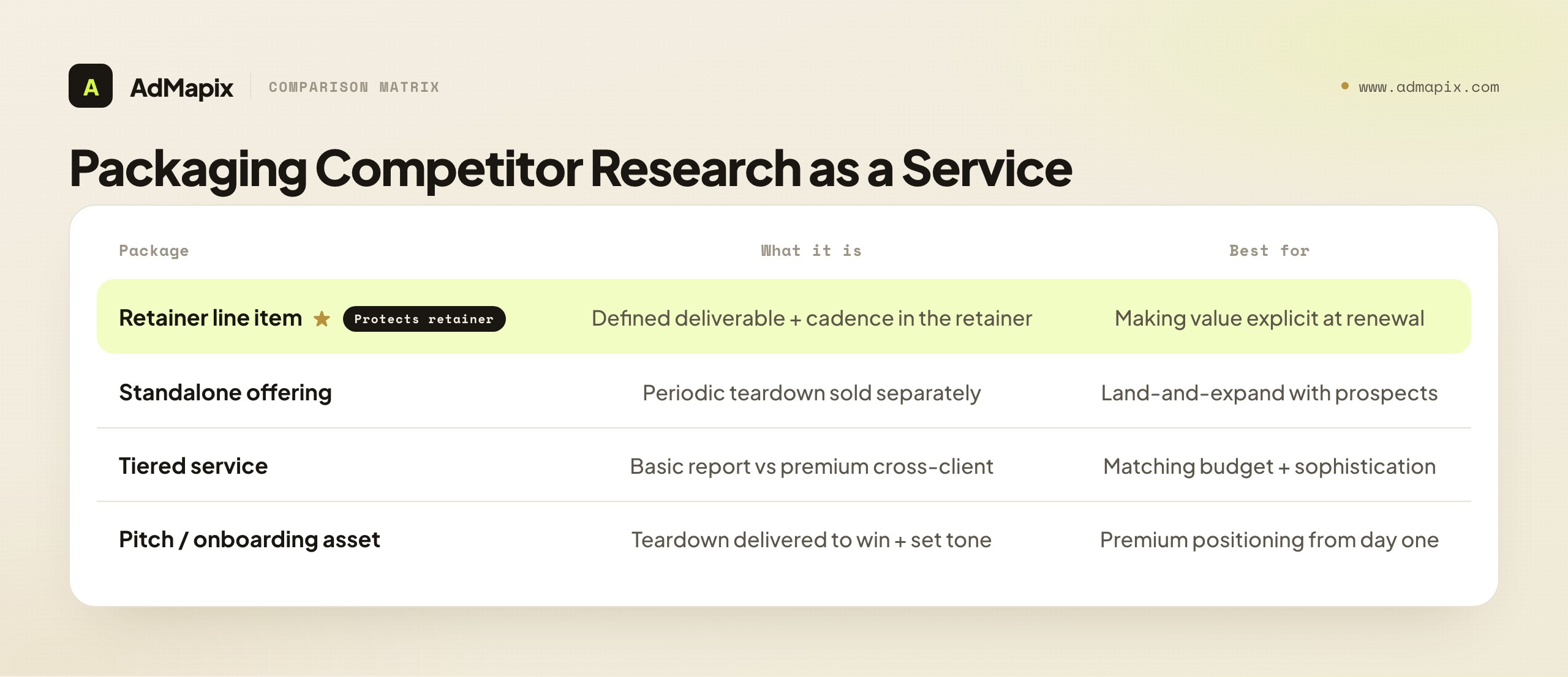
- As a retainer line item. A defined "competitive intelligence" deliverable within the retainer, with a stated cadence and report structure, makes the value explicit and defensible at renewal rather than buried in general account management.
- As a standalone offering. A periodic competitive teardown or market report sold separately, which can serve as a land-and-expand entry point with prospects not ready for a full retainer — and a low-commitment way to demonstrate value.
- As a tiered service. Basic (a recurring report on a fixed competitor set) versus premium (deeper analysis, cross-client benchmarking, more frequent cadence), letting the agency match the service to the client's budget and sophistication.
- As a pitch and onboarding asset. A competitive teardown delivered during the pitch or onboarding, which sets the tone for a research-driven relationship and justifies a premium positioning from day one.
The strategic synthesis: packaging competitor research explicitly does two things at once — it creates a billable, differentiating service, and it forces the discipline (consistent process, defensible claims, polished deliverables) that makes the research good. An agency that gives competitor research away as an invisible favor captures none of its value and has no incentive to systematize it; one that packages it as a named service captures the revenue, protects the retainer, and builds the process discipline that makes it a genuine capability. That's the difference between competitor research as a cost and competitor research as a product.
A Worked Example: One Client's Monthly Research Cycle
Principles stick when applied, so here's how the agency process runs for a single client over one monthly cycle, end to end. Say the client is a mid-market project-management SaaS, the agreed competitor set is four named rivals, and the reporting cadence is monthly.
Week 1 — scan and capture. The analyst opens each competitor on LinkedIn and the Google Transparency Center, captures new creative on the fixed field list (source, date, format, offer, landing path), and tags each ad (audience, hook, proof, CTA, format). One competitor has launched a wave of new "switch from [incumbent]" comparison ads; another has shifted its CTA from "book a demo" to "start free." Both deltas are logged with evidence and dates. The analyst doesn't interpret yet — just captures and tags, the high-volume, standardizable work.
Week 2 — interpret. The creative strategist reviews the tagged deltas and writes the reads, clearly labeled as inference. The "start free" shift suggests the competitor is moving toward a PLG motion to capture down-market self-serve demand; the comparison-ad wave suggests they're attacking the incumbent's dissatisfied users. The strategist also notes a cross-client pattern: two other SaaS clients' competitors made similar PLG shifts this quarter, suggesting a category-wide move worth flagging to all of them.
Week 3 — recommend. The account owner ties the reads to the client's goals. The recommendation: test a low-friction free-trial entry point of your own before the competitor's PLG motion captures the self-serve segment, and prepare a comparison angle in case the incumbent attack spreads to your shared buyer. Each recommendation has a next test with a metric and a timeline.
Week 4 — report and review. The report is assembled in the standard structure (headline change → evidence → read → recommendation → next test), reviewed by the lead for the fact/hypothesis discipline, and delivered in the agency's branded format. It closes the loop on last month's recommended test ("you suggested X, here's how it performed") and opens this month's. The client sees a consistent, accountable, forward-looking deliverable — and the cross-client PLG pattern, surfaced only because the agency researches multiple SaaS accounts, becomes a strategic flag the client couldn't have generated alone.
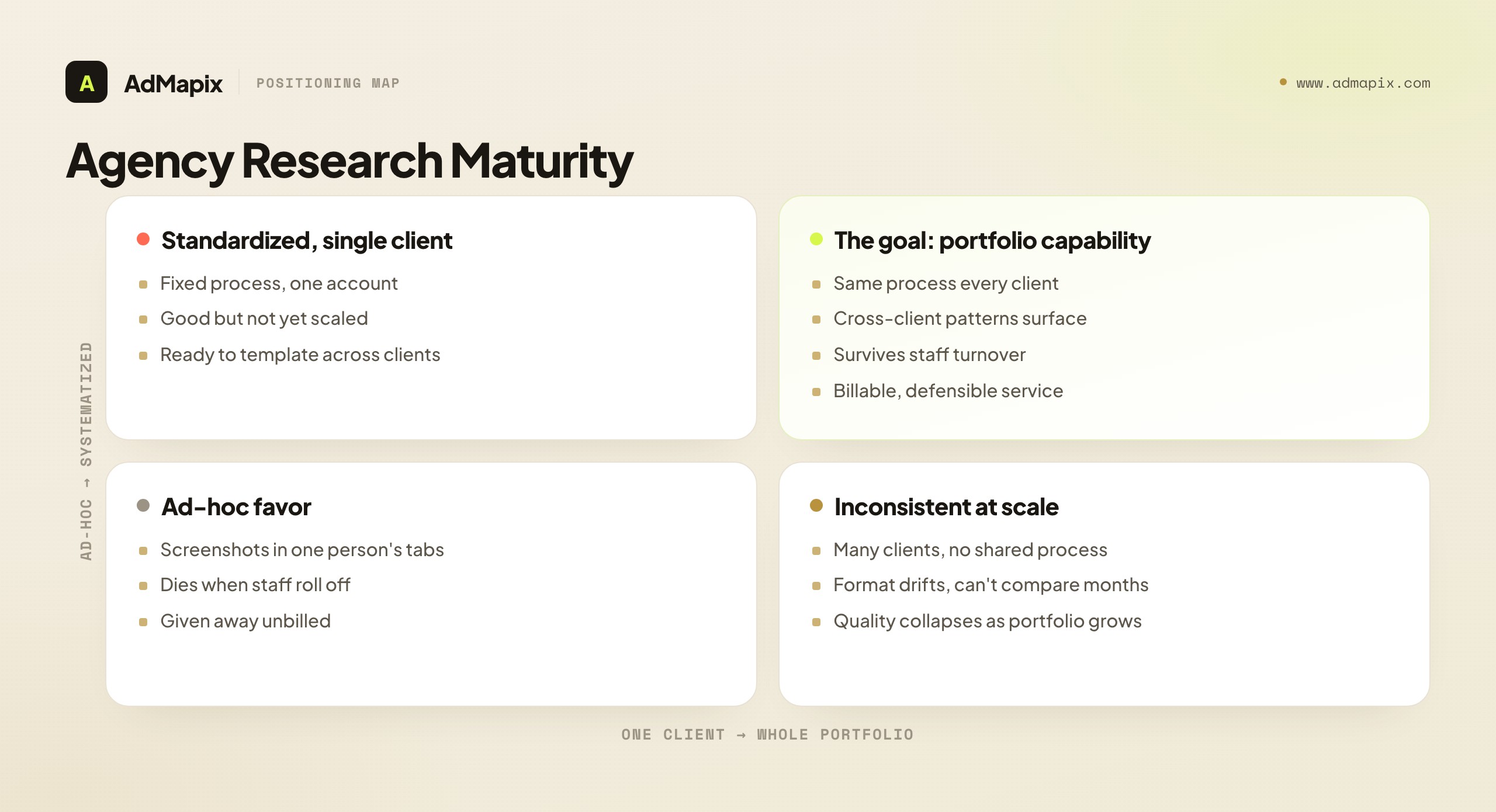
The cycle is identical for every client even though the findings differ — which is exactly what makes it scalable. A new analyst runs the same Week 1 capture for any account; the same report structure ships whether the account owner or a stand-in assembles it; and the cross-client patterns surface automatically because every account uses the same tag scheme. That uniformity is the agency capability the tool and process exist to create.
Research by Agency Type: Performance, Creative, and Full-Service
The competitor-research process is universal, but its emphasis shifts by agency type, so matching the research focus to the agency's service tells you which signals to weight and how to position the deliverable. Different agencies sell different value, and their competitor research should reinforce it.
- Performance / media-buying agencies sell efficient acquisition, so their research emphasizes offers, formats, landing-page funnels, and the spend-proxy signals (longevity, new-ad velocity) that inform media decisions. The deliverable ties competitor moves to testable performance hypotheses — a new competitor offer becomes a CPA test, a competitor's funnel leak becomes a landing-page opportunity.
- Creative agencies sell winning creative, so their research emphasizes hooks, angles, creative formats, and messaging patterns. The deliverable is a creative brief informed by what's working in the category — competitor teardowns become the evidence behind a creative direction, and the cross-client view becomes a library of market-tested angles.
- Full-service agencies sell strategy plus execution, so their research spans the widest scope — positioning, messaging, offers, formats, and funnels — and the deliverable is the most strategic, tying competitor intelligence to the client's whole go-to-market. The cross-client pattern advantage matters most here, because full-service agencies are sold on strategic insight.
- Consultants and fractional teams sell senior judgment, so their research emphasizes the interpretation and recommendation layer — the analysis is the product, and the competitor evidence is the support. A polished, insight-dense teardown is the consultant's calling card.
The strategic point: an agency's competitor research should reinforce what it sells, not be a generic exercise bolted on. A performance agency burying creative-angle analysis in a deck aimed at a CFO-minded client is misweighting its research; a creative agency leading with CPA tables instead of creative insight is underselling its actual value. Match the research emphasis and the deliverable framing to the agency's core offer, and the research strengthens the agency's positioning rather than diluting it.
Build vs. Buy: Tooling the Agency Research Process
Every agency eventually faces a build-vs-buy decision for its competitor-research tooling — spreadsheets and manual collection, an in-house system, or a dedicated ad-intelligence platform — and the right answer depends on portfolio size and how central research is to the agency's offer. Reading the trade-offs keeps you from over- or under-investing.
The realistic options:
- Free / manual (spreadsheets + transparency libraries). Works for a small agency with a handful of clients where one or two people run the research. The ceiling: no cross-network search, no shared workspace for cross-client patterns, no searchable history once ads go dark, and it breaks down as the portfolio grows or staff turns over. Cheap to start, expensive to scale.
- Cross-network ad-intelligence platform. Earns its place when the portfolio outgrows manual collection — when you need a shared workspace for cross-client pattern recognition, searchable creative history, consistent capture across analysts, and report generation that doesn't get rebuilt per account. The right move for most agencies once research becomes a billable, multi-client service. See the best ad spy tools in 2026 and marketing intelligence tools for the landscape.
- Custom in-house build. Rarely worth it — the engineering cost of building and maintaining ad collection across networks almost never pencils out against a dedicated platform, and it diverts the agency from its actual business. Reserve it for the rare agency whose entire differentiation is proprietary intelligence at a scale no platform serves.
The decision principle: the right tool is the cheapest one that removes the agency's current bottleneck, and for most agencies the bottleneck isn't access (everyone has the libraries) — it's consistency and cross-client visibility at scale. A platform that standardizes capture, preserves history, and supports cross-client pattern recognition removes exactly that bottleneck, which is why most growing agencies move off spreadsheets once research becomes a service rather than a favor. The trap, identical to the one every spy-tool buyer faces, is buying a tool to skip the methodology — no platform writes the recommendation or maintains the fact/hypothesis discipline for you. The tool standardizes the collection so the agency's senior time goes to the interpretation that clients pay for.
Onboarding a New Client's Research
The first research cycle for a new client sets the standard for the whole relationship, so a deliberate onboarding process for competitor research pays off disproportionately — it's where you establish the competitor set, the cadence, the report shape, and the expectations that everything after depends on. Rushing onboarding produces a research program that drifts; doing it well produces one that runs smoothly for the life of the account.
The onboarding steps that matter:
- Agree the competitor set with the client. Don't assume you know who the client's real competitors are — the client knows their market, and the competitor set should be agreed up front, including direct rivals and the adjacent players competing for the same buyer. Getting this wrong means researching the wrong brands for months, so it's worth a dedicated conversation.
- Establish the baseline. The first cycle isn't about deltas (there's no prior month to compare against) — it's about mapping the current competitive landscape: what each competitor is running, their offers, their positioning, their funnels. This baseline is what every subsequent cycle's "what changed" is measured against, so it has to be thorough.
- Set the cadence and report shape. Agree how often the research runs (matching the client's decision cadence) and what the report will look like, then deliver the first report in exactly that shape so the client knows what to expect every cycle. The first report is a template the client will compare all future ones against.
- Calibrate the fact/hypothesis line early. Show the client, in the first report, the distinction between what you can prove (the creative, offer, positioning) and what you infer (why it might work). Setting this expectation early prevents the client from later demanding spend or ROAS numbers no public source can provide — and positions the agency as rigorous rather than evasive.
The strategic point: onboarding is where the agency teaches the client what good competitor research looks like — evidence-based, decision-driven, honest about its limits — which shapes the client's expectations for the entire engagement. An agency that onboards research well sets itself up to deliver a clean, comparable report every cycle with no friction; one that onboards sloppily spends the whole relationship managing mismatched expectations about what the research can and can't do. The baseline cycle is extra work, but it's the foundation everything else is built on, and it's where the agency demonstrates the rigor that justifies the retainer from day one.
Research Quality Assurance at Scale
As competitor research scales across a portfolio, quality assurance becomes the thing that keeps it from degrading — because the failure mode of agency research isn't doing it wrong once, it's doing it inconsistently across many accounts until the quality quietly erodes. A deliberate QA layer is what protects the agency's credibility as the portfolio grows.
The QA practices that hold quality at scale:
- A review gate before client delivery. Every report passes a lead or senior strategist who checks the fact/hypothesis discipline, the evidence quality, and whether each observation ties to a recommendation. This gate is non-negotiable — a single overclaim that reaches a client damages credibility more than a dozen clean reports build it.
- A consistent rubric. The same quality checklist applied to every report (is the headline change clear? is every claim sourced and dated? is the fact/hypothesis line visible? does it end in a recommendation and a next test?) keeps quality uniform regardless of who produced the report.
- Periodic process audits. Reviewing the research process itself, not just individual reports — are analysts capturing the full field list? are tags applied consistently across accounts? is the cross-client view actually being used? — catches drift before it degrades the deliverable.
- Spot-checking the inferences. Because the riskiest part of agency research is the inference layer, periodically pressure-testing the reads ("what evidence supports this interpretation? would it survive a client challenge?") keeps the analysis rigorous rather than sloppy or speculative.
The strategic synthesis: QA is what lets an agency scale competitor research without the quality collapsing, which is the central challenge of agency research. Any agency can produce one excellent report; the ones that build a durable competitive-intelligence service are the ones that produce a consistently excellent report across twenty accounts every cycle, which only happens with a deliberate QA layer. The same standardization that makes the research scalable (fixed process, shared tags, clear ownership) is what makes QA possible — you can only check consistency against a standard, and the standard is the process this guide describes. Quality at scale isn't an accident; it's the product of a process designed to be checkable.
Handling Client Pushback on Competitor Research
Clients push back on competitor research in predictable ways, and an agency that anticipates the common objections handles them with credibility rather than defensiveness — which turns a moment of doubt into a demonstration of rigor. The pushback is usually rooted in a misunderstanding of what public ad data can prove, so the response is education, not retreat.
The common pushback and how to handle it:
- "How do you know this is their best-performing ad?" You don't, and you say so plainly: public data shows the creative ran, not how it performed. What you can say is that the competitor has run this concept for a while and relaunched it across formats, which suggests it's working well enough to keep funding — a hypothesis worth testing, not a proven fact. Answering this honestly builds more trust than a confident overclaim ever could, because a sophisticated client knows the limits and is testing whether you do too.
- "Why should we pay for research we could do ourselves?" Because the value isn't access (the client could open the same libraries) — it's the consistent process, the cross-client pattern recognition the client can't replicate, the senior interpretation, and the time it frees the client's team to act on insight rather than collect it. Frame the research as a capability, not a data pull.
- "This competitor moved, so we should copy them." Push back gently: a competitor's move makes sense in their economics, audience, and funnel, which may differ from the client's. The right response to a competitor move is a test of the underlying structure against the client's own data, not a clone — and guiding the client away from blind copying is part of the strategic value the agency provides.
- "Nothing changed this month, so the research wasn't worth it." A cycle with no major competitive change is itself a finding — a stable competitive landscape is information that informs the client's own strategy (it may be safe to make a bigger bet, or the category may be ripe for disruption). Frame "no change" as a confirmed read, not a wasted cycle, and the recurring value holds even in quiet months.
The strategic point: client pushback on competitor research is almost always an opportunity to demonstrate rigor and reframe the value, not a threat to defend against. An agency that handles these objections with honest, educational answers — especially the temptation to overclaim performance — reinforces exactly the credibility that makes the research worth paying for. The agencies that lose competitor-research budget are usually the ones that overclaimed, got caught, and lost trust; the ones that keep it are the ones whose rigor survives the client's hardest questions. Handling pushback well is, in the end, the same discipline as everything else in this guide: prove what you can prove, label what you infer, and let the honesty be the differentiator. The agency that masters that discipline turns every hard client question into one more reason the client keeps paying for the research.
What Public Data Can and Cannot Prove
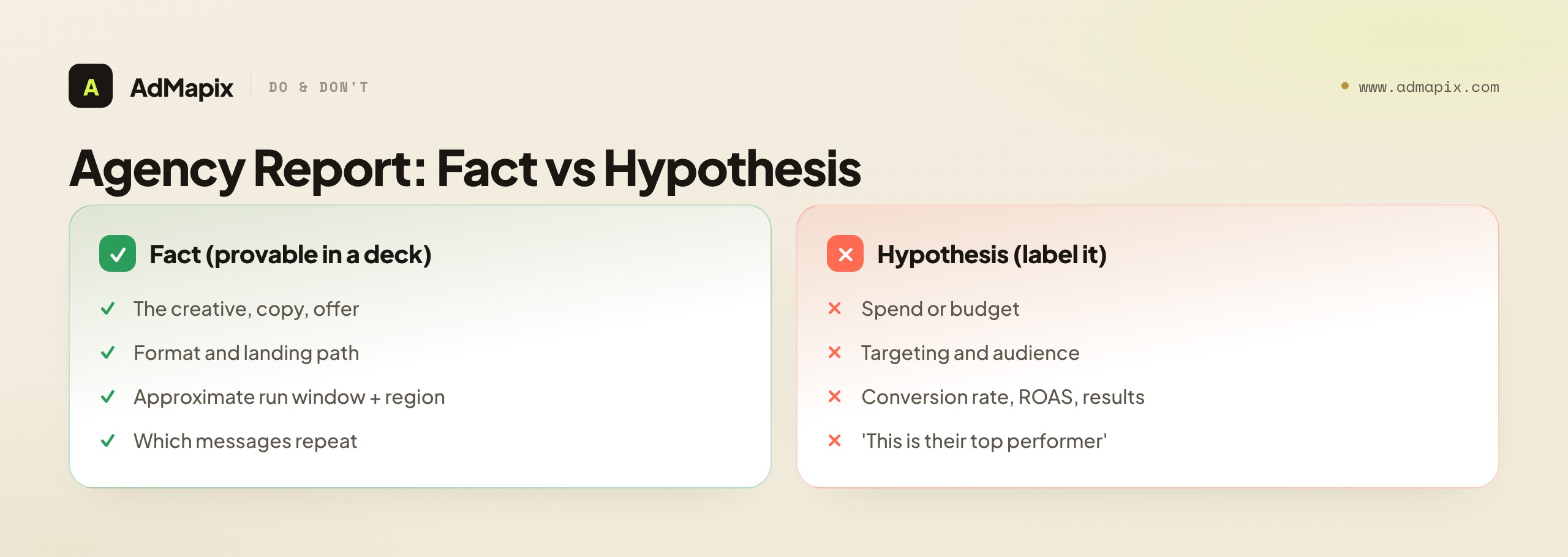
A public ad library is evidence that a competitor was willing to fund a particular angle, not evidence that the angle worked. This distinction is what keeps an agency report defensible when a client pushes back.
| Public data CAN show | Public data CANNOT show |
|---|---|
| The creative, copy, and offer | Spend or budget |
| The format and landing path | Targeting and audience segments |
| An approximate run window | Impressions, clicks, conversion rate |
| Which messages a competitor repeats | ROAS, pipeline, results |
| The region and which surfaces it ran on | Whether the ad is profitable |
What public data can show genuinely tells you what bets a competitor is making and where they're localizing. What it cannot show is performance — spend, impressions, click-through rate, conversion rate, ROAS, audience targeting, and pipeline are all private and never appear in any public transparency source. So a line in a deck like "this is their top performer" is an inference, not a fact. The one legitimate inference is repetition: a creative a competitor has run for a long time and relaunched across formats is more likely to be working, because advertisers rarely fund losers — but even that is a hypothesis, not a verdict. Write every report so observations and inferences live in clearly different places, and never let an assumption ride into the client's hands dressed as data. This discipline isn't just ethics — it's what makes the agency's research trustworthy, which is the entire basis of its value.
Common Agency Ad Intelligence Mistakes
- Copying a competitor ad without the economics. A competitor's creative can inspire a test, but their margins, audience, and offer aren't yours; the same ad doesn't make the same math true for your client.
- Overclaiming hidden metrics. Public ads never reveal spend, targeting, ROAS, or results. Presenting any of those as fact is the fastest way to lose a client's trust.
- Saving ads with no metadata. An asset without a source URL, date, and reason-for-saving is dead weight nobody can reuse — especially after a staff change.
- Ignoring the landing page. The destination — landing page, demo flow, store page, or lead form — often carries the real conversion work the ad only hints at.
- Letting the report format drift. If every cycle looks different, the client can't compare months and the research stops being a deliverable.
- Keeping research in one person's tabs. The moment they roll off the account, the institutional knowledge leaves with them.
- Giving research away unbilled. Competitor research delivered invisibly inside campaign management captures none of its value and trains clients to see it as free.
When to Use AdMapix
AdMapix fits agencies that run competitor research across multiple clients and want one consistent process instead of rebuilding it per account. Use Search AdMapix to find ad creatives across networks from a single interface, Media to save assets with their metadata in one place, Video Analysis to break down a video creative's hook, pacing, and structure for a creative brief, and Reports to turn tagged evidence into a shareable client report. Compare solo, team, and agency access on Pricing, or start from Login.
It's a good fit for performance and creative agencies, media buyers, and consultants who need the same research motion to scale across a portfolio and survive staff changes. It's not the right fit if you manage a single brand and prefer ad hoc spot-checks, or if your real requirement is private competitor performance metrics — no public-source tool can provide spend, targeting, or ROAS. AdMapix sits in the cross-network creative-intelligence slot: it standardizes the collection and reporting so your agency's time goes to the interpretation and recommendation that clients actually pay for.
FAQ
What is an agency ad intelligence tool?
It's the system an agency uses to collect competitor ad evidence the same way for every client, tag it consistently, and turn it into a recurring report that links observations to recommendations. The distinguishing feature is repeatability across a portfolio — one client's research and ten clients' research should follow the same shape, survive staff turnover, and end in a defensible recommendation.
Can competitor ad research reveal a competitor's performance?
No. It can show the public creative, the offer, the format, the landing path, an approximate run window, and which messages repeat. It can't prove spend, targeting, conversion rate, ROAS, or client results, because those are private and never appear in any public ad library. In a client deck, label any performance statement as an inference, never a fact — your credibility depends on the boundary.
How do agencies keep research consistent across many clients?
Standardize the process, not the findings. Run the same six steps, the same fixed field list, and the same tag scheme for every account, and assign clear ownership (analyst, strategist, account owner, approver) so research doesn't live in one person's tabs. Consistency is what makes the report comparable month over month and resilient to staff turnover.
What should each saved ad include?
At minimum: source URL, capture date, platform, the asset, the format, the offer, the landing path, the owning team member, and the test or recommendation it suggests. The fixed field list is what lets any teammate interpret the ad later without asking the person who saved it — the capture date and ownership fields are the ones agencies regret skipping most.
How does competitor research help win new business?
A competitive teardown in a pitch demonstrates capability before a contract exists — it's a sample of the actual work product. A teardown that surfaces a gap the prospect didn't know they had (a competitor's winning angle they're not running, or a funnel leak versus competitors) creates urgency and positions the agency as proactive. Because it's public-data and fast to produce, it's an economical investment in pitches worth winning.
How does a recurring competitor report protect a retainer?
It makes the agency's vigilance visible and forward-looking, builds a documented track record of "we spotted this, recommended that, here's the result," and reframes the agency from a replaceable campaign executor into a strategic partner providing competitive intelligence. At renewal, the client isn't just deciding whether to keep running ads — they're deciding whether to give up the intelligence the agency provides.
What's the cross-client advantage agencies have?
An agency researching many clients in a vertical sees the whole category at once, which surfaces category-wide shifts, transferable winners, and benchmark context that no single in-house brand can see. A shared tag scheme across accounts lets the agency answer questions like "which competitors across all our clients in this vertical moved to this offer" — which is the single best reason a client should buy competitive intelligence from an agency rather than do it in-house.
How should an agency price competitor research?
Package it explicitly rather than giving it away inside campaign management: as a defined retainer line item with a stated cadence, as a standalone teardown for land-and-expand, or as a tiered service (basic recurring report vs. premium cross-client benchmarking). Packaging it as a named service captures the revenue, protects the retainer, and forces the process discipline that makes the research good.
How often should an agency run competitor ad research?
Match the client's reporting cadence — most accounts settle on weekly or monthly. The point of a standardized process is that a recurring cycle costs little once the steps are fixed, so the frequency is driven by how often the client makes creative or offer decisions, not by how long the research takes. Premium tiers may justify a more frequent cadence.
Where does AdMapix fit an agency workflow?
AdMapix covers the layers above raw discovery: cross-network creative search, saving media with metadata, video analysis, tagging, and report generation, with a shared workspace that supports the cross-client pattern recognition agencies depend on. It sits after you decide what to research — you still set the competitor list and write the recommendation; the tool keeps the evidence and the report consistent across the portfolio.
Related Reading
- Competitor Ad Analysis Framework: The 5-Dimension System — the scoring model the agency report is built on.
- How to Spy on Competitors' Ads in 2026 (30-Min/Week Workflow) — the per-client research cadence that scales across a portfolio.
- Paid Ads Competitor Research: The Complete Playbook — the broader competitive-research system agencies operationalize.
- Marketing Intelligence Tools: The 2026 Stack — where ad intelligence fits the wider agency tool stack.
- Ecommerce Ad Spy Tools: The Complete Guide — the per-vertical research framework for ecommerce clients.
- B2B Ad Creative Examples: Formats, Offers & Proof — the per-vertical framework for B2B and SaaS clients.
Sources
- Google Ads manager accounts — manager accounts let agencies view and manage multiple Google Ads accounts from a single location.
- Google manager accounts for clients — describes managing multiple ad accounts with reporting, access control, and consolidated billing.
- Google Ads Transparency Center — find active ads published through Google across surfaces such as Search, YouTube, and Discover.
- LinkedIn Ads Guide — documents ad formats including Single Image, Video, Carousel, Document Ads, Lead Gen Forms, Sponsored Messaging, Text, and Dynamic Ads.
Sources checked as of June 21, 2026. Platform docs, ad formats, and product pages change, so re-verify source URLs before using a claim in client work. AdMapix data reflects only ads in our own index, clearly scoped, and never private performance metrics.
Turn these observations into your next creative study
Open the creative library and select samples for your market, network and research question.
Related Articles
TikTok Shop GMV Max Ads 2026: Competitor Creative, Product & Offer Research
A 2026 guide to TikTok Shop GMV Max ads — what GMV Max automates, why it shifts competitive research from bids to creative and offer, a five-signal capture framework, a weekly research workflow, what public ad data can and cannot prove, and where a cross-network creative-intelligence layer like AdMapix fits.
Ecommerce Ad Spy Tools in 2026: The Complete Guide to Researching Competitor Product Ads
A complete 2026 guide to ecommerce ad spy tools — what to capture from every competitor product ad, the five-signal framework that turns screenshots into a test backlog, platform-by-platform coverage across Meta, TikTok, Google and native, a DTC creative-research workflow, offer and proof teardowns, landing-page and funnel analysis, how to choose between free ad libraries and cross-network tools, and what public data can and can't prove.
Taboola Ad Spy Tool in 2026: Native Ad Research for Headlines, Thumbnails, and Offers
How to research Taboola native ads from public evidence in 2026 — what a Taboola ad spy tool can and cannot prove, how to decode the headline-and-thumbnail pair that carries the whole click, read advertorial and quiz landing paths, follow the retargeting trail, separate observed creative facts from private-metric guesswork, and turn repeating patterns into a testable creative brief instead of a one-off screenshot.