
TikTok Shop GMV Max Ads 2026: Competitor Creative, Product & Offer Research
A 2026 guide to TikTok Shop GMV Max ads — what GMV Max automates, why it shifts competitive research from bids to creative and offer, a five-signal capture framework, a weekly research workflow, what public ad data can and cannot prove, and where a cross-network creative-intelligence layer like AdMapix fits.
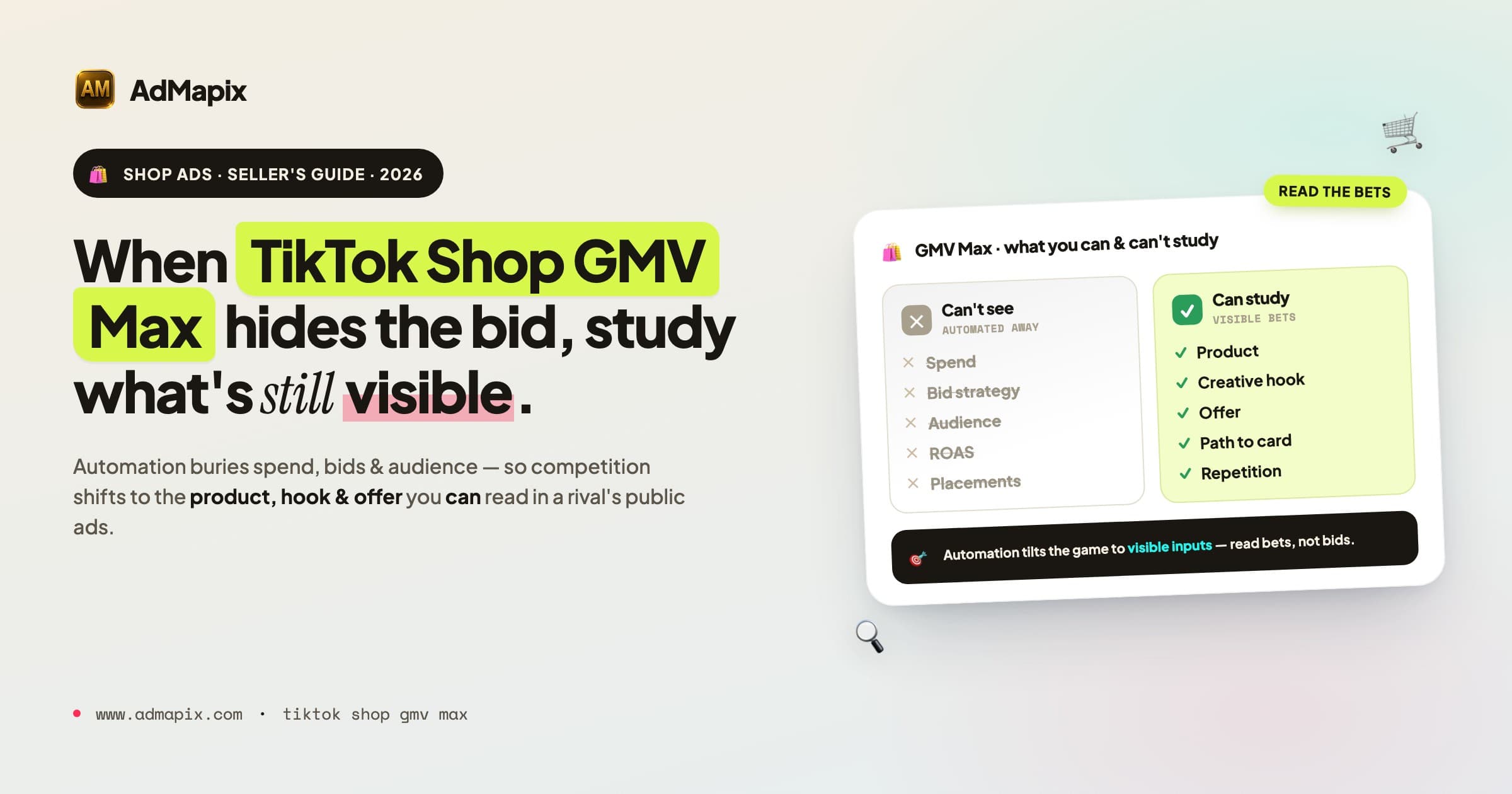
By the AdMapix Research Team — Updated June 21, 2026
TikTok Shop GMV Max Ads 2026: Competitor Creative, Product & Offer Research
TikTok Shop GMV Max ads are TikTok's automated Shop Ads campaign type that optimizes a product's promotion for gross merchandise value (GMV) instead of asking sellers to hand-tune placements, audiences, and bids. That single design choice reshapes how you should study competitors. When the machine takes over targeting and bidding, the levers left in human hands shrink to a short list: which product you push, which creator-style hook opens the video, which offer you anchor on, and which path you send viewers down to the product card. Those are the inputs GMV Max consumes — and they are exactly the inputs you can observe in a rival's public ads. This 2026 guide is for TikTok Shop sellers, cross-border ecommerce operators, creator-commerce teams, and agencies who want to research competitor GMV Max creative honestly, without pretending a visible ad reveals a private spend report. It covers what GMV Max actually automates, a five-signal capture framework, a repeatable weekly workflow, the firm line between what public creative proves and what it cannot, the common mistakes that waste research time, and where a cross-network creative-intelligence layer like AdMapix earns its place.
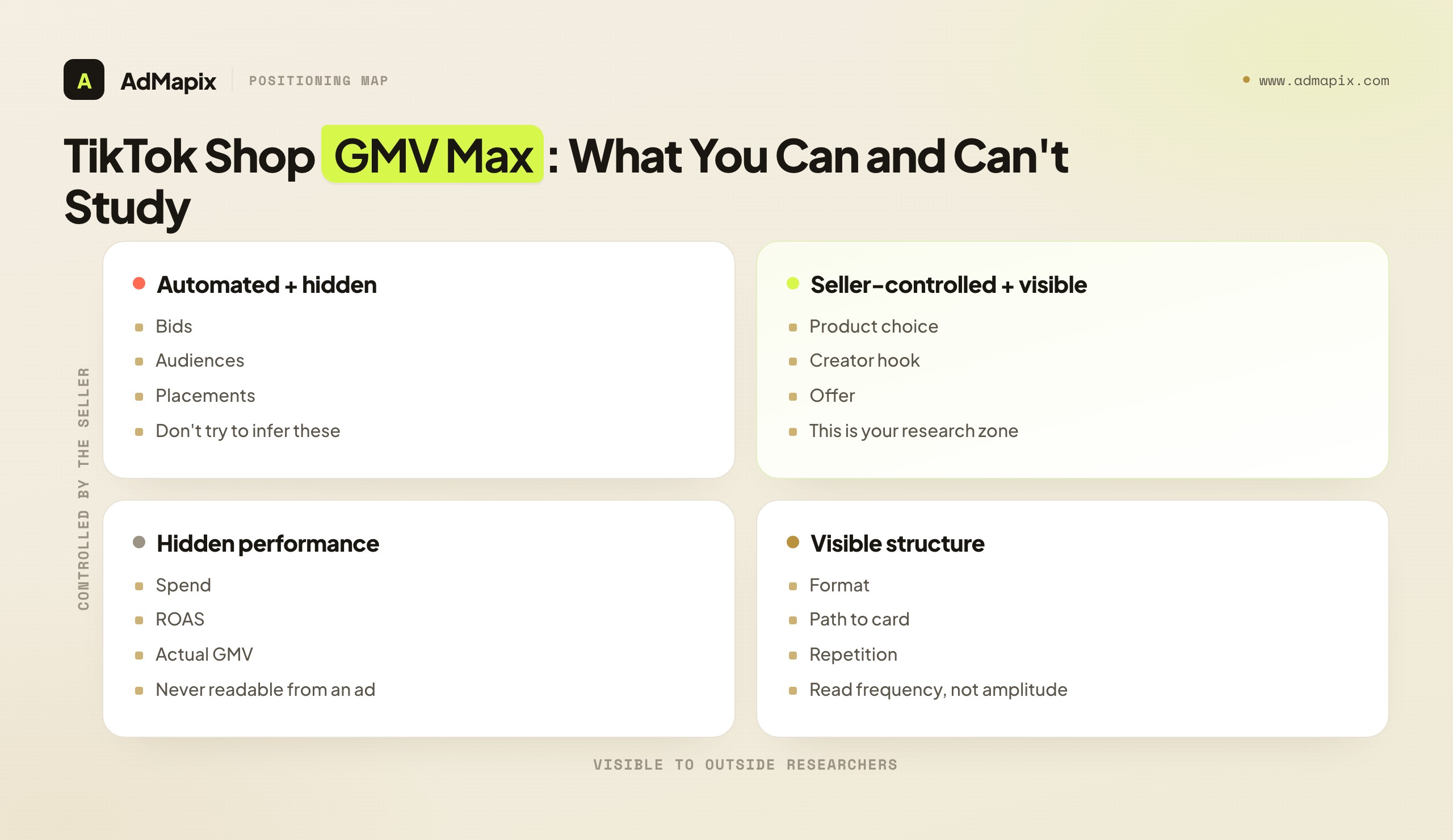
TL;DR — TikTok Shop GMV Max Ads in One Screen
- GMV Max automates the bid-and-targeting layer of TikTok Shop Ads and optimizes toward GMV, so the variables you can still control and study are the product, the creator hook, the offer, and the path to checkout.
- Research at the signal level, not the screenshot level. Capture five signals per competitor ad — product, creative, offer, path, output — so a pile of saved videos becomes a dataset you can count and compare.
- Public ads prove structure; they never prove performance. You can read the product, hook, offer, format, and how often an angle repeats. You cannot read spend, bid, audience, ROAS, or the GMV the campaign actually produced.
- Repetition is your strongest public signal — and only a hypothesis. A rival running near-identical creative on the same product for weeks suggests it works for them; it is a thing to test with your own margin, not a number to copy.
- The offer often moves GMV more than the hook on commodity and impulse products. Capture both, and when you brief a test, vary one at a time.
- A cross-network creative-intelligence layer like AdMapix fits teams researching competitor creative weekly: search ads by product or brand, save the best, break down the video, tag the offer, and turn repeated patterns into a shareable report.
What GMV Max Actually Is — and What It Automates
GMV Max is TikTok's one-stop automated solution for Shop Ads, and the word that matters is automated. In a classic manual TikTok Shop Ads campaign, a buyer sets up audiences, picks placements, manages bids, and babysits delivery. GMV Max collapses most of that into a single campaign objective: hand the system a product and a pool of creatives, set a target, and let it allocate spend toward the gross merchandise value the product can generate. According to TikTok's Business Help Center, Product GMV Max is positioned as an automated campaign type for TikTok Shop products that optimizes toward GMV rather than toward a manual bid strategy.
For a seller, that automation is a convenience. For a researcher, it is a constraint that clarifies the work. The levers GMV Max removes — manual bids, granular audience segments, placement toggles — are also the levers you could never observe in a competitor anyway. No public surface has ever shown you a rival's bid or their audience definition. So when those levers move inside an automated black box, you lose nothing as an outside observer, because they were already invisible. What stays visible is the part that was always the most actionable: the creative and the offer the competitor feeds the machine.
One terminology note worth getting right before you brief anything: GMV Max in TikTok's docs is framed at the product level — "Product GMV Max" — and TikTok has described it as part of a migration toward a one-stop automated solution for Shop Ads, consolidating what used to be several manual campaign types. The practical reading is that GMV Max is not a niche ad format sitting alongside manual Shop Ads; it is increasingly the default way TikTok wants sellers to run Shop Ads. For research, that means you should treat "GMV Max-style automated Shop creative" as the mainstream you are studying, not an edge case. When you see a competitor running TikTok Shop ads in 2026, the safe assumption is that automation is doing the targeting and bidding, and the creative-and-offer reading in this guide applies — confirm the exact current terminology against TikTok's docs before you put feature names in a client deliverable, since the platform renames and consolidates these products regularly.
That is the quiet good news in GMV Max for competitive research. The system concentrates the entire competitive question onto inputs you can see. A rival's GMV Max strategy is, from the outside, almost entirely a story about which products they bet on, which hooks they reuse, and which offers they anchor. You do not need to reverse-engineer a bid; you need to read a pattern.
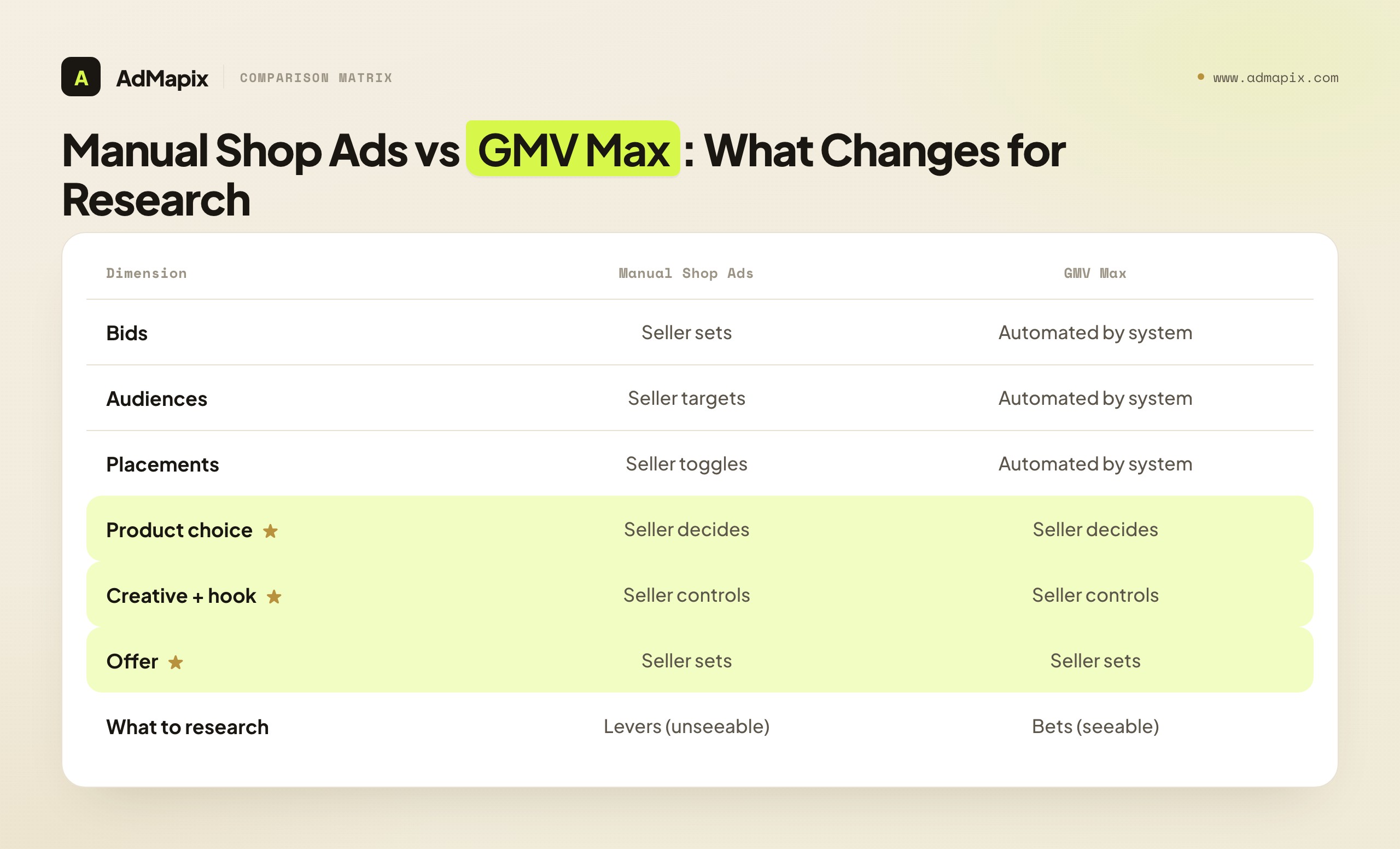
Why GMV Max Changes the Research Question
Most competitive-ad advice was written for a manual world. It tells you to estimate a rival's spend, guess their bidding posture, infer their audience. With GMV Max, almost all of that advice is wasted motion — not because it is wrong in principle, but because the thing it tries to infer is now automated and was never observable to begin with. The research question has to change shape.
The old question was implicitly: "How is this competitor running their account?" — a question about levers. The new question is: "Which product, hook, and offer is this competitor betting on often enough that it surfaces repeatedly in their public ads?" — a question about bets. The shift from levers to bets is the whole point. A bet is something a competitor commits to with creative volume and offer design, and creative volume and offer design are exactly what leak into public view.
Concretely, that means three things for how you read a competitor in 2026. First, stop trying to price their campaign. You cannot, GMV Max or not, and the attempt produces confident-sounding numbers with no evidence behind them. Second, read frequency, not amplitude. You cannot see how loud a rival is shouting (their spend), but you can often see how often they repeat an angle, and repetition across a category is the closest thing to a public confidence signal. Third, treat the offer as a first-class object, not as a footnote on the creative — because on the products GMV Max sells best (impulse buys, commodity goods, creator-driven trends), the offer is frequently the real engine, and a hook copied onto a worse offer rarely transfers the result.
There is a subtler shift hiding inside this one. Under manual campaigns, a competitor's edge could be operational — a sharper bid strategy, a tighter audience, a placement nobody else had figured out. Those edges were invisible to you, which made competitive research frustrating: the thing that mattered most was the thing you could least see. GMV Max collapses that operational edge. When everyone hands the same kind of product-and-creative pool to the same optimizer, the differentiator stops being how well you run the account and becomes how good your product, creative, and offer are. And those three are observable. So GMV Max does not just change the research question — it tilts the entire competitive game toward inputs that happen to be public, which is the best news a competitive researcher has had in years. The work is no longer guessing at hidden levers; it is reading visible bets carefully and testing them honestly.
What GMV Max Means for the Competitive Landscape
When an automated optimizer becomes the default way most sellers run Shop Ads, the shape of competition changes in ways worth naming explicitly, because they determine what your research should look for.
Creative volume becomes a competitive axis. GMV Max rewards a steady supply of fresh creative — the system needs variety to find what works and to fight fatigue. That means a competitor's rate of new creative is itself a signal. A rival shipping ten new angles a week in a category is playing a different game from one recycling the same two videos, and you can often read that cadence from their public output. The research takeaway: track not just which creative repeats, but how fast new creative appears. A high creative-velocity competitor has likely built a content engine — creators, briefs, a production pipeline — and that operational reality matters more than any single ad.
Product-offer fit becomes the moat. Because the bidding edge is automated away, the durable advantage moves upstream to picking the right product and pairing it with the right offer. A competitor who consistently wins a category under GMV Max usually has a structural reason: better margins that let them run aggressive vouchers, an exclusive or differentiated product, or a creator network that produces native-feeling content cheaply. Your research should try to identify which of those structural advantages is in play, because it tells you whether you can compete head-on or need to find an adjacent angle.
The market reads faster, so edges decay faster. GMV Max lowers the operational skill required to run Shop Ads, which means more sellers can chase a winning product-offer system once it is visible. Winning angles saturate quickly. The practical consequence for research is urgency: a pattern you spot is also a pattern others can spot, so the value is in reading it early and testing it fast, not in admiring it. This is why the weekly cadence later in this guide matters — in a fast-reading market, stale research is barely research at all.
The Five Signals to Capture for Every Competitor Ad
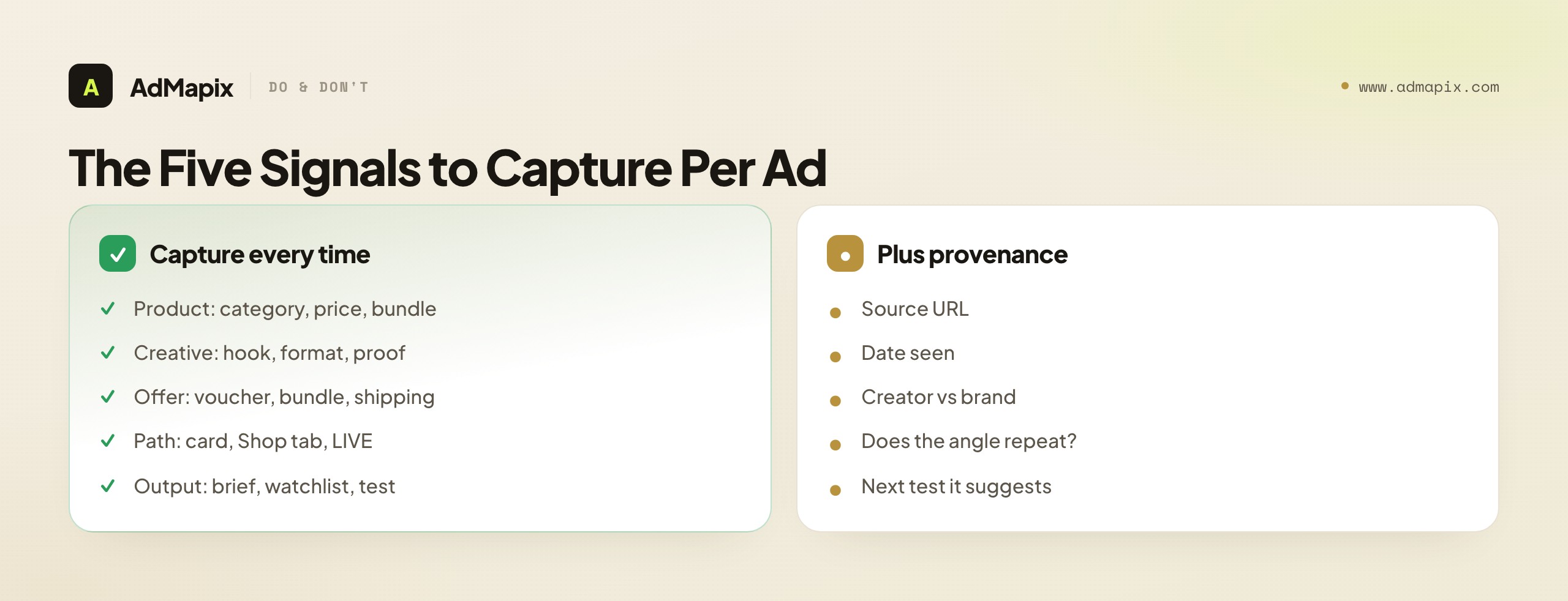
A single saved video is an anecdote. The same offer or the same hook seen five times across a category is a pattern worth a test. The discipline that turns the first into the second is capturing the same five signal types for every ad, so a folder of screenshots becomes a comparable dataset you can sort, count, and brief from. Here is what to record, and why each one matters specifically under GMV Max.
| Signal type | What to capture | Why it matters for GMV Max |
|---|---|---|
| Product | Category, price band, variant, bundle composition, the exact product on the card | GMV Max optimizes per product, so the product choice is the bet — track it first |
| Creative | Creator hook, format (demo / unboxing / testimonial / problem-solution), proof moment, first-3-second angle | The creative is the lever you and they both control; repeated hooks are directly testable |
| Offer | Voucher, free shipping, bundle deal, limited-time price, flash discount, creator/affiliate incentive | On commodity and impulse items the offer often moves GMV more than the hook |
| Path | Product card, Shop tab, LIVE shopping, in-feed product link, profile-to-shop flow | Shows how attention becomes a checkout — the destination is part of the conversion |
| Output | Watchlist entry, creative brief, offer map, video teardown, test ticket | Forces every saved ad to produce a next action, not just sit in a folder |
The fifth signal — Output — is the one most researchers skip, and it is the one that determines whether the research compounds. If a saved ad does not produce a watchlist entry, a brief, or a test, it is a clip, not intelligence. Every ad you bother to capture should leave behind a decision or a hypothesis. That single rule keeps a research library from rotting into a graveyard of videos nobody reopens.
A second discipline rides on top of the five signals: always save the source URL and the date. A video file with no provenance cannot be compared next month, cannot be audited in a client report, and cannot anchor a claim about how long an angle has been running. The product-creative-offer-path bundle is the what; the URL and date are the when and where that make the bundle trustworthy later.
How GMV Max Shifts the Balance Between Hook and Offer
There is a persistent instinct among creative teams to treat the hook as the hero — the first three seconds, the scroll-stopper, the line everyone quotes in the standup. On TikTok organic that instinct is often right. On TikTok Shop under GMV Max, it is frequently wrong, and the error is expensive.
Here is the mechanism. GMV Max optimizes toward gross merchandise value, which is a function of conversion and order value, not of attention alone. A hook earns the view; the offer closes the sale. On a differentiated, high-consideration product, a brilliant hook can carry a thin offer because the product itself does the convincing. But the products GMV Max tends to sell at volume — kitchen gadgets, beauty consumables, phone accessories, seasonal impulse items — are commodity-adjacent, and on commodity-adjacent products the buyer's decision often collapses to price and risk. A bundle that drops the per-unit price, a voucher that removes hesitation, free shipping that kills the last objection — these move GMV in ways a clever hook on a worse offer simply does not.
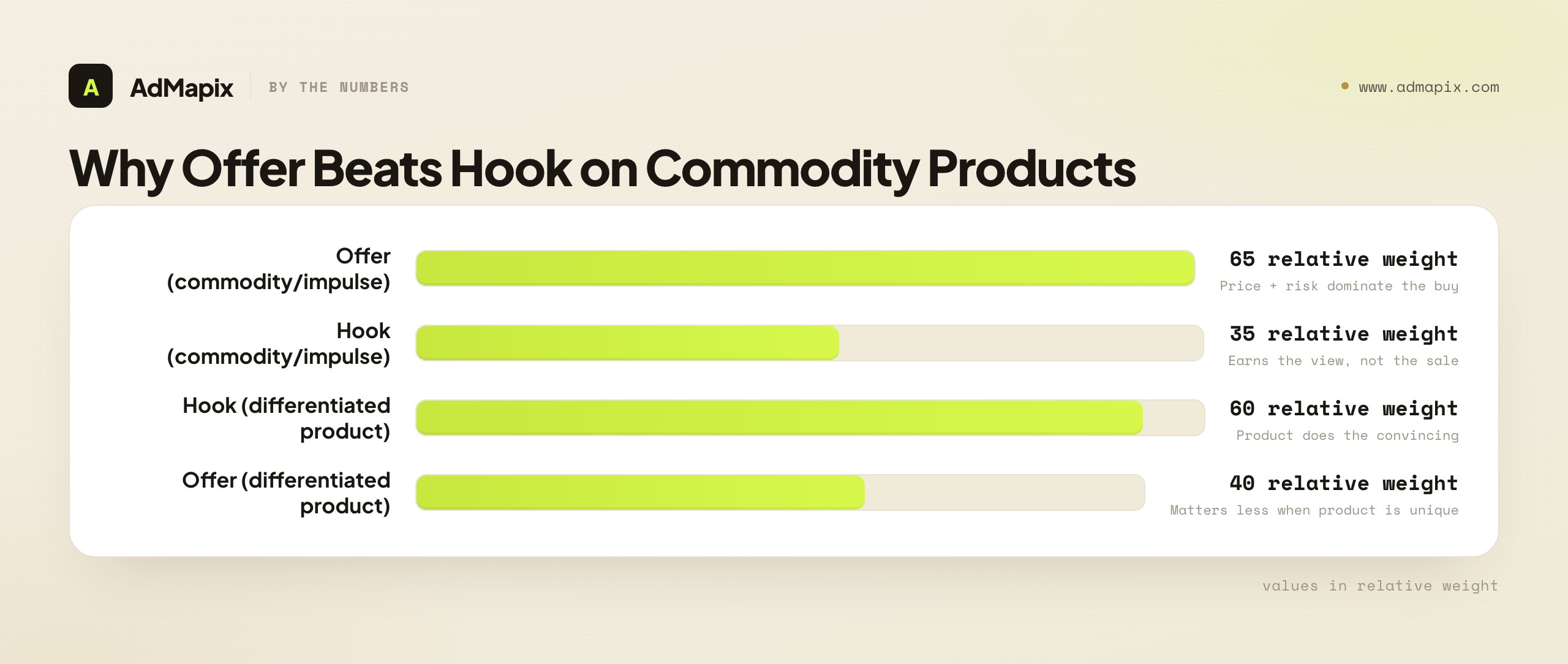
The research implication is sharp: if you copy a competitor's hook but not their offer, you have copied the wrong half. A rival's GMV Max ad that is winning is winning as a system — product, hook, and offer together — and the offer is often the load-bearing element. When you brief a test off a competitor ad, capture the offer with the same rigor you capture the hook, and resist the temptation to lift the visible, quotable creative while ignoring the boring voucher that was doing the actual work.
This is also why the offer deserves its own column in your capture template. Treat "voucher vs. bundle vs. free shipping vs. flash price" as a categorical variable you can count across a category, the same way you count "demo vs. unboxing vs. testimonial" for hooks. When you have ten ads tagged that way, the dominant offer structure in a category jumps out — and that is a far more reliable thing to test than any single hook.
Reading GMV Max Ads by Product Category
The hook-versus-offer balance is not uniform across products, and neither are the signals worth weighting. A research framework that treats a phone-case ad the same as a skincare ad will miss the texture that makes the research useful. Adjust what you look for by category.
Impulse and gadget products — phone accessories, kitchen tools, novelty items, cleaning gadgets. Here the offer and the demonstration dominate. The buyer decides in seconds, often on price and a single "wow" moment, so the signals that matter are the voucher or bundle and the first-three-seconds demo. Hooks tend to be problem-solution or oddly-satisfying demos. When researching this category, weight the offer and the demo proof heavily; a clever narrative hook matters less than a crisp price and a satisfying visual payoff. Repetition here saturates fastest, so recency is critical — an angle that was winning a month ago may already be dead.
Beauty and personal-care consumables — skincare, cosmetics, supplements, hair care. These reward creator credibility and before/after proof more than raw price. The buyer is risk-averse about something they put on their body, so testimonials, transformation proof, and creator authenticity carry weight the offer alone cannot. Voucher and bundle still matter, but they sit alongside trust signals. When researching, capture the proof type and creator framing as carefully as the offer, and note whether a competitor leans on a roster of creators (a content engine) or one hero creator (a relationship that may not be reproducible for you).
Apparel and accessories — clothing, jewelry, bags. Aesthetics and styling lead, with the offer as a closer. The signals are the look (try-on, styling, fit), social proof, and then the bundle or discount. Fit and return-risk are real friction points, so offers that reduce that risk — easy returns, size guidance baked into the creative — function almost like part of the product. Research here should weight the styling format and the risk-reduction elements, not just the headline price.
Higher-consideration products — electronics, appliances, anything above an impulse price band. The product and the hook regain importance, and the offer matters less in relative terms because the buyer is comparing on features, not just price. Here a strong, specific hook and a credible feature demonstration can carry a thinner offer. When researching this category, do not over-apply the "offer beats hook" rule — it is a commodity-product rule, and it inverts as consideration rises.
The meta-point: your capture template stays the same five signals, but your weighting shifts by category. Knowing that the offer dominates gadgets while creator proof dominates skincare is what turns a generic teardown into a brief that actually fits the product you are about to test.
A Weekly GMV Max Research Workflow
Random screenshotting does not produce intelligence; a standing loop does. Here is a concrete weekly workflow a TikTok Shop team can run instead of saving ads whenever one happens to catch their eye. The cadence matters as much as the steps — TikTok creative fatigues fast, so a one-time scrape goes stale within weeks, while a weekly rhythm keeps the dataset alive.
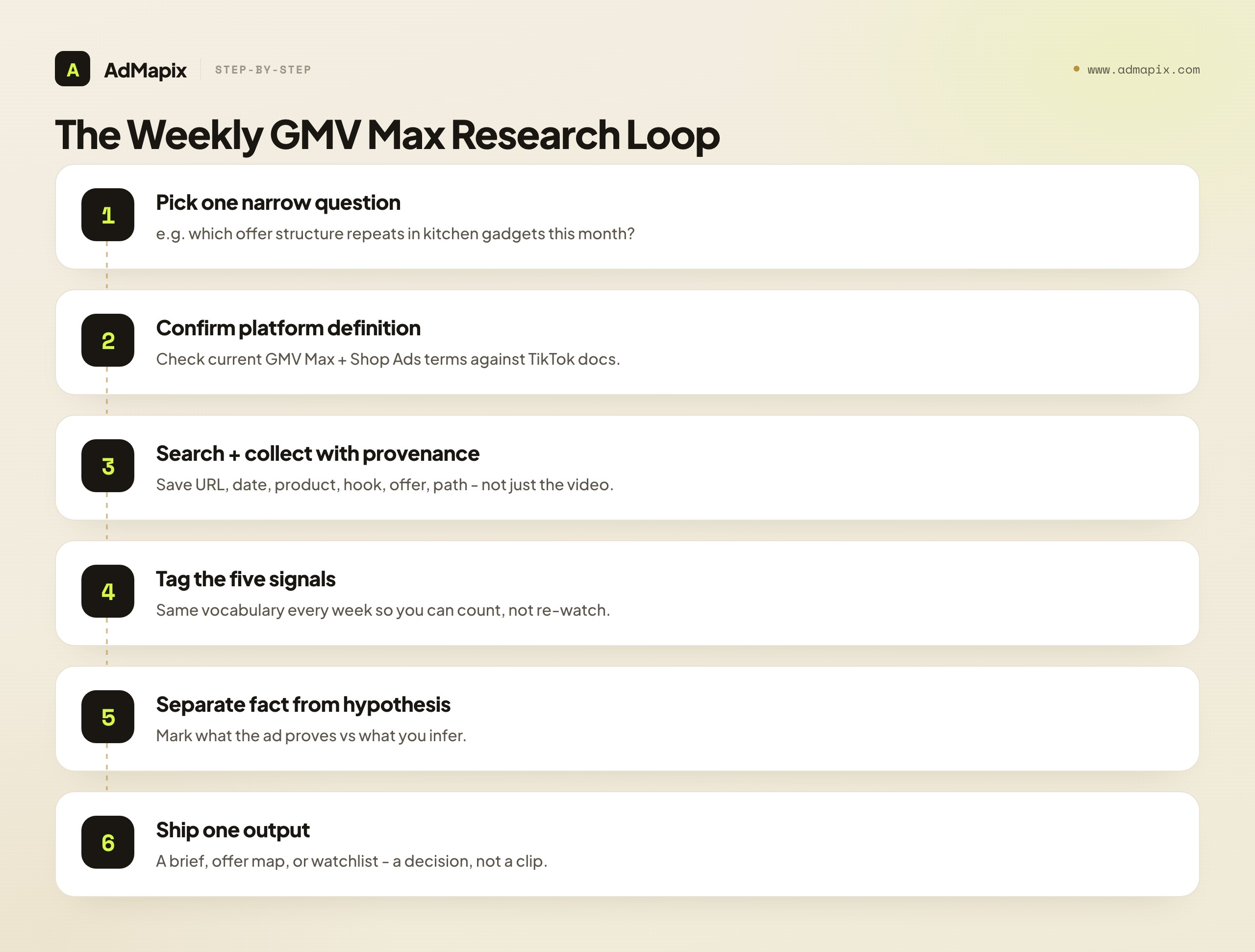
- Pick one research question. Narrow beats broad. Not "what are competitors doing on TikTok Shop," but "in the kitchen-gadget category, which offer structure repeats most across GMV Max-style creator ads this month?" A question you can answer in a week is a question worth asking.
- Confirm the platform definition first. Before you brief anything, check the current GMV Max and Shop Ads terminology against TikTok's own docs so your brief uses the platform's vocabulary and you are not chasing a feature that has been renamed or merged.
- Search and collect with provenance. Pull competitor ads in the category, and save each one with its source URL, date, product, hook, offer, and path — not just the video file. Provenance is what makes the example comparable next month.
- Tag the five signals consistently. Apply the same tag vocabulary every week — hook type, proof type, offer type, product price band, path — so you can sort and count instead of re-watching. Consistent tags are what turn a folder into a dataset.
- Separate fact from hypothesis explicitly. In the brief, mark what the ad proves (product, hook, offer, format) versus what you are inferring (that it converts, that it is profitable). Honest separation keeps you from acting on a guess dressed up as a finding.
- Ship one output. End every loop with a creative brief, an offer map, or a watchlist update — a decision, not a clip library. If a week of research does not change a test plan, the loop did not pay off, and you should tighten the question.
The discipline is in steps 4 through 6. Anyone can search and collect; the teams that win are the ones who tag consistently, label their inferences as inferences, and force each cycle to produce a decision. Do that for a quarter and you will have a longitudinal view of how a category's offers and hooks shift — a view no single scrape can give you.
What Public GMV Max Data Can and Cannot Prove
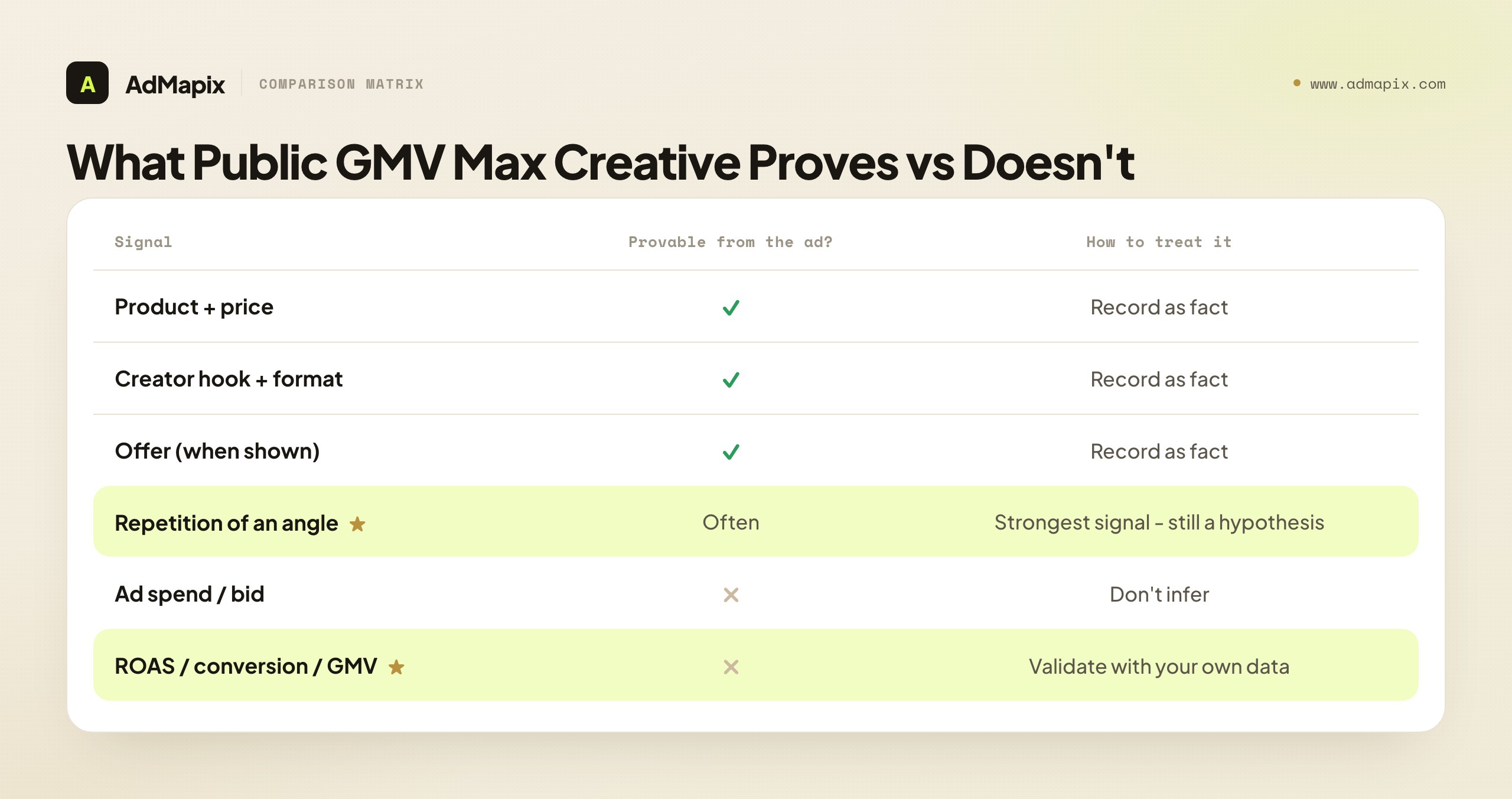
This is the section to read twice, because the most common research failure on GMV Max is not laziness — it is confidently reading numbers off an ad that the ad never contained. Public creative is strong evidence of structure and weak-to-zero evidence of performance. Hold that line and your research stays honest; cross it and you will scale a "winner" that was only ever a guess.
What public creative proves. You can directly observe the product on the card and its price. You can observe the creator-style hook and the format — demo, unboxing, testimonial, problem-solution. You can observe the offer when it is shown in-creative or on the product card: the voucher, the bundle, the free-shipping flag, the limited-time price. You can observe the call to action and the path it points to. And — most valuable — you can observe repetition: whether a competitor runs the same product-hook-offer system across many ads, many creators, or many weeks. These are real, auditable facts you can build a brief on.
What public creative cannot prove. It cannot show you ad spend. It cannot show you the bid or bidding posture (and under GMV Max, even the competitor barely "sets" a bid — the system does). It cannot show you the audience. It cannot show you conversion rate, ROAS, or the actual GMV the campaign produced. None of that is exposed by a visible ad, and no honest public tool claims otherwise. The moment you write "they must be making money on this" in a brief, you have left the territory of observation and entered the territory of assumption — fine, as long as you label it as an assumption.
Repetition is the bridge, and it is a hypothesis. If a seller runs near-identical creative on the same product for weeks, that consistency suggests the system is working for them — sellers rarely keep pouring creative into a losing product. But "suggests" is the operative word. Repetition is the strongest public signal available, and it is still only a hypothesis to validate with your own product, your own margin, and your own test. Treat it as a strong lead, never as a confirmed result.
The practical rule that follows: validate every inference against your own data. A competitor's repeated ad earns a test, not a copy. Run the system — product analog, hook, offer — against your own store and CRM, and let your real conversion and margin numbers decide whether the rival's "winner" is a winner for you. The ad is where the research starts, not where it ends.
Reading the Product-Card Path, Not Just the Creative
A signal almost everyone under-weights: the same hook on a frictionless product card and on a confusing one are not the same ad. GMV Max optimizes toward GMV, and GMV is realized at checkout, so the path from the swipe to the buy button is part of the conversion machine — not a detail to skip past.
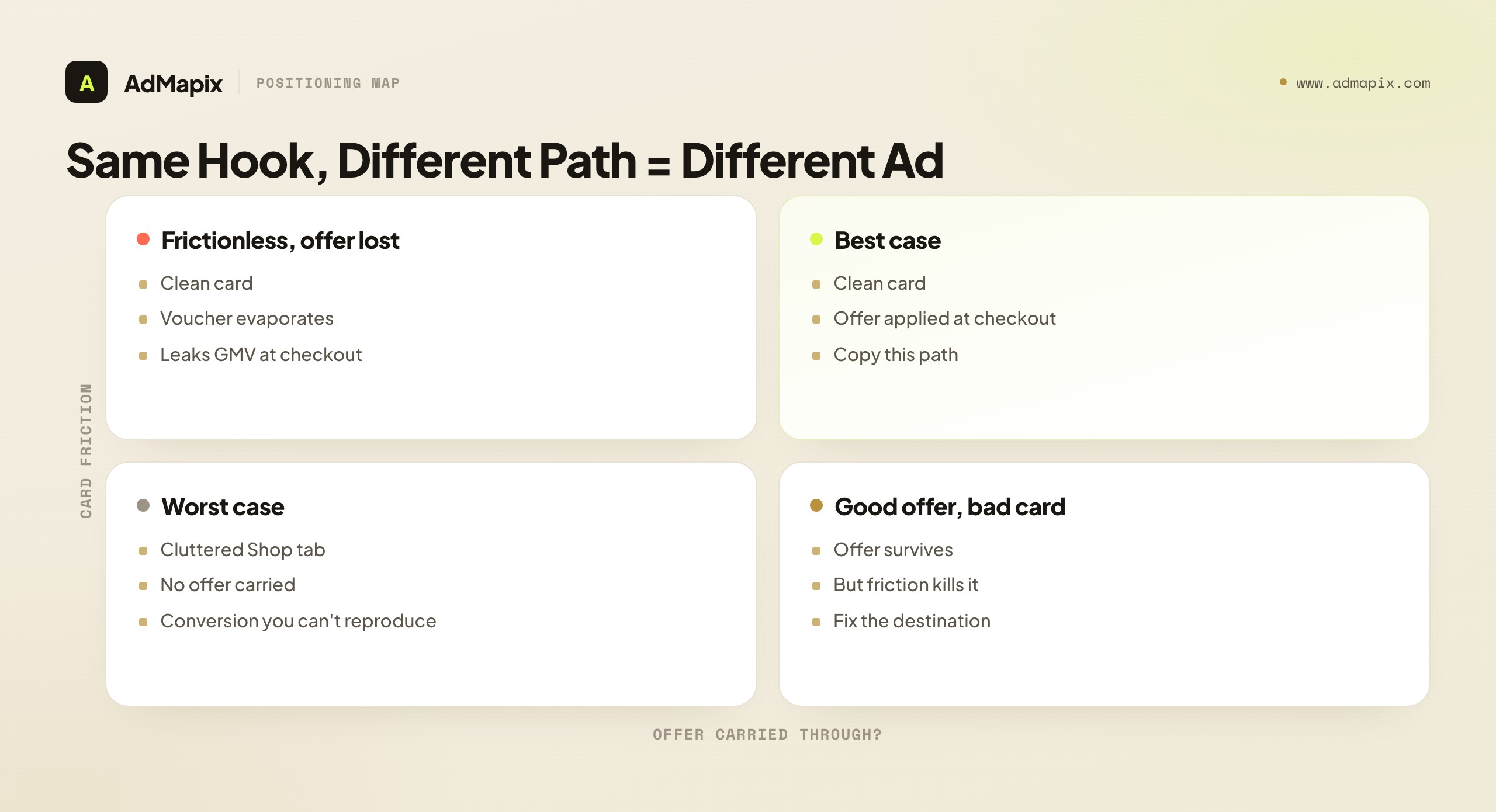
When you study a competitor's GMV Max ad, follow the path. Does the ad route to a clean product card with the offer front-and-center, a clear price, and trustworthy reviews? Or does it dump the viewer into a cluttered Shop tab where the product is three taps away? Does the in-feed link carry the voucher through to checkout, or does the offer evaporate between the video and the card? A hook can be identical across two competitors while one converts far better simply because the destination is frictionless and the offer is preserved end-to-end.
For research, this means your capture template should record the path as deliberately as it records the hook. "Routes to product card with voucher applied" and "routes to Shop tab, offer not carried through" are materially different ads even if the first three seconds are twins. When you brief a test off a rival, brief the destination too — because copying a hook into a worse path is another way of copying the wrong half.
Spark Ads, Affiliates, and the Paid/Organic Blur
TikTok Shop's commerce runs heavily on creators, and that blurs a line you need to keep sharp. A large share of GMV flows through affiliate creators and Spark Ads — brand-boosted creator posts — not classic in-feed brand ads. The consequence for research is that a video which looks organic may be a paid Spark Ad feeding GMV Max, and a video that looks like a polished ad may be an unpaid affiliate post that simply popped.
If you mis-classify these, you mis-price the competitor's strategy. Assume a cheap affiliate win required a big paid budget and you will over-estimate their commitment; assume a scaled Spark Ad campaign was a lucky organic post and you will under-estimate it. Neither is observable with certainty from the outside — which is itself a fact worth labeling honestly in a brief — but you can read clues: affiliate posts often carry creator-side incentive framing and disclosure patterns, while brand-boosted creative tends to be more consistent in product framing and offer across multiple creators. When in doubt, tag it as "ambiguous source" rather than guessing, and weight your confidence accordingly.
The deeper point is the one that recurs throughout GMV Max research: you are reading a product-creative-offer system, not a single ad. A competitor's presence in a category is the sum of their brand ads, their Spark Ads, and their affiliate creators all feeding the same products into the same automated optimizer. Read the system, count the repetition across creators, and resist the urge to over-interpret any one clip.
Common Mistakes That Waste GMV Max Research Time
Most wasted research hours trace back to a handful of repeatable errors. Naming them is the cheapest way to avoid them.
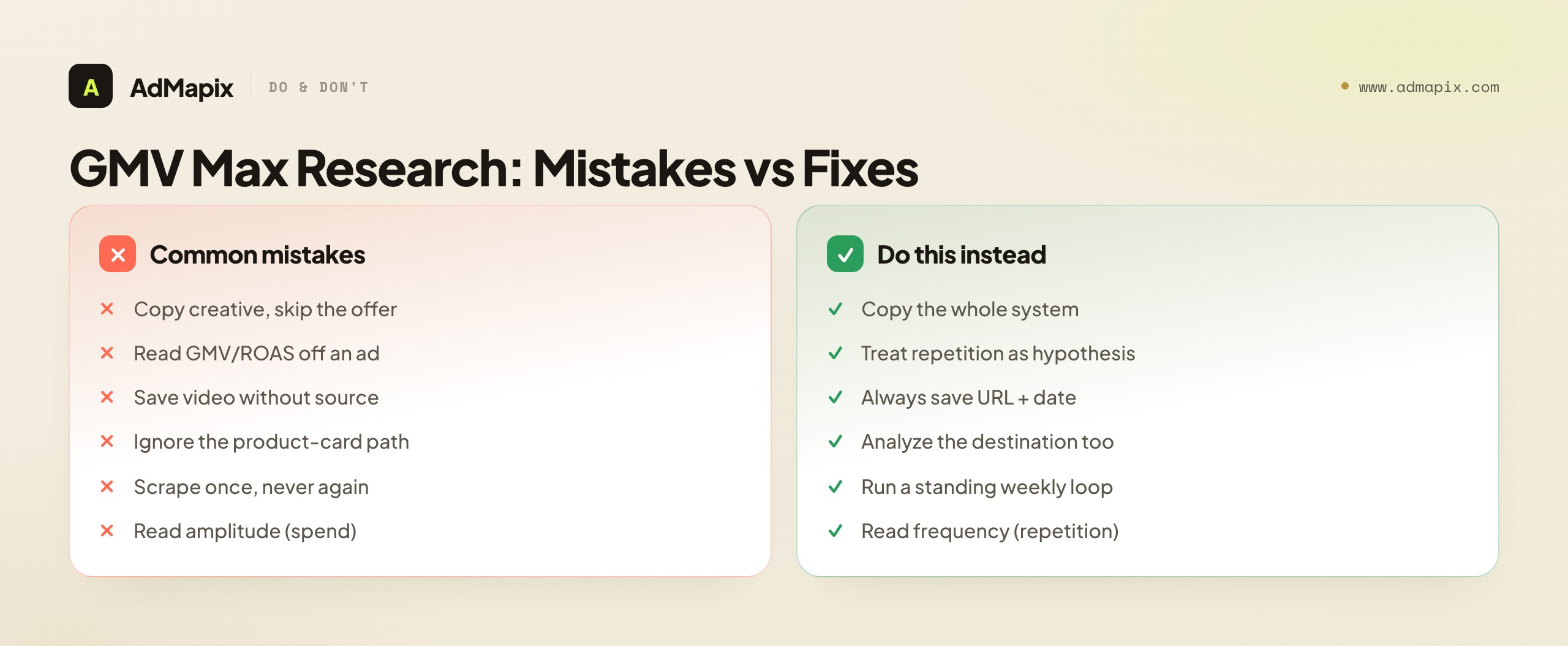
- Copying the creative without the offer. A GMV Max ad's pull is frequently the voucher or bundle, not the hook. Lift the hook onto a worse offer and the result rarely transfers — you copied the visible half and dropped the load-bearing one.
- Assuming the ad reveals GMV or ROAS. Visible creative cannot prove spend, bids, audience, or revenue. Treating repetition as a metric instead of a hypothesis is the single most expensive mistake in competitive ad research.
- Saving the video without the source. Without URL, date, product, and offer, a saved ad cannot be compared next month or audited in a client report. Provenance is not optional bookkeeping; it is what makes the example evidence.
- Ignoring the product-card path. The same hook on a frictionless card and a confusing one are different ads. Analyze the destination, or you will copy a conversion you can't actually reproduce.
- Researching once and never again. TikTok categories and offers shift fast, and a one-time scrape goes stale within weeks. A standing weekly loop beats a heroic one-off every time.
- Reading amplitude instead of frequency. You cannot see how much a rival spends, so stop trying. You can often see how often they repeat an angle — read frequency, and let it stand in for the confidence signal you can't observe directly.
A Worked Category Teardown: Reading One Competitor Over a Month
Principles land harder when you watch them run against a real shape, so here is a composite month of researching a single rival in the kitchen-gadget category — the kind of impulse, commodity-adjacent niche where GMV Max does its heaviest lifting. Call the competitor "Rival Shop." You picked them because they keep surfacing on the same products you sell, which makes them a direct read rather than an adjacent one.
In week one you pull their visible Shop creative and tag the five signals. The picture that emerges is not a single ad but a system: three products carry almost all their creative volume, every video opens with the same problem-solution beat (a messy kitchen task solved in one satisfying motion), and every product card anchors a "buy 2 save 15%" bundle with free shipping. Already the bet is legible — they are not testing broadly; they are concentrating creative behind three products and one offer structure. That concentration is itself the signal. A rival spreading thin across twenty products reads very differently from one pouring fresh creative into three, and the latter almost always means those three are working for them.
Week two and three are about velocity and repetition. You notice Rival Shop ships four to six new videos a week, all variations on the same problem-solution hook with different creators. The offer never changes; only the creative rotates. That tells you two things at once: they have a content engine (multiple creators on a repeatable brief), and the offer is the fixed, load-bearing element they have stopped testing because it already converts. For your own brief, that is the most useful read of the month — the hook is where they iterate, the offer is where they have settled. If you were going to copy one half, the offer is the validated one.
Week four is synthesis, and this is where honesty earns its keep. What the month proves: three products, one hook archetype, one bundle-plus-shipping offer, high creative velocity, multiple creators. What it does not prove: that any of it is profitable for Rival Shop, what their margin is, or what GMV the system produces. So the output is a hypothesis, not a verdict — "a problem-solution hook on a 2-for bundle with free shipping is the dominant winning structure in this category right now" — and it ships as two clean tests against your own store: the bundle offer against your current hook first, then a new problem-solution hook against your current offer. Each result attributes to one variable, and your margin, not Rival Shop's apparent momentum, sets the success bar. That is the whole method in one month: a reconstructed system, an honestly labeled hypothesis, and two interpretable tests — none of which required a number the platform hides.
How Competitive Creative Research Maps to Your Own GMV Max Campaign
Research only pays off when it changes what you ship. Here is how the five signals you capture from competitors map directly onto the inputs you feed your own GMV Max campaign — closing the loop from intelligence to action.
The product signal tells you which categories and price bands a market is currently betting on, which informs which of your products to feed GMV Max first. The creative signal — the repeated hooks and formats — becomes your creative pool: GMV Max competes on creative volume and product-offer fit, so a shortlist of validated hook structures is exactly what the machine wants more of. The offer signal tells you what voucher, bundle, or shipping structure a category responds to, which shapes the offer you anchor your own campaign on. The path signal reminds you to make your own product card frictionless and carry your offer through to checkout. And the output — the briefs and offer maps — is what your creators and your campaign managers actually execute against.
Because GMV Max rewards creative volume, the research-to-creative pipeline matters more than under manual campaigns. You are not trying to find the one perfect ad to clone; you are trying to extract a set of validated structures — three or four hook patterns, two or three offer shapes — that you can brief your creators against to produce variety quickly. The competitor research gives you the menu of what a category responds to; your creators give the system the volume it needs to find a winner inside that menu. A team that turns weekly research into a steady brief output is feeding the optimizer exactly what it is hungry for, while a team that hunts for a single ad to copy is starving it.
When you turn a competitor pattern into a test, design the test so the result is interpretable. The cardinal rule is vary one element at a time. If a rival's winning system pairs a problem-solution hook with a bundle offer, do not launch a test that changes both your hook and your offer at once — you will not know which one moved the number. Run the bundle offer against your current hook first, then test the new hook against your current offer, so each result attributes cleanly. GMV Max will optimize within whatever you give it, but it will not tell you why one creative beat another; that interpretability has to be designed into the test structure, not extracted afterward.
And set the success bar against your economics, not the competitor's apparent momentum. A bundle that works for a rival with 60% margins can be a loser for you at 30%, because the discount that drives their GMV erodes all of yours. Before you copy an aggressive offer, run the unit economics: what does the voucher cost you, what does the bundle do to your average order value and your margin, and does the GMV lift survive contact with your actual cost structure? The competitor's public ad tells you what is possible in the category; only your own numbers tell you what is profitable for you.
The honest framing throughout: a competitor's repeated, public system is a strong starting hypothesis for your own campaign, validated against your margin and your real conversion data. You are not copying a number you can't see; you are testing a structure you can — and the discipline of one-variable tests and margin-aware success bars is what keeps the testing honest.
Where AdMapix Fits in GMV Max Research
AdMapix fits TikTok Shop sellers, agencies, and creative teams who research competitor ads often enough that screenshots and spreadsheets stop scaling — and who want a cross-network view, not just a single-platform feed. It is a cross-network ad creative search and intelligence layer: use Search to find competitor creatives by product, brand, or keyword across networks; save the strongest examples to Media; run Video Analysis to break down pacing, hook, proof, and structure; tag the offer and signals; and turn repeated patterns into a shareable Report. Pricing compares solo, agency, and growth plans, and you can start the recurring workflow from Login.
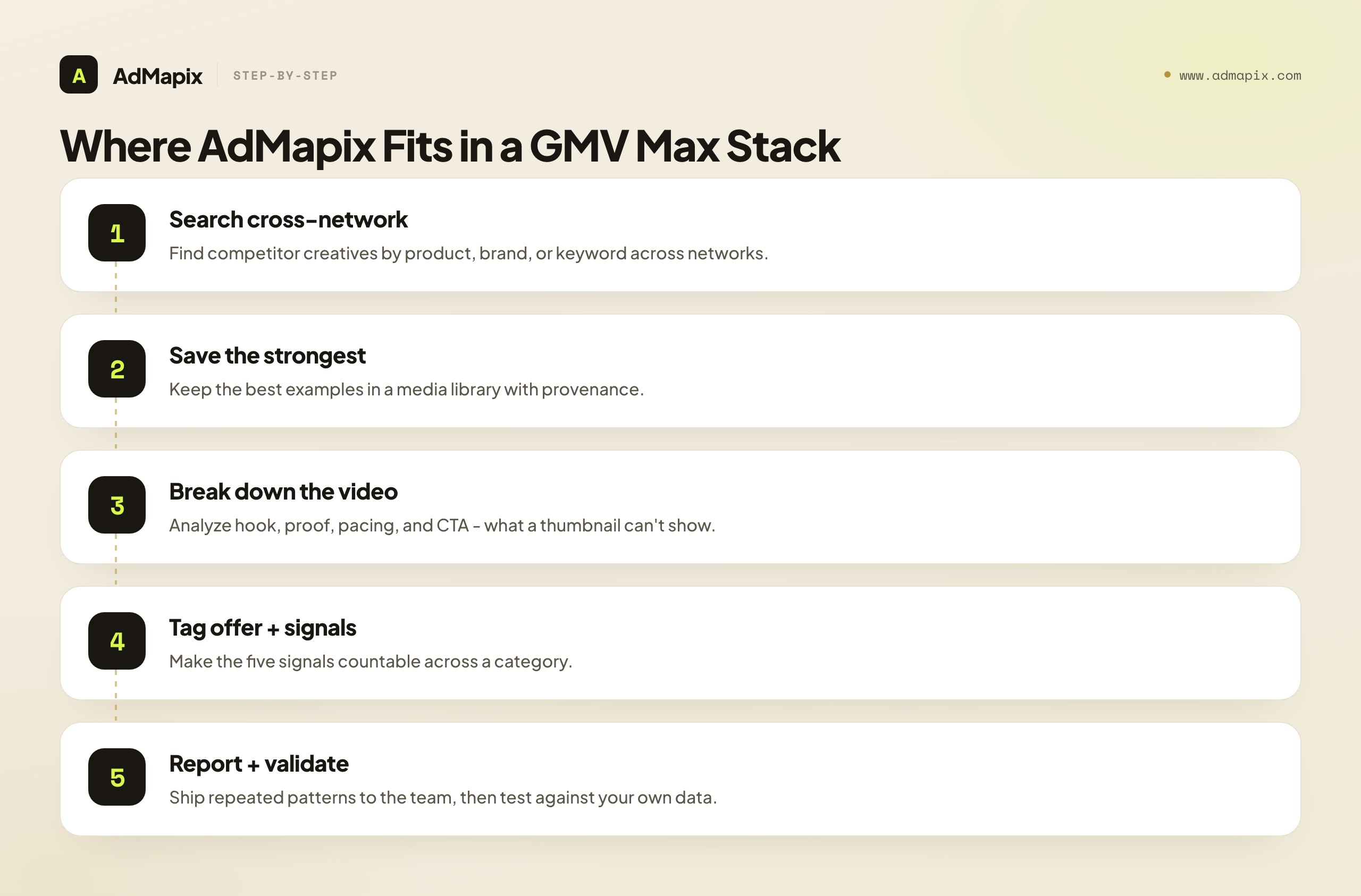
Where it earns its place specifically for GMV Max research: GMV Max concentrates the competitive question onto creative and offer, and AdMapix is built to search, save, break down, and report on exactly those. The cross-network angle matters because TikTok Shop sellers rarely run TikTok in isolation — the same product and offer often surface on Meta and elsewhere, and seeing the system across networks tells you more than any single-platform wall of videos. The video breakdown matters because, on shoppable creative, the first three seconds, the proof moment, and the CTA carry the conversion — and a static thumbnail can't show any of that. The report matters because research that doesn't travel to a team doesn't compound.
Where it is not the right tool: if you only need to glance at one ad once; if you are hunting for a competitor's private spend or actual GMV (no honest public tool exposes that, and AdMapix doesn't pretend to); or if your research never gets reused. AdMapix earns its keep when the same category needs reviewing every week and the findings need to reach a team — and it positions itself honestly as the cross-network creative-intelligence link in your stack, not as a magic spend-revealer.
Putting It Together: A Standing GMV Max Intelligence Loop
The whole guide reduces to a loop you can run forever. Pick a narrow question. Confirm the platform definition. Search and collect competitor ads with provenance. Tag the five signals — product, creative, offer, path, output — consistently. Separate the facts the ad proves from the inferences you're making. Ship one decision: a brief, an offer map, or a watchlist. Then validate every inference against your own store and margin before you scale anything.
Do that weekly and three things compound. You build a longitudinal read of how a category's products, hooks, and offers shift over time — something no single scrape can give you. You train your team to distinguish observation from assumption, which is the difference between research and wishful thinking. And you keep your own GMV Max creative pool fed with validated structures, which is exactly what the automated optimizer rewards. The system removed the bid levers; it handed you a sharper, more honest competitive game played on creative and offer. Play that game with discipline and provenance, and the automation works for you instead of hiding the field.
The final reframe worth holding onto: automation did not make competitive research harder — it made the part you can see more decisive than ever. When bids and audiences were the battleground, the most important variables were the ones you could never observe, and research was an exercise in confident guessing. GMV Max moves the battleground onto product, creative, and offer — all of them visible in a rival's public ads, all of them testable in your own store. The teams that win in 2026 will not be the ones who guess best at hidden numbers; they will be the ones who read visible bets carefully, label their inferences honestly, and convert a weekly loop into a steady stream of margin-aware tests. That is a game you can actually play, and play better than competitors who are still pretending a screenshot reveals a spend report.
FAQ
What is TikTok Shop GMV Max?
GMV Max is TikTok's automated Shop Ads campaign type that optimizes a product's promotion toward gross merchandise value (GMV). According to TikTok's Business Help Center, it is positioned as a one-stop automated solution for Shop Ads, handling much of the placement and bidding work so sellers focus on feeding the system products and creatives rather than hand-tuning audiences and bids.
How does GMV Max change competitor research compared with manual Shop Ads?
It narrows the research to what you can actually see. Manual campaigns invite you to guess a rival's bids, audiences, and placements — none of which were ever public anyway. GMV Max automates those, so the competitive question collapses onto the inputs that are observable: which product a competitor pushes, which hook they reuse, and which offer they anchor. Research the bet, not the bid.
Can I see a competitor's GMV Max spend or ROAS from their ads?
No. Public ads show the creative, product, offer, format, and how often an angle repeats. They do not reveal a competitor's spend, bids, audience, conversion rate, or actual GMV. Use repetition as a hypothesis to test with your own product and margin, not as a performance metric you can read off a screenshot.
What should I capture from each competitor GMV Max ad?
Capture five signals: the product (category, price, variant, bundle), the creative (hook, format, proof, first-3-second angle), the offer (voucher, bundle, free shipping, flash price), the path (product card, Shop tab, LIVE, in-feed link), and the output (the brief, watchlist entry, or test it produces). Always save the source URL and date too — provenance is what makes the example comparable later.
Is the creative or the offer more important for GMV Max research?
It depends on the product, but on commodity and impulse items — which GMV Max sells well — the offer often moves GMV more than the hook. Because GMV Max optimizes toward gross merchandise value, the offer that closes the sale frequently outweighs the hook that earned the view. Capture both, and when you brief a test, vary one at a time so you can tell which one drove the change.
Why does the product-card path matter if the hook is identical?
Because GMV is realized at checkout, not at the view. The same hook routed to a frictionless product card with the offer carried through converts very differently from the same hook dumped into a cluttered Shop tab where the voucher evaporates. The destination is part of the conversion machine, so analyze the path alongside the creative and brief it into your tests.
How do I tell a paid Spark Ad from an organic affiliate post?
Often you can't with certainty from the outside, and the honest move is to tag ambiguous cases as "ambiguous source." Clues help: affiliate posts tend to carry creator-side incentive framing and disclosure patterns, while brand-boosted Spark Ads are usually more consistent in product framing and offer across multiple creators. Mis-classifying these mis-prices a competitor's strategy, so weight your confidence accordingly rather than guessing hard.
How often should I run GMV Max competitor research?
Weekly is a strong default. TikTok creative fatigues fast and category offers shift within weeks, so a one-time scrape goes stale quickly. A standing weekly loop — one narrow question, consistent tagging, one shipped output — beats a heroic one-off and builds a longitudinal view of how a category's products, hooks, and offers move over time.
How does AdMapix help with TikTok Shop GMV Max ad research?
AdMapix lets you search cross-network ad creative, save examples to a media library, run video analysis on pacing, hook, and structure, tag offers and signals, and compile repeated patterns into a shareable report. It is built for teams researching competitor creative on a recurring basis — exactly the creative-and-offer surface GMV Max concentrates the competitive question onto — and it does not claim to reveal private spend or GMV that no public tool can honestly show.
Should I copy a competitor's winning GMV Max offer directly?
No — test it against your own unit economics first. An aggressive bundle or voucher that drives a rival's GMV can quietly destroy yours if their margins are wider than yours. The competitor's public ad proves the offer structure is possible in the category; only your own cost numbers prove whether it is profitable for you. Run the voucher's real cost, its effect on average order value, and the margin after discount before you scale anything, and hold the success bar against your economics rather than their apparent momentum.
How many competitors should I track for GMV Max research?
Fewer than you think, watched more closely. Three to five competitors in a single category, tracked weekly with consistent tagging, produces a far sharper read than twenty competitors glanced at once. The value of GMV Max research is in spotting repetition — the same product-hook-offer system surfacing across weeks and creators — and repetition only becomes visible when you watch a tight set of rivals over time. Add an adjacent competitor or two (same buyer, different product) if you want early warning on offers migrating into your niche, but resist the urge to widen the set until your weekly loop is already producing shipped tests.
Does high creative volume from a competitor mean they're winning?
Not by itself. High creative velocity tells you a competitor has built a content engine and that GMV Max is rewarding fresh creative for them — both real facts — but it does not prove the campaigns are profitable. A venture-funded seller can flood a category with creator videos while losing money on every order. Read volume as a signal of commitment and infrastructure, then look for the corroborating signal that matters more: whether the same product-and-offer system repeats and persists. Persistence on a fixed offer is a stronger profitability hint than raw video count, because sellers rarely keep pouring creative into a losing offer.
Key Takeaways
- GMV Max automates the levers you could never see anyway (bids, audiences, placements) and concentrates the competitive question onto the inputs you can see: product, hook, offer, and path.
- Capture five signals per ad — product, creative, offer, path, output — with source URL and date, so screenshots become a dataset you can count, compare, and brief from.
- Treat repetition as your strongest public signal and as a hypothesis, never as proof of spend, ROAS, or GMV. Validate every inference against your own store and margin.
- The offer often outweighs the hook on the commodity and impulse products GMV Max sells best — capture both, and never copy a hook onto a worse offer.
- Analyze the product-card path alongside the creative, and run a standing weekly loop that ends each cycle with a brief, offer map, or watchlist — not a folder of clips.
Related Reading
- Competitor Ad Analysis Framework — a general structure for turning rival ads into testable briefs, applicable beyond TikTok Shop.
- TikTok Shop Ad Spy Tools 2026 — free and paid tools compared for sourcing the competitor ads you'll research here.
- KaloData vs FastMoss — the TikTok Shop commerce-analytics layer that pairs with creative intelligence.
- Best TikTok Ad Spy Tools — a broader look at TikTok-first ad discovery.
Authoritative Sources
- TikTok Business Help Center — About Product GMV Max — describes Product GMV Max as an automated campaign type for TikTok Shop products optimized toward GMV.
- TikTok Business Help Center — Shop Ads FAQ — explains Shop Ads concepts, product-level promotion, and seller/advertiser setup considerations.
- TikTok Business Help Center — GMV Max Migration — describes GMV Max as a one-stop automated solution for Shop Ads.
Sources verified as of 2026-06-21. Platform docs and ad products change often; confirm the source path before quoting details in a client report or quarterly plan.
Turn these observations into your next creative study
Open the creative library and select samples for your market, network and research question.
Related Articles
Puzzle Game Ad Examples: Hooks, Mechanics, and Test Ideas for 2026 UA
A practitioner's library of puzzle game ad examples for 2026: the recurring pin-pull, fail-state, and satisfying-solve hooks; a five-axis tagging framework to turn a folder of competitor creatives into a test backlog; the mechanic-match gap that drives cheap clicks and day-1 churn; playable structure; and the honest line between what a public ad proves and what it never can.
Taboola Ad Spy Tool in 2026: Native Ad Research for Headlines, Thumbnails, and Offers
How to research Taboola native ads from public evidence in 2026 — what a Taboola ad spy tool can and cannot prove, how to decode the headline-and-thumbnail pair that carries the whole click, read advertorial and quiz landing paths, follow the retargeting trail, separate observed creative facts from private-metric guesswork, and turn repeating patterns into a testable creative brief instead of a one-off screenshot.
Ecommerce Ad Spy Tools in 2026: The Complete Guide to Researching Competitor Product Ads
A complete 2026 guide to ecommerce ad spy tools — what to capture from every competitor product ad, the five-signal framework that turns screenshots into a test backlog, platform-by-platform coverage across Meta, TikTok, Google and native, a DTC creative-research workflow, offer and proof teardowns, landing-page and funnel analysis, how to choose between free ad libraries and cross-network tools, and what public data can and can't prove.