Mobile Game Ad Spy Tools in 2026: The Complete UA Creative Intelligence Playbook
The 2026 canonical guide to mobile game ad spy tools and UA creative intelligence: how to read playable hooks and genre tells, what public data can and can't prove, a tool-selection framework, the four signal layers (creative, store, channel, longevity), a teardown workflow, and turning patterns into A/B tests.
By the AdMapix Research Desk — Updated June 21, 2026
Mobile Game Ad Spy Tools in 2026: The Complete UA Creative Intelligence Playbook
A mobile game ad spy tool earns its keep when it helps you read why a competitor's creative is structured the way it is — the playable hook, the first-three-seconds fail-bait, the reward frame, the genre tells — not when it just hands you a pile of screenshots. Mobile game UA creative is genre-coded in a way no other vertical is: a 4X strategy ad lives or dies on its fake-tactical-battle hook, a match-3 ad on its "wrong move" fail-bait, a hyper-casual ad on a 2-second satisfying loop. Reading that code, not collecting it, is what separates a UA team that out-iterates competitors from one that drowns in inspiration folders.
This is the complete 2026 playbook for mobile game ad spying and UA creative intelligence, written for mobile game UA managers, growth leads, creative strategists, indie studios, and agencies. It covers what UA teams actually need from a spy tool, how to read a creative like a UA manager (not a collector), the hard line between what public data can and can't prove, how to choose the right tool for games specifically, the four signal layers beyond creative (store, channel, longevity), a step-by-step teardown workflow, and how to turn patterns into a test backlog. We'll be honest throughout: a visible ad tells you what a competitor shipped, never what worked — read it for craft, then prove ROAS in your own funnel.
The core discipline, up front: borrow the mechanic, not the pixels. A mobile game ad spy tool is for classifying playable hooks, video pacing, genre mechanics, and reward framing — not for measuring a competitor's spend or ROAS. The output that matters is a test brief: hook, mechanic, format, and the one variable you'll isolate in your own A/B test.
For the broader app method, see our mobile app ad spy tool guide; for the AppLovin-specific deep dive, AppLovin ads spy tool; and for the full tool landscape, best ad spy tools 2026.
TL;DR — Mobile Game Ad Spy Tools in 2026
- Mobile game creative is genre-coded. A match-3 fail-bait, a 4X fake-battle hook, and a hyper-casual satisfying loop follow different rules — read the genre's mechanic, not just the format.
- A spy tool classifies craft; it doesn't measure performance. You can read the hook, format, playable mechanic, and reward frame. You cannot see spend, ROAS, retention, or targeting. Those are private.
- Repetition is a longevity signal, not proof of profit. A creative running for months might be a winner — or a default nobody paused. Only your own funnel proves performance.
- Most game networks have no public library. Unity, AppLovin, ironSource, Mintegral, and Moloco expose no Facebook-style archive — so game ad spying means cross-network creative intelligence plus in-app observation.
- Borrow the mechanic, not the pixels. Copying a competitor's exact ad ignores the genre, reward frame, and audience that made it work — and is a legal risk. Adapt the lever to your own game.
- The output is a test brief. Every research session ends with a one-line hypothesis: "test a fail-bait opener against our current satisfying-win opener for match-3 UA."
Why Mobile Games Need Their Own Spy Approach
It's tempting to treat "mobile game ad spy" as a subset of generic ad spying, but games are different enough to warrant their own playbook — and applying a generic ad-library mindset is exactly why most game UA research underperforms. Three things make games unique:
| What makes games different | Why it changes the research |
|---|---|
| Genre-coded creative | A hook only makes sense against its genre's audience and mechanic |
| Playable-heavy formats | The mechanic lives in interaction, which a screenshot can't capture |
| No public library on key networks | Unity/AppLovin/ironSource/Mintegral expose no archive — you build evidence yourself |
| Fake-mechanic temptation | Misleading playables win installs and tank retention — a what-not-to-do pattern |
| AI-optimized delivery | On AXON/Moloco the creative is the targeting, so creative research = the main lever |
The practical upshot: a generic "search the ad library" approach barely works for games, because the networks driving most game installs publish no library, and the creative that matters most (playables) is interactive, not static. Mobile game ad intelligence is therefore a craft-reading and evidence-building discipline, not a database lookup — and that's the approach this guide teaches.
What Mobile Game UA Teams Actually Need
Most teams searching for a mobile game ad spy tool aren't short on screenshots — they're short on a way to read them. Spotting the format is step one; understanding the mechanic underneath it is what lets you adapt rather than plagiarize.
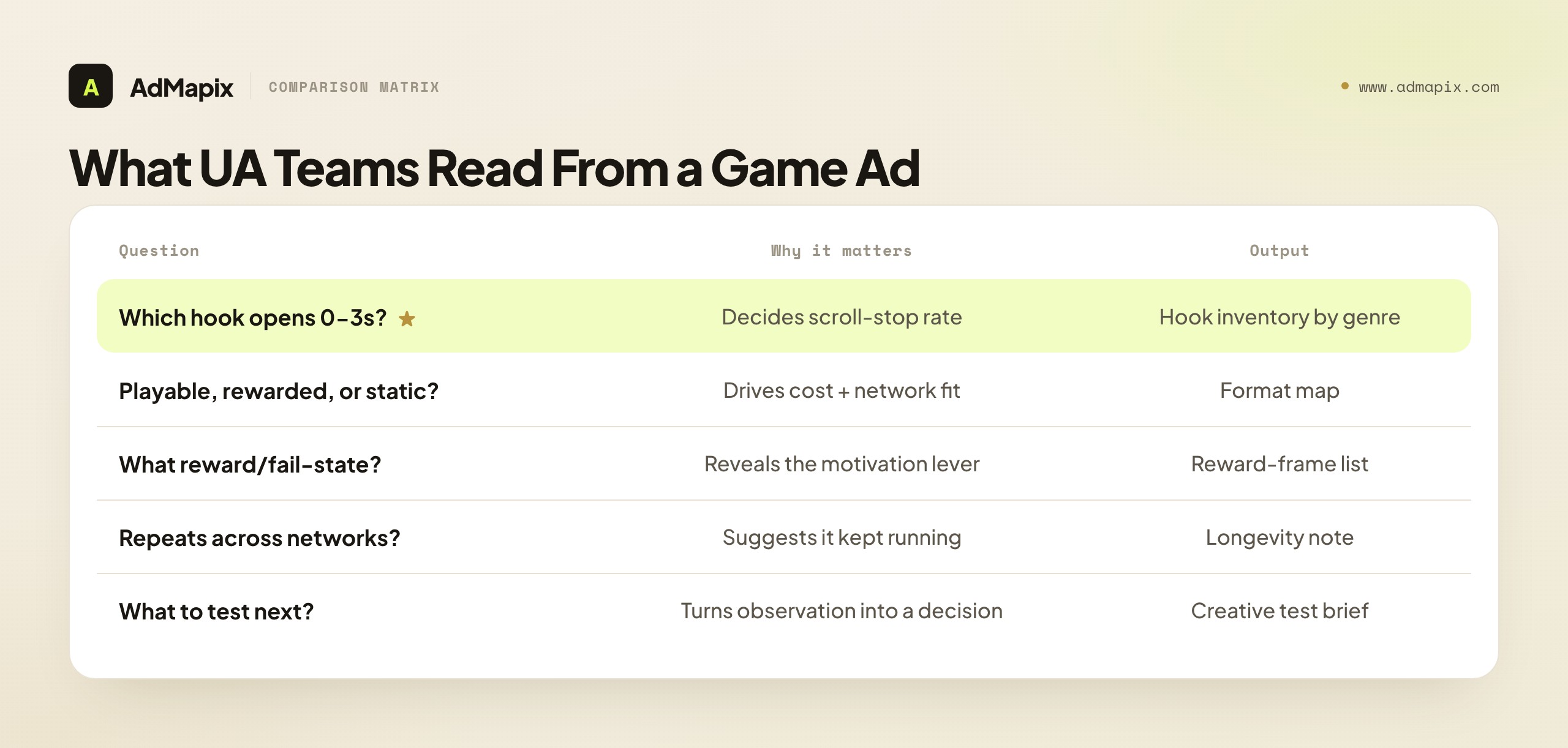
| Question | Why it matters for games | Output |
|---|---|---|
| Which hook opens the first 3 seconds? | Decides scroll-stop rate before anything else | Hook inventory by genre |
| Is it a playable, rewarded video, or static? | Drives production cost and network fit | Format map |
| What reward or fail-state is shown? | Reveals the motivation lever being pulled | Reward-frame list |
| Does the creative repeat across networks/weeks? | Suggests the advertiser kept running it | Longevity note |
| What's the next thing we should test? | Turns observation into a UA decision | Creative test brief |
The deliverable is never "a folder of ads." It's a hook inventory, a format map, a reward-frame list, and — most importantly — a one-line test hypothesis per pattern. Everything in this guide builds toward that final output, because a pattern that never becomes a test produces zero installs.
Read the Creative Like a UA Manager, Not a Collector
Start from the mechanic, because the mechanic is what you can legally and usefully borrow. A hook is the opening device that earns the next second of attention; a reward frame is the in-ad promise (a chest, a level-up, a near-win) that motivates the install. Two ads can share a format and pull completely different levers — copy the lever, not the pixels.
Work in a fixed order so your notes stay comparable across a genre:
- Genre and app category first. A hook that converts for idle RPG often dies in hyper-casual. Tag the category before anything else so you never compare across mismatched audiences.
- Opening hook (0–3s). Name the device: fail-bait, ASMR satisfaction, fake-UI tap-test, character reveal, or social/meme framing.
- Format and mechanic. Playable, rewarded video, static, or UGC-style. Note the exact mechanic the playable lets the viewer touch.
- Reward frame and CTA. What's promised, and how the install ask is staged.
- Repetition. Whether you see the same creative across multiple networks or multiple weeks.
The deliverable is a one-line hypothesis per pattern: "Match-3 competitors open with a deliberately wrong move; test a fail-bait variant against our current satisfying-win opener." That's the difference between reading like a UA manager and hoarding like a collector — the manager leaves every session with a test, the collector leaves with a fuller folder.
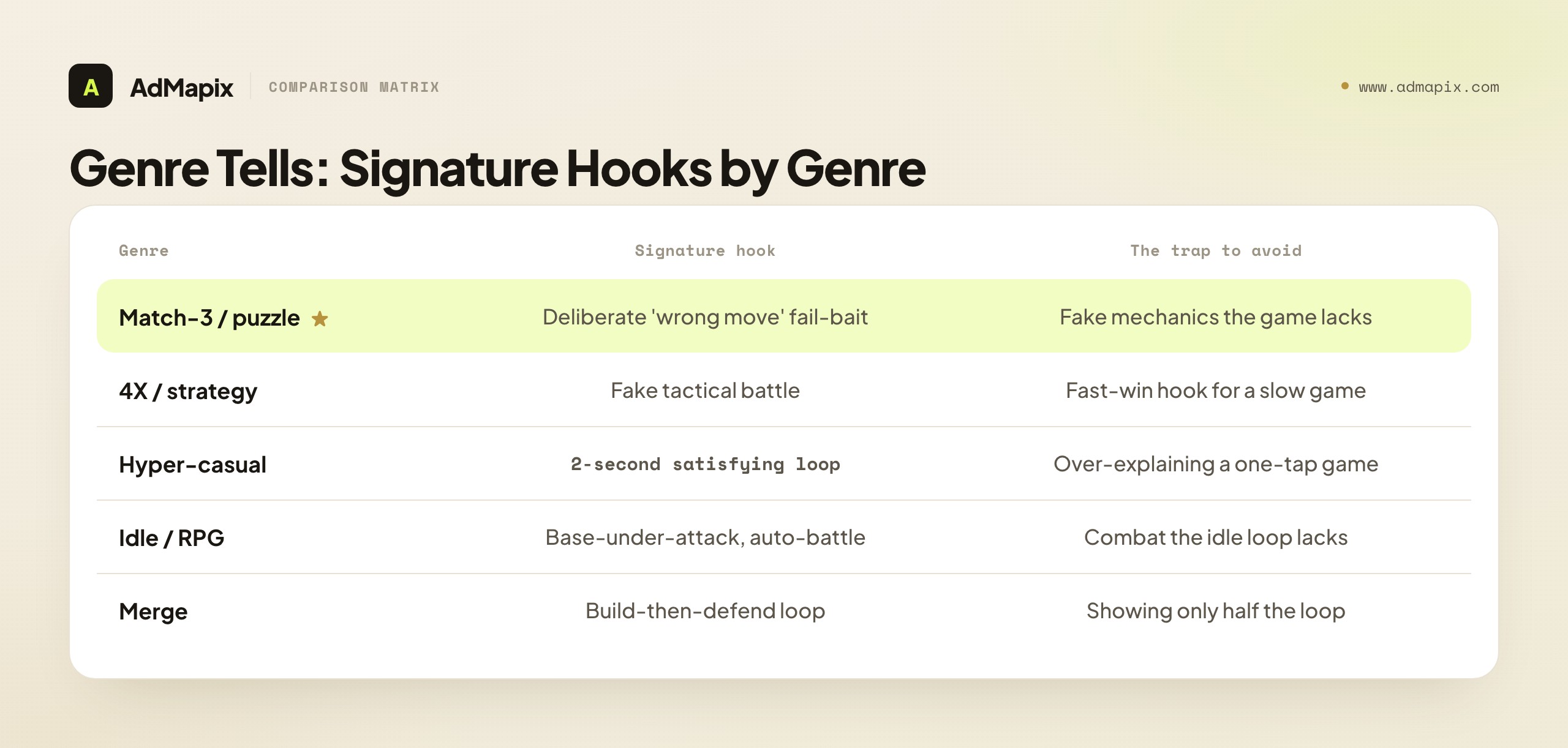
Genre tells: a quick reference
Because games are genre-coded, it helps to know the dominant hooks per genre before you start. This is the cheat sheet for reading a competitor's ad against its genre's conventions.
| Genre | Signature hook | What the playable usually shows | The trap |
|---|---|---|---|
| Match-3 / puzzle | Deliberate "wrong move" fail-bait | A near-solve the viewer wants to fix | Fake mechanics the game lacks |
| 4X / strategy | Fake tactical battle, base-under-attack | A simplified combat the real game gates | Fast-win hook for a slow game |
| Hyper-casual | A 2-second satisfying loop | The one-tap mechanic itself | Over-explaining a simple game |
| Idle / RPG | Progress bar, "base under attack," auto-battle | A power fantasy / progression tease | Combat the idle loop doesn't deliver |
| Merge | "Merge to build, then defend" combined loop | The merge plus a combat payoff | Showing only half the loop |
| Casino / slots | Big-win celebration, near-miss | A spin and an outsized payout | Implying odds the game doesn't have |
What Public Ad Data Can and Cannot Prove
This is the line that separates a useful workflow from a misleading one. A spy tool surfaces creatives that were visible; it does not surface the spreadsheet behind them.
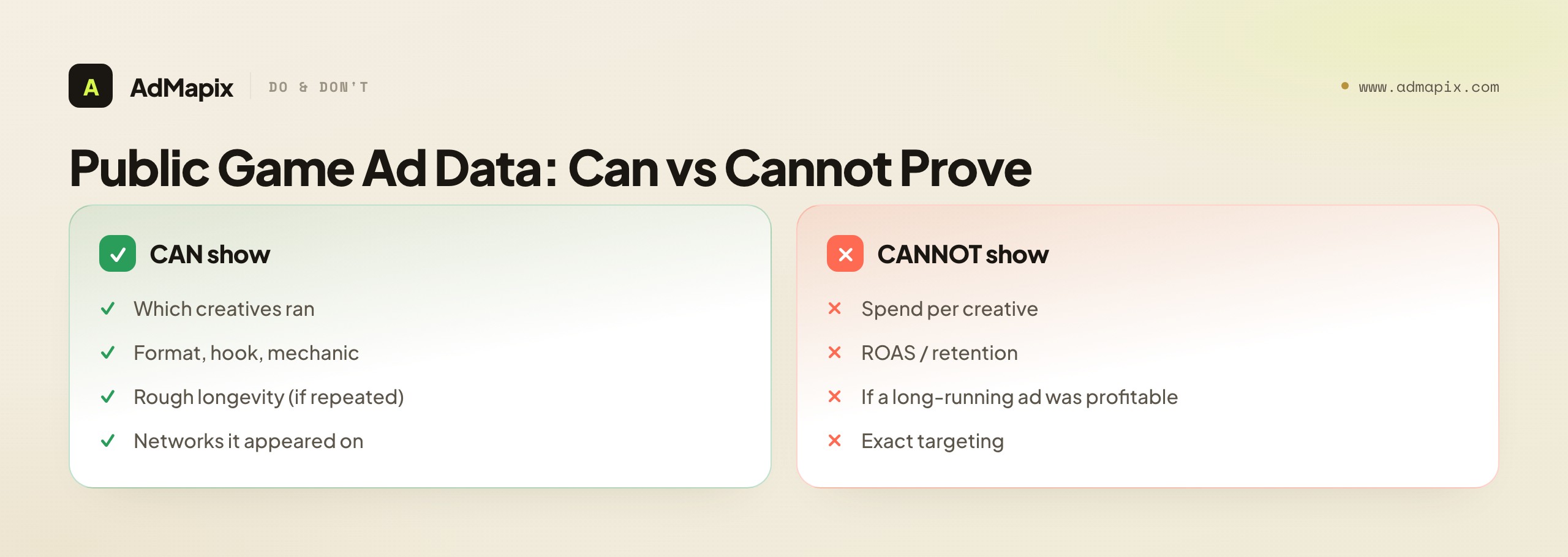
| Public ad data CAN show | Public ad data CANNOT show |
|---|---|
| Which creatives a competitor ran | How much they spent on each |
| The format, hook, and mechanic used | The ROAS or retention each delivered |
| Rough longevity if the creative repeats over time | Whether a long-running ad was profitable or just unmanaged |
| Which networks a creative appeared on | The exact targeting or audience behind it |
| Apparent localization (language, store layout) | Whether that market is actually performing |
Treat every observation as a hypothesis. A creative that ran for months might be a winner — or it might be a default nobody turned off. The only proof of performance is your own test in your own funnel. This discipline matters more for games than almost any vertical, because the temptation to copy a "clearly winning" competitor playable is so strong — and the playable might be acquiring users who install on a fake mechanic and churn by Day 1. Repetition raises the odds a creative is performing; it never proves it.
Most Game Networks Have No Public Library
A fact that reframes the whole task: the networks driving the most mobile-game installs publish no public ad library the way Facebook does. This is why "just check the ad library" is useless advice for game UA.
| Network | Public ad library? | How to research it |
|---|---|---|
| Meta (Facebook/Instagram) | Yes — full Ad Library | Search the library directly |
| TikTok | Partial — Creative Center top ads | Creative Center + a tool |
| Unity Ads | No | Cross-network tool + in-app observation |
| AppLovin / AXON | No | Cross-network tool (deep dive) |
| ironSource | No | Cross-network tool |
| Mintegral | No | Cross-network tool |
| Moloco | No | Cross-network tool |
Because the in-app networks expose nothing, game ad research means one of two things: a cross-network ad-intelligence tool that has aggregated game creatives into a searchable database, or in-app observation — playing competing and adjacent games on a clean device and screen-recording the rewarded and interstitial ads served to you. In-app observation is the free fallback every UA manager should run occasionally (it shows real served creatives on Unity and AppLovin that no library covers), but it's slow, unsearchable, and only shows what's targeted to your device. For systematic research, a tool that has done the aggregation is the scalable answer. For the full network-by-network method, see mobile app ad spy tool.
How to Choose a Mobile Game Ad Spy Tool
"Best ad spy tool for mobile games" is a question with no universal answer — the right tool depends on your networks, genres, and whether you need analysis and reporting or just discovery. But games need a different buying checklist than generic ad spying, because the things that matter for games (playable coverage, in-app network reach, genre filtering) are exactly the things generic tools skimp on.
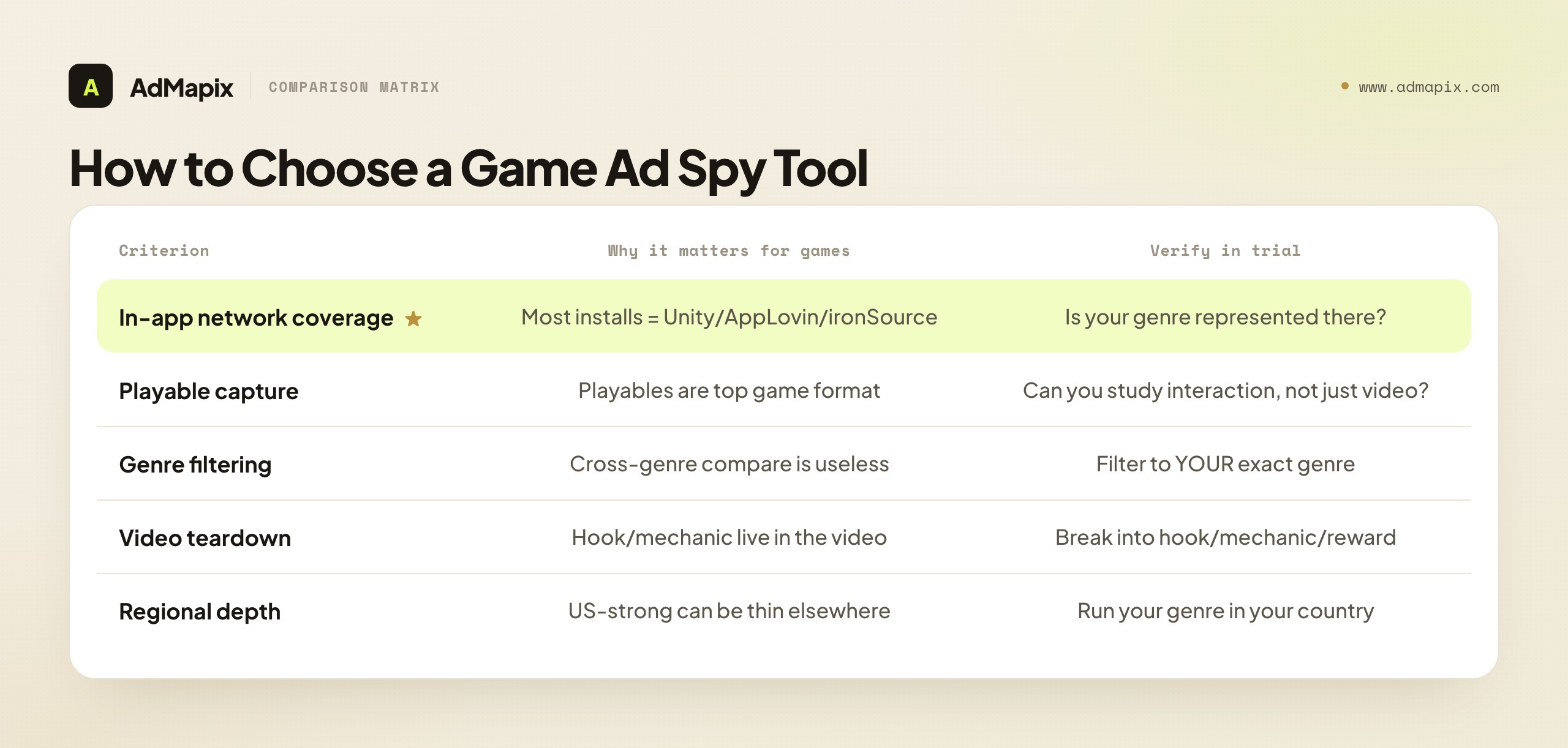
| Selection criterion | Why it matters for games | What to verify in a trial |
|---|---|---|
| In-app network coverage | Most game installs come from Unity/AppLovin/ironSource | Search your genre — are these networks actually represented? |
| Playable capture | Playables are the highest-leverage game format | Can you study playable interaction, not just video? |
| Genre/category filtering | Cross-genre comparison is useless | Can you filter to your exact genre? |
| Video teardown | The hook and mechanic reveal live in the video | Can you break a creative into hook/mechanic/reward beats? |
| Regional depth | A US-strong tool can be thin in your markets | Run your genre in your target country |
| Saved, searchable evidence | Re-finding ads kills the workflow | Can you tag and re-query, not just browse? |
| Reporting | UA standups and clients need a deliverable | Can research become a shareable report? |
The decision framework: if your competitors run across several in-app networks (almost all game advertisers do), a single-network tool leaves blind spots, and the free libraries (Meta, partial TikTok) miss the in-app networks entirely. A cross-network tool that covers the game ecosystem and can study playables is usually the right call — but judge any tool on its actual coverage of your genre and networks in a trial, because aggregation depth varies enormously and a tool strong on social can be thin on in-app. For side-by-side comparisons, see best ad spy tools 2026 and marketing intelligence tools.
The Four Signal Layers: Beyond the Creative
Strong app competitor ad analysis reads more than the creative — it reads four signal layers together, because the creative alone can mislead. A great hook pointing at a weak store page or a poorly-matched market is a different story than the ad suggests.
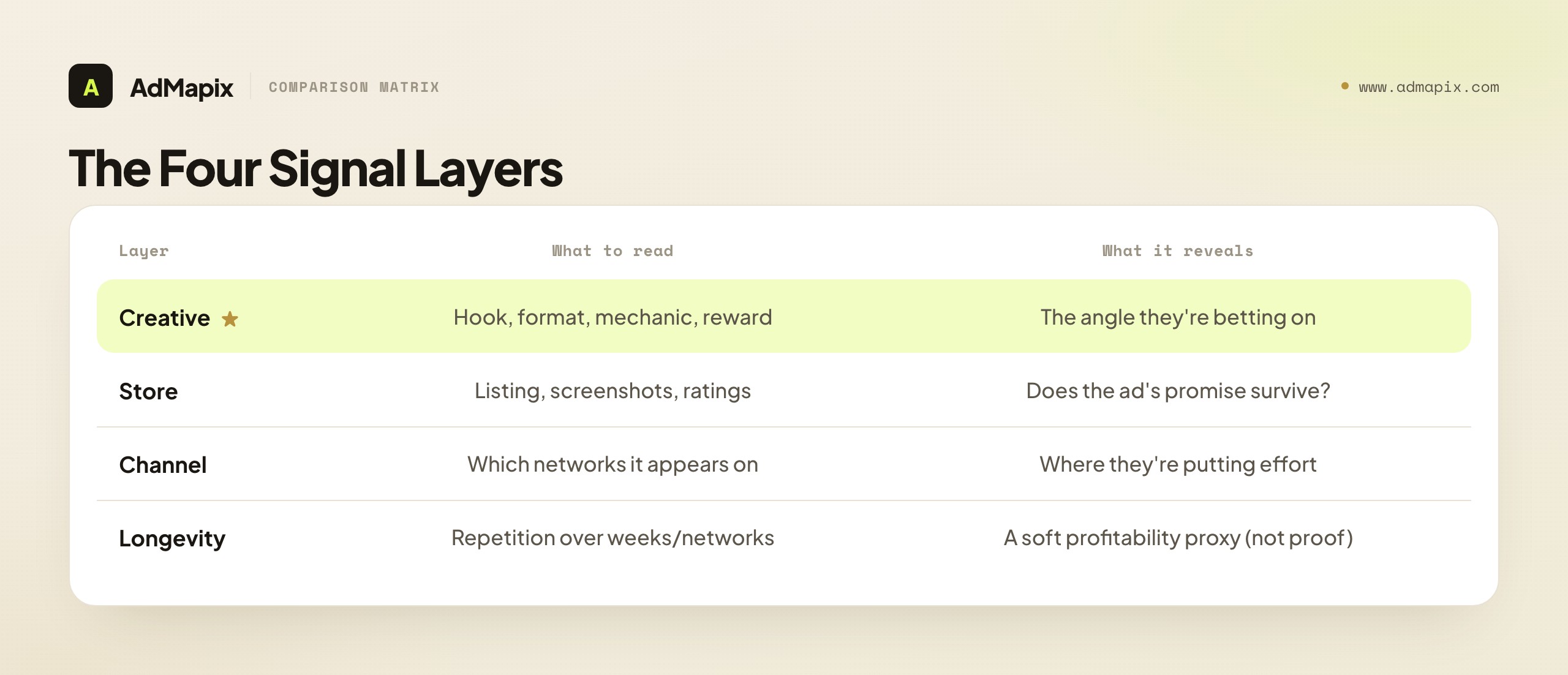
| Signal layer | What to read | What it reveals |
|---|---|---|
| Creative | Hook, format, mechanic, reward frame | The angle the competitor is betting on |
| Store | Store listing, screenshots, preview video, ratings | Whether the ad's promise survives to the store |
| Channel | Which networks the creative appears on | Where the competitor is putting creative effort |
| Longevity | Repetition across weeks and networks | A soft profitability proxy (never proof) |
Reading these together is what turns "a competitor ran a fail-bait ad" into intelligence: "A competitor runs a fail-bait playable across Unity and ironSource, repeated for weeks, pointing to a store page whose first screenshot now matches the playable's hook — they've committed to this angle end to end." That's a far stronger signal than any single layer, and it tells you the angle is worth a serious test, not a glance. The channel layer specifically reveals effort allocation (a creative on four networks signals more conviction than one on a single network), and the store layer catches the most common competitor weakness: an ad promise that the store page doesn't deliver, which is an opening you can exploit with better ad-to-store continuity.
A Step-by-Step Teardown Workflow
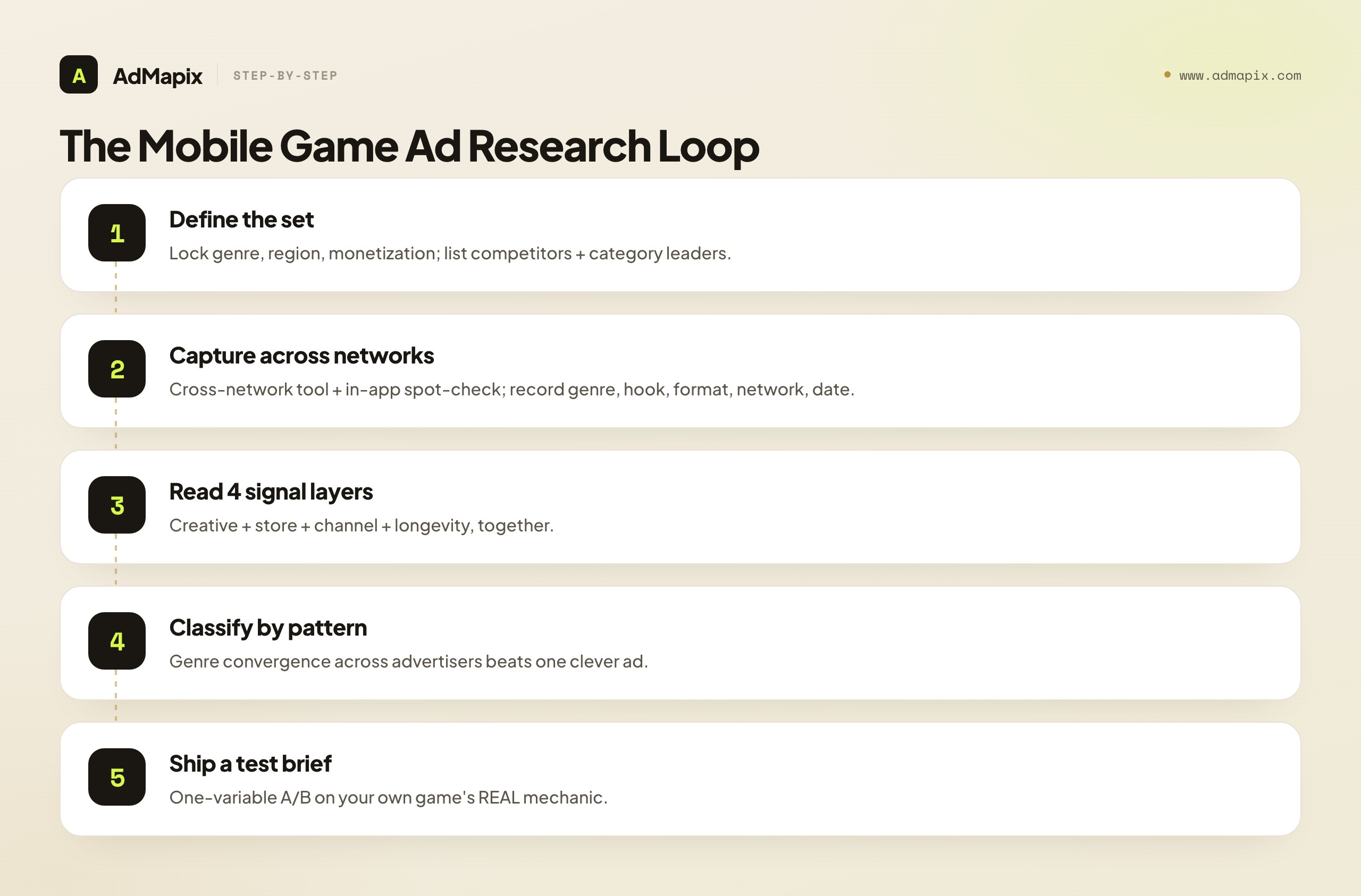
Here's the full loop, from defining the set to shipping a brief. Each step has one job and feeds the next.
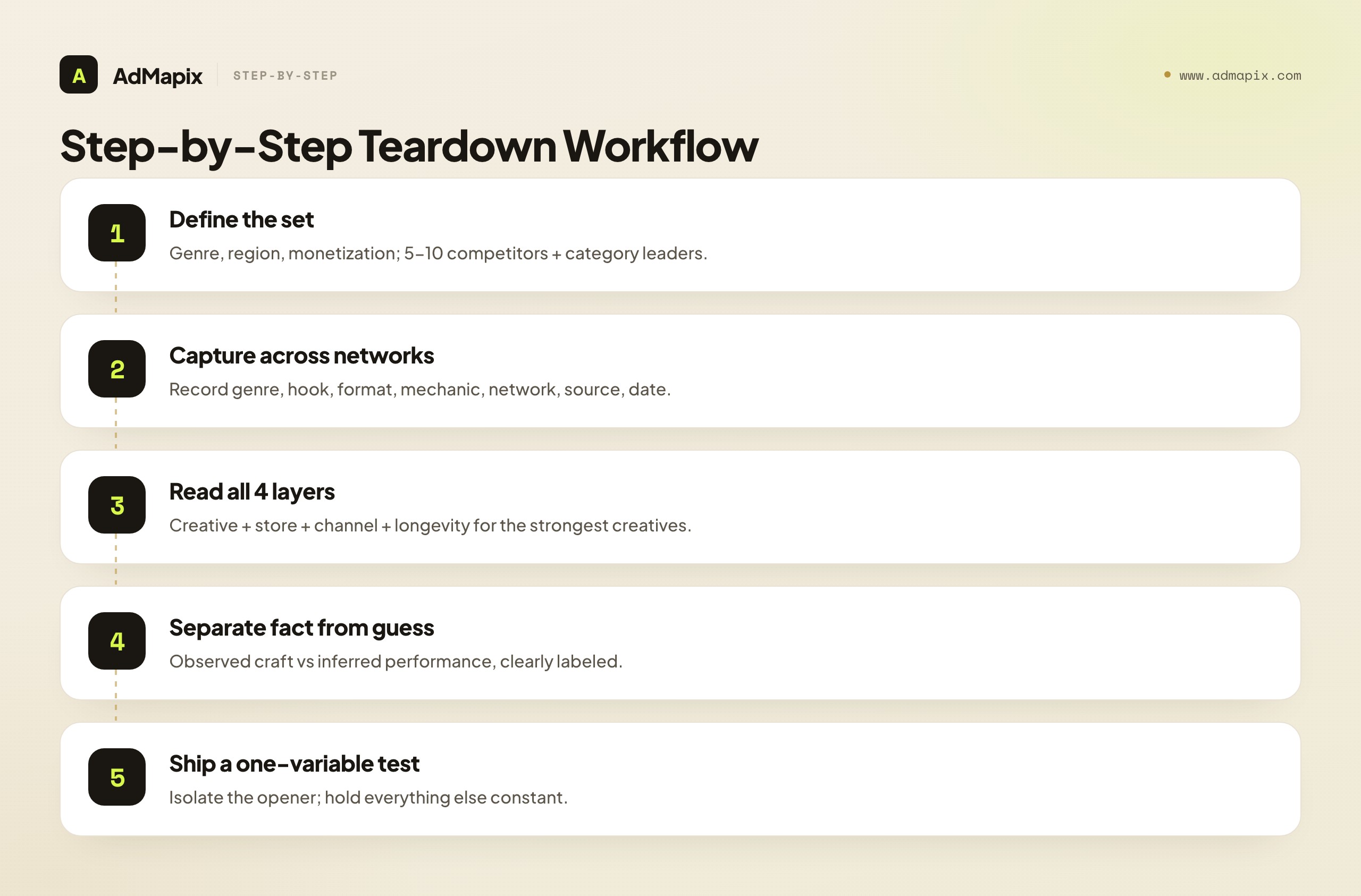
- Define the set. Lock genre, region, and monetization model. List 5–10 direct competitors plus 2–3 category leaders whose creative is most refined. Never mix genres in one teardown.
- Capture across networks. Pull creatives for the set across the networks your competitors use (cross-network tool + in-app spot-check), recording for each: genre, hook, format, mechanic, reward frame, network, source URL, and date.
- Read all four signal layers. For the strongest creatives, also check the store page (does the promise survive?), the channel spread (how many networks?), and longevity (how long repeated?).
- Classify by pattern. Group by hook type and format within the genre. Convergence across multiple advertisers is the signal; one clever ad is an anecdote.
- Separate facts from hypotheses. Keep observable craft ("fail-bait playable, base-under-attack, US English") apart from inferred performance ("probably scaling" — labeled a guess). Never present a spend or ROAS guess as fact.
- Ship a test brief. Turn the strongest convergent pattern into a one-variable A/B test on your own game's real mechanic — isolate the opener, hold everything else constant, set a metric and kill condition.
The teardown isn't done when you understand the competitor's ad; it's done when you've written a test you can ship. For the broader competitor-to-test discipline, see paid ads competitor research.
From Pattern to Test Backlog
The bridge most teams skip is turning a pile of patterns into a prioritized, testable backlog. A pattern in a doc isn't a deliverable; a ranked backlog of test briefs is.
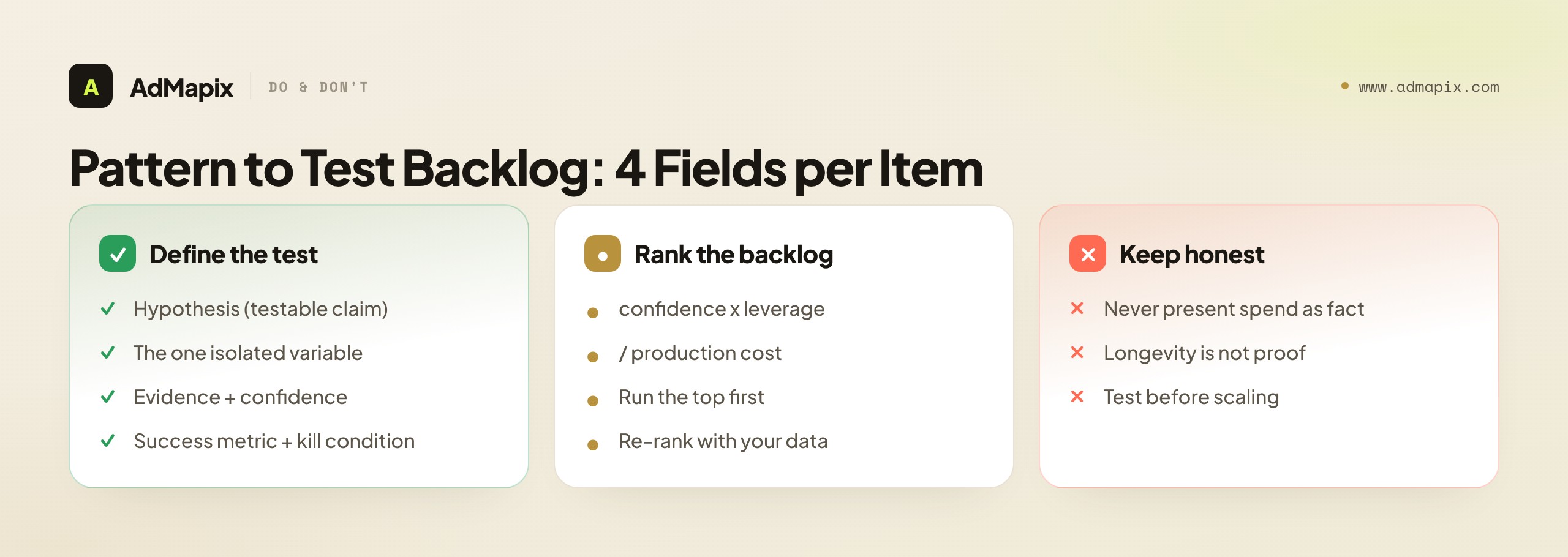
Each strong pattern becomes a backlog item with four fields:
- Hypothesis — a testable claim: "a fail-bait opener will lift install rate versus our satisfying-win opener for match-3."
- The isolated variable — exactly one thing changes (the opener), everything else held constant, so the result is interpretable.
- Evidence + confidence — why you're testing it ("six independent competitors converge on this") and how confident you are (high, because it's convergent).
- Success metric + kill condition — set before production: "beat control on install rate over 7 days; kill if it underperforms control by 15%+."
Rank the backlog by a simple heuristic: confidence × leverage ÷ production cost. A high-confidence, high-leverage, cheap-to-produce test (a new opener on an existing playable) beats a low-confidence, expensive one (a from-scratch hero video on a hunch). Run the top of the backlog first, feed results back, and let your own data re-rank it. Over a quarter this backlog — fed by weekly research and pruned by your own test results — becomes the engine of your creative pipeline. The spy tool generates the hypotheses; the backlog sequences them; your funnel proves them.
Reading Playables in Depth
For mobile games, the playable ad is the highest-leverage and most-studied format, and it deserves its own analytical lens — because a playable's effectiveness lives in its interaction design, which a screenshot can never capture. When you study a competitor's playable, work through these layers in order:
- The first interaction (0–2s). What does it ask the user to do — tap, swipe, drag? The best playables get a finger on screen immediately, because a user who interacts is far likelier to install than one who passively watches. Note how fast the first meaningful tap happens.
- Tutorial framing. Does it teach the real core loop, or a simplified/fake version? This is the single most important read for games, because "fake" playables — showing a mechanic the game doesn't have — win installs and then tank Day-1 retention. Catalog these as a what-not-to-do, not a model. (See fake mobile game ads for why deceptive mechanics are a long-term loss.)
- Friction-to-reward ratio. How many taps until the satisfying payoff — a near-win, a merge, a level clear? Winning playables front-load the dopamine within the first few seconds, then escalate.
- The fail state and retry. Many top game playables let the user almost win or actually fail, then offer a retry — the "I can do better" loop that drives installs. Note whether and how the competitor uses it.
- The end-card handoff. Where and how the playable transitions to the store, and what the end card promises. The "I'm playing → install" moment is where many playables leak; study how the strong ones bridge it.
The hard part is that playables are interactive HTML5, not a file you can right-click — far harder to "save" than a video. When you study one, record the interaction flow in writing: first action, tutorial type (real or fake), reward timing, fail-state use, end-card promise. That written teardown survives even though the playable itself doesn't, and it's enough to brief your own version. Because playables are where the biggest game-UA wins (and the worst retention traps) hide, the teams that systematically tear down competitor playables — rather than only watching videos — hold a real edge.
Creative Fatigue and Refresh Cadence
A dimension competitor research uniquely illuminates for games: creative fatigue. Mobile game creative fatigues fast — a winning hook that's everywhere this month is exhausted next month as the audience saturates and the network's algorithm sees declining engagement. Reading competitor creative over time tells you not just what works, but where each angle is in its lifecycle.
| Fatigue signal (read over weeks) | What it suggests | Your move |
|---|---|---|
| A hook newly appearing across many competitors | The angle is rising — early in its cycle | Test it now, before it saturates |
| A hook everyone has run for months | Likely fatiguing in-market | Differentiate; don't enter late |
| A competitor suddenly refreshing all creative | Their previous set fatigued | Watch what they replace it with |
| The same creative running unchanged for a very long time | Either a durable winner or an unmanaged default | Read longevity cautiously — it's ambiguous |
The strategic insight: you don't want to enter a hook at its saturation peak. By the time an angle is running across every competitor in your genre, the cheap installs it once produced are gone — you'd be arriving late to a fatigued angle and paying a premium. The competitor research edge is timing: catch a rising angle early (when only a couple of advertisers run it) to ride it before saturation, and recognize a saturated angle so you differentiate instead of copying into a crowded, fatigued space. This is also why a living research loop beats a one-time audit — fatigue is only visible over time, so the team tracking competitor creative weekly sees the lifecycle that a one-off snapshot misses entirely.
For your own creative, the same lesson applies internally: assume every winning hook will fatigue, and keep a pipeline of fresh angles (sourced from your research backlog) so you're never caught with a single fatiguing creative and no replacement. The studios that sustain UA aren't the ones with one great ad — they're the ones whose research loop continuously feeds the next angle before the current one dies.
There's also a defensive read worth naming: when your own winning creative starts fatiguing, your competitors are watching it the same way you watch theirs. A hook that you rode to cheap installs becomes, over time, the convergent pattern everyone in your genre copies — which both saturates it faster and signals to rivals exactly what's working for you. This cuts two ways. It means you should expect your best angles to be copied and plan to have moved on before they are, treating your current winner as a depreciating asset rather than a permanent moat. And it means the freshest, least-copied angle in your genre is often the most valuable one to test, precisely because saturation hasn't arrived yet. The competitive-fatigue lens, in other words, isn't only about reading rivals — it's about understanding that your own creative lives in the same lifecycle, and that durable UA comes from out-cycling the genre, not from defending a single hook that the whole category will eventually exhaust.
A Weekly Game UA Research Loop
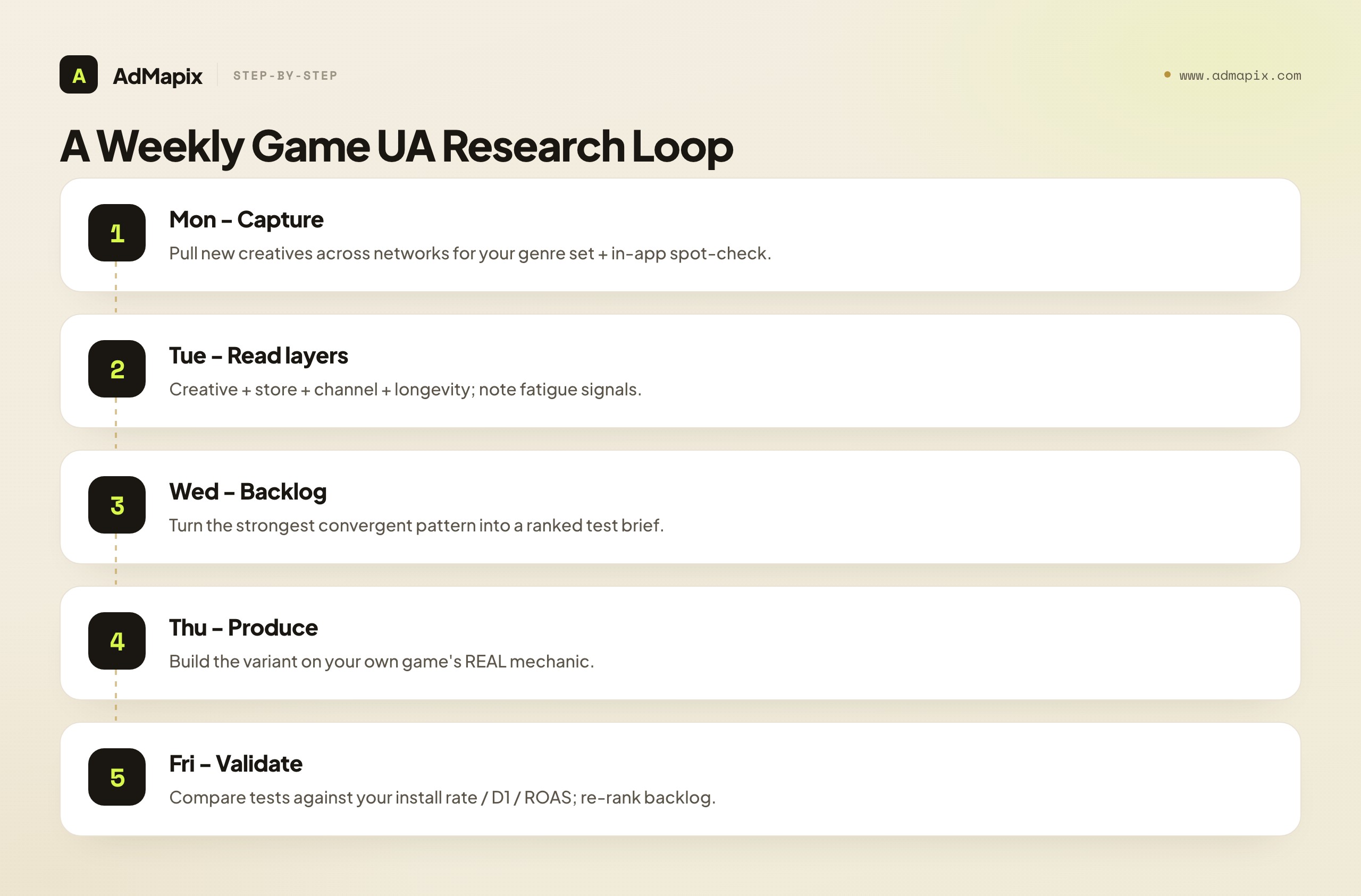
Mobile game ad research compounds as a habit, not a one-time sweep. Here's a lightweight weekly loop that takes under an hour and builds a real asset over time.
| Day / step | Action | Output |
|---|---|---|
| Monday — capture | Pull new creatives across networks for your locked genre set (+ in-app spot-check) | Fresh, tagged evidence |
| Tuesday — read layers | Read creative + store + channel + longevity; note fatigue signals | Updated genre pattern + lifecycle read |
| Wednesday — backlog | Turn the strongest convergent pattern into a ranked test brief | A prioritized test backlog item |
| Thursday — produce | Build the variant on your own game's REAL mechanic (no fake playables) | A test-ready creative |
| Friday — validate | Compare last week's tests against your own install rate / D1 / ROAS | Promote, kill, or iterate; re-rank backlog |
Three rules keep it honest: read all four signal layers (creative alone misleads); keep observed craft separate from inferred performance (never present a spend or ROAS guess as data); and always end on your own funnel (longevity suggests a creative survived; only your test proves it works for your game). A team running this loop for a quarter builds a searchable history of what's serving in their genre, how each angle is aging, and what converted for them — an asset no single audit matches. For the cross-platform version, see how to spy on competitors' ads in 2026.
A Worked Example: Idle-RPG UA Decision
Here's the whole workflow on a real decision. A small idle-RPG studio sees a competitor's installs climbing and wants to know which creative angle to test next — and their "research" is a Slack channel of competitor ad screenshots nobody acts on.
Define + capture. They lock the set: idle-RPG, US market, IAP-led monetization. Instead of browsing one rival at a time, they pull creatives across networks for the whole genre, recording genre, hook, format, mechanic, and network for each.
Read the layers + classify. Clustering by hook, a pattern emerges: a cluster of rewarded-video creatives opening with a "base under attack" fail-bait, a second cluster using a fake auto-battle progress bar, and a few static store-style ads that appear far less often. Checking the channel layer, the fail-bait cluster runs across Unity and ironSource and has repeated for weeks — high channel spread + longevity. The store layer confirms the leading competitor's first screenshot now matches the fail-bait hook. That's end-to-end commitment, not a one-off.
Separate + brief. They keep observation ("base-under-attack fail-bait, rewarded video, multi-network, repeated") apart from inference ("looks like it's scaling" — a labeled guess). The brief isolates the opener: "fail-bait base-under-attack opener vs our current progress-reveal opener, everything else held constant, 7-day test, kill if 15% under control." Crucially, the fail-bait maps to a real combat moment their idle game actually has — no fake mechanic.
Validate. The fail-bait opener beats their control on install rate and holds D1 retention (because the combat is real). They scale it and add "fail-bait opener" to their permanent testing rotation. The competitor ads didn't tell them what to copy — they revealed a genre-convergent structure their real game could honestly deliver, and their own funnel confirmed it.
The lesson: reading all four signal layers turned a single observed ad into a high-confidence bet; the separation discipline kept the brief honest; and the test — not the screenshot — was the deliverable.
How Official Network Docs Fit
Network documentation is context, not a spy feed — read it to understand how UA, AI bidding, and creative production are framed by each platform, then let a spy tool show you what advertisers actually shipped on top of that. The two sources together are stronger than either alone. Unity Ads describes UA campaigns spanning ROAS, event, and creative-testing objectives — useful for understanding what a Unity-running competitor is likely optimizing toward. Unity's user-acquisition solutions frame the goal as reaching high-quality users for game growth. Mintegral's creative guide explains how to structure and scale creative production — context for why playables and rewarded video dominate certain feeds. Moloco Ads is positioned as an ML performance solution, which shapes how much creative variation a competitor on Moloco may be churning through. Read these for how the network behaves; read the spy tool for what competitors built on it.
Reading Competitor Creative Across Markets
Mobile games go global, and competitor creative research has a powerful market dimension most teams underuse: the same game often runs entirely different creative angles in different markets, and reading those differences reveals what's working where. A competitor's localized creative is a free read on how they think a market behaves.
| Localization signal | What to read | What it reveals |
|---|---|---|
| Language & casting | The on-screen language, voiceover, and people shown | Which markets the competitor prioritizes enough to localize |
| Hook variation by region | Whether the angle (not just language) changes per market | Cultural fit — a hook that works in the US may be replaced in Japan |
| Format mix by region | Playable-heavy in one market, video-heavy in another | Network and audience differences by geo |
| Store-page localization | Whether the store screenshots match the localized ad | Depth of commitment to that market |
Two practical reads. First, a competitor who fully localizes (new casting, new hook, matching store page) for a market is signaling that market matters to them — useful intelligence for your own geo-prioritization. A machine-translated ad with US casting suggests a low-effort market entry; a fully reshot, culturally-adapted creative suggests a market they're betting on. Second, hook variation by region teaches you cultural creative fit for free: if every competitor swaps the US "aggressive PvP" hook for a "cozy collection" hook in a specific Asian market, that convergence tells you the genre's emotional promise shifts by culture — and you should adapt accordingly rather than running one global creative everywhere.
The discipline is the same as domestic research: capture the localized creative with its market tag, classify by region, and never assume one market's winning angle transfers. A creative that crushes in the US can flop in Brazil or Korea not because the production was worse, but because the cultural hook didn't translate. Reading competitor localization is how you learn which angle to test in each market before you spend to discover it the hard way. For the broader global UA picture, see mobile game marketing strategy.
A practical way to run cross-market research is to maintain a small matrix: rows are your target markets, columns are your tracked competitors, and each cell holds that competitor's dominant creative angle in that market. Filled in over a few weeks, the matrix surfaces two things instantly. First, gaps — markets where competitors are running tired or machine-translated creative, which is your opening to enter with a properly localized angle and win cheaper installs. Second, convergence — markets where every competitor has independently arrived at the same localized hook, which is strong evidence of cultural fit you should respect rather than fight. The matrix turns a vague sense that "creative is different abroad" into a concrete, market-by-market test plan, and it doubles as the brief for your localization team: not "translate this ad" but "this market wants this emotional angle, build for it." The studios that scale globally treat each major market as its own creative-research problem, not a translation of the home market — and competitor localization research is the cheapest way to learn each market's rules before paying to discover them.
Getting Started: Your First Game Ad Teardown
If this is your first structured game ad research session, here's the minimum viable version you can run today.
First, pick one genre and 3–5 leaders in it for your target market. Don't research across genres — a tight, single-genre set produces sharper patterns than a broad one, because game creative only makes sense against its genre's mechanic and audience.
Second, gather a starting sample. Combine whatever cross-network tool you can access with a short in-app observation session: install a few competing and adjacent games on a clean device, play to the rewarded and interstitial slots, and screen-record the ads served. Aim for 15–20 creatives — enough to see a genre pattern, not so many you stall.
Third, read each one in the fixed order — genre, hook, format/mechanic, reward frame, repetition — and tag it with the full context (network, source, date, why-it-matters). For the strongest few, also glance at the store page and how many networks the creative runs on (two of the four signal layers). Keep observed craft separate from any performance guess from the start.
Fourth, find one convergent pattern. Don't extract ten insights from your first session — find the single clearest thing multiple competitors are doing that you aren't (a format gap, a hook convergence, a reward frame). That's your first test.
Fifth, write one brief and ship one test on your own game's real mechanic, isolating one variable, with a metric and kill condition set before production. One shipped, validated test beats a beautiful research doc that never becomes a creative.
Then repeat weekly. The first teardown is the hardest because you're building the muscle and the genre library from scratch; by week three the loop takes under an hour and the pattern library starts doing the heavy lifting. The studios that win at game UA aren't the ones with the fanciest tools — they're the ones who turn this loop into a standing habit and let the compounding genre library out-iterate competitors whose research is occasional and unstructured.
Common Mistakes
- Copying the pixels instead of the lever. Replicating a competitor's exact ad ignores the genre, reward frame, and audience that made it work — and is a legal risk. Borrow the mechanic, then make it yours.
- Treating a visible ad as performance proof. A creative being live says nothing about its spend, ROAS, or whether it's even being managed.
- Ignoring the first three seconds. For mobile games the opening hook and the moment the mechanic is revealed decide everything; static thumbnails hide that.
- Comparing across mismatched genres. A hyper-casual hook benchmarked against a 4X strategy ad produces a useless conclusion.
- Reading only the creative. A great hook pointing at a weak store page or wrong market is a different story than the ad alone suggests — read all four signal layers.
- Copying fake-mechanic playables. A playable showing a mechanic the game lacks wins installs and tanks retention — note it as a what-not-to-do, don't replicate it.
- Saving screenshots without metadata. A creative with no network, date, or reason-for-saving can't be compared next month or rolled into a report.
When to Use AdMapix
AdMapix is a cross-network ad creative search tool. Use it after you know which competitors and genres you care about, when manual screenshotting has stopped scaling. It fits mobile game UA teams who need to search creatives across networks in Search AdMapix, keep examples searchable and tagged in Media, break video and playable structure down in Video Analysis, and turn recurring patterns into team-ready Reports. Compare workflow access on Pricing, and start an account from Login when the workflow is replacing manual collection.
It is not the right tool if you want a competitor's spend, ROAS, or exact targeting — no public ad tool can supply those, and AdMapix doesn't claim to. It's also overkill if you only need to glance at one or two ads occasionally rather than build a repeatable creative-intelligence loop. We're honest about that boundary because a tool that pretended to know competitor ROAS would be lying to you — and your own funnel is the only place performance is actually proven.
FAQ
What does a mobile game ad spy tool actually do?
It surfaces ad creatives competitors ran across networks so you can study their hooks, formats, playables, and reward framing. It shows what was shipped and, through repetition, rough longevity — but it does not reveal spend, ROAS, or targeting. Use it to generate test ideas, then validate them in your own campaigns. For games specifically, the most valuable thing it does is let you read genre-coded creative (the match-3 fail-bait, the 4X fake-battle hook) you can adapt.
What's the best ad spy tool for mobile games?
There's no universal best — it depends on your networks, genres, and whether you need analysis and reporting or just discovery. Games need a different buying checklist than generic ad spying: prioritize in-app network coverage (Unity, AppLovin, ironSource), playable capture, genre filtering, and video teardown. Verify a tool's coverage of your exact genre and networks in a trial, because aggregation depth varies enormously and a social-strong tool can be thin on the in-app networks where most game installs originate.
Can I just copy a competitor's winning ad?
No. A visible ad is a hypothesis, not a verified winner. You can't see its spend or return, and a creative that converts for one genre, region, or app often fails elsewhere. Borrow the underlying mechanic or hook, adapt it to your game's real mechanic, and prove it with your own A/B test. Copying the footage outright is also a legal risk, and copying a fake mechanic acquires users who churn fast.
How do I tell a real winner from an ad that's just still running?
You often can't from public data alone — that's the key caveat. Repetition across networks and weeks raises the odds a creative is performing, and reading the four signal layers (creative + store + channel + longevity) together sharpens the read. But a long-running ad can still be a default nobody paused. Treat longevity as a signal, never as proof, and confirm with your own test.
Why do most game ad networks have no public ad library?
Unlike Meta, the major in-app networks — Unity, AppLovin, ironSource, Mintegral, Moloco — are optimization and monetization platforms, not transparency archives, so they publish no searchable library of every active ad. That's why game ad research relies on cross-network ad-intelligence tools (which aggregate game creatives) and in-app observation (playing games and screen-recording the ads served), rather than a single official database.
What should I save for each creative?
Save the video or playable, the opening hook, the mechanic, the format, the reward frame, the genre, the network it appeared on, the source URL, the date, and a one-line note on why it matters. Without that metadata you can't compare creatives over time, read the four signal layers, or fold them into a report — and on in-app networks nothing fills that gap automatically.
How is mobile game ad intelligence different from app competitor ad analysis?
They overlap heavily and this guide covers both. "Mobile game ad intelligence" emphasizes reading and classifying game creative (hooks, playables, genre mechanics) into a test backlog. "App competitor ad analysis" emphasizes the four signal layers — creative, store, channel, longevity — read together. For a game UA team, you want both: classify the creative craft and read it against the store, channel, and longevity context before you commit a test.
How do I read a playable ad I can't download?
Playables are interactive HTML5, so you usually can't save the file — record the interaction in writing instead. Note the first tap (does it get a finger on screen in 2 seconds?), the tutorial framing (real mechanic or fake?), the friction-to-reward ratio (taps to the satisfying payoff), and the end-card handoff to the store. That written teardown survives even though the playable doesn't, and it's enough to brief your own version on a mechanic you can honestly deliver.
How often should I run mobile game ad research?
A weekly 30–60 minute loop suits most game UA teams: capture new creatives, read the signal layers, classify patterns, brief a test, and validate last week's results. High-spend studios and agencies may go twice weekly; pre-launch indies might do a focused one-time dive on 3–5 genre leaders. Match the cadence to how fast you ship new creative — and let the test backlog, fed weekly, sequence what you build next.
Where does AdMapix fit in this workflow?
AdMapix fits after you've defined your competitor set: search creatives across networks, save and tag examples, analyze video and playable structure shot by shot, and compile patterns into recurring reports. It organizes the evidence across the networks game advertisers actually use — your own tests still prove what performs. It does not provide competitor spend, ROAS, or targeting, because no public tool honestly can.
How do I track creative fatigue in my competitors' ads?
You track fatigue by reading competitor creative over time, not in a single snapshot — which is why a weekly research loop beats a one-off audit. Note when a hook first appears across the genre (it's early in its cycle, worth testing before saturation), when everyone has run it for months (likely fatiguing, time to differentiate), and when a competitor suddenly refreshes all their creative (their previous set fatigued — watch what replaces it). Log each angle's first-seen date so you can read its lifecycle, and treat the freshest, least-copied angle as often the most valuable to test, because saturation hasn't arrived yet.
Related Reading
- Mobile app ad spy tool — the broader cross-network app method
- AppLovin ads spy tool & ad intelligence — the AppLovin-specific deep dive
- Best ad spy tools 2026 — the full tool landscape
- Mobile game ads guide — formats, examples, and competitor research
- Fake mobile game ads — why deceptive mechanics are a long-term loss
- Paid ads competitor research — the broader competitor workflow
- Mobile game marketing strategy — the playbooks your creative research feeds
Sources
Official sources checked as of June 21, 2026. Mobile UA products and creative guidance change often, so verify the current page before building a recurring workflow.
- Unity Ads — UA campaign objectives including ROAS, event, and creative testing.
- Unity user acquisition solutions — reaching high-quality users for mobile game growth.
- Mintegral creative preparation guide — setting up, structuring, and scaling creative production and measurement.
- Moloco Ads — machine-learning performance ads for mobile app marketers.
- AppLovin AXON — the AI engine behind one of the largest library-less game networks.
Bottom Line
A mobile game ad spy tool earns its keep by helping you read genre-coded creative — the playable hook, the fail-bait opener, the reward frame — on networks that mostly publish no public library, then turn that craft into testable hypotheses. Read all four signal layers (creative, store, channel, longevity), borrow the mechanic rather than the pixels, keep observed craft separate from inferred performance, and ship a one-variable test on your own game's real mechanic.
What no spy tool can do is show you spend, ROAS, or targeting — those are private, and longevity is a signal, never proof. Read to understand, classify to find genre convergence, brief to test, and validate with your own funnel. That's how mobile game ad intelligence becomes a creative pipeline that out-iterates competitors instead of a screenshot graveyard. The edge isn't owning the most ads or the fanciest tool — it's running the loop every week, reading the four signal layers and creative fatigue over time, and turning convergent genre patterns into validated tests faster than the competition can. On AI-optimized networks where the creative is the targeting, that disciplined creative-intelligence habit is the single most durable advantage a UA team can build.
When manual screenshotting across the in-app networks stops scaling, start with AdMapix Search, keep examples searchable in Media, and break down structure in Video Analysis — built for exactly this job, across the networks where mobile games actually buy their installs and where no public ad library will ever do the research work for you.
See what competitors are really running
Search 6M+ ad creatives, landing pages, and weekly spend across 200+ countries. No credit card, no commitment.
Related Articles
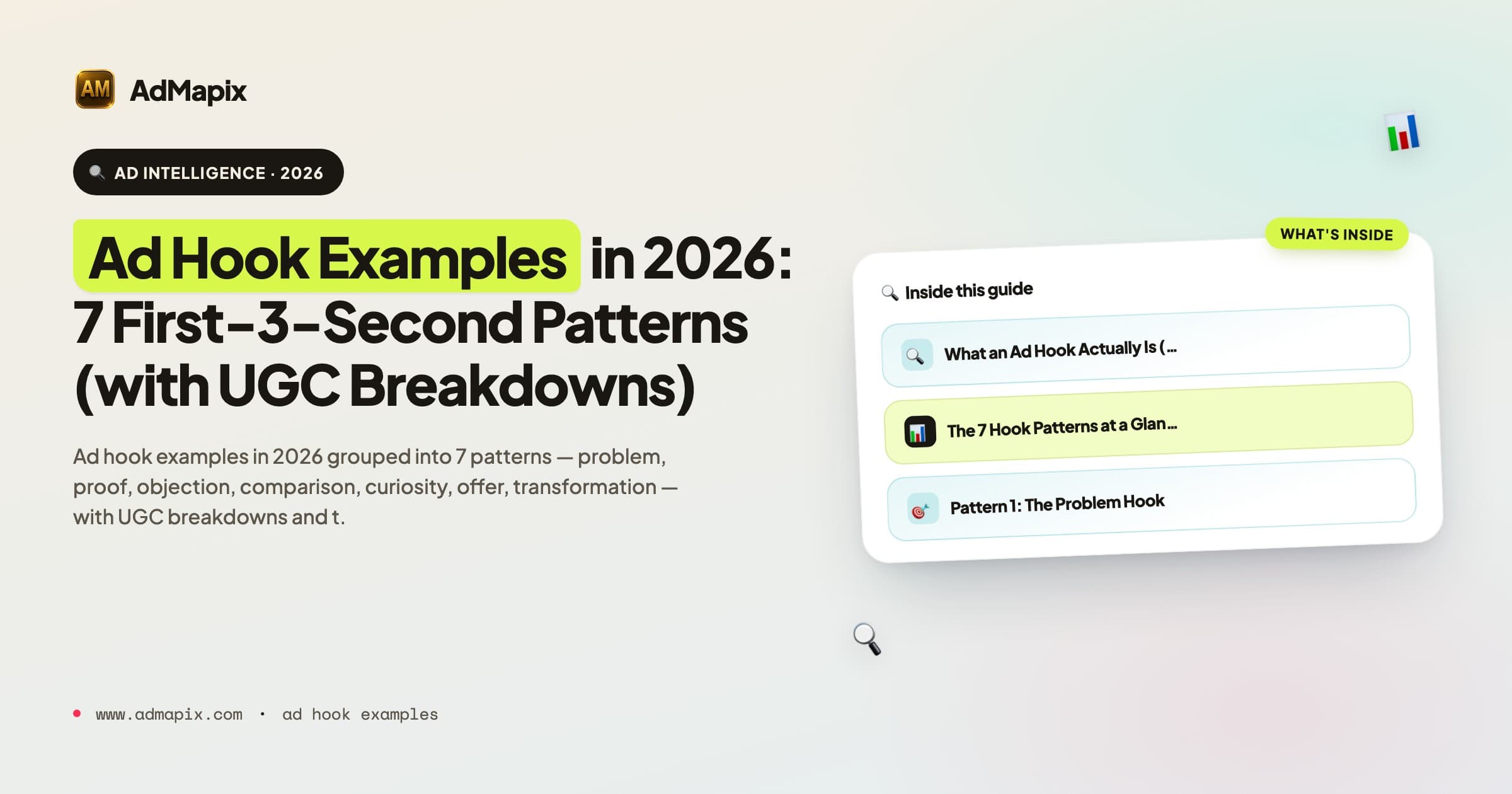
Ad Hook Examples in 2026: 7 First-3-Second Patterns (with UGC Breakdowns)
A complete 2026 library of ad hook examples organized into seven repeatable patterns — problem, proof, objection, comparison, curiosity, offer, and transformation — with UGC hook breakdowns, platform-by-platform differences for TikTok, Meta, and YouTube, an industry-by-industry hook map, a hook-testing workflow that ships variants, the metrics that actually grade a hook, and a worked teardown that turns a competitor opener into a running test.
Outbrain Ad Spy Tool in 2026: Native Ad Research for the Open Web
How to research Outbrain native ads from public evidence in 2026 — what a spy tool can and cannot prove, how to decode headline-and-thumbnail hooks, advertorial landing paths, retargeting trails, and how to turn patterns into testable native campaigns.
Agency Ad Intelligence Tools in 2026: Turning Competitor Research Into Client Reports
A 2026 guide to ad intelligence for agencies — how to standardize competitor research across a client portfolio, the fixed capture field list and weekly workflow that survive staff turnover, how to structure a recurring client report, white-label and deliverable considerations, using competitor research to win new business and prove retainer value, the cross-client pattern advantage only agencies have, team roles and scaling, packaging research as a billable service, and the public-data.